The processes, from fruit to green coffee
From cherry to green bean, each route decides what is removed, what is kept and what is left to ferment. Start by comparing the techniques, then explore each topic.
Read the full introduction and its nuances
Between the picked cherry and the green bean, everything that is removed and everything that is left to work: the dry process, the washed process and the washing point, honey and its colors, Indonesian wet hulled, monsooned coffee, drying; then today's fermentations, anaerobic and SIAF, carbonic maceration, micro-oxygenation (MOX), selected yeasts, thermal shock, lactic, co-fermentation and infusion, with what science has measured, what the rules allow, and what no one has yet proven. Every figure carries its level of evidence: peer-reviewed article, national institute, trade press, exporter's document or commercial page.
32 processes, from fruit to green coffee
Choose a process: its scene plays out here, step by step, and its sheet gives the details and the sources. 32 processes have their scene. On a large screen, “Compare two processes” puts two scenes side by side, at the same step.
The dry process
The washed process
The intermediate processes
Directed fermentations
Drying
After drying
What happens to a whole dried cherry?
Start the scene or choose a stage. The animation simplifies the mechanism; what follows gives the details and the available references.
Cherries are tipped into a water tank: the dense ones sink, the light ones, already partly dried on the tree, float and form a separate lot, which would not dry at the same rate. Then nothing is removed: skin, pulp and mucilage go to drying with the bean. Fresh fruit contains 68 to 72% water and its water activity, the share of water that microorganisms can use, is close to 0.98. On a raised bed, the layer is 2 to 4 cm.
Read the stages without animation
- Sorting in water, spreading the cherryCherries are tipped into a water tank: the dense ones sink, the light ones, already partly dried on the tree, float and form a separate lot, which would not dry at the same rate. Then nothing is removed: skin, pulp and mucilage go to drying with the bean. Fresh fruit contains 68 to 72% water and its water activity, the share of water that microorganisms can use, is close to 0.98. On a raised bed, the layer is 2 to 4 cm.
- Turning several times a dayFor the first six to eight days, around 0.95 water activity, it is mostly harmless bacteria working the surface of the fruit: acetic bacteria oxidize glucose there into gluconic acid. Turning at least two to three times a day evens out moisture between the top and the bottom of the layer.
- Crossing the danger windowThen comes a transition of about six days around 0.90: yeasts and fungi settle in. This is where Aspergillus can produce ochratoxin A, a toxin that requires at least 0.85 water activity, close to 20% bean moisture. At night, the lot is covered with a tarp or brought indoors: the gap between day and night makes it take up water again.
- Stopping at 10 or 12%Drying lasts about twelve days according to one review, fifteen to twenty days in the open air according to Cenicafé. It is stopped at 10 or 12% moisture, which is about 0.60 water activity. The dry lot goes into the silo, where it rests so that moisture evens out through the mass; no resting time is published.
- Hulling in a single passSkin, pulp and parchment have become a single shell, dry and brittle. A huller, and not a pulper, removes it in one pass: the green coffee goes one way, the husk the other.
To remember: Drying is the process, fermentation its consequence: as long as the fruit holds water, its flora is at work, and drying alone decides whether one gets a clean dried fruit or a rotten one.
Read the full article and its sources ↓Read the sheet “The dry process” and its sources ↗
How does washed processing work?
Start the scene or choose a stage. The animation simplifies the mechanism; what follows gives the details and the available references.
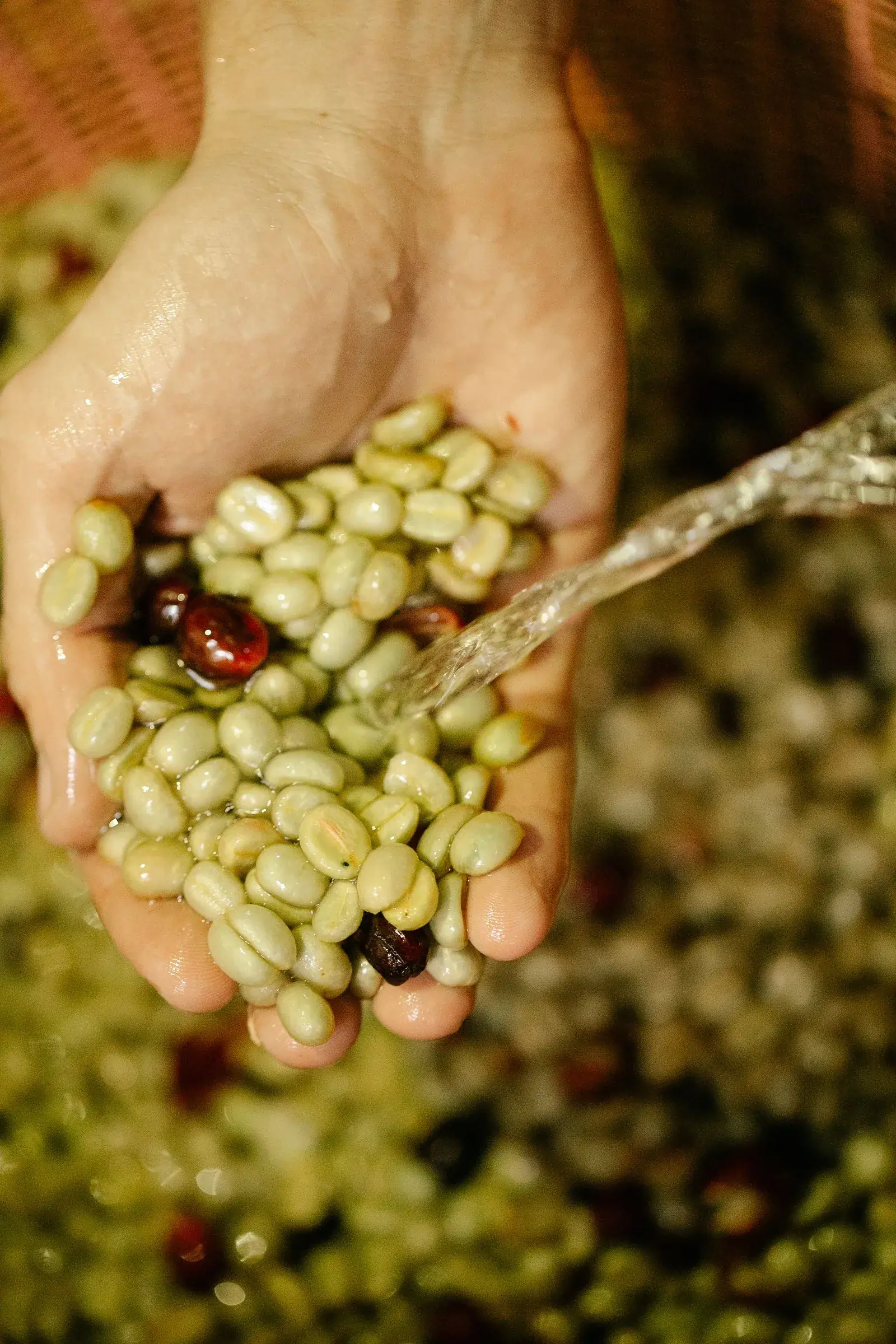
The cherry is pinched between a drum and a breast plate set to tear off skin and flesh without crushing the seed. What comes out is parchment coffee coated in mucilage, a slimy layer that water alone does not remove.
Read the stages without animation
- Pulp on the day of harvestThe cherry is pinched between a drum and a breast plate set to tear off skin and flesh without crushing the seed. What comes out is parchment coffee coated in mucilage, a slimy layer that water alone does not remove.
- Ferment in a tank, a few dozen hoursIn this sugary medium, yeasts and lactic acid bacteria break down the pectin that holds the mucilage, and the pH falls from 6.0 to 6.5 toward 4.0: this acidification loosens the layer and keeps the undesirables at bay, as in a yogurt. In Yunnan, 36 to 48 hours after pulping, 12 hours after a mechanical demucilager. Dry, it is faster and hotter; under water, slower and buffered.
- Wash with plenty of waterThe water carries away the loosened mucilage and the coffee comes out as clean parchment. A 24-hour soak in clear water may follow: it tempers the effects of the fermentation that preceded it.
- Dry to under 12%The parchment coffee dries to under 12% moisture. The parchment stays: it leaves only at hulling, much later.
To remember: The drop in pH is the central event of the tank. The durations and the flora come from the Yunnan trials, the only complete published dataset: these values do not hold for all farms.
Read the full article and its sources ↓Read the sheet “The classic washed process” and its sources ↗
How is mucilage removed mechanically?
Start the scene or choose a stage. The animation simplifies the mechanism; what follows gives the details and the available references.
The pulper pinches the ripe cherry and separates skin and pulp, 43.6% of the fruit, without water. A grate with 7 to 8 mm bars, the zaranda, rejects the unpulped fruit. The beans come out covered in mucilage, 14.9% of the fruit: a sweet flesh in gel form, stuck to the parchment.
Read the stages without animation
- Pulp dry, within six hoursThe pulper pinches the ripe cherry and separates skin and pulp, 43.6% of the fruit, without water. A grate with 7 to 8 mm bars, the zaranda, rejects the unpulped fruit. The beans come out covered in mucilage, 14.9% of the fruit: a sweet flesh in gel form, stuck to the parchment.
- In the column, the bean rises and the water descendsAn auger pushes the beans to the bottom of a column where a ribbed rotor turns. Mucilage is pseudoplastic: the more it is sheared, the more fluid it becomes. Shearing and bean-against-bean impacts detach the gel in a few seconds. A little water enters from the top, counter-current: the bottom of the column detaches, the top rinses.
- The honey comes out whole, the bean comes out cleanNothing has fermented: the pectin leaves the bean as it is, in the form of concentrated honey, and goes with the water to the pulp screw and then to the compost. The clean parchment coffee goes straight to the dryer, down to 10 to 12% moisture, and is never submerged while waiting.
- Adjust every week, or tear the parchmentAdjustment is made by coffee flow rate, stopwatch in hand, and checked every week because the size of the fruit drifts. Too aggressive, and the rotor tears the parchment and damages the bean. Two other losses do not come from the machine: green cherries, with 30% of cups rejected from just 2.5% of the lot, and waiting under water before drying.
To remember: The mechanical demucilager waits for nothing and degrades nothing: it tears off the mucilage by friction, in a few seconds and with very little water. It comes after the pulper and does not remove the parchment.
In history: Cenicafé developed BECOLSUB and then Ecomill; the first settings also fed criticism about quality.
Read the full article and its sources ↓Read the sheet “Mechanical demucilaging” and its sources ↗
Why does Kenya add a soak?
Start the scene or choose a stage. The animation simplifies the mechanism; what follows gives the details and the available references.
The cherries first pass through a tank of water, where whatever floats is set apart. The disc pulper leaves the parchment covered in mucilage, which is divided into three classes, grades 1, 2 and lights: each ferments in its own tank, at a single speed. Pectin, the cement of this flesh, is broken down, lactic acid bacteria dominate and the pH drops from 6.0 to 6.5 toward 4.0. Published durations diverge: 12 to 24 hours with traders, 24 to 72 in a Kenyan training document.
Read the stages without animation
- Ferment in a tankThe cherries first pass through a tank of water, where whatever floats is set apart. The disc pulper leaves the parchment covered in mucilage, which is divided into three classes, grades 1, 2 and lights: each ferments in its own tank, at a single speed. Pectin, the cement of this flesh, is broken down, lactic acid bacteria dominate and the pH drops from 6.0 to 6.5 toward 4.0. Published durations diverge: 12 to 24 hours with traders, 24 to 72 in a Kenyan training document.
- Rinse, ferment a second timeThe coffee is rinsed and stirred. The rinse never carries everything away: a film stays attached, especially in the groove of the bean. A second fermentation of 12 to 24 hours finishes the job, in a cleaner, less sugary bath that acidifies more slowly.
- Wash in a channel, countercurrentIn the concrete channel, the paddle pushes the parchment against a trickle of water. The dense beans stay at the head, the light ones slip downstream: the washing grades at the same time as it washes, into fractions P1, P2, P3 and lights.
- Soak in clear waterEach fraction goes back, in its own bin, under renewed clear water, for twelve to twenty-four hours: remixing them would undo the grading of the channel. There is no mucilage left to dissolve: it is a soak, not a second fermentation, a deduction that no published monitoring comes to measure. The only controlled trial, in Yunnan, sees the water carry away chlorogenic acids, citric acid, sugars and amino acids.
- Skin dry, then dryOn mesh tables, in a layer of at most 1.3 centimeters, the coffee goes from 55 to 45% moisture. A thick layer would make the pile ferment. Raised beds then take it toward 11%, in one to two weeks.
To remember: The second bath is a soak: no more mucilage, clean and renewed water, and the only controlled trial shows that it tempers and evens out the fermentation that precedes it rather than amplifying it.
In history: A Kenyan study from the 1960s, attributed to Wootton, is cited as the authority for soaking; it could not be read at first hand.
Read the full article and its sources ↓Read the sheet “The Kenyan washed process and soaking” and its sources ↗
What is a honey?
Start the scene or choose a stage. The animation simplifies the mechanism; what follows gives the details and the available references.
The cherries, ripe only since nothing will be washed, first go into water: those that float, hollow or attacked, leave. The pulper then removes skin and flesh, without water or with very little water: this is the process's water saving.
Read the stages without animation
- Pulp, almost without waterThe cherries, ripe only since nothing will be washed, first go into water: those that float, hollow or attacked, leave. The pulper then removes skin and flesh, without water or with very little water: this is the process's water saving.
- Leave all or part of the mucilageThe mucilage, the sticky layer of flesh stuck to the parchment, rich in pectins, sugars and water, stays in whole or in part. Two schools coexist: one sets a mechanical demucilager, a machine that scrubs off a share of it; the other keeps everything and decides the color later, at drying. Neither one weighs what is left.
- Dry with it, more or less fastDrying removes the water, fermentation consumes the sugars: the two compete for the same mucilage, and it is the duration that decides. In the sun and in a thin layer, a Costa Rican yellow honey dries in about eight days; in the shade, a Salvadoran black honey takes twenty-five. In Yunnan, at 25 °C and 75% relative humidity, it takes fifteen days for red and twenty-two for black.
- Stop at 10 to 12%The target is 10 to 12% moisture, where water activity, the share of water usable by microorganisms, falls to around 0.60. The longer the drying lasts, the longer the lot stays above the thresholds at which Aspergillus carbonarius produces ochratoxin A, between 0.96 and 0.98.
- Read the color, with no standardWhite, yellow, red and black name the shade of the dry parchment, not a recipe. One 2026 article puts red at 50 to 60% of mucilage retained, another from 2025 at 75 to 80%; neither ICAFE, nor the SCA, nor the International Coffee Organization sets any thresholds.
To remember: White, yellow, red and black honey are not standardized categories: two levers, the share of mucilage and the speed of drying, lead to the same color.
In history: The practice is Brazilian and old; the colors are a vocabulary of the Costa Rican micro-mills of the 2000s.
Read the full article and its sources ↓Read the sheet “The honeys, from white to black” and its sources ↗
What does pulped natural do that honey does not?
Start the scene or choose a stage. The animation simplifies the mechanism; what follows gives the details and the available references.
In Brazil, the branch is stripped at once and all the ripeness stages arrive mixed. The washer-separator first sets aside, by density, what floats: dry fruit, fruit pierced by the borer, malformed fruit. These floaters go off to another circuit.
Read the stages without animation
- Separate by density, the same dayIn Brazil, the branch is stripped at once and all the ripeness stages arrive mixed. The washer-separator first sets aside, by density, what floats: dry fruit, fruit pierced by the borer, malformed fruit. These floaters go off to another circuit.
- Hull: only the ripe skin gives wayThe cherry huller presses the fruit against a grid. The ripe cherry bursts, the bean passes with its mucilage and the skin leaves by an auger. The green fruit, firmer, resists and comes out whole through another chute: it is a ripeness sort.
- Dry at once, with all the mucilageWith no tank and no washing, the parchment goes to the drying area at about 45 to 50% moisture, with all its mucilage. A cooperative guide gives 7 liters per square meter, half as much as for the natural, because the mucilage glues the parchments together.
- Stir up to sixteen times on the first dayThe same guide recommends up to sixteen turnings on the first day: they break up the clumps before they form. The parchment mass is kept under 40 °C, a working value rather than a demonstrated threshold.
- Stop at 11 or 12%The working target is 11 to 12% moisture, the published trials stopping between 11 and 13%. With hot air capped at 40 °C, a dryer covers the same path in 15 to 37.5 hours. The coffee then rests in a silo before the parchment is hulled.
To remember: Pulped natural sorts for ripeness by machine, then dries all the mucilage, without adjusting it: its quality rests on the setting of the washer and of the huller, because nothing makes up for a defect afterwards.
In history: A buying guide credits Pinhalense with the first line of this process in 1991; its spread dates from the 1990s.
Read the full article and its sources ↓Read the sheet “Pulped natural” and its sources ↗
What does dried pulped honey designate?
Start the scene or choose a stage. The animation simplifies the mechanism; what follows gives the details and the available references.
Taken at its word, pulped, kept with its mucilage and dried, the name describes a pulped natural: the cherry huller removes the skin, and the lot keeps all its mucilage. A first reading puts the word dried on the practice: dried slowly, in a thick layer, it may have taken twenty days.
Read the stages without animation
- Reading 1: a slowly dried pulped naturalTaken at its word, pulped, kept with its mucilage and dried, the name describes a pulped natural: the cherry huller removes the skin, and the lot keeps all its mucilage. A first reading puts the word dried on the practice: dried slowly, in a thick layer, it may have taken twenty days.
- Reading 2: a mill black honeyA second reading makes it a dark position on the honey scale: a lot run through an adjusted demucilager, then dried in the shade in eight days. In a dryer at 40 °C, the same coffee dries in 15 to 37.5 hours: used alone, the word dried covers a ratio of one to fifty.
- The same dark parchmentA mucilage that dries slowly browns and hardens into a dark lacquer that glues the parchments together: both lots come out dark, and no published measurement tells them apart. Only a mucilage that dries fast leaves on the parchment a thin, clear, brittle film.
- The two numbers that are missingThe trial that would give the name a meaning fits in one sentence: weigh the dry matter left on the parchment at the end of drying, relate it to the mass of parchment, and publish this number with the drying duration. A balance and a drying oven, the apparatus that dries a sample thoroughly, would suffice.
To remember: The name does not say which of the two levers moved, the share of mucilage or the drying speed: it therefore describes nothing reproducible.
Read the full article and its sources ↓Read the sheet “Dried pulped honey” and its sources ↗
What does the word semi-washed cover?
Start the scene or choose a stage. The animation simplifies the mechanism; what follows gives the details and the available references.
The pulper removes the skin and pulp; the mucilage, the layer of sweet flesh stuck to the parchment, stays in place. In the Colombia variety, it makes up 14.85% of the fresh fruit, the pulp 43.58%. It is what decides what comes next, and the glossary of the International Coffee Organization knows only two boxes, washed and unwashed.
Read the stages without animation
- Pulping: the shared first stepThe pulper removes the skin and pulp; the mucilage, the layer of sweet flesh stuck to the parchment, stays in place. In the Colombia variety, it makes up 14.85% of the fresh fruit, the pulp 43.58%. It is what decides what comes next, and the glossary of the International Coffee Organization knows only two boxes, washed and unwashed.
- In Brazil: drying with the mucilageNeither tank nor washing: the coffee dries with its mucilage, one to two days on the farm's drying area, then in the mechanical dryer. On real lots from southern Minas Gerais, the final moisture ranges from 9.32 to 11.69%.
- In Indonesia: hulling wetFermentation overnight, washing the next day, a half-day of skin drying, then hulling of the still-moist parchment, at between 35 and 45%, by a machine cushioned with a rubber band. The bare bean then dries in the sun to 12%.
- In Colombia: tearing off the mucilageCenicafé's DESLIM demucilager tears off more than 98% of the mucilage by friction, with 0.7 to 1.0 liter of water per kilo of dry parchment, against 4.17 to 20 liters in natural fermentation; the parchment goes straight to the dryer. Cenicafé calls this coffee washed: same machine, different name.
To remember: Semi-washed is not a process but a box with no official definition: a Brazilian semi-washed and a Sumatran semi-washed do not share a single parameter.
Read the full article and its sources ↓Read the sheet “Semi-washed” and its sources ↗
Why hull while still wet?
Start the scene or choose a stage. The animation simplifies the mechanism; what follows gives the details and the available references.
The cherries first go into a water tank: the hollow ones, pierced by the borer, float and are set aside. The cherry enters the pulper at 60 or 65% moisture. The water injected into the pulper does not wash: it lubricates, so as not to split the parchment. The coffee then ferments, generally under water, for 12 to 46 hours according to a regional survey, until the parchment is no longer sticky to the finger.
Read the stages without animation
- Pulp, ferment overnightThe cherries first go into a water tank: the hollow ones, pierced by the borer, float and are set aside. The cherry enters the pulper at 60 or 65% moisture. The water injected into the pulper does not wash: it lubricates, so as not to split the parchment. The coffee then ferments, generally under water, for 12 to 46 hours according to a regional survey, until the parchment is no longer sticky to the finger.
- Wash, drain, deliver wetIn the FAO trial, the schedule fits in three days: washing, half a day of sun drying, collection in the afternoon. The parchment leaves for the collector at 41.7 to 49.0% moisture.
- Wait in bags, unmanagedThis is the step that decides the lot, and no one runs it. The core of the bags goes from 21.5 °C to 34 or 35 °C in two days: microorganisms respire by consuming the remaining sugars. Water activity oscillates between 0.89 and 0.95; black Aspergillus goes from 0 to 4% of beans on the first day to 21 to 97% on the seventh.
- Hull at 40% moistureEverywhere else, the parchment leaves only once the bean is dry. Here, in the hulling workshop, it is torn off at about 40%: the bean is soft and deformable. The screw huller is modified, its steel bar replaced by a rubber belt that peels the parchment without shearing the bean. The signature defect remains the goat's hoof: the tip of the bean splits.
- Dry the bare beanWithout parchment to cross, the steam escapes faster: the bare bean dries down to 12% and takes on its dark bluish green color, its swollen, irregular look. It nonetheless leaves the huller at 14.3% on average, above the 12.5% ceiling of the Indonesian standard.
To remember: The distinguishing feature of the process is the timing of hulling: it is a shift in the drying calendar, imposed by climate and collection, not a managed fermentation.
In history: The huller is of Dutch colonial design, made in Malang; the date of the process is established by no first-rank source.
Read the full article and its sources ↓Read the sheet “Wet hulled” and its sources ↗
What happens in a closed tank?
Start the scene or choose a stage. The animation simplifies the mechanism; what follows gives the details and the available references.
An airtight tank is filled with pulped coffee or whole cherries, then closed with a one-way valve, which lets gas out without letting air in. Nobody drives out the trapped air. Pulping opens up the mucilage to microorganisms, the layer of sweet flesh stuck to the parchment; the skin of a whole cherry slows these exchanges.
Read the stages without animation
- Loading, closing, fitting the valveAn airtight tank is filled with pulped coffee or whole cherries, then closed with a one-way valve, which lets gas out without letting air in. Nobody drives out the trapped air. Pulping opens up the mucilage to microorganisms, the layer of sweet flesh stuck to the parchment; the skin of a whole cherry slows these exchanges.
- Oxygen runs out in under an hourThe microorganisms of the fruit, and the fruit itself, which still respires, consume the trapped oxygen. With pulped coffee in an airtight bin, dissolved oxygen falls from 100% to 0% in fifteen to sixty minutes. That is the moment that tips the metabolism, not the closing of the lid.
- Acids, alcohol, gas: the CO₂ leaves through the valveDeprived of oxygen, yeasts and bacteria ferment the sugars of the mucilage: lactic acid bacteria make lactic acid from them, yeasts make ethanol and carbon dioxide. The gas builds up, maintains the anoxia and leaves through the valve; without it, the tank would build up pressure. The pH starts at 5.5 to 5.8, falls to about 3.8 at 24 hours and settles at about 3.6 after 36 hours.
- One tank, several fermentationsThe tank is not homogeneous: in a vertical 175 kg tank, lactic acid is 5.06 g/L at the bottom against 2.18 g/L at the surface at 72 hours. Published durations range from 12 to 192 hours and their results contradict each other: a Colombian trial sees the score rise up to 96 hours, Cenicafé sees long durations degrade quality. Past the useful window, butyric and propionic acids give onion notes.
- Opening, washing if needed, drying fastThe mass comes out acidic, wet and loaded with residual sugars. It may be washed, then it is dried: slow drying after a long fermentation opens the door to molds and to the phenolic defect, that medicinal taste.
To remember: The name promises an absence of oxygen; the reality is a depletion: the trapped air is consumed, then the carbon dioxide produced leaves through the valve.
In history: The origin of the process is not established: its attribution to the 2015 world barista champion circulates only in the retailers’ press.
Read the full article and its sources ↓Read the sheet “Fermentation in a closed tank, known as anaerobic” and its sources ↗
A whole cherry in a closed tank
Start the scene or choose a stage. The animation simplifies the mechanism; what follows gives the details and the available references.
Ripe cherries are harvested, at 18 to 19.3 degrees Brix in the Caparaó series. The Arara series washes them with well water, which lowers the starting microbial load; the Caparaó series loads them without washing. Tanks range from a 20 liter bucket to a 15,000 liter stainless steel tank.
Read the stages without animation
- Washing or not, loading the cherriesRipe cherries are harvested, at 18 to 19.3 degrees Brix in the Caparaó series. The Arara series washes them with well water, which lowers the starting microbial load; the Caparaó series loads them without washing. Tanks range from a 20 liter bucket to a 15,000 liter stainless steel tank.
- The water seal, and the air running outThe water seal lets carbon dioxide out and keeps air from getting in. Nobody drives out the oxygen: the oxygen in the tank headspace is breathed by the microorganisms on the fruit. The skin, a waxy layer, slows their access to the mucilage; fermentation starts from the surface and from the points where the skin is open.
- Three metabolisms take turnsLactic acid bacteria make lactic acid, yeasts make ethanol and carbon dioxide, acetic bacteria make acetic acid as long as oxygen remains. Methylobacterium holds 64.3% of the bacteria at entry, then recedes; the yeast Kazachstania reaches 61.8% of the fungi at 72 hours. Acids, alcohols and esters cross the pericarp, the set of coverings of the fruit, to the seed.
- Drying the whole fruitThe fruit dries on the bean, on a patio, down to 11 to 12%: about 12 days against 7 in the washed process, because the water has to cross the pulp. About six days are spent around a water activity of 0.90, the window in which Aspergillus can produce ochratoxin A. In the Arara series, lots rest 30 days before hulling.
To remember: The word natural describes the whole fruit, the word anaerobic describes the medium of the tank: two different dimensions, and a drying that remains the longest half of the process.
Read the full article and its sources ↓Read the sheet “Natural in a closed tank” and its sources ↗
What distinguishes carbonic maceration?
Start the scene or choose a stage. The animation simplifies the mechanism; what follows gives the details and the available references.
Ripe, whole, undamaged cherries are loaded, sorted by flotation. The Brix degree, which measures the sugar in the fruit, tells what the fermentation will have to consume. The volume of the tank matters, because it sets the ratio between the mass of fruit and the gas headspace above it.
Read the stages without animation
- Whole cherries in a closed tankRipe, whole, undamaged cherries are loaded, sorted by flotation. The Brix degree, which measures the sugar in the fruit, tells what the fermentation will have to consume. The volume of the tank matters, because it sets the ratio between the mass of fruit and the gas headspace above it.
- The CO₂ from the cylinder drives out the airIn injection-driven operation, carbon dioxide comes from a cylinder and the tank is held at constant pressure: the pressure drives out the air and keeps it from coming back. The only coffee trial read with this setup held 1.50 bar, a figure the sheet could not recheck at the source. Without a cylinder, the merely closed tank must first deplete its oxygen.
- Macerating: temperature sets the durationPublished durations range from 24 hours to 15 days: five to fifteen days at about 18 to 20 °C, four to five days at 38 °C. The mass heats up by itself, it is the parameter that gets away fastest, and it can be controlled only if it is measured.
- The fruit gives off juice, the skin delays the microbesThe whole cherry gives off a leachate, the liquid that runs to the bottom: 1,400 mL for 20 kg at 144 hours in a closed tank. Its skin delays microbial work, without creating a new mechanism: fermentation inside the cells of the fruit, known in grapes, is not demonstrated by any study on the coffee cherry. By the fifteenth day, the green coffee deteriorates while the score rises.
- Getting out and drying below 0.70In Mexico, the coffee dries 21 days on raised beds, down to 10 to 11% moisture and a water activity below 0.70, the share of free water available to molds. Some of the lots sold under this name are pulped and then washed after the maceration.
To remember: The word covers two ways of running it: injected carbon dioxide, which drives out the air from the start, or a merely closed tank where the air runs out by itself.
In history: The word enters coffee in 2015, with the Colombian Sudan Rume of Sasa Sestic at the world barista championship; the detail of the lot rests only on the press.
Read the full article and its sources ↓Read the sheet “Carbonic maceration” and its sources ↗
What does a lactic fermentation change?
Start the scene or choose a stage. The animation simplifies the mechanism; what follows gives the details and the available references.
Every coffee fermentation is already lactic in part; the process changes the relative share of the lactic acid bacteria. They draw their energy from fermentation alone. Acetic bacteria, those of vinegar, need oxygen to oxidize alcohol. Closing the tank therefore does not feed the lactic ones: it starves the acetic ones. Nobody purges the tank, the oxygen is consumed.
Read the stages without animation
- Closing starves the acetic onesEvery coffee fermentation is already lactic in part; the process changes the relative share of the lactic acid bacteria. They draw their energy from fermentation alone. Acetic bacteria, those of vinegar, need oxygen to oxidize alcohol. Closing the tank therefore does not feed the lactic ones: it starves the acetic ones. Nobody purges the tank, the oxygen is consumed.
- Submerge, or notIn the trial on the Arara cultivar, bioreactors of 200 liters each receive about 124 kg of cherries; the submerged variant adds 60 liters of water, 30% of the volume. Submerged, Lactobacillus reaches 80.9% of the bacteria; with no added water, 67.4%, with Weissella occupying 21.9%.
- Hold 27 °C, sometimes inoculateA chamber held at 27 °C raised the relative abundance of Lactobacillus by 10.8%. The closed tank warms little by itself, by 0.5 to 3.7 °C, whereas the open tank gains 5.1 to 17.6 °C. When one inoculates, it is to impose a dominant population from the start.
- The pH drops and keeps orderThe pH goes from 5.8 to 4.4 in a closed Brazilian tank: the enterobacteria at the start cannot bear this acidity and recede. The heterofermentative lactics yield lactic acid, carbon dioxide and ethanol or acetic acid. Cenicafé places the tipping point at 72 hours: beyond it, the viability of the embryo and the physical quality of the bean decline.
- Wash, dry, restThe lot is washed then dried to 11 or 12% moisture; in the Arara trial, hulling takes place only after 30 days of rest at room temperature.
To remember: Lactic is an orientation, not a category: closing the tank removes an advantage from the acetic bacteria, without guaranteeing a lactic flora.
Read the full article and its sources ↓Read the sheet “Lactic fermentation” and its sources ↗
What is a selected yeast for?
Start the scene or choose a stage. The animation simplifies the mechanism; what follows gives the details and the available references.
Saccharomyces cerevisiae comes up most often: it tolerates a pH of 2.3 to 8.6, in an acidic, sugary and warm tank. The published protocol wakes up 3 g of freeze-dried yeast, that is, dried cold, in 100 mL of a rich medium, at 30 °C and shaken at 100 revolutions per minute, up to a billion cells per milliliter.
Read the stages without animation
- Choose the strain and wake it upSaccharomyces cerevisiae comes up most often: it tolerates a pH of 2.3 to 8.6, in an acidic, sugary and warm tank. The published protocol wakes up 3 g of freeze-dried yeast, that is, dried cold, in 100 mL of a rich medium, at 30 °C and shaken at 100 revolutions per minute, up to a billion cells per milliliter.
- Load the bioreactorIn the Brazilian trial, a 200-liter polyethylene bioreactor receives about 124 kg of washed cherries. Its lid carries a bubbler valve that lets carbon dioxide out without letting air in; nobody drives out the air present, it is consumed.
- Inoculate from hour zeroThe inoculum goes in at 10% of the volume. The bet is a population bet: a yeast that arrives by the billions works at once and deprives the others of sugar and space. In the submerged variant, 60 liters of water are added, 30% of the volume.
- Hold the temperature, track pH and BrixArara was run at 27 °C, Paraíso at 18 °C; Cenicafé compared 15 °C, 20 °C and a cycle of 18 to 26 °C. The falling Brix and the falling pH say the population is working. The bet is not always won: the indigenous yeast Kazachstania still weighs 83.6% after inoculation, against 85.4% without.
- Stop, wash, dry, restThe durations tested in Brazil are 24, 48 and 72 hours; Cenicafé notes more frequent defects beyond 42 hours. The coffee is washed, sun-dried to 11 to 12%, and hulled after 30 days of rest.
To remember: Inoculating means refusing the lottery of the spontaneous flora by imposing a strain from hour zero; monitoring shows that the introduced strain does not necessarily dominate.
In history: Oenology and brewing have been inoculating for over a century; coffee has only done so since the 2010s.
Read the full article and its sources ↓Read the sheet “Selected yeasts” and its sources ↗
What does koji do to a cherry?
Start the scene or choose a stage. The animation simplifies the mechanism; what follows gives the details and the available references.
Ripe cherries only, from blood red to burgundy red. Flotation in drinking water removes the fruits that float and knocks down the wild flora: koji starts slowly, and the cherry carries a dense population of competitors.
Read the stages without animation
- Sort and floatRipe cherries only, from blood red to burgundy red. Flotation in drinking water removes the fruits that float and knocks down the wild flora: koji starts slowly, and the cherry carries a dense population of competitors.
- Sow the spores on the cherryKoji is Aspergillus oryzae, a mold domesticated for sake and miso. The protocol published in 2021 sows its spores, the tane-koji, directly on the whole cherry: 1 g per kilo, gently mixed without breaking the skin. Bringing in 350 g from Japan treats about 70 kg of green coffee.
- Let it grow in the airThe cherry is spread in a thin layer in a bin with a lid laid on without tightening: laid on, because the fungus consumes oxygen; not tightened, because it also needs high humidity. It does not ferment: it secretes its enzymes and digests the skin, the pulp and the mucilage. The mass must stay between 25 and 30 °C, with a probe at the core every 6 hours and stirring at least every 12 hours; above that, it dies.
- Stop at the white veilOver 24 to 36 hours, a white veil covers the whole surface and the smell becomes frankly tropical. The phrase “koji turns starch into sugar” comes from rice: coffee pulp has very little starch, the plausible routes are those of pectins and proteins.
- Dry right away, for a long timeDrying is immediate, on raised beds under a shade net that cuts 60 to 80% of the light, between 20 and 30 °C, for 20 to 30 days as whole cherry. The target of 12.5 to 13% is not stable: vacuum packing and cold storage from the moment it is milled. These weeks of drying are also the window for the molds that produce ochratoxin A.
To remember: Koji is not a closed-tank fermentation: it is a mold that grows in the air on the whole cherry, and the whole job is played out between 25 and 30 °C.
In history: The protocol was designed in 2021 by Christopher Feran for El Vergel Estate, in Colombia, and published free of charge the same year.
Read the full article and its sources ↓Read the sheet “Koji and fungal fermentations” and its sources ↗
What does micro-oxygenation mean?
Start the scene or choose a stage. The animation simplifies the mechanism; what follows gives the details and the available references.
Ripe cherries, sorted; the 2025 protocol picks them with a refractometer between 22 and 25 degrees Brix, Brix measuring dissolved sugar. They are pulped without water and the time is noted. Pulp and skin are pressed separately to draw a must, the mosto, added to the tank at 30 to 50% of the volume. Then the tank is closed.
Read the stages without animation
- Pulp, add the must, closeRipe cherries, sorted; the 2025 protocol picks them with a refractometer between 22 and 25 degrees Brix, Brix measuring dissolved sugar. They are pulped without water and the time is noted. Pulp and skin are pressed separately to draw a must, the mosto, added to the tank at 30 to 50% of the volume. Then the tank is closed.
- Phase 1: a closed fermentationFor 24 to 48 hours, between 18 and 22 °C, without agitation, the monitored pH falls from 6.5 toward 4.5. The process is described as a cross between an anaerobic fermentation and an input of oxygen in low doses: at this stage, oxygen has not yet been added.
- Phase 2: oxygen through the stoneDuring the first twelve hours of the aerobic phase, oxygen from an industrial cylinder is introduced gradually up to a target level of 5 to 8%, under gentle agitation, between 20 and 24 °C. A diffusion stone of porous ceramic disperses it in fine bubbles rather than in a single large one.
- The cliquage, ten minutes every six hoursFrom the twelfth to the seventy-second hour comes the cliquage, a winemaking term for injecting oxygen in bursts: ten minutes every six hours, level held between 5 and 10%, pH stabilized between 4.0 and 3.8. At each injection, the stopper is removed to smell the mass. The original protocol injected twenty minutes every three hours: 160 minutes a day, against 40 today. The 5 to 10% level is defined nowhere.
- Washing gently, drying in the shadeEnd of the line: filtration, gentle washing, drying on raised beds in the shade down to 10 to 12%, then 30 to 60 days of resting in parchment before shipping. No peer-reviewed publication and no controlled comparison covers this process.
To remember: Micro-oxygenation does not mean opening the tank to the open air: it is a closed tank to which oxygen is given back in small doses, at chosen moments.
In history: The author of the site is one of the designers of the process; this position is stated in the article.
Read the full article and its sources ↓Read the sheet “Micro-oxygenation” and its sources ↗
What does thermal shock really show?
Start the scene or choose a stage. The animation simplifies the mechanism; what follows gives the details and the available references.
The lot documented by the importer starts from 95% ripe cherries, washed with water filtered by reverse osmosis and then by ultraviolet light, so that the added starter dominates. First fermentation of 48 hours at 18 °C, in a closed bioreactor with a valve: the valve lets the carbon dioxide out, it does not create a vacuum.
Read the stages without animation
- Fermenting as whole cherryThe lot documented by the importer starts from 95% ripe cherries, washed with water filtered by reverse osmosis and then by ultraviolet light, so that the added starter dominates. First fermentation of 48 hours at 18 °C, in a closed bioreactor with a valve: the valve lets the carbon dioxide out, it does not create a vacuum.
- Pulping, re-fermenting in rotationThe coffee is pulped; the honeys, the sweet juice of the fruit, are kept and re-inoculated. Second fermentation of 48 hours at 21 °C, starter added to the mucilage, in a rotating fermenter: the rotation homogenizes the mass and limits the gap between top and bottom.
- The shock: bringing the liquid to 40 °CAt the end of the tank stage, the fermentation liquid is heated to around 40 °C with the beans in it; a roaster gives 40 to 50 °C. At 40 °C, no microorganism in the tank dies: their growth ceiling is exceeded, yeasts die only above 50 °C. If the step goes on, degradation continues. Its duration is published nowhere.
- Washing at once in cold waterThe coffee is washed without delay in cold water, at 12 °C on this lot. Cold slows the microorganisms without stopping them: refrigeration keeps café en baba, the pulped bean still covered with mucilage, only below 8 °C, and lactic acid bacteria still reproduce at 0 °C. The idea of pores dilated and then closed remains a practitioner’s hypothesis.
- Drying in a machineMechanical drying for 34 hours at 35 °C, in air at 25% relative humidity, down to 10 to 11% bean moisture. A cold, water-logged bean left waiting becomes covered with condensation and molds.
To remember: Thermal shock ferments nothing: it ends a fermentation, and neither the hot bath nor the cold bath stops the microorganisms dead.
In history: The process is associated with Finca El Paraíso of Diego Samuel Bermúdez Tapia, in Cauca; the first lot sheets that mention it date from the 2021 harvest.
Read the full article and its sources ↓Read the sheet “Thermal shock” and its sources ↗
What happens when an ingredient is added?
Start the scene or choose a stage. The animation simplifies the mechanism; what follows gives the details and the available references.
Edwin Noreña’s protocol, at Campo Hermoso, starts from a Caturra grown at 1,650 meters, picked above 20 degrees Brix. Twenty-four hours at low oxygen between 18 and 22 °C, then 48 hours of maceration in 2,000-kilo tanks, at the end of which the mosto, the juice of the mucilage, is collected: pH 4.2 and 11.5 Brix.
Read the stages without animation
- Whole cherry, closed tankEdwin Noreña’s protocol, at Campo Hermoso, starts from a Caturra grown at 1,650 meters, picked above 20 degrees Brix. Twenty-four hours at low oxygen between 18 and 22 °C, then 48 hours of maceration in 2,000-kilo tanks, at the end of which the mosto, the juice of the mucilage, is collected: pH 4.2 and 11.5 Brix.
- The mosto becomes a starterThe mosto is inoculated with a chosen yeast, then fed with a solution of allulose, a rare sugar, and dehydrated fruit. The result is a starter culture, a starter in the bread sense. The dehydrated fruit therefore does not go into the coffee tank: it feeds the starter, which goes in afterwards.
- The starter goes into the reactorThe cherries, brought to the black honey stage, go into 200-kilo reactors. The starter goes in at a rate of 10 milliliters per kilo, about 1% of the mass, for 72 hours at 18 °C.
- What passes into the beanThat the bean changes in composition is measured: in beans fermented with a chosen starter, more than a hundred metabolites differ from a spontaneous fermentation, including mannitol and methyl phenylacetate, produced by the microbes. That a molecule specific to the added fruit is found in the bean, no trial has measured.
- Drying; infusion is another matterThe lot dries for ten days in a greenhouse, then stabilizes for ten days. Infusion, for its part, applies an odorous substance to the already green bean, for example three to five days in water with cinnamon sticks: no microorganism works in it. The world championships forbid any addition after the green coffee stage.
To remember: Co-fermentation feeds microorganisms before drying; infusion perfumes a bean that is already green. What went into the tank must be written down: kind, timing, dose.
In history: The practice is first spotted in 2018, with a cinnamon espresso served at the World Barista Championship in Amsterdam.
Read the full article and its sources ↓Read the sheet “Co-fermentation and infusion” and its sources ↗
Two meanings for a double fermentation
Start the scene or choose a stage. The animation simplifies the mechanism; what follows gives the details and the available references.
In the Kenyan sequence described by the FAO in 2000, the coffee is pulped on the day of harvest and ferments in a tank, on its mucilage. The first fermentation lasts from 1 to 4 days depending on the weather, 12 to 24 hours according to trade descriptions: the ambient temperature sets it more than the operator does.
Read the stages without animation
- Ferment a first timeIn the Kenyan sequence described by the FAO in 2000, the coffee is pulped on the day of harvest and ferments in a tank, on its mucilage. The first fermentation lasts from 1 to 4 days depending on the weather, 12 to 24 hours according to trade descriptions: the ambient temperature sets it more than the operator does.
- Stop by touch, wash thoroughlyA handful of parchment is washed and felt: if rough, the mucilage is degraded. The parchment is then washed thoroughly to remove the degraded mucilage and the acids. It is this wash that defines the process; without it, there would only be a long fermentation.
- A second fermentationA second fermentation works on what remains of the mucilage, 12 to 24 hours according to the trade, a duration that the FAO manual does not give. It starts from a lot that is already acidic and depleted: giving it the duration of the first is going too far.
- Soak, then dryThe coffee soaks for about 12 hours in clean water, up to 48 hours when the drying areas are full. The mucilage is gone: it is no longer a fermentation. It then dries on raised beds, from 55% moisture to 11%.
- The directed version, without washingA 2024 Peruvian trial cuts it differently: a solid phase of about 18 hours, without water, then a liquid phase of about 22 hours, coffee and water in equal parts, at 13.2 or 22.8 °C. The break is the change of medium, not a wash. The final pH drops to between 3.2 and 3.9.
To remember: Under one name, a Kenyan sequence that washes between two fermentations to detach the mucilage, and a recent process that changes medium to build aromas.
In history: The Kenyan sequence is described as the ordinary practice of washing stations as early as 2000, in an FAO manual on coffee post-harvest in Africa.
Read the full article and its sources ↓Read the sheet “Double fermentation” and its sources ↗
What does an extended fermentation change?
Start the scene or choose a stage. The animation simplifies the mechanism; what follows gives the details and the available references.
To extend is to let the mass ferment well beyond the moment when the mucilage, the sugary flesh stuck to the parchment, has finished coming off. That moment arrives early: 21.2 hours in an open tank at 20.1 °C at Cenicafé. One carries on to 48, 72, 96 hours or more.
Read the stages without animation
- The stopping point comes earlyTo extend is to let the mass ferment well beyond the moment when the mucilage, the sugary flesh stuck to the parchment, has finished coming off. That moment arrives early: 21.2 hours in an open tank at 20.1 °C at Cenicafé. One carries on to 48, 72, 96 hours or more.
- The medium acidifiesLactic bacteria convert the remaining sugars into lactic acid: pH goes from 5.8 to 4.4 in 72 hours in a closed tank, and ends under 3.5 in fermentation chilled to 15 °C. Ethanol accumulates, about six times more concentrated at 72 hours than at 24.
- Open or closedIn an open tank, oxygen keeps entering and acetic bacteria rise to 20 to 57% of the bacteria; the mass gains 5.1 to 17.6 °C over ambient, against 0.5 to 3.7 °C in a closed tank with an airlock. The dominance of lactic bacteria depends on the tank, not on the duration: under 29% in a closed tank, over 90% at 48 hours in an open tank.
- The juice runs, the seed suffersThe leachate, the juice that runs from the mass, reaches 1,250 mL at 72 hours in an open tank and 1,400 mL at 144 hours in a closed tank, for 20 kg; if it is not drawn off, it stays in contact with the bean. The viability of the embryo holds above 80% up to 120 hours in a closed tank, but falls to 25% at 192 hours in an open tank. On overripe cherries, twenty more hours at 20 °C produced the fermento defect in seven units out of eight.
- Stop, wash, dry without delayOne stops, washes abundantly and dries without delay, in air at 40 °C down to about 11%. A coffee that cannot be dried at once stays under 15 °C, 30 hours at most, then is rinsed. Up to 192 hours in a clean tank, the effect of duration on the score is not significant.
To remember: Duration alone says almost nothing: it is read together with the tank, open or closed, the temperature and the ripeness of the cherries.
Read the full article and its sources ↓Read the sheet “Extended fermentation” and its sources ↗
What makes a coffee stable?
Start the scene or choose a stage. The animation simplifies the mechanism; what follows gives the details and the available references.
Whole cherry or fresh parchment contains 50 to 60% water on a wet basis, that is, relative to the total weight of the wet bean; a washed parchment followed in Huila started from 52%. Drying must bring it down to the level at which microorganisms no longer grow.
Read the stages without animation
- Start from 50 to 60% waterWhole cherry or fresh parchment contains 50 to 60% water on a wet basis, that is, relative to the total weight of the wet bean; a washed parchment followed in Huila started from 52%. Drying must bring it down to the level at which microorganisms no longer grow.
- Migrate, then evaporateTwo resistances govern the operation. Water must first migrate from the core of the bean to its surface, then evaporate into the air. After the first hours, it is internal migration that limits everything; it speeds up with the temperature of the air.
- Turn the layerOn a patio, the layer is 2 to 5 centimeters; on a raised bed, 2 to 4. It is turned at least two to three times a day: without stirring, a wet layer stays trapped under an already dry layer. At night it is covered, otherwise the coffee takes water back from the air.
- Get under the toxin thresholdWhat matters for molds is not moisture but water activity, the share of free water. At least 0.80, about 14% moisture, is needed for Aspergillus to produce ochratoxin A. Too fast, and the surface hardens and locks in the water: this is case hardening.
- Stop at 10 or 12%The target is 10 to 12% moisture, a water activity of 0.60 or less. Brazil and Indonesia cap commercial green at 12.5%. The reference measurement remains weighing before and after sixteen hours in an oven at 105 °C.
To remember: Moisture percentage and water activity are two different measures: the second says what share of the water microorganisms can use.
Read the full article and its sources ↓Read the sheet “Drying, from floor to ceiling” and its sources ↗
How does coffee dry on a patio?
Start the scene or choose a stage. The animation simplifies the mechanism; what follows gives the details and the available references.
Brazilian agricultural extension spreads cherry 5 centimeters deep on the first day, parchment 2. The Codex asks for 3 to 5 centimeters. With 50 liters of cherry per square meter, a 500 liter bag needs ten square meters of slab.
Read the stages without animation
- Spreading in a thin layerBrazilian agricultural extension spreads cherry 5 centimeters deep on the first day, parchment 2. The Codex asks for 3 to 5 centimeters. With 50 liters of cherry per square meter, a 500 liter bag needs ten square meters of slab.
- RakingA slab is a thermal mass: it stores the heat of the day and gives it back to the coffee from below. The bottom of the layer is therefore the hot spot, with no air to renew it. The coffee is turned with a wooden rake every two hours on a paved area, in the direction of the sun; the mass is held around 35 to 40 °C.
- Thickening the furrows at mid-dryingUntil mid-drying, the furrows are about 3 centimeters; they are then thickened to about fifteen. Once the surface water is gone, evaporation no longer cools the layer: thick, it shades itself and avoids the black-green bean, burned by heat. A hulled sample still shows a dark kernel.
- Piled under a tarp, at nightAfter one day of drying for parchment, three for cherry, the coffee spends the night in a pile under a tarp. In the early morning, the slab drops below the air temperature: that is the condition for dew, and a lot left spread takes the water back up.
- Looking at the kernelA sample is hulled: a dark blue-green kernel is still damp. When the sample shows none, the lot is finished, at around 10 to 12% moisture, after 7 to 20 days depending on climate.
To remember: The patio is a support, not a route: its quality is not decided the day the slab is poured, it is decided every afternoon of the harvest.
In history: Ukers describes in 1922 drying areas with cement or brick surfaces, turned several times a day.
Read the full article and its sources ↓Read the sheet “The patio” and its sources ↗
What does a raised bed change?
Start the scene or choose a stage. The animation simplifies the mechanism; what follows gives the details and the available references.
Drying means taking the parchment from about 52% moisture to 10 or 12%. Skin drying, two to three hours in a 2.5-centimeter layer stirred without stopping, removes the surface water first. The Codex then asks for layers of 3 to 5 centimeters, or 25 to 35 kilos per square meter; on a raised bed, a 2026 review gives 2 to 4 centimeters. The bed is a frame held 0.8 or 1.2 meters off the ground, stretched with wire mesh or cloth.
Read the stages without animation
- Skin dry, then load in a thin layerDrying means taking the parchment from about 52% moisture to 10 or 12%. Skin drying, two to three hours in a 2.5-centimeter layer stirred without stopping, removes the surface water first. The Codex then asks for layers of 3 to 5 centimeters, or 25 to 35 kilos per square meter; on a raised bed, a 2026 review gives 2 to 4 centimeters. The bed is a frame held 0.8 or 1.2 meters off the ground, stretched with wire mesh or cloth.
- Air passes above and belowEvaporation depends on the renewal of the air in contact with the layer, and it is the support that decides this. On a mesh bed, air passes under the coffee as much as over it. A concrete slab blocks the underside and gives the day's heat back to the coffee; a tarp becomes damp under the layer, which the Codex links to molds.
- Cross the window fastAt the second stage, water loss is at its maximum and water activity, the share of water that microorganisms can use, crosses the band of 0.95 to 0.80 where the Aspergillus grow and make ochratoxin A. The Codex allows five days at most in this band; the layer is turned constantly.
- Ventilate at nightAt night, the moist coffee is ventilated so that vapor does not condense on the beans. It is piled under a tarp only after one day of drying for parchment, three for cherry: earlier, the cover traps vapor.
- Finish under 12.5%The Codex sets the end at under 12.5% moisture and a water activity of 0.67 to 0.70 at most; Cenicafé aims at 10 to 12% before bagging, and regards drying below 10.5% as excessive. Samples are taken two or three days before the expected end, then every day.
To remember: The drying support is independent of the process: a washed, a natural or a honey is dried on the same bed, and what changes is the renewal of the air under the layer.
In history: The 2009 Codex already lists mesh tables among ordinary surfaces; the origin of the African bed is not dated.
Read the full article and its sources ↓Read the sheet “The raised bed and drying areas” and its sources ↗
Shade and greenhouse: same goal, different environments
Start the scene or choose a stage. The animation simplifies the mechanism; what follows gives the details and the available references.
“Shade drying” and “greenhouse drying” are used for one another. They have one point in common, which explains the confusion: no more rain or dew on the coffee. On temperature, they do the opposite of one another.
Read the stages without animation
- Two covers, one word“Shade drying” and “greenhouse drying” are used for one another. They have one point in common, which explains the confusion: no more rain or dew on the coffee. On temperature, they do the opposite of one another.
- Under the net: slower, coolerA net intercepts direct radiation: the surface of the bean cools, evaporation slows. The black honeys of Los Pirineos, in El Salvador, dry in this way for about twenty-five days. The only demonstrated effect of this slowness is to avoid case hardening, the crust that locks in the water of the core.
- Under the greenhouse: hotterThe polyethylene sheeting lets solar radiation in and holds back the infrared returned by the coffee: the air rises 5 to 15 °C above ambient. In Colombian drying greenhouses in service, 35 °C inside was recorded for 21 outside. Drying there takes 7 to 15 days, against 24 to 48 hours in a gas dryer.
- Open the sidesClosed, the greenhouse saturates with the vapor it draws from the coffee: it heats without drying, and a bare enclosure can exceed 64 °C. It is ventilated through side openings, a low opening of 70% giving a good effect, and one stays under 50 °C.
- At night, the sheeting dripsThe day’s vapor condenses on the cooled plastic and falls back in drops on the lot. In the cup, slowness has demonstrated nothing: 81.37 points in the slow zone, 80.93 in the fast zone. The cover brings sanitary quality first: 4.0% of infected beans in a tunnel on a 2 cm layer, 93.3% in full sun on 6.
To remember: What the cover brings that is measured is sanitary quality and regularity; what it brings in the cup is not demonstrated.
Read the full article and its sources ↓Read the sheet “Shade and greenhouse drying” and its sources ↗
What is adjusted in a mechanical dryer?
Start the scene or choose a stage. The animation simplifies the mechanism; what follows gives the details and the available references.
The coffee is intended for human consumption: Cenicafé asks for external combustion and a heat exchanger, so that the furnace gases never touch the beans: the smoke goes up the chimney. The drying air does not exceed 50 °C or 15% relative humidity.
Read the stages without animation
- Heat the air without touching the beanThe coffee is intended for human consumption: Cenicafé asks for external combustion and a heat exchanger, so that the furnace gases never touch the beans: the smoke goes up the chimney. The drying air does not exceed 50 °C or 15% relative humidity.
- Push the air through the layerA mass of parchment leaves 45% of void between the beans and offers 780 square meters of surface per cubic meter: an almost ideal exchanger. Cenicafé recommends 25 cubic meters of air per minute per cubic meter of coffee. The air enters under the perforated floor: the inlet face receives the hottest, driest air, it dries first, the outlet face stays wet.
- Reverse the flowThe direction of the air reverses every 6 to 12 hours until the desired moisture is reached: it then enters above the layer. In a three-story dryer, the reversal is made when the chamber is between 14 and 16%. Without reversal, one gets two different coffees in the same silo.
- Or turn the coffeeThe guardiola, named for the Guatemalan who patented it in 1872, turns the coffee in a perforated drum, at three or four turns per minute, with air at 40 to 60 °C passing through, arriving by the hollow shaft. No bean stays long in the same place: case hardening recedes.
- Look at the kernel, finish with ambient airThe operator samples, hulls and looks: a dark blue-green kernel is not dry. As 10 to 12% approaches, the furnace is turned off and ambient air is blown in, which recovers the stored heat and avoids over-drying the outer layers. A Peruvian trial finds no difference in the cup between 30 and 60 °C.
To remember: Mechanical drying is not a penalty in itself: what harms the cup is a poorly run machine, air too hot or too dry, a flow not reversed, smoke in contact with the bean.
In history: Ukers reports in 1922 dryers kept between 65 and 85 °C, well above today’s ceiling.
Read the full article and its sources ↓Read the sheet “Mechanical drying” and its sources ↗
Rest, then the dry mill
Start the scene or choose a stage. The animation simplifies the mechanism; what follows gives the details and the available references.
Dried to 10 to 12%, the coffee keeps its parchment, the fibrous endocarp around the bean, for a few weeks in a silo or in bags. It acts as a buffer: water distributes itself between the core and the surface of each bean, and between the beans of the lot. The 15 to 60 days that circulate are a trade figure, no trial compares them.
Read the stages without animation
- Resting in parchmentDried to 10 to 12%, the coffee keeps its parchment, the fibrous endocarp around the bean, for a few weeks in a silo or in bags. It acts as a buffer: water distributes itself between the core and the surface of each bean, and between the beans of the lot. The 15 to 60 days that circulate are a trade figure, no trial compares them.
- Friction splits the parchmentStones, wood and metal are removed first, because they break beans. Then the bean is pushed against a perforated cylinder: the husk splits and comes away, and the silverskin goes with it, except in the center cut.
- Air carries away the huskAn air stream carries away the husk debris and dust; the heavier green bean falls. The screens, the gravity table and sorting follow, then the bags, under 12.5% moisture for shipping.
- It all comes down to the bean's waterToo wet, above 12 or 13%, the soft bean deforms instead of letting its husk split. Too dry, below 10%, it breaks, and its fragments burn while the lot roasts. A badly adjusted huller also lets parchment beans through, which come out of the roaster blond.
To remember: the parchment protects the dry bean during the rest; the dry mill removes it by friction, air separates it, and the bean's moisture decides the breakage.
In history: In history: the first English patent for a coffee hulling mill goes to William Panter in 1775.
Read the full article and its sources ↓Read the sheet “Hulling and resting in parchment” and its sources ↗
What is actually being polished?
Start the scene or choose a stage. The animation simplifies the mechanism; what follows gives the details and the available references.
Wet polishing is a finishing step of the dry mill. It takes a green coffee already hulled, graded and sorted, which still holds remnants of silverskin, the seed’s integument, mostly in its center cut.
Read the stages without animation
- An already dry beanWet polishing is a finishing step of the dry mill. It takes a green coffee already hulled, graded and sorted, which still holds remnants of silverskin, the seed’s integument, mostly in its center cut.
- Wet the silverskin, not the beanA pump mists a little water, or steam, just enough to wet the silverskin. Dry, it is brittle and clings; wet, it swells and loosens. The word wet describes the water added, not the state of the bean.
- The beans rub against each otherThe machine agitates the lot with no abrasive lining: the beans rub against one another, and the silverskin leaves with the dust in a bin. The loss and breakage figures come from a manufacturer; nobody has verified them.
- Cool before baggingFriction heats: thirty kilowatts for 800 kilos per hour have to go out somewhere. The bean is cooled right away, because a bean bagged hot discolors. The lot comes out clean and shiny; no trial says what this changes in the cup.
To remember: wet polishing removes the silverskin from a dry bean; it changes the look and the price of a lot, not its demonstrated quality.
In history: In history: in Guadeloupe, in the early 20th century, polished coffee was called café bonifieur, after the name of the machine.
Read the full article and its sources ↓Read the sheet “Wet polishing” and its sources ↗
Three properties, four machines
Start the scene or choose a stage. The animation simplifies the mechanism; what follows gives the details and the available references.
At reception, the cherries drop into water. A ripe, full cherry is denser than water and sinks; one that the broca, a small beetle, has emptied, one that has dried on the tree or whose bean did not form, contains air and floats. This is Archimedes' buoyancy, not a ripeness test: a green fruit is dense, it sinks with the good ones.
Read the stages without animation
- Density: what floats, what sinksAt reception, the cherries drop into water. A ripe, full cherry is denser than water and sinks; one that the broca, a small beetle, has emptied, one that has dried on the tree or whose bean did not form, contains air and floats. This is Archimedes' buoyancy, not a ripeness test: a green fruit is dense, it sinks with the good ones.
- Size: plates with round holesAfter drying and hulling, the green bean passes over perforated plates. Each retains what is wider than its holes; one number equals one sixty-fourth of an inch. Screen grading does not judge quality: it makes the lot uniform, so that a small bean does not burn before the large ones in roasting.
- Density again: the tableA gravity table takes up density again, on the dry bean this time: a perforated deck, inclined and vibrating, with air passing through from below. The bed of beans fluidizes; the dense beans touch the sheet and climb the slope, the light ones float on the air cushion and slide back down. No published trial measures its efficiency on coffee.
- Color: a camera, a jet of airThe beans stream past a camera in free fall, in the visible or near infrared. The one whose reflected light falls outside the accepted range is ejected by a jet of air. What the surface does not betray, no color sorter sees.
- What no stage seesEach stage measures only one property and stays blind to the others. The potato defect, a molecule with an earthy smell, can be read neither on the scale nor in the color: the affected bean passes everything and ends up accepted. The quaker, an immature bean that stays pale, only reveals itself after roasting. Sorting does not make up for non-selective picking.
To remember: flotation and the table sort by density, the screen by size, the camera by color; none judges cup quality on its own.
Read the full article and its sources ↓Read the sheet “Sorting, from flotation to the optical sorter” and its sources ↗
What does the defect grading measure?
Start the scene or choose a stage. The animation simplifies the mechanism; what follows gives the details and the available references.
The count is done on green coffee, dry and hulled, at inspection or at contract. 350 g are taken from a homogenized lot, otherwise the result measures the spot in the bag where the sample was drawn. Almost nothing that will be counted was born here: a black bean comes from the field, a sour one from the tank, a broken one from a machine.
Read the stages without animation
- Weighing 350 g of greenThe count is done on green coffee, dry and hulled, at inspection or at contract. 350 g are taken from a homogenized lot, otherwise the result measures the spot in the bag where the sample was drawn. Almost nothing that will be counted was born here: a black bean comes from the field, a sour one from the tank, a broken one from a machine.
- One pile per familyThe affected beans are separated by hand into as many piles as there are families. A bean carrying two defects goes into the pile of the one that is worse in the cup; a bean that is merely twisted goes nowhere.
- Each pile has its exchange rateA pile is divided by the equivalent of its family: one full black bean is worth one full defect, it takes three partial blacks, five broken, ten slightly insect-damaged. Two families are never added together: eight broken make one defect, four broken and four withered make none.
- The threshold, then the cupFor specialty coffee: zero Category 1 defects, at most five Category 2, and no quaker, that bean picked too early which stays pale, in 100 g of roasted coffee. It is an eligibility check, not a score: a graded lot has not been tasted.
To remember: the scale counts concentrations by type of mishap, not a mass of damaged beans; it says whether a lot passes, not what it is worth in the cup.
Read the full article and its sources ↓Read the sheet “Green coffee defects and their classification” and its sources ↗
Why rewet dry coffee?
Start the scene or choose a stage. The animation simplifies the mechanism; what follows gives the details and the available references.
Monsooning ferments nothing: it rehydrates. It starts from cherry coffee, natural-dried, already hulled and sorted, bagged at 11.5% moisture: grade A for arabica, retained on a 6.65 mm screen, AB for canephora.
Read the stages without animation
- Starting from coffee that is already dryMonsooning ferments nothing: it rehydrates. It starts from cherry coffee, natural-dried, already hulled and sorted, bagged at 11.5% moisture: grade A for arabica, retained on a 6.65 mm screen, AB for canephora.
- Spreading it in the monsoon windFrom June to September, in the factories of the Malabar coast, the coffee is spread in a layer 10 to 15 centimeters deep in a shed open on the sides. The southwest wind is almost saturated with water. It is raked about every three hours so that the whole pile takes the air, not only the surface.
- The bean takes up water againThe bean is hygroscopic, it exchanges water with the air: instead of drying, it climbs back to 14 or 15% in about ten days, swells to nearly double its size and turns pale yellow.
- Bagging, emptying, starting overThe coffee then goes into half-full jute bags, unsewn, stacked four high, emptied and rebagged every week, for twelve to sixteen weeks in all. These steps are the safeguards against mold: Aspergillus dominate around the fourth week.
- Checking the exitOn leaving the warehouse, moisture must be between 13.0 and 14.5%. The coffee is polished, screen graded and sorted by hand: beans that stayed hard, blacks and cut beans are removed.
To remember: This is not another way of drying the cherry: the distinctive step comes after drying, and it deliberately sets up the conditions that the rest of the industry avoids.
In history: The account of the sailing voyages has no primary source; the first dated landmarks are the Indian standard of 1967 and the launch for export in 1972.
Read the full article and its sources ↓Read the sheet “Monsooned coffee” and its sources ↗
What does long storage do to the bean?
Start the scene or choose a stage. The animation simplifies the mechanism; what follows gives the details and the available references.
Deliberate aging keeps the bean for months or years in warm, humid air, in jute sacks that let water through. This is exactly what Cenicafé advises against for ordinary storage. Nothing is added, nothing is seeded.
Read the stages without animation
- Keeping it warm and humidDeliberate aging keeps the bean for months or years in warm, humid air, in jute sacks that let water through. This is exactly what Cenicafé advises against for ordinary storage. Nothing is added, nothing is seeded.
- The seed diesGreen coffee is a living seed. Outside the parchment, it loses its viability in under six months; in parchment, it keeps it for more than a year. The authors of the measurement propose this death as the cause of the flattening of the cup.
- Precursors wear out, lipids splitGlutamine falls markedly, glucose and fructose a little: these are the precursors that roasting will turn into aromas. Lipids split into free fatty acids, which then oxidize. Chlorogenic acids, for their part, stay stable: the common explanation for the mildness does not hold.
- What can be seen, what can be measuredThe bean becomes lighter and yellower, and the cup score drops from 60 days in the hottest trial. No blind trial compares a deliberately aged lot with its control.
To remember: aging is measured in losses, viability, precursors, lipids; the profile the trade seeks has not been measured.
In history: In history: Old Government Java stayed two to three years in godown, the storage warehouse of the Dutch East Indies.
Read the full article and its sources ↓Read the sheet “Deliberate aging” and its sources ↗
Where does the processing water go?
Start the scene or choose a stage. The animation simplifies the mechanism; what follows gives the details and the available references.
Pulp and mucilage do not pollute through toxicity: they are rich and soluble. Sugars, pectins, organic acids and phenols pass into the washing water, which becomes the aguas mieles, the honey waters.
Read the stages without animation
- Washing loads the waterPulp and mucilage do not pollute through toxicity: they are rich and soluble. Sugars, pectins, organic acids and phenols pass into the washing water, which becomes the aguas mieles, the honey waters.
- In the river, the oxygen disappearsDischarged as is, this water feeds yeasts and bacteria that consume the dissolved oxygen and produce acids. Aquatic life disappears, suffocated rather than poisoned. Diluting removes nothing from the load.
- Another practice: less water, closed tanksThe other practice discharges nothing raw. The load per kilogram of coffee is almost fixed; the water volume is a choice. Washing with little water gives a concentrated effluent, which is digested in closed tanks packed with bamboo, after a limestone filter that raises the alkalinity. They remove more than 80% of the load and yield biogas.
- A wetland to finishA shallow planted wetland holds the water two to five days and brings the reduction close to 95%. Even treated, the water stays toxic to the most sensitive organisms: compliant does not mean without effect.
To remember: pollution comes from the substance of the fruit; less water makes it digestible, more water only dilutes it.
Read the full article and its sources ↓Read the sheet “Processing water and pulp” and its sources ↗
Elsewhere on the site, the passages that deal with the same things as this page. Computed from the text, not picked by hand.