Anaerobic and SIAF: nobody drives out the air
What happens in a SIAF tank?
Start the scene or choose a stage. The animation simplifies the mechanism; what follows gives the details and the available references.
A closed tank, polyethylene or stainless steel, with a bubbler or a one-way valve: carbon dioxide gets out, air does not get in. That is the whole setup. In Brazil, tanks measuring 82 by 47 centimeters received 175 kilos of pulped arabica and 30 liters of ozonated water.
Read the stages without animation
- Close the tank, without driving out the airA closed tank, polyethylene or stainless steel, with a bubbler or a one-way valve: carbon dioxide gets out, air does not get in. That is the whole setup. In Brazil, tanks measuring 82 by 47 centimeters received 175 kilos of pulped arabica and 30 liters of ozonated water.
- The residual oxygen is consumedThe literature speaks of SIAF, for self-induced anaerobic fermentation: an absence of oxygen that sets in by itself. The microorganisms consume the residual oxygen; nobody drives out the air, it is eaten.
- CO₂ saturates the tank headspaceThe microorganisms then saturate the tank headspace with carbon dioxide, which leaves through the bubbler. The pH falls from 5.8 to 4.4. The population changes along the way: enterobacteria at 85% at 24 hours, then lactic acid bacteria at about 20% between 48 and 72 hours. Nobody has published the pressure prevailing in these tanks.
- Three fermentations in one vesselSamples were taken at 24, 48 and 72 hours. At 72 hours, lactic acid is 5.06 g/L at the bottom, 4.70 in the middle and 2.18 at the top: a 175-kilo tank is not a homogeneous medium, it is a stack of conditions. All the lots score above 84 points.
- Alongside, the open tank heats upCenicafé compared over 192 hours an open tank, called semi-aerobic, and a hermetic tank: 30 to 37 °C in the open tank, around 20 °C in the closed tank, for the same coffee. Acetobacter is more abundant with air, and phenolic notes appear only at 72 hours, in semi-aerobic only.
To remember: A single tank is not homogeneous: the Vale study measured different concentrations depending on height.
Principle diagram: the initial air is not necessarily driven out. The gas formed can leave through the valve.
Acid is not distributed the same everywhere
In the trial by Vale et al. (2023), after 72 hours, the concentration of lactic acid varies with the height in the tank:
These values describe this experimental lot, not all SIAF tanks. The text below also compares a study in open and closed tanks.
The 1880 archive below shows a pulper, not a SIAF tank. It illustrates another step of the processing.
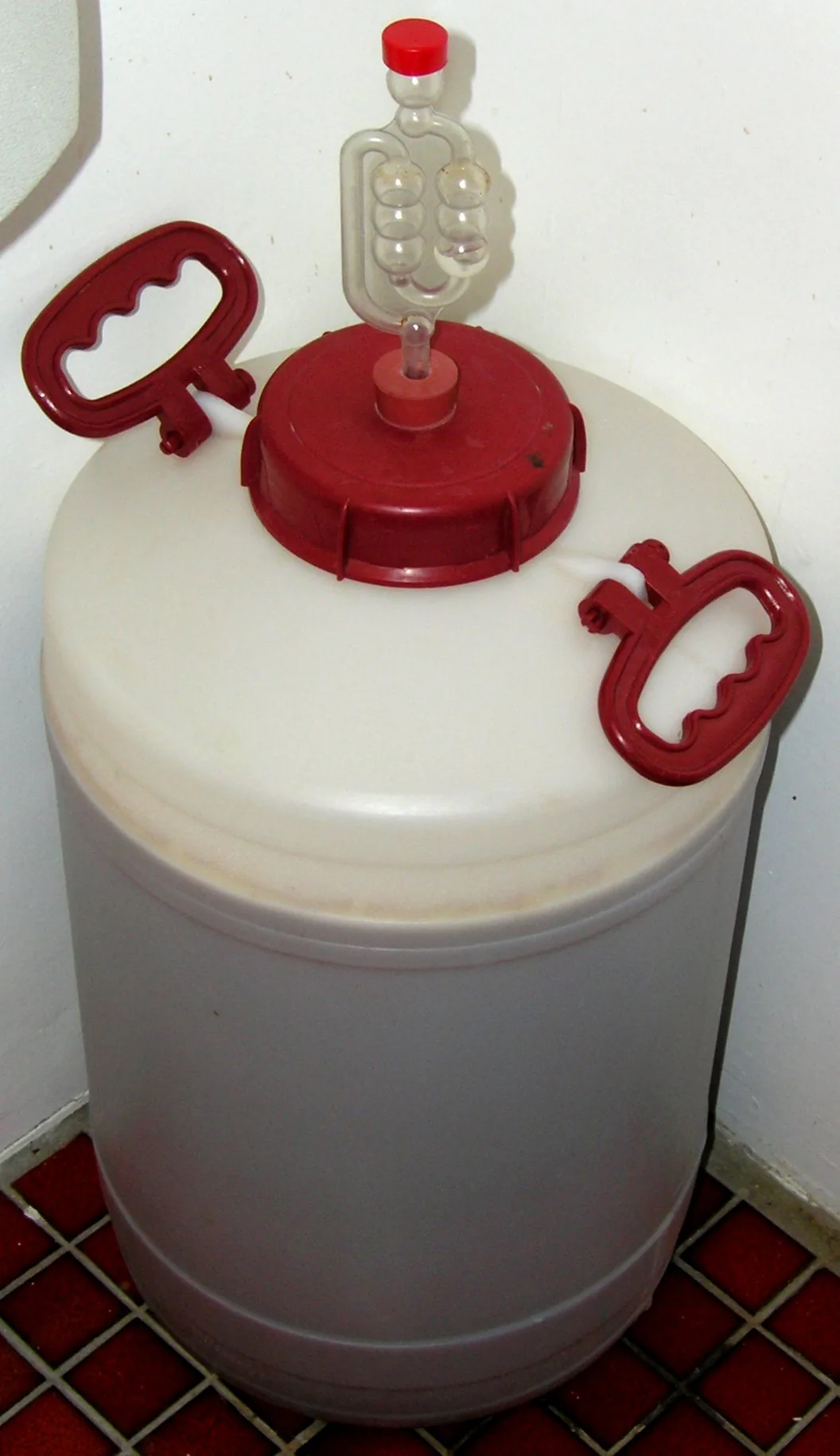
A closed tank, polyethylene or stainless steel, with a bubbler or a one-way valve: carbon dioxide gets out, air does not get in. That is the whole setup.
What is called anaerobic fermentation is almost never an imposed anaerobiosis. The literature speaks of self-induced anaerobic fermentation, SIAF, that is, an absence of oxygen that sets in by itself: the microorganisms consume the residual oxygen, then saturate the tank headspace with CO₂. Nobody drives out the air, it is consumed.
In Brazil, cylindrical polypropylene tanks measuring 82 by 47 centimeters received 175 kilos of pulped arabica and 30 liters of ozonated water. Samples were taken at 24, 48 and 72 hours. The pH falls from 5.8 to 4.4. At 72 hours, the bottom of the tank titrates 5.06 g/L of lactic acid, 1.00 g/L of acetic acid and 4.47 g/L of residual glucose. The population changes along the way: enterobacteria at 85% at 24 hours, then lactic acid bacteria at about 20% between 48 and 72 hours. All the lots score above 84 points.
Yet the most telling result is none of these figures, it is the gradient. Lactic acid is 5.06 g/L at the bottom, 4.70 in the middle, 2.18 at the top. A 175-kilo tank is not a homogeneous medium, it is a stack of conditions. In other words, an anaerobic lot is the mixture of three fermentations run in the same vessel.
Vale et al., Foods (2022), solid level; tank material taken from section 2.1 of the methods of this article (polypropylene), whose introduction has one sentence saying polyethylene; LC ch. 17bAt Cenicafé, a semi-aerobic fermentation in an open tank and a SIAF in a hermetic tank are compared over 192 hours. The most spectacular difference is thermal: 30 to 37 °C in the open tank, around 20 °C in the closed tank, seventeen degrees of difference for the same coffee. The SIAF consumes glucose faster and produces more lactic acid; mean 83.14 ± 0.39; optimal fermentation quality index in the closed tank up to 96 hours; phenolic notes appear only at 72 hours and only in semi-aerobic.
| Closed tank, measurements | Vale 2022 (Brazil) | Cenicafé 2025 |
|---|---|---|
| Load | 175 kg pulped + 30 L ozonated water | hermetic vs. open tank |
| Duration | 72 h | 192 h |
| pH | 5,8 → 4,4 | monitoring |
| Temperature | uncontrolled | ≈20 °C closed, 30-37 °C open |
| Lactic acid | 5.06 / 4.70 / 2.18 g/L bottom-middle-top | higher in SIAF |
| Scores | all > 84 | 83,14 ± 0,39 |
Genera recurring from one study to another: Leuconostoc, Weissella, Lactiplantibacillus, Acetobacter more abundant with air, yeasts Pichia, Issatchenkia, Wickerhamomyces, Hanseniaspora uvarum. What nobody has published: the actual pressure prevailing in these tanks, in bar, nor the valve calibration.
Peñuela-Martínez et al. (Cenicafé), Foods (2025), solid level; LC ch. 17b