Deliberate aging
After drying.
What does long storage do to the bean?
Start the scene or choose a stage. The animation simplifies the mechanism; what follows gives the details and the available references.
Deliberate aging keeps the bean for months or years in warm, humid air, in jute sacks that let water through. This is exactly what Cenicafé advises against for ordinary storage. Nothing is added, nothing is seeded.
Read the stages without animation
- Keeping it warm and humidDeliberate aging keeps the bean for months or years in warm, humid air, in jute sacks that let water through. This is exactly what Cenicafé advises against for ordinary storage. Nothing is added, nothing is seeded.
- The seed diesGreen coffee is a living seed. Outside the parchment, it loses its viability in under six months; in parchment, it keeps it for more than a year. The authors of the measurement propose this death as the cause of the flattening of the cup.
- Precursors wear out, lipids splitGlutamine falls markedly, glucose and fructose a little: these are the precursors that roasting will turn into aromas. Lipids split into free fatty acids, which then oxidize. Chlorogenic acids, for their part, stay stable: the common explanation for the mildness does not hold.
- What can be seen, what can be measuredThe bean becomes lighter and yellower, and the cup score drops from 60 days in the hottest trial. No blind trial compares a deliberately aged lot with its control.
To remember: aging is measured in losses, viability, precursors, lipids; the profile the trade seeks has not been measured.
In history: In history: Old Government Java stayed two to three years in godown, the storage warehouse of the Dutch East Indies.
Read the full article and its sources ↓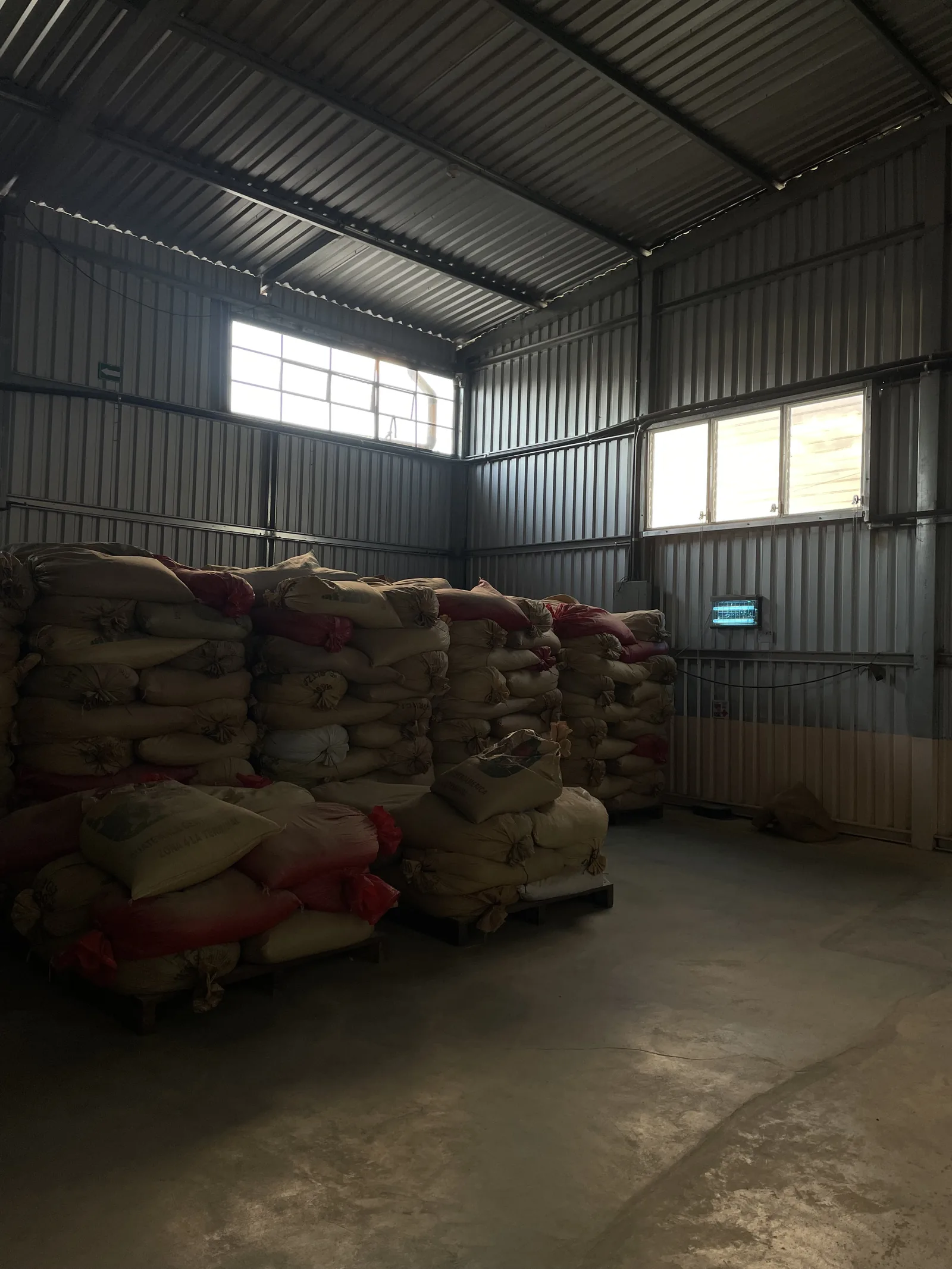
Where it is practiced
Java first, and under administrative constraint. Under the Dutch cultivation system, the colonial government bought the crop from the planters. It then kept it two to three years in godown, the depot warehouse of the Indies. The coffee came out “mellow”, softened by age, and this is what was sold under the name Old Government Java. Ukers writes in 1922 that this system has just been abandoned. Planters then sell without waiting, and aging occurs only during the crossing.
This crossing lasted as long as sail did, and Ukers contradicts himself on its duration. His chapter on markets gives three to four months for sailing ships. His chapter on sea transport gives four to five months from Padang or Batavia, without distinguishing the two ports. The contradiction is not resolved. The last coffee sailing ship to arrive in the United States is the barque Padang, in New York on Christmas Day 1914.
Ukers also describes what the crossing did to the bean, and the description matters because it explains the sought-after brown. The coffee was loaded still moist, then the hold hatches were sealed until arrival. The cargo sweated and frothed through months of tropical seas. The bean went from light green to dark brown. This brown fetched three to five cents more than a Java that arrived “pale”, that is, light in color.
Today's trade sells aged lots under Indonesian names, including Old Brown Java and aged Sumatra. No source of rank 1 to 3 read here documents these lots. Neither storage time, nor warehouse conditions, nor volume, nor the date the practice resumed. See GRAY AREA.
A word on India, because the confusion is constant. The monsooning of the Malabar coast is not aging. An already dry coffee is exposed to the winds laden with the southwest monsoon, in open sheds. The scientific literature gives six to seven weeks of exposure. It is a short, managed rewetting, not a long storage.
The principle
Green coffee is a living seed. Deliberate aging consists of keeping it for months or years in warm, humid air, instead of protecting it. Nothing is added, nothing is seeded. Time is left to work, and what time does is measured in losses, not gains.
Three mechanisms overlap, and they have been measured separately.
First, the death of the seed. Selmar, Bytof and Knopp stored coffees prepared by the wet, dry and semi-dry routes for two years. Outside the parchment, the fibrous endocarp that wraps the bean beneath the pulp, all the lots lost their viability in under six months. In parchment, they kept it for more than a year. The authors propose this loss of viability as the cause of the flattening of the cup.
Next, the consumption of aroma precursors. These precursors are the sugars and free amino acids, the ones that roasting will turn into odorous molecules. Selmar measures a significant drop in glutamine and a slight drop in glucose and fructose. These changes do not follow the viability curve. The authors therefore rule out cellular metabolism and post-mortem reactions. They conclude by elimination that slow Maillard reactions, in the dry seed itself, could explain the loss. This is their exit hypothesis, not a direct measurement.
Finally, the hydrolysis of lipids. The triglycerides of the bean split and release free fatty acids. The lot's fatty acidity rises, and Borém retains it as a marker of degradation because it is simple to assay. These fatty acids then oxidize. Aung tracks this second step through the peroxide value and through thiobarbituric acid reactive substances.
A received idea falls here. The mildness of aged coffee is often explained by the disappearance of chlorogenic acids. Badmos and Kuhnert followed green coffees for four years under ambient conditions. They find these compounds stable, and more stable than the other constituents of coffee. They degrade by hydrolysis and by oxidation to quinones, but slowly. The common explanation therefore does not hold.
The sequence
- Start from a sound, well-dried lot. Cenicafé sets the end of drying at between 10 and 12% bean moisture. Above 12%, it classes storage as inadequate, because molds then have enough free water to grow.
- Track water activity as much as moisture. Water activity is the share of water actually available to a microorganism, rated from 0 to 1. It is what controls mold growth, and not the moisture content alone.
- Choose a permeable packaging. This is the decisive point, and it is the reverse of quality practice. Jute, fique and paper let the bean exchange its water with the ambient air. Barrier packaging, polymer or vacuum, serves on the contrary to prevent aging.
- Keep it warm and humid, that is, exactly what Cenicafé advises against. It regards an unventilated warehouse above 23 °C and 80% relative humidity as inadequate. An aging warehouse is permanently on the wrong side of these two thresholds.
- Do not count on heat alone to load the bean with water. In the Cenicafé trial, the permeable sacks at Santa Marta, at 28 °C and 80% relative humidity, reach only 12.5% moisture and 0.66 water activity in a year. The same sacks in a cold room, at 11.3 °C and 77% relative humidity, peak at 16.6% and 0.77 at 240 days. Cool, humid air loads the bean more than warm, humid air.
- Avoid temperature swings. They cause condensation, hence local rewetting, hence mold foci in the middle of an otherwise dry lot. Cenicafé lists rewetting during transport among the causes of ochratoxin A.
- Let it run for two to three years. This is the only duration backed by a source, that of the godowns of the cultivation system, reported by Ukers.
- Re-sort and re-polish before sale. Ukers describes this tumbling and scouring at the end of the Robison process, the only artificial maturing process he judges successful.
What it gives in the cup
What is measured. In the sources read, there is no blind trial comparing a deliberately aged lot with its own control. What is measured is the degradation of green coffee in storage, and it always goes in the same direction.
- Cenicafé, 365 days, four sites, eight packagings. At Santa Marta, 28 °C and 80% relative humidity, the total SCA score drops from 60 days, whatever the packaging. In the cold room, the drop comes at 240 days. At Alto de Letras, 10.3 °C and 72% relative humidity, four polymer packagings hold the score for 365 days, but not the fique sacks.
- Matias and Borém, nine months, natural coffees scored 82 and 84 points at the start. Sweetness, acidity, body and aftertaste all fade. The overall score stays stable in high-barrier packaging.
- Borém and his co-authors, NMR analysis over eighteen months. The paper sack drops off at six months in cupping, and NMR sees the drift as early as three months. Vacuum and high barrier hold for eighteen months.
- Borém and his co-authors, twelve months, eight packagings. The jute sack gives the highest fatty acidity and the lowest tasting scores.
- Zarebska and her co-authors, twelve months, five temperatures. The best result comes from a natural in a GrainPro bag at minus 10 °C. The second comes from a natural in a jute sack at 10 °C. Jute is therefore not bad in itself, it is bad when it is hot.
What is claimed. The trade credits aged coffee with four things.
- A collapsed acidity.
- A thick body.
- Notes of wood and cedar.
- Notes of spice and tobacco.
None of these descriptions is backed by a published trial. The sheet therefore gives them as sales arguments, not as results.
Ukers, in 1922, is more cautious than today's catalogs. He reports that the trade takes improvement with age for granted, then raises three reservations.
- Too long a storage develops flavor at the expense of body.
- A mild coffee at the outset risks, he wonders, becoming insipid with age.
- Santos, says part of the trade, are better in new crop than in old.
He concludes that the optimal storage conditions are not known. He even asks what temperature, humidity and ventilation should be kept. They are still not known.
One last observation troubles the story of the browning bean. In the Cenicafé trial, at Santa Marta, the bean becomes lighter and yellower. Lightness L* goes from 72.5 to a value between 82.0 and 84.6 depending on the packaging. The yellow index b* goes from 11.5 to a value between 17.6 and 19.3. No packaging prevented this drift at that site. Ukers himself speaks of “yellow matured coffee” for coffees long at sea. The brown of the Javas of old therefore came from something else, and Ukers says so: coffee loaded moist and shut in under the hold hatches.
What goes wrong
Mold, and behind it ochratoxin A. This mycotoxin is classified as possibly carcinogenic to humans, group 2B of the International Agency for Research on Cancer. In coffee, Cenicafé names mainly Aspergillus ochraceus, common in tropical regions, and Penicillium verrucosum, which is found only in temperate regions. Other Aspergillus species produce it, including A. carbonarius, which recent work holds to be the main producer on canephora cherry.
The window is known, and it is higher than what is usually read. A. ochraceus grows between 8 and 37 °C, and between 0.76 and 0.99 water activity. Its growth optimum is 24 to 31 °C and 0.95 to 0.99. Ochratoxin A production, for its part, is documented between 0.83 and 0.87, and in some cases near 0.80. Pardo and co-authors, on irradiated green bean, detect no toxin at 0.80 water activity. They detect none either at 10 °C, whatever the water activity. Their production maximum is at 20 °C and 0.99.
The figures from the Cenicafé trial frame the order of magnitude, and they contradict a widespread intuition. In natural-fiber sacks, water activity at 365 days reaches 0.73 at Alto de Letras, then 0.74 in the cold room as at Chinchiná. The peak of the trial is 0.77, in the cold room at 240 days. At Santa Marta, the hottest site, it stays at 0.65 or 0.66. In polymer packaging, it stays below 0.70 at all four sites. No packaging, at any site, therefore brought the bean into the toxin production zone.
The risk is not the average regime of a warehouse, it is the local accident. A cold spot, condensation, a punctured tarp, and a pocket of beans on its own goes above 0.83. This reasoning is mine, it is not in the sources. See GRAY AREA.
Mold was not an accident in the old trade, it was accepted. Ukers writes that part of the cargo molded in the hold. The damage rarely exceeded one or two inches in the mats, that is, two and a half to five centimeters. And a moldy taste, if not too marked, was prized by experts. This last sentence must be read with today's knowledge.
The only measured analogue is monsooned coffee, which undergoes a much shorter wetting. Ahmad and Magan count there about 10⁸ colony-forming units of bacteria per gram and 10⁵ of fungi, more than on non-monsooned coffees. They give as dominant Aspergillus terreus, A. restrictus and A. ochraceus. Tharappan and Ahmad, on the same practice, find others.
- Aspergillus niger.
- A. tamarii.
- A. candidus.
- Penicillium species.
- Absidia heterospora.
The two studies therefore do not agree on the species. They agree on the conclusion, which is that monsooned coffee carries more spoilage molds, including mycotoxigenic species.
The other defects.
- Rancid. It comes from the hydrolysis of lipids and then their oxidation. Fatty acidity rises, and Aung then tracks the peroxide value and the thiobarbituric acid reactive substances.
- Flat and stale. This is the loss of aroma precursors, hence a cup with no highs and no relief.
- Bleached. Cenicafé counts 93.9% sound beans at the start. After a year in permeable packaging, this rate falls to between 85.3 and 91.8% depending on the site, the most degraded being Chinchiná. Discolored beans reach 7.6 to 9.05% in these same packagings.
- Condensation in the container. Temperature swings during transport redistribute the remaining water and create wet spots.
A management risk, finally. Ukers notes that the tied-up capital and storage costs deter roasters from aging their stock. Three years of warehouse is three years of unsold coffee.
A word on artificial aging, because it sheds light on the rest. Ukers lists the patented processes of his time for shortening storage.
- Steaming in crates with perforated bottoms, by Ashcroft.
- Timby's autoclave, alternating between two or three atmospheres and a partial vacuum, between 4 and 38 °C.
- Treatment with oxygen or ozone after passage through a hot chamber, by Desvignes.
- Exposure to a magnetic field, by Weitzmann, which Ukers himself judges doubtful.
- Treatment with nitrogen dioxide gas, by Gram.
He regards Robison's as the most successful, patented in the United States in 1919 and sold under the name Cultured coffee. The green coffee is washed, then seeded with chosen strains. Ukers names two, “Ochraeceus” and “Aspergillus Wintii”. Incubation lasts six to seven days at 90 °F, or 32 °C, and 85% relative humidity. The coffee then rests about ten days in a silo, then it is tumbled and scoured. The species Ukers names first is the one Cenicafé now designates as the main producer of ochratoxin A in tropical coffee.
One last thing on the artificial, which says what the brown fashion was worth. New York houses steamed coffees that had arrived by steamship, to imitate the brown of the sailing ships. The authorities of the Pure Food and Drugs Act of 1906 opposed this. A federal court ranked the practice among adulterations and misleading labeling. Ukers ties the end of this demand to the disappearance of the coffee sailing ships.
Benchmarks
- Old Government Java storage in godown2 to 3 years
- Premium paid for a “sweated” Java over a “pale” Java3 to 5 cents, unit not specified by Ukers
- Measured drop in SCA score at 28 °C and 80% relative humidityfrom 60 days
- Growth of Aspergillus ochraceus8 to 37 °C, water activity of 0.76 to 0.99
- Ochratoxin A production by this specieswater activity of 0.83 to 0.87, sometimes near 0.80
- Highest water activity reached in one year in the Cenicafé trial0.77, in the cold room, in natural-fiber sacks
- Bean moisture at the end of drying according to Cenicafé10 to 12%
- Warehouse judged inadequate by Cenicaféunventilated, above 23 °C and 80% relative humidity
- Loss of viability of green coffee in standard storageless than 6 months outside parchment, more than a year in parchment
- Exposure of Indian monsooned coffee6 to 7 weeks