The classic washed process
The washed process.
How does washed processing work?
Start the scene or choose a stage. The animation simplifies the mechanism; what follows gives the details and the available references.
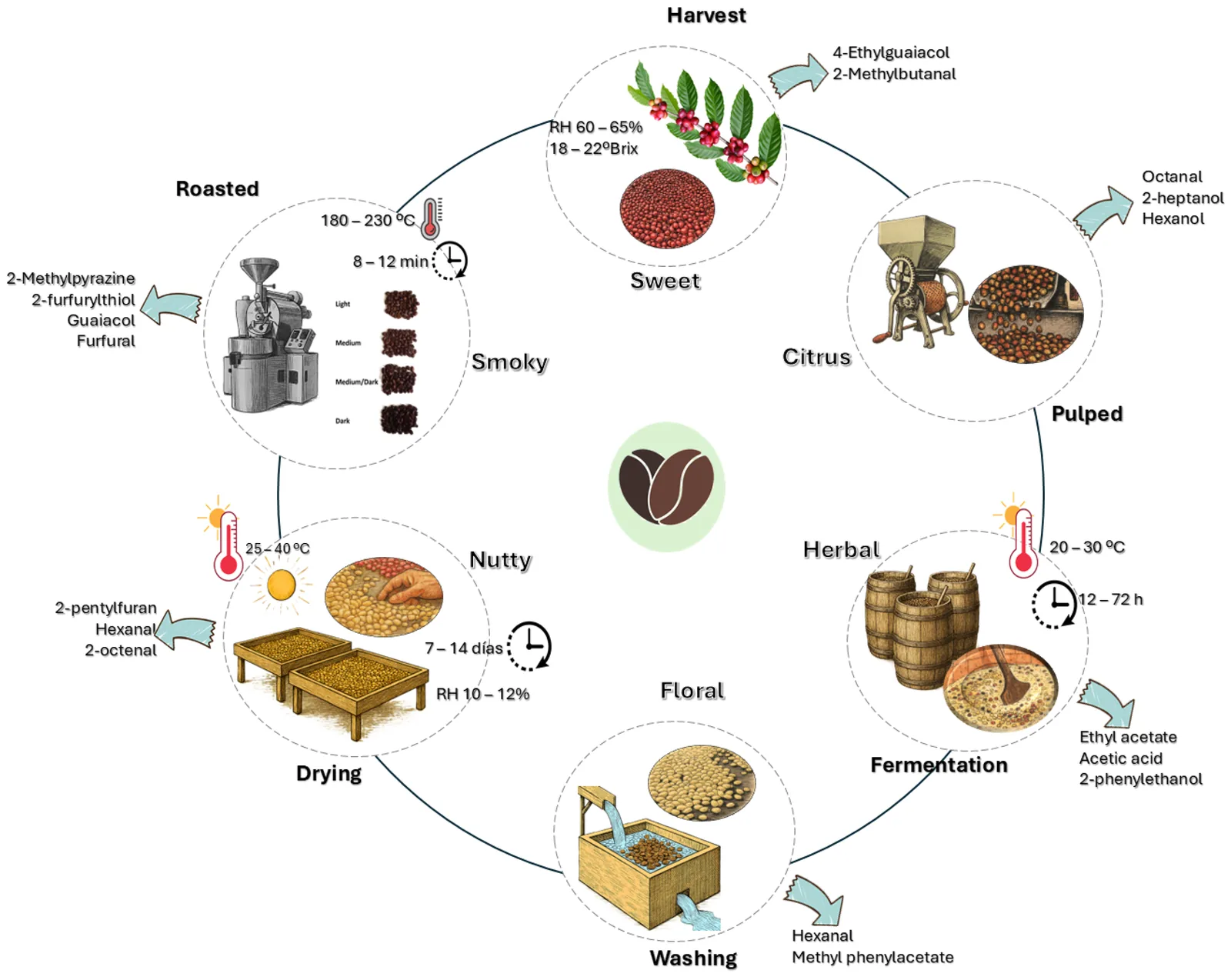
The cherry is pinched between a drum and a breast plate set to tear off skin and flesh without crushing the seed. What comes out is parchment coffee coated in mucilage, a slimy layer that water alone does not remove.
Read the stages without animation
- Pulp on the day of harvestThe cherry is pinched between a drum and a breast plate set to tear off skin and flesh without crushing the seed. What comes out is parchment coffee coated in mucilage, a slimy layer that water alone does not remove.
- Ferment in a tank, a few dozen hoursIn this sugary medium, yeasts and lactic acid bacteria break down the pectin that holds the mucilage, and the pH falls from 6.0 to 6.5 toward 4.0: this acidification loosens the layer and keeps the undesirables at bay, as in a yogurt. In Yunnan, 36 to 48 hours after pulping, 12 hours after a mechanical demucilager. Dry, it is faster and hotter; under water, slower and buffered.
- Wash with plenty of waterThe water carries away the loosened mucilage and the coffee comes out as clean parchment. A 24-hour soak in clear water may follow: it tempers the effects of the fermentation that preceded it.
- Dry to under 12%The parchment coffee dries to under 12% moisture. The parchment stays: it leaves only at hulling, much later.
To remember: The drop in pH is the central event of the tank. The durations and the flora come from the Yunnan trials, the only complete published dataset: these values do not hold for all farms.
Read the full article and its sources ↓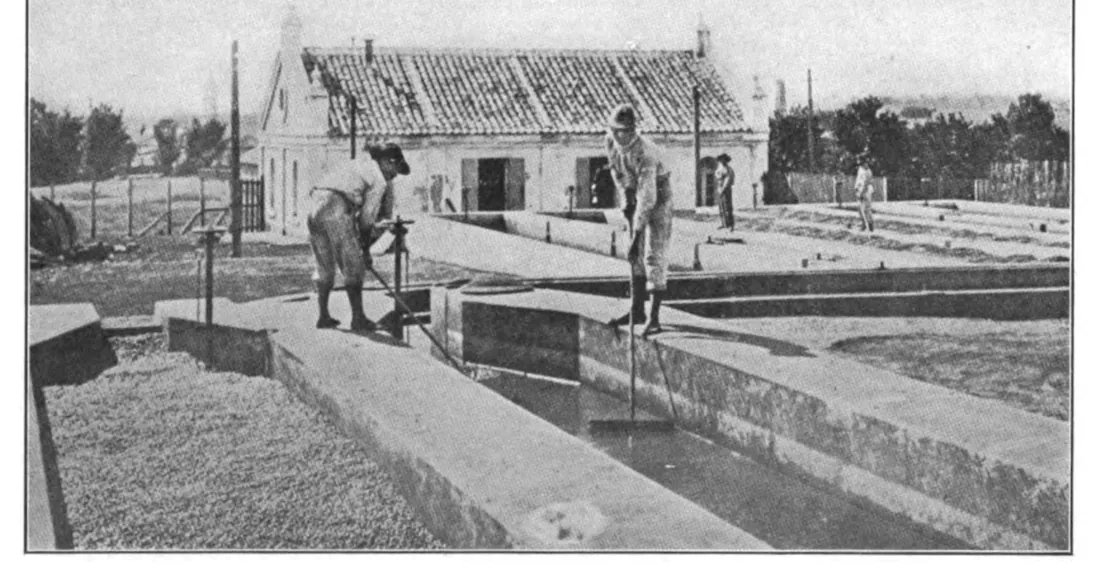
Where it is practiced
The washed process is the norm in Colombia. The national coffee research institute, Cenicafé, has documented and quantified it since 1938. Most of the published parameters for this process come from there. Colombian coffee growing is spread between 1,000 and 2,000 meters of altitude. This range covers a wide span of fermentation temperatures, and temperature governs duration.
It is also the dominant route in Kenya, Rwanda, Burundi, Central America and Peru. In Ethiopia it coexists with the dry process depending on the regions and the pulping stations. Its spread follows the availability of water: it requires a clean and regular source at harvest time.
The date of appearance of the process could not be established on a first- or second-rank source. See the gray area.
The principle
The washed process removes the mucilage, the layer of sugary, slimy flesh stuck to the parchment, before drying. It does not remove it by rubbing: it makes it come apart chemically.
Mucilage is a gel. About 90% of its fresh weight is water. What gives it its hold are the pectic substances, which weigh from 0.6% to 2.0% of the fresh mucilage. They are chains of D-galacturonic acid, more or less esterified by methyl groups.
Fermentation in a tank brings into play enzymes called pectinases. They do not all do the same thing, and it is this division of labor that explains the loss of hold of the gel. Polygalacturonases hydrolyze the bonds between galacturonic acid units, which cuts the chain and releases galacturonic acid and simple sugars. Pectinesterases, for their part, detach the methyl groups, which releases methanol. Other esterases release acetate. The gel then loses its cohesion, becomes soluble, and the washing water carries it away.
These pectinases come from two sources. The microorganisms settled on the pulped bean produce them, yeasts included. Pectinesterases, for their part, are naturally present in plant tissues.
In parallel, the same microorganisms ferment the sugars of the mucilage into ethanol, lactic acid and acetic acid. This fermentation is not the goal. The goal is to degrade the mucilage, and the degradation of other compounds damages the product. Acidification is therefore a by-product, but it serves as a convenient tracer. The pH of the mucilage falls from about 5.2 to a value between 3.5 and 4.0, and it is this drop that is measured.
A word on so-called closed tanks. Closing a tank does not mean driving the air out of it. Nobody purges the oxygen: it is consumed by the microorganisms, and the medium becomes depleted of oxygen by exhaustion. The term anaerobic, common in the trade, therefore does not describe a purge.
A chemical reason to prefer the submerged tank to the dry tank
This sheet compares submerged and dry fermentation by their durations and their pH curves. There is a third criterion, rarely written down, and it concerns what each system produces rather than the time it takes.
Hackler and Särchen write that fermentation conducted in a water tank increases founding components of roast aroma, namely organic acids such as aspartic acid and glutamic acid, esters, alcohols and aldehydes, that it lowers the pH, and that it conveniently reduces the concentration of undesirable compounds such as butyric acid.
This last point is the one missing from the sheet, and it deserves to be developed because it is not obvious. One would expect a water bath, by excluding air, to favor the strictly anaerobic pathways, therefore precisely the one that produces butyric acid. Two mechanisms explain why this is not so. The first is dilution: a submerged tank contains several times the water volume of the mucilage alone, and a molecule produced is spread through a much larger volume, therefore stays below its perception threshold for longer. The second is leaching: part of what is produced passes into the water and leaves with the washing, whereas a dry fermentation keeps everything on the parchment and lets it dry along with it. The water tank therefore does not prevent the butyric pathway, it carries off its product.
Two clarifications are needed so that this reasoning is not abused. The first is that the same leaching also carries off desirable molecules, and that this is exactly the reproach that advocates of dry fermentation make to the water tank. The authors mention the increase in aroma precursors and the decrease in butyric acid in the same sentence, without giving figures for either, and the two effects must therefore be treated as directions and not as magnitudes. The second is that the comparison comes with no control: the paragraph cited describes what fermentation in a water tank does, it does not report a trial that would have measured, on the same lot, the butyric acid contents of the two systems.
What would make it possible to conclude is a simple experiment, and its absence is notable: split a lot of pulped cherries in two, run one half submerged and the other dry, in the same room and over the same duration, then measure the short-chain acids of the two washed and dried parchments. As long as this measurement is lacking, the sheet may write that the literature credits the submerged tank with an effect of reducing undesirable compounds, indicating that it is plausible by dilution and leaching, and that it has not been quantified.
Sources for this passage: Hackler and Särchen, chapter 6, p. 92; general judgment on the control of parameters in the wet process, chapter 5, p. 71.
The sequence
1. Selective harvest. More than 80% ripe fruit and less than 2.5% green fruit. This threshold governs the homogeneity of the mass, because the mucilage load depends on ripeness. Relative to the whole fresh fruit, green carries 1.3% mucilage, pinton (half-colored fruit, in Spanish) 8.4%, ripe about 11%. Relative to the already pulped bean, a different basis that must not be confused with the previous one, ripe carries 18.8% and pinton 14.9%. A mixed mass therefore has no single end point.
2. Hydraulic classification of the cherry in clean water. Floaters and damaged fruits rise and are set aside. Cenicafé publishes two consumption figures that differ by a factor of ten: see the gray area.
3. Pulping, preferably without water. On a ripe arabica fruit, the pulp weighs about 44% of the weight, the parchment coffee 45%, the mucilage about 11%. Pulping with water that does not enter the tank leaches part of the soluble sugars, those that start the reactions, and lengthens the fermentation.
4. Screening of the pulped bean (zaranda, in Spanish). It removes unpulped fruits, pulp debris and dried fruits. A badly kept sieve changes the count and the type of microorganisms of the substrate to be fermented. This debris also raises the temperature of the mass, which speeds up the process and exposes it to over-fermentation.
5. Fermentation in a tank. Durations recommended by Cenicafé, depending on the system and the ambient temperature:
- tank without water, open system, 20 to 23 °C: 14 to 18 hours
- tank without water, open system, 13 to 17 °C: 14 to 24 hours
- submerged tank at 30 L of clean water per 100 kg of slimy coffee (pulped bean still covered in mucilage), 20 to 23 °C: 18 to 30 hours
- submerged tank, 13 to 17 °C: up to 42 hours
Temperature governs the speed because the fermenters are mesophilic, that is, they work at moderate temperatures. Most yeasts grow between 5 and 39 °C, with an optimum of 28 to 35 °C. Lactic acid bacteria grow between 25 and 30 °C. Cooling is therefore enough to slow things down: under refrigeration at 4 to 8 °C, 31 hours degrade only 20% of the reducing sugars, against 30% at 23 °C.
6. Effect of altitude. It works entirely through temperature. The Colombian coffee zone extends from 1,000 to 2,000 meters. Minimums there run from 12.2 to 18.1 °C, maximums from 22.4 to 28.2 °C. The low values correspond to high altitudes, since air cools as it rises. Higher up, the mass is colder, therefore slower. A field survey of 20 farms in Cesar, between 1,116 and 1,938 meters, gives durations of 10 to 42 hours. The mean tank temperature there was 20.5 °C, with a standard deviation of 1.93 °C. It rises during the process, and some farms recorded increases of 6 to 10.6 °C.
7. Recognizing the end. Four methods, two of them poor:
- the stick pushed into the mass, whose hole is checked to see whether it holds: it gives the point at 7.29 hours, for only 58% of the mucilage degraded
- touch, the bean becoming rough: 10.23 hours on average, for 74% degradation
- the Fermaestro, a perforated truncated cone of 500 mL filled with pulped coffee and immersed in the mass: the mass settles as it loses its mucilage. A void greater than 85 mm at the top signals more than 96% removal
- the pH, measured with a pH meter or colored strips
These gaps matter, because actual degradation beyond 97% takes 15.5 hours, within 0.9 hour. The two traditional methods therefore have the coffee washed too early. The Fermaestro gave the right point in 97.1% of the trials run on 70 farms. It proposed durations of 11.45 to 20.0 hours there, where the coffee grower's judgment ranged from 10 to 72 hours.
8. Stopping thresholds. Cenicafé publishes end-of-fermentation values for open tanks run between 18 and 23 °C. In a tank without water, fermentation lasts 12 to 18 hours, the pH starts at 5.0 to 5.3 and ends between 3.7 and 3.9. The mucilage goes from 17 to 19 degrees Brix to 12 to 14 degrees Brix (refractometer reading of soluble solids). In a submerged tank at 30% water, fermentation lasts 18 to 30 hours, the pH starts at 5.3 to 5.6 and ends between 3.9 and 4.2. The medium goes from 4.2 to 5.8 degrees Brix to 8.0 to 9.0 degrees Brix. The two systems therefore do not have the same pH limit, and the Brix move in opposite directions: they fall without water, they rise when submerged because the sugars dissolve in the water. A delay in washing of 3 hours or more after degradation increases the risk of cup defects.
9. Washing in four successive rinses, at 30%, 20%, 20% and then 30% of the total volume. The coffee is stirred, impurities are removed, and the tank is drained at each phase. The splitting serves to carry off the residues that would otherwise ferment uncontrolled during drying. Quantities: 2.0 L per kg of slimy coffee after fermentation without water, 1.7 L after submerged fermentation. The water must be potable and of pH 6 to 8. It must contain no enterobacteria, no heavy metals and no dissolved solids.
10. Drying to 10 to 12% moisture, the Colombian commercial standard for parchment coffee. In thin layers, so that the water evaporates quickly. In a fixed-bed mechanical dryer, the drying air stays between 48 and 52 °C. Above 50 °C, veined and crystallized beans become more frequent, and above 55 °C one makes reposado. The recommended airflow is 98 to 102 m³ per minute and per tonne of dry parchment coffee, for a total layer height of 70 to 75 cm. At this setting, drying does not exceed 24 hours. If drying cannot start right away, keep the bean under 15 °C for 30 hours at most, and rinse it before drying it.
11. Rest and storage. Leave the dry coffee packed for at least 15 days, at 18 to 20 °C, before hulling. For longer keeping, Cenicafé recommends 12 to 18 °C and a relative humidity of 65 to 70%. A second Cenicafé document quantifies the keeping: at 10 to 12% bean moisture, between 15 and 18 °C and at 65 to 70% relative humidity, quality holds for up to 10 months. The two published lower temperature limits do not coincide: see the gray area. Under 10% moisture, lipids oxidize, and the bean degrades by another route.
12. Fate of the water. The pollution load does not disappear when water is saved: it concentrates. The values below are those that Cenicafé publishes, in liters and in chemical oxygen demand (COD) per kilogram of dry parchment coffee:
- natural fermentation, all practices combined: from 4.17 to 20 L
- correteo channel: 20 L
- traditional tank washed in four rinses: 4.17 L, COD close to 26,500 mg/L
- Becolsub: 0.7 to 1.0 L, leachates at about 110,000 mg/L of COD
- Ecomill: 0.3 to 0.5 L
Two treatments exist on the farm. The Becolsub mixes the mucilage waters with the pulp by a screw conveyor. It thus controls 90 to 92% of the potential pollution of coffee, pulp included, and not that of the washing alone. The washing waters of the Ecomill can be dehydrated in the sun: under a parabolic dryer, a load of 15 liters per m² falls to 10 to 12% moisture in 7 to 10 days depending on the climate. The liquid then becomes a solid residue, storable and usable as organic fertilizer.
What it gives in the cup
What is measured, in Cenicafé trials run under controlled conditions:
- on 45 lots monitored with the Fermaestro, the mean mucilage removal was 96.7%, with a standard error of 0.22%. No cup from these lots carried a fermentation-related defect
- the two traditional end-point methods have the coffee washed well before complete removal, at 58% and 74% degradation. Mucilage therefore remains on the bean at drying
- a fermentation run at 15 °C increases the frequency of so-called special flavors, compared with a fermentation at an ambient of 18 to 26 °C
- rough, woody and sour defects are more frequent when the temperature rises, in a closed system, in solid substrate, and beyond 42 hours
On the profile, and still in these trials: submerged fermentations give a sweet cup with chocolate and caramel notes. Fermentations without water give a more complex cup, with fruity, citric and chocolatey notes. Open systems favor fruity, chocolatey and sweet notes.
What is claimed without evidence consulted. First, the common claim that the washed process gives more acidity and a cleaner cup than the dry process. No blind comparison on the same lot, published by a first-rank source, could be read here. The comparison is in any case confounded with variety, altitude and drying management. Second, the idea that prolonging fermentation beyond the washing point improves the score. A first-rank trial published in 2025 by the Cenicafé team itself finds no significant sensory effect of duration. It does see the physical quality of the bean degrade, however. See the gray area.
One thing is certain on the logical level: the washed process adds nothing to the cup. It removes a substrate before it transforms. What is credited to it in the positive is often an absence of defect.
What goes wrong
Fermented and vinegary (fermento and vinagre, in Spanish). This is the central defect of the process. It comes from the accumulation of fermentation acids in contact with the bean, acetic acid first. At 18 hours of fermentation without water, acetic acid and lactic acid are at the same level, 0.16% on average. At 42 hours, acetic has risen to 0.36% and lactic to 0.24%. The prolonged stay in these acids makes vinegary beans and sour cups.
Stinker. This is the next stage, with a nauseating smell. In a trial simulating poor practices, unsorted and over-fermented coffee, the stinker reaches 100% of samples at 88 hours. Sensory analysis with 12 replicates per sample and six judges.
Uncontrolled dry fermentation. Slimy coffee left in a tank with pulp remains acidifies and heats up quickly. It must be washed before having spent more than 14 to 16 hours in the container.
Delay in washing. Three hours or more after complete degradation raise the risk of cup defects. On 70 farms, the coffee grower fermented longer than necessary in 40% of the trials.
Mixing of lots from several days. It produces heterogeneous quality, vinegary and discolored beans, and increases the risk of contamination by the pulp present.
Reposado. It comes from drying above 55 °C, from a bean stored above 12.5% moisture, or from an ambient humidity above 75%.
Phenol and mold. Five causes are identified:
- molds of the genera Aspergillus and Penicillium
- delays in drying, which discolor and mold the bean
- beans pierced by the coffee berry borer
- dirty water, notably slimy coffee left in water loaded with pulp
- direct combustion in a dryer with no heat exchanger or chimney
Counterintuitive altitude effect. One study covers 580 samples from 162 farms, harvests 2005 to 2007. The fermented defect in the cup reaches 16.0% above 1,600 meters. It falls to 13.1% between 1,300 and 1,600 meters, and to 4.9% below 1,300 meters. The source gives the figure without establishing the cause.
Benchmarks
- Duration, tank without water, open, 20 to 23 °C14 to 18 hours
- Duration, submerged tank at 30%, 13 to 17 °Cup to 42 hours
- End pH, tank without water3.7 to 3.9
- End pH, submerged tank at 30%3.9 to 4.2
- Mucilage on a ripe pulped bean18.8% of the weight
- Washing water, traditional tank in four rinses4.17 L per kg of dry parchment coffee
- COD of these washing watersabout 26,500 mg/L