The dry process, the oldest and the hardest
What happens when the whole cherry dries?
Start the scene or choose a stage. The animation simplifies the mechanism; what follows gives the details and the available references.
The coffee is not pulped: the cherry dries with its skin, its flesh and its sugar. On raised beds, traders' glossaries give 10 to 15 kilos per square meter, in a layer of one to two centimeters, the thickness of a finger.
Read the stages without animation
- Spread the whole cherryThe coffee is not pulped: the cherry dries with its skin, its flesh and its sugar. On raised beds, traders' glossaries give 10 to 15 kilos per square meter, in a layer of one to two centimeters, the thickness of a finger.
- Run a hand through every half hourDuring the first days, the layer is turned every 30 to 60 minutes, from sunrise to sunset. The figure comes only from traders; the principle of frequent turning, for its part, is documented as a measure against mold.
- Dry for three to six weeksIt takes three to six weeks, sometimes two to four, to reach 10 to 12% moisture. In southwestern Ethiopia, parchment reaches 11.5% in eight days in the sun, four in a solar tunnel, thirty hours in a dryer after a pre-drying: these three durations apply to parchment, not to the whole cherry. Drying that is too slow produces stinkers, beans with a vinegary, putrid taste: sometimes five in a bag are enough to spoil a lot.
- Hull the huskThe fruit has become a brittle husk, which is hulled later to free the green bean.
To remember: The natural is not a lazy process: it is the one that demands the most supervision for the least equipment.
Read the full article and its sources ↓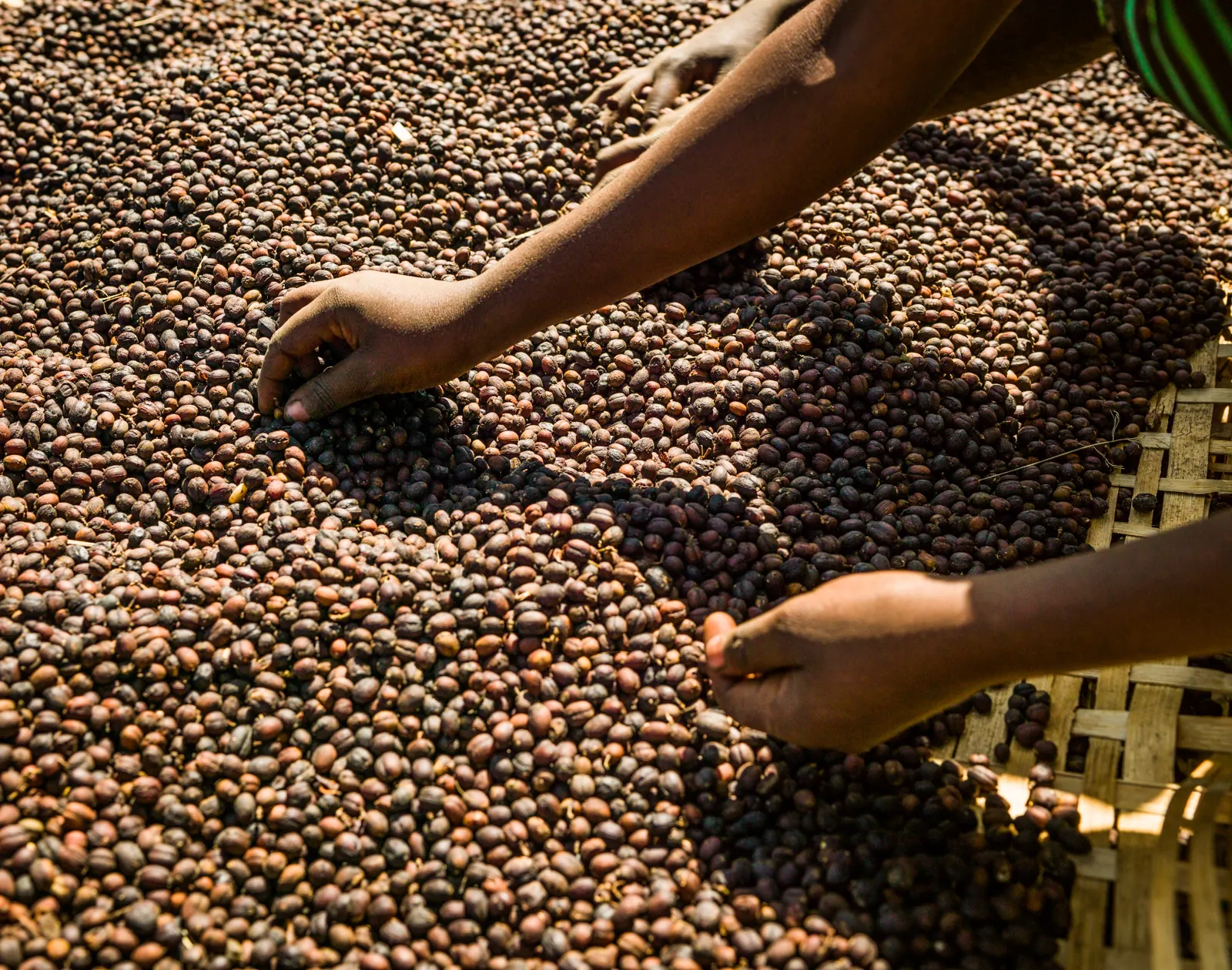
The coffee is not pulped: the whole cherry is spread out and dried with its skin, its flesh and its sugar until the whole becomes a brittle husk that will be hulled later. All this time, the bean bathes in a fruit that slowly ferments and whose compounds migrate into the kernel. The reported duration is three to six weeks, sometimes two to four to reach 10 to 12% moisture.
On raised beds, which Ethiopia has made a standard, the cited values are 10 to 15 kilos per square meter in a layer one to two centimeters thick, turned every 30 to 60 minutes during the first days: a layer the thickness of a finger, over which a hand is passed every half hour from sunrise to sunset for weeks. These values come only from traders' glossaries; the principle of frequent turning, for its part, is documented as an anti-mold measure.
In southwestern Ethiopia, sun drying takes eight days, a solar tunnel four, an artificial dryer 30 hours after pre-drying, to bring the parchment to 11.5%; semi-washed lots dried in the sun or in a tunnel reach grade Q1.
Firdissa et al., Journal of Food Quality (2022), art. 9184374, abstract; traders' glossaries for the beds (medium level); LC ch. 17bThe real subject of the natural is risk. A whole fruit drying slowly in a climate where relative humidity climbs back up every night is a culture medium. Over-fermentation produces the stinkers, isolated beans with a vinegary, putrid taste, invisible at sorting, sometimes five in a bag, and enough to contaminate the cup of an entire lot; mold sets in if the layer is too thick, the turning too rare or the drying too slow; drying directly on the ground adds re-wetting by capillarity and soil-borne contamination.
Coste added a sanitary argument: the wet process kills the coffee berry borer, the dry process multiplies it on the drying areas. The natural is not a lazy process; it is the one that demands the most supervision for the least equipment. In Yemen, the drying of the whole cherry on terrace roofs is a consensus, but durations, thicknesses and moisture content come only from roasters' pages: ethnographic description, never technical data.
Coste 1955, p. 285-288 (Vayssière); LC ch. 17b; no serious source on the Yemeni parameters