The dry process
The dry process.
What happens to a whole dried cherry?
Start the scene or choose a stage. The animation simplifies the mechanism; what follows gives the details and the available references.
Cherries are tipped into a water tank: the dense ones sink, the light ones, already partly dried on the tree, float and form a separate lot, which would not dry at the same rate. Then nothing is removed: skin, pulp and mucilage go to drying with the bean. Fresh fruit contains 68 to 72% water and its water activity, the share of water that microorganisms can use, is close to 0.98. On a raised bed, the layer is 2 to 4 cm.
Read the stages without animation
- Sorting in water, spreading the cherryCherries are tipped into a water tank: the dense ones sink, the light ones, already partly dried on the tree, float and form a separate lot, which would not dry at the same rate. Then nothing is removed: skin, pulp and mucilage go to drying with the bean. Fresh fruit contains 68 to 72% water and its water activity, the share of water that microorganisms can use, is close to 0.98. On a raised bed, the layer is 2 to 4 cm.
- Turning several times a dayFor the first six to eight days, around 0.95 water activity, it is mostly harmless bacteria working the surface of the fruit: acetic bacteria oxidize glucose there into gluconic acid. Turning at least two to three times a day evens out moisture between the top and the bottom of the layer.
- Crossing the danger windowThen comes a transition of about six days around 0.90: yeasts and fungi settle in. This is where Aspergillus can produce ochratoxin A, a toxin that requires at least 0.85 water activity, close to 20% bean moisture. At night, the lot is covered with a tarp or brought indoors: the gap between day and night makes it take up water again.
- Stopping at 10 or 12%Drying lasts about twelve days according to one review, fifteen to twenty days in the open air according to Cenicafé. It is stopped at 10 or 12% moisture, which is about 0.60 water activity. The dry lot goes into the silo, where it rests so that moisture evens out through the mass; no resting time is published.
- Hulling in a single passSkin, pulp and parchment have become a single shell, dry and brittle. A huller, and not a pulper, removes it in one pass: the green coffee goes one way, the husk the other.
To remember: Drying is the process, fermentation its consequence: as long as the fruit holds water, its flora is at work, and drying alone decides whether one gets a clean dried fruit or a rotten one.
Read the full article and its sources ↓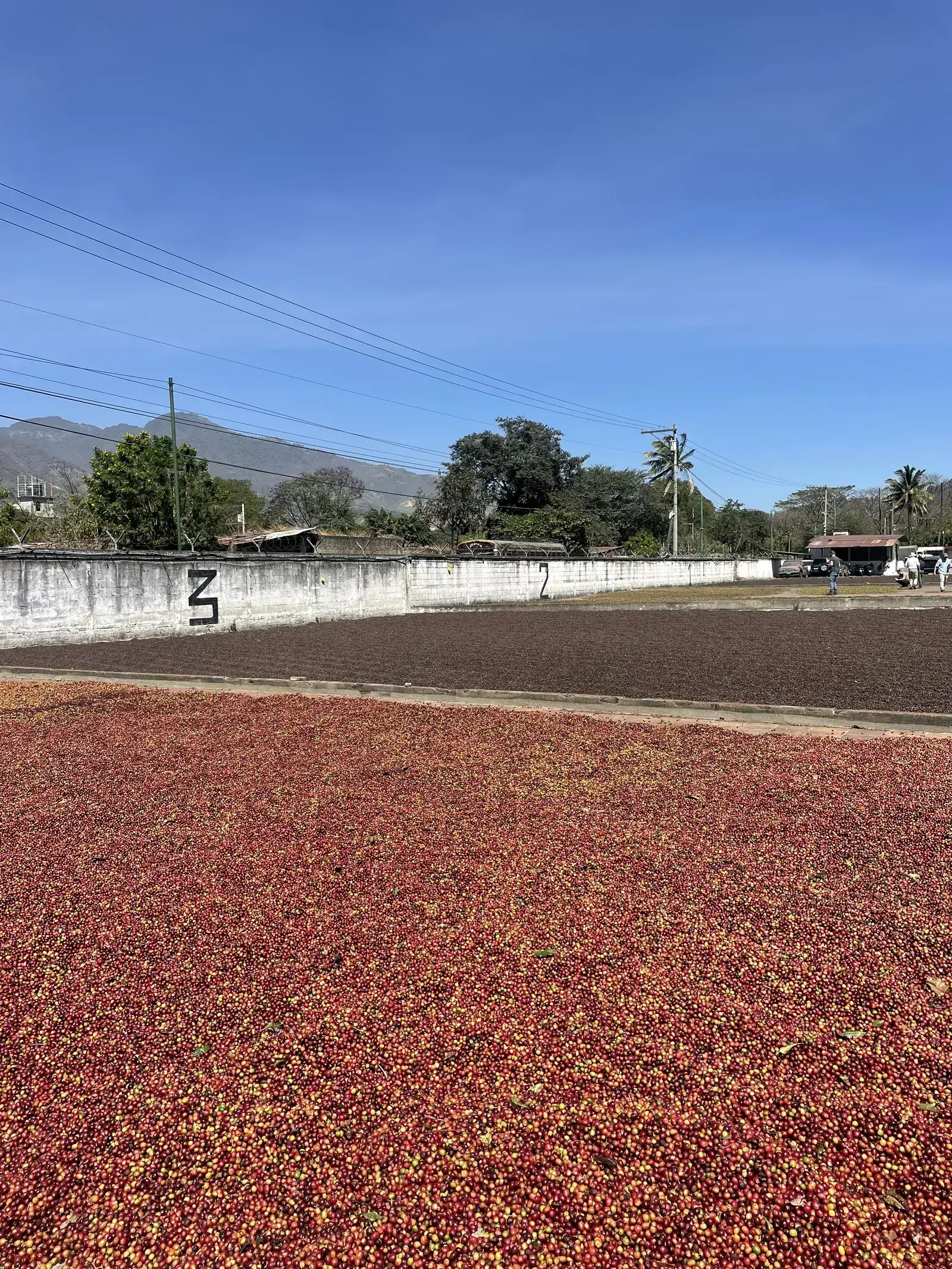
Where it is practiced
Three historic heartlands have never abandoned it.
- Yemen: whole cherry dries on the flat-stone terrace roofs of the highland villages.
- Ethiopia: the east of the country, around Harrar, dries as natural for lack of water to wash. Guji, Sidamo and Yirgacheffe also process a large share this way, on raised beds of mesh or cloth.
- Brazil: this is the dominant route, on the patio (terreiro, in Portuguese), the drying area in cement, packed earth or suspended. Finishing is often done in a mechanical dryer.
The Brazilian zones concerned are mainly:
- Minas Gerais;
- the Cerrado;
- the Mogiana;
- Espírito Santo.
It is the oldest method of preparation. It predates the washed process, which presupposes water, tanks and a pulper. Since the 2000s, it has spread again to origins that washed by default, in Central America and Colombia, for specialty lots.
The principle
The whole cherry goes to drying without the skin or pulp being removed. Drying is therefore the process; fermentation is only its consequence. As long as the fruit contains water, its flora is at work.
On the outer layers of the cherry, a microbial succession sets in. Acetic bacteria dominate there, Acetobacter and Gluconobacter. Yeasts accompany them: the genera Pichia and Candida are the most present, with Starmerella and Saccharomycopsis. These bacteria oxidize glucose into gluconic acid. This reaction consumes oxygen and acidifies the medium. In an Ecuadorian trial followed day by day, no sucrose was found in the outer layers of the dried cherries. Glycerol and mannitol, on the other hand, accumulated strongly there, as did arabitol, sorbitol and xylitol.
This work remains essentially on the outside. In the albumen, that is, the seed itself, the same authors record far fewer changes. They measure low glycerol contents there, and an accumulation of gluconic acid, glucuronic acid and succinic acid early in drying, followed by a gradual decrease.
The widespread idea of fruit sugar migrating into the bean needs a two-part correction. The natural bean is indeed much richer in free glucose and fructose than the washed bean. But the authors do not attribute this gap to migration. They attribute it to the absence of injury at pulping and to the absence of anoxia, which spare the bean losses that the washed process inflicts on it. The transfer actually documented goes the other way, in fact. It is in the washed process that the lactic acid, acetic acid and mannitol produced in the mucilage end up in the bean.
The second mechanism is internal, and it is the best documented. The bean stays alive throughout the treatment and begins to germinate. In the dry process, the peak of germinative activity arrives about a week after the start of treatment. In the washed process, it arrives after two days. The metabolism of the seed therefore runs longer, and differently. It is this difference in activity, and not a migration of sugars, that the authors retain to explain the differences in composition.
Finally, the drying pulp forms around the bean an increasingly hard envelope. It slows the exit of water, lengthens drying and keeps water activity high for longer. Water activity is the share of free water, the water that microorganisms can use. The whole difficulty of the process lies in this window. The sugar and the water are there, the flora too. Drying alone decides whether the result will be a clean dried fruit or a rotten fruit.
The sequence
1. Sorting at harvest. There is no pulper to set aside green cherries, nor washing to make up for approximate picking. Maturity at the time of picking therefore directly governs the final result. 2. Separation by density, in Brazil especially. The cherries are tipped into a water tank: the dense ones, ripe or green, sink, the light ones float (cereja, verde and boia, in Portuguese). These floaters are cherries already partly dried on the tree. Separating these lots avoids putting very different water contents on the same area, which will not dry at the same rate. 3. Layering. On a raised bed, the layer runs from 2 to 4 cm, which gives even exposure to the sun and to the circulating air. On a drying area, Brazilian practice cites 2 to 5 cm. Thickness governs the speed at which water leaves the middle of the layer. It therefore governs the time spent in the window where molds develop. 4. Turning. On a raised bed, the recommendation is at least two to three turns a day. It aims at three effects: keeping the cherries from clumping, slowing microbial growth, and eliminating the pockets that stayed damp where fermentation starts on its own. On Brazilian patios, agricultural extension goes up to about ten times a day. 5. Protection at night and in rain. On a drying area, the temperature gap between day and night favors nighttime water uptake. This uptake makes final moisture uneven and increases the risk of contamination by ochratoxin A-producing Aspergillus. Covering with a tarp or bringing the lot indoors avoids it. 6. Moisture descent. A Cenicafé measurement puts fresh fruit at between 68 and 72% water, with a water activity close to 0.98. Drying then breaks down into three stages:
- six to eight days around 0.95 water activity, where harmless hydrophilic microorganisms dominate, mostly bacteria;
- about six days around 0.90, a transition phase that opens the door to mesophilic and xerophilic yeasts and fungi. It is during this phase that ochratoxigenic fungi produce their toxin;
- the finishing, safer, down to the storage threshold.
7. Total duration. The review that describes these three phases puts drying at about 12 days in the dry process, against 7 days after the washed process. A Cenicafé review places open-air drying, on a drying area or raised bed, between 15 and 20 days. The dry process therefore spends markedly more time in the risk zone than the washed process. 8. End of drying. The aim is 10 to 12% moisture on a wet basis, that is about 0.60 water activity. This is the threshold from which the lot keeps for a long time without fungal regrowth. The green coffee grading scale cited by the FAO allows a range of 9 to 13%. 9. Possible mechanical finishing. The maximum temperature allowed is generally set at 50 °C of air, beyond which the risk of chemical degradation and sensory deterioration increases. The range of 40 to 50 °C is the one that best preserves the desired attributes while ensuring microbiological safety. Rotary dryers run lower on whole cherry than on parchment coffee, to avoid thermal damage. 10. Resting, then hulling. The dried cherry is removed in a single pass, by a huller and not by a pulper. Skin, pulp and parchment now form a single brittle husk.
Ten to twenty-five days, constant turning, and the most water-sparing process
Three additions complete the handling described here, and the first is a duration that widens the range without contradicting it.
Hackler and Särchen write that cherries dry in the sun in ten to twenty-five days, and that during this time fermentation processes take place, the organisms releasing enzymes that break down the pulp and mucilage, which allows moisture to evaporate more easily. This range is wider than the twelve days given by one review and than the fifteen to twenty days of Cenicafé that this sheet already carries, and it encompasses both.
The mechanism they describe in passing is worth retaining, because it reverses a common intuition. Fermentation and drying are usually pictured as two processes that get in each other's way, the first needing water and the second removing it. In the dry process, they cooperate: the enzymatic breakdown of the pulp opens the path for water to the outside, so fermentation speeds up the drying that will finally stop it. It is a loop that closes on itself, and it is also why a lot of cherries whose pulp resists dries slowly and stays long in the risk zone.
Two instructions complete this. The first is sanitary: filamentous molds are found in greater numbers in the dry process and in honey than in the washed process. This is not surprising, since the sugar stays on the bean in the open air for weeks, but it is the quantified justification of a vigilance this sheet already recommends. The second is an action: constant mixing is judged essential to prevent over-fermentation, unwanted decomposition and mold. The word “constant” is the authors' own, and it is worth keeping: it is not a daily turning, it is a repeated setting back in motion, whose function is twofold, to even out moisture between the top and the bottom of the layer, and to prevent an anoxic pocket from forming at the heart of a pile where the pulp sticks.
The third addition is an argument this sheet does not have and which gains value with time: dry process coffees consume less water and produce less wastewater, which makes it the most water-sparing process if one reasons on post-harvest processing alone. The caveat lies in this last qualification: the balance concerns processing and not the whole chain, and it says nothing of the water consumption in cultivation, which is of a completely different order of magnitude. Kornman generalizes the same idea in forward-looking terms, writing that regions exposed to drought and to unpredictable supplies because of climate change will tend toward more water-efficient processes, honey, dry fermentation for washed coffees, or eco-pulping. This is the Costa Rican argument carried by the sheet on honeys, extended to all origins, and it is prospective: nobody has measured this shift, it is anticipated.
Sources for this passage: Hackler and Särchen, chapter 5, p. 61 for the duration and the mechanism; chapter 4, p. 44 for filamentous molds; chapter 5, p. 65 for constant mixing; chapter 7, p. 104 for water efficiency. Kornman, p. 20.
What it gives in the cup
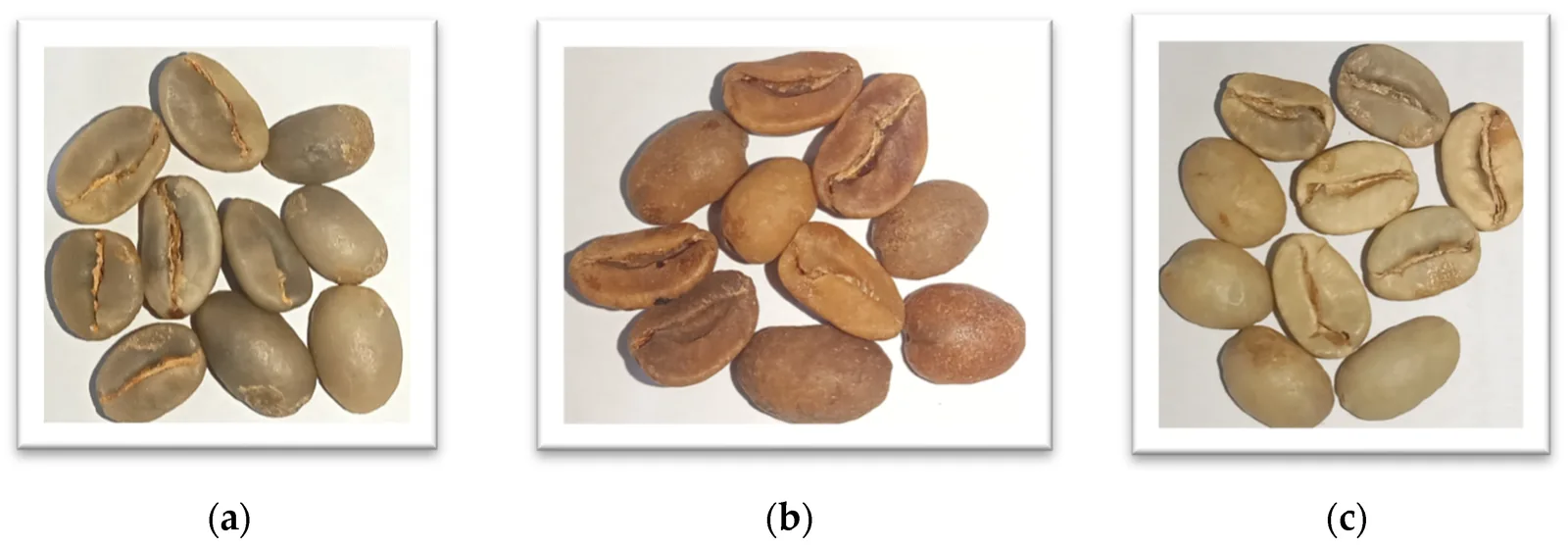
What is measured. On the same Ecuadorian lot processed in parallel, natural green beans differ from washed beans. They are richer in:
- fructose and glucose;
- caffeic acid;
- caffeine and trigonelline;
- certain chlorogenic acid isomers, namely 3-CQA, 4-CQA, 3,4-diCQA and 4,5-diCQA.
They are poorer in citric acid and erythritol. The direction of this gap matters, because it is almost always given the wrong way round in popular literature.
A Polish study goes in the same direction on caffeine. It measures 1.758 g/100 g in the natural process, against 1.666 g/100 g in the washed, a significant difference. The proposed mechanism is a loss by leaching: earlier work attributes about 3% of caffeine loss to the soaking phase of the washed process. The same study finds no significant difference in total polyphenols, whose values range from 37.51 to 40.12 mg GAE/g. It finds none either in antioxidant capacity.
What is deduced, and not measured. The authors of the Ecuadorian trial write that one would “expect” more bitterness and astringency in the dry process. Their reasoning is consistent with their figures: caffeine, chlorogenic acids and trigonelline carry bitterness and astringency, and the natural bean contains more of them. But this sentence is in their discussion, not in their results. They conducted no blind sensory comparison to back it.
What is claimed. The commercial portrait of the natural is a trade description of usage:
- red fruits and strawberry;
- jam or cooked fruit;
- thick body;
- low acidity.
I found no published blind sensory trial isolating the effect of the process alone. This would require comparing lots of identical origin, variety, altitude and harvest. Perceived sweetness is commonly explained by a migration of sugars from the fruit to the bean. This explanation does not hold: the natural bean is much richer in glucose and fructose, but by sparing and not by migration. The description therefore holds, the explanation given for it is wrong.
What goes wrong
Over-fermentation, called “fermented”. It comes from a layer that is too thick, turning that is too rare, or a pile left in place. In the Ecuadorian trial, one lot was deliberately heaped four to six cherries deep, without any turning for six days. The control lot was spread in a single layer of cherries and stirred every day. In the outer layers of the heaped lot, lactic acid reached 2.1%, against 1.0% in the control. Gluconic acid rose there to 14.3%, against 8.7%. A yeast in the heaped lot, Saccharomycopsis crataegensis, developed an extensive mycelium there, which explains the moldy look of the heaped cherries. In the cup, this type of drift gives winey notes, then sour, then frankly alcoholic ones.
Mold and ochratoxin A. Whole cherry contains enough water to feed molds during the first days. The toxin comes from two sections of the genus Aspergillus:
- section Circumdati: A. ochraceus, A. westerdijkiae and A. steynii, the last two being the largest producers;
- section Nigri: A. carbonarius, the larger producer of the two, and A. niger.
The risk is not played out at the wettest point. Above 0.95 water activity, ochratoxigenic fungi develop poorly, because the hydrophilic flora occupies the place. Toxin production requires a minimum of about 0.85 water activity, which corresponds to close to 20% bean moisture. The dangerous window is therefore the transition phase, when the lot goes down from 0.95 toward 0.80. Direct contact with bare ground aggravates contamination, by exposing the lot to soil, dust, animals and water. The raised bed reduces it for this reason. European regulation sets 3 µg/kg for roasted coffee and 5 µg/kg for soluble. There is no limit for green coffee, which shifts responsibility onto the buyer.
Phenolic defect, or Rio flavor. It was long attributed to simple fermentation. Analysis says otherwise. The compound responsible is 2,4,6-trichloroanisole, found between 1 and 100 ppb in green coffee. Its perception threshold in the drink is 8 ppt by the orthonasal route, that is, by nose, and 1 to 2 ppt by the retronasal route, that is, during tasting. Roasting destroys only about half of it, which is not enough to erase the defect. A few beans are therefore enough to mark an entire lot. It is one of the rare cup effects in this sheet that has been verified by trial. Sound coffees spiked with about 25 ppb of trichloroanisole were recognized as “Rio” by a panel of experts. The origin of the compound is a well-supported hypothesis, not a certainty. Filamentous fungi would methylate 2,4,6-trichlorophenol, its precursor, and high contents of the precursor are indeed found alongside the compound in affected coffees.
Water uptake. Nighttime dew or showers raise water activity again. The lot then returns to the risk zone, even late in drying. On a cement area, the gap between the heating of the ground by day and its cooling at night makes this uptake particularly pronounced.
Surface crusting. Drying that is too fast hardens the skin before the core has dried. The water stays trapped and moisture becomes uneven through the mass. The lot then rewets in places in the warehouse, with a bean that has become brittle.
Physical defects counted at sorting. The green coffee grading scale cited by the FAO separates two families. Primary defects are counted one by one: full black bean, full sour bean called stinker, undehusked dried cherry, stones and bits of wood. Secondary defects need several units to count as one defect: parchment, husk, broken bean, insect damage, partial black or sour bean, floater, shell, wet bean. The Specialty grade allows no primary defect, and at most five full defects in a 300 g sample. It allows no quaker either, that is, a bean that refuses to brown in roasting. A single full black bean is therefore enough to take a lot out of the grade.
Ochratoxin, a date and a direction, and two molds that are not enemies
Two additions are made here, one regulatory, the other ecological, and the second is the more unexpected.
What Europe set in 2022
The European ochratoxin A limits were reread in the text: 3.0 µg/kg in roasted coffee, 5.0 µg/kg in soluble, none for green coffee. Hackler and Särchen supply the date and the direction of the movement, if not the figure: owing to the highly controversial state of research and under the precautionary principle, the European Commission lowered the maximum ochratoxin A content of coffee. They date the decision to May 2023; the text is Regulation (EU) 2022/1370 of August 5, 2022, applicable from January 1, 2023, which brought the limit from 5.0 to 3.0 µg/kg for roasted and from 10.0 to 5.0 µg/kg for soluble, and which Regulation (EU) 2023/915 has taken over. The sheet therefore has a date, a direction and the values.
The same authors recall the toxicological profile that justifies this tightening, and it is worth giving because it explains why this molecule is treated differently from other contaminants: it is carcinogenic in chronic exposure, its nephrotoxic effect, that is, its toxicity to the kidney, is demonstrated and powerful, and it is potentially neurotoxic and immunosuppressive. The word “chronic” is the key: the risk does not come from one cup, it comes from repeated exposure over years, which is exactly the consumption pattern of coffee and what justifies a low limit rather than an acute toxicity threshold.
Not all molds are enemies
This sheet, like the plate, presents molds only as a risk. That is justified in practice, but it is false in biology, and Hackler and Särchen bring two nuances.
The first is that at least one species, Penicillium brevicompactum, can influence flavor positively, and is associated with pleasant vegetal and floral notes. There is no measurement, no threshold and no protocol, and this mention must not become a process argument; it suffices, however, to rule out the sentence “molds spoil coffee”, which is a generalization.
The second nuance is more solid and more useful: yeasts can suppress the growth of mycotoxin-producing molds. The mechanism is not mysterious, it is that of all ecological competition, occupation of the substrate, consumption of the available sugar, acidification of the medium. The consequence is important for another sheet, the one on selected yeasts: the real sanitary argument for inoculation is not about taste, it is here. Seeding a tank means occupying the place before an Aspergillus takes it. It is also, incidentally, an answer to the question of why the dry process, more exposed to filamentous molds than the washed process, draws a particular benefit from an abundant and fast yeast flora.
Sources for this passage: Hackler and Särchen, chapter 4, p. 44 for ochratoxin A and the May 2023 decision; chapter 4, p. 45 for Penicillium brevicompactum and the suppressive effect of yeasts.
Benchmarks
- Layer thickness2 to 4 cm on a raised bed, 2 to 5 cm on a drying area according to Brazilian practice
- Turningat least two to three times a day on a raised bed
- Drying timeabout 12 days in the dry process against 7 in the washed process; 15 to 20 days in the open air according to Cenicafé
- Moisture68 to 72% on a wet basis in fresh fruit, 10 to 12% in storage, 9 to 13% allowed in grading
- Water activityclose to 0.98 in fresh fruit, about 0.60 in storage, minimum of about 0.85 for ochratoxin A production
- Perception threshold of 2,4,6-trichloroanisole8 ppt by the orthonasal route, 1 to 2 ppt by the retronasal route
- Maximum dryer temperature50 °C of air, the range of 40 to 50 °C being the one that best preserves quality