Preparations
From the decoction drunk with its grounds to the espresso profiled bar by bar: every way of bringing water into contact with coffee, with its date, its inventor, its makers, its quantified settings and the physics that explains what it gives in the cup. Appliances earlier than 1922 are dated by chapters XXXIV and XXXVI of Ukers and his chronology; the physics of the filter comes from Gagné (2021); the recent methods and figures, from patents, manufacturers, SCA standards and works published up to 2026.
29 methods, from decoction to nitro
Each sheet tells the history of the method, its technique and settings, what it has going for it and what it is blamed for, what it gives in the cup, its anecdotes and its sources. 29 methods have their scene: choose a button, the scene plays here, step by step. On a large screen, “Compare two methods” puts two scenes side by side, at the same step.
Decoction
Immersion
Gravity percolation
The pressure
Cold
Milk
Instant coffee
Why does Turkish coffee keep its foam and its grounds?
Start the scene or choose a stage. The animation simplifies the mechanism; what follows gives the details and the available references.
Very fine powder, sugar and cold water go together into the small pot. Nothing is extracted yet: the powder, the finest on the market, floats and begins to get wet.
Read the stages without animation
- Everything starts coldVery fine powder, sugar and cold water go together into the small pot. Nothing is extracted yet: the powder, the finest on the market, floats and begins to get wet.
- The slow heatingThe heat rises gently and the powder soaks up water. The water takes on color, the gases of the bean escape and a foam forms on the surface. No measured temperature has been published.
- The riseJust before boiling, the foam climbs into the narrow neck and the pot is taken off the heat. The neck squeezes the foam; a full boil would burst it and make it overflow.
- Two or three timesIt is put back on the heat, taken off again, depending on the household: three rises in all at Petros, four in the Turkish recipe, ten or twelve at Thevenot. Each rise prolongs the hot contact and thickens the foam.
- SharingIt is poured in turn into each cup so that each gets its share of foam. The powder goes with the liquid: nothing holds it back, neither paper nor cloth.
- The restYou wait for the grounds to settle before drinking, and leave the bottom. The large particles fall, the finest stay in suspension and make the thick body.
To remember: Nothing filters Turkish coffee: the foam comes from the gases of the bean, which the neck squeezes, the thick body from the fines that stay in suspension.
In history: Thevenot describes the drink in the mid-17th century; UNESCO inscribes it on the intangible heritage list in 2013.
Read the full article and its sources ↓Read the sheet “Turkish coffee” and its sources ↗
What happens in the pot of Mexican coffee?
Start the scene or choose a stage. The animation simplifies the mechanism; what follows gives the details and the available references.
The water boils in the clay pot. Nothing is extracted yet; the clay of the pot heats along with the water.
Read the stages without animation
- The water at a boilThe water boils in the clay pot. Nothing is extracted yet; the clay of the pot heats along with the water.
- The sugar and the cinnamonRaw cane sugar, sold in loaves, and the cinnamon stick go into the water. The sugar melts, the spice steeps: the water is already sweet and fragrant.
- The coffee plunges inThe ground coffee is added to the boiling water. At this temperature, extraction is fast and also pulls out bitterness.
- The restOff the heat, the coffee is left to release its flavor. The grounds begin to settle; some of the aromas have already left with the steam.
- The sieveIt is poured through a sieve into the small clay pots. The sieve stops the large particles; fines and oils pass into the cup.
To remember: Boiling extracts fast and pulls out bitterness; raw sugar and cinnamon cover it, and the sieve holds back only the large particles.
In history: No established date of origin; coffee has been grown in Mexico since the late 18th century.
Read the full article and its sources ↓Read the sheet “Café de olla” and its sources ↗
What does boiling do to coffee?
Start the scene or choose a stage. The animation simplifies the mechanism; what follows gives the details and the available references.
A kettle of water comes to a boil on the fire, at about 100 °C at sea level. Nothing is extracted yet.
Read the stages without animation
- The water boilsA kettle of water comes to a boil on the fire, at about 100 °C at sea level. Nothing is extracted yet.
- The grounds plunge inCoarse grounds are thrown into the boiling water. Extraction starts very fast; the particles tumble in the eddies.
- The boil resumesThe liquid is allowed to come back to a boil, from a simple return to the boil up to 20 or 25 minutes depending on the recipe. Steam carries off some of the aromas; the heat pulls out bitter compounds.
- Bringing the grounds downOff the heat, a spoonful of cold water or an egg helps the grounds sink. The heavy particles settle; the fines remain partly in suspension.
- Pour without stirringIt is poured gently, leaving the bottom in the kettle. No paper holds back the oils: they pass into the cup with their diterpenes.
To remember: Boiling extracts fast, but steam carries off the aromas and heat pulls out bitterness; nothing holds back fines and oils.
In history: The usual way in the coffeehouses of London in 1722 and in the American colonies before 1800, still widely followed in Norway in 1922.
Read the full article and its sources ↓Read the sheet “Boiled coffee” and its sources ↗
What happens in a glass of Indonesian coffee?
Start the scene or choose a stage. The animation simplifies the mechanism; what follows gives the details and the available references.
A fine powder, a little finer than table salt, and often sugar wait at the bottom of the glass. Nothing has been extracted yet.
Read the stages without animation
- The powder at the bottom of the glassA fine powder, a little finer than table salt, and often sugar wait at the bottom of the glass. Nothing has been extracted yet.
- Boiling water all at onceBoiling water is poured over all the powder at once. The powder rises to the surface, releasing its gases, then begins to get wet.
- Steeping in the glassThe powder bathes in all the water, which gradually takes on coffee. Extraction advances while the open glass cools, and slows down with it.
- The grounds settleThe water-soaked particles sink and form a layer at the bottom. The liquid clears at the top; the finest particles stay in suspension.
- Drinking, leaving the bottomOne drinks slowly, without stirring, and stops before the layer of grounds. The cup is strong but not very concentrated: the infusion has not reached its plateau, which comes at around twenty minutes.
To remember: Nothing separates the powder from the water: the grounds settle on their own, and one drinks before the infusion has given everything.
In history: A popular practice with no established date of origin; coffee trees were introduced to Java in 1696, then 1699.
Read the full article and its sources ↓Read the sheet “Kopi tubruk” and its sources ↗
What happens in a French press?
Start the scene or choose a stage. The animation simplifies the mechanism; what follows gives the details and the available references.
Hot water is poured over all the coarse grind at once. The grind rises in a crust, releasing its gases; extraction begins everywhere at the same time.
Read the stages without animation
- All the water at onceHot water is poured over all the coarse grind at once. The grind rises in a crust, releasing its gases; extraction begins everywhere at the same time.
- ImmersionWith the lid on and the filter raised, the grind bathes in all the water. Concentration rises quickly, then more and more slowly toward a plateau, at around 21% extraction in the laboratory.
- The plunger descendsThe plunger is pressed down slowly; the mesh, edged with its spring, slides against the wall. The spring follows the irregularities of the glass: the grounds are pushed to the bottom without slipping past the edges.
- The grounds packed at the bottomThe mesh stops on the packed grounds. The oils and the finest particles pass through the wire mesh and stay in the liquid.
- Serve at onceThe whole carafe is poured into the cups. Grounds left in contact would keep extracting; once emptied, the carafe stops there.
To remember: The plunger does not press the coffee: it puts the grounds away at the bottom. What passes the mesh, oils and fines, makes the body of the cup.
In history: Milan, 1928 to 1934: Paolini, Calimani and Moneta, then Cassol for the seal; a French ancestor of 1852 remains unverified.
Read the full article and its sources ↓Read the sheet “The French press” and its sources ↗
What does a tasting session fix, bowl by bowl?
Start the scene or choose a stage. The animation simplifies the mechanism; what follows gives the details and the available references.
The coffee is weighed bowl by bowl, 8.25 g for 150 mL to within 0.2 g, and each is ground separately, a little coarser than for a filter. All the bowls start from the same dose and the same grind.
Read the stages without animation
- Weigh and grind each bowlThe coffee is weighed bowl by bowl, 8.25 g for 150 mL to within 0.2 g, and each is ground separately, a little coarser than for a filter. All the bowls start from the same dose and the same grind.
- Pour to the brimWater at 93 °C fills each bowl to the brim. The grind rises and forms a crust that holds in the aromas.
- Break the crustAfter three to five minutes, the crust is stirred three times, nose above the bowl. The aromas trapped under the crust come out all at once; the grounds begin to fall.
- SkimThe particles and oils left on the surface are removed. The liquid clears; the grounds stay at the bottom and keep extracting.
- Slurp as it coolsAt around 70 °C, the coffee is slurped from the spoon, then one goes back over it as it cools. Each pass reads the coffee at a lower temperature, where other qualities are perceived.
To remember: All the bowls start from the same dose, the same grind and the same water: only the difference in the coffee shows.
In history: Widespread in the United States in the early 20th century according to Ukers, in Brazil from 1910 to 1917.
Read the full article and its sources ↓Read the sheet “The tasting cup” and its sources ↗
How does the valve cone marry steeping and filter?
Start the scene or choose a stage. The animation simplifies the mechanism; what follows gives the details and the available references.
The cone sits on the table, the valve closed, a paper filter inside. Nothing can flow: the cone is a small vat.
Read the stages without animation
- Valve closedThe cone sits on the table, the valve closed, a paper filter inside. Nothing can flow: the cone is a small vat.
- The water on the groundsA little water is poured to bloom the grounds, thirty seconds, then the rest. The grounds release their gases and sit in all the water, as in a French press.
- The steepingYou wait about two minutes, lid on. Concentration rises; the cone loses heat, which slows extraction.
- OpeningSet on the cup, or when the button is pressed, the bottom opens. The liquid begins to pass through the bed of grounds and the paper.
- The drainingThe coffee drains for about a minute. The paper holds back oils and particles; the finest can clog it and slow the flow.
To remember: The valve makes the cone a vat, then a filter: the cup has the steeping of a French press and the cleanness of paper.
In history: A Taiwanese patent filed in the United States in 1997; a first valve cone in cafés as early as 2008, a button version in 2019.
Read the full article and its sources ↓Read the sheet “The immersion dripper: the valve cone” and its sources ↗
How does the paper filter separate the coffee from the grounds?
Start the scene or choose a stage. The animation simplifies the mechanism; what follows gives the details and the available references.
The folded sheet, seams turned over, sits on the ribs of the filter holder and goes down to the slot at the bottom. The paper is supported everywhere, so it no longer tears at the edge.
Read the stages without animation
- The paper in the coneThe folded sheet, seams turned over, sits on the ribs of the filter holder and goes down to the slot at the bottom. The paper is supported everywhere, so it no longer tears at the edge.
- Wetting the grindA first trickle of hot water, between 92 and 96 °C on contact, wets all the grind, which swells and releases its gas. The dry bed becomes a wet bed that the water passes through more evenly.
- The water passes through the bedClean water runs down through the grind and takes on dissolved matter. The water takes on color and becomes coffee.
- The paper sortsThe liquid passes through the pores of the paper; the grounds, some of the oils and almost all the diterpenes stay above. The cup is clear and nearly free of sediment.
- The slot sets the flowThe narrow opening holds a reserve of water in the cone, which drains in a few minutes. Contact time lengthens, four to six minutes, without any need to pour slowly.
To remember: The paper sorts, the slot sets the flow: a reserve of water waits in the cone and lengthens contact.
In history: In 1908 in Dresden, Melitta Bentz.
Read the full article and its sources ↓Read the sheet “The Melitta filter” and its sources ↗
Why does the Chemex need a groove?
Start the scene or choose a stage. The animation simplifies the mechanism; what follows gives the details and the available references.
The funnel and the carafe form a single piece, with no gap between the two. Nothing leaks anymore, but the air in the carafe has no way out.
Read the stages without animation
- A single piece of glassThe funnel and the carafe form a single piece, with no gap between the two. Nothing leaks anymore, but the air in the carafe has no way out.
- The coffee drives out the airEvery drop that falls takes the place of a little air in the carafe. With no outlet, the air pushes upward and slows the flow.
- The grooveA groove cut into the wall connects the carafe to the open air and also serves as a spout. The air escapes, the coffee goes down.
- The thick side of the paperThe three layers of the filter sit against the spout and keep it from blocking the groove. The air passage stays open to the end.
- ServeThe paper and its grounds are removed, and the coffee is poured from the same groove. The carafe becomes the server.
To remember: A one-piece carafe has to let the air out: the groove does it, and the thick side of the paper keeps it open.
In history: Peter Schlumbohm, in New York, from 1939 to 1941.
Read the full article and its sources ↓Read the sheet “The Chemex” and its sources ↗
Why does the V60 have spiral ribs?
Start the scene or choose a stage. The animation simplifies the mechanism; what follows gives the details and the available references.
The grind forms a deep bed above a single large hole. The water converges toward the center and passes through a thickness of coffee.
Read the stages without animation
- The sixty-degree coneThe grind forms a deep bed above a single large hole. The water converges toward the center and passes through a thickness of coffee.
- The bloomTwice the weight of the coffee in water, thirty seconds of waiting: the grind swells and degasses. The gas escapes before the water has to pass through.
- The ribs lift the paper offBetween the paper and the wall, the ribs leave a gap where air circulates. The paper filters over its whole surface and clogs little.
- The water that bypassesSome of the water runs through this same gap, without passing through the whole bed. The cup is diluted and the bottom of the bed stays less extracted.
- The hand sets the flowPouring fast or slowly changes the height of water in the cone. The same cone gives a light cup or a richer one, in under three minutes.
To remember: The gap left by the ribs makes all the paper filter, but also lets some of the water bypass the bed: the pouring hand sets the cup.
In history: In Japan, in 2004 and 2005.
Read the full article and its sources ↓Read the sheet “The V60” and its sources ↗
What does a flat bottom change compared with a cone?
Start the scene or choose a stage. The animation simplifies the mechanism; what follows gives the details and the available references.
The same dose of coffee spreads over a flat bottom instead of piling up in a point. The layer of grounds is less thick.
Read the stages without animation
- A spread-out bedThe same dose of coffee spreads over a flat bottom instead of piling up in a point. The layer of grounds is less thick.
- The wavy filterThe waves of the paper hold it away from the wall. Little water passes between the paper and the glass.
- Three small holesWater accumulates above the bed and drains through three narrow holes. The flow depends less on the hand that pours.
- The paper sagsIf the filter lies down over the holes, the water passes through only a small zone. The bed clogs and the flow slows; gently lifting the filter is often enough to restart it.
- A more even extractionWhen the paper stays lifted, the water passes through all the layers about equally. The cup gains in softness.
To remember: The flat bottom spreads the bed; as long as the paper stays lifted, the water passes through all the layers about equally.
In history: Around 2010 according to retailers, at a Japanese maker founded in 1958 in Tokyo.
Read the full article and its sources ↓Read the sheet “The Kalita Wave” and its sources ↗
What does a cloth filter hold back, and what does it let through?
Start the scene or choose a stage. The animation simplifies the mechanism; what follows gives the details and the available references.
The flannel, stretched on a wire ring, hangs above the pot, free on all sides. The whole surface of the cloth can filter.
Read the stages without animation
- The bag on its hoopThe flannel, stretched on a wire ring, hangs above the pot, free on all sides. The whole surface of the cloth can filter.
- A lot of coffeeA large dose of grounds, 40 to 50 g for a half cup, fills the bottom of the bag. The bed is thick and the drink will be concentrated.
- The slow pourA thin stream of water, not very hot, falls at the center for five to seven minutes. The grounds swell and extraction proceeds gently.
- The weaveThe liquid passes quickly through the fibers; the finest particles and some of the oils pass with it. The cup has more body than with paper.
- The fats stayA good part of the fats is fixed in the cloth. The bag must be rinsed and kept in cold water, otherwise it goes rancid.
To remember: Cloth lets through more fines and oils than paper, but keeps most of them in its fibers, which must be kept in cold water.
In history: In France in 1711, a fustian bag, a linen and cotton cloth; the Japanese flannel filter in the 20th century.
Read the full article and its sources ↓Read the sheet “The cloth filter” and its sources ↗
How does the Vietnamese filter make coffee fall drop by drop?
Start the scene or choose a stage. The animation simplifies the mechanism; what follows gives the details and the available references.
A small perforated metal chamber rests on the glass by its plate. The coffee will fall directly into the cup.
Read the stages without animation
- The chamber on the glassA small perforated metal chamber rests on the glass by its plate. The coffee will fall directly into the cup.
- The pressA perforated disc, set on the grind, levels it and holds it in place. The grind does not float when the water arrives.
- Wet firstA little hot water wets the grind, which swells against the press. The bed tightens and will slow the water.
- Fill and closeWater is poured in, the lid is set on, and the water slowly passes through the tight bed. The coffee comes out drop by drop, very concentrated, in two to five minutes depending on the trials.
- In the glassThe coffee falls on the condensed milk, or into an empty glass to be drunk black. A small, strong cup, with a light sediment.
To remember: Little water, a lot of coffee, a tight bed under the press: the water passes slowly and the coffee comes out very concentrated.
In history: Late 19th century at the earliest, in French Indochina; the precise origin was not found.
Read the full article and its sources ↓Read the sheet “The Vietnamese phin filter” and its sources ↗
How can a porcelain filter hold back the grounds?
Start the scene or choose a stage. The animation simplifies the mechanism; what follows gives the details and the available references.
The bottom of the filter is a double wall of porcelain slotted in a cross. There is neither paper nor metal between the coffee and the pot.
Read the stages without animation
- The slotted gridThe bottom of the filter is a double wall of porcelain slotted in a cross. There is neither paper nor metal between the coffee and the pot.
- Flaring slotsEach slot is very fine on the side of the grounds and widens toward the underside. The grounds stay on top, and nothing gets wedged in the slot.
- Grind coarseA coarse grind rests on the grid, more abundant than with paper, 8 to 10 g per cup. The grains do not pass through, but more coffee is needed.
- The distributorWater poured onto a disc pierced with large holes falls like rain on the grounds. The bed is not dug into, the water passes through it everywhere.
- ServeThe filter is lifted off, the lid is put on the porcelain pot. The coffee is served from the pot it dripped into.
To remember: A slot that is fine at the top and wide at the bottom holds the grounds without ever clogging: you only have to grind coarse, and use more.
In history: In 1878, at the porcelain factory of Count Oswald von Thun, in Klösterle, Bohemia.
Read the full article and its sources ↓Read the sheet “The Karlsbad coffee maker” and its sources ↗
Why is the Neapolitan flipped?
Start the scene or choose a stage. The animation simplifies the mechanism; what follows gives the details and the available references.
The bottom container, full of water, is set on the heat; the grind waits above, between two filters. The water heats without touching the coffee.
Read the stages without animation
- Water at the bottomThe bottom container, full of water, is set on the heat; the grind waits above, between two filters. The water heats without touching the coffee.
- BoilingThe water boils; the coffee maker is taken off the heat. The heat source disappears.
- The flipThe whole is turned over: the boiling water ends up above the grind. Gravity takes over from the fire.
- Drip by dripThe water slowly passes through the packed grind and falls into the spouted container. The coffee forms, and the water cools on the way.
- ServingThe empty part is removed and the coffee is poured through the spout. A cup of filter coffee, made without paper or pressure.
To remember: The heat warms the water, the flip puts it on the grind, and gravity does the rest.
In history: In 1819, Morize, a tinsmith, that is, a tinplate craftsman, and lamp maker in Paris.
Read the full article and its sources ↓Read the sheet “The Neapolitan flip coffee pot” and its sources ↗
How does an electric coffee maker heat and pour the water?
Start the scene or choose a stage. The animation simplifies the mechanism; what follows gives the details and the available references.
Cold water poured in at the top flows down by gravity to the heating element. The water heats only as it passes.
Read the stages without animation
- The reservoirCold water poured in at the top flows down by gravity to the heating element. The water heats only as it passes.
- The hot blockOn contact with the heated block, the water rises in temperature, then reaches the distribution head. It arrives on the grounds at about 92 to 96 °C.
- Rain on the bedThe head spreads the water over the whole surface of the grounds, in the paper filter. The bed is wetted everywhere at once.
- A single passThe water passes through the bed once and runs into the carafe, in four to six minutes. No coffee passing back over coffee: the cup aims for 1.30 to 1.55% dissolved solids.
- The waitThe carafe stays warm, on a hot plate or in an insulated server. The coffee stays hot, above 80 °C for the first half hour, but it ages.
To remember: The machine heats the water as it passes and spreads it as rain: a single pass through the bed, at 92 to 96 °C.
In history: The first machines: 1954 in Germany, 1969 in the Netherlands, 1972 in the United States.
Read the full article and its sources ↓Read the sheet “The electric drip coffee maker and the mass-produced filter” and its sources ↗
Why does the percolator overextract?
Start the scene or choose a stage. The animation simplifies the mechanism; what follows gives the details and the available references.
The pot is filled with water, the tube and the basket filled with ground coffee are set in place, and it goes on the heat. At the bottom of the pot, the water caught under the base plate starts to boil: steam pushes a column of water up the central tube.
Read the stages without animation
- Water boils under the plateThe pot is filled with water, the tube and the basket filled with ground coffee are set in place, and it goes on the heat. At the bottom of the pot, the water caught under the base plate starts to boil: steam pushes a column of water up the central tube.
- The jet falls backWater spurts from the top of the tube, falls on the lid and sprays the coffee basket. The coffee receives water that has just left a boil, the hottest of all methods.
- It passes through and runs back downThe liquid passes through the coffee, then the perforated bottom of the basket, and rejoins the pot. The pot no longer contains water but an ever more loaded coffee; strength is judged by color, often through a small glass dome on the lid.
- The cycle starts againIt is this coffee that rises again through the tube and goes back over the same grounds, as long as the heat is on. Heat and recirculation add up: extraction goes beyond measure. The chemist Charles Trigg added in 1922 that the liquid turns to vapor at the heating point, which carries off the aromas and spoils what is dissolved.
- Filtration, only onceNext to it, a filter passes clean water, only once, through the coffee. In 1913, the American roasters' association measured 2.90 grains of “coffee tannin” per cup for the percolator, 0.29 for the filtration of a pulverized grind: ten times less. This “tannin” is a period name for compounds now linked to chlorogenic acids and their roasting products.
To remember: The percolator sends an already loaded coffee back over the same grounds, at boiling temperature: two causes of overextraction, physical and not a matter of taste.
In history: Hanson Goodrich, of McLeansboro, Illinois, patents the American form in 1889, an accessory that fits into any coffee pot; the apparatus is first French, with Laurens in 1819.
Read the full article and its sources ↓Read the sheet “The percolator” and its sources ↗
What happens in a moka pot?
Start the scene or choose a stage. The animation simplifies the mechanism; what follows gives the details and the available references.
The water fills the bottom of the boiler, which has a valve; a pocket of air stays above it, and the finely ground coffee waits in the funnel. The physicist Warren King showed that the volume of coffee that can rise is proportional to the volume of air left: the step that changes the cup most is done before turning on the heat.
Read the stages without animation
- Fill the boilerThe water fills the bottom of the boiler, which has a valve; a pocket of air stays above it, and the finely ground coffee waits in the funnel. The physicist Warren King showed that the volume of coffee that can rise is proportional to the volume of air left: the step that changes the cup most is done before turning on the heat.
- HeatOn the heat, the trapped air and steam rise in pressure well before the water boils. King showed that the pressure rises much more slowly than the vapor pressure of water: it is first the air that pushes on the surface of the water.
- The water passes through the coffeeWhen the pressure overcomes the water column and the resistance of the bed, the water rises through the funnel tube, passes through the grind and gushes up the column into the upper chamber. With water that started cold, half the coffee passes below 70 °C; King advises preheating the water to around 70 °C and leaving at least 100 mL of air, to extract closer to 90 to 95 °C.
- The boiler emptiesWhen the water drops below the bottom of the tube, the last drops leave with the steam and the jet sputters. Plate XV advises cutting the heat as soon as this gurgling starts: the last jets are steam, which burns the bed.
- In the cupThe drink has no crema: under 1.5 atmospheres at most, according to the historian Jonathan Morris, the pressure does not form it. It is more concentrated than a filter and less than an espresso: in Gloess's trial, 7.5 g of coffee for 110 mL, about 1:15, give 2.13% dry matter in 224 seconds, against 1.03% for the filter; plate XV gives 3 to 4% for a ratio close to 1:10.
To remember: The moka pot pushes water upward with trapped air and steam, at 1.5 atmospheres at most: enough to pass through a bed of fine coffee, too little for crema.
In history: Louis Bernard Rabaut patents in 1822 an apparatus in which steam forces water upward through the coffee; Alfonso Bialetti designs his aluminum coffee maker in 1933.
Read the full article and its sources ↓Read the sheet “The moka pot” and its sources ↗
How does the siphon make coffee rise and then fall back?
Start the scene or choose a stage. The animation simplifies the mechanism; what follows gives the details and the available references.
The water is heated in the bottom bulb. The air and steam trapped above it rise in pressure: the internal pressure exceeds that of the atmosphere. The sources read give no figure for it.
Read the stages without animation
- Heat the bottom bulbThe water is heated in the bottom bulb. The air and steam trapped above it rise in pressure: the internal pressure exceeds that of the atmosphere. The sources read give no figure for it.
- The water risesPushed by this pressure, the water goes through the tube into the top bulb; a little water stays at the bottom, below the end of the tube, and the bottom bulb keeps the steam. Nörrenberg counted only a few seconds of boiling.
- SteepThe coffee is poured into the risen water and stirred; the flame stays lit and keeps up the heat, at around 92 °C in the top bulb for the astrophysicist Jonathan Gagné. Most of the extraction takes place here, in immersion: thirty-five seconds in his recipe, 23.5 g of coffee for 400 g of water.
- Remove the heatThe flame is removed. The steam condenses, the bottom bulb goes into negative pressure, and the outside air pushes the coffee through the filter, strongly enough to pass through a grind that would clog a filter cone. Gagné wraps the bulb in a cloth wet with cold water to speed up the descent.
- The grounds stay up topThe clear coffee has gone down into the bottom bulb, the grounds stay pressed on the filter; Nörrenberg saw them come out in one breath, in a block molded on the neck. With a paper filter and a very fine grind, Gagné gets a cup with no oil or fines and extraction yields of 23.2 to 24.6%, in under three minutes in all.
To remember: The siphon pushes the water up by steam pressure, then lets it come back down by the negative pressure of cooling: extraction takes place between the two, in immersion.
In history: Professor Nörrenberg described in 1827 a physics apparatus turned coffee maker; Madame Vassieux, of Lyon, obtained in 1842 the first French patent for a glass apparatus, according to Ukers.
Read the full article and its sources ↓Read the sheet “The siphon” and its sources ↗
How does the AeroPress extract coffee?
Start the scene or choose a stage. The animation simplifies the mechanism; what follows gives the details and the available references.
The cylinder is set on the cup, the paper filter held under the cap. Into it go 16 to 18 g of medium-fine ground coffee, then water at 85 °C according to the manufacturer: immersion begins, and this is where most of the extraction happens.
Read the stages without animation
- Wet the groundsThe cylinder is set on the cup, the paper filter held under the cap. Into it go 16 to 18 g of medium-fine ground coffee, then water at 85 °C according to the manufacturer: immersion begins, and this is where most of the extraction happens.
- StirThree seconds with the paddle bring every particle into contact with the water: no more dry pockets. For Jonathan Gagné, this ease of stirring the coffee slurry is the device's great asset.
- Insert the plungerThe manufacturer has you wait thirty seconds, sixty for pre-ground coffee. The plunger goes in: its seal closes the cylinder, and a pocket of air stays trapped between the seal and the liquid. That compressed air will push the coffee.
- PressWith a gentle, steady push, without forcing, the plunger is lowered: the compressed air drives the liquid through the filter and the cap, until the air hisses. This short percolation finishes the extraction, and the filter holds back the particles.
- EjectWith the cap removed, the plunger pushes the puck of grounds out of the cylinder and wipes it on the way: the device is clean for the next cup. With 18 g of coffee, the chamber leaves room for only about 260 mL of water, a ratio close to 1:14.
To remember: The AeroPress is an immersion finished by a short percolation: the compressed air under the plunger pushes the brew through a filter.
In history: Alan Adler filed the patent for his filtering press on May 18, 2005; it is the compressed air under the plunger, he writes, that drives the liquid through the cap.
Read the full article and its sources ↓Read the sheet “The AeroPress” and its sources ↗
What does pressure do to the coffee puck?
Start the scene or choose a stage. The animation simplifies the mechanism; what follows gives the details and the available references.
The first machines, those of Bezzera and Pavoni at the start of the century, push the water with the steam of their boiler. The historian Jonathan Morris describes a black, bitter, burnt coffee, coming out of a group at 130-140 °C under about 1.5 bars in 45 seconds, with no crema at all.
Read the stages without animation
- Steam pushesThe first machines, those of Bezzera and Pavoni at the start of the century, push the water with the steam of their boiler. The historian Jonathan Morris describes a black, bitter, burnt coffee, coming out of a group at 130-140 °C under about 1.5 bars in 45 seconds, with no crema at all.
- The spring pushesAchille Gaggia's patent of 1947 separates pressure from heat: a lever cocks a spring that pushes a piston, and the water crosses the puck under pressures that rise and fall between 3 and 12 atmospheres. Oils and colloids then form the foam that Gaggia christens “coffee cream.”
- Wet firstOn the Faema E61 of 1961, an electric pump pressurizes the water. Its patent covers a valve head: the first opens at about 1.5 atmospheres and lets the water wet the puck without pressure, the second at about 7, and the pump climbs. This is pre-infusion.
- The puck slows the waterThe grind is very fine and tamped: it is the resistance of the bed that sets the flow. The definition of the Italian institute asks for 7 g, water at 88 °C at the group outlet, 9 bars, 25 seconds. Too fine, zones clog: extraction becomes uneven, the cup both bitter and sour; Cameron dropped to 6 bars to avoid it.
- Short or longThe shot is stopped at 15, 25 or 120 mL: it is the water that makes the cup. A short shot reduces bitterness and caffeine; the long shot in Gloess's test pulls more from the coffee per gram, but at a concentration of about 1.3%, whereas espressos exceed 4% dry matter.
To remember: Pressure makes crema only when it no longer comes from heat: the spring, then the pump, push the water through a fine, tamped puck that itself sets the flow.
In history: Angelo Moriondo, of Turin, patents in France in 1885 a machine in which steam pushes water through a cake of compressed coffee; the Faema E61 of 1961 installs the pump.
Read the full article and its sources ↓Read the sheet “Espresso” and its sources ↗
How do you make an espresso by arm strength?
Start the scene or choose a stage. The animation simplifies the mechanism; what follows gives the details and the available references.
With no boiler, it is the hot metal that must hold the water at temperature: the cylinder is first soaked in water that has just boiled, thirty seconds at one of the manufacturers, which later added an insulating sleeve at the request of its first backers.
Read the stages without animation
- PreheatWith no boiler, it is the hot metal that must hold the water at temperature: the cylinder is first soaked in water that has just boiled, thirty seconds at one of the manufacturers, which later added an insulating sleeve at the request of its first backers.
- Tamp and pourThe fine grind, tamped in the basket, waits at the bottom of the cylinder; hot water is poured above it, at the desired temperature. It wets the puck before any pressure, which is what Valente was trying to obtain from a pump machine in 1960.
- Lower the leverThe piston is set in place and the lever is lowered in a steady motion. The lever multiplies the effort of the arm: holding 9 bars on a 40 mm piston takes about 1,130 newtons, the weight of a 115 kg mass, which the arm does not supply alone.
- Meter the pressureOn some versions the pressure gauge shows the pressure; it is held at around 6 to 9 bars. The designer of one of these presses advises 6 to 7 bars, which is gentler; Cameron and his coauthors also went down to 6 bars so that fine grinds would not clog the puck.
- Release at the end of the strokePressure drops as the water runs out: the profile rises then falls under the hand, as on the spring levers of bars. The cup stays small, 50 mL at most for one of the models.
To remember: The portable lever replaces the pump with the arm and the boiler with preheating: pressure is set by hand, reading the gauge.
In history: In 1947, Achille Gaggia patents a piston driven by lever and spring; portable presses take up its principle without a boiler; the designer Patrick Hunt says he drew his around 2002.
Read the full article and its sources ↓Read the sheet “Portable lever machines” and its sources ↗
What happens inside a capsule?
Start the scene or choose a stage. The animation simplifies the mechanism; what follows gives the details and the available references.
The ground coffee, dosed and tamped at the factory, waits in a container closed by a membrane: no more grinder or weighing, everything is decided in advance. Gloess measured 5.5 g of coffee per capsule, to within 1.1 g; the fineness of the grind is not disclosed by the manufacturer.
Read the stages without animation
- A sealed doseThe ground coffee, dosed and tamped at the factory, waits in a container closed by a membrane: no more grinder or weighing, everything is decided in advance. Gloess measured 5.5 g of coffee per capsule, to within 1.1 g; the fineness of the grind is not disclosed by the manufacturer.
- The water entersCapsule slid in, machine closed: the machine injects hot water under pressure into the container. Pressure rises against the membrane, 19 bars claimed by the manufacturer of the machine used in the test.
- The membrane gives wayThe membrane opens along its line of weakness, the one described in Éric Favre's patent, and the coffee escapes through the opening it delimits. In Gloess's test, 30 mL flow in 24 seconds, give or take 2 seconds.
- The cremaThe passage under pressure makes the oils and gases foam. Lomolino and his colleagues find at 19 bars a very stable crema with very fine bubbles, at 15 bars more unstable foams with irregular bubbles; Gloess finds that the capsule has the most abundant and darkest crema of his test.
- The used capsuleThe empty container, with its grounds, is discarded: one cup, one package to collect. The inventor of the American filter cartridge said in 2015 that he sometimes regrets an invention made of a four-layer plastic that he judged impossible to recycle.
To remember: The capsule does at the factory everything that comes before the water: the machine only has to push water at high pressure until the membrane opens.
In history: Éric Favre files with Nestlé, on December 17, 1976, the Swiss patent for a capsule sealed by a membrane; the system is launched in 1986.
Read the full article and its sources ↓Read the sheet “The capsule” and its sources ↗
What does cold do to coffee extraction?
Start the scene or choose a stage. The animation simplifies the mechanism; what follows gives the details and the available references.
A coarse grind falls into a jar of cold or room-temperature water, ten times its weight: 35 g of coffee for 350 mL of water in the Philadelphia protocol, the grounds held in a mesh bag to stay submerged. All the coffee touches all the water: it is an immersion, with no flow.
Read the stages without animation
- The grounds plunge inA coarse grind falls into a jar of cold or room-temperature water, ten times its weight: 35 g of coffee for 350 mL of water in the Philadelphia protocol, the grounds held in a mesh bag to stay submerged. All the coffee touches all the water: it is an immersion, with no flow.
- Everything diffuses slowlyWithout heat, compounds leave the bean in slow motion, the fastest first. The liquid darkens over hours instead of minutes; cold brews tend toward red, hot ones toward black.
- The plateauFuller and Rao measure a plateau between 6 and 7 hours for caffeine and 3-chlorogenic acid, and not between 10 and 24 hours as common recipes say. Concentration levels off: waiting longer extracts almost nothing more of these two compounds.
- Fewer acids, same pHThe pH, which counts only the acids active at the moment of reading, stays the same as when hot, between 4.85 and 5.13 in Rao and Fuller's measurements; titratable acidity, which counts all the acids present, is lower when cold. The cup loses liveliness without becoming less acidic in the pH sense.
- Filter, keep, diluteThe concentrate is filtered, kept cold, more than a week according to the manufacturer, and diluted on demand, cold or hot. Preparation is done in advance and in volume, the cup by the minute; no hot step comes to sanitize the liquid.
To remember: When cold, extraction is a slow diffusion that levels off in 6 to 7 hours: the cup keeps the same pH as when hot, but fewer acids in total.
In history: In 1922, Ukers describes Brazilians who let coffee soak in cold water for several hours, filter it, then reheat the liquid as needed.
Read the full article and its sources ↓Read the sheet “Cold brew” and its sources ↗
How does cold water pass through the coffee drop by drop?
Start the scene or choose a stage. The animation simplifies the mechanism; what follows gives the details and the available references.
The apparatus stacks three levels: at the top a reservoir of cold water, sometimes with ice cubes; in the middle a bed of ground coffee, often topped with a paper that spreads the water; at the bottom a carafe. The coffee is wetted first so that the first drops do not dig a channel. Gravity alone brings the water down, with no pump or pressure.
Read the stages without animation
- Three levelsThe apparatus stacks three levels: at the top a reservoir of cold water, sometimes with ice cubes; in the middle a bed of ground coffee, often topped with a paper that spreads the water; at the bottom a carafe. The coffee is wetted first so that the first drops do not dig a channel. Gravity alone brings the water down, with no pump or pressure.
- The tap sets the paceThe reservoir's tap sets the pace: one drop falls, then another. The pace sets the duration, which is counted in hours; the sources read do not quantify it.
- Always fresh waterEach drop arrives clean on a coffee that has already given. Unlike immersion, the concentration gap between the bean and the liquid stays large, and it is this that drives extraction forward: the yield is higher than in immersion at the same temperature.
- A concentrate at the bottomThe carafe fills with a dark, loaded extract. In Bogota, cold drip comes out the most loaded in the test: the most dissolved solids, caffeine, trigonelline and chlorogenic acids; the panel finds it more bitter and more roasted than cold immersion.
- DiluteThe extract is cut with water or milk at serving: the same concentrate gives a black coffee or a coffee with milk, as with the Cubans described by Ukers in 1922.
To remember: Cold drip is a percolation so slow that it is counted in hours: the always-fresh water keeps a large concentration gap and pulls more from the coffee than immersion does.
In history: In 1922, Ukers describes in Cuba a finely ground coffee, put in a flannel bag over which cold water is poured, again and again; the Dutch or Japanese names of the method rest on no dated source.
Read the full article and its sources ↓Read the sheet “Cold drip” and its sources ↗
What does nitrogen do to a cold coffee?
Start the scene or choose a stage. The animation simplifies the mechanism; what follows gives the details and the available references.
It starts from a cold brew, diluted or not, poured into a sealed keg: the liquid is ready in advance, in volume, like a beer. The pioneers improvised with home-brewer kegs and a simple regulator.
Read the stages without animation
- A cold brew in a kegIt starts from a cold brew, diluted or not, poured into a sealed keg: the liquid is ready in advance, in volume, like a beer. The pioneers improvised with home-brewer kegs and a simple regulator.
- Nitrogen under pressureThe keg is charged with nitrogen under pressure. This gas dissolves poorly, but it does dissolve, and does not sting. Carbon dioxide, by contrast, dissolves well and makes the water acidic: in a black coffee, it makes the drink almost undrinkable, hence the choice of pure nitrogen.
- The narrow faucetOn draw, a stout faucet forces the liquid through tiny holes: the dissolved gas comes out all at once, in very fine bubbles.
- The cascadeThe bubbles go down along the glass, then rise to form the head: the glass clouds up before clearing from the bottom.
- The head of foamA tight foam settles on the coffee. The small nitrogenous molecules of the brew make it foam, the polysaccharides, long chains of sugars, hold it. At Guelph, 70 mL of brew run through with nitrogen for 30 seconds make a head of 30 to 40 mL, more stable on a dark, very cold coffee, at 4 °C rather than 20 or 35 °C.
To remember: Nitrogen barely changes what is in the cup: dissolved under pressure, released as very fine bubbles at the tap, it changes the way the coffee is drunk.
In history: Nitrogen entered brewing in the 1950s; a roaster in Austin dates the first glass of nitro cold brew served to the public to the summer of 2012.
Read the full article and its sources ↓Read the sheet “Nitro cold brew” and its sources ↗
How can you make cold coffee without waiting?
Start the scene or choose a stage. The animation simplifies the mechanism; what follows gives the details and the available references.
Ice cubes are weighed into the bottom of the carafe: part of the recipe's water is already there, in solid form. In one amateur's recipe, a little under half the mass of the drink is put in as ice; this is not a standard.
Read the stages without animation
- Ice firstIce cubes are weighed into the bottom of the carafe: part of the recipe's water is already there, in solid form. In one amateur's recipe, a little under half the mass of the drink is put in as ice; this is not a standard.
- A shorter filterAn ordinary filter is made on top, with the dose of coffee planned for the whole drink, ice included, pouring only the hot water that is missing. The extraction is hot, but the coffee that drips is more concentrated.
- The coffee falls on the iceEach hot trickle melts a little ice as it arrives: the drink cools and dilutes in the same motion. Some Japanese coffee makers spread the dripping coffee so that it does not always dig into the same ice cube.
- The balanceAt the end, a few half-melted ice cubes remain at the bottom: the drink arrives cold and at the target concentration. The size of the ice cubes changes the result.
- A cup of filter coffee, coldA lively filter coffee is drunk right away, served iced: the hot extraction keeps a higher titratable acidity and more furanic compounds than cold brew. Cold makes the aromas more discreet; the argument that aromas are locked in by the ice has no study behind it.
To remember: Japanese-style iced coffee is a more concentrated hot filter, cooled and diluted in one go by the melting ice: it keeps the acidity of a hot extraction.
In history: In 1922, Ukers gives the rule for iced coffee: make it stronger than usual; the filter poured directly over ice was tinkered together in the United States in 2004 by a professional trained in Japan.
Read the full article and its sources ↓Read the sheet “Japanese-style iced coffee” and its sources ↗
How does steam froth milk?
Start the scene or choose a stage. The animation simplifies the mechanism; what follows gives the details and the available references.
The steam wand does two things at once: its steam heats the cold milk, and when the tip skims the surface, it draws air in there, which makes foam. So you start just below the surface.
Read the stages without animation
- The tip at the surfaceThe steam wand does two things at once: its steam heats the cold milk, and when the tip skims the surface, it draws air in there, which makes foam. So you start just below the surface.
- The tip deeperThe tip is then pushed deeper: the milk starts to spin, and the large bubbles break. What remains of them, bubbles too small for the eye, can be poured and drawn with: this is microfoam.
- Proteins hold the bubblesMilk proteins settle around each bubble and hold it: the foam forms. More protein slightly increases its volume, more fat makes it less stable. The great enemy is lipolysis, the breakdown of milk fats: beyond about 2 milliequivalents of free fatty acids per 100 g of fat, the foam no longer holds.
- Stop at about 60 degreesThe pitcher becomes too hot for the hand. In Klimanova's study, which frothed with steam from 30 to 80 °C, the optimum lies between 50 and 60 °C, and it is at 60 °C that the bubbles of pasteurized milk are best distributed: beyond that, the foam gains nothing more.
- The milk meets the coffeeThe microfoam is poured into the espresso, more or less generously depending on the drink. Milk proteins form complexes with the coffee's polyphenols: the more protein there is, the more bitterness and astringency recede. Casein also binds part of the 5-caffeoylquinic acid, one of the chlorogenic acids.
To remember: Steam heats the milk and, at the surface, draws air into it; proteins hold the bubbles and, in the cup, bind to some of the coffee's compounds.
In history: In 1685, the Grenoble physician Monin recommends coffee with milk as a remedy, according to Ukers; milk foam comes with the steam of the Italian machines of the early 20th century.
Read the full article and its sources ↓Read the sheet “Milk drinks” and its sources ↗
What is left to do in the cup when the coffee is instant?
Start the scene or choose a stage. The animation simplifies the mechanism; what follows gives the details and the available references.
The powder is a coffee already brewed from which the water has been removed: extraction took place at the factory, at temperatures and yields that no kitchen reaches. In 1922, Ukers describes the typical factory: a battery of three to seven percolators, an evaporator and a vacuum drum dryer. At home, there is no longer any grind, filter or grounds.
Read the stages without animation
- The factory did everythingThe powder is a coffee already brewed from which the water has been removed: extraction took place at the factory, at temperatures and yields that no kitchen reaches. In 1922, Ukers describes the typical factory: a battery of three to seven percolators, an evaporator and a vacuum drum dryer. At home, there is no longer any grind, filter or grounds.
- Water meets the powderA spoonful of powder or granules, water, a stir: the grains dissolve almost instantly, in hot water as in cold, Ukers already noted. The cup is ready in a few seconds.
- The puff of aromaFrom the first contact with hot water, a cloud of odors escapes; the Swiss and Brazilian team that measured it speaks of an “aroma explosion.” Each molecule leaves at its own pace, according to its volatility and solubility; most of the aroma is released in the very first seconds.
- The cup fadesThe odor above the cup then declines: the nose perceives less and less as one drinks. It is the reverse of a filter, whose aroma renews itself as long as the cup is hot.
To remember: Instant coffee did its extraction at the factory: in the cup, all that is left is to put the water back, and the aroma leaves almost entirely in the first puff.
In history: Satori Kato, in Chicago, filed in 1901 the first American patent on a dry coffee concentrate; he was already drying the aroma separately, below 4 °C, to return it to the powder.
Read the full article and its sources ↓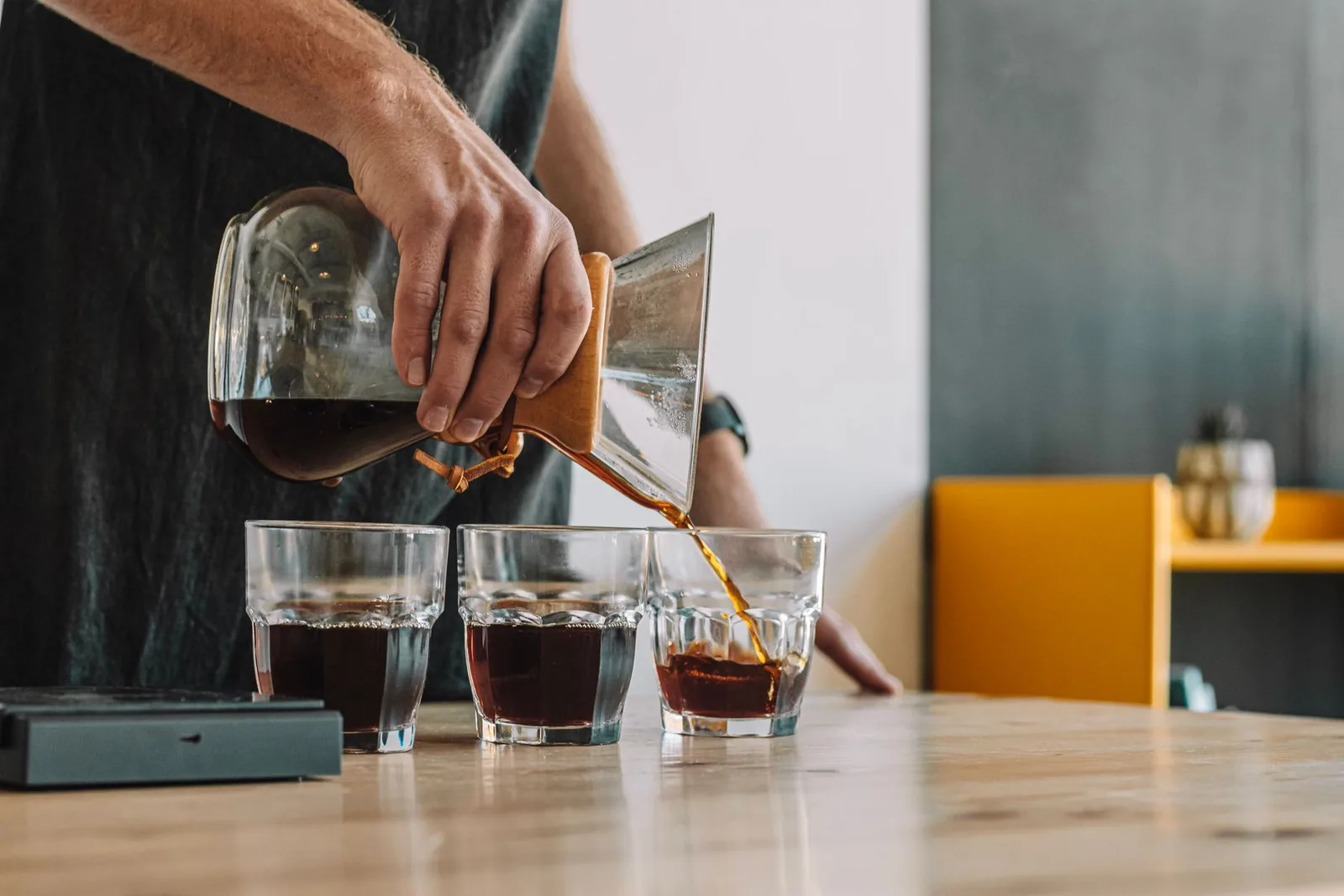
The 17 sections of this plate
Each section has its own page. The first sentence says what you will find there.
- 01What is extracted, and how it is measuredA roasted bean yields only 30 to 32% of its mass to water; the rest, cell-wall cellulose first of all, is insoluble.
- 02Seven centuries of utensils
- 03Decoction: ibrik, cezve, Turkish coffeeThe oldest method is also the only one where the grounds stay in the cup.
- 04Steeping: cloth bag, French press, tasting cupAn idea we find obvious took a century to establish itself: do not boil coffee.
- 05Gravity percolation, from De Belloy to the V60Ukers distinguishes three words that patents have confused.
- 06Filters: paper, metal, clothThe filter decides what ends up in the cup.
- 07Percolators and electric coffee makersThe pump percolator is not a true percolation, says Ukers, and the name is misleading.
- 08The siphon: steam pressure then vacuum
- 09Steam pressure: Rabaut, Loysel, the moka potIn 1822, Rabaut has a simple idea and literally turns the French coffee pot upside down: instead of letting the water descend by gravity, he uses the pressure of steam to force it upward, through the coffee.
- 10Espresso, from Moriondo to the E61Angelo Moriondo, a café owner in Turin, patents on May 16, 1884 (No. 33/256) a steam apparatus for “instantaneous” coffee.
- 11Espresso today: machines, technique, profilingProfiling has made pressure variable, that is, it no longer equals 9 bars from the beginning to the end of extraction but follows a chosen curve.
- 12The grind: grinders, fines, retentionBefore coffee can be prepared, it must be reduced to powder, and the history of that tool runs over centuries without ever really settling.
- 13MilkThe steam wand enters the bar with Pavoni, around 1905 according to the history of the trade; the only dated act is his Italian patent of 1907, which improves the Bezzera system according to Ukers, without mentioning a wand.
- 14Cold coffee and nitroCold drip, called “Kyoto-style” or “Dutch coffee,” drips water onto the grounds drop by drop for hours.
- 15Measuring: scale, refractometer, thermometer, sievesThe barista of 2026 weighs everything. The scale reading to 0.1 g with a timer and flow display (Acaia Pearl S) sets dose, brew ratio, pour rhythm and final beverage weight; Gagné has two scales run in parallel by an app to record poured flow and drained flow.
- 16TodayWhat the sources do not allow us to assert.
- 17Archive platesEngravings and photographs from William Ukers's book All About Coffee (1922), now in the public domain.
And, as an annex to the plate, the 29 methods, sheet by sheet.
Elsewhere on the site, the passages that deal with the same things as this page. Computed from the text, not picked by hand.