Extended fermentation
Directed fermentations.
What does an extended fermentation change?
Start the scene or choose a stage. The animation simplifies the mechanism; what follows gives the details and the available references.
To extend is to let the mass ferment well beyond the moment when the mucilage, the sugary flesh stuck to the parchment, has finished coming off. That moment arrives early: 21.2 hours in an open tank at 20.1 °C at Cenicafé. One carries on to 48, 72, 96 hours or more.
Read the stages without animation
- The stopping point comes earlyTo extend is to let the mass ferment well beyond the moment when the mucilage, the sugary flesh stuck to the parchment, has finished coming off. That moment arrives early: 21.2 hours in an open tank at 20.1 °C at Cenicafé. One carries on to 48, 72, 96 hours or more.
- The medium acidifiesLactic bacteria convert the remaining sugars into lactic acid: pH goes from 5.8 to 4.4 in 72 hours in a closed tank, and ends under 3.5 in fermentation chilled to 15 °C. Ethanol accumulates, about six times more concentrated at 72 hours than at 24.
- Open or closedIn an open tank, oxygen keeps entering and acetic bacteria rise to 20 to 57% of the bacteria; the mass gains 5.1 to 17.6 °C over ambient, against 0.5 to 3.7 °C in a closed tank with an airlock. The dominance of lactic bacteria depends on the tank, not on the duration: under 29% in a closed tank, over 90% at 48 hours in an open tank.
- The juice runs, the seed suffersThe leachate, the juice that runs from the mass, reaches 1,250 mL at 72 hours in an open tank and 1,400 mL at 144 hours in a closed tank, for 20 kg; if it is not drawn off, it stays in contact with the bean. The viability of the embryo holds above 80% up to 120 hours in a closed tank, but falls to 25% at 192 hours in an open tank. On overripe cherries, twenty more hours at 20 °C produced the fermento defect in seven units out of eight.
- Stop, wash, dry without delayOne stops, washes abundantly and dries without delay, in air at 40 °C down to about 11%. A coffee that cannot be dried at once stays under 15 °C, 30 hours at most, then is rinsed. Up to 192 hours in a clean tank, the effect of duration on the score is not significant.
To remember: Duration alone says almost nothing: it is read together with the tank, open or closed, the temperature and the ripeness of the cherries.
Read the full article and its sources ↓Where it is practiced
The published trials that can be cited concentrate on two countries. In Colombia, first. The Cenicafé station at Chinchiná, in Caldas, conducted fermentations of up to 192 hours. Two agroecological zones of Huila were used for whole-cherry fermentations of up to 96 hours. In Brazil, next. A farm in Paraná carried a trial in a sealed tank over 72 hours. A farm in Minas Gerais carried a trial on cherries of the Arara variety, also over 72 hours. The studies drawn on here span 2001 to 2026. The commercial practice circulates more widely in the specialty trade. No census of producers and no date of adoption can be verified in the sources read. See OMBRE.
The principle
Extended fermentation consists of letting the coffee mass ferment well beyond the usual stopping point. This point is the one where the mucilage, the layer of sugary flesh stuck to the parchment, has finished coming off the bean. It arrives early. In an open tank at 20.1 °C, Cenicafé measures 21.2 hours on its control. To extend is to carry on to 48, 72, 96 hours or more.
The first mechanism is less well established than one reads. It is written everywhere that pectinolytic enzymes cut up the pectin of the mucilage. Avallone and his colleagues measured the opposite in 2001. After twenty hours of fermentation, the pectic substances show no apparent degradation. Only a slight drop in average molar mass and a partial de-esterification are measurable. The authors speak of a restricted pectolysis and say its mechanism remains to be elucidated. What is established is that acidification weakens the polysaccharide network and changes the texture of the gel.
The medium then acidifies steadily. Lactic bacteria, tolerant of acid, convert the remaining sugars into lactic acid. The pH goes down. In a Brazilian closed tank, it goes from 5.8 to 4.4 in 72 hours. In fermentation chilled to 15 °C, it ends under 3.5.
A correction is needed on the dominance of these bacteria. It depends on the tank, not on the duration. In the Brazilian closed tank, they stay under 29% of the population. In the Colombian open tank, Junqueira and his colleagues find them above 90% after 48 hours. Lactic bacteria are microaerophilic, that is, they need a little oxygen. The anoxia of a sealed tank therefore does not favor them.
Ethanol accumulates. The Brazilian authors measure it at about six times more concentrated at 72 hours than at 24 hours. One hypothesis, and only a hypothesis, explains the late acetic acid. Certain Lactobacillus convert lactic acid into acetic acid and 1,2-propanediol. This pathway is established in Lactobacillus buchneri in silage. Its role in coffee remains assumed.
The bean remains a living seed and it suffers. Its embryo loses its viability. Its endosperm, the nutrient reserve that feeds the germ, degrades. The authors attribute this to three joint causes, without ranking them: the increased microbial activity, the anoxic medium and the high temperatures.
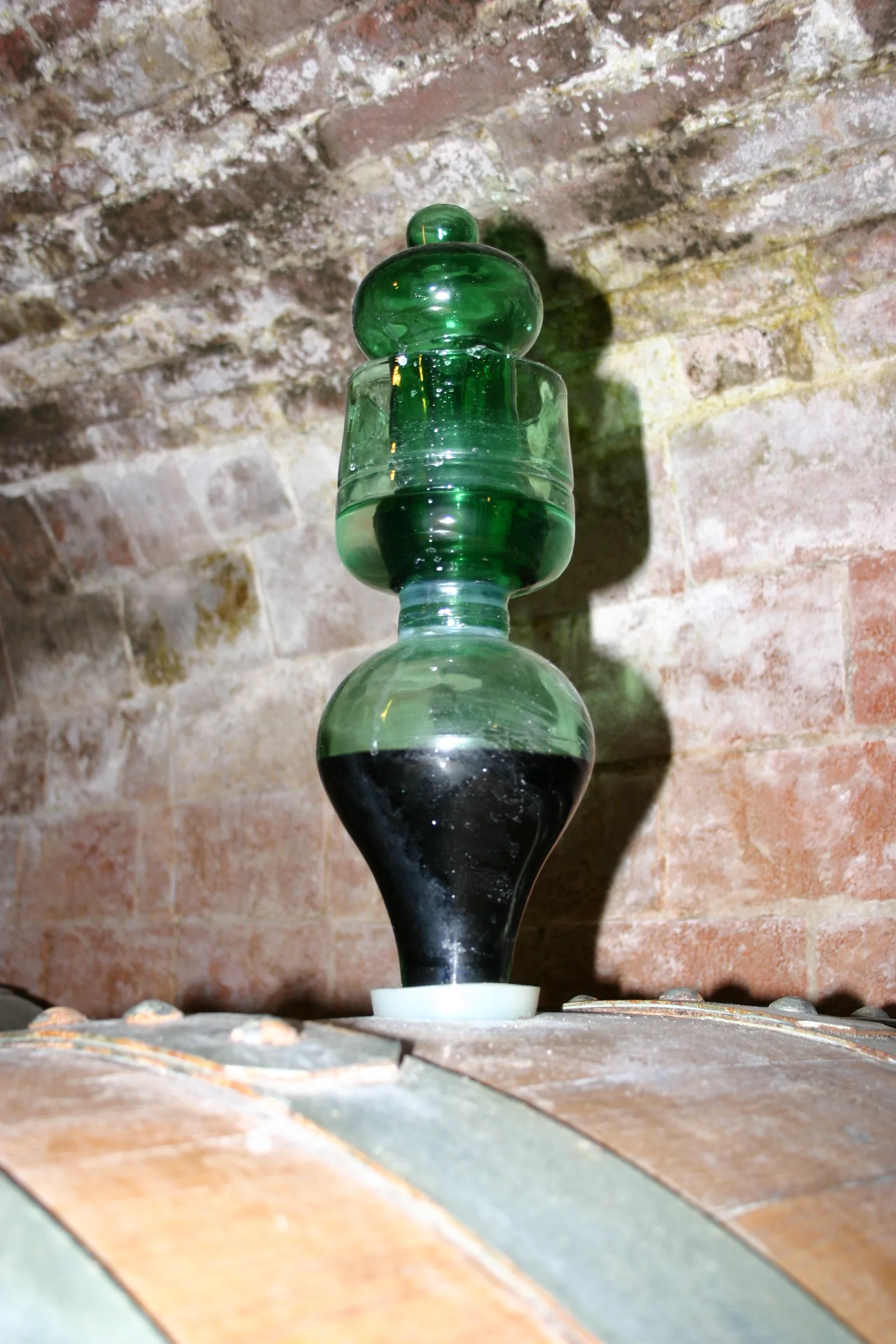
A word on vocabulary. Closed tanks sold as “anaerobic” are not purged: nobody drives the air out of them. The oxygen present is consumed by the microorganisms and the medium becomes anoxic by exhaustion. The airlock lets carbon dioxide out without letting air in. It does not make a vacuum.
The sequence
- Sorting and flotation of the cherries, then pulping or not. Both routes are documented. The pulped bean acidifies faster. The whole cherry keeps the pulp as a substrate. At Chinchiná, it gives more glucose and a lower acidity than the pulped bean. The pH gap there remains significant up to 48 hours.
- Loading into the tank. Two practices are opposed. Open tank, called semi-anaerobic: oxygen keeps entering and acetic bacteria rise to 20 to 57% of the bacterial population. Closed tank with an airlock, the valve that lets gas out without letting air in: the remaining oxygen is consumed by the microorganisms.
- Monitoring of the temperature, which governs the rest. In a closed tank, the gap with ambient stays at 0.5 to 3.7 °C. In an open tank, it rises by 5.1 to 17.6 °C. Whole cherries in an open tank exceed 30 °C from hour 48 and stay there. High temperatures favor enterobacteria at the expense of yeasts and lactic bacteria.
- Monitoring of the pH, which serves as a marker of progress. From 5.8 toward 4.4 in 72 hours in a closed tank. Under 3.5 in fermentation chilled to 15 °C. Chilling to 15 °C lengthens the breakdown of the mucilage by more than 24 hours, and brings the final acidity lower.
- Control of the ripeness of the cherries, which the commercial literature forgets. It is the factor that most often decides whether the extension succeeds or fails. See RISQUES.
- Management of leachates, the juice that runs from the mass. On 20 kg of cherries, the flow is at its maximum at 72 hours in an open tank, 1,250 mL, and at 144 hours in a closed tank, 1,400 mL. This acid juice stays in contact with the bean if it is not drawn off.
- Stopping, abundant washing, then drying without delay. The reference trials dry in air at 40 °C down to 11 ± 0.5% moisture of the parchment coffee. A coffee that cannot be dried at once must be kept under 15 °C for 30 hours at most, then rinsed before drying.
What it gives in the cup
What is measured. The Cenicafé trial over 192 hours is the clearest. Three trained tasters, SCA protocol, one sample every 24 hours. The duration of fermentation has no significant effect on the score (p = 0.3338). Neither does the tank practice (p = 0.5740). The samples score between 80.75 and 85.00 points, mean 83.14 ± 0.39. Only one shows a phenolic defect: whole cherries, open tank, 72 hours.
The other trials point the same way. On the cherry fermentations of Huila, from 0 to 96 hours, scores range from 78 to 86. The authors conclude that there is no universal optimal duration. On the Brazilian closed-tank trial, the three durations score above 84 points. The descriptors, for their part, change. The body goes from “pleasant medium” at 24 hours to “velvety, dense” at 72 hours. This trial involved only two Q Graders, certified tasters, and no blind comparison.
What is claimed. The trade attributes to long fermentations a fruity, winey or alcoholic intensity. None of the trials read here shows a significant rise in the SCA score due to extension alone. The Fermaestro trials say it another way. There the extension is 2 to 8 hours beyond the stopping point, over nine replicates. No statistical difference appears among the nine treatments. The probability of not exceeding the control, scored 81.6 points, stays at 44 to 56%. That of obtaining a defective cup stays at 0 to 11%.
What goes wrong
The fermented defect, also called vinegary (fermento and vinagre, in Spanish), is the first in Colombia. The reference study covers 580 samples of parchment coffee, taken from 162 farms in seven departments, from the 2005 to 2007 harvests. One sample in three carried a cup defect, that is 36.8%. The fermented defect affected 11.9% of samples on average, from 3% to 17% depending on the department. It alone represented 32.3% of the defects recorded, which makes it the first. It comes from acetic, propionic and butyric acids. These acids form when the breakdown of the mucilage and of the pulp remnants continues uncontrolled. Butyric acid and propionic acid are the recognized markers of over-fermentation, and give the onion note.
The least cited factor is the ripeness of the cherry. Cenicafé compared three ripeness stages of the Castillo variety, two temperatures and two extensions. On red-orange and carmine cherries, extending by 10 or 20 hours produced no measurable sensory effect. On vinotinto cherries (wine-red, in Spanish), the most advanced in ripening, the 20-hour extension at 20 °C produced the fermented defect in seven experimental units out of eight. These cherries contain less mucilage, 10.0% against 15.4%, because they dehydrate at the end of ripening. Duration alone therefore says little. It is read only together with ripeness and temperature.
On unsorted coffee, unsieved after pulping and poorly dried, with remnants of pulp and dried cherries, Cenicafé measured the cascade hour by hour. Six judges, twelve replicates per sample. The dominant cup defect follows this order.
- 24 hours: sour.
- 40 hours: sour and winey.
- 64 hours: soured pineapple.
- 72 hours: rancid and onion.
- 88 hours: foul-smelling, with stinker then affecting 100% of cups.
Mind the scope of these figures. They describe simulated bad practices, not a clean long fermentation.
The other risks are physical or physiological rather than flavor-related, and this is the least known point.
- Drop in the proportion of sound beans, marked in an open tank and growing with duration.
- Loss of viability of the embryo. It stays above 80% up to 120 hours in a closed tank, but falls to 25% at 192 hours in an open tank.
- Rise in physical defects from 72 hours on the cherry fermentations of Huila, with a drop in the proportion of sound beans.
- Self-heating in an open tank, which speeds up everything and pushes the population toward enterobacteria.
- Vertical heterogeneity of the tank. At 72 hours, lactic acid goes from 2.18 g/L at the top to 5.06 g/L at the bottom.
- Mixing of several days of pulping in the same tank, which produces vinegary beans.
Benchmarks
- Control fermentation at 20.1 °C, Cenicafé21.2 ± 1.2 h
- Window judged safe in cherry fermentation (Huila)24 to 48 h, physical defects rising from 72 h
- Effect of duration on the SCA score up to 192 h, in a clean tanknot significant, p = 0.3338
- Ethanol in the beanabout x6 between 24 h and 72 h
- Viability of the embryoover 80% up to 120 h in a closed tank, 25% at 192 h in an open tank
- Lactic bacteriaunder 29% in a closed tank, over 90% at 48 h in an open tank
- Overripe cherries, 20 h of extension at 20 °Cfermented defect in 7 units out of 8
- Stinker on unsorted, poorly dried coffee100% of cups at 88 h