Plate IX · section 02 of 22
Three centuries of gestures
THE PROCESS IN MOTION
How have processing gestures changed?
Start the scene or choose a stage. The animation simplifies the mechanism; what follows gives the details and the available references.
Dry, then pound
Between 1690 and 1710, in Java, the VOC, the Dutch East India Company, has the cherries dried in the sun and then pounded. In Yemen, La Roque describes in 1716 the whole fruit dried on the terraces and the husk sold separately; in 1732, he specifies that the dried fruit is pounded in wooden mortars to separate the bean.
Read the stages without animation
- Dry, then poundBetween 1690 and 1710, in Java, the VOC, the Dutch East India Company, has the cherries dried in the sun and then pounded. In Yemen, La Roque describes in 1716 the whole fruit dried on the terraces and the husk sold separately; in 1732, he specifies that the dried fruit is pounded in wooden mortars to separate the bean.
- Pulp, ferment, washFrom the 1780s to the 1840s, in the Antilles and Central America, hydraulic pulping mills, masonry fermentation tanks and washing in channels appear; Laborie describes the wet process of Saint-Domingue in 1798. In 1881, Thurber describes in Ceylon and Java the disc pulper, the tanks and the hullers.
- Machines, a sanitary choiceMachines multiply: Guardiola's rotary dryer in Guatemala in 1872, pulpers and hullers between 1900 and 1930, Pinhalense founded in Brazil in 1949. In 1955, Coste shows that the washed process kills the coffee berry borer, the insect that bores into the cherry, whereas the natural multiplies it on the drying areas: the choice of process is also a sanitary one.
- Less pollutionIn the 1980s and 1990s, Cenicafé, in Colombia, develops mechanical demucilaging, BECOLSUB and then Ecomill, with 90% less pollutant load. In 1990 and 1991, after the dissolution of the Brazilian Coffee Institute, Brazil adopts the semi-dry process, and Pinhalense is credited with the first machine.
- Measure, steer, regulateSince 2013, measurement has taken hold: Cenicafé publishes the Fermaestro, a cone that makes the washing point objective; Lallemand launches in 2014 the first yeast selected for coffee; micro-oxygenation arrives in Nicaragua and then in Colombia. Competitions then regulate additions, and in 2025 Cenicafé compares an open tank and a hermetic tank over 192 hours.
To remember: In three centuries, the gesture goes from the pestle to the pulping mill, from the pulping mill to the machine, then from the machine to measurement.
Read the full article and its sources ↓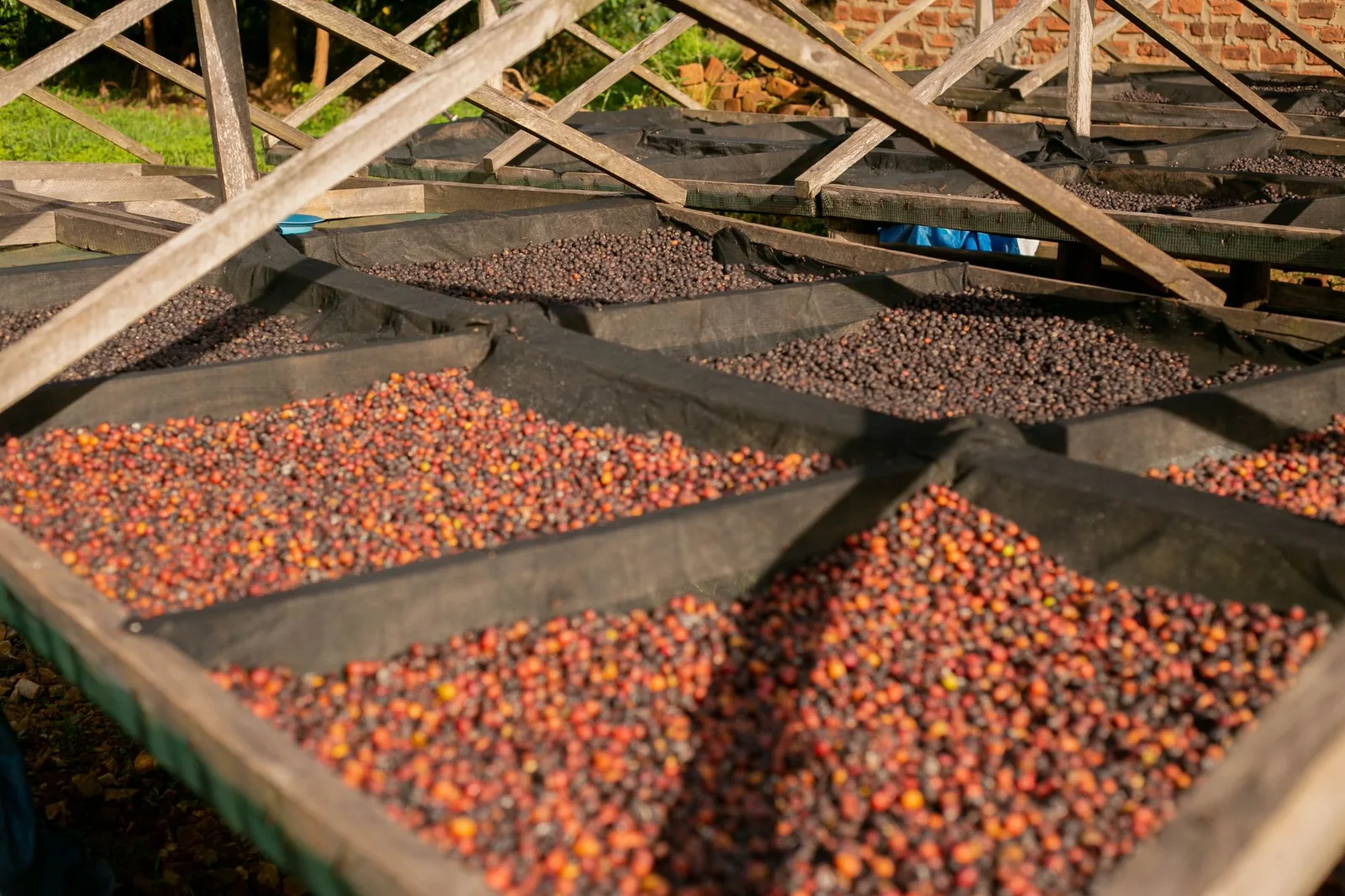
- 1690s-1710sJava: the VOC has the cherries dried in the sun and then pounded; La Roque (1716) describes in Yemen the drying of the whole fruit on terraces and the sale of the husk, the qishr.
- 1732La Roque, Traité historique du café: the dried fruit “is pounded in wooden mortars” to separate the bean.
- 1780s-1840sThe Antilles and Central America: first hydraulic pulping mills, masonry fermentation tanks, washing in channels. Laborie (1798) describes the wet process of Saint-Domingue.
- 1881Thurber describes in Ceylon and Java the disc pulper (Walker), the tanks, the drying on barbecues and the Gordon hullers.
- 1894Walsh, Coffee: its History, Classification and Description, compares the Brazilian dry process with the Central American wet process.
- 1900-1930Gordon pulpers, Guardiola (rotary dryer, Guatemala, 1872), Engelberg and O'Krassa hullers; Pinhalense founded in 1949 in Brazil.
- 1955Coste: the wet process kills the coffee berry borer, the dry process multiplies it on the drying areas; the choice of process is also a sanitary one.
- 1980s-1990sCenicafé, Colombia: BECOLSUB and then Ecomill, mechanical demucilaging with 90% less pollutant load.
- 1990-1991Brazil: pulped natural (cereja descascado, in Portuguese) after the dissolution of the Brazilian Coffee Institute; Pinhalense credited with the first machine.
- 2013Cenicafé publishes the Fermaestro, a cone that makes the washing point objective.
- 2014Lallemand launches the first yeast selected for coffee, Lalcafé Oro.
- 2015Saša Šestić wins the World Barista Championship with a Colombian lot processed by carbonic maceration.
- 2017-2019Micro-oxygenation (MOX) in Nicaragua and then in Colombia, with the author of this site.
- 2020-2022Hadj Salem (CIRAD) measures the transfer of aromas from the medium to the bean; Vale et al. measure a Brazilian anaerobic tank.
- 2023-2024Cup of Excellence forbids any foreign addition (yeasts and mosto allowed); the SCA allows any addition made before the green coffee stage; Best of Panama disqualifies four infused coffees.
- 2025Cenicafé compares an open tank and a hermetic tank over 192 hours; de Abreu compares two yeasts on four varieties.
Read nextProcess sheetSelected yeastsBoth mention cenicafé, yeast and yeasts.Process sheetCo-fermentation and infusionBoth mention mosto, yeast and yeasts.