Fermentation in a closed tank, known as anaerobic
Directed fermentations.
What happens in a closed tank?
Start the scene or choose a stage. The animation simplifies the mechanism; what follows gives the details and the available references.
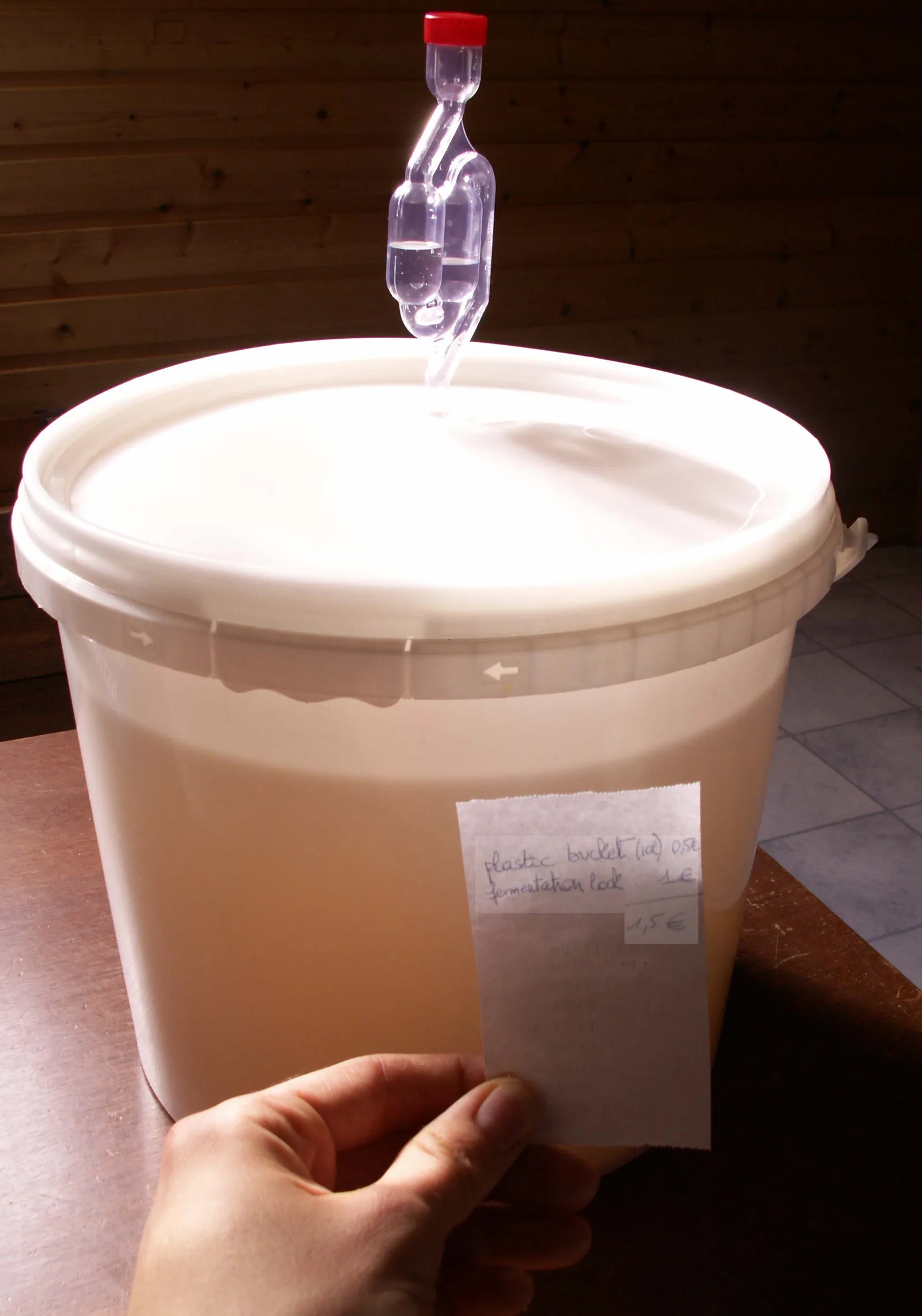
An airtight tank is filled with pulped coffee or whole cherries, then closed with a one-way valve, which lets gas out without letting air in. Nobody drives out the trapped air. Pulping opens up the mucilage to microorganisms, the layer of sweet flesh stuck to the parchment; the skin of a whole cherry slows these exchanges.
Read the stages without animation
- Loading, closing, fitting the valveAn airtight tank is filled with pulped coffee or whole cherries, then closed with a one-way valve, which lets gas out without letting air in. Nobody drives out the trapped air. Pulping opens up the mucilage to microorganisms, the layer of sweet flesh stuck to the parchment; the skin of a whole cherry slows these exchanges.
- Oxygen runs out in under an hourThe microorganisms of the fruit, and the fruit itself, which still respires, consume the trapped oxygen. With pulped coffee in an airtight bin, dissolved oxygen falls from 100% to 0% in fifteen to sixty minutes. That is the moment that tips the metabolism, not the closing of the lid.
- Acids, alcohol, gas: the CO₂ leaves through the valveDeprived of oxygen, yeasts and bacteria ferment the sugars of the mucilage: lactic acid bacteria make lactic acid from them, yeasts make ethanol and carbon dioxide. The gas builds up, maintains the anoxia and leaves through the valve; without it, the tank would build up pressure. The pH starts at 5.5 to 5.8, falls to about 3.8 at 24 hours and settles at about 3.6 after 36 hours.
- One tank, several fermentationsThe tank is not homogeneous: in a vertical 175 kg tank, lactic acid is 5.06 g/L at the bottom against 2.18 g/L at the surface at 72 hours. Published durations range from 12 to 192 hours and their results contradict each other: a Colombian trial sees the score rise up to 96 hours, Cenicafé sees long durations degrade quality. Past the useful window, butyric and propionic acids give onion notes.
- Opening, washing if needed, drying fastThe mass comes out acidic, wet and loaded with residual sugars. It may be washed, then it is dried: slow drying after a long fermentation opens the door to molds and to the phenolic defect, that medicinal taste.
To remember: The name promises an absence of oxygen; the reality is a depletion: the trapped air is consumed, then the carbon dioxide produced leaves through the valve.
In history: The origin of the process is not established: its attribution to the 2015 world barista champion circulates only in the retailers’ press.
Principle diagram: the initial air is not necessarily driven out. The gas formed can leave through the valve.
Acid is not distributed the same everywhere
In the trial by Vale et al. (2023), after 72 hours, the concentration of lactic acid varies with the height in the tank:
These values describe this experimental lot, not all SIAF tanks. The text below also compares a study in open and closed tanks.
Where it is practiced
The process is documented by research in Brazil and Colombia. In Brazil, the published trials come from Paraná and Minas Gerais. A Paraná trial worked with 175 kg tanks in Jacarezinho, using Catuaí Amarelo IAC 86 harvested in July 2021. The Minas Gerais trials use 200-liter bioreactors, and cover municipalities such as Monte Carmelo, Três Pontas, Carmo de Minas and Lajinha. In Colombia, two teams are working. Cenicafé, the national coffee research center, compared open and closed tanks over 192 hours in Huila. The Universidad Surcolombiana, also in Huila, tracked dissolved oxygen and pH over five fermentation durations. Work also exists on Brazilian canephora, the Conilon variety. The publications found on this process span 2022 to 2026.
The principle
The name promises an absence of oxygen. The reality is depletion. An airtight tank is filled with whole cherries or pulped coffee. It is closed, then an airlock is fitted, a valve that lets gas out without letting air back in. Nobody drives out the air. The trapped oxygen is consumed by the microorganisms of the fruit, and by the fruit itself, which still respires. A Colombian trial tracked dissolved oxygen in airtight bins of pulped coffee. It falls from 100% to 0% in fifteen to sixty minutes. The medium thus becomes anoxic by depletion, not by purging.
Once the oxygen is gone, yeasts and bacteria switch to fermentative pathways. The sugars of the mucilage, the layer of sweet flesh stuck to the parchment, enter glycolysis. This splits glucose into pyruvate. In lactic acid bacteria, pyruvate becomes lactic acid. In yeasts, it becomes ethanol and carbon dioxide, by decarboxylation followed by reduction. The dominant lactic bacteria here, Weissella and Leuconostoc, are heterofermentative. They follow the phosphoketolase pathway, which yields acetate and carbon dioxide in addition.
This carbon dioxide builds up and maintains the anoxia. The pH falls. Acetic acid bacteria need oxygen to oxidize ethanol into acetic acid. Cenicafé finds them more abundant in open tanks than in closed ones. In closed tanks, they make up less than 1% of the sequences read. The acetic acid measured would then come from lactobacilli breaking down lactate, a mechanism presented as a hypothesis by its authors. Finally, yeasts esterify alcohols and acids, forming esters such as ethyl acetate and amyl acetate.
What the closed tank leaves in the bean, molecule by molecule
This sheet describes in detail what happens during closed-tank fermentation, the depletion of oxygen, the fall in pH, the pathways followed. What it lacks is the result, that is, the composition of the resulting green coffee, compared with that of other methods. Hackler and Särchen give it, after Pereira and colleagues.
According to this source, closed-tank fermentation strengthens the activity of lactic acid bacteria and yeasts, and therefore the production of aroma compounds, and an organic composition different from that of other methods emerges: more chlorogenic acid, more sucrose, more lactic acid and more trigonelline, and less glucose.
Each of these five directions deserves a word, because they do not all say the same thing.
- Less glucose, more sucrose: The pair is consistent with the energy balance of fermentation. Glucose is the directly consumable form, the one that enters glycolysis; sucrose is a reserve, made of a glucose and a fructose bound together, which must first be split. A closed tank, where the organisms must burn a lot of material for little energy, first exhausts what is immediately available. Sucrose matters for what follows: it is the main precursor of the browning reactions in roasting.
- More lactic acid: This is the expected signature and the least surprising, since anoxia favors lactic acid bacteria. It confirms through chemistry what the sheet establishes through sequencing.
- More chlorogenic acid and more trigonelline: These two are compounds of the bean and not of the mucilage, and that is what makes the result interesting. Their increase cannot be explained by an input from the bath; it suggests either less degradation or a reaction of the bean itself. Trigonelline is a major aroma precursor, which breaks down in roasting into roasted nitrogen compounds.
Two sensory profiles accompany these measurements in the same source: a natural run in a closed tank, described as floral, fruity, winey, woody, caramel and alcoholic; a washed coffee run in a closed tank, described as floral and fruity, with citrus and sugarcane notes in addition. With Saccharomyces cerevisiae used as a starter culture, citrus, floral, plum or peach aromas emerge in addition.
These data must be carried with their caveat, and it is a serious one: they are second-hand results, reported by Hackler and Särchen after Pereira, and the experimental conditions, the number of lots, the presence of a control and the nature of the panel are not given in the text available. The directions are worth writing down, the magnitudes are not. Pereira’s publication will have to be read before these five movements are entered into the numerical benchmarks of this sheet.
Sources for this passage: Hackler and Särchen, chapter 6, p. 91, after Pereira and colleagues. Composition to be checked at the source before figures are taken up.
The sequence
1. Harvest and sorting. A Colombian trial compared three preparations before loading into the tank: unsorted cherries, sorted cherries rinsed with drinking water, sorted cherries disinfected with Timsen. Mean scores range from 82.21 to 83.85 points, the disinfected lot scoring highest. The 1.64-point gap is not statistically significant. Sorting changes the starting microbial load, but this trial does not show that it changes the score.
2. Choice of whole cherry or pulped coffee. Pulping gives immediate access to the mucilage and speeds up acidification. The whole cherry keeps its skin, which slows exchanges. The choice weighs on the acids produced: in the Brazilian trial from Minas Gerais, whole-cherry coffee ends at about 80 mg/g of lactic acid, against 60 mg/g for pulped.
3. Loading into an airtight tank fitted with a one-way valve. The published setups come in three sizes.
- Cylindrical polypropylene tanks 82 cm high by 47 cm in diameter, loaded with 175 kg of pulped coffee.
- 200-liter polypropylene bioreactors, disinfected with peracetic acid.
- 30-liter high-density polyethylene bioreactors, sacrificed one by one at each sampling.
4. Choice of dry or submerged route. Without water, the mass ferments as it is. With water, the published trials add 30% water, relative to weight or volume depending on the team. Water lowers the final pH more than the dry route. It does not alone decide the acid profile: in the Minas Gerais trial, the dry route also produces a lot of lactic acid.
5. Oxygen depletion. Fifteen to sixty minutes on pulped coffee in an airtight bin. That is the moment that tips the metabolism, not the closing of the lid.
6. Fermentation. The published durations are 12, 24, 48, 72, 96, 144, 180 and 192 hours. Duration governs the depth of acidification and the quantity of metabolites produced. It does not govern the cup score in a single direction, as the CUP field shows.
7. Temperature. In the 200-liter bioreactors, the mass starts at 22 to 23 degrees and reaches 26 to 28 degrees after about twenty hours. These bioreactors were exposed to the sun, and one lot dropped to 17 degrees along the way. The share due to microbial work is therefore not isolated. The Colombian trial, run on 0.5 kg bins, concludes on the contrary that the mass does not give off enough heat to move away from ambient temperature.
8. Tracking the pH. Start between 5.5 and 5.8. About 5.0 at ten hours, 4.3 at fifteen hours, 3.8 at twenty-four hours. After thirty-six hours, the pH settles at about 3.6. This plateau is the useful signal: it says that the accessible sugars are largely consumed and that the acidity inhibits what follows. The starting pH changes the shape of the curve. Above 5.5, the fall is slow during the first nine hours; below it, this slow phase lasts less than six hours.
9. Opening, optional washing, then drying. The mass comes out acidic, wet and loaded with residual sugars. The drying that follows decides a large part of the result, and belongs to another sheet.
What it gives in the cup
What is measured. The published trials compare a closed tank with a control on the same lot, scored according to the Specialty Coffee Association protocol. A 2024 Colombian trial finds a score that rises with duration:
- 12 hours: 80.96 points
- 24 hours: 81.48 points
- 48 hours: 82.06 points
- 72 hours: 83.25 points
- 96 hours: 84.60 points
The balance attribute follows the same slope, from 7.25 to 8.08 points. A 2024 Brazilian trial gives 87.50 points for whole cherry fermented 96 hours without water, against 83.30 for its control. The same trial ranges from 78.95 to 87.50 points, and four of its eight treatments on pulped coffee do worse than their control. A 2022 Brazilian trial places all its lots at 84 points or more. A study on selected yeast reports a gain of 7.1 points, to 84.4 points in four days, but it concerns Coffea canephora and not arabica.
The descriptors do not all converge on fruit. A 2022 study concludes that self-induced anaerobiosis intensifies the fruity attribute. Cenicafé finds tropical notes, mango, pineapple and peach, more often in closed tanks, and citrus and berry notes more often in open tanks. But a 2024 Brazilian trial measures the opposite in spontaneous fermentation: 48 hours gives woody notes, 72 hours chestnut notes. Fruity dominance appears there only with an inoculated yeast. Volatile analyses find esters, including ethyl acetate and amyl acetate, and, after roasting, more furfural and pyrazines.
What is not measured. The favorable slope is not universal. Cenicafé, which went up to 192 hours, obtains the opposite: short durations in a closed tank give the best quality index, and long durations degrade it. The two results say that the optimal duration depends on the lot and the container, and is not known in advance.
Finally, the panels in these studies are trained, but rarely blind to the treatment. One of the trials cited uses only two certified tasters. An SCA score is not a triangle preference test. The size of the gains reported therefore remains to be confirmed.
What goes wrong
Over-fermentation is the main defect. When fermentation goes past the useful window, bacteria produce butyric acid and propionic acid. These acids give the coffee notes described as onion. The trade calls the defect over-fermented. The reference work on the volatiles of this defect dates from 1997. A 2019 publication reports the belief that Bacillus produce propionic acid, while noting that none of its own Bacillus strains produced any.
Long duration punishes quality. Cenicafé measures a drop in its quality index for extended durations. This index combines the SCA score, the share of sound beans, the viability of the embryo and the yield factor.
The closed tank protects the embryo better than the open tank. This is the opposite of what the trade often assumes. In a closed tank, Cenicafé measures embryo viability above 80% up to 120 hours. In an open tank, degradation starts after 48 hours and viability falls to 25% at 192 hours. A bean whose embryo is dead behaves badly in drying and storage.
The tank is not homogeneous. In a vertical 175 kg tank, the lactic acid measured at 72 hours is 5.06 g/L at the bottom against 2.18 g/L at the surface. Acetic acid is 1.00 g/L against 0.40 g/L. The bottom therefore produced more than twice as much acid as the top. The authors note, however, that the microbial communities do not differ from one layer to another. So it is not the population that stratifies, it is its activity.
Not all the sugars are consumed. At the bottom of this same tank, glucose goes from 9.12 to 4.47 g/L in 72 hours. Fructose goes only from 20.65 to 18.67 g/L. Lengthening the duration is not enough to exhaust the mucilage, and leaves a substrate available for what follows.
The closed tank does not automatically select the right microorganisms. In the same trial, the Enterobacteriaceae family makes up about 85% of the bacterial population during the first twenty-four hours. Lactic acid bacteria stay under 29% at 48 hours. A Colombian open-tank fermentation, by contrast, sees them exceed 90%. The commercial story of an environment dominated by yeasts and lactic bacteria does not describe what these measurements show.
Carbon dioxide builds up. A tank with no outlet rises in pressure. The one-way valve is not an accessory, it is the safety device of the process.
Finally, emptying the tank is a critical point. The mass is wet, acidic and sugary. Slow drying after a long fermentation opens the door to molds and to the phenolic defect.
Benchmarks
- Dissolved oxygenfrom 100% to 0% in 15 to 60 minutes, pulped coffee in an airtight bin
- pH5.5 to 5.8 at the start, 3.8 at 24 hours, plateau around 3.6 after 36 hours
- Published durations12, 24, 48, 72, 96, 144, 180 and 192 hours
- Mass temperature in a 200-liter bioreactor22 to 23 degrees at the start, 26 to 28 degrees at the peak
- SCA score by duration80.96 points at 12 hours against 84.60 points at 96 hours
- Stratification of a 175 kg tank at 72 hours5.06 g/L of lactic acid at the bottom, 2.18 g/L at the surface
- Embryo viabilityabove 80% up to 120 hours in a closed tank, 25% at 192 hours in an open tank