Dried pulped honey
The intermediate processes.
What does dried pulped honey designate?
Start the scene or choose a stage. The animation simplifies the mechanism; what follows gives the details and the available references.
Taken at its word, pulped, kept with its mucilage and dried, the name describes a pulped natural: the cherry huller removes the skin, and the lot keeps all its mucilage. A first reading puts the word dried on the practice: dried slowly, in a thick layer, it may have taken twenty days.
Read the stages without animation
- Reading 1: a slowly dried pulped naturalTaken at its word, pulped, kept with its mucilage and dried, the name describes a pulped natural: the cherry huller removes the skin, and the lot keeps all its mucilage. A first reading puts the word dried on the practice: dried slowly, in a thick layer, it may have taken twenty days.
- Reading 2: a mill black honeyA second reading makes it a dark position on the honey scale: a lot run through an adjusted demucilager, then dried in the shade in eight days. In a dryer at 40 °C, the same coffee dries in 15 to 37.5 hours: used alone, the word dried covers a ratio of one to fifty.
- The same dark parchmentA mucilage that dries slowly browns and hardens into a dark lacquer that glues the parchments together: both lots come out dark, and no published measurement tells them apart. Only a mucilage that dries fast leaves on the parchment a thin, clear, brittle film.
- The two numbers that are missingThe trial that would give the name a meaning fits in one sentence: weigh the dry matter left on the parchment at the end of drying, relate it to the mass of parchment, and publish this number with the drying duration. A balance and a drying oven, the apparatus that dries a sample thoroughly, would suffice.
To remember: The name does not say which of the two levers moved, the share of mucilage or the drying speed: it therefore describes nothing reproducible.
Read the full article and its sources ↓Where it is practiced
This question must be answered in a way that will displease, and said at once: this appellation has no geography of its own, because it has no definition of its own. A process can be located; a floating word cannot.
What can be located are the two practices to which the word refers in turn, and they are treated elsewhere on this site. Pulped natural (cereja descascado, in Portuguese) has its home in Brazil, in Minas Gerais and the Mogiana of São Paulo, where it answers a specific harvest constraint, the stripping of the branch that brings all ripeness stages in mixed. The colored honeys have their home in Costa Rica and El Salvador, in micro-mills installed on the farm, and spread from there to Panama, Guatemala, Peru, Uganda, Vietnam, Myanmar and Chinese Yunnan. The two corresponding sheets carry the dates, the names and the figures.
What is verifiable about the name itself is short, and here it is. No search conducted for this sheet found “dried pulped honey” used as a process category by an industry institution, a peer-reviewed journal, a national standard or an importer offer list. Searches on the exact expression systematically return pages that talk about honey or pulped natural without ever using the term. The Coffee Quality Institute, which trains professionals in post-harvest processing, classes processes according to the part of the fruit that is removed, and its breakdown names washed, natural, semi-washed and pulped natural or honey; it does not name this one. The Specialty Coffee Association, which overhauled its tasting standards in 2024, publishes no taxonomy of processes at all.
An absence of trace is not proof of nonexistence, and this must be said so as not to conclude too fast. The coffee trade creates names faster than it documents them: the sheet devoted to honeys thus lists three recent appellations, pink honey, orange honey and golden honey, which circulate with no published definition. Dried pulped honey belongs to this family of names. What can be established is not that it designates nothing, it is that nothing public says what it designates.
The principle
Let us begin by taking the appellation at its word, since that is the first thing a buyer will do.
Three terms make it up. Pulped means pulped: the skin and outer flesh of the cherry have been removed. Honey refers to the mucilage, that layer of viscous flesh, rich in pectins and sugars, which stays stuck to the parchment after pulping, and which Central American producers nicknamed honey because of its appearance. Dried means dried.
Put end to end, the three words describe the following: a coffee pulped, kept with its mucilage, and dried that way. That is the exact definition of pulped natural. Read literally, the appellation is therefore a pleonasm: it adds nothing to a name that already exists, since a pulped natural is by construction dried with its mucilage. If the term says something more, that something lies elsewhere than in its letter.
Two readings circulate, and they do not overlap.
The first puts the word dried on the drying practice. It reads the appellation as a pulped natural qualified by the way it was dried: slowly, in a thick layer, in the shade, to the point that the mucilage has time to harden on the parchment instead of falling away as dust. It is a reading of practice. It is coherent, and it has a merit: it names the only lever that remains when the proportion of mucilage is not adjusted, which is precisely the case of Brazilian pulped natural, where the skin is removed and nothing else.
The second puts the word dried on the state of the mucilage itself, and reads the appellation as a position on the honey scale, on the dark side. It then makes it a neighbor, or a synonym, of black honey. It is a reading of recipe.
These two readings do not describe the same lot. A slowly dried pulped natural may have kept a hundred percent of its mucilage and taken twenty days; a Costa Rican mill black honey may have been obtained by adjusting a demucilager and drying in the shade for eight days. Both will come out dark. Neither describes what the other describes.
The underlying reason why this name cannot stabilize is already established elsewhere on this site, and it must be recalled here because it governs everything. The visible result of a honey depends on two independent levers. The first is the quantity of mucilage left, which is set at the demucilager. The second is the drying speed, which is set by the thickness of the layer, the frequency of turning and the shading. Both lead to the same place: a dark, sticky parchment. A name that does not say which of the two levers was moved describes nothing reproducible. Adding an appellation to a scale that itself has no published threshold cannot fix that scale; it adds a graduation to a ruler without units.
The state of the sources is, moreover, worse still than what the sheet on honeys established. It listed seven mutually incompatible color scales. An eighth was found for the present sheet in the professional literature: white honey at 10 to 25 percent of mucilage retained, yellow at 40 to 60, red at 70 to 80, black at nearly a hundred. It does not overlap with any of the other seven. Two of the scales already listed, both peer-reviewed, differ by a factor of two on the sole definition of red honey.
It remains to say what really exists behind the name, because there is something, and that something is physical. A mucilage that dries fast forms on the parchment a thin, clear, brittle film, which largely comes off at hulling. A mucilage that dries slowly loses its water while its sugary fraction continues to be consumed and transformed: it browns, it hardens, and it ends up as a dark lacquer that glues the parchments together and has to be broken. These two states are distinguished by eye and by touch. They are distinguished by no published measurement. There exists, to this sheet's knowledge, no published method making it possible to say that a lot carries sixty and not seventy-five percent of its mucilage, nor any measurement of the dry matter left on the parchment at the end of drying. The percentages announced in scientific articles are protocol instructions; those announced by producers are machine settings or estimates by eye.
The sequence
Since the name sets no protocol, what follows describes what a lot sold under this appellation actually goes through, retaining only the values actually published. The steps common to pulped natural and honeys are treated in detail in their respective sheets; this one takes up only what decides the dark position.
Harvest is the first constraint, and it is heavier here than anywhere else. Nothing will be washed, so nothing that enters the mucilage layer will come out of it. The published protocols require ripe cherries, checked with a refractometer, that instrument which measures the dissolved sugar of a liquid by the way it bends light. The thresholds read in this site's directed fermentation protocols stay above 20 degrees Brix.
Flotation sorting follows. Hollow, dry or pierced cherries float and are set aside. This sorting governs the baseline level of the lot, because dry and attacked fruits are those that carry the most fungal contamination, and because, in this route, nothing downstream will catch them: there is no tank or washing channel to separate a second time.
Pulping is done without water or with very little water. In Brazil, the huller (descascador, in Portuguese) presses the cherry against a grid and only the skin of ripe fruits gives way, the green ones coming out whole through another chute: pulping here is a ripeness sorter as much as a pulper. A setting that is too tight also crushes the greens and brings into the lot the astringent beans that the process was supposed to set aside.
It is at the next step that the two schools part ways, and it is the only step that would give the name a content. The mechanical school adjusts a demucilager, a machine that rubs the parchment to tear off part of the mucilage, and decides the color through this setting. The drying school leaves a hundred percent of the mucilage on all its lots and decides the color later, by the drying practice alone. A lot sold as dried pulped honey should say which of the two it followed. Almost none does.
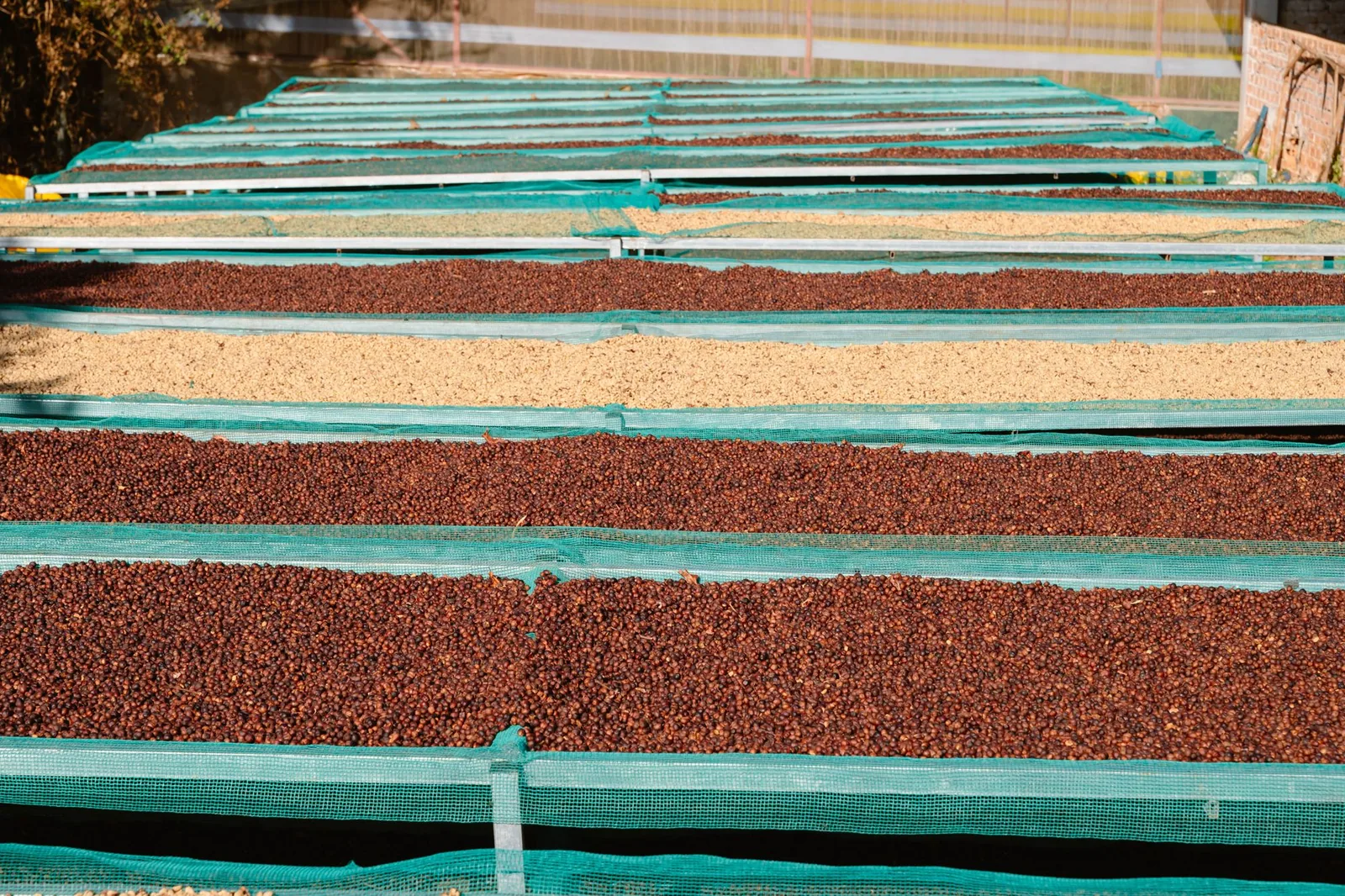
Putting on the drying surface comes next, and thickness is the first parameter. The parchment enters at about 45 to 50 percent moisture on a wet basis, that is, relative to the total mass of the wet bean and not to its dry matter. A technical guide from a Brazilian cooperative gives 7 liters per square meter for pulped natural, against 14 for natural coffee: the layer is half as thick because the mucilage glues the parchments together and a thick layer sets in blocks. Cenicafé gives for parchment in sun drying a range of 2 to 10 centimeters. These values come from different sources and cannot be converted into one another.
Turning governs two things at once, the uniformity of moisture and the loosening of agglomerated beans. The same Brazilian guide recommends up to sixteen turnings on the first day, once the surface water has gone. At the other extreme, the Costa Rican black honeys described by the trade press are stirred very little, which deliberately prolongs fermentation under the layer. Both practices are claimed, neither is compared with the other in a trial.
Shading is the lever specific to the dark positions, and it is treated in the sheet on shade drying. Suffice it to note here that it acts on the same quantity as thickness and turning: the evaporation rate, and so the length of time the lot stays moist enough for microorganisms to work in it.
The duration follows from everything above. A Costa Rican yellow honey is given at about 8 days by the sector's official communication. A Salvadoran black honey is described at about 25 days in a thin layer on shaded raised beds. A Chinese controlled trial run at 25 degrees and 75 percent relative humidity gives 15 days for red and 22 for black. A full mechanical hot-air drying capped at 40 degrees takes pulped natural from 45 to 50 percent down to 11 to 13 percent in 15 to 37.5 hours, which shows that the word dried, used without its practice, can cover a ratio of one to fifty in duration.
The end of drying aims at 10 to 12 percent moisture, the published trials stopping between 11 and 13. This is not a comfort figure: it is the point where water activity, that is, the share of water really available to a microorganism, falls to around 0.60, the threshold below which molds no longer develop.
Finally comes the rest in parchment, then hulling, then sorting of the green. On a lot with a dark, hardened mucilage, hulling is more demanding than on a washed one, because the lacquer sticks and a badly adjusted huller breaks instead of splitting.
The trial that would give the name a meaning fits in one sentence, and it has never been published: weigh the dry matter left on the parchment at the end of drying, relate it to the mass of parchment, and publish this number next to the drying duration. Two numbers, a balance and a drying oven. As long as they are missing, no appellation of color or practice describes a lot.
What it gives in the cup
There is no tasting trial run on lots bearing this appellation, for the obvious reason that no protocol says what it covers. What follows therefore reports what has been measured on the two neighboring practices, and it must be kept in mind that these results do not carry over as is to a bag labeled with an undefined name.
What is measured on the proportion of mucilage comes from three Chinese works on Yunnan arabica, detailed in the sheet on honeys. The first finds black honey and anaerobic fermentation ahead of the other treatments on mouthfeel, balance and overall score. The second, which compares five retention rates, finds the highest relative content of volatile compounds not at maximum retention but at an intermediate level, defined there as 75 to 80 percent, with thirteen compounds exceeding the odor contribution threshold. The third identifies 1,682 metabolites in the green bean and shows that the removal rate significantly changes the profile of non-volatile compounds, above all amino acids, organic acids, phenolic acids and sugars. These three works measure an effect of the proportion of mucilage, not an effect of an appellation.
What is measured on pulped natural comes from elsewhere. Duarte, Pereira and Farah compared in 2010 the semi-dry route and the washed route on seventeen Brazilian cultivars, assaying by liquid chromatography nine chlorogenic acids, caffeine, trigonelline and sucrose. The semi-dry route gives more sucrose, fewer chlorogenic acids and less trigonelline, with no difference in caffeine. This result matters because sucrose is the raw material of the two browning routes at roasting, the Maillard reaction between reducing sugars and amino acids on one side, caramelization on the other. But this study assayed, it did not taste: the link to a sweeter cup remains a hypothesis.
One measurement even goes against the most widespread claim. Lima and his collaborators, comparing in 2005 in southwestern Bahia the same Catuaí Amarelo as natural, as pulped natural and as fermented pulped (despolpado, in Portuguese), find a lower pH in the pulped natural than in the fermented pulped, so a more acidic bean. The pH of a green bean and the acidity perceived in the cup are not the same measurement, and the two must not be confused. But nothing in these figures supports the commercial statement of low acidity.
What is claimed, finally, is always the same fourfold statement: high sweetness, round body, low acidity, honey or cane aroma, all the more marked as the color is dark. No trial comparing several positions of the scale on a single lot, a single farm and a single year, with a panel and replicates, was found. The proportionality between color and intensity in the cup, which is the sales argument of this whole family of processes, is demonstrated nowhere.
The practical consequence must be drawn, and it is severe. A buyer who recommends a lot on the sole mention “dried pulped honey” is not buying a process. He is buying a word, from a given producer, which he hopes will do the same thing as last year. It is a bet on a person, which is perfectly legitimate, and it is not what the label claims to sell.
What goes wrong
The first risk is commercial, and it is the one Marco will meet most often. Two bags bearing the same mention, from two farms, do not describe the same treatment. The reproduction of a purchase from one year to the next therefore rests on nothing written. A British importer says it in the terms of the trade about honey colors: what one produces as red may be another's yellow or black. The reasoning holds all the more for an appellation that does not even have seven competing definitions, but none.
The second risk is sanitary, and it is the direct consequence of the dark position. Everything that lengthens drying lengthens the lot's stay in the window where molds work. The ochratoxin A-producing fungi belong to the sections Circumdati and Nigri of the genus Aspergillus, and their production requires a high water activity: from 0.96 to 0.98 for Aspergillus carbonarius, up to 0.99 for Aspergillus westerdijkiae and Aspergillus steynii. The risk is therefore a matter of time spent above the threshold. A washed coffee dries in seven days, a cherry coffee in twelve; a honey falls between the two and a black honey exceeds both. Choosing the dark position is choosing to lengthen this window, and it is a choice that must be made knowingly.
Agglomeration is the third, and it is the risk specific to mucilage left on. The parchments stick to one another and form blocks. At the heart of the block, water no longer escapes, fermentation continues and mold sets in. This is the Brazilians' ardido bean, the over-fermented of English-language cupping tables. The high frequency of turning in the first days serves only this.
Rewetting is the fourth. A shower, an unprotected dew, a tarp laid too early, and the water activity of the lot rises again. It does not rise in a virgin lot: it rises in a lot where molds are already established, and it restarts their work at once. The distance covered is canceled, the counter of the dangerous window starts over. The process therefore presupposes a reliable dry season, which restricts the terroirs where it is reasonable.
The fifth risk is overheating at the ground, treated in detail in the patio sheet. Suffice it to note here that common Brazilian practice caps the mass of parchment coffee at 40 degrees, that this ceiling is a prudence value handed down and not a demonstrated damage threshold, and that the tools that would measure the damage exist and are used elsewhere: the electrical conductivity of the exudate and potassium leaching account for the integrity of the bean's cell membranes.
The sixth is not a defect but a drift of vocabulary, and it is perhaps the most interesting. A dark position is obtained by drying slowly. Now slow drying is also obtained by accident, when it rains fifteen days in a row. A lot that dragged on the area because the season turned looks very much, on exit, like a lot deliberately held back in the shade: same brown parchment, same lacquer, same agglomerates broken up with the rake. An appellation without protocol does not allow the two to be told apart. It therefore allows, without any need for bad faith, an accident to be sold as a style. This is why this sheet insists on the two missing numbers, the dry matter left on the parchment and the drying duration: it is they, and not the color, that would separate a practice from an incident.
Benchmarks
- Uses of the appellation found in a standard, an institutional glossary or a peer-reviewed journalnone
- Mutually incompatible honey color scales listed on this siteeight, including two peer-reviewed ones that differ by a factor of two on red honey
- Eighth scale found for this sheet, professional literaturewhite 10 to 25 percent of mucilage retained, yellow 40 to 60, red 70 to 80, black near 100
- Published methods for measuring the proportion of mucilage actually left on a parchmentnone
- Moisture of the parchment at the start of drying45 to 50 percent on a wet basis
- Target moisture at the end of drying10 to 12 percent, the published trials stopping between 11 and 13
- Corresponding water activityabout 0.60
- Patio spreading for pulped natural7 liters per square meter, against 14 for natural, single source
- Turnings recommended on the first day, same sourceup to sixteen
- Maximum temperature of the parchment mass, common Brazilian practice40 degrees, a prudence value and not a demonstrated threshold
- Drying of a yellow honey in Costa Ricaabout 8 days
- Drying of a black honey in El Salvadorabout 25 days
- Drying in a controlled trial in Yunnan, at 25 degrees and 75 percent relative humidity15 days for red, 22 for black
- Full mechanical air drying of pulped natural capped at 40 degrees15 to 37.5 hours
- Water activity needed by Aspergillus carbonarius to produce ochratoxin A0.96 to 0.98
- Tasting trials on lots sold under this appellationnone