What a process is for
What lies between the skin and the bean?
Start the scene or choose a stage. The animation simplifies the mechanism; what follows gives the details and the available references.
Coffee is a drupe, that is, a stone fruit, ten to fifteen millimeters long. Under the skin, a sweet flesh, the pulp; then the mucilage, a sticky layer; the parchment, a hard straw-colored envelope; the silverskin; and at the center two seeds. These are what we will drink.
Read the stages without animation
- A drupe of 10 to 15 mmCoffee is a drupe, that is, a stone fruit, ten to fifteen millimeters long. Under the skin, a sweet flesh, the pulp; then the mucilage, a sticky layer; the parchment, a hard straw-colored envelope; the silverskin; and at the center two seeds. These are what we will drink.
- A fruit that rots fastHarvested ripe, the cherry is full of water and sugar, in a hot climate: an ideal culture medium, which rots in a day or two. The producer first has a problem of preservation, and a process is the answer to this constraint.
- Each route cuts elsewhereEach process decides where to cut and how much to keep: the washed removes everything down to the parchment, the honey keeps the mucilage, the natural keeps everything and dries the whole fruit. What the washed process removes, skin, pulp and mucilage, goes into the by-product bins.
- What is sold, what is thrown awayIn 1955 Coste put the ratio between harvested cherries and marketable coffee at five to seven to one; the ICO reckons that 1 to 5% of the mass of the cherry ends up in the cup. With the washed process, about 80% of the mass leaves as by-products, including some 22 kilos of mucilage per 100 kilos of cherries.
To remember: The name of a processing route mostly tells what is removed before drying.
In history: The choice of method was first dictated by what was at hand: water, climate, space and cash.
Read the full article and its sources ↓
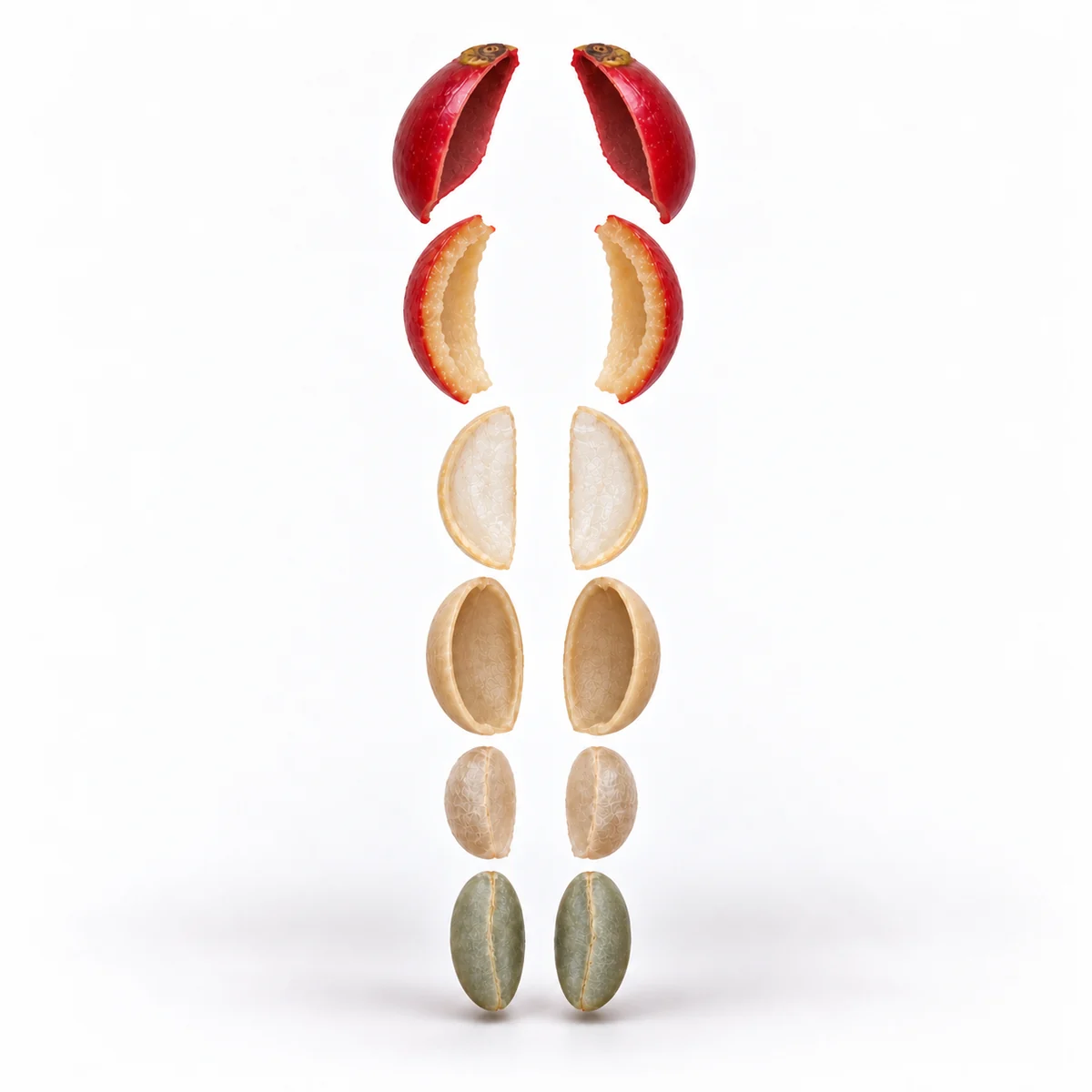
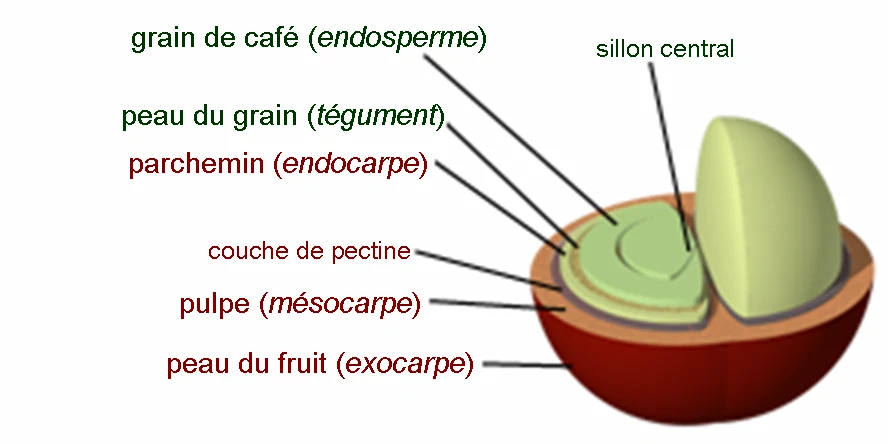
Coffee is a drupe, that is, a stone fruit, ten to fifteen millimeters long. It has four nested layers: a skin, a sweet flesh, a hard straw-colored envelope, the parchment, and at the center two seeds. These two seeds are what we will drink. Everything else must go.
Harvested ripe, the cherry is full of water and sugar, in a hot climate. In other words, it is an ideal culture medium, and it rots in a day or two. The producer therefore does not first have a problem of taste, but a problem of preservation: turning a living, perishable matter into a dry, stable seed. That seed will have to wait for months in a warehouse, then cross an ocean. A process is the answer to this constraint.
The disproportion between what is harvested and what is sold is considerable. In 1955 Coste put the ratio between harvested cherries and marketable coffee at five to seven to one for arabica. The International Coffee Organization goes lower still: the cherry delivers only 1 to 5% of its mass in the coffee actually drunk.
With the washed process, about 80% of the mass leaves as by-products as early as processing, the mucilage alone accounting for some 22 kilos per 100 kilos of cherries. Processing coffee therefore also means, and above all in tonnage, producing waste (see what is thrown away).
Coste, Les caféiers et les cafés dans le monde (1955); ICO, report on by-products; LC ch. 17bThe choice of method was almost never aesthetic. It was dictated by what was at hand: running water or not, a dry climate at harvest or a rainy season, room to spread the coffee out, and above all cash. Ethiopia and Yemen dried the whole fruit because they had sun, dry air and no water to waste; Central America washed because it had rivers, slopes and an export market that demanded consistency; Indonesia invented a process that exists nowhere else because it rains there almost all year round; Brazil industrialized an intermediate route once it had the machines. Taste came afterward: a side effect that was first undergone, then named, then claimed, and finally steered.
LC ch. 17b; Coste 1955; Thurber, Coffee from Plantation to Cup (1881)