The Kenyan washed process and soaking
The washed process.
Why does Kenya add a soak?
Start the scene or choose a stage. The animation simplifies the mechanism; what follows gives the details and the available references.
The cherries first pass through a tank of water, where whatever floats is set apart. The disc pulper leaves the parchment covered in mucilage, which is divided into three classes, grades 1, 2 and lights: each ferments in its own tank, at a single speed. Pectin, the cement of this flesh, is broken down, lactic acid bacteria dominate and the pH drops from 6.0 to 6.5 toward 4.0. Published durations diverge: 12 to 24 hours with traders, 24 to 72 in a Kenyan training document.
Read the stages without animation
- Ferment in a tankThe cherries first pass through a tank of water, where whatever floats is set apart. The disc pulper leaves the parchment covered in mucilage, which is divided into three classes, grades 1, 2 and lights: each ferments in its own tank, at a single speed. Pectin, the cement of this flesh, is broken down, lactic acid bacteria dominate and the pH drops from 6.0 to 6.5 toward 4.0. Published durations diverge: 12 to 24 hours with traders, 24 to 72 in a Kenyan training document.
- Rinse, ferment a second timeThe coffee is rinsed and stirred. The rinse never carries everything away: a film stays attached, especially in the groove of the bean. A second fermentation of 12 to 24 hours finishes the job, in a cleaner, less sugary bath that acidifies more slowly.
- Wash in a channel, countercurrentIn the concrete channel, the paddle pushes the parchment against a trickle of water. The dense beans stay at the head, the light ones slip downstream: the washing grades at the same time as it washes, into fractions P1, P2, P3 and lights.
- Soak in clear waterEach fraction goes back, in its own bin, under renewed clear water, for twelve to twenty-four hours: remixing them would undo the grading of the channel. There is no mucilage left to dissolve: it is a soak, not a second fermentation, a deduction that no published monitoring comes to measure. The only controlled trial, in Yunnan, sees the water carry away chlorogenic acids, citric acid, sugars and amino acids.
- Skin dry, then dryOn mesh tables, in a layer of at most 1.3 centimeters, the coffee goes from 55 to 45% moisture. A thick layer would make the pile ferment. Raised beds then take it toward 11%, in one to two weeks.
To remember: The second bath is a soak: no more mucilage, clean and renewed water, and the only controlled trial shows that it tempers and evens out the fermentation that precedes it rather than amplifying it.
In history: A Kenyan study from the 1960s, attributed to Wootton, is cited as the authority for soaking; it could not be read at first hand.
Read the full article and its sources ↓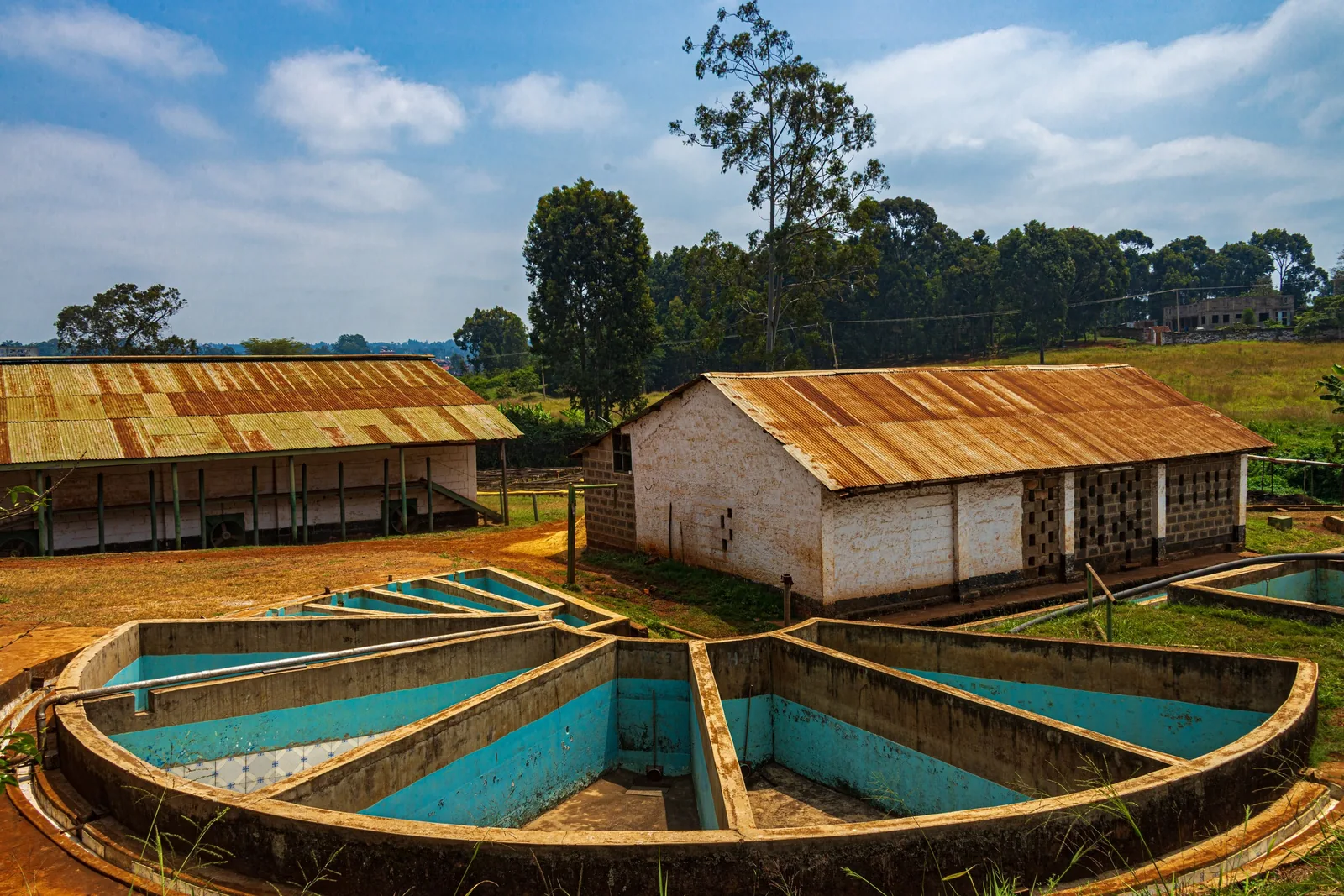
Where it is practiced
Kenya, in the village washing stations that the country calls factories. They belong to cooperatives and process the harvest of hundreds or thousands of smallholders. The regions concerned surround Mount Kenya and the Aberdare range: Nyeri, Kirinyaga, Murang'a, Embu, Kiambu, Machakos. Altitude puts the river water at around fifteen to twenty degrees, which slows the whole process. The date at which soaking became the national norm is not established by any document that can be consulted. A Kenyan study from the 1960s, attributed to Wootton, has since been cited in the literature as having shown the benefit of a controlled lengthening of the wet phase. This study could not be read at first hand. The process is now taken up outside Kenya, notably in Colombia and Rwanda, under the name double fermentation.
The principle
The Kenyan process separates two operations that the rest of the world confuses. On one side, the dissolution of the mucilage, the layer of sugary flesh stuck to the parchment. On the other, the finishing of the bean, which comes after and has nothing left to dissolve.
The first fermentation does the dissolving work. Pectin, the cement that holds this flesh together, is broken down enzymatically. The enzymes come from the fruit itself and from the microorganisms settled on the mucilage. Lactic acid bacteria dominate the population and the pH falls from about 6.0 to 6.5 toward 4.0. The mucilage loses its hold and becomes rinsable.
The intermediate wash carries off what has come loose. It never carries off everything. A residual film stays attached, especially in the groove of the bean. The second fermentation resumes on this remainder, in a cleaner and less acidic bath. This is the mechanical reason for double fermentation. Two short cycles finish the mucilage better than one long cycle, without pushing the mass toward over-fermentation.
The soak is of a different nature. The washed parchment is put back under clear water, without mucilage, for twelve to twenty-four hours. There is no longer any fermentable substrate in quantity, and the water is renewed. Two documented mechanisms then operate.
The first is leaching, that is, the passage by diffusion of soluble compounds from the bean into the water. The only controlled trial available measures this loss. A twenty-four-hour soak lowers chlorogenic acids, citric acid, isocitric acid, several amino acids, glucose and fructose.
The second mechanism is that the bean is alive. The coffee seed continues a germination metabolism during post-harvest processing, as long as it stays moist. Soaking prolongs this moist phase instead of interrupting it by drying.
The conclusion of this trial goes against the common discourse. Soaking does not amplify fermentation. It tempers it and evens out the quality of the green coffee, whatever the processing that precedes it. It is a leveler, not an enhancer. For a station that receives the harvest of a thousand different gardens, that is precisely the useful function.
The sequence
1. Reception and flotation. The delivered cherries pass through a tank of water. What floats is dry, pierced or hollow, and goes into a separate lot. This first sorting by density governs everything else: a hollow cherry does not ferment at the same rate as a full one.
2. Pulping. Kenyan stations work with the disc pulper, of the McKinnon type according to descriptions in the trade. The disc tears off the skin and pulp and leaves the parchment covered in mucilage.
3. Pre-grading at the pulper outlet. The coffee is divided into three classes, grades 1, 2 and lights, according to density and size. Each class ferments in its own tank. A tank uniform in density ferments at a single speed, which makes the stopping point decidable.
4. First fermentation. Published durations diverge, and it must be put that way:
- 12 to 24 hours with green coffee traders;
- 24 to 72 hours in a Kenyan training document;
- 1 to 4 days for the whole fermentation phase according to the institutional source, shorter in hot weather, longer in cold weather.
What happens during it: breakdown of pectin, drop of pH from about 6.0 to 6.5 toward 4.0, rise of lactic acid bacteria. The stopping point is read on no instrument. It is judged by touch, when the parchment squeaks under the finger instead of slipping.
5. Intermediate wash and stirring. The coffee is rinsed and stirred to detach the degraded mucilage. This is the first of the two washes that give double washing its name.
6. Second fermentation, twelve to twenty-four hours. It attacks the residual film that the rinse did not take. The medium is cleaner, the sugar load lower, so acidification is slower. This slowness is the point of the step: it leaves a margin before the defect.
7. Final wash in a channel. The washing is done in concrete channels. The parchment is pushed with a wooden paddle against a trickle of water. The gesture is a washing and a grading at once. The current carries the light beans downstream, the dense beans stay at the head of the channel. Descriptions in the trade name the resulting fractions:
- P1, the densest parchment;
- P2;
- P3;
- the lights, often marked PL.
Each fraction goes into its own soaking tank and dries separately. This is where a good part of the homogeneity of the final lot is decided.
8. Soaking in clear water, twelve to twenty-four hours. The Kenyan institutional source retains about twelve hours and credits it with a gain in color and taste. The water must be clean and renewed, otherwise the step becomes a fermentation again. What happens during it: leaching of soluble compounds into the water, and continuation of the bean's metabolism, which stays hydrated and alive.
9. Final rinse and draining. The coffee comes out of the soak at about 55% moisture.
10. Skin drying, as the English-speaking trade calls it. The parchment is spread on wire-mesh tables, in a layer not exceeding half an inch, or about 1.3 centimeters, and turned often. This phase runs from 55% to 45% moisture. A thick layer at this stage makes the pile ferment and ruins the soak that has just avoided it.
11. Drying on raised beds to 11% moisture according to the institutional source, 10 to 12% according to a Kenyan training document. Shading in the hot hours and regular turning. Drying takes one to two weeks depending on the weather.
12. Resting in parchment, then milling and grading of the green coffee by size and density. Only at this point do the marks AA, AB and PB appear, which are size grades and not quality scores.
What it gives in the cup
What is measured. A single controlled trial isolates the effect of soaking. It was conducted in Yunnan, China, and not in Kenya. It compares lots with and without a twenty-four-hour soak in clear water, on two starting routes, mechanically removed mucilage or fermentation in parchment. Its results are as follows:
- drop of chlorogenic acids 4-CQA, 5-CQA, 3,5-diCQA and 4,5-diCQA in the green bean;
- drop of citric acid and isocitric acid;
- drop of several amino acids, including arginine, glycine, methionine, isoleucine, aspartic acid and phenylalanine;
- drop of glucose and fructose, which passed into the water;
- rise of the overall aromatic intensity in the cup, drop of spicy notes;
- drop of the total intensity of volatile compounds in most variants.
The authors conclude that soaking tempers the effects of the fermentation that precedes it and evens out the quality of the green coffee, whatever the route applied before it. The same trial also shows that a lengthened fermentation gives a fruitier and more acidic cup.
What is claimed, without a published trial. The trade and the specialist press credit soaking with the following effects:
- it would build the bright acidity characteristic of Kenya;
- it would eliminate fermentation by-products;
- it would give cup cleanness and a crisp aftertaste;
- it would stabilize proteins and lengthen the shelf life of the green coffee.
None of these four claims has been measured against a control. The first is even contradicted in its direction by the only trial available, which sees citric acid and chlorogenic acids fall under the effect of soaking, and not rise. The fourth rests on no published ageing measurement.
A note of caution on attribution. The classic Kenyan profile, blackcurrant, citrus and sharp acidity, is also built by the varieties SL 28 and SL 34, by volcanic soils and by altitude. No published trial separates the share of the process from the share of the variety and the terroir.
What goes wrong
Over-fermentation remains the main risk of the first tank, especially in hot weather. It produces the defects that the trade calls fermented and stinker. The stinker comes from butyric acid, which smells of rancid butter, and propionic acid, which smells of onion. The Kenyan remedy is double fermentation itself: two short cycles instead of one long one.
Dirty soaking water is the risk specific to the step, and it is mechanical. If the water is reused, loaded with mucilage or stagnant, the substrate comes back and the population starts up again. The soak then becomes a third fermentation, uncontrolled and unmeasured. The lot takes on sour and earthy notes. This is why the instruction concerns the cleanness of the water and its renewal, and not the duration alone.
Excessive soaking is a risk of leaching. The only measurement available shows that the water carries off sugars and amino acids, that is, the precursors of the Maillard reaction that will build the aroma at roasting. Prolonging the bath beyond what the finishing requires therefore impoverishes the bean. No trial says where the threshold lies.
Delay in drying is the next risk, and it is made worse by soaking. The coffee leaves the bath at about 55% moisture and must be skin dried without delay. A rain, a full table or a layer that is too thick leave the pile warm and humid, and fermentation resumes on the drying bed.
Water consumption is an operating risk. The process chains two fermentations under water, two washes and a soak. It requires an equipped station, an abundant resource and effluent management. This is why it practically does not exist at the scale of an isolated farm.
Finally, the mixing of the channel fractions is a handling risk. If P1, P2, P3 and the lights go back together into the same tank, the grading achieved by the channel is undone. The lot then dries at different speeds under the same shovel.
Benchmarks
- First fermentation12 to 24 h with traders, 24 to 72 h in a Kenyan training document
- Total length of the fermentation phase1 to 4 days depending on the weather, institutional source
- Second fermentation12 to 24 h
- Soaking in clear waterabout 12 h retained by the institutional source, 12 to 24 h in the reported practice
- pH during fermentationfrom 6.0 to 6.5 at the start, toward 4.0 at the end
- Moistureabout 55% leaving the soak, 45% at the end of skin drying, 11% at the end of drying
- Skin drying on tableslayer under half an inch, or about 1.3 cm
- Parchment fractions leaving the channelP1, P2, P3 and lights, dried separately