Mechanical drying
Drying.
What is adjusted in a mechanical dryer?
Start the scene or choose a stage. The animation simplifies the mechanism; what follows gives the details and the available references.
The coffee is intended for human consumption: Cenicafé asks for external combustion and a heat exchanger, so that the furnace gases never touch the beans: the smoke goes up the chimney. The drying air does not exceed 50 °C or 15% relative humidity.
Read the stages without animation
- Heat the air without touching the beanThe coffee is intended for human consumption: Cenicafé asks for external combustion and a heat exchanger, so that the furnace gases never touch the beans: the smoke goes up the chimney. The drying air does not exceed 50 °C or 15% relative humidity.
- Push the air through the layerA mass of parchment leaves 45% of void between the beans and offers 780 square meters of surface per cubic meter: an almost ideal exchanger. Cenicafé recommends 25 cubic meters of air per minute per cubic meter of coffee. The air enters under the perforated floor: the inlet face receives the hottest, driest air, it dries first, the outlet face stays wet.
- Reverse the flowThe direction of the air reverses every 6 to 12 hours until the desired moisture is reached: it then enters above the layer. In a three-story dryer, the reversal is made when the chamber is between 14 and 16%. Without reversal, one gets two different coffees in the same silo.
- Or turn the coffeeThe guardiola, named for the Guatemalan who patented it in 1872, turns the coffee in a perforated drum, at three or four turns per minute, with air at 40 to 60 °C passing through, arriving by the hollow shaft. No bean stays long in the same place: case hardening recedes.
- Look at the kernel, finish with ambient airThe operator samples, hulls and looks: a dark blue-green kernel is not dry. As 10 to 12% approaches, the furnace is turned off and ambient air is blown in, which recovers the stored heat and avoids over-drying the outer layers. A Peruvian trial finds no difference in the cup between 30 and 60 °C.
To remember: Mechanical drying is not a penalty in itself: what harms the cup is a poorly run machine, air too hot or too dry, a flow not reversed, smoke in contact with the bean.
In history: Ukers reports in 1922 dryers kept between 65 and 85 °C, well above today’s ceiling.
Read the full article and its sources ↓Where it is practiced
Wherever the volume exceeds what a drying area can absorb, and wherever the harvest falls in the rainy season. These are the two reasons for the process to exist, and they have nothing to do with the pursuit of quality.
Colombia gives the clearest formulation because it has quantified it. Cenicafé holds that drying with the energies of the sun and the air is viable for small flows, in practice farms producing less than 12.5 tonnes, or 1,000 arrobas of dry parchment coffee per year. Beyond that, a drying surface, equipment and labor would be needed such that the investment becomes unreasonable, and this under the risk of losing quality through the slowness of the process. The institute adds an observation that explains everything: the harvest generally coincides with the rainy season, so that sun drying is slow there.
Brazil dries in the rotary dryer, alone or after a pass on a terrace, in the Campo das Vertentes and the Alta Mogiana notably. Central America built its whole mechanization around the rotary dryer (guardiola, in Spanish). Indonesia and Thailand work on rotary dryers and thin-layer trials. Peru has recently been publishing drying kinetics in forced-convection ovens.
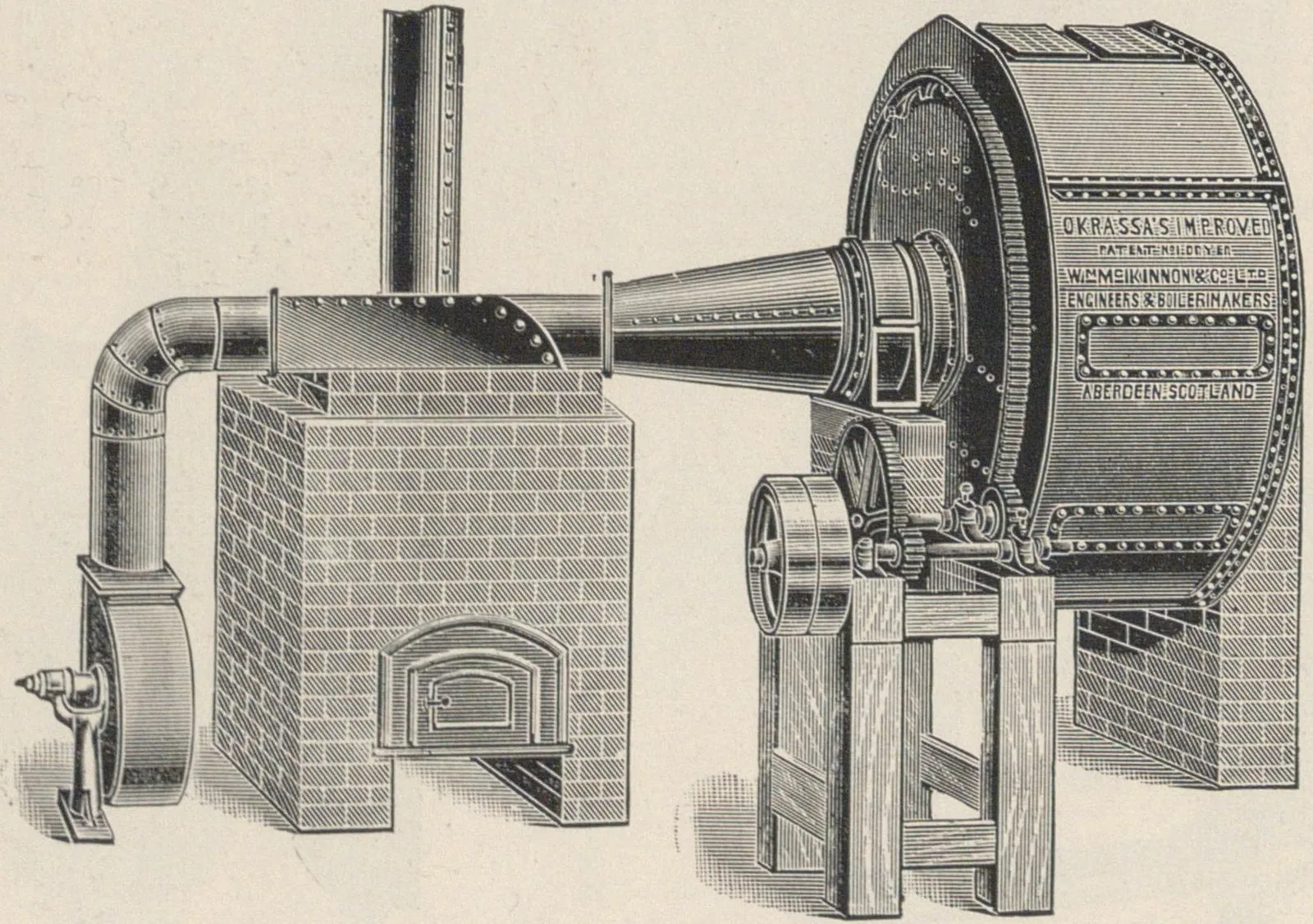
The history is old and precise, and it is read in Ukers. The name most familiar to planters in the matter of plantation equipment is Guardiola: it appears in the chronological record in 1872, when J. Guardiola, of Chocolá in Guatemala, obtains several American patents on machines for pulping and drying coffee. Since then, writes Ukers, “Guardiola” designates a particular type of rotary drying machine, manufactured, once the original patent expired, by practically all the large makers of plantation equipment. José Guardiola obtains other American patents on hullers in 1886. A rival appears in 1891, R. F. E. O’Krassa, of Antigua in Guatemala, whose dryer is built on the same principle but differs in detail and dries its load a few hours faster.
One last point places the process in its best documented country. In 2008, Cenicafé reports that only 2 percent of Colombian farms dried in a mechanical dryer. This process is therefore, in number of farms, a minority even where it is old, quantified and taught. It is not a minority in volume, and no statistic consulted separates the two.
The principle
The principle is banal: heated air is forced through a mass of coffee. It is the reasons why this air is capped in temperature that make the sheet interesting, and they must be taken one by one, because they do not have the same solidity.
Before that, an observation of geometry explains why the thing works so well. Cenicafé measures on parchment coffee a uniform, ample intergranular space, corresponding to about 45 percent of the total volume, which lets the air through without excess mechanical power, and a bean surface of about 780 square meters per cubic meter of parchment coffee. A mass of coffee is therefore an almost ideal heat exchanger: lots of surface, lots of void, little resistance. This is why a coffee dryer needs neither high pressures nor high temperatures.
First reason for the ceiling, the most solid: the bean is a living seed. Drying subjects it to water stress, and beyond a certain point its cell membranes give way. The damage can be measured, and by two converging methods. The electrical conductivity of the exudate rises, because a bean whose membranes have failed releases its electrolytes into the water in which it is soaked. Potassium leaching rises for the same reason. Brazilian post-harvest literature, which has long used these two indicators, establishes two things: electrical conductivity and potassium leaching increase with drying temperature whatever the mode of preparation, and the highest sensory scores go with the lowest values of these two indicators. The ceiling therefore protects a measurable physical integrity, and not only a taster’s impression.
Second reason: the chemistry of precursors. Beyond 50 degrees, chlorogenic acids and the precursors of volatile aromas degrade, with the reported consequences of reduced acidity, a shifted bitter balance and a loss of aromatic complexity. This reason is coherent and rests on a review article; it is not accompanied, in what was read, by a trial that would have isolated this degradation with a panel.
Third reason: the physics of transfer. Water must first migrate from the core of the bean to its surface, then evaporate. After the first hours, it is internal migration that limits everything. If surface evaporation is forced faster than internal diffusion can keep up, the outer layers of the bean contract and harden, forming a crust that traps the remaining water: this is crusting, or case hardening. The lot seems dry to the touch without being so, the moisture then comes back out in the bag, and the molds start again. The continuous stirring of the drum dryer reduces this risk compared with static silos and cross-flow dryers, because no bean stays long exposed to the same condition.
To these three reasons is added a particular case that concerns not the temperature of the air but that of the mass. A lot loaded with immature fruit must not see its mass exceed 30 degrees, excessive heating on these fruits producing the defects named verde-escuro and preto-verde, the dark green and the black-green of the Brazilian classification. The Codex states the same mechanism in its way: an inlet air too hot on immature fruit produces black beans, and it makes this the second defect of mechanical drying after over-drying.
What weakens this ceiling must now be said, because it is the most interesting point of the file and it is almost always left unsaid.
The first element is historical. Ukers reports in 1922 that a temperature of 65 to 85 degrees centigrade is maintained during drying in the machines of his day, hot air, steam or electric heat taken together. One can suppose that he speaks of the air and not of the mass, and that the quality produced was not what the specialty market expects today. It remains that the dominant practice of an entire industry stood, for decades, thirty degrees above the present ceiling.
The second is contemporary and more embarrassing. A Peruvian trial published in 2026 dried Caturra at four constant temperatures, 30, 40, 50 and 60 degrees, in forced-convection ovens, relative humidity held around 60 percent, from 45 percent initial moisture down to 12 percent. The durations obtained follow the temperature: 52 hours at 30 degrees, 34 at 40, 30 at 50, 20 at 60. The tasting scores, for their part, follow nothing: 83.21 points at 30 degrees, 83.50 at 40, 83.60 at 50 and 83.26 at 60, with no statistically significant difference among the four. The authors conclude that the drying temperature, in the range evaluated, does not significantly affect sensory quality, and recommend all the same working between 40 and 50 degrees as a balance between efficiency and preservation. This trial does not refute the ceiling, but it shows that at the exact place where the trade draws it, nobody has seen it produce an effect.
The third element is the one that usefully replaces the ceiling, and it is the real principle of this sheet. It is not only temperature that counts, it is the drying rate, and temperature is only one of its two determinants. Borém and his collaborators crossed in 2018 three dry-bulb temperatures, 35, 40 and 45 degrees, with three dew-point temperatures, 2.6, 10.8 and 16.2 degrees. The dew point is the temperature at which the air becomes saturated: the lower it is, the drier the air, the faster it draws water from the bean. The result is twofold and instructive. At 35 degrees dry bulb, beverage quality fell as the dew point fell, that is, as the drying rate increased. At 45 degrees, quality fell at both extremes, at 2.6 as at 16.2 degrees dew point. In other words, warm but very dry air damages a coffee that a hotter and more humid air would not have damaged, and hot air penalizes it as much when it is too dry as when it is too humid. A dryer that displays only its temperature therefore tells only half of what it does.
The sequence
Airflow is the first setting, and it comes before temperature. For drying parchment coffee in a static layer, Cenicafé recommends 25 cubic meters per minute per cubic meter of coffee placed in the dryer. This same flow is expressed in three useful equivalences: 66 cubic meters per minute per tonne of dry parchment coffee, 20 cubic meters per minute per square meter when the total layer is 0.8 meter, and 10 per square meter when it is 0.4 meter. The institute specifies that it is better to use the first two, related to volume or mass, because they remain constant whatever the load.
The reason for this setting is given with the same clarity. If the air is insufficient, the drying time lengthens and the beans show strong heterogeneity in final moisture. If the flow greatly exceeds what is needed, more energy is consumed for the fans and more thermal energy to heat the air, which weighs on the cost without bringing anything. Cenicafé’s sizing table gives the corresponding pairs: 80 cubic meters per minute under 6.2 centimeters of water column for 2 horsepower, 120 for 3 horsepower, 160 for 5 horsepower, according to the farm’s annual capacity.
The static dryer without a pre-drying chamber is the simplest. It has only the drying chamber, layer thicknesses of up to 40 centimeters are used in it, the hot air enters from the top, and the direction of flow must be reversed periodically every 6 to 12 hours until the desired final moisture. Reversal is not a refinement: in a layer crossed by a constant flow, the inlet face receives the hottest, driest air and dries first, the outlet face receives air already laden with moisture and stays wet. Without reversal, one gets two different coffees in the same silo.
The Cenicafé silo-secador adds a second chamber, placed next to the first, one serving for drying and the other for pre-drying when they are operated together. A flow of 20 cubic meters per minute per square meter is passed through two layers of 0.4 meter each, the drying air not to exceed 50 degrees. A series of rectangular hatches makes it possible to change the direction of flow between the two chambers, to dry in one or in both, with or without pre-drying. Capacities run from 60 arrobas, or 750 kilos, to 500 arrobas, or 6,250 kilos of dry parchment coffee.
The two-story dryer places the pre-drying chamber above the drying chamber: the air leaving the lower chamber rises and pre-dries the upper load. When the lower bean is ready, it is removed and the upper one is brought down by gravity. At the moment of this transfer, the order of the layers is carefully reversed by hand, so that the driest and hottest layers end up on top and the coldest and wettest at the bottom. It is a gesture that the machine does not make and that the operator must make.
The three-story dryer is the most widespread form in medium-sized Colombian farms. Capacities run from 12 to 500 arrobas of dry parchment, layer thicknesses vary between 0.1 and 0.3 meter, and the air temperature must be 50 degrees to obtain total durations of 20 to 24 hours when the final moisture is between 11 and 16 percent. In continuous operation, a layer comes out every 8 hours. The flow reversal in the drying chamber is done when the moisture there is between 14 and 16 percent; some small dryers carry for this a sliding metal plate that blocks the passage of air.
The rotary drum dryer works differently. The coffee turns in a perforated cylinder crossed by hot air, at three or four turns per minute, so that no bean stays long in the same place. Ukers already described the principle in 1922: the machine resembles the cylinder of a roaster, it is made of perforated steel plates, and it is carried by a hollow shaft through which the hot air passes. Continuous stirring limits case hardening and keeps the beans from sticking together, which matters on naturals and honeys, still laden with mucilage. The 2026 review gives for this family 40 to 60 degrees of air on parchment, and a little less on cherry, with residence times ranging from a few minutes to a few hours depending on the design. Central American professional documentation warns that beyond about 45 degrees on parchment, one risks hardening the outer layer of the bean and trapping the residual moisture in it.
The cross-flow dryer sends the air sideways through a moving column, between 45 and 65 degrees, for 24 to 48 hours. All machines taken together, the same review gives 24 to 72 hours depending on the load, the starting moisture and the design.
Fuel is the point that most sheets forget and that decides the taste of the lot. Cenicafé is categorical: since coffee is a product intended for human consumption, direct contact of combustion gases with the beans must be avoided, and the belief that combustion of gas and coke would be “clean” is false. It is false for a precise reason: the combustion of natural gas or propane is more or less complete only if gas and air are in the correct proportion, which is difficult to guarantee in practice because the quantity of oxygen varies with altitude and with the state of the burners. The combustion of coke releases sulfur, which gives sulfuric acid in the presence of moisture, and the effect is observed in the accelerated corrosion of the metal parts of the units that use it. Granulated mineral coal, burned in automatically fed equipment, is presented as an excellent alternative above 120 arrobas of static capacity, with an average observed consumption of 3.5 kilos per arroba of dry parchment and good temperature regulation. The costs published in 2000, in Colombian pesos per arroba of dry parchment, are worth more as a ratio than as a value: 220.47 for coal, 758 for propane in direct combustion, which Cenicafé does not recommend, and 1,474 for diesel at 0.7 gallon per arroba. The practical conclusion is a heat exchanger and external combustion, which is what Cenicafé explicitly asks for.
The end of drying is judged by the color of the kernel. The operator samples, hulls and looks. A bean still wet is a dark bluish green, what Cenicafé calls a grano flojo. When the sample shows no more of them, the operator stops. The practice is safe from the point of view of eliminating granos flojos, but the institute points out its downside frankly: it leads to excessive drying of the outermost layers, through prolonged exposure to the drying air at 50 degrees. The proposed alternative is simple and costs nothing: supply ambient air when the bean approaches the characteristic green color corresponding to 10 to 12 percent, which recovers the heat already stored in the system and in the beans themselves.
What it gives in the cup
What is measured in direct comparison comes from a 2025 Brazilian trial already used elsewhere on this site, and its conclusion must be recalled because it runs against the market’s intuition. The dedicated dryer beats the traditional solar route, without being infallible. In the Campo das Vertentes it clears the 80-point bar of the Specialty Coffee Association scale at the start and middle of the harvest, 81 then 80, and falls below it at the end of the harvest, at the same level as the traditional route. In the Alta Mogiana it holds 80 points whatever the date, where the traditional route stays below. The same trial notes that the dedicated dryer reduces the population of filamentous fungi by 38 percent in the Alta Mogiana and by 44 percent in the Campo das Vertentes, and that no sample exceeded the detection threshold of the ochratoxin A kit, set at 2.5 micrograms per kilo.
What is measured on temperature itself was given above and deserves to be repeated here, because it is the most disturbing result of the file: the 2026 Peruvian trial finds no significant sensory difference among 30, 40, 50 and 60 degrees, the four treatments standing between 83.21 and 83.60 points. All remain above 83, therefore in the specialty category.
What is measured on speed is the contribution of the 2018 Borém trial, and it gives the nuance missing from the previous two: quality depends on the interaction between dry-bulb temperature and dew point, that is, between the heat and the dryness of the air. A drying run at 35 degrees with very dry air loses quality; a drying run at 45 degrees loses quality at both ends.
What is measured on kinetics, finally, gives the practical orders of magnitude. An Indonesian laboratory trial in a rotary dryer held at 60 degrees, with fan regulation, gives 270 minutes for 1 kilo at 11.28 percent final moisture, 330 minutes for 2 kilos at 9.92 percent, and 450 minutes for 3 kilos at 10.92 percent. A Colombian protocol monitored by near-infrared spectroscopy runs much more gently: 40 degrees, 35 seconds of agitation every hour, down to 10 to 12 percent.
The synthesis is therefore the following, and it must be formulated precisely because it contradicts a widespread prejudice. Mechanical drying is not in itself a quality penalty. It is faster, more regular, safer from a sanitary standpoint, and the only comparative trial published has it winning against the sun. What penalizes the cup is not the machine, it is a poorly run machine: air too hot, air too dry, insufficient flow, a flow not reversed, fuel in contact with the bean, an end of cycle that over-dries the outer layers. Each of these six points has a setting, and each costs less than the loss it avoids.
What goes wrong
Over-drying is the first defect of mechanical drying, and the Codex explicitly makes it the most common, with its direct consequence: a loss of weight, hence a loss of income. Cenicafé gives its mechanism and scale. The beans in the outer parts of the layer can reach 6 to 7 percent moisture, because they receive the hottest, driest air, at 50 degrees and at most 15 percent relative humidity, while the beans in the inner zones first receive colder, more humid air. In the last hours of the process, the temperature and relative humidity of the air in the middle of the layer exceed 40 degrees and 40 percent. Drying is therefore fast on the outer faces and slow at the center, and it is at the center that the operator concentrates attention, which is both reasonable and costly.
Heterogeneity is the second, and it is the reason for flow reversal. Cenicafé showed as early as 1985 that reversing the direction of flow improves the uniformity of final moisture. A lot coming out of a non-reversed dryer cannot be fixed: the dispersion of individual moistures remains, even if the average of the lot is right, and it is this dispersion that makes uneven roasts.
Case hardening is the third. The outer layers of the bean harden and trap water. Its consequences are described by the 2026 review: internal cracks in storage or in roasting, heterogeneous roasting, degraded cup uniformity. No drying rate or temperature gradient beyond which it forms on coffee has been found quantified.
Color defects are the fourth, and they have names. The crystallized is a gray-blue bean, fragile and brittle, attributed to drying temperatures beyond 50 degrees. The discolored and the moldy are associated with it by Cenicafé, which links these three defects to the use of direct combustion and to too high a temperature. The black-green and the dark green come from inlet air too hot on immature fruit.
The smoke taste and the chemical taste are the fifth, and they come from the contact of combustion gases with the coffee. They are beyond repair: nothing downstream removes a smoke smell from a green coffee. This is why Cenicafé asks for external-combustion dryers and heat exchangers, and refuses direct propane combustion.
The sixth risk is the timing of the heat rather than its level. Recent literature observes that high temperatures after the half-dry stage are unfavorable to sensory attributes. The same degree applied at the start, when free water abounds and evaporation cools the mass, and applied at the end, when it no longer cools it, does not produce the same effect. A dryer run at a constant setpoint therefore does not do the same thing to the bean throughout its run.
The seventh is economic and concerns the installation itself. Heat costs money, and the 2000 Colombian table gives a ratio of one to six between mineral coal and diesel for the same quantity of coffee. A poorly insulated dryer, an oversized flow or a poorly tuned combustion shifts the cost of drying to the point of making the investment unfavorable, which is the first reason a producer gives up on it.
The eighth, finally, is not a risk of drying but its avoidance, and Cenicafé treats it as the most serious of all. The marketing of wet coffee, that is, the sale of undried washed coffee to a third party, has increased in a worrying way. It is described as a high-risk mode of marketing because the start of drying is excessively delayed there: it is common for the coffee not to begin drying until forty-eight hours after the start of fermentation, the moment when beverage quality begins to deteriorate rapidly. The economic loss is added to it, and it can be calculated. The most widely used conversion factor is 2.0, that is, the producer is paid for half the weight of the washed coffee. For normal moistures, 48 to 52 percent, the producer loses between 8 and 17 percent of the weight of the coffee; if selling at 40 percent moisture, therefore “dry of water”, the loss is 34.8 percent; if selling wetter than normal, at 56 percent, the producer gains 1.1 percent. The conclusion the institute addresses to the producer is unambiguous: drying one’s coffee is profitable, and selling wet loses money while favoring defects that damage the quality of Colombian coffee.
Benchmarks
- Intergranular space of a mass of parchment coffeeabout 45 percent of the total volume
- Bean surface per unit of volumeabout 780 square meters per cubic meter of parchment coffee
- Threshold beyond which Cenicafé points toward mechanical drying12.5 tonnes, or 1,000 arrobas of dry parchment per year
- Recommended airflow in a static layer25 cubic meters per minute per cubic meter of coffee
- Equivalences of the same flow66 per minute per tonne of dry parchment; 20 per minute per square meter for a 0.8-meter layer; 10 for a 0.4-meter layer
- Corresponding fans80 cubic meters per minute under 6.2 centimeters of water column for 2 horsepower, 120 for 3 horsepower, 160 for 5 horsepower
- Maximum drying air temperature according to Cenicafé50 degrees
- Relative humidity of this air at inletat most 15 percent
- Temperature and relative humidity in the middle of the layer in the last hoursabove 40 degrees and 40 percent
- Interval of flow reversalevery 6 to 12 hours
- Layer thickness, static dryer without pre-dryingup to 40 centimeters
- Cenicafé silo-secadortwo chambers of 0.4 meter, 20 cubic meters per minute per square meter, capacity from 60 arrobas (750 kg) to 500 arrobas (6,250 kg)
- Three-story dryerlayers of 0.1 to 0.3 meter, air at 50 degrees, 20 to 24 hours for a final moisture of 11 to 16 percent, one layer coming out every 8 hours in continuous operation
- Moisture at which to reverse the flow in the drying chamber14 to 16 percent
- Drum dryer3 to 4 turns per minute, air at 40 to 60 degrees on the parchment
- Cross-flow dryer45 to 65 degrees, 24 to 48 hours
- Duration, all machines taken together24 to 72 hours
- Moisture of the outer layers in case of over-drying6 to 7 percent
- Consumption of granulated mineral coal3.5 kilos per arroba of dry parchment
- Fuel costs published in 2000, in pesos per arroba of dry parchmentcoal 220.47; propane in direct combustion 758; diesel 1,474 at 0.7 gallon per arroba
- Drying temperatures compared in the 2026 Peruvian trial and scores obtained30 degrees 83.21 points; 40 degrees 83.50; 50 degrees 83.60; 60 degrees 83.26; no significant difference
- Corresponding durations, same trial52 hours at 30 degrees, 34 at 40, 30 at 50, 20 at 60
- Design of the 2018 Borém trialdry bulb 35, 40 and 45 degrees crossed with dew point 2.6, 10.8 and 16.2 degrees
- Temperature maintained in the dryers described by Ukers in 192265 to 85 degrees
- Share of Colombian farms drying in a mechanical dryer in 20082 percent
- Weight loss when selling wet parchment, conversion factor 2.08 to 17 percent at 48-52 percent moisture, 34.8 percent at 40 percent