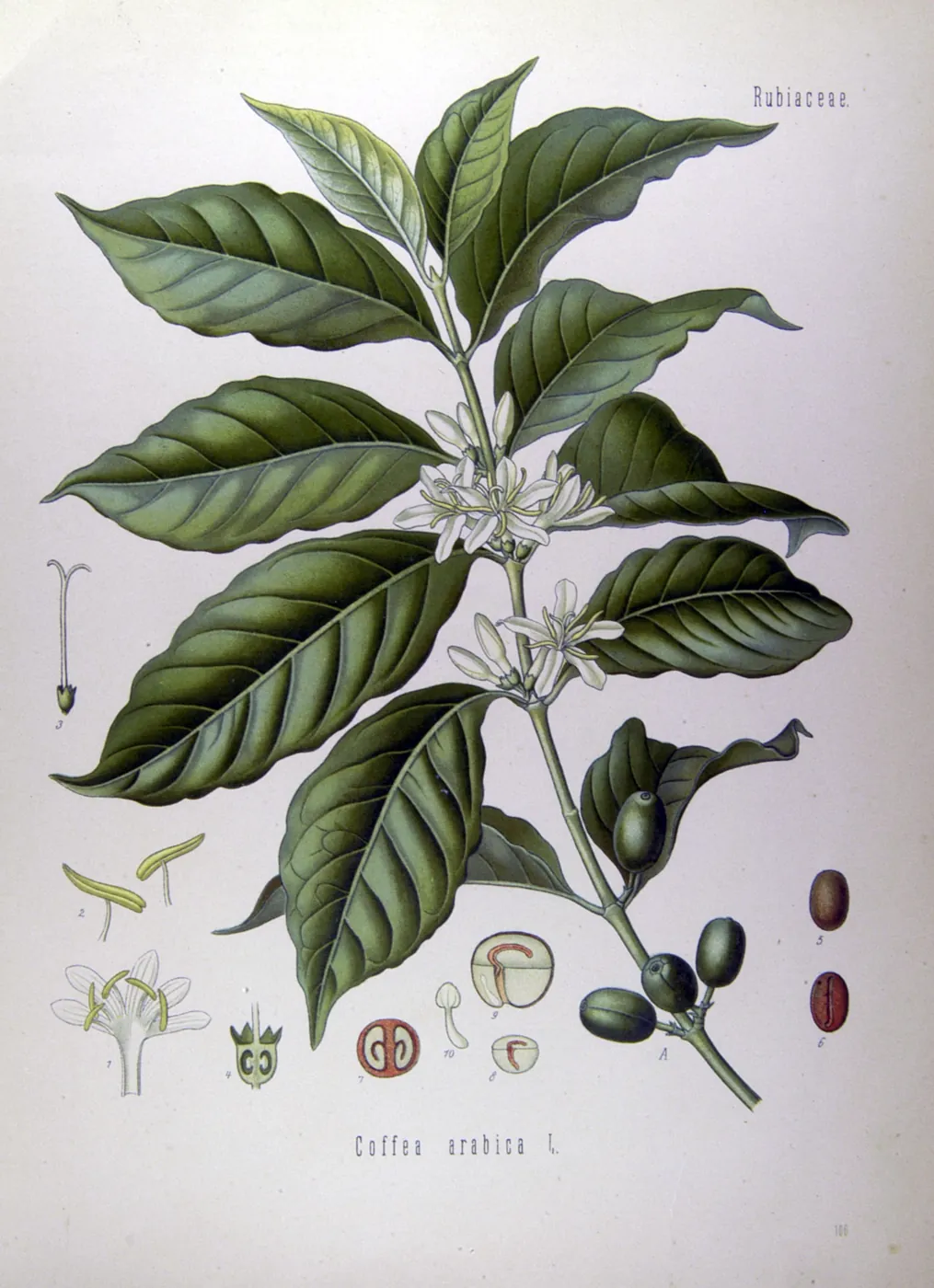
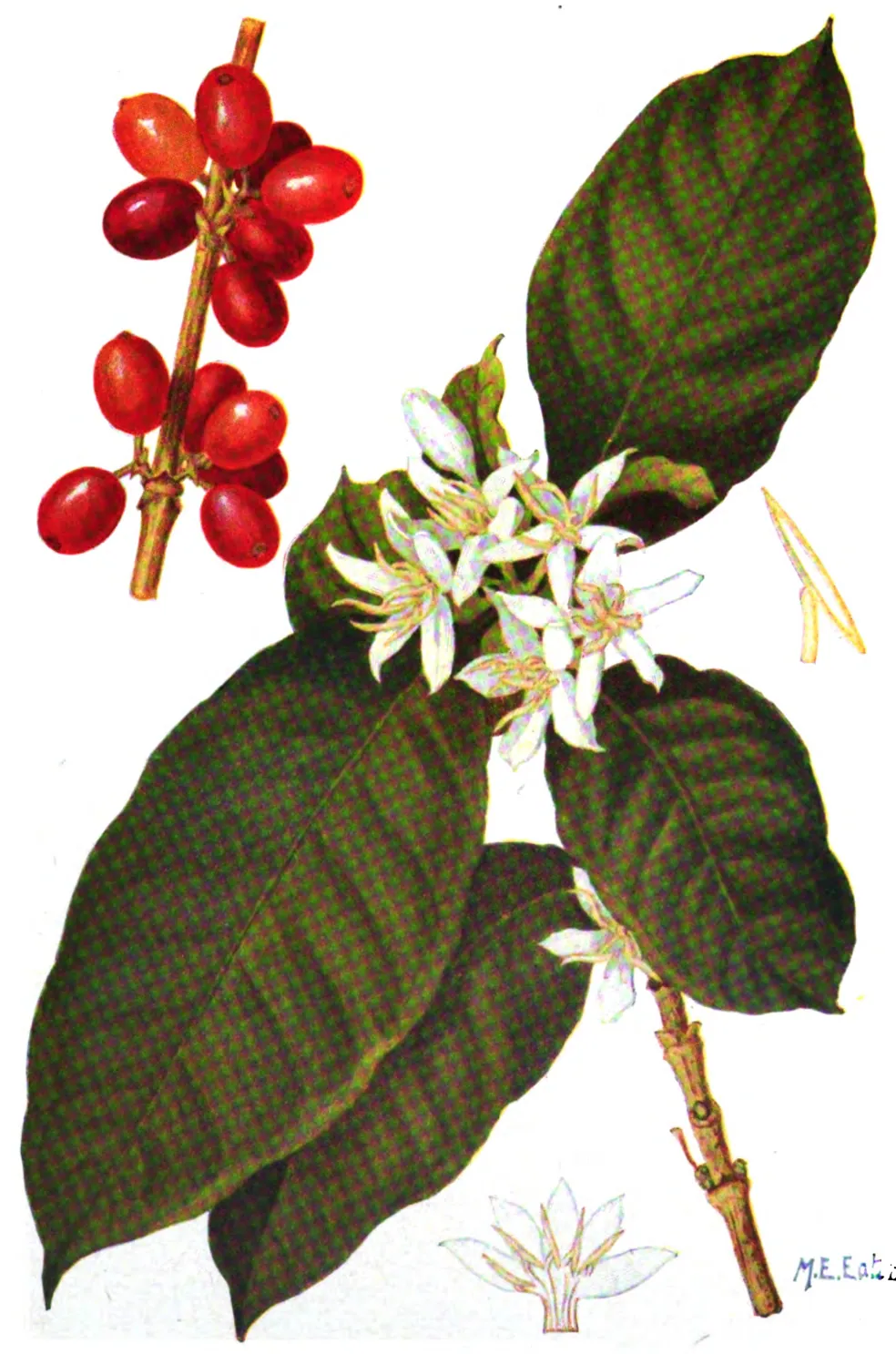
Illustration Coffea arabica L., plate 106 of Köhler's Medizinal-Pflanzen, Gera, 1887 · public domain. Details: 1 flower in section, 2 stamens, 3 pistil, 4 calyx, 5 and 6 seed seen from the front and in profile, 7 section of the fruit and its two seeds, 8 and 9 sections of the seed, 10 embryo.
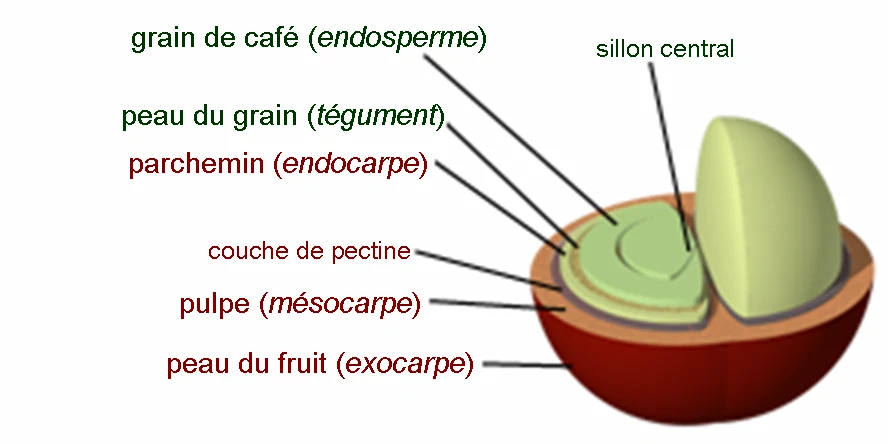
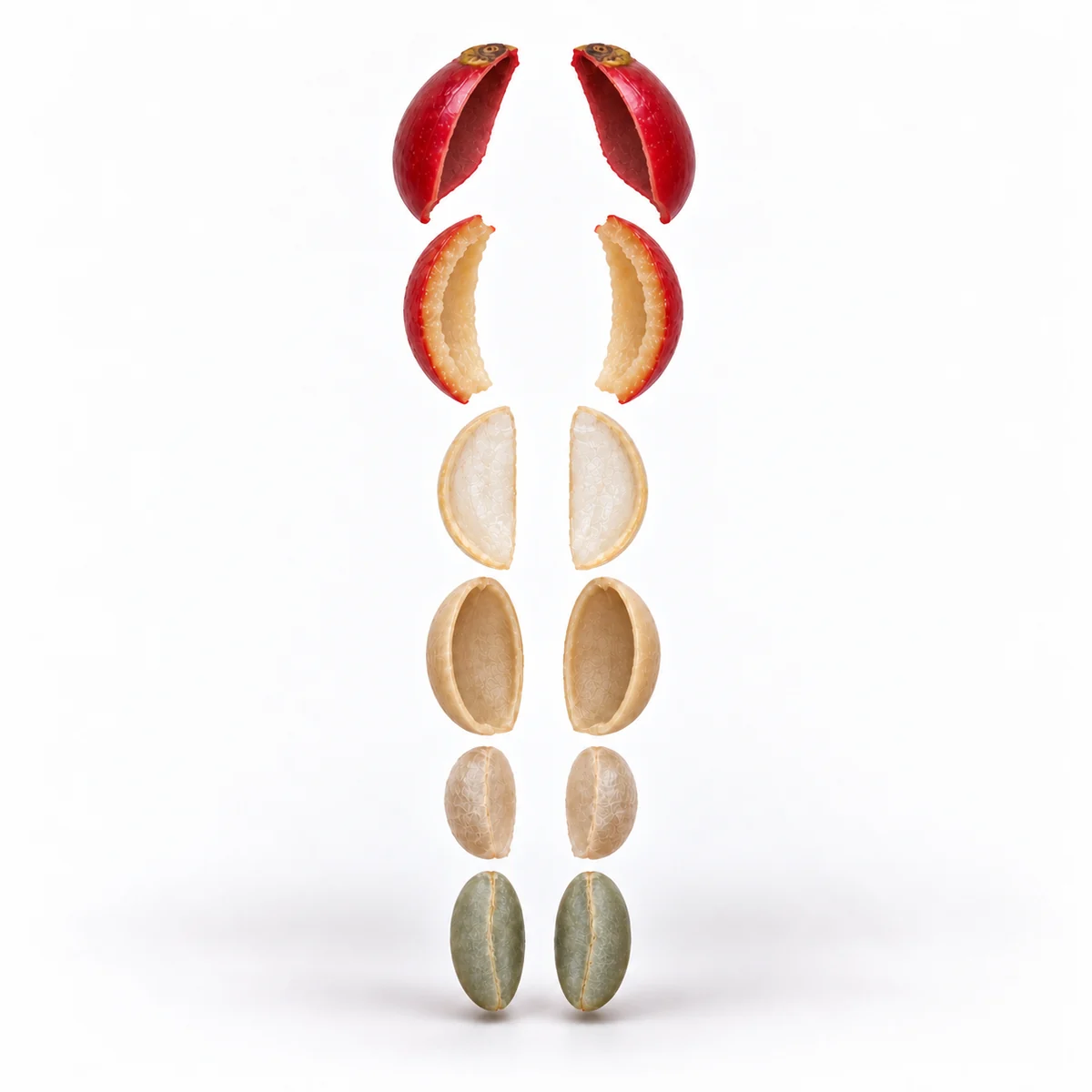
Exocarp, the skinGreen, then red or yellow depending on a single gene: the yellow of the Bourbon and Catuaí amarelos comes from a mutation of Typica spotted at Botucatu in 1871.
Mesocarp, the pulpSweet, thin in arabica. What the wet process strips off at the pulper, what the dry process leaves to dry around the seed.
MucilageThe slimy layer that fermentation dissolves in 36 to 60 hours depending on altitude (Thurber, 1881, without the slightest microbiological concept).
Endocarp, the parchmentThe hard, straw-yellow covering that gives its name to “parchment coffee,” stored before hulling.
Integument, the silverskinA thin skin that comes off during roasting.
The two seedsFlat on the side where they touch, as in section 7 of the plate. When one ovule aborts, the other gives the peaberry. Each seed carries 44 chromosomes in arabica, 22 in all the other cultivated species: Piza counted them in 1929, without being able to draw the conclusion from it.
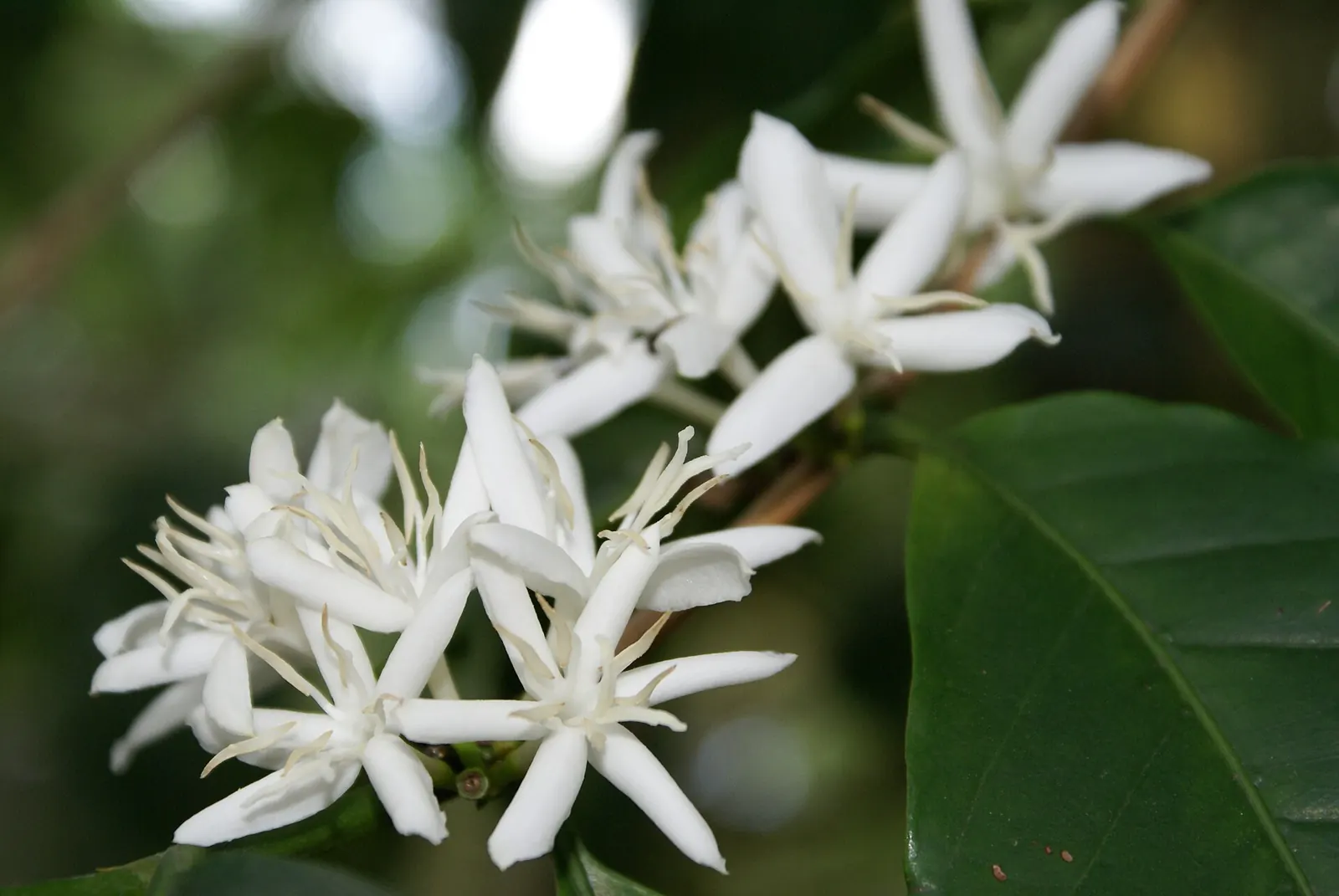
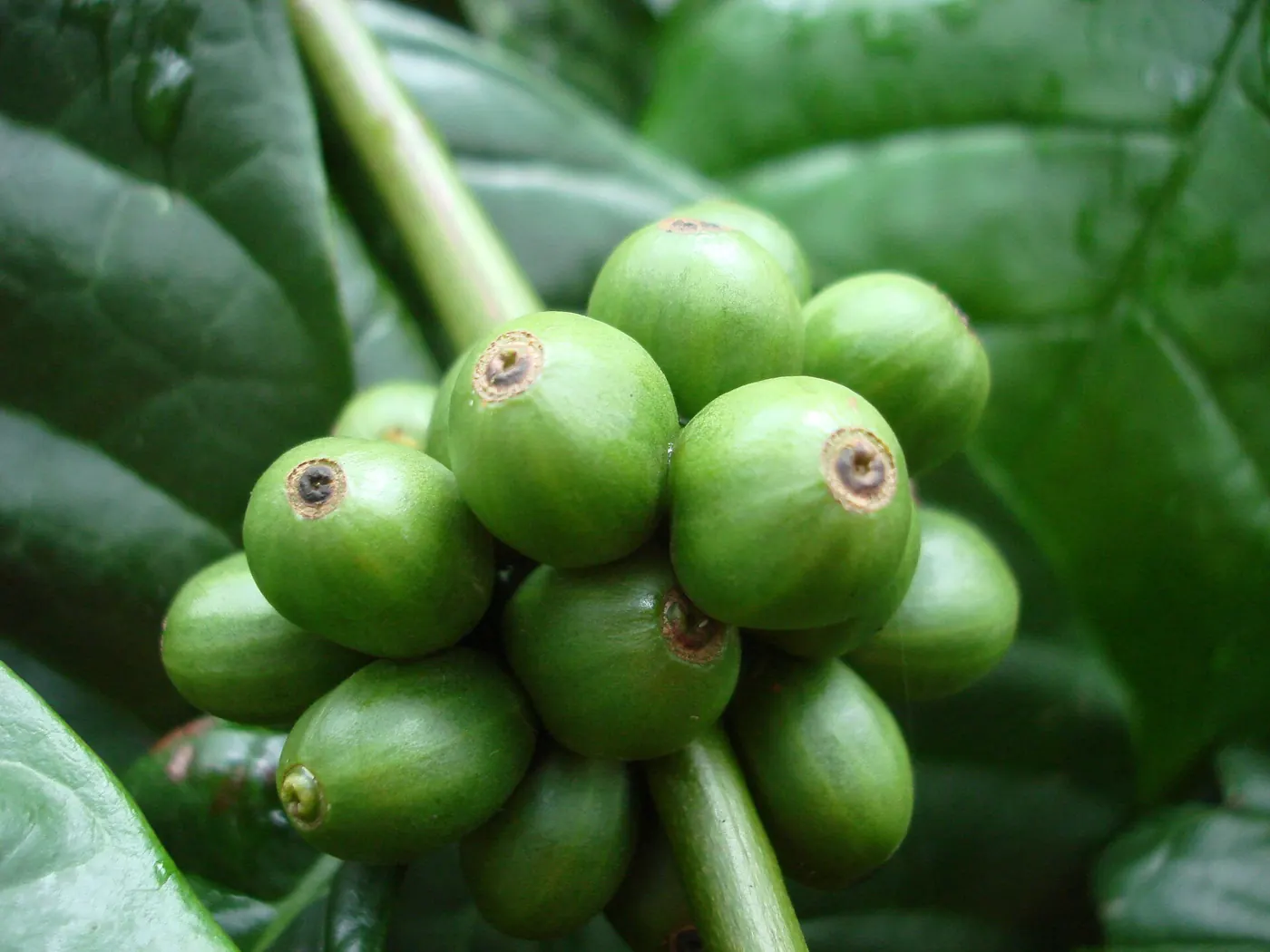
Coffea arabica 2n = 44
Photograph La Réunion · B. Navez, 2007 · CC BY-SA 4.0
Coffea canephora 2n = 22
Photograph Ksd5, 2009 · CC0
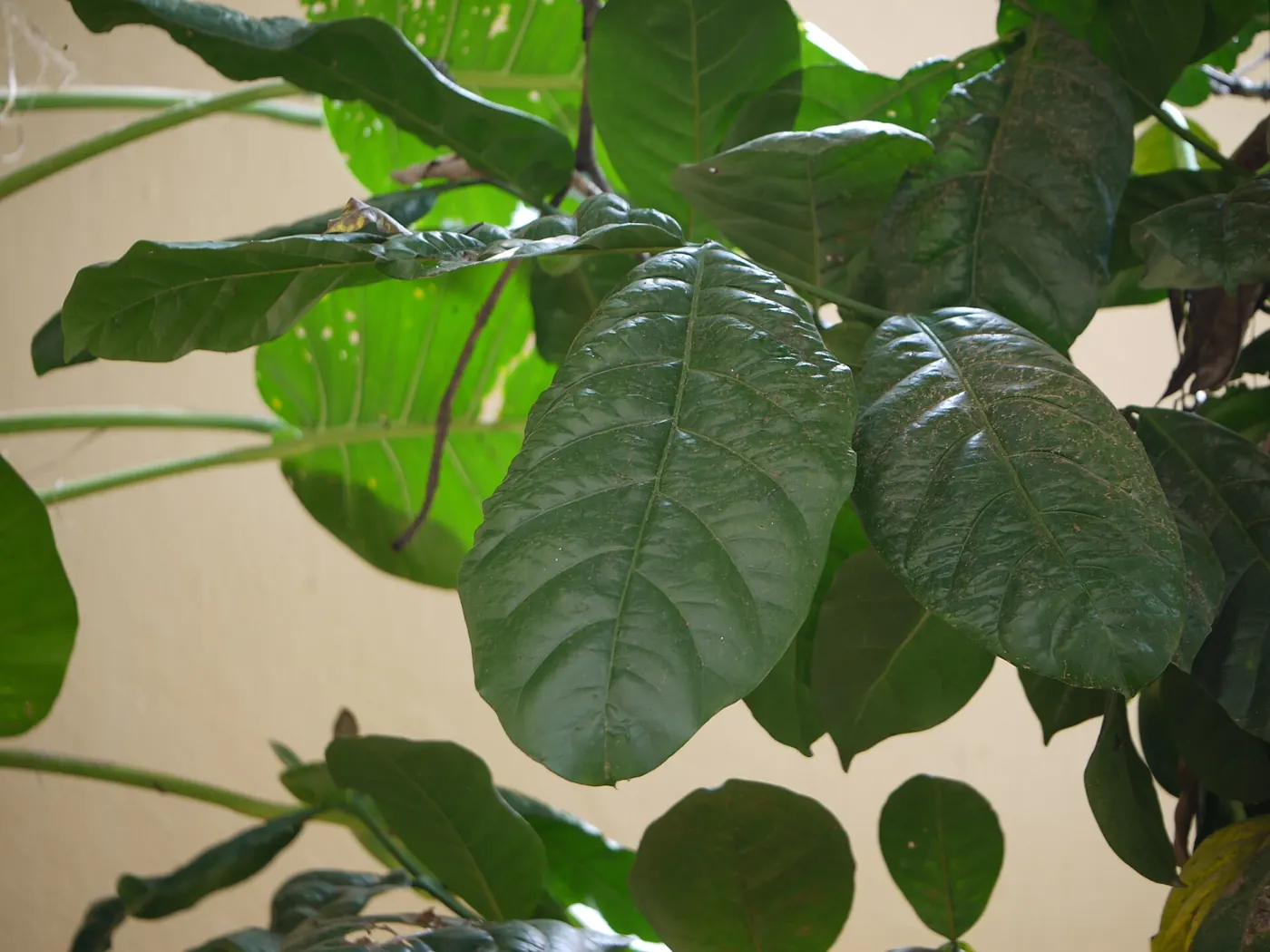
Coffea liberica 2n = 22
Photograph Thane, India · Dinesh Valke, 2011 · CC BY-SA 2.0
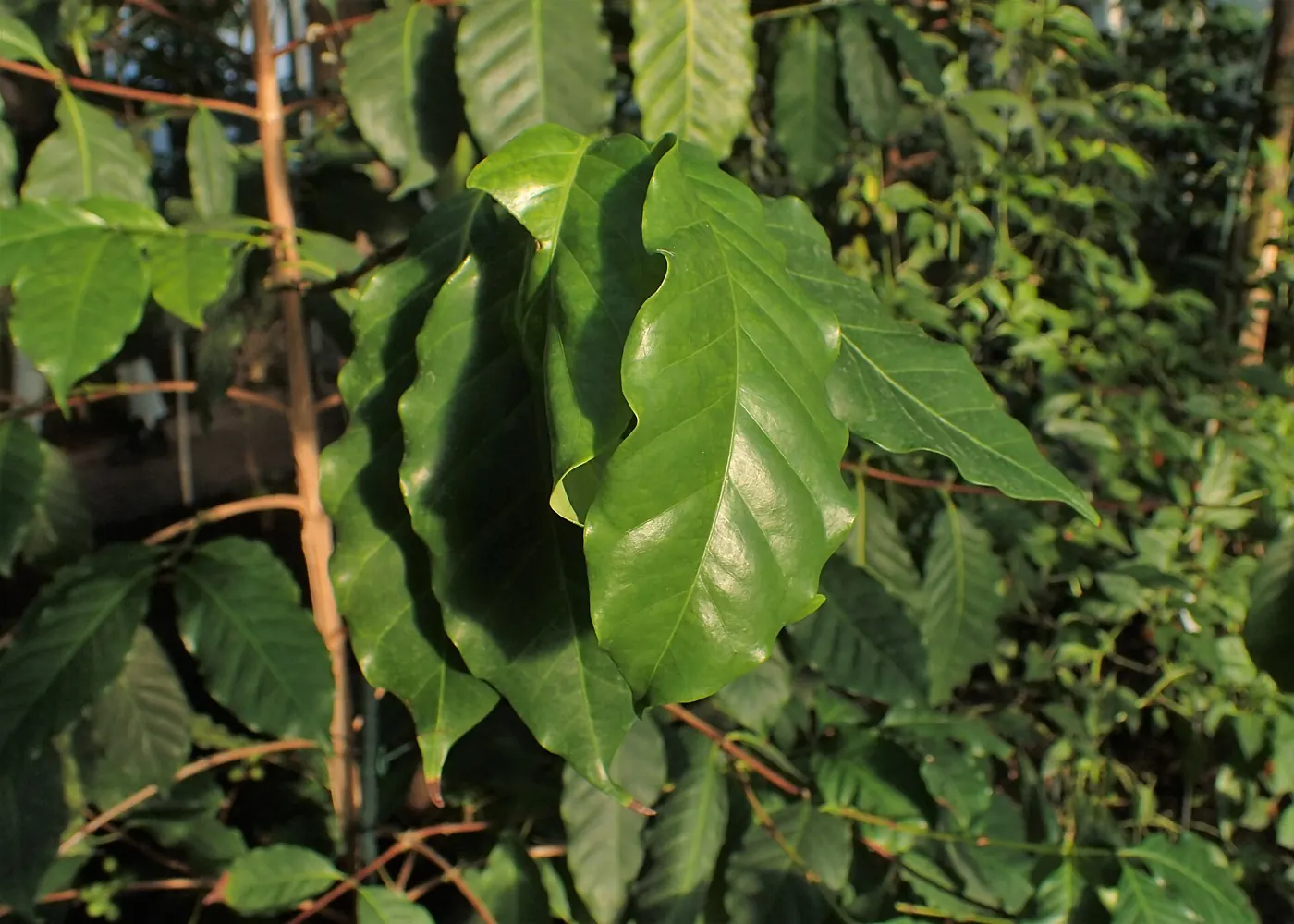
Coffea stenophylla 2n = 22
Photograph Berlin Botanical Garden · K. Ziarnek, 2019 · CC BY-SA 4.0
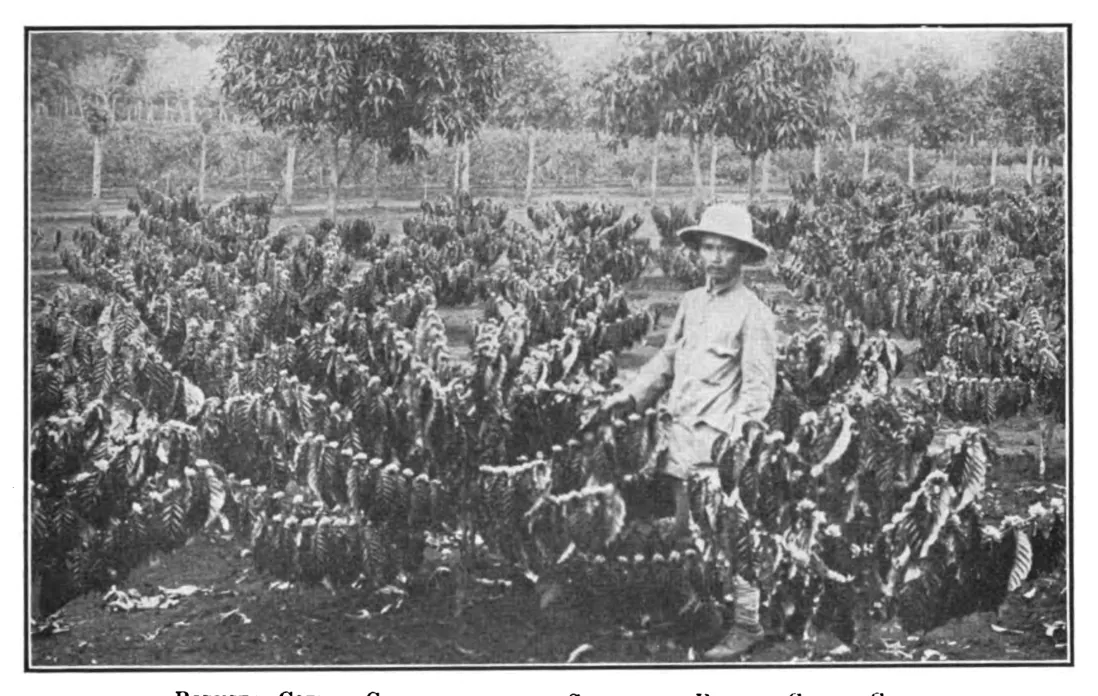
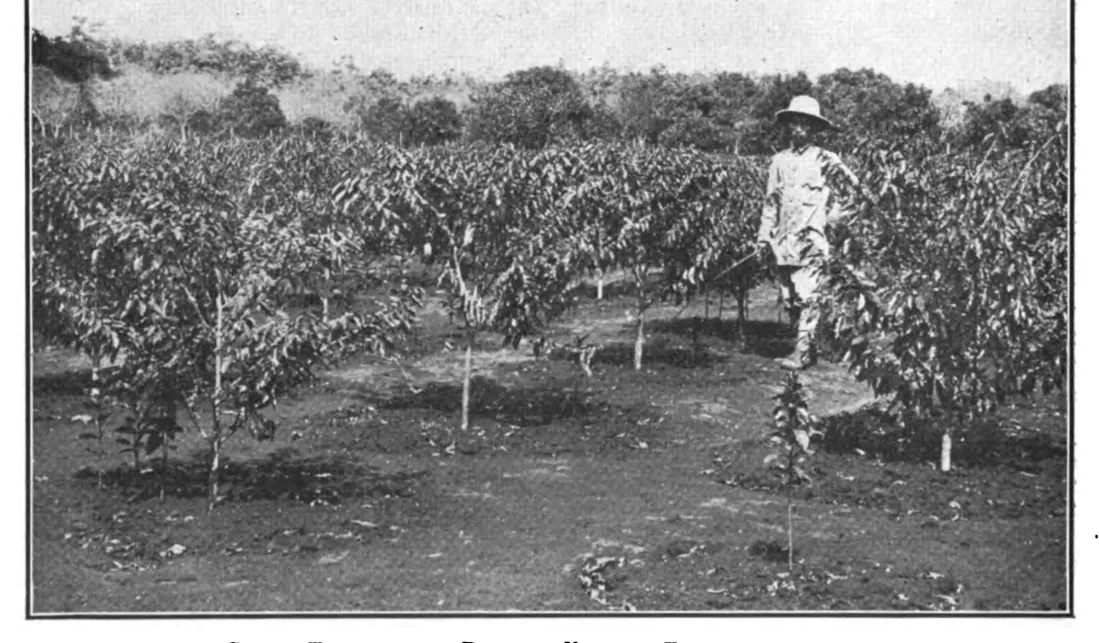
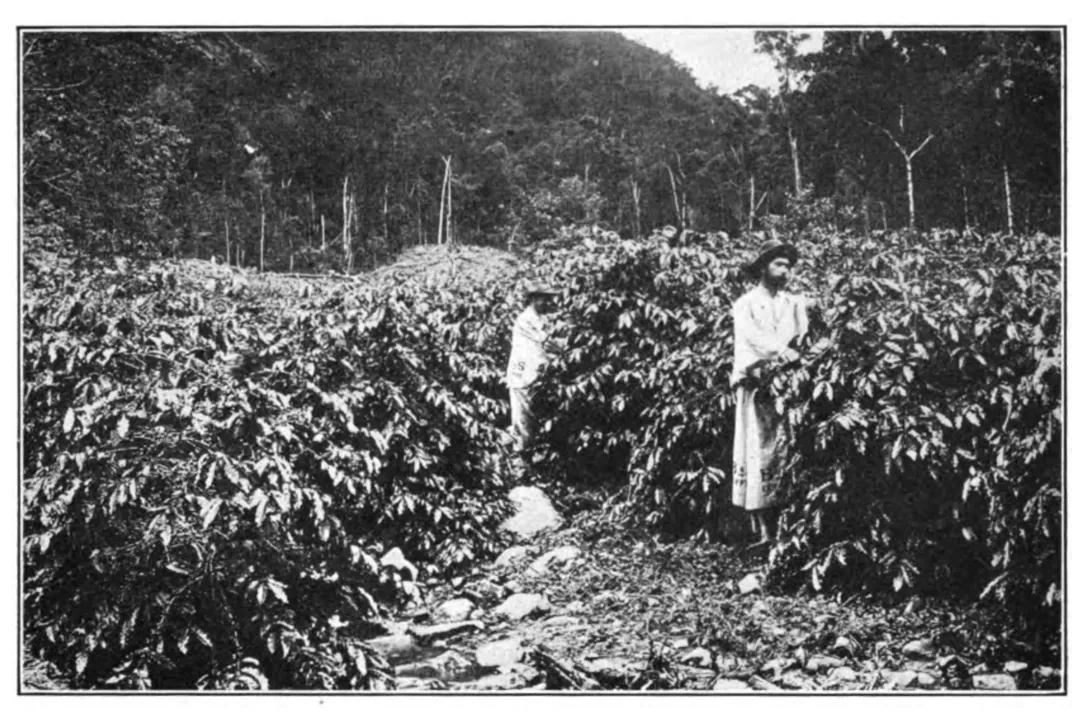
01Two archive plates
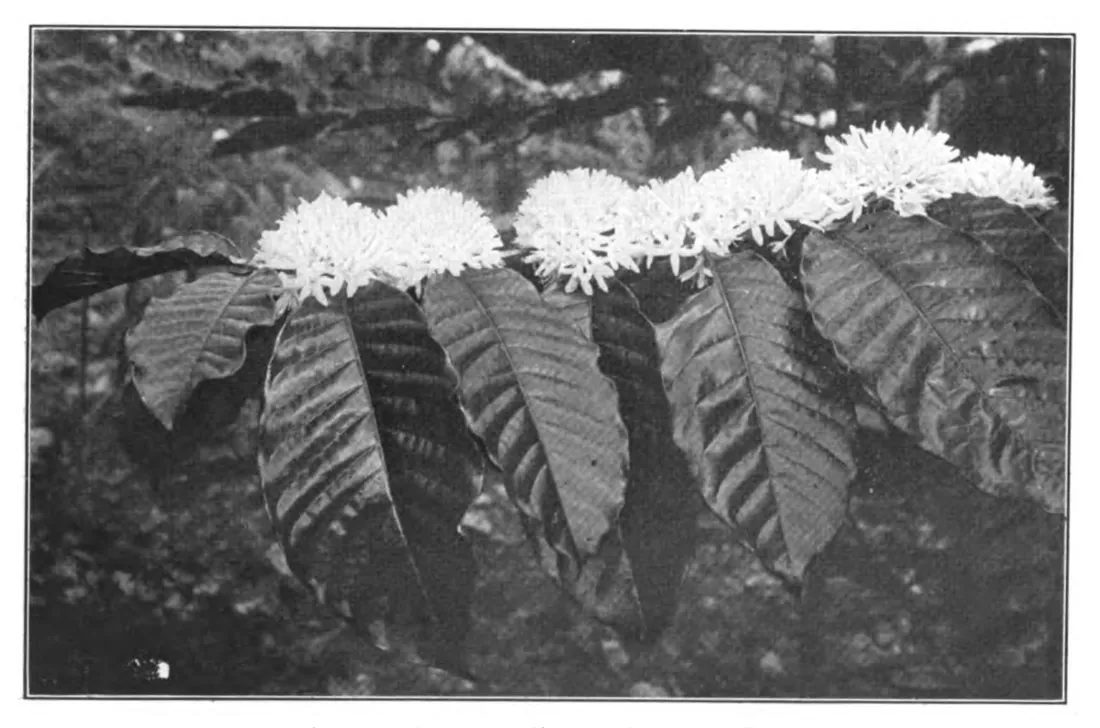
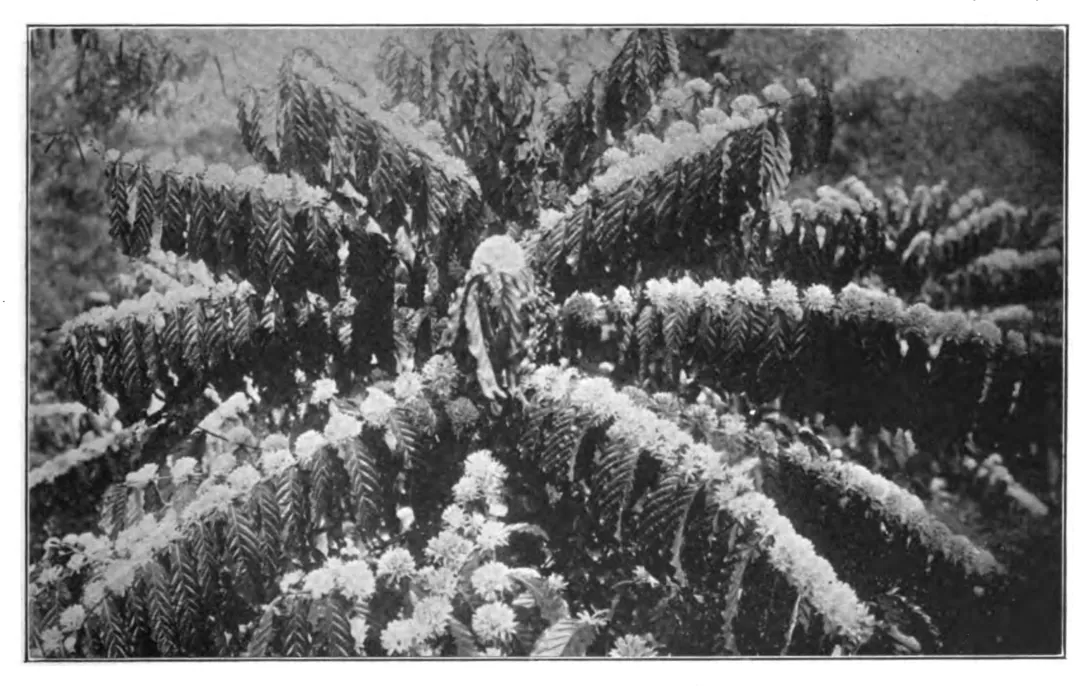
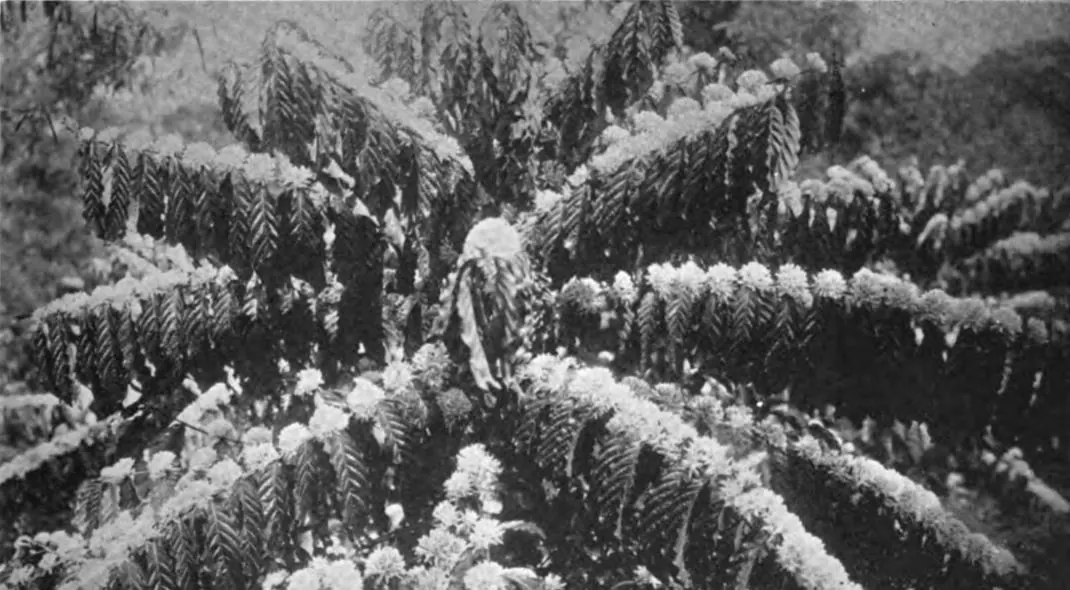
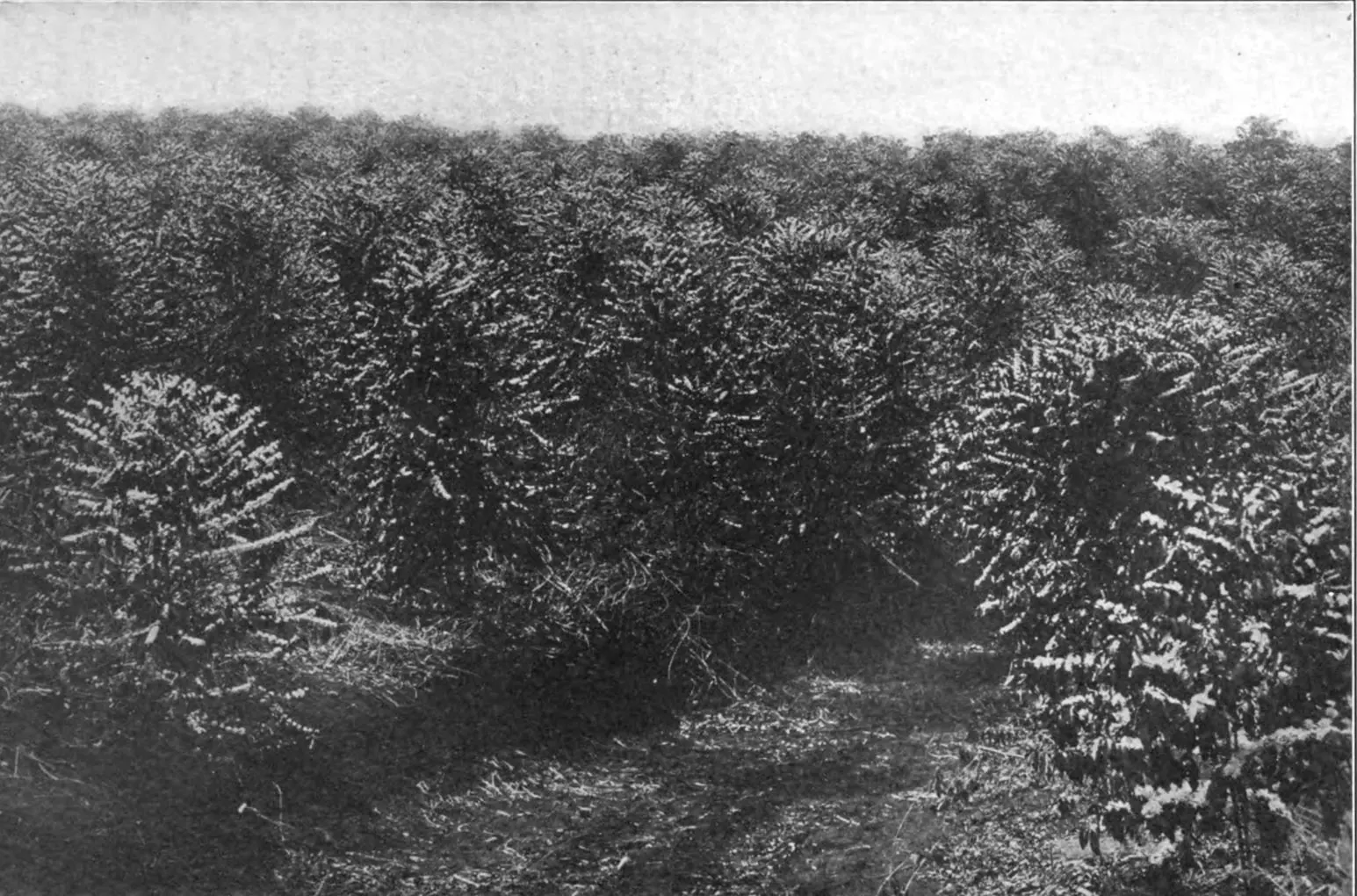
Robusta in flower, Preanger, Java
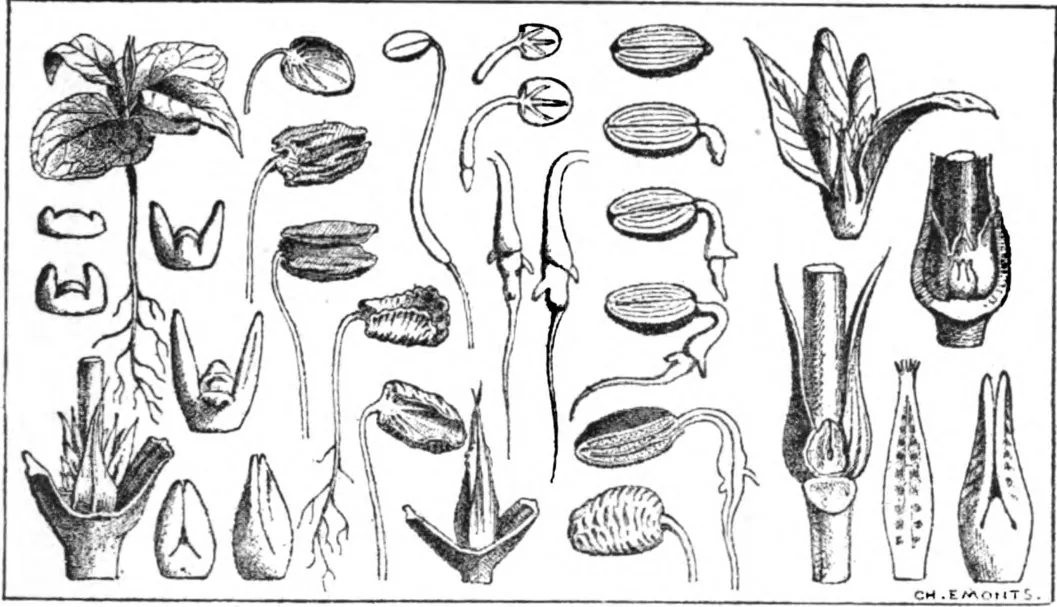
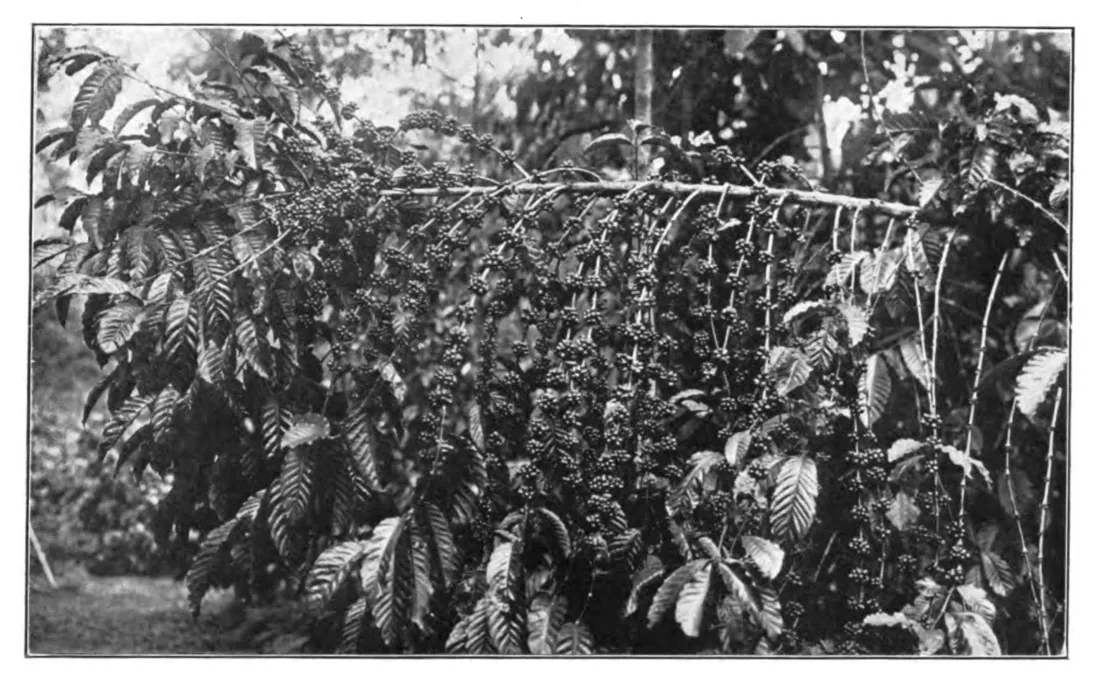
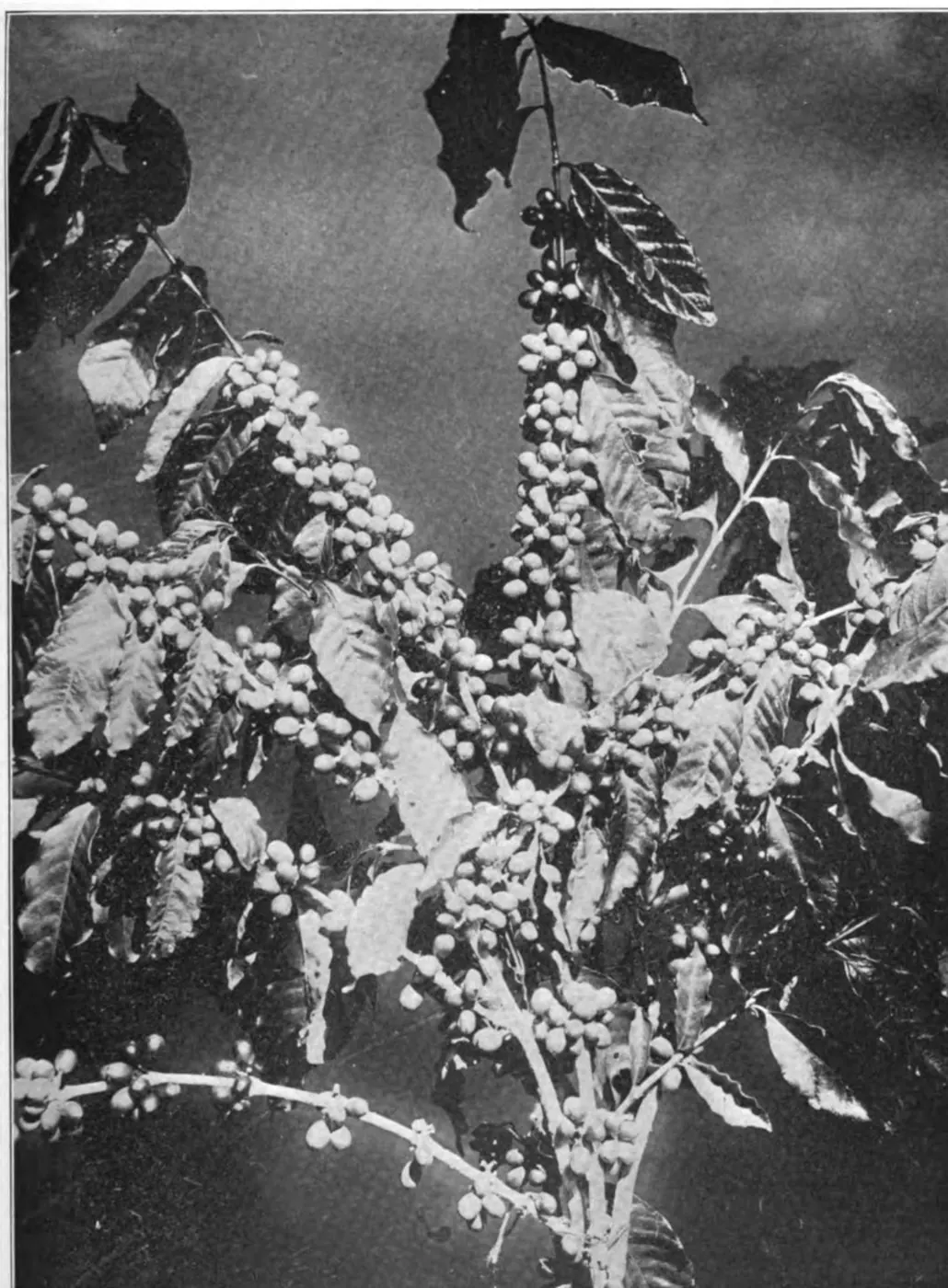
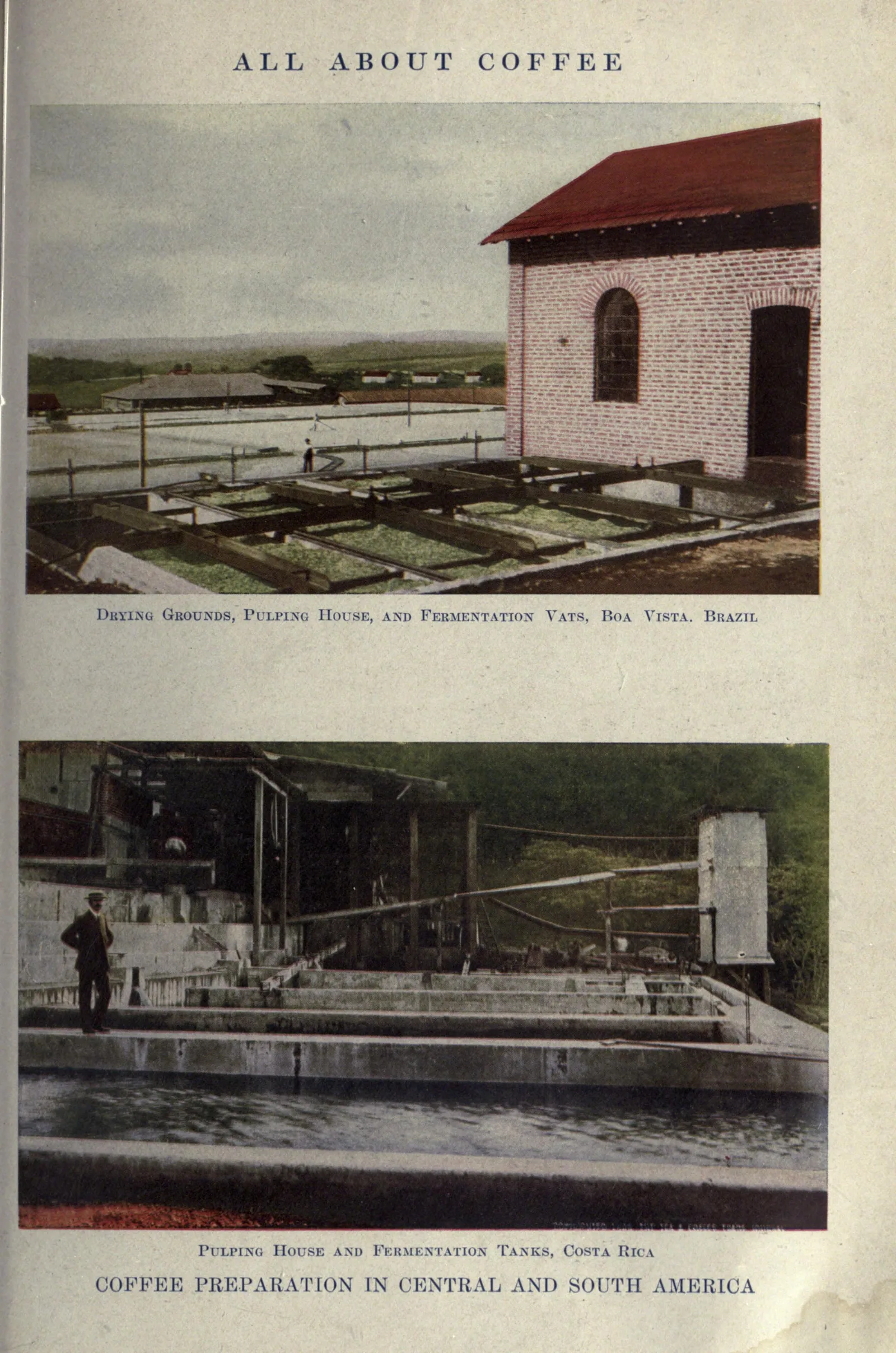
Archive Coffea arabica: leaves, flowers and fruits, painted from nature by M. E. Eaton · Ukers, All About Coffee, 1922, p. 8 · public domainArchive Details of the germination of the coffee plant, drawing by Ch. Kmoch · Ukers, All About Coffee, 1922, p. 133 · public domain
Plate II
The map of varieties
from left to right: the genus, the species, Yemen, then everything that came out of it; from top to bottom: the canephora, the hybridizations, the arabica
The registry in rings
Hover over a sector for details, click to open the dossier. From the center to the edge: the genetic family, the nature of the entry, the entry itself.
The registry as a web
Each dot is an entry, each line a parentage. Highly connected cultivars gather by themselves; those with only one parent stay at the periphery. Hover to read, click to open the dossier.
Lineage
cross, hybridmutationselectiondebated parentage
×0.85 · wheel, drag, click
Plate III
The introduction routes
a variety is also a journey
Plate IV
The chronicle
the plant and the world of coffee, in five chapters
The history in 9 parts
Each age fits in a few lines; “read more” opens the full account, with the landmarks of general history in the margin. The dated landmarks are further down.
02The legends of coffee, and the date of their texts
This chapter does not ask whether the great origin stories of coffee are true; it asks when the texts that carry them date from, and what the gap between the date of the text and the date of the events lets us see.
Read moreCollapse2,137 words
The history of coffee circulates with a stock of stories that almost everyone knows and almost no one dates. The goatherd and his restless animals, the exiled saint who boils berries, the seven seeds brought back from Arabia in a beard, the plant watered during the crossing by an officer who goes without water himself, the seeds obtained from a governor's wife, the pope who tastes the drink of the infidels and finds it good.
These stories are beautiful, they are taught, they are painted on sacks and on shop signs. Yet there is a modest, verifiable question to be asked about them, which is not the question of their truth: in which book, in which year, does this story first appear in writing? The answer is a fact of the archive, one that can be established and cited, whereas the truth of a scene a thousand years old cannot be established at all.
A late story is not for all that a false one: an ancient oral tradition may wait centuries before being printed. But when the date of the text is known, we at least know in what period the story was useful, and to whom.
The oldest sustained text on the origin of coffee is neither European nor legendary. Abd al-Qadir ibn Muhammad al-Ansari al-Jaziri al-Hanbali completed in 996 of the Hijra, the Muslim reckoning that begins in 622, that is, in 1587 of our era, a treatise entitled Umdat al-safwa fi hill al-qahwa, which can be rendered roughly as “what the pure rely on concerning the lawfulness of coffee.” The manuscript is held at the Bibliothèque nationale de France under the shelfmark Arabe 4590.
It has seven chapters: the etymology of the word, the virtues of the bean, then above all the religious quarrel in Mecca in 1511 and the refutation of those who wanted to ban the drink, and it ends with a collection of Arabic verses composed during that quarrel. A Latin note on the flyleaf of the volume sums it up: a book in seven chapters, published in the year 996 of the Hijra, when a hundred and twenty years had passed since the use of this drink had become established in Arabia Felix.
Yet this text recounts neither goats nor miracle. It attributes the adoption of coffee to a mufti of Aden, that is, a jurist charged with pronouncing the law, Jamal al-Din al-Dhabhani, who died around 1470 and who is said to have spread its use around 1454. A hundred and thirty years separate the thing told from the text that tells it, and al-Jaziri himself refers to an earlier author, Shihab al-Din, of whom no copy is known. The oldest surviving witness thus rests on a lost witness.
This manuscript reached Europe in the baggage of Nointel, ambassador of Louis XIV to the Ottoman Porte. Antoine Galland, the orientalist who would later give the Thousand and One Nights their French form, analyzed it and translated part of it under the title De l'origine et du progrès du café, in 1699. More than a century later, Sylvestre de Sacy edited its first two chapters in his Chrestomathie arabe, an anthology of selected passages intended for the students of the École des langues orientales, published in 1806 and reissued in 1826.
The count is instructive: between the use attested around 1454 and the treatise of 1587, a hundred and thirty years; between the treatise and its first French reading, a hundred and twelve more.
The goatherd, for his part, enters print in 1671. The book is by Antonio Fausto Naironi, a Maronite, professor of Chaldean and Syriac languages at the college in Rome: De saluberrima potione cahue, seu cafe nuncupata discursus, printed in Rome by Michele Ercole and dedicated to a cardinal. It is the first printed treatise devoted to coffee alone. In it we find a herder in Arabia Felix, animals that become lively after eating certain fruits, and a monk from the neighborhood who makes a decoction from them to keep his brothers awake.
No name appears there. The goatherd is called Kaldi only in later retellings, and I have not managed to establish with certainty the date at which this name becomes attached to the character: it is reported sometimes in 19th-century English versions, sometimes in the mass diffusion that Ukers gave it in 1922, and I have verified none of these earliest occurrences myself.
What is certain and verifiable is that the name is absent from the 1671 text. The events recounted are commonly placed around the 9th century; the text, for its part, is eight centuries younger.
Galland, in 1699, does not hold back from saying so. He reproaches Naironi for having accepted as history the stories of Omar and the Abyssinian goatherd, then adds a remark that illuminates the scene better than any refutation: the abbot and his monks, he writes in substance, are the mufti Gemaleddin and Muhammad al-Hadrami, and the monks are dervishes, that is, members of a Sufi brotherhood who keep vigil while reciting.
The Yemeni story was translated into a convent. The usefulness of this translation is easy to understand: in 1671, in Rome, in a work dedicated to a prince of the Church, a drink from the Muslim world gains a great deal from having been revealed to monks. This is not a falsification, it is a work of acclimatization, the same one that many plants and many words have undergone.
Sheikh Omar follows the same path, in the opposite direction. Tradition places him in 656 of the Hijra, that is, in 1258, exiled to Mount Ousab for misconduct, reduced to boiling the berries he finds, then recalled in triumph to Mocha, where a convent is built for him. The written foundation is the 1587 manuscript, thus three and a half centuries after the supposed events, and the story reaches the French public only with Galland in 1699 and Jean de La Roque in 1716.
In the meantime it has accumulated embellishments: in a version reported by Ukers, the dead master reappears under a veil and grown by ten cubits, water gushes from the ground, a bird of marvelous plumage leads the exile to the tree. Ukers himself makes no secret of it: in the chronology that closes his book, the date 1258 carries a note marker that refers to a single word, “legendary,” and a second that signals that the date is approximate.
The main vehicle of the story thus flags it as a story. What the legend of Omar contributes is clear: it attaches coffee to a lineage of saints, that of Shadhili, patron of Mocha, and it gives a drink contested by jurists a protector whom the jurists cannot challenge.
There is one case where the dating is complete, and it serves as a model for all the others. Vienna, 1683: the besieged city, the Ottoman army withdrawing, the sacks of green beans left behind, Kolschitzky receiving them as a reward and opening the Blue Bottle. This story first appears in 1783, from the pen of Gottfried Uhlich, exactly a century after the siege, and the historian Karl Teply established this in 1980.
The city's archive says otherwise: the privilege of serving coffee in Vienna was granted on January 17, 1685 to the Armenian merchant Johannes Diodato. Uhlich's story nonetheless won; it has its statue and its street. It is the textbook case, because one can see what a centenary is for: in 1783, Vienna tells itself the story of its siege, and the founding of the Viennese café finds a hero there rather than a commercial privilege.
The Indian tradition of Baba Budan, a pilgrim returned from Mecca with seven fertile seeds hidden on his person, planted on the slopes of Chikmagalur, resists this exercise. Ukers, in 1922, gives it as plausible while hesitating over the date, “as early as 1600” according to some, 1695 according to an authority he judges better, and his chronology marks the entry with two signs at once, approximate date and legendary story.
I have not found the first putting into writing of the seven-seeds story and so I do not give one. What is attested is more mundane and more solid: coffee grew in the Mysore hills well before the English began plantations there in 1840, the range bears the name of Baba Budan, and the shrine exists. The number seven, a number of blessing, and the hiding place in the beard belong to the later life of the story, the one in which a tale grows more specific as it ages.
Gabriel de Clieu offers the opposite case, one where we have an author. The story of the plant carried under a glass frame and watered during the crossing from his own water ration comes from a letter from the man himself, published in L'Année littéraire in 1774. It is a first-hand account, and it was written some fifty years after the crossing, in the very year of its author's death, when he was close to eighty-eight.
Ukers notes the wavering: some date the arrival to 1720, others to 1723; Jardin supposes two voyages, one of them failed, to reconcile the two; there is hesitation between one plant and three, de Clieu saying one. The sentence about the shared water is in his own hand, and it has made its way: a poem in L'Année littéraire the same year, verses by Esmenard, a porcelain service commissioned in his honor, a botanical garden in Fort-de-France opened in 1918 and dedicated to him.
One can read this success without contempt and without naivety: it places a colonial fortune under the sign of private devotion, one man and one plant, where there were fleets, monopolies and forced labor.
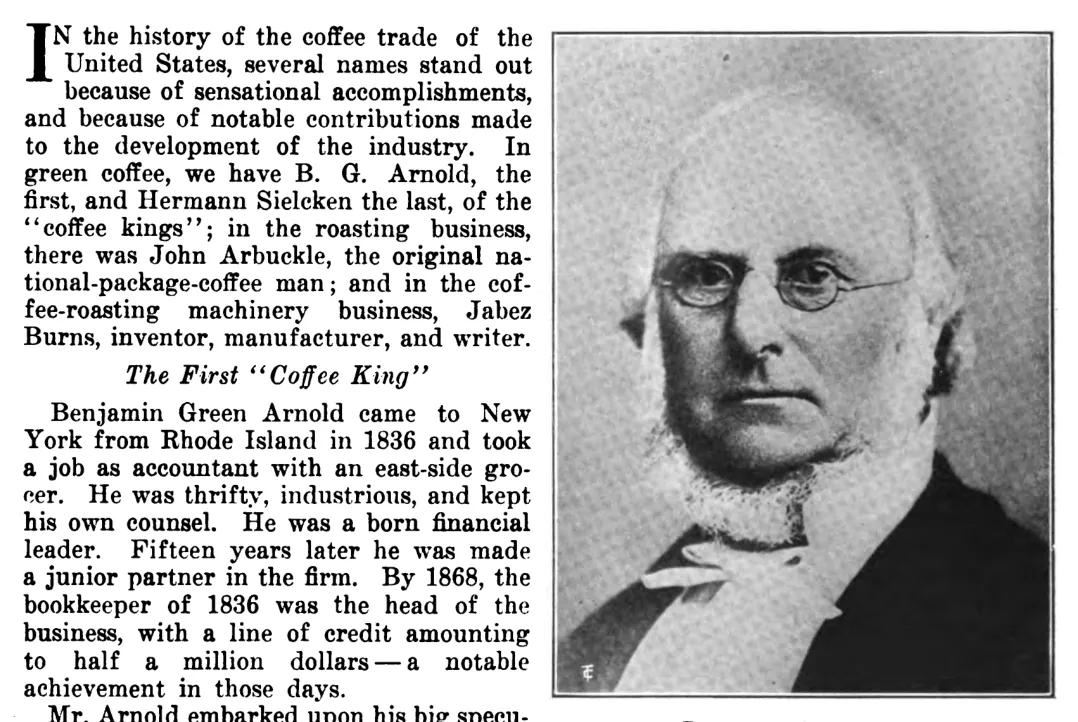
Francisco de Melo Palheta raises the same question with fewer documents. What is attested administratively fits in few words: in 1727, an officer of the Portuguese crown is sent to Cayenne on a border matter, and he returns with seeds and plants. The bouquet offered by the governor's wife, in which the seeds that French Guiana forbade to export were supposedly hidden, belongs to another layer of the story, and I have not been able to date its first telling.
Two negative indications deserve to be noted rather than a verdict: Ukers, in 1922, does not enter this episode in his chronology, where the Brazilian entry for those years mentions only the failure of the Pará plantation in 1723; and the gallant version circulates mainly in 20th-century literature, where Pendergrast takes it up in 1999. The scene has the world's greatest coffee economy begin with a gift, that is, with a favor granted, rather than with a state mission and with what the plantation then demanded in human beings.
That leaves the pope. No known pontifical act concerns coffee, either to ban it or to bless it. Ukers relates the story of the priests asking Clement VIII to proscribe the drink of Satan, and of the pope who tastes it and proposes to baptize it, introducing it with a cautious formula, “according to a much-cited legend,” and naming no source. The detail that matters lies elsewhere: he does not include this episode in his chronology, whereas he includes Rhazes, Avicenna and Omar there with the mark “legendary.” I have not found the first printed version of this scene and so I propose none.
What can be dated around it, on the other hand, is well dated: in 1585, Gianfrancesco Morosini reports to the Senate of Venice that the Turks drink a black water made from a seed called cavee; in 1615, Pietro Della Valle writes from Constantinople that he will bring some back. The baptism anecdote settles in a single scene the question that those years were really asking, whether a drink of Islam could become Christian. The dedication of Naironi's book to a cardinal, in 1671, answers the same question by other means.
Put end to end, these gaps trace a slope. The oldest written testimony is Arabic, sober, administrative: a mufti of Aden, a date, a quarrel over law. The picturesque scenes, the goatherd, the marvelous bird, the amused pope, the governor's wife's bouquet, are later and, for the most part, European. That does not disqualify them, it situates them. Ukers, who more than anyone made them circulate, had taken care to put at the foot of his chronology two notes of three words, one for approximate dates, the other for legendary facts; the use made of his book has often erased these notes.
The proposal of this chapter is to put them back: keep the stories, which have their beauty and their usefulness, and set beside each one the date of its oldest text.
Abd al-Qadir ibn Muhammad al-Ansari al-Jaziri al-Hanbali, Umdat al-safwa fi hill al-qahwa, 996 of the Hijra (1587), Bibliothèque nationale de France, manuscript Arabe 4590; description of the manuscript, of the seven chapters and of the Latin flyleaf note in Ukers, All About Coffee (1922), section on the Arabic manuscript. Attribution of the adoption of coffee to Jamal al-Din al-Dhabhani, mufti of Aden who died around 1470, around 1454: al-Jaziri, taken up by the scholarly literature; Ukers writes Mocha where recent studies write Aden. Reference by al-Jaziri to Shihab al-Din, a lost work: Ukers, same section, after La Roque. Antoine Galland, De l'origine et du progrès du café, 1699, partial translation of the manuscript; criticism of Naironi and identification of the abbot and the monks with the mufti Gemaleddin, Muhammad al-Hadrami and the dervishes: Galland, cited by Ukers, chapter III. Antoine Isaac Silvestre de Sacy, Chrestomathie arabe, Paris, 1st edition 1806, 2nd edition 1826, which gives the first two chapters of al-Jaziri. Antonio Fausto Naironi, De saluberrima potione cahue, seu cafe nuncupata discursus, Rome, typis Michaelis Herculis, 1671, dedicated to a cardinal: title page of the digitized copy (Internet Archive, bub_gb_XqtX_0BdDbwC); first printed treatise devoted to coffee alone according to Ukers 1922, chapter III and the bibliographic chapter. Absence of the name Kaldi in the 1671 text: title page and text of Naironi, as well as the English-language Wikipedia entry on Kaldi, which makes the name a later addition; the exact date at which the name became attached to the character could not be established here. Jean de La Roque, Voyage de l'Arabie heureuse, Paris, André Cailleau, 1716, containing a Mémoire concernant l'arbre et le fruit du café and a Traité historique de l'origine et du progrès du café (full title in the Catalogue collectif de France, record CCFr ark:/06871/0011738666); Ukers's chronology dates this work to 1715. Ukers's 1922 chronology and its two note markers, [L] Approximate Date and [M] Legendary, applied notably to Rhazes around 900, Avicenna around 1000, Omar in 1258 and Baba Budan around 1600. Versions of the Omar story, including the one with the veiled specter and the bird: Ukers 1922, chapter III. Vienna: privilege of serving coffee granted on January 17, 1685 to the Armenian merchant Johannes Diodato (Vienna city archives); invention of the Kolschitzky story by Gottfried Uhlich in 1783, established by Karl Teply in 1980. Baba Budan: Ukers 1922, chapter on propagation, which hesitates between 1600 and 1695 and marks the entry as legendary; start of English plantations in India in 1840, same chapter. The first putting into writing of the seven-seeds story was not found. Gabriel de Clieu: letter from de Clieu published in L'Année littéraire in 1774, cited and discussed by Ukers 1922, chapter II, which notes the divergences of date (1720 or 1723), the two-voyage hypothesis proposed by Jardin, and the hesitation between one plant and three; obituary notice in the Mercure de France, December 1774; botanical garden of Fort-de-France opened in 1918. Francisco de Melo Palheta: 1727 mission to Cayenne over a border dispute, Brazilian tradition of the bouquet reported notably by Pendergrast, Uncommon Grounds (1999), chapter 1; Ukers's 1922 chronology mentions for these years only the failure of the Pará plantation in 1723; the first writing of the gallant version was not found. Clement VIII: Ukers 1922, p. 26, which gives the episode as a “much-cited legend” without source and does not enter it in his chronology; no known pontifical document; the first printed version was not found. Dated landmarks of the same moment: report of Gianfrancesco Morosini to the Senate of Venice, 1585, and letter of Pietro Della Valle from Constantinople, 1615, both cited by Ukers 1922, chapter on Italy. Full text of Ukers consulted from the Project Gutenberg edition, ebook 28500.
610,000 BCE to 1500
03Before 1500, the origins and what we do not know of them
A species born of an accident, a custom born of a religious vigil, and a history written so late that its oldest dates are its youngest stories.
Read moreCollapse1,524 words
-300000Emergence of Homo sapiens in Africa-3300First writing in Mesopotamia622The Hijra, start of the Muslim calendar1347The Black Death reaches Europe1453Capture of Constantinople by the Ottomans1492Christopher Columbus reaches America
Two landmarks of this period are not about people, and they are the only ones that rest on a measurement rather than a story. Between 610,000 and 350,000 years ago, on the high plateaus of East Africa, two wild coffee plants crossed: Coffea canephora, the species now called canephora, and Coffea eugenioides, which is not drunk. The descendant keeps the chromosome sets of both its parents instead of retaining only one, a doubling that makes it fertile where an ordinary hybrid would remain sterile, and a third species is born from it, Coffea arabica. This is what Salojärvi's team established in 2024 by comparing the genomes of the three species. Two consequences follow.
The first is that arabica is young: its hybridization is barely older than our own species. The second is that it was born from a single meeting, perhaps a single pair of plants. A species that begins this way contains, at the outset, only the diversity of its two parents. This is the first of the two bottlenecks whose effects this site follows. The second, that of Yemen, comes at the end of this chapter: it created nothing, it narrowed.
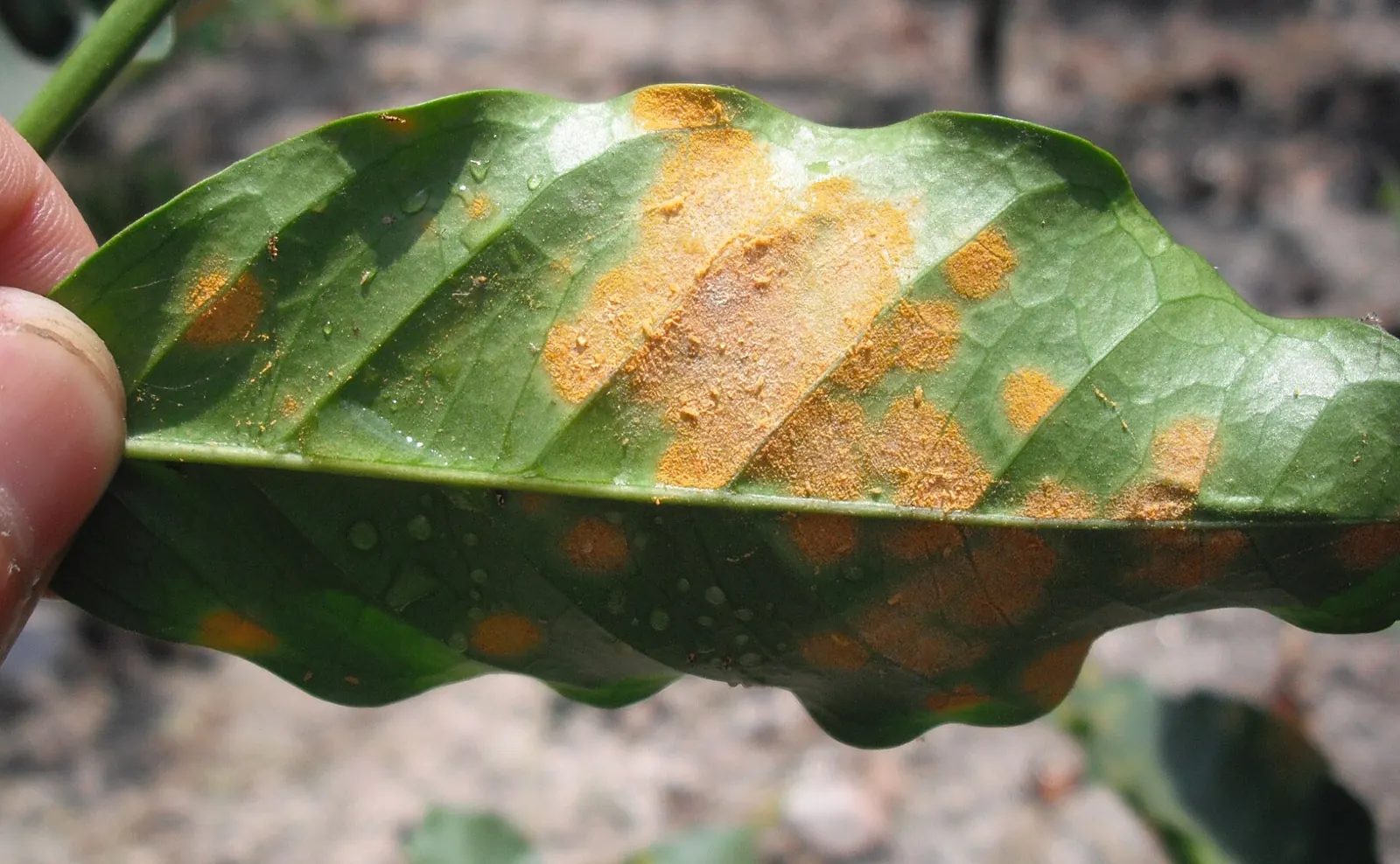
When coffee leaf rust is spotted in Ceylon in 1869 and goes around the Indian Ocean within twenty years, it is not only a disease that travels, it is a plant almost without variants paying a bill opened half a million years ago. The catalog of World Coffee Research notes again in 2025 that 97.55% of Brazilian cultivars descend from Typica and Bourbon.
The second measured landmark is more delicate, and it needs to be said what it is not. About 30,500 years ago, population genetics models make the wild arabicas of Ethiopia and the population that would later found the cultivars diverge. These models, SMC++ and fastsimcoal2, read today's genomes and work backward to calculate the population sizes that would explain what is observed.
They therefore date no human act: nobody was cultivating anything 30,500 years ago. They date the moment when two groups of plants stopped exchanging their genes. Taking this date for a domestication amounts to confusing a natural separation with a decision.
Between this figure and the 15th century, the chronicle has a gap, and this gap is the real subject of the chapter. None of the landmarks that follow rests on an excavation, a charred bean or a dated vessel: they all rest on texts, and all these texts were written centuries after the events they report. A drink leaves nothing: an infusion cannot be preserved, a vigil cannot be petrified.
What we call the origin of coffee is therefore, literally, memory put into writing late, by people who had a reason to write it.
That reason can be named. The first account held to be authentic is that of Sheikh Abd al-Qadir, written in 1587, preserved in an Arabic manuscript at the Bibliothèque nationale in Paris and translated by Antoine Galland in 1699. 1587 is seventy-six years after the trial of Mecca, in the middle of a century of quarrel: coffee is attacked there as a novelty, and a novelty is defended with an ancestry.
To write the origin of coffee, in the 16th century, is to plead a case. From this manuscript come Galland, La Roque in 1716, Ukers in 1922, then the pages you are reading: all our knowledge of the origins passes through one text, two translations and two compilers.
The two oldest dates of the timeline are read in this light. Around 900, Rhazes, the great physician of Baghdad, is said to have been the first to mention coffee under the name bunchum; around 1000, Avicenna is said to have explained its virtues, under the same name. Ukers marks these two dates as legendary, and he is right: a word does not prove a plant. Nothing guarantees that the bunchum of the manuscripts designates the bean we drink.
It must be added that these two attributions are convenient. Rhazes and Avicenna are the two highest medical authorities of Islam; to name them as first witnesses is to endow coffee with a medical credential, precisely what would be debated before the judges of Mecca in 1511. These legendary dates are not innocent errors. They are arguments.
Around 1258 comes the most solid legend, that of Sheikh Omar, disciple of Shadhili and patron saint of Mocha. Exiled to Ousab for misconduct, he survives by boiling berries; the sick of Mocha come to consult him, are healed by the decoction, and recall him in triumph. This story has in its favor that it appears in the Arabic chronicle that Galland translated, that is, in the closest source we have, and La Roque gave it his preference in 1732.
It also has a recognizable form: the discovery arises there from necessity and not from chance. Ukers classes it among the legends nonetheless, and prudence stops there: it is the oldest story that coffee drinkers have told themselves about themselves, which does not make it true.
Then there is Kaldi, around 850, the goatherd of Abyssinia whose goats dance and whose billy goat, usually so dignified, gambols. This is the legend that everyone knows, and the youngest of all. It is late, it is of French origin, and La Roque was already dismantling it in 1732 by opposing to it the story of the mufti of Aden, that religious jurist from whom the Yemeni Sufis got their custom.
One detail is enough to date it from the inside: the monk, in this version, first throws the berries into the fire, and it is the smell of the roasted bean that converts him. Roasting is thus already there, in a story supposed to recount the moment when nothing was known about coffee. The chronology of the facts is here the reverse of that of the texts: the older the date displayed, the more recent the story. The goat, for its part, has stayed on the packages.
The first solid fact of coffee's human history therefore arrives late, and it does not arrive in Ethiopia. In the 15th and 16th centuries, Yemen brings into cultivation material that came from Ethiopia, probably through Zeila and Aden. Why there, and not in the country where the plant grows on its own? Because it needed something other than coffee trees: terraces, channeled water, a port and a state capable of taxing.
Yemen had all four. Bani Matar, Haraz, Yafe' are developed slopes, farmed dry and irrigated, at a distance from the humid forests. This ecological accident, pointed out by McCook, had a global consequence: coffee leaf rust lives in those forests, and Yemeni cultivation settled out of its reach. For three centuries the world drank a coffee that its principal disease had not followed, which would lead 19th-century planters to believe it did not exist.
In the same period, between 1450 and 1500, the Sufi brotherhoods, those mystical fraternities of Islam whose services are held at night, adopt the decoction to stay awake. Here are the two halves of the matter: a country that knows how to produce and a custom that gives a reason to drink. The price of this passage can still be read in the plants. Almost all arabica cultivated outside Ethiopia descends from the small number of plants that passed through Yemen: Montagnon and colleagues find only three genetic groups there in 2022, SL34, Typica-Bourbon and New-Yemen, and show in passing that a local name such as Udaini designates not a lineage but a reputation. A terroir name is not a genotype, and that has been true from the start.
Then coffee leaves the mosques and takes the pilgrims' road. From 1470 to 1500, its use reaches Mecca and Medina from Aden. This move of a few hundred kilometers is the most important of the period, because Mecca is not a city like any other: the entire Muslim world comes there every year and leaves again. A drink adopted there is distributed everywhere, free of charge, by travelers who have nothing to sell.
The dazzling spread of the following century has this mechanism and no other. The first ban too: it is in Mecca, in 1511, that coffee meets its first police, because that is where it had become visible to everyone.
One last line of the timeline calls for caution. Ukers dates to about 1505 the introduction of the coffee plant to Ceylon by the Arabs. Nothing confirms it, no later landmark attaches to it, and the true plantation of Ceylon is Dutch, in 1658. The entry is kept because it appears in the reference chronology, and the doubt with it. Such is the state of the file in 1500: a species born of an accident, a culture established on terraces, a religious custom becoming urban, a port that is going to matter, and not a single page written by those who lived all this.
Hybridization of C. canephora and C. eugenioides, chromosome doubling and birth of C. arabica, dating between 610,000 and 350,000 years: Salojärvi et al., Nature Genetics 56 (2024), p. 722-725, chronicle landmark “610,000-350,000 years ago.” Modeled divergence around 30,500 years and SMC++ / fastsimcoal2 methods: Salojärvi et al. 2024, landmark “~30,500 years ago,” which itself specifies that this is a genomics result and not a date of domestication. First observation of Hemileia vastatrix in Ceylon on November 6, 1869 and tour of the Indian Ocean from 1876 to 1894: chronicle landmarks “1869” and “1876-1894.” Share of Brazilian cultivars descending from Typica and Bourbon, 97.55%: World Coffee Research, Coffee Varieties Catalog 2025, landmark “2025.” Account of Abd al-Qadir written in 1587, Arabic manuscript of the Bibliothèque nationale de France, translation by Antoine Galland in 1699: Ukers 1922, chronology p. 725, landmark “1587.” Rhazes around 900 and Avicenna around 1000, bunchum, dates marked legendary: Ukers 1922, chronology p. 725, landmarks “around 900” and “around 1000.” The argument that these attributions served to give coffee a medical endorsement is a reading proposed here, not a claim of Ukers. Sheikh Omar, Shadhili, exile to Ousab and founding of Mocha: Ukers 1922, p. 13-14 and chronology p. 725 (legend); Galland 1699; La Roque, Voyage de l'Arabie heureuse (1716), 1732 translation, historical treatise; landmark “around 1258.” Kaldi, late French version, goats and billy goat, berries thrown into the fire and smell of the roasted bean, refutation by Galland in 1699 and by La Roque in 1732: Ukers 1922, p. 14-15; La Roque 1732, p. 311; landmark “around 850.” Bringing into cultivation in Yemen from Ethiopian material, probable passage through Zeila and Aden, terraces of Bani Matar, Haraz and Yafe': Livre café, ch. 3; dry and irrigated cultivation away from the humid forests where rust lives: McCook, Coffee Is Not Forever (2019), p. 23-25; landmark “15th-16th centuries.” Three Yemeni genetic groups SL34, Typica-Bourbon and New-Yemen, and the fact that a vernacular name such as Udaini does not designate a genotype: Montagnon et al., Agronomy 12 (2022), same landmark. Adoption by the Sufi brotherhoods to stay awake, Aden then Mecca: La Roque 1716, historical treatise; Ukers 1922; Livre café, ch. 5; landmark “around 1450-1500.” Spread toward Mecca and Medina from Aden from 1470 to 1500 and supposed introduction of the coffee plant to Ceylon around 1505: Ukers 1922, chronology p. 725, landmark “1470-1500.” Dutch plantation in Ceylon in 1658, set here against this date of 1505: chronicle landmark “1658.” The link between the pilgrimage and the speed of diffusion, as well as the connection between the visibility acquired in Mecca and the condemnation of 1511, are explanations proposed here from the landmarks “1470-1500” and “1511,” and not claims of the sources.
1500 to 1600
04The 16th century, from Yemen to the Ottoman Empire
In a hundred years, a vigil of brotherhoods becomes an urban institution, a line of tax revenue and a rumor in print in Europe; the agent of this transformation is not taste, it is a conquest.
Read moreCollapse1,528 words
1517Luther posts his 95 Theses at Wittenberg1520Suleiman the Magnificent takes the Ottoman throne1543Copernicus publishes De revolutionibus1571Naval battle of Lepanto1588Failure of the Invincible Armada
In 1500, coffee is a regional custom: it is drunk in Yemen and in the holy cities of the Hejaz, and nowhere else. In 1600, it is drunk from Cairo to Constantinople, in rooms that have a sign, a price list and a proprietor; an empire draws an income from it; a botanist has described it in Latin in a book printed in Venice.
A hundred years to go from one to the other. It would be convenient to attribute this to taste, but taste never explains a speed. This one lies in two dates of conquest that the timeline leaves side by side without linking them.
In 1516 and 1517, Selim I overthrows the Mamluk sultanate and takes Syria and then Egypt; the chronicle records that he brings coffee back to Constantinople among his booty. In 1536, the Ottomans occupy Yemen. These two dates, together, place within a single political space the country that produces, the routes that carry and the cities that consume. Between Mocha and the Bosphorus, coffee no longer has a border to cross, only the customs houses of the same state.
The merchandise goes up by way of Jeddah and Suez to Cairo and Constantinople, and the governor of Mocha pays his revenue to the treasury every year. Coffee then ceases to be a custom and becomes a revenue, and this decides the rest of the century.
The conquest displaces not only bales, it displaces men. The first coffeehouses of Constantinople, in 1554, are opened by Schemsi, from Damascus, and Hekem, from Aleppo, that is, by two men from the Arab provinces annexed thirty-seven years earlier. The capital did not invent coffee: it learned it from its new subjects, and the word itself arrived with them. An empire is first of all a machine for circulating the habits of the vanquished.
At the same time, the drink changes nature without changing recipe. In 1510, in Cairo, the Yemeni dervishes, that is, the members of the brotherhoods, drink it on nights of devotion from a large vessel of red clay: the superior draws from it for each one while chanting, then the bowl passes to the laymen. It is a rite, and it costs nothing. In 1554, in Constantinople, the cup costs one aspre, a small Ottoman silver coin, and one sits on sofas kept clean.
Between these two scenes, the essential has happened: coffee has a price. A drink that has a price has a supplier, premises, a clientele and a possible tax. It also has a by-product, for from the same fruit two drinks are drawn, that of the beans and that of the husks, the “Sultana's coffee.”
The series of bans, Mecca in 1511, Cairo in 1534, Constantinople in 1543 and then around 1580, is detailed in the account devoted to the question, which shows that the motive was not the drink but the room. What the chronicle adds is the calendar. Suleiman has coffee thrown into the sea at Constantinople in 1543, seven years after his troops took the province whose coffee pays him, and trade continues through the very city that has just condemned it.
The same state forbids on one side what it taxes on the other, in the same decade. The contradiction did not last, because an administration always ends up preferring revenue to principle.
The way out is read in two landmarks that are never brought together. In 1524, the qadi of Mecca, that is, the judge of the city, closes the coffeehouses for disorder but lets people drink at home; his successor reopens them under license. Around 1580, in Constantinople, the mufti having had roasted coffee declared charcoal, and therefore forbidden, Murad III has the rooms closed, and the officers charged with keeping them shut turn a blind eye in return for payment.
A license and a bribe are the same solution, once legal and once not: in both cases, the ban is turned into a tariff. Ottoman power did at retail what it was already doing wholesale at Mocha. It stopped preventing and began collecting.
The ground of the dispute, for its part, is medical. The medicine of the time classifies each substance by degrees of hot, cold, dry and moist, and lawfulness can be deduced from this classification. In 1511, in Mecca, the two Hakimani brothers, Persian physicians, declare the plant cold and dry; one of them feared for his clientele. Twelve years later, around 1523, a physician of Cairo asks the same question and answers it in the negative: coffee goes to the head, therefore it is not lawful.
This time the matter dies, and the chronicle says why. The physicians of Cairo valued this new adjunct of their pharmacopoeia. Between 1511 and 1523, coffee went from suspect novelty to professional asset, and its legal fate followed its economic fate. The doctrine had not moved; the interests had. Where nobody had an interest against it, in Damascus, in Aleppo, there was no quarrel at all.
Another landmark shows the same reversal, but at the top. The seraglio, the sultan's court, equips itself with coffee officers, the kahvedjibachi, at the very moment when the religious authorities obtain closures. And in the rooms of Constantinople one sees arrive the future judges, provincial qadis in search of a post, professors, officers of the seraglio and merchants. These houses were called “schools of the wise.” In an empire where offices are obtained through presence and recommendation, a room where those who appoint and those waiting to be appointed sit together is an employment office.
This explains the nervousness of power better than the word sedition. It is not only that people talk there, it is that careers are handed out there.
One landmark, on the other hand, asks to be kept at a distance. Around 1573, we read, refusing coffee to one's wife was among the Turks a legitimate ground for divorce. The formula traveled from traveler to traveler as far as Ukers, who gives it after a 19th-century author, and we have verified it nowhere. What it surely attests is that Ottoman coffee was not only a matter of public rooms: it had entered homes, enough for Europeans to describe it as a domestic institution before having tasted it.
For Europeans end up looking, and the way they look decides the following two centuries. In 1582, the German physician Leonhard Rauwolf describes in Aleppo the “chaube”: it is the first printed mention of coffee in Europe. In 1585, Gianfrancesco Morosini, a Venetian magistrate in Constantinople, reports to the Senate that the Turks drink a black water, as hot as they can bear it, an infusion of a seed called “cavee.” In 1592, Prospero Alpini publishes in Venice, in Latin, the first printed description of the tree, which he calls bon, and of the drink, which he calls caova, brought back from Egypt.
Look at the places. Aleppo, Constantinople, Cairo. Not a word of Yemen, and for good reason: none of these men went there. Europe met coffee in the cities that consumed it and never in those that produced it. It brought back Turkish and Arabic names, a scene from a room, a description of a market, but no correct idea of the plant nor the means of obtaining it.
Hence the belief that will last a hundred years and that the account of the escapes finds intact in Dufour in 1685: coffee would grow only in Arabia and nowhere else. This error is not stupidity, it is the consequence of a mode of observation: one describes only what one has been able to approach. Let us note, finally, that these three testimonies are printed: it is printing, less than a century and a half old, that turns a traveler's note into a European fact.
The century ends by turning back on itself. In 1587, Sheikh Abd al-Qadir writes the first account held to be authentic on the origin of coffee. He writes it seventy-six years after the trial of Mecca, in a society that is still arguing about the lawfulness of the drink, and so partly to close the dispute through antiquity. Galland will translate it in 1699, La Roque will use it in 1716, Ukers will summarize it in 1922, and from there come the legends of the preceding chapter, including those that Ukers marks as doubtful.
A quarrelsome century is a century that writes: the best source we have on the origins of coffee was born of the effort to defend it.
On the threshold of 1600, let us count. Coffee has a public, a price, a clientele of notables, a police that has given up, a tax, a learned literature in Arabic and three printed attestations in Europe. It still has only one producing country, a single port of shipment and not one plant outside Arabia. None of the great questions of the following century, how to get the plant out, how to make it grow elsewhere, how to pay for what is drunk of it, has yet been asked. They will all be asked at the same time.
Conquest of Egypt and coffee brought back to Constantinople by Selim I in 1517: Ukers 1922, chronology p. 725, landmark “1517.” Ottoman occupation of Yemen in 1536, convoy by Jeddah and Suez to Cairo and Constantinople, two bales of two hundred and seventy pounds per camel, thirty thousand piastres a year paid by the governor of Mocha: La Roque, Voyage de l'Arabie heureuse (1716), 1732 translation, p. 88-89 and 106; Ukers 1922, chapter on Arabia; landmark “1536.” First coffeehouses of Constantinople in 1554, Schemsi of Damascus and Hekem of Aleppo, sofas, cup at one aspre, coffee officers of the seraglio (kahvedjibachi), clientele of future judges, qadis in search of a post, professors and merchants, “schools of the wise”: Ukers 1922, p. 22, and treatise appended to La Roque 1716; landmarks “1554” and “1554 · Schemsi and Hekem.” The interpretation of this clientele as an employment office is a reading proposed here. Yemeni dervishes of Cairo in 1510, vessel of red clay, chanting, passing of the bowl to the laymen, then kaveh kanes of Mecca: Ukers 1922, p. 19-20, landmark “1510.” Qahwah first designating wine and the “Sultana's coffee” drawn from the husks: Ukers 1922, p. 18-19; La Roque 1715 cited by Ukers; landmark “around 1500.” The point is developed for itself in the account “Banning coffee,” chapter I. Trial of Mecca of 1511, Hakimani brothers, plant declared cold and dry, fear for their clientele, witness beaten with a stick, edict overturned by the sultan of Cairo: Ukers 1922, p. 20-21, after the manuscript of Abd al-Qadir translated by Galland in 1699; La Roque 1716, 1732 translation; landmarks “1511” and “1511 · the trial.” Closing then reopening under license by the qadi of Mecca in 1524: Ukers 1922, chronology p. 725, landmark “1524.” Question raised by a physician of Cairo around 1523, matter left to die by colleagues attached to this new adjunct of their pharmacopoeia, reception without opposition in Damascus and Aleppo, Café of Roses and Café of the Gate of Salvation: Ukers 1922, p. 21-22, landmark “around 1523.” Cairo riot in 1534: Ukers 1922, chronology p. 725. Order of Suleiman in 1543 and merchandise thrown into the sea, trade continuing through the very city: La Roque 1716; Livre café, ch. 5; landmark “1543.” Roasted coffee declared charcoal around 1580, closures ordered by Murad III, officers paid to turn a blind eye: Ukers 1922, p. 20 and chronology p. 725, landmark “around 1580.” The connection between the license of 1524 and the payments of 1580, presented here as one and the same conversion of the ban into a tariff, is a reading proposed from these two landmarks. Ground for divorce among the Turks around 1573: Ukers 1922, p. 22, after Fulbert de Monteith; landmark “around 1573.” We have found no first-hand source for this assertion. Rauwolf and the “chaube” of Aleppo: Rauwolf, Aigentliche Beschreibung der Raiß (1582); Ukers 1922; landmark “1582-1583.” Morosini and the black water called “cavee”: Ukers 1922, p. 27 and chronology p. 725, landmark “1585.” Alpini, bon and caova, De plantis Aegypti, Venice 1592: Ukers 1922, chronology p. 725, landmark “1592.” Dufour writing in 1685 that coffee grows only in Arabia: Dufour, Traitez nouveaux & curieux du café (1685), taken up in the account “The escapes,” chapter I. Account of Abd al-Qadir of 1587, manuscript of the Bibliothèque nationale de France, translation by Galland in 1699: Ukers 1922, chronology p. 725, landmark “1587.”
1600 to 1700
05The 17th century, Europe discovers coffee and opens its cafés
In a hundred years, coffee goes from the travel report to the public room, and Europe learns to gather around a drink that it knows neither how to grow nor how to care for.
Read moreCollapse1,503 words
1618Start of the Thirty Years' War1648Treaties of Westphalia1649Charles I beheaded in London1666Great Fire of London1687Newton, Principia
In 1600, Europe does not drink coffee: it reads about it. The first three printed mentions come from a physician, a botanist and a diplomat, never from a merchant. Leonhard Rauwolf describes in 1582 the chaube served in Aleppo, Gianfrancesco Morosini reports to the Senate of Venice in 1585 that the Turks drink a black water as hot as they can bear it, and Prospero Alpini publishes in Venice in 1592 the first printed description of the coffee plant, brought back from Egypt.
These men write in Latin, for scholars. Coffee thus enters Europe as an object of study before being a commodity, and this detail governs the whole century: when the drink arrives for good, it will pass through the apothecaries and not through the taverns, and it will take eighty years to stop asking whether it heals or kills.
Why so late, when Constantinople has had its coffeehouses since 1554? Because the plant belongs to a single empire and leaves by a single port. Since the Ottoman occupation of Yemen in 1536, Mocha coffee has been a line of the imperial budget, taxed and convoyed through Jeddah and Suez. Europeans therefore meet coffee only where their merchants and envoys meet Ottomans: in Aleppo, in Cairo, in Constantinople.
Venice is the first served because it is the port of that trade. Pietro Della Valle writes from Constantinople in 1615 that he will bring some back, the thing being unknown in his homeland; in 1616, Pieter Van den Broecke brings the first coffee to Holland; it is not until 1640 that Wurffbain puts a true commercial cargo on sale in Amsterdam. Twenty-five years between a traveler's curiosity and the first lot for sale: that is the time it takes for a route to settle in. The detail of these successive escapes is told elsewhere on this site, in The escapes.
In the meantime, one tiny thing changes the drink itself. In 1625, in Cairo, coffee is sweetened for the first time; in 1638, the botanist Johann Vesling, based in Venice, describes two to three thousand coffeehouses in the same city of Cairo, notes that people are beginning to sweeten it there and to candy the beans into comfits, and observes that in Venice coffee is leaving the cabinets of the curious to enter the apothecaries as a drug.
These two notations are worth more than they appear. The first explains why coffee was able to become a mass drink in Europe: alone, it is bitter, and Europe did not have the Ottoman habit of bitterness. Sugar spared it that. Now sugar becomes cheap at exactly this moment, and for a reason that belongs to the next chapter: the plantations of the West Indies.
From its first European cup, coffee is a compound of two colonial commodities. The second notation, for its part, explains the seller: it is an apothecary who opens the first outlet in Oxford, and it is before physicians, in Marseille, that the city will debate in 1679.
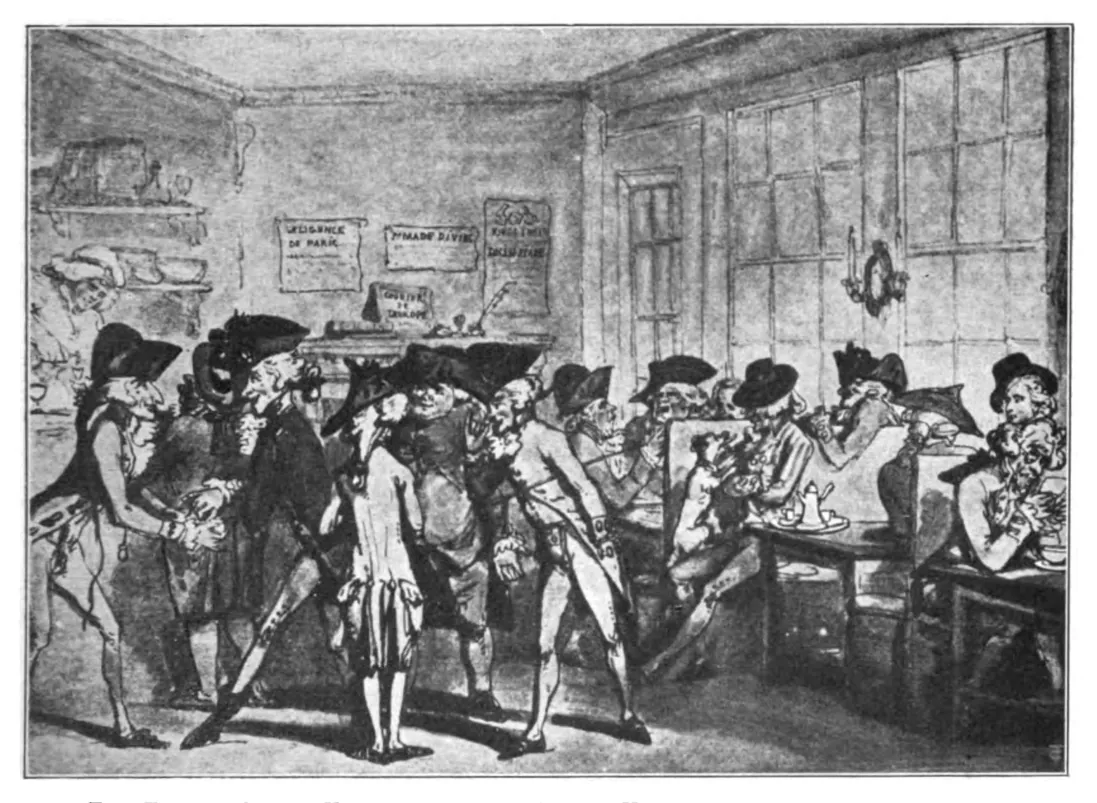
The opening of the rooms follows a geography that seems capricious and is not: Venice in 1645, Oxford around 1650 with a Jewish man, Jacobs, London in 1652, Marseille in 1671, Paris and the Procope in 1686. England moves fast, France slowly, and both have their reasons. In England, coffee arrives through the university: Nathaniel Conopios, a Cretan student of Balliol College, introduces it in Oxford in 1637, and royalist students around 1655 push the apothecary Arthur Tillyard to serve it publicly.
The country is then in civil war, control of print has loosened, and news has become a commodity that people come looking for. Above all, the coffeehouse belongs to no guild: it sells neither beer nor wine, nobody has a monopoly to defend against it, it opens without permission. In France, on the contrary, coffee enters through the court, with the embassy of Suleiman Aga in 1669, then comes down into the street with the Armenian Pascal at the Saint-Germain fair in 1672. What comes from above spreads less quickly than what settles into an alley of the City.
For one must look at the price. In 1662, at the Turk's Head in Exchange Alley, a pound of coffee sells for four to six shillings eight pence, whereas it had been worth up to five guineas, that is, more than twenty times as much. The cup costs a penny, hence the nickname penny universities given to the rooms of Oxford and London. A penny is the price of a seat for the day in a room where one finds merchants, scholars and men of letters.
No institution of the time sold that at that rate. The state notices at once: coffee enters the English statutes as early as 1660, taxed at four pence per gallon made and sold, and in 1663 all houses must be licensed. This is the fundamental difference between Europe and the Ottoman East of the same decade. Where Köprülü has drinkers sewn into leather sacks in 1656, London counts gallons and issues patents.
The motive is no more moral on one side than on the other: a power that needs money prefers revenue to a ban. The series of bans, moreover, is treated separately in Banning coffee.
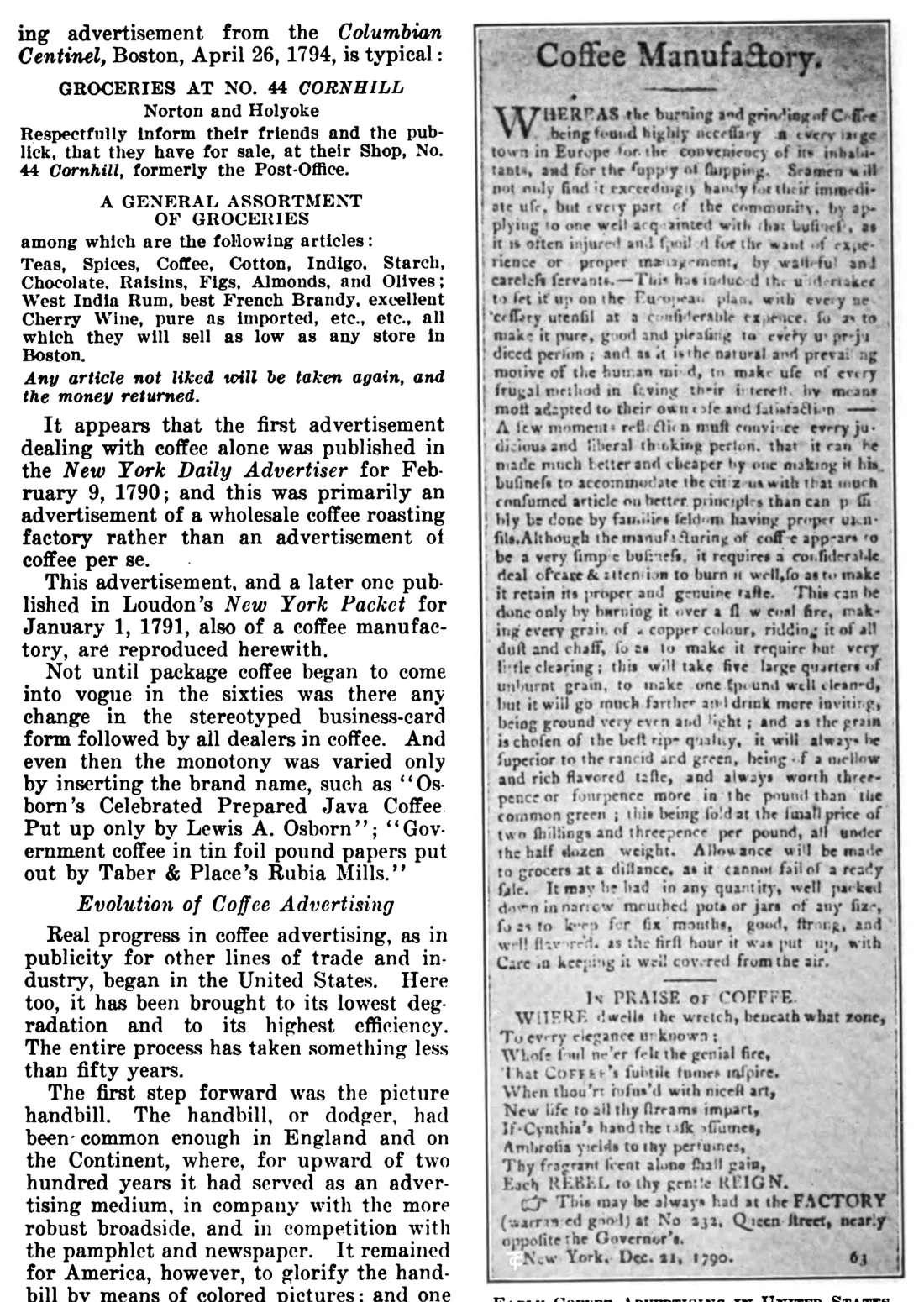
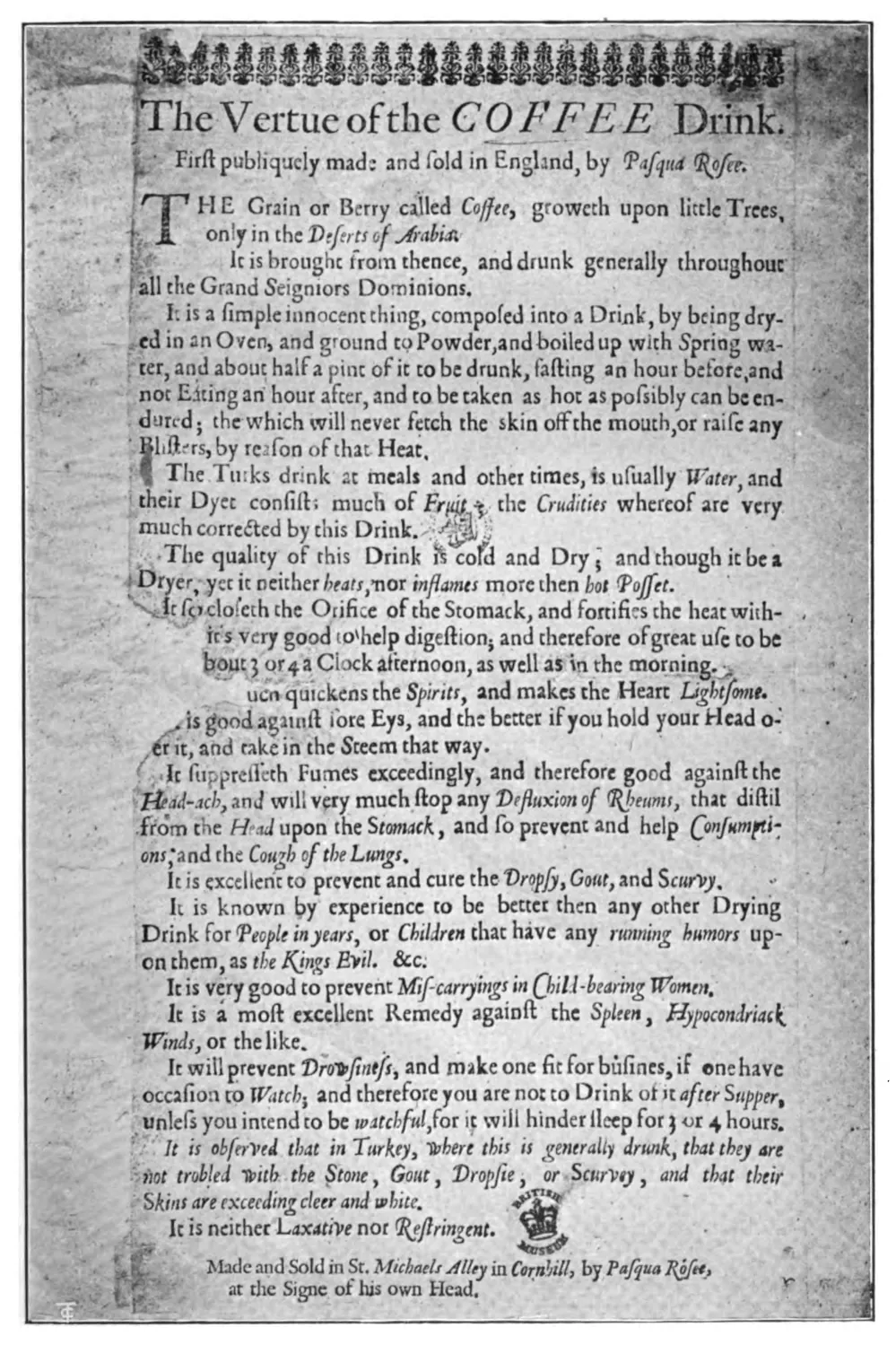
Two things are born in these rooms that we forget to count. The first is printed advertising: the handbill of Pasqua Rosée, The Vertue of the Coffee Drink, distributed at the opening of his shop in St Michael's Alley in 1652, is the first printed advertisement for coffee, and the first advertisement in a London newspaper follows in 1657. Coffee and the commercial press are exactly contemporary, and each needs the other: an advertisement presupposes a sheet, a sheet presupposes a room where it can be read aloud.
The second is more material. After the civil war, England runs short of small change; the coffeehouse keepers then strike their own tokens, bearing the effigy of Morat the Great or of Suleiman, and these tokens circulate as small change until 1675. James Farr, barber and keeper of the Rainbow, strikes one of the first after the great fire of 1666, a rainbow coming out of the clouds. A business whose tokens are accepted by the neighboring shops is a business whose credit is good in the district. What was to be played out at Lloyd's and at Jonathan's, in 1688, was already contained in that bit of brass.
What these rooms founded is told in The room where it all began, and there is no point in repeating it here: the Oxford club that becomes the Royal Society, Harrington's Rota and its first ballot urn in 1659, Edward Lloyd's shipping lists, the market of the stockjobbers of Change Alley. What must be retained for the rest of the century lies elsewhere, and it is a question of knowledge.
While London builds an exchange in a coffeehouse, no one in Europe knows where what is drunk there grows. In 1685, Dufour writes calmly that coffee grows only in Arabia, without cultivation, and nowhere else. He has been wrong for twenty-seven years: the Dutch have been planting in Ceylon since 1658, and will carry plants from Malabar to Java between 1696 and 1699. The century that invented the coffeehouse was ignorant of the geography of its own drink.
Finally, we must say what we do not know, for this century is the one in which the legends still repeated today are fabricated. Pope Clement VIII tasting coffee and baptizing it to rescue it from the infidels: Ukers himself gives it as a widespread legend, and no known pontifical document carries it. Kolschitzky receiving the sacks abandoned by the Ottomans after the siege of Vienna in 1683 and opening the first coffeehouse of the city: the story was written in 1783 by Gottfried Uhlich, a century after the events, and Karl Teply dismantled it in 1980; the document, for its part, exists, it is the privilege of January 17, 1685 granted to the Armenian merchant Johannes Diodato.
The seven seeds of Baba Budan, brought back from Mecca in a belt, float between 1600 according to Ukers and 1695 according to others, and nothing allows a decision. As for the tip, which the coffeehouses of London are said to have invented with boxes marked To Insure Promptness, it is an etymology that Ukers reports and that the Oxford English Dictionary rejects. The century ends on two monopolies that face each other without seeing each other: that of Yemen, intact, and the one that France grants in 1692 to Damame François, a bourgeois of Paris, on the sale of coffee and tea throughout the kingdom for ten years.
Neither will survive the next twenty-five years, and for a reason no one saw coming: an earthen pot in a botanical garden in Amsterdam.
Rauwolf 1582, Alpini 1592 and the report of Morosini of 1585: Ukers, All About Coffee (1922), p. 27 and chronology p. 725. Ottoman occupation of Yemen in 1536, convoy through Jeddah and Suez: La Roque, Voyage de l'Arabie heureuse (1716, 1732 translation), p. 88-89 and 106. Della Valle 1615, Van den Broecke 1616, Wurffbain 1640, sweetening of coffee in Cairo in 1625, Conopios at Oxford in 1637, Jacobs in 1650, Venice 1645, Marseille 1671, Procope 1686, Suleiman Aga 1669 and Pascal in 1672: Ukers 1922, chronology p. 726 and p. 91-92. Vesling on the coffeehouses of Cairo and on the apothecaries of Venice: Ukers 1922, p. 26. Tillyard and the Oxford club around 1655: Ukers 1922, p. 41-42, after Aubrey, Brief Lives, and Anthony Wood. Price of 1662 and five guineas a pound, Rules and Orders: Ukers 1922, p. 58 and 60; penny universities and coffeehouse keepers' tokens: p. 73 and p. 62-63; James Farr and the rainbow token: p. 55-56 and 63, with Hatton, New View of London (1708). Tax of 1660 and licenses of 1663: Ukers 1922, chronology p. 726. Pasqua Rosée and The Vertue of the Coffee Drink: Ukers 1922, p. 53-56. Köprülü's ban in 1656: Ukers 1922, chronology p. 726. Rota of 1659: Ukers 1922, p. 58-59, after Aubrey and Pepys's Diary. Lloyd's and Jonathan's in 1688: Ukers 1922, p. 84-86 and 89. Dufour, Traitez nouveaux et curieux du café (1685); Ceylon 1658 and Java 1696-1699: Ukers 1922 and World Coffee Research, Coffee Varieties Catalog 2025, p. 9-10. Legend of Clement VIII: Ukers 1922, p. 26, given as a legend, no known pontifical document. Vienna: privilege of January 17, 1685 to Johannes Diodato; invention of the Kolschitzky legend by Gottfried Uhlich in 1783, established by Karl Teply in 1980; City of Vienna, history of Viennese coffeehouse culture. Baba Budan: Ukers 1922 retains 1600, another tradition 1695, no arbitration possible. Etymology of the tip: Ukers 1922, p. 73, rejected by the Oxford English Dictionary. Monopoly of Damame François in 1692: Ukers 1922, p. 34.
1700 to 1800
06The 18th century, the colonial plantation
Coffee ceases to be an import from Arabia and becomes a colonial crop, and its price falls because the labor that produces it is that of people reduced to slavery.
Read moreCollapse1,525 words
1755Lisbon earthquake1756Start of the Seven Years' War1769Watt patents his steam engine1776Declaration of Independence of the United States1789Storming of the Bastille
The century begins with an earthen pot and ends with an insurrection. In 1706, a single plant leaves Java for the botanical garden of Amsterdam; almost all the Typica in the world descends from it. In 1791, the enslaved people of Saint-Domingue revolt, and the world's leading coffee production disappears in a few months. Between the two, coffee changes nature: it is no longer a commodity bought from a foreign empire, it becomes a crop that one sets up at home, on seized land and with bought hands. What changes is not botany, it is the regime of ownership of labor.
The series of transplantations is told in detail in The escapes, and it is enough to retain its rhythm and degree of certainty. On July 29, 1714, Antoine de Jussieu examines at the Jardin du Roi the coffee plant offered by Amsterdam. Then, in twenty-two years: Surinam in 1718, Pará in 1722, Gabriel de Clieu's Martinique in 1723, Saint-Domingue in 1725, Brazil in 1727, Jamaica in 1730.
The dates of arrival and the first harvests are documented; the way of telling them much less so. Clieu sharing his water ration with his plant under a bell jar comes from his own late account, which Ukers takes up and which everyone takes up after him; the fact that he carried a plant is not in question, the scene of the thirsty sailor is. The bouquet of the wife of the governor of Cayenne, in which Francisco de Melo Palheta is said to have hidden the plants of Brazil in 1727, is a Brazilian tradition, which Pendergrast reports as such, and Brazil has a good reason to prefer it to administrative truth: the official attempt of 1723, at Pará, with plants from Cayenne, had failed.
The seven seeds of Baba Budan, finally, are dated to 1600 by Ukers and to 1695 by others. These three stories come to us from books of the 19th and 20th centuries, and have been repeated ever since without anyone having found the document.
What motivated all this, on the other hand, is perfectly quantified, and it is price. The first public sale of Java coffee in Amsterdam, in 1711, covers 894 pounds knocked down at twenty-three and two thirds stuivers a pound. The Dutch Company does not wait: it then imposes compulsory deliveries on the regents of Java, that is, it does not buy the coffee, it orders it. This system of forced cultivation precedes by a century the Cultuurstelsel of 1832, and it must be set beside what is being put in place in the Americas, because they are two answers to the same problem.
Coffee demands repeated picking, pass after pass, on slopes, over several months, and no machine does this work, neither then nor today. Its cost is labor and almost nothing else. For coffee to become cheap in Europe, this labor therefore must go unpaid. In Java, it is obtained by administrative coercion on a peasantry in place. In the Americas, it is obtained by slavery.
The figures must be given and their origin stated, for they vary from one source to another and no primary accounting has been consulted here. Saint-Domingue receives coffee in 1725. On the eve of the revolt, in 1789, the colony exports on the order of 35,000 tonnes of coffee, which the old sources count in French pounds and put between 74 and 77 million; according to estimates, it supplies between half and sixty percent of the coffee consumed in the world.
The enslaved population there is estimated at around five hundred thousand people, about nine inhabitants out of ten. These orders of magnitude are those of the current historiography of the colony; the chronicle of this site relies for the turning point of 1791 on Michel-Rolph Trouillot, Motion in the System, published in Review in 1982, and on Pendergrast, Uncommon Grounds (1999), chapter one. For Brazil, the figures come from another source and with another precision: Thurber, Coffee: From Plantation to Cup (1881), gives 391,785 sacks leaving the port of Rio alone in 1830, and 1,476,567 people recorded as enslaved in Brazil in 1876. Slavery there will be abolished only in 1888, ninety-seven years after the revolt of Saint-Domingue.
A remark on the source, itself a documentary fact. Ukers's chronology, which serves as the backbone of nearly all the history of coffee written in the 20th century, contains no entry for 1791. It carefully records the opening of every coffeehouse in London and Philadelphia, coffee pot patents and American customs duties to the nearest cent, and it does not mention the event that destroyed the world's leading production and redrew the map of origins.
This silence is not an isolated oversight: it is the way the history of coffee has long been written, from the side of the consumer and the cup.
There is nonetheless, in the Saint-Domingue file, a fact that complicates the picture without excusing anything in it. Coffee does not grow where cane grows: it occupies the mornes, those hills that cane cannot exploit. A coffee plantation therefore cost much less to set up than a sugar estate, and often employed fewer than twenty-five people where a sugar estate concentrated hundreds.
The consequence, which Trouillot studied and which made the reputation of his article, is that coffee widened the class of owners: poor whites and above all freedmen, that is, free people of color, entered the plantation system by this door, to the point of holding on the eve of the revolt, according to his estimate, about a third of the properties and a quarter of the people enslaved there.
This figure must be read for what it says: coffee was not a gentler crop than sugar, it was the crop that multiplied the number of those who owned human beings.
Let us look at the European side of the same accounting, for the two halves never meet in the stories and are nevertheless the same sentence. In London, before 1715, there are two thousand coffeehouses, three thousand if we believe Dufour; at the end of Anne's reign, the taxes on tea, coffee and newspapers bring the cup to two pence.
Retail coffee is worth five shillings a pound, tea twelve to twenty-eight: it has become the cheaper of the two drinks, it that was worth five guineas a pound two generations earlier. This fall has no other cause than the plantations. Add sugar, which comes from the same islands and the same plantations, and the 18th-century European cup contains two commodities produced by enslaved people, in the same vessel.
It is because the price fell that the coffeehouse ceased to be an exceptional place and became an ordinary one, and it is because it became ordinary that it could serve for what we know: Samuel Johnson's club in 1763, the Café de la Régence where Diderot works on the nine sous his wife gives him, the Merchants' Coffee House of New York from which in 1774 the proposal of an American Union comes.
The clearest demonstration lies in one address. In 1754, in Philadelphia, the printer William Bradford opens the second London Coffee House, which the city would call its beating heart: the governor has his stall there, the gazettes are read there, and horses, goods, and men, women and children reduced to slavery are sold there at auction, on a platform set up in the street before the door.
This is not a contradiction between two eras or two continents: it is the same decade, the same sidewalk, the same customers. The rooms that produced the institutions described in The room where it all began are also these.
The rest of the century can be read from there. If Frederick II publishes in 1777 his manifesto on coffee and beer, then reserves roasting in 1781 to royal establishments, and if the Elector of Cologne imitates him in Westphalia in 1784, it is not that coffee had grown worse: it is that it now weighs on a trade balance, which is a symptom of success and not of harm; the detail of these failures is in Banning coffee.
Science catches up: Linnaeus creates the genus Coffea in 1737 in the Genera Plantarum and names Coffea arabica in 1753 in the Species Plantarum, fifty-two years after Dufour had written that the plant grew only in Arabia. And on June 5, 1792, a hundred and fifty New York merchants lay the cornerstone of the Tontine Coffee House, built from the outset to be a stock exchange.
A year earlier, the economy that filled their cups had risen up. The century had given coffee to the whole world; it had also fixed what it would cost, and who would pay for it.
Single plant from Java to Amsterdam in 1706 and descent of Typica: World Coffee Research, Coffee Varieties Catalog 2025, p. 10; Ukers, All About Coffee (1922), chronology p. 726. Jussieu at the Jardin du Roi on July 29, 1714: La Roque, Voyage de l'Arabie heureuse (1716, 1732 translation), p. 398-399. Surinam 1718, Pará 1722, Martinique 1723, Saint-Domingue 1725, Jamaica 1730: Ukers 1922, chronology p. 728, and Thurber, Coffee: From Plantation to Cup (1881), p. 124. Cayenne bouquet in 1727: Brazilian tradition reported by Pendergrast, Uncommon Grounds (1999), chapter 1; the failure at Pará in 1723 is in Ukers 1922, chronology p. 727. Baba Budan, 1600 according to Ukers 1922, 1695 according to another tradition. Amsterdam sale of 1711, 894 pounds at twenty-three and two thirds stuivers, and compulsory deliveries imposed on the regents of Java before the Cultuurstelsel of 1832: Ukers 1922, p. 43-44 and chronology p. 727. Saint-Domingue in 1789: the orders of magnitude retained here, about 35,000 tonnes exported, that is 74 to 77 million pounds according to the old sources, from half to sixty percent of the world's coffee, and about five hundred thousand people reduced to slavery for nine inhabitants out of ten, are those of the current historiography of the colony and vary from one author to another; no primary accounting was consulted for this page, and the exact figure for the exports of 1789 remains to be verified against the colonial returns. The landmark of 1791 and the shift toward Cuba, Jamaica and then Brazil follow Michel-Rolph Trouillot, Motion in the System: Coffee, Color and Slavery in Eighteenth-Century Saint-Domingue, Review (Fernand Braudel Center), 1982, and Pendergrast, Uncommon Grounds (1999), chapter 1. The share of a third of the properties and a quarter of the enslaved people held by the free people of color on the eve of 1789 is Trouillot's estimate in that same article, known here through the literature that cites it and not through a reading of the original: to be verified against the text. Average size of coffee plantations, smaller than that of sugar estates, and their location on the mornes: same article. Brazil: 391,785 sacks leaving Rio in 1830 and 1,476,567 people recorded as enslaved in 1876, Thurber 1881, p. 120-124; abolition of 1888, Coste 1955, p. 348. Absence of any entry for 1791 in the chronology of Ukers 1922, p. 725-737: finding from reading. Two thousand coffeehouses in London before 1715, three thousand according to Dufour, cup at two pence, coffee at five shillings a pound and tea at twelve to twenty-eight: Ukers 1922, p. 58 and 73. Johnson's club in 1763: Ukers 1922, p. 81, after Boswell. Café de la Régence and Diderot: Ukers 1922, p. 96-98. Merchants' Coffee House and the proposal for a Union in 1774: Ukers 1922, chronology p. 727 and p. 119-120. William Bradford's London Coffee House in Philadelphia in 1754, auctions of enslaved people on the street platform, stamped newspaper burned in 1765: Ukers 1922, p. 127-129. Manifesto of Frederick II of September 13, 1777, Declaration of the King of January 21, 1781 and decree of the Elector of Cologne of February 17, 1784: Ukers 1922, p. 47-48. Linnaeus, Genera Plantarum (1737) and Species Plantarum (1753). Tontine Coffee House, June 5, 1792: Ukers 1922, p. 121-123.
1800 to 1900
07The century of the machine, of Brazil and of the world market
In a hundred years, coffee stops being a colonial commodity sold in bulk and becomes the world's leading exchange-listed agricultural commodity: a machine roasts it without stopping, one country produces three quarters of it, and a fungus decides the fate of everything else.
Read moreCollapse1,493 words
1815Waterloo and the Congress of Vienna1848The Springtime of Peoples1861Start of the American Civil War1869Opening of the Suez Canal1885Berlin Conference and the partition of Africa1889Paris World's Fair and the Eiffel Tower
In 1800, coffee is sold green, by the sack, at the grocer's, and it is the buyer who roasts it in a pan. In 1900, it arrives roasted, in a package, under a brand name, with a daily quotation in New York and Le Havre and an exchange where crops that have not yet flowered are sold. Between these two states, three engines run together, and it is their simultaneity that makes the century: a machine that roasts continuously, a country that produces more than three quarters of the world's coffee, and a fungus that empties the whole Indian Ocean of its coffee trees.
Brazil first. In 1830, the port of Rio alone ships 391,785 sacks and the country becomes the leading producer. What makes this possible is not the soil but an organization of labor: coffee growing in the Paraíba valley, then on the red lands of São Paulo, rests on slavery, and Thurber still counts 1,476,567 enslaved people recorded in 1876. The Eusébio de Queirós law of 1850 closes the Atlantic slave trade; the coffee frontier thereafter buys its labor from the sugar-growing northeast, which drives up the price of a human being at the very moment when the price of coffee falls.
The Free Womb law of 1871 frees children yet to be born, the Sexagenarians law of 1885 the elderly: the enslaved population ages without renewing itself, and its value as bank collateral erodes with it. When abolition comes, it completes an arithmetic already three-quarters done.
On May 13, 1888, the Lei Áurea frees without land and without compensation. The fazendas immediately replace slavery with the colonato, a contract in which a family tends a fixed number of trees in exchange for a wage and the right to grow its food between the rows; the province of São Paulo pays the passage of Italian immigrants to bring them in. What follows is mechanical: money, hands, new plantations, and a coffee tree that takes four to five years to bear, so that the trees planted after 1888 come into production around 1896-1897 and flood the market.
Rio 7 falls to 7 cents a pound in October 1897, to around 5 cents in 1903. Everything the following century would invent in the way of valorizations, quotas and destructions answers this single overproduction, born of abolition and of the easy credit that followed it. Politically, the Republic of 1889 installs the pact known as café com leite, in which the presidency alternates for forty years between São Paulo, which holds the coffee, and Minas Gerais, which holds the milk: the planters do not pressure the state, they are the state. The plate on the economy lays out this mechanism in detail.
Ceylon next. In 1869, in the Madulsima district, the superintendent Donald Reid notices leaves that are turning yellow; on November 6, in London, the Reverend Berkeley names the fungus Hemileia vastatrix without ever having seen a diseased tree. Why could a leaf rust empty an island? Because the cultivated coffee of the whole world had come out of Yemen, where it is grown dry, far from the humid forests: a genetic bottleneck doubled by an ecological filter, which had kept the fungus at a distance for two centuries without giving the plants the slightest immunity.
The day it meets this single genotype, planted acre against acre on a cleared island, nothing stops it. The figures come from witnesses who wrote during the fall: the planted area goes from 176,000 acres in 1869 to 275,000 in 1879 while the yield falls from 4.5 to 2 hundredweight per acre, then the coffee area collapses from 68,787 hectares to 14,170 and exports, from a little over a million hundredweight around 1870, drop below 100,000 in the 1890s.
They planted more as they harvested less, not out of blindness but because each was compensating for a decline he did not control and protecting the collateral given to his bank. The plate on diseases shows this in detail.
Rust leaves Ceylon and follows shipping lines rather than winds, from Sumatra in 1876 to Usambara in 1893. The Dutch East Indies lose half of their exports between 1883 and 1887, Réunion three quarters of its production. The responses are botanical and they commit the whole following century: Hiern describes liberica in 1876, planted as a replacement for the rusted arabicas, and around 1900 Java brings in from the Congo, via Brussels, the canephora without which, McCook estimates, today's world production would be 30 to 40 percent lower.
Ceylon becomes a tea island: the roads, the ports and the capital were already there, they carried another leaf. The last effect is intellectual. London sends Harry Marshall Ward to work on the island from 1880 to 1882; he establishes the causal link between the fungus and the disease and shows that continuous monoculture sustains the epidemic. Plant pathology is born of a coffee epidemic.
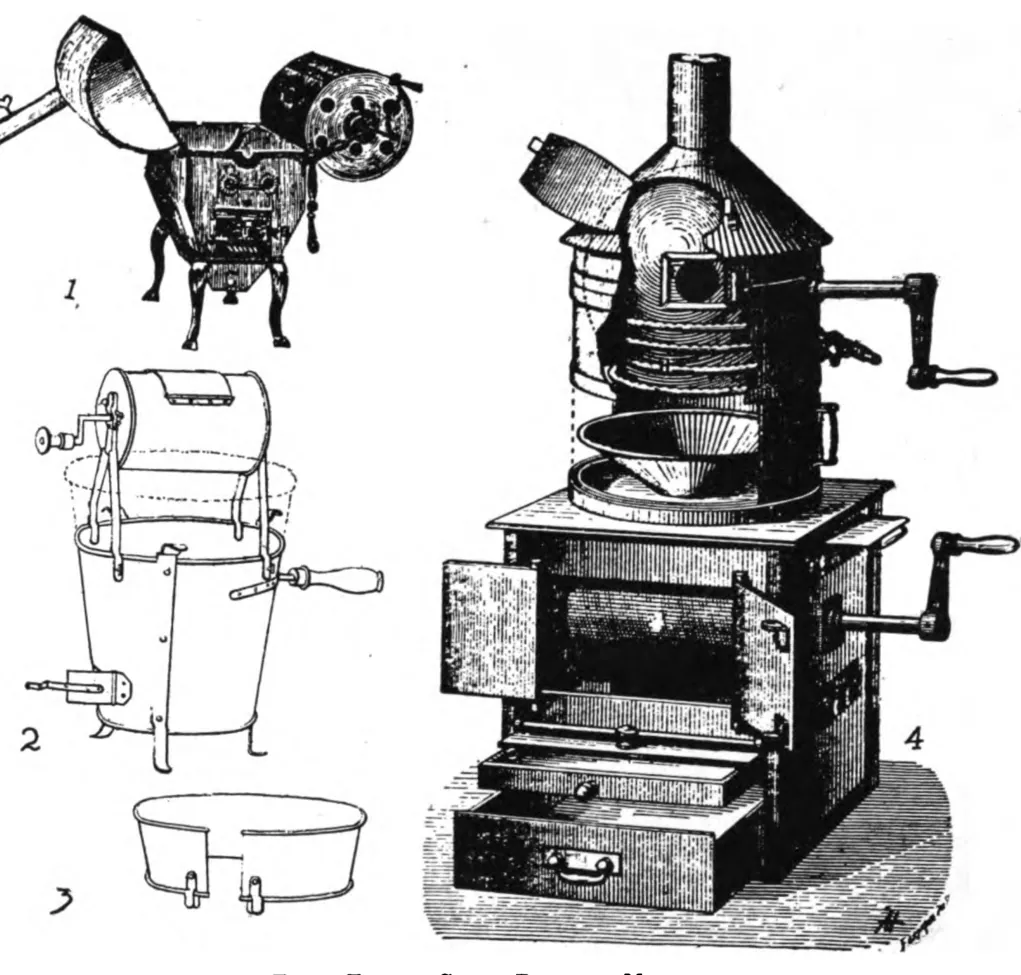
The machine remained. The roaster's problem was never heating, it was always emptying. Richard Evans's English patent of 1824 already contains the finned cylinder and the probe that makes it possible to judge a roast without stopping it; but as long as the apparatus must be taken off the fire to be unloaded, one must stop, cool and start again, and so give up continuous work.
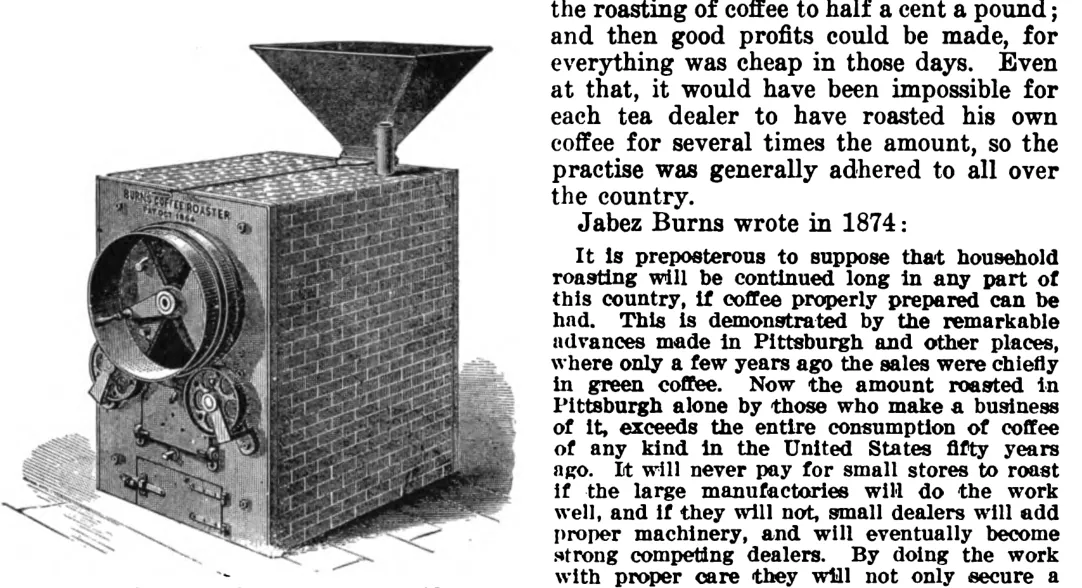
In 1864, Jabez Burns, a bookkeeper by trade, patents in New York the first roaster that no longer has to be taken off the fire: a closed cylinder, set in brickwork, in which a double screw pushes the coffee forward and unloads it without stopping anything. This is the date when roasting becomes an industry. Emmerich follows in 1868 with the firm that would become Probat, and the first direct-flame gas roaster arrives in New York in 1893. The plate on roasting tells the mechanics themselves.
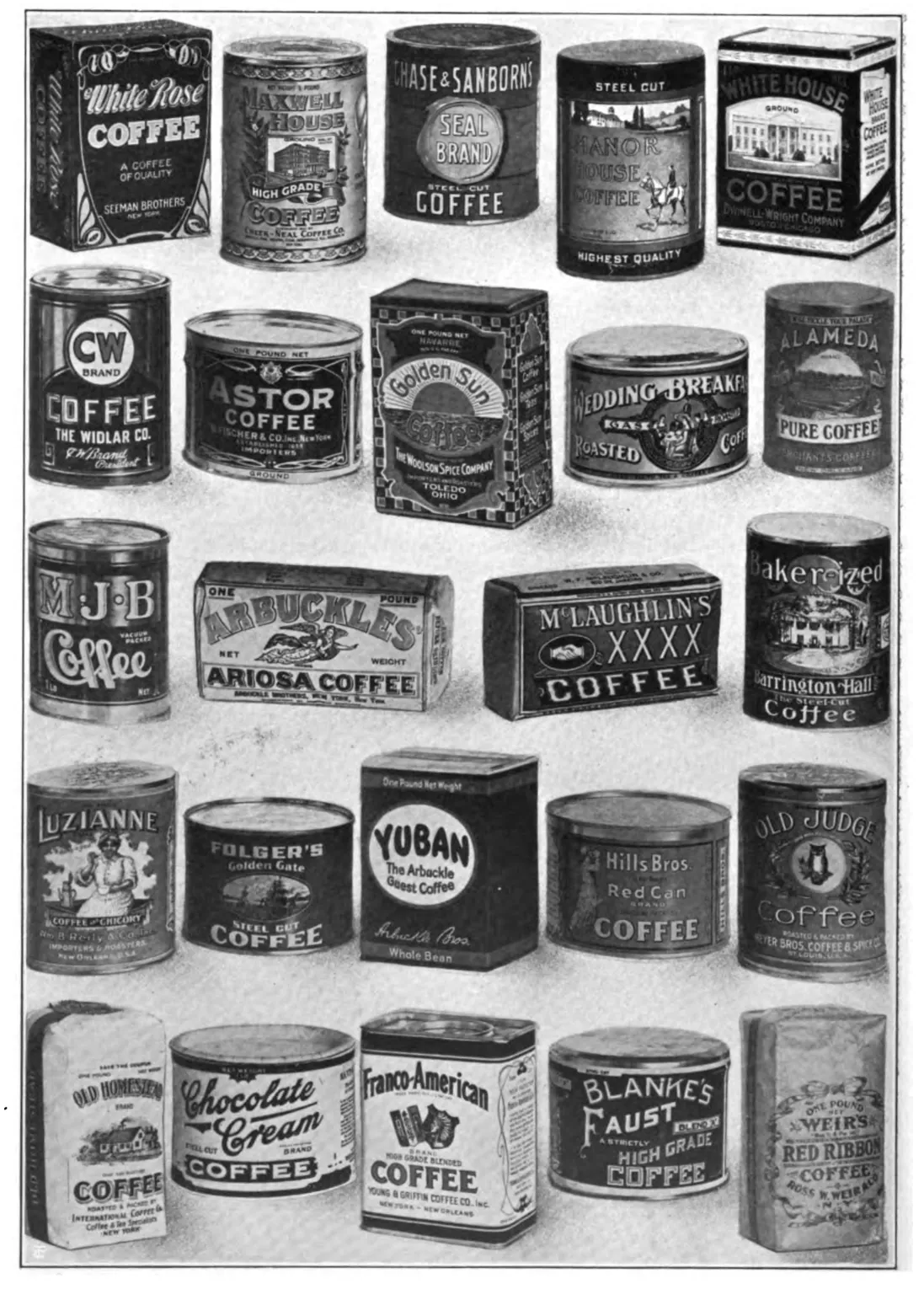
What the machine changes downstream is worth more than the machine. Roasting by the tonne makes it possible to sell coffee already roasted: Arbuckle launches Ariosa in 1873, the first national packaged brand in the United States, and Thurber counts in 1881 more than a thousand roasting machines and 1,200,000 pounds a day, noting that twenty years earlier not a pound of roasted coffee was sold.
But a roasted coffee, and still more a ground one, can no longer be checked by eye. The same decade therefore sees the patenting of bean glazing, that film applied hot and filed by Pidding, Berry and then Arbuckle between 1866 and January 1868: officially to protect aroma, in practice to mask stained beans and add 5 to 6 percent of weight. And Thurber records the current American formula for a thousand pounds of goods sold as coffee: 400 of peas, 200 of rye, 200 of coffee, 100 of chicory, 100 of miscellaneous. Industrialization and adulteration are the same movement seen from its two ends, as the plate on adulteration details.
The market, finally. A futures exchange always appears at the same point of a supply chain: where a crop arrives in a single season while consumption is continuous, someone carries a stock whose value moves and seeks to insure himself. The price series says the rest: 11.04 cents a pound for current Rio in 1857, 42.5 cents in 1864 in the middle of the Civil War, a price that says as much about the depreciation of the dollar as about scarcity, 13.25 cents in September 1879.
On September 18, 1873, the day of the Jay Cooke panic, the banks stop lending, no one can finance a shipment any longer and Rio drops at a stroke from 24 to 15 cents. B. G. Arnold, who rose from accountant to coffee king, makes 1.2 million dollars in a single year, then the crash of 1880-1881 carries off 5 to 7 million and the three biggest houses in New York.
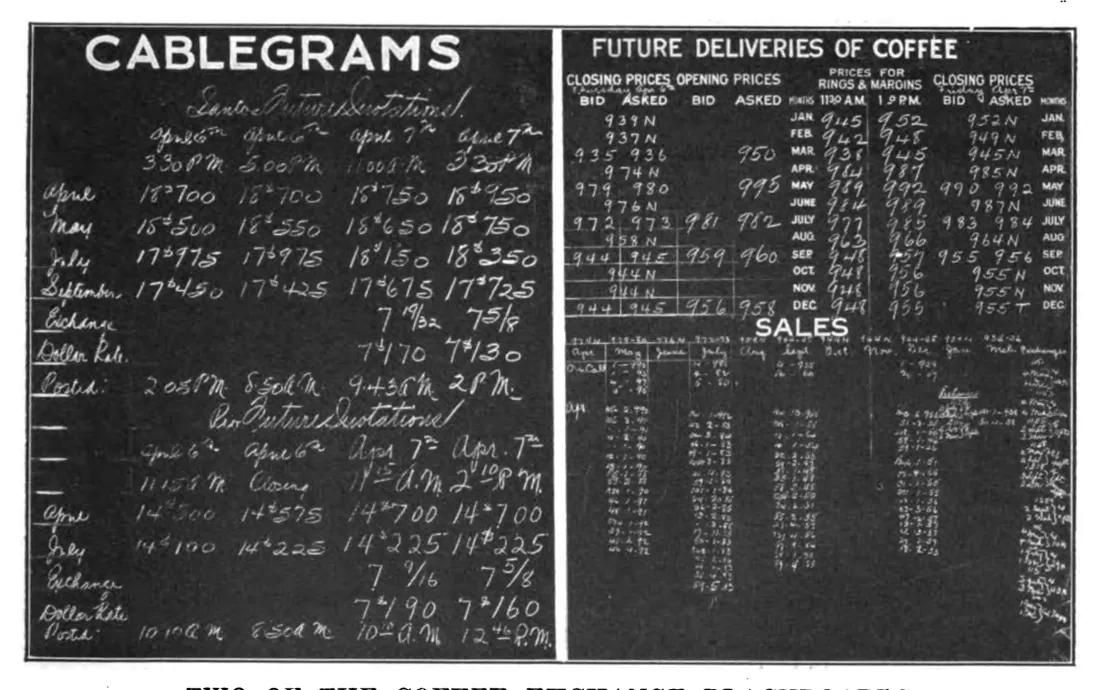
The New York Coffee Exchange and Le Havre open in 1882, Amsterdam and Hamburg in 1887. The telegraph also becomes a component of price: in 1884, a simple cable cut with Brazil prevents agents from covering their margins and drops Rio from 11.5 to 8.25 cents. The century of the kings follows this series from end to end.
Meanwhile, Europe invents the place and the apparatus: Rumford's percolator in 1806, then on May 16, 1884 the steam machine of Angelo Moriondo of Turin, the first of its kind, fifteen years before Bezzera. In the end, 1900 leaves a coherent and fragile object: one country supplies three quarters of the harvest, a single genotype almost all the arabica, a machine made the brand, an exchange made the price, and this price has fallen back to 4.5 cents. The three facts of the century will be paid for in the next.
Brazil, volumes and labor: Thurber, Coffee: From Plantation to Cup (1881), p. 120-124 (391,785 sacks leaving Rio in 1830; 1,476,567 people recorded as enslaved in 1876). Prices: Thurber 1881, p. 186-188 and Walsh, Coffee: Its History, Classification and Description (1894), p. 286-287 (11.04 cents in 1857; 42.5 in 1864; 13.25 in September 1879); Ukers, All About Coffee (1922), chronology p. 731 (Jay Cooke panic, 24 to 15 cents on September 18, 1873); Ukers 1922, p. 195 and 219-220 via Thurber (crash of 1880-1881, 5 to 7 million dollars, three houses carried off); Ukers 1922, p. 527 (cut of the Portuguese cable, 1884); Ukers 1922, chronology p. 732-733 (New York Coffee Exchange and Le Havre 1882, Amsterdam and Hamburg 1887; Rio 7 at 7 cents in 1897, 4.5 cents in 1898). Ceylon and rust: McCook, Coffee Is Not Forever (2019), p. 1, 36, 43-44, 66-70, 112 and 202; figures for area, yield and exports taken from plate X section 04 of this site, itself after Thurber 1881, p. 92-94 and 98, Walsh 1894, p. 125-128 and BSPP 2022, p. 5 (after Waller et al. 2007); Ward 1882 and BSPP 2022, p. 3-4 for the birth of plant pathology; Hiern, Transactions of the Linnean Society (1876) for Coffea liberica. Roasting: Ukers 1922, ch. XXXIV, p. 625-640 and chronology p. 728-733; American patent of Jabez Burns, 1864; English patent of Richard Evans, 1824; Probat, history of the Emmerich firm. Brand and adulteration: Ukers 1922, chronology p. 731 (Ariosa, 1873); Thurber 1881, p. 23, p. 162-168 (thousand-pound formula) and p. 254 (glazing); Walsh 1894, p. 195-196. Apparatus and places: Ukers 1922, p. 94 and 99-107, chronology p. 728-730; Mayer and Delforge patent, 1852; Italian patent no. 33/256 of Angelo Moriondo, Turin, May 16, 1884. Points taken from general historiography and not from the chronicle's corpus, to be cross-checked against a printed source before publication: Eusébio de Queirós law (1850), Free Womb law (1871), Sexagenarians law (1885), Lei Áurea of May 13, 1888 without compensation or land, colonato system, Italian immigration subsidized by the province of São Paulo, and café com leite pact of the First Republic (1889-1930).
1900 to 1950
08Science, burned stocks and the two wars
Coffee inherits an overproduction, invents to contain it the first modern public intervention in a commodity market, ends up burning the equivalent of three world harvests, and comes out of the period remade by two laboratories: that of the geneticists and that of the military supply services.
Read moreCollapse1,496 words
1914Start of the First World War1918Armistice of November 111929Wall Street Crash1939Start of the Second World War1945Surrender of Japan and atomic bombs1947Independence of India
Coffee's 20th century begins with a debt. The coffee trees planted in Brazil in the euphoria that follows the abolition of 1888 all bear at once, and in 1903 Santos 4 falls to 3.55 cents a pound in New York, the lowest ever recorded. The fifty years that follow are a series of answers to a single question, and it is this that gives the period its unity: what to do when there is too much coffee.
The first answer is unprecedented, and it will be copied around the world for a century. A state buys its own harvest to withdraw it from sale: this is valorization, agreed at Taubaté in 1906. The following year yields 20,190,000 Brazilian sacks out of a world harvest of 24,307,000, and at that level selling amounts to crushing one's own price. São Paulo therefore buys above the market, but it takes 75 million dollars and the Rothschilds refuse, then all the banks of the Continent.
In August 1906, the commissioner of São Paulo travels to Baden-Baden to see the trader Hermann Sielcken, who ends up advancing 80 percent of a value reckoned at seven cents a pound. The harvest is bigger than expected: the state has to buy nearly nine million sacks, holds at the end of 1907 half of the world's visible stock, and the price barely exceeds 6 cents.
Only one remedy will work, and it is legal: ban any new planting by law. The lesson holds for the entire century, guaranteeing a floor amounts to ordering planting. In the United States, Senator Norris puts the bill at 35 million dollars a year in 1911; the 1912 lawsuit is dropped against the promise to liquidate the 746,539 sacks stored in the United States, and the Norris law of February 1913 forbids any American to take part in a valorization. The plate on the economy details the arrangement.
The second answer concerns labor. The Paulista colonato, that contract that ties a family to a fixed number of coffee trees, had attracted the Italians; the conditions imposed on the fazendas are harsh enough that Italy forbids subsidized emigration to Brazil in 1902, by the Prinetti decree. São Paulo then turns to Japan, and the Kasato Maru lands the first contract families at Santos in June 1908: the largest Japanese community outside Japan is born of a shortage of coffee labor.
Elsewhere, the same crop made the landholding structure and the political regime that goes with it. In January 1932, in El Salvador, where fourteen families hold the land and the coffee, the peasant revolt led by Farabundo Martí is crushed: the Matanza kills ten to thirty thousand people in a few weeks.
The third answer is scientific, and it is what makes up the true novelty of the period. Until then, coffee selection was a matter of a planter observing a tree finer than the others. It becomes a matter of laboratory for a precise reason, established in 1929 when Piza counts 44 chromosomes in arabica against 22 in all the other coffee species. Arabica is tetraploid, that is, it carries a double set of chromosomes inherited from an ancient natural hybridization, and it self-fertilizes.
This explains three things at once: that a mutation spotted on a single tree, like the Brazilian Caturra of the years 1915-1918, becomes fixed and multiplies as it is; that the diversity of the cultivated species is wretched; and that a cross with diploid canephora almost always fails. Hence the value of what is identified in 1927 on the island of Timor, a spontaneous arabica by canephora hybrid, tetraploid and fertile, from which almost all the rust resistance planted in the world descends today.
Institutions are built around this program: Kent selects at Mysore from 1911, the Scott Laboratories open at Kabete in 1922 and give SL28 and SL34 between 1931 and 1935, Mayne publishes in Nature in 1932 the Mendelian genetics of resistance and the existence of races of the fungus, the Instituto Agronômico de Campinas is created the same year with Krug and Carvalho, the Colombian Cenicafé in 1938; and the Indian S.795, distributed in 1945-1946, is the first widely cultivated resistant variety. The plate on diseases follows this lineage.
In passing, the period harvests what will be talked about seventy years later:
the British collections in Ethiopia from 1931 to 1936 bring back the accession planted at Lyamungu under the name Geisha
which will not enter CATIE until 1953 and will be tasted for what it is worth only in the 21st century. And the other answer to rust becomes an economic species: canephora
1900arrived in Java
enters Espírito Santo in 1912 under the name conilon and will later make Vietnam the world's leading producer of this species, as the plate on canephora tells it.
Then come the wars, which do to coffee what they do to every commodity: they turn it into a logistics question. In 1918, the United States places importers and roasters under license; shipping tonnage is requisitioned, more than nine million sacks pile up in Brazilian ports, and Hoover has to get coffee recognized as a foodstuff in order to obtain ships. In June 1918, a very real frost strikes Paraná and São Paulo, but American buyers take it for the usual seasonal rumor and do not follow; Santos 4 goes from 8.25 cents in May to 20.5 cents on December 10, after the armistice.
The war above all invents a product. Mustard gas makes the hot drink vital at the front, instant coffee becomes one of the most important subsistence items of the American army, and the New York quartermaster requests 42,500 pounds a day from January 1919. Ukers, in 1922, still holds this instant coffee to be a will-o'-the-wisp that loses aroma.
The crash of 1929 does not merely lower prices: it destroys valorization itself, because the accumulated stock served as collateral for the loans that had financed it. Brazil then does the only arithmetic that holds, and it is terrible to read. From 1931 to 1944, 78.2 million sacks of exportable coffee are destroyed, burned at Santos, thrown into the sea, used as locomotive fuel or as landfill: the equivalent of three world harvests.
Selling them would have crushed the price that the entire operation was meant to hold. The same crash carries off the café com leite regime, and Vargas's revolution ends in 1930 forty years of alternation between São Paulo coffee and Minas milk. The practical question remains: what to do with an unsellable and perishable surplus. It is turned into something that keeps.
It is a Brazilian request that sets Nestlé to work, and Nescafé comes out of the Orbe factory on April 1, 1938. The Second World War will make it an American habit, and in 1952 the campaign of the Pan-American Coffee Bureau, Give yourself a Coffee-Break, will bring the coffee break into the language and then into labor law.
The rest of the period is read in objects, each answering a dated problem. Hills Bros packs under vacuum from 1900: coffee can now travel far from its roaster, which makes the national brand possible and in time condemns the neighborhood roaster. Melitta Bentz has her blotting-paper filter registered on June 20, 1908, against grounds in the cup.
Ludwig Roselius, a Bremen merchant who blames his father's death on excessive coffee drinking, patents between 1903 and 1908 decaffeination with steam and benzene, sold under the names Kaffee HAG and then Sanka; in 1932, General Foods ships free to thousands of American restaurants orange-necked coffee pots, the color of the package, to signal that Sanka is served here.
The message received was that here, orange means decaf, and this code has outlived the brand all over the world, as the plate on decaf tells it. Calimani gives us in 1929 the modern French press, Bialetti the Moka Express in 1933, the chemist Schlumbohm the Chemex in 1941. And it is only in 1947-1948 that Achille Gaggia markets the lever: nine bars of pressure and a crema that no one had seen. The espresso we drink is thus a postwar object, forty-seven years after Bezzera's patent and sixty-four after Moriondo's.
In 1950, everything is in place for what follows, including the dead ends. Production is overequipped, public intervention has become a habit of the state that will lead to the International Coffee Agreement of 1962, genetic resistance finally exists but will rest essentially on a single hybrid found by chance, and the colonial question remains intact: in Kenya, coffee growing has been forbidden to African peasants since 1900 and will be opened to them only in 1954, by the Swynnerton Plan.
Prices and valorization: Ukers, All About Coffee (1922), chronology p. 734-736 (Santos 4 at 3.55 cents in 1903); Ukers 1922, p. 517-519 and 529-534, after Sloss, World's Work (1906-1907 harvest of 20,190,000 sacks out of 24,307,000 worldwide, Baden-Baden episode, advance of 80 percent, nine million sacks bought, half of the world's visible stock at the end of 1907, legal ban on planting, loan of 75 million dollars placed in 1908); Ukers 1922, p. 532-533 (Norris, 35 million dollars a year, 746,539 sacks, Norris law of February 1913). War of 1914-1918: Ukers 1922, chronology p. 736-737 and p. 535-540 (licenses of 1918, nine million sacks blocked, Hoover and the recognition of coffee as a foodstuff, frost of June 1918, Santos 4 from 8.25 to 20.5 cents on December 10, instant coffee, 42,500 pounds a day on January 1, 1919, Ukers's judgment on instant coffee); Ukers 1922, p. 538 for the deflation of 1920. Destruction of stocks: Daily Coffee News, 90 Years Ago (2021); Time, Brazil: Smoke & Mirth (1936); Conselho Nacional do Café (78.2 million sacks destroyed from 1931 to 1944). Genetics and selection: Coste 1955, p. 331 and Piza 1929 (2n = 44 in arabica, 22 in the others); Salojärvi et al., Nature Genetics 56 (2024), p. 726 and McCook 2019, p. 134 (Timor Hybrid, 1927); WCR 2025, variety sheets Caturra p. 30, Maragogipe p. 52, SL28 p. 75, SL34 p. 76, S795 p. 73, Geisha p. 38; CCRI and Coffee Board of India (Kent 1911, S.288, S.795 released in 1945-1946); Mayne, Nature (1932); IAC and Setotaw et al., Crop Science 53 (2013); Cenicafé (1938); Coffee Research Foundation, Kenya (Scott Laboratories 1922, Ruiru 1949). Canephora: Coste 1955, p. 22-30; McCook 2019, p. 202; Ferrão et al., Informe Agropecuário 41 (2020) and Incaper for the conilon of 1912. Objects and brands: Ukers 1922, chapter on packaging and Smithsonian, Hills Bros. Coffee Company Records, NMAH.AC.0395 (vacuum of 1900); Deutsches Patent- und Markenamt, Melitta Bentz utility model registered on June 20, 1908; Roselius patents, Bremen, 1905-1908, and Kaffee HAG, history; Sprudge, A brief history of decaf and the color orange, and The Takeout (Sanka orange pots, 1932); Italian patent of Attilio Calimani, 1929; Bialetti, history of the Moka Express, 1933; Chemex Corporation and Schlumbohm patent, 1941; Gaggia, history and lever patent (1938, marketing 1947-1948); Luigi Bezzera patent no. 153/94, Milan, June 1901; Moriondo patent, Turin, May 16, 1884. Nescafé: Nestlé, Nescafé marks its 75th anniversary (2013), launch on April 1, 1938 at Orbe. Coffee break: Pendergrast 1999, ch. 12, and campaign of the Pan-American Coffee Bureau, 1952. El Salvador: Anderson, Matanza (1971); Paige, Coffee and Power (1997); Pendergrast 1999, ch. 8. Kenya: Swynnerton, A Plan to Intensify the Development of African Agriculture in Kenya (1954); Pendergrast 1999, ch. 13. Points taken from general historiography and not from the chronicle's corpus, to be cross-checked before publication: Prinetti decree of 1902 forbidding subsidized Italian emigration to Brazil, and arrival of the Kasato Maru at Santos in June 1908.
1950 to 2000
09Quotas, instant coffee and the invention of quality
For twenty-seven years, a treaty held the price of coffee; the industry spent the following ten years reinventing, under the name of quality, what the treaty did with sacks.
Read moreCollapse1,493 words
1961Gagarin, first man in space1969First steps on the Moon1975End of the Vietnam War1989Fall of the Berlin Wall1994Mandela elected president of South Africa
Coffee comes out of the war with a dated fear: that of 1930, when Brazil produced more than the world could drink and burned its sacks on the docks. The answer after 1945 changes scale. It is no longer a state storing on its own account, but producers and consumers signing together. The International Coffee Agreement of 1962, concluded under the auspices of the United Nations, sets up the International Coffee Organization in London and assigns each exporter a share of the world market, tightened when the price falls below the target, loosened when it exceeds it.
The mechanism is detailed in the plate on the economy. What must be understood here lies elsewhere: why a consuming country agrees to pay more for its coffee than it otherwise would. The reason is political, and it dates from 1959. The Cuban revolution has just made Latin American rural poverty a matter of security for Washington, and the agreement is treated as a piece of the Alliance for Progress. Coffee becomes an instrument of the Cold War. It is this status, much more than economics, that will explain its death.
A quota is counted in bags, never in cup points. For twenty-seven years, then, the industry was paid by volume, and breeding went exactly where the money was: yield, precocity, resistance. The years around 1949 give the measure of it, with Pacas in El Salvador, Pache in Guatemala, the Catuaí cross at Campinas, the opening of the Ruiru station in Kenya, and the Icatu program launched in 1950 to pass canephora genes into arabica.
None of this was after flavor. The heaviest consequence appeared only in 1970, and at first it looked like a stroke of luck. In 1955, at Oeiras in Portugal, a laboratory devoted entirely to coffee leaf rust, the CIFC, was founded, while Coste wrote that same year, in the standard reference manual, that the disease did not exist in America. Four years later, the CIFC crossed the Timor Hybrid with Caturra: the Catimors were born, and at that date they had no market.
That market opened in 1970, when rust was detected in Bahia. The sanitary barrier built around the outbreak gave way as early as 1971, and the whole continent was now affected. The sequence that follows can be read only by holding both threads together. Kenya, struck in 1971 by an epidemic of coffee berry disease, the rot that blackens the cherry on the tree, launched the program that would yield Ruiru 11, released in 1985.
Colombia released Variedad Colombia in 1982; rust reached it in 1983. A year ahead. Honduras released IHCAFE 90 and then Lempira, and the Catimors became the basis of Central American orchards. In other words: America was saved by a plant crossed eleven years before it needed it, in an institute founded for a disease that people swore was absent. What this rescue cost in the cup would be measured only forty years later.
Meanwhile, a powder was redrawing the map. Instant coffee had existed since 1899 and Nescafé since 1938, but it changed in nature between 1963 and 1965, when Maxwell House and then Nestlé switched to freeze-drying, that is, drying by cold under vacuum: comparative measurements give 77% of volatile compounds retained, against 57% for hot spray-drying. A product that had become drinkable opened a market, and that market had a preference.
Instant coffee tolerates canephora, richer in extract and cheaper, where the filter drinker refused it. The figure that follows is the most telling of the whole period. Under the quotas, from 1963 to 1989, the ICO measured a stable average of 72.5% arabica and 27.5% canephora, and in 1990, the last year of the system, canephora was still at 27.5%. In 2013, once the market was free, it stood at 38.9%. The agreement did not only freeze the price, it froze the composition of the coffee the world drank.
Demand, for its part, was not left to chance. In 1952, the Pan-American Coffee Bureau, financed by Latin American producers, launched the campaign “Give yourself a Coffee-Break”; the break entered the vocabulary, then American collective bargaining agreements. In 1959, the Colombian federation invented, with a New York advertising agency, the character of Juan Valdez: a country acquired a brand, forty-six years before Ethiopia registered its own.
The equipment followed. Achille Gaggia marketed the lever machine and its nine bars of pressure in Milan in 1948, Faema released the E61 in 1961, from which most current machines descend, and in 1972 the Mr. Coffee replaced the percolator in American kitchens. These machines are in the preparations plate. What matters here is the commercial result: by the end of the 1970s, coffee was drunk everywhere, ever faster and ever less well.
Then an accident reminded everyone who was really in charge. On July 17 and 18, 1975, the black frost struck Paraná and killed about a billion and a half coffee trees. The price did not move right away, and that is the lesson: Brazil had stocks, and a stock is time bought. It took all of 1976 to go from one to two dollars a pound, then three months to reach three dollars.
In April 1977, the New York contract touched 339.86 cents a pound, a record that would stand until 2024. No international agreement ever moved the price in this way. The quotas, moreover, were suspended from 1972 to 1980 because prices were too high for anyone to need them: the mechanism worked in one direction only.
It is in the depths of this disorder that a word appears. In 1974, in the Tea and Coffee Trade Journal, the importer Erna Knutsen used the expression “specialty coffee” for the small lots from particular microclimates that she bought and that the mass trade did not know how to price. The word was thus born with a trader before it was born with a taster, and it first designated a commercial problem: what to do with a coffee too singular to enter a standard contract.
The Specialty Coffee Association of America was founded in 1982. Alfred Peet had opened in Berkeley in 1966; three of his admirers founded Starbucks in Seattle on March 30, 1971, and Howard Schultz bought it in 1987 to graft the Italian bar onto it. The whole vocabulary of quality was thus put in place inside a system that paid for volume.
In July 1989, this system came to an end. The quotas were abandoned for lack of agreement on how to share them out: Brazil refused to reduce its share, the consuming countries demanded more mild arabicas, and the end of the Cold War removed the motive that had led the United States to support prices. The agreements that followed, in 1994, 2001 and 2007, had no economic clause. The average price of the 1980s, around 120 cents a pound, fell to 50 cents at the turn of the century.
What this does to the countries for which coffee is the first resource is not abstract. The Max Havelaar label, launched in the Netherlands on November 15, 1988 by Nico Roozen, Frans van der Hoff and Solidaridad, had been designed in response to the fall that was beginning: it is the industry's first enforceable price floor, the one that a certified buyer has no right to go below.
In Rwanda, where coffee was the leading export, historians of the genocide count the ruin of planters after 1989 among the conditions of 1994. A variation in prices does not explain a massacre; it explains the fragility on which it took hold.
The state withdrew elsewhere too. Brazil dissolved its Instituto Brasileiro do Café in 1991; the same year, Pinhalense built the first pulped natural machine (cereja descascado, in Portuguese), for coffee pulped without fermentation that Costa Rica would popularize under the name honey. These two facts must be read together: when no one guarantees the price any longer, the producer's only room to maneuver is to manufacture a difference.
In Vietnam, the economic reform of Đổi Mới in 1986 pushed coffee toward the Central Highlands; within ten years the country multiplied its production by fifteen, almost entirely in canephora, and became the world's second-largest producer. This expansion prepared exactly the overproduction that would crush prices after 2000. The decade ends with two tiny but decisive devices: the first Cup of Excellence, in Brazil in 1999, where the price of a lot is formed in public, and the first World Barista Championship, in Monte Carlo in 2000. The century ends without an institution to set the price, and with a nascent institution to set the score.
1962 agreement and end of the quotas in July 1989: ICO, International Coffee Agreement and FAQ; McCook, Coffee Is Not Forever (2019), p. 173. American political motive and Alliance for Progress: Pendergrast, Uncommon Grounds (1999), ch. 15 and 18; Bates, Open-Economy Politics (1997). Breeding of the years 1949-1950: Coste, Les caféiers et les cafés dans le monde (1955), p. 323; IAC for Icatu. CIFC founded in 1955 and Coste writing the same year that rust was absent from America: McCook 2019, pp. 132-133; Coste 1955, p. 224. Bahia 1970 and failure of the sanitary barrier in 1971: McCook 2019, pp. 143-146. Catimors, Ruiru 11, IHCAFE 90 and Lempira: WCR, Coffee Varieties Catalog 2025, pp. 27, 71, 42 and 50. Variedad Colombia released in 1982, rust in Colombia in 1983: Cenicafé; McCook 2019, p. 171. Freeze-drying of 1963-1965 and 77% of volatiles retained against 57%: Nestlé, Nescafé 75 years (2013); Works in Progress, A brief history of instant coffee. Shares of arabica and canephora from 1963 to 1990, then 2013: ICO, via Daily Coffee News, July 17, 2014. Campaign of 1952: Pan-American Coffee Bureau. Juan Valdez: Federación Nacional de Cafeteros and Doyle Dane Bernbach, 1959. Gaggia 1948, Faema E61 1961, Mr. Coffee 1972: manufacturers' histories; The Henry Ford Museum. Erna Knutsen: Tea and Coffee Trade Journal (1974); SCA, history, for the SCAA in 1982. Frost of July 17 and 18, 1975, and 339.86 cents in April 1977: Pendergrast 1999, ch. 18; ICO, price series; Covoya, A Brief History of the Price of Coffee. Max Havelaar: Stichting Max Havelaar, November 15, 1988. Rwanda: Kamola, Third World Quarterly 28 (2007); Verwimp, Journal of Development Economics (2003). Dissolution of the IBC and pulped natural: professional training document, ch. 17b. Đổi Mới of 1986 and the Vietnamese takeoff: USDA FAS, Coffee Annual Vietnam; Vietnam country profile on this site. Cup of Excellence 1999: Alliance for Coffee Excellence. World Barista Championship, Monte Carlo, 2000. The causal link between the maintenance of the quotas and the stability of canephora's share is a reading of the ICO series made here, not a thesis cited as such.
2000 to 2026
10The 2001 slump, specialty and climate
The industry responded to the worst price crisis in its history by selling measured quality; the market has since broken all its records, without anyone knowing how much of it comes back down to the producer.
In August 2002, in Johannesburg, the head of the International Coffee Organization, Néstor Osorio, laid out four numbers that no one has contested since. In the early 1990s, the producing countries took in 10 to 12 billion dollars for a retail market of about 30 billion. In 2002, retail exceeded 70 billion and producers received only 5.5. The composite indicator price, at 109 cents in 1998, fell below 48 cents: the lowest in real terms in a hundred years.
The cause is arithmetical: five years of surplus in a row, production growing 3.6% a year against 1.5% for demand, with Vietnam and the new Brazilian plantations as engines. The detail is in the economics plate. What must be retained is the effect: more than 125 million people then depended on coffee, and where it is the cash crop of a subsistence farm, a slump like that translates into interrupted schooling, debt, an abandoned farm, departure.
The response was not a new agreement, since no one wanted one any more. It was commercial: unable to raise the base price, the industry would sell the gap. It still had to be said what that gap was made of, and that is what 2004 produced. The Specialty Coffee Association set the cupping form that would govern scoring for twenty years, the Coffee Quality Institute launched the Q system and its certified tasters, and at the Best of Panama the Hacienda La Esmeralda presented its Geisha separately from the rest of its harvest.
A score, judges authorized to deliver it, an identified lot: nothing was missing to make a premium claimable. In 2005 came the Hario V60 and the AeroPress, which put in the drinker's hands the means to check the promise at home. The protocols are in the cup plate.
It is also at this moment that the trade gave itself a narrative. In 2002, in the Roasters Guild newsletter, the roaster Trish Rothgeb named a “third wave,” precisely about what she was observing in Norway. The term was a great success; it is worth saying what it is worth. Born in a professional bulletin, never defined by any organization, with no start date and no entry criterion, it borrows its image from the waves of feminism, which gives it an air of periodization that no study has validated.
Above all, it tells an Anglo-American story: to hold up, it must ignore postwar Italian espresso, the Japanese kissaten, those parlors where coffee is prepared to order, and the Scandinavian light roast, the very subject of the founding article. This chronicle dates the facts; it does not date the waves, for lack of knowing where to place them.
There remains the question that decides everything: does the premium exist, and how far down does it go? On the first point, the data are good. The Specialty Coffee Transaction Guide, built at Emory University, aggregates nearly 105,000 anonymized contracts and gives, for three harvests, a median FOB price of 3.48 dollars a pound, with 4.18 dollars for coffees scored 84 points and above against 2.93 for those from 80 to 83.9. The premium is real and measured.
On the second point, we do not know. The FOB price is that of coffee loaded onto the ship; what the producer receives, once the local intermediaries and the processing are paid, is often less than half of that amount. Direct trade has neither a shared definition nor an audit. Auctions, the only mechanism where the price is formed in public, concern a few hundred kilos, whereas the Coffee Guide counted 130.7 million bags of standard coffee against 10.8 million of specialty, one bag in sixteen.
Whether the value created at the top flows back to the producer or stays with new intermediaries has not been established: no one publishes the series that would settle it.
Two series, however, say something, and in the wrong direction. In France, the BASIC study compared the averages for 1994-1997 and 2014-2017: the new value created by coffee drunk at home went, at 1,177 million euros a year, to roasting and distribution, and at 64 million to the upstream, producers and traders combined. Four percent. And format decides everything: on a pack of ground coffee, the producer's share ranges from 11.6% in Peru to 24.1% in Colombia; on a portioned coffee, it falls between 2.7 and 4.8%. The more sophisticated the packaging, the more the grower's share melts away, at the very moment when the industry's narrative promises the opposite.
The 2023 Coffee Barometer adds the second finding: coffee income remains at or below the living income threshold in eight of the ten largest producing countries. See the economics plate, on the distribution of value and on minimum prices.
Labels run into the same wall. For the 2019-2020 season, 55% of world production met a voluntary sustainability standard, and only 25% of that volume was bought as such. Three quarters of certified coffee is thus sold as ordinary coffee, on the terms of ordinary coffee. In 2005, Ethiopia had tried another path by registering the names Sidamo, Harar and Yirgacheffe as trademarks, registered in the European Union between 2006 and 2008: unable to set the price, it tried to own the name.
Then the climate catches up with the price, by a path that the timeline alone does not show. From 2008, the Big Rust ravaged Central America and the Andean region: Colombia lost 33% of its harvest, El Salvador 57%, Mexico 46%, and 373,585 workers were displaced. Varieties reputed to be resistant fell. The epidemic has meteorological causes, but it also has an economic cause, ten years older: during the slump of 2001 to 2004, trees were no longer pruned, fertilized or renewed, for lack of money.
When the fungus arrived, the orchard was old and weakened. The peak of 2011, above three dollars a pound for the first time since 1977, did not have time to repair that. A price crisis becomes an epidemic a decade later: this is the costliest causality of the period.
The response is genetic, and quickly runs into the limits of the available material. World Coffee Research, founded in 2012, launched variety trials in fifteen countries. Colombia moved to Castillo in 2005 and then to Cenicafé 1 in 2016, Kenya released Batian in 2010, and Starmaya, the first first-generation hybrid sold as seed, came out in 2017. The same year, Lempira lost its resistance in Honduras: a resistance is not a property, it is a loan that the fungus calls in.
The root of the problem has been measured: in Brazil, 97.55% of cultivars descend from Typica and Bourbon. A continental orchard built on two lineages defends itself poorly. And the solution used since 1959, the introgression of the Timor Hybrid, that is, the lasting insertion of canephora fragments into the arabica genome, was mapped in 2024, and its quality penalty described in 2026. Resistance therefore has a price, paid in the cup. See the F1 hybrids.
The rest comes down to a few facts that seem contradictory. In 2019, Davis and his coauthors established that 60% of the 124 wild Coffea species are threatened with extinction, just as C. stenophylla, which tolerates heat, was being rediscovered in Sierra Leone. In 2023, the European Union adopted the regulation against imported deforestation, which will require geolocation of plots for coffee produced by 12.5 million farms, many of which have never had coordinates; its application has been postponed.
On February 11, 2025, arabica reached 440.85 cents a pound in New York, the highest in the entire history of the contract, on a frost and a drought in Brazil and stocks at their lowest; in August, a Best of Panama lot sold for 30,204 dollars a kilo. The same year, the USDA announced a record production of 178.8 million bags. A market can break its price record and its volume record in the same year, because the price looks at stocks and at the weather that has been, never at the harvest to come. See economics and what comes next.
What the period produced comes down to a tension, which is better stated than resolved. Coffee sells for more than ever, the measurement of its quality is finer than ever, and we still do not know what the producer gets out of it, for lack of a long series on income at the farm gate. The only solid figure on this point comes from Peru and Ethiopia: in 2017, a producer's coffee income there was 20% lower than in 2005 in constant currency, and below the poverty line in every year but one.
2001-2004 crisis: ICO, The Global Coffee Crisis: A Threat to Sustainable Development, London, August 21, 2002, pp. 1-2, for the 10-12 then 5.5 billion, the 30 then 70 billion at retail, the 109 and 48 cents, the 3.6% against 1.5% and the 125 million people. SCA form of 2004 and CQI Q system: SCA; Coffee Quality Institute, About (2004). Geisha presented separately: Best of Panama 2004; WCR 2025, p. 38. V60 and AeroPress: Hario; Alan Adler, 2005. Third wave: Rothgeb, Roasters Guild newsletter (2002); the absence of an institutional definition, of boundaries and of scholarly validation is a finding made here, from the absence of any definition published by the SCA or the ICO, and not a quotation. Specialty premium: Specialty Coffee Transaction Guide 2024, nearly 105,000 contracts, median FOB 3.48 dollars a pound, 4.18 for 84 points and above against 2.93 for 80 to 83.9, summarized by Daily Coffee News, February 18, 2025. Share of the FOB price that comes back down to the producer, and absence of definition and audit of direct trade: synthesis of the economics plate of this site, sections 11 and 13. Standard, premium and specialty volumes: ITC, The Coffee Guide, 4th ed. (2021). Distribution of value in France: BASIC, Commerce Équitable France, Max Havelaar France and the collective Repenser les filières, Étude sur la durabilité de la filière café (Oct. 2018), pp. 9-11, for the 1,177 and 64 million euros, the shares by format, and the 20% fall in Peruvian and Ethiopian income between 2005 and 2017. Living income: Coffee Barometer 2023, Sept. 14, 2023. Certification: ITC 2021, pp. 39-40 and 47-48, for the 55% and the 25%. Ethiopian trademarks: Oxfam, Starbucks-Ethiopia agreement, June 2007; Ethiopian Intellectual Property Office. Big Rust: McCook, Coffee Is Not Forever (2019), pp. 171-178, for the losses by country, the 373,585 displaced workers, and the link between the under-maintenance of orchards after the 2001 crisis and the virulence of the epidemic. 2011 peak: ICO, composite indicator. World Coffee Research, Castillo, Cenicafé 1, Batian, Starmaya, loss of resistance of Lempira: WCR, history and 2025 catalog, pp. 19, 31 and 79; Cenicafé; IHCAFE. 97.55% Typica and Bourbon descent in Brazil: WCR 2025, p. 10. Timor introgression and quality penalty: Salojärvi et al., Nature Genetics 56 (2024); Yang et al., Agriculture (2026). Threatened species and stenophylla: Davis et al., Science Advances 5 (2019) and Nature Plants 7 (2021). Pandemic: ICO, Coffee Break Series (2020). EUDR: Regulation (EU) 2023/1115 of May 31, 2023, and Regulation (EU) 2024/3234 for the postponement; ITC 2021, p. 2, for the 12.5 million farms. Records of 2025: ICE Futures US, C contract, 440.85 cents a pound on February 11, 2025; UPI, August 8, 2025, for the 30,204 dollars a kilo of the Best of Panama; USDA FAS, Coffee: World Markets and Trade, for the 178.8 million bags.
Reading the chronicle crosswise
Plate V
The origins
93 producing countries and territories, sheet by sheet: what is grown there, at what altitude, how it is processed and how each country grades its coffees. The sheets are those of Marco De Sousa Rosa (Country Profiles, 2026); the production volumes at the head of each sheet are those they cite, ICO statistics 2009, and serve as an order of magnitude; a recent sourced volume is added where one could be found.
Burundi is one of those small countries that people rarely talk about, yet which live on coffee far more intensely than one would imagine. Introduced in the 1930s, coffee growing today involves more than 800,000 households (most of the rural population) on tiny plots of a few hundred coffee trees.
Mostly mild highland arabica is grown here, between 1,250 and 2,000 meters, with a little canephora lower down. Almost no chemical inputs are used, and the bet is on the wet process. For some years now, the country has been trying to stand out through quality, with its “Ngoma” label and weekly auctions on samples.
For all these types: no foreign matter or major defect tolerated. Other designations: TT (large-bean triage), T (medium beans), Stocklot (unsorted). The name of the region is often highlighted in the designation.
History and today
History
Coffee did not come to Burundi until the twentieth century. The profile dates the introduction to the 1930s, under the Belgian administration of Ruanda-Urundi.
The world census of exports compiled by Ukers in 1922 confirms this, and it confirms it by an absence. Ukers gives one line for Uganda, 9,999,845 pounds in 1918. One for the Belgian Congo, 347,588 pounds in 1919. None for Ruanda-Urundi. A territory that does not appear in a table of exporters exports nothing, in other words does not yet produce.
The country's planting material is that of the Great Lakes missions, and two lineages make it up. First Mibirizi, a Typica-type selection made by missionaries in Rwanda in the 1930s. Then Bourbon Mayaguez 139, introduced into Rwanda and Burundi at the same time from the Mayagüez station in Puerto Rico.
Country Profiles, Marco De Sousa Rosa, 2026; Ukers 1922, ch. XXII, p. 289-291 (exports of the producing countries); World Coffee Research, Coffee Varieties Catalog 2025, Mibirizi and Bourbon Mayaguez 139 profiles
The country's recent history is first of all a history of prices. The export quotas of the 1962 International Coffee Agreement collapsed in July 1989, when the members did not renew the economic clauses
between 1997 and 2001, the indicative price of the International Coffee Organization fell to a third of its value
that is, the lowest real prices since 1900. For an economy where coffee is the leading export and where the state lived off the margin between the world price and the price paid to the grower, these two dates weigh more heavily than any agronomic innovation.
McCook, Coffee Is Not Forever (2019); ICO, indicative price 1997-2001; LC ch. 19
Today
The volume shown at the head of the profile, 112,000 bags, is that of the profile itself, based on ICO 2009 statistics. It serves as an order of magnitude and nothing more, because no more recent figure could be sourced here.
This small volume rests on a considerable population. Coffee growing involves more than 800,000 households, on plots of a few hundred coffee trees each. Many families, very little coffee per family: that is the agrarian structure of the country, not an accident of the harvest.
Arabica occupies the highlands, between 1,250 and 2,000 meters, and canephora stays lower down. Almost no chemical inputs are used.
The varieties declared are Bourbon and Blue Mountain. Processing is by the wet process and the semi-wet process. Both pulp the cherry before drying the bean, but the second leaves part of the mucilage stuck to the parchment. Drying is in the sun.
Country Profiles, Marco De Sousa Rosa, 2026
The strategy for getting out of the crisis is one of quality: the Ngoma label, weekly auctions on samples, manual and selective harvesting. It is the same choice as that of neighboring Rwanda, made at about the same time and on the same Bourbon material.
Country Profiles, Marco De Sousa Rosa, 2026
Gray areas
The date of introduction, “the 1930s,” comes from the profile and has not been cross-checked against a primary source.
No production volume after 2009 could be sourced for this country.
The exact share of canephora in Burundian production is not established by the available sources.
The “Blue Mountain” grown in Burundi is not linked by any source consulted to the Jamaican Typica of the same name.
Africa
13Cameroon
690,000 bags (ICO 2009)
Cameroonian coffee rests largely on canephora, which accounts for about 85% of production. Arabica, for its part, has taken refuge in the mountains of the West and North, where the volcanic soils, black and rich, suit it better. The first plants date back to 1905, but the sector did not really take off until the late 1920s.
Here, farming is done by families, on small areas, between shade trees and food crops. Yields remain modest, and these coffees often go into blends, like many West African coffees. The long global coffee crisis left its mark; in response, producers have gradually banded together in cooperatives.
Canephora: dry process; Arabica: wet process (mainly)
Sorting
Canephora: mechanical; Arabica: manual and electronic
Harvest period
Canephora: Nov. to Feb.; Arabica: Sept. to Jan.
Packaging
60-kg bag
Coffee grading
Arabica: by grade
Cameroonian arabica is sorted into 6 grades, each marked with a letter from A to F. Each letter says two things at once. A size, detailed in the table below. And a cleanliness class, which is counted in defects.
Defects are always counted on a 300 g sample, which makes it possible to compare one lot with another. Grades A, B, C and E fall under the Prima class, capped at 15 defects. D is Supérieur, at 30 defects. F is Courant, at 60 defects.
Grade
Details
A
70% retained on screen 18, 30% on screen 17
B
70% on screen 17, 30% on screen 16
C
Peaberry beans only (a single seed per cherry, rounded shape)
D
70% on screen 16, 30% on screen 15
E
Elephant beans only (large, misshapen beans)
F
70% on screen 15, 30% on screen 14
Canephora: number of defects
Class
Max defects
Extra Prima
15
Prima
30
Supérieur
60
Courant
120
Limite
180
Canephora: bean size
Grade
Screen
Large beans
18/20 (screen 18 and above, max 1% retained on screen 16)
Grade 1
16/18 (30% retained on screen 18)
Grade 2
14/16 (30% retained on screen 16)
Grade 3
10 (30% retained on screen 14)
There are also low-end lots: “triage” and “broken beans.”
History and today
History
The first plants are said to date from 1905, but the sector only took off at the end of the 1920s. In 1922, Ukers gives no line for Cameroon in his world table of exports: production there is still negligible on the scale of trade. The country did, however, give its name to a plant health episode: in 1933, a second coffee rust was identified there, distinct from Hemileia vastatrix.
Country Profiles, Marco De Sousa Rosa, 2026; Ukers 1922, ch. XXII, p. 289-291 (exports of the producing countries); LC ch. 13
Cameroon has also played a role in the circulation of varieties, and this role comes down to a single lineage.
It is called Java. It is an Ethiopian landrace, passed through the island of Java in the 1920s before arriving in Cameroon.
French research selected it there in 1980, and for a precise reason: its tolerance to berry anthracnose. A coffee plant that withstands this fungus interests every country where it rages. Java was therefore distributed to Nicaragua, Costa Rica and Panama.
Despite its name, it has nothing to do with the Typica of Java. The name preserves the trace of one stage of the journey, not of a kinship.
The volume at the head of the profile, 690,000 bags, is that of the profile (ICO 2009). Canephora accounts for about 85% of production, on the lowlands, in the dry process with non-selective manual harvesting from November to February; arabica has retreated to the volcanic soils of the West and North, between 1,000 and 2,200 meters, in the wet process with selective picking from September to February. Farming is by families, on small areas, under shade trees and mixed with food crops, with modest yields; a large part of the coffee goes into blends.
Country Profiles, Marco De Sousa Rosa, 2026
The long price crisis left its mark on the Cameroonian sector, and the response was the gradual grouping of producers into cooperatives. This is the pattern common to canephora West Africa after the collapse of the quotas in 1989.
Country Profiles, Marco De Sousa Rosa, 2026; McCook, Coffee Is Not Forever (2019); ICO, indicative price 1997-2001; LC ch. 19
Gray areas
The date of 1905 comes from the profile; no primary source consulted here confirms it.
The profile gives “Canephora: Java” as the variety: yet the name Java designates, in the varieties catalog, an arabica of Ethiopian origin. The ambiguity has not been resolved.
No production figure after 2009 could be sourced for Cameroon.
The current institutions of the Cameroonian sector are not documented by any of the sources in the corpus.
Africa
14DR Congo
425,000 bags (ICO 2009)
The Democratic Republic of the Congo grows its arabica in the east, along the great East African Rift. That East comes down to three features: the mountains, the great lakes, the volcanic terroirs.
This whole area bears a name that often comes up among enthusiasts: “Kivu.” Within Kivu, one terroir is more renowned than the others, and it is called “Bord Lac.”
The potential is there, real, but it runs up against a harder reality: political instability and the lack of road infrastructure hold back exports. It is not unusual for bags to stay in storage for a long time before they can be shipped.
For washed arabica, the official classification rests on preparation quality (screen + number of defects), broken down into “Kivu” levels.
Grade
Bean color
Screening / defects
Kivu 3
Green to blue-green
54% min. above screen 17; 20% max below 16. Rare minor defects, no major ones
Kivu 4
Green, slight brown tinges
Same screening. A few minor defects (insect-damaged, immature), no major ones
Kivu 5
Gray-green
Same screening. Many minor defects (broken beans, fragments, shells…)
Kivu 6
Heterogeneous
No screening, many defective beans
Kivu 7
Very heterogeneous
No screening, triage lots
The grade says only the quality of preparation. It says nothing of where the lot comes from, and that is why the name of the zone is often added to the designation.
So one reads “DR Congo, Kivu 4 Bord Lac,” or “… Buttembo.” The number informs the buyer about defects, the zone name about the terroir.
History and today
History
The Congo is the country of origin of canephora. Yet it came late to export coffee growing, and the gap between these two facts deserves a closer look.
In 1922, Ukers attributes to it only 347,588 pounds exported in 1919. In the same table, Uganda weighs in at nearly ten million pounds and Kenya at more than eighteen. On the scale of world trade, the Belgian Congo is then no more than a margin.
Sheltering a species and selling it are two different things. The first belongs to botany, the second to roads and outlets.
Ukers 1922, ch. XXII, p. 289-291 (exports of the producing countries), p. 291
Its role lies elsewhere: in breeding. The Yangambi station, founded in 1927, and the Lula station produced the elite INEAC and Lula lineages between 1930 and 1960.
What these lineages brought comes down to one figure. In 1955, Coste reports yields of 1,000 to 1,800 kilos per hectare. A yield like that travels, which is why these clones are the stock of many canephoras grown outside Africa.
The same Coste cites the Nioka trials, in the east of the country, for excelsa: 400 to 1,000 kilos per hectare. The gap with Yangambi is clear, and it weighs on a grower's choice.
Coste, Les caféiers et les cafés dans le monde (1955); World Coffee Research, Coffee Varieties Catalog 2025, INEAC / Lula clones profile; LC ch. 1 and 14
Today
The volume at the head of the profile, 425,000 bags, is that of the profile itself, based on ICO 2009 statistics.
Arabica is grown in the east, along the rift, between 1,500 and 2,000 meters. The profile declares three varieties: Bourbon, Jackson and Kent. Harvesting is by hand, processing by the wet process.
The terroir name that circulates among buyers is Kivu, and within Kivu, Bord Lac.
Country Profiles, Marco De Sousa Rosa, 2026
The brake is not agronomic. Political instability and the absence of road infrastructure delay exports, to the point that lots stay in storage for a long time before being shipped: a factor in the degradation of green coffee that the quality of the terroir does not offset.
Country Profiles, Marco De Sousa Rosa, 2026
Gray areas
The date of introduction of cultivated coffee in the Congo is given by no source consulted.
No production volume after 2009 could be sourced.
The current split between Kivu arabica and lowland canephora is not quantified by the available sources.
The yields of the Yangambi clones cited by Coste date from the 1950s and say nothing about present-day orchards.
Africa
15Côte d’Ivoire
1,850,000 bags (ICO 2009)
Côte d'Ivoire was for a long time the world's leading producer of canephora. That is no longer the case: producers turned to crops judged more profitable (cocoa, rice, rubber) and Asia's rise did the rest. The country is now 4th in the world for canephora.
Nearly 300,000 families still grow coffee, grouped in cooperatives, but the orchards are aging: a good part of the coffee trees are past twenty-five years, without being replaced. A national program is trying to revive the sector, by replanting and working on quality.
The official criteria are the number of defects and bean size, grouped under the notion of grade.
Grade
Screen
Max defects
Grade 1
16/18
60
Grade 2
14/16
90
Grade 3
12/14
120
Grade 4
10/12
Not specified
History and today
History
In 1918, Côte d'Ivoire exported 66,358 pounds of coffee. That is derisory next to Angola's ten and a half million.
Everything was decided afterward, and the turning point comes down to a plant. Canephora of the Guinean group was successfully planted in the 1920s in Côte d'Ivoire and Madagascar. It is called Kouilou, after a river in Gabon where the species grows wild.
From this success came the rank the country would hold for a long time: world's leading producer of canephora.
Ukers 1922, ch. XXII, p. 289-291 (exports of the producing countries), p. 291; World Coffee Research, Coffee Varieties Catalog 2025, Kouilou Niaouli / Petit Indénié profile
Côte d'Ivoire is also one of the rare places where the behavior of the coffee plant has been quantified. Roland Portères measured there the effect of wind on the plant, and the reaction time of the coffee plant to rain; these Ivorian measurements remain among the most cited agronomic data on the species. The country also received liberica in 1932, and it keeps old records on the distribution of stenophylla, a species long reported extinct.
Portères, cited by Coste 1955; LC ch. 2 and 4
Today
The volume at the head of the profile, 1,850,000 bags, is that of the profile (ICO 2009). The country is no longer first: it has dropped to fourth place worldwide for canephora, as producers turned to cocoa, rice and rubber, judged more profitable, while Asia took its place. Nearly 300,000 families still grow coffee, in cooperatives, between 100 and 400 meters, with non-selective manual harvesting and the dry process only.
Country Profiles, Marco De Sousa Rosa, 2026
The central problem is the age of the orchard: a good part of the coffee trees are over twenty-five years old and have not been replaced. A national program of replanting and work on quality is trying to revive the sector.
Country Profiles, Marco De Sousa Rosa, 2026
Gray areas
The year in which Côte d'Ivoire lost its rank as the world's leading canephora producer is not established by the sources consulted.
No production volume after 2009 could be sourced.
The details of the national replanting program (dates, areas, financing) are not documented by any source in the corpus.
The varieties cited by the profile (Kouillou, Niaouli, Conillon, Petit Indénié) are commercial names for canephora populations, whose exact genetic boundaries are not settled.
Africa
16Ethiopia
4,500,000 bags
Birthplace of coffee, Ethiopia grows only arabica, between 1,500 and 2,300 meters. These coffees are called “the Mochas,” in memory of the port of Mocha from which they once left. Behind this name actually lies a great diversity of crus, depending on the region and the processing method.
Coffee remains central to the country's economy: 5th largest producer in the world, with a large share of production exported. About 80% of coffees are natural, dried by the dry process. Notably, almost no chemical inputs are used; the country could lay claim to organic, but certification is judged too costly.
As for the origin of coffee, a legend attributes it to a shepherd, Kaldi, intrigued by his goats that had become quite lively after eating a few seeds.
Production characteristics
Botanical species
Arabica
Varieties
Mocha and its derivatives, depending on altitude and terroir
Altitude
1,500 to 2,300 m
Shade
Forest and fruit trees
Harvest
Manual and selective
Processing
Wet process and dry process
Sorting
Manual
Harvest period
October to April and August to December
Packaging
60-kg bag
Recent volume 11.6 million bags in 2025-2026, a record (7.0 according to the ICO for 2024-2025: definitions of year and scope differ)USDA FAS, June 2025; ICO, reports 2024-2025
Coffee grading
Ethiopia's “Mocha” coffees are described by two elements: the “cru” and the number of defects.
The “cru”
The cru is defined by two things at once: the region of production and the processing method. The same region therefore yields several crus, depending on whether the cherry is washed or dried whole.
Kaffa is the example. There one finds washed Mochas, designated “Mocha Limu,” and dried Mochas, designated “Mocha Djimmah.” The sales name thus carries what the grade does not say: the grade counts defects, the cru says where the coffee comes from and how it was prepared.
Number of defects (300 g sample)
Grade
Number of defects
Grade 1
0 to 3
Grade 2
4 to 12
Grade 3
13 to 25
Grade 4
20 to 45
Grade 5
46 to 100
Grade 6
101 to 153
Grade 7
154 to 340
Grade 8
more than 340
Export of the last two grades (7 and 8) is prohibited.
History and today
Wild coffee plants of Kaffa, near Addis Ababa
History
Ethiopia is the cradle of the species, and the only origin where arabica grows wild. From this follows a particularity that no other country shares: coffee is harvested there that no one planted.
In 1922, Ukers already distinguishes two Ethiopian coffees, and he separates them on precisely this point. Harari comes from cultivated trees, in the province of Harar. Abyssinian, or Kaffa, comes from wild trees, in the provinces of Sidamo, Kaffa and Guma.
He describes immense forests where the inhabitants gather the fallen beans. The average annual harvest of this wild coffee is around 6,000 bags.
It remained to get this coffee out of the country, and the route shows the effort that took: by mule to Dire Dawa, then by rail to Djibouti.
Ukers 1922, ch. XX, p. 216-244, p. 240-241
Legend · The origin of coffee is attributed to a shepherd, Kaldi, whose goats are said to have started dancing after browsing red berries. Ukers classes it among the legendary accounts, and the historical treatise appended to La Roque, translated in 1732, already took it apart.
Ukers 1922, ch. II-III and chronology p. 725 (“legend”); La Roque, Voyage de l'Arabie heureuse (1716, trans. 1732); LC ch. 5
Ethiopian genetic material has irrigated the world twice, and the two passages are nothing alike.
The first goes through Yemen. From there come the two founders, Typica and Bourbon, that is, the stocks from which most cultivated varieties descend.
The second is deliberate: people go to Ethiopia to find material to feed breeding programs. A British mission collected wild seeds in 1931 for the programs of Kenya, Uganda and Tanganyika. In this lot there is an accession labeled Geisha.
The later collections are institutional. The FAO passed through in 1964-1965, ORSTOM in 1966, and they brought back the Agaro, Dilla, Gimma and Kaffa accessions. These four names still feed breeding programs, which makes Ethiopia a supplier of genes as much as a producing country.
World Coffee Research, Coffee Varieties Catalog 2025, Geisha and FAO 1964-65 / ORSTOM 1966 Accessions profiles; LC ch. 3 and 8
Today
The country grows only arabica, between 1,500 and 2,300 meters, in the dry process for about 80% of lots. The trade name remains “Mocha,” in memory of the Yemeni port from which these coffees left. Almost no chemical inputs are used: the country could lay claim to organic, but certification is judged too costly. The varieties are the local populations and selections from the national Jimma program, the JARC, which has distributed numbered lineages (74110, 74112, 74158) since 1967, then named selections such as Sende and Limu 1.
Country Profiles, Marco De Sousa Rosa, 2026; World Coffee Research, Coffee Varieties Catalog 2025, JARC profiles; LC ch. 8
Domestic trade was overhauled in April 2008 with the creation of the Ethiopian Commodity Exchange, the first commodity exchange in Africa, under the direction of Eleni Gabre-Madhin.
An exchange works by making lots interchangeable: one buys a grade and a region, not a farm. That is exactly what specialty coffee buyers held against it. By erasing traceability at the farm level, the ECX also erased the means of paying more to an identified producer.
The ECX opened a direct channel, then, from 2017, a direct specialty license that preserves traceability.
An earlier episode had shown what was at stake. In 2007, after a dispute over the Sidamo, Harar and Yirgacheffe trademarks filed by Ethiopia, Starbucks signed a licensing agreement with Addis Ababa. The name of an origin is worth something, and that is why people fight over which farm a bag comes from.
Perfect Daily Grind, What Is The Ethiopian Commodity Exchange?, October 2020; Collaborative Coffee Source, Changes to the Ethiopian Commodities Exchange, April 2018; LC ch. 19
Gray areas
Ethiopian production figures diverge depending on the source and the definition of year: the USDA reports 11.6 million bags for 2025-2026, the ICO 7.0 million for 2024-2025. The two do not measure the same thing.
The exact share of wild, semi-forest and cultivated coffee in Ethiopian production is not stably established.
The number of distinct varieties grown in Ethiopia is unknown: the orchards are populations, not lineages.
The net effect of the ECX on producers' income is not settled by the sources consulted.
Africa
17Kenya
667,000 bags (ICO 2009)
Kenya is a neighbor of Ethiopia, and yet it took up coffee late, at the very end of the 19th century. What distinguishes it is not age but organization: few countries have structured their sector as rigorously, to the point of building cup quality into the selection of the best lots.
A third of the plantations belong to large landowners; the rest is shared among a multitude of smallholders grouped in cooperatives. The coffees are mostly washed, and sales are made on samples, through the Nairobi exchange.
The smallest and thinnest beans, often flattened, broken or defective
Cup quality
Old scoring from 1 (best) to 10. Today only the FAQ (Fair to Average Quality) mention remains common, with an “FAQ+” for the best lots. Coffees from the main crop are considered superior to those from the intermediate crop.
Natural arabica
Grade
Description
MH / ML
Unwashed and not hand-picked (cherries gathered from the ground). ~7% of the harvest, poor quality
M'buni
All the beans set aside from the other lots
History and today
History
Coffee arrives late: Ukers dates the introduction of the crop in British East Africa, that is, the colony that would become Kenya, to 1901. The material comes from Réunion.
The rise is then rapid. In 1918, the colony already exported 18,735,572 pounds, the largest African figure in Ukers's table. A British officer drew a prediction from it in 1920: British East Africa “is going to become one of the great coffee countries.”
Another route of introduction exists, and it is the varieties that give it away. In Kenya there is the French Mission, a Bourbon brought by the Spiritan missionaries. That arrival precedes 1901, but no primary date allows it to be placed.Ukers, All About Coffee (1922), ch. II, pp. 5-10; Ukers 1922, ch. XX, pp. 216-244, p. 243; Ukers 1922, ch. XXII, pp. 289-291 (exports of the producing countries), p. 291, World Coffee Research, Coffee Varieties Catalog 2025, French Mission entry
Ukers, All About Coffee (1922), ch. II, p. 5-10; Ukers 1922, ch. XX, p. 216-244, p. 243; Ukers 1922, ch. XXII, p. 289-291 (exports of the producing countries), p. 291; World Coffee Research, Coffee Varieties Catalog 2025, French Mission profile
Kenyan coffee growing was at first a colonial monopoly. The Swynnerton Plan of 1954 finally authorized African farmers to grow coffee, which had been reserved since 1900 for European settlers; ten years later, they produced the majority. In the meantime, the Scott Agricultural Laboratories had selected SL28 in 1931-1935, from a tree of the Tanganyika Drought Resistant lineage, then SL34 in 1935-1939, and R. H. Walker K7 in 1936.
Swynnerton, A Plan to Intensify the Development of African Agriculture in Kenya (1954); Pendergrast 1999, ch. 13; World Coffee Research, Coffee Varieties Catalog 2025, SL28, SL34, K7 profiles
The coffee berry disease epidemic of 1971 destroyed part of the Kenyan harvest. The name of the disease says the essential: it strikes the cherries, and so directly what is sold.
The Coffee Research Foundation responded with breeding. It built Ruiru 11, a composite F1 hybrid released in 1985.
An F1 hybrid crosses two very different parents, which gives it remarkable vigor. But its seeds segregate: sown, they do not give back the same tree. It must therefore be multiplied by cloning, not by sowing.
Next came Batian, a tall composite variety released in 2010 by the CRF, which in the meantime became KALRO. Its interest is not only a matter of health: its cup comes close to that of the SLs. That is what counts in a country whose reputation in the cup rests on these lineages.McCook 2019
World Coffee ResearchCoffee Varieties Catalog 2025, Ruiru 11 and Batian profiles
LC ch. 15
McCook 2019; World Coffee Research, Coffee Varieties Catalog 2025, Ruiru 11 and Batian profiles; LC ch. 15
Today
The volume at the head of the profile, 667,000 bags, is the one the profile gives (ICO 2009). The coffees are mostly washed, between 1,400 and 2,100 meters, with selective hand picking. The Kenyan particularity is the prolonged double washing, often presented as a long fermentation although it is first of all a washing and a soaking in clear water. A third of the plantations belong to large landowners, the rest to a multitude of smallholders in cooperatives; sale is by sample through the Nairobi exchange, and the cup quality enters into the selection of the best lots.
Country Profiles, Marco De Sousa Rosa, 2026; LC ch. 17b
Gray areas
The date of 1901 is Ukers's for British East Africa; arrival through the Spiritan missions is older, with no primary date available here.
No Kenyan production volume after 2009 could be sourced.
The current share of SL28 and SL34 in the orchard, compared with Ruiru 11 and Batian, is not quantified by the sources consulted.
The exact mechanism by which Kenyan double washing acts on the cup is not established.
Africa
18Madagascar
An eighteen-month-old Coffea kouilou in flower452,000 bags (ICO 2009)
On the “Great Island,” coffee splits between two worlds: arabica of the Highlands, a minority, and canephora of the east coast, very largely dominant. It was settlers from Réunion who introduced it, before Malagasy farmers adopted it in turn, in the middle of the 20th century.
Coffee matters to the economy, but it comes after vanilla, lychees and crustaceans. For a long time a big name in canephora, Madagascar has fallen behind other origins after a drop in quality. Some arabica plantations have since chosen the path of organic certification.
Grading exists but is not systematically used: the country produces mostly canephora, and arabicas are often sold as “stocklot” (on sample). Two criteria are taken into account.
Number of defects
Designation
Defects
Max broken beans
Extra Prima
0 to 15
5
Prima
15 to 30
5
Superior
30 to 60
10
Standard
30 to 120
25
Limite
120 to 240
40
Triage of the same species: 2% max foreign matter (parchment, husk), 10% max broken beans/shells, 10% max whole beans.
Bean size
Grade
Screen
Large beans
18-20
Grade 1
16
Grade 2
14
Grade 3
12
Grade 4
10
History and today
History
Madagascar exported 707,676 pounds of coffee in 1918, for a five-year average of 981,047: real but modest production. Coffee is said to have been introduced there by settlers from Réunion, before Malagasy farmers adopted it in the middle of the twentieth century. Canephora of the Guinean group, Kouilou, was successfully planted there in the 1920s, at the same time as in Côte d'Ivoire.
Ukers 1922, ch. XXII, p. 289-291 (exports of the producing countries), p. 291; Country Profiles, Marco De Sousa Rosa, 2026; World Coffee Research, Coffee Varieties Catalog 2025, Kouilou Niaouli profile
The island also has a special botanical status: it is home to the Mascarocoffea, eighteen species of caffeine-free coffee plants, long present and on which no sector has ever been built. They raise the question of a naturally decaffeinated coffee, which has remained without a commercial answer.
LC ch. 4; Coste 1955
Today
The volume at the head of the profile, 452,000 bags, is that of the profile (ICO 2009). Production is split between Typica arabica from the Highlands, a minority, and Kouilou canephora from the east coast, very largely dominant, between 800 and 1,500 meters, in the dry and wet processes, with manual harvesting by picking or stripping. Coffee matters to the economy, but after vanilla, lychees and crustaceans.
Country Profiles, Marco De Sousa Rosa, 2026
For a long time a big name in canephora, Madagascar has fallen behind other origins after a drop in quality. Some arabica plantations have since chosen organic certification.
Country Profiles, Marco De Sousa Rosa, 2026
Gray areas
The date of introduction of coffee to Madagascar by settlers from Réunion is not established by the sources consulted.
No production volume after 2009 could be sourced.
The “drop in quality” that made Malagasy canephora fall behind is neither dated nor quantified by the available sources.
No source consulted documents any commercial use of caffeine-free Mascarocoffea.
Africa
19Uganda
3,000,000 bags (ICO 2009)
In Uganda, coffee settles into the relief, and it is altitude that sorts the two species. Arabica, a minority, holds the heights: the Northeast around Mount Elgon, the West near the Ruwenzori.
Canephora, the majority, occupies the lower lands around Lake Victoria. It is at home there, since this basin is the natural habitat of the species. Uganda is therefore not only a canephora-producing country: it is a center of origin of it.
The country exports almost all of its production. For some years it has been working more on quality, notably through certifications and a national producers' association that federates several hundred grassroots organizations.
1,300 to 2,300 m (Arabica); 900 to 1,500 m (Canephora)
Shade
Yes
Harvest
Manual and selective
Processing
Canephora: dry process; Arabica: wet process (fermentation 12-36 h)
Sorting
By density
Harvest period
Canephora: almost all year (peak August-April); Arabica: Sept. to Feb.
Packaging
60-kg bag
Recent volume 7.05 million bags in 2024-2025, versus 6.78 the previous yearICO / UCDA, 2024-2025 coffee year
Coffee grading
Production region + processing
E.g.: washed arabica from Bugisu = “Washed Bugisu”; natural arabica from Drugar = “Unwashed Drugar.”
Arabica: bean size
Grade
Criteria
AA
90% min > screen 17; 2% max < screen 12
A
10% max > 17; 2% max < 12
B
10% max > 16; 2% max < screen 12
C
10% max > screen 15; 5% max < screen 12
PB (peaberry)
5% max > screen 16; 2% < screen 12
E (Elephant)
85% min > 19.5; 5% max < 12
Canephora: bean size
Grade
Criteria
Natural
92% min on screen 18; 1% < screen 12
Standard
90% on screen 17; 2% max < screen 12
Screen 14
5% max > screen 15; 10% max < screen 12
Screen 12
13% > screen 15; 2% < screen 12
History and today
History
Uganda did not need canephora to be brought to it: it is a center of origin of it. The handbook of the national coffee authority states that the Lake Victoria basin is the native habitat of the species, and that between 150 and 400 hectares of wild canephora survive in the natural forests of the basin and in the Kibaale and Zooka-Adjumani reserves. The local populations bear the names Nganda, with a spreading habit, and Erecta, with an upright habit.
UCDA, Robusta Coffee Handbook (2019), ch. 1; World Coffee Research, Coffee Varieties Catalog 2025, Ugandan Group profile
The country was already exporting 9,999,845 pounds in 1918; a British report of 1919 counted 21,000 acres planted in coffee in the protectorate, plus 16,000 elsewhere. The sector was liberalized in 1991, framed by the regulations of 1994; research is centralized at the National Coffee Research Institute of Kituza, in Mukono District, under the National Agricultural Research Organisation, and support for producers falls to the Uganda Coffee Development Authority.
Ukers 1922, ch. XX, p. 216-244, p. 243; Ukers 1922, ch. XXII, p. 289-291 (exports of the producing countries), p. 291; UCDA 2019, preface and §1.1
Today
Coffee is the country's leading export: 492 million dollars in fiscal year 2017-2018, or 16% of Ugandan exports. About five million people live from production and associated trades.
These two figures are read together. When the world price moves, it is not only growers who take the blow, it is the export revenues of an entire country.
In the field, altitude governs the split. Arabica, a minority, occupies Mount Elgon in the Northeast and the Ruwenzori in the West, between 1,300 and 2,300 meters. Typica and Kent are planted there, processed by the wet process, that is, pulped and then fermented for 12 to 36 hours before washing.
Canephora stays lower, between 900 and 1,500 meters, and goes by the dry process: the whole cherry dries as it is, without pulping or washing.UCDA 2019, preface; Country Profiles, Marco De Sousa Rosa, 2026
UCDA 2019, preface; Country Profiles, Marco De Sousa Rosa, 2026
Since 2009, national research has released ten canephora clones, the NARO-Kituza Robusta 1 to 10. All resist coffee wilt disease, this fungal disease that blocks the tree’s vessels and makes it die of thirst in moist soil.
These are clones and not seeds. They are propagated vegetatively so that each plant is the exact copy of the resistant plant: a seedling, for its part, would redistribute the traits.
The official roadmap aimed at a rise from 4.6 to 20 million bags, with a 20% extension of the area. Actual production stood at 7.05 million bags in 2024-2025.
The gap measures the ambition of the target. No source consulted explains why it was not met.UCDA 2019, §1.1 and table 1
World Coffee ResearchCoffee Varieties Catalog 2025, NARO-Kituza Robusta profile
ICO / UCDA2024-2025 coffee year
UCDA 2019, §1.1 and table 1; World Coffee Research, Coffee Varieties Catalog 2025, NARO-Kituza Robusta profile; ICO / UCDA, 2024-2025 coffee year
Gray areas
The target of 20 million bags for 2025, set in 2019, was not reached; no source consulted gives the official analysis of it.
The area of wild canephora remaining in Uganda is given as a range of 150 to 400 hectares, without a more precise survey.
The share of arabica in Ugandan production is not quantified by the available sources.
The volume of 3,000,000 bags shown at the head of the profile dates from 2009 and has since been more than doubled.
Africa
20Rwanda
256,000 bags (ICO 2009)
Introduced at the start of the 20th century, Rwandan coffee has had a difficult history, then a patient reconstruction: after 1994, the cooperatives organized themselves and chose quality. The country, landlocked and mountainous, grows almost exclusively arabica, at high altitude.
This is coffee growing by very small producers, hundreds of thousands of families on small areas. Shade is carefully managed, erosion is fought, and the selection of beans is meticulous. Since 2008, Rwanda has organized its own Cup of Excellence, which has done a great deal for its reputation.
Arabica: Feb.-July depending on region; Canephora: May-June
Packaging
60-kg bag
Coffee grading
The producer and the importer jointly define the maximum number of defects as well as the homogeneity and size of the beans. 4 types of preparation are distinguished at origin.
Type
Criteria
Standard
Fewer than 58 defects, screen 15/16
Ordinaire
More than 58 defects
Sans Grade
Too many defects, bean fragments
Sorting
Stinker, black or insect-damaged beans
History and today
History
Coffee was introduced to Rwanda at the start of the twentieth century, under colonial administration.
The orchard was not built by a research institute but by missions: it was missionaries who chose the trees. The selections that still make up the country bear their mark.
MibiriziChosen by the missionaries in the 1930s, at the mission of the same name. Described as of exceptional quality, but very sensitive to disease: the best in the cup is here the most fragile in the field.
Bourbon Mayaguez 139Came from Puerto Rico at the same time, that is, in the 1930s.
JacksonCame from Kenya, the neighbor that was then selecting its own lineages.
HararIntroduced in 1956, the latest of this group.
The exact year of introduction is not established by the sources consulted. The decade is known, not the date.World Coffee Research, Coffee Varieties Catalog 2025, Mibirizi, Bourbon Mayaguez 139, Jackson, Harar profiles; Country Profiles, Marco De Sousa Rosa, 2026
World Coffee Research, Coffee Varieties Catalog 2025, Mibirizi, Bourbon Mayaguez 139, Jackson, Harar profiles; Country Profiles, Marco De Sousa Rosa, 2026
Rwandan coffee is one of the rare cases where an agricultural sector has entered the historical analysis of a genocide. Coffee accounted for up to three quarters of the country's exports
the state set the price paid to growers and lived off the margin. The collapse of the quotas in 1989 halved the world price and ruined the growers
historians of the 1994 genocide count this bankruptcy among its conditions. Reconstruction then came through coffee: the washing stations built after 2000 made Rwanda a specialty origin, and the country has organized its own Cup of Excellence since 2008.
Kamola, The Global Coffee Economy and the Production of Genocide in Rwanda, Third World Quarterly 28 (2007); Verwimp, Journal of Development Economics (2003); Cup of Excellence Rwanda 2008
Today
The volume at the head of the profile, 256,000 bags, is that of the profile (ICO 2009). The country grows almost exclusively Bourbon arabica, between 1,300 and 2,400 meters, with hundreds of thousands of families on very small areas. Processing is the wet process with drying on raised tables, the African model; shade is carefully managed, erosion is fought, and the sorting of beans is meticulous.
Country Profiles, Marco De Sousa Rosa, 2026
Gray areas
The precise year of the introduction of coffee to Rwanda is not established by the sources consulted.
No production volume after 2009 could be sourced.
The link between the collapse of the coffee price and the genocide is a link of condition established by academic work, not a demonstrated causality; the authors cited present it as one factor among others.
The number of washing stations in operation today is not documented here.
Africa
21Tanzania
709,000 bags (ICO 2009/10)
In Tanzania, coffee plants settle at the foot of Kilimanjaro and Mount Meru. Coffee is old there; it is said to have first been chewed as a stimulant, and even used as currency by some tribes, but its cultivation only really started under colonization.
Arabica dominates, alongside a little canephora, and most of the production comes from small farms grouped in cooperatives, the country's first, born of the need to negotiate better prices. Some terroirs, such as Ruvuma, remain well-kept secrets, prized for their washed coffees.
Arabica: 950 to 1,900 m; Canephora: 900 to 1,500 m
Soil type
Fertile red soils
Shade
Fruit trees (notably banana trees)
Harvest
Manual and selective
Processing
Wet process and dry process; sun drying on racks
Sorting
Mechanical and electronic
Harvest period
North and South: July-Dec.; West: May-Oct.
Packaging
60-kg bag
Coffee grading
According to the Tanzania Coffee Board, the region is indicated (South or North, or even the terroir for higher qualities), then the bean size.
Arabica bean size
Grade
Criteria
AA
90% > screen 18; 8-10% max screen 17; 2% max screen 15
A
90% > screen 15/16; 2% of screen 14
B
90% min retained on screen 15/16
C
90% min retained on screen 14; 10% max screen 13
PB (peaberry)
95% min retained on screen 14
AF
90% max retained on screen 17; 8-10% max screen 15/16; 2% max screen 14
TT
90% max retained on screen 15/16; 10% max retained on screen 14
E (Elephant)
90% min retained on screen 18; 10% max < screen 15
History and today
History
The territory, then German East Africa, exported 2,334,450 pounds of coffee in 1913. Coffee there is said to be older than its organized cultivation: the profile reports that it was first chewed as a stimulant, and even used as currency by some tribes, but cultivation only really starts under colonization.
Ukers 1922, ch. XXII, p. 289-291 (exports of the producing countries), p. 291; Country Profiles, Marco De Sousa Rosa, 2026
Tanzania supplied the world with two important lineages, and one of them made the reputation of its Kenyan neighbor.
The Arusha comes from Mount Meru. It appears in the 1880s and is found today in Papua New Guinea, on the other side of the world. Its placement in Typica or Bourbon remains debated among sources: none settles it.
The Tanganyika Drought Resistant is an East African selection with a Bourbon background, derived from Moduli. It is what supplied the Scott Laboratories of Kenya with the mother tree of SL28, in 1931. In other words, the coffee reference of East Africa was born from a Tanzanian tree.
The same year, a British mission collected wild seeds in Ethiopia for the programs of Kenya, Uganda and Tanganyika. The three colonies were going to seek their material where the species is at home.World Coffee Research, Coffee Varieties Catalog 2025, Arusha and Tanganyika Drought Resistant profiles; LC ch. 8
World Coffee Research, Coffee Varieties Catalog 2025, Arusha and Tanganyika Drought Resistant profiles; LC ch. 8
Today
The volume at the head of the profile, 709,000 bags, is that of the profile (ICO 2009-2010). No later data could be sourced: this figure is a dated benchmark, not today's production.
Coffee plants occupy the foot of Kilimanjaro and Mount Meru. Arabica dominates between 950 and 1,900 meters, with a little canephora between 900 and 1,500: here again, it is altitude that separates the two species.
Processing is by the wet process as well as the dry process, with sun drying on racks. Harvesting is manual and selective, that is, the same plot is gone through several times to pick only the ripe cherries.Country Profiles, Marco De Sousa Rosa, 2026
Country Profiles, Marco De Sousa Rosa, 2026
Most of the production comes from small farms grouped in cooperatives, the country's first, born of the need to negotiate better prices. Some terroirs, such as Ruvuma, remain little known and are prized for their washed coffees.
Country Profiles, Marco De Sousa Rosa, 2026
Gray areas
The use of coffee as currency by some tribes is reported by the profile without a primary source: it is a tradition, not an established fact.
No production volume after 2010 could be sourced.
The genetic placement of Arusha (Typica or Bourbon) is explicitly debated among sources.
The share of Tanzanian canephora in total production is not quantified here.
22Southern Africa
Southern Africa
23Malawi
17,000 bags
Malawi is a small producer, often eclipsed by tea, which occupies a far larger place in its economy. Landlocked, crossed by the Rift and bordered by an immense lake, the country has to deal with a major constraint: getting coffee to the export ports.
Production comes mostly from large estates, with smallholders grouping in cooperatives in the northern highlands. After a decade in which many uprooted their plants, the trend is slowly recovering, partly thanks to the conversion of former tobacco fields.
Permanent and natural (faidherbia albida, gliricidia, tephrosia)
Harvest
Manual (at dawn, before sunrise)
Processing
Wet process; natural drying on tables
Preparation
Sorting and screen grading
Harvest period
May to October
Packaging
60-kg bag
Coffee grading
There is no official standard, but the Coffee Association of Malawi has set grading rules by grade.
Grade
Screen / description
E (“Elephant”)
Screen 19/20 (manual sorting of AAA)
AAA
Screen 19 (very little volume)
AA
Screen 18 (grade 1 if mixed with AA)
AB
Screen 16 (grade 2 if mixed with AA)
PB
Screen 12 (equivalent to grade 2)
TT2
Screen 14 (sorting leftovers from AAA/AA/AB, no black beans)
TT3
Screen 10 (sorting leftovers from PB, no black beans)
Moisture at delivery: 8 to 12.5%. Maximum 86 defects per 300 g sample (about 29 per 100 g). No black beans tolerated (ICO ochratoxin legislation).
History and today
History
Ukers dates to 1878 the start of the spread of coffee by the British in British Central Africa, that is, in Nyasaland, present-day Malawi. In 1918, the territory exported 122,796 pounds, and a British report of 1919 counts 1,300 acres planted: an old coffee sector but one that remained tiny.
Ukers, All About Coffee (1922), ch. II, p. 5-10; Ukers 1922, ch. XX, p. 216-244, p. 243; Ukers 1922, ch. XXII, p. 289-291 (exports of the producing countries), p. 291
Malawi gave its name to a variety distributed elsewhere: Nyasaland, from the colonial name of the country. It is a Typica, and it found its audience among Ugandan smallholders rather than at home.
The country is also the point of passage of a 1956 Gesha lineage. It is distinct from the Geisha of 1931, the one distributed from Costa Rica. The confusion between the two is easy since they bear almost the same name.
Documentation on the 1956 lineage remains thin, including in the varieties catalog. We know that it passed through Malawi, hardly more.World Coffee Research, Coffee Varieties Catalog 2025, Nyasaland and Gesha (1956 lineage, Malawi) profiles
World Coffee Research, Coffee Varieties Catalog 2025, Nyasaland and Gesha (1956 lineage, Malawi) profiles
Today
The volume at the head of the profile, 17,000 bags, is that of the profile: it is the smallest production of the thirty-two origins presented here.
Coffee grows between 1,600 and 2,000 meters, on terraces, that is, on flat ledges cut into the slope. The range of varieties is unusual for so small a volume: Agaro, Geisha, Blue Mountain, Catimor, Malawi Bronze, SL28, Caturra, Catuai. The orchard is more diverse than the volume would lead one to expect.
Harvesting is done by hand at dawn, before sunrise. The reason for this schedule is not given by the profile.
Processing is the wet process, with natural drying on tables.Country Profiles, Marco De Sousa Rosa, 2026
Country Profiles, Marco De Sousa Rosa, 2026
Two constraints structure the sector: tea, which occupies a far larger place in the economy, and being landlocked, which makes transport to the export ports difficult. After a decade of uprooting, the trend is slowly recovering, partly through the conversion of former tobacco fields; production comes mostly from large estates, with smallholders grouping in cooperatives in the northern highlands.
Country Profiles, Marco De Sousa Rosa, 2026
Gray areas
The “SL29” cited by the profile does not appear in any varieties catalog consulted; SL28, SL34 and SL4 do.
No recent production volume could be sourced for Malawi.
The decade of uprooting mentioned by the profile is neither dated nor quantified by the available sources.
The Gesha 1956 lineage that passed through Malawi is poorly documented, including in the varieties catalog.
Southern Africa
24Zambia
28,000 bags (ICO 2009)
Zambia came to coffee later than its East African neighbors. The crop has existed since the 1950s, but it took until the 1980s for exporting to really get started.
It is above all an export crop, and the country has no port of its own. Lots transit through Durban or Dar es Salaam, two outlets located outside the borders, which adds a step and a cost to every bag.
Production is split between many smallholders in the North and a few large landowners in the South, who weigh heavily in the total volume. The sector is overseen by a Coffee Board and an association that promotes specialty coffees; organic, UTZ and fair-trade certifications are growing.
Production characteristics
Botanical species
Arabica, Canephora
Varieties
Originating in Tanzania and Kenya, Bourbon, Catimor, Caturra…
Altitude
1,000 to 1,500 m
Shade
Fruit trees
Harvest
Manual and selective (picking)
Processing
Wet process only
Sorting
Mechanical and manual
Harvest period
April to September
Packaging
69 kg bag
Coffee grading
Grading, by bean size, is identical to Kenya's.
Grade
Screen / description
AAA
Screen 19 (best quality)
AA
Screen 18
AB
Screen 16
C
Screen 14
PB
Small bean, below 4.5 mm
TT
Finer than the AA and AB grades
T
Small bean, below screen 15
E (“Elephant”)
Screen 12
History and today
History
Zambia came to coffee well after its East African neighbors: the crop dates from the 1950s, real exporting from the 1980s.
A silence confirms it. In 1922, Ukers gives no line for Northern Rhodesia, the colonial name of the country, in his world table of exports. An absence proves nothing on its own, but it fits this late chronology.
The exact date of the first plantations, somewhere in the 1950s, is not established by the sources consulted.Country Profiles, Marco De Sousa Rosa, 2026; Ukers 1922, ch. XXII, p. 289-291 (exports of the producing countries), p. 291
Country Profiles, Marco De Sousa Rosa, 2026; Ukers 1922, ch. XXII, p. 289-291 (exports of the producing countries), p. 291
The planting material comes from the neighbors: the profile lists varieties originating in Tanzania and Kenya, plus Bourbon, Catimor and Caturra. This is the classic pattern of a young sector: lineages already proven are imported rather than selected locally.
Country Profiles, Marco De Sousa Rosa, 2026; World Coffee Research, Coffee Varieties Catalog 2025
Today
The volume at the head of the profile, 28,000 bags, is that of the profile (ICO 2009). It is above all an export crop, between 1,000 and 1,500 meters, with selective manual harvesting and the wet process only; lots transit through Durban or Dar es Salaam. Production is split between many smallholders in the North and a few large landowners in the South, who weigh heavily in the total volume.
Country Profiles, Marco De Sousa Rosa, 2026
The sector is overseen by a Coffee Board and an association that promotes specialty coffees; organic, UTZ and fair-trade certifications are growing.
Country Profiles, Marco De Sousa Rosa, 2026
Gray areas
No Zambian production volume after 2009 could be sourced.
The exact names and founding dates of the Zambian Coffee Board and of the specialty coffee association are not documented by the sources in the corpus.
The list of varieties “originating in Tanzania and Kenya” is not specified: it is not known whether they are SL, Kent or other lineages.
The exact date of the first plantations in the 1950s is not established.
Southern Africa
25Zimbabwe
29,000 bags (ICO 2009)
Coffee growing in Zimbabwe goes back to the 1890s. Its history is nonetheless nothing like a continuous line, because diseases destroyed the first plantations.
It took until the end of the 1950s for a small group of farmers to really restart the harvest. All had trained in Kenya and India, that is, where the sector was already running.
Zimbabwe is a high-plateau country, landlocked. Its production remains modest and is concentrated in the Southeast, around Chipinge and Chimanimani.
This low volume has nevertheless not prevented it from building a reputation for quality. That rests on care rather than size, since the harvest there requires six to seven passes and hand sorting.
Wet process; sun drying on tables, manual selection
Preparation
Screen grading; gravity table sorting
Harvest period
July to October
Packaging
60-kg bag
Coffee grading
Official classification by bean size.
Grade
Screen
AAA (“Pinnacle”)
19/20
AA
18
AB
15
E (Elephant)
15
PB (Peaberries)
15
C
15/14
TT
14
Did you know? Zimbabwean beans show a curiosity, known as “Elephant” or “ears”: a deformation that causes a separation during roasting.
History and today
History
The crop goes back to the 1890s. Its history is made of breaks, because diseases destroyed the first plantations.
It was not until the end of the 1950s that a small group of farmers restarted the harvest. All had trained in Kenya and India, where coffee growing was already established.
The colonial finding of 1919 went in the same direction. The British reports saw no hope of an immediate revival in Natal, where various pests had killed the crop twenty years earlier.
The same reports, on the other hand, bet on the neighbor. Coffee “should certainly be established in the warmer parts of Rhodesia,” they wrote, that is, on the territory of present-day Zimbabwe.Country Profiles, Marco De Sousa Rosa, 2026; Ukers 1922, ch. XX, p. 216-244, p. 243
Country Profiles, Marco De Sousa Rosa, 2026; Ukers 1922, ch. XX, p. 216-244, p. 243
Zimbabwe is one of the rare origins to have built a reputation for quality on a very low volume, in the Southeast, around Chipinge and Chimanimani. It is a landlocked high-plateau country, which weighs on the logistics cost of every bag.
Country Profiles, Marco De Sousa Rosa, 2026
Today
The volume at the head of the profile, 29,000 bags, is that of the profile (ICO 2009). The orchard is planted at 1,200 meters, in Catimor, Catuai and Caturra, three Latin American lineages and not East African ones. Harvesting is manual and selective, in six to seven passes, and processing is by the wet process with sun drying on tables and manual selection.
Country Profiles, Marco De Sousa Rosa, 2026; World Coffee Research, Coffee Varieties Catalog 2025
Gray areas
The diseases that destroyed the first Zimbabwean plantations are not named by the sources consulted.
No production volume after 2009 could be sourced.
The effect of land reform on Zimbabwean coffee growing is not documented by any source in the corpus.
The origin of the Latin American planting material planted in Zimbabwe (by whom, when) is not established.
26Central America
Central America
27Costa Rica
1,460,000 bags (ICO 2009)
Costa Rica was the first Central American country to launch into commercial coffee production, and it has kept a head start from it: very early, it bet on science, agronomy and shade. To the point of serving as a model for its neighbors.
Here, the law prohibits canephora: it is arabica, and nothing else. Since the 1990s, the coffee institute has imposed social and environmental requirements that raise the cost of production somewhat. The great terroirs (Tarrazu foremost) yield fine coffees, readily compared with the best origins in the world.
Wet process (mainly) and semi-wet; pulping at the washing station
Sorting
Electronic (European prep) and mechanical (US prep), sometimes by hand
Harvest period
November to March
Packaging
69 kg bag
Coffee grading
Production region
The former “Pacific” / “Atlantic” system (according to the port of shipment) has been replaced by the mention of the production region, the most renowned being Tarrazu.
Quality: number of defects
Preparation
Defects
European (EP)
≤ 4 defects, no major defect
American (USP)
~ 12 defects
Altitude (linked to bean density)
Description
Altitude
Hard Bean (HB)
800-1,100 m
Strictly Hard Bean (SHB)
1,200-1,700 m
SHB quality is the most sought after: the higher the altitude at which the coffee is grown, the denser, more intense and more complex the bean.
History and today
Coffee estate in the mountains of Costa Rica
History
Ukers attributes the introduction of coffee to Costa Rica to the Spanish traveler Don Francisco Xavier Navarro. He is said to have brought it from Cuba in 1779.
The country was then the first in Central America to launch into commercial production. This head start gave it a lead that it has never lost.
The lead is not only a matter of date, because the country bet very early on agronomy, science and shade. It has come to serve as a model for its neighbors.Ukers, All About Coffee (1922), ch. II, p. 5-10; Country Profiles, Marco De Sousa Rosa, 2026
Ukers, All About Coffee (1922), ch. II, p. 5-10; Country Profiles, Marco De Sousa Rosa, 2026
Costa Rica produced two major lineages, and each answers a specific constraint of the terrain.
Villa Sarchí is a dwarf mutation of Bourbon, spotted in Sarchí in the 1950s. Its wind tolerance makes it useful on exposed plots. It became the parent of the whole Sarchimor family.
The national coffee institute, ICAFE, released Costa Rica 95 in 1995. It is a Catimor selected for hot zones and acid soils, in other words for the least comfortable plots in the country.
Costa Rica is also one of the three sites of the pre-commercial F1 hybrid trials conducted after the Big Rust, with Peru and Guatemala.World Coffee Research, Coffee Varieties Catalog 2025, Villa Sarchí and Costa Rica 95 profiles; LC ch. 16
World Coffee Research, Coffee Varieties Catalog 2025, Villa Sarchí and Costa Rica 95 profiles; LC ch. 16
Today
The volume at the head of the profile, 1,460,000 bags, is that of the profile (ICO 2009).
The law prohibits canephora: it is arabica and nothing else. A Costa Rican lot is therefore arabica by construction, without any need to check.
Harvesting is manual and selective. Processing is by the wet or semi-wet process, with pulping in washing stations (beneficios, in Spanish), where the cherry is stripped of its skin.Country Profiles, Marco De Sousa Rosa, 2026
Country Profiles, Marco De Sousa Rosa, 2026
Since the 1990s, the coffee institute has imposed social and environmental requirements that raise the cost of production. The great terroirs, Tarrazu foremost, yield fine coffees that are compared with the best origins in the world. One useful contradiction deserves noting for the reader: chlorogenic acids fall with altitude in Ethiopia, and rise with altitude in Costa Rica. Altitude has no universal effect.
Country Profiles, Marco De Sousa Rosa, 2026; LC ch. 17
Gray areas
The date of 1779 and the name of Navarro come from Ukers, who does not cite his primary source.
No Costa Rican production volume after 2009 could be sourced.
The exact content and the date of the law prohibiting canephora are not documented by the sources in the corpus.
The share of the Costa Rican orchard that has moved to F1 hybrids is not quantified.
Central America
28Guatemala
3,500,000 bags (ICO 2009)
Guatemala is the country of highland coffees par excellence. Introduced by the Jesuits, developed by German immigrants, coffee there has become a strategic sector, and the country ranks among the world's top exporters of arabica. A multitude of producer families and a mosaic of micro-terroirs are found there.
Nearly all plantations grow under shade, and the wet process dominates. The real work in recent years has been to map the terroirs: the eight Guatemalan regions are now designations of origin, all classified Strictly Hard Bean.
Naming one of the 8 regions is increasingly common to showcase the diversity of the coffees.
Quality: defects / bean size
Preparation
Criteria
European (EP)
100% > screen 15 (5% tolerance screen 14); 8 defects max/300 g; no major ones
American (USP)
100% > screen 13; 23 defects max/300 g
Altitude (linked to bean density)
Description
Altitude
Good Washed (GW)
700 m
Extra Good Washed (EG)
700-850 m
Extra Prime Washed (EP)
900-1,100 m
Semi Hard Bean (SH)
1,100-1,200 m
Hard Bean (HB)
1,200-1,400 m
Fancy Hard Bean (FHB)
1,500-1,600 m
Strictly Hard Bean (SHB)
1,600-1,800 m
The higher the altitude, the better the quality (liveliness and persistence). SHB is by far the best quality in the country.
History and today
Coffee nursery, Pajajabal, PochutaEntrance of a finca in the Guatemalan highlands
History
Ukers places the introduction of coffee in Guatemala around 1750-1760. The profile attributes it to the Jesuits, then its development to German immigrants, which trade figures confirm: in 1900 Germany bought 44,416,064 pounds of Guatemalan coffee, and 53,232,910 in 1913. In 1920, after the war, it bought only 452,206. No other origin in Ukers's table suffers so abrupt a reversal.
Ukers, All About Coffee (1922), ch. II, p. 5-10; Ukers 1922, ch. XIX, p. 190-206, p. 196; Country Profiles, Marco De Sousa Rosa, 2026
The civil war of the second half of the twentieth century marked the country and its sector.
The most recent coffee event, however, is phytosanitary, that is, it comes from a disease of the coffee plant. It is the Big Rust of 2008-2013, the rust episode that swept the region.
The regional toll is heavy. Central America taken as a whole lost 16% of its production in the 2012 and 2013 seasons. PROMECAFÉ, the regional coffee research organization, also counts 373,585 displaced workers.
It is this crisis that launched the search for new material. Guatemala is then one of the three countries of pre-commercial F1 hybrid trials.LC ch. 16; PROMECAFÉ, cited in LC ch. 16
LC ch. 16; PROMECAFÉ, cited in LC ch. 16
Today
The volume at the head of the profile, 3,500,000 bags, is that of the profile (ICO 2009).
The orchard spreads between 700 and 2,000 meters. This gap of thirteen hundred meters matters, since the Guatemalan scale classifies lots precisely by altitude, from Good Washed to Strictly Hard Bean.
Nearly all plantations grow under shade. Harvesting is manual and selective, processing is by the wet process, and drying is natural, in the sun.Country Profiles, Marco De Sousa Rosa, 2026
Country Profiles, Marco De Sousa Rosa, 2026
The national association, ANACAFÉ, released the variety Anacafé 14 in 2014. It thus came out in the wake of the Big Rust.
It is a Catimor crossed again with Pacamara, dwarf in habit with large beans.
The structuring work of recent years has been quite different: mapping the terroirs. The eight Guatemalan regions are now designations of origin, all classified Strictly Hard Bean.
Naming the region changes how coffee is sold. A lot is then negotiated on its terroir, and no longer only on its grade.World Coffee Research, Coffee Varieties Catalog 2025, Anacafé 14 profile; Country Profiles, Marco De Sousa Rosa, 2026
World Coffee Research, Coffee Varieties Catalog 2025, Anacafé 14 profile; Country Profiles, Marco De Sousa Rosa, 2026
Gray areas
The attribution of the introduction to the Jesuits comes from the profile; Ukers gives a range of dates with no named actor.
No Guatemalan production volume after 2009 could be sourced.
Guatemala's own production loss during the Big Rust is not isolated in the sources: only the regional figure and those of El Salvador, Mexico and Peru are.
The effect of the civil war on Guatemalan coffee growing is not quantified by any source consulted.
Central America
29Honduras
3,527,000 bags (ICO 2009)
Honduras has risen to the rank of a major Central American producer without making much noise. A large part of its land is devoted to coffee, grown mostly in the mountains, and the El Paraiso region remains the oldest and most renowned.
Producers work on small “fincas,” grouped in associations and supervised by a national institute that focuses on yields, biodiversity and cup quality. The vast majority of the country's departments produce coffee.
Recent volume 5.14 million bags in 2024-2025, the lowest since 2013-2014ICO / IHCAFE, 2024-2025 coffee year
Coffee grading
Altitude
Description
Altitude
Central Standard (CS)
700 to 1,000 m
High Grown (HG)
1,000 to 1,500 m
Strictly High Grown (SHG)
> 1,500 m
The higher the coffee is harvested, the more the acidity (hence the length on the palate and the complexity) is accentuated. SHG is the best grade (~12% of production); HG accounts for ~78%.
Quality: number of defects
Preparation
Criteria
European (EP)
Optical sorting then hand sorting; no major defect tolerated
American (USP)
Mechanical sorting
The region
Rarely mentioned, except “Marcala” (El Salvador border), reputed the best region of the country: described as “SHG Genuine Marcala.”
History and today
History
Honduras came late to trade: in 1920, it exported 1,091,977 pounds of coffee, against 94,205,569 for neighboring Guatemala, or less than 2% of its neighbor. Its rise to the rank of a major Central American producer is therefore a phenomenon of the late twentieth century, and it happened without making much noise.
Ukers 1922, ch. XXII, p. 289-291 (exports of the producing countries), p. 290; Country Profiles, Marco De Sousa Rosa, 2026
The national institute, IHCAFE, built a range of adapted varieties, each for a different need of the Honduran orchard.
IHCAFE 90A Catimor released in 1990, intended for low altitudes.
ParainemaA selection from the Sarchimor T5296 lineage, dwarf in habit with large beans.
The rust resistance of Lempira was overcome in 2017. A resistance is therefore never definitive: it holds as long as the parasite has not found the counter.World Coffee Research, Coffee Varieties Catalog 2025, IHCAFE 90, Lempira, Parainema profiles; LC ch. 14 and 16
World Coffee Research, Coffee Varieties Catalog 2025, IHCAFE 90, Lempira, Parainema profiles; LC ch. 14 and 16
Today
The volume at the head of the profile, 3,527,000 bags, is that of the profile (ICO 2009).
The 2024-2025 coffee year produced 5.14 million bags, the lowest level since 2013-2014. The country has therefore grown so much since 2009 that its worst recent harvest still far exceeds its volume at that time.
The varieties declared are Caturra (30%), Catuai (20%), Typica (20%) and Bourbon (20%), between 500 and 1,700 meters.
Harvesting is manual and selective. Processing is mainly by the wet process, with sun drying.Country Profiles, Marco De Sousa Rosa, 2026; ICO / IHCAFE, 2024-2025 coffee year
Country Profiles, Marco De Sousa Rosa, 2026; ICO / IHCAFE, 2024-2025 coffee year
Producers work on small fincas, grouped in associations, supervised by a national institute that focuses on yields, biodiversity and cup quality. The El Paraiso region remains the oldest and most renowned, and the vast majority of the country's departments produce coffee.
Country Profiles, Marco De Sousa Rosa, 2026
Gray areas
The date of introduction of coffee to Honduras is given by no source consulted.
The Honduran production loss during the Big Rust is not isolated in the available sources.
The causes of the 2024-2025 drop (climate, prices, aging orchard) are not established here.
The current share of IHCAFE varieties in the orchard is not quantified.
Central America
30Mexico
4,200,000 bags (ICO 2009)
Mexican coffee is old, but its export history only really begins at the end of the 19th century. The country is today one of the world's major producers, with production largely oriented toward export.
It is above all a matter of smallholders, very numerous, farming tiny areas. The great terroirs (Veracruz, Chiapas, Oaxaca) spread over a volcanic chain. Notably, Mexico is the world's leading producer of organic arabica, often grown under forest shade.
Wet process (mainly); drying on cement patios or in ovens
Sorting
Mechanical and electronic, supplemented by hand for higher qualities
Harvest period
October to March
Packaging
69 kg bag
Coffee grading
Altitude
Description
Altitude
Prime Washed (PW)
500-1,000 m
High Grown (HG)
1,000-1,600 m
Strictly High Grown (SHG)
> 1,700 m
The higher the altitude, the more acidity and complexity increase. SHG is the best quality in the country.
The region (Veracruz, Oaxaca, Chiapas)
Increasingly mentioned; the name of the “Finca” sometimes appears on contracts.
Quality: number of defects
Preparation
Max defects (300 g)
European (EP)
15 defects, none major
American (USP)
35 defects
History and today
Thirty-year-old coffee trees, Esperanza, Huatusco
History
Ukers dates the start of cultivation in Mexico to 1790, from seeds coming from the Antilles. Intensive cultivation had to wait until 1817, in the state of Veracruz, under the impetus of Don Juan Antonio Gomez.
Twenty-seven years thus separate the plant from serious planting. Mexican coffee is old, but its trade is much less so.
In 1922, Mexico was the leading producing country of the northern part of the American continent. Its coffee was then described on the market as a greenish to yellow bean, of mild flavor.
Two traits were thus enough to qualify an origin: the color of the bean and a note of taste. The modern profile, for its part, lines up altitudes and defect counts.Ukers, All About Coffee (1922), ch. II, p. 5-10; Ukers 1922, ch. XIX, p. 190-206, p. 193
Ukers, All About Coffee (1922), ch. II, p. 5-10; Ukers 1922, ch. XIX, p. 190-206, p. 193
Mexico is one of the three countries whose Big Rust loss has been quantified. It lost 46% of its production over the 2012-2013 episode, against 57% for El Salvador and 39% for Peru.
The timing aggravated the blow. While these harvests were disappearing, the world price fell from three dollars a pound in early 2011 to under 1.50 dollars in June 2013.
Producers thus lost twice: fewer bags to sell, and each bag sold for less.LC ch. 16; McCook 2019
LC ch. 16; McCook 2019
Today
The volume at the head of the profile, 4,200,000 bags, is that of the profile (ICO 2009).
The varieties declared are Bourbon (20%), Typica (20%), Mundo Novo (20%) and Caturra (20%). To these are added Garnica (10%) and Maragogype. The orchard extends between 500 and 2,000 meters.
Garnica is a Mundo Novo by Caturra cross selected in Mexico. The country therefore does not merely import lineages, it makes them.
The national institute has also released Oro Azteca, a Mexican Catimor, and INIFAP canephora selections.Country Profiles, Marco De Sousa Rosa, 2026; World Coffee Research, Coffee Varieties Catalog 2025, Garnica, Oro Azteca, INIFAP profiles
Country Profiles, Marco De Sousa Rosa, 2026; World Coffee Research, Coffee Varieties Catalog 2025, Garnica, Oro Azteca, INIFAP profiles
The sector is made up of very numerous smallholders, farming tiny areas on a volcanic chain: Veracruz, Chiapas, Oaxaca. Mexico is the world's leading producer of organic arabica, often grown under forest shade, and harvesting is by picking, with drying on cement patios or in ovens.
Country Profiles, Marco De Sousa Rosa, 2026
Gray areas
No Mexican production volume after 2009 could be sourced.
Mexico's world rank in organic arabica comes from the profile and has not been cross-checked.
The release date of Garnica is not given by the varieties catalog.
The share of the Mexican orchard replanted after the Big Rust is not quantified here.
Central America
31Nicaragua
1,687,000 bags (ICO 2009)
Nicaragua went through difficult years, a devastating hurricane, then the coffee crisis of the early 2000s. The response came from the cooperatives, which made it possible to secure both quality and marketing. Since then the sector has regained a little optimism.
Coffee is the country's leading export product, and tens of thousands of families depend on it directly. Most of the production comes from smallholders farming under shade, in volcanic mountains. Nueva Segovia, in particular, often returns to the Cup of Excellence rankings.
SHG is the best quality in the country. Little HG is exported under its own name: it is often blended with SHG and sold as such.
Quality, terroir and variety
Following the Honduran model: distinction between European (EP) and American (AP-USP) preparation, with no strict rule, the importer defines the number of defects and the homogeneity. The terroir (department or traced microlot) is increasingly valued, as is the variety: Nicaragua's Maragogype (~7,000 bags/year) is one of the best productions in the country.
History and today
History
In 1922, Ukers describes a country where coffee grows everywhere, but gives its best only between 600 and 900 meters. He names the Sierra de Managua, Diriamba, San Marcos and Jinotega, then the slopes of the Mombacho volcano and the island of Ometepe.
Only one date appears in his account: cultivation began in 1893 around Boaco, in the department of Chontales. It is valid only for that zone, and so does not say when the coffee plant entered the country.
Coffee was nonetheless already the republic's leading agricultural product. What held it back was not agronomy but transport, difficult on the Atlantic side. A coffee that does not reach the port does not sell.
The country exported 15,345,398 pounds in 1920.
Ukers 1922, ch. XX, p. 216-244, p. 239-240; Ukers 1922, ch. XXII, p. 289-291 (exports of the producing countries), p. 290
Nicaragua went through difficult years: a devastating hurricane, then the coffee crisis of the early 2000s, when the ICO indicative price fell to a third of its 1997 value and reached its lowest real levels since 1900. The response came from the cooperatives, which secured both quality and marketing.
Country Profiles, Marco De Sousa Rosa, 2026; McCook, Coffee Is Not Forever (2019); ICO, indicative price 1997-2001; LC ch. 19
Today
The volume at the head of the profile, 1,687,000 bags, is that of the profile (ICO 2009).
Hulling is done in the workshops where the coffee is processed after harvest.
Nicaragua has also served as the cradle of a variety. Marsellesa was released there: it is a cross of HdT 832/2 by Villa Sarchí, made by Cirad and ECOM. HdT stands for the Timor Hybrid, the source of rust resistance most used in breeding. Marsellesa is in turn the parent of Starmaya.
Country Profiles, Marco De Sousa Rosa, 2026; World Coffee Research, Coffee Varieties Catalog 2025, Marsellesa and Starmaya profiles
Coffee is the country's leading export product and tens of thousands of families depend on it directly. Most of it comes from smallholders farming under shade in volcanic mountains; Nueva Segovia often returns to the Cup of Excellence rankings.
Country Profiles, Marco De Sousa Rosa, 2026
Gray areas
The hurricane mentioned by the profile is neither named nor dated by the sources consulted (Mitch, in 1998, is the obvious candidate, but it is not cited).
The estimate of Nicaraguan production for 2024-2025, around 2.69 million bags, comes from an ICO market report and was not verified against the primary document.
The date of introduction of coffee to Nicaragua is not given by the sources consulted; Ukers dates only the start of cultivation in Chontales, in 1893.
The Nicaraguan loss during the Big Rust is not isolated in the sources.
32Caribbean
Caribbean
33Haiti
346,000 bags
Haiti occupies the western part of the island of Hispaniola, shared with the Dominican Republic. Its coffee, once nicknamed “the black pearl,” counted among the most renowned in the world. Introduced by the Jesuits in 1726, it quickly became a traditional crop, woven into daily life.
Today it is a fragile sector. Precariousness, climate risks (cyclones, the 2010 earthquake) and aging plantations weigh heavily; less than 20% of production is exported, and the areas shrink year after year. The agronomic potential, for its part, remains real, and the coffee-growing regions are among the few areas of the country still wooded.
Sometimes with a pestle (flattened beans, known as “BB”)
Harvest period
August to March
Packaging
60-kg bag
Coffee grading
Altitude (washed coffees only)
Description
Altitude
Standard / Good Washed
700 to 1,000 m
High Grown (HG)
1,000 to 1,500 m
Strictly High Grown (SHG)
> 1,500 m
Bean size
Grade
Criteria
Haiti XX
15% min screen 17+; 60% min screens 16-17; 25% max < 16
Haiti XXG
20% min screen 18; 60% min screen 17; 20% max screens 15-16
Haiti XXX
60% min screens 18+; 5% max < screen 17
Haiti XXXXX
60% min screens 19+; 5% max < screen 18
Taste (4 ratings)
Term
Quality
Extra Supérieur / Extra Fancy
No defects, exceptional organoleptic qualities
Supérieur / Fancy
No defects, good organoleptic qualities
Choix / Choice
A few defects, “merchantable” cup
Ordinaire / Ordinary
Minimum acceptable
A grading system by number of defects (per 300 g) also exists, but it is very little used today.
History and today
History
Two dates coexist, and no source consulted settles the matter. Ukers places the introduction in Haiti and Saint-Domingue in 1715, before hardier plants came later from Martinique. The profile, for its part, gives 1726 and attributes it to the Jesuits.
De Clieu tells the sequel himself. Two years after his first harvest of 1726, a storm and a flood destroyed the cacao trees. It was this destruction that made it possible to send plants to Saint-Domingue and Guadeloupe.
Why does the loss of the cacao trees open the way for the coffee plant? The account does not say.
Ukers, All About Coffee (1922), ch. II, p. 5-10; Country Profiles, Marco De Sousa Rosa, 2026
Saint-Domingue becomes the world's leading origin. In 1789, the French colony exported more coffee than the rest of the world combined, on the labor of hundreds of thousands of enslaved people; the coffee plantations, smaller and higher than the sugar estates, had covered the mornes. The revolt of 1791 caused production to collapse and shifted the center of gravity to Cuba, Jamaica and then Brazil. Haiti was still exporting 61,970,694 pounds in 1920, not counting 6,322,167 pounds of triage.
Ukers 1922; Ukers 1922, ch. XXII, p. 289-291 (exports of the producing countries), p. 290; LC ch. 9; professional training document, L'Histoire du café
Today
The volume at the head of the profile, 346,000 bags, is that of the profile. The orchard is 90% Typica and Caturra, between 300 and 2,000 meters, with exclusively manual harvesting, 90% by the dry process and 10% by the wet process. Less than 20% of production is exported, and the areas shrink year after year.
Country Profiles, Marco De Sousa Rosa, 2026
Haitian coffee, once nicknamed “the black pearl,” is today a fragile sector: precariousness, cyclones, the 2010 earthquake, aging plantations. The agronomic potential remains real, and the coffee-growing regions are among the few areas of the country still wooded, which makes the coffee plant here a forestry issue as much as an economic one.
Country Profiles, Marco De Sousa Rosa, 2026
Gray areas
The introduction dates diverge: 1715 according to Ukers, 1726 and the Jesuits according to the profile. No source consulted settles it.
The figure of 40,000 tonnes a year attributed to Saint-Domingue in 1780 by a training document was not cross-checked against a primary source.
No recent Haitian production volume could be sourced.
The quantified effect of the 2010 earthquake on coffee growing is not documented by any source in the corpus.
Caribbean
34Puerto Rico
300,000 bags (2009)
Coffee was introduced to Puerto Rico in 1736, and the arrival of immigrants in the Yauco region, in the 19th century, transformed the sector: new methods, new equipment, export contacts. By the end of the century, the island was even the world's sixth-largest exporter.
Annexation by the United States in 1898 then tipped the economy toward industry, pushing coffee into the background. Today, production remains modest and very little is exported, but the mountainous Yauco region gave its name to a prestigious cru, the “Yauco Selecto.”
Coffee is designated by its bean size (1 screen = 0.4 mm).
Grade
Screen
AA
Screen 17
A
Screen 16
PB
Peaberry
Producers are increasingly developing high-end estate coffees: the terroir and the name of the plantation then become full qualifying elements.
History and today
Shade-grown coffee, Puerto Rico
History
Puerto Rico begins growing coffee around 1755 according to Ukers, whereas the profile gives 1736. The two dates coexist without any source deciding between them.
The island became a leading exporter in the nineteenth century. The arrival of immigrants in the Yauco region has a lot to do with it: they brought new methods, new equipment and export contacts.
The measure of the period comes from a tax survey, which explains its precision. For the fiscal year 1915-1916, Ukers counts 167,137 acres planted in coffee. The best zones he cites are the Sierra de Luquillo, Yauco, Utuado, Lares and Ciales.
Ukers, All About Coffee (1922), ch. II, p. 5-10; Ukers 1922, ch. XX, p. 216-244, p. 235-236; Country Profiles, Marco De Sousa Rosa, 2026
The island holds an anomaly that no one has ever reproduced: in 1903, Puerto Rico eradicated coffee leaf rust. Not contained, not limited: the fungus disappeared from the island. It is the only case of eradication to have entered the literature, and it held for at least half a century, since Barat could still write in 1955 that rust was absent from the Antilles. Brazil, with national budgets, was unable to repeat it in 1970.
McCook 2019; Barat, in Coste 1955; LC ch. 12 and 13
Today
The volume at the head of the profile, 300,000 bags (2009), is that of the profile. Ukers gives an older benchmark: the island exported 29,967,879 pounds in 1921.
What made coffee decline did not come from the field. Annexation by the United States in 1898 tipped the economy toward industry, and the bean therefore moved into the background.
Production remains modest and very little is exported. It takes place between 200 and 1,100 meters, in Typica, Bourbon, Mundo Nuevo, Caturra and Pacas, by the wet process with natural sun drying.
Country Profiles, Marco De Sousa Rosa, 2026; Ukers 1922, ch. XXII, p. 289-291 (exports of the producing countries), p. 290
The island left two traces in the global genealogy of varieties. Its production is modest today, but its planting material has traveled.
The first trace is a Bourbon. In the 1930s the Mayagüez station supplied Rwanda and Burundi with Bourbon Mayaguez 139, which still makes up the orchard of the Great Lakes.
The second is a Sarchimor, that is, a lineage derived from the cross between Villa Sarchí and the Timor Hybrid. Puerto Rico produced its own, Limani, little documented.
The island's prestigious name, however, is not that of a variety but of a cru: the “Yauco Selecto,” from the mountainous Yauco region.
World Coffee Research, Coffee Varieties Catalog 2025, Bourbon Mayaguez 139 and Limani profiles; Country Profiles, Marco De Sousa Rosa, 2026
Gray areas
The introduction dates diverge: around 1755 according to Ukers, 1736 according to the profile.
The mechanism of the 1903 eradication is not explained in the literature: the fact is recorded without a reproducible recipe.
No recent Puerto Rican production volume could be sourced.
The exact route of Bourbon Mayaguez 139 from Puerto Rico to the Africa of the Great Lakes is not documented.
Caribbean
35Dominican Republic
Heavy fruiting of a Coffea robusta in Java352,000 bags
The Dominican Republic occupies the eastern part of the island of Hispaniola. Its plantations spread over the mountain ranges of the center, in small valleys where a microclimate, between 600 and 1,450 meters, favors coffee growing. Smallholders grow under natural shade there.
Regularly exposed to cyclones, the island has benefited from a Franco-Dominican program (AFD, Codocafé) aimed at raising producer awareness, financing infrastructure and defining terroirs at once. The best highland lots are grouped under the designation “Cibao Altura,” considered the best cru of the island.
Wet and semi-wet process; drying on cement patios or in ovens
Preparation
Mechanical screen grading; mechanical sorting supplemented by hand
Harvest period
December to May
Packaging
60-kg bag
Coffee grading
There is not yet an official criterion: producer and importer jointly define a product specification (altitude, varieties, shade, harvest, processing, bean size, sorting). The state body CODOCAFE is nonetheless setting up, with the AFD, a national grading system.
This system combines: production region, altitude, varieties, processing method and maximum number of defects. Example: “Cibao Altura, Supremo AA” = washed arabica from Cibao Altura, screen size > 18, 5 defects max, blue-green and homogeneous appearance.
History and today
History
Coffee was introduced in the eastern part of Hispaniola at the same time as in the western part, in 1715. Plants from Martinique then reinforced cultivation.
The trace is direct: de Clieu explicitly mentions sending plants to “Santo Domingo” after 1728.
What follows, however, has nothing in common with that of the neighboring half. In 1920, the republic exported 1,361,666 pounds, forty-five times less than Haiti on the same island.
In other words, the same plant, introduced on the same date, did not give rise to the same sector.
Ukers, All About Coffee (1922), ch. II, p. 5-10; Ukers 1922, ch. XXII, p. 289-291 (exports of the producing countries), p. 290
The contrast between the two halves of the island is one of the most telling facts of coffee geography. Same rock, same climate, same introduction date, and two opposite trajectories.
No source consulted explains this gap. The fact can be measured; its cause remains open.
The profile notes outside support. Regularly exposed to cyclones, the Dominican Republic benefited from a Franco-Dominican program involving the Agence française de développement and Codocafé. It covered three areas: raising producer awareness, financing infrastructure and defining terroirs.
Country Profiles, Marco De Sousa Rosa, 2026
Today
The volume at the head of the profile, 352,000 bags, is that of the profile. The plantations spread over the mountain ranges of the center, in small valleys with a microclimate, between 600 and 1,450 meters, under natural shade. The varieties are Typica, Catuai, Caturra and Bourbon; harvesting is by picking, processing by the wet and semi-wet process, with drying on cement patios or in ovens.
Country Profiles, Marco De Sousa Rosa, 2026
The best highland lots are grouped under the designation “Cibao Altura,” considered the best cru of the island.
Country Profiles, Marco De Sousa Rosa, 2026
Gray areas
No recent Dominican production volume could be sourced.
The dates and amount of the Franco-Dominican program are not documented by the sources in the corpus.
The historical gap between Haiti and the Dominican Republic on the same island is explained by no source consulted.
The share of Dominican production consumed locally is not quantified.
36South America
South America
37Bolivia
142,000 bags (ICO 2009)
Bolivia is a small producer, in the shadow of its large Brazilian and Peruvian neighbors. Coffee was encouraged there by the government from the 1950s, notably to replace coca. The coffee growers come from indigenous peoples, Quechua or Aymara, farming small areas.
Practices are environmentally friendly, with almost no phytosanitary products. Grouped in cooperatives, the producers work with a real quality approach, supported by structures such as ACEB and FECAFEB. Varieties are readily blended, which gives coffees reputed to be smooth and very fine.
Bolivia recently adopted a defect table inspired by the Colombian model, with two groups of defects.
Group
Defects concerned
Group 1 (primary)
Defects that alter the cup: stinker, immature, black bean
Group 2 (secondary)
Defects that affect the look of the green: spongy bean, insect-damaged, broken, wood, stone…
Two descriptions depending on the number of defects: Bolivia “Primera Arabica” and Bolivia “Extra Arabica.” Altitude and bean size are used to refine. In practice, coffees are often sold under the designations “Excelso” and “Supremo” (depending on bean size and homogeneity).
History and today
History
Bolivia does not appear in Ukers's world table of exports in 1922, whereas Ecuador and Peru do: its export coffee growing is later. The profile indicates government encouragement from the 1950s, notably to replace coca.
Ukers 1922, ch. XXII, p. 289-291 (exports of the producing countries), p. 290; Country Profiles, Marco De Sousa Rosa, 2026
The country has stayed out of the great waves of varietal selection. Its orchard comes down to five names: Typica, Criolla, Caturra, Catuai and Catimor.
Criolla is not one more variety: it is the other name of Typica in Latin America.
The rest is the common Latin American stock, the one found from country to country across the continent. No national lineage has come out of it, and nothing here bears a Bolivian name.
Country Profiles, Marco De Sousa Rosa, 2026; World Coffee Research, Coffee Varieties Catalog 2025, Typica profile
Today
The volume at the head of the profile, 142,000 bags, is that of the profile (ICO 2009). Cultivation is between 500 and 1,600 meters, with selective manual harvesting, 80% by the wet process and 20% by the dry process. The coffee growers come from indigenous peoples, Quechua or Aymara, on small areas, with practices almost free of phytosanitary products.
Country Profiles, Marco De Sousa Rosa, 2026
Grouped in cooperatives, the producers work with a quality approach supported by structures such as ACEB and FECAFEB. Blending varieties is common, which gives coffees reputed to be smooth.
Country Profiles, Marco De Sousa Rosa, 2026
Gray areas
The exact year of the government program to substitute for coca is not established by the sources consulted.
No Bolivian production volume after 2009 could be sourced.
The founding dates of ACEB and FECAFEB are not documented in the corpus.
The date of arrival of rust in Bolivia is not given by the available sources.
South America
38Brazil
39,470,000 bags (ICO 2009/10)
Brazil is the country of wide-open spaces. The world's leading producer and exporter, it alone produces about a quarter of the world's coffee supply. Its “fazendas” are among the most technologically advanced in the world, capable of processing enormous volumes very quickly.
But reducing Brazil to volume would be to miss a shift: the country increasingly presents specialty coffees, quality becoming a real selling point, supported by the public authorities. It is also, less well known, the world's leading coffee-consuming country, ahead of the United States.
Recent volume 65 million bags in 2025-2026, 71.9 projected in 2026-2027, a recordUSDA FAS, Coffee: World Markets and Trade, June 2025 and June 2026
Coffee grading
Geographic origin
One of the following: the port of shipment (e.g. Santos), the state (e.g. Minas Gerais) or the region (e.g. Sul de Minas).
Number of defects (“type,” 300 g sample)
Type
Max defects
Type 2
8
Type 2/3
12,5
Type 3
17
Type 3/4
23,5
Type 4
30
Type 4/5
58,5
Type 5
87
Bean size: the screen (0.4 mm) runs from 13 to 20 for flat beans, from 9 to 12 for round beans (Caracoli / Peaberry).
Taste: softness and finesse
Softness (from + to − soft)
Finesse (from + to − fine)
Strictly Soft
Fine Cup
Soft
Good Cup
Softish
Fair Cup
Hard
Poor Cup
Hardish
Bad Cup
Rioy
-
Example of a typical description: “Brazil, Cerrado Type 2 screen 18 Strictly Soft Fine Cup.”
History and today
Picking and bagging in BrazilPicking and transport in the fields, São PauloPrivate railway on a fazenda in São Paulo
History
The first Brazilian plantation was established in Pará in 1723, with plants from French Guiana. It failed, without anyone knowing why.
Legend · The famous version has it that the Portuguese Francisco de Melo Palheta brought the seeds back from Cayenne. He had been sent there in 1727 to arbitrate a border dispute, and Guiana refused to export its seeds. The governor's wife is said to have slipped them to him in a farewell bouquet.
What is established comes down to two propositions: Portugal was looking for seeds, and Brazil got some. The exact route belongs to the story.
Intensive cultivation then started from the Portuguese colonies of Pará and Amazonas, in 1752. Two dated contributions followed.
1760João Alberto Castello Branco brought a coffee plant from Goa to Rio.
1774The monk Molke gave seeds to the Capuchin monastery in Rio.
Ukers, All About Coffee (1922), ch. II, p. 5-10; professional training document, L'Histoire du café; LC ch. 8
The Brazilian twentieth century is the century of politically managed overproduction. The 1906-1907 harvest reached 20,190,000 bags when the world consumed fewer: São Paulo launched “valorization,” buying and stockpiling to hold prices
and in 1908 placed a loan of 75 million dollars. The crash of 1929 left the country with unsellable stocks
from 1931, the state destroyed coffee. Then
on the night of July 17 to 18, 1975, a so-called black frost fell on Paraná and southern São Paulo: about a billion and a half trees killed, and a world price that more than tripled.
Brazil is also the world's leading breeder. The Campinas Agronomic Institute produced Caturra (a dwarf mutation of Bourbon spotted around 1915-1918, registered in 1951), Mundo Novo (a natural cross of Sumatra Typica by red Bourbon, 1943, registered in 1977), Catuai (yellow Caturra by Mundo Novo, 1949, registered in 1972) and Icatu, a tetraploidized canephora crossed with Bourbon. Maragogype was spotted at Maragogipe, in the State of Bahia, around 1870, and Conilon, a Guinean-type canephora, was introduced in 1912 in Espírito Santo.
World Coffee Research, Coffee Varieties Catalog 2025, Caturra, Mundo Novo, Catuai, Icatu, Maragogipe, Conilon profiles; Setotaw et al., Crop Science 53 (2013)
Today
The volume at the head of the profile, 39,470,000 bags, is that of the profile (ICO 2009-2010). It has aged, and the recent-volume benchmark placed higher up in this profile corrects it.
The rank, for its part, has not moved: the world's leading producer and exporter, with about a quarter of world supply. Harvesting is mechanical, between 200 and 1,300 meters, by the wet process as well as the dry process.
Espírito Santo has also released clonal varieties of Conilon. A clonal variety is not a seed-sown lineage but an assemblage of cuttings, each identical to the plant it came from.
Vitória Incaper 8142 combines thirteen of them, compatible with one another. Robustão Capixaba, for its part, was selected for its drought tolerance.
Country Profiles, Marco De Sousa Rosa, 2026; World Coffee Research, Coffee Varieties Catalog 2025, Vitória Incaper 8142 and Emcapa 8141 profiles; Ferrão et al. 2020
The country of volume has also become a country of specialty: pulped natural (cereja descascado, in Portuguese) appeared after the dissolution of the Brazilian Coffee Institute and has spread around the world. Brazil is, finally, the world's leading coffee-consuming country, ahead of the United States.
LC ch. 17b; Country Profiles, Marco De Sousa Rosa, 2026
Gray areas
The story of Palheta and the bouquet is a legend: no primary source attests it.
The number of trees killed by the 1975 frost, “about a billion and a half,” is an estimate taken from Pendergrast, not a count.
The quarter of world supply attributed to Brazil varies strongly from year to year and with the biennial production cycle.
The exact year of the dissolution of the Brazilian Coffee Institute is not given by the sources consulted.
South America
39Colombia
8,500,000 bags (ICO 2009)
Colombia is the world's leading producer of washed arabica, in the jargon “Mild Washed Arabica.” It is a deliberate choice: the country works almost exclusively by the wet process, betting on quality. The production zones stretch from north to south, in the Andes mountains.
Half a million families live directly from coffee growing. The sector has been overseen since 1927 by the National Federation of Coffee Growers, whose action covers the farm as much as rural communities, the environment and the training of young people. A monitoring system (SICA) and the Cenicafé research center serve as the technical reference for producers.
MainSept. to Dec.; second (mitaca): a few months later
Packaging
70 kg bag
Recent volume 14.87 million bags over the October 2024-September 2025 coffee year, the highest in 33 years; 13.67 million over calendar year 2025, down 2%Federación Nacional de Cafeteros, 2025 reviews (Semana, Portafolio, La República)
Coffee grading
Number of defects
Two groups: Group 1 (defects that alter the taste: stinker, immature, black beans) and Group 2 (defects of appearance and roast loss). Ratio of 1 to 10: one Group 1 defect counts as 10 Group 2 defects. In 500 g, export allows 72 defects (private exporters) or 42 (the Federation).
Specialty coffees: by grade
Grade
Criteria
AA
0 group 1 defects; 5 max from group 2; no Broca or insects
A
3 max from group 1; 8 max from group 2
Bean size
Designation
Criteria
Maragogype
“Giant” beans (variety), very low volume, Medellín region
Supremo 18+
Max 5% < screen 18; 100% > screen 14
Supremo
Max 5% < screen 17; 100% > screen 14
Excelso Extra
Max 5% < screen 16; 100% > screen 14
Excelso
Max 2.5% < screen 15; 100% > screen 12
UGQ (Usual Good Quality)
Max 1.5% < screen 14; 100% > screen 12
Traditionally sold in Medellín/Armenia as Excelso or Supremo type. Increasingly, the terroir is named: Quindío, Popayán, Bucaramanga, Huila, Tolima, Nariño…
History and today
Coffee estate in Antioquia, with its windbreaks
History
The oldest written testimony of coffee in Colombia is that of the Jesuit José Gumilla. Around 1730 he notes the presence of the plant at the mission of Santa Teresa de Tabajé, near the mouth of the Meta.
A written testimony does not date an introduction. It says only that at that date the plant was there, which makes it the oldest benchmark available.
Legend · The tradition of Salazar de las Palmas, in Norte de Santander, has it that Father Francisco Romero imposed on his parishioners an agricultural penance: plant three or four coffee trees per sin confessed. The archbishop is said to have made it a general practice.
The Federación Nacional de Cafeteros takes up the story, but it has no primary source. Nothing therefore makes it possible to know whether anything of the kind happened.
Gumilla, El Orinoco ilustrado (1741, written around 1730); oral tradition of Salazar de las Palmas taken up by the Federación Nacional de Cafeteros; professional training document, L'Histoire du café
In 1922, Ukers notes that Colombian foreign trade statistics are too irregular to compare before and after the war. In other words, no series makes it possible to measure what the war changed.
He nonetheless records where the coffee went: England, France, Germany and the United States took most of the exports.
The modern structure of the sector dates from 1927 and the founding of the Federación Nacional de Cafeteros. It organizes the producers and guarantees the purchase, which, for a grower, means he always finds a buyer.
In 1938, the Federación acquired its research center, Cenicafé. From then on the country held the two tools it would use afterward: a producers' organization and a laboratory.
In 1959, the Federación created the character of Juan Valdez with the Doyle Dane Bernbach agency. A country becomes a brand.
Ukers 1922, ch. XIX, p. 190-206, p. 195-196; Federación Nacional de Cafeteros, history; Cenicafé
Colombia is the country that has invested most in rust resistance, and this shows in its varieties. Cenicafé released Variedad Colombia in 1982, a composite of Caturra lineages crossed with Timor Hybrid HdT 1343 in the F5 generation, a year before rust arrived in the country in 1983; then Tabi in 2002, Castillo in 2005, which occupies more than 40% of the Colombian orchard, and Cenicafé 1 in 2016. Between 2007 and 2011, the country nevertheless lost about a third of its production to the Big Rust, and a large part of the orchard was replanted in the years that followed.
The volume at the head of the profile, 8,500,000 bags, is that of the profile (ICO 2009). The country is the world's leading producer of washed arabica, the “Mild Washed Arabica,” and works almost exclusively by the wet process, between 800 and 1,900 meters, with selective manual harvesting, with drying on cement patios or in ovens. Half a million families live directly from coffee growing; a farm information system, SICA, and Cenicafé serve as the technical reference.
Country Profiles, Marco De Sousa Rosa, 2026
The country also supplies a large share of the recent specialty varieties whose identity has been revised through genotyping, that is, by reading markers in their DNA.
The Huila Pink Bourbon is not a Bourbon. Two DNA tests make it an Ethiopian landrace, in other words a local population cultivated for a long time without going through selection.
The Urrao Chiroso has met the same fate. It had long been taken for a Caturra mutation; genotyping linked it to the “Core Ethiopia” group.
Both corrections point the same way, toward Ethiopia. The name a coffee carries therefore does not always say where the plant comes from.
World Coffee Research, Coffee Varieties Catalog 2025, Pink Bourbon and Chiroso profiles; DNA Analytica 2017; RD2 Vision 2023
Gray areas
The story of Father Romero is a legend without a primary source; the Federación itself presents it as a tradition.
The figure of 33% loss between 2007 and 2011 is an order of magnitude taken from the literature, not a plot-by-plot count.
The exact share of Castillo in the orchard changes every year; the 40% figure comes from the variety profile.
The genetic identity of Pink Bourbon and Chiroso is established by commercial tests, not by a peer-reviewed publication.
South America
40Ecuador
813,000 bags (ICO 2009)
In Ecuador, coffee growing only really developed from the 1920s, replacing diseased banana and cacao trees. Crossed by the Andes and covered in the East by the Amazon, the country allows both highland arabica and lowland canephora.
The sector remains traditional, from cultivation to processing, with nearly half smallholders. Ecuador's real asset is its unique ecosystem and its agro-climatic potential, the Galápagos Islands being the most striking example. Two regions, Pichincha and Loja, now forge its reputation in demanding markets.
Wet process and dry process; fermentation 12-36 h for washed coffees
Sorting
Gravity, mechanical and electronic sorting, supplemented by hand
Harvest period
June to October
Packaging
69 kg bag
Coffee grading
There is no established official procedure; some criteria nonetheless come up frequently.
Altitude
The main determinant of quality: it conditions ripening and the aroma precursors. Acidity and fruitiness are directly linked to it.
Quality
Preparation
Criteria
European
Hand-picked and hand-sorted, screen 18/19, mild and fruity cup
US
Standard, machine-sorted, screen 17/18
Bean size: the Colombian model (“Excelso,” “Supremo”) is often borrowed to describe the homogeneity and size of the beans.
History and today
History
In 1919, Ecuador exported 3,729,413 pounds of coffee. Its five-year average, that is, the average calculated over five years, reaches 5,843,033 pounds: 1919 is therefore a low year.
These figures mainly serve to place the country among its neighbors. Ecuador exports ten times more than Peru at the same date, and far less than Colombia.
Ecuadorian coffee growing is therefore young. The profile places its real development in the 1920s, and gives it a precise cause: banana and cacao trees fall sick, and the coffee plant takes their place.
Ukers 1922, ch. XXII, p. 289-291 (exports of the producing countries), p. 290; Country Profiles, Marco De Sousa Rosa, 2026
The country gave two varieties whose genotyping overturned their identity. Sidra, originally presented as a Typica by Bourbon cross from a Nestlé station, is placed by genetic analysis in the Ethiopian group. Typica Mejorado is not a Typica: genotyping indicates a spontaneous cross between Bourbon and an Ethiopian landrace. Two commercial names, two false identities.
World Coffee Research, Coffee Varieties Catalog 2025, Sidra and Typica Mejorado profiles
Today
The volume at the head of the profile, 813,000 bags, is that of the profile (ICO 2009).
Here, relief rules. The Andes give altitude, the Amazon gives the lowlands, so that the same country carries both highland arabica and lowland canephora.
Harvesting is by picking, that is, cherry by cherry and taking only the ripe ones. The country works both processes, wet and dry, with a fermentation of 12 to 36 hours for washed lots.
Country Profiles, Marco De Sousa Rosa, 2026; World Coffee Research, Coffee Varieties Catalog 2025
The sector remains traditional, from cultivation to processing, with nearly half smallholders. Two regions, Pichincha and Loja, forge the country's reputation in demanding markets; the Galápagos serve as an extreme example of the Ecuadorian ecosystem.
Country Profiles, Marco De Sousa Rosa, 2026
Gray areas
The date of introduction of coffee to Ecuador is not given by the sources consulted.
No Ecuadorian production volume after 2009 could be sourced.
The history of the Nestlé station at the supposed origin of Sidra is not documented by a primary source.
Coffee production in the Galápagos is not quantified by any source in the corpus.
South America
41Peru
3,315,000 bags (ICO 2009)
Peru ranks 8th in the world and exports most of its production, largely certified organic. Coffee growing extends over about 230,000 hectares, in almost all provinces, and supports 150,000 families, 80% of them on very small holdings of under two hectares.
The great change of the past decade is a change of governance. Peruvian coffee has gone from state management to a private association of exporters and producers (Camara).
The transfer mattered because it acted on two concrete levers. The association set quality standards, and it trained producers. That is where the recovery of the country's image comes from.
For European import, up to 22 defects tolerated on a 350 g sample.
Grade
Max defects
Screen / moisture
Grade 1
15
50% min > screen 15; 5% max < 14; Superior Cup
Grade 2
23
5% max < screen 14; moisture 10-12%
Grade 3
30
50% min > screen 15; moisture 10-12.5%
Grade 4
35
50% min > screen 15; moisture ≤ 13%
Grade 5
40
No screen limit; moisture ≤ 13%
The screen is measured from 13 to 20 (1 unit ≈ 0.4 mm). Without a screening indication, “AA” = large bean (screen 18), “A” = medium bean (screen 16).
History and today
History
In the world table of 1922, Peru is a marginal origin: 370,655 pounds exported in 1919, for a five-year average of 455,212, or ten times less than neighboring Ecuador. All of its coffee history is therefore recent.
Ukers 1922, ch. XXII, p. 289-291 (exports of the producing countries), p. 290
Peru is one of the three countries whose loss in the Big Rust, the great rust epidemic of those years, has been quantified. Its production fell by 39% over the 2012-2013 episode.
Two neighbors did worse: El Salvador, with minus 57%, and Mexico, with minus 46%. Peru thus comes just behind them in this ranking of damage.
The response explains why the country comes up so often in the varietal literature. With Guatemala and Costa Rica, it became one of the three sites of pre-commercial F1 hybrid trials. These hybrids are first-generation crosses between two distinct parents, trialed in response to the epidemic.
LC ch. 16; PROMECAFÉ
Today
The volume at the head of the profile, 3,315,000 bags, is that of the profile (ICO 2009). It is therefore old. The USDA has since announced a rebound of 8%, to 4.2 million bags for the 2025-2026 season, but that is a forecast, not a survey.
The orchard comes down to two main varieties: Typica for 70% and Caturra for 20%, the other varieties sharing the remaining 10%. Brazilian Mundo Novo is also widely planted there.
Cultivation is tiered between 600 and 1,800 meters. Harvesting is manual and selective, and processing is mainly by the wet process, the one in which the bean is pulped and washed before drying.
Country Profiles, Marco De Sousa Rosa, 2026; USDA FAS, Coffee: World Markets and Trade, June 2026; World Coffee Research, Coffee Varieties Catalog 2025, Mundo Novo profile
Coffee growing covers about 230,000 hectares in almost all provinces and supports 150,000 families, 80% of them on holdings of under two hectares, largely certified organic. The striking change of the past decade is the move from state management to a private association of exporters and producers, which set quality standards and trained producers.
Country Profiles, Marco De Sousa Rosa, 2026
Gray areas
The date of introduction of coffee to Peru is not given by the sources consulted.
The exact name and founding date of the private association that replaced state management are not documented in the corpus.
The figure of 4.2 million bags for 2025-2026 is a forecast, not a survey.
The share of the Peruvian orchard replanted after the Big Rust is not quantified.
42Asia
Asia
43China
In China, coffee is a recent story and still under construction. Nearly all production comes from Yunnan, the “red land,” whose climate and relief recall the Colombian Andes. The coffee plants, sheltered from frost by the mountains, are grown there by small farms.
The country is both a producer of arabica (almost all of which it exports) and an importer of canephora from Laos and Vietnam. The sector was supported in the 1980s by a United Nations program, and remains in full development today.
The Chinese system combines number of defects and bean size, grouped into grades.
Grade
Criteria
Grade 1
90% min > screen 17; 10% max < screen 15; 5% max defects; 0.5% major defects (black beans…)
Grade 2
90% min > screen 14; 10% max < screen 12; 8% max defects; 1% max major defects
History and today
History
China does not appear in Ukers's world table of exports in 1922: its coffee growing is entirely later. The profile places the takeoff in the 1980s, with the support of a United Nations program, and nearly all production in Yunnan.
Ukers 1922, ch. XXII, p. 289-291 (exports of the producing countries), p. 290-291; Country Profiles, Marco De Sousa Rosa, 2026
Chinese planting material is imported, and the choice of the two varieties says a lot about the project.
The first pillar is Caturra, a dwarf mutation of Bourbon selected in Brazil.
The second is S.288. It is the first variety resistant to coffee leaf rust, released in India by the Central Coffee Research Institute in 1936-1937. It comes from a natural hybrid between arabica and liberica, another species of the genus Coffea.
The choice of S.288 is the more telling of the two. It was planted for disease resistance, not for what the coffee would give in the cup.
World Coffee Research, Coffee Varieties Catalog 2025, Caturra and S.288 (Sln.1) profiles
Today
The profile gives no production volume for China. Cultivation is between 700 and 1,200 meters, in the “red land” of Yunnan, on small farms sheltered from frost by the mountains, with selective manual harvesting and the wet process. The country is both a producer of arabica, almost all of which it exports, and an importer of canephora from Laos and Vietnam.
Country Profiles, Marco De Sousa Rosa, 2026
Gray areas
No Chinese production volume is given by the profile or sourced elsewhere here.
The United Nations program of the 1980s is neither named nor dated by the sources consulted.
The date of introduction of coffee to China (the French missionaries of Yunnan are often cited) is established by no source in the corpus.
The share of Chinese domestic consumption, which is growing fast, is not quantified here.
Asia
44India
4,827,000 bags (ICO 2009)
In India, coffee growing is said to have been born more than four centuries ago: legend attributes to a pilgrim, Baba Budan, the importation of arabica seeds from Yemen. But real production only developed under English colonization, around 1840. The country is today the world's fifth-largest producer.
Coffee is concentrated in the three southern States (Karnataka, Kerala, Tamil Nadu), grown under very varied forest shade and associated with other crops (cardamom, pepper, citrus) that contribute to the aromatic profile. Local enthusiasm is such that India ends up importing coffee. A few coffees are unique in the world, such as Monsooned Malabar, whitened by the monsoon winds.
Natural, sorted; 90% retained on screen 18; sorting tolerance 3%
Cherry A
Natural, sorted; 90% retained on screen 17; tolerance 3%
Cherry / Parchment AB
Natural and washed, sorted; 90% retained on screen 15; tolerance 3%
Cherry / Parchment PB
Sorted, not screened; tolerance 3%
Cherry / Parchment Bulk
Unsorted, not screened; tolerance 10%
Cherry / Parchment C
Unsorted, not screened
Natural arabica
Grade
Criteria
Cherry AB
Sorted; 90% retained on screen 15; tolerance 3%
Cherry PB
Sorted, not screened; tolerance 3%
Cherry Bulk
Unsorted, not screened; tolerance 18%
Cherry C
Unsorted; 75% retained on screen 14
Washed arabica (Plantation)
Grade
Criteria
Plantation A
Sorted; 90% retained on screen 17; tolerance 2%
Plantation B
Sorted; 75% retained on screen 15; tolerance 3%
Plantation C
Unsorted; 75% retained on screen 14
History and today
Shade-grown coffee, Urban estate, India
History
Legend · Indian tradition attributes the introduction of coffee to Baba Budan, a Muslim pilgrim who is said to have brought back seven seeds from Yemen and planted them near his hut at Chikmagalur, in the Mysore mountains. Ukers gives the tradition as 1600 but specifies that a better authority gives 1695; he adds that he saw on the spot the descendants of those first plants, under centuries-old jungle trees. English cultivation, for its part, only begins in 1840.
Ukers, All About Coffee (1922), ch. II, p. 5-10; LC ch. 6; professional training document, L'Histoire du café
India is the first stage outside Arabia on the coffee route, and this position gives it a role in the whole genealogy that follows.
It is from Malabar that, in 1696, the plants sent to Java by Adrian Van Ommen departed, at the instigation of the burgomaster of Amsterdam Nicolaas Witsen.
Then, in 1699, the cuttings of Henricus Zwaardecroon departed. They are the ones that would become the ancestors of all the coffees of the Dutch East Indies. The Malabar coast is therefore the source of Dutch colonial coffee.
Rust, for its part, struck India in 1872. That is three years after Ceylon, which gives the measure of the speed at which the fungus spread across the continent.
Ukers, All About Coffee (1922), ch. II, p. 5-10; LC ch. 8, 12 and 13
India also supplied the first resistances. Kent, a selection by L. P. Kent at the Doddengudda estate in Mysore between 1911 and 1920, is the first variety to show a tolerance to rust, since overcome, and it was distributed to East Africa and Java. S.288 followed in 1936-1937, then S.795 in 1945-1946, a cross of S.288 and Kent, the first widely distributed resistant variety, known in Indonesia as Jember. Sln.6, or CxR, crosses the canephora S.274 with tetraploidized Kent, and Cauvery is the Indian Catimor, received from CIFC in 1985.
World Coffee Research, Coffee Varieties Catalog 2025, Kent, S.288, S.795, Sln.6, Cauvery profiles; Central Coffee Research Institute, Coffee Board of India
Today
The volume at the head of the profile, 4,827,000 bags, is that of the profile (ICO 2009). The USDA gives 3.7 million bags for 2024-2025: the two figures do not cover the same seasons and cannot be compared directly.
Production is concentrated in the three Southern states: Karnataka, Kerala and Tamil Nadu. It is tiered between 600 and 2,000 meters.
Coffee grows there under varied forest shade, associated with cardamom, pepper and citrus. These neighboring crops are not decorative: they take part in the aromatics of the cup.
Harvesting is by hand, by picking, taking only the ripe cherries. Processing combines the wet process and natural drying.
Country Profiles, Marco De Sousa Rosa, 2026; USDA FAS, 2025
India also produces one of the strangest coffees in world trade: Monsooned Malabar, arabica or canephora exposed for several weeks to monsoon winds in open warehouses, until the bean swells and whitens. Its neighbor Old Brown Java follows the same logic of directed aging.
LC ch. 17b; professional training document, Malabar guide
Gray areas
The date of the introduction by Baba Budan oscillates between 1600 and 1695 depending on the authorities, and the account itself is a tradition.
The claim, taken from a training document, that India became the “world's leading producer” two centuries after Baba Budan is corroborated by no source in the corpus and appears false.
The moisture content and the exact duration of Malabar monsooning are not established: the sources give incompatible ranges.
The share of Indian production now consumed locally is not quantified here.
Asia
45Indonesia
11,380,000 bags (ICO 2009)
To each island its terroir: that is perhaps what sums up Indonesia best. Introduced by the Dutch from the end of the 17th century, coffee spread from Java to Sumatra, Bali and Sulawesi. The country produces mostly canephora, but it is the diversity of its terroir arabicas that makes it singular.
The harvest, spread over five to six months, is done by hand every ten days to pick only the ripe cherries, a real quality factor. Specialty coffees have developed greatly there, starting with the famous and very rare Kopi Luwak, with its, to say the least, particular processing.
Recent volume 11.3 million bags in 2025-2026, a recordUSDA FAS, June 2025
Coffee grading
The description of arabicas systematically takes the region into account (even the plantation or the variety), so distinct is each island's typicity. Preparation criteria are added to it.
Number of defects (300 g sample)
Grade
Defects
Grade 1
11
Grade 2
12 to 25
Grade 3
26 to 44
Grade 4a
45 to 60
Grade 4b
61 to 80
Grade 5
81 to 150
Grade 6
151 to 225
The grade can also be designated by an acronym rather than a number. These acronyms are in Dutch, the language of the former colonial power, and they tell the level of preparation of the lot.
EK1Eerst Kwaliteit, that is, 1st quality.
GBGewone Bereiding, that is, simple preparation.
OIBOost Indische Bereiding. The profile gives no French equivalent for this acronym.
WIBWest Indische Bereiding, the best preparation.
Canephora bean size
Size
Criterion
Large bean
2.5% max below 7.5 mm
Medium bean
2.5% max below 6.5 mm
Small bean
2.5% max below 5.5 mm
ELB
Extra Large Bean
For arabica, no bean size specification.
History and today
The Boekit Gompong estate, near Padang, west coast of Sumatra
History
The first coffee plants of Java arrived in 1696. The Dutch had them shipped from Kananur, on the Malabar coast.
Governor-General Willem Van Outshoorn planted them on the Kedawoeng estate, near Batavia. The attempt failed for a reason that had nothing agronomic about it: an earthquake and a flood swept the plants away.
It therefore had to be started again. In 1699, Henricus Zwaardecroon imported cuttings, from Malabar again. These succeeded, and became the ancestors of all the coffees of the Dutch East Indies.
Twelve years later, Java coffee entered the European market. The first public sale took place in Amsterdam in 1711: 894 pounds, knocked down at about 47 cents a pound.
Ukers, All About Coffee (1922), ch. II, p. 5-10; LC ch. 8
Forced cultivation came next. The Company first imposed compulsory deliveries on the regents of Java, who had to supply coffee whatever the harvest.
The system hardened with the Cultuurstelsel of 1830-1832. Each family in the Sundanese districts had to maintain a thousand trees. Coffee ceased to be a chosen crop and became a burden imposed on the household.
The coercion left two written traces. In 1860, Multatuli drew from it the novel Max Havelaar. And Walsh, in 1894, still describes the system as closely akin to despotism.
Ukers 1922; Walsh, Coffee: Its History, Classification and Description (1894); LC ch. 9
The archipelago was then the stage of two decisive events, and both come down to rust.
The first is a destruction. In the 1870s-1880s, rust destroyed the arabicas, and plantations switched to canephora and liberica, two species planted at the time because arabica was dying.
Witnesses of the earlier arabica remain. Bergendal / Sidikalang of Sumatra and Blawan of East Java are old Typicas that survived the episode.
The second event is a discovery. On the island of Timor, a natural hybrid between arabica and canephora was spotted: the Timor Hybrid.
Its reach goes far beyond the archipelago. Almost all the rust resistances used since descend from it.
World Coffee Research, Coffee Varieties Catalog 2025, Bergendal, Blawan, Timor Hybrid profiles; McCook 2019; LC ch. 12 and 14
Today
The volume at the head of the profile, 11,380,000 bags, is that of the profile (ICO 2009). The USDA reports 11.3 million bags for 2025-2026, a record.
Indonesia produces mostly canephora. Its singularity lies elsewhere: in the diversity of its terroir arabicas, grown between 1,000 and 1,700 meters.
Four materials come up repeatedly. First Typica. Then the Timor Hybrid, grown as is under the name Tim Tim in the Gayo highlands. Next Ateng, the local name of the Sumatran Catimors. And finally the Gayo selections.
The harvest is spread over five to six months. It is done by hand, every ten days, which makes it possible to pick only the ripe cherries. This repeated passage is a quality factor.
Country Profiles, Marco De Sousa Rosa, 2026; USDA FAS, June 2025; World Coffee Research, Coffee Varieties Catalog 2025, Tim Tim, Ateng, Gayo profiles
Indonesia invented the strangest process in the coffee world, wet hulling (giling basah, in Indonesian), in which the parchment is hulled at a very high moisture content, which gives the blue-green bean and the earthy profile of Sumatran coffees. It is also the origin of Kopi Luwak, which passes through the digestive tract of the civet.
LC ch. 17b; Country Profiles, Marco De Sousa Rosa, 2026
Gray areas
The actual moisture content at which Indonesians hull their coffee is not established: four incompatible ranges coexist in the literature.
The exact year of the appearance of the Timor Hybrid is not fixed; the sources give a range.
The respective shares of arabica and canephora in current Indonesian production are not quantified here.
The actual volume of Kopi Luwak produced, and the share of captive production, are documented by no source in the corpus.
Asia
46Vietnam
~ 20 million bags
Vietnam's entry into the world market upset all the other producers: between 1975 and 2000, its production was multiplied by a hundred, raising it to second place worldwide behind Brazil. The first plants date from 1857, however; it was the “green revolution” of the 1970s that changed everything.
The system is very intensive, in monoculture, with many state plantations leased out in small plots. The country is massively canephora, but a few thousand hectares of arabica (often Bourbon, more aromatic) are worked, sometimes organically. The big companies invest continuously in technology and quality.
Canephora: dry process (90%) and wet; Arabica: mainly wet process for export
Preparation
Manual sorting
Harvest period
September to March
Packaging
60-kg bag
Recent volume 31.7 million bags in 2025-2026USDA FAS, June 2025
Coffee grading
The grade is the main criterion. Since 2001, new criteria make comparison with the Indonesian grades easier. Five grades exist, for arabica as for canephora (max defects by equivalence on 300 g).
Arabica
Grade
Screen
Max defects
Special grade
16/18
15
Grade 1
14/16
30
Grade 2
12/14
60
Grade 3
10/12
120
Grade 4
< 10
150
Grade 5
< 10
Not specified
Canephora
Grade
Screen
Max defects
Special grade
16/18
30
Grade 1
12½/16
60
Grade 2
12/12½
90
Grade 3
10/12
150
Grade 4
< 10
250
Grade 5
< 10
Not specified
Some superior lots (fewer defects or higher screen) are simply noted in addition to the grade in the purchase description.
History and today
Robusta on the Suzannah estate, CochinchinaBourbon coffee plants, French Indochina
History
Ukers dates the introduction of coffee to Indochina by the French, in Tonkin, to 1887; the profile traces the first plants back to 1857. The two dates are not incompatible (missionary trials first, colonial planting afterward), but no source consulted connects them. In 1918, French Indochina exported 79,145 pounds of coffee: almost nothing.
Ukers, All About Coffee (1922), ch. II, p. 5-10; Ukers 1922, ch. XXII, p. 289-291 (exports of the producing countries), p. 290; Country Profiles, Marco De Sousa Rosa, 2026
Then came the event that upset the world market. Between 1990 and 2000, Vietnam multiplied its production by fifteen, almost all of it canephora
2001and became the world's second-largest producer behind Brazil. The profile speaks of a multiplication by a hundred between 1975 and 2000. This arrival coincides with the collapse of the quotas in 1989 and prepares the crisis
1997when the ICO indicative price fell to a third of its value
McCook 2019; ICO; LC ch. 19; Country Profiles, Marco De Sousa Rosa, 2026
Today
The profile gives about 20 million bags; the USDA reports 31.7 for 2025-2026. The system is intensive, in monoculture, with many state plantations leased out in small plots. Canephora dominates, harvested by stripping and processed 90% by the dry process; a few thousand hectares of arabica, often Bourbon, Typica, Caturra and Mundo Novo, are worked by picking and the wet process for export.
Country Profiles, Marco De Sousa Rosa, 2026; USDA FAS, June 2025
The country has also built its own clones: TR4 and the other TRs are selected by the WASI, the agroforestry institute of the Central Highlands, from mother trees spotted in open-pollinated cultivated populations, then multiplied by propagation by cuttings. The large companies invest continuously in technology and quality.
World Coffee Research, Coffee Varieties Catalog 2025, TR4, TR9, TR11 profiles; Country Profiles, Marco De Sousa Rosa, 2026
Gray areas
The dates of 1857 (profile) and 1887 (Ukers) are not reconciled by the sources consulted.
The multiplication “by a hundred between 1975 and 2000” cited by the profile and the multiplication “by fifteen between 1990 and 2000” cited by McCook do not cover the same period; no annual series was checked here.
The exact role of Vietnamese public policies in the boom (credit, internal migration, guaranteed prices) is documented by no source in the corpus.
The area actually planted in arabica in Vietnam is not quantified by the available sources.
47Oceania
Oceania
48Australia
Australia is a little-known producer, which nonetheless planted its first coffee trees as early as 1788. After a long decline, the industry emerged again from the 1980s. Curiously, arabica grows there at low altitude, between 100 and 900 meters, which sometimes requires additional irrigation.
The volume remains low and most of it is consumed locally. What distinguishes Australia is its model: highly modernized, in monoculture, with mechanized harvesting and efficient processing plants. Here, optimizing the cost of production is the first concern, a logic almost the opposite of that of the other origins.
There is no official classification, but there are two usual benchmarks.
Cup assessment
Fancy = mild; Fine Cup = mild.
Quality of preparation (screen grading + sorting)
Grade
Screen
Max defects (300 g)
Grade 1
> 18
8
Grade 2
> 16
15
Grade 3
> 15
23
Grade 4
> 14
86
History and today
Picking on a plantation in North Queensland
History
Ukers dates the introduction of coffee growing in Queensland to 1896, and judges it successful on a small scale. The profile traces the first coffee trees back to 1788, with the First Fleet. No source consulted reconciles the two dates: between a plant landed and an established crop, there is more than a century.
Ukers, All About Coffee (1922), ch. II, p. 5-10; Country Profiles, Marco De Sousa Rosa, 2026
After a long decline, the industry re-emerges from the 1980s, on a model found nowhere else: fully mechanized monoculture, efficient processing plants, and optimization of the cost of production as the first concern. It is the opposite logic of the other origins, where labor is abundant and capital scarce.
Country Profiles, Marco De Sousa Rosa, 2026
Today
The profile gives no production volume. Arabica grows there at low altitude, between 100 and 900 meters, which sometimes requires additional irrigation, in Bourbon, Caturra and Catuai. Harvesting is exclusively mechanical, because of the cost of labor, and processing is by the dry process as well as the wet process. The volume remains low and most of it is consumed locally.
Country Profiles, Marco De Sousa Rosa, 2026
Gray areas
The dates of 1788 (profile) and 1896 (Ukers) are not reconciled.
No Australian production volume is given by the profile or sourced elsewhere here.
The reasons for the long decline between the nineteenth century and the 1980s are documented by no source in the corpus.
The Australian cost of production, presented as the central variable of the model, is quantified by no source consulted.
Oceania
49Papua New Guinea
1,004,000 bags (ICO 2009)
Papua New Guinea occupies the eastern half of New Guinea, the third-largest island in the world. About 95% of its coffees are washed arabicas. Nearly a million people live from the sector, most of them in tribes, in small villages with well-defined territories.
The country combines smallholders grouped in cooperatives and a few renowned large plantations (“Estates”), such as Sigri or Bunum Wo, in the lush Waghi valley. Mountainous relief, deep valleys, humid forests: conditions are ideal for quality coffee, and the government guarantees producers a minimum price each season.
The system rests on grades tied to screen size and the maximum number of defects (by equivalence on 300 g).
Grade
Screen
Max defects
AA
> 20
10
A
> 19
10
AB
> 16/17 (50 %)
10
B
> 16
10
C
> 15
25
PB
11-14
10
X (blend)
-
20
E
> 19
10
PSC (Premium Smallholder Coffee)
> 15 mm
35
Since 1993, the Coffee Industry Corporation (CIC) also controls the quality of parchment coffees, classified into 4 classes.
Class
Grade
Max defects (100 g)
Class 1
Premium
12
Class 2
Medium
35
Class 3
FAQ
70
Class 4
Low quality
> 70
The region of production and the name of the plantation are also regularly included in purchase descriptions.
History and today
History
Papuan coffee growing is recent. The world table of exports of 1922 does not mention it. For the Pacific, it retains only British North Borneo, New Caledonia, the New Hebrides and Hawaii.
Being absent from this list means one simple thing: the country was then shipping nothing that counted on the world scale. Everything was therefore decided afterward, without it being possible to say from which year.
The planting material, for its part, came from elsewhere, without exception. There are Typica and Bourbon, Arusha descended from Mount Meru, in Tanzania, and Blue Mountain from Jamaica.
The date 1728 attached to Blue Mountain is that of its introduction to Jamaica, not of its arrival in Papua. It is from the island that the variety swarmed out, to Kenya, Papua New Guinea and Hawaii. It therefore traveled for a long time before reaching the high Papuan valleys.
Ukers 1922, ch. XXII, p. 289-291 (exports of the producing countries), p. 290; World Coffee Research, Coffee Varieties Catalog 2025, Arusha and Blue Mountain profiles; Country Profiles, Marco De Sousa Rosa, 2026Ukers 1922, ch. XXII, p. 289-291 (exports of the producing countries), p. 290; World Coffee Research, Coffee Varieties Catalog 2025, Arusha and Blue Mountain profiles; Country Profiles, Marco De Sousa Rosa, 2026
The country provides a useful counterexample on rust: Papua New Guinea three times believed it had gotten rid of the fungus, without these eradications holding. They serve as a negative reference against the only documented case of successful eradication, that of Puerto Rico in 1903.
McCook 2019; LC ch. 12
Today
The volume at the head of the profile, 1,004,000 bags, is that of the profile (ICO 2009). About 95% of the coffees are washed arabicas, between 1,200 and 1,800 meters, with manual and selective harvesting. Nearly a million people live from the sector, most of them in tribes, in small villages with well-defined territories.
Country Profiles, Marco De Sousa Rosa, 2026
The country combines smallholders grouped in cooperatives and a few renowned large plantations, the “estates” such as Sigri or Bunum Wo, in the Waghi valley. The government guarantees producers a minimum price each season, a rare arrangement among the origins presented here.
Country Profiles, Marco De Sousa Rosa, 2026
Gray areas
The date of introduction of coffee to Papua New Guinea is given by no source consulted.
No production volume after 2009 could be sourced.
The dates of the three rust eradications announced and then denied are not specified by the sources.
The mechanism and level of the minimum price guaranteed by the government are not documented in the corpus.
Plate VI
Canephora
Coffea canephora is a species, described in 1897; “robusta” is the name of one of its varieties, which trade extended to the whole species. This plate follows the species from the forests of the Congo basin to the 2025-26 season, when for the first time it supplies nearly one bag of coffee in two worldwide: discovery and naming, genome, genetic groups, Kouilou and Conilon, Uganda and its clones, coffee wilt disease, agronomy and processing, Vietnam, fine robustas, the record price of 2025 and the Timor Hybrid through which canephora saved arabica. Main sources: the manual of the Uganda Coffee Development Authority (2019) with its page numbers, Ukers (1922), Coste (1955), the genomics work of Denoeud (2014) and Salojärvi (2024), the reviews by Kawuki (2026) and Davis (2026), the USDA and ICO reports, and Marco's unpublished book (LC).
50A species, not a variety
In trade, the word robusta designates all the production of Coffea canephora. In botany, it names only one of its groups, that of the Congo basin. The commercial word therefore covers far more than the botanical word.
The imprecision dates from the very birth of the name, because trade christened the plant before botany had ruled. As early as 1922, Ukers places half a dozen different forms under “robusta group.” The stations of Java exported them together, under a label that spoke of the embarrassment: “robusta-achtigen,” the “ones similar to robusta.”
The American pharmacognosist Viehoever came to no other conclusion: “the botanical origin is not entirely clarified,” and the classification of the varieties of the group “deserves further study.”
Coste puts things in order in 1955. He places canephora, arabica and congensis in a single subsection, the Erythrocoffea, a subsection gathering species held to be close relatives. And he notes that cultivated canephora comes under three names: Robusta, Kouillou and Niaouli.
Between arabica and canephora there is a species barrier, that is, the two do not cross freely. It rests on a count made by Piza in Brazil in 1929: 44 chromosomes in one, 22 in the other. Arabica carries twice as many.
Ukers 1922, ch. XV, p. 253-254 and ch. XXII, p. 371; Coste 1955, p. 20-22 and 331; LC ch. 4
What everyday vocabulary reduces to an opposition of quality (the fine and the strong, the expensive and the cheap) therefore covers a difference of plant. Going from Bourbon to Typica is changing model within a species; going from arabica to canephora is changing species, chromosome number, mode of reproduction and bean composition. The rest of this plate rests on this distinction, and the atlas respects it: the variety map treats canephora as a species, with its Congolese, Guinean and Ugandan groups, the Conilon and the national clones.
LC ch. 4 and ch. 22 (glossary, entries “Canephora” and “Robusta”)
51Discovery and naming, 1880-1900
The two great world panoramas of coffee of the late nineteenth century, Thurber in 1881 and Walsh in 1894, ignore the species. Its so-called Kouilou form is observed in the wild by the French around 1880 between Gabon and the mouth of the Congo, along the Kouilou-Niari river that gives it its name. The botanist Louis Pierre, at the Paris Museum, receives a sample collected in Gabon by the missionary Théophile Klaine and proposes the name Coffea canephora in 1895; the validating description is published in Berlin by Albrecht Froehner in 1897, hence the author citation “Pierre ex A. Froehner” that the species carries.
Wikipedia, “Coffea canephora,” and Plants of the World Online (Kew), accessed September 7, 2026; Thurber 1881 / Walsh 1894 digest; level: online encyclopedia cross-checked against Kew's nomenclatural database
Almost at the same time, and with no link to Pierre, the Belgian botanist Émile Laurent spots a vigorous wild coffee tree in the Congo. Ukers, writing in 1922 from Javanese sources, dates the discovery to 1898 and reports that a horticultural house in Brussels seizes upon it, multiplies it for the market and christens it Coffea robusta, even though it already bore the name of its discoverer, Coffea Laurentii.
The publication of C. robusta by Lucien Linden, in 1900, makes “robusta” a competing species name; it would later be established that the two plants are one and the same, and Froehner's name, being earlier, prevails. This commercial christening is the source of all the later confusion: a firm sold under a brand name what a botanist had already described as a species.
The collecting of material begins before the names: the review by Kawuki and his coauthors places the first collections for cultivation around 1870 in the region of the Lomami river, in the Congo, and notes that in Uganda local populations were already practicing informal tree selection in the forests before the colonists arrived (Thomas 1935). Canephora was therefore not “invented” in Brussels: it was extracted from forests where it was already known.
Kawuki et al., “Genetic improvement of robusta coffee,” Frontiers in Plant Science, 16, January 15, 2026, introduction and table 1; Wikipedia, “Coffea canephora”
52Java, 1900-1919: rust paves the way for canephora
Kouilou (Coffea canephora) in Africa, plate from William Ukers, All About Coffee, 1922. Archive, public domain.
Orange rust destroyed the arabicas of Ceylon from 1869 and reached Sumatra in 1876; in the Dutch East Indies, it drove arabica out of every district below 3,500 feet, a little over 1,000 meters. Liberica, tried first, disappoints. The Congolese material arrives in Java in 1901, via Brussels, with three sought-after traits: resistance to rust, vigor and productivity.
Ukers describes the tree as the Javanese planters saw it: taller than arabica and liberica, parasol-shaped because its long branches droop, flowering all year round and from the first year, ripening its drupes in ten months, with a negligible crop in the first two years and an abundant one from the fourth. At low altitude it produces earlier and more, but its productive life is only ten years against thirty for high-altitude arabica; left unpruned on some mountain estates, it reaches ten to twelve meters and is picked from a ladder, for six to seven pounds of coffee per tree.
Ukers 1922, ch. XV, p. 252 and ch. XXII, p. 370-371; McCook 2019 (digest, chronology); Kawuki et al. 2026, table 1
The shift is rapid, and it can be measured. In 1919, the Dutch East Indies count 142,272 acres of coffee. Canephora occupies 110,903, arabica 15,314, liberica 4,940. The species that arrived in 1901 already holds most of the area.
A government declaration of August 1919 says the same thing in percentages: 84% of the area in canephora, 5.5% in arabica, 4.5% in liberica. The rest goes to “dozens of other varieties,” including canephora, Ugandae, Bukobensis, Quillou and stenophylla. All resemble canephora, and that is why they leave with it, without distinction.
These names are nevertheless not duplicates. At the Bangelan trial gardens, Cramer still tests in 1919 the Quillou, that is, the Kouilou. The yield is good: three pounds of fruit give one pound of marketable coffee. Some even prefer it to canephora for the taste of the roasted bean.
Cramer also tests the Ugandae, whose “product has a better flavor than canephora,” it is said at the time.
On the American side, the judgment comes from a public laboratory and not from a seller, which gives it weight. Viehoever and Lepper, at the USDA Bureau of Chemistry, publish a series of tastings that are “clearly favorable.” Their conclusion: canephora “deserves consideration and recognition.”
Ukers 1922, ch. XXII, p. 370-371 and ch. XV, p. 253-254
Java does not content itself with growing: it becomes the world's first center of canephora selection.
Three institutions work on it between 1907 and the 1930s: the Besoeki station, ancestor of today's ICCRI, the Malang station and the Bangelan farm. They use all the tools of the breeder of the time. Mass selection, which consists in keeping the best trees of a population and starting again from them. Progeny tests, to know whether a good tree gives good offspring, which is by no means automatic. Self-pollination. And above all cloning by cuttings and grafting.
This last point deserves a word, because it explains all the rest. Canephora is self-incompatible: a tree cannot fertilize itself, so every seed is a new individual, different from its parents. Sowing a good tree does not give a good tree again. Cloning it does. That is why canephora is worked in clones where arabica is worked in varieties.
From this work come, between 1920 and 1940, the BP series for Besoekisch Proefstation, SA for Soember Asin, and Bgn. The abbreviations are place names: a clone bears the address of the station that selected it.
The clone BP 534 is still the most planted in Indonesia today. A clone is not resown, it is recopied, and that is what lets it cross a century without being diluted.
And material circulates in both directions, which explains the present map of canephora. Javanese seeds leave for Uganda in 1910 and for India in 1916. Selections come back to the Congo, to Yangambi. It is through this network that canephora reaches Vietnam, Brazil and Côte d'Ivoire in the first third of the century.
Kawuki et al. 2026, § 2.1 and tables 1-2; WCR, Coffee Varieties Catalog 2025, p. 100 (BP 534)
53The genome: diploid, allogamous, parent of arabica
Canephora is diploid, with 2n = 22 chromosomes and a base number x = 11. It therefore carries two sets of eleven chromosomes, one from each parent, like most plants. Coste records the fact in 1955 and stops there: one cannot, he notes, “draw any conclusion from it.”
The conclusion came later, in two stages.
First stage, 2014. Denoeud and his coauthors publish in Science the first genome of the genus. They sequenced it on a doubled haploid of canephora, the accession DH200-94, that is, a plant whose two sets of chromosomes are identical: there is only one version of each gene to read, and the assembly is simplified.
The result comes down to two numbers: 568.6 megabases assembled on a genome estimated at 710. Gene order is conserved there among the asterids, the large group of flowering plants to which the coffee tree belongs: in all these neighbors, genes follow one another in the same order.
Other gene families, on the other hand, are amplified, that is, present in multiple copies: the N-methyltransferases of caffeine, defense genes, the enzymes of alkaloids and flavonoids. These are exactly the functions that make the character of the plant.
Second stage, 2024. Salojärvi and his coauthors establish in Nature Genetics that arabica was born between 610,000 and 350,000 years before us. Its origin is a hybridization between the ancestors of canephora and of eugenioides, followed by a chromosome doubling. Hence this result: half the genome of every arabica is canephora.
Coste 1955, p. 331; Denoeud et al., “The coffee genome provides insight into the convergent evolution of caffeine biosynthesis,” Science, 345 (6201), 2014, p. 1181-1184; Salojärvi et al., Nature Genetics, 2024, p. 722-725 (genetics digest); level: peer-reviewed journals
Canephora is allogamous: the flower does not fertilize with its own pollen, and an isolated tree bears nothing. This is why all clonal programs, from the Javanese BP 534 to the Brazilian Emcapa, require planting several compatible clones together, and why the species is genetically far more diverse than arabica, which is more than 90% self-pollinating. World Coffee Research warns that its genealogy poster is deceptive: the arabica circle, saturated with arrows, does not reflect more diversity, only more known directed crosses; the reality is the opposite.
Denoeud et al. 2014 (“allogamous diploid”); WCR 2024, poster user guide, p. 3; WCR 2025, p. 100; Coste 1955, p. 45 (self-pollination of arabica); LC ch. 1
The chemistry of the bean can be read in this genome. The Ugandan manual gives the baseline gap: 2.7% caffeine in canephora against 1.5% for arabica, and 3 to 7% sugars against 6 to 9%.
Yang's review (2026) says by what mechanism. Caffeine is made by three methyltransferases, enzymes that graft a methyl group onto the starting molecule: XMT, MXMT and DXMT. Canephora has three copies, highly expressed; arabica has six, but less active. The number of copies therefore decides nothing; it is activity that counts.
The rest of the gaps go in the same direction. The difference in lipid content between the two species exceeds 30%. A canephora fruit contains 16.9 mg of 5-caffeoylquinic acid against 13.6 in arabica, which on the other hand accumulates 7.3 to 11.4% sucrose.
These gaps show up in the cup, and they can be followed one by one. More caffeine and more chlorogenic acids, hence more bitterness. Less fat, hence a drier body. Less sugar, hence less material to caramelize in roasting.
Coste added the planter's figures, which describe the same plant seen from the field. Nine to eleven months from flower to ripe cherry, against six to eight for arabica. Five kilos of cherries for one kilo of marketable coffee. And 700 to 1,000 kg/ha in full production, against 400 to 600: slower to ripen, but markedly more productive.
UCDA 2019, § 1.2, p. 4; Yang et al., Agriculture, 2026, p. 3-5 (digest); Coste 1955, p. 46-48 and 324-325 (table with scrambled layout, figure to be rechecked); LC ch. 17
54Two groups, then eight: genetic geography
The structure of the species was read twice: first in the field, by eye, then in the DNA. The two readings agree, which is rather reassuring.
In the 1980s, Berthaud proposes distinguishing two large sets, named after the regions where the wild populations grow. On one side Upper Guinea: the “Guinean” group. On the other Lower Guinea and the Congo basin: the “Congolese” group.
In 2000, Montagnon subdivides the Congolese group into four. SG1, on the Atlantic coast of Central Africa, from which the Brazilian Conilon comes. SG2, in the Congo basin, which is Robusta in the strict sense, the one planted all over the world. B, for the rest of the basin. And C, for the Central African Republic and Cameroon.
Then genetic markers take over, and they add an explanation that the field could not give. Microsatellites, in Gomez in 2009 and Cubry in 2013, tie this structure to the forest refuges of the glaciations: when the forest fragmented, populations became isolated, and each diverged in its own corner. Recent human migrations did the rest.
The 8,580-SNP chip of Mérot-L'Anthoëne, in 2019, refines the picture further. A SNP is a position in the genome where a single DNA letter changes from one tree to another. Reading 8,580 at once separates populations that earlier markers confused.
The subgroups are designated by letters, and each is tied to a region.
AGabon, Congo and western DRC.
EDRC.
CCameroon.
BEastern Central African Republic.
OUganda.
GAngola.
RSouthern DRC.
Gomez et al., BMC Evolutionary Biology, 9:167, 2009; Cubry et al., Genetic Resources and Crop Evolution, 2013; Mérot-L'Anthoëne et al., Plant Biotechnology Journal, 2019; Kawuki et al. 2026, introduction; level: peer-reviewed journals, read through their abstracts and through the 2026 review
The two large groups have opposite phenotypes that breeders exploit. The Congolese is tall, with long internodes, little branched, late, resistant to rust, with large beans and intermediate caffeine, but sensitive to drought; the Guinean is short, with tight internodes, early, drought-resistant, with small beans rich in caffeine. The Conilon behaves like an intermediate, which has led to the supposition of an ancient hybridization between the two.
The Ugandan populations form a separate group, established by Musoli (2009) and confirmed by Kiwuka (2021): on 18 markers, they fall into none of the known groups. Two forms coexist there, the Nganda, with a spreading habit and weak stems, considered to come from the local forests, and the Erecta, with an upright habit, strong stems and large cherries, which the literature derives from Javanese seeds received in 1910.
Kawuki et al. 2026, introduction and § 2.4; Musoli et al., Genome, 2009 (doi 10.1139/G09-037); Kiwuka et al., PLoS ONE, 16 (2), e0245965, 2021
In Côte d'Ivoire, the CNRA built a method on this opposition, reciprocal recurrent selection. The principle: systematically cross the Guinean and the Congolese, retain the best hybrid progenies, then start again from them for the next round. One is not looking for the good tree, one is looking for the good parents.
The gain has been measured. Leroy and his coauthors (1997) report yields 16 to 140% higher than the average of two commercial clones. Montagnon (2003) puts the narrow-sense heritability of yield between 0.25 and 0.45 over four years, that is, the share of yield that is really passed on to the offspring. A middling value: progress is real, but it is earned generation after generation.
It is the only program in the world to have organized the meeting of the two halves of the species. Cirad's ROBUST project extends it, aiming this time at climate change, through agroforestry and through the diversity of genetic resources.
Kawuki et al. 2026, § 2.5 and 2.7.2, citing Leroy et al. 1997 and Montagnon et al. 2003
55Selecting an allogamous plant: five strategies in a century
Because canephora does not fertilize itself, no lineage can be fixed by sowing as with arabica: every seed is a hybrid between two trees. Breeders have therefore tried five routes. Java's mass selection and progeny tests (1907-1930) keep the best mothers and sow their seed: simple, cheap, but the offspring segregate and part of the gain is lost with each generation; this is still the principle of the Ugandan “Elite” (1995), given at 2,000 kg/ha. Clonal selection, made possible in Java by cuttings and grafting and then generalized (BP and SA series 1920-1940, Emcapa 1993, KR 2009-2017, Vietnamese TR), copies a superior individual identically: doubled yield (3,000 to 4,000 kg/ha of marketable coffee in Uganda against 1,500 for seed), grouped ripening, sure resistances, but the obligation to plant several compatible clones, a narrow genetic base and costly nurseries. The reciprocal recurrent selection of Côte d'Ivoire (1980s and 1990s) crosses the Guinean and Congolese groups and exploits heterosis, +16 to +140% in Leroy (1997), at the price of long cycles. Seed varieties derived from intercrossed clones, TRS1 in Vietnam or Conquista (2019) in Brazil, seek to make genetic progress accessible to small farms that cannot buy cuttings. Genomic selection, finally, tested since 2025 to guide the pairing of parents and take advantage of hybrid vigor, promises to shorten cycles that Kawuki estimates at more than twenty years per variety. The Nestlé program (clones Roubi 1-10) illustrates the private route, with unpublished parentage.
Kawuki et al. 2026, § 2.1 to 2.6 and 2.8; UCDA 2019, § 3.1.7 and 3.2, p. 23 and 27, table 1; Tree Genetics & Genomes, 2025, “Genomic-assisted selection to guide mate allocation and leverage hybrid vigor in Coffea canephora” (title as recorded); WCR 2024, poster, p. 3 (Roubi)
56Kouilou, Niaouli, Conilon: the Guinean and Atlantic lineage
The name Kouilou comes from a coastal river of southern Gabon and Congo, where the species grows spontaneously. The coffee bears the name of the place where it was found.
In Côte d'Ivoire, the “Kouilou” planted since the late nineteenth century come out of no program: they are spontaneous forms taken from the neighboring forests. Two coffee trees discovered in Indénié, in 1905 and 1907, enter the Bingerville station in 1914. One becomes the Petit Indénié, the other the Gros Indénié, with a wider bean.
In Dahomey, the Niaouli trial garden, founded in 1904, fixes in 1923 a botanically very close form, the Niaouli. The division has held: Ivorian genotypes remain of Kouilou type, those of Togo and Benin of Niaouli type.
Kouilou was successfully planted in Madagascar as early as the 1920s, and it left a trace there: a professional training document on acidity still cites “the Kouillou of Madagascar” among the canephoras rich in chlorogenic acid.
Coste gives the mass this lineage then weighed. In 1955, he counts more than 200,000 tonnes of canephora in the world. Of this total, 175,000 tonnes go to Africa and Madagascar, or 95% of everything that was not arabica. At that date, canephora is an African plant.
Gomez et al. 2009 (Ivorian Kouilou as a spontaneous form); Persée 1935 and 1939 via the atlas's Niaouli sheet; professional training document, Tout savoir sur l'acidité; Coste 1955, p. 30
The Conilon is the Kouilou that crossed the Atlantic. The name itself is a phonetic deformation of Kouilou, pronounced the Brazilian way.
It is introduced in the state of Espírito Santo in 1912. Kawuki's table indicates a “Congo / Indonesia” origin and specifies what was sought at the time: resistance to rust and tolerance to drought.
Then it remains marginal for sixty years. What brings it out of the shadows is two catastrophes: rust, arrived in Brazil in 1970, and the frost of 1975. Both ruin the low-altitude arabicas, and the state pushes for replanting in canephora. Brazilian canephora was born of an arabica disaster.
Half a century of selection follows, and the rhythm is worth following. Emcapa, now Incaper, releases the first clonal varieties in 1993: Emcapa 8111, 8121 and 8131. These are three groups of mutually compatible clones, with early, intermediate and late maturation, which makes it possible to spread the harvest from April to August instead of picking everything at once.
Then, in 2000, the Robustão Capixaba, drought-tolerant. In 2013, Diamante, Jequitibá and Centenária, which do 42% better than the Emcapa, with 88.75 bags per hectare for Jequitibá and 79.01 points on the CQI protocol. In 2016, Marilândia, which climbs to 135 bags per hectare under irrigation with high technology. And in 2019, Conquista, multiplied by seed, hence accessible to the family farming that has no cuttings workshop.
What these dates hide is time. These varieties come out of twenty years of trials on more than 2,000 clones, and Incaper's full cycle lasts twelve years. Twelve years between the idea and the plant sold to the producer.
Embrapa in Rondônia followed another track: the “Amazonian robustas,” gathered in the BRS series. These are natural crosses between Conilon and Canephora, that is, meetings that nobody directed and that the breeder merely spotted.
BRS 2314 was scored up to 87.2 points and classed Fine Robusta, the mention that the CQI protocol reserves for the best canephoras. Which was not supposed to happen to a canephora: the species had been retained, for a century, for its vigor, its resistance and its yield.
Kawuki et al. 2026, table 1 and § 2.6, citing Ferrão et al. 2019; Ferrão et al. 2020 via the atlas's Emcapa, Jequitibá and Marilândia sheets; WCR 2025, p. 105 (BRS 2314); McCook 2019 (rust in Brazil, 1970); WCR, “History of Robusta,” varieties.worldcoffeeresearch.org, September 7, 2026 (year 1912, origin of the name)
The result can be counted. Conab expects for 2025 a harvest of 18.7 million bags of conilon-robusta. It is the highest ever recorded in an off year of the biennial cycle, that is, the lean year of the alternation that makes a coffee tree bear heavily, then lightly the following year. The record therefore falls on the wrong half of the cycle.
The harvest is highly concentrated. Espírito Santo alone supplies 13.1 to 13.8 million bags, or 69 to 70% of the total, ahead of Bahia (2.5 million) and Rondônia (2.28 million).
The USDA places Brazilian canephora production at a record in 2025-26, then at 24.4 million bags in 2026-27, with Espírito Santo still supplying about 70% of the total.
Conab, 2025 estimates, via StoneX (May 2025) and Cultivar (2025); USDA, Coffee: World Markets and Trade, June 2026, via Daily Coffee News, June 24, 2026; level: statistical institute relayed by the specialized press
57Uganda: the species on its native ground
The Lake Victoria crescent is the original habitat of Ugandan canephora, and this is not a figure of speech: wild canephora still grows there, in the forests of the lake basin and in the Kibaale and Zoka-Adjumani reserves, over an estimated 150 to 400 hectares. The country grows a plant that is at home.
Commercial production begins in the early 1920s, after the Javanese introductions of 1910 and the pioneering work of the Kawanda station. A large planting program follows in the 1950s.
The curve that follows tells a political story as much as an agricultural one. The country exceeds 2 million bags in 1960 and reaches 3.7 million in 1972-73. Then it falls back to 2.1 million in 1991: aged trees, a failing market, neglected management. The liberalization of 1991 restarts the sector, which reaches 4.2 million bags in 1996-97.
Today, 1.7 million households grow coffee, which accounts for 20 to 30% of the country's export earnings. Of 104 coffee-growing districts, 60 grow only canephora, 13 only arabica, and 38 both.
Canephora represents about 80% of production, grown between 900 and 1,500 meters, at 1,200 meters on average. Keep this altitude in mind: it is unusual for a canephora, and it is what allows Uganda to sell a high-altitude canephora, at a premium.
UCDA, Robusta Coffee Handbook, 2019, § 1.0-1.3, p. 3-4, and § 2.2, p. 9; Kawuki et al. 2026, § 2.4 and table 1
The recommended varieties tell the recent history of the country, because each was chosen against the disease that threatened at the time of its release.
The “Elite,” recommended in 1995, is a mix of open-pollinated seeds. It yields 2,000 kg/ha, but it succumbs to rust, red blister and coffee wilt disease, that fungal disease that clogs the vessels of the tree. The six old clones (1s/2, 1s/3, 1s/6, 223/32, 257/53, 258s/24) reach 2,500 kg/ha and also remain susceptible to coffee wilt disease. The available material thus produced, but it died.
Since 2009, the National Coffee Research Institute of Kituza (NaCORI, which depends on NARO) has released ten NARO-Kituza Robusta clones. KR1 to KR7 in 2009, KR8 to KR10 in 2017. All are resistant to rust and coffee wilt disease, tolerant to red blister, with large beans and good cup quality. The announced yields range from 2,200 kg/ha for KR1 to 4,900 kg/ha for KR3. In 2019, NaCORI was still building up the plant stock of the last three, which were therefore not yet multipliable on a large scale.
The national roadmap aimed at 20 million bags in 2025, from 4.6. To get there, yield had to be multiplied by three or four and the share of commercial farmers raised from 10 to 65% by 2040.
Reality is below the target, but above anything the country had known. Uganda exported 7.7 million bags in 2024-25, or 462,000 tonnes, for 2.2 billion dollars. This is double the previous year.
UCDA 2019, § 1.1 and 1.4, p. 3-6, table 1; Ecofin Agency, “Uganda doubles export earnings to $2.2 billion in 2024/2025,” 2025; level: official manual and business press
58Coffee wilt disease, 1927-1993
The disease that redrew African canephora is called coffee wilt disease, or tracheomycosis. The word says the mechanism: a mycosis, that is, a disease caused by a fungus, which settles in the conducting vessels of the tree. The agent is the fungus Fusarium xylarioides, whose sexual form bears the name Gibberella xylarioides.
It was first observed in 1927 in Ubangi-Shari, today's Central African Republic, on an excelsa plantation. Barat, in the diseases chapter of Coste's treatise, reports that it had almost completely destroyed 15,000 hectares of excelsoids in 1942. The cause, for its part, was confirmed only in the late 1940s: plantations were seen dying long before anyone knew what was killing them.
These first waves wipe out the excelsa of the Central African Republic and Cameroon, then spread to the canephora of the Belgian Congo and Côte d'Ivoire. Against a soil fungus, there is nothing to spray: the only way is the plant itself. From the 1950s, the Boukoko station therefore looks for resistant individuals, and retains two, B10 and A445.
Then the disease goes quiet for decades. It reappears in eastern Congo in the mid-1980s and crosses the Ugandan border. Detected in 1993, it affects up to 90% of plantations and destroys about 56% of the country's canephora. About one Ugandan canephora in two, destroyed where the species is at home.
Coste 1955, p. 348 and the chapter on diseases (Barat) via LC ch. 4; Rutherford, Phytopathology, 96 (6), 2006, p. 663; Peck and Flood, “Coffee wilt disease: the forgotten threat to coffee,” Plant Pathology, 2024; UCDA 2019, § 1.2, p. 4 and § 7.1, p. 83
The mechanism is that of a tourniquet. The fungus lives in the soil, enters through wounds of the collar and roots, colonizes the vessels and blocks the rise of water: the leaves yellow and curl, the tree defoliates and dies from the top, stem after stem on a multistem plant; the cut bark shows a black band from bottom to top, cankers split the collar, cherries ripen prematurely and stay on the tree, and the dead tree stands upright, unlike a plant killed by armillaria.
There is no chemical remedy. Spores travel with the wind, runoff water, soil and moved plants, coffee husks used as mulch, dead wood gathered for fire and uncleaned tools. The manual therefore prescribes uprooting on the spot, burning, a ban on husk mulch until the disease is eradicated, disinfecting tools with bleach or fire, eighteen months to two years without coffee on the plot, and replanting with resistant clones on a new plot. It is this pressure that made Uganda the country of the ten KR clones.
UCDA 2019, § 7.1.1 to 7.1.3, p. 83-84, figures 50-51
Rust, for its part, exists on all Ugandan canephora between 1,000 and 1,500 meters, some cultivars being more susceptible than others. The manual nevertheless judges chemical treatment unprofitable on canephora, unlike arabica: the fungicide would cost more than the harvest it saves. The answer therefore lies in resistant clones and orchard management, not in the sprayer.
Red blister, caused by Cercospora coffeicola, has been reported only in the lowlands of Uganda and the Bukoba region of Tanzania. It is a lowland affair, not a hillside one.
The array of insects is detailed in the plate on diseases. Let us note here the link with climate. Prolonged drought and heat increase the vulnerability of Ugandan canephora to the black twig borer (Xylosandrus compactus) and to coffee wilt disease. In Asia and Brazil, they worsen root-knot nematodes. In other words, part of the health risk is played out on rainfall before it is played out on treatments.
UCDA 2019, § 7.2-7.3, p. 85-86; Kawuki et al. 2026, introduction
59Agronomy: what the species requires
The Ugandan manual sets the conditions for canephora, item by item. Each governs a precise moment in the tree's cycle.
SoilFertile, airy, well-draining, slightly acid, pH 5.5 to 6.5. At least 1 to 1.5 meters deep in humid zones and 3 meters in dry zones: the less it rains, the higher the depth requirement. Never “with its feet in water.” The ideal is red volcanic earth or sandy loam.
AltitudeFrom 900 to 1,500 meters.
TemperatureFrom 22 to 28°C. Above 30°C, flowers abort. Fruit set, that is, the passage from flower to fruit, falls with photosynthesis. Heat does not slow the tree, it takes its harvest. Frost kills it at around 0°C.
RainFrom 1,200 to 1,800 mm, well distributed over nine months. Distribution matters as much as the total, because it is rain that triggers flowering and fills the fruit.
The manual puts a figure on what “well distributed” means: a good rain of 25 mm every fourteen days during cherry development. That makes about 20 liters, one jerrycan, per tree.
And if this rain fails? Flowering spreads over months, so the harvest becomes uneven and costly, since the same trees have to be picked over several times. Drought defoliates the tree and attracts mites, leaf miners, borers and bark beetles. Excess rain has the opposite fault: it makes the tree grow wood instead of flowers.
The optima published elsewhere are hotter and wetter than Uganda, which is a reminder that these figures describe a country as much as a species. Coste gives 24-26°C and 2,000 mm over nine to ten months in the equatorial forest zone. Yang's review goes up to 30°C by day and 26 by night, with 85% relative humidity and 2,000 to 3,000 mm.
UCDA 2019, § 2.1 to 2.5, p. 9-10; Coste 1955, p. 60; Yang et al. 2026, p. 7-8 (digest)
The Ugandan farming system is most often the coffee-banana association, at the rate of one banana plant for four coffee trees, each coffee tree being shaded by only one banana plant; coffee is planted at 10 feet by 10 (about 3 m × 3 m), banana at 20 by 20, and the manual puts at more than 50% the extra income per hectare compared with pure coffee, against increased competition for water, nitrogen and light if shade exceeds what is needed.
The intercrops of the first two years (dwarf bean, peanut, soybean, tomato, cabbage) stay confined to the central 2 meters of the interrow; maize, millet, rice, cassava and potato are banned as too greedy. Yang's review places useful shade in hot, low zones between 30 and 50%, and notes that beyond 60% flowering drops. Chapter 4 of the manual is devoted to the cutting back of old trees, in three modes, staggered, total or in thirds, because half of the Ugandan orchard dates from the plantings of the 1950s.
UCDA 2019, § 2.6, p. 10-13, tables 2-3, and ch. 4, p. 41-47; Yang et al. 2026, p. 11-12 (digest)
60Propagating, irrigating, cutting back: the grower's options
The plant. Two materials are sold in certified nurseries. The seedling of “Elite,” open-pollinated seed, is planted at 4-5 pairs of true leaves. The clonal cutting, taken from a mother-plant garden, is planted at 3-4 pairs.
The manual is clear on the gap, and it is wide. Under good management, the seedling gives at least 1,500 kg of marketable coffee per hectare per year; the clone, 3,000 to 4,000. The clone, however, imposes two constraints. It needs sufficient rainfall or supplementary irrigation. It also needs a mix of compatible clones for fertilization, since a canephora does not fertilize with its own pollen.
Grafting, which Java was practicing as early as the 1910s, is used today mostly the other way around. It is arabica that is grafted onto canephora roots, Nemaya or Apoatã. The aim is to put it out of reach of nematodes, those tiny worms that gnaw at the roots. Coste, in 1955, already saw in propagation by cuttings, “now mastered,” the future of the species.
When buying, several plants are to be refused. Those whose taproot is bent into a J. Those whose roots come out of the bag. Those carrying root mealybugs or brown spots. These defects can be seen in the nursery, and it is the only moment when the grower can still choose.
Planting itself follows a few simple rules. In Uganda, one plants at 10 feet by 10 in prepared holes, shades temporarily, mulches without touching the stem. “Bottle” irrigation, a pierced flask placed at the foot of the plant, has proven itself for establishment in the dry season. Establishment is the moment when the young plant starts growing again and makes its own roots: the bottle is not aimed at yield, it is aimed at that passage.
UCDA 2019, § 3.1.7 and 3.1.8, p. 23-27, figures 10-13, and § 3.2, p. 27; Coste 1955, p. 355; Kawuki et al. 2026, § 2.1
Water. The manual compares four systems. Drip, including micro-jets, is the most economical: little evaporation, fertigation possible, dry foliage so fungicides are not washed off, uniform distribution, but heavy investment, emitters that clog if the water is not filtered, pipes gnawed by rodents, salinization and lines to flush. Sprinkling suits all terrains without leveling, applies foliar fertilizers and fungicides, dusts off the leaves and triggers flowering, but consumes nearly double the water, washes off treatments, burns the foliage if the water is saline, is costly in energy and is distorted by wind.
The basin at the foot of the tree requires little capital, consumes half as much as sprinkling, retains eroded soil and does not wet the leaves, but the dose is poorly controlled, pipes get damaged in transport and basins fill in. The pierced bottle is only a planting rescue. These choices are not neutral on a global scale: Davis's review (2026) stresses that the massive irrigation of the Vietnamese Highlands and the Brazilian plains is what holds yields up, and what makes canephora so sensitive to soil water deficit.
UCDA 2019, § 3.2, p. 30-32, tables 7-9; Davis et al. 2026 (abstract and press)
Cutting back. A canephora stays productive for 40 to 50 years provided its cycle is changed: at ten years, when the fruiting heads are under a meter, the tree gives less than 2 kg of cherries and the stems exceed the pickers, one cuts, then starts again every seven years. Three approaches are compared. Phased cutting back divides the orchard into parts cut over one to four years, spreads labor and maintains an income.
Total cutting back all at once gives a uniform orchard and a large cash flow at recovery, but a year without coffee and a concentrated expense, offset by intercropped legumes. Staggered cutting back, a few trees drawn by lot each season, also spreads costs but leaves neighboring trees to shade the shoots, which grow spindly, and makes a coherent fertilization plan impossible. Three techniques follow: with multiple breathers, one stem in three per year, with spindly, brittle shoots; with a single breather, all stems but one, cut in turn after one or two years when the shoots can sustain themselves, the method recommended for the quality of the shoots and the low risk of stump drying; complete, without a breather, the riskiest. One Ugandan orchard in two dates from the 1950s: this is the gesture that decides national production as much as the clones.
UCDA 2019, § 4.0 to 4.3, p. 41-47, tables 12-13, figures 27 and 34
Canephora drags a reputation as an easy plant. Recent research corrects it, and the lead author of the study that does so presents his work as the refutation of an “internet myth.”
This review, signed by Davis and his coauthors, published in Sustainable Development in 2026, says three things.
First, that canephora does tolerate heat better than arabica, but remains very vulnerable to drought and to soil water deficit. Hot does not mean dry.
Second, that climate research has concentrated on temperature while neglecting water. Which partly explains where the misunderstanding came from: what could be measured was measured.
Finally, that the massive irrigation, low shade and synthetic fertilizers that drive yields in Vietnam and Brazil come into direct contradiction with biodiversity and low-carbon goals. Canephora is not more frugal, it is managed more intensively.
The Ugandan manual, for its part, projects for 2050 a rise of 1.7 to 1.8°C, stronger in the Southwest, and annual rainfall up by 6.8 to 11.5% but more irregular. More water in total, less water when it is needed: for a plant, this is not good news.
The country draws from this a redrawing of its canephora map into four categories, and they say clearly what they mean. Transition zones, where it will be necessary to switch to arabica, to cocoa, or to leave agriculture. New zones, including the forests of Mount Elgon. Zones to improve. And zones to adapt through shade and the choice of varieties.
Davis et al., “The Sustainability of Robusta Coffee Under Global Change,” Sustainable Development (Wiley), 2026, read through its abstract and through the press of August 28 to September 1, 2026 (Reuters via Yahoo, Ecofin, Inside FMCG); UCDA 2019, ch. 11, p. 115-117, figures 77-78
61Harvest and processing: Kiboko and washed
Two harvests a year, the main one and the “fly crop,” staggered from one region to another (see the table in the margin). Cherries ripen over several passes ten to fifteen days apart, spread over several months; the best quality comes from selective picking of bright red cherries, the green ones being left six to eight days longer. The manual forbids stripping “at all costs”: Ugandan varieties do not ripen uniformly, stripping mixes green, pest-damaged and overripe cherries, breaks the leaves and fruiting nodes of the following season, and once dried all cherries turn black, so that nothing distinguishes the unripe from the ripe except the cup. Cherries fallen on the ground, often contaminated with ochratoxin A, are not collected; picking is done onto a clean tarp.
UCDA 2019, § 8.0 to 8.2, p. 89-91, table 21, figures 55-59
Picking itself involves two gestures. Selective picking, cherry by cherry, maximizes the ripe, lets the green grow and protects the nodes of the following season; it costs in passes and labor, and presupposes a flowering grouped by regular rains. Stripping, the hand that slides the whole branch into a basket, is fast and cheap; it is the gesture of Vietnam, Côte d'Ivoire and Cameroon, where the country profile notes it as a “non-selective” harvest, and it is justified where flowering is homogeneous or the harvest mechanized, but it produces black beans, overripe fermentations and a loss of yield the following year.
The manual settles the question for Uganda, where ripening is staggered; Brazil solves the problem differently, with its three groups of Emcapa clones with grouped, early, medium or late ripening, which allow a clean harvest by plot.
UCDA 2019, § 8.2, p. 90-91; country profiles Vietnam, Côte d'Ivoire and Cameroon (pays.json); Ferrão et al. 2020 via the Emcapa sheet
The dry process gives Kiboko: the whole cherry dried in the sun, husk included. The surface can be a cemented slab, a tarp, a table or raised mesh. Never bare ground: coffee that touches the earth picks up dust, stones and moisture there.
Drying management comes down to a few gestures. A layer of 4 cm at most for the first two or three days. Turning with a rake. Covering at night, which keeps dew from rewetting what the day has dried. Fourteen to thirty days depending on the weather, down to 13-14% moisture.
The expected result is described to the letter: a black cherry, odorless, free of stones and dust, and a hulling yield of at least 50%. This last figure is the one that pays, since it says how much marketable coffee will come out of the dry husk. Solar dryers are spreading to shorten the time.
The wet process is better paid, and more demanding. It takes 2 to 10 liters of clean water per kilo of cherry. Then come pulping, a one- to two-day fermentation of the mucilage and a careful washing. Drying the parchment takes ten to fifteen days, down to 12-13%.
The semi-washed variant replaces the fermentation with a mechanical demucilager. The saving is twofold: about 0.5 liter of water per kilo instead of 2 to 10, and no more tanks or washing to manage.
The manual notes that these pulper-demucilagers, designed first for canephora, have become the most consistent way to obtain good quality. Marco's book recalls why the machine took time to catch on. The first models damaged the parchment, which for a long time earned the process a reputation for fermented flavors.
Storage, finally. Sisal bags, never polypropylene. Pallets, 15 cm off the floor and 30 cm from the walls. Nothing near fuels and fertilizers. And first in, first out, so that no lot ages forgotten at the back of the warehouse.
Other countries have their own customs. Dry process at 90% in Vietnam, exclusive in Côte d'Ivoire. In India, one says “Cherry” for the natural and “Parchment” for the washed. The plate on processing details the processes.
UCDA 2019, § 8.3 and 8.4, p. 91-95, figures 60-69; LC ch. 17b; country profiles Vietnam, Côte d'Ivoire and India (pays.json, ICO 2009); professional training document, Guide des classifications et descriptions
Ugandan marketable coffee is called “FAQ,” for fair average quality, the fair average quality of the trade. It is graded by screen, that is, by bean size: sieves with round holes numbered from 10 to 20, that is, 4.00 to 8.00 mm.
The grade says both the sieve and the cleanliness of the lot. Screen 18 retains 92% of the beans on sieve 18 and tolerates 7% defects. Screen 17 retains 90% on 17. Then come Screen 15, 14, 13 and 12. Below them are the BHP, for “below higher parchment,” numbered 1899, 1599, 1299 and 1199, where broken or light lots fall. Black beans, for their part, are removed by hand or by optical sorter.
The moisture of all grades is capped at 13-14%. This is not just one more figure: it is the drying target, carried over as is into the grade.
None of this is universal. A screen measures a size, not a taste, and each origin has its own scale: from one country to another, grades cannot be compared. Vietnam has had five grades since 2001, from Special (16/18, 30 defects) to Grade 4 (250 defects). Côte d'Ivoire has four, from 60 to 120 defects. Cameroon runs from “Large beans 18/20” to “Grade 3.” India classifies its Cherry AA, A, AB and its Parchment.
UCDA 2019, § 9.3, p. 98-101, tables 22-23; country profiles Vietnam, Côte d'Ivoire, Cameroon and India (pays.json)
62A century of market share
The rise of canephora is read by period, and each stage comes down to a market regime.
1919Canephora occupies 84% of the coffee area of the Dutch East Indies. The proportion is overwhelming, but the archipelago hardly weighs against Brazil: on a world scale, it changes almost nothing.
1955Coste estimates that arabica still supplies “more than nine tenths” of the world's coffee, with five billion shrubs on four million hectares.
1963-1989Over the whole period of the market regulated by the International Coffee Agreement, the ICO gives an average of 72.5% arabica and 27.5% canephora. As long as the quotas hold, the share does not move: in 1990, the last year before their collapse, canephora is still at 27.5%.
2013The free market changes everything: 38.9%, or 56.5 million bags out of 145.5. The share hovers around 40% in the 2010s, and Davis's review (2026) places it at about 43% of world trade.
2025-26The USDA report of December 18, 2025 gives a world production of 178.848 million bags, of which 95.515 arabica (53.4%) and 83.333 canephora (46.6%). It is a record.
2026-27The June 2026 projection raises arabica to 55.8% of 189.667 million bags, which still leaves 44% for canephora.
We are around one half, and we stay there.
Ukers 1922, ch. XXII, p. 371; Coste 1955, p. 22-30; ICO via Daily Coffee News, July 17, 2014; USITC, “Is Robusta on the Rise?”; Kawuki et al. 2026; Davis et al. 2026; USDA, Coffee: World Markets and Trade, December 18, 2025 and June 2026, via LC ch. 1 and Comunicaffe
Three countries make up most of it. Vietnam first: the USDA expects 32.5 million bags in 2026-27, of which 31.4 canephora, a record. Brazil next, with 24.4 million bags of canephora, after a record in 2025-26. Indonesia finally, which has nearly doubled its share since 1990 and weighed 12.7 million bags in 2013.
Then come Uganda and India, where the reversal can be measured. Indian coffee was 72% arabica in the 1950s; canephora now occupies 48% of the area.
Côte d'Ivoire, for its part, has receded. Long the world's leading canephora producer, it has seen its growers turn to cocoa, rice and rubber. A rank is also lost through arbitrage between crops, and not only through climatic accident.
McCook puts a figure on what this species has contributed: without canephora, born of rust, world coffee production would today be 30 to 40% lower. World volume thus owes part of itself to the epidemic that drove arabica out of the lowlands.
USDA, June 2026, via Daily Coffee News, June 24, 2026, and Comunicaffe; ICO via Daily Coffee News 2014; Kawuki et al. 2026, introduction (ICO 2024); Côte d'Ivoire country profile (pays.json); McCook 2019, p. 202 (digest)
63Vietnam since 1990
The first plants date from 1857, according to the country profile; the first documented trials begin in 1887 near Hanoi, in Tonkin, with arabica seeds from Réunion, which the soil and climate reject, and canephora takes over with liberica and excelsa. In 1916, a million trees are in production in Tonkin, Annam and Cochinchina, and Ukers reproduces a photograph of canephora on the Suzannah estate, in Cochinchina; exports, 517,000 pounds a year on average until 1918, go almost all to France. The material comes from the Congo and Java in the 1900s. The WASI institute of the Highlands begins formal selection in the late 1970s and releases the clones TR4, TR9, TR11, TR12, the seed variety TRS1 derived from their intercrossing, then TR14 and TR15, selected for climate change.
Ukers 1922, ch. XXII, p. 394; Vietnam country profile (pays.json); Kawuki et al. 2026, § 2.3 and table 1
The takeoff comes down to a policy. The Đổi Mới of 1986 opens the market, allows private enterprise and the privatization of land. The state then pushes coffee into the Central Highlands, Đắk Lắk, Lâm Đồng, Gia Lai, on former state farms leased in small plots.
The curve follows the decision. The country goes from about 1 million bags in 1990 to 22 million in 2013 according to the ICO. To this are added more than 25 million around 2010, and 32.5 million expected in 2026-27. It is now the world's second producer behind Brazil.
This coffee is of a single type and managed in a single way: 95% canephora, on about half a million hectares, in intensive irrigated monoculture, stripped and dried. Đắk Lắk alone supplies nearly 30% of the total, and its capital, Buôn Ma Thuột, presents itself as the capital of canephora.
Two consequences go beyond the country's borders. It is this expansion that took the world share of canephora from 27 to more than 40% in thirty years. And it is the stock retention by Vietnamese growers, who were waiting for better prices, that fed the surge of 2024-25.
ICO via Daily Coffee News 2014; Vietnam country profile (pays.json); USDA, June 2026, via Daily Coffee News, June 24, 2026; Sucafina and DRWakefield, Vietnam origin pages (level: commercial pages); Business Recorder, February 17, 2025
64Fine robustas and the CQI protocol
The idea that a canephora can be good is not new. The tastings by Viehoever and Lepper, in 1922, were already “clearly favorable,” and Cramer noted in Java that some preferred the Kouilou. What was missing was not taste, it was a grid: without a common scale, a well-worked lot sells at the price of a mediocre one.
In 2009, the Coffee Quality Institute convened a tasting symposium in Uganda. Kenneth Davids, who took part, describes what he finds in the cup. A “hazelnut neutrality.” Low acidity. Modest aromas of spice and chocolate. A fatty body.
He also tells where the operation came from. Ted Lingle, director of the CQI, set it up with the support of USAID “on behalf of canephora growers around the world.” The aim is stated bluntly: create criteria that reward work well done.
What follows is institutional. The first “Q Robusta” course, specialized in evaluating fine robustas, was held in Uganda in 2010 with the UCDA. The CQI-UCDA document “Fine Robusta Standards and Protocols” sets its rules. That all this happens in Uganda is no accident: it is the country that was already selling its high-altitude canephora at a premium.
Ukers 1922, ch. XV, p. 253-254; Kenneth Davids, “CQI Takes on the Robusta Taboo,” Coffee Review, October 26, 2009; CQI/UCDA, Fine Robusta Standards and Protocols (document accessed via Scribd, September 7, 2026)
The protocol scores ten attributes out of 100 points. The “R Grader” sheet is not the arabica one. It adds two ratios specific to the species, salt/acid and bitter/sweet, and gives more weight to mouthfeel. The grid therefore follows what is particular about canephora, more bitterness and less sugar than arabica.
The thresholds are simple. From 80 to 84.99 points, you hold a Fine Robusta. From 75 to 79.99, a Premium Robusta. Below 70, a commodity coffee, that is, a coffee paid at the exchange price and not for its cup.
The green must be free of primary defects and have no more than five secondary defects in 350 grams. The roasted tolerates no more than three quakers in 100 grams, those beans that stayed pale in the roast because they were immature. These thresholds are those reproduced by professional and commercial pages: the original document is not freely accessible, and this is a limit that must be taken into account.
The institution, for its part, has changed hands. The CQI's Q Robusta program ended on September 30, 2025, with the Specialty Coffee Association taking over the Q Grader certification as of October 1st, 2025.
In the field, the grid has above all served as a benchmark for breeders, who finally had a score to aim at. The Brazilian BRS 2314 reaches 87.2 points, and the Incaper varieties of 2013 stand between 77.20 and 79.01. India, for its part, built its strategy on a shade-grown, intercropped canephora sold as a specialty. The Ugandan manual says it in its own way: well managed and well processed, canephora “can be a product for specialty markets.”
Hello5 Coffee, Origin Coffee Cambodia (September 3, 2026) and Helena Coffee, pages on the CQI/UCDA standard (level: commercial pages); WCR 2025, p. 105; Ferrão et al. 2020 via the Jequitibá sheet; Kawuki et al. 2026, § 2.2 and 2.6; UCDA 2019, § 2.0, p. 9
65Price: the 2024-2025 record
Canephora is quoted in London, on ICE, in contracts of ten tonnes. Arabica, for its part, is quoted in New York. Two species, two exchanges, two prices that can diverge.
This price is not the price of coffee, it is the price of the contract. It reflects the positions of those who buy and sell this contract, not the state of the coffee. In other words, it can rise without a single bag having moved from a warehouse.
The rise is signaled in May 2024, when the specialized press reports a 45-year high. On September 26, 2024, the November contract touches 5,575 dollars a tonne, an all-time record. In mid-February 2025, the market registers 5,849 dollars a tonne, the historic peak of the series.
Three facts add up behind this figure. A drought in Vietnam, the country that weighs the most in world canephora supply. Brazilian arabica harvests revised downward, the other species thus becoming scarcer. And Vietnamese growers holding back their coffee instead of selling it.
The rise can also be read at the end of the chain. The average price of Ugandan canephora in London goes from 4.09 to 5.42 dollars a kilo in one year, a 33% increase.
Then comes the correction. Vietnamese supply recovers, Brazil has a big arabica year, and the November 2026 contract quotes 3,644 dollars a tonne in mid-August 2026. More than a third lost from the peak.
LC ch. 18; Perfect Daily Grind, May 2024; Comunicaffe, September 26, 2024; Business Recorder, February 17, 2025; Ecofin Agency 2025; Cocoa Intel, August 13, 2026; level: financial and specialized press
66The Timor Hybrid: what canephora gives arabica
On a plantation in the Portuguese half of Timor, today Timor-Leste, an arabica and a canephora crossed spontaneously. Nobody had looked for it: the discovery is accidental. McCook places it in the 1920s, and the genomic analyses of 2024 retain 1927 for the identification.
Why did that cross matter, when others came to nothing? Because of the chromosome count. From 1927, arabica × canephora crosses were obtained by hand at Balehonnur, in India. They were diploid, 22 + 11 = 33 chromosomes, and sterile. A hybrid that sets no seed is a dead end: nothing can be built on it.
The Timor Hybrid, for its part, is tetraploid, that is, it carries four sets of chromosomes: 44 in all, the count of an arabica. And it is self-fertile like an arabica, so it sets seed on its own. This is what made systematic backcrossing possible, the repeated crossing with an arabica parent.
Salojärvi and his coauthors sequenced the hybrid itself and five of its backcrosses. Introgression, that is, the lasting entry of the genes of one species into another, covers 7 to 11% of the genome of the varieties descended from it.
They also located the defense. Three families of resistance genes are duplicated in tandem, that is, copied side by side on the chromosome: RPP8 in five copies, CPR1 in ten, LRK10L in three. Eight of these copies are retained as candidates. The three families lie on chromosome 4 of the canephora subgenome. The defense is stored in the part that canephora supplied.
McCook 2019, p. 134-135 (digest); Salojärvi et al., Nature Genetics, 2024, p. 726-727; Coste 1955, p. 349; LC ch. 14
The Rust Research Center, the CIFC, is founded at Oeiras in Portugal in 1955. Almost everything that resists today comes from there.
From the Timor Hybrid come the Catimor, born in 1959 from crossing accession 832/1 with Caturra. An accession is a specific material, collected at a given place and registered under a number. Another accession, 832/2, crossed with Villa Sarchí, gives the Sarchimor.
The principle does not change: the resistance of the hybrid is married to an already cultivated arabica, the Caturra here, the Villa Sarchí there. Through accession 1343, the CIFC also gave the Colombia and Castillo varieties of Cenicafé.
Except that this resistance has a price, and the World Coffee Research catalog makes no secret of it. It describes the Timor Hybrid as the source of almost all resistances, and rates its cup quality “low to medium.” Catimor and Sarchimor climb back to “good.” Bourbon, SL28 and Geisha are rated “exceptional.”
Yang's review, in 2026, gives a name to this cost: a quality penalty. And above all, it says where it comes from, which is far more interesting.
When two plants are crossed, what is transmitted is not an isolated gene but a whole segment of chromosome, with all its neighborhood. By taking the resistance gene, one also takes what lies next to it, and one does not always know what that is. Successive backcrosses, which consist of crossing the hybrid back with the quality parent generation after generation, reduce this baggage without ever detaching it completely. One cannot quite separate the front from the back.
Last point, and a discouraging one: this resistance is not permanent. Mayne had established it as early as 1932 in Nature: rust exists in races, that is, in different strains, and a resistance effective against one is not against another. The Big Rust of 2008-2013 reminded all of Central America of this, and the Lempira lineage fell in 2017.
WCR 2025, p. 11, 27, 53; Yang et al. 2026, p. 3; McCook 2019, p. 94 and 132-133; LC ch. 14 and 16
Deliberate routes followed the same path with less success. Timor had made the cross on its own; the stations wanted to remake it to order.
ArabustaIvorian, from the 1960s and 70s. An arabica crossed with a canephora made tetraploid with colchicine, a product that doubles the number of chromosomes and puts both parents at the same count. The aim was a fine low-altitude coffee. It remained little grown.
IcatuFrom the IAC, launched in 1950 on the same principle, then backcrossed with Mundo Novo to recover quality. It was released only in the 1990s, forty years later.
CxR and Sln. 3RIn India. The CxR is a congensis × canephora. The Sln. 3R come from backcrosses to canephora.
CongustaIn Java, at Bangelan: congensis × canephora, for 1,250 kg/ha around 1955.
Canephora finally serves as legs. The Nemaya (Promecafé-Cirad-CATIE) and Apoatã (IAC) rootstocks carry arabicas on nematode-infested soils, those microscopic worms that gnaw at the roots. The root holds, and the top of the tree remains an arabica. Liberica already carried the arabicas of Java in Coste's time.
In all, canephora has saved arabica three times. By the half of the genome it gave it at the origin. By what it produces where the other cannot hold. By the resistance transmitted in 1927.
The pack marked “100% arabica” contains in equal parts the heritage of the species it claims to exclude.
Coste 1955, p. 348-350; Arabusta, Icatu, Sln.6, Nemaya and Apoatã sheets of the atlas (WCR 2025); Kawuki et al. 2026, § 2.2; LC ch. 14
67What changed, 2023-2026
Four dated facts sum up the state of the species.
The share46.6% of world production in 2025-26 according to the USDA of December 18, 2025, a historic record. The projection published in June 2026 falls back to 44% for 2026-27, but it is a forecast, not a measurement.
The price5,849 dollars a tonne in mid-February 2025, then 3,644 in mid-August 2026. A record and its correction, eighteen months apart.
National recordsUganda exported 7.7 million bags in 2024-25, for 2.2 billion dollars. Brazil expected 18.7 million bags of conilon-robusta in 2025: the coffee tree alternates a strong year and a weak year, and this is the best off year ever seen. Vietnam projects 32.5 million bags in 2026-27.
KnowledgeKawuki's review, in January 2026, finds that a canephora variety takes more than twenty years to come out, and that selection long ignored the cup. The expansion under way since the 1990s now imposes three requirements: quality, tree architecture and drought resistance. Davis's review, in August 2026, undoes the legend of a climatically armored species and recalls that it drinks a lot. The first selection responses are here: the Vietnamese varieties TR14 and TR15, and the Ugandan clones evaluated for drought tolerance (PLoS ONE, 2026).
What remains is the matter of certifications, already touched on above. The CQI's Q Robusta ended on September 30, 2025, in favor of the SCA's Q Grader.
USDA, December 2025 and June 2026; Business Recorder, February 17, 2025; Cocoa Intel, August 13, 2026; Ecofin Agency 2025; Conab via StoneX 2025; Kawuki et al. 2026; Davis et al. 2026; “Intraspecific drought tolerance in Ugandan Coffea canephora,” PLoS ONE, 2026 (title as recorded, not read); Origin Coffee Cambodia, September 3, 2026
68Archive plates
Engravings and photographs from William Ukers's All About Coffee (1922), which has entered the public domain.
One-year-old robusta estate, west coast of Sumatra
Plate VII
Roasting
Green coffee hardly smells of anything; everything the cup gives us to recognize is born in ten to twenty minutes of heat. This plate follows the machines from the perforated plates of Persia and Turkey to the electric drums of 2025 (Ukers 1922, chronology and chapter XXXIV; trade press 2016-2026), sets out the physics of the process after the engineering thesis of Johandri Vosloo (North-West University, 2017) and the energy balance of Henry Schwartzberg (University of Massachusetts), the chemistry after the review by Yang et al. (2026) and the chapters of the author's unpublished book, then details the technologies, the manufacturers, the tools, the profile, the colors, the defects, the resting, the uses, the energy and the state of the trade in 2024-2026. What the sources do not settle is gathered in the gray areas.
69What roasting does, and what it does not do
Period
Canephora share
Source
1919, Dutch East Indies
84% of the area
Ukers 1922, p. 371
1955
under a tenth of the world; over 200,000 t
Coste 1955, p. 22-30
1963-1989
27.5% (average)
ICO via DCN 2014
1990
27,5 %
ICO; USITC
2013
38.9% (56.5 M bags)
ICO via DCN 2014
2010s
about 40%
Kawuki 2026
2025-26
46.6% (83.3 M of 178.8)
USDA, Dec. 18, 2025
2026-27 (proj.)
44% (of 189.7 M)
USDA, June 2026
Sources given line by line; the 1960-1980 decades are known only through the average of the regulated period
A green bean contains precursors, not aromas. In other words, it carries the raw materials of taste, not yet the molecules we will recognize in the cup.
The stock is known. Sucrose, 7.3 to 11.4% in arabica. Chlorogenic acids, 13.6 mg per fruit in arabica and 16.9 in canephora. Lipids, 7 to 17% of dry weight. Proteins and amino acids, caffeine (0.9 to 1.5%) and trigonelline.
Heat consumes this stock and makes molecules that did not exist, through the Maillard reaction and caramelization. The review by Yang et al. (2026) in fact treats roasting as the step that consumes the precursors accumulated upstream, and devotes no section to roast profiles.
The consequence is twofold. The farm sets the ceiling, since the roaster works only with what the green coffee has brought him: he can reveal it or spoil it, not increase it. And agronomic research stops at the green bean, whereas the final taste is decided afterward.
Yang et al., Agriculture, 2026, p. 12; Davis-Yang digest; LC ch. 16b and 17
Physically, the process boils down to three movements: dry, react, cool. The bean, exposed to a hot gas or surface, first slowly loses its water (7 to 11% of its mass); then come hundreds of simultaneous reactions, hydrolysis, polymerization, reduction, oxidation, decarboxylation, which change color, structure and composition; finally it must be cooled quickly, with air or by water spray, because the end-of-roast reactions have become exothermic and would continue on their own. More than eight hundred volatile compounds appear; the bean loses 12 to 20% of its mass depending on the degree, nearly doubles in volume and loses half its density.
Vosloo 2017, § 2.2.1, p. 15-17, after Eggers and Pietsch 2001, Franca 2005, Schwartzberg 2002
Eighty percent color, twenty percent time
There is in the professional corpus a single sensory measurement, that is, a single result obtained by having people taste coffees rather than by reasoning on curves. It is little cited, and it should be cited more, because if it holds, it shifts the question.
The result
In 2018, Davide Giacalone, Morten Münchow and others compared roast profiles varied by final color and profiles varied by time, then measured what explained the differences perceived in the cup. The final color explained about 80 percent of the sensory variation, the time about 20. Münchow writes elsewhere without detour: the roast degree is by far the factor with the greatest influence on taste.
We must take the measure of what this would mean. Rao's whole book is built on the shape of the curve, hence on time and on the way of getting there. Almost the whole professional conversation, the forums, the profile software, the debates on rate of rise and on the dip after charge, concerns this same half of the subject. Yet this split says that the heaviest variable is the one we talk about least, because it seems trivial: at what color we stop. Most of what roasters argue about would play out inside the 20 percent.
The reservations, and they are serious
This result is also the least well documented in the corpus, and Münchow is the one accountable for it. He is a coauthor, he reports it in an educational text intended for training, and he gives neither the number of coffees compared, nor the number of tasters, nor the range of the varied profiles. Yet these three elements decide the result: if the profiles compared were close in time and far apart in color, the split mostly measures the experimental design and not the reality of coffee.
A number of this importance deserves to be cited with its original reference, the published article, and not with the manual that summarizes it. This plate therefore gives it for what it is: the only controlled trial in the corpus, reported secondhand by one of its authors.
What the other camp opposes, and what it does not oppose
Rao does not dispute this result, he does not mention it. What he has on his side are twenty thousand batches tasted and no controlled comparison. The two positions are therefore not symmetrical: one rests on a poorly described experiment, the other on a long experience and on no experimentation. This is not a reason to prefer one, it is a reason to say which is which.
Münchow himself, moreover, does not draw the conclusion one would expect. He refuses to judge the roast degree in terms of right or wrong and refers it to the preference of a customer segment. In other words, the most powerful variable is also the one he holds to be the least technical: it would belong to commercial choice and not to know-how. If the 80 percent are a matter of market and the 20 a matter of craft, we understand better why the craft talks mostly about the 20, and why it would be wrong to believe that this proportion measures the importance of things.
A counter-indication, in Münchow himself
Münchow puts forward elsewhere a claim that runs against the idea that color would sum everything up: at equal final color, a fast roast will have swollen more than a slow one. He gives 50 percent expansion in volume for light roasts and up to a doubling for dark ones.
If the first claim is correct, two coffees of the same Agtron value would have neither the same density nor the same solubility, that is, neither the same ease in giving up their compounds to water. Color would then cease to be a sufficient summary of what will happen at extraction, and the 80/20 split would hold for the cup tasted under a fixed protocol, not for all preparations.
This claim is stated flatly, with neither measurement nor source. It is also the only one in the file that a roaster can verify alone, by weighing a known volume of beans from two profiles of the same color. It is the most accessible lead we have noted.
What the bean loses, and four figures that do not agree
Weight loss in roasting is the only figure on this plate that translates directly into money: a coffee bought green and sold roasted is paid for on the difference, and two points of gap on that difference change the margin on every bag. It is also, curiously, one of the places where the sources agree least.
Mass loss
The plate gives 10 to 13 percent for light, 14 to 16 for medium, 17 to 20 for dark, up to 22 for very dark. Münchow writes that light roasts lose about 15 percent and dark ones up to 20, and he draws from it a simple commercial rule: buy about 1.2 kilo of green to sell one kilo of roasted, which is 16.7 percent loss.
His figure for light therefore falls in the band that the plate reserves for medium, and his ceiling for dark is two points below that of the plate. Between 13 and 15 percent loss, there are two points of margin on each bag, which is not a nuance of wording. Nothing in the two sources says on what the figures were taken, nor on which coffees, nor at what starting moisture; yet the loss depends first of all on the water the green contained, which would be enough to explain the gap without either of them being wrong.
Residual moisture, and the gap is a factor of two
The plate gives 2.8 percent water in the roasted bean for a light roast and 1.4 for very dark. Münchow writes that specialty coffee contains between 1 and 1.5 percent water after roasting. Yet specialty coffee is mostly light: his figure for a light coffee is half that of the plate for the same coffee.
The two arithmetics nonetheless hold separately, and that is what makes the disagreement instructive rather than embarrassing. Starting from 12 percent water in the green and arriving at 1.3 gives about eleven points of water loss; arriving at 2.8 gives nine and a half. Both are compatible with a plausible total roast loss, the difference being carried over to the organic matter consumed.
The question is therefore which of the two values was measured, on what device and by what drying method, and neither source says. This is the point in the file where a measurement would settle things fastest: a moisture analyzer and ten light coffees would be enough.
The stakes are not only descriptive. Residual water governs the aging of the coffee and the speed at which it degasses, and a bean at 2.8 percent does not behave over time like a bean at 1.3.
Green coffee moisture: three targets, and above all three lines of reasoning
Münchow writes that the origin dries the coffee to about 12 percent, that specialty green should be between 9 and 11 percent on arrival, and that one should aim for 60 percent relative humidity in the storage room. Karen Foley gives the opposite rule: stay under 65 percent relative humidity, which lets the bean keep 12 percent moisture before roasting. The plate reasons in water activity and retains 0.45 to 0.55, which corresponds roughly to 10.5 to 11.5 percent.
The disagreement concerns less the number than what each is trying to protect, and that is where it becomes legible. Münchow justifies his lower limit by the integrity of the cell structure, which an overly dry green compromises. The plate justifies it by the death of the seed and by the flatness of the cup that follows. Foley gives no lower limit, simply because her article deals with the risk of mold, and from that point of view drier is always better.
Three authors, three different risks, three optima: there is no green moisture target in the absolute, there is one target per danger one wants to avert, and the danger must be named before the number.
One last point to add to the file, out of honesty: the notion of water activity, on which the plate rests this whole passage, is absent from the three books. Münchow and Foley reason in relative humidity of the room, and Rao treats it in a chapter that could not be read. The plate's material on this subject is therefore neither confirmed nor contradicted here.
Morten Münchow, Roasting Foundation, CoffeeMind, p. 10 for the moisture of green coffee and the room at 60 percent, p. 11 for the mass loss and the 1.2 kilo rule, p. 11 and p. 18 for the residual moisture of the roasted bean; Karen Foley, Banking Your Green: Proper Storage and Handling of Green Beans, in The Book of Roast, 2017, p. 87, for the 65 percent rule; Scott Rao, The Coffee Roaster's Companion, 2014, index p. 87 and 88, water activity referred to chapter 3, outside the viewable excerpt.
Morten Münchow, Roasting Foundation, CoffeeMind, p. 14 for the study by Giacalone, Münchow et al., 2018, p. 13 for the degree as the main factor, p. 15 for the refusal to judge the degree, p. 11 for the expansion in volume and for the comparison of fast and slow roasts; Scott Rao, The Coffee Roaster's Companion, 2014, p. 42 and 43 for the method based on twenty thousand batches.
70From brazier to cylinder, 1200-1800
According to Ukers's reconstruction, the first dried seeds and husks were roasted between 1200 and 1300 in dishes of baked clay or stone, over an open fire. There is as yet no machine: the vessel only holds the beans above the fire.
1400-1500Turkey and Persia place circular plates of clay or metal on footed braziers. They measure 10 to 15 cm in diameter, are slightly concave and pierced with small holes like a skimmer. Only a few beans are roasted at a time.
1500-1600Baghdad and the Arabs of Mesopotamia use shallow iron pans with a handle of about 85 cm, with a spatula to turn the beans.
Around 1600Comes the iron “spider” on legs, set in the hearth.
Around 1650The small individual cylinder of tinplate or tinned copper appears, inspired by the Turkish pocket mill and turned over the embers. Ukers sees in it the ancestor of all commercial cylinders: the bean is enclosed and stirred, instead of being moved about in the open in a pan.
Knowing how to use these tools is another matter. Bernier, at the same period, finds among the thousand cafés of Cairo only two people who really know how to roast.
Ukers 1922, ch. XXXIV, p. 615-618
In England, around 1660, the Elford machine, of tinned sheet iron “turned on a spit by a turnspit,” enlarges the cylinder for use by households and shops. The gesture does not change, only the quantity increases.
Around 1670 the Dutch combine the long handle of Baghdad with the closed cylinder. The result is a sheet-iron tube 12 cm in diameter and 15 to 20 cm long, mounted on an iron rod one meter long. It is loaded through a sliding door and set in the hook of the fireplace crane. The model is domestic, and it remains in favor in Holland, France, England and the United States until the middle of the 19th century.
Dufour, in 1685, roasts two or three pounds at most at a time, “for the less there is, the better it is roasted.” He works over live coals without flame, stirring without pause with an iron spoon to a tan color. And he keeps a pinch as a witness of the successful batch to compare the color of the grind: it is the first sample-based quality control.
Broadbent, in London in 1722, recommends a perforated iron vessel turning on a spit, then spreading the coffee immediately on a plate to dissipate the heat. He also advises roasting at home, so as not to be deceived about the goods.
The fuel, for its part, changes. In 1704, the Bull machine, patented in England, probably marks the first use of coal for roasting on a commercial scale. In the 18th century small cast-iron coke stoves carrying a horizontal cylinder appear. And around 1812 the Italians still roast in stoppered glass flasks, shaken over the embers: the old and the new coexist for a long time.
Ukers 1922, ch. XXXIV, p. 618-624; Dufour 1685, p. 46-49 (Dufour-La Roque digest); LC ch. 7
71Industrialization, 1824-1864
Richard Evans obtains in 1824 the first English patent for a commercial roaster, and his machine already contains three ideas that will not change.
A sheet-iron cylinder with improved vanes for stirring the coffee. A hollow tube with a probe, the trier, which makes it possible to draw a few beans during the roast to look at them. And a complete tilt to empty it.
This probe is the most important of the three: it is the first instrument that lets one know where one stands without stopping the machine.
What follows is a race between Europe and America. The dates answer one another from one continent to the other, and each builds its own version of the cylinder.
Lauzaune makes crank-operated iron cylinders in Paris from 1829. In 1833-34, James Wilde sets up in New York, on Wooster Street, a complete English roasting and grinding plant. It is the first one Thurber has kept a record of, and it comes from England: America buys the machine before making it.
The Hope Mills follow in 1835 with four cylinders. They burn down in 1845, ten years later, without the source saying why.
The first French patent, issued to Lacoux in 1836, is a porcelain roaster-grinder. Why porcelain? Because the inventor believed that metal gave a bad taste. He was wrong, but the error is reasoned.
The Dakins, in England in 1847-48, push the same worry to the extreme. Since metal is suspected of giving a taste, they line the cylinder with gold, silver or platinum, and enclose it in an oven.
Above all they add a taster, the first sampler allowing the beans to be examined without stopping the machine. It is Evans's trier pushed a notch further, and it answers the same problem as ever: a roast that cannot be seen can only be judged by drawing samples.
And in 1849, in Le Havre, Preterre makes the decisive move: he mounts the roaster on a scale. The device indicates the weight loss and stops the roast by itself when it is reached. It is the first attempt to run a roast by measurement and not by eye, and it is exactly what today's machines do.
Ukers 1922, ch. XXXIV, p. 625-632; Thurber 1881, p. 23; chronology p. 728-729
James W. Carter, in Boston, patents in 1846 the “pull-out”: an unperforated sheet-iron cylinder pulled out of the furnace on its shaft to be emptied or reloaded through a sliding door, heated with bituminous coal 40 to 45 cm below; the machine dominates the American trade for twenty years. The recollections of A.E. Forbes (St. Louis, 1853) describe the trade: the end is judged by the color of the smoke escaping through the slit, the cylinder is drawn and opened several times to look, the batch is poured into a wooden bin and stirred until cool, a bucket of water is thrown on; the roaster has to lift sacks of Rio weighing 70 to 80 kg. At Dwinell-Wright in Boston, the coffee is spread on the floor to a depth of 8 to 10 cm and sprinkled with a watering can, the room disappearing in steam with each batch. In 1846, according to Ukers, around New York one could already roast as much coffee as Great Britain consumed, at half a cent a pound.
Ukers 1922, ch. XXXIV, p. 632-635
We must stop at Jabez Burns, because he settled in one stroke the problem that kept roasting from becoming an industry.
Born in London in 1826, arrived in New York in 1844, he is first a bookkeeper at the Globe Mills and invents an adding machine in 1858. An accountant, then, not a roaster.
The problem of the time is this: to empty a roaster, it has to be taken off the fire. Which means stopping, cooling, starting again. Impossible to work continuously.
In 1864, Burns patents the first roaster that is no longer taken off the fire. It is a closed iron cylinder, set in brickwork, fitted inside with a double screw, “a double auger, right-handed and left-handed, one inside the other,” which pushes the coffee from one end to the other during the roast and makes it come out at the front when decided.
In 1867 he adds a cooler that draws air through a wire-cloth bottom, instead of blowing it from underneath. It is more even, and it also carries off the smoke and dust.
In 1874, he predicts the end of home roasting. He was right, a century ahead of time.
In 1879, he lays down two control rules that still hold: the aroma must be “sharp and keen” to the nose, and the broken bean “crisp and uniform in color inside as well as out.” He draws from it an unappealable conclusion: a man with no sense of smell and color-blind has no business in the trade.
The sequel is that of all good patents. The 1864 one expires
1881and Abele copies it in 1882 under the name Knickerbocker. Burns retaliates by patenting an improved roaster
1878then the first sample roaster in 1883. He publishes the Spice Mill
1888and dies
Ukers 1922, ch. XXXIV, p. 636-640; ch. XXXI, p. 531-533; chronology p. 729-731
Thurber describes in 1881 the New York roasting room. The perforated iron cylinders there are built for 300 pounds and loaded with 200. It takes forty-five minutes of fire, an hour counting loading and cooling.
Judgment is made by the smell carried off in the smoke, and the margin is thin: “thirty to sixty seconds more than is necessary sometimes ruin the batch.” The weight loss is 16% on average, 14.5 to 22% at the extremes.
Walsh describes the same machine in 1894: perforated steel cylinder on a hollow shaft, four internal ribs, sampling probe, water quench at the end of the cycle, cooler with a screen bottom and forced air. He counts 30 to 40 minutes and 14% loss.
The change of scale, for its part, is brutal. Thurber counts more than a thousand roasting machines in the United States, 1,200,000 pounds a day. And he notes that twenty years earlier not a pound of roasted coffee was sold in the country. In one generation, the gesture leaves the kitchen and becomes a trade.
The author's book notes that this description is, give or take a few words, that of today's artisanal machine. Paddles, probe, quench (reserved for large volumes) and suction-air cooler have not changed. Only the time has dropped, from 45 to 10-14 minutes, because heat now enters mostly by convection and no longer through the wall.
Thurber 1881, p. 22-26, 165; Walsh 1894, p. 187-191 (Thurber-Walsh digest); LC ch. 11
72Gas, the sphere and “fast roasting,” 1868-1922
In Emmerich, on the Rhine, Alexius van Gülpen produces in 1860 a green coffee grader, then founds in 1868 with J.H. Lensing and Theodor von Gimborn the Emmericher Maschinenfabrik und Eisengiesserei; in 1870 the firm launches a spherical wood- and coke-fired roaster, perforated and fitted with an exhauster, the first commercial success of the future Probat (671 units produced in 1880 according to the registers). The first German roaster patent goes to G. Tubermann's Sohn in 1877; von Gimborn obtains in 1892 French and English patents for an open flame in a rotating cylinder; the firm acquires in 1889 the German rights to the Henneman patent and patents in 1897 a motorized tilting circular cooler. In 1922, it presents the Probat (coal) and Perfekt (gas) models, Gothot, in Mülheim an der Ruhr, sells its “Ideal-Rapid” fired by coke or gas, and G.W. Barth builds in Ludwigsburg.
Ukers 1922, ch. XXXIV, p. 641-643; chronology p. 730-733; Daily Coffee News, 08/10/2015 (history of Probat); Probat, history page (accessed 09/07/2026)
Gas changes the trade, and for a reason that must be kept in mind: with coal, you adjust the heat by waiting; with gas, you adjust it by turning a tap. The roaster becomes controllable.
Roure, in Marseille, produces the first gas roaster in 1877. A decade follows in which everyone looks for where to let the flame in.
Faulder, in Stockport in 1879, applies an external forced-air burner;
Fleury and Barker, in London in 1880, gas jets above the cylinder;
Pearson, in Manchester in 1881, a wire-cloth cylinder under a heated plate;
Tupholme in London in 1887 and Henneman in The Hague in 1888 patent the direct flame in the cylinder, the one that will win out.
The first direct-flame machine in America, a Tupholme, is installed in 1893 at Potter-Parlin in New York, which rents it by the day all over the country. It is a way of teaching the process to a whole profession without its having to invest.
The rest follows quickly. Natural gas goes under the coal-fired cylinders of Pennsylvania and Indiana in 1896. Lambert sells in 1897 the first “self-contained” roaster, without brick masonry, hence movable. Burns adds a gas burner to his machine the same year, and brings out in 1900 his direct flame with a swivel door. Potter, in 1899, spreads the flame over a large surface to avoid scorching the beans.
In Germany, Otto, in Dresden, starts from a commonsense observation: a fifty-gram sample roasted in the small roaster gives more aroma than a large batch. Why? Because it roasts faster and more evenly. So in 1889 he patents a tubular spiral that roasts in three and a half minutes, and builds in 1893 the first continuous industrial machine, exhibited in Dresden in 1894. Thurmer will sell it from 1914, with a five-meter spiral and 200 kg an hour.
A quarrel follows that stirs the German and French trade, that of “fast roasting.” Thurmer advocates slow cooling after a fast roast; Mottant, in Paris, with his “Magic” machines, rapid cooling. The big German factories then roast in ten to seventeen minutes.
Ukers 1922, ch. XXXIV, p. 643-646; chronology p. 731-735
Ukers's industrial chapter fixes the orders of magnitude of 1922: 25 to 30 minutes with coal or coke depending on the moisture of the beans, spongy or hard, and the degree wanted; 15 to 20 minutes with gas; 3.5 to 10 minutes claimed by the German manufacturers; and already the opinion of “many heads of the trade” that a short roast retains more aromas, that a slow roast “bakes” and makes the bean hard instead of brittle.
The consensus is a gentle fire at first, until some of the moisture is driven off, then stronger heat for development; intense heat at the start causes “tipping,” the charred germ at the tip of the bean. Arbuckle's Jumbos in New York, cylinders 3.7 m in diameter fed hot air by blower from an anthracite furnace, roast 2,270 kg every half hour.
Electricity is demonstrated in Germany in 1906 (Moegling roaster, invented in 1900) and patented in the United States in 1911 (Talbutt), but Ukers still judges it prohibitive because a machine must evacuate smoke and chaff and the lost heat costs too much to replace with current. American roasters found their national association in 1911.
Ukers 1922, ch. XXV, p. 385-389; chronology p. 735-736
73The physics: how heat enters the bean
Three modes of transfer coexist. Conduction, by contact of the bean with the hot metal of the drum and from bean to bean; convection, by the hot air passing through the mass; radiation, from the wall and the flame. In a conventional rotary drum, conduction and convection share the work; in a fluidized bed, convection does almost everything. Schwartzberg models the bean with a dry-matter heat capacity of 1.099 + 0.007 T kJ per kg per degree, and a latent heat of water desorption of about 2,760 kJ/kg, 1.2 times that of free water: driving off the 11% moisture of a kilo of green alone costs nearly 300 kJ.
The process is first endothermic, the bean absorbs; between 150 and 190 °C, around 165 °C as a median value and before first crack, it becomes exothermic, the reactions release their own heat, the rise in temperature becomes partly self-sustaining and the decision window narrows: this is the physical reason for Thurber's “thirty to sixty seconds.” This threshold has no single value: Raemy's calorimetry puts it around 175 °C, Schwartzberg's model has the reaction heat start from 150 °C, and Schenker reports estimates of 140 to 190 °C. These are bean temperatures, measured outside the drum; the machine's probe, which reads the mixture of beans and air, does not display them as such.
Vosloo 2017, § 2.2.1-2.2.2, p. 15-19; Schwartzberg, Batch coffee roasting (UMass, undated PDF, 2010s), § Overall enthalpy balances; LC ch. 11; for the exothermic threshold: Wikipedia, Coffee roasting, after Raemy; Bustos-Vanegas et al., Frontiers in Food Science and Technology 5, 2025, after Schwartzberg 2002; Barista Hustle, after Schenker 2000 (accessed 10/21/2026)
The mass transfers follow. It is water vapor first, about 70% of the gases emitted at the start, then CO2, whose proportion grows with the degree. The emission of reaction gases stays low for about 80% of the roast, then rises sharply.
Part of the CO2 does not escape: it stays trapped under pressure in the cells. When this pressure exceeds the strength of the walls, the bean bursts. This is first crack, and it is the moment when the bean doubles in volume and loses half its density through pore formation.
The total mass loss, the “roast loss,” adds up water, volatiles and dry matter. It ranges from 10-13% in a light roast to 14-16% in medium, 17-20% in dark, up to 22% in very dark. The final moisture, for its part, falls from 2.8% in light to 1.4% in very dark.
A word on the probe, because it is made to say more than it says. Planted in the mass, it measures neither the core nor the surface of the bean, but the bean-air mixture around it. The sharp dip at the start of the curve is only the cold bean meeting the hot drum.
Vosloo measured experimentally, on a Genio 6 whose thermocouple dips into the bean mass, a consistent first crack at about 175-180 °C probe temperature and a second at about 200 °C. He concludes that a rudimentary prediction of the degree is possible from the exit temperature. This holds only on his machine, because his reading is low: taken across nineteen sources, manuals, articles and online roasters, the first-crack readings have a median of 200 °C probe and range from 175 to 207 °C (plate 06). Gloess, on a 1 kg Probatino, hears it at 184 °C, and the whole scale comes down with it: a medium coffee comes out there between 186 and 196 °C, when Davids's table places medium brown between 215 and 225 °C. The probe, its thickness, its place in the bed of beans and the drum load together shift all the landmarks of a curve.
Vosloo 2017, § 2.2.1.1, p. 16-17; § 2.2.4, p. 22-23; tables 2.4 and 2.5, p. 25; abstract p. ii; § 6.1, p. 133; Schwartzberg, fig. 3; Vosloo 2017, § 3.2.1-3.2.2, p. 46-49, and § 5.1.1, table 5.2, p. 106; Gloess et al. 2014, International Journal of Mass Spectrometry 365-366, p. 324, table 1 p. 327, figure 5 p. 331; Kenneth Davids, Book of Roast, p. 38; survey of first-crack readings, plate 06
The internal gradient, and what the rate of rise really commands
The plate has just explained where the heat comes in. What is missing is what it does once inside, and it is the biggest hole in this section, because this is where the only physical justification is at stake for the rule the whole trade recites: the rate of temperature rise must decline. It is repeated, it is plotted on screen, it is watched; why is rarely explained.
Heat moves only down a slope
A coffee bean heats from its surface. Its core receives nothing directly: it receives what the surface passes to it, step by step, through a material that conducts poorly. At every instant there is therefore a gap between the temperature of the surface and that of the center, and Scott Rao notes this gap DT, for delta temperature, delta being the Greek letter that physicists use to say a difference.
This gap is not a flaw, it is the engine. Heat flows only down a temperature slope, as water flows only down a slope of land, and the steeper the slope, the greater the flow. A wide gap means heat entering fast; a closing gap means heat that hardly enters any more. When the surface and the core are at the same temperature, however hot the drum the bean sits in, nothing progresses toward the inside any longer.
Hence the approach that Rao sums up in one sentence: establish a large gap early, then reduce it until it is minimal at the end. The start of the roast serves to dig the slope, the end serves to fill it, and the rate of rise is only the visible trace of this maneuver. A rate that declines steadily is a gap that closes steadily.
A rate that collapses is a gap that disappears too early and a core left behind. A rate that climbs back up is a gap reopened when the surface is already cooked, which amounts to making two different coffees in the same bean.
Two batches that all the figures declare identical
Rao builds on this his first commandment, apply enough energy at the beginning. His wording deserves to be cited in detail, because it contains a concession that is rarely quoted: one can, he says, start with too little heat and still roast the center of the bean correctly, but the roast must then be extended excessively, and it is taste that pays. A soft start is therefore not an absolute fault, it is a fault that is made up for in time, and time has its own cost.
His demonstration sets two deliberately twin batches against each other: same charge temperature, same exit temperature, same total duration. The only difference is that the bean temperature of the first rises faster during the first minutes. In that one, the energy poured in early dug a wide gap, and this gap gave the core the momentum needed to catch up with the surface before the drop. In the other, the start was soft, and the energy added in the middle of the roast arrived too late for the center to reach the surface. Two batches that all the numbers a roaster usually notes declare identical, and of which one is developed and the other is not.
We must say at once what this demonstration is not. The internal temperature curves that Rao draws are not readings: nobody has planted a probe in the core of a seven-millimeter bean during a batch. It is an illustrated line of reasoning, consistent with the physics of conduction, and nothing more. The distinction matters, because the rest of the trade cites it as if it were a measurement.
Time, in three reasons
Morten Münchow arrives at the same place by another route, and gives three reasons why duration matters and not only the temperature reached. First, the extent of a chemical reaction depends on the time spent at a temperature, not on the value of that temperature alone; this is why the correspondence between exit temperature and color obtained is specific to each profile and does not carry over from one machine to another.
Next, heat takes time to diffuse from the surface to the center, which sustains a gradient, that is, a continuous decrease of temperature as one goes deeper into the bean, as long as it is heating; this is exactly Rao's DT, seen from the side of diffusion rather than from the side of control. Finally, this gradient ends up showing in the color, light and fast roasts showing a more marked one than slow ones.
Münchow takes care not to make it a defect in principle and refers the question to the cupping table, which is honest. He does give a threshold that the plate did not have: a flash roast is a total roast of less than three minutes, in which the surface may be frankly over-roasted while the center stays raw. It is the extreme case that makes the reasoning visible to the naked eye.
Scott Rao, The Coffee Roaster's Companion, 2014, p. 19 and 20 for the internal gradient, p. 42 for the first commandment, p. 43 for the comparison of the two batches; Morten Münchow, Roasting Foundation, CoffeeMind, p. 27 for the three reasons of time and for the flash roast.
74Five stages, two cracks
The stages are a teaching simplification. Water loss, for example, does not stop at drying: it lasts the whole roast.
DryingThe green bean, which contains 7 to 11% water, absorbs a large amount of energy before evaporation begins. Nothing browns as long as the water is there. And insufficient drying cannot be made up for later: the outside cooks, the inside stays raw, the cup is bitter and acidic at once.
YellowingAround 160 °C on the probe, from 150 to 175 °C depending on sources and machines, chlorophyll degrades, sugars break into acids, the bean smells of bread. It swells and sheds its silverskin (chaff), which must be evacuated by the airflow to avoid fire.
First crackAt about 200 °C probe temperature on most drums, from 175 to 207 °C depending on the probe, its place in the bed and the machine, the accumulated CO2 and steam make the bean burst with a snap. It starts slowly, speeds up and lasts up to two minutes, the shorter the higher the temperature. From there the roaster can stop at any time, and at constant heat the rise in temperature visibly slows. If not enough energy is supplied, the bean stops roasting and “bakes.”
DevelopmentThe time between first crack and the exit sets the degree. Acids degrade quickly, bitterness climbs.
Second crackAround 225 °C on the probe, from 200 to 232 °C depending on machines, a drier and more discreet cracking, and the oils rise to the surface. Acidity has disappeared. What remains is body, bitterness and a generic roast taste, in which the origin is no longer recognizable.
Vosloo 2017, § 2.2.3, p. 19-22, after Hoffmann 2014, Rao 2014, Gloess 2014; figure 2.5, p. 23; survey of nineteen readings of first crack, ten of second and five of yellowing: Vosloo 2017, § 5.1.1, table 5.2, p. 106; Gloess et al. 2014, p. 324, 327 and 331; Münchow, Roasting Foundation, p. 17 and 21; Davids, Book of Roast, p. 38; Wilson 2014; Wikipedia, Coffee roasting; Sweet Maria's Coffee Library, Home-Barista, Coffee Parts, Bloomvik, Tasting Table, Barista Hustle, Green Plantation, Mahalia Coffee (accessed 10/21/2026)
Four disagreements on how the roast unfolds
The landmarks that the section has just laid down are those of one machine and one school. Confronted with three professional manuals, four of them no longer stand alone: they stand beside other, equally defensible versions. Here they are with both faces, without arbitration, because no source supplies the measurement that would settle it.
At what temperature the bean cracks
The plate put forward 175 to 185 °C probe temperature for first crack and more than 200 °C for second, the values that Vosloo measures on his Genio 6 and that Gloess gives for his 1 kg Probatino; it now takes about 200 °C for the first and about 225 °C for the second, the medians of the published readings. Münchow, in his worked example, takes a first crack at 190 °C and a second at 210 °C. Davids places the first below 400 °F, that is 205 °C, and the second between 435 and 445 °F, that is 225 to 230 °C. Wilson, who studies the sound of the cracks, writes that the first occurs at about 200 °C inside the bean and the second at about 230 °C. Taken across nineteen sources, manuals, articles and online roasters, the first-crack readings have a median of 200 °C and a mean of 197 °C, from 175 to 207 °C; across ten sources, those of the second have a median of about 226 °C, from 200 to 232 °C. Sweet Maria's reads first crack at 402 to 405 °F, 206 to 207 °C, on its Probat L-12; roasters on Home-Barista read it at about 395 °F, 202 °C, on a Diedrich, and at about 200 °C on a Quest. Thirty degrees of spread on first crack, twenty-five on second: this is no longer an imprecision, it is a disagreement.
The reconciliation is in Münchow himself, and it is unpleasant. The displayed value depends on the probe and its position: the different places in the drum are not at the same temperature, and the length as well as the diameter of the probe change both the value read and the speed at which it moves, a short probe possibly being cooled by the frame to which it is fixed.
The three figures can therefore all be exact, each on its own machine. But one must then give up writing a first-crack temperature without specifying the instrument, and the plate now accepts this: it gives a reference value, about 200 °C probe temperature, with the range of published readings and the reason for the gap. What would settle it does not exist: it would take one and the same batch listened to by a single ear and read at the same instant by several probes of different geometries, and nobody has published that at the moment of the crack. Rob Hoos came close in 2017: three probes of 1.6, 3.2 and 6.4 mm plunged into the same batch do not read the same curve; the thinnest reaches its low point in 47 seconds, the thicker ones clearly later, and the largest still shows ten degrees Fahrenheit more than the others after nearly ten minutes of cooling. The thickness of the sheath, the position of the probe, the mass of beans and the air passing through it make the reading, he writes; he does not publish the temperature each one reads at the crack.
What makes the bean burst
The plate explains that carbon dioxide stays trapped under pressure and that the bean bursts when this pressure exceeds the strength of the walls. Münchow attributes first crack mainly to the pressure of boiling water vapor, and reserves carbon dioxide for the second, which he says is caused by the roasting gases formed during the brown phase.
The difference is not academic, because it changes what a roaster believes he hears. If first crack is a steam event, its timing depends on the moisture of the green and the conduct of the drying, and it shifts when the lot changes. If it is a reaction-gas event, it depends on the progress of the browning reactions, and it shifts when the profile changes. The same sound, two opposite diagnoses. What would settle it is within reach of a laboratory, an analysis of the gases emitted at the moment of the crack, and no source cites one.
When does the bean start producing its own heat
A bean that is heating absorbs energy; at a certain moment, the reactions taking place in it release more than they consume, and it produces some. It is said to pass from endothermic to exothermic, literally from taking heat to giving it. The plate places this switch between 150 and 190 °C, at about 165 °C as the median value of four estimates: about 175 °C by Raemy's calorimetry, from 150 °C in Schwartzberg's model, 165 °C in differential calorimetry for Abdul Ghani, 140 to 190 °C in the estimates that Schenker reports. These are bean temperatures, measured outside the drum; they fall before first crack, which the probe reads at about 200 °C on most machines. Münchow places it after first crack: as long as the bean is wet it can only absorb, and it is only after the crack that the system has two heat sources, the burner and the bean itself, the second starting very slowly and then weighing more and more.
Rao places it much earlier, since he writes that the first two thirds or so of the roast are endothermic, and that according to his own third commandment first crack occurs at 75 or 80 percent of the total time. For him, the bean therefore starts producing its heat before cracking.
The consequence bears directly on the roaster's hand. Münchow recommends reducing the flame several times before first crack to anticipate the exotherm; if Rao is right, this anticipation should begin even earlier. Rao's index suggests, moreover, that he does not reason in terms of a single switch, since he indexes there separately an endothermic flash, that is, a brief episode in which the bean becomes an energy consumer again. What would settle it is a calorimetric measurement on a whole batch; the three sources agree in describing the switch and none puts a figure on it.
Does the drying phase exist
The plate writes that the stages are a teaching simplification and that water loss does not stop at drying. Münchow, on the contrary, teaches drying as a real phase, of a typical duration of nine minutes, and gives it a causal role: certain reactions crucial to aroma do not start until most of the water has evaporated. Rao titles two sections of his chapter eight the illusion of the S-curve and the myth of the drying phase.
We must say here what is missing. These pages of Rao were not read, only their titles noted from the table of contents: one can report that he puts the thing on the side of myth, not report his argument. And we must measure what the disagreement involves. Münchow is the one of the three authors who wrote the SCA's roasting certification program: the drying phase is therefore what is taught to the majority of certified roasters. The plate is on Rao's side, hence with the minority, and it should say so.
Morten Münchow, Roasting Foundation, CoffeeMind, p. 10 for the drying phase, p. 13 for the cause of first crack, p. 17 for the example at 190 and 210 °C, p. 21 for the effect of the probe, p. 33 for the exothermic transition; Scott Rao, The Coffee Roaster's Companion, 2014, p. 19 for the first two thirds endothermic, p. 29 (headings only, noted from the table of contents) for the myth of the drying phase, p. 32 for the endothermic flash, p. 48 for first crack at 75 or 80 percent of the time; Kenneth Davids, Book of Roast, p. 38, for the temperatures of the two cracks; Johandri Vosloo, Heat and mass transfer model for a coffee roasting process, MEng thesis, North-West University, 2017, § 3.2.1-3.2.2, p. 46-49, and § 5.1.1, table 5.2, p. 106; A.N. Gloess et al., International Journal of Mass Spectrometry 365-366, 2014, p. 324, table 1 p. 327, figure 5 p. 331; Preston S. Wilson, Coffee roasting acoustics, Journal of the Acoustical Society of America 135(6), 2014, p. EL265; Rob Hoos, Our World Through a Keyhole, Roast Magazine, September-October 2017, picked up by Daily Coffee News on 07/09/2019; Wikipedia, Coffee roasting, for 196 and 224 °C and for the exothermy at about 175 °C according to Raemy; Bustos-Vanegas et al., Frontiers in Food Science and Technology 5, 2025, after Schwartzberg 2002, for 150 °C; Barista Hustle, after Schenker 2000 and Abdul Ghani 2015, for 140 to 190 °C and 165 °C; Sweet Maria's Coffee Library (Probat L-12, glossary), Home-Barista, Coffee Parts, Bloomvik, Tasting Table, accessed 10/21/2026, for the roasters' readings.
75The chemistry, stage by stage
The two families of reactions are those of the kitchen. The first is the Maillard reaction, described by Louis-Camille Maillard at the beginning of the 20th century. Free amino acids and reducing sugars react together to give nitrogenous heterocycles, aromas and brown melanoidins. These are what make the color: yellow, then tawny, then light brown.
The second is caramelization, sugar alone melting and darkening, from light brown to dark brown. In the wake of Maillard, Strecker degradation turns amino acids into aldehydes and pyrazines.
Sucrose is the main fuel, and it is consumed: it is not found again in the cup. Its fragmentation also gives organic acids, acetic, formic, lactic, glycolic, which explain the bright acidity of light roasts and its disappearance afterward.
Chlorogenic acids, for their part, degrade with the degree, especially at the “Italian” level. They give quinic acid (astringency, bitterness), lactones and, via caffeic and ferulic acids, guaiacol and 4-vinylguaiacol, hence the smoky and spicy notes. Trigonelline, for its part, breaks down into pyridines and nicotinic acid.
Two molecules are worth following to the end. The pyrazines (roasted, earthy) peak at about 250 °C, then are incorporated into the melanoidins. 2-Furfurylthiol, the “roasted coffee” par excellence, is born from sugars and sulfur compounds, then binds to the melanoidins too, which contributes to staling.
Caffeine, for its part, is thermostable. Liebig's belief, taken up by Thurber (“in the over-dark ones there is no caffeine”) and by Walsh, is therefore false: the losses are limited to a slight sublimation.
Vosloo 2017, § 2.2.1.1, p. 16-17; Sciencedirect, Effect of roasting on chemical composition of coffee, 2025; Wu et al., Food Science & Nutrition, 2022; Hofmann et al., J. Agric. Food Chem., 2001 (thiols and melanoidins); Thurber-Walsh digest, which is false; LC ch. 16b
Two undesirable compounds form in the same reactions. Acrylamide, from asparagine and sugars, appears early, peaks in light roasts and then decreases because it degrades faster than it forms; Regulation (EU) 2017/2158, applicable since April 11, 2018, sets “benchmark levels” (not limits) of 400 µg/kg for roasted coffee and 850 µg/kg for instant, requires determining the critical roasting conditions and building their control into a prerequisite program of good manufacturing practices, exempts the roaster who sells at retail or only to the local retail trade, recalls that canephora contains more than arabica and suggests enzymatic treatment with asparaginase.
Furan and the methylfurans, from sugars, amino acids and fatty acids, make coffee the leading contributor to adult exposure along with cereals; EFSA concluded on October 25, 2017 that there was a health concern (liver) without being able to set a threshold, by margin of exposure. The level of evidence is that of an agency and a regulation: solid on the levels, open on the real risk at consumption doses.
Regulation (EU) 2017/2158, annexes I and IV (EUR-Lex, accessed 09/07/2026); EFSA, press release of 10/25/2017; Sciencedirect, Insights into acrylamide and furanic compounds in coffee, 2024
The thresholds, the sugar that disappears, and the caffeine that concentrates
The section describes the reactions well and gives no onset threshold, that is, no temperature from which they begin to count. Rao gives two, with the sequence that links them, and he adds on sugar a remark that goes against everyone's intuition.
Two thresholds, and the caution that goes with them
Maillard reactions become self-sustaining above 320 °F, that is 160 °C; caramelization begins at about 340 °F, that is 171 °C. Eleven degrees separate the two, which explains why they are always seen together even though they have neither the same reactants nor the same products. These are probe readings, like all those on this plate: Rao reasons on a machine where first crack falls at about 375 °F, 191 °C, according to his answer to a reader on Home-Barista, when most drums read it at about 200 °C; on those, the same thresholds would probably read some ten degrees higher. Online trade guides, moreover, have the Maillard phase begin at yellowing, at about 150 to 160 °C probe temperature.
The wording of the first threshold deserves to be reread with caution, and the plate must say so if it takes it up. Maillard is not a reaction, it is a family of hundreds of reactions between sugars and amino acids. To write that such a family becomes self-sustaining beyond a single threshold is a strong wording for a phenomenon that has none, and the footnote calls that Rao attaches to it refer to references absent from the excerpt consulted. The figure is useful as an order of magnitude, not as a physical constant.
The mid-roast runaway, finally explained
Between his two thresholds, Rao inserts a causal chain that the plate lacks and that is worth more than the two numbers. Once the internal temperature is high enough for most of the moisture to be gone, the temperature of the bean rises faster, because evaporation no longer takes energy from it: turning water from liquid into vapor costs a great deal of heat, and as long as that lasts, the bean is held back.
As soon as this brake disappears, the rise accelerates, which accelerates Maillard, which produces still more heat. This is one of the reasons why aromatic development runs away in the middle of the roast, and it is also why this part of the curve is the hardest to hold without the rate of rise climbing back up.
Rao offers in passing the most telling culinary comparison in the corpus: to understand what Maillard contributes, it is enough to compare a roast meat and a boiled meat. The second has cooked, it has not browned, and it lacks exactly what roasting brings to coffee.
Sugar: a disagreement, and a surprise
The plate says that sucrose is the main fuel and that its fragmentation yields organic acids. Rao adds an element that runs against intuition: caramelization, which is a pyrolysis, that is, a decomposition by heat alone without any other reagent, lowers the sweet taste and raises bitterness. According to him this is the main reason why light roasts are sweeter and dark ones more bitter.
Caramelizing sugar, then, is not making it sweeter, it is destroying it while making something else, and the word caramel misleads everyone here, including the cupping sheets.
Münchow, for his part, draws a curve with only two axes, acidity going down and bitterness going up as the roast advances. Sweetness does not appear in it. This is not a head-on contradiction, it is an absence, and it matters: one makes sweetness a dimension that decreases with the degree, the other does not represent it at all. Neither measures anything, and yet this would be one of the few easily measurable things here, since the residual sugars of a roasted coffee can be assayed.
Caffeine, and the arithmetic the plate forgets
The plate says that caffeine is thermostable, that is, that it does not degrade at roasting temperatures, and stops there. Rao follows the reasoning to the end. Since the quantity of caffeine is practically unchanged and the bean loses mass, the proportion of caffeine relative to weight increases during the roast.
The consequence is counterintuitive and it is arithmetic, not chemical: if all one's coffees are prepared with the same ratio of water mass to ground coffee mass, dark roasts give a more caffeinated beverage than light ones. The precision about mass is decisive and it explains why the opposite belief survives: measured with a spoon, thus by volume, a dark roast puts less matter in the filter, since the bean has swollen and become lighter. Two dosing methods, two opposite results, and the same chemistry behind them.
Scott Rao, The Coffee Roaster's Companion, 2014, p. 18 for the two thresholds, the causal chain, the comparison of roast and boiled meat and the caramelization that reduces the sweet taste, p. 19 for caffeine and the consequence on dosing by mass; Morten Münchow, Roasting Foundation, CoffeeMind, figure 5, p. 15, for the two-axis curve of acidity and bitterness; Home-Barista, thread “What is Baked Coffee?”, accessed 10/21/2026, for the first crack at 375 °F assumed in Rao's book; Barista Hustle, How to Roast Coffee, and Green Plantation, accessed 10/21/2026, for yellowing at about 150 °C.
76The technologies, one by one
Direct-heat drum
Principle: a horizontal cylinder, often perforated, turns above a flame, of coal, coke, then gas. Heat enters by two paths, conduction against the wall and air drawn through the drum. Interior paddles lift the coffee and let it fall back.
Lineage: Evans 1824, Carter 1846, Burns 1864 for unloading without removing from the fire, then direct flame with Tupholme 1887 and Henneman 1888.
What it does well: fine control by the roaster, slowness, up to 18 minutes, which gives the reactions time, robustness, and the “tradition” that part of the market expects.
What it does poorly: scorching when the wall is too hot or the drum too slow, that is, when the stirring no longer suffices to keep the bean away from the metal. Then the deposits of oil and carbon on the chamber, which give a smoky taste to the following batches. Finally a strong thermal inertia, and about 75% of the heat lost up the stack.
Measured energy: 1,245 kJ per kg of green for a light-to-medium roast of 613 s in a modern 250 kg drum with a catalytic afterburner. 1,675 kJ/kg for a Probat type R drum with catalyst. And up to 4,060 kJ/kg with thermal afterburning.
Indirect-heat drum
Principlethe flame never touches the drum; an exchanger or a separate combustion chamber heats the air that is then sent through the coffee, or the wall is heated by channeled gases; the cylinder is often solid and unperforated.Lineagethe enclosed-cylinder ovens of Dakin (1848), the “indirect” Lambert of 1901, the principle generalized by the Italian manufacturers (IMF since 1994, “vortex” combustion chamber and a single burner also serving as afterburner).Strengthsless contact with an open flame, less scorching, better evenness, fumes treated at the source, up to 30% of energy recovered by recirculation according to the manufacturer.Weaknessesslower response to flame changes, heavier and more expensive machines, and an efficiency that depends entirely on insulation.
Fluidized bed and hot air
Principle: a strong flow of hot air enters from the bottom of the chamber and makes the beans float. Heat therefore passes almost exclusively by convection, without contact with hot metal. A variant, the spouted bed, fluidizes only a column.
Lineage: Fullard 1919, with a hot-air patent cited by Ukers, then Siemens's domestic Sirocco in the 1970s-80s.
And above all Michael Sivetz, a chemical engineer who passed through General Foods, Folgers and Kaiser. He built in 1974 his gas prototype in his garage in Corvallis (Oregon). On November 11, 1974, he filed patent US 3 964 175 “Coffee roasting system,” issued on June 22, 1976. The air does not exceed 530 °F (277 °C) there and the mass must be “dense and recirculating uniformly.” Neuhaus Neotec has been developing in Germany, for some thirty years, the industrial RFB (30 to 240 kg per batch) on this same principle.
Strengths: short roast, with short times and high temperatures, no scorching, even batch, clean chamber, chaff removed continuously. At very large volumes, recirculation also lowers consumption.
Weaknesses: speed does not make the best coffees (Hoffmann), fan energy climbs fast when the air/bean ratio exceeds 10, and the spouted bed gives uneven batches. Finally Barista Hustle recalls that neither the principle nor the probe was new with Sivetz: only their combination was.
Tangential
Principlethe drum turns around a horizontal axis, but hot air is injected tangentially from below through a wall and a helical paddle, so that the mass is stirred by the air as much as by the rotation
bean-metal contact is reduced and convection dominates.
LineageProbat presents its Jupiter, the first industrial tangential, in 1969 (according to the trade press cited below; the manufacturer's history page does not date this model).Strengthslarge batches (hundreds of kilos) in short times, evenness close to the fluidized bed, adjustable profiles
it is the machine of the big European industrial players.
Weaknessesheavy machine, reserved for industry, high ventilation consumption.
Single-burner recirculation (Loring type)
Principlea single burner, placed in a cyclone, heats the roasting air and incinerates the fumes at the same time
the air is recycled in a closed loop to the drum instead of being discharged
no external afterburner.
LineageMark Loring Ludwig, a coffee packer in Northern California, begins in 1998 and delivers around 2003 “the first smokeless machine”
Loring Smart Roast (Santa Rosa) claims up to 80% less gas and a fleet in more than 60 countries
IMF (Italy) applies the same single-burner principle with built-in afterburner.
Strengthsconsumption and emissions cut down, clean chamber, highly repeatable profiles.Weaknessesprice, dependence on electronics, and an unsettled debate on the “taste of the machine” (Roast magazine devotes an article to it, “Can you taste the roasting system?”).
Principle: heat comes from current, and no longer from a flame. Four ways of bringing it in coexist.
ResistanceThey heat the air or the wall.
InductionThe drum itself is heated: Aillio Bullet, 1 kg, since 2015-2016, R2 and R2 Pro in July 2024, Gemma Induction from Sweet Coffee Italia.
Halogen and hot plateHalogen lamps and a plate combined with hot air, at Stronghold, in Seoul: the S7 is announced for the United States in December 2016, the 4.5 kg S8X on May 28, 2025.
Gas infraredGas infrared burners, at Diedrich, Idaho, which goes all-electric with the DR3-E in April 2024.
The big manufacturers have followed. Probat sells the P05 E (April 2022), the P01 (August 2022) and the P12 E (January 2023), and announces hydrogen trials in November 2022. Giesen announces a 15 kg electric in 2022. Bellwether (California) sells an exhaust-free “Shop Roaster,” 1.5 kg, 14,900 dollars, with a claimed 87% smaller carbon footprint per pound.
Strengths: no flame, no gas connection, hence installation possible in a shop. Control is very fine, induction heating the drum without the inertia of a burner. And local emissions are zero.
Weaknesses: the electrical power required, the limited capacity (1 to 15 kg for most), the cost of the kWh depending on the country. The carbon footprint, above all, depends entirely on the grid. Ukers already ruled out electricity in 1922 for its cost, and the objection remains economic a century later.
Probe-controlled roasters (automatic profile)
Principle: the machine itself follows a recorded bean-temperature curve, modulating heat and air by PID control
the operator choosing a profile rather than driving the batch.
Lineagethe Preterre of 1849 already stopped the roast at the weight loss
Ikawa (London) has sold since the 2010s app-controlled fluidized-bed sample roasters (Pro V3 in 2018, Pro100 in 2021, Pro100x in 2023, Pro50X in 2025, Ikawa Go in 2026), Bellwether and Stronghold sell ready-to-use profiles
Ikawa and Bühler partner in 2023.
Strengthsrepeatability
sharing of profiles between buyer and producer (the 2020 Ikawa-Algrano campaign to equip coffee growers), training.
Weaknessesthe curve describes what happened, it does not say what is good, the author of the book notes having seen, and made, mediocre batches “while following the profile perfectly.”
Home roasters
Principle: from the pan to the countertop machine.
Home roasting is universal until the 1860s. It then recedes with Arbuckle's one-pound package (1865), that is, with already-roasted coffee sold in a package, and almost disappears after the First World War. Burns had predicted it, as we saw above.
It nevertheless survives in places: in rural France until the 1920s, and in the cast-iron pan in the producing countries (photograph on this page, Jamaica 2018).
The revival comes from Siemens's Sirocco (1970s-80s), from the Sivetz patent (1976), then from a wave of home-appliance patents between 1986 and 1999. Then come small electric drums and fluidized beds (Hottop, Behmor, Gene Café, Fresh Roast). Then the sale of green coffee over the internet around 2001, which puts the raw material within reach of the individual. Repurposed popcorn poppers are the cheapest version of it.
Strengths: freshness, cost, learning.
Weaknesses: smoke in the kitchen, batches of 100 to 300 g, and the absence of a reliable probe and of fast cooling on the simple models.
Vosloo 2017, § 2.2.2, p. 17-19; Schwartzberg, tables 1-2 and § Energy saving methods; patent US 3 964 175 (FreePatentsOnline, accessed 09/07/2026); Kaladi Coffee, Michael Sivetz (accessed 09/07/2026); Barista Hustle, Who really invented the air roaster; Global Coffee Report, Built to last (2018) and Neuhaus Neotec's air to the throne; Loring, Our story (accessed 09/07/2026); IMF, Company (accessed 09/07/2026); Daily Coffee News, 12/30/2024, 07/03/2024, 12/19/2016, 05/28/2025, 04/26/2022, 08/19/2022, 01/19/2023, 11/08/2022, 06/22/2022, 06/25/2018, 02/22/2021, 04/20/2023, 05/08/2025, 05/12/2026, 02/05/2020, 08/16/2023; Global Coffee Report, Bellwether launches low-cost electric shop roaster (2024); Bellwether, Shop Roaster specifications; Wikipedia, Home roasting coffee (accessed 09/07/2026); Ukers 1922, ch. XXV, p. 385; chronology p. 737; LC ch. 11
Conduction versus convection, and two objects that bear the same name
Two points of this section need to be taken up again, and they are linked: the split between the two modes of transfer in a drum, and the part that is invoked to correct it.
The most cited figure in the trade, and where it comes from
The plate writes that conduction and convection share the work in a classic drum. Rao writes something else: classic drums roast mainly by convection and secondarily by conduction, and he puts forward a split of 70 against 30. Münchow goes the same way even in the case least favorable to his thesis, since he notes that even in a machine where the flame licks the drum, the majority of the transfer still comes from the hot air.
Two cautions before correcting the plate, and they weigh heavily. First, Rao's figure is not a measurement. It is, he writes himself, what a representative of a well-known German manufacturer estimated for him in a private conversation, without the company or the person being named. No protocol, no machine, no reading. It is nevertheless the most cited number in the trade, passed from manual to article as if it came from a laboratory. It must be cited with this caution, or not cited.
Next, Rao says two paragraphs later that conduction from the hot drum plays an important role during the first minutes, before the air temperature recovers and convection regains dominance. The split therefore depends on the moment of the roast. The plate's formula, two modes that share the work, is wrong only unless read as an average over the whole batch; it is right at the start and wrong afterward.
This gives, incidentally, its real significance to the dip in the curve at the start of the batch, which the plate explains as the meeting of the cold bean and the hot drum: it is also the moment when the heating regime changes in nature, and not just a probe artifact.
A double drum, or the other
The term double drum is missing from this plate, and it should appear there with its two meanings, because they are opposite.
In Rao, a double drum is made of two concentric layers of metal separated by a space of several millimeters. The flame heats the outer drum, the inner one stays cooler, and the whole reduces conduction transfer to the bean. The gap is an insulator, and the part serves to protect the coffee from the metal.
In the Book of Roast, a part that bears the same name does the opposite. At Probat, the inner wall is perforated and the outer one solid; the fan draws hot air into the space between the two and passes it through the perforations. The gap is a duct, it increases convection, and it incidentally protects the perforated wall from fouling.
A reader who asks a supplier for a double drum will get one or the other without knowing which, and the two modify heat transfer in opposite directions. Both descriptions are exact: these are two different objects under a single word. No measurement will resolve this, since it is not a disagreement over a fact but a collision of vocabulary between manufacturers; the only defense is to ask which of the two, and where the air goes.
The point of agreement is elsewhere and is worth noting: in both senses of the term, the double drum is credited with the same practical merit, reducing surface burns due to overly hot metal. The Book of Roast even specifies that the part was introduced for this, against tipping caused by localized overheating of the perforated cylinder. The defect therefore has a mechanical solution known for a century, which the section on defects did not say.
Scott Rao, The Coffee Roaster's Companion, 2014, p. 19 for the 70/30 split, for its origin and for the role of conduction in the first minutes, p. 22 for the insulating double drum and surface burns; Morten Münchow, Roasting Foundation, CoffeeMind, p. 31 for the share of air even in direct heating; Jens Roelofs, Machinery, Ingenuity, Discovery, in The Book of Roast, 2017, p. 29, for Probat's double drum.
77The manufacturers, one by one
Jabez Burns & Sons, New York (1864)
1864Founded at 107 Warren Street to make the patented roaster
1867cooler
1867-1874granulator
1881improved roaster
1883sample roaster
1900direct flame with swivel door
1908open perforated cylinder
1909gas or electric tilting sampler
1906incorporated
1908six-story factory on 43rd Street
1917doubled
“the largest coffee-machine shop in the United States” in 1922. Arbuckle's Jumbos and the batteries of twenty-four Burns of the big New York houses come out of it.
Probat, Emmerich (1868)
Emmericher Maschinenfabrik und Eisengiesserei (van Gülpen, Lensing, von Gimborn)
1870sphere
patent 1892, Perfekt in the early 20th century
G series “groß” in 1930 (including a model dedicated to espresso)
October 7, 1944factory destroyed
1949rebuilt
1950exports exceed domestic sales
1959Probat name
tangential Jupiter in 1969 (trade press)
1985takeover of Bauermeister
2012R&D center
2018150 years
May 2022industrial Neptune 1000
2022-2023electric range P01/P05 E/P12 E
2022hydrogen trials announced
2024acquisitions of A.C. Horn and Royal Duyvis Wiener
2025unified “Probat Group” brand
Gothot, Mülheim an der Ruhr
Ukers cites the firm in 1922 for its fast roaster Ideal-Rapid, fired with coke or gas, and for its manual version Favour.
The model's name tells its era. This is the moment when “fast roasting” stirs the German trade, and Gothot sells speed as a catalog argument.
The machine outlived the manufacturer. Schwartzberg still cites, after Rothfus, a “Gothot Rapido Nova” with thermal afterburning consuming 2,680 kJ/kg. The figure is high, and the reason is not in the drum. Thermal afterburning, which burns the fumes at high temperature, is the most energy-hungry of the air treatments.
When Gothot was absorbed by Probat is not known. The date could not be verified in the sources consulted (see gray areas).
Petroncini, Bologna then Ferrara (1919)
Ruggero Petroncini founds the firm as an artisan, and with a bias: convection. That is, heat carried by hot air, and not by contact with the wall of the drum. The choice is not theoretical. The less the bean touches the burning metal, the less risk of scorching.
The patented gears and the first 120 kg drum arrive between 1931 and 1937. Complete industrial installations follow from the 1980s. The head office moves to Sant'Agostino, near Ferrara, in the early 1990s.
In 2005 comes the TMR720, “the largest drum in the world,” 720 kg per batch. The trajectory fits in these two numbers: starting from an artisan's drum, the firm ended up claiming the largest batch on the market.
The outcome is also the end of independence. Petroncini is merged into the IMA group in 2017.
Officine Vittoria, Italy
Italian maker of artisanal and semi-industrial drums; neither the website nor the press consulted provided a verifiable founding date (see gray areas).
Loring Smart Roast, Santa Rosa (1998-2003)
Single burner and recirculation: the principle is described above, in the technologies. The range is its variation, and its names read themselves. The number gives the capacity, from 7 to 70 kg, the bird gives the model: S7 Nighthawk, S15 Falcon, S35 Kestrel, S70 Peregrine.
Two additions surround the drum. The W70 weighing system brings the control back to the oldest measurement in the trade, the weight loss between green and roasted. The Roast Architect software, for its part, records the profile and calculates its rate of rise.
The fleet exceeds 60 countries, which is a lot for so young a manufacturer.
Diedrich Roasters, Idaho
Gas infrared burners and indirect-heat drums; change of owners at the founders' departure in March 2016, new 7,400 m² headquarters in June 2020, DR-3 replacing the IR-1 and IR-2.5 in January 2022, all-electric DR3-E in April 2024, DR-280 (four bags) in December 2025.
Giesen, Ulft (Netherlands)
Giesen builds gas drums from 1 to 60 kg. That is the whole scale of the trade, from the sample roaster to the small industrial unit, without ever going toward batches of several hundred kilos.
What follows matches the general movement. In June 2022 come the W6 Pro and the announcement of a 15 kg electric, at the very moment when electrification becomes the dominant fact in the sector. In February 2024 comes the Profiler 2.0 software, in-house, like Loring with Roast Architect and Aillio with RoasTime. In May 2025, the firm is renamed Giesen Roasting Solutions; in July, it announces the overhaul of its 6 and 15 ranges.
The founding date is missing. The sources that give it could not be consulted, and we prefer to leave the gap visible.
IMF, Occhiobello (1994)
Indirect heat, “vortex” combustion chamber under PID control mixing ambient air and hot air, single burner serving as afterburner, recirculation claimed to save up to 30%; taken over by Alessandro Garbin in 2010; boutique and industrial ranges; ISO 9001 and 14001.
Stronghold, Seoul
Stronghold heats with electricity, and by three means at once: hot air, halogen lamps and a hot plate. The trio covers exactly the three ways heat enters a bean, convection, radiation and conduction, described above.
What follows is a series of dates. December 2016: the S7 is presented for the United States. 2022-23: the S7 Pro becomes the official machine of the American championships. A competition machine must be repeatable enough for the competitors to be judged on their handling and not on their equipment.
On May 28, 2025 the 4.5 kg S8X and the compact S2 are unveiled. The S2 goes on worldwide sale in April 2026.
Aillio
1 kg induction Bullet R1, presented in 2015 before its commercialization; update and announcement of the 2 kg Bullseye in 2019; 2 kg AiO in 2022; Bullet R2 and R2 Pro in July 2024, RoasTime software, Cropster and Artisan compatibility; showroom in Latin America (El Salvador) in August 2026.
Ikawa, London
App-controlled fluidized-bed sample roasters:
2018Pro V3
2020Pro 3.0 app
2021Pro100 with doubled capacity
2022digital cupping form
2023Pro100x
2025Pro50X
2026Ikawa Go
2023partnerships Algrano (2020) and Bühler
Bühler, Uzwil (Switzerland)
Food engineering group claiming more than fifty years of roasting; RoastMaster drums up to one tonne per hour with “Infinity Profile Control” regulation of the air/bean ratio; “ultra-low emissions” plant planned with Joh. Johannson (Norway) in 2018; Ikawa partnership in 2023.
Neuhaus Neotec, Ganderkesee (1931)
The firm is born in Delmenhorst and begins by manufacturing under Burns license. The mills and continuous roasters patented in New York are thus built in Germany, under contract, before the German manufacturer develops its own principles.
For about thirty-five years, it has been developing the RFB, for Roasting by Fluid Bed, that is, fluidized-bed roasting brought to industrial scale: 30 to 240 kg per batch. The beans float in the hot air instead of rubbing against a wall.
It announces profiles from fast to slow. This is a response to the reputation of the process, which specialty coffee suspects of knowing only how to go fast. It also sells drums, for customers attached to long roasts. A manufacturer who sells both principles acknowledges that the debate is not settled.
Ukers 1922, ch. XXXI, p. 531-533; ch. XXXIV, p. 641-643; chronology p. 731-737; Probat, history page; Daily Coffee News, 08/10/2015, 03/14/2024 and archive research cited above; IMA Group, Petroncini (accessed 09/07/2026); IMF, Company; Loring, Our story; Neuhaus Neotec, About us; Bühler, Coffee (accessed 09/07/2026); Schwartzberg, § Comparisons
Three earlier dates, one missing machine, and a source to handle with kid gloves
An article in the Book of Roast completes this section on three points of date and adds to it a machine that it lacks. First we must say where it comes from: it is signed by the marketing manager of Probat-Werke, and Probat is its hero from start to finish, from van Gülpen and the Emmerich workshops to the Lifter, the Quick Roaster, the Perfect, the double-wall drum, the Jupiter and the Saturn.
The catalog dates are probably exact; the selection is not. They can therefore be used for dated facts, not for the hierarchy it suggests between the firms.
The perforated drum, or the gesture that tipped the trade
The first contribution is not a date but a mechanism, and it bears directly on heat transfer. The perforated drum of Burns's Jubilee, in 1906, increases the share of convection compared with the solid cylinders that preceded it, whose conductivity was markedly higher, and makes it possible to come down to sixteen minutes of roasting and three batches an hour. The perforation of the drum is therefore the technical gesture that moves the trade from conduction to convection, and everything said today about the dominance of air dates from there.
The consequence arrives in its wake and is often told backwards: the fast drop becomes necessary not because residual cooking would have been discovered, but because transfer had accelerated to the point of making it a problem. A bean leaving a slow machine keeps cooking slowly; a bean leaving a fast machine keeps cooking fast. The suction cooling tray is a response to an acceleration, not progress coming from nowhere.
Two dates older than those on the plate
Antonio Scolari patents in 1957 a roasting machine using infrared lamps. The concept did not take, and that is precisely what makes it useful to know: infrared periodically returns in manufacturers' announcements as a novelty, and it is seventy years old.
The German company Caasen brings out a European fluidized bed in 1926, half a century before Sivetz. If the date is exact, it is the oldest in the corpus for a commercial air machine, and it seriously shifts the chronology that the plate gives. But it is put forward without a reference, in a manufacturer's article, and it is consequential enough to deserve checking elsewhere before being taken up without reservation.
The centrifugal roaster, absent from the plate
Probat presents in 1973 the first centrifugal roaster, the Saturn: a roasting bowl fitted with a ring of slats, in which the coffee circulates toroidally, that is, in a torus, turning around the axis of the bowl while rolling on itself. The design aims at a high share of convective transfer, which puts it on the side of air machines without being a fluidized bed. It is a whole family that the section ignores, and it has left industrial descendants.
Three details to check before reuse
The mention of a Jabez Burns aged twenty in 1864 does not agree with the dates usually held for him, and the article supports its own with no birth year.
The sentence according to which the design of Burns's inner cylinder is still used in all drums more than a hundred and fifty years after his patent employs an absolute that nothing supports, and that a single counterexample would be enough to undo.
The date of 1926 for Caasen's fluidized bed is given without a source, even though it is the most consequential claim in the article.
Jens Roelofs, Machinery, Ingenuity, Discovery: A History of Roasting Equipment, in The Book of Roast, Roast Magazine, JC Publishing, 2017, p. 28 for Burns and the fall in roasting times, p. 29 for the Jubilee and the perforated drum, p. 30 for the Scolari patent and the Caasen fluidized bed, p. 31 for the Saturn. The author is marketing manager of Probat-Werke, which calls for caution about the selection of facts.
78The tools
Probes and thermocouples
The profile is the curve of a thermocouple planted in the bed of beans; a second probe reads the incoming air, others the air leaving the drum and farther along in the duct, connected to a recorder at one-second intervals. The bean probe reads a mixture of beans and air, never the core of the bean; its diameter and position change the displayed value and the figures can be compared only on the same machine (“Our world through a keyhole,” Roast Magazine). Vosloo had to add two gas probes for research, which the artisan roaster does not have.
Profile software
Cropster (Innsbruck2007, born originally from working with producers, today profile, stocks, quality control and green coffee marketplace)
Artisan (2009free software under AGPL v3 by the programmers Rafael and Marko, more than 80 machine brands and 50 devices, artisan.plus platform, user base presented as ten times larger than any other)
RoastLog (profilesstocks, samples, more than 1.5 million batches recorded)
RoasTimespecific to Aillio
Profiler 2.0 at Giesen, Roast Architect at Loring. All calculate the rate of rise (RoR) and the development time ratio.
Colorimeters
Agtron (near-infrared reflectance, Gourmet and Commercial scales, the lower the number the darker the coffee); Probat Colorette (Colortest and Colorette 3b yesterday, Colorette 4 with a 64-channel photodetector today); Tonino (small wireless device from the Artisan team, “at the price of two bags of green”); RoastRite RA-720BF (15 g of grind, range 15-150 on the Agtron Gourmet scale, certified for competitions); Lighttells CM-100 and CM-200, the latter the official device of the World Coffee Events championships. The SCAA standard of 2015 for cupping requires 63.0 Agtron Gourmet (48.0 Commercial, 62.0 Colortrack, 96.0 Colorette 3b) on ground coffee, to ± 1, measured between 30 minutes and 4 hours after roasting; a professional training document gives 85-95 on whole bean and 100-120 on ground on Neuhaus Colortest II.
Moisture meters and water activity
The moisture of green coffee, 10 to 12%, is measured by capacitance or by oven. It says how much water the bean contains, not what that water can do.
That is the role of water activity, aw, a vapor pressure ratio: it measures the share of water actually available, the water that molds can use. The Sustainable Harvest study (2021) recommends a window of 0.45 to 0.55, that is 10.5-11.5% moisture. Above it, mold and degradation accelerate. Below it, the seed dies, and the coffee becomes flat.
Yang's review retains higher ceilings, a moisture of 12.5% or less and an aw of 0.7 or less, to contain ochratoxin A.
These measurements protect, they promise nothing. To date, aw is not a predictor of the cup score: it says whether the coffee will spoil, not whether it is good.
The density meter, Sinar brand in the protocol cited above, sets the charge temperature. The first decision of a roast is therefore made on a green coffee instrument, before the machine heats up.
Cooler
Circular tray with a perforated bottom, fan drawing through the layer, stirring arm: Burns's principle (1867) has not changed. A.L. Burns recalled that a coffee “magnificently uniform” on exit loses all uniformity if it cools late or badly, and that a piled-up mass can catch fire. The big factories of 1922 used tilting carts and flexible arms; the water quench (3 to 4 liters for 60 kg in the “wet” method of 1922) is reserved for large volumes and frowned upon in specialty coffee.
Destoner
An ordinary bag of Jamaica contained in 1860 3 to 5 pounds of stones and twigs sorted by hand after roasting; the pneumatic destoner, downstream of the cooler, separates by density in an ascending air current; Loring sells a D35 with its machines. The cyclone, for its part, collects the silverskin, extremely flammable: “a roaster who does not clean his cyclone will eventually have a fire” (LC ch. 11), 170 years after the Hope Mills fire.
Sampler (trier) and sample roaster
Evans's tubular probe (1824) and Dakin's “taster” (1848) became the trier. It is a hollow rod that is pulled out to drop a few beans into the hand. The tool has not changed function in two centuries, because the need has not changed. One must know where the batch stands without stopping the machine.
The author of the book uses it five or six times per batch. He holds that a roaster who claims to no longer use it “lies, or is roasting something he does not care about.” The probe curve records a temperature; it tells neither the color, nor the smell, nor the sound.
The sample roaster, for its part, follows a numerical protocol: Burns patents one in 1883, Probat makes it electric today, Ikawa air-driven. The numbers are fixed because a sample is useless if it is not comparable to another.
100 gthe mass of the test batch.
150 to 200 °C at the startdepending on the measured density of the green bean.
8 to 12 minutesthe total duration, shorter than that of a sales batch.
Drop before second crackbeyond it, the roast taste covers the origin, and it is the origin one is trying to judge.
At least 8 hours of restin a permeable container, away from light: the gas must be able to get out, the light must stay out.
Spectrometers and analysis
Agtron colorimetry is already a near-infrared measurement; full NIR spectroscopy (“Spectroscopy illuminated,” Roast Magazine) is used in the laboratory to estimate moisture, degree and composition without reagents, and CIE L*a*b* remains the scientific reference (L* of 28-30 in light to 18 in very dark). Vosloo recommends as a research priority an in-line measurement of the degree, all current methods judging after the fact.
Smoke sensors and afterburners
At the end of the roast, the coffee emits volatile organic compounds and carbon monoxide. The air that leaves must therefore be treated before the stack. The trade has three afterburners and a filter.
Thermalit burns the fumes at 760 °C at least, with 0.4 s of residence. It is the most energy-hungry, since that temperature has to be produced.
Catalytica catalyst lowers the work to 400 °C at least, for 0.05 to 0.1 s of residence. Cooler and shorter, so less gas: it is the most common.
Regenerative (RTO)alternating fires and a heat recovery, which takes back from the fumes a share of what has just been given to them.
Electrostatic precipitator (ESP)it burns nothing. It ionizes the particles and collects them on plates: up to 95% fewer particles, 20 to 50% fewer VOCs. It also saves 30 to 50% of gas when it replaces an afterburner, which consumes about 4 m3 of gas per hour. Count 5,000 to 50,000 dollars and a payback in two to five years.
Two items remain. Low-NOx burners cut nitrogen oxides by about half. And the CO and opacity sensors in the stack are not used to run the roast. They serve regulatory checks; Roast magazine devotes a chapter to the rules on air quality.
Vosloo 2017, § 2.2.4, p. 22-23; § 3.2.2, p. 48-49; § 6.2, p. 134; Roast Magazine, The Book of Roast vol. 1 and 2, tables of contents; Cropster (Verdane, Tracxn, accessed 09/07/2026); Artisan, About (accessed 09/07/2026); RoastLog and RoastRite, websites (accessed 09/07/2026); Tonino, website; Lighttells, Caffèlab (accessed 09/07/2026); SCAA Standard, Roast level for cupping, 07/13/2015; professional training document, cupping guide, p. 3; Martinez Agudelo, Daily Coffee News, 06/23/2021; Yang et al. 2026, p. 15-16; Ukers 1922, ch. XXV, p. 388-391, ch. XXXIV, p. 634 and 639; Schwartzberg, § VOC oxidation; STiR, 08/25/2025; LC ch. 11
79The profile: charge, time, rate of rise, development time ratio, drop
A profile is described by a few numbers.The chargemass of green coffee and drum temperature at charging, which decide the vigor of drying; Ukers already noted that one does not exceed 90% of nominal capacity and that too small a charge heats too fast.The total time8 to 12 minutes for a sample, 10 to 14 minutes for a specialty coffee according to the author of the book, rarely more than 20; 25 to 45 minutes in the coal-fired cylinders of the 19th century. The rate of rise (RoR): the derivative of the probe curve, in degrees per minute; Scott Rao holds that the RoR must decrease continuously and denounces the “crash and flick,” a sharp drop as first crack approaches (gas cut too hard, endothermic reactions of the bursting) followed by a rebound at the end of the crack, which he associates with flat coffees.The development time ratio (DTR): time between the start of first crack and the drop, relative to the total time; Rao recommends 20 to 25% for most degrees between first and second crack, specifying that these are “round numbers” drawn from the observation that 18 of the 20 best batches among more than 20,000 examined fell within that range, and that the DTR is one indicator among others, not a guarantee.The dropexit probe temperature, which, according to Vosloo, roughly predicts the degree since the cracks occur at constant temperatures on a given machine.
Rao, Development time ratio, scottrao.com, 08/25/2016; Mill47 and Green Coffee Collective on the crash and flick (accessed 09/07/2026); Vosloo 2017, § 2.2.4, p. 22-23; § 6.1, p. 133; Ukers 1922, ch. XXV, p. 386; professional training document, cupping guide, p. 3; LC ch. 11
Only three levers: heat (flame or element), airflow, which carries the heat, removes steam, chaff and smoke and cools the bed when it is increased, and drum speed, which sets the contact with the wall. No fixed rule gives a given degree; adjustments must be almost instantaneous, and “it takes years” to read color, sound and smell at the same time as the curve.
The author's book adds two positions: the probe and the software do not roast, they turn a judgment into a trace, and the trace can be compared, passed on and reproduced, which makes a profession of a craft; but the decision window has narrowed since Thurber, not widened, because machines are more responsive, coffees more revealing and expectations more precise, so that “thirty to sixty seconds” is today a generous estimate. The World Roasting Championship, created in 2013, scores precisely this handling: announced profile, adherence to the profile, cup.
Twenty-five percent, or three and a half: the sharpest disagreement in the file
The plate gives Rao's development time ratio, 20 to 25 percent of the total time between the start of first crack and the drop, specifying that it is an indicator and not a guarantee. The specification is right, and it must be added that it is Rao's own. Still, confronted with the manual that underpins SCA certification, this number does not survive as a rule.
The two versions
Rao sets the range and names the two symmetrical failures: below 75 percent of the total time before the crack, the coffee will probably be flat; beyond 80, the development will probably be insufficient. It is a narrow window, and it is presented as such.
Münchow gives benchmarks that do not fit. His central case, nine minutes to first pop and three minutes after, falls exactly on 25 percent: up to there the two men agree. But his ranges go from five to thirteen minutes before the pop and from one to four minutes after, and he adds that development can drop to one minute for a light coffee, even to half a minute for an extremely light roast, and rise to four or five minutes for a dark one, over rise times of five to fourteen minutes.
Half a minute after fourteen minutes of rise makes a ratio of three and a half percent. Rao would call that a flat coffee. Münchow calls it an extremely light roast, and teaches that it is the main difficulty of the light style.
A factor of six between the two lower bounds. This is not a nuance of adjustment, it is a disagreement over what developing means.
What the two numbers are worth
We must know how each was obtained, because it is the only thing that really distinguishes the two positions.
Rao explains his method, and it is to his credit. He examined the data of more than twenty thousand batches tasted over nineteen years of trade and consulting, then looked for what the best ones had in common, not the very good ones, but those exceptional enough that he could taste them from memory years later. It is serious work and it is not an experiment: the sample is self-selected, since these are the batches he liked; the tasting was not blind; the judge and the theorist are the same person; and he indicates in a note that the analysis was done with pencil, calculator and spreadsheet.
He goes further, and it is the most useful admission in the corpus: he is convinced that the optimal range is much narrower than 20 to 25 percent and that it should vary with the target degree, but he writes that he does not yet have enough data to support these convictions. A belief declared as such by its author is not a rule, and the plate would do well to cite it with that quality.
Münchow, for his part, explicitly frames his benchmarks as rules of thumb and compares them to the twenty-five-second rule in espresso: useful for a first trial on an unknown machine, worthless in competition. He therefore does not claim to describe an optimum, he describes the range within which coffees actually sold are found.
What would settle it
A comparative trial, and none exists. It would take one coffee, one machine, one final color reached with development time ratios staggered from five to thirty percent, and a blind tasting with enough judges for the result to emerge from the noise. Neither author has done it, neither cites anyone who has. The plate would do well to give Münchow's range next to Rao's ratio, not to decide between them but because their coexistence is the more instructive fact of the two: on the most cited number in roast control, professional consensus does not exist.
Scott Rao, The Coffee Roaster's Companion, 2014, p. 42 and 43 for the method of establishing the commandments and for the pencil analysis, p. 48 for the ratio of 20 to 25 percent, the two symmetrical failures and the admission about the optimal range; Morten Münchow, Roasting Foundation, CoffeeMind, p. 35 for the ranges and the comparison with the twenty-five-second rule, p. 36 for development dropping to half a minute.
The roast plan, the midpoint, and the batch that is sacrificed
Three contributions of Münchow's are missing from this section and they hold together, because all three answer the same question: how to work on a machine you know nothing about.
The plan is the cause, the profile is the effect
The distinction appears nowhere in this plate and it changes the way of working. The profile, that is, the record of temperature over time, is an effect. The sequence of flame and air settings is the cause. What is commonly called a profile is therefore the trace of something that has not been named, and that something, Münchow calls the roast plan: a strategy written before the batch, not an improvisation during it.
His example fits on one line: preheat to 220 °C, charge at 140 with the flame at maximum, maximum again at 160, reduced one notch at 180, reduced again at 195, drop. Nothing but thresholds and gestures. A roaster who works this way no longer watches the curve to decide, he watches it to verify, which is a completely different posture: it removes the lag between what one reads and what one acts on, since the decision was made before the reading existed.
He adds a benchmark that is missing from this section: the reference temperature at charging is that of the air in the empty machine, ideally rising, and not that of the bean. To charge on a falling temperature is to charge into a machine that is already giving back the energy it had stored.
The midpoint, an answer to the problem of probes
Münchow describes a simple device for obtaining comparable degrees on different machines and without a colorimeter, which is exactly the problem that the section on colors declares insoluble. The bean temperature is noted at the start of first crack and at the start of second, then the average of the two is targeted. In his example, first crack at 190 °C, second at 210, midpoint at 200. These are the readings of his probe: another machine shifts them all together, from 175 to 207 °C for first crack depending on the sources, and the midpoint remains an average between two readings of the same instrument, not a figure to copy.
The trick gets around the problem of non-comparable probes, and one must see why. The two cracks are physical events of the bean and not instrument readings: they happen when they happen, whatever probe is installed. The probe now serves only to measure an interval between two landmarks that it did not define, and the midpoint is recalculated on each machine, giving a similar degree everywhere. It is the only solution in the corpus to the problem of comparability between workshops, and it costs nothing.
Münchow himself gives its limit, which is rare: this degree is chosen for teaching, because it falls in the middle and can be targeted anywhere, not because it would be good in itself. It serves to compare, not to do well.
The batch that is sacrificed
What remains is the calibration method, and it is brutal. On an unknown machine, roast a first batch at full load and full flame until second crack. It is the worst possible profile and the batch is lost. But it gives at once two things that no catalog supplies: the real energy potential of the machine, that is, what it can deliver when asked for everything, and the bean temperatures at which the two cracks occur on that probe. These are the landmarks of all the following profiles.
Münchow judges the sacrificed coffee less costly than groping about, and he attaches to the advice a safety warning that must be repeated with him: carried through to the end, the coffee can catch fire.
Finally he compares his set of starting benchmarks, air temperature at the inlet 200 °C with a range of 170 to 230, nine minutes to first pop with a range of five to thirteen, three minutes after with a range of one to four, exit at 200 °C with a range of 185 to 225, to the twenty-five-second rule in espresso: useful for a first trial, worthless in competition. Few manual authors frame their own numbers this way, and the plate would do well to take up this framing along with the figures.
Morten Münchow, Roasting Foundation, CoffeeMind, p. 16 and 17 for the midpoint, p. 21 for the effect of the probe, p. 35 for the rules of thumb, the calibration batch and the comparison with the twenty-five-second rule, p. 36 for the ranges of time and exit temperature, p. 39 for the distinction between roast plan and profile, p. 40 for the example of a roast plan.
80Colors and scales
The degree is read by color, and there is no standard shared from one roaster to another. Each names what he sees.
The American names of 1922 are already numerous: light, cinnamon, medium, high, city, full city, French, Italian. Ukers superimposes a map of tastes on them. England likes it light. France, Italy, Brazil, Turkey and the producing countries, very dark. On American soil, the Pacific coast goes light, the South dark, Boston cinnamon. The source notes these preferences, it does not give the reason.
The table of Hoffmann and Rao, taken up by Vosloo, does it differently: it ties each name not to a shade of brown, but to an audible landmark, the crack.
Cinnamondropped at the very start of first crack.
Cityend of first crack.
Full cityjust before the second, first oils on the surface.
Viennesestart of second crack.
Frenchduring second crack, dark brown and oily.
Italianend of second crack, almost burnt.
What remain are the objective measurements: reflectance (Agtron, Colorette, L* of 28-30 to 18), final moisture (2.8 to 1.4%) and mass loss (10 to 22%). None makes a universal scale, and Vosloo says why: the composition of green coffee varies too much with climate, processing, species and origin. The same value therefore does not cover the same coffee.
Color has an even more troublesome limit. It does not tell the time spent reaching it, and the same shade can cover a fast roast and a slow one. This is the subject of an article in Roast magazine, “Flavor development: the relationship between time and color.”
Ukers 1922, ch. XXV, p. 387; Vosloo 2017, § 2.2.5, pp. 23-25, tables 2.2 to 2.5; Roast Magazine, The Book of Roast vol. 2, table of contents
Davids's table: ten degrees, four cross-referenced markers
The section has just said that there is no shared color scale. That is correct, and yet there is one item worth reproducing here, because it is the only place in the professional corpus where a commercial scale is tied to physical markers. Kenneth Davids published a table that crosses four systems at once: the named color, the state of the bean surface after resting, the exit temperature, and the Agtron Gourmet value with the corresponding SCAA disk. Ten degrees, with the common names alongside.
Two warnings before reading it, and they come from Davids himself. All the values and all the correspondences in it are approximate, because roasting remains difficult to quantify, owing to the chemical complexity of the bean and the variability of coffee. And the table is taken from his own 2003 book on home roasting: it therefore describes the state of the vocabulary around that date, not its current state.
The ten degrees
Very light brown, dry surfaceAround 380 °F, or 195 °C. Agtron Gourmet 95 to 90, disk 95. Common names: light, cinnamon.
Very light brown, dry surface, first crackUnder 400 °F, or 205 °C. Agtron Gourmet 90 to 80, disk 85. Light, cinnamon, New England.
Light brown, dry surfaceAround 400 °F, or 205 °C. Agtron Gourmet 80 to 70, disk 75. Light, New England.
Medium light brown, dry surfaceFrom 400 to 415 °F, or 205 to 215 °C. Agtron Gourmet 70 to 60, disk 65. Light, light-medium, American, regular.
Medium brown, dry surfaceFrom 415 to 435 °F, or 215 to 225 °C. Agtron Gourmet 60 to 50, disk 55. Light, medium, mild, medium high, American, regular city.
Medium dark brown, from dry to fine droplets or light spots of oilSecond crack, from 435 to 445 °F, or 225 to 230 °C. Agtron Gourmet 50 to 45, disk 45. Full city, mild, Viennese, northern Italian, espresso, continental, after-dinner.
Moderately dark brown, light oily spots to fully shiny surfaceFrom 445 to 455 °F, or 230 to 235 °C. Agtron Gourmet 45 to 40. Espresso, bold, dark, french, european high, continental.
Dark brown, shinyFrom 455 to 465 °F, or 235 to 240 °C. Agtron Gourmet 40 to 35, disk 35. French, espresso, Italian, dark, Turkish.
Very dark brown, very shinyFrom 465 to 475 °F, or 240 to 245 °C. Agtron Gourmet 35 to 30. Italian, bold, Neapolitan, Spanish, heavy.
Very dark brown, almost black, shinyFrom 475 to 480 °F, or 245 to 250 °C. Agtron Gourmet 30 to 25, disk 25. French and dark french, Neapolitan, Spanish.
What the surface column teaches
The least-watched column is the most useful to a roaster without instruments, because it gives a free marker. The bean stays dry until medium brown; the first droplets appear around second crack; full shine arrives about ten degrees Celsius later, and it never goes away. This oil is not added, it is expelled: the internal structure, weakened by the loss of water and by the pressure of the gases, stops retaining the lipids that the bean has carried since the field.
A shiny surface is therefore the admission of a cell wall that has given way, which incidentally accounts for a fact known to retailers, namely that very dark coffees go rancid faster: their fat is outside, in contact with the air.
The cross-reference the plate can make and Davids does not
The 2015 SCAA cupping standard requires 63.0 on Agtron Gourmet for samples presented on the table. Carried over to this table, that figure falls in the medium light brown band, between 205 and 215 °C exit, on Davids's probe scale; from one machine to another, these exit temperatures shift with the probe: on Gloess's Probatino, a medium coffee comes out between 186 and 196 °C. The reference degree of professional cupping is therefore lighter than what everyday vocabulary calls medium, and noticeably lighter than what a French drinker calls a normal coffee.
The degree at which a coffee's quality is judged is not the one at which it is sold, and this gap explains part of the misunderstandings between the cupping table and the counter.
Kenneth Davids, Roast Color Chart, in The Book of Roast: The Craft of Coffee Roasting, Roast Magazine, JC Publishing, 2017, pp. 38 and 39; table adapted from Kenneth Davids, Home Coffee Roasting: Romance and Revival, second edition, St. Martin's Press, 2003. Author's warning on the approximate nature of the values, p. 35.
The two Agtron scales, the disks, and the word espresso
The plate lists the colorimeters without saying what separates the two Agtron scales, though it is the first question that arises when facing a number read somewhere. An Agtron of 60 does not mean the same thing depending on the scale, and most sources omit to say which one they use.
Commercial and Gourmet
The first is the commercial scale, called E10/E20. It was designed for mass-market coffee, that is, for a range of rather dark degrees. The second is the Gourmet scale, called M-Basic, which Carl Staub developed later to better resolve the high end of the day, with its emphasis on dark roasts; resolve here means separating neighboring values that the first scale squashed together.
Across all manufacturers, the convention is the same and it is counterintuitive: the lowest number designates the darkest roast, since what is measured is a reflectance, that is, the share of light that the ground coffee sends back instead of absorbing.
Davids adds a fact one would prefer to ignore and that he holds from his own laboratory: his calibrated Agtron gives him constant readings from one month to the next, but comparison with another Agtron installed elsewhere is much less constant. The cause is therefore not the carelessness of users, it is the instrument. The only way he knows to understand each other between two distant laboratories is private calibration, that is, the physical exchange of samples and readings between the two houses.
He also names the instruments with a proprietary scale of his day, ColorTrack, Fresh Roast Systems, Javalytics, Neuhaus-Neotec, Probat and QuantiK, and notes that Javalytics alone offered the choice among four scales, including the two of the Agtron. A color figure with no instrument name and no scale name therefore means nothing, and yet it circulates in this form.
The disks, a forgotten answer to the problem of price
In the early 1990s, the SCAA and Carl Staub developed a device that the plate ignores and that answered the cost objection directly: the Agtron/SCAA classification disk system. Eight reference points numbered in increments of ten, paired with eight colored disks ranging from very light to very dark. A ground sample is pressed into a Petri dish, compared with the disks, and the number is read. A few hundred dollars, against several thousand for the instrument.
Davids judges the impact modest, and his reason deserves to be heard: numbers confuse consumers. The device was aimed at a professional audience but was also meant to serve for communication, and that is where it stumbled. He prefers what he calls a color thermometer, a graphic scale printed on the package where the roast is placed on a continuum; it is better, he says, than all the old naming systems, because it shows that color is relative instead of pretending to name it.
The word espresso designates no color
What remains is the basic disagreement, and it is a frontal one. The plate takes up the table of Hoffmann and Rao, which attaches each name to an audible marker: full city just before second crack, Viennese at the start of the second. This is a nomenclature that means to be operational, usable in the noise of a workshop. Davids's table, for its part, places full city, mild, Viennese, northern Italian, espresso, continental and after-dinner in one and the same row, that of medium dark brown. What Hoffmann and Rao separate, Davids merges.
And his table contradicts itself, which is more instructive still: the word espresso appears in it in three consecutive rows, from 50-45 to 40-35 on Agtron Gourmet, a range of ten degrees Celsius at the exit. In other words, this word designates no color. It designates a destination, the machine to which the coffee is promised, and not a roast degree. The plate is right to write that everyone names what they see; it can now prove it with this table instead of asserting it.
Neither of the two nomenclatures can be refuted by the other, for lack of a survey that would have tied these names to measurements on the same set of coffees. Hoffmann and Rao describe the usage of English-language specialty roasting in the 2010s; Davids describes that of the American market around 2003, where espresso commonly meant a dark degree. Both are accurate in their own world, and it is the word that moved, not the coffees.
Kenneth Davids, Saying Coffee: The Naming Revolution, in The Book of Roast, Roast Magazine, JC Publishing, 2017, p. 34 for the two Agtron scales, the inconsistency between instruments and private calibration, p. 35 for the Agtron/SCAA disk system and the color thermometer, p. 38 for the table of degrees; James Hoffmann and Scott Rao for the nomenclature tied to the cracks, as the plate takes it up; Gloess et al., International Journal of Mass Spectrometry 365-366, 2014, table 1, p. 327, for the Probatino exits.
81Roast defects
One fact deserves to open this section, because it is more surprising than it looks: the defects Ukers described in 1922 are exactly those described today. In the meantime the machine has changed everything, coal became gas then electricity, the drum was doubled, probes appeared, the profile is plotted on a screen. And the list of failures has not changed by a line.
The reason is simple and it governs everything else. These defects are not machine defects, they are heat-transfer defects. Now heat enters a coffee bean in 1922 exactly as in 2026: through its surface, then toward its core, at a rate that depends on the temperature gap between the two. As long as seeds are roasted, there will be the same ways of ruining them.
They can therefore be sorted into two families, and this sorting is more useful than the alphabetical list read everywhere. On one side surface burns, where the bean touched something too hot. On the other roast defects, where heat entered the mass poorly. The first are a metal problem, the second a problem of how the roast is run.
Surface burns: metal that is too hot
Scott Rao groups under a single term three accidents that the trade treats separately. He calls them the surface burn of the bean, and grouping them is precisely what makes the advice usable, since all three have the same cause and the same remedy.
TippingThe tips of the bean, and the germ lodged in them, are charred. That is where the material is thinnest: heat passes through there before the rest of the bean has been able to conduct it toward its core, where water evaporates and cools. A charge that is too hot at the start is enough to blacken them. In the cup, this gives smoke, burnt, ash.
ScorchingA whole face of the bean carries a brown or black spot, because it stayed pressed against a wall that was too hot instead of rolling. A bent vane, a drum that turns too slowly, a charge that is too large are enough. Ukers called this “kissing the cheeks,” which says well what it is: a contact.
FacingThe same accident, but diffuse: the entire surface of the lot takes on a darker shade than its core, without a sharp spot. The site ignored it, and yet it is the most frequent of the three on well-tuned machines, because it can only be seen by comparing the whole bean to its ground coffee.
The remedy is mechanical, and a century old. The double drum, that is, a second solid cylinder placed around the perforated cylinder, was introduced precisely for this: it keeps the flame from heating directly the metal the bean touches. It is therefore not a modern refinement, it is a response to a defect identified very early. And it explains why surface burns remain more frequent on small single-drum machines, where the bean rolls on a wall directly exposed to the burner.
Scott Rao, The Coffee Roaster's Companion, p. 22, for the grouping of the three defects; Book of Roast, p. 29, for the introduction of the double drum against tipping; Ukers, All About Coffee, 1922, ch. XXV, pp. 386 to 389, for “kissing the cheeks”
Roast defects: heat that entered poorly
These are not seen on the bean, or poorly. They are tasted. And to understand them a single idea is needed, the one this plate lacked.
Heat moves only by going down a temperature slope. Between the surface of a bean, which is hot, and its core, which is less so, there is therefore a gap, and this gap governs the rate at which heat enters. The larger it is, the faster the flow; when it vanishes, nothing enters anymore. Rao calls it DT, and all his approach fits in one sentence: establish a large gap early, then reduce it progressively until the end.
This idea finally gives its reason to the rule the trade recites without explaining it, that of the rate of rise in temperature that must decrease steadily. A rate that decreases is a gap that closes. A rate that collapses all at once is a gap that disappears before the core has finished roasting. A rate that climbs back is a gap reopened when the surface is already cooked.
BakedThe rate of rise collapses at first crack, then flattens or climbs back, for lack of energy. The bean finishes its roast with no slope, so with nothing really entering. The cup tastes of bread, of oat flakes, and above all it is flat and dull: the sugars had time to degrade without the browning reaction, which requires speed, producing its molecules. Ukers already wrote it differently: a slow roast makes the bean hard instead of brittle.
UnderdevelopedThe opposite: the surface is cooked and the core is raw. The cup is green, grassy, it recalls hay, peas or raw peanuts, and it is both bitter and sour, which is the signature of the defect. It is beyond rescue, for a structural reason: the parts of the bean evolved at different speeds, and no extraction setting rescues two coffees in the same bean.
Over-roasted, or overdevelopedThe roast went too far. What remains is ash and carbon, and every singularity of the origin has vanished. It is the only defect the roaster chooses, at least in part, and the only one that long served commercially to mask a mediocre green.
Why the first batches of the morning are failures
Here is the case that makes everything else concrete, and any roaster can verify it on their own machine.
Rao tells of having spotted, on a table of award-winning coffees, one very underdeveloped sample and another that was slightly so, and of having guessed, correctly, that they were the first and second batch of the morning. The explanation lies in what a probe measures. A probe measures a temperature, not an energy. When a cold machine heats up, the air quickly reaches the stated temperature, and the probe says so; but the metal mass of the drum is still far behind, and it is what will give the heat back to the bean throughout the roast.
The first batch therefore roasts in a machine that displays the right temperature and does not contain the right energy. The second as well, less severely. It is a defect of operation that no curve shows, since the curve is precisely the instrument that lies. The remedy is known and costly: run the machine empty, for longer than seems necessary, or sacrifice a batch.
Scott Rao, The Coffee Roaster's Companion, pp. 19 and 20 for the temperature gap between surface and core, p. 49 for thermal mass and the first batches; Johandri Vosloo, engineering thesis, North-West University, 2017, § 2.2.3.2, pp. 20 to 21, for the bean cooked outside and raw inside
Two old remedies, and why they were abandoned
The trade has tried to make up for these defects, and two of these attempts are worth knowing because they come back regularly.
The double pass through the fire, called double roasting, consists in running an already roasted coffee through again. It brightens the color, which long sufficed to justify it commercially, and it harms the cup, for a reason that follows from everything above: the second pass finds a bean whose surface is already cooked and whose core can no longer receive a useful temperature gap.
Sprinkling at the end of the roast, for its part, did not aim at taste: it served to recover three to four percent of weight loss by putting water back into the bean. Ukers already noted in 1922 that the practice was “disapproved of by the best roasters,” which says enough about its being common among the others.
The numbers, and the two points where sources disagree
The temperature of first crack. This plate put forward 175 to 185 degrees, Vosloo's readings on his machine; it now holds at about 200 degrees on the probe, the median of nineteen published readings, which range from 175 to 207. Morten Münchow gives 190 degrees, and Kenneth Davids places the event under 205 degrees. The gap is too large to be a measurement imprecision, and it probably comes from what is measured: the air temperature, that of the probe planted in the mass, or that of the bean itself are not the same quantity, and none of the three sources says clearly which one it reports. A roaster who compares their figure with that of a book is therefore often comparing two instruments.
Development time. Rao gives 20 to 25 percent of the total roast time. Münchow gives a range that goes down to 3.5 percent. Here again the gap is not a quarrel over detail: it is a ratio of six. And a single study in the corpus has measured the sensory effect of these variables, that of Giacalone and Münchow in 2018, which attributes about 80 percent of the perceived variation to final color and 20 percent to time. If this result holds, a large part of the professional debate on profiles concerns the 20 percent.
The moment of the exothermic transition, that is, the instant when the bean begins to produce heat itself instead of receiving it, is placed by Rao at two thirds of the roast and by Münchow after first crack. This matters, because it is exactly the moment when the rate of rise becomes hard to hold.
The residual moisture of the roasted bean. This plate gives 2.8 percent, Münchow 1 to 1.5 percent. A factor of two on a quantity that governs the aging of coffee and the speed of its degassing.
None of the sources read provides a quantified curve of chlorogenic acid degradation during roasting, nor reflectance values that would tie a commercial color scale to a physical measurement. This is the most troublesome gap in the professional literature on roasting.
The quaker, a field defect that reads like a drum defect
This section lacks the defect that passes for one of them without being one, and that leads roasters every year to correct a profile that had nothing wrong with it.
The quaker is an immature bean. It reveals itself only after roasting, because it does not brown like the others: it stays pale, sometimes almost yellow, in the middle of an otherwise regular batch. That is why the term exists only in the tasting room. Before roasting, nothing distinguishes it to the naked eye, and this gap is what causes the whole misunderstanding: the defect appears at the moment of roasting, so it looks like a roasting defect.
It is not one. The main cause, on which all the sources agree, is the picking of unripe cherries, so a decision made at the farm several months earlier. Two other causes lead to it, soil deficiency and poor upkeep of the plot, by a mechanism worth understanding because it explains the look of the bean. A deficient coffee tree, that is, one deprived of a nutrient it needs, goes into survival mode and stops devoting its resources to its fruit.
The bean that results has a poorly defined cell structure and does not contain the sugars needed for flavor. Now these are precisely the sugars that brown: a bean that has none cannot brown, whatever heat it is given, and no profile manufactures the missing matter.
The practical consequence is clear. A roaster who sees pale beans in their batch and concludes insufficient mixing or too little heat will modify a correct profile, and will degrade it. Sorting, manual or optical, is the only answer, and it is done after roasting, since that is the only moment when the defect can be seen.
One last point deserves to be repeated as it stands, because the genre almost always neglects it. The prevalence of quakers, that is, their frequency in a lot, is higher where the dry process dominates. But the processing is not the cause. It is a correlation of sorting and not a mechanism: passage through water removes some of the immature cherries, which do not behave like ripe ones at the moment of sorting, whereas drying as cherry carries the whole lot along without distinction.
The dry process does not make quakers, it lets them through. Confusing the two would lead to blaming a processing method for a picking defect, which is one more error in a chain that already counts many.
Detecting Defects: Plants & Quakers, in The Book of Roast: The Craft of Coffee Roasting, Roast Magazine, JC Publishing, 2017, pp. 101 and 102 for the definition and causes, p. 102 for the mechanism of deficiency and for the distinction between prevalence tied to sorting and cause tied to processing.
Morten Münchow, Roasting Foundation, CoffeeMind; Kenneth Davids, Book of Roast; Giacalone D. and Münchow M., 2018, on the respective share of color and time in sensory variation; Vosloo 2017, table 5.2, p. 106, and the survey of plate 06 for the reference value
82Degassing, resting, freshness
The CO2 formed stays largely trapped under pressure in the bean; quantity and pressure depend on the profile, and fast, dark roasts produce more and release it faster. Smrke et al. (ZHAW, 2018) measured by time-resolved gravimetry that CO2 escapes much faster than the aromas (methanethiol being the slowest): after two weeks, three of the four aroma markers remain near 50% of their initial value when the CO2 is almost gone, which explains the window of 7 to 21 days after roasting often advised for espresso, where the gas hinders extraction under pressure and makes the crema.
The CO2 does not react with the bean; it drives the oxygen out of the bag with its one-way valve and protects. The oils migrate to the surface by capillarity in days or months, faster in dark roasts and on decafs, and oxidize there into rancidity; microscopic droplets appear as early as the next day. Five enemies: time, heat, moisture, oxygen, UV light.
Tasting protocols call for at least 8 hours of rest (professional training), and color measurement between 30 minutes and 4 hours (SCAA 2015); Roast magazine notes that the ideal resting time depends on how the green was processed (“The waiting is the hardest part”).
Gagné 2021, § 8.1-8.4, pp. 159-161, after Smrke et al., J. Agric. Food Chem., 2018, and Schenker et al. 2000; Clive Coffee, Is your coffee too fresh? (accessed 09/07/2026); professional training document, tasting guide, p. 3; SCAA Standard 2015; The Book of Roast vol. 2, table of contents
Cooling fast, and a disagreement over the status of the quench
The plate describes the tray, the fan and the stirring arm, and gives no threshold. Münchow gives one, with the taste consequence that justifies it, and in passing he opens a disagreement over the one technique that allows going faster.
Under thirty degrees in less than five minutes
The coffee must fall below 30 °C in less than five minutes after the drop, otherwise it will taste baked and lose acidity. The reason is the one that governs this whole plate: a bean leaving the drum is still hot at the core, the reactions continue there, and the end of the roast is not the drop but the moment when the temperature falls low enough for nothing to move forward. Five minutes of slow cooling is a profile extension that no one has plotted and that the recorded curve does not show.
Münchow recommends the infrared thermometer for checking, for two reasons worth separating: precision, and hygiene, since an instrument that measures from a distance does not touch the coffee. It must also be said what this threshold is not: in his book it is backed by no measurement and no reference. It is a practitioner's rule, consistent with the rest and unverifiable as it stands.
The quench: condemned in itself, or perverted by use
The plate ranks the water quench among the bad practices, recalling that as early as 1922 the sprinkling meant to recover three to four percent of weight was disapproved of by the best roasters. Münchow holds a noticeably different position, and it must be given in full because it does not rest on the same facts.
In theory, he writes, the quench is harmless if the quantity of water is controlled: the water vaporizes on contact with the scorching bean and leaves with the airflow, without leaving the bean any wetter than it was. The problem is one of use. Industry applies a ratio that leaves the bean at 5 percent moisture, against 1 to 1.5 in specialty, and sells at the price of coffee the water it has added. He adds that he has seen the quench used with extreme care on high-quality beans, without noticeable degradation.
The difference with the plate is therefore not about the facts, it is about the status of the practice: condemned in itself in one, perverted in the other. And Münchow proposes the one test that allows deciding case by case, which is more useful than a position of principle: measure the moisture of the roasted bean. A coffee quenched honestly sits where the others sit; a coffee quenched for weight gives itself away at the first moisture analyzer. This plate therefore does not have to choose between the two judgments, it can give the criterion.
The Book of Roast complicates the picture further, and instructively: sprinkling after roasting was common in the seventeenth and eighteenth centuries, long before anyone imagined using it to cheat on weight. The fraud grafted itself onto a gesture that preceded it by two centuries, which partly explains its persistence: it never had to be invented, only abused.
Morten Münchow, Roasting Foundation, CoffeeMind, p. 18 for the cooling threshold, the infrared thermometer, the quench and the moisture left by industrial use, p. 19 for the measurement of the roasted bean's moisture as a test; The Book of Roast, Roast Magazine, JC Publishing, 2017, pp. 27 and 28, for sprinkling after roasting in the seventeenth and eighteenth centuries; Ukers, All About Coffee, 1922, for the disapproval of sprinkling meant to recover weight.
83Espresso, filter, decaf
An “espresso profile” is not necessarily darker: the roasters interviewed by Perfect Daily Grind in 2019 often keep the same temperature and the same time after first crack but lengthen the Maillard phase and the development to make the bean more brittle and more soluble, extraction under pressure lasting 20 to 30 seconds; filter calls for shorter, more dynamic profiles that preserve acidity and origin aromas.
A darker roast is more porous, therefore more soluble, with more melanoidins for body and crema stability, and fewer acids. The residual CO2, which hinders espresso, matters little in filter, except through the bloom (see the cup).
Decaf is roasted differently. Decaffeination by solvent (beans moistened to over 30% water, solvent at 40-70 °C, steam, drying), by supercritical CO2 (above 31 °C, its critical temperature, the training document giving 30.6 °C, under very high pressure, gas washed with water and recycled, costly but judged the best in taste) or by water (baths saturated with coffee compounds except caffeine, up to ten passes, 0.01 to 0.02% residual caffeine, with transfer of some of the precursors to the water, which the activated carbon filters of the Mexican and Canadian processes try to limit) leaves a green bean that is darker, matte, less moist and more porous, which absorbs heat faster, browns well before first crack and cracks almost silently.
Swiss Water (December 2025, with the trainer Rob Hoos) advises a gentle, progressive start, a prolonged development with a steady decrease in gas, and “feeling” first crack rather than hearing it; Sweet Maria's warns that a decaf is not judged by color. See caffeine.
Professional training document, caffeine and decaffeination processes, pp. 2-3; Swiss Water, Optimizing the roast of decaffeinated coffee, 12/23/2025; Sweet Maria's, Roasting decaf coffee (accessed 09/07/2026); Gagné 2021, p. 160; NIST Chemistry WebBook, carbon dioxide, critical point at 304.13 K
84Industrial versus artisanal: time, energy, emissions
Schwartzberg first quantifies the sector: 6.7 billion kg of coffee roasted a year, mostly in batches. This takes about 11.2 × 10¹² kJ of fuel to roast and afterburn. The emission is 7.0 × 10⁸ kg of CO2 a year. The most striking thing is the loss. Nearly 75% of the heat supplied can leave through the stack.
His model concerns an average roast of 600 s, in a recirculating drum with a catalytic afterburner. It gives 1,621 kJ per kg of green all included, 1,491 in light and 1,729 in very dark.
Smoke treatment therefore weighs more heavily than the roast degree. The same machine equipped with a thermal afterburner climbs to 3,426 kJ/kg. Fast-convection machines with a high air-to-bean ratio reach 3,266.
Recovering the heat of the smoke toward the afterburner, the roasting air and the oven allows up to 17% savings, 20% per kg of roasted coffee. One reservation, however: these are models calibrated on manufacturers' measurements, Rothfus and Dorfner, and not surveys of artisanal workshops.
Behind these numbers, two logics oppose each other, and they do not seek the same thing.
Industry roasts fast. Otto held 3.5 minutes in 1889, a rotating bowl does 2 minutes, an RFB about 5 minutes, the German factories of 1922 took 10 to 17. Speed pays twice. It gains weight, since a short roast loses less matter; and it makes the bean less dense, up to 34% in “high-yield,” therefore more soluble. The name says it: high yield, more cups per kilo of green bought.
The price to pay is a homogeneity and a taste judged inferior by Hoffmann and by specialty roasters. The artisan does the opposite. He roasts in 10 to 14 minutes in drums of 5 to 60 kg, and pays more gas per kilo. He treats his smoke according to local regulation, by afterburner, catalyst or electrostatic precipitator.
The gains announced by vendors are spectacular and unverifiable here. Loring claims 80% less gas through recirculation, Bellwether 87% less carbon through electricity. Electrostatic precipitators claim 30 to 50% less gas than an afterburner. These are manufacturers' figures.
A Thai study gives a measured order of magnitude. Roasting gas weighs 0.42 kg of CO2 per kg of green. Solar drops to 0.32 kg of CO2 equivalent per kg roasted, the local electric grid climbs to 0.74. Electricity is clean only if the grid is.
Schwartzberg, Batch coffee roasting, introduction, tables 1-2, § Energy saving methods and § High-speed roasting; Vosloo 2017, § 2.2.2, pp. 18-19; Ukers 1922, ch. XXXIV, pp. 645-646; Global Coffee Report, Neuhaus Neotec; Loring, Efficiency; Bellwether, Shop Roaster; STiR, 08/25/2025; Barista Hustle, Roasting, and European Journal of Sustainable Development, Carbon footprint of the coffee roasting process (accessed 09/07/2026); LC ch. 11
85Roasting at origin
Producing countries have always roasted for themselves, very dark according to Ukers, in a pan or a small cylinder. Exporting roasted coffee is another matter, and three obstacles are added to it.
The first is physical: roasted coffee travels poorly, since it degasses and its oils oxidize within the first days, whereas green keeps for months. The second is commercial: brands and distribution are with the consumer. The third is fiscal: customs duties hit the processed product more than green.
Ethiopia tries anyway. The leading African producer, it expects a record 11.6 million bags in 2025/26. It consumes 3.6 million locally, or 2.3 kg per capita. And it has tripled its roasted exports, to more than 27,000 bags in 2023/24. The figure looks big; set against the 5.63 million bags exported, it remains tiny. Coffee earned it 2.7 billion dollars in 2024/25, and its value-added policy targets twenty new markets in Asia and the Middle East.
The American response tells the balance of power. In April 2025, the United States announced a 10% duty on roasted, ground or packaged coffee from Ethiopia. Green remained exempt. The duty was applied in summer 2025. The tariff structure continues to push value toward the consuming country.
Two tools go the other way. Cropster, born in 2007 working with producers, and the 2020 Ikawa-Algrano campaign, which put sample roasters on farms. The idea is the same: give the producer the means to taste what they sell. See the economy.
Ukers 1922, ch. XXV, p. 387; Daily Coffee News, 06/09/2025, after USDA FAS, May 2025; Finance in Africa, Ethiopia's 2.7bn coffee boom at risk (2025, accessed 09/07/2026); FurtherAfrica, 07/18/2024; Cropster, history; Daily Coffee News, 02/05/2020
86Today
Trait
C. canephora
C. arabica
Chromosomes
2n = 22, diploid
2n = 44, allotetraploid
Reproduction
allogamous (self-incompatible)
self-pollinating at over 90%
Genome
568.6 Mb assembled (710 Mb)
two subgenomes, one of them canephora
Caffeine
2,7 %
1,5 %
Sugars
3-7 %
6-9 %
5-CQA per fruit
16.9 mg
13.6 mg
Flower to ripe cherry
9-11 months
6-8 months
Cherries per 1 kg of marketable coffee
5 kg
5-7 kg
Yield (Coste)
700-1,000 kg/ha
400-600 kg/ha
Temperature
22-28°C (UCDA); 30/26°C day/night (Yang)
20-24°C annual mean
Altitude in Uganda
900-1,500 m
1,300-2,300 m
UCDA 2019, p. 4 and 9; Coste 1955, p. 46-48, 324-325 and 331; Denoeud et al. 2014; Yang et al. 2026; Uganda country profile (pays.json)
The dominant fact of these last three years fits in one word: electrification.
The Daily Coffee News tally gives the measure of the movement: eight commercial electric machines launched in 2024 alone, from 1 to 15 kg.
The paper cites the Typhoon 10 kg, the Gemma Induction from 2 to 120 kg, the Coffee Crafters Valenta 3 and 15. Then the Diedrich DR3-E, the Bellwether Shop Roaster, the Aillio R2 and R2 Pro, the Roastino.
The list of names counts as much as the number. Diedrich heated its drums with gas, by infrared burners; the DR3-E takes the Idaho house to all-electric. In other words, electric has ceased to be the preserve of newcomers.
The capacities say whom these machines are for. Except the Gemma, none exceeds 15 kg, the upper limit of almost all electric. With no flame or gas connection, a machine can be installed where the coffee is sold. This is what the paper calls a “paradigm shift.”
A year does not make a trend. The next two each add their batch of announcements, and that is what separates a movement from a fad.
May 2025Stronghold releases the S8X, Ikawa the Pro50X
July 2025Giesen overhauls its ranges
April 2026Stronghold S2
May 2026Ikawa Go
August 2026Aillio showroom in El Salvador
Two things can be read in this sequence. The same houses come back from one year to the next, which looks like a range being maintained rather than a trial run. And Aillio's showroom opens in El Salvador, that is, in a producing country and not a consuming one.
Probat, which bought A.C. Horn and Royal Duyvis Wiener in 2024 then unified its brands in 2025, sells three electrics and is experimenting with hydrogen.
On the software side, Cropster and Artisan share profiling, and automatically tracked profiles descend to the shop and to the home. What was a craft becomes a setting you download.
How much does this market weigh? Here, caution.
Market research firms value it between 0.5 and 2.6 billion dollars. The gap comes from the perimeter, that is, from what each decides to call a roaster, and not from a disagreement on sales.
IMARC announces 516.5 million for 2025, with growth of 3.8% a year. The firm gives Europe and industrial as dominant, and hot air as the first segment. Market Research Future, for its part, announces 2.58 billion for 2024.
A gap of one to five authorizes no figure. Better to say so than to choose one.
What remains is what frames the trade, upstream and downstream. Upstream, the volume to roast: world consumption reaches 177 million bags in 2023/24 according to the ICO, 30% of it in Europe.
Downstream, regulation, and it is Europe again that sets it. The acrylamide regulation and the 2017 furan opinion frame roasting, because these two compounds are born of the very reactions that make aroma.
Smoke, for its part, is changing treatment: the electrostatic precipitator is gaining ground on the afterburner (STiR, August 2025). One captures the particles instead of burning them, and burning costs gas.
A blind spot remains, and it is considerable. Research always stops at the green bean. The 2026 review “From germplasm to cup” contains no section on roast profiles. And Vosloo was already calling in 2017 for real-time measurement of the roast degree: it still does not exist.
Daily Coffee News, 12/30/2024, 05/28/2025, 05/08/2025, 07/09/2025, 05/12/2026, 04/30/2026, 08/12/2026, 03/14/2024; Probat, history page 2024-2025; IMARC, Coffee roaster market (2025 edition); Market Research Future, Coffee roaster market (accessed 09/07/2026); ICO, Coffee market report, December 2024; STiR, 08/25/2025; Yang et al. 2026; Vosloo 2017, § 6.2, p. 134; Vosloo 2017, § 5.1.1, table 5.2, p. 106; Wilson 2014, Journal of the Acoustical Society of America 135(6), p. EL265; Henry Schwartzberg, Roasting Chemistry and Profile Roasting, slideshow, Sweet Maria's Coffee Library, after Schenker, ETH thesis no. 13620, 2000; survey of plate 06
87Archive plates
Engravings and photographs from William Ukers's All About Coffee (1922), which has entered the public domain.
English gas roasting installation, four machinesGerman gas installation, Ideal-Rapid machinesFrench gas installation, Moderne machinesThe roast test, using the paddleFaulder and Simplex roasters in an English factoryThe roasters of French retailersEnglish gas installation, Morewood machinesTurkish coffee mill, Peter collection, National MuseumRelics from the Peter collection, United States National MuseumThe old-school New York roasters, 1892
The original roaster of Jabez Burns, 186418th-century roaster, Essex Institute, SalemOld French roastersCast-iron pan roasting at James Dennis's, Portland parish, Jamaica, 2018. Photograph by Matthew Kowal, CC BY-SA 4.0. The gesture of the Baghdad pans and hearth “spiders,” still practiced in producing countries.Fletcher Russell & Co home roaster, Auckland War Memorial Museum collection, CC BY 4.0. The Dutch cylinder of 1670 reduced to the kitchen, as it survived until Arbuckle's package.
1400-1500Perforated plates on a brazier, Turkey and Persia
c. 1650Individual tinplate cylinder, Cairo and Europe
1704Bull, England: first patented coal-fired roaster
1824Evans, England: vaned cylinder, probe, turning over
1846Carter, Boston: the “pull-out”
1864Burns, New York: unloading without removing from the fire
2022-2024Probat P05 E/P12 E, Diedrich DR3-E, Bellwether: electric wave
Ukers 1922, ch. XXXIV and chronology; US patent 3,964,175; Loring; Daily Coffee News 2015-2025; Global Coffee Report 2018
Degree
Exit
Loss
Moisture
L*
Light (cinnamon, city)
start to end of 1st crack
10-13 %
2,8 %
28-30
Medium (full city, Viennese)
before or at start of 2nd crack
14-16 %
2,0 %
24
Dark (French)
during 2nd crack
17-20 %
1,7 %
20-21
Very dark (Italian)
end of 2nd crack
up to 22%
1,4 %
18
Vosloo 2017, tables 2.2 to 2.5, pp. 24-25, after Hoffmann 2014, Rao 2014, Baggenstoss 2008, Eggers and Pietsch 2001, Schwartzberg 2013
Configuration (medium roast, 600 s)
kJ per kg of green
Recirculating drum, catalytic afterburner
1 621
Same, very light / very dark
1 491 / 1 729
Same, thermal afterburner
3 426
Fast convection, air/bean 0.73, thermal
3 266
Measured: 250 kg drum, catalytic (Dorfner)
1 245
Measured: Probat type R, catalytic (Rothfus)
1 675
Measured: Probat SP, thermal (Rothfus)
4 060
Schwartzberg, Batch coffee roasting (UMass), table 1 and § Comparisons
Scale (ground coffee, cupping)
Value
Tolerance
Agtron Gourmet
63,0
± 1
Agtron Commercial
48,0
± 1
Colortrack
62,0
± 1
Probat Colorette 3b
96,0
± 1
Lighttells, Javalytics, RoastRite
= Agtron Gourmet
± 1
SCAA Standard, Roast level for cupping, v. 07/13/2015; RoastRite, website (accessed 09/07/2026)
Profile parameter
Cited marker
Load
≤ 90% of capacity (Ukers 1922); 100 g, 150-200 °C for a sample
Total time
8-12 min sample; 10-14 min specialty; under 20 min
First crack
around 200 °C on the probe (175 to 207 depending on the probe and the machine); up to 2 min
Rate of rise (RoR)
decreasing with no crash or flick (Rao)
Development time ratio (DTR)
20-25% (Rao 2016, an indicator, not a guarantee)
Second crack
around 225 °C on the probe (200 to 232 depending on the machine)
Resting before cupping
≥ 8 h; color measured between 30 min and 4 h
Ukers 1922, ch. XXV; professional training document, tasting guide, p. 3; Vosloo 2017, § 2.2.3; Rao 2016; SCAA 2015; LC ch. 11; for the cracks, survey of plate 06 (Vosloo 2017, table 5.2; Gloess 2014; Münchow; Davids; Wilson 2014; online roasters)
Plate VIII
The cup
What we taste in a coffee, what chemistry says about it, how it is named and how the trade scores it. The composition of the bean and what heat makes of it come from the review by Yang and coauthors (Agriculture, 2026) and from the work of Grosch, Hofmann and Spadone; the vocabulary, from the World Coffee Research Sensory Lexicon (2016) and from professional training documents; the protocols, from the 2004 scoresheet of the Specialty Coffee Association and the Coffee Value Assessment that replaced it on November 5, 2024; extraction, from Lockhart (1957) and Gagné (2021). The level of evidence is indicated when it varies: peer-reviewed article, institute, trade press, commercial page.
88What green coffee contains
A green bean smells of almost nothing and contains none of the aromas of roasted coffee. It contains their precursors, a stock of raw materials that heat will transform. Sucrose first, 7.3 to 11.4% of dry weight in arabica; it is not found in the cup, it is the fuel of the roasting reactions. Chlorogenic acids (CGAs) next, polyphenols of which 5-caffeoylquinic dominates: 13.6 mg per fruit in arabica, 16.9 mg in canephora, which offsets the gap by accumulating less sugar.
Lipids, 7 to 17% of dry weight, of which about a fifth is diterpenes (cafestol, kahweol); the difference in content between the two species exceeds 30%. Caffeine, finally, 0.9 to 1.5% in arabica according to the wide range in the literature (0.85 to 1.15% in the sample set of the 2026 review), about double in canephora, made by three methyltransferases (XMT, MXMT, DXMT) of which canephora has three highly expressed copies and arabica six less expressed ones.
Yang et al., Agriculture (2026), p. 3-5; LC ch. 16b and 17
Green coffee does not stop there. Added to it are trigonelline, an alkaloid that weighs about as much as caffeine, around 1% of dry weight. Then proteins and free amino acids. Then polysaccharides, arabinogalactans and galactomannans. Then organic acids already present in the fruit: citric, malic, phosphoric.
Each has a use later on, and that is how they are recognized. Amino acids supply the nitrogen without which the Maillard reaction cannot get started, since this reaction is by definition the meeting of a sugar and a nitrogen compound. Polysaccharides will make the framework of the melanoidins, those large brown molecules that color the cup. Trigonelline is mostly destined to be destroyed by heat.
This list reads as a ceiling, not an inventory. Everything that will come out in the cup is already present here, as raw material. The farm, the climate, the variety and the fermentation make up this stock; roasting only consumes it. A roaster therefore cannot add what the bean does not have.
The 2026 review draws the same boundary. It explicitly treats roasting as the step that consumes the precursors accumulated upstream, and stops there.
Yang et al. 2026, p. 12; Moreira et al., Food & Function 3 (2012), on melanoidins; Royal Society of Chemistry, Coffee: Production, Quality and Chemistry (2019), ch. Trigonelline and Derivatives; LC ch. 16b
89What heat makes of it
Two families of reactions govern roasting, and they are those of bread crust and caramel. The Maillard reaction, described by Louis-Camille Maillard in the early 20th century, makes sugars and nitrogen compounds react and produces both the brown color and hundreds of aromatic molecules; caramelization breaks down sugars alone. Both make melanoidins, heterogeneous brown polymers built on sucrose, arabinogalactans, galactomannans, proteins and chlorogenic acids, which make up as much as 25% of the dry matter of a cup and carry the color, part of the body and of the astringency.
Trigonelline is degraded by 50 or 80% depending on the roast degree, into nicotinic acid (vitamin B3, 1 to 2% of what is degraded), pyridine and methylpyridines. Sucrose almost entirely disappears. The detail of the roast is on the roasting plate.
Moreira, Nunes, Domingues, Coimbra, Food & Function 3 (2012), p. 903-915; RSC 2019, ch. Trigonelline; Yang et al. 2026, p. 12; LC ch. 16b
Bitterness is mostly made by the roast, not inherited from the bean. In 2007, Thomas Hofmann and Oliver Frank (University of Münster, then TU Munich) isolated the bitter compounds of roasted coffee by fractionation: the chlorogenic acid lactones, formed when CGAs lose a molecule of water, give the frank and pleasant bitterness of light to medium roasts; if roasting continues, these lactones break into 4-vinylcatechol, which oligomerizes into hydroxylated phenylindanes, responsible for the harsh and lingering bitterness of overroasted coffees.
Caffeine, which the public takes to be the source of bitterness, accounts for only part of it. In the same movement, the breakdown of CGAs releases quinic acid, whose content rises with dark roasting, with aging and with the cooling of the cup.
Frank, Blumberg, Kunert, Zehentbauer, Hofmann, J. Agric. Food Chem. 55 (2007), summarized by the American Chemical Society, August 21, 2007; professional training document, acidity in coffee, p. 3
Volatiles are the other product of roasting. More than a thousand volatile compounds have been identified in roasted coffee, but only a minority really weighs on the aroma. The reason is the perception threshold: a molecule counts only if its concentration exceeds the dose at which the nose detects it. Being present is not enough.
Sorting through these thousand compounds therefore required a method. In 1992, Blank, Sen and Grosch (Deutsche Forschungsanstalt für Lebensmittelchemie, Garching) tried one on the ground coffee and the brew of an arabica. Their tool is aroma extract dilution analysis, that is, the extract is diluted in steps until the odor is no longer perceived. The longer a molecule resists dilution, the more it weighs.
They thus retained 13 key odorants, including 2-furfurylthiol (roasty, “coffee”), methional (boiled potato), several methoxypyrazines (vegetal, bell pepper) and furanones. Grosch's later work raised the list to 25 or 30 high-impact compounds.
These compounds are grouped by chemical family, and each family brings its own register.
Furansincluding furaneol (4-hydroxy-2,5-dimethyl-3(2H)-furanone), which smells of caramel.
Pyrazinesfrom Strecker degradation. 2-ethyl-3,5-dimethylpyrazine leans toward earthy and toasted, 2,5-dimethylpyrazine carries the very smell of “roasted coffee.”
Aldehydesacetaldehyde and methional, already met above.
Diketonessuch as 2,3-butanedione, which smells of butter.
Volatile phenolsderived from ferulic acids: guaiacol and 4-vinylguaiacol, smoky and clove-like.
β-damascenonecited separately, for cooked fruit and honey.
The roast degree shifts the balance between these families. A 2024 study compared five roast degrees and counted 74 volatiles, of which 25 were active: 8 furans, 7 pyrazines, 2 ketones. Medium roasting concentrates the sweet, hazelnut and caramel notes; dark roasting tips toward burnt and sulfurous. One lot, two roasts, two aromas.
Blank, Sen, Grosch, Z. Lebensm. Unters. Forsch. 195 (1992), p. 239-245; Grosch, Chemistry III: Volatile Compounds, in Coffee: Recent Developments, Wiley (2001); Sunarharum, Williams, Smyth, Food Research International 62 (2014); Effect of Roasting Level on the Development of Key Aroma-Active Compounds in Coffee (2024, PMC11477549)
90Five tastes, and touch
The tongue distinguishes five tastes, not four: sweet, salty, sour, bitter, and umami. The fifth took nearly a century to enter the textbooks. Kikunae Ikeda described it in 1908, from the glutamate of seaweed broth. Physiology only admitted it in 2002, when its T1R1/T1R3 receptors were finally identified: as long as the organ had not been found, the taste remained an impression.
These five tastes are not detected by the same mechanism. Sweet and umami share a family of receptors, the T1R, which makes them close relatives. Bitter alone mobilizes about thirty, the T2R family, by far the largest. Sour and salty do not go through receptors of this type: they use ion channels.
This date of 2002 explains a gap the reader will often run into. The training documents that still teach “four nuances” are not wrong through carelessness; they reproduce the state of physiology from before the 2000s.
In coffee, these tastes do not weigh equally. Sweetness is weak and comes mainly from caramelization products. Sourness comes from organic acids and CGAs. Bitterness comes from lactones, phenylindanes and caffeine.
That leaves salty and umami, marginal but measurable. Enough, in any case, to be named: the World Coffee Research lexicon, for that matter, keeps salty among its basic attributes.
Ikeda, J. Chem. Soc. Tokyo 30 (1908); Nelson et al., Nature 416 (2002); Chandrashekar, Hoon, Ryba, Zuker, Nature 444 (2006), p. 288-294; World Coffee Research, Sensory Lexicon 2.0 (2017)
The rest of what we call taste is tactile, not gustatory. Body, for example, is a sensation of weight and coating. It is carried by lipids, melanoidins and suspended solids, that is, by matter that stays in the liquid and settles on the tongue.
The training documents separate two things that the word body confuses. “Matter” is consistency. “Texture” is the quality of the contact, velvety or rough. They also point out that a coffee described as full-bodied is simply a coffee with presence in the mouth.
This presence does not come from the bean alone. It depends just as much on the preparation: the grind, the dose, the temperature, the time. The same coffee can therefore be made full-bodied or thin by the person who prepares it.
Astringency, that tightening of the mucous membranes, is classically explained by the precipitation of salivary proteins. Polyphenols bind to them, the precipitated saliva no longer lubricates, and the mouth feels dry.
A team at The Ohio State University (Simons, Peterson, Linne) wanted to know what the word body really covers. In 2021 it broke it down into four sub-attributes: coating, astringency, chalkiness and thickness. It then linked astringency to melanoidins, and coating to 3- and 4-caffeoylquinic acids.
One of its results runs against intuition, and the team flags it as unexpected: the coating sensation decreases as the concentration of these acids increases. More of the molecule associated with coating, therefore less perceived coating. A reason to be wary of shortcuts that pin a sensation on one compound.
professional training document, tasting guide, p. 6; Linne, Simons, Peterson, American Chemical Society Fall Meeting, August 22-26, 2021, then Food Research International (2023); level of evidence: conference paper, then peer-reviewed article
91The nose, twice
Almost everything we think we taste, we smell. Volatile molecules reach the olfactory epithelium, 1 to 2 cm² at the back of the nasal cavity, by two routes. The orthonasal route, when inhaling: this is the odor, that of the bag of ground coffee or of the crust in the bowl. The retronasal route, when exhaling through the nose after taking the liquid into the mouth: this is aroma in the strict sense, and it is the route that creates the impression of flavor.
Paul Rozin showed in 1982 that the brain attributes to the mouth what comes from the nose by this route, which explains why we “taste” raspberry or jasmine in a coffee without any taste receptor being involved. The professional training documents set the vocabulary of the trade on this distinction: “odor” for direct nasal perception, “aroma” for retronasal perception, and they teach the gesture, drawing the liquid in with air, mouth closed, exhaling through the nose. At rest, 10% of the airflow reaches the receptors; when sniffing, 90%.
Rozin, Perception & Psychophysics 31 (1982), p. 397-401; Shepherd, Neurogastronomy, Columbia University Press (2012); professional training document, coffee odors and aromas, p. 3
This division overlaps with a chemical division. Volatile compounds leave the hot liquid, rise to the nose and disappear with the steam; non-volatiles, sugars, acids, CGAs, caffeine, melanoidins, remain in the cup and make the body, the acidity, the bitterness, the astringency and the length. A cup forgotten for an hour hardly smells of anything and still tastes of everything. Yang and coauthors point to a bias in their discipline: research has chased the volatiles, which gas chromatography has separated well since the 1960s, and neglected the non-volatiles, which nonetheless carry half of the perception.
The dimensions the literature has worked on least, body and persistence, are also the ones trainers have the most trouble getting people to perceive.
Yang et al. 2026, p. 14; LC ch. 16b and 17
92Naming: from trade vocabulary to the wheel
The first vocabulary is that of the merchants. Ukers, in 1922, lists the “trade designations” that the palate of the New York cup tester applies to a liquor: it has body, it is smooth, rich, acidy or mellow; winy, neutral, harsh or Rioy; musty, groundy, woody or grassy; rank, hidey (sour), muddy or bitter. Each word has an effect on price. Brazil, for its part, formalizes a two-axis cup scale that purchase descriptions still carry: softness, from strictly soft to soft, softish, hard, hardish and rio; fineness, from fine cup to good, fair, poor and bad cup.
Ukers 1922, ch. XXIV, p. 551; professional training document, classifications and purchase descriptions of green coffee, p. 8
The modern vocabulary was born with Ted Lingle, executive director of the Specialty Coffee Association of America. His Coffee Cupper's Handbook appeared in 1986. Its novelty is not the list of defects but how they are sorted: Lingle classes them by origin, and therefore by the place where they can be corrected.
Harvest and dryingearthy, moldy, fermented.
Storagegrass, straw, wood.
Roastinggreen, tipped, baked, burnt.
Agingflat, stale, rancid.
Lingle then published, in 1995, the first flavor wheel. It stayed in use for twenty years.
In 2016, the SCAA and World Coffee Research replaced it. The new wheel rests on the Sensory Lexicon of the Sensory Analysis Center at Kansas State University, built with Texas A&M. It has 110 attributes of flavor, aroma and texture.
Its principle settles an old problem: two cuppers who say “cherry” are not necessarily thinking of the same cherry. Each attribute is therefore defined by a commercial reference product and by an intensity on a 15-point scale. The reference for “cherry” is a branded tart cherry juice, which one can buy and taste. The word stops being an opinion.
Version 2.0, of October 2017, adds references for 24 attributes, including acetic, butyric, isovaleric, fermented, musty and jasmine.
It remained to decide how to arrange the words on the circle, and the authors did not decide alone. Spencer and his coauthors (UC Davis) had 72 people sort 99 words freely: 29 trained panelists and 43 professionals recruited by the SCAA. A hierarchical classification then brought out nine main classes. A multidimensional analysis placed each group on the circle, so that neighbors on the wheel are those that tasters spontaneously bring together.
The nine classes are fruity, sour/fermented, green/vegetative, other (chemical, papery), roasted, spicy, nutty/cocoa, sweet and floral.
Lingle, The Coffee Cupper's Handbook, SCAA (1986); World Coffee Research, Sensory Lexicon (2016) and 2.0 (October 2017); Spencer, Sage, Velez, Guinard, Journal of Food Science 81 (2016), 10.1111/1750-3841.13555; SCAA News, January 19, 2016
A French tool took another path. A Bordeaux importer had a set of 48 vials built with the aroma house Cinquième Sens. The method is short: about fifty coffees roasted to three profiles, tasted blind by six people, three coffee experts and three aroma experts.
The selection rule is the interesting point. A note was kept only if at least four of the six had perceived it. The set therefore does not list everything one can smell in a coffee, but what six trained noses agree on.
Vegetalbay leaf, blackcurrant bud, bell pepper, rhubarb.
Leatherbirch, tobacco leaf, animal.
The difference from the World Coffee Research lexicon lies in the size of the panel. Here, six people; the 2016 wheel, by contrast, was drawn from the sorting of 72. This is a pedagogical consensus, not a nomenclature, and it is used as a learning tool.
professional training document, coffee odors and aromas, p. 6 and 8
93Acidity, six acids and a confusion
Acidity is the taste that separates a complex coffee from a flat one, and the one that roasters disguise as “brightness” so as not to frighten anyone. The professional training documents teach how to recognize six acids. Phosphoric, the fizzy freshness of Kenyan coffees (SL28). Citric, the lime of washed coffees from Ethiopia and Central America, dominant in a fresh harvest. Malic, green apple, rounder, in certain washed coffees from Burundi and the Dominican Republic.
Lactic, creamy, in Brazilian naturals. Acetic, winey, the signature of Harrar naturals, which is easily mistaken for body. Quinic, the only undesirable one, born of the breakdown of CGAs, which rises with dark roasts, aging and the cold cup, and is abundant in canephora. Citric and malic come from the fruit; acetic and lactic are fermentation products, which explains why they are the signature of naturals and of long fermentations; phosphoric is mineral.
professional training document, acidity in coffee, p. 2-3; Yeager, Batali, Guinard, Ristenpart, Critical Reviews in Food Science and Nutrition (2021), Acids in coffee: a review of sensory measurements and meta-analysis of chemical composition
Measurement and perception do not coincide. The pH of a filter coffee is around 5, that of a canephora a little higher. But this figure tells less than it seems to.
pH measures only one thing, free protons, that is, the acidity already dissociated in the liquid. Perceived acidity depends on it, but it also depends on titratable acidity, which additionally counts the reserve of acid still bound. It depends as well on sweetness, which masks it, and on bitterness, which hardens it. Four parameters for a single sensation.
Roasting muddies the trail a little more. It sharply lowers CGAs and citric acid. It raises quinic and acetic. It also shifts the CGA isomers, so that the acid profile on exit is no longer that of the green bean.
Temperature adds its effect. The same coffee tasted at 70 and then at 40 °C does not show the same acidity. This is why every protocol requires going back over the bowls as they cool: tasting only once means seeing just one moment of the coffee.
There remains the question that would decide everything. Can perceived acidity be predicted from an assay? The review by Yeager and coauthors (UC Davis, 2021) compiles the published measurements and answers no. It finds no stable relationship between the content of this or that acid and the acidity that a panel reports.
Yeager et al. 2021; Yang et al. 2026, p. 7; professional training document, tasting guide, p. 6
94How much citric acid is in a coffee? Six answers
Since six acids have just been named, a simple question: how much of it is there? Six published sources answer, and the comparison is instructive for anyone who wants to read scientific literature without being fooled.
For citric acid, the main one: Van der Stegen and Van Duijin give, in 1987, 5.0 to 14.9 g per kilo. Balzer, in 2001, 0.5 to 1.49% on a wet basis. Steiman, in 2003, 0.7 to 1.8%. Ferreira and coauthors, in 2008, 9 to 13.5 mg per gram. Borém, in 2014, 0.5 to 1.58%.
Four different units for six sources. That is the first obstacle, and it is not trivial: these figures cannot be compared without converting them, and most of the articles that cite them do not.
Let us do it. Five grams per kilo make 0.5%. Nine milligrams per gram make 0.9%. Once everything is brought down to a percentage, the first five sources overlap neatly, somewhere between 0.5 and 1.8% of the mass. Forty years of independent measurements that agree: this is reassuring, and it was not apparent.
The sixth stands out. Evangelista and coauthors, in 2013, give 0.02 to 0.59 g per kilo, that is, a hundred times less. A gap of this order is not explained by a slightly different method: it means that the two are not measuring the same thing. Without the full article in front of us, we cannot say which one, and it is better to flag this than to average incomparable numbers.
Keep the reflex more than the figures: faced with a published range, look first at the unit, then at the material measured, and only then at the number.
Comparison drawn up from a summary document reproducing Van der Stegen and Van Duijin (1987), Balzer (2001), Steiman (2003), Ferreira et al. (2008), Evangelista et al. (2013) and Borém (2014); unit conversions made here
95Cupping, where the gesture comes from
Until the end of the 19th century, almost all the coffees bought and sold in the United States were judged on the appearance of the green or roasted bean. Ukers, in 1922, describes the cup test that had become general: comparison of the green with a standard sample, comparison of the roasted, examination of the odor of the ground coffee, then “the most difficult of all,” the liquor. The tester roasts his samples in a six-ounce gas cylinder, distinguishes light, medium, dark, Italian and French roasts, notes the quakers, and smells the bean hot and then cooled.
Two methods coexist: the blind test, preferred by buyers and sellers, and the open test. In both, the ground coffee is weighed so that the strength is identical in every cup, and the water is poured at a constant temperature; a crust forms, and it is smelled before being broken (the “wet smell” or “crust test,” “held to be of great importance”), equal sips are slurped, and the coffee is spat into an hourglass-shaped brass spittoon, waist high.
“The expert never swallows the liquor.” The typical setup includes a turntable, a precision scale, brass kettles, porcelain cups and silver spoons.
Ukers 1922, ch. XXIV, p. 549-551
Secondary sources attribute the systematization of the “cup test” to a San Francisco trader, Clarence E. Bickford, in the 1890s; the level of evidence is low (commercial pages and blogs, with no contemporary document cited). What is better established is the role of Brazil: the Brazilian official classification (COB) was built orally among warehouses, green coffee traders and cuppers, a cup evaluation system is in use in warehouses around 1910, and the Santos official coffee exchange classifies by the cup from 1917.
This is where the soft/rio scale comes from, along with the expression “Brazilian method” that French trainers still use for steeping directly in the bowl.
Daily Coffee News, February 21, 2019, COB: The Complex History of the Brazilian Official Classification System (trade press); professional training document, tasting guide, p. 4; on Bickford: commercial pages, not verified
96The protocol
The protocol the SCAA published in 2004 sets figures that the whole world adopted. Samples are roasted in 8 to 12 minutes, to a light to medium-light color (Agtron 58 whole bean, 63 ground on the Gourmet scale), and rest between 8 and 24 hours. The grind is a little coarser than for a filter, 70 to 75% of the particles passing a US sieve of mesh 20, and it is done bowl by bowl, at most 15 minutes before the water, purging the grinder between two coffees.
The ratio is 8.25 g of coffee for 150 mL of water, to within 0.25 g, which gives 5.5 g per 100 mL; five bowls per sample. The water is clean, odorless, between 125 and 175 ppm of dissolved solids, neither distilled nor softened, poured at 93 °C directly onto the grounds. After four minutes (five at most), the crust is broken by pushing the grounds back three times with the back of the spoon, nose right at the rim of the bowl, the surface is skimmed, and then the coffee is slurped from the spoon, drawing in air.
Flavor and aftertaste are judged at about 71 °C, acidity, body and balance between 70 and 60 °C, and sweetness, uniformity and clean cup as the liquor approaches 37 °C; evaluation stops below 21 °C.
House variants are numerous, and each says what its author is looking for. A French professional training protocol gives a good example: it takes up the SCAA framework and adds several requirements.
The setting first. Tasting takes place between 8 and 11 in the morning, in a room with no fragrance and no telephone: nothing that smells, nothing that distracts. At least two cuppers are needed and three bowls per coffee, because the scoresheet precisely scores the consistency from one bowl to another.
Then the roast. The density of the lot is measured, then 100 g are roasted in a sample roaster, in 8 to 12 minutes, dropped before second crack. The target color runs from 85 to 95 for whole bean and from 100 to 120 for ground, measured with the Neuhaus Colortest II.
The steeping keeps the SCAA ratio, 8.25 g per 150 mL. The water measures 50 to 150 ppm and is poured at 93 °C. The range is narrow, and the protocol says why: above 95 °C “you burn,” below 90 “you under-extract.” Four minutes, then three movements to break the crust.
Then comes a gesture the SCAA does not require: the concentration is checked with the VST refractometer before scoring. The aim is to make sure that the bowls being compared all have the same strength, failing which one would be scoring a dilution rather than a coffee.
Finally, the reading follows the clock and the thermometer. Odors are judged 3 to 4 minutes after steeping. Aromas are judged at 71 °C, around 8 to 10 minutes, because that is where they are at their maximum. Matter, brightness and sweetness are judged between 71 and 60 °C, going back over the bowls two or three times.
professional training document, tasting guide, p. 2-6
97The 2004 scoresheet and what 80 points are worth
The SCAA scoresheet, approved by its technical standards committee in 2003 and published in 2004 with the protocol, scores ten attributes on a scale of 6 to 10 in quarter-point steps: fragrance/aroma, flavor, aftertaste, acidity, body, balance, uniformity, clean cup, sweetness and overall impression. The three attributes of uniformity, clean cup and sweetness are scored by bowl, 2 points per clean bowl out of five.
Defects are deducted at the end of the calculation: a taint (taint, perceptible on the nose) is worth 2 points per bowl affected, a fault (fault, perceptible in the mouth) 4 points per bowl. The final score classifies: 90 and above, outstanding; 85 to 89.99, excellent; 80 to 84.99, very good; below 80, the coffee is not “specialty.” This threshold of 80 has become, in twenty years, the operational definition of the word specialty, without any physical property distinguishing it from 79.75.
SCAA, Cupping Form (2004); Daily Coffee News, September 10, 2019, The Complexity of Cupping; Royal Coffee, Scoring Specialty Coffee (commercial page)
The professional training form cited above is an adaptation of it, reduced from ten criteria to nine. Here they are: odors, aromas, matter, brightness, sweetness, persistence, harmony, purity, uniformity. Purity is the absence of defects. Uniformity is consistency from one bowl to another, over three bowls.
They do not all weigh the same. Only odors and aromas receive a coefficient of 1.5, which amounts to making the nose decide one and a half times more than the mouth.
Above all, the form lays down a postulate that the SCAA scoresheet does not: a coffee is judged within its geographic perimeter. The brightness of a Brazil is evaluated on the scale of Brazils, not on that of Kenyas. A low-acid origin therefore stops being penalized for what it never had.
Its tiers follow.
Over 90unique.
85 to 90excellent.
80 to 84.75very good.
75 to 79.75good.
65 to 74.75commercial.
50 to 64.75inferior.
The difference from the SCAA shows at the bottom of the table. Where the 2004 scoresheet stops at “not specialty,” this one goes on naming what it has in the bowl.
professional training document, tasting guide, p. 3 and 7
What a point is worth can be read at auctions. The 2026 review opens with this figure. In specialty coffee, one more point on the sensory score corresponds to a 54.6% higher price at auction. Buyers who fight over a quarter point therefore have their reasons.
Yet one still has to know what the figure covers. The observation concerns specialty auctions, that is, minuscule volumes on a world scale. It also concerns a zone of high scores, the one where competition between buyers is fiercest. It says nothing about the ordinary market.
The institution that created this market is the Cup of Excellence. It was founded in 1999 by George Howell, Susie Spindler and Silvio Leite. It came out of a “Gourmet Coffee” project of the International Coffee Organization and the International Trade Centre. The juries score on the SCA form there, after a national preselection.
The gap between the first sale and the latest ones tells how far it has come. The first auction, in Brazil, paid 2.60 dollars a pound for a lot of 50 bags from the Alterosa farm, at a time when Brazil was selling at a discount. A Sidama lot has since reached 400.50 dollars a pound at an Ethiopian auction.
Yang et al. 2026, p. 2; Global Coffee Report, 25 years of Cup of Excellence (2024); George Howell Coffee, biography (commercial page); LC ch. 17
98Five forms, five philosophies
There is not one scoresheet but several, and the only way to find one's bearings is to ask, for each, which question it answers.
The Brazilian classification, the COB, answers: what price? It counts physical defects in 300 grams, with a scale: one full black bean is worth one defect, a shell one third, an insect-damaged bean a tenth, a large stick two. It then classifies the cup on two axes, soft / rio and fine / bad. It describes nothing. This is its strength as much as its limit: fast, reproducible from one warehouse to another, and blind to everything that makes specialty what it is.
The 2004 SCAA scoresheet answers: what is this coffee worth on a universal scale? Ten attributes, a single number at the end, deductions by bowl. It made worldwide comparison possible, along with the famous 80-point threshold. Its flaws are known: it mixes description and preference, it starts at 6 as if every coffee were at least good, and it compresses scores between 80 and 90 to the point that buyers fight over quarter points.
The Cup of Excellence form answers: what is the best lot of this country this year? Eight attributes scored from 0 to 8 (clean cup, sweetness, acidity, mouthfeel, flavor, aftertaste, balance, overall impression), plus 36 base points, and a threshold of 86 to pass each round.
The funnel deserves to be detailed, because it explains the price of these lots. It starts with 300 samples or more, each tasted four times. At most 150 pass the preselection. 90 pass the national jury, made up of about twenty cuppers from the country. 40 go to the international jury. 30 receive the label. And the top 10 are retasted to establish the ranking. A calibration day precedes each stage, so that all the judges score on the same ruler.
The professional training scoresheet cited above answers: how does this coffee place within its origin? Nine criteria, a coefficient of 1.5 on the nose, a geographic perimeter. It is fine for an importer comparing Brazils with one another, and unusable for comparing a Brazil with a Kenya.
The 2023-2024 CVA answers four separate questions, and that is both its strength and its weakness. Its strength: “I like it” and “it is acidic” are no longer confused. Its weakness, according to its critics: four sheets instead of one, training to be redone, and a market that keeps asking for a single number.
professional training document, classifications and purchase descriptions of green coffee, p. 8-10; SCAA, Cupping Form (2004); Scott Rao, A Deep Dive into Cup of Excellence (blog, trade press); professional training document, tasting guide, p. 3; Perfect Daily Grind, May 2025
99When chemistry discriminates, and what it really discriminates
One would like a chemical analysis to be able to say, in place of the cupper, whether a coffee is good. A 2013 Brazilian thesis put the question properly, and its answer is more interesting than a yes or a no.
Luisa Pereira Figueiredo, at the Federal University of Lavras, under the direction of Flávio Meira Borém, compared four arabica genotypes: Mundo Novo, widely grown in Brazil, and three belonging to the Bourbon group. Not in the laboratory, but in the field, and in three different places: Lavras and Santo Antônio do Amparo in Minas Gerais, São Sebastião da Grama in the Mogiana region of São Paulo.
First result, and it concerns place: São Sebastião da Grama proved the most promising of the three for producing specialty coffees.
Second result, and it is the one that should give pause to anyone who buys a coffee on the strength of its variety name. The three Bourbons are not equal. Bourbon Amarelo IAC J9 and the Bourbon Amarelo of SSP origin are indicated for specialty. The Bourbon Amarelo of CM origin is not, and it is not in any of the three environments. Same name, same group, and an opposite verdict whatever the terroir.
Third result, counterintuitive: caffeine content made it possible to discriminate beverage quality, and the superior coffees contained less. Sucrose and oxalic acid also proved to be good markers of quality in specialty coffees.
Fourth result, and it divides the work neatly between the plant and the place: the content of 5-CQA, a chlorogenic acid, made it possible to discriminate the environments. In other words, in this data set, chemistry is better at telling where a coffee comes from than what it is.
Two precautions, because this kind of result travels fast and badly. This is a 2013 thesis, on four genotypes and three sites. “Good coffees have less caffeine” is not a law of nature: it is a discriminating power observed in a specific sample. And nothing in it replaces a tasting; at best, it indicates where chemistry might one day assist one.
Figueiredo, Abordagem sensorial e química da expressão de genótipos de Bourbon em diferentes ambientes, doctoral thesis in food science, Universidade Federal de Lavras, 2013 (advisor Flávio Meira Borém), 127 p.
100The Q Grader
The Coffee Quality Institute, a nonprofit created by the SCAA, launched the Q Grader program in 2004. The aim is not to hand out one more title. It is to give producing countries evaluators that buyers recognize, because a score is worth nothing as long as the other party distrusts it.
The license certifies a cupper calibrated on the 2004 scoresheet. The course lasts six days, three of review and three of exams, about twenty tests spread over nine modules. The essential part concerns less what the candidate knows than what their senses do.
Scored cuppingsin calibration with the instructor, that is, by checking that one scores as the instructor does.
Triangulationsfinding the odd bowl out of three.
Olfactory recognitionthe 36 vials of Jean Lenoir's Nez du café.
Thresholdsspotting sweet, salty and sour in solution.
Organic acidsmatching acetic, citric, malic and phosphoric.
Roastingidentifying the roast degree.
Defectsclassifying those of the green coffee in 350 g, then those of the roasted.
General knowledgethe only test that relies on the head rather than the nose.
The license is recalibrated every three years. It attests to the state of the senses on a given date, not to a diploma acquired once and for all.
In twenty years, the CQI has certified about 10,000 arabica and canephora Q Graders according to the trade press, “more than 8,000” according to its own press release. Two figures for the same tally, and no one explains the gap.
Coffee Quality Institute, Q Grader Exams and Calibrations; Perfect Daily Grind, May 2025; Daily Coffee News, April 25, 2025; level of evidence: institute and trade press
On April 22, 2025, the SCA and the CQI announced that the SCA would take over the program on October 1, 2025. The Q Grader is rebuilt on the Coffee Value Assessment, that is, on the evaluation system that replaced the old scoresheet. Holders therefore do not keep their license as it stands. They must take the “CVA for Cuppers” course before December 31, 2025 to become “Evolved Q Graders.”
The discontent predates the takeover. As early as October 2022, the SCA acknowledged that some Q Graders felt “poorly served and poorly represented” by the administration of the program.
The published reactions range from support to criticism, and each targets a different point. Spencer Turer (Coffee Enterprises) judges that the abrupt move from the 2004 scoresheet to the CVA compromises the launch. Krzysztof Blinkiewicz (Red Ink Coffee) deplores decisions made “in closed offices, without the community.” Spencer Ross (UMass Lowell) notes that licensees have seen “the value of their certification evaporate overnight”: the title they maintained every three years stops being the reference.
The financial terms of the takeover have not been published.
SCA, press release of April 22, 2025; Daily Coffee News, April 25, 2025; Perfect Daily Grind, May 2025; Coffee Intelligence, May 2025
101Cup defects and their cause
The best-elucidated defect is rio, that medicinal, phenolic or iodine-like taste. It affects 20 to 25% of Brazilian production, mainly in the state of Rio, Minas Gerais, the Zona da Mata and the northwest of Espírito Santo. The condition that triggers it is known: a harvest made in wet weather.
In 1990, Spadone, Takeoka and Liardon, at the Nestlé research center in Lausanne, compared sound green beans with rioy beans. They isolated the volatiles by distillation-extraction, separated them by chromatography, then sniffed them. The culprit is 2,4,6-trichloroanisole, or TCA, the molecule behind cork taint in wine.
TCA is present in all the rio samples, between 1 and 100 ppb, together with its precursor 2,4,6-trichlorophenol. Three observations lock down the demonstration. Less than half of the TCA disappears during roasting, so the defect reaches the cup. Added to a sound coffee, it reproduces the defect. And its perception threshold in the brew is very low: 8 parts per trillion for the odor, 1 to 2 ppt in the mouth.
That leaves the origin of the molecule. The rio beans were overrun with fungi (Aspergillus, Fusarium, Penicillium, Rhizopus) and with lactic acid bacteria. This points to microbial methylation of chlorophenols, in other words to microorganisms that transform the chlorophenol present on the bean into TCA.
The “phenol” of East African coffees (Uganda, Kenya) belongs to the same family of chlorophenols. Trade pages attribute it to the chlorinated water of washing stations, phenolic pesticides, and treated pallets and container floors. No study equivalent to that of 1990 has verified these, so the causes remain trade hypotheses.
Spadone, Takeoka, Liardon, J. Agric. Food Chem. 38 (1990), p. 226-233; Green Coffee Collective, glossary “phenolic” (commercial page)
The “potato” defect (potato taste defect) is specific to the Great Lakes region: Rwanda, Burundi, Uganda, DRC. Two properties make it formidable for a buyer. It is sporadic, one bowl on a table, and it is invisible on the green coffee. In other words, it cannot be ruled out by looking at the bean, and a clean sample does not guarantee the lot.
The marker is 2-isopropyl-3-methoxypyrazine, or IPMP. It forms when contaminated beans are heated between 60 and 200 °C, that is, in the range that every roast passes through. The contamination comes earlier, but it is the roasting that makes the taste.
Ndayambaje and coauthors (Food Science & Nutrition, November 2018) isolated enterobacteria from affected beans: Pantoea, Enterobacter cloacae, Enterobacter cancerogenus, Klebsiella pneumoniae. Yet they write, in the same article, that “the source of the invasion was not identified.” Finding the bacteria does not say where they got in.
The dominant hypothesis points to the Antestiopsis thunbergii bug, present on 98.7% of Rwandan farms. Its sting would open a door to bacteria. An argument comes from the field: in Burundi, the combination of monthly insecticides, visual sorting of cherries and flotation at the station markedly reduces the proportion of bowls affected.
A 2025 experimental article (International Journal of Fruit Science) complicates this story. A mechanical wound to the cherry is enough to trigger the defect, without any bug. The cause thus shifts from the insect to the lesion, and the sting would be no more than one way among others of wounding the cherry.
Ndayambaje et al., Food Science & Nutrition (2018); Agriculture, Ecosystems & Environment (2018), Occurrence of potato taste defect in coffee and its relations with management practices in Rwanda; Mechanical Damage Causes Potato Taste Defect in Coffee Without Antestia Bug Infestations, Int. J. Fruit Science (2025), 10.1080/15538362.2025.2548292
The other defects are sorted by link. Fermented and sour come from delays between picking and pulping, from fermentation that is too long or too hot, in the tank or on the branch (overripe cherries), from storage that is too wet or from dirty water; they are the signature of excess acetic acid and ethanol. Moldy, earthy and “over-fermented” come from interminable fermentations, interrupted drying and beans brought in too wet: this is the domain where ochratoxin A appears, which justifies the storage thresholds (moisture 12.5% at most, water activity 0.7 at most).
Paper, wood and the “bag” defect (baggy) are defects of time: the fat in the bean oxidizes under the effect of heat, oxygen and light, hexanal and methional are its markers, and a bean dried below 10% moisture becomes flat and stale even before aging. Paper is also the signature of quakers, those immature beans that turn pale in roasting for lack of sugars to brown. The physical sorting upstream is described on the processing plate.
Perfect Daily Grind, January 25, 2018, Coffee Defects and How to Avoid Them (trade press); Yang et al. 2026, p. 15-16; Lingle 1986; Gagné, The Physics of Filter Coffee (2021), glossary, “quakers”
102What each link changes
The 2026 review makes it possible to say, link by link, what is established. Origin first: of 176 arabicas analyzed by metabolomics, it is geographic origin that structures the profiles most, ahead of processing, altitude and variety. The same article reports, however, a few pages earlier, that post-harvest would account for about 60% of the cup profile; the two figures are not reconciled, and the most defensible reading is that they do not measure the same thing, one being the variance among three processings of the same lot, the other the variance among coffees from around the world.
Processing moves a coffee; the origin decides where it starts from. The variety fixes the stock: more caffeine and CGAs and less sugar in canephora, hence more bitterness and less matter to caramelize; and the introgression of canephora into resistant arabicas comes with a measurable “quality penalty” in the genome, the only place in the chain where a loss in the cup can be tied to an identifiable piece of DNA. The same variety does not have the same cup everywhere: a Geisha sometimes disappoints, a Caturra at 1,400 m surprises.
Yang et al. 2026, p. 3, 12-13; LC ch. 17
Altitude is a real indicator and an insufficient predictor. Coffees from 1,950 to 2,100 m beat coffees from 1,600 to 1,680 m in appearance, aroma and overall quality, because each 100 m slice above 900 m adds about ten days to ripening; but caffeine and CGAs fall with altitude in Ethiopia and rise in Costa Rica, depending on the cultivar, the local climate and the aspect of the slope; and above 2,000 m cold stress triggers lipid peroxidation that weakens the bean in storage.
The real parameter is temperature: heat speeds up ripening and depletes precursors, raises butane-2,3-diol and butane-1,3-diol along with earthy and green notes, whereas cold favors ethanol, acetone, acidity and fruit. Shade is a thermal correction, not a virtue: 30 to 50% improves the cup in hot, low zones, more than 60% makes flowering, yield and CGAs plunge, and at cool altitude (Oporapa, Colombia) shade degrades fragrance, acidity, body and preference.
Fertilizer can be tasted: ammoniacal forms of nitrogen inhibit taste enzymes, and potassium chloride degrades the cup through the accumulation of chloride, whereas sulfate and nitrate are neutral.
Yang et al. 2026, p. 7-12; LC ch. 17
Processing makes three chemistries, not three degrees on one scale. The dry process leaves more CGA analogues, hence more bitterness and astringency after roasting, alongside the fruit it is sold for; the washed process gives more caffeine, more bitterness and more body, contrary to its reputation for lightness; honey produces phenolamides of its own, including N-caffeoyltryptophan.
Fermentation, a cleaning operation for a century and a half, reshapes the stock of precursors through the enzymes of yeasts and lactic acid bacteria, cellulases, pectinases, amylases, proteases, lipases; pectinase brings a fermentation of 36-72 hours down to 24 hours; and the authors call it a “black box,” for lack of knowing how temperature, pH and oxygen steer the microbial succession. Roasting, finally, is covered in no review of the chain: the published science of taste stops at the green bean, just where the roaster's trade begins.
Water, which decides the extraction of acids and the rendering of acidity through its hardness and its alkalinity, has its own plate (water), and the grind, which sets the surface offered and the uniformity of extraction, has that of the preparations.
Yang et al. 2026, p. 12-14; LC ch. 16b and 17
103Extraction: Lockhart, 18 to 22%, and what was made of it
Coffea canephora berries. Photograph, Wikimedia Commons, see the provenance.
What ends up in the cup depends on two numbers that must not be confused. The extraction yield is the share of the dry grounds that has dissolved. The concentration, or TDS for total dissolved solids, is the share of the liquid that is dissolved coffee.
The two vary separately, and that is the whole trap: one can extract a lot and dilute a lot. A cup can therefore be well extracted and weak at the same time.
Ernest Earl Lockhart crossed these two numbers in 1957. A biochemist trained at MIT, he directed the Coffee Brewing Institute, an organization created in the early 1950s by the National Coffee Association and the Pan American Coffee Bureau. His article, The Soluble Solids in Beverage Coffee as an Index to Cup Quality, drew from it the Coffee Brewing Control Chart, a plane in which each cup occupies a point.
The ideal zone does not come out of a laboratory but from consumer panels. The preferred filter coffee lies between 18 and 22% extraction and between 1.15 and 1.35% concentration; the institute held 1.0 to 1.5% to be acceptable. Below 18%, the cup is under-extracted, grassy and peanutty. Above 22%, it turns bitter and astringent.
The Norwegian Coffee Association, and later the SCAA, took up the diagram with slight shifts of the ideal zone.
Lockhart, Coffee Brewing Institute Publication (1957); Lingle, The Coffee Brewing Handbook, SCAA (1996); Gagné, The Physics of Filter Coffee (2021), p. 2-3; Fresh Cup, Why the New Coffee Brewing Control Chart is a Big Deal (trade press)
Gagné recalls why the average yield tells something about the profile: compounds do not extract at the same speed, acids and sugars quickly, the slow compounds, bitter, metallic or astringent, at the end, so that beyond 28% one would have nearly everything that can dissolve, and around 15% one would lack sweetness and complexity. He adds three nuances.
The average yield hides uniformity: two cups at 20% can be one a regular extraction of all the cells, the other a mix of cells at 28 and at 15%, and they do not resemble each other. The preferred zone has slid upward with today's lighter roasts, grinders and green coffees, with yields below 19% rarely described as preferred and some going beyond 22%, a figure that itself rarely exceeds 23.5%. And concentration is a matter of intensity, hence of personal taste: espresso is drunk between 7 and 12% at similar yields.
Rao noted a local optimum of preference around 15%, a hated zone between 15 and 18%, then a rise. The refractometer, which deduces TDS from the refractive index, has put measurement on every tasting table, including in training protocols.
Gagné 2021, p. 3-5; Rao, The Coffee Roaster's Companion (2014) and Everything but Espresso (2016); professional training document, tasting guide, p. 5
Lockhart's diagram was redone in 2023. Guinard, Frost, Batali, Cotter, Lim and Ristenpart, at the UC Davis Coffee Center, had filter coffees described by trained panels of twelve people. The same coffees were then rated by consumers. These coffees covered a wide range of concentration, yield and coffee/water ratio.
In the Journal of Food Science they publish not one diagram, but two. The first is sensory: it places the attributes (sour, bitter, sweet, roasty, tea) in the concentration/yield plane. The second is a preference diagram: it shows the response surfaces of two consumer segments, because these two groups do not want the same cup.
The result contradicts the idea of a single ideal zone. Attributes and preferences follow more complicated trends than the 1957 rectangle. “Good coffee” is not a single thing: it depends on the group of consumers it is served to.
The coffee/water ratio, which the original diagram showed only in outline, becomes an explicit axis there.
Guinard, Frost, Batali, Cotter, Lim, Ristenpart, Journal of Food Science 88 (2023), p. 2168-2177, 10.1111/1750-3841.16531; Fresh Cup (trade press)
104Instruments: what each one measures, and what it misses
The refractometer starts from a simple optical principle: light is bent when it passes through a liquid, and the angle of this deflection depends on what is in it. A calibration curve converts this angle into a percentage of dissolved solids.
The first benchtop instruments tuned for coffee were those of VST, by Vince Fedele in the United States, at the end of the 2000s. Atago followed with the PAL-Coffee in Japan, then DiFluid in China in the 2020s, at a tenth of the price. They read to a hundredth of a percent.
Their limit lies in the word calibration. It assumes a typical chemical composition for coffee, and not all coffees conform to it.
Gagné documents it: the yields he calculates vary systematically by origin. Kenyas, Burundis and Africa in general extract more, up to 1.70% dissolved solids against 1.36% for a Panama prepared the same way. And one cannot decide between two explanations: do these beans really contain more solubles, or does their composition skew the reading?
Other things throw off the measurement, more mundane ones: the temperature of the sample, the oils, the suspended fines. Hence the usual instructions, which are not superstitions: let it cool for fifteen minutes, filter, clean the prism, and reset to zero before each reading.
The conductivity meter, for its part, is used only for water, and one must know what it is worth. It deduces dissolved solids from electrical conductivity, through a ratio arbitrarily set at 0.5 or 0.7 depending on the brand. It depends strongly on temperature, with up to 20% error if it is not corrected, and it is accurate to within 30%.
Above all, it says nothing about alkalinity, which matters more than hardness for the cup. For a few euros, the aquarium titration kits, those that measure KH and GH, do better than it does.
Gagné 2021, p. 35 (Wellinger, Smrke, Yeretzian 2017), p. 173-174 and p. 199-200; professional training document, tasting guide, p. 5
How can one objectively measure how roasted a coffee is? By looking at its color, but with an instrument rather than the eye.
The colorimeter sends near-infrared light onto the bean or the grounds, measures what comes back, and converts this reflectance into a number.
The reference is Agtron, of Reno, Nevada. Its M-Basic model has served as the SCAA's reference since 1995. That year, Carl Staub and the association published a set of eight color disks, running from 95, very light, to 25, very dark. These disks gave the trade a physical standard to compare against, and that is what made Agtron the reference. It reads on the Gourmet scale, from 0 to 100.
Other manufacturers each have their own instrument, and above all their own scale.
Neuhaus Neotecthe Colortest II, in Germany.
Probatthe Colorette.
Lighttellsthe CM-100 and CM-200, in Taiwan.
Roastrite and Javalytics complete the list.
And here is the trap, which costs dearly to anyone who ignores it: these scales cannot be converted exactly into one another. A protocol that announces “Agtron 58 whole bean, 63 ground,” or “Colortest 85-95 whole bean, 100-120 ground,” is reproducible only with the instrument it names. The number without the brand means nothing.
The advantage of the instrument is that it takes color out of the judgment of the eye, which drifts with lighting and with fatigue. Its drawback is that it measures only the surface, or the average of a grind. Two coffees of the same outer color can differ in their inner development, and that is why both are measured, whole bean and ground, and why the gap between the two is read rather than each number separately.
Green coffee, for its part, has its own instruments, and each one watches for a specific risk. The capacitive moisture meter, from Sinar or Kett, must stay below 12.5%. Water activity, measured at Rotronic or Aqualab, must stay below 0.7 to contain ochratoxin, a mold toxin. And bulk density approximates the altitude and hardness of the bean, which guides the charge temperature.
SCAA/Agtron, Roast Classification Color Disk System (1995); SCAA, Cupping Protocols (2004); professional training document, tasting guide, p. 4; Yang et al. 2026, p. 15-16
The laboratory has two tools that the tasting room does not.
The first is gas chromatography coupled with mass spectrometry, GC-MS. It separates the volatiles of coffee, then identifies them one by one. It says what is in the coffee, not what matters. To find out, a human nose is plugged into the outlet of the column: this is GC-olfactometry.
Two methods organize this sniffing. Aroma extract dilution, developed by Ullrich and Grosch in 1987, and Acree's CharmAnalysis in 1984, dilute the extract until the odor is no longer perceived. The compound that holds out longest is the one that weighs the most. This is how we went from a thousand compounds to about thirty key odorants.
Its limits come down to three points. Cost, first. Then sample preparation, which alters fragile volatiles, thiols first. Finally its silence on non-volatiles: these require liquid chromatography, LC-MS, and have remained the poor relations.
The second tool is the electronic nose, an array of metal-oxide or polymer sensors whose response is processed statistically. Gardner, Shurmer and Tan applied it to coffee as early as 1992. It distinguishes origins or roast degrees, but on one condition: staying within a calibrated set of samples.
Outside this frame, it drops out. It drifts over time, reacts to humidity, and must be recalibrated for every lot. Thirty years later, it has found no place in the trade, and the 2026 review does not mention it among the tools of the chain.
Between the two are the tools that train the human nose. Jean Lenoir's Le Nez du Café sorts 36 aromas into four families: enzymatic, sugar browning, dry distillation, defects. These are the ones used in the Q Grader olfactory test. The Korean Scentone T100 set offers 100, and the French set of 48 vials described above follows yet another logic.
And since the 2010s, tasting sheets have become applications: Tastify, Cropster Cup, the SCA's CVA app. They calculate, archive and compare scores between cuppers. For the first time on a large scale, the gap between juries becomes visible.
Ullrich, Grosch, Z. Lebensm. Unters. Forsch. 184 (1987), p. 277-282; Acree, Barnard, Cunningham, Food Chemistry 14 (1984), p. 273-286; Gardner, Shurmer, Tan, Sensors and Actuators B 6 (1992), p. 71-75; Coffee Quality Institute, Q Grader Exams and Calibrations; Yang et al. 2026, p. 14
105Today
The 2004 scoresheet is no longer the standard. The SCA first surveyed 1,600 cuppers around the world. It presented a beta version of the Coffee Value Assessment in Portland, at the Re:co Symposium and the Specialty Coffee Expo, from April 19 to 23, 2023. The system was then tested in Latin America and Europe, and adopted as the official standard on November 5, 2024.
It rests on three documents: SCA 102-2024 for sample preparation and the mechanics of tasting, 103-2024 for descriptive evaluation, 104-2024 for affective evaluation.
What the CVA changes comes down to one gesture: it separates what the 2004 scoresheet mixed together. Four distinct evaluations, instead of one score that did everything at once.
Physicalthe state of the green coffee: color, moisture, defects, screen size.
Descriptivewithout value judgment. The intensity of fragrance, aroma, flavor, aftertaste, acidity, sweetness and mouthfeel is scored on a scale of 1 to 15. Descriptors are then ticked in “check all that apply” lists.
Affectivewhat the cupper likes, and nothing else.
Extrinsicwhat cannot be tasted: origin, farm, altitude, variety, processing, certifications.
The affective evaluation scores eight sections: fragrance, aroma, flavor, aftertaste, acidity, sweetness, mouthfeel, overall impression. The scale is hedonic, from 1 to 9, where 5 is neutral. It replaces the 6 to 10 scale, which started at “good” as if every coffee necessarily were.
The score out of 100 is obtained with the formula 0.65625 × (sum of the eight sections) + 52.75. Deductions for non-uniform bowls and defective bowls are subtracted from it, and the result is rounded to the quarter point. Eight 9s give 100, eight 5s give 79, and the floor is 58.
The threshold of 80 therefore remains, but it has changed in nature. It is no longer a definition: it corresponds to a cupper who likes the coffee a little more than neutral.
SCA, press release of November 5, 2024; Daily Coffee News, November 5, 2024; SCA Standard 104-2024, formula taken up by the official calculator sca.coffee/cuppingscore; Perfect Daily Grind, April 2023; MTPak Coffee, September 2023
What has moved in recent years comes down to a few dates. The Q Grader passed under the SCA on October 1, 2025, with a conversion deadline of December 31, 2025. The Cup of Excellence celebrated its 25th anniversary in 2024. The chemistry of the mouth finally has its first results (Ohio State, 2021-2023). The extraction diagram was redone (2023). The potato defect has an experimental mechanical cause (2025).
And the review by Yang and coauthors (2026) covers 12.48 million hectares harvested in 2024, for 11.28 million tonnes. It gives the figure that governs everything else: 54.6% in price per point.
It also gives the list of what is still unknown.
Precursorsthe biosynthetic pathways are little explored.
Heatthermal thresholds by cultivar are not established.
Shadeits mechanisms remain correlative, that is, a link is observed without knowing what it passes through.
Fermentationa black box.
Non-volatilesneglected by research.
None of this work says how to manufacture a point of score with certainty. What remains, as the only reliable instrument of decision, is ground coffee, hot water and a spoon.
Daily Coffee News, April 25, 2025; Global Coffee Report 2024; Yang et al. 2026, p. 1-2 and 14; LC ch. 17
The cupping turntable, three and a half feet in diameterThe evolution of a cup of coffee: the operations that separate the seed from the cupCoffee flowers in Réunion. Their jasmine scent is one of the few floral notes whose sensory reference (WCR lexicon 2.0, 2017) matches the plant itself. Photograph, see the provenance.
In green coffee (arabica)
Content
What roasting does to it
Sucrose
7.3-11.4% dry
consumed: caramelization, Maillard, melanoidins
Chlorogenic acids
13.6 mg/fruit (canephora 16.9)
bitter lactones, then phenylindanes; quinic acid
Lipids
7-17% dry, 1/5 diterpenes
body, carrier of volatiles; oxidize in storage
Caffeine
0.9-1.5% dry
stable; part of the bitterness
Trigonelline
~1% dry
degraded by 50-80%: niacin, pyridines
Amino acids, proteins
Maillard nitrogen; pyrazines, Strecker
Polysaccharides
framework of the melanoidins (up to 25% of the dry matter of the cup)
Citric, malic, phosphoric acids
citric falls, quinic and acetic rise
Yang et al. 2026, p. 3-5, 12; Moreira et al. 2012; Frank et al. 2007; RSC 2019
Acid
Recalls
Where it is found
Origin
Phosphoric
soda fizz
Kenya
mineral
Citric
lime
washed coffees of Ethiopia, Central America
fruit
Malic
green apple
washed coffees of Burundi, Dominican Rep.
fruit
Lactic
butter, creaminess
Brazilian naturals
fermentation
Acetic
wine, vinegar
Harrar naturals
fermentation
Quinic
harsh, bitter
dark roasts, canephora, cold cup
breakdown of CGAs
professional training document, acidity in coffee, p. 3
Protocol
SCAA 2004
Professional training (France)
Dose
8.25 g / 150 mL (± 0.25)
8.25 g / 150 mL (± 0.25)
Bowls
5
3
Water
125-175 ppm, 93 °C
50-150 ppm, 93 °C (90-95)
Roasting
8-12 min, Agtron 58/63, rest 8-24 h
8-12 min, Neuhaus 85-95 / 100-120, rest 8 h min.
Steeping
4 min, crust broken in 3 movements, skimming
4 min, crust broken in 3 movements
Flavor, aromas
71 °C
71 °C (8-10 min)
Acidity, body
70-60 °C
71-60 °C, 2-3 passes
Sweetness, uniformity, clean cup
around 37 °C
per bowl, out of 3
Scoring
10 attributes, 6-10, defects −2/−4 per bowl
9 criteria out of 10, odors and aromas × 1.5
SCAA, Cupping Protocols (2004, rev. 2015); professional training document, tasting guide, p. 3-7
Le Nez du Café (36), Scentone (100), Olfactorium (48)
pedagogical, not a measurement
Gagné 2021; SCAA 1995 and 2004; Gardner et al. 1992; CQI
before 1900Coffees judged on the appearance of the bean (Ukers 1922)
1917The Santos exchange classifies by the cup
1922Ukers describes the cup test: weighed dose, crust, spittoon
1957Lockhart, Coffee Brewing Control Chart, 18-22%, 1.15-1.35%
1986Lingle, The Coffee Cupper's Handbook
1990Spadone et al.: rio is TCA
1992Blank, Sen, Grosch: 13 key odorants
1995First SCAA flavor wheel
1999First Cup of Excellence, Brazil
2004SCAA scoresheet and protocol; launch of the Q Grader
2007Hofmann and Frank: lactones and phenylindanes
2016WCR lexicon (110 attributes) and new wheel
Apr. 2023CVA in beta version, Portland
2023New extraction diagram, UC Davis
Nov. 5, 2024The CVA replaces the 2004 scoresheet
Oct. 1, 2025The Q Grader passes under the SCA
sources cited in the text
Plate IX
The processes, from fruit to green coffee
Between the picked cherry and the green bean, everything that is removed and everything that is left to work: the dry process, the washed process and the washing point, honey and its colors, Indonesian wet hulled, monsooned coffee, drying; then today's fermentations, anaerobic and SIAF, carbonic maceration, micro-oxygenation (MOX), selected yeasts, thermal shock, lactic, co-fermentation and infusion, with what science has measured, what the rules allow, and what no one has yet proven. Every figure carries its level of evidence: peer-reviewed article, national institute, trade press, exporter's document or commercial page.
Coffee is a drupe, that is, a stone fruit, ten to fifteen millimeters long. It has four nested layers: a skin, a sweet flesh, a hard straw-colored envelope, the parchment, and at the center two seeds. These two seeds are what we will drink. Everything else must go.
Harvested ripe, the cherry is full of water and sugar, in a hot climate. In other words, it is an ideal culture medium, and it rots in a day or two. The producer therefore does not first have a problem of taste, but a problem of preservation: turning a living, perishable matter into a dry, stable seed. That seed will have to wait for months in a warehouse, then cross an ocean. A process is the answer to this constraint.
The disproportion between what is harvested and what is sold is considerable. In 1955 Coste put the ratio between harvested cherries and marketable coffee at five to seven to one for arabica. The International Coffee Organization goes lower still: the cherry delivers only 1 to 5% of its mass in the coffee actually drunk.
With the washed process, about 80% of the mass leaves as by-products as early as processing, the mucilage alone accounting for some 22 kilos per 100 kilos of cherries. Processing coffee therefore also means, and above all in tonnage, producing waste (see what is thrown away).
Coste, Les caféiers et les cafés dans le monde (1955); ICO, report on by-products; LC ch. 17b
The choice of method was almost never aesthetic. It was dictated by what was at hand: running water or not, a dry climate at harvest or a rainy season, room to spread the coffee out, and above all cash. Ethiopia and Yemen dried the whole fruit because they had sun, dry air and no water to waste; Central America washed because it had rivers, slopes and an export market that demanded consistency; Indonesia invented a process that exists nowhere else because it rains there almost all year round; Brazil industrialized an intermediate route once it had the machines. Taste came afterward: a side effect that was first undergone, then named, then claimed, and finally steered.
LC ch. 17b; Coste 1955; Thurber, Coffee from Plantation to Cup (1881)
107Three centuries of gestures
1690s-1710sJava: the VOC has the cherries dried in the sun and then pounded; La Roque (1716) describes in Yemen the drying of the whole fruit on terraces and the sale of the husk, the qishr.
1732La Roque, Traité historique du café: the dried fruit “is pounded in wooden mortars” to separate the bean.
1780s-1840sThe Antilles and Central America: first hydraulic pulping mills, masonry fermentation tanks, washing in channels. Laborie (1798) describes the wet process of Saint-Domingue.
1881Thurber describes in Ceylon and Java the disc pulper (Walker), the tanks, the drying on barbecues and the Gordon hullers.
1894Walsh, Coffee: its History, Classification and Description, compares the Brazilian dry process with the Central American wet process.
1900-1930Gordon pulpers, Guardiola (rotary dryer, Guatemala, 1872), Engelberg and O'Krassa hullers; Pinhalense founded in 1949 in Brazil.
1955Coste: the wet process kills the coffee berry borer, the dry process multiplies it on the drying areas; the choice of process is also a sanitary one.
1980s-1990sCenicafé, Colombia: BECOLSUB and then Ecomill, mechanical demucilaging with 90% less pollutant load.
1990-1991Brazil: pulped natural (cereja descascado, in Portuguese) after the dissolution of the Brazilian Coffee Institute; Pinhalense credited with the first machine.
2013Cenicafé publishes the Fermaestro, a cone that makes the washing point objective.
2014Lallemand launches the first yeast selected for coffee, Lalcafé Oro.
2015Saša Šestić wins the World Barista Championship with a Colombian lot processed by carbonic maceration.
2017-2019Micro-oxygenation (MOX) in Nicaragua and then in Colombia, with the author of this site.
2020-2022Hadj Salem (CIRAD) measures the transfer of aromas from the medium to the bean; Vale et al. measure a Brazilian anaerobic tank.
2023-2024Cup of Excellence forbids any foreign addition (yeasts and mosto allowed); the SCA allows any addition made before the green coffee stage; Best of Panama disqualifies four infused coffees.
2025Cenicafé compares an open tank and a hermetic tank over 192 hours; de Abreu compares two yeasts on four varieties.
La Roque 1716 and 1732; Laborie, The Coffee Planter of Saint Domingo (1798); Thurber 1881; Walsh 1894; Coste 1955; Ukers 1922, chronology p. 725-737; publications cited below
108The washed process, measured once
The cherry is pulped on the day of harvest between a drum and a breast plate set to tear off the skin and flesh without crushing the seed. What comes out is coffee in parchment coated with a sticky layer, the mucilage, which water alone does not remove. It is left in a tank for a few dozen hours: yeasts and bacteria settle in this sugary medium, break down the pectin that holds the mucilage, and the layer comes loose.
It is washed with plenty of water, then dried. The only complete published data set on this sequence comes from trials in Yunnan, at 1,300 meters: on coffee that was simply pulped, standard fermentation lasts 36 to 48 hours, extended to 84; on coffee passed through a mechanical demucilager, 12 hours, extended to 72. The temperature of the mass starts at about 15 °C and drops to 11 to 13 °C. The pH starts at 6.0-6.5 and falls to about 4.0. The dominant flora is made up of lactic acid bacteria of the genus Leuconostoc (pseudomesenteroides, mesenteroides, holzapfelii), with Lactococcus lactis taking over in the demucilaged lots. Soaking 24 hours, drying to under 12%.
Zhang, De Bruyn, Pothakos, Contreras, Cai, Moccand, Weckx and De Vuyst, Frontiers in Microbiology 10:2621 (2019), solid level
The drop in pH from 6.5 to 4.0 is the central event in the tank: the medium acidifies because the microorganisms make organic acids, and this acidification is both what loosens the mucilage and what keeps undesirable organisms from settling in, exactly as in yogurt. A fermentation that does not acidify is a fermentation that drifts. The sensory effects are measured, not told: extended fermentation increases fruitiness and acidity and decreases cereal and floral notes; pulping, compared with demucilaging, gives more fruitiness and less humus and earthiness; the final 24-hour soak increases overall intensity, decreases spiciness, and tempers the effects of the fermentation that preceded it. One step can therefore erase part of the work of the step before.
Zhang et al. 2019; LC ch. 17b
Fermentation can be run dry or under water. Dry, in an open tank, with the mucilage alone, it is faster and hotter, because nothing carries away the heat that the microorganisms release; under water, it is slower and thermally buffered. The range of 12 to 18 hours cited for the underwater version comes from non-institutional Colombian relays. As for the rule “the higher and cooler, the longer the fermentation,” it is consistent with what is known about the effect of temperature on microbial activity, universally taught, and no study quantifies it: the Yunnan trials are single-altitude.
LC ch. 17b, from the external research of August 12, 2026; no published duration/altitude curve
109Knowing when it is done: the Fermaestro
Cenicafé, the Colombian coffee research center, developed a perforated truncated cone that is filled with fermenting coffee and plunged into the tank: as long as the mucilage coats the beans it keeps them apart; as it is broken down, the beans pack closer and the level drops; when it reaches a mark, the washing point has been reached.
Without the instrument, the fermentations observed in the field ran up to 72 hours; with the Fermaestro they stay between 11 and 20 hours. The device is given as accurate in 97.1% of trials, the associated coffee scoring 81.6 points on average. These numbers do not describe a productivity gain but fermentations that had lasted three to six times longer than necessary, because nobody could say when to stop.
A follow-up published in 2023 tests mucilage degradations of 25, 50 and 75% and deliberate over-fermentations of 2, 4, 6 and 8 hours beyond the washing point.
Peñuela-Martínez, Pabón and Sanz-Uribe, Avances Técnicos Cenicafé no. 431 (2013) and no. 554 (2023), read in secondary summaries; Cenicafé, Fermentation 9(11):976 (2023)
110Mechanical demucilaging
The principle replaces fermentation with friction: the coffee in parchment passes through a machine that tears off the mucilage by abrasion, with very little water. In the 1980s and 1990s Cenicafé developed the BECOLSUB set and then the Ecomill: about 90% less pollutant load in the discharged water, and a saving of the order of 35,000 liters of water per 1,000 kilos of coffee processed.
A private manufacturer announces 0.2 liter of water per kilo of cherry and 95% of the mucilage removed, a figure from a product page. The forgotten lesson: the first machines, designed first for canephora, damaged the bean; poorly adjusted friction wounded parchment and seed, and the wounds produced parasitic fermented flavors. A technology made for cleanliness dragged along for twenty years a reputation for degrading the cup, judged on its first implementations.
Pulping, first fermentation, washing, second short fermentation on the film of mucilage left on the bean, channel washing, then a 12 to 24 hour soak in clean water. People speak of double fermentation for the two tanks; counting the soak in it would be a stretch, since there is no mucilage left to ferment and the water is renewed. The justification claimed is the removal of the last mucilage residues and of the by-products of the first fermentation, hence the clarity and acidity of Kenyan coffees, which is consistent with what the Yunnan trials measure on soaking.
The origin reported by the press and by traders is more prosaic: soaking is said to have been born as a way of storing washed coffee while waiting for room to free up on the drying areas. A logistical constraint produces a gesture, the gesture a taste, the taste a national signature.
Trade press and traders, medium level; Zhang et al. 2019 for the effect of soaking; LC ch. 17b
112The dry process, the oldest and the hardest
The coffee is not pulped: the whole cherry is spread out and dried with its skin, its flesh and its sugar until the whole becomes a brittle husk that will be hulled later. All this time, the bean bathes in a fruit that slowly ferments and whose compounds migrate into the kernel. The reported duration is three to six weeks, sometimes two to four to reach 10 to 12% moisture.
On raised beds, which Ethiopia has made a standard, the cited values are 10 to 15 kilos per square meter in a layer one to two centimeters thick, turned every 30 to 60 minutes during the first days: a layer the thickness of a finger, over which a hand is passed every half hour from sunrise to sunset for weeks. These values come only from traders' glossaries; the principle of frequent turning, for its part, is documented as an anti-mold measure.
In southwestern Ethiopia, sun drying takes eight days, a solar tunnel four, an artificial dryer 30 hours after pre-drying, to bring the parchment to 11.5%; semi-washed lots dried in the sun or in a tunnel reach grade Q1.
Firdissa et al., Journal of Food Quality (2022), art. 9184374, abstract; traders' glossaries for the beds (medium level); LC ch. 17b
The real subject of the natural is risk. A whole fruit drying slowly in a climate where relative humidity climbs back up every night is a culture medium. Over-fermentation produces the stinkers, isolated beans with a vinegary, putrid taste, invisible at sorting, sometimes five in a bag, and enough to contaminate the cup of an entire lot; mold sets in if the layer is too thick, the turning too rare or the drying too slow; drying directly on the ground adds re-wetting by capillarity and soil-borne contamination.
Coste added a sanitary argument: the wet process kills the coffee berry borer, the dry process multiplies it on the drying areas. The natural is not a lazy process; it is the one that demands the most supervision for the least equipment. In Yemen, the drying of the whole cherry on terrace roofs is a consensus, but durations, thicknesses and moisture content come only from roasters' pages: ethnographic description, never technical data.
Coste 1955, p. 285-288 (Vayssière); LC ch. 17b; no serious source on the Yemeni parameters
113Honey: the colors are standardized nowhere
The cherry is pulped as for a washed coffee, but it is not fermented in a tank and not washed: it is dried directly with all or part of the mucilage, whose sugar slowly browns, hence the name honey. The documented origin is Brazilian: pulped natural (cereja descascado, in Portuguese) appears after the dissolution of the Instituto Brasileiro do Café in 1990, with Pinhalense credited with the first machine in 1991; Costa Rica then popularized the vocabulary of colors through its micro-mills.
The explanation by the water restrictions after the 2008 earthquake has only commercial sources. A crucial and counterintuitive point: white, yellow, red, black are defined by no body, neither the SCA, nor an institute, nor a product specification. The percentages that circulate, 10% of mucilage for white, 25 for yellow, 50 for red, 75 to 100 for black, vary from one source to another.
The importer Cafe Imports puts it most clearly: some mills leave 100% of the mucilage on all their lots and obtain the four colors by changing only the drying, shading, thickness, duration. The color tells how the coffee was cooked, not the recipe: two coffees labeled red honey may come from two distinct processes.
Pinhalense; Cafe Imports, Honey process glossary; LC ch. 17b
Research is beginning to give some benchmarks. A Chinese study from 2025 identifies an optimum of 75 to 80% mucilage retention for richness in volatile compounds, with bacteria more active when little mucilage remains and fungi when a lot remains. On canephora honey, quantified starting conditions: pH 6.7-6.8, 26 °C, 10 ± 1.5 °Brix, falling to pH 4.3 ± 0.3. Cenicafé makes honey by another route, the controlled degradation of the mucilage to 25, 50 or 75%, a definition by fermentation and not by mechanics.
A single commercial category therefore covers at least three ways of obtaining the result, even though honey makes molecules of its own, the phenolamides, that neither the washed nor the natural produces (see the cup).
Food Chemistry: X (2025), abstract; Food Chemistry (2023) on canephora honey; Cenicafé, Avances Técnicos no. 554 (2023); Yang et al. 2026 for the phenolamides
114Wet hulled
In Indonesia, the coffee is pulped, briefly fermented, partially dried in parchment, then hulled while the coffee is still decidedly wet, which no other country does; the naked bean, soft and swollen, finishes drying in the open air. The parchment does not break, it tears. Two material reasons, unrelated to taste: the climate, 70 to 90% relative humidity all year round and some 2,000 millimeters of rain, where drying in parchment would take weeks during which mold would set in, whereas the naked bean dries two to three times faster; and cash, the producer selling within a few days to a collector who takes over the drying instead of tying up his harvest for weeks. It is a technique of economic survival.
Lynch, Perfect Daily Grind, October 21, 2015; Marsh, Review of the Aceh Coffee Industry (2006); Hoffmann, The World Atlas of Coffee, 2nd ed. (2018); LC ch. 17b
On wet hulled (giling basah, in Indonesian), the sources flatly contradict one another on one precise point: at what moisture content is the coffee hulled?
30 to 35% for the Specialty Coffee Association of Indonesia in 2008, Marsh in 2006 and Hoffmann in 2018;
30 to 40%, or 35 to 40%, among the traders Sucafina and DRWakefield;
30 to 50% in various commercial sources;
and 20 to 24% at Lynch.
The last gap is too large to be a mere imprecision. From one source to another, the bean being hulled is not in the same state. And it is Lynch's description that is the most detailed from the field, because it comes from on-site observation. Here it is in full.
Fermentovernight, in a concrete tank or in plastic rice sacks.
Wash, then dry in parchmenttwo to three days, no more: it stops well before the coffee is dry.
Hullthe hulling is done at high friction, on semi-dry parchment.
Finish drying on the naked beandown to 12-13%, in the sun by day, bagged indoors at night.
This last detail matters more than it seems: bagged warm overnight, the bean keeps fermenting. The method therefore prolongs fermentation without saying so.
The result is recognizable among all others. The green coffee is blue-green to opal, swollen, irregular, porous. In the cup: a syrupy, heavy body, very low acidity, little sweetness, earthy, woody, herbaceous, sometimes moldy notes.
The signature defect has a name, the goat's nail (kuku kambing, in Indonesian): a hoof-shaped split, caused by the crushing of the still-soft bean at hulling.
Two reservations to finish. The mechanism put forward, the direct exposure of the kernel to microorganisms once the parchment is removed, is plausible and claimed, but it has not been measured. And the historical origin of the process, traced back now to the VOC, now to the nineteenth century, now to the Aceh of the 1970s, rests only on commercial blogs.
Lynch 2015; Marsh 2006; Hoffmann 2018; Zhang et al. 2019 for the effect of pulping on earthy notes; LC ch. 17b
115Monsooned coffee, an accident turned into a requirement
On the Malabar coast, already dry coffee, sorted into grades A or AA, is taken and spread in layers ten to fifteen centimeters thick. The place is not a dryer but its opposite: large open sheds exposed to the winds of the southwest monsoon, from June to September. It is raked about every three hours, so that the whole pile takes in the humid air and not only the surface.
These winds are saturated with water. Instead of continuing to dry, the bean therefore climbs back to 14 or 15% moisture in about ten days. The complete cycle, with its repeated bagging and unbagging, lasts twelve to sixteen weeks, until the bean turns straw yellow, between 13 and 14.5% moisture. The whole process consists of re-moistening, slowly and under control, a coffee that had been dried.
The product is protected by a geographical indication of Karnataka. Its official documentation could not be consulted directly, which leaves the values above without an institutional source.
What remains is the story, which circulates everywhere. Six months of crossing under sail are said to have moistened and discolored the coffee; the European buyers are then said to have refused the “normal” coffee that arrived by steamer, demanding the taste they knew. It is found word for word in catalogs, and it is backed by no primary source: no trader's correspondence, no register, no administrative report. An attractive hypothesis, unverified.
Its neighbor Old Brown Java, aged two to three years in a warehouse exposed to the same winds, is even worse off: it has only roasters' pages.
professional training document, monsooned coffee, p. 2-3; Indian geographical indication (not consulted); LC ch. 10 and 17b
116Drying, a floor and a ceiling
Brazilian trials compare sun drying, eight to ten days to reach around 11% moisture, and mechanical drying that does the same job in 24 hours. The condition is to keep the temperature of the mass under 40 °C.
The whole setup is designed so that air reaches all the coffee, and not only the top of the pile: seven-centimeter columns alternating with voids, airflow reversed every ten minutes, a static phase down to about 30% moisture and then a dynamic phase.
The quantity that matters is not the moisture content but the water activity. It is the share of the water that remains actually available to a microorganism, expressed from 0 to 1. A bean can contain water without that water being usable, and it is this water that molds go looking for. All the treatments tested drop below 0.6, and below 0.5 microbial growth is prevented.
The rest of the measurements follow from there. Mechanical drying reduces filamentous fungi by 38 to 44%. Ochratoxin A was not detected in any sample: 2.5 µg/kg is the detection threshold of the kit, not a measured value. The mechanical lots score 80 to 81 points against under 80 for the solar ones, with total phenols of 3.24 against 2.20 g of gallic acid equivalent per 100 g. The first function of a successful drying is sanitary, and the cup score follows.
Abreu, Lorenço, Machado, Silva, de Azevedo and Carvalho, Foods 14(9):1463 (2025), solid level
Targets: the ICO gives 8 to 12.5% moisture, commercial practice aims for 10 to 12%, and storage requires a water activity below 0.65. On parchment, the maximum temperature is 40 °C, 42 tolerated by some. Beyond that, the embryo is damaged and the parchment split.
The lower limit, for its part, is always forgotten. Below 10% moisture, at a water activity close to 0.4, the coffee is no better protected: it is flat and stale. Too dry is therefore not safer, it is only worse.
Two symmetrical accidents frame the window. Drying too fast produces case hardening: the surface closes up, the core stays moist, the water no longer escapes. The bill arrives later, in splits at hulling or at roasting. Drying too slowly in high humidity produces the opposite accident, molds, acid pockets and stinkers.
ICO; Yang et al. 2026, p. 15-16; Abreu et al. 2025; LC ch. 17b
117Anaerobic and SIAF: nobody drives out the air
A closed tank, polyethylene or stainless steel, with a bubbler or a one-way valve: carbon dioxide gets out, air does not get in. That is the whole setup.
What is called anaerobic fermentation is almost never an imposed anaerobiosis. The literature speaks of self-induced anaerobic fermentation, SIAF, that is, an absence of oxygen that sets in by itself: the microorganisms consume the residual oxygen, then saturate the tank headspace with CO₂. Nobody drives out the air, it is consumed.
In Brazil, cylindrical polypropylene tanks measuring 82 by 47 centimeters received 175 kilos of pulped arabica and 30 liters of ozonated water. Samples were taken at 24, 48 and 72 hours. The pH falls from 5.8 to 4.4. At 72 hours, the bottom of the tank titrates 5.06 g/L of lactic acid, 1.00 g/L of acetic acid and 4.47 g/L of residual glucose. The population changes along the way: enterobacteria at 85% at 24 hours, then lactic acid bacteria at about 20% between 48 and 72 hours. All the lots score above 84 points.
Yet the most telling result is none of these figures, it is the gradient. Lactic acid is 5.06 g/L at the bottom, 4.70 in the middle, 2.18 at the top. A 175-kilo tank is not a homogeneous medium, it is a stack of conditions. In other words, an anaerobic lot is the mixture of three fermentations run in the same vessel.
Vale et al., Foods (2022), solid level; tank material taken from section 2.1 of the methods of this article (polypropylene), whose introduction has one sentence saying polyethylene; LC ch. 17b
At Cenicafé, a semi-aerobic fermentation in an open tank and a SIAF in a hermetic tank are compared over 192 hours. The most spectacular difference is thermal: 30 to 37 °C in the open tank, around 20 °C in the closed tank, seventeen degrees of difference for the same coffee. The SIAF consumes glucose faster and produces more lactic acid; mean 83.14 ± 0.39; optimal fermentation quality index in the closed tank up to 96 hours; phenolic notes appear only at 72 hours and only in semi-aerobic.
Genera recurring from one study to another: Leuconostoc, Weissella, Lactiplantibacillus, Acetobacter more abundant with air, yeasts Pichia, Issatchenkia, Wickerhamomyces, Hanseniaspora uvarum. What nobody has published: the actual pressure prevailing in these tanks, in bar, nor the valve calibration.
Borrowed from Beaujolais winemaking, brought to coffee by Saša Šestić with a Colombian lot at the 2015 World Barista Championship, which he won. It differs from an ordinary anaerobic process in two ways, not one: CO₂ is actively injected to drive out the oxygen instead of being produced by the fermentation, and the fruit stays whole.
The whole fruit is the key to the mechanism. Under a CO₂ atmosphere, the cells of the fruit switch to an intracellular anaerobic metabolism, without microbial intervention: it is the enzymes of the cell itself that break down the sugars. Malic acid decreases, ethanol and higher alcohols appear. Then the skin gives way, and ordinary microbial fermentation takes over.
This theory is solid and well described, but it comes entirely from enology. On coffee, no peer-reviewed study documents this intracellular biochemistry. The values that circulate, ethanol of 1.5 to 2% by volume, succinic, fumaric and shikimic acids, are measured on grapes.
In commercial practice, “carbonic maceration” moreover very often designates a simply anaerobic lot, without injection and without whole cherry. No body defines the term, so nothing prevents writing it.
Trade press on Šestić 2015 (medium level, consensual); enological literature for the mechanism; LC ch. 17b
119Micro-oxygenation, MOX
The author of this site is one of the designers of this process, which must be said before describing it. The acronym abbreviates micro-oxygenation, micro and not macro: enology strictly distinguishes macro-oxygenation, occasional and large inputs, from micro-oxygenation, small, fractional and controlled inputs. The word nevertheless circulates on the web expanded the wrong way round, an illustration of a sector without a vocabulary police. The most complete technical source is a six-page document written by a third-party exporter from work carried out in Colombia, which thanks Marco de Sousa Rosa by name.
Definition given: deliberate and controlled addition of small volumes of oxygen to the fermenting mass, a practice almost nonexistent in coffee and common in wine, mainly in France; stated hypothesis, a gain in complexity and a reduction of astringency; process described as a cross between an anaerobic fermentation and a supply of oxygen at low doses, precisely to avoid outright oxidation and phenolic notes; the end result must be a washed coffee.
What truly separates it from an anaerobic process, the document notes, is not an idea but the equipment: being able to deliver a precise volume of oxygen at a precise moment.
Technical document of an exporter, MOX Process, 6 p., Colombia (medium level: exporter document, not peer-reviewed); LC ch. 17b; MOX primary-sources digest, August 12, 2026
The original protocol, as described by the exporter
Equipment: plastic tank of at least fifteen gallons, new, airtight and clean; drill and hole saws to pierce it; perforated rubber stopper; stainless steel valve and plastic fitting; diffusion stone of porous ceramic, the kind that disperses the gas in fine bubbles instead of one big one; transparent hose, gas hose, industrial oxygen cylinder, regulator, bubbler.
Procedure. Ripe cherries only, hand-sorted. Pulping without water, collection in plastic tanks noting the time, since the whole run is counted from that moment.
Pulp and skin are pressed separately to extract a cherry must, which the document compares to grape juice and presents as the key ingredient. The pulped coffee and the must are then combined in the tank, hermetically sealed.
Then comes the oxygen: a first injection of twenty minutes, then twenty minutes every three hours. The total duration is not fixed, it depends on the temperature of the mass, and the hotter it is the shorter it gets. The reported trial lasts 72 hours between 12 and 20 °C, of which 24 hours as whole cherry and 48 after pulping.
Then washing, then drying in marquesina, on an African raised bed or in a mechanical silo between 35 and 40 °C. The parchment is stored in a barrier bag, in a dark, cold and dry warehouse.
One detail tells the spirit of the protocol: at each injection, the stopper is removed. It is the moment to smell the mass and judge whether what is developing is pleasant and complex. If not, the system needs adjusting. The nose stands in for an instrument.
And a rare sentence in this kind of document: this is not a miracle process that would turn an ordinary coffee into an exceptional one. It moves the coffee toward a more complex, cleaner, more elegant taste and length. The result depends on the variety and on the conditions of production.
Technical document of an exporter, MOX Process, p. 1-6
The 2025 protocol, two phases and monitored parameters
Selection of cherries by refractometer between 22 and 25 °Brix, Brix measuring dissolved sugar: underripe cherries are thus set aside before even starting. Pulping keeping a thin layer of mucilage. The juice, obtained by gentle pressing of the pulp then filtered, is added to the tanks at 30 to 50% of the total volume.
Phase 1, enriched anaerobic, 24 to 48 hours. The tanks are simply closed, without inerting, that is, without replacing the air with a neutral gas: the medium becomes anoxic because the microorganisms consume the oxygen present. Temperature of 18 to 22 °C, pH monitored from 6.5 to 4.5, no agitation.
Phase 2, aerobic, 36 to 72 hours. Activation takes up the first twelve hours: gradual introduction of oxygen up to a target level of 5 to 8%, light agitation, 20 to 24 °C, pH around 4.2 then 4.0.
Next comes cliquage, a French enology term for injecting oxygen in bursts, from the twelfth to the seventy-second hour: ten minutes of exposure every six hours, level held between 5 and 10%, pH stabilized between 4.0 and 3.8. A single rule of handling is given: if acetic notes appear, increase the oxygenation.
End of the run: filtration, gentle washing, drying on African raised beds in the shade down to 10-12%, then resting in parchment for 30 to 60 days before shipping.
The document itself announces three variants still to be tested: 36 versus 72 hours of aerobic phase, 10 versus 15 minutes of exposure, and the comparison with a conventional fermentation.
MOX protocol 2025, document by the author, 410 words; LC ch. 17b
MOX (micro-oxygenation)
Exporter document
2025 protocol
Oxygen dose
20 min every 3 h
10 min every 6 h
O₂ level
not specified
5 to 10%
Temperature
undergone, 12-20 °C
controlled, 18-24 °C
pH
not monitored
6,5 → 4,5 → 4,0 → 3,8
Structure
one phase
anaerobic 24-48 h then aerobic 36-72 h
Selection
ripe cherries, hand sorting
22-25 °Brix
Inerting
hermetic seal
none, closed tank
Cherry juice
must added
30-50% of the volume
After drying
barrier bag
resting in parchment 30-60 days
MOX primary-sources digest, August 12, 2026
Set side by side, the two documents show a trajectory. We go from twenty minutes every three hours to ten minutes every six. Over a day, the supply falls from 160 minutes to 40, four times less oxygen. Meanwhile a thermometer, a pH meter, a refractometer and resting in parchment appear. The first thing the parameters said was to ease off.
What remains is what these documents do not prove. Better to list it without softening it.
No peer-reviewed publicationneither on MOX nor on its effects.
No published controlled comparisonthe comparison with a conventional fermentation appears in the 2025 protocol among the variants to be tested. The process therefore describes its expected effects, not effects measured against a control.
No measurement of redox potentialyet this is the quantity that enology uses to steer this kind of input.
An oxygen level of 5 to 10% defined nowherepercentage of what, measured where, with what device?
Neither number of lots produced nor consistencynothing is documented from one year to the next.
A term absent from the glossariesneither the SCA nor the literature knows it.
The same axis is treated elsewhere under neutral terms: aerobic, semi-aerobic, SIAF. The 2025 Cenicafé comparison is, quite exactly, a controlled study of the effect of oxygen on a coffee fermentation.
Finally, adding cherry juice at 30-50% of the volume brings MOX closer to co-fermentation. The difference lies in the nature of the addition: this juice is coffee, the mosto, allowed by the Cup of Excellence when it forbids any outside addition.
MOX primary-sources digest (August 12, 2026); Peñuela-Martínez et al. 2025; Cup of Excellence rules 2023; LC ch. 17b
120Choosing your microorganisms: selected yeasts
Clone (NARO-Kituza)
Release
Announced yield
Elite (seed)
1995
2,000 kg/ha, susceptible to CWD
6 old clones
before 2009
2,500 kg/ha, susceptible to CWD
KR1
2009
2,200 kg/ha
KR2
2009
2,600 kg/ha
KR3
2009
4,900 kg/ha
KR4
2009
2,300 kg/ha
KR5
2009
2,900 kg/ha
KR6
2009
2,600 kg/ha
KR7
2009
3,000 kg/ha
KR8
2017
3,100 kg/ha
KR9
2017
3,900 kg/ha
KR10
2017
4,800 kg/ha
UCDA 2019, table 1, p. 6: all KRs are given as resistant to rust and coffee wilt disease, tolerant to red blister
Instead of steering the conditions and letting the local flora come, a selected strain is introduced in sufficient quantity to supplant the indigenous flora and impose its kinetics, like a baker or a brewer. Lallemand, coming from enology and brewing, launched its first yeast for coffee in 2014, Lalcafé Oro, then a range that includes Cima. The most useful study compares Saccharomyces cerevisiae CA11 and Kluyveromyces lactis B10 in the wet process, 48 hours at 20-24 °C, on four arabica varieties in triplicate: all scores exceed 83, and the combination of the Paraíso 2 variety with CA11 exceeds 85; one hundred volatile compounds in thirteen classes; two compounds appear exclusively in the inoculated lots, 5-methyl-2-furfuryl alcohol and n-hexadecanoic acid, absent from the spontaneous controls.
This is not an intensification of what existed, it is the appearance of something that was not there. CA11 pulls toward fruity and floral, B10 toward lemongrass, citrus, lemon and honey. The manufacturers' argument, predictability, is sound: less variability, faster kinetics, reproducible profiles. What it shifts: a spontaneous fermentation expresses the flora of a place, an inoculated fermentation expresses a strain sold all over the world. The selection of indigenous yeasts, collected on site, is the subject of recent publications and reconciles the two requirements.
de Abreu et al., Foods 14(1):111 (2025), solid level; Lallemand, manufacturer documentation; Journal of Agricultural and Food Chemistry (2023) on indigenous yeasts; LC ch. 17b
121Thermal shock and bioreactors
Two Colombian farms have pushed control further than anyone. Their documentation, however, is almost entirely journalistic: what follows is a reported description, not a measurement.
Diego Bermúdez, Finca El Paraíso, Cauca. Whole cherry in anaerobic conditions for 48 to 72 hours, one source specifying 60. Second fermentation after pulping, from 24 to 96 hours. Transfer to a wider tank with water at 35-40 °C to homogenize the mass for 60 hours. Stop by cold, 8 hours. Then the washing as thermal shock: hot water at around 40 °C, immediately followed by cold water at around 10 °C.
The explanation given is a dilation of the pores under heat, then a sudden contraction in the cold that would fix the aromatic compounds in the kernel. It is a producer's explanation, not demonstrated, and the figures vary from one source to another.
Wilton Benítez, Granja Paraíso 92. Sterilization with ozonated water and ultraviolet light, immersion at 70 °C for 30 seconds, pulping, then 96 hours in an anaerobic bioreactor inoculated with Saccharomyces pastorianus. The pH, Brix, conductivity and temperature are monitored continuously. Mechanical drying at 38 °C for 46 hours. No publication.
In ten years, specialty coffee has equipped itself with a toolkit of directed fermentation. It has not equipped itself with the literature that goes with it.
Trade press and importers, medium to low level; LC ch. 17b
122Co-fermentation and infusion: what goes into the bean
An inventory published in early 2023 lists what is put in the tanks: fruits, apple, grape, strawberry, orange, local berries; organic or mineral acids, citric, malic, tartaric and even phosphoric; hops; spices, ginger, aji chili, cinnamon; and mosto, juice or pulp of recycled coffee. The most frequently invoked mechanism is indirect: citric acid lowers the pH and favors lactic acid bacteria.
The thorny question is whether what is put in the tank reaches the bean. The work of Fatma Hadj Salem at CIRAD (Qualisud, Institut Agro Montpellier, a thesis with a yeast manufacturer) settled it: labeled aroma compounds are put in the liquid medium and then searched for in the bean. 2-phenylethanol, isoamyl acetate and butanal pass through, the first with the highest transfer rate; the identified limits are the resistance of the parchment, adsorption on yeast walls and degradation reactions in the bean.
Something does get into the bean; the argument of the watertight parchment is false. This does not say whether that is good or bad, nor whether the quantities transferred explain the spectacular profiles of some lots.
Roast Magazine no. 115, January-February 2023; Hadj Salem et al., Food Chemistry (2020) and Journal of Food Engineering (2022), solid level; LC ch. 17b
Body
Position
Year
Cup of Excellence
Zero tolerance for foreign ingredients, no additive other than water; yeast inoculation and mosto allowed; “Experimental” category created in Brazil
2023
SCA, world championships
Old rule: no additive between the cherry and the beverage. New rule: no additive after the green coffee stage, so co-fermentation is allowed if the addition comes before the green stage
late 2023, WBC 2024
Best of Panama
Four infused coffees disqualified, judged to have been altered by foreign additives with the intention of scoring better
2024
CoE rules 2023, SCA 2024, Best of Panama 2024; LC ch. 17b
Three bodies, three lines, the same year. Individual positions are just as scattered: Šestić, who introduced carbonic maceration, criticizes the lack of transparency ' '; Kyle Ramage speaks of a slippery slope; Jorge Hernán Castro Molina considers that the practice harms specialty coffee when labeling is lacking; on the other side, Christopher Feran and Edwin Noreña defend microbial modulation as a legitimate tool. The opponents do not say that it is bad, they say that it is not declared; the supporters do not ask for the right to deceive, they ask for the right to use a tool. The point of agreement is labeling, not legitimacy, and the control tool exists: gas chromatography coupled with mass spectrometry (GC-MS/MS) and measurement of isotope ratios (GC/C/IRMS) identify exogenous aromas. What is missing is a standard to anchor it to.
Trade press 2023-2024; LC ch. 17b
123Lactic, koji and the other leads
Lactic fermentation is not a category: it is a sub-case of the anaerobic process where lactic acid bacteria, Leuconostoc mesenteroides and Lactiplantibacillus plantarum, are deliberately favored at the expense of yeasts and acetic bacteria, by means of a sealed tank, long durations beyond 80 hours, lowered temperatures to slow the fungi, possibly an inoculation or a 2-3% brine. Described profile: creamy texture, yogurt, butter, chocolate, intense sweetness.
The figure of “up to 90% of the glucose and fructose consumed” has no primary source. Koji, the Aspergillus oryzae of sake and miso, saccharifies starch; a cross trial in four countries on Red Bourbon is said to have given higher scores in body, aftertaste and acidity: a single secondary source. Bioreactors of 50 to 7,000 liters are said to have kept specialty level: press, unverified.
Perfect Daily Grind (2023), Feran cited; single secondary sources for koji and bioreactors (low level); LC ch. 17b
124Where the tank's microorganisms come from
This whole plate describes what is fermented and how. It never said where the microorganisms that do the work come from.
A 2024 review, signed by Gisele Xavier Ribeiro Costa at the Federal University of Uberlândia, gathers what the literature knows about it. Three points stand out.
First, this microflora is active well before the tank: it is present and metabolically active at every stage, from the plant to the harvested fruit. When a fermentation is opened, a sterile medium is not being inoculated, one is taking over from something.
Second, it comes from the growing and processing environment, and above all: soil and fruit share microorganisms. What lives under the tree is found in the cherry. This is the missing link between agronomy and fermentation, and it ties this plate to what plate XVIII says about mycorrhizae.
Finally, the review finds similar microorganisms from one region, process and variety to another, but communities that are overall different from one study to another. This confirms, without quantifying it, that the environment, the genetics of the plant and the type of processing all three weigh in.
Two honest reservations. It is a literature review, not a new measurement: it organizes what exists, it adds no data. And it concludes, like almost this entire field, on a prospect rather than on a result: selecting precise microbial groups to inoculate them. This is a lead, and it remains to be proven.
Costa, Processos de fermentação e suas influências na qualidade do café (Coffea arabica), master's thesis in food engineering, Universidade Federal de Uberlândia, 2024, DOI 10.14393/ufu.di.2024.57
125Restoring proportions
Everything above, starting from the closed tanks, concerns a tiny fraction of the coffee produced: microlots of a few bags, sold to specialty roasters, entered in competitions.
The overwhelming majority of the some eleven million tonnes produced each year is processed as ordinary washed or ordinary natural. Those who produce it have no bubbler, no probe, no selected yeast. Their stake is not a remarkable profile, it is not losing the lot.
Cenicafé nevertheless works on the same parameters as the showcase farms of Cauca: oxygen, temperature, duration, degree of mucilage degradation. The objective differs. Well-run control aims first at the absence of defects, not at exoticism.
The first benefit of a rigorous protocol, on a worldwide scale, is therefore not a 90-point lot. It is a harvest that does not tip into defect, for a family whose income for the year it is.
Cenicafé, Fermentation 9(11):976 (2023); ICO, world production; LC ch. 17b
126Today
In 2025-2026, the vocabulary of processes is the most sophisticated in the whole history of coffee: anaerobic, carbonic maceration, thermal shock, co-fermentation, micro-oxygenation.
And none of these words is defined by any body. Anyone can write any of them on a bag.
That said, three things have really moved since 2020, and it would be unfair to see only marketing packaging in them.
Measurement. Tanks are now monitored for pH, Brix and temperature. These three quantities can be read while the fermentation is working, instead of being guessed at the time and then confirmed in the cup.
Each says one precise thing. The pH, that is, the acidity of the medium, drops as the microorganisms produce their acids, and thus gives a numerical marker of progress. The Brix, that is, the sugar concentration read with a refractometer, says what is left for them to consume. The temperature says how fast they are working.
Two controlled studies of the effect of oxygen have also been published: Vale in 2022, Cenicafé in 2025. Controlled means compared against a control, with a single parameter changing from one lot to another. This is still rare here, where most protocols announce expected effects rather than measured effects.
These two publications give no official definition to any of the words printed on the bags. At least they put numbers behind one of them, the anaerobic process.
The proof of transfer. The work of Hadj Salem between 2020 and 2022 showed that added aromas do pass into the bean. This result shifted the whole debate: the question is no longer whether it is possible, but how it is labeled.
The rules of 2023-2024, which diverge from one another, each competition drawing its own boundary.
What remains is what has not moved an inch, and the list is long. The relationship between altitude, temperature and duration is still not quantified. The honey colors are still not standardized. The water consumption of traditional washed processing still ranges from 5 to 200 liters per kilo depending on the source, a factor of forty.
And fermentation remains, by the admission of its own researchers, a black box: no one knows how temperature, pH and oxygen direct the succession of microorganisms. We know how to do it, we do not know how to explain it.
Yang et al. 2026, p. 14; publications cited above; LC ch. 17b, as of August 12, 2026
127Archive plates
Engravings and photographs from William Ukers's All About Coffee (1922), which has entered the public domain.
Coffee preparation in Central and South AmericaThe Smout huller-polisherFermentation and washing tanks on a fazenda in São PauloDrying areas of the Schmidt fazenda, the largest in BrazilDrying patios, Longa-España hacienda, VenezuelaWalker's original disc pulper, 1860Altamira hacienda, Venezuela, and its water conduit
The cultivation and preparation of mild coffeesPicking on a plantation in BogotáReceiving and measuring the cherries brought by the pickers, MexicoDrying on raised beds, Hawassa, Ethiopia. Photograph, see the provenance.
Process
What is removed before drying
What it gives
Dry, natural
nothing
fruity, body, risk of foul-smelling beans (stinkers); the coffee berry borer completes its cycle
Washed
skin, pulp, mucilage
clean, acidic; kills the coffee berry borer
Honey, pulped natural
skin, part of the mucilage, or nothing more than the skin
a third thing, with phenolamides of its own
Wet hulled
skin, mucilage, then the parchment while wet
heavy body, low acidity, earthy
Monsooned coffee
dry natural, then monsoon winds
body, muted acidity, spices
Yang et al. 2026, p. 12-13; Coste 1955, p. 285-288; LC ch. 17b
Washed process, Yunnan 2019
Value
Fermentation, pulped
36-48 h, extended 84 h
Fermentation, demucilaged
12 h, extended 72 h
Temperature of the mass
15 °C → 11-13 °C
pH
6,0-6,5 → 4,0
Soaking
24 h
Drying
below 12% moisture
Zhang et al., Frontiers in Microbiology 10:2621 (2019)
Vale et al., Foods (2022); Peñuela-Martínez et al., Foods (2025)Sumatra, home of wet hulled. Photograph, see the provenance.
Plate X
Diseases and pests
What attacks the coffee plant, how it travels, how it is monitored and fought, and why no resistance is final. The rust of Ceylon (1869) to the genomics of 2024 and the races of 2024, the Big Rust of 2008-2013 country by country, the coffee berry borer, coffee wilt disease, berry anthracnose, the nematodes, the bugs, the leaf miner, control methods compared with their costs and dates, the pharmacopoeia of 1955 and what remains of it. After Coste's treatise (1955, chapters by H. Barat and P. Vayssière), McCook's world history of rust (2019), the study of the British Society for Plant Pathology (Koutouleas and Collinge, 2022), the UCDA canephora manual (2019), the World Coffee Research variety catalog (2025), the review articles cited, and the Livre café (ch. 11b to 16).
128The disease triangle
A plant epidemic requires three things brought together in the same place at the same time: a pathogen able to attack (present and virulent), a host able to be attacked (a plant susceptible to that precise agent), and an environment that allows the meeting (temperature, free water on the organs, light, cultural practices). Plant pathologists call this conjunction the disease triangle. Removing one side is enough to prevent the epidemic; the presence of the pathogen alone does not trigger it.
Hemileia vastatrix has been established for decades in regions where it does no notable damage, and it has wiped out entire industries elsewhere, sometimes with the same race.
McCook, Coffee Is Not Forever (Ohio University Press, 2019), p. 3; LC ch. 13
What gives the concept its reach is that none of the three sides is fixed. The fungus exists as races and keeps producing new ones. The host changes because it is planters who decide on the variety, the density and the shade, and who have narrowed the genetic diversity of cultivated arabica to a handful of lineages. Conditions change with the climate and with practices (removal of shade, sprinkler irrigation, pruning).
A region that has coexisted peacefully with leaf rust for forty years is not protected: for the moment, it is simply missing one side of the triangle. Coexistence between coffee and its diseases is always provisional.
McCook 2019, p. 3-6; LC ch. 13
The “host” side cannot be reduced to the variety. Barat, who wrote the chapter on fungal diseases in Coste's treatise, opens with a strong thesis: the Ceylon catastrophe owed as much to the planters' agronomic ignorance (plantations on fully bare soil, clean weeding, no anti-erosion measures, squandered humus, shade removed) as to the fungus. He notes elsewhere that the agent of anthracnose lives in a latent state in the bark of healthy-looking trees and only breaks out when the plant weakens.
McCook, sixty-four years later and without citing Barat, concludes that leaf rust is never only biological: each historical phase (colonial, Cold War, neoliberal) manufactured its own vulnerability.
Coste, Les caféiers, vol. I (1955), p. 207 and 220-222 (H. Barat); McCook 2019, p. 12-16; LC ch. 12
129Fungi, spores, obligate parasites
A fungus has no chlorophyll: it makes nothing and takes material that has already been made, from dead wood, debris or a living plant. What we see (cap, down, powder) is the reproductive organ; the organism itself is an invisible network of filaments. It spreads by spores, a powder in which every grain is a possible start, carried by the wind, by bouncing raindrops, by tools, clothing, and above all by the live plants that get shipped. Coffee has traveled, and what eats it has traveled in the same crates.
LC ch. 11b, after Coste 1955, ch. XI
Two strategies stand opposed. Dead-matter fungi wait: Barat describes a root rot that survives more than seven years in a large Kouillou stump as long as it still holds carbohydrate reserves, which is why stumps must be removed completely and two to three years allowed to pass before replanting. Obligate parasites, on the other hand, live only on a living host and die outside it: they have no refuge in the soil or in dead wood.
That is a weakness (removing every host from a territory starves them out) and a strength (they travel with living things, and the millions of hectares of coffee planted continuously offer them an endless food supply). Hemileia vastatrix falls in this second case; it cannot even be grown on a nutrient medium in the laboratory, and no alternate host has ever been found for it.
Coste 1955, p. 210-217 (Barat); McCook 2019, p. 39-41; Koutouleas and Collinge, BSPP Plant Pandemic Study 5 (September 2022), p. 20; LC ch. 11b and 13
For a plant, resisting does not mean being invulnerable: it means detecting the intrusion, blocking its progress, and sacrificing a few cells to wall off the parasite. It is a matter of degree. And the parasite is alive: among billions of spores, it takes only one carrying what is needed to get around the defense of a variety planted across a continent. As early as 1932, Wilson Mayne established in Nature that the coffee plant's resistance to rust follows Mendelian inheritance and that the fungus exists as distinct races, defined solely by the list of coffee plants they are able to attack. A variety is therefore never resistant in the absolute, but to certain races, at a given date, in the regions where it has been tested.
Mayne, Nature (1932); McCook 2019, p. 94; LC ch. 11b
130Orange rust: biology and cycle
The symptoms described by Barat in 1955 have not changed: on the underside of the leaf, yellowish spots of 1 to 2 mm, scattered and then coalescing, translucent against the light like oil stains on paper, covered with a bright orange powder of urediniospores that stays on the fingers. Old lesions turn brown. The tree does not die: it loses its leaves, stops making sugars, draws on its root reserves, fills its cherries poorly and does not prepare the next harvest.
A plantation is lost in three or four seasons, through exhaustion, without a single tree falling. Since the primary buds that bear the fruiting branches never renew themselves (Meier, cited by Coste), each defoliation takes away some of the productive framework.
Coste 1955, p. 35 and 224-226; UCDA, Robusta Coffee Handbook (2019), p. 85; LC ch. 12-13
Barat timed the infection, and each duration explains a constraint in the field. In a drop of water at 24 °C, the spore germinates in two to four hours. An hour later, it sends out a tube that enters through a stoma, that is, through one of the tiny openings the leaf uses to breathe. The infection becomes visible only twelve to eighteen days later, and sporulation comes at three weeks. Current sources count 25 to 35 days between two cycles.
Temperature sets the useful window. McCook places it between 15 and 28 °C. The Bebber et al. (2016) model puts a finer figure on germination: minimum 12.9 °C, optimum 21.4 °C, maximum 30.9 °C. The BSPP retains 6 to 24 hours of leaf wetness, with an optimum of 21-25 °C.
The decisive point lies in the word wet. Germination requires liquid water on the leaf: rain, dew, condensed mist, sprinkling. Humid air is not enough. What matters, then, is not a region's rainfall but the number of hours per year that a leaf stays wet within the right range. Two regions that receive the same amount of water do not carry the same risk.
The fungus's output also depends on heat. A lesion produces four to six waves of spores over three to five months, or 300,000 to 400,000 spores. Under controlled conditions, a range of 22-27 °C multiplies sporulation by 2,000 compared with 18-23 °C. Strong light with little nitrogen increases it further (Toniutti et al., 2017).
A practical consequence follows from these durations. What a producer notices one morning in the rows is the state of things three weeks earlier, since that is the time it takes for the spot to become visible. Detection is structurally behind contamination.
Coste 1955, p. 224-226 (Barat); McCook 2019, p. 39-41; Bebber, Delgado Castillo and Gurr, Philosophical Transactions B (2016); BSPP 2022, p. 10-11; Wikipedia, “Hemileia vastatrix”, accessed 09/07/2026; LC ch. 13
Dispersal is by wind over short distances and by people over long ones: clothing, tools, and live plants exchanged between colonial administrations, aboard steamships that had just cut crossing times by half or two thirds. On site, the epidemic is focal: one focus, then spread step by step; Avelino showed that plots exposed to prevailing winds, at the edge of pastures, receive more spores, that rain washes spores off the leaves, and that shade trees reduce this washing.
McCook describes three altitude belts: at the bottom, arabica is impossible anyway and rust is at home; at the middle level (about 800 to 1,400 m depending on latitude), coexistence is possible but costly; at the top (above 1,500-1,600 m), rust exists without serious harm, because the cycle is slowed by cold. These belts are drawn in temperatures; meters are only a local translation of them.
McCook 2019, p. 5-6 and 39-41; BSPP 2022, p. 11-12 (Avelino et al. 2012, 2020); LC ch. 13
Barat acknowledges in 1955 that the conditions for the shift to epidemic remain poorly understood: depending on the region, either the dry season or the rainy season is blamed; shade sometimes favors the disease (leaves wet longer, reduced temperature range), sometimes resistance (less stress, no exhausting overproduction). He recommends Bordeaux mixture at 1-1.5%, three to four applications a year, 6 to 10 hl/ha, the first one preventive.
A second rust, Hemileia coffeicola, identified in Cameroon in 1933, sporulates abruptly without prior necrosis; it never had the economic weight of the first. Three genetic lineages of H. vastatrix are now distinguished: C1 and C2, ancestral, infect diploid species (canephora, liberica, excelsa, racemosa); C3, called domesticated, infects only tetraploid arabica and its hybrids; they can hybridize. The fungus reproduces clonally over almost its whole range, produces basidiospores with no known alternate host, and the emergence of new races is explained by a “cryptosexuality” during the formation of asexual spores.
Coste 1955, p. 224-226 (Barat); BSPP 2022, p. 9 and 20 (Silva et al. 2018; Carvalho et al. 2011); LC ch. 13
131Ceylon, 1869-1890: the birth of plant pathology
In 1869, Donald Reid, superintendent of the Galloola estate, noticed leaves turning yellow. The estate lay in the Madulsima district, in Uva, in eastern Ceylon. Samples were sent to George Thwaites, director of the Peradeniya botanical garden, and then to London.
The description, however, was made far from the diseased trees. On November 6, 1869, in The Gardeners' Chronicle, a horticultural weekly, the Reverend Miles Berkeley and Christopher Broome described the fungus and named it Hemileia vastatrix. Berkeley was a mycologist, and he had never seen the disease in the field.
The name is already a diagnosis. “Hemileia” refers to the half-smooth surface of the spores, “vastatrix” means the devastator. It was coined before anyone had seen the scale of what was beginning. Colonial officers, for their part, called it “Devastating Emily”.
The date of discovery is not settled for all that: Barat places it in 1868, McCook in 1869. And the disease had been seen as early as 1861 by a British settler, on wild coffee plants near Lake Victoria, hence before the Ceylon episode.
McCook 2019, p. 1, 36 and 43; historyofceylontea.com, “The Collapse of Coffee in Ceylon, c. 1869-1890” (2026); BSPP 2022, p. 3; Coste 1955, p. 224; LC ch. 12
For ten years, planters and agents blamed the disease on poor vigor and on humidity, and tried to strengthen the trees. The Ceylon government did not set up a commission until 1879, and London sent a young botanist, Harry Marshall Ward, who worked on the island from 1880 to 1882. Ward established the causal link between the fungus and the disease (published in 1882), described the life cycle, demonstrated that the spores travel by wind and that continuous monoculture sustains the epidemic; he recommended no longer planting a single variety, multiplying the types of coffee and leaving belts of trees between plantations.
This advice arrived on an island where nearly every available acre already carried the same coffee plant and where native species had been cleared: it was not followed. Ward became professor of botany at Cambridge in 1895 and ranks among the founders of plant pathology as a discipline; coffee rust is its first great textbook case.
The figures come from people who were writing during the collapse, as it unfolded. They count as dated testimonies, not as a statistic reconstructed after the fact.
Thurber, 1881A record yield of 616 pounds per acre in 1870, or about 690 kg/ha, above the 400-600 kg/ha that Coste would give as the norm in 1955. It was never seen again. In the 1878-79 season alone, the loss reached 26 million rupees. And more than 30 million pounds sterling had been paid out up to 1877 in wages to workers brought from southern India.
Walsh, 1894Around 1880, the island had a thousand plantations, produced 80 million pounds at 400 pounds per acre, and had absorbed 70 million dollars of investment.
The overall movement says more than any single figure. The planted area rose from about 176,000 acres in 1869 to 275,000 in 1879, an increase of 50%. Over the same period, yield fell from 4.5 to 2 English hundredweights per acre. More and more was being planted to harvest less and less per hectare.
The end is clear. Exports peaked at a little over one million hundredweights around 1870, then fell below 100,000 in the 1890s. The coffee area itself fell from 68,787 ha to 14,170 ha.
Thurber, Coffee: from Plantation to Cup (1881), p. 92-94 and 98; Walsh, Coffee: its History, Classification and Description (1894), p. 125-128; McCook 2019, p. 44; historyofceylontea.com (2026); BSPP 2022, p. 5 (Waller et al. 2007); LC ch. 12
Planting more while yields collapsed was not blindness. Three reasons held together. Each planter was arithmetically compensating for a decline he did not control. He was then protecting the value of the security given to his bank. And he was betting, for lack of knowledge, on a disease that would pass like a bad season.
The calculation held up at the scale of a farm and was disastrous at the scale of the island. Each new hectare fed an obligate parasite, which lives only on living tissue and found its reserve there. It pushed cultivation toward slopes and lower altitudes, hence warmer ones. And it multiplied the shipments of plants and people, that is, the vehicles of the spore. It is a positive feedback loop: the remedy fed the evil.
Ceylon became a tea island. The cleared land, the roads, the ports and the capital were already there; they carried a different leaf, with James Taylor and then Thomas Lipton.
On the significance of this shift, the sources differ. For 1894, Walsh gives a United Kingdom consuming less than one pound of coffee per head against six to eight pounds of tea, and the Livre café sees an industrial reorientation in it. The BSPP, on the contrary, judges that no evidence links the collapse of Ceylon to the dominance of tea in Great Britain, since imports from elsewhere may have compensated.
McCook 2019, p. 44; Walsh 1894; BSPP 2022, p. 4-5; LC ch. 12
132A fungus's world tour, 1872-2020
Before 1869, Hemileia vastatrix lived in the highland forests of southwestern Ethiopia on scattered and varied coffee plants, in stable coexistence. The cultivated coffee of the whole world came out through Yemen, dry and irrigated at the foot of the trees: McCook speaks of an ecological filter, a historical accident that kept rust at bay for two centuries without conferring any immunity on the plants. After Ceylon
1872the disease follows shipping lines, not winds: Travancore (southern India)
1876Sumatra
1878Natal
1879Fiji
1886Timor
1890Philippines
1892New Guinea
German Samoa 1894, and back to Africa from the east, in the Usambara mountains
1910in 1893-94. The Dutch East Indies lose half their exports between 1883 and 1887 and are down to 15% of the 1883 level
Réunion loses 75% of its production in the 1880s and 1890s. Java replaces its arabicas with canephora introduced from the Congo around 1900, and India and Java switch to canephora; without this species, born of rust, McCook estimates current world production would be 30 to 40% lower (see canephora).
McCook 2019, p. 12-13, 66-70, 112 and 202; Vos, review of McCook (2022); LC ch. 12-13
Puerto Rico eradicates rust in 1903:
the first and only documented case. The principle rests on the biology of the obligate parasite (removing all its living hosts for long enough)
the conditions on geography (an island whose entry points can be controlled, a focus caught early, an administration able to impose destruction). Barat could still write in 1955 that rust was absent from the Antilles and from the whole American continent. Papua New Guinea believed three times that it had got rid of it. In Africa
the fungus reaches the Congo around 1913 (noted in 1918)
Ivory Coast in 1951-54
1955Liberia
Nigeria in 1962-63 and Angola in 1966 according to McCook (1930 according to the BSPP table), the last lock before Brazil.
McCook 2019, p. 69 and 138; Coste 1955, p. 224 and 226; Wikipedia, “Hemileia vastatrix”; BSPP 2022, p. 6, table 1; LC ch. 12-13
Rust is detected in Bahia in 1970 by a plant pathologist returning, coincidence or not, from a tour of Angola.
Brazil had nonetheless built a sanitary barrier: buffer zone, movement controls, uprooting. It was breached as early as 1971.
It is worth understanding why such a barrier could not hold. An administrative border cuts neither the wind, which carries the spores, nor the seasonal workers, who carry them too on their clothing. And detection lags infection by three weeks: by the time the spot is seen, the fungus has already swarmed.
After that, the advance is methodical. All Brazilian regions are reached in 1975. Then Nicaragua, in the Carazo district, and Ecuador in 1976. Peru and Bolivia in 1978. El Salvador in 1979. Honduras and Guatemala in 1980. Mexico in 1981. Colombia and Costa Rica in 1983.
Take the measure of what has just happened. In a little over a century, an organism unable to survive outside a living leaf had gone around every producing continent. It is now recorded in about 70 countries.
The last unaffected territory was Hawaii. Rust is found there on Maui in October 2020. It reaches Lanai, Oahu, Molokai and Kauai in the nine months that follow. Arms of the sea therefore do not stop it once it has gained a foothold somewhere. The affected orchards are planted with Typica, Bourbon, Caturra, Catuaí and Geisha.
McCook 2019, p. 143-146; BSPP 2022, p. 6-8 and 13 (Money 2006; Schieber and Zentmeyer 1984); Koutouleas et al., Plant Pathology 73 (2024); LC ch. 13
133Races, SH genes and the Oeiras catalog
Since the fungus exists as races, we need to know which ones, where, and which ones open what. That is the job of the Centro de Investigação das Ferrugens do Cafeeiro (CIFC), founded in 1955 in Oeiras, near Lisbon, in a country that does not produce coffee: a living catalog to which coffee plants and rusts from all over the world are brought and in which they are systematically crossed with one another.
In 1965, the center had assembled 2,101 coffee accessions and 783 rust samples, each kept alive on plants, race by race. A race is defined by its attack profile on a series of differential coffee plants carrying known combinations of resistance genes.
McCook 2019, p. 132-133; LC ch. 13 and 16
Nine dominant resistance genes have been identified, SH1 to SH9. SH1, SH2, SH4 and SH5 come from Ethiopian lineages of pure arabica, SH3 from Coffea liberica, SH6 to SH9 from Coffea canephora. The CIFC differential clones carry them alone or combined; to each resistance gene there corresponds a virulence gene in the fungus (v1 to v9), and a race is named by the genes it is able to get around.
More than fifty physiological races have been described (49 in Barka et al., 2020); race II, which attacks only arabicas with no particular SH gene, is the most widespread in the world. The Peruvian samples of 2024 were read on 27 differentials. The only sources of resistance available outside arabica have therefore been two related species: liberica in India, canephora everywhere else.
Silva et al., Coffee Leaf Rust Resistance: An Overview (Springer, 2022); “An overview of physiological specialization of coffee leaf rust”, Agronomy Journals 2 (2019); BSPP 2022, p. 18; Quispe-Apaza et al., Agronomy 14 (2024), 1811; LC ch. 13
134Resistance: Kent, S.795, the Timor Hybrid and its descendants
The first so-called resistant variety is Kent, a tree selected around 1911 by L. P. Kent on the Doddengudda estate (Mysore) because it held up when everything fell around it; its resistance has since been overcome, but it remains a parent of S.795. Still in India, around 1910 in Coorg, a spontaneous arabica × liberica hybrid, S.26, transmits the SH3 gene: the Central Coffee Research Institute at Balehonnur (1925) derives from it S.288 (1936), then S.795 (S.288 × Kent, released in 1945-46), the first widely grown resistant variety, still 25 to 30% of Indian arabica, whose resistance the 2025 WCR catalog now rates as low. Coste cites in 1955 the lineages S.288, 526 and 544, and the arabica × canephora crosses carried out at Balehonnur since 1927.
WCR, Arabica Coffee Varieties (2025), Kent and S795 sheets; Coste 1955, p. 349; site/data.js
Rust had reached Timor around 1886. In the 1920s, on a Portuguese plantation on the island, some trees were noticed that did not fall sick. Examination in 1927 identified a spontaneous arabica × canephora cross.
This stroke of luck was worth any laboratory, and it is worth seeing why. The tree is tetraploid (2n = 44) and self-fertile like arabica, so it can be used as is in breeding. Yet all the hybrids made by hand between the two species until then were diploid and sterile, for lack of a compatible chromosome count: 22 on one side, 11 on the other.
The Timor Hybrid carries SH6 to SH9, that is, four of the nine known resistance genes. Its cup, on the other hand, is judged low to medium. All the work that follows consists of keeping the genes while losing this fault.
From it the CIFC derived, as early as 1959, the Catimor (accession 832/1 × Caturra, dwarf habit), then the Sarchimor (832/2 × Villa Sarchí). These are two families and not two varieties, and the nuance matters: each country has drawn its own lineages from them, which can differ greatly from one another.
On the Catimor side: T5175, T8667, Costa Rica 95, IHCAFE 90, Lempira, Oro Azteca, Catisic, Cauvery, Ateng. On the Sarchimor side: T5296, Parainema, Cuscatleco, IAPAR 59, Obatã, Marsellesa. Crosses with Catuaí or Mundo Novo added the dwarf habit and bean quality on top.
Colombia, for its part, played ahead of the game. In 1982 Cenicafé released the Variedad Colombia (Caturra × HdT 1343, a multiline composite) to prepare for the arrival of rust, before it had even reached the country. Castillo followed in 2005, after twenty-three years of work, with regional versions.
In Brazil, the IAC took a different route as early as 1950: Icatu. The principle is to redo by hand what Timor had given by accident. A canephora is made tetraploid with colchicine, crossed with a Bourbon, then backcrossed onto Mundo Novo.
McCook 2019, p. 134-135; Coste 1955, p. 331 (Piza, 1929); BSPP 2022, p. 17-18 (Zambolim 2016); WCR 2025, Timor Hybrid, Catimor, Sarchimor sheets; site/data.js; LC ch. 14
What this hybrid brings can now be read in genomes. Salojärvi and his coauthors (Nature Genetics, 2024) sequenced the Timor Hybrid itself and five of its backcrosses: the introgression covers 7 to 11% of the genome of the varieties descended from it, and the region associated with resistance lies on chromosome 4 of the canephora subgenome, where three families of defense genes are tandem-duplicated (five copies of RPP8, ten of CPR1, three of LRK10L), eight copies being retained as candidates.
Candidate does not mean validated. The review by Yang et al. (2026) points out that this introgression comes with a measurable quality penalty; the WCR catalog classes Catimor and Sarchimor at intermediate resistance and “good” quality, below Bourbon and SL28 but well above the source hybrid. Genetic fingerprinting now makes it possible to verify that a material sold as resistant truly descends from the source, and conversely to find canephora segments in trees sold under a prestigious name.
Salojärvi et al., Nature Genetics 56 (2024); Yang et al., journal 2026, p. 3 and 6; WCR 2025; LC ch. 14
135The great coffee leaf rust of 2008-2013, country by country
What the Big Rust cost
Drop in production attributed to the rust epidemic, by country, between 2008 and 2013. Some farms lost 70 to 80% of their crop.
The trigger is not the heat of the day but the mildness of the nights: higher nighttime minimums shorten the fungus's latent period and extend it to higher altitudes.
The figures
Production loss
El Salvador
−57 %
Mexico
−46 %
Peru
−39 %
Colombia, 2008-2011
−33 %
Central America, 2012-13
−16 %
McCook, Coffee Is Not Forever (2019), p. 171-178; see the plate's table
Between 2007 and 2011, Colombia lost about a third of its production, a drop of 33%, including 31% in 2008 alone. At the end of 2011, the epidemic spread to the arc running from Peru to Mexico.
In 2012-2013, Central America lost 16% overall. This average hides the extremes, and quoting it alone would be misleading: El Salvador down 57%, Mexico down 46%, Peru down 39%, some farms up to 70 or 80%.
Costa Rica, Honduras and Guatemala declared a national emergency in 2012-13. Eleven countries did so between 2010 and 2013 according to Peter Baker (CABI), who christened the episode “Big Rust” in 2014. Losses continued afterward: 2013-2014 in Central America and Mexico, 2014-2015 in Peru and Ecuador.
The cost has been estimated in several ways, and the orders of magnitude agree. USAID puts it at one billion dollars between 2012 and 2014, affecting more than two million people. Other estimates give one billion dollars and 250,000 jobs lost, mostly on farms. PROMECAFÉ, the regional research organization, counts 373,585 displaced workers for its part.
Why does employment take the hit so fast? Because hand picking is the moment when a region employs the most people. Yet a tree defoliated in mid-cycle does not fill its cherries. There is nothing to pick, and no season. Emigration from Guatemalan households nearly doubled between 2007 and 2016, with a marked link to coffee households.
McCook 2019, p. 171-178; Koutouleas et al., Plant Pathology 73 (2024); BSPP 2022, p. 7-9 (Baker 2014; Mallén 2014; Dupre et al. 2022); USAID, cited by Wikipedia, “Hemileia vastatrix”; LC ch. 16
The world price made the opposite journey from the harvest: the New York benchmark contract was trading at three dollars a pound in early 2011 and below 1.50 dollars in June 2013. In Central America, the crop and the price were lost at the same time. Avelino and his coauthors show that every high-intensity epidemic recorded in Colombia and Central America since 1987 coincided with, or followed, periods of low international prices or expensive inputs that reduced profitability, and with it the fungicides bought in time, fertilization, stumping and shade maintenance.
In Nicaragua, low-income producers, with little training and no access to technical services, suffered the heaviest losses (Villarreyna et al., 2020). In Colombia, a wave of Ponzi schemes had swallowed a little over 1% of annual GDP just before the 2008 epidemic, in coffee households already caught between low prices and expensive fertilizer.
Avelino et al., “The coffee rust crises in Colombia and Central America (2008-2013)”, Food Security 7 (2015); BSPP 2022, p. 10 and 15; McCook 2019, p. 171-172; LC ch. 16
Four hypotheses have been put forward to explain the unprecedented severity of the episode, and the BSPP reviews them.Virulencenew races were indeed found in Honduras, Guatemala and Costa Rica after the epidemics began, but comparisons of spores from before and after 2008 in Colombia (Rozo et al., 2012) did not confirm a more virulent strain; the new races would be a consequence rather than a cause. Producers' means, set out above.Climateexcessive rain in Colombia in 2008, unusually low rainfall in the wet season and heavy rainfall in the dry season in Central America, and a reduced temperature range in the hardest-hit countries (Avelino et al., 2015); but the mechanistic model of Bebber et al. (2016), based on climate reanalyses from 1990 to 2015, finds no long-term trend in risk in Colombia, only a small but significant rise in daily infection risk between 2008 and 2011 (p = 0.027), and explicitly rejects the hypothesis of climate change as the cause of the epidemic.Degradation of landscapesthe shift from shade-grown coffee to full sun is said to have reduced natural enemies; but other studies find more rust under humid canopy. The BSPP concludes that there is no single explanation.
BSPP 2022, p. 9-12; Bebber, Delgado Castillo and Gurr, Phil. Trans. R. Soc. B 371 (2016); Avelino et al. 2015
The most disturbing point is that rust came back, in part, on varieties selected to resist it, those that carried the Timor genes and on which whole national programs had been built. All three sides of the triangle had moved within the same decade. McCook adds an institutional factor: the collapse of the quotas of the International Coffee Agreement in 1989, the lasting fall in prices, the shrinking of national institutes and extension services.
The varieties had been inherited and the machinery meant to renew them had been dismantled. At Sasaima, in Colombia, he photographs two plantations a few meters apart, same altitude, same nights, same spores: one abandoned and defoliated, the other dense and green. What separates them is credit, cash on hand at the moment of treating, the age of the trees, a technician within reach. Organic farms were the most vulnerable, for lack of an effective alternative to copper: in 2016, PROMECAFÉ advised them to turn temporarily to conventional methods.
McCook 2019, p. 173 and 197-199; BSPP 2022, p. 16; LC ch. 16
136Milder nights
The climatic trigger described by McCook is not “it is hotter” but “the nights are less cold”. What rose first in the coffee zones of Latin America was minimum nighttime temperatures, so the daily temperature range narrowed. A cold night takes the leaf out of the useful window for several hours and interrupts germination before the dew dries in the morning; a night that stays within the window gives the fungus hours it did not have.
The latent period shortens. Over a favorable season of six months, a three-week cycle gives about eight rounds, a cycle of two and a half weeks gives ten; in a multiplicative process, two more rounds change the order of magnitude (256 versus 1,024 if each round merely doubled the population, and the real factor is far higher). An epidemic is not triggered because conditions have become good, but because they stayed good a little longer.
McCook 2019, p. 177; Coste 1955, p. 224-226; LC ch. 16 (illustrative arithmetic)
The second effect is geographic: the belts climb. The zone where coexistence is costly eats into the zone where it used to be free, toward an area that shrinks with every meter gained. And the highest plots are precisely those planted with the most susceptible material, because there was no reason to sacrifice cup quality there for a resistance that was not needed: Bourbon, Typica, Caturra, Catuaí, Pacamara, all classed by the 2025 WCR catalog between “susceptible” and “very susceptible”, and all rated good to exceptional in the cup.
The altitude printed on a bag is a thermometer disguised as a tape measure. Avelino observes that in Central America the other major leaf disease, ojo de gallo (Mycena citricolor), linked to long, cool, rainy seasons, has almost disappeared since 2012, while rainy seasons interspersed with dry days and higher temperatures favor rust; with fewer rainy days forecast, “rust will be the main problem of our future”. Yang et al. (2026) list among the unknowns the real thermal thresholds per cultivar in the field (most of the knowledge comes from brief heat shocks in the laboratory; arabica proved resilient up to 37 °C under controlled conditions with elevated CO2) and the quantitative relationships between rain, humidity, rust and quality.
McCook 2019, p. 5-6 and 177; BSPP 2022, p. 21 (interview with J. Avelino); WCR 2025; Yang et al. 2026, p. 8; LC ch. 16
137The erosion of resistance, 2017-2024
Region of Uganda
Main crop
Fly crop
Center, East
Oct.-Feb.
Apr.-July
Masaka, West, Southwest
Mar.-July
Oct.-Dec.
Mid-North
Oct.-Jan.
none
UCDA 2019, table 21, p. 89 (simplified reading)
Honduras, January 2017: IHCAFE receives reports of rust on Lempira, the Catimor (HdT 832/1 × Caturra) massively replanted after 2012 and now a significant share of the national orchard. Tests confirm susceptibility. In April 2017, national incidence is only 6%, below the economic damage threshold, but 18% of the Lempira farms surveyed in March exceed 10%. Two hypotheses: a local race has mutated, or a foreign race has entered.
In April 2018, IHCAFE identifies four new strains. The 2025 WCR catalog now classes Costa Rica 95 and IHCAFE 90, two Catimors of the same 832/1 × Caturra origin, as having “low/susceptible” resistance, Lempira as “intermediate”, while Parainema (a selection of T5296) remains “highly resistant”. In Nicaragua, the resistance of most commercial cultivars gave way during the five years before 2022.
World Coffee Research, “Coffee leaf rust resistant coffee variety overcome in Honduras” (May 2017); Daily Coffee News, 05/12/2017; USDA FAS, Coffee Annual Honduras (May 2018); WCR 2025, Lempira, Costa Rica 95, IHCAFE 90, Parainema sheets; BSPP 2022, p. 14
Colombia, May 2021: Cenicafé announces six rust races never before characterized in the country and nine variants with increased genetic complexity, with virulences and aggressiveness different from those of other producing countries. About 84% of the Colombian area is then planted to resistant varieties (Castillo, Cenicafé 1, regional Castillo, Tabi) and 16% to susceptible ones (Caturra, Typica, Bourbon, some Catimors).
Average incidence is 20% or more on susceptible varieties, 6% or less on resistant ones; potential losses without management range from 30 to 80% on susceptible ones. In parallel, Cenicafé is working on introgressing the SH3 gene, of liberica origin, into Castillo lineages to broaden the resistance base. Cenicafé has released fourteen resistant varieties in total.
STiR Coffee and Tea, “FNC Warns of More Aggressive Races and New Leaf Rust Variants”, 05/12/2021; Journal of Plant Breeding and Crop Science, “Introgression of the SH3 gene resistant to rust in improved lines of Castillo variety”
Peru, August 2024: eighteen rust samples taken from Caturra, Typica and Catimor in several regions, sent to the CIFC and read on 27 differentials, reveal five known races and two new races. The Catimor lineages are susceptible to the two new races and to races XXXIV and XXXV. Catimor was the answer of the Peruvian emergency plan to the 2012-2013 epidemic: ten years later, what knows how to open it is found in the field, at about the moment when the replanted trees reach full yield.
Eighteen samples measure neither a frequency nor an area; they establish that the thing exists. Genetic resistance is not a property, it is a delay, and the delay is shrinking: forty years for the first generation of Timor, about ten for Lempira.
Quispe-Apaza et al., “New Races of Hemileia vastatrix Detected in Peruvian Coffee Fields”, Agronomy 14 (2024), 1811; LC ch. 16
138Diagnosis, surveillance and warning
Rust is diagnosed by eye, by turning over the lower leaves. The lesions sit on the underside of the blade: without this gesture, nothing is seen.
Surveillance, for its part, relies on incidence surveys made on sampled trees. Incidence is the share of leaves carrying at least one lesion, expressed in classes rather than as an exact value. IHCAFE thus publishes national incidences by class of farm (5-10%, 10-15%, more than 15%) and by department.
This figure is used to decide, not just to describe. Brazil recommends contact fungicides below 5% incidence and systemic ones above it (Zambolim, 2016), with a visual scoring grid applied by a trained eye.
Knowing which race is attacking, on the other hand, takes a laboratory. Typing is not done in the field: samples go to the CIFC to be inoculated onto the differential series, like the eighteen Peruvian samples of 2024.
A recent tool shifts the moment of sorting. Since 2025, breeding has had low-cost genetic markers for rust resistance, developed by WCR with Cenicafé and the USDA. They make it possible to sort seedlings before planting them, and so to read what a young plant carries without waiting to see how it behaves in the field.
USDA FAS, Coffee Annual Honduras (May 2025); BSPP 2022, p. 17; Quispe-Apaza et al. 2024; WCR, 2025 Annual Report (05/14/2026)
Warning models are recent. Bebber et al. (2016) built a mechanistic model of germination and infection from canopy temperature and leaf wetness duration, calibrated on climate reanalyses; daily risk is correlated with canopy surface water (r = 0.87). In Nicaragua, the CAFENICA association of cooperatives launched an early warning system in 2018 and distributes climate data with CIAT to decide on treatments; the ExpeRoya model, built by Cirad in the Procagica project, forecasts epidemics in Central America and the Dominican Republic with IICA (Motisi et al., 2022).
For the berry borer, the 30-tree sampling method introduced in Hawaii in 2012 gives the percentage of infested cherries, the position of the insect in the berry (still in the pulp, and so reachable by a treatment, or already in the bean) and the foci; alcohol traps (ethanol-methanol, 15 traps per hectare in the Ugandan protocol) are used to monitor flights and for mass trapping.
For the leaf miner, one pheromone trap per four hectares, and aerial imaging and ground photogrammetry systems under development. For coffee wilt disease and root rots, only destructive diagnosis exists (cutting the trunk, digging up roots).
Bebber et al. 2016; BSPP 2022, p. 15 (CAFENICA 2018; Motisi et al. 2022); Lee et al., “Economic Benefits from Managing Coffee Berry Borer in Hawaii” (2023); UCDA 2019, p. 77; Insects 12 (2021), review of Leucoptera coffeella
139The coffee berry borer, the chief enemy
Hypothenemus hampei (Stephanoderes coffeae in Vayssière, who defends that name in a footnote and lost) is an African beetle. The female measures 1.5 to 1.6 mm, or 1.4 to 1.8 according to current sources.
Her route through the fruit explains why she is so hard to reach. She flies, attacks the cherry at the top, the navel zone, pierces the mesocarp and then the parchment. She then sets up her egg chamber in the seed itself. As long as she is in the pulp, a treatment can still reach her; once inside the bean, it cannot.
Egg laying is abundant: 30 to 50 eggs in clutches of 4 to 8. The full cycle lasts 20 to 35 days, or 24 to 45 depending on temperature. The female lives about three and a half months.
The male, for his part, never leaves. Smaller, with atrophied wings, he does not leave the berry where he was born: he fertilizes his sisters in the gallery and dies there. Males make up only 8 to 12% of the population, thirteen females to one male.
This biology has a heavy consequence. Each cherry is a closed world from which females leave already fertilized. A single one is therefore enough to found a lineage on an unaffected plot, without having to meet a male there. And inbreeding quickly fixes whatever works.
The densities reached are in proportion to this arrangement: a single cherry can shelter up to a hundred individuals, a tree three to five generations.
Coste 1955, p. 285-288 (P. Vayssière); UCDA 2019, p. 76-77; Wikipedia, “Coffee borer beetle”, accessed 09/07/2026; LC ch. 15
The female looks for a precise hardness of albumen, that of fruits three to four months old, beyond 5 mm in diameter. Albumen is the developing seed, and its firmness changes with the age of the fruit. The UCDA has the insect enter about eight weeks after flowering, then wait for the bean to harden before laying.
It has a predilection for dried black berries left on the tree or on the ground. They serve it as shelter and nursery during the off-season, which makes every forgotten fruit a focus for the next harvest.
Losses are quantified differently depending on the source and the period. Vayssière gives up to 25% of the crop and a commercial downgrade of up to 50%. The UCDA speaks of 50 to 100% yield loss in the case of heavy infestation, with young cherries dropping and lots being downgraded. In Hawaii, poorly kept farms reached 95% infested cherries before 2011.
The insect's trip around the world is dated, and it begins with seeds. Vayssière places the contamination of Java by African seeds in 1909, and that of São Paulo from Java in 1913; current sources give 1926 for Brazil. Then come Guatemala and Mexico in the 1970s, Colombia in the late 1980s, Puerto Rico in August 2007, Kona (Hawaii) in August 2010.
In all, the insect weighs on the economy of more than twenty million families.
Coste 1955, p. 285-288; UCDA 2019, p. 76-77; Lee et al. 2023; Wikipedia, “Coffee borer beetle”; LC ch. 15
The control of 1955: systematic collection of all berries during the three months following the harvest, three-minute scalding, operations stopped at four in the afternoon, the hour the females take flight. A processing fact: the wet process (pulping, fermentation, washing) drowns galleries and larvae; the dry process spreads thousands of berries for days in the exact state the insect prefers, within flight range of the plots (see processing).
The figure of a fermentation “at 60 °C” supposed to kill it, in the same chapter, is manifestly wrong. Biological control was already described: the African hymenopteran Prorops nasuta, one individual of which destroys a hundred eggs or fifty larvae, Heterospilus coffeicola, and the fungus Beauveria bassiana, which colonizes the adult from the inside.
Coste 1955, p. 285-288 (Vayssière); LC ch. 15
Against the berry borer, there is no single weapon. What is called integrated pest management is a stack of small measures, none of which suffices alone. Here is the one the UCDA describes for Uganda, item by item.
Hygiene. Pick at least every two weeks, collect and then bury or burn fallen berries, strip old berries left on the tree. Each of these forgotten berries is a hotel for the insect during the off-season.
Shade pruning. It exposes the insect to its predators. And shade trees also attract more birds: in Costa Rica, warblers have been measured cutting berry borer populations by half.
Traps. Brocap or homemade, the latter being nothing more than a clear bottle with a vial of 75% ethanol attractant. The protocol matters: 15 traps per hectare, placed at two thirds of the height of the trees, cleaned every two weeks.
Parasitoids, that is, insects that lay their eggs in the berry borer and kill it as they develop: Cephalonomia stephanoderis, Prorops nasuta, Phymastichus coffea.
The fungus Beauveria bassiana, which infects the insect. It needs precise conditions to act: above 80% relative humidity, between 25 and 30 °C. Fresh deposits then infect 30 to 40% of the females searching for a host. The Brazilian review judges it costly and of variable efficacy, which is the honest summary.
Chemistry remained, and it is closing. Endosulfan, long the reference weapon in Latin America, was listed under the Stockholm Convention on April 29, 2011, and so is destined for elimination. The UCDA still cites fenitrothion, pyrethroids and chlorpyrifos, for which the European Union lowered the residue limit to 0.01 mg/kg as of November 13, 2020, which in practice amounts to banning its use on coffee destined for Europe.
Does this whole stack of measures work? Hawaii supplies the best-quantified answer. Adoption of the measures there rose from 8% of producers in 2011 to 59% in 2021. Average yield gained 32%, the price per pound 41%, and revenue per acre 60%. Cumulative benefits are estimated at 251 million dollars, of which 52 million from Beauveria alone, 69 from the first integrated pest management and 130 from research-based integrated pest management.
UCDA 2019, p. 77-78; Wikipedia, “Coffee borer beetle”; Lee et al. 2023; Frontiers in Sustainable Food Systems 5 (2021), agroecological management of coffee pests in Brazil; ICO, “Growing coffee without endosulfan”; Regulation (EU) 2020/1085
140Coffee wilt disease: from the Ubangi to Uganda
In 1927, in Ubangi-Shari (present-day Central African Republic), excelsoid coffee plants abruptly stop growing; the foliage blackens and curls without falling, the tree “looks burned”. In cross section, the central cylinder carries brown-violet streaks: the fungus Gibberella xylarioides (asexual form Fusarium xylarioides) does not destroy the tissues, it clogs the vessels, and the tree dies of thirst in moist soil. Judged alarming in 1938, the disease had almost completely destroyed 15,000 hectares of excelsoids by 1942.
For Barat, it enters exclusively through wounds and is not transmitted by the soil, hence a treatment centered on disinfecting pruning wounds every three months; the Boukoko station was looking for resistant subjects (B10, A445).
Coste 1955, p. 217-220 (Barat); LC ch. 15
Considered a closed case, it resurfaces in 1993 in the Bundibugyo district, in western Uganda, this time on canephora. By 1997, the ten main producing districts are affected, 450 km from the nearest Congolese border.
The scale is hard to quantify, but all the orders of magnitude are heavy. The UCDA estimates that the disease has destroyed about 56% of Ugandan canephora since its detection. Other sources speak of nearly half the trees and about 100 million dollars in losses, with foci in the Democratic Republic of the Congo and in Tanzania. A regional program funded by the Common Fund for Commodities, the European Union and the British DFID starts in 2000.
The diagnosis of transmission has changed since Barat, and that changes the instructions. The current Ugandan manual holds the disease to be transmitted by the soil, and there is no chemical remedy. All that remains is hygiene measures, all meant to avoid moving the fungus.
The plantHealthy plants, taken from an approved nursery.
The affected treeUprooting and destruction on the spot, without dragging it through the rows: a tree that is carried sows along the way.
MulchNeither firewood nor coffee husks, which can carry the fungus to the foot of healthy trees.
ToolsDisinfected with bleach or fire, and wounds treated at once.
ReplantingNothing for a year and a half to two years, the time for the soil to empty.
Genetics remains. Ten resistant clones derived from the Ugandan populations themselves, the NARO-Kituza Robusta 1 to 10, have been distributed since 2009 (see canephora).
UCDA 2019, p. 4-5 and 83-84; Peck, “Coffee wilt disease: the forgotten threat to coffee”, Plant Pathology (2024); Rutherford, Phytopathology 96 (2006); site/data.js
In Ethiopia, a distinct lineage has specialized on arabica. Surveys give average incidences of 20 to 70% depending on the zone, with 45% at Gera and 69% at Bebeka.
Two ways of counting the loss give two opposite pictures, and both must be held. At the national scale, the annual loss is estimated at 1.6% of yield, or 3,360 t and about 3.75 million dollars: that is little. On the affected farms, production falls by 37% and income by 67%: that is ruin. A national average dilutes damage that is, itself, concentrated.
On the control side, opponents of the fungus are being sought. Isolates of Trichoderma and actinomycetes taken from the rhizosphere of wild coffee plants, that is, from the soil around their roots, are being tested as antagonists (2023-2024).
On December 6, 2024, Peck and his coauthors publish in PLOS Biology the comparison of thirteen historical strains spanning six decades. Fusarium xylarioides comprises at least four lineages: one specific to arabica in Ethiopia, one of canephora in Uganda, the DRC and Tanzania, and two historical ones.
The most striking result concerns the origin of its weapons. The fungus acquired from Fusarium oxysporum genes that help it degrade the coffee plant's cell walls. The transfer is horizontal, that is, from one organism to another and not from parent to offspring, and it passes through large mobile elements of about 110 kilobases called Starships.
In other words, a fungus did not merely mutate: it received from another a set of tools developed on other crops. No quantification of recent losses accompanies this result.
Peck et al., PLOS Biology 22 (2024), e3002480; Frontiers in Plant Science 14 (2023), Trichoderma against F. xylarioides; Ethiopian Journal of Biological Sciences, review of coffee wilt disease in Ethiopia; LC ch. 15
141Coffee berry disease, Kenya 1922 and 1971
Barat describes anthracnose under the name Glomerella cingulata, whose asexual form is called Colletotrichum coffeanum. The fungus spares no organ: leaves, twigs, flowers, fruits. It ends in die-back, that is, the descending death of twigs, which starts at the tip and moves toward the trunk. One form attacks mainly the berries, and it is this one that bears a proper name, coffee berry disease (CBD).
Rayner's discovery in Kenya changes how the disease is read. The fungus is already settled in a latent state in the bark of trees that look healthy. It only waits for the plant to weaken before declaring itself.
The list of triggering factors then becomes legible, because none of them is the fungus itself: lack of shade and exhausting overproduction, erosion, weeds, wind, and, in arabica, defoliation by rust. Caring for the tree is here a sanitary measure, on a par with a treatment.
In 1955, then, the mechanism was held correctly with a wrong identification. The agent of CBD is not Colletotrichum coffeanum but a distinct species, Colletotrichum kahawae, described only in 1993.
Coste 1955, p. 220-222 (Barat); Waller et al., Mycological Research 97 (1993); LC ch. 15
CBD is reported in 1922 on young plantations on the slopes of Mount Elgon, at Sotik, in western Kenya. It crosses the Rift Valley, from the east, only in 1939. In 1951, it covers all the Kenyan coffee zones.
From Kenya, it then spreads to the rest of the continent.
1930Angola
1937Congo
1955-57Cameroon
1959Uganda
1964Tanzania
1971Ethiopia
1985Malawi
CBD has remained confined to Africa. That is the reason for the strict quarantine imposed on African plant material headed for the Americas. American coffee plants have never met this fungus. Nobody wants to be the one who brought it there.
The Kenyan epidemic of 1967-68 triggers the genetic response. The Coffee Research Foundation launches a breeding program in 1971. The resistance then available came down to three genes of distinct origins. The T gene comes from the Timor Hybrid. The R gene comes from Rume Sudan, a wild accession from the Boma Plateau collected in 1941. The k gene comes from K7.
The three are assembled in Ruiru 11 (1985). It is a composite F1 hybrid: the mother is a Catimor, the father a multicross of SL28, SL34, Rume Sudan, N39 and K7. The price to pay is manual pollination, on which the variety depends, because the seeds of an F1 do not give the same tree again.
Batian (2010) lifts this constraint: a tall variety, propagated by seed, it also aims at the SL cup. The WCR catalog rates Ruiru 11 highly resistant to rust and resistant to CBD, Batian resistant to CBD.
Elsewhere, tolerance was sought in the Ethiopian stock rather than in crossing. Java and Geisha were retained in Cameroon and Tanzania for their tolerance to CBD. Chemical control has not changed: copper and systemic fungicides in the rainy season, on the green berries, that is, at the moment and on the organ where the fungus strikes.
Journal of Plant Diseases and Protection (2023), “Coffee berry disease: a century-old anthracnose”; Current Agriculture Research Journal 9 (2021); WCR 2025, Ruiru 11 and Batian sheets; site/data.js
Nematodes are worms a few tenths of a millimeter long that penetrate roots without any specific symptom: the tree yellows, stagnates, and the observer concludes a fertilization fault. In Java, Pratylenchus coffeae destroyed more than 95% of the arabicas of a plantation in under six months; since liberica planted under the same conditions was affected only to 59%, arabica was grafted onto it, like the grapevine onto American roots after phylloxera.
Vayssière also cites Heterodera marioni (more than fifty hosts, today a Meloidogyne) and Tylenchus similis, and concludes that no species or variety of coffee plant is recognized as resistant. In Central America, Meloidogyne incognita in Guatemala and Meloidogyne sp. in El Salvador led to hypocotyl grafting on canephora at very large scale: unselected rootstocks give 30 to 40% resistant plants, the parents T3561 and T3751 transmit 56 and 54%, their cross 78%, which gave the Nemaya rootstock; Brazil uses Apoatã.
Excelsa seedlings used as rootstocks still left 60% losses, so much did they segregate. Parainema, Cuscatleco and IAPAR 59 are rated resistant to certain Meloidogyne, not to Pratylenchus.
Coste 1955, p. 235-239 (Vayssière); Bertrand et al., Euphytica (2000); WCR 2025; site/data.js; LC ch. 15
The Antestiopsis bugs pierce green berries and inject a saliva that dissolves the endosperm, that is, the nutrient reserve of the bean. The damage shows in three places. On the tree, shrunken beans. In washing, cherries that float, because an emptied bean no longer weighs enough, and that are discarded for that reason. In the bean, finally, a yeast of the genus Nematospora that the bite inoculates along the way: this is stigmatomycosis.
The insect's biology explains why it settles in without ever carrying everything off. The cycle lasts about two months and the adult lives eight months, so generations overlap. But the clutches are small, 9 to 12 eggs, and 70 to 90% of these eggs are parasitized by micro-hymenopterans. Natural regulation therefore already does most of the work.
In the absence of berries, the bug falls back on the buds. It then causes “witches' brooms”, those tufts of short twigs that tie up wood for years.
Vayssière's protocol is an action threshold before the term existed. Dust five trees with ash and pyrethrum. Count the bugs that fall onto a cloth. Treat only beyond five bugs per tree.
In the Great Lakes region, in Rwanda and Burundi, the bite of Antestiopsis thunbergii does more than empty the bean: it opens the way for a bacterium, Pantoea coffeiphila. Described in 2015, this is the cause of the potato taste (potato taste defect) that downgrades the region's arabica. The insect does not destroy the crop, it downgrades it.
Coste 1955, p. 245-251 (Vayssière); Gueule et al., International Journal of Systematic and Evolutionary Microbiology 65 (2015); LC ch. 15
The Leucoptera leaf miners, L. caffeina in Africa and L. coffeella in America, dig galleries between the two epidermises of the leaf. The larva consumes the green tissue without piercing the surface: the leaf stays in place but stops feeding the tree, and the fall comes afterward.
The cycle depends on temperature. Vayssière counted 25 to 60 days; today it is counted at about 22 days at 25 °C, that is, 5 days as egg, 12 as larva and 5 as pupa. Each female lays more than 50 eggs. Vayssière recorded up to seven generations a year, and eight to twelve are counted in Brazil. So many overlapping generations leave few windows without the insect.
The preference for arabica is clear, and it is in the nursery that damage is most serious. Natural regulation can nonetheless be strong: in Guadeloupe, a small parasitic wasp, the braconid Mirax insularis, parasitized 65 to 80% of the caterpillars.
In Brazil, the world's top producer with more than 59 million bags on 1.9 million hectares in 2023, L. coffeella remains a key pest. Losses range from 30 to 70% depending on the season: above 50% in Brazil and Colombia, 20 to 40% in Puerto Rico, about 12% in Mexico. Defoliation reaches 75%, and up to twenty sprays a year are counted under heavy infestation.
The basic insecticides are thiamethoxam, which protects for more than 180 days, chlorantraniliprole and cartap. The same scenario replays with each molecule: resistance to organophosphates has been documented for decades, and it has recently appeared to the first two on this list. The new molecule isocycloseram is being monitored (2025), for this precise reason.
Natural parasitism varies greatly from one country to another: 8 to 44% in Brazil, 17 to 32% in Kenya, 58 to 89% in Colombia. Buckwheat intercrops increase it. On the genetic side, the response is thin: only two resistant cultivars are registered in Brazil, Siriema VC4 and Siriema AS1.
About fifty species of mealybugs suck the sap. Coccus viridis adds poisoning of its host by its saliva. The Planococcus, a problem mainly in the dry season, are spread by ants, which makes any isolation ditch useless: a trench does not stop an ant. Phthiriosis follows the same pattern, a fungus associated with a Pseudococcus, which encloses the taproot, that is, the main root, in a black sheath.
The longhorn beetle Bixadus sierricola, in West Africa, proceeds differently. Its larva digs under the bark a ring-shaped gallery that girdles the trunk, then descends more than 40 cm into the taproot. Girdling a trunk amounts to cutting off the circulation of the sap. As many as 24 exit holes have been counted on a single canephora, for a larval development of five months to three years.
Control is then done tree by tree: injection of gasoline or carbon disulfide into the gallery, opening plugged with putty, a hundred trees per man per day. Anthores leuconotus plays the same role in East Africa.
Coste 1955, p. 215, 257, 272-279 and 303-305 (Barat, Vayssière); Insects 12 (2021), review of Leucoptera coffeella; Frontiers in Sustainable Food Systems 5 (2021); Journal of Economic Entomology (2025), isocycloseram; UCDA 2019, p. 78; LC ch. 15
143Diseases of soil, of fruit, and what is not alive
Root rots bear the color names that planters gave to what they saw on dug-up roots: white fungus (Leptoporus lignosus), brown rot (Phellinus lamaensis), black fungus (Rosellinia bunodes, apoplectic death). The agaric root rots (Armillariella mellea, Clitocybe tabescens) kill in patches starting from the shade trees; Barat saw some of more than a hectare. For Armillaria (root rot, collar crack), the UCDA describes wood decomposed into a moist white mass crossed by black lines, vertical cracks at the collar, and control by ringbarking trees before felling to empty the roots of their carbohydrate reserves, on which the fungus depends.
A root disease does not cost a harvest: two to three years of waiting plus four years before the first harvest, it costs a decade.
Coste 1955, p. 210-217 (Barat); UCDA 2019, p. 86-87; LC ch. 15
On the fruits, three diseases, two of which are dated from their first report.
Powdery diseaseTrachysphaera fructigena, reported in the Gold Coast in 1919.
Warty diseaseBotrytis cinerea, Kenya around 1929.
Red blisterCercospora coffeicola, in Uganda and at Bukoba (Tanzania), on old seed-grown canephora. Raised red spots merge into blisters with a black center; the cherries dry out and pulp poorly, so the defect is still paid for at processing.
Against red blister, no chemical is proposed. Everything rests on how the plot is managed: tolerant varieties, NPK fertilization, pruning, spacing, at least 50% shade and drainage. In other words, the “environment” side of the triangle is taken away from the fungus instead of aiming at the fungus itself.
On the leaves, the catalog is longer.
Brown eye spotCercospora, mainly in nurseries.
Pink diseaseCorticium salmonicolor.
KolerogaPellicularia koleroga, one of the most serious in India.
Viruela mancha, or ojo de galloOmphalia flavida, now Mycena citricolor. Exclusively of the Americas, 30 to 40 spots per leaf. In retreat since 2012 in Central America, but more frequent on rust-resistant varieties.
Sooty molds and “leprosy”Sooty mold is named for the soot it mimics on the leaf. “Leprosy”, for its part, is not due to a fungus but to an alga, Cephaleuros virescens.
One line of this catalog deserves a pause. Ojo de gallo becomes more frequent on rust-resistant varieties. Resisting one fungus protects against no other, and replanting a whole orchard with anti-rust varieties may shift the problem rather than remove it.
Finally, black tip, which blackens the end of young shoots, does not belong on this list: it is not infectious. Jurion linked it to a jump of 26 °C in two hours at sunrise, which young tissue cannot withstand. No product can do anything about it, since there is nothing to kill; only shade cushions the swing.
Coste 1955, p. 224 and 228-229 (Barat); UCDA 2019, p. 86; BSPP 2022, p. 21; LC ch. 11b and 15
144The pharmacopoeia of yesterday and today
The arsenal of 1955: carbon disulfide injected into borer galleries, sodium arsenate on stumps against coffee wilt disease, chloropicrin and dichloropropene (DD) as soil fumigants against nematodes, and against insects the range of organochlorines and organophosphates of the day: DDT, HCH and lindane, chlordane, aldrin, dieldrin, parathion, HETP/TEPP, paradichlorobenzene. Almost all of it is banned today: DDT withdrawn in most countries since the 1970s, aldrin, dieldrin and chlordane among the first twelve persistent organic pollutants of the Stockholm Convention (2001), lindane added in 2009, endosulfan in 2011, parathion, chloropicrin and arsenicals gone from legal agriculture.
Surviving are Bordeaux mixture, pyrethrum and, for a time, rotenone, since withdrawn in the European Union. Vayssière already pointed out that HCH eliminates entomophagous hymenopterans and pollinators, that is, exactly the beneficial insects whose efficacy he had just quantified, and he recommended the product on the same page: he had the fact without having the thesis, seven years before Silent Spring (1962).
Coste 1955, p. 219, 311-313; Stockholm Convention, annexes A and B; LC ch. 15
Against rust, three groups of fungicides: copper, a contact fungicide, which forms a barrier on the leaf (in Brazil, four to five applications at thirty-day intervals, recommended below 5% incidence); the triazoles, systemic, which act from the inside on the first stages of infection (cyproconazole, epoxiconazole, flutriafol, tebuconazole, triadimenol); and triazole + strobilurin mixtures, mesostemic (azoxystrobin, pyraclostrobin, picoxystrobin, trifloxystrobin), reserved for higher incidences.
About 60% of the products registered against rust in Brazil contain a triazole. Bordeaux mixture, far less effective than the other coppers and “of doubtful value” (Merle et al., 2020), remains attractive in Central America because it is permitted in organic farming. Tank-mixing copper hydroxide with cyproconazole or pyraclostrobin reduces efficacy; fungicide resistance is a growing concern.
Applications begin at the start of the rainy season and depend on the fruit load. On canephora, the UCDA judges chemical control unprofitable and advises against it. Against the berry borer, the Ugandan manual still cites fenitrothion 50% EC (6 ml per 4.5 l at fruit set, then 120-150 days later if needed), cypermethrin, deltamethrin, chlorpyrifos, and an imidacloprid + tebuconazole combination that targets the insect and the ambrosia fungus it feeds on.
On the biological side against rust, the hyperparasite Lecanicillium lecanii (formerly Verticillium), observed naturally on lesions, has been studied since the 1980s without keeping its promises in the field, for lack of being established before the pathogen arrives and of surviving its latent periods; Calonectria hemileiae, Trichoderma harzianum, Bacillus, the mite Ricoseius loxocheles and the snail Bradybaena similaris, which eat the spores, are under trial; mycorrhizae have been associated with fewer infections. Lime sulfur at 0.5% against mites and azadirachtin (neem, 0.025-0.1 g/l) against the leaf miner complete the Brazilian biological toolkit.
BSPP 2022, p. 16-20 (Zambolim 2016; Merle et al. 2020; Vélez and Rosillo 1995); Agronomy 12 (2022), “Coffee Leaf Rust in Brazil”; Crop Protection (2019), copper + triazole mixtures; UCDA 2019, p. 77 and 86; Frontiers in Sustainable Food Systems 5 (2021)
145Control methods compared
Medium
Pros
Cons
Cost, dates
Contact fungicides (copper, Bordeaux mixture since the 1880s)
Preventive, inexpensive, permitted in organic; effective below 10% inoculum
Washed off by rain, 3-5 passes a year, Bordeaux mixture judged poorly effective; antagonism with systemics in mixtures
Barat 1955: 6-10 hl/ha per pass; Brazil: 4-5 passes at 30 days
Systemic and mesostemic fungicides (triazoles, 1970s; strobilurins, 1990s)
Curative, act on the infection in progress, fewer passes
Cost, possible resistance, not permitted in organic; gradual withdrawal of molecules (chlorpyrifos on the insecticide side, EU MRL 0.01 mg/kg in 2020)
60% of the products registered in Brazil; a permanent cost line that decides who carries on
Continuous protection without spraying; the only response at the scale of a country
Overcome in 10 to 40 years (Lempira 2017, Catimor in Peru 2024); cup penalty linked to introgression; replanting = 3 years without harvest; F1 to be cloned
Starmaya seed ~$0.07, half the cost of an embryogenesis plantlet; 30-year breeding cycle, WCR target 8 years
Biological control (Prorops nasuta and Beauveria described in 1955; Lecanicillium since the 1980s)
Efficacy varies with humidity and temperature, high cost (Beauveria), Lecanicillium never convincing in the field
Hawaii 2011-2021: $52M of benefits from Beauveria alone
Cultural control (shade, pruning, fertilization, hygiene, picking up berries, wound disinfection, stump removal, grafting onto canephora)
Residue-free, acts on all three sides of the triangle; picking up fallen berries = basis of berry borer control; grafting = the only response to nematodes
Very labor-intensive (100 trees/man/day for borers; 3 months of berry collection); effects of shade contradictory depending on context
Only total victory: Puerto Rico 1903; CBD still absent from the Americas
Requires an island, a focus caught early and an authority; Brazilian barrier breached within a year (1971)
McCook 2019
Coste 1955; BSPP 2022, p. 16-20; UCDA 2019; Lee et al. 2023; Georget et al. 2019; WCR 2025; McCook 2019
The principle of integrated pest management, spread through world agriculture from the 1960s in reaction to calendar-based spraying, fits in one sentence: one does not treat because a pest is present, but because it exceeds the level at which it costs more than the treatment, and one preserves the beneficial insects that do most of the work for free. Vayssière's protocol of five trees and five bugs (1955) is a complete formulation of it, seven years before the concept had a name.
All the clean methods rest on arms: picking up by hand all the fallen berries for three months, counting insects on a cloth, puttying a hundred trees a day, disinfecting every pruning wound, removing the stumps of a plot. Coste records without comment that governments closed schools during the harvest to free up child labor. Chemistry claimed to settle the labor question; integrated pest management returns to it, and each time asks who makes the gesture, at what price and at what age.
The choice of a variety, notes a professional training document, comes down to three motivations: yield, resistance to a disease and cup quality; these three are rarely compatible, and that is the whole subject of the plate.
Coste 1955, p. 245-251 and 321; professional training document, “Caféiculture” (p. 6); LC ch. 15
146Today: 2023-2026
Honduras. The average national incidence of rust, surveyed by IHCAFE, went from 7.57% to 8.44% in March 2026. A national average says little, because it mixes unaffected farms with ravaged ones.
The April 2025 survey is more telling. 16.67% of the sampled farms were at medium incidence (5-10%), 7.80% at high (10-15%) and 21.63% at very high (more than 15%). The foci were in Intibucá, Santa Bárbara, Comayagua and Yoro.
Production is rising nonetheless, which is not contradictory: rust amputates a yield, it does not cancel it, and other levers work in the opposite direction. The country expects 5.53 million bags of 60 kg in 2025/26, or 6.3% more, then 6.03 million in 2026/27. The orchard counts 330,000 ha harvested and 2.1 billion trees in production. The reasons given are nutrition, pruning, the maturing of renewed plantations and the adoption of varieties such as Parainema.
Elsewhere, the picture fits in two lines. Colombia has 84% of its orchard in resistant varieties (2021), but Cenicafé is tracking new local races there. Peru found in 2024 two new races able to get past the Catimors. Resistance is gaining ground, and so is the adversary.
The cost of rust for the world industry is estimated at between 1 and 2 billion dollars a year (Wellman, 2021). A range from single to double says by itself what the estimate is worth.
Breeding. World Coffee Research's 2025 annual report, published on May 14, 2026, describes an expanded network. Innovea now covers arabica and canephora, in eleven countries that produce more than 40% of the world's coffee, Vietnam and Ghana having been added in 2025. TIME magazine named it among the best inventions of 2025.
Three concrete results come out of it. First, low-cost genetic markers for rust, developed with Cenicafé and the USDA. Second, seed sources established or strengthened in Peru, Guatemala, Honduras and Uganda. An improved variety is useless as long as its seed is not available near the farm. Finally, for the ten years of the IMLVT multilocation trial, a study. The trial compares 31 arabica varieties in more than a dozen countries. The result: resistance to rust depends on both genotype and environment.
This last point is not a laboratory subtlety. It means that a variety classed as resistant in one country may disappoint in another, and that a catalog never dispenses with the local trial.
WCR's F1 hybrid program gives the measure of the time the exercise takes. 43 crosses created in 2015, observed in the field from 2017 to 2022 in El Salvador, Costa Rica and Rwanda. Four finalists came out of it, all Sarchimor × Geisha.
Their results fit in four lines. 28% more yield than the controls. More than 84 SCA points on average for three of them. Immunity to rust, with cups above 90 points. And a first harvest at two years.
Since July 2024, they have been planted at 10,000 specimens on ten pre-commercial plots in Costa Rica, Guatemala and Peru: Aquiares, Los Volcanes, Alsacia, CENFROCAFE. Evaluation runs until 2031. From cross to verdict, then, the time elapsed will be 2015 to 2031.
That is why the stated goal of cutting a breeding cycle from thirty years to eight reads as an organizational target, not a measured result.
What remains is what the 2025 catalog already validates. Centroamericano (T5296 × Rume Sudan, released around 2010) and Starmaya are classed there as highly resistant and very good in the cup. Resistance and cup in the same tree: that is what had been sought since 1927.
World Coffee Research, 2025 Annual Report (05/14/2026); WCR, “Next-generation F1 hybrid varieties” (program page); Sprudge, 07/30/2024; WCR 2025, Centroamericano and Starmaya sheets; LC ch. 16
The clause is logistical. The seeds of an F1 segregate, that is, the plants that come from them no longer resemble the parent. The hybrid must therefore be cloned by somatic embryogenesis. This requires laboratories, specialized nurseries, and capital on the producer's side, who must buy plants instead of producing them.
Starmaya gets around the obstacle. Cirad and ECOM, between 2017 and 2019, use a male-sterile parent, CIR-SM01, crossed with Marsellesa in a seed field. A parent unable to self-pollinate guarantees that every seed harvested from it is indeed a hybrid, and without manual pollination.
The result is the first F1 arabica seed produced in bulk, at about 0.07 dollars apiece, half the price of an embryogenesis plantlet. The limit is known: the male-sterile parent is not fixed enough, and about 15% of plants segregate anyway.
In Nicaragua, one case shows what field adoption depends on. The NICAFRANCE foundation, at La Cumplida, Matagalpa, counts more than 1,500 ha with neighboring farms. It has been renewing since 2015 under agroforestry with Cirad-ECOM hybrids, and it is converting to organic. The reason is not conviction: producers can no longer pay for inputs.
The other fronts advance each on their own. Among wood fungi, Peck (2024) shows that coffee wilt disease borrows genes from other Fusarium. Among insects, the Brazilian leaf miner is monitored for its resistance to new molecules (2025). And Hawaii, the latest arrival in the geography of the berry borer (2010) and of rust (2020), serves as a laboratory for integrated pest management quantified in dollars.
What remains is the sentence that governs the rest: a solution that is not accessible to all producers is not a general solution. The genetics of 2025 is far superior to that of 1975. The channel that must put it in the hands of two-hectare farms is weaker.
Georget et al., “Starmaya: The First Arabica F1 Coffee Hybrid Produced Using Genetic Male Sterility”, Frontiers in Plant Science 10 (2019), 1344; Cirad, press release of 12/19/2019; BSPP 2022, p. 13-15; Peck et al., PLOS Biology (2024); LC ch. 16
Hemileia vastatrix: underside of an affected leafOrange rust under a coffee leaf: the urediniospores that stay on the fingers. Photograph, see the provenance.
Year
Rust arrives
1861
Lake Victoria, wild coffee plants
1869
Ceylon, Galloola (Madulsima); named Nov. 6
1872
Travancore, southern India
1876-1879
Sumatra, Natal, Fiji
1880-82
Marshall Ward mission to Ceylon
1886-1894
Timor, Philippines, New Guinea, Samoa, Usambara
1903
Puerto Rico: eradicated
1913-1918
Congo
1951-1963
Ivory Coast, Liberia, Nigeria
1966
Angola (1930 per the BSPP)
1970
Brazil (Bahia); barrier breached in 1971
1976
Nicaragua, Ecuador
1978-1981
Peru, Bolivia, El Salvador, Honduras, Guatemala, Mexico
WCR, Arabica Coffee Varieties (2025); STiR 2021 for Castillo; a ranking holds for the races present at the date of the test
Almost all resistance to rust descends from the Timor Hybrid, which can be followed in the variety map. The origins and the genetic bottlenecks that made arabica so uniform are on the origins plate; canephora, born of rust, has its own plate.
Plate XI
The economics of coffee
A coffee is sold before it exists, at a price that no one in the trade controls. This plate follows the coffee trade from the market courtyard of Bayt al-Faqih described in 1712 to today's markets: the coffee kings and their corners, the birth of the exchanges and their panics, Brazilian valorization and wartime controls, the quotas of the International Agreement and its breakdown, the 2001 crisis, the green coffee traders, cooperatives and roasters who concentrate the chain, the Incoterms that say who pays what from the farm to the warehouse, climate and European compliance. Today's prices and the share that goes to the producer are not here: they live in the viewpoints, signed and dated. After La Roque (1716), Thurber (1881), Walsh (1894), Ukers (1922, ch. XXXIII, XXXIV and XXXV), the Coffee Guide of the International Trade Centre (2021), the ICO reports (2025-2026), the USDA and the Incoterms 2020 rules of the International Chamber of Commerce.
147Before the exchange: Mocha, the brokers and the right not to come
The first coffee market for which we have a precise description is that of Bayt al-Faqih, in the Yemeni plain, visited by French merchants from Saint-Malo in 1712 and described by Jean de La Roque in 1716. The growers bring their coffee there in mat sacks; they do not deal with buyers from London, Amsterdam, Venice or Cairo, but with brokers, the Banians, who cross the courtyard from one camp to the other.
Weighing is done on a scale whose standard weight is a local stone wrapped in cloth, under the eyes of officers seated on a platform; payment is made in metal that the seller demands immediately. One actor sees both sides of the transaction: the broker, who produces nothing, transports nothing and sells information. Three centuries later, the importer and the green coffee trader occupy exactly this position.
La Roque, Voyage de l'Arabie heureuse (1716), English transl. 1732, pp. 311-341; Dufour-La Roque digest; LC ch. 6
La Roque also notes that the peasants “have a knack for not bringing coffee to market when the price is not the one they like.” This is the only mention in the early corpus where the producer appears as an actor who decides: he practices withholding. This capacity presupposes three conditions, a commodity that keeps, a place to store it, and the absence of a debt that can be called in; the third is the one that the advance on the crop destroys, yesterday as today, by turning a seller into a debtor. La Roque's text says nothing about the indebtedness of Yemeni growers; this silence is left as it is.
La Roque 1716/1732, p. 341; LC ch. 6 (analysis)
The price of Yemeni coffee then depends on a de facto monopoly, not a legal one: no one else knows how to grow the plant. When the Dutch, then French and English East India Companies obtain plants and acclimatize them in Java, in Bourbon and in the Antilles, the monopoly disappears without a trial, simply through the appearance of a competing supply. The following century is that of forced-labor plantations: in Java, under the Cultuurstelsel, each family in the Sunda districts must maintain a thousand trees, deliver the coffee to the state warehouse and receive 3 copper rix-dollars for the picul of 225 pounds, barely more than a dollar per hundred pounds, when the same coffee sells for 20 dollars per hundred pounds in Batavia, fifty miles away.
Walsh, who reports these figures in 1894, describes the system as “forced services at inadequate rates.” The first documented gap in value between the farm and the port is a ratio of one to twenty.
Walsh, Coffee: Its History, Classification and Description (1894), pp. 129-134; LC ch. 6 and 9; see the routes
On the consumption side, the lever is the customs duty. In the United States, it rises from 2.5 cents a pound in 1789 to 10 cents in 1812, disappears in 1832, then returns at 5 cents during the Civil War. It is abolished for good in 1872.
A duty on a commodity that is not produced at home protects no farmer, since there is none to protect. It is a tax revenue, levied on the person who drinks. Abolishing it therefore amounts to deciding that coffee must come in freely and in bulk.
The decision can be read in the volumes. American consumption goes from 80 million pounds in 1861 to 400 million in 1881, then to about 600 million. That makes 9 to 10 pounds per person per year, against less than a pound in the United Kingdom, which drinks tea.
Walsh 1894, pp. 283-286; LC ch. 11
148The century of kings: Arnold, the syndicate and the crash of 1880-1881
The 19th century fits in a single price series: that of Rio “fair to prime” in New York, given by Thurber and taken up by Walsh. One origin, one quality, one market. That is enough, because everything that shakes the world market ends up passing through this column of figures.
11.04 cents a pound in 1857. 42.5 cents in 1864, in the midst of the Civil War, a price that says as much about the depreciation of the currency as about the scarcity of coffee. Then 13.25 cents in September 1879.
And in the middle, one day. On September 18, 1873, the day of the Jay Cooke panic, American banks stop lending. Without credit, no buyer can finance a shipment, so all of them withdraw at the same time. Rio falls from 24 to 15 cents in a single session.
The same year, the first international coffee syndicate forms in Europe. A syndicate, in this trade, is a group of houses that buy and sell as one, to bear on the price instead of being subject to it.
This one is financed by the Deutsche Handelsgesellschaft of Frankfurt, with agencies in London, Rotterdam, Antwerp and Brazil. It will control the main markets for more than eight years.
Thurber, Coffee: From Plantation to Cup (1881), pp. 186-188; Walsh 1894, pp. 286-287; Ukers, All About Coffee (1922), ch. XXXV, p. 797 (print)
Benjamin Green Arnold, who came from Rhode Island in 1836 as bookkeeper for a grocer on the East Side, runs the firm in 1868 with a line of credit of half a million dollars. He enters coffee speculation in 1869 and holds the market for ten years; a single year of operations earns his firm 1.2 million dollars. His method is that of all corners: buy massively, take the goods off the market, let the price rise with the value of the stock one holds.
Thurber, who knew him, reports his motto: he will act on his own judgment and by it “sink or swim.” The high prices he created set off a planting fever in the producing countries; the overproduction that results floods the market.
Thurber 1881, p. 219; Ukers 1922, ch. XXXI, pp. 779-780 (print); LC ch. 11
The New York syndicate, known as the “trinity” (O. G. Kimball, B. G. Arnold, Bowie Dash), carries in January 1880 a visible stock of about 767,000 bags. It has to let go of the Javas, which fall from 24 ¾ cents in January 1880 to 16 cents in December, and remains the sole buyer of the Brazils, of which Rio falls from 14 ½ to 12 ¾ cents. The first failure is that of C. Risley & Co. on October 27, 1880, with 800,000 dollars in liabilities; the death of Kimball in Boston on December 4 precipitates the crash of December 7, when B. G. Arnold & Co., the largest house in New York, suspends payments with official liabilities of 2,157,914 dollars; Bowie Dash & Co. follows within three days with 1.4 million.
The losses of the New York and Boston trade between July 1880 and January 1881 are estimated at between 5 and 7 million dollars. For weeks, there is no market at all.
Ukers 1922, ch. XXXV, pp. 797-799 (print); Thurber 1881, pp. 195, 220
149The exchange and its panics: New York 1882, Le Havre, Hamburg, London
The response to the collapse is not the abandonment of speculation but its regulation. The New York Coffee Exchange is organized in December 1881, incorporated the same year with the statutory purpose of adopting classification standards, establishing uniform rules and settling disputes between members; it opens its sessions in March 1882, with Arnold as its first president. The entry fee is 250 dollars; a seat sells for 110 dollars at the worst of times, 3,000 in January 1916, 8,600 at the 1919 record, about 6,000 in 1922. The institution then has 323 members, brokers, importers, green coffee traders and roasters, and reports average annual sales of over 16 million bags of 130 pounds over five years; it licenses its own graders, warehousemen, weighers and samplers.
Ukers 1922, ch. XXXIV, pp. 509-516 (print), and ch. XXXV, p. 799
Europe follows, place by place.
1882Coffee exchange at Le Havre. Before 1914, this is where most of the world's visible stock is concentrated, in bonded warehouses, that is, stores where the goods wait without yet having paid the import duty.
1887Amsterdam and Hamburg.
1890Antwerp, London and Rotterdam.
1905Trieste.
London is the exception: it does not quote prices. It sells green coffee at auction in Mincing Lane, four times a week, by catalog. Samples are displayed before the sale and buyers can taste them. One therefore buys a lot one has seen, and not a contract on a quality defined in advance.
The duty there is 4 and a half pence a pound, paid only on leaving the bonded warehouse. This detail matters, because the domestic market takes only a tenth of it: the rest is re-exported without ever entering the country, hence without ever paying the duty.
A doubt about the date remains. Ukers specifies that the Le Havre exchange was the only one in existence when New York organized, which places its founding in 1881 at the latest. His own date of 1882 for Le Havre is therefore to be taken with a year of uncertainty.
Ukers 1922, ch. XXXIII, pp. 461 and 469 (print), ch. XXXIV, pp. 508-509, ch. XXXV, p. 799
The exchange rests on an enforceable quality convention. New York quotes on the basis of type No. 7; each type is defined by a number of imperfections counted on a pound of sample, reduced to “full black” equivalents on a fixed scale: three pods, five immature beans or five broken beans equal one full black, a large stone equals two or three.
Six full blacks make a No. 2, thirteen a No. 3, twenty-nine a No. 4, sixty a No. 5, one hundred and ten a No. 6; beyond that, No. 7 or No. 8 by comparison with reference types, and nothing below No. 8 is admitted for import. Other origins are quoted by gaps in points, hundredths of a cent, above or below the base: when Rio No. 7 is worth 17.10, Santos No. 3 is worth 19.10 and Bogota No. 5 is worth 18.10. The modern differential is already there, down to its unit.
Ukers 1922, ch. XXXIV, pp. 510-512 (print); LC ch. 18 and 19
Two markets coexist from the start, and they do not trade the same thing.
The first is the “spot” market, in lower Wall Street, between Front Street and Water Street. Actual coffee is sold there, in warehouse, available immediately.
The second is the futures market. Contracts are bought and sold there for coffee that may still be on the tree. Accounts are settled by margin difference, that is, by paying the gap between the agreed price and the market price, without the coffee changing hands. Physical delivery is only rarely exercised.
The rules provide that in the event of a corner, the officers of the exchange themselves set a liquidation price. The aim is to avoid chain failures: without this safeguard, the cornered operator drags down his broker, who drags down his banker. There is not yet a general clearing house, so no one stands guarantor for the whole of the commitments.
The Hughes committee of the State of New York, in 1909, acknowledges that the exchange has created “stability and certainty” where scarcity and glut used to alternate. Then it points to a “noncommercial” factor that has just distorted the game: Brazilian valorization.
Ukers 1922, ch. XXXIV, pp. 510, 514-515 (print)
The exchange does not abolish corners. It gives them a calendar.
In 1883-1884, a rise from 7 to 11 ½ cents unwinds for a reason that has nothing commercial about it. The telegraph cable that runs through Portugal breaks on a Saturday. The agents of the Brazilian syndicate can no longer cover their margins, so their accounts are liquidated automatically. The funds arrive on Monday, too late.
The “great boom” of 1886-1887 starts, for its part, from catastrophic Brazilian crop estimates: 3,033,000 bags announced for 1887-1888. A bullish clique from New York, Chicago, New Orleans, Brazil and Europe sets itself a target of 25 cents.
It carries the December contracts from 7.65 to 22 ¼ cents on June 1st, 1887, a record that will stand for thirty-two years. Then the market breaks by 6 ¼ cents in less than two weeks, on a session of 412,000 bags.
It is in this campaign, waged against the Arbuckles, that Hermann Sielcken earns his spurs. He becomes the most feared man on the floor.
Ukers 1922, ch. XXXV, pp. 800-801 (print); ch. XXXI, p. 781
What follows is a decade of maneuvers, and it is worth taking them one by one rather than making a list of them.
September 1891. George Kaltenbach, a Parisian speculator, allies himself with three operators from Le Havre, Hamburg and Antwerp to break a New York corner. Then he changes sides and becomes a buyer. He pushes the price to 17.7 cents and pockets, rumor has it, more than a million dollars. In May 1893 he collapses, and drags down with him thirty houses in Hamburg, Le Havre and Rotterdam.
April 1895. Guzmán Blanco, a former president of Venezuela living in Paris, tries the stunt in his turn and buys 200,000 bags at Le Havre.
1898. A bear campaign brings Rio 7 down to 4 ½ cents in November.
1899-1900. This is what was called the “bubonic plague boom.” Brazilian steamers are quarantined, the coffee stops arriving, and the price goes from 4 ¼ to 8 ¼ cents. An epidemic has just doubled the price of coffee.
June 1903. Brazil harvested 15 million bags in 1901-1902, then 20 million in 1902-1903. Too many. The price falls to 3.55 cents a pound for July delivery: the lowest in the entire history of coffee.
February 1904. The “Southern boom,” led by the cotton king D. J. Sully, lifts the price back to 11.85 cents on February 2 on 462,000 bags. Three days later, on the 5th, more than a million bags are liquidated in a single session.
Look at what these fifteen years have in common. Not one of these shocks comes from a coffee tree.
Ukers 1922, ch. XXXV, pp. 801-803 (print)
150Brazilian valorization and wartime controls, 1906-1944
The mechanism that will govern the whole 20th century of coffee is born of a crop that is too good.
Slavery ends in Brazil in 1888. A period of depreciated currency follows, which floods São Paulo with money in circulation and with immigrants, and therefore with new plantations. A coffee tree takes a few years to produce: those trees come into production around 1896-1897.
The market takes it badly. Rio 7 falls to 7 cents in October 1897, then to around 5 cents in 1903. European trading houses see their mortgages foreclosed.
And 1906-1907 is the year too many. The world crop reaches 24,307,000 bags, of which 20,192,000 for Brazil alone. At this level, selling amounts to making one's own price collapse.
The State of São Paulo then decides on something unprecedented: to buy the crop itself from its planters, about one cent above the market, to take it off sale. A law of 1905 provides for it, an agreement of 1906 with Minas Gerais and Rio de Janeiro widens it, and these two states abandon it almost at once. That leaves 75 million dollars to find.
The Rothschilds, bankers to Brazil for sixty years, refuse. Then every bank on the continent refuses in turn. It is at this point that the São Paulo commissioner takes the train to Baden-Baden.
Ukers 1922, ch. XXXV, pp. 804-806 (print); ch. XXXIII, p. 468
In August 1906, the São Paulo commissioner turns to one man: the green coffee trader Hermann Sielcken, born in Hamburg in 1847, arrived in the United States in 1869, partner of Crossman & Sielcken. He is resting at Baden-Baden.
Sielcken puts together a contract. A few large green coffee traders, including his former rivals Arbuckle Brothers, advance 80% of the value of two million bags, valued at 7 cents a pound for Rio No. 5.
Except that the crop is bigger than expected. The state has to buy nearly nine million. At the end of 1907, it alone holds half of the world's visible stock, and the price barely exceeds 6 cents. In other words, it bought a mountain of coffee to push prices up, and prices did not rise.
Sielcken then hands the matter over to the Rothschilds of Paris and their associates. The plan is ratified by the Brazilian federal government in July 1908, and its content is worth setting out in detail, because a state commits itself there on every front at once:
a loan of 75 million dollars;
a surtax of 5 gold francs, or 96 ¼ cents, on every bag exported, to pay the costs of the operation;
an export ceiling of 10 million bags for 1907-1908, then 10.5 million for 1909-1910;
a law penalizing any new coffee planting;
and a committee of seven men in charge of selling off the stock, on which sit Sielcken, Edouard Bunge of Antwerp, Theodor Wille of Hamburg, the Société Générale and Baron Bruno Schroeder of London.
Their mandate is written in black and white: to sell “at prices that do not disturb the price of other coffees.” A whole country had just entrusted its crop to seven people, none of whom was Brazilian.
Ukers 1922, ch. XXXI, pp. 780-782 (print); ch. XXXV, pp. 806-807, 810-811; LC ch. 11
The committee absolutely refuses to deliver valorized coffee on the exchanges. Delivering this coffee on the exchange would put it back into the circuit that makes the price, and thus undo the operation.
The method varies by continent. In Europe, it puts the coffee up for auction and buys it back itself when it does not sell, which spares it from endorsing a low price. In America, it sells it only to buyers who commit in writing not to deliver it to the New York Coffee Exchange.
The result is out of all proportion to the real imbalance. Over five seasons, the world produces nearly 90 million bags, and consumption exceeds production by only 4 million. And yet the price doubles in two years: 13 cents at the end of 1911, 16 cents in 1911 at the peak, a rise of about ten dollars per bag between 1904 and 1911.
Washington ends up getting involved. Senator Norris of Nebraska puts the cost to the American consumer at 35 million dollars a year. On May 18, 1912, the federal government sues Sielcken, Schroeder, Bunge, Wille, the Société Générale and the New York Dock Co. for conspiracy in restraint of trade. It asks for the 746,539 bags stored in the United States to be placed under receivership.
Justice does not follow. The injunction is refused, the stock is sold to eighty green coffee traders in thirty-three cities before April 1st, 1913, and the complaint is dropped in May 1913. Congress decides otherwise: the Norris Act of February 1913 bans any American participation in a future valorization.
Two dates close the episode. The 1908 loan is fully repaid in 1919. The surtax of 5 francs, promised as temporary, is still in force in 1922.
Ukers 1922, ch. XXXV, pp. 807-812 (print); Hughes committee 1909 cited p. 515
Ukers, writing in 1922, judges the principle “economically unsound, because it encourages overproduction.” A price held by a public buyer tells the planter to plant again, and the next crop makes the support heavier to finance. He moreover attributes the success of the operation to a fortuitous combination: small crops, Sielcken's genius, and the war.
Brazil nonetheless starts again. São Paulo buys about 3 million bags in early 1918; after the frost of June 1918, these stocks briefly show 60 million dollars of capital gain. A new campaign follows in 1921-1922, with a federal loan of 9 million pounds sterling placed in London and New York in May 1922, secured by 4,535,000 bags.
Next come the Permanent Defense of the 1920s, then the crash of 1929. Coffee then accounts for more than half the value of Brazilian exports: when its price falls, the whole country loses its revenue. Brazil turns to outright destruction.
From 1931 to 1944, the Departamento Nacional do Café, financed by an export tax of 2.40 dollars per bag, burns or submerges 78.2 million bags of exportable coffee. That is 10.3 billion pounds. That is also 12% of the annual stock in 1931, and 70% in 1937.
The word valorization has disappeared. The logic does not budge: withdraw the supply to hold the price. It is the one the International Agreement will take up again.
Ukers 1922, ch. XXXV, pp. 804, 813-818 (print); ch. XXXIII, p. 468; Daily Coffee News, Sept. 22, 2021, after Time and the CEPEA/ESALQ series, accessed Sept. 7, 2026
The war brings the American state into the coffee trade. On January 31, 1918, President Wilson places all green coffee traders under license.
Hoover's Food Administration then regulates everything that can be regulated. It sets a maximum price of 8 ½ cents for the spot month, that is, the nearest delivery. It adds 15 points of carry per month, an allowance authorized for each month of waiting. It limits stocks to ninety days, caps profits on actual cost and bans resales.
Hoover also fights on another front. The Shipping Board wanted to classify coffee outside the food commodities; coffee would then have lost its rank in the allocation of tonnage, hence its place in the holds. Hoover forces through, against it, a tonnage guaranteeing 1,500,000 bags of visible stock.
Then the weather settles the question in place of the regulations. At the end of June 1918, a real frost strikes São Paulo. The market takes it for the usual seasonal rumor.
It will end up believing it, late and all at once. Santos 4s, at 8 ¼ cents in May, quote 20 ½ cents on December 10. The control is lifted on December 5, and the exchange reopens on December 26 at 17 ½ cents.
In March-April 1919, the market that had refused to buy at 10-12 cents bids at 20-22 cents. In June 1919, the July contract beats the 1887 record, at 24.65 cents. Then the deflation of 1920 drops coffee “well below its intrinsic value.”
Ukers concludes that price control had nothing to do with it. The frost and the indifference of buyers had been enough.
Ukers 1922, ch. XXXV, pp. 813-818 (print); p. 800 for the 1919 record
151The International Coffee Agreement, 1962-1989, and its breakdown
After the Second World War, the instrument changes scale: it is no longer a state and its bankers, but producers and consumers together. The International Coffee Agreement of 1962, signed under the auspices of the United Nations, creates the International Coffee Organization (ICO, London) with the objective of “a reasonable balance between supply and demand.” The tool is the export quota: a target price is set, each exporting country receives a share, quotas are reduced when the price falls below the target and relaxed when it exceeds it.
Quotas are active in the 1960s, suspended from 1972 to 1980 because prices are high, reintroduced in September 1980 and maintained until February 1986, reinstated afterward, then abandoned in July 1989 for lack of agreement on how to allocate them: Brazil refuses to cut its share, consumers want more mild arabicas, and the political context of the end of the Cold War removes the United States' interest in supporting the prices of producing countries. The agreements of 1994, 2001 and 2007 that follow no longer have an economic clause.
ICO, FAQ and International Coffee Agreement 2007 (ico.org, accessed Sept. 7, 2026); Herrmann, Burger and Smit, International Commodity Policy, ch. 9; professional training document, Histoire et économie du café, p. 22
In the middle of the quota period, a frost is going to settle the price better than all the international agreements put together.
On July 17 and 18, 1975, the black frost strikes Paraná. It destroys, according to estimates at the time, a billion and a half coffee trees.
The price does not soar right away, however, and the reason deserves to be noted: Brazil has stocks. It takes all of 1976 for the price to go from 1 to 2 dollars a pound. Then three months to reach 3 dollars. In April 1977, the New York contract touches 339.86 cents a pound, a record that will stand until 2024.
A stock is time bought. When it is exhausted, the price catches up all at once with everything it had not done.
After 1989, quotas disappear, and the market recovers the amplitude of the 19th century. The average price of the 1980s, around 120 cents a pound, collapses to 50 cents at the turn of the century.
Covoya, A Brief History of the Price of Coffee, and Spilling the Beans, Coffee Prices 1972-2016 (trade press, accessed Sept. 7, 2026); ICO, The Global Coffee Crisis (2002), p. 1
152The 2001 crisis
On August 21, 2002, the executive director of the International Coffee Organization, Néstor Osorio, appears at the World Summit on Sustainable Development in Johannesburg. He submits a document there.
Since then, no one has disputed its figures. Here they are.
In the early 1990s, producing countries took in 10 to 12 billion dollars in exports, for retail sales of about 30 billion. In 2002, retail exceeds 70 billion, and producers receive only 5.5 of it.
Read these four numbers twice. The pie has more than doubled, and the share of those who grow the coffee has been cut in half.
The composite indicator price, which was 109 cents in 1998, falls below 48 cents in 2002. It is the lowest in real terms in a hundred years.
The cause is mechanical: five consecutive years of surplus. In 2001-2002, the world produces about 113 million bags for a consumption of a little over 106 million, with 40 million bags of stocks weighing on top of that. Production grows by 3.6% a year, demand by 1.5%. Two things lie behind this runaway: the rapid expansion of Vietnam and the new Brazilian plantations.
What remains is what it does to people, and this is where Osorio's document stops being a market note. More than 125 million people then depend on coffee. Where costs are low and the exchange rate favorable, in Brazil, they survive. Where coffee is the cash crop of a subsistence farm, in Africa and Asia, there is no longer enough to pay for medicine or school. And where debt is added, the farm is abandoned, or growers switch to proscribed crops.
ICO, The Global Coffee Crisis: A Threat to Sustainable Development, London, Aug. 21, 2002, pp. 1-2; Daily Coffee News, Sept. 4, 2018 (accessed Sept. 7, 2026)
The composite price does not go back above a dollar a pound until 2007. It is in this trough that most of the instruments the trade now points to are born: Cup of Excellence (1999), raised certified minimum prices, the sustainability programs of the big groups, the term “direct trade.” None of these instruments acts on the base price; all of them act on the gap.
ICO 2002; LC ch. 18 (analysis)
153Green coffee traders, cooperatives and the institutions of origin
Between the one who exports and the one who roasts, there is a trade the public has never heard of and without which nothing would arrive: trading. A handful of houses finance the harvest, store it, hedge it against price swings and transport it. The German syndicate of 1873 and the committee of seven of 1908, met above, are their direct ancestors.
Today's names, and the city from which each works:
Neumann Kaffee GruppeHamburg
VolcafeWinterthur, in the ED&F Man group
ofiSingapore, the former Olam
SucafinaGeneva
Louis Dreyfus Companybetween Rotterdam and Geneva
ECOMPully
Reread the list of cities: not one is in a producing country.
How much do they weigh exactly? This was long unknown, for lack of named figures, that is, volumes attached to a specific house rather than to a whole country.
An analysis by Trase gives them for the first time. Trase is an organization founded by the Stockholm Environment Institute and Global Canopy. It published these figures in September 2026, from customs data for 2020: it is this passage through customs that makes it possible to go down from the country to the company.
On the export side, here are the shares of world volumes:
ofi and Olam7.6%, in the lead
Louis Dreyfus4.1%
Neumann3.4%
Sucafina3.0%
On the import side, the order changes, and a roaster slips in among the green coffee traders:
Neumann6.8%
Nestlé5.5%
Olam4.6%
And here are the two figures to remember. The top ten companies control 35% of world exports, the top thirty 55%. The 2018 BASIC study already estimated that in 2013 the five largest green coffee traders handled nearly 40% of the green coffee trade.
Trase, report on coffee exports and imports by company, summarized by Daily Coffee News, Sept. 2, 2026 (accessed Sept. 7, 2026); BASIC, Étude sur la durabilité de la filière café, summary (Oct. 2018), p. 7
The green coffee trader is the only actor who sees the entire chain, from the differential negotiated at origin to the price delivered to the roaster; he is also the only one, with the big roasters, to make massive use of hedging on the C contract. What La Roque described of the broker of Bayt al-Faqih applies to him: he sells information, and this information is complete only with him. This is not an accusation, it is the description of a function without which millions of bags would find no buyer; it is also the reason why the distribution of value upstream of the port is the least documented point of the supply chain.
LC ch. 6 and 18 (analysis); ITC 2021, ch. 6 (futures markets and hedging)
Between the producer and the port, two models of organization have tried to take back some of the power to set the terms. The first is the cooperative, which pools pulping, drying, sorting, export and sometimes credit; it makes it possible to sell by the container rather than by the bag, to obtain a certification (Fairtrade certifies only organizations of small producers, not individuals), to negotiate a differential and to keep the first processing step, hence the quality and the price that goes with it.
Its limits are documented by the BASIC study: governance, insufficient cash to pay on the spot at harvest against intermediaries who, for their part, pay immediately, dependence on a few buyers, and the cost of renewing audits. The second model is the national institution. The Federación Nacional de Cafeteros de Colombia, founded in 1927, financed by a levy on every pound exported paid into the Fondo Nacional del Café, publishes an internal reference price every day and guarantees the purchase of any standard-quality coffee at that price by its cooperatives: on September 4, 2026, 2,080,000 pesos per 125 kg load of parchment coffee, adjusted according to the distance to the purchase point, or 16,640 pesos per kilo of parchment.
It is this public intervention that explains, according to BASIC, why the Colombian producer captured 16% of the consumer price in 2017 against 10% in Peru and Ethiopia.
BASIC 2018, pp. 9-11, 20-21; Federación Nacional de Cafeteros, precio interno de referencia of Sept. 4, 2026 (federaciondecafeteros.org, accessed Sept. 7, 2026); Fairtrade International, small producers' standard
Ethiopia chose another path in April 2008 with the Ethiopia Commodity Exchange, created at the instigation of the economist Eleni Gebre Medhin: a national physical exchange through which most of the coffee was to pass, with grading by warehouse and quotation by category. The expected advantage was a transparent market price for hundreds of thousands of small producers; the drawback noted by specialty buyers was the loss of traceability, the coffee of a washing station being blended into a regional category.
Later reforms have reopened direct sale for vertically integrated exporters; the balance between price transparency and lot identity has no single solution. Who wins in a national exchange: the anonymous seller of a standard coffee, who obtains the price of his category without negotiating. Who loses: the producer whose lot was worth more than its category.
Ethiopia Commodity Exchange (2008), after the reference entry accessed Sept. 7, 2026; LC ch. 18 (traceability analysis)
154Incoterms: who pays for what, from the farm to the warehouse
A green coffee contract often fits on one line: a quantity, a quality “as per sample,” a shipment period, a payment condition, and three letters followed by the name of a port. These three letters, FOB Santos or CIF Le Havre, are an Incoterm. They do not say what the coffee is worth, but how far the seller answers for it and who pays for each stage of the journey.
The International Chamber of Commerce, the ICC, which writes these rules, insists on this: “the FOB price” designates only a calculation formula, and the three letters are “neither exclusively, nor even mainly” indicators of price, but reciprocal obligations, the main one of which fixes the point where the risk passes from seller to buyer.
Born in Paris in 1919, the ICC compared six trade terms in thirteen countries as early as 1923: they changed meaning from one port to another. Its first rules, in 1936, defined six of them, FAS, FOB, C&F, CIF, Ex Ship and Ex Quay, among them FOB and CIF, which coffee still uses. The revisions followed transport: rail in 1953, air in 1974, the container in 1980, then the overhaul of 1990, which created FCA, the carrier designated by the buyer. The edition in force, Incoterms® 2020, was launched in September 2019.
Its eleven terms have been arranged since 2010 by mode of transport: seven for any mode, even if a ship covers part of the journey (EXW, FCA, CPT, CIP, DAP, DPU, DDP), four for sea and inland waterways (FAS, FOB, CFR, CIF). The older classification into four families, which the ICC keeps, follows the point of delivery:
EEXW alone: the coffee waits for the buyer at the seller's premises, before any transport.
FFCA, FAS, FOB: the seller hands the coffee to the carrier that the buyer has chosen and paid.
CCPT, CIP, CFR, CIF: the seller pays for the main carriage, but delivers at departure.
DDAP, DPU, DDP: the seller delivers at destination, and bears the risk up to that point.
F and C are sales “at departure,” says the ICC: the seller has fulfilled the obligation whether or not the coffee arrives. The 2020 edition changed four things that affect coffee: DAT, Delivered at Terminal, became DPU, Delivered at Place Unloaded, which differs from DAP only in that the seller unloads; the insurance differs between CIF and CIP; FCA makes it possible to hand the seller an “on board” bill of lading; the costs of a term fit in one article, A9 for the seller, B9 for the buyer.
ICC, “Incoterms® rules history” and “Incoterms® 2020” pages (source 3); ICC, introduction, § 4 and 21 to 25 (source 1).
Risk and costs: two lines, not one
An Incoterm is always followed by a named place, which the ICC holds to be decisive: where the coffee is delivered, or how far the seller arranges the transport, or both in the D family. Each term fixes there the transfer of risk, after which a stolen, wet or lost bag is no longer the seller's concern, and the sharing of costs, broadly the seller's before delivery, the buyer's after.
These two lines coincide, except in the C family, the source of most misunderstandings. In CFR, the seller pays the freight to the port of arrival, but the risk passed when the goods were put on board, at departure. ICC example: goods loaded at Shanghai for Southampton are delivered, and at the buyer's risk, from Shanghai, on a ship paid for by the seller as far as Southampton. “CFR Southampton” therefore names the place where the risk does not pass.
Export clearance, that is, the formalities that allow the goods to leave the country, falls to the seller except in EXW; import clearance, duties included, to the buyer except in DDP. The European contract says the same: duties and taxes of the country of origin to the seller, of the country of destination to the buyer.
ICC, introduction, § 7 and 16 to 20 (source 1); explanatory notes for CFR, points 1 and 4, and article A7 of the eleven rules (source 2); ESCC, shipment, art. 18 (source 4).
The route of a bag, stage by stage
The scene above follows a bag of green coffee through seven stages, from the farm to the importer's warehouse, each with its expense and its risk: at the dry mill, each lot receives its identification mark; at the port of shipment, the coffee is stuffed, that is, loaded into a container, then put on board. Almost all coffee now travels by container, bagged or in bulk; bags loaded loose in the hold survive only on a few coasts.
Terminal handling charges can shift an agreement. In FOB, unless otherwise agreed, the shipper pays them at departure and the consignee at arrival; in FCA, the consignee pays both, the guide of the International Trade Centre, the ITC, reminds us. A buyer who obtains a lower freight rate from a line with higher terminal charges at departure shifts an expense toward the exporter.
ITC, pp. 231, 244 and 246 (source 9); ICO, Rule 3 (source 7).
FOB, the coffee term
“Most coffee contracts are in fact FOB,” writes the ITC. The buyer pays the freight, and prefers to: a large importer obtains from the shipping lines what an isolated exporter could not, hence so many bills of lading that carry only “freight as agreed.”
According to the ICC, the FOB seller delivers on board the vessel designated by the buyer, at the named port of shipment; the risk and all costs then pass to the buyer. Earlier versions placed delivery at the “ship's rail,” the vessel's railing; the current rules have replaced this imaginary line with the sole fact of being on board.
Coffee's FOB is not the ICC's. From the first European contract, in 1956, the trade noted that a “free on board” sale should be treated as a poorly defined cost and freight contract, the freight remaining with the buyer. The current European contract makes it a rule: in FOB, CFR or CIF, the seller books the space on board, concludes the contract of carriage, arranges the shipment and prepares the documents; the seller's responsibility ends when the coffee passes the ship's rail, a term the contract keeps, as in CFR. On this point, writes the ITC, the standard coffee contracts prevail over the ICC.
Another tension: the ICC advises FCA rather than FOB when the goods are handed to the carrier before being on board, in a container terminal for example. That is the case of a container of coffee, which waits in the terminal stack between its handover and the crane. The European contract covers this interval through insurance: in FCA, FOB and CFR, the buyer insures the coffee before the shipment period, and the seller keeps the benefit of the policy as long as the documents have not been paid. The American contract of the Green Coffee Association has the risk pass at the ship's rail and leaves the terminal charges at loading to the seller.
ITC, pp. 230-231, 243 and 263-264 (source 9); ICC, explanatory notes for FOB, points 1, 2 and 4 (source 2); ESCC, introduction, arts. 12 and 17 (source 4); GCA, p. 8 (source 6).
CFR and CIF: the seller pays for the voyage, the buyer bears the risk
In CFR, Cost and Freight, the seller pays for transport to the named port of destination; for the European contract, this “freight” includes the rate and all surcharges, currency, fuel, port congestion, whether on the bill of lading or not, and an extra cost arising after shipment is for the buyer. The ICC advises the buyer to take out insurance, the voyage being at the buyer's risk.
CIF adds insurance to the freight. The ICC asks for the minimum there, clauses (C) of the Institute Cargo Clauses, the marine insurance clauses of the London market, on the contract value plus 10%, from the point of delivery to the port of destination, and reserves clauses (A), the widest, for CIP; it accepts the custom of a trade. The custom of coffee, in the European contract: “all risks” insurance on the model of clauses (A), plus war, strike and riot, on the contract value including freight plus 5%. The insurance certificate is transferred by endorsement, like the bill of lading.
ICC, explanatory notes for CFR, point 1, and CIF, art. A5 (source 2); ESCC, arts. 9, 17 and 20 (source 4); ITC, pp. 230, 239 and 264 (source 9).
FCA, when the country is landlocked
A landlocked country, Uganda for example, often sells FCA, Free Carrier: the seller hands the coffee, cleared for export, to the buyer's carrier, at the named place, loaded onto the truck if it is the seller's own premises, ready to be unloaded if the seller brings it elsewhere. The risk passes there, and all the freight, loading onto the ship included, is for the buyer. Carriers tied to shipping lines thus take the coffee at Kampala and deliver it at Hamburg under a combined bill of lading, valid by road and by sea.
To keep the seller's guarantees on weight and quality, the European contract has the coffee shipped no later than 56 days after its handover if it was delivered inland, 28 days if it was delivered at the port; the buyer bears the risks of the road, and the reference weight is the loaded weight, not the shipped weight.
ICC, explanatory notes for FCA, points 1, 5 and 6 (source 2); ITC, pp. 230 and 263 (source 9); ESCC, introduction and art. 13 (source 4).
EXW and DAP, at the two ends of the chain
EXW, Ex Works, asks the least of the seller: the seller makes the coffee available at the named place, a mill warehouse for example, without loading it or clearing it through customs. The risk passes when the coffee is made available, not at loading, hence a gray area if the seller loads anyway with its own equipment, which the ICC advises settling in advance. Above all, EXW leaves export customs to a buyer who is, by definition, foreign; the ICC advises against it and then recommends FCA. Neither of the two standard coffee contracts read here offers EXW.
DAP, Delivered at Place, is the other extreme: the seller pays for and organizes the transport to the named place, bears the risk of it, and delivers on the vehicle that has arrived, without unloading it. Import customs and duties stay with the buyer; if the buyer does not clear customs, the ICC specifies, the coffee stays blocked at the port, at the buyer's risk.
ICC, introduction, § 22 (source 1); explanatory notes for EXW and DAP, points 1, 5 and 6 (source 2); ESCC, introduction (source 4); GCA, pp. 8-10 (source 6).
Ex-warehouse, spot, ex dock: the usages of the trade
A lot of coffee changes hands in a warehouse in the consuming country. The ITC calls “spot” this coffee that has already arrived, available for example “ex warehouse Hamburg,” in a warehouse in Hamburg: a trade usage, which standard contracts define, not an Incoterm. For the European contract, a spot coffee is in a warehouse in Europe at the time of the sale and is sold “in/ex store,” that is, in a store, or FOB, FCA, DAT, DAP, DDP; in ex-store, the risk stays with the seller until the coffee, or its documents, are at the buyer's disposal, and the document of title is a warehouse receipt or a warrant from a recognized public warehouse, not a bill of lading. This physical market existed in New York from the founding of the exchange, in 1882, alongside the futures market.
The American contract has the risk pass, in ex dock, on the quay of the port of destination, freight and terminal charges paid, coffee cleared through customs; in ex warehouse, at the warehouse, the transfer up to that point being the seller's; in spot, where the coffee is sold, free of any charge. Most North American roasters buy ex dock and leave marine insurance to the importer, notes the ITC, whereas many Europeans buy FOB.
ITC, pp. 230, 236 and 264 (source 9); ESCC, introduction, spot contract and delivery, art. 18 (source 4); GCA, pp. 9-10 (source 6); plate “The economics of coffee,” section on the exchanges (source 10).
What the standard contracts add
Coffee contracts do not refer to Incoterms, without rejection or disagreement, the ITC specifies: faced with general rules, they want to remain autonomous and clear. Two texts share the market. In Europe, the one of the European Coffee Federation, the ECF: to the European Contract for Coffee, published in 1956 by the European associations of green coffee traders, were added a spot contract in 1983, a contract for bulk in 1995, attached to the first in 2002, a delivery contract and an FCA contract in 2012. The four were merged in 2018 into the European Standard Contract for Coffee, the ESCC, in force since September 1, 2018, amended in 2019 and in 2021: shipment, delivery and spot sales, only the English version being authoritative.
It fixes what Incoterms leave unsaid: the goods, payment, transfer of ownership, disputes. Tolerance of 3% more or less on the quantity, if the difference is beyond the seller's control; reimbursement by the seller beyond 0.5% loss on the invoiced weight, established by an independent weigher. The coffee must conform to the description, sound and merchantable: a difference established by arbitration gives the right to an allowance, and an unsound coffee, excessive moisture being one criterion, or a radically different one can be re-invoiced to the seller. Arbitration samples are drawn and sealed by an independent body within 28 days after unloading, the period for quality claims. A dispute not settled amicably goes to arbitration at the place provided, under the rules of the coffee arbitration chamber of that place, London, Hamburg and Le Havre foremost; anyone who fails to carry out an award may have their name reported to the whole trade. The 1980 Vienna Convention on Contracts for the International Sale of Goods is expressly set aside in favor of the law of the country of arbitration.
In the United States, the Green Coffee Association, founded in 1923, publishes general conditions in force since 2002, last amended in 2021. Nine contracts there allocate costs and risk: four for coffee sold outside the country of destination, four within that country, one for coffee delivered at the border. Quality is described by crop year, grade, screen size, that is, the size of the beans measured on a sieve, color, cup, roasting behavior and a maximum moisture; a claim must be made within 15 days following unloading or the obtaining of all authorizations. The “No pass, no sale” clause of every import contract cancels the sale for the share of coffee that the authorities refuse at entry.
ITC, pp. 240-242 and 264 (source 9); ESCC, introduction, shipment, arts. 1, 2, 7, 8 and 24, general provisions, arts. 2 and 3 (source 4); FoodDrinkEurope (source 5); GCA, pp. 8 and 13 (source 6); ICC, introduction, § 7 (source 1).
The documents that count
International sales, writes the ITC, are carried out by transfer of title, not by physical transfer: this title is the bill of lading (B/L), issued by the shipping line from the mate's receipt that the ship's mate signs at loading. It names the shipper, the consignee and the party to notify on arrival, carries its number, the vessel, the ports of loading and destination, the number of originals, the container and seal numbers, and above all the dated notation, without reservation as to the condition of the coffee, that it is on board: this date proves shipment. It is negotiated by endorsement, each holder transferring the title to the next, and a single break in the chain voids the subsequent transfers. Issued as a set of two or three originals, each of which allows the coffee to be claimed, it must be complete for the buyer to pay.
The European contract lists what the seller supplies at no charge: the invoice; the carrier's receipt, the complete set of “on board” bills of lading or a delivery order from the shipping line; the weight certificate; the insurance certificate in CIF. And, if the buyer asks for them in time, the ICO certificates of origin, certificates of preferential entry, which open a right to a reduced customs duty, certificates of fumigation, and the phytosanitary certificate, an attestation of the sanitary condition of plant goods issued by a state service in the form prescribed by the law of the country.
The ICO certificate of origin follows rules revised in October 2022. Every export has one, endorsed by customs or the approved agency just before export; the original accompanies the shipping documents. Each lot carries a unique mark, printed in a frame on all the bags or stamped on a metal plate attached to them, and carried over to the certificate: member country code, three digits at most, exporter code, four, lot number, five, starting again from 1 each October 1; the unique consignment reference recommended by the World Customs Organization may replace it. The ICO called its members to order in 2019 after the arrival of a cargo without a mark, neither on the bags nor on the container. These certificates count for less than in the days of quotas, observes the ITC, and some consuming countries no longer require them; they remain the basis of the world coffee trade statistics.
ITC, pp. 231 and 236-239 (source 9); ESCC, shipment, arts. 11 and 20 (source 4); ICO, introduction and Rule 3 (source 7); ICO, ED 2315/19 (source 8).
Reading a contract, or a label
“FOB Santos” and “CIF Le Havre” both deliver on board, at departure: the first names the port where the risk passes, the second the port where the freight paid by the seller stops, and confusing them is the most common mistake. On a roaster's provenance sheet, “FOB” means coffee on board at the port of origin, with everything that precedes it, farm, mill, road, export customs, without saying how this whole is divided among producer, cooperative, mill and exporter; “ex-warehouse” or “spot” at a European importer means coffee already landed, which changes hands at the warehouse door. What these points are worth in money belongs to the signed viewpoints, in particular to “What isn't said about the price of specialty coffee.”
ICC, introduction, § 16 and 24, and explanatory notes for CFR, point 4 (sources 1 and 2); ITC, p. 230 (source 9).
What the sources do not say
No source consulted gives the share of each term in the green coffee trade: that most contracts are FOB, that the use of FCA is growing and that CIF sales have become very rare, the ITC notes without statistics. None documents the often-mentioned use of EXW for microlots: the ITC describes the difficulties of small lots, groupage, air freight, empty space paid for in the container, without linking them to a term. Finally, the ITC gives 21 days after unloading for quality claims under the European contracts, the amended ESCC read here 28, the period retained above; the gap may come from an earlier version of the contract.
ITC, pp. 230, 250 and 264 (source 9); ESCC, shipment, art. 24 (source 4).
The sources for this section
International Chamber of Commerce (ICC), Incoterms® 2020, Paris, ICC, 2019, introduction, § 4 to 8, 16 to 25 and 51, read in the ICC digital library (library.iccwbo.org, work BK_0049, “Introduction”), accessed October 21, 2026.
ICC, Incoterms® 2020, explanatory notes and articles A2 to A7 of the EXW, FCA and DAP rules (“Rules for any mode or modes of transport”) and of the FOB, CFR and CIF rules (“Rules for sea and inland waterway transport”), same library, accessed October 21, 2026.
ICC, “Incoterms® 2020” and “Incoterms® rules history” pages, iccwbo.org, accessed October 21, 2026.
European Coffee Federation, European Standard Contract for Coffee (ESCC), amended 2018 edition, adopted June 19, 2018, in force September 1, 2018, published in June 2018, June 2019 and January 2021, ecf-coffee.org.
FoodDrinkEurope, “European Standard Contract for Coffee: facilitating the green coffee trade,” April 4, 2021, fooddrinkeurope.eu.
Green Coffee Association, Contract Terms and Conditions, in force May 1, 2002, amended through September 27, 2021, greencoffeeassociation.org; read from the page images, the text layer of the file being unreadable.
International Coffee Organization (ICO), Rules on Statistics. Certificates of Origin, document ICC-102-9 Rev. 5, approved by the International Coffee Council at its 134th session, October 7, 2022.
ICO, document ED 2315/19, “Rule 3 of the Rules of Statistics. Certificates of Origin: Marking of bags and other packaging for export,” September 2, 2019.
International Trade Centre, The Coffee Guide, 4th edition, Geneva, ITC, 2021, chapter 7, “The commercial aspects of the coffee trade,” pp. 230 to 264.
PXL Roasters, plate “The economics of coffee,” section on the exchanges (the New York “spot” market); viewpoint “What isn't said about the price of specialty coffee,” for the question of price.
155The industrial roasters
At the other end of the chain, among those who roast and sell, concentration is stronger still than in trading.
In 2015, the top four roasters made about 40% of the world sales of coffee consumed at home. That same year, the merger of Mondelez's coffee businesses with Douwe Egberts created the world's number two, JDE.
In France, the movement is even clearer. In 2008, three multinationals concentrated 70% of at-home sales: Kraft Foods, Nestlé and Sara Lee. In 2017, they account for 80% of them, and they are no longer quite the same: Nestlé, JDE and Lavazza.
The number of dominant players has therefore not moved, but their grip has gained ten points in nine years.
Private labels, for their part, accounted for 30.6% of volumes in supermarkets. This figure does not contradict the previous one: it is counted in volumes, whereas the 80% is counted in sales.
Out of home, Starbucks alone represented 21% of the estimated world market. Which explains why in 2018, Nestlé paid 7.15 billion dollars to Starbucks for the mere right to sell its products in grocery and foodservice outside North America. The deal proved a good one: sales under this license reached 3.6 billion Swiss francs in 2022.
The latest move dates from yesterday. On August 25, 2025, Keurig Dr Pepper announces the acquisition of JDE Peet's.
JDE Peet's carries Jacobs, L'Or, Douwe Egberts and Peet's, and weighs 9.9 billion euros of sales in 2025. The price offered is 31.85 euros per share, which gives an enterprise value, that is, the price of the shares plus debt, of about 23 billion dollars.
The buyer announces in the same move its intention to subsequently spin off a global coffee group. The coffee it is buying is therefore not meant to stay where it lands.
As of April 1st, 2026, the offer had gathered 96.22% of the shares. At this level, the operation is no longer a plan, it is done.
Concrete consequence, and it is worth pausing on: the coffee of Jacobs, Maxwell House and Peet's is now decided from Burlington, Massachusetts.
BASIC 2018, pp. 6-7 (after Euromonitor); World Coffee Portal, 2023, and Fortune, May 7, 2018 (Nestlé-Starbucks); Keurig Dr Pepper, press releases of August 25, 2025 and April 1, 2026; CNBC, August 25, 2025 (accessed Sept. 7, 2026)
Added value has shifted with the format, and France gives the clearest case.
Portioned coffee, that is, capsules and pods, accounted for 48% of the coffee consumed at home in 2012, then 58% in 2017. That weighs 1.2 billion euros in mass retail, to which are added about 800 million of Nespresso sales in boutiques and online. This is what makes France the world's leading market for portioned coffee per capita.
The shift can be read in a second figure. The added value created in France by roasted coffee more than doubled between 1994 and 2017, from 1.2 to 2.6 billion euros.
Making and transporting these new formats costs more, that is true. But not on the same scale: this extra cost is estimated at 310 million. The additional spending therefore explains only a small part of the gain.
The same logic can be read at Nestlé. The group reports for 2025 a mid-single-digit growth in its coffee, driven by prices, that is, by what it charges rather than by quantities sold. Soluble Nescafé is the leading contributor. The category of powdered and liquid beverages, which houses Nescafé, Nespresso and the Starbucks license, grew 7.3% organically. This last word means excluding acquisitions and excluding exchange-rate effects.
On climate, the studies all say the same thing in direction, and rarely the same thing in magnitude. It is necessary to understand why before citing a figure, otherwise one picks the one that suits.
Bunn and his coauthors, in 2015, project a reduction in the areas suited to arabica by 2050, in the main producing regions of Africa, Mesoamerica and South America. A suitable area is an area whose climate still allows the species to grow.
Magrach and Ghazoul, the same year, put a number on this loss: 56% of suitable areas, and up to 85% in Brazil.
Grüter and his coauthors, in 2022, take the problem from the other end. Instead of starting from the areas cultivated today, they start from what the plant needs in order to grow. They do find an overall decline in suitability, greatest at low altitude and in Brazil, but with possible gains in East Africa.
That is where the gap comes from. A model that looks at where coffee grows today cannot see the places where it could grow tomorrow; a model that starts from the plant's needs sees those places, but assumes that planting will happen there. Neither is wrong. They do not answer the same question.
World Coffee Research adds a drier estimate: arabicas grown in intensive monoculture could lose up to 25% of yield in the coming decades.
And on the market, all of this reads as risk premiums, that is, money paid in advance against the fear of running short. In July 2026, the American Climate Prediction Center gave a 97% probability to an El Niño persisting until spring 2027, and 81% to a very strong event in October-December 2026. Within the month, the composite index of the International Coffee Organization jumped 15.4%.
Bunn et al., PLOS ONE (2015); Magrach and Ghazoul, PLOS ONE (2015); Grüter et al., PLOS ONE (2022); BASIC 2018, pp. 4, 12; ICO, Coffee Market Report, July 2026, pp. 1, 4-5; see diseases
The EU Deforestation Regulation (EUDR, Regulation 2023/1115) requires the operator, the one who places coffee on the Union market for the first time, to provide geolocation of the plots and a due diligence statement proving the absence of deforestation after December 31, 2020; since Regulation (EU) 2025/2650, the downstream operator and the trader keep only the references of their suppliers and of their customers. Its application
December 30, 2024scheduled
was postponed a first time to December 30, 2025, then
November 26, 2025by the revision voted by the European Parliament
December 23, 2025approved by the Council on December 18 and published in the Official Journal
to December 30, 2026 for large companies and June 30, 2027 for micro and small companies, with simplified obligations. The cost of geolocation and documentation falls back on the origin, a producer without plot coordinates risks being pushed out of European supply chains
and this is one of the arguments that weighed in the postponements. The ICO ranked the November 2025 postponement among the factors that brought prices down.
Council of the EU, press release of Dec. 18, 2025; European Commission, Access2Markets, Delay until December 2026; Tea & Coffee Trade Journal and Sprudge, Dec. 2025; ICO, Coffee Market Report, Dec. 2025, p. 2 (accessed Sept. 7, 2026)
157Archive plates
Engravings and photographs from William Ukers's All About Coffee (1922), which has entered the public domain.
Hoisting coffee into the warehouses beside the Brooklyn docksTractor moving coffee on the docks at Bush Terminal, BrooklynUnloading by hoist in New OrleansCoffee under the steel sheds of New OrleansOld and new loading methods, SantosThe world coffee tower compared with the Eiffel Tower and the WoolworthThe world coffee cup and the largest ship in the worldWomen cleaning Mocha coffee in a warehouse in AdenBenjamin Green Arnold, first president of the New York Coffee ExchangeJohn ArbuckleA meeting of coffee brokers in Amsterdam, 1820The green coffee district of New OrleansView of the coffee district of San FranciscoA few well-known green coffee brandsPackaged coffees made famous by advertisingAn advertisement published in the New York Packet, January 1, 1791The joint coffee trade publicity committee of the United StatesStreetcar cards, spring 1921The pioneers of roasted coffee in New York, with the approximate dates of their beginnings
Two of the blackboards of the Coffee ExchangeUnloading Java coffee from a sailing ship in BrooklynUnloading under the covered sheds of the New York Dock CompanyCoffee plantation, plate from William Ukers, All About Coffee, 1922. Archive, public domain; see the provenance.
Mexico, El Salvador, Nicaragua, PNG, Panama, Tanzania, Uganda, Honduras, Peru
+1,000 pts
Colombia, Costa Rica, Kenya
+500 pts
Guatemala
-100 pts
Burundi, Rwanda, Venezuela, India
-400 pts
Dominican Rep., Ecuador
-600 pts
Brazil; Vietnam from May 2027
Delivery
NY, Virginia, New Orleans, Houston, Miami, Bremen-Hamburg, Antwerp, Barcelona
Robusta (London)
10 t, 6 expiries, grade 1 at par
ICE Futures U.S. and ICE Futures Europe, specifications accessed Sept. 7, 2026
Month
I-CIP (¢/lb)
Change
Nov. 2025 (peak 11/11)
343,92
Dec. 2025
304,68
-7,8 %
Jan. 2026
296,89
-2,6 %
Feb. 2026
267,57
-9,9 %
Mar. 2026
273,70
+2,3 %
Apr. 2026
266,24
-2,7 %
May 2026
256,05
-3,8 %
Jun. 2026
248,90
-2,8 %
Jul. 2026
287,26
+15,4 %
ICO, Coffee Market Reports, Dec. 2025 to Jul. 2026
Value distribution (France)
1994-97
2014-17
Roasters + distributors (M€/yr)
1 260
2 437
Imported coffee, producers and traders (M€/yr)
397
461
Upstream share
24 %
16 %
Producer, ground coffee pack (2017)
11.6% (Peru) to 24.1% (Colombia)
Producer, single-serve coffee (2017)
2.7% (Peru) to 4.8% (Colombia, Ethiopia)
BASIC for Commerce Équitable France, Oct. 2018, pp. 9-10
Fairtrade Minimum Price ($/lb FOB)
2011
August 2023
Dec. 2026
Washed arabica
1,40
1,80
2,00
Natural arabica
1,35
1,75
1,95
Washed robusta
1,05
1,25
1,35
Natural robusta
1,01
1,20
1,30
Fairtrade premium
0,20
0,20
0,20
Organic differential
0,30
0,40
0,40
Fairtrade International, Q&A March 2023; Daily Coffee News, August 4, 2026
Certification
Since
Floor
Premium / differential
Who is certified
Scale (latest figure)
Fairtrade
1988
$2.00/lb washed arabica (Dec. 2026)
$0.20/lb + $0.40/lb organic
cooperatives of small producers
prices revised across 57 cooperatives, 13 countries (2026)
Rainforest Alliance (+ UTZ 2018)
1987
none
negotiated sustainability differential (2020)
farms and groups, all sizes
1.9 M ha, 29 countries (2024 report)
Organic (EU)
1991 / 2018
none
$0.40/lb via Fairtrade; otherwise negotiated
any farm, 3-year conversion
~890,000 ha of coffee trees (2017)
4C
2006
none
none
producer groups, 94% smallholders
29.1 M bags, 300,000 producers (2024)
Fairtrade International 2023 and 2026; Rainforest Alliance 2025; ITC 2021, pp. 44, 47-48; 4C Services 2024
Mechanism
Principle
Since
Who gains
Who loses
Corner
buy and withdraw the supply
1869 (Arnold)
the operator while he buys
himself and the market when he sells
Futures market
standard contract, margin, rare delivery
1881-1882 (NY, Le Havre)
whoever has cash and information
whoever can neither hedge nor wait
Valorization
the state stocks or destroys
1906-1944 (Brazil)
planters and bankers behind the scheme
consumers; the state that finances
ICA quotas
negotiated export shares
1962-1989
established producers
new entrants, consumers
Differential
gap negotiated against the price
from 1882 (points)
origins in demand
unfashionable origins
PTBF
differential fixed, price fixed later
common practice
whoever chooses the moment
whoever fixes badly
Fixed price
figure set in advance
2000s
seller in a bear market
seller if costs rise
Minimum price
enforceable floor
1988 (Fairtrade)
cooperatives in a low market
no effect in a high market
Auction
price formed in public
1999 (COE)
a few producers a year
the rest of their crop
EUDR
geolocation, due diligence
Dec. 30, 2026
chains already documented
producers without coordinates
Synthesis of this plate; Ukers 1922; ITC 2021; Fairtrade; ACE; Council of the EU 2025
Record
Price
Lot
Source
Best of Panama, August 2025
$30,204/kg ($13,705/lb)
Washed Geisha, Hacienda La Esmeralda, 98 pts, Dubai buyer
UPI, August 8, 2025
Best of Panama, August 2025
$23,608/kg
Natural Geisha, La Esmeralda, Chinese buyer
UPI, August 8, 2025
Best of Panama, August 2025
$8,040/kg
Laurina, Beijing buyer
UPI, August 8, 2025
Best of Panama, 2025 average
$2,861.20/kg
50 lots, $2.8 M in total
Global Coffee Report, August 2025
Cup of Excellence, record
$445/lb
1st lot, Ethiopia auction
Comunicaffe (year to be verified)
Median specialty FOB price
$3.48/lb
105,000 contracts, 3 harvests
SCTG 2024
C contract, record
440.85¢/lb
Feb. 2025
ICE via Interactive Brokers
Sources in the table, accessed Sept. 7, 2026Coffee trees in bloom in southern Minas Gerais, photograph from 2016. Flowering announces the harvest: that of 1906-1907, 20.2 million bags, triggered the first valorization. See the provenance.
Plate XII
Caffeine and instant coffee
The molecule that the coffee plant makes to defend itself, what it does to the human body, what epidemiology establishes and what it only associates, then the industry that has been turning coffee into powder since Chicago in 1901 and Orbe in 1938. The one that removes caffeine from the bean, born in Bremen in 1905, has its own plate. After Ukers (1922), Coste (1955), the collection Coffee and Caffeine Consumption for Human Health (Nutrients, 2020), the EFSA opinion (2015), IARC Monograph 116 (2016), professional training documents, the market reports of the ICO and Swiss Water (2025-2026), and the Livre café (ch. 19).
158The molecule
Caffeine is 1,3,7-trimethylxanthine, formula C₈H₁₀N₄O₂, an alkaloid of the purine group, related to the theobromine of cocoa (dimethylxanthine) and the theophylline of tea. It was isolated from coffee in 1819-1820 by the German chemist Friedlieb Ferdinand Runge; the training documents give 1820, the year of publication. During the 19th century it was found in tea (where it was first called theine), guarana, kola nut and maté: it is the same molecule everywhere.
Pure, it forms long, silky white needles, melts at about 235 °C, sublimes from 140 °C, and dissolves well in hot water, little in alcohol, very little in ether. Ukers reports in 1922 that, according to Gorter, the caffeine of the green bean is not free but bound to chlorogenic acid in a water-soluble complex, hence the difficulty of extracting it with organic solvents as long as this complex has not been dissociated: the whole history of decaffeination comes down to this chemical detail.
Ukers 1922, ch. XVIII (pp. 174-188); professional training document, Caffeine and decaffeination processes, p. 2; LC ch. 19
Ukers also describes the first measuring tools: the Viehoever test, which sublimes caffeine directly out of the plant tissue in a small apparatus and identifies its crystals under the microscope, and the gravimetric assays by chloroform extraction that feed his tables II and III. He notes that in 1922 manufacturers were already recovering caffeine from the dust in roaster chimneys. Today the content is measured by high-performance liquid chromatography (HPLC) with ultraviolet detection at 272-280 nm; the ISO 20481 (2008) standard sets the method for green, roasted, instant and decaffeinated coffee, with hot-water extraction and an internal standard. It is this method that the technical sheets of decaffeination companies cite when they announce 99.9% of the caffeine removed.
Ukers 1922, ch. XVIII, tables II and III; ISO 20481:2008, Coffee and coffee products, determination of caffeine content by HPLC
159What it does for the plant
The coffee plant makes its caffeine in three successive methylations starting from xanthosine: xanthosine, 7-methylxanthosine, 7-methylxanthine, theobromine, caffeine. Each step is catalyzed by an N-methyltransferase; in coffee they are called XMT, MXMT and DXMT. The genome of Coffea canephora, published in Science in 2014 by Denoeud and his coauthors, shows that this gene family duplicated and specialized in the coffee lineage independently of those of tea and cocoa: caffeine was invented at least three times by evolution, with different enzymes that end up at the same molecule.
The review by Yang and coauthors (2026) specifies that canephora carries three highly expressed copies of these genes and arabica six less expressed copies, which explains part of the difference in content between the two species.
Denoeud et al., The coffee genome provides insight into the convergent evolution of caffeine biosynthesis, Science 345 (2014); Yang et al. 2026, pp. 3-4, via digest; LC ch. 19
The molecule's role in the plant is twofold. Nathanson showed in 1984 in Science that caffeine and the neighboring methylxanthines inhibit insect feeding and kill insects at the concentrations naturally present in leaves and seeds, by blocking phosphodiesterase and causing cyclic AMP to accumulate in their cells: it is a pesticide that the plant synthesizes itself. Wright and coauthors showed in 2013, in the same journal, that the nectar of Coffea and Citrus contains caffeine at low dose and that bees rewarded with caffeinated nectar remember the scent of the flower three times better than those fed sugar alone, through antagonism of adenosine receptors in their mushroom bodies.
Repelling leaf eaters, keeping the foraging bees loyal: that the same molecule wakes up humans is, from the coffee plant's point of view, a side effect.
Nathanson, Caffeine and related methylxanthines: possible naturally occurring pesticides, Science 226 (1984); Wright et al., Caffeine in floral nectar enhances a pollinator's memory of reward, Science 339 (2013)
The orders of magnitude have been stable for a century. Ukers gives in 1922 an average of 1.5% of dry weight for arabica and 1.97% for C. canephora; the ITC's Coffee Guide (2021) gives 0.8-1.7% for arabica and 1.5-2.5% and more for canephora; the Ugandan canephora handbook (2019) compares 2.7% with 1.5%; Yang (2026) narrows arabica to 0.85-1.15%. Liberica stands, according to commercial pages, around 1.2-1.5%, a figure of weak evidence for lack of a peer-reviewed source. Coste wrote in 1955 that the seeds of the section Eucoffea contain 0.5 to 2% caffeine and that the content varies with soil and climate; Yang confirms this instability: caffeine falls with altitude in Ethiopia and rises in Costa Rica, a contradiction that the authors attribute to cultivar, local climate and even slope orientation. A washed coffee contains slightly more caffeine than a natural, according to the same review.
Ukers 1922, ch. XVIII, table II; ITC, The Coffee Guide, 4th ed. (2021), pp. 9-10, via digest; UCDA, Robusta Coffee Handbook (2019), p. 4; Coste 1955, pp. 20-22; Yang et al. 2026, pp. 3-4, 8-9, via digest
Some coffee plants do not make any. Coste places in the section Mascarocoffea eighteen Malagasy and Mascarene species devoid of caffeine; Ukers already cites in 1922 C. mauritiana at 0.07% and C. humboldtiana at zero, but with a bitter principle, cafamarine, which makes the brew undrinkable, and reports that Willcox, analyzing wild coffees of Madagascar, found none free of caffeine. In continental Africa, C. pseudozanguebariae (Kenya) is caffeine-free, and Coffea charrieriana, collected in 1983-1985 in the Bakossi forest reserve in Cameroon and described in 2008 by Stoffelen and Anthony in the Botanical Journal of the Linnean Society, is the first caffeine-free species known from central Africa; it is classed as critically endangered, known from a single locality.
Ukers wondered in 1922 why the trade had not taken advantage of these species or selected lines low in caffeine; a century later the question is still open, because these species cross poorly with arabica and their cup has never convinced.
Coste 1955, pp. 20-22, via digest; Ukers 1922, ch. XV (pp. 131-148) and ch. XVIII; Stoffelen et al., A new caffeine-free coffee from Cameroon, Bot. J. Linn. Soc. 158 (2008), pp. 67-72; Wikipedia, Coffea charrieriana, accessed on 09/07/2026
Only one cultivated variety is naturally low in caffeine: Laurina, or Bourbon Pointu. It escapes the problem just described. It is not another species but a mutation of Bourbon: an ordinary arabica, one copying accident away.
The mutation was spotted around 1810 in Réunion, and was first known by the name of the planter who isolated it, “Le Roy”. The tree is smaller than Bourbon. The foliage resembles laurel, the cherries and beans are elongated to a point: these are the two traits that earned it its two names. Caffeine stands, according to analyses, between 0.4 and 0.75% of dry weight, about half that of an ordinary arabica.
Laurina nearly disappeared in the 20th century. It was found again on the island in 1999 by Yoshiaki Kawashima, head of agronomic research at UCC in Japan, who financed its revival. It is sold today among the most expensive coffees in the world, and is also grown in Brazil, El Salvador and Colombia.
This low caffeine is paid for in vigor: the tree is fragile, low-yielding, susceptible to rust. The sources cited here do not establish the causal link between the two, but the fact itself is constant. It is enough to explain the price, and to explain why the variety has remained a curiosity. A fragile, low-yielding coffee plant will not replace industrial decaf. See the variety sheet for the genealogy.
Musées de la Réunion, Une histoire du café Bourbon pointu; Perfect Daily Grind, What is Laurina coffee?, 04/2022; Royal Coffee, Bourbon's botanical origins and the evolution of Laurina; levels: commercial pages, weak evidence
161What it does to the body: pharmacology
Caffeine is absorbed entirely by the digestive tract and reaches its blood peak in thirty to sixty minutes; tea releases the same molecule more slowly, which explains the different sensation at equal dose. It crosses the blood-brain barrier and occupies the four adenosine receptor subtypes (A1, A2A, A2B, A3). Adenosine accumulates in the brain during waking hours and signals fatigue; caffeine does not make this accumulation disappear, it blocks the receptor that should read it.
Blocking A2A produces wakefulness, blocking presynaptic A1 lifts the brake on the release of dopamine, norepinephrine and acetylcholine. Nothing is given back of what has been spent: the doorbell is disconnected, the visitor is still there.
StatPearls, Caffeine (NCBI Bookshelf, NBK519490); Jacobson et al., Adenosine A2A receptor antagonists: from caffeine to selective non-xanthines, Br. J. Pharmacol. (2022); professional training document, Caffeine and decaffeination processes, p. 2; LC ch. 19
The half-life in a healthy adult is four to five hours: half the dose remains after that time, a quarter after twice that, and the 8 o'clock cup is still measurable at midnight. Elimination takes place almost entirely in the liver, by the enzyme CYP1A2, which removes a methyl group and produces paraxanthine (about 80% of the metabolites), then theobromine and theophylline, themselves active on the same receptors.
The half-life lengthens in the newborn (several days), on oral contraceptives, in liver insufficiency, and during pregnancy: the enzyme's activity falls by a third in the first trimester and by half in the second, so that the same cup exposes the pregnant woman substantially longer than before. It shortens in the smoker, whose tobacco induces CYP1A2: quitting smoking suddenly makes one more sensitive to coffee that one drank without effect.
StatPearls, Caffeine (NBK519490); Del Coso (ed.), Coffee and Caffeine Consumption for Human Health, MDPI (2020), pp. 11, 229-233; LC ch. 19
162The genetics of the response
The CYP1A2 gene exists in several versions. The variant rs762551 (*1F allele, position −163C>A) distinguishes AA homozygotes, fast metabolizers, from carriers of the C allele, slower to eliminate the molecule. At equal dose, in the same cup, at the same moment, a slow metabolizer keeps caffeine active longer. Cornelis and coauthors showed in 2006 in JAMA, on 2,014 cases of heart attack and 2,014 controls in Costa Rica, that coffee consumption was associated with an increased risk of nonfatal heart attack only in slow metabolizers, from two to three cups a day, and not in fast ones.
Some studies suggest that fast metabolizers get a better stimulant effect from caffeine during exercise, but this result is not consistently found, in basketball and cycling in particular, and the 2020 collection explicitly flags this disagreement: the mechanism is established, its translation into performance is not.
Cornelis et al., Coffee, CYP1A2 genotype, and risk of myocardial infarction, JAMA 295 (2006); MDPI 2020, p. 11; LC ch. 19
Two other genes matter. NAT2, another transformation pathway, separates acetylator populations, fast and slow, according to geographic origin. ADORA2A codes for the A2A receptor itself; one of its variants is associated with increased anxiety after consumption, and its carriers spontaneously drink less coffee without anyone having tested them. Some of the people who explain that coffee does not suit them are reading out their genotype without knowing it.
This also contaminates observational studies: if heavy and light drinkers differ by a gene, they differ by everything that gene entails elsewhere. One study in the collection tests the measurement of urinary metabolites as a routine test to find out one's profile; the proposed formulas sometimes classify the same subject differently. A lead, not yet a tool.
MDPI 2020, pp. 93, 239-253; LC ch. 19
163How to read a coffee study
Almost everything that circulates about coffee and health comes from observational studies: one records what tens or hundreds of thousands of people say they drink, follows what happens to them, and compares. The result is an association, never a proof, and three mechanisms can produce it without any coffee having protected anyone.The confounding factorheavy drinkers also differ by age, income, tobacco, alcohol, sleep, occupation, and statisticians only correct for what they have measured.Reverse causationsomeone who starts to feel unwell cuts back on coffee, so that light drinkers fall ill more often, and the conclusion is reversed.The questionnaireone reports a number of cups from memory, sometimes over a year. An association repeated on several continents, with a dose relationship, that withstands corrections, becomes a serious clue; it remains a clue. The 2020 collection itself, source of the most-cited cardiovascular and metabolic figures, contains no original study on these subjects: fourteen of its twenty articles deal with athletic performance, and the general-public data come from a literature review inserted in a chapter on consumer perceptions.A collection that cites a review that cites meta-analyses that compile studies: four layers, and at each layer caveats get dropped.
MDPI 2020, pp. 207-210; LC ch. 19
164Established, associated, unknown: organ by organ
Heart. The review inserted in the 2020 collection reports cardiovascular mortality reduced by about 19% in habitual consumers, with a maximum around three cups a day. Stroke mortality is reduced by 30% there.
Poole and his coauthors published in 2017 in the BMJ an umbrella review, that is, a review that does not reread the studies but the meta-analyses already done on them. This one compiles 201, all observational, covering 67 health outcomes, plus 17 meta-analyses of trials. It finds the same shape.
The risk of death from all causes is lowest at about three cups a day there, and three to four cups are associated with less coronary disease than abstinence. What matters here is not the figure, it is the shape of the curve. A relationship that rises and then falls again is harder to manufacture by a simple bias than one that always rises. It demonstrates nothing by itself.
Blood pressure, for its part, resists. The authors of the collection write that the results are contradictory: a single dose raises pressure in the non-consumer, little or not at all in the habitual drinker. Beyond these two points, the literature does not converge.
MDPI 2020, pp. 117-119, 209-210; Poole et al., Coffee consumption and health: umbrella review of meta-analyses of multiple health outcomes, BMJ 359 (2017)
Metabolism and liver. The meta-analyses cited give about 25% lower risk of type 2 diabetes for three to four cups a day compared with fewer than two, and 6% per additional cup, an effect more marked in women; no one has shown that coffee prevents diabetes, and nothing suggests that it aggravates it. The liver is the organ where the associations are strongest and most consistent in Poole's review: less cirrhosis, chronic liver disease and liver cancer among drinkers, and decaf takes part in it. Gout and kidney stones also figure among the outcomes associated with a lower risk. All these sentences describe associations.
MDPI 2020, p. 209; Poole et al., BMJ 2017; LC ch. 19
Brain. The collection reports a possible association between moderate consumption and less cognitive decline, a lower risk of Parkinson's and Alzheimer's, mechanism not demonstrated. On Parkinson's, the meta-analyses are more substantial: Qi and Li (2014) find a relative risk of 0.72 at about three cups a day after adjustment for tobacco, and Hong and coauthors (Nutrients, 2020) a risk ratio of 0.80 in regular consumers, with a dose effect mainly in men.
The methodological problem is more severe here than elsewhere: these diseases develop over decades, consumption is measured once by questionnaire, and the first damage changes habits well before diagnosis. The A2A receptor, target of the antagonists tested against Parkinson's, gives at least one biological lead.
MDPI 2020, pp. 42-45, 209; Qi & Li, Geriatr. Gerontol. Int. 14 (2014); Hong et al., Nutrients 12 (2020) 1860; Jacobson et al., Br. J. Pharmacol. 2022
Cancer. The collection's chapter on colorectal cancer relies on a meta-analysis of 26 prospective studies and 3.3 million subjects. It finds no overall association, neither with colorectal cancer nor with rectal cancer. On the colon alone, it finds a modest but significant protective effect, more marked in European men and Asian women.
A detail that general-audience articles omit nevertheless reverses the reading. The protective effect appears in decaf drinkers, not in those who drink caffeinated. If an effect exists, caffeine is therefore probably not its driver.
The reverse cannot be concluded either. Decaf drinkers are not a sample like the others: one often comes to it on medical advice, and the confounding factor described above takes over again. The authors' conclusion: the data are not enough to demonstrate a protective role.
The institutional verdict has moved in the same direction. The International Agency for Research on Cancer had classified coffee as “possibly carcinogenic”, group 2B, in 1991. It reclassified it in June 2016 in group 3, “unclassifiable”, after reviewing more than a thousand studies (Monograph 116).
Group 3 does not mean harmless. It means that the data do not allow a decision in either direction. It is not an acquittal of coffee, it is a dismissal of the case. And the same monograph places beverages drunk above 65 °C in group 2A, “probably carcinogenic” for the esophagus. It is the temperature that receives the verdict, not the drink.
MDPI 2020, pp. 269-274; IARC, press release 244 of 06/15/2016 and Monograph 116, Drinking coffee, mate, and very hot beverages (2018); LC ch. 19
165Sleep, pregnancy, thresholds
Drying surface
UCDA recommendation
Bare ground
prohibited: dirt, earthy flavors, mold
Tarp or mat
acceptable, layer of 4 cm at most in the first days
Cemented slab
acceptable, to be turned with a rake, covered at night
Raised table
recommended
Raised mesh
recommended, prevents parchment cracking
Solar dryer
expanding, shortens the time
UCDA 2019, § 8.3.1-8.3.2, p. 92, figures 62-66
Sleep is the best-measured point of contact. The 2020 collection contains an original study: 6 mg per kilo taken in the evening before exercise clearly degrade the following night (efficiency down, more awakenings, longer time awake in bed) without affecting next-day performance, which does not prove that the lost night costs nothing elsewhere.
The meta-analysis by Gardiner and coauthors (Sleep Medicine Reviews, 2023), on 24 studies, quantifies the average effect: 45 minutes less total sleep, 7% less efficiency, 9 minutes more to fall asleep, 12 minutes more nighttime wakefulness. To stop measuring an effect, a coffee of 107 mg must be drunk at least 8.8 hours before bedtime, and a dose of 217 mg at least 13.2 hours before.
These are averages over populations mixing slow and fast metabolizers; everyone can make their own measurement by moving their last cup back by two hours.
MDPI 2020, pp. 42-45; Gardiner et al., The effect of caffeine on subsequent sleep: a systematic review and meta-analysis, Sleep Med. Rev. 69 (2023) 101764
The European Food Safety Authority published its opinion on caffeine on May 27, 2015. For the healthy adult, it retains 400 mg per day and 200 mg in a single intake, or 5.7 mg per kilo per day. These are not recommended doses but ceilings: below them, the agency sees no safety concern.
Two groups receive a lower threshold. The pregnant or breastfeeding woman is brought down to 200 mg per day, against 300 mg in the old value. We saw above why: the enzyme that eliminates caffeine loses a third of its activity in the first trimester, half in the second. Children and adolescents are held to 3 mg per kilo per day.
ANSES, in its opinion of January 31, 2014 on an enriched confectionery, takes up the 400 mg per day for the adult. For the child it retains the stricter dose of Health Canada, 2.5 mg per kilo. And it recalls who pays first for exceeding it: children, pregnant women and sensitive people. In them appear irritability, anxiety and sleep disturbances, and, at high doses, panic attacks.
On pregnancy itself, the 2020 collection is mixed. A Polish study of a hundred women consuming on average 68 mg per day finds no link with the weight or length of the newborn. Meta-analyses conducted at higher consumption levels see something else. They associate caffeine with an increased risk of miscarriage, of 7 to 19% per increment of 100 to 150 mg daily. Low birth weight is also associated, with results that vary by country.
There is a reason to be wary of these associations even more than of the others. First-trimester nausea is more frequent in pregnancies that go well, and it often turns women off coffee. The woman whose pregnancy holds firm therefore drinks less, which is enough to manufacture the association without any molecule having acted. Reverse causation is particularly hard to rule out here. What follows is a matter for a conversation with a health professional.
EFSA, Scientific Opinion on the safety of caffeine, EFSA Journal 13(5):4102 (2015); ANSES, opinion 2013-SA-0068 of 01/31/2014; MDPI 2020, pp. 229-233; LC ch. 19
For sport, the reference dose is called ergogenic, that is, capable of improving performance. It is 3 to 6 mg per kilo before exercise, or 210 to 420 mg for 70 kg. The International Olympic Committee recognizes it as such.
Going above brings nothing and costs something. At 9 to 11 mg per kilo, in athletes who are nonetheless habituated, the additional benefit is not clear. Palpitations, anxiety and digestive disturbances, on the other hand, appear in up to 92% of subjects. Severe effects begin between 9 and 13 mg per kilo in a single intake, or 630 to 910 mg at once for 70 kg.
Anti-doping regulation long sought a threshold, then gave up. The urinary threshold was 12 µg/mL in 1987, then more than 6 µg/mL, which corresponds to more than 9 mg per kilo ingested. The World Anti-Doping Agency removed caffeine from its prohibited list in 2004, and keeps it under monitoring.
There remains the figure of the non-responder, the person on whom caffeine would not act. The collection doubts it, for a reason of protocol. Most studies test each subject only once with caffeine and once without, whereas an athlete's performance already varies from one day to the next. A repeated-measures study finds that all subjects respond at least three times out of eight. In other words, what was taken for insensitivity may be only measurement noise.
One last figure circulates and says nothing about the coffee drinker. A toxicity study on pubescent rats works at 120-180 mg per kilo per day, or 8 to 13 g per day scaled to a human. It serves to identify the target organs of an intoxication, not to describe a cup, and cannot be extrapolated.
MDPI 2020, pp. 11-18, 90-93, 115-120; LC ch. 19
166How much is in the cup
All the values above are in milligrams, and all general-audience articles convert them into cups. The cup is not a unit. The content depends on the species (a canephora contains up to twice as much as an arabica), the dose of grounds, the volume of water, the fineness, the temperature, the contact time. Because caffeine is very soluble in hot water, it is extracted almost entirely in all methods: it is therefore the quantity of coffee used that decides, not the strength of the taste.
According to EFSA, a 60 mL espresso contains about 80 mg, a 200 mL filter coffee about 90 mg, a 220 mL tea 50 mg, a 250 mL energy drink 80 mg, a 355 mL cola 40 mg, 50 g of dark chocolate 25 mg. But a large filter coffee made with 20 g of grounds exceeds 150 mg, and a double espresso of 18 g approaches 130; two coffees served under the same name in two establishments on the same street can differ by a factor of two or three.
The training document sums it up: for little caffeine, a washed arabica as espresso, with a glass of water alongside rather than a long coffee; and a bold taste has nothing to do with caffeine, which contributes only a discreet bitterness.
EFSA 2015, table of content per serving, via EUFIC, EFSA opinion on the safety of caffeine, 05/27/2015; professional training document, Caffeine and decaffeination processes, p. 2; LC ch. 19
Ukers wrote in 1922, with table III in support, that part of the caffeine sublimes during roasting, that the proportion decreases with color and that an Italian roast pushed to carbonization retains almost none. Modern analyses temper this: the molecule is thermally stable at usual roasting temperatures, and the gap between light and dark comes mostly from the roast loss of the bean, which concentrates caffeine per gram of roasted coffee while diluting it per bean.
The consequence for the cup is small: measured by weight, a dark roast is neither much more nor much less caffeinated than a light one. This point appears among the gray areas, because no reference measurement has been verified here.
Ukers 1922, ch. XVIII, table III; state of modern knowledge not verified against a primary source, see gray areas
167Three beliefs from 1685, and a fourth
Dufour, in his Traitez nouveaux et curieux du café (1685), already answered the three questions that Europe was asking about coffee. Does coffee sober one up? He tells of a friend who loses at piquet because he has been drinking, takes a cup and goes back to play with a clear mind. The modern answer is no, without reservation: caffeine removes drowsiness, it changes neither the alcohol in the blood, nor the speed at which the liver eliminates it, nor the impairment of judgment and coordination; it removes the alarm and leaves the danger.
Of all the beliefs of 1685, it is the only one that has lost nothing of its vigor, because it rests on a true sensation, and the only one that kills. Does it cause sterility? Dufour refuted Simon Pauli with a sound argument (the countries where the most coffee is drunk are among the most populous) and a false explanation (the sulfur would stay in the grounds). No, and the right conclusion never validated the reasoning.
Does it cure gout? He produced a Marseille monk cured at 72; modern epidemiology does associate regular consumption with a lower risk of gout. He was right the way one is right at the lottery.
Dufour, Traitez nouveaux et curieux du café, du thé et du chocolate (1685), pp. 113-114, 133; Poole et al., BMJ 2017; LC ch. 7 and 19
The fourth belief does not date from 1685 but comes back in every training course: coffee dehydrates, one would need a glass of water per cup. Caffeine is indeed diuretic, especially at high dose and in the non-habituated, and the effect fades with habituation like the one on blood pressure. But a cup is a dose of caffeine dissolved in water, and crossover trials in which the same people drink coffee at one time and water at another in identical volumes find no difference in body mass or in blood and urinary markers of hydration in habitual consumers at ordinary doses.
The extra urine remains less than the volume drunk: a coffee counts toward what one has drunk, it is not subtracted from it. This does not hold for a long effort in great heat, nor for the dry mouth after an espresso, which comes from astringency.
LC ch. 19, from the hydration crossover trials cited; MDPI 2020, pp. 209-210 for habituation
168Decaf
Removing caffeine from the bean is an industry in its own right, born in Bremen in 1905. It now has its own plate, because the subject has its chemistry, its patents and its ongoing regulatory dispute, and it largely overflows this section.
There one finds the chemistry that makes the operation difficult, and the processes one by one, from benzene to supercritical CO₂. One also finds the ongoing dispute over methylene chloride, and what the bean loses in the operation, in measured figures. Then how to roast it, the few factories in the world that know how to do it, and what becomes of the caffeine taken out of it. See decaf.
169Instant coffee: from Kato to Nescafé
The forerunners are extracts, that is, coffee already brewed, then reduced or mixed with a fat: not yet a powder. John Dring patents in England in 1771 a “coffee compound” with butter and tallow. T & H Smith, in Scotland, reduces an infusion to a quarter of its volume in 1840. The Union army buys in 1861 an “essence” from H. A. Tilden.
The first real powder comes from New Zealand. David Strang, a spice merchant of Invercargill, dries it with hot air in 1889.
Ukers then tells the American sequel, which begins with a failure. The Japanese chemist Sartori Kato, of Tokyo, brings to Chicago around 1899 a soluble tea that does not sell. The attempt nevertheless leads him to produce, the same year, with merchants, an instant coffee. The Kato Coffee Co. sells it to the public at the Pan-American Exposition in Buffalo in 1901, supplies the Ziegler Arctic expedition with it, and Kato obtains the American patent on August 11, 1903.
The competitor arrives by another path. George Constant Louis Washington, born in Belgium to English parents and settled in Guatemala City, invents around 1906 a “refined” instant coffee. He puts it on the market in 1909 under the name Red E Coffee, then founds in 1910 the George Washington Coffee Refining Co., with a factory in Brooklyn. His process remains secret, never patented. His family doctor, F. Lehnhoff Wyld, nonetheless copies its principle in 1913 to launch Belna in Brussels.
The product did not convince the professionals. Ukers notes that some of the trade experts and connoisseurs remained skeptical: for them, instant coffee was a “will-o'-the-wisp”, impossible to make without destroying the aromatic principle. They had a technical reason to think so, and we will find it again below: an extract dried hot loses its volatiles.
Ukers 1922, ch. XXXI (pp. 517-540) and chronology pp. 725-737 (entries 1899, 1901, 1903, 1909); Works in Progress, A brief history of instant coffee
It is war that imposes the product. According to E. F. Holbrook, head of the coffee section of the American quartermaster corps, the Germans' use of mustard gas made it “one of the most important articles of subsistence”: instant coffee is prepared without fire or pot in a trench. After trials in sticks, tablets and capsules, the army adopts the individual envelope
one month before the armistice, the New York depot learns that from January 1, 1919 it will need 25,000 pounds a day in addition to the reserve rations, or 42,500 pounds daily
the Washington factory in Brooklyn was reaching 37,000 pounds a day. I. D. Richheimer, promoter of the Kato patent, founds in 1918 the Soluble Coffee Co. of America for the army, then grants licenses
Hamor and Trigg patent in 1919 a process that fixes the volatilized caffeol onto petroleum jelly to return it to the extract, exploited by King Coffee Products of Detroit under the name Minute Coffee. The quality remained mediocre: an extract dried hot loses its volatiles.
Ukers 1922, ch. XXXI (pp. 517-540) and chronology pp. 725-737 (entries 1918, 1919); Works in Progress, A brief history of instant coffee
The modern process comes from Brazilian overproduction. In 1929, the Banque française et italienne pour l'Amérique du Sud asks Louis Dapples, chairman of Nestlé, to find a use for Brazil's unsold stocks, those that would end up burned in the 1930s (see economics). The chemist Max Morgenthaler works from 1932 in Vevey and observes that the extract keeps its aroma better if mixed with carbohydrates before drying; he mixes the extract in roughly equal parts with dextrins or glucose and dries it by atomization. Nescafé is launched in Switzerland on April 1, 1938 from the Orbe factory, in the United Kingdom in June 1938, in the United States in 1939, in thirty countries in April 1940; a year's stock goes in two months. The Second World War repeats 1918: the American government classifies instant coffee as a “commodity vital to the war effort” in 1942, Nestlé opens two American factories in 1943 for the army, and more than 75% of world production is drunk in Switzerland, the United Kingdom and the United States. After the war, the Saint-Menet factory (Marseille) produces in 1952 the first instant coffee with no added carbohydrates; Borden in the United States develops a pure extract around 1950.
Nestlé, Nescafé 75 years, nestle.co.uk (2013); Works in Progress, A brief history of instant coffee; professional training document, Instant coffee: atomization and freeze-drying, p. 2, after the Syndicat français des fabricants de café soluble
Freeze-drying changes the product in the 1960s: Maxwell House (General Foods) launches the first freeze-dried instant coffee in 1963-1964, Nestlé answers with Nescafé Gold Blend in 1965. Comparative measurements give 77% of volatile compounds retained by freeze-drying against 57% by atomization. Agglomeration, which briefly rewets the atomized powder with steam to fuse it into granules, appears at the same time and gives the powder the look of ground coffee. In the 1990s Nestlé introduces a self-foaming solution for instant cappuccinos, Starbucks launches VIA in 2009 by mixing micro-grounds into the extract, and since 2016 subcontractors such as Swift Cup freeze-dry in small batches for specialty roasters. Nescafé today claims more than 5,500 cups per second in more than 180 countries.
Works in Progress, A brief history of instant coffee; Nestlé, Nescafé 75 years (2013); MadeHow, How instant coffee is made
1771Dring patent, England: first “coffee compound”.
1819-1820Runge isolates caffeine.
1889Strang, New Zealand: coffee powder dried with hot air.
1899-1903Kato in Chicago: instant coffee sold at Buffalo in 1901, patent 1903.
1903-1906Roselius in Bremen: benzene process, German patent 1905, Kaffee HAG.
1909G. Washington launches Red E Coffee; Roselius brings his decaf to the United States.
1918-1919Instant coffee enters the American ration: 42,500 pounds a day planned.
1923Sanka launched in New York; General Foods in 1932.
1938Nescafé, Orbe, April 1: industrial atomization.
1963-1965First freeze-dried instant coffees: Maxwell House, then Nescafé Gold.
1967-1970Zosel discovers then patents decaffeination with supercritical CO₂.
1975The NCI classifies trichloroethylene; the industry moves to methylene chloride.
1980-1988Swiss Water: Coffex commercializes the water process, Burnaby plant in 1988.
2008Coffea charrieriana, caffeine-free coffee plant from Cameroon, described.
2015-2016EFSA: 400 mg per day; IARC: coffee reclassified in group 3.
2024The EPA bans methylene chloride outside food uses; FDA petition under way.
2025Decaf drunk by 12% of Americans; instant coffee at 12.1% of world exports.
170Making instant coffee
Extraction. The coffee goes in roasted fairly light and coarsely ground, to limit fines, those tiny particles that slow the flow. It is loaded into a battery of five to eight percolation columns arranged in countercurrent, that is, the water and the coffee move in opposite directions to each other.
In practice, the water enters at 140-180 °C under pressure in the most exhausted column, the one that has almost nothing left to give. It then passes through columns that are fresher and fresher and leaves at about 100 °C in the newest. The hottest water therefore attacks the most emptied coffee, and the already loaded water ends up on the fresh coffee.
These temperatures are not only for speed. At the highest, the water hydrolyzes the polysaccharides of the cell wall: it breaks down with water complex sugars that domestic brewing leaves in the grounds. The yield thus rises to 40-55% of the mass of coffee, against 18-22% in an ordinary cup.
This is where the taste of instant coffee is decided. This extra extraction is rich in bitter compounds and caramelized sugars, and it is what gives the product its own taste. The extract leaves at 20-30% dry matter and is cooled immediately, otherwise its aromas would keep escaping. The training document sums up the principle in three steps: giant percolators, immediate cooling, then drying.
MadeHow, How instant coffee is made; US patents 5,190,779 and 5,204,136 (countercurrent extraction, 150-180 °C); professional training document, Instant coffee: atomization and freeze-drying, p. 2
Concentration and aroma recovery. The extract is filtered then concentrated to about 40% dry matter, by vacuum evaporation, by centrifugation or by freeze concentration (the water is frozen into crystals that are separated out). Before or during these steps, the volatiles are recovered: by steam stripping of the moistened ground coffee before extraction, by condensation of grinding and roasting gases, or by pressurized extraction (2,000 psi at least); these aroma fractions, protected from oxygen by CO₂ or nitrogen, are reinjected into the powder or the jar at packaging.
This is the step that separates a budget instant coffee from a branded one: without it, everything the nose perceives has left in the steam.
MadeHow, How instant coffee is made; US patents 4,701,333 and 5,242,700
Atomization (Nestlé, Orbe, 1938; principle used for milk since the 1920s). The concentrated extract is sprayed in fine droplets by a turbine or by high-pressure nozzles at the top of a cylindrical tower twenty-five meters or more tall, in a stream of air at about 250 °C; the water evaporates in a few seconds, the powder falls to the bottom at 2-4% moisture. Advantages: continuous, fast, the cheapest in energy and investment, fine powder that dissolves instantly. Drawbacks: the heat carries off the volatiles (57% retained in the comparison cited) and cooks part of the sugars; the powder is fine, irregular, dusty. Agglomeration remedies this: the powder is rewetted for a few seconds with steam or sprayed water, fuses into granules, and is re-dried; the product looks like ground coffee and flows better, with no aroma gain.
professional training document, Instant coffee: atomization and freeze-drying, pp. 2-3; MadeHow, How instant coffee is made; Works in Progress, A brief history of instant coffee
Freeze-drying (Maxwell House 1963-1964, Nescafé Gold 1965). The concentrated extract, sometimes foamed with gas to adjust density, is first cooled to about −6 °C into a paste, then frozen on belts or trays at −40 / −50 °C; the block is ground and sieved into calibrated granules, which pass into a high-vacuum chamber where the ice sublimes directly into vapor without passing through the liquid state, the vapor being trapped on a condenser; the granules come out dry and porous. Cold and vacuum are the two factors. Advantages: much better preserved aromas (77% of volatiles in the comparison cited), the structure of the coffee bean preserved to the eye, better ranking in the cup. Drawbacks: batch process, several hours per load, the highest energy consumption of the two routes, granules fragile to moisture; this is why freeze-drying is reserved for the finest and most expensive blends. The end-of-line control measurements cover moisture, density, solubility, color and, for decaffeinated instant coffee, caffeine by HPLC.
professional training document, Instant coffee: atomization and freeze-drying, p. 3; MadeHow, How instant coffee is made; ISO 20481:2008
171Today (2024-2026)
Instant coffee. It is gaining ground, and it is gaining it against the current.
According to the International Coffee Organization's market report of October 2025, instant coffee gained a place in world exports. Its share, all forms of coffee combined, went from 11.5% in 2023-2024 to 12.1% in 2024-2025. It rose while total volumes fell.
The next figure seems to contradict this gain, and does not. Monthly exports of instant coffee hover around one million bags: 1.01 million in September 2025, down 21% on a year. A share is a ratio, not a volume. It rises as soon as instant coffee falls less fast than the rest of coffee. Gaining ground, here, means falling less than the others.
Four countries concentrate most of this production: Brazil, Vietnam, India and Indonesia. The last two work mostly from canephora, which is no accident: instant coffee absorbs coffees that the bean market would pay poorly for.
Then come the market figures, and they must be taken with a grain of salt. Research firms value the whole at between 15 and 16 billion dollars in 2025, growing 4 to 5% a year, with atomized accounting for more than 70% of volumes and Europe nearly half of demand. These are figures of weak evidence: commercial pages, opaque methodologies. They give an order of magnitude, not a measurement.
The same caution applies to the national shares one reads everywhere, cited by the manufacturers' association and repeated in the training documents.
United Kingdom80% of cups drunk are said to be instant coffee
Japan and Russia90%
France26%
Spain21%
The problem is not that these figures are wrong, it is that they are old and undated. A market share with no vintage cannot be verified and compares to nothing: one does not know which year it speaks of, nor whether it has moved since.
The training document adds two orders of magnitude of the same kind: 21% of the world's green coffee used for instant coffee, and more than 30% of cups. They cannot be verified here.
When an industry accounts for a third of the world's cups and one has only unverifiable figures, that deserves to be said rather than copied.
ICO, Coffee Market Report, October 2025, ico.org/documents/cy2025-26/cmr-1025-e.pdf; market reports (Market.us, IMARC, Mordor Intelligence) 2025, weak evidence; professional training document, Instant coffee: atomization and freeze-drying, p. 2
Decaf. Long looked down on, it is growing, and for reasons that have changed.
The National Coffee Data Trends is the survey of the American National Coffee Association. In spring 2025, it gives 12% of Americans having drunk decaf the previous day, against 9% in 2024.
The question concerns the previous day, not the year. It thus avoids the flaw pointed out above: a number of cups reported from memory over twelve months is not a measurement.
The movement is not only American. According to Euromonitor, cited by Swiss Water, world consumption grew by 4.2% in 2024. In the United Kingdom, one drinker in five chooses it regularly. In Germany, decaf accounts for about 8% of consumption.
The most telling detail is elsewhere. The 18-40 year olds who drink it at least twice a week cite, in equal parts, sleep and anxiety. It is no longer a drink for the elderly person whom the doctor told to stop, it is a young adult's trade-off.
The sector has only one publicly listed company, Swiss Water Decaffeinated Coffee. It is our only window with figures on decaf. A listed company must publish audited accounts; its competitors, which are not listed, owe nothing to anyone.
On March 12, 2026, it published 2025 revenue of 258.7 million Canadian dollars, up 49%.
This rise is misleading, and its own report explains why: it comes from the price of green coffee, not from activity. The volumes processed rise only 2%, because its American customers cut their purchase commitments in the face of prices. For the record, its 2024 revenue was 173.1 million, up 4%, with 67.7 million in the second quarter of 2025 alone, up 56%.
Elsewhere, Descafecol is running at 75% of capacity, and Colombian export routes are congested.
Research firms value world decaf at around 3.2 billion dollars in 2025, growing 6 to 7% a year, with the same weakness of evidence as above. And a gap worth flagging: the respective share of the four decaffeination processes in world volumes is published nowhere. We know how coffee is decaffeinated, not in what proportions.
NCA, National Coffee Data Trends, spring 2025; Coffee Intelligence, What's happening with decaf?, 08/26/2025; Swiss Water, annual results 2024 (03/12/2025) and 2025 (03/12/2026), investor.swisswater.com; market reports 2025, weak evidence
The science. The 2015 EFSA opinion remains the European regulatory reference (400 mg per day, 200 mg per intake, 200 mg in pregnancy, 3 mg per kilo in children); IARC Monograph 116 (2016, published in 2018) has not been revised; the Gardiner meta-analysis (2023) supplied the first quantified delays before bedtime; the CYP1A2 and ADORA2A genetics have an established mechanism and debated clinical consequences. Two American patents of 2024-2025 concern beans enriched in paraxanthine, the main metabolite of caffeine, presented as a stimulant with a shorter half-life: the next commercial ground may not be less caffeine, but another xanthine. And in the United States, the fate of methylene chloride in decaffeination was still, in July 2026, in the hands of the FDA.
EFSA 2015; IARC, Monograph 116; Gardiner et al. 2023; US patents 12,178,820 and 12,310,971 (paraxanthine); Barista Magazine, 07/27/2026
Advertisements aimed at medical journalsBourbon Pointu (Laurina) in Réunion, the only cultivated variety that is naturally low in caffeine. See the provenance.
Species, variety
Caffeine, % of dry weight
Source
Arabica
0.85-1.15 (Yang 2026); 0.8-1.7 (ITC 2021); 1.5 (Ukers 1922)
review, institute
Canephora (robusta)
1.5-2.5 and more (ITC); 2.7 (UCDA 2019); 1.97 (Ukers)
institute
Liberica
1,2-1,5
commercial pages, weak
Laurina (Bourbon Pointu)
0,4-0,75
specialist press, weak
C. mauritiana
0,07
Ukers 1922
Mascarocoffea (18 spp.), C. charrieriana, C. pseudozanguebariae
0
Coste 1955; Stoffelen 2008
Ukers 1922, ch. XVIII; Coste 1955, pp. 20-22; ITC 2021; UCDA 2019; Yang 2026; Stoffelen et al. 2008
Beverage (serving)
Caffeine
Espresso, 60 mL
≈ 80 mg
Filter coffee, 200 mL
≈ 90 mg
Tea, 220 mL
≈ 50 mg
Energy drink, 250 mL
≈ 80 mg
Cola, 355 mL
≈ 40 mg
Dark chocolate, 50 g
≈ 25 mg
Decaf, 470 mL (United States, 2006)
3-32 mg
Adult threshold (EFSA 2015)
400 mg/day, 200 mg/intake
Pregnancy (EFSA 2015)
200 mg/day
Child (EFSA; ANSES 2014)
3 mg/kg/day; 2.5 mg/kg/day
Ergogenic dose
3-6 mg/kg
Severe effects
from 9-13 mg/kg in a single intake
The caffeine in a serving
Approximate content per serving, compared with the threshold of two hundred milligrams per intake set by EFSA for an adult.
Two espressos stay under the threshold per intake; it is the cumulative total of the day, four hundred milligrams, that bounds consumption.
The figures
Caffeine per serving
Filter coffee, 200 mL
≈ 90 mg
Espresso, 60 mL
≈ 80 mg
Energy drink, 250 mL
≈ 80 mg
Tea, 220 mL
≈ 50 mg
Cola, 355 mL
≈ 40 mg
Dark chocolate, 50 g
≈ 25 mg
Decaf, 470 mL
3-32 mg
EFSA 2015; content by beverage, see the table above
EFSA 2015 via EUFIC; Wikipedia, Decaffeination (Florida study, 2006); ANSES 2014; MDPI 2020, pp. 11, 93
Decaffeination process
Date, author
Principle
Residues, thresholds
Pros / cons
Direct solvent (“European”)
1903-1905, Roselius, Bremen; DCM since 1975, EA since ~1982
bean steamed or swollen, solvent baths 40-70 °C, 8-12 cycles, steam, drying
Ukers 1922, ch. XVIII; professional training document, Caffeine and decaffeination processes, pp. 2-3; Wikipedia, Decaffeination; mpg.de; Coffee Intelligence 08/26/2025; Directive 2009/32/EC
Instant coffee process
Date
Principle
Pros / cons
Countercurrent extraction
batteries from the 1930s
5-8 columns, water 140-180 °C under pressure, yield 40-55%, extract 20-30% DM
yield; bitter hydrolysis compounds
Concentration
vacuum evaporation, freeze concentration, up to 40% DM
less water to dry
Atomization
Nescafé, Orbe, 1938
spraying in a tower with air ≈ 250 °C, powder at 2-4% moisture
continuous, cheap; 57% of the volatiles
Agglomeration
1960s
brief rewetting, granules, re-drying
look of ground coffee; no aroma gain
Freeze-drying
Maxwell House 1963-64, Nescafé Gold 1965
freezing −40/−50 °C, grinding, sublimation under vacuum
77% of the volatiles, better cup; energy, cost, batches
Aroma recovery
Hamor and Trigg 1919; industrial after 1950
volatiles captured with steam or from the grounds, reinjected
separates the budget product from the brand
professional training document, Instant coffee: atomization and freeze-drying, pp. 2-3; MadeHow; Works in Progress; Ukers 1922, ch. XXXICoffea canephora: the species that supplies the bulk of instant coffee and contains up to twice as much caffeine as arabica. See the provenance.
Plate XIII
What we throw away
The coffee cherry delivers only 1 to 5% of its mass to the cup. Skin, pulp, mucilage, parchment, silverskin, washing water, spent coffee grounds, capsule: each stage of the chain sets aside a material that the trade has treated as waste for three centuries, whereas Yemen drank the husk of it and the chemists of 1922 were already proposing its use as fertilizer and alcohol. This plate follows each by-product from the cherry to the cup, with its composition, its toxicity, its recovery routes, their players, their real scales and their obstacles, after Ukers (1922), La Roque (1732), chemistry and agronomy reviews, Ethiopian and Colombian field studies on washing water, the Beyond Coffee report of the International Coffee Organization (2024), European regulatory texts and the Livre café.
172The mass balance, from cherry to drunk bean
A ripe cherry weighs 1.5 to 2 g. According to the ratio given by René Coste and still in use, it takes 5 to 7 kg of arabica cherries for one kilo of marketable coffee, 5 kg for canephora and 12 kg for liberica; one kilo of cherries therefore gives 150 to 200 g of green coffee, and 80% of the mass is already discarded before shipping.
Roasting then removes 15 to 20% of the weight of the green coffee, mostly water and volatile compounds. Extraction, finally, dissolves only 18 to 22% of the grind; the rest is the puck that gets thrown away. The complete calculation gives 22 to 37 g of dissolved matter per 1,000 g of cherries, that is 2 to 4% of the starting weight, within the range of 1 to 5% set by the ICO. For an espresso of 7 g of grind, about fifty grams of cherries were needed and the water draws out about 1.5 g.
Coste 1955, p. 48; ICO, Coffee Development Report 2022-23: Beyond Coffee (2024), p. 28-29; calculation LC ch. 20
Charles W. Trigg, who wrote the chemistry chapter of Ukers, gives the breakdown as it was counted in 1922: about 68% pulp, 6% parchment and 26% marketable coffee. Three items for the whole cherry, and nothing more.
The ICO, a century later, refines it layer by layer. Skin and pulp weigh 39 to 43% of the weight of the fresh cherry. Mucilage represents about 22 kg per 100 kg of cherries. Parchment accounts for 35 to 39% of the dried cherry. The dry process husk is worth about 45% of the starting weight, and the silverskin only 0.4%.
These percentages do not add up, and that is normal: they are not relative to the same base. Some start from the fresh cherry, others from the dried cherry or from the starting weight. Comparing two by-product figures without checking the base is comparing two different things.
Over a crop year, this accounting becomes a tonnage. The 2022-2023 crop year produced 165.5 million 60-kg bags, or 47.29 million tonnes of cherries. Worldwide processing draws 40.68 million tonnes of biomass a year from them, that is, 86% of the weight of the cherries harvested. The ICO compares this tonnage to the weight of 365,000 blue whales.
Almost everything is decided in the days following picking: 95 to 99% of the weight of the cherry becomes by-product right in post-harvest. The washed process alone removes about 80% of it, because it separates the skin, pulp and mucilage right at the station.
The count does not stop at the farm. Consumption adds about 11.4 million tonnes of spent coffee grounds a year. These do not form in the producing countries, but in the kitchens, offices and bars of the consuming countries.
Ukers 1922, ch. XVII (Trigg), p. 155 sq.; ICO 2024, p. 21-22, 24, 28, 55-67, 78, 82; LC ch. 20
The losses do not happen in the same place. The first takes place at the farm, in a producing country, over a few weeks of harvest, in wet form. The second, the silverskin, forms in a workshop or roasting plant, most often in a consuming country, as a steady, dry stream. The third, the spent coffee grounds, forms at the drinker's. This geography explains, better than chemistry, why the smallest by-product has found the most industrial outlets and why the biggest remains in heaps behind the mills: the value of the waste follows the same path as the value of the coffee, toward the places where the means, the logistics and the industries already are.
ICO 2024, p. 65-73; LC ch. 20 analysis
173Three centuries of drinking the husk: qishr, kisher and Sultana's coffee
The part of the cherry that the West threw away for a century and a half, the region that made coffee a drink never stopped drinking. In Yemen, the growers do not consume the bean: it all goes to export. What is left for them to drink is the husk of the fruit.
This drink has a name, kisher (qishr). It is a decoction of the husks of the fruit, often boiled with ginger and sometimes cinnamon.
The sorting is done by hand. In the cleaning houses of Aden and Hodeida, Indian women winnow the coffee on bamboo trays. The clean beans become bun safi, the husks become kisher: one and the same sorting gesture separates the export product from the local drink.
Further south, the recipe changes form. In Abyssinia and Somalia, an hour of boiling roasted husks gives a straw-colored, lightly sweet decoction.
Two stories circulate about the origin of this custom, and neither rests on a solid source. Ukers first reports a legend that dates the decoction of the husks alone to around 1200, before the discovery of roasting. He gives no source for it, and the date should be treated as such.
The second story is a misattribution. The invention of this drink, called Sultan, Sultana or Sultana's coffee, was credited to Dr. Andry by French authors, wrongly; Andry was dean of the Paris faculty of medicine. He merely had his own recipe: boil the husks for half an hour, for a lemon-colored liquid drunk with a little sugar.
Ukers 1922, ch. XX (Cultivation), p. 197 sq.; ch. XXI (Preparing green coffee), p. 245 sq.; ch. XXXV (Manners and customs), p. 655 sq.; ch. XXXVI, p. 693 sq.; Wikipedia, “Qishr,” accessed on 09/07/2026
The European testimonies are old. Johann Vesling, a German botanist settled in Venice, already distinguished in 1638, commenting on Alpini, the qualities of a drink made from the husks (the “skins”) of the berries from those of the liquor drawn from the “stones” themselves. Jean de La Roque, in 1732, describes the Arabian “Sultana's coffee,” made from the skins and parchments, without bitterness and therefore drunk without sugar, and declares it impossible to reproduce outside the country, the husks being too dry to yield anything after the journey.
In 1886, the Pharmaceutical Journal still notes that the Arabs around Jeddah throw away the stone and infuse the husk; dried and roasted pulp was even imported into England to take the place of coffee. In 1902 and 1903, The Lancet and the Scientific American Supplement discuss the “alleged medicinal properties” of the husk of the bean.
Ukers 1922, ch. IV (Vesling 1638); ch. XVII, p. 155 sq., n. 108 (Pharm. Jour. 1886, xvii, p. 656); Ukers bibliography: The Lancet 1902, II, p. 944; Sci. Am. Suppl., March 7, 1903, LV; La Roque 1732, p. 263 and 270 (digest); LC ch. 6 and 20
1741922: pulp as fertilizer, alcohol and fuel
Ukers's chemistry chapter shows that putting the pulp to use is nothing new. Trigg lists there “various schemes” proposed to use “the large quantity of pulp” coming from coffee preparation. Most rely on fertilizer, the fresh pulp containing 2.61% nitrogen, 0.81% P2O5, 2.38% potassium and 0.57% calcium.
A Mexican process (Sencial, El Hacendado Mexicano) consists of mixing the pulp with sawdust, urine and a little lime, then leaving it all covered in a pit for a year. The pulp also contains about 0.88% caffeine and 18 to 37% sugars; R. Pique, in the Bulletin de l'Association des chimistes de sucrerie et de distillerie, proposes extracting the caffeine with chloroform and the sugars with acidulated water, fermenting the solution into alcohol, burning the insoluble residue as fuel and spreading the ash as fertilizer.
Compost, caffeine extraction, bioethanol, combustion: four of the routes the ICO presents in 2024 are described, with their figures, a century earlier. What was missing was not the idea but the equipment, the outlet and the intermediary.
Ukers 1922, ch. XVII (Trigg), p. 155 sq., n. 105-107 (Gorter; Schulte; Loew, Ann. Rep. Porto Rico Agr. Expt. Sta. 1907, p. 41-55; Sencial; Pique, Bull. Assoc. Chim. sucr. dist., xxiv, p. 1210-1213)
Mulching with husks has remained the basic peasant practice. The Uganda canephora handbook (2019) ranks coffee husks among the organic mulching residues with bean vines, corn stalks and banana leaves, but it warns that husks from infected cherries can carry coffee wilt disease (wilting of the coffee plant, see the diseases) and advises against mulching coffee plantations with coffee husks as long as the disease has not been eradicated from the country. The simplest by-product to recycle on site is also a sanitary vector.
175Pulp: composition, toxicity and what can be done with it
The pulp (exocarp and mesocarp) comes out wet, sugary, all at once during the weeks of harvest, and begins to ferment the same day; it is the biggest item and the hardest to handle. Dried, it contains about 10.6% crude protein and 48% NDF fiber on a dry-matter basis; modern analyses of arabica find 0.69 to 0.77% caffeine in it, chlorogenic acid as the dominant phenolic, and the agronomic literature adds tannins and polyphenols in variable amounts, as well as a lot of potassium.
Caffeine, tannins and chlorogenic acids are molecules that the plant makes to hinder its competitors and predators; spread fresh in a thick layer, the pulp inhibits germination, acidifies and immobilizes nitrogen for the time it takes to decompose. This is why all the routes begin with a degradation step: composting, ensiling, fermentation or anaerobic digestion.
Feedipedia (INRAE-CIRAD-AFZ-FAO), sheet Coffee pulp and hulls; Duangjai et al., Integrative Medicine Research 2016; Arya et al., Journal of Food Science and Technology 2021 (review); ICO 2024, p. 57-59
Animal feed. The route has been documented since the work of INCAP in Guatemala. Then comes the synthesis by Braham and Bressani, published by Canada's International Development Research Centre in 1979, then taken up by Bressani in 1991. Feeding the pulp to livestock is therefore nothing new.
What limits the dose is not the nutritional value but the defensive chemistry described above. The inclusion rates retained by Feedipedia are capped by caffeine and tannins, and they vary a great deal from one species to another.
Dairy cows15 to 25% of the concentrate.
Heifers18%.
Steers20 to 42% of the ration, the highest ceiling on the list.
Pigs5 to 18% when growing, 9.5 to 20% when finishing.
Broilers2.5% at most: beyond 5%, performance drops.
Sheep15 to 25%.
To exceed these ceilings, the troublesome molecules have to be removed, and three detoxification routes are described. The physical route washes the pulp by percolation with water. The chemical route proceeds by extraction with alcohol. The microbiological route entrusts the work to microorganisms, by fermentation or ensiling.
If only one figure is kept, the ICO proposes 20% of the ration as an order of magnitude. Recent trials point the same way: in Pelibuey lambs in 2023, in goats in 2022, ensiled or dried pulp remains digestible at these levels.
Braham & Bressani, Coffee Pulp: Composition, Technology and Utilization, IDRC 1979; Bressani 1991; Feedipedia, sheet Coffee pulp and hulls; Munguía-Ameca et al. 2023 (PMC10668683); Maxiselly et al. 2022 (PMC9608610); ICO 2024, p. 58
Compost and vermicompost. This is the most widespread route because it requires only an area and time: the pulp returns to the plot as a biofertilizer. Its advantage is to close the mineral cycle on the farm itself, where the nitrogen and potassium exported by the harvest are lacking; its drawback is leaching, an uncovered pile of pulp releasing in the rainy season an acid juice whose organic load joins that of the washing water. Biogas. Anaerobic digestion, fermentation without oxygen that recovers a fuel gas, applies to pulp, mucilage and husks; continuous-reactor trials on Ethiopian husks and pulp (2018) show that process stability depends on a supply of trace elements, the material alone being unbalanced. Mushrooms. The pulp, like the spent coffee grounds, serves as a substrate for oyster mushrooms: the reported biological efficiency ranges from 125 to 138%, sometimes 152%, and about 73% of the substrate is consumed, the rest becoming a soil amendment.
ICO 2024, p. 57-59; Chala et al., 2018 (PMC6999297); Murthy & Manonmani 2008 and Martínez-Carrera et al. 2000, cited by Arya et al. 2021
176Cascara, from waste to “novel food”
The Spanish word cáscara means the rind or husk. In coffee, it names the dried pulp of the cherry, that is, the material that the station regards as a co-product of processing and most often composts.
Drinking it requires a protocol, because the material is dry and whole. The one taught in professional training calls for 3 g of unground cascara, 5 minutes or more at 90 °C, in 100 ml of water. The pulp is not crushed: it steeps.
The result is amber and very sweet, with hibiscus and honey notes. It becomes sweeter as it cools, which also makes it suited to iced service: the cup does not degrade as it cools, it gains.
The document specifies the order of things, and it is the reverse of what one thinks. The drink was originally consumed in producing countries like Yemen. It became a coffee shop fashion only “recently.”
professional training document, La cáscara, p. 2
The commercial turning point dates from January 10, 2017. Starbucks launched the Cascara Latte that day, made with espresso, milk and cascara syrup. It was its first new drink of the year, born from a barista competition held at the Reserve Roastery in Seattle in September 2016. The chain presents it as “the fruit of the coffee cherry.”
On the European market, the same drink ran into a regulatory wall. The EU Regulation 2015/2283 on novel foods sets a date rule: a product not significantly consumed in the Union before May 15, 1997 must be authorized before it is put on sale. Cascara fell into this case.
The authorization came with Implementing Regulation (EU) 2022/47 of January 13, 2022. It authorizes the placing on the market of dried cherry pulp of Coffea arabica and/or Coffea canephora, and of its infusion, as a traditional food from a third country.
This text does not come from nowhere: it follows two notifications from industry. That of the Société des Produits Nestlé dates from May 6, 2020, that of Luigi Lavazza from November 13, 2020. EFSA delivered technical reports on these files on May 27 and September 2, 2021, without identifying a risk.
What the regulation covers is broader than the pulp alone. It targets the skin, the pulp, the mucilage, the parchment and part of the silverskin. The authorized uses are infusions, coffee extracts and substitutes, and ready-to-drink non-alcoholic beverages.
The label is also regulated, for a simple reason: cascara contains caffeine. It must bear “coffee cherry pulp” or “cascara.” Above 150 mg of caffeine per liter, it must add the statement “High caffeine content, not recommended for children and pregnant or breastfeeding women.”
A second file followed the same path. A separate EFSA opinion, delivered in 2022 on the “dried coffee husk (cascara)” of arabica and filed by another applicant, also concludes that there is no safety concern.
Tea & Coffee Trade Journal, “Starbucks launches limited edition Cascara Latte,” January 2017; Implementing Regulation (EU) 2022/47 of 01/13/2022, OJEU, eur-lex.europa.eu/eli/reg_impl/2022/47; EFSA Journal 2022, 20, 7085, “Safety of dried coffee husk (cascara) from Coffea arabica L. as a Novel food”
The paradox is twofold. First, a drink prepared for centuries in Yemen is classified as “new” by a regulation that dates novelty from its own territory; this is not an aberration, it is the definition, but the country with the oldest use of the product is the one that has the most trouble selling it. Next, the ICO notes that the application of the novel food rule to cascara varies greatly from one country to another, which makes export uncertain: the same bag is legal here, blocked there.
And there is no customs code dedicated to coffee by-products: parchment, skin and substitutes are drowned in the generic coffee code, so that no trade statistic builds up, no investor can measure the market and the market does not develop. The ICO recommends the creation of specific harmonized codes.
ICO 2024, box C.1, p. 79; LC ch. 20
177Mucilage and washing water
Under the pulp, the mucilage: about 22 kg per 100 kg of cherries, a layer of pectins and sugars that the washed process dissolves by fermentation then rinses with plenty of water, that the dry process keeps and that the honey processes keep in part (see the processing). What is drawn from it is technical: pectin, beverage concentrate (the ICO cites NAOX in Costa Rica), foliar fertilizer, natural preservative.
But most stations send it to the water, and that is where the invisible by-product becomes a problem. The washing effluent, which the trade sometimes calls honey water, is loaded with sugars, pectins, fermentation acids, caffeine and tannins; the review by Rattan et al. (2015) gives a biochemical oxygen demand (BOD) up to 20,000 mg/l, a chemical oxygen demand (COD) up to 50,000 mg/l and a pH below 4. In Colombia, the COD of the washing water reaches 24,000 to 30,000 mg/l, and the effluent is judged 60 to 240 times more polluting than domestic wastewater.
ICO 2024, p. 57-61; Rattan et al., Environmental Science and Pollution Research 22 (2015), p. 6461-6472; González-Freire & Martínez-Hernández, Revista Ciencias Técnicas Agropecuarias 31-2 (2022)
Water consumption of conventional washing is of the order of 40 l per kilo of dry parchment coffee in Colombia. The Ethiopian mills of the Gidabo basin, measured in 2022, used about 63 l per kilo of green coffee. The theoretical minimum is however 22 l, provided the water is recycled, and 90% of these mills lacked recycling.
What these volumes do to a river has been measured. In the Wonsho district (Sidama, Ethiopia), in November-December 2019, two stations used 15,000 and 20,000 l a day.
Their raw discharges showed a BOD of 2,410 to 3,770 mg/l and a COD of about 4,100 to 4,300 mg/l. The pH fell between 2.4 and 2.7, so frankly acidic water, and the dissolved oxygen was almost nil. The Ethiopian discharge limits are 80 mg/l for BOD, 250 mg/l for COD and a pH between 6 and 9: the effluent came out far beyond them.
The Orsha river records the difference between upstream and the discharge point. Its pH goes from 6.9 to 3. Its dissolved oxygen falls from 10 mg/l to 0.6. Its BOD rises from 28 mg/l to 2,090.
Life on the bottom follows the chemistry, because a river without oxygen no longer feeds much. The benthic invertebrates, the small animals that live on the riverbed, fall from 296 individuals upstream to 40 downstream. Mayflies and caddisflies, sensitive insects, give way to chironomids, which tolerate this water.
One of the two stations did, however, have a constructed wetland, supposed to filter the effluent before the river. It removed only 16.4% of the BOD and 20.1% of the COD. The equipment existed; it was not enough.
Genanaw et al., Environmental Health Insights 15 (2021), PMC8842449; Ulsido et al., Environmental Health Insights 18 (2024), PMC11181887
At the scale of a basin, the Gidabo basin (southern Ethiopia) has more than 285 washing stations concentrated along the river and its tributaries. During the 2022 processing season (September-November), the BOD of the watercourses was 254 to 600 mg/l and the COD 1,100 to 3,830 mg/l, dissolved oxygen close to zero, turbidity up to 516 NTU; the water quality index rated all sites “bad” except one upstream tributary.
The stations treated their effluents in lagoons, generally two basins 1.5 m deep with an average residence time of 1.99 days, insufficient to break down the load. A neighboring study (Aroresa, 2023) likewise finds that most effluent and downstream samples clearly exceed the limits of the Ethiopian environment agency. These rivers serve the riverside communities.
Ulsido et al. 2024, PMC11181887; Amare et al., 2023, PMC10068982
178Treating the water: lagooning, wetlands, biodigesters, BECOLSUB
Four families of responses exist, from the most rustic to the most radical. Lagooning, a series of basins where the effluent settles and breaks down, is the dominant solution in Ethiopia and Central America; it costs only land, but with two basins and two days of residence time it treats almost nothing, as the Gidabo shows. Constructed wetlands, planted basins that filter biologically, and filtration by vetiver, a grass whose root system retains and breaks down part of the load, are the two field responses listed by the ICO; once treated, the liquid becomes a biofertilizer in turn.
Their yield depends on sizing: 16 to 20% removal on an undersized wetland in Sidama. Anaerobic biodigesters ferment the effluent and mucilage away from air, recover methane to dry the coffee or to cook, and remove a large part of the COD; Cenicafé designed a modular version of it (SMTA, modular anaerobic treatment system) intended for fermented mucilage, which represents 26% of the total contamination of the process.
The review by Rattan et al. also lists batch aeration as post-treatment, hybrid upflow reactors, chemical flocculation, advanced oxidation processes and co-digestion.
ICO 2024, p. 58; Genanaw et al. 2021; Ulsido et al. 2024; González-Freire & Martínez-Hernández 2022; Rattan et al. 2015
The BECOLSUB process, for beneficio ecológico y manejo de subproductos, was developed by Cenicafé, the research center of the Colombian Coffee Growers Federation. Its originality is to take the problem at the source rather than treating the water afterwards.
Three steps make it up. Pulping is done without water. The mucilage, that sticky layer around the bean, is removed mechanically by a mechanical demucilager instead of being fermented then rinsed. And this mucilage is then mixed in a controlled way with the pulp, which absorbs it.
The results are spectacular. Water consumption falls to 0.7 to 1 liter per kilo of dry parchment coffee, against 40 liters in conventional washing, and even below 0.5 liter in the no-discharge version. More than 90% of the pollution generated by the process is retained in the pulp, and the discharged chemical oxygen demand falls by 77.5 to 83.8%.
Deployment follows, and that is what distinguishes BECOLSUB from a prototype: about 20,000 units are installed in Colombia.
They process some 291,000 tonnes of parchment coffee a year. The water that this tonnage would have drunk in conventional washing is simply no longer drawn. That makes 11.4 million m³ saved every year, that much river that stays in the river.
One drawback remains that tasters know well: without fermentation, the cup profile changes. Part of Colombian specialty coffee has refused the process for this reason alone, and it is a real trade-off between water and taste.
And a limit that must also be stated: the pulp loaded with mucilage must then be composted or digested. Without that, the pollution is not eliminated, it is only moved from the stream to the pile.
González-Freire & Martínez-Hernández 2022; patent WO2013114341A2 (modular wet treatment system without water pollution); IntechOpen, Past, Present, and Future of Coffee Crop Sustainability in Colombia; LC ch. 17b
179Parchment and husks: fuel, biochar, paper, cup
Under the mucilage, the endocarp, the hard straw-colored envelope that gives parchment coffee its name; 35 to 39% of the weight of the dried cherry, removed at hulling just before export. It is dry, light, stable and keeps for months under a shed, which leaves it time to find a buyer; this is why its uses are the most advanced of all the by-products at origin.
The first is energy: burned in controlled combustion, it supplies the heat that dries the coffee; pyrolyzed without oxygen, it gives biochar incorporated into soils. The ICO explicitly advises against open-air burning of dry waste because of its polluting emissions, and the difference between burning and recovering through combustion lies in the presence or absence of equipment. The other uses are material: biodegradable papers and packaging, filler in bricks and cements for thermal insulation, and reusable cups molded from a composite based on coffee husk, produced by the Australian company Huskee, which adds a cup exchange system between cafés (HuskeeSwap).
ICO 2024, p. 24-25, 58-60; huskee.co, accessed on 09/07/2026; LC ch. 20
In the dry process, the whole cherry dries with its flesh and hulling removes in one go a single husk, skin, dried pulp and parchment together, about 45% of the starting weight. The husk contains 10.1% protein, 60% NDF fiber and 24 g of potassium per kilo of dry matter. Its uses overlap those of the pulp and the parchment: infusion, mulch, compost, biochar, pressed fuel briquettes (the ICO cites Dilla, in Ethiopia) and biosorbent for wastewater treatment, a porous material that captures dissolved pollutants. The husk is, with the pulp, the most common material in anaerobic digestion trials.
ICO 2024, p. 61-63; Feedipedia, sheet Coffee pulp and hulls; Chala et al. 2018
180Silverskin: the smallest item, the most industrialized
Under the parchment, stuck to the seed, is the seed coat, thinner than an onion skin. The heat of roasting lifts it from the bean and it flies off into the cyclone (see roasting). This is the silverskin.
Its weight is debated. The ICO puts it at 0.4% of the weight of the cherry. Chemistry reviews speak rather of 1 to 2% of the cherry, or of a few percent of the green bean. The gap is not a contradiction: it comes from the basis of calculation and the species.
Its composition makes it first of all a fiber. Arya et al. find 54 to 62% total dietary fiber in it, Angeloni et al. up to 68 to 80%, of which 46 to 54% insoluble. Then come 16 to 19% protein, 2 to 4% lipids and 5 to 7% ash.
In detail, what one reads is a plant wall: 23.8% cellulose, 16.7% hemicellulose and 28.6% lignin, the three polymers that hold the tissues of a plant upright.
The silverskin is not, however, dead matter. It still contains 730 to 845 mg/kg of caffeine and 975 to 1,156 mg/kg of chlorogenic acids. Its antioxidant capacity, 139 mmol Fe²⁺/kg, is comparable to that of dark chocolate, which explains the interest of manufacturers in what comes out of the cyclone.
Arya et al. 2021 (Ballesteros et al. 2014; Narita & Inouye 2014; Bresciani et al. 2014); Angeloni et al., Molecules 2020 (PMC7411821); ICO 2024, p. 65
It is the by-product with the longest list of industrial outlets, and the ICO gives names: cosmetics with Intercos, faux leather of which Volkswagen is among the users, paper at Favini with 15% substitution of the material, furniture at Mater, pellets for anaerobic digestion. Research continues to extend the list: bio-polyethylene composite reinforcement (2019), chocolate cake ingredient as a fiber source (2024), plywood filler (2025), biocomposite films based on polylactide and silverskin extracts (2025).
The reason for this lead has nothing to do with the material: the silverskin is the only coffee by-product that forms in a plant, in Europe or North America, as a steady, clean and dry stream, next to the industries and design offices able to use it. For a craft workshop, what comes out of the cyclone fits in a bag and goes to the compost or the mulch.
ICO 2024, p. 65-67; Dominici et al. 2019 (PMC6749558); Franca et al. 2024 (PMC11641578); Wronka et al. 2025 (PMC11989794); Petaloti et al. 2025 (PMC11944891); LC ch. 20
The spent coffee grounds no longer belong to the cherry but to this story. They are the residue of the last subtraction, that of extraction (see the cup): what the water has not dissolved stays in the basket.
How much does this deposit weigh? The two available figures do not match. The ICO puts it at 11.4 million tonnes a year. The review by Lee et al. (2023) uses 6 million tonnes, relying on the instant coffee industry. In that industry, each tonne of green coffee leaves nearly 650 kg of spent grounds, and each kilo of instant coffee more than 2 kg of wet grounds. Nothing here makes it possible to reconcile them.
Its composition, on a dry-matter basis, comes down to a few items.
Lipids6 to 38.6%. Spent grounds from instant coffee or canephora keep less than espresso grounds from arabica.
Cellulose8.6 to 13.3%.
Hemicellulose30 to 40%.
Lignin25 to 30%.
Proteins11.5 to 18%.
Caffeine0.02 to 0.4%, what remains after the water has passed.
All together this gives a calorific value of about 5,000 kcal/kg. It is this figure, and not fine chemistry, that gave rise to the log and pellet industries.
These values are not fixed. They vary with the extraction rate, the method, the roast profile and the residual moisture. The grounds of a tight espresso and those of a long filter do not contain the same thing, and whoever buys spent grounds therefore buys a variable material.
ICO 2024, p. 28, 71-73; Lee et al., Molecules 2023 (PMC10146170); Arya et al. 2021; LC ch. 20
Fresh spent grounds are not a ready-to-use fertilizer. Their high carbon/nitrogen ratio means soil microorganisms consume nitrogen to break them down and make it temporarily less available; they are acidic; their chlorogenic acids inhibit germination and growth, and their caffeine and tannins degrade soil microbial activity when applied in bulk. Spread in a thick layer at the foot of a seedling, they do the opposite of what is expected.
Composted, or given to the worms of a vermicomposter, and in a low proportion in the mix, they work. The three uses transferable without equipment that the ICO explicitly cites are soil amendment after composting, oyster mushroom growing on substrate and raw exfoliant. Oyster mushrooms take advantage of a unique property of spent grounds: they come out of the coffee maker pasteurized, which removes the most energy-intensive step of the cultivation; GroCycle, founded in 2011 in Devon, claims more than 75,000 kg of spent grounds recycled into more than 20 t of mushrooms.
Lee et al. 2023; ICO 2024, p. 71-72; grocycle.com, “Growing mushrooms in coffee grounds,” accessed on 09/07/2026; LC ch. 20
182Spent coffee grounds in cities: biofuel, logs, cosmetics, activated carbon
Plant
Leaves at planting
Yield (good management)
Constraints
“Elite” seedling
4-5 pairs
1,500 kg FAQ/ha at least
heterogeneous progeny; susceptible to CWD, rust, red blister
Clonal cutting
3-4 pairs
3,000-4,000 kg FAQ/ha
several compatible clones; sufficient rain or irrigation; certified nursery
Graft onto canephora
rootstock
depends on the scion
reserved for nematode soils (Nemaya, Apoatã); arabica is the scion there
UCDA 2019, § 3.1.7 and 3.2, p. 23-27; WCR 2025 (Nemaya, Apoatã)
At industrial scale, the yields are known. Transesterification of the lipids in the spent grounds gives biodiesel with a yield of 73 to 96% of the extracted oil; hydrolysis and fermentation give bioethanol (15.3 g/l, 87.2% yield after pretreatment); pyrolysis gives biochar; heat treatment above 170 °C opens the porosity and produces an activated carbon, a filtering material that the water and air industry consumes in considerable quantities; an integrated process extracts 25.6 g of D-mannose per 100 g of dry grounds. The obstacle is not chemistry but collection: spent grounds are produced in small quantities, wet, at thousands of points, and go moldy within a few days.
Lee et al. 2023 (PMC10146170); Arya et al. 2021
The story of Bio-bean sums up the difficulty. The company was founded in London in 2013 by Arthur Kay, then an architecture student.
In 2015, it opened in Cambridgeshire a plant able to process 50,000 t of grounds a year. The material came from cafés, offices, stations and airports, Caffè Nero and London Stansted among them. The plant dried it, then pressed it into pellets and logs for stoves, the “Coffee Logs,” each made from the grounds of about 25 cups.
The chain went up a notch in 2017. With Shell, Argent Energy and Transport for London, Bio-bean produced a biodiesel from spent grounds that fueled London buses.
The fall was brutal. In March-April 2023, after a fire at the plant and without ever having been profitable, the company was placed in administration. Envar Composting bought the assets in July 2023, and the logs stopped being made.
In Copenhagen, Kaffe Bueno follows the other route. This B Corp-certified bioscience company does not burn the grounds, it extracts rare molecules from them. There is coffee oil for cosmetics, Kaffoil. There is a functional ingredient, Kaffage, with clinical results announced in October 2025. And there is a surfactant, that is, a molecule that detaches fatty substances, Kleanstant, awarded in 2024 and 2025. The ICO cites it as a reference for spent grounds cosmetics.
Comparing the two trajectories gives the rule. The model that survives is the one that sells the gram dear, not the one that burns the tonne: collecting and drying a wet and scattered material costs too much for what a fuel is worth.
Wikipedia, “Bio-bean,” accessed on 09/07/2026; Lekto Woodfuels, “What happened to Coffee Logs?,” updated January 2025; Biofuels International, “Caffè Nero teams up with Bio-bean”; kaffebueno.com, accessed on 09/07/2026; ICO 2024, p. 72
183Capsules
The capsule adds a waste the cherry had not foreseen: an aluminum or plastic container weighing a few grams around 5 to 14 g of grind. Nespresso had sold more than 20 billion capsules between 2000 and August 2010, with growth of about 30% a year; each capsule not recycled leaves about 1 g of aluminum, whose recycling requires only 5% of the energy of primary production. In 2017, 24.6% of Nespresso capsules were actually recycled worldwide, whereas the company said it had the capacity to recycle 100% and had collection systems in 36 countries; more than 80% of the capsules produced in 2015 contained recycled aluminum. The stated goal today is a worldwide recycling rate of 60% in 2030. In early 2016, Hamburg banned capsules in city buildings on environmental grounds. Keurig switched its K-Cups to recyclable polypropylene at the end of 2020; Nespresso launched in 2023 in France and Switzerland paper-based pods intended for biowaste collection. Capsules that are compostable “under industrial conditions” pose their own problem: they degrade only in industrial composting and contaminate plastics collection if thrown in there.
Wikipedia, “Nespresso” and “Single-serve coffee container,” accessed on 09/07/2026; nestle-nespresso.com/sustainability, accessed on 09/07/2026
The European framework has changed. Regulation (EU) 2025/40 of December 19, 2024 on packaging and packaging waste (PPWR), in force since February 2025, replaces directive 94/62/EC: from 2030, all packaging will have to reach a recyclability grade (A, B or C) based on design criteria, and at least grade B in 2038
minimum recycled-content rates apply to plastics from 2030, raised in 2040
single-use formats are banned from January 1, 2030 (annex V)
article 9 requires permeable tea and coffee bags and flexible pods to be compostable under industrial conditions by February 12, 2028 at the latest, throughout the Union and without any collection condition; the condition of biowaste collection applies only to the national option that targets rigid non-metallic pods for machines. The mixture of plastic, aluminum and wet grounds that makes up the capsule is exactly what this regulation targets.
Regulation (EU) 2025/40 of 12/19/2024, eur-lex.europa.eu/eli/reg/2025/40; Wikipedia, “Packaging and Packaging Waste Regulation,” accessed on 09/07/2026
Life cycle analysis nevertheless tempers the case against the capsule. The team from the Université du Québec à Chicoutimi (Viana et al., 2023) compares four preparations of a 280 ml cup: traditional filter uses 25 g of grind, French press 17 g, capsule 14 g, instant 12 g. Coffee production accounts for 40 to 80% of total emissions: producing 11 g of arabica emits about 59 g of CO2 equivalent, whereas making a capsule and landfilling it emit 27 g. The traditional filter, which overdoses and heats more water, has the highest footprint; instant the lowest, at recommended doses. The visible waste is not the main item.
Viana, Marty, Boucher & Dessureault (UQAC), The Conversation, 01/05/2023
184The carbon footprint of a cup
Mark Maslin and Carmen Nab (University College London) quantify the footprint of coffee per kilo of green coffee. A conventional arabica from Brazil or Vietnam, consumed in the United Kingdom, weighs 15.33 kg of CO2 equivalent per kilo of green coffee.
The same kilo produced under so-called sustainable conditions falls to 3.51 kg, a possible reduction of 77%. These conditions have a precise content: agroforestry, reduced fertilizers, sea freight, solar drying. It is therefore not a label, it is a list of practices.
Brought down to the cup, on the basis of 18 g of green coffee, the gap is easier to read. A conventional espresso weighs about 0.28 kg of CO2e, a sustainable espresso 0.06 kg.
Milk changes the order of magnitude. The latte goes to 0.55 kg (0.33 when sustainable), the cappuccino to 0.41 (0.20), the flat white to 0.34 (0.13). When there is any, the milk weighs more than the coffee itself.
In coffee alone, cultivation dominates, and first of all nitrogen fertilizers, ahead of transport and roasting. Relative to 9.5 billion kilos produced a year, and to a production that these authors see tripling by 2050, the stake is agricultural before it is domestic: what is at stake at the counter weighs less than what is at stake in the field.
Maslin & Nab (UCL), The Conversation, 01/04/2021
What links the carbon footprint to the rest of this plate is the pile behind the mill. The same pulp gives three opposite results there, depending on what is done with it.
Left to ferment in the open air, it emits methane, a greenhouse gas far more powerful than CO2 over twenty years. The pile is not neutral: it heats up.
Digested anaerobically in a digester, the same pulp provides a fuel that replaces the wood or gas used for drying. The methane then goes into the burner instead of going into the air.
Composted, it gives back to the plot a nitrogen that will not have to be bought as synthetic fertilizer. Now these fertilizers are the main source of emissions at the farm.
Putting the by-products to use is therefore not a separate chapter of the coffee footprint. It is one of its main levers, and one of the few that bring something in to the producer.
185From line to circle: what blocks and what works
If all this is known, quantified, tested and sometimes commercialized, why does 86% of the weight of the world harvest still end up in piles? First the structure: the pulp comes out wet, in bulk, over a few weeks a year, in rural areas often at altitude, on 12.5 million farms of which 95% are smaller than five hectares, thousands of kilometers from the industries that could use it; one does not build a biomass value chain on a seasonal, perishable and atomized flow unless someone finances the intermediary.
Next the administration: the missing customs codes and the novel food rule. Finally the gap between buy-in and practice: in a sector survey cited by the ICO, out of 322 respondents, only 37% apply a circular practice although the value of the approach is a matter of consensus. Buying in costs nothing; applying costs drying, storage, transport, a partner and a lasting outlet. The Circularity Gap Report 2024 judges only 7.2% of the world economy circular: coffee is not behind, it is average.
ICO 2024, p. 16, 30, 79; ITC, The Coffee Guide, 4th ed. (2021), p. 2; LC ch. 20
Where it works, no technical breakthrough is involved. What unblocks it is information, and proximity.
The SISSI project, in Trieste, a roasting city, applies territorial industrial symbiosis. The term covers a simple idea: the waste of one factory serves as raw material for its neighbor. The method has two stages. First the waste flows of a basin are mapped. Then the roasters, who produce silverskin, are linked to the papermakers, chemists or materials manufacturers located next door, who are looking for a plant filler.
The C4CEC in Turin plays on another lever, pooling. This center for the circular economy of coffee was created with the Lavazza Foundation and the Politecnico di Torino. It brings together more than 35 members in a so-called pre-competitive space, that is, a ground where competitors share the research done upstream of products. It is a co-author of the ICO report.
In both cases, what was missing was neither a process nor a machine. It was a list: who produces what, and who would need it.
The ICO presents the shift from the linear chain to the circle first as a source of income for producers. It is the only viable angle, because the producer is the one who would pay for the drying, storage and transport of this material. Without revenue on the other side, the producer has no reason to take it on.
The order of magnitude makes it concrete. A farm that sells two tonnes of green coffee produces eight to twelve tonnes of the rest. One truckload a year, in short, pushed behind the building and appearing on no paper (see the economics).
ICO 2024, p. 15-16, 33, 80; ico.org, presentation of the Coffee Development Report 2022-23, accessed on 09/07/2026; LC ch. 20
186Today (2023-2026)
The deposit is growing, and several figures are needed to pin it down, because none covers exactly the same scope.
First landmark, world exports of the 2025-2026 crop year. They reached 106.16 million bags from October 2025 to June 2026, and 140.6 million bags over twelve rolling months. The breakdown by species gives 81.59 million bags of arabica and 58.99 of canephora, according to the ICO monthly report of July 2026.
This figure says what crosses a border, not what grows. The exported bag is green coffee, already pulped, hulled and dried in the country of origin. The biomass has never left the farm.
Second landmark, production. The Beyond Coffee report, for its part, reasoned on 165.5 million bags produced. The biomass tonnage announced at the beginning of this plate derives from this total, because the whole calculation starts from the harvested cherry.
Now this total has been revised twice. The ICO raised the figure to 168.2 million as early as December 2023. The Livre café notes that the 2026-2027 crop year exceeds 189 million bags.
In other words, the calculation basis of the reference report is already exceeded by about 14%. All the biomass figures that follow from it are therefore floors, not high estimates.
Two last points of honesty. No Coffee Development Report later than that of 2022-2023 was online on the ICO site on September 7, 2026. And the 40.68 million tonnes of biomass remain, to date, the only consolidated world figure available.
ICO, Coffee Market Report, July 2026, ico.org, accessed on 09/07/2026; ICO 2024, p. 22; LC ch. 20
On cascara, the European Union has had a legal framework since February 2022, obtained by the two biggest roasters on the continent, but the product remains marginal in volume and without a customs code of its own. On spent grounds, the model of mass collection for fuel has gone bankrupt (Bio-bean, 2023) while that of extracting cosmetic ingredients is consolidating (Kaffe Bueno, awards in 2024 and 2025). On silverskin, research published in 2024-2025 tests it as dietary fiber, plywood filler and packaging film. On capsules, Regulation (EU) 2025/40 has been in force since February 11, 2025 and applicable since August 12, 2026; its first dated obligations are the limits on per- and polyfluoroalkyl substances, PFAS, on August 12, 2026, and the compostability of flexible bags and pods on February 12, 2028, before the recyclability criteria of 2030, the date by which Nespresso aims for 60% worldwide recycling. On washing water, the Ethiopian studies of 2021, 2023 and 2024 show that in the leading producing country of Africa most stations discharge without effective treatment, while Colombia has deployed a water-free technology on about 20,000 units. The circularity of coffee, in 2026, is real where the material falls near an industry, and almost nil where it falls in bulk.
Regulation (EU) 2022/47; Lekto Woodfuels, January 2025; kaffebueno.com; Wronka et al. 2025; Petaloti et al. 2025; Regulation (EU) 2025/40; nestle-nespresso.com/sustainability; Genanaw et al. 2021, Amare et al. 2023, Ulsido et al. 2024; González-Freire & Martínez-Hernández 2022
Branch of Coffea arabica in fruit, photograph of 1909, Ukers 1922. Each cherry weighs 1.5 to 2 g and will deliver only a grain of rice to the cup. Archive, public domain.
Mass balance
Step
What remains (per 1,000 g of cherries)
Picked cherries
1,000 g
Green coffee (5 to 7:1)
150-200 g
Roasted coffee (-15 to -20%)
120-170 g
Dissolved matter (18-22%)
22-37 g
Share drunk
2-4% (ICO: 1-5%)
Coste 1955, p. 48; ICO 2024, p. 28-29; calculation LC ch. 20
From cherry to cup
What remains, in grams, of a thousand grams of picked cherries, at each stage of the chain. The last bar is the matter actually dissolved in the drink.
Three percent of the cherry reaches the cup. All the rest, ninety-seven percent, leaves the chain in another form.
The figures
Remaining mass
Picked cherries
1,000 g
Green coffee
150-200 g
Roasted coffee
120-170 g
Dissolved matter
22-37 g
Coste 1955, p. 48; ICO 2024, p. 28-29; calculation LC ch. 20
By-products
Co-product
Share
Where it forms
Skin and pulp
39-43% of the cherry
Farm, wet, seasonal
Mucilage
~22 kg / 100 kg
Farm, dissolved in water
Parchment
35-39% of the dried cherry
Station, dry, storable
Husk (dry process)
~45 %
Station, dry
Silverskin
0,4 %
Roasting plant
Spent coffee grounds
~11.4 Mt / year
At the drinker's
Total biomass
40.68 Mt / year, 86% of the harvest
ICO, Beyond Coffee (2024), p. 21-28, 57-73
Recovery routes
Route
Material
Principle
Real scale
Obstacles
Compost, vermicompost
Pulp, husk, spent grounds, silverskin
Aerobic degradation or by worms, return to the soil
Common on the farm and in households
Leachates, high C/N, phytotoxicity of the fresh material
Animal feed
Pulp, husk
Ensiling or drying, 2.5 to 42% of the ration depending on the species
Local, Central America since the 1970s
Caffeine and tannins, detoxification needed
Cascara
Dried pulp, husk
Infusion 3 g / 100 ml / 90 °C / 5 min
Niche, coffee shops since 2017
Novel food (EU authorized 2022), no customs code, sanitary drying
Biogas
Pulp, mucilage, husk, water
Anaerobic fermentation, methane for drying
Pilots and equipped stations
Investment, digester stability, seasonality
Combustion, briquettes
Parchment, husk
Drying heat, pressed briquettes (Dilla)
Common for parchment
Open-air burning discouraged by the ICO
Biochar
Parchment, husk, spent grounds
Pyrolysis without oxygen, amendment
Pilots
Equipment, uncertain carbon market
Mushrooms
Spent grounds, pulp
Pasteurized substrate for oyster mushrooms, 73% of the substrate consumed
Composites, paper (Favini 15%), faux leather, plywood, cups (Huskee)
Industrial for silverskin, niche for husk
Steady stream required, logistics
Pectin, concentrate
Mucilage
Pectin extraction, beverage concentrate (NAOX)
A case cited by the ICO
Mucilage diluted in washing water
Activated carbon, biosorbent
Spent grounds, husk
Thermal activation > 170 °C, adsorption of pollutants
Laboratory and pilots
Competition from coconut-shell activated carbon
ICO 2024, p. 57-73; Feedipedia; Lee et al. 2023; Arya et al. 2021; Wikipedia “Bio-bean”; grocycle.com; kaffebueno.com; professional training document, La cáscara
Washing water
Process or site
Water (l / kg)
Load
Conventional washing, Colombia
40
COD 24,000-30,000 mg/l
Gidabo stations, Ethiopia 2022
63 (theoretical min. 22)
Rivers: BOD 254-600, COD 1,100-3,830 mg/l
Raw discharge, Sidama 2019
15,000-20,000 l / day
BOD 2,410-3,770, COD ~4,100-4,300 mg/l, pH 2.4-2.7
Ethiopian discharge limit
BOD 80, COD 250 mg/l, pH 6-9
Dry or wet hopper
< 2
Ecological treatment, Colombia
0,7-1
> 90% of the pollution retained in the pulp
BECOLSUB
~0,8
COD -77.5 to -83.8%
No discharge
< 0,5
González-Freire & Martínez-Hernández 2022; Genanaw et al. 2021; Ulsido et al. 2024; Rattan et al. 2015
Capsules and carbon
Fact
Value
Source
Nespresso capsules sold 2000-2010
> 20 billion
Wikipedia
Aluminum per non-recycled capsule
~1 g
Wikipedia
Nespresso recycling rate 2017
24,6 %
Wikipedia
Nespresso goal 2030
60 %
nestle-nespresso.com
Grind per 280 ml cup
filter 25 g, French press 17 g, capsule 14 g, instant 12 g
Viana et al. 2023
11 g of arabica produced
~59 g CO2e
Viana et al. 2023
Capsule made and landfilled
~27 g CO2e
Viana et al. 2023
Conventional green coffee
15.33 kg CO2e / kg
Maslin & Nab 2021
“Sustainable” green coffee
3.51 kg CO2e / kg
Maslin & Nab 2021
Conventional espresso
~0.28 kg CO2e
Maslin & Nab 2021
Conventional latte
~0.55 kg CO2e
Maslin & Nab 2021
Wikipedia “Nespresso”; nestle-nespresso.com/sustainability; The Conversation, 01/05/2023 and 01/04/2021
Chronology
1638Vesling distinguishes in Venice the drink of the husks from that of the beans (Ukers).
1732La Roque describes Sultana's coffee, made from skins and parchments, without bitterness.
1886The Pharmaceutical Journal notes that the Arabs of Jeddah infuse the husk and throw away the bean.
1922Trigg (Ukers) lists the uses of the pulp: fertilizer (2.61% N), alcohol from the sugars, fuel.
1979Braham and Bressani, Coffee Pulp: Composition, Technology and Utilization (IDRC).
2011GroCycle grows oyster mushrooms on spent grounds in Devon.
2013Founding of Bio-bean in London; 50,000 t/year plant in 2015.
2016Hamburg bans capsules from municipal buildings.
2017Starbucks launches the Cascara Latte (January 10); 24.6% of Nespresso capsules recycled.
2020Nestlé (May) and Lavazza (November) notifications for cascara as a traditional food.
2022Regulation (EU) 2022/47: cherry pulp and its infusion authorized in the Union (February).
2023Bankruptcy of Bio-bean (March-April); Nespresso paper pods in France and Switzerland.
2024ICO, Beyond Coffee: 40.68 Mt of biomass a year; PPWR regulation adopted on December 19.
2025PPWR in force (February); silverskin tested in plywood and packaging films.
2026Exports 2025-26: 106.16 M bags from October to June (ICO, July).
sources cited in the text
Plate XIV
Water
A cup of filter coffee is more than 98% water, and the argument stops where it becomes interesting: perfectly drinkable water can give a flat or bad coffee, because it is not its defects that matter but its ions. The physics of dissolution, alkalinity and hardness, units, salts and their hydrates, making a concentrate, published recipes, measurement, and a taste-profile calculator in the manner of commercial mineral concentrates. After the “Water” chapter of Gagné (2021), his 2018 articles, Colonna-Dashwood and Hendon (2015), the SCA and the Zurich laboratory.
187What water does, and why
To understand why water extracts coffee, we have to spend a minute on its shape. It is worth the effort, because everything else follows from it.
The water molecule is a triangle: two hydrogens bonded to one oxygen. In these bonds, the oxygen pulls the electrons toward itself. As a result, the molecule carries a negative pole on one side and two positive poles on the other. It is said to be polar.
Because it has a plus side and a minus side, each molecule clings to its neighbors. These are hydrogen bonds, and water behaves like a crowd of small, lopsided magnets.
Now let us see what happens when a solid falls into it, table salt for example. The water molecules turn around the intruder: they present their negative side to the salt's positive charges, and their positive side to its negative charges.
This attraction is enough to separate the sodium from the chlorine. Each ion ends up wrapped in an oriented shell of water. It becomes invisible. It is dissolved.
And this is why almost all water contains ions, picked up from the ground it has crossed. The calcium carbonate of limestones, for example, gives it both calcium ions and bicarbonate ions.
Remember these two: they are the two most important properties for coffee extraction. And they act at concentrations far too low to change the taste of the water itself. You do not sense them in a glass of water, you sense them in the cup.
Gagné, The Physics of Filter Coffee (2021), ch. 2, pp. 19-22
To dilute an espresso into an americano, the water only needs to be good. To extract, it needs cations, magnesium and calcium above all, which go looking in the grounds for the compounds of taste; sodium plays a lesser role and needs higher concentrations to be felt. Bicarbonate, for its part, is a buffer: it captures the hydrogen ions of acids. Too little, and the cup is sour and unstable; too much, and it neutralizes the aromatic acids we set out to extract before they can be tasted.
Gagné, Water for Coffee Extraction, Coffee ad Astra, December 16, 2018, pp. 1-3; Gagné 2021, pp. 22-23
188Alkalinity and hardness, and the words that mislead
Total alkalinity is the water's capacity to resist changes in pH. In practice, it is measured by its concentration of bicarbonate ions, since they are what makes the buffer just discussed.
Beware of the word, which misleads twice. Alkalinity is not pH. And an “alkaline” pH refers to another concept, despite the kinship of the names.
Contaminants aside, this is probably the parameter that weighs most on taste. Why this one? Because many of the desirable compounds in coffee are acids. A high alkalinity modifies them chemically as they are extracted, even before they reach the cup.
Now the figures. In the sensory trials of the Zurich laboratory, the least alkaline water tested, 20 ppm, was the one preferred. This result needs a caveat: the coffee used may have been roasted darker than the specialty average. A low alkalinity would then have been favored, because it preserved an acidity that was otherwise discreet.
The community, for its part, commonly uses 40 to 50 ppm. Gagné finds 20 ppm a little too sour on light roasts. The right figure therefore depends on the coffee that goes into it, not only on the water.
Gagné 2021, pp. 23-24; Wellinger and Yeretzian 2015
Total hardness is the concentration of cations, calcium and magnesium in practice. Its effect is less direct: the consensus among professionals is that harder water favors the extraction of certain compounds, though the mechanism has not been demonstrated in coffee; the hypothesis, based on gas chromatography data, is that these ions increase the rate of diffusion of specific compounds.
Magnesium would tend to extract slightly more caffeine and less quinic acid than calcium; sodium would favor a very different profile, several acids favored, caffeine and eugenol disfavored. Other preliminary experiments failed to measure any difference in extraction yield when varying hardness, and suppose that calcium and magnesium act as flavor modulators even at concentrations imperceptible in the water.
Field anecdote has it that a higher calcium hardness favors body and sweetness, and that a little magnesium adds complexity. Colonna-Dashwood's rough rule: softer water, with low alkalinity and hardness, extracts less and gives a brighter acidity, imitating certain aspects of a lighter roast.
Gagné 2021, pp. 24-25, after Colonna-Dashwood and Hendon, Water for Coffee (2015), Hendon, Colonna-Dashwood and Colonna-Dashwood, Journal of Agricultural and Food Chemistry 62 (2014), Smrke (pers. comm.) and Colonna-Dashwood, January 5, 2016
Temporary hardness and permanent hardness are used mostly to talk about scale. Scale forms when cations recombine with bicarbonate into calcium carbonate that precipitates and damages machines. Temporary hardness, called carbonate hardness, measures the maximum amount of scale the water can form: it is the smaller of the two quantities, alkalinity or hardness, in equivalent units, generally the alkalinity.
Titration kits sold for alkalinity are often, wrongly, called carbonate hardness tests. Permanent hardness is what remains of the cations once all the bicarbonate is consumed, that is, the difference between the two, zero when alkalinity exceeds hardness.
Gagné 2021, pp. 25-26
189Units
Ions are measured as mass per volume, mg/L, often written ppm on American bottles, which Gagné considers misleading since it is not a number of ions per million molecules. Chemists prefer to count ions: moles per liter, or “ppm as CaCO₃”, the concentration by mass one would get by replacing the ion with a molecule of calcium carbonate, a strange but convenient way of obtaining a quantity that does not depend on the mass of the species.
This is the unit adopted by the SCA. One ppm as CaCO₃ equals 0.056 German degrees, 0.01 mmol/L of calcium plus magnesium or 0.02 mmol/L of bicarbonate, 0.40 mg/L of calcium, 0.24 mg/L of magnesium, 1.22 mg/L of bicarbonate. One French degree equals 10 ppm CaCO₃; one German degree, 17.85.
Gagné 2021, pp. 22-23, conversion table; Wellinger, Smrke and Yeretzian, SCA Water Quality Handbook (2018)
190The standard, and the zones that do not coincide
Parameter
SCA target
Acceptable
Chlorine, odor
none
Total dissolved solids (TDS)
150 mg/L
75-250
Calcium hardness
68 mg/L CaCO₃
17-85
Total alkalinity
40 mg/L CaCO₃
close to 40
pH
7,0
6,5-7,5
Sodium
10 mg/L
close to 10
SCA, Water Quality Handbook; list reproduced by Gagné 2018, p. 2
On a graph of hardness against alkalinity, the tap waters of big cities line up along a diagonal where the two are equal, because water takes its minerals by dissolving limestone; filter pitchers shift the composition along that same line, toward zero. All the recommendations, SCA, Colonna-Dashwood and Hendon, Zurich, and all the published recipes, are relatively soft waters, hardness under 200 ppm and alkalinity between 20 and 80; most cities in the world have much harder water.
Paris, for example: 90 mg/L of calcium, 6 of magnesium, 220 of bicarbonates, 10 of sodium, 420 mg/L of total dissolved solids, that is, a hardness of about 250 ppm CaCO₃ and an alkalinity of about 180, outside every zone. The SCA aims at taste; the SCAE drew a narrower zone, alkalinity 40 to 75 and hardness 50 to 175, dictated by scaling and corrosion of machines; the two overlap only in part.
The professional cupping protocol calls for pure, odorless water at between 50 and 150 ppm of total dissolved solids, heated to between 90 and 95 °C, 93 being ideal.
Gagné 2021, pp. 26-27, composition graph; Eau de Paris, water quality, mineral content table (accessed September 7, 2026); SCAE water chart; professional training document, tasting guide, p. 5
191Salts, and the hydrate trap
The minerals historically used are calcium chloride, magnesium sulfate, magnesium chloride, sodium bicarbonate and potassium bicarbonate; calcium carbonate, calcium sulfate and calcium citrate exist but are harder to find or to dissolve, the citrate acting on alkalinity through an anion different from bicarbonate. Food-grade minerals are required: laboratory grades, which are purer, may contain impurities unfit for consumption, heavy metals included.
And the hydrated form must be read on the label: a hydrate carries a fixed number of water molecules that weigh on the scale. Weighing calcium chloride believing it to be anhydrous when it is tetrahydrate seriously underestimates the calcium added. Calcium chloride is sold mostly anhydrous, as small white spheres; magnesium sulfate mostly heptahydrate, which is Epsom salt, transparent crystals like snow; magnesium chloride mostly hexahydrate, large milky flakes; the bicarbonates have no hydrate.
Three properties to set, alkalinity, hardness, magnesium-to-calcium ratio, and five ingredients: there are several combinations for the same water. The choice between magnesium sulfate and magnesium chloride is historical, it is not known whether the anion changes the taste; the choice between sodium and potassium bicarbonate may matter a little, since sodium can mark the profile slightly, far less than magnesium and calcium.
Gagné 2021, pp. 26-29
Salt
Common form
What it provides
Calcium chloride
CaCl₂ anhydrous, white spheres
calcium, chloride
Magnesium sulfate
MgSO₄·7H₂O, Epsom salt
magnesium, sulfate
Magnesium chloride
MgCl₂·6H₂O, milky flakes
magnesium, chloride
Sodium bicarbonate
NaHCO₃, no hydrate
alkalinity, sodium
Potassium bicarbonate
KHCO₃, no hydrate
alkalinity, potassium
Calcium carbonate
CaCO₃
calcium and alkalinity, very poorly soluble in pure water
Gagné 2021, pp. 26-28
192Getting pure water
This is often the hardest part, and the least ecological. Four routes lead to pure water, and each has a price: in time, in equipment, or in discarded water.
Home distillationAbout an hour per liter, with a noisy fan. The appliance has to be maintained regularly with a weak acid, otherwise the water takes on a metallic taste. Gagné's overheated and gave up the ghost after a month.
Microfiltration pitchersThey remove the vast majority of dissolved solids, where ordinary pitchers are far less aggressive. Peak Water, designed by Colonna-Dashwood for coffee, microfilters then remineralizes with ion-exchange resins; the BWT pitcher gives back magnesium. All require a new filter every month or two, even unused, because microbes proliferate in them.
Bottled distilled waterIt suits the short term and travel. Large returnable jugs are perhaps the most efficient option.
Reverse osmosisMounted on the tap, reverse osmosis gives a water at about 10 ppm rather than a distilled one. These 10 ppm are adjusted in the concentrate, and even make it possible to keep the magnesium-to-calcium ratio and the hardness-to-alkalinity ratio of the local water. It is the best option for a coffee shop or a heavy consumer. The price is a yield of 10 to 20%: each liter of soft water sends 4 to 9 liters down the drain.
One false good idea to finish. Adding an acid to tap water to lower its alkalinity does not work. Weak acids, vinegar for example, react with part of the bicarbonate but leave another buffer behind them. As for strong acids, they are dangerous.
Gagné 2021, pp. 28-30
193Making a concentrate
Adding the salts directly to each liter demands extreme precision and a lot of agitation. Hence the concentrate: a large quantity of salts in a little hot pure water, which is stored and then dosed. Weigh once, pour for weeks.
The container first. No metal part, so plastic or glass. And above all not airtight, because the concentrate gives off CO₂ long after it is prepared: the gas has to be able to escape. Gagné uses a 350 mL squeeze bottle for barbecue sauce, after cooling in a glass jar.
The sequence, next.
Weigh the saltsTo the nearest 0.01 g, with a black plastic or glass spoon, and gloves. Take them in the order in which they get progressively messier: calcium chloride, magnesium chloride, magnesium sulfate, sodium bicarbonate, potassium bicarbonate.
Heat, then tareBring the distilled water to 90 °C or more. Tare the jar once the salts are in.
Top upRinse the spoon with a little hot water poured into the jar, then top up to the desired mass of water. This mass excludes that of the salts, which is why the jar was tared just before.
Let it degasLid set on, never screwed down.
DecantOnce the jar is cold, stir with a glass or plastic rod, then decant, recovering the solid deposits. Keep in the refrigerator, although the mineral concentration is already hostile to bacteria.
DoseShake vigorously, weigh the dose to the nearest 0.1 g, pour it into the bottle of pure water, rinse the spoon with a little of this water. Ideally wait thirty minutes.
Water prepared from tap or osmosis water also keeps in the refrigerator: these waters contain bacteria, and osmosis does not remove them all.
Solid particles may appear in the first minutes. These are the impurities tolerated by the food grade of certain salts. In filter, they are of no consequence, because the coffee bed holds them back.
What remains is to choose the strength of the concentrate. The stronger it is, the more precise the weighing, the better it resists microbes, the less room it takes. But it precipitates more. Shake it, otherwise the composition drifts from one dose to the next.
Gagné 2021, pp. 30-32; Park and Hu 2010 on bacteria and reverse osmosis
194Published recipes
For 350 mL of concentrate, 4 g/L
MgSO₄·7H₂O
MgCl₂·6H₂O
CaCl₂
NaHCO₃
KHCO₃
Water
KH
GH
Rao / Perger
8,8
3,5
2,6
3,0
3,5
328,6
40
88
Rao / Perger simplified
13,0
0
2,6
6,0
0
328,4
40
88
Rao (2013)
0
7,0
5,3
0
7,0
330,7
40
94
Barista Hustle
17,2
0
0
5,9
0
326,9
40
80
Gagné 2021, p. 34 (masses in grams, KH and GH in ppm CaCO₃; OCR reading checked by stoichiometric calculation)
Gagné tried only three of them and usually prefers the simplified Rao/Perger, which he could not tell apart in a blind tasting from the full Rao/Perger, easier to prepare and more convenient. With the Barista Hustle recipe, magnesium alone, he perceived clearly less sweetness every time, which is consistent with the common idea that calcium plays on the perception of sweetness, though no robust study has demonstrated it.
In 2018, in a blind tasting, he had already preferred Rao/Perger to Third Wave Water, judged too acidic, itself far superior to Montreal water. These recipes can be transposed to other hydrates, other volumes, other concentrations, to a non-distilled soft water or to other salts by simple stoichiometric considerations: ions can be added, never removed, so the starting water must contain less of each species than the target. This is what the calculator below does.
Gagné 2021, pp. 32-35; Gagné 2018, pp. 6 and 11-14
195The profile calculator
Choose a taste profile, or set your own targets; say which water you start from; set the strength. The calculator subtracts what your base water already contains, gives the salts to weigh for a concentrate of the chosen size and dose, the resulting ionic composition, and places the water in the SCA and SCAE zones, next to the published recipes and the water of Paris.
The profiles, named by their effect in the cup, bright, floral, round, body, are not distinguished by their hardness but by the magnesium-to-calcium ratio and by the split between sulfate and chloride: these are the levers on which the published recipes really differ from one another. None goes beyond the hardness of the hardest recipe, 94 ppm for Rao 2013, and most stay within the acceptable SCA band, 17 to 85 ppm. The effects in the cup stated are those reported by practitioners, not measured results, and the calculator says so again under each profile.
Gagné 2021, pp. 33-35 (principle of the calculation); Apax Lab, Tonik, Jamm, Lylac and Konflux concentrates, product pages and declared compositions (accessed September 7, 2026); profiles and targets: the author of the site, not a standard
How it calculates
Hardness and alkalinity are converted into ions: calcium = calcium hardness ÷ 2.497, magnesium = magnesium hardness ÷ 4.118, bicarbonate = alkalinity ÷ 0.8202, in mg/L. The share of magnesium fixed as sulfate comes from Epsom salt, the rest from magnesium chloride; the calcium comes from calcium chloride; the bicarbonate is carried first by the requested sodium, then by the requested potassium, and, if there is a shortfall, by additional potassium bicarbonate; the remaining sodium and potassium come as chlorides. Molar masses: MgSO₄·7H₂O 246.47, MgCl₂·6H₂O 203.30, CaCl₂ 110.98, NaHCO₃ 84.01, KHCO₃ 100.12, NaCl 58.44, KCl 74.55. For a concentrate dosed at D grams per liter, each salt weighs mg/L × size ÷ (1,000 × D). The base water is subtracted ion by ion before the calculation; what it has in excess cannot be removed. The dry residue is the sum of the ions, without conductivity correction.
Chemistry and conversions: Gagné 2021, pp. 22-23 and 33-35; Coffee ad Astra 2018 spreadsheets; zones: SCA Water Quality Handbook, SCAE water chart; Paris water: Eau de Paris (2026)
196Measuring your water
Conductivity meters, called TDS meters, measure the electrical conductivity of water and translate it into total dissolved solids. They are small, cheap and fast. They are also problematic, for two reasons.
The first: the reading depends strongly on temperature, and the built-in correction is imperfect. The second: the translation into total dissolved solids assumes a typical tap water chemical profile, and applies a ratio of 0.5 or 0.7 depending on the device. If your water does not resemble that profile, the displayed figure no longer means much.
The result is a rough approximation of hardness, and nothing at all on alkalinity, which matters more. Expect a typical 30% error, plus 20% if the temperature is not corrected.
The device keeps two uses: detecting that a water has changed, and verifying that a water is properly distilled. Provided it always measures at the same temperature, 25 °C by convention.
Aquarium kits are much better, because they titrate instead of estimating: one drop of reagent at a time is counted into 5 mL of water, until the color changes. Orange to green for hardness, blue to green then yellow for alkalinity with API.
The hardness reagent is a tetrasodium salt of EDTA, a molecule that captures calcium and magnesium. It is buffered at a very high pH by triethanolamine, which makes the color change easier to read.
Its resolution, on the other hand, is coarse: each drop equals one German degree, or 17.85 ppm. That is a lot when the recipes aim at 40. A Red Sea kit goes down to 2.5 ppm per drop for alkalinity, but only to 82 for magnesium.
In what order to measure? Alkalinity first. A bad alkalinity harms taste far more than a bad hardness.
Gagné 2021, pp. 34-38; Wellinger, Smrke and Yeretzian 2017
Three strategies improve the precision of these titrations.
Stretched titrationMore water goes in the tube: twice as much, and each drop is worth half as much, about 9 ppm instead of the 17.85 of the 5 mL kit; four times as much, 20 mL as in the calculator's table, and it falls to about 4.5 ppm. The price is a reagent consumption that grows in the same proportion. And the gain plateaus: past a certain point, other errors dominate, such as the assumption the kit makes about the magnesium-to-calcium ratio. Never count better than 5 ppm or 5% of the reading.
Reverse titrationFor hard waters, beyond 400 ppm, where an ordinary titration would take too many drops. Start from a fixed volume of reagent, then add drops of water until the reverse color change, with a pipette calibrated on a milligram scale, 25 drops weighed.
Scale-assisted reverse titrationSame principle, except that the reagent and the water are weighed instead of counting drops. To be carried out between 18 and 25 °C, so that the densities on which the calculation rests remain valid.
That leaves electronic colorimeters, such as the Hanna HI775 for alkalinity. More convenient and more precise, but costly and hungry for reagent. This one reads in mg/L of bicarbonate: divide by 1.22 to get back to ppm CaCO₃.
Watch the model numbers. The HI719 and HI720 are unsuitable, because they are made for minute concentrations. And the only hardness photometer Gagné found adequate, the HI96735, is expensive and complicated.
He compared all these methods on his Rao/Perger water, expected at 40.5 ppm. All landed right, within the error bars. The most precise were scale titration and the colorimeter. And reverse titration with five drops of reagent saves a lot of reagent for the same error.
Gagné 2021, pp. 38-45, with his online spreadsheets
197Water in machines
An espresso machine or a boiler coffee maker heats water continuously, and therefore concentrates scale. It is no longer only taste that is at stake, it is the appliance.
Hence a narrower zone, that of the SCAE: alkalinity 40 to 75 and hardness 50 to 175 ppm CaCO₃. It sits between two opposing dangers. Scaling rises with carbonate hardness, which pulls the limits downward. Corrosion, for its part, threatens waters that are too soft and too weakly buffered, which pulls them upward.
Ion-exchange resin softeners replace calcium and magnesium with sodium. The water therefore no longer makes scale, but it keeps all its alkalinity. And an excess of sodium and bicarbonate gives flat, salty cups: the machine is saved, the coffee is not.
Professional filtration cartridges proceed differently, by partial ion exchange or by osmosis with remineralization. An adjustable bypass doses the share of water that really goes through the treatment.
In both cases, the rule in the field fits in one sentence. Measure the output alkalinity, not the total dissolved solids.
SCAE water chart; Colonna-Dashwood and Hendon 2015; Gagné 2021, pp. 25-26 and 29-30
198Before chemistry: water in the old treatises
The oldest advice Ukers reports comes from a 17th-century London merchant: some make coffee with spring water, but it is not as good as river water or Thames water, because the first makes it hard and unpleasant, while the other makes it smooth and agreeable, gentle on the stomach; and to clarify a cloudy coffee, a spoonful or two of cold water that precipitate the heavy parts to the bottom.
Two centuries before measurement, the observation was right: limestone spring water is hard and alkaline, river water softer. The same merchant's rule of proportions, two ounces of powder per quarter gallon, about 50 grams per liter, also says how strong the coffee of 1660 was.
Ukers 1922, ch. XXXVI, pp. 691-692, citing a 17th-century English manual
199Today
Irrigation
Water
Capital
Specific advantage
Specific drawback
Drip, micro-jets
most economical
high
fertigation, dry foliage
clogged emitters, rodents, salinity
Sprinkling
nearly double
high
any terrain, triggers flowering
washes off treatments, energy, wind
Basin
half of sprinkling
low
retains soil, no salt burn
poorly controlled dose, basins filled in
Pierced bottle
minimal
none
establishment of young plants
planting only
UCDA 2019, § 3.2, p. 30-32, tables 7-9
Since 2018, coffee water has become a product that is bought.
First, sachets of minerals to dissolve, with Third Wave Water in 2016. Then remineralizing pitchers, with Peak Water in 2019. And since 2023, launched in Australia, liquid concentrates in drops.
The latter offer four taste profiles, built on chlorides, magnesium sulfate, bicarbonates and sometimes silica. The dosage is 3 to 4 g per liter, or one to ten drops in a 200 mL cup.
Is it a laboratory fad? Not only: the great majority of finalists at the 2025 World Brewers Cup say they used it.
Research follows. The Zurich center of excellence, the ZHAW, keeps publishing, and the SCA has built water into its Coffee Value Assessment.
But a gap remains, and it is instructive. The effect of anions, potassium and pH has still not been isolated by a controlled study. The reason is physical: they cannot be varied without touching the rest. Change the pH, and you change the bicarbonate balance. Add an anion, and you necessarily add a cation with it. Some questions resist experiment, not for lack of interest, but because nature refuses to isolate them.
Apax Lab, product pages (2026); Third Wave Water; Peak Water; Gagné 2021, pp. 24-25 and 33; Gagné 2018, pp. 3-4
Wild coffee flower, Lokobe, Madagascar. Photograph, see the provenance.
1 ppm as CaCO₃ equals
German degrees
0.056 °dH
French degrees
0.1 °f
calcium + magnesium
0.01 mmol/L
bicarbonate
0.02 mmol/L
calcium
0.40 mg/L
magnesium
0.24 mg/L
bicarbonate
1.22 mg/L
Gagné 2021, pp. 22-23
Zone
Alkalinity
Hardness
What it aims at
SCA target
40
68
taste
SCA acceptable
≈ 40
17-85
taste
SCAE core
40-75
50-175
the machines
Published recipes
40
80-94
the filter
Zurich 2015
20 preferred
sensory trial
SCA; SCAE; Gagné 2021, pp. 23-27 and 34
Water
Ca
Mg
HCO₃
Na
GH
KH
Paris, tap
90
6
220
10
≈ 249
≈ 180
Reverse osmosis
≈ 2
≈ 0,5
≈ 6
≈ 1
≈ 7
≈ 5
Distilled
0
0
0
0
0
0
Eau de Paris, mineral content table (2026), mg/L; GH and KH calculated; osmosis: order of magnitude, Gagné 2021, p. 30
Measurement
Precision
Cost
TDS meter
≈ 30%, nothing on alkalinity
low
API kit, 5 mL
17.85 ppm per drop
low
Stretched titration, 20 mL
≈ 5 ppm or 5%
4 times more reagent
Reverse titration, 5 drops
≈ 5 ppm or 5%
little reagent
HI775 colorimeter
best, independent of the water
high, fixed reagent
Gagné 2021, pp. 35-45
Plate XV
Preparations
From the decoction drunk with its grounds to the espresso profiled bar by bar: every way of bringing water into contact with coffee, with its date, its inventor, its makers, its quantified settings and the physics that explains what it gives in the cup. Appliances earlier than 1922 are dated by chapters XXXIV and XXXVI of Ukers and his chronology; the physics of the filter comes from Gagné (2021); the recent methods and figures, from patents, manufacturers, SCA standards and works published up to 2026.
200What is extracted, and how it is measured
A roasted bean yields only 30 to 32% of its mass to water; the rest, cell-wall cellulose first of all, is insoluble. This ceiling limits every preparation. What one takes of it is called the extraction yield (dissolved mass divided by the dry dose); the concentration of the beverage (TDS, total dissolved solids, in % of dissolved solids) also depends on the quantity of water.
Two cups with the same average yield can differ completely if one results from a uniform extraction at 20% and the other from a mixture of exhausted cells at 28% and barely touched cells at 15%.
Gagné 2021, pp. 1-4 (de Maria et al. 1994; Ellero and Navarini 2019)
Yield and concentration are two laboratory measurements, and neither figure says whether the cup is good. In 1957, Ernest E. Lockhart, first director of the Coffee Brewing Institute, made the link that was missing. He crossed these two quantities with the preferences of an American panel, in The Soluble Solids in Beverage Coffee as an Index to Cup Quality.
The panel draws a window. Yield of 18 to 22%, concentration of 1.15 to 1.35%. The European grid, that of the European Coffee Brewing Centre (ECBC), keeps the same yield but places the concentration higher, from 1.30 to 1.55%, according to the joint SCA and ECBC procedure on extraction uniformity. What falls outside has a recognizable taste, and that is where the measurement becomes useful.
Below 18%, not enough has been taken from the bean: grass and peanut. Above 22%, what should have been left has been taken, hence the bitterness and the astringency.
The SCA made this window the Golden Cup Standard. It then translated it into verifiable settings in standard 310-2021, the one that certifies home coffee makers. One does not certify a taste, one certifies instructions, and there are three. 55 g of coffee per liter of water, to within ± 10%. Water at 93 ± 3 °C at the moment it touches the ground coffee. And 4 to 8 minutes of contact.
The window, for its part, has moved. Gagné notes that with light roasts and recent grinders, preference has shifted upward. Less than 19% rarely passes for good, and a few professionals claim more than 22%. Lockhart's lower bound has become a floor, and his upper bound is no longer a prohibition.
SCA, Towards a New Brewing Chart (25, issue 13); SCA Standard 310-2021, Home Coffee Brewers (PDF hosted by CoffeeGeek, Oct. 2023); Gagné 2021, pp. 2-3 (Lingle 1996; Rao 2014, 2016, 2018)
Lockhart's diagram has been redone, and what changes lies less in the figures than in the question asked. The “ideal” square answered yes or no. The new diagram says what the cup is going to be like.
The work began in 2017 at the Coffee Center of the University of California, Davis, around Ristenpart and Guinard. It was funded by Breville, with the SCA and the Coffee Science Foundation, and lasted seven years. The new Coffee Brewing Control Chart appeared in the Journal of Food Science on December 18, 2024.
It exists in four versions. In place of the single square, more than a hundred sensory descriptors cover the plane: one reads what a point yields, and not only whether it is allowed. Brew ratio lines cross it diagonally. The relationship between dose and water can therefore be read off the diagram, instead of being calculated separately.
The main conclusion lies elsewhere. The “good coffee” is not a single thing: it depends on the group of consumers surveyed. The authors themselves acknowledge the limit of their measurement. The tasting panels had twelve volunteers, and the preference tests were carried out mostly on Davis students.
Fresh Cup, Why the New Coffee Brewing Control Chart is a Big Deal (2025); UC Davis College of Engineering, press release; Guinard et al., J. Food Science, 2024
The physics of extraction comes down to two words. Advection carries off with the current what is already dissolved at the surface of the particles; diffusion, slow, makes the solubles migrate from the core of the particle to its surface, the faster as the water is hot (the diffusion coefficient grows with temperature, Einstein-Smoluchowski relation) and the particle small. Compounds do not diffuse at the same speed: caffeine and trigonelline come out quickly, even from large particles; the oils stay in the large ones.
The fines, the smallest particles, made of broken cells, give everything at once. Changing the grind therefore changes the aromatic profile even at equal yield, and not only the flow time.
Gagné 2021, pp. 5-11 (Moroney et al. 2019; Smith 2015)
Immersion and percolation are not equivalent. In immersion, without agitation, only diffusion moves the solubles away from the particle; the water loads up, extraction slows by itself: the method forgives timing errors, extracts less efficiently, lets fines through and gives more body. In percolation, clean water constantly sweeps the particles; the coffee bed filters itself and gives the cleanest cup, but any flow defect has to be paid for.
One detail matters for the calculations: the spent coffee grounds retain more than twice their weight in water (a liquid retention ratio of about 2.2 for a V60 at 1:17), and the yield is calculated from the weight of beverage, not from the weight of water poured.
Gagné 2021, pp. 12-17
201Seven centuries of utensils
around 800-1300In Ethiopia, coffee is a food: berries crushed in a stone mortar and rolled in fat. Between 1200 and 1300, hulls and seeds are roasted in clay dishes; whole beans are boiled, then the powder pounded in a mortar, drunk with the grounds. Decoction for four centuries.
16th centuryThe small long-handled pot, the ibrik, makes preparation instantaneous in the Levant: powder thrown into boiling water, taken off the fire several times when it rises to the brim; cinnamon, clove, then sugar. Coffee attested in Istanbul in 1539, first public coffeehouse in 1554.
1665The Turkish brass mill with folding handle and reservoir, made in Damascus; the Turkish service, long-handled pot and porcelain findjans in their egg cups.
1685Dufour publishes the Levantine protocol: three drachms of powder for water worth one and a half times the cup, a dozen boilings by moving the pot away from the fire and back toward it; the pot is called ibriq and could never be imitated in France.
1711In France, the grounds are enclosed in a fustian bag over which boiling water is poured: first steeping, first cloth filter. Broadbent in 1722 condemns boiling an ounce of powder per quarter gallon, the practice of London coffeehouses, and recommends five minutes of steeping.
1760-1763In France decoction gives way to steeping; Donmartin, a tinsmith, invents a coffee maker with a canvas bag and a tap.
around 1800De Belloy's coffee pot, tinplate then porcelain: boiling water poured over the grounds held back by a perforated grid. Never patented, it inspires the whole century.
1806-1812French patent of Hadrot (tin and bismuth filter, perforated tamper); Count Rumford's percolator, with a double wall of hot water, published in London in 1812 with an essay on the art of making coffee.
1817-1827The English biggin with a flannel bag; Laurens (1819) patents the pump percolator in which steam makes the water rise; Rabaut (1822) reverses the direction and forces boiling water upward by steam; Gandais (1827) delivers the first truly practicable pump percolator, Durant (1827) the first inner tube that sprinkles the grounds.
1827-1843Nörrenberg describes a vacuum machine (1827); Vardy and Platow patent in England the glass globe urn (1839); Napier builds his distillation and filtration machine (1840); Mme Vassieux obtains in Lyon the first French patent for a glass coffee maker (1842); Loysel de Santais patents in Paris (1843) the principle of the hydrostatic percolator.
1852-1959Mayer and Delforge patent in 1852, according to Wikipedia, a French press without a tight seal; Ugo Paolini files in 1928-1929 a filtering plunger mounted on a rod, sold to Calimani and Moneta (US patent granted in 1931); Bruno Cassol adds in 1934 the spring that seals the rim; Bondanini files in Switzerland in 1955 the coffee maker that will become the Melior (US patent of 1959).
1884-1902Moriondo patents in Turin an “instantaneous” steam machine (May 16, 1884, in volume); Bezzera files in Milan on December 19, 1901 the patent for the cup served one at a time (granted on June 5, 1902).
1905-1908Cauchois sells in New York a Japanese paper filter (1905); Melitta Bentz files in Berlin, on June 20, 1908, her blotting-paper filter, registered on July 8.
1933-1948Bialetti launches the Moka Express (1933); Schlumbohm files the patent for the Chemex (1939, issued in 1941); Gaggia markets the lever machine (1948).
1954-1972Wigomat, first electric drip coffee maker (1954); Faema E61 with pump (1961); Toddy (around 1963 according to the manufacturer, design patent in 1967); Moccamaster (1969); Mr. Coffee (1972).
1976-2005Nespresso patent by Favre (1976), launch in 1986; Saeco Superautomatica (1985); Keurig K-Cup (1998); Hario V60 (2004); AeroPress (2005).
2009-2026Pressure profiling on the Strada EP (2009), Kalita Wave (2010), Kruve (2015), Decent DE1 (2017), Hario Switch (2019), new Davis diagram (Dec. 2024), V60 NEO (May 2026).
Ukers 1922, ch. XXXIV (p. 619 ff.), ch. XXXVI and chronology pp. 725-737; Wikipedia, Espresso machine, French press, Vacuum coffee maker, Turkish coffee (accessed Sept. 7, 2026); DPMA, Melitta Bentz' coffee filters; other sourced dates in the following sections
202Decoction: ibrik, cezve, Turkish coffee
The oldest method is also the only one where the grounds stay in the cup. In the 16th century, the common Levantine practice was to soak the powder for a day, reduce the liquor by half by boiling, filter it and keep it in earthenware pots; the ibrik replaces it with an on-the-spot preparation. Around 1650 appears the covered pot of tinned copper, with a swollen body and a narrow neck, into which one pours one and a half times the volume of the cup, throws in the powder at the boil, takes it off the fire and puts it back a dozen times, then sets the pot in hot ashes so that the grounds settle.
Dufour prescribes sipping the scalding coffee from the edge of the cup without dipping the tongue in it, and forbids stirring: “the grounds are worth nothing.” La Roque describes the gesture of the Arabs who wrap the pot in a wet cloth as it comes off the fire: the grounds fall all at once, a cream rises, and they breathe in its vapor. Sugar enters coffee in Cairo around 1625.
Ukers 1922, ch. XXXVI, citing Dufour 1685 and La Roque 1716; Dufour, De l'usage du caphé (1685) via LC ch. 7 and the Dufour-La Roque digest
The modern version was inscribed by UNESCO as intangible heritage in 2013, under the name Turkish coffee culture. It starts from cold water. Both practices are old: Thevenot and Dufour describe the powder thrown into boiling water, but Rambaldi notes as early as 1691 that in Arabia, in Turkey, among travelers and in the armies, the powder is put into cold water before boiling.
The powder is very fine, 75 to 125 microns, finer than espresso. Water, sugar and coffee go together into the cezve, the small long-handled pot. Heating is slow, until the foam rises. It is taken off the heat, left to rise two or three times, and served unfiltered.
Never a hard boil: it destroys the foam and cooks the grounds.
The physics is that of a short immersion at high temperature. The particles are so fine that they give up almost everything, and that they stay in suspension instead of falling to the bottom. Hence the thick body, and a bitterness that is corrected with sugar rather than by extracting less.
A consequence goes more unnoticed. As in any unfiltered beverage, the diterpenes of coffee, cafestol and kahweol, end up in the cup. Paper retains them. The grounds that settle at the bottom retain nothing.
UNESCO, Turkish coffee culture and tradition, representative list 2013; Wikipedia, Turkish coffee (Sept. 7, 2026); Urgert and Katan 1997 on cafestol, via Wikipedia, Cafestol
203Steeping: cloth bag, French press, tasting cup
An idea we find obvious took a century to establish itself: do not boil coffee.
Steeping without boiling was born in France in 1711, with the fustian bag, a cloth in which the grounds are placed. It spreads slowly in England and America, where whole beans are still boiled.
One must read what Broadbent, a London coffee merchant, writes in 1722, because everything is already there. He will not use less than two ounces of powder per quarter gallon, which comes to about 50 grams per liter. In other words: exactly the ratio the SCA recommends today. Three centuries without moving.
He adds two pieces of advice. A stoneware or silver pot rather than tin or copper, which “rob it of its flavor,” and he is right, these metals react with the acids of coffee. And a spoonful of cold water to precipitate the grounds, which also works, by simple difference of density.
The French press descends from that lineage, that of steeping without boiling. It would take a century and four nationalities to be perfected. The obstacle is always the same: sealing the edge of the filter. Without that, the grounds pass around it instead of being held back.
1852Mayer and Delforge patent. The filter does not meet the wall, so there is no real filtration: the device separates the grounds from the liquid poorly.
1924Paquet patent. The sealing problem is still not solved.
1929Ugo Paolini, of Milan, files in the United States a filtering plunger mounted on a rod, whose rights he assigns to Calimani and Moneta; its spring holds the filter at the desired height, it does not yet make a seal.
1934Bruno Cassol, also a Milanese, lines the filter with a helical spring covered in gauze, which follows the variations in the diameter of the glass: the 1852 defect finally disappears.
1955Faliero Bondanini files in Switzerland a “filter coffee maker” that cites Cassol's patent (US patent of 1959); according to Wikipedia, the French clarinet maker Martin produces it under the Melior brand.
1974-1991Bodum launches its first French press in 1974, buys the rights to the Chambord in 1983, then in 1991 the Martin company, according to Wikipedia.
Ukers 1922, ch. XXXVI, citing Broadbent, The True Way of Preparing and Making Coffee (1722); Wikipedia, French press (Sept. 7, 2026)
Usual French press settings: coarse grind (the size of coarse salt), 30 g for 500 mL (1:16 to 1:17), water at 93-96 °C, four minutes, plunger lowered slowly, and above all immediate serving, because the grounds left at the bottom keep extracting and make the cup astringent. The metal mesh lets fines and oils through: heavy body, sediment, and cafestol. The work of Urgert and Katan (1997) established that boiled or unfiltered coffee raises serum cholesterol whereas coffee filtered through paper does not; that is the health reason for the paper filter, not only a reason of taste.
Wikipedia, French press; Wikipedia, Cafestol, citing Urgert and Katan, Annual Review of Nutrition, 1997
The professional tasting cup (cupping) is a standardized immersion. Everything is fixed in advance for a simple reason: if the protocol does not move, the only thing that changes from one cup to the next is the coffee itself.
The protocol comes down to a few numbers. 8.25 g of ground coffee for 150 mL of water at 93 °C, to within 3 °C, a brew ratio of 1:18. The crust, that layer of grounds gathered at the surface, stays intact for three to five minutes, then is broken with a spoon by stirring about three times.
The grind is coarser than for filter. It is ground cup by cup, at most fifteen minutes before the water. The grinder is purged with a few beans between two samples, to empty what is left of the previous one.
This cup is for comparing coffees, not for drinking them.
professional training document, tasting guide, pp. 4-5
Two hybrid devices have reconciled immersion and paper. Abid's Clever Dripper (Taiwan), present in North American cafés from 2008-2009, is a paper-filter cone whose valve opens only once it is set on the cup: one steeps for three to four minutes, then drains. Hario answered in 2019 with the Switch, a glass V60 on a silicone base whose steel ball closes or opens the orifice.
Alan Adler's AeroPress, presented at the Coffee Fest in Seattle in November 2005 after two years and about thirty prototypes, adds manual pressure: Adler sought to reduce bitterness by shortening contact. Gagné showed that the AeroPress's extraction formula is that of a percolation and not an immersion, because the plunger expels the water held between the particles; calculated wrongly, it gave overestimated yields while its cups were underextracted, and the correction consisted of grinding finer or using less coffee.
Prima Coffee, Abid Clever Coffee Dripper; Coffeeness, Hario Switch Review; AeroPress Inc., About; Perfect Daily Grind, The History of the AeroPress (2019); Gagné 2021, p. 17
204Gravity percolation, from De Belloy to the V60
Ukers distinguishes three words that patents have confused. Infusion is extraction without boiling, water poured over the grounds. Percolation is draining through fine openings of porcelain or metal, as in De Belloy's coffee pot: boiling water passes through the grounds held back by a grid and a perforated spreader. Filtration is draining through a porous body, cloth or paper.
Rumford, who passes for the inventor of the percolator, mainly added in 1806-1812 a double wall of hot water and a four-legged tamper that compresses two thirds of an inch of grounds into a half inch of definite thickness; De Belloy had preceded him by about six years. Hadrot, in 1806, already held his perforated tamper half an inch from the powder so that the water falling from above would not disturb it. The inventors who followed made fun of this exactness; Ukers notes in 1922 that nearly all their ideas survive in modern appliances.
Ukers 1922, ch. XXXIV, pp. 619-622, and ch. XXXVI (definitions)
The paper filter has two commercial births. In the United States
Frederick A. Cauchois sells in 1905 his Private Estate coffee maker with Japanese paper, Finley Acker patents the same year a percolator with “porous paper or blotting paper”
1908Richheimer launches the Tricolator
1911Aborn the Make-Right
King a paper-filter accessory in 1912. In Dresden, Melitta Bentz, who pierced a brass cup with a nail and set in it the blotting paper from her son's notebook
June 20, 1908files her “coffee filter with a domed underside, a hollow bottom and inclined drain holes”
July 8, 1908the utility model is registered at the Kaiserliches Patentamt in Berlin
and the company entered in the commercial register on December 15. In 1917, a comparative test organized by the Tea and Coffee Trade Journal, and tasted by the chemist E. M. Frankel and by William B. Harris, coffee expert at the US Department of Agriculture, ranks paper first, ahead of cloth, glass, the percolator and the boiled pot.
Three cones remade the method. Peter Schlumbohm's Chemex, a German chemist who emigrated, patented in 1941 (US 2 241 368, “Filtering device”, filed April 13, 1939, issued May 6, 1941), fuses funnel and carafe into a single piece of glass and imposes a slower paper than the others: 7.2 mL per second for the bleached Chemex against 11.0 for a Hario paper with a tab, for an almost equal thickness, 210 microns against 206. Hario's V60, launched in 2004 according to Hario UK, in 2005 according to the manufacturer's global site, is a 60° cone whose spiral ribs lift the paper off the wall and whose orifice is large.
The Kalita Wave (around 2010 according to resellers; the manufacturer does not date the model) has a flat bottom, three holes and pleated paper. The Origami (pleated ceramic, wider orifice than a V60) and the Fellow Stagg X are recent variants. In May 2026, Hario presented the V60 NEO, the first redesign in twenty years: 72 fine ribs at the top of the cone converging toward 9 deep ribs at the base, Tritan resin to stand up to the temperature, compatible with Switch bases; early users describe a cleaner cup, “closer to tea”.
Google Patents US2241368A; Chemex, About; Hario UK, Birth of the Hario V60; Corner Coffee Store, When Was the Kalita Wave Invented; Gagné 2021, pp. 154-157; Yanko Design, May 12, 2026
Darcy's law governs the flow: the flow rate increases with the permeability of the bed (coarser, less compacted grind), the filter cross-section, the water height and the density of the liquid; it decreases with bed thickness and viscosity. The orders of magnitude explain everything: a column of 8 cm of water, a full V60, pushes with 0.008 bar, a thousand times less than the 9 bars of an espresso machine; one must therefore grind much coarser.
Four departures from Darcy make or break a cup. The migration of fines, smaller than the voids between large particles, clogs the bottom of the bed or the paper. Channeling, caused by a jet that is too fast or by localized flow, creates regions of large pores where the water runs through, overextracting one corridor and underextracting the rest. The compaction of the bed under pressure, reversible, matters in espresso but has not been observed in filter.
And bypass, when water passes between the paper and the wall without crossing the whole bed: it dilutes the cup and lowers the yield, it is unpredictable, and it is a trait of ribbed cones like the V60, especially when the water column is high and the bed resistant.
Gagné 2021, pp. 72-76 and 147-148 (Yang 2016; Rosti et al. 2020)
Hence the technique. Pre-infusion (bloom) wets a dry bed that resists water far more than a wet bed; without it, water carves out paths and keeps them. Capillarity spreads water in all directions and draws water into the particles; the CO2 from roasting escapes in bubbles, more numerous with more alkaline water. Gagné blooms for 45 seconds in general, but measures that a bloom of two to three minutes gains up to a point of yield on light roasts, and makes dark roasts bitter.
Swirling the cone after each pour closes up the channels and returns the fines to the mass. Agitation increases extraction and makes it more uniform in the layers it reaches; removing it with a stream breaker such as the Melodrip makes the yield drop, unless one grinds finer. A fine, smooth gooseneck allows pouring from higher without the stream breaking into drops; measured flow rates range from 1 to 18 g/s for a 0.6 L Stagg EKG and from 2 to 35 g/s for a Brewista Artisan.
Usual brew ratios from 1:16 to 1:17, up to 1:18 for the best grinders; water near boiling (99 °C) on light roasts, lowered to between 88 and 96 °C on dark roasts; the temperature of the slurry is always clearly below that of the kettle, and depends on the material of the cone.
Cones are compared on three axes. Flat bottoms extract more uniformly across the plane but less in depth, the bottom layer always receiving water that is already loaded; the cone compensates by passing more water near the bottom. The cone is more tolerant of dose variations beyond 10 g; the flat bottom sees its bed depth vary more.
The Chemex, without ribs, has almost no bypass but a tiny effective filter surface, a glass that cools the slurry, and a cone-carafe joint that can block the flow if the paper sags into the spout; it requires a coarser grind. The stainless steel Kalita Wave, little prone to bypass, has three small holes that slow the flow and a metal that conducts heat; its air-filled pleats partly insulate.
Gagné finds that flat bottoms give a slightly higher yield and a greater perceived sweetness, and attributes the difference to the partial bypass of V60s, which underextracts the bottom of the bed.
Gagné 2021, pp. 145-148, 154-157 (Moroney et al. 2019)
205Filters: paper, metal, cloth
The filter decides what ends up in the cup. Metal has enormous pores: fast flow, almost no retention of oils or fines, body and sediment. Paper slows the flow, absorbs a share of the oils and a share of the migrating fines, depending on its thickness; the pores of cone papers resemble one another, with a peak at 45 to 50 microns, unbleached papers having more uniform pores but a cardboard taste that must be rinsed out at length (5 ppm of solids released by a natural Hario against 0 for a bleached Hario, in Gagné's measurement).
Bleaching is done with chlorine or oxygen. Cloth, common on siphons and in Tokyo cafés, gives a cup that is fast and cloudy like metal but absorbs the oils, which go rancid; Gagné judges it “a nightmare” to maintain: immediate washing, freezing, boiling in unscented detergent then in clear water, hanging to dry. The useful indices of a paper are its hydraulic resistance, its capacity to load fines before clogging (the Cafec “dark roast” papers are among the quickest to clog), its uniformity and its wet strength.
Gagné 2021, pp. 105-125 (Rao 2010)
The idea is not new. In 1915, at the request of Ukers, the Mellon Institute of Pittsburgh compares nine appliances: the boiled pot gives the most “caffetannic acid” and caffeine, the French drip the least, and the best cup is obtained between 195 and 200 °F (90 to 93 °C) rather than at boiling. In 1916, the University of Kansas concludes that filtration gives the best brew. The first committees of American roasters recommended keeping muslin bags “in cold water” between uses, because drying makes them break down.
Ukers 1922, ch. XXXVI (Bacon, Mellon Institute, 1915; Home Economics Laboratories, Kansas, 1916; The Coffee Book, 1915)
206Percolators and electric coffee makers
The pump percolator is not a true percolation, says Ukers, and the name is misleading. The water does not cross the bed once and flow out. It boils at the bottom, the steam lifts it through a central tube, and it falls back onto a basket of grounds. Then the cycle starts again, until the desired shade. The process thus sits halfway between decoction and steeping.
The appliance is first French: Laurens (1819), Gaudet (1820), Gandais (1827) and Durant (1827) filed its successive forms. By 1825, it is widely used in France, Holland, Germany and Austria. Hanson Goodrich, of McLeansboro (Illinois), patents on August 13, 1889 (US 408 707) the American form, the one placed on the stove. General Electric publishes in 1905 Coffee Making by Electricity, and automatic models follow in the 1940s.
The defect is not a matter of taste, it is physical, and it is double. The grounds receive hotter water than in any other method, since it comes straight from boiling. And it is coffee already steeped that passes back over the grounds, instead of clean water. Both push in the same direction, that of overextraction.
The verdict is old. As early as 1915, Aborn, rapporteur of the American roasters' committee, condemned it as “a very defective utensil.” The analysis of the roasters' association, presented in 1913, quantified the gap: 2.90 grains of “tannin” per cup for the percolator, against 0.29 for filtration on pulverized grounds.
It would still take until the early 1970s, and electric drip coffee makers, for it to be supplanted.
The electric drip coffee maker is German. Gottlob Widmann's Wigomat, patented in 1954, held water at 94-95 °C, and that range became the standard of the genre. Douwe Egberts distributed it in the Benelux and in France.
Gerard-Clement Smit's Moccamaster (Technivorm, Amerongen) was designed in 1968 and has been sold since 1969. Its principle is to heat higher than the target. The water rises to 100 °C in a copper element, and arrives on the grounds at between 92 and 96 °C: the journey costs it those few degrees. Ten million units in 2017, 137 parts, manufacture still Dutch.
In the United States, Vincent Marotta and Samuel Glazer launch Mr. Coffee in 1972. The scheme is simple: water passes over a heating element, is sprayed onto a paper filter, and the carafe is kept warm on a plate. The appliance replaces the percolator in American kitchens.
The SCA ended up controlling the machines themselves, and not only the cup. Its Certified Home Brewer program sets measurable requirements. The water must reach 92 °C within the first minute in contact with the grounds, then stay there without exceeding 96 °C. Contact lasts 4 to 8 minutes. And the cup must fall within the 18-22% window.
The 2023-2026 list has fifteen models:
OXO, GE Profile and Café, Braun, Mr. Coffee Perfect Brew
Zwilling and Fellow Aiden in 2024, then Krups, Aarke
Breville and Cosori in 2025-2026.
Wikipedia (de), Wigomat; Wikipedia, Technivorm; Wikipedia, Mr. Coffee; SCA, Certified Home Brewer Program Requirements (2017) and sca.coffee/certified-home-brewer (accessed Sept. 7, 2026)
207The siphon: steam pressure then vacuum
The siphon is a physics apparatus. In the lower globe, heated, the vapor pressure added to that of the expanded air exceeds atmospheric pressure and pushes the water into the upper globe where the grounds wait; one steeps for one to two minutes at a little under 100 °C, cuts the heat, the vapor condenses, the pressure falls, and the atmosphere sends the coffee back down through a filter of cloth, metal, paper or a simple glass rod. Nörrenberg describes it in 1827; Vardy and Platow patent in England in 1839 the glass globe urn; Robert Napier, of the Clyde engineering firm, presents in 1840 his distillation and filtration machine, never patented; Mme Vassieux, of Lyon, obtains in 1842 the first French patent for a glass coffee maker. The “double glass globes” were very popular in Europe until the end of the 19th century, then enjoyed a revival in the United States in 1914-1916 (Silex), with two survivors still made in 1922, with alcohol lamp, gas or electricity; Inez Peirce of Chicago files in 1930 the first automatic siphon. Japan (Hario, Yama) has kept the tradition and the manufacture. The constant heat compensates for losses, which makes the method hot and stable; Gagné recommends replacing the cloth with a paper adapter.
Ukers 1922, ch. XXXIV, ch. XXXVI and chronology (1839, 1840, 1842); Wikipedia, Vacuum coffee maker and Coffeemaker (Sept. 7, 2026); Gagné 2021, pp. 124-125, 153
208Steam pressure: Rabaut, Loysel, the moka pot
In 1822, Rabaut has a simple idea and literally turns the French coffee pot upside down: instead of letting the water descend by gravity, he uses the pressure of steam to force it upward, through the coffee.
This is the principle that will lead, a century later, to espresso, and it is already there.
The idea is taken up at once, each adding his own piece. Casseneuve patents it in 1824 with a paper filter. Andrews in 1841 with a perforated cylinder screwed to the bottom of the pot. Samuel Parker patents a steam machine on January 11, 1833.
Then, in 1843, Loysel de Santais produces what Ukers calls “the first ideas” of the hydrostatic percolator. The result can be seen at the Exhibition of 1855: two thousand cups an hour. Ukers, cautious, specifies that these were probably half-cups, which is still considerable.
In 1922, he notes that these machines have been overtaken by the “Italian rapid-filtration machines,” which give a thousand large cups an hour. Counter coffee, the kind served quickly to many people, has just been born.
Ukers 1922, ch. XXXIV; Wikipedia, Moka pot (Parker 1833)
The domestic moka pot is the coffee maker of Alfonso Bialetti, Crusinallo workshop, who is said to have observed the central-tube laundry boilers of the washerwomen of Piedmont: aluminum Moka Express, 1933, sold in local markets (about a thousand units a year in the late 1930s, 70,000 in all in 1947), then the only product of the house when Renato Bialetti takes over in 1947 and launches a poster and television campaign with the mustached mascot created in 1952
220 million units in 2001. The lower boiler carries a safety valve
steam pushes the water at 1 to 2 bars, far from the 9 of espresso, toward the funnel of grounds then the column. Brew ratio around 1:10 in practice; at 1:15, the test by Gloess et al. (2013) measures 2.13% solids, between filter and espresso. The classic error is to let the boiler keep climbing in temperature until it spits: the last jets are superheated steam that burns the bed
stop at the first gurgle.
MoMA, Alfonso Bialetti, Moka Express, designed 1933; INeedCoffee, The Story of the Bialetti Moka Express; Bialetti, Our History; Wikipedia, Moka pot (Sept. 7, 2026)
209Espresso, from Moriondo to the E61
Angelo Moriondo, a café owner in Turin, patents on May 16, 1884 (No. 33/256) a steam apparatus for “instantaneous” coffee. The historian Jonathan Morris, for his part, takes as the reference the patent that Moriondo registers in France in 1885. It produces in volume, not by the cup, and had no commercial sequel.
The decisive step falls to Luigi Bezzera, a Milanese mechanic. On December 19, 1901 he files the application for a system that serves one cup at a time, with groups and portafilters. Patent No. 153/94 is granted to him on June 5, 1902. Serving one cup at a time changes trade as much as technique, since each customer receives a coffee made for him, on the spot.
Desiderio Pavoni buys the rights in 1903 and founds La Pavoni. He adds a release valve and a steam wand
then obtains in 1907 an Italian patent for an improvement of the “Bezzera system.” The Tipo Gigante appears at the Milan Exhibition in 1906. Victoria Arduino and La Cimbali are born within the decade
1927La Marzocco
1939where Giuseppe Bambi patents the horizontal boiler
All these boiler machines share the same limit. It is steam that pushes the water, at only 1.5-2 bars, and the water therefore reaches the grounds too hot. The cup is quickly made, but burnt, and without crema.
Wikipedia, Espresso machine (Sept. 7, 2026); Perfect Daily Grind, A history of the espresso machine (June 2024); Ukers 1922, chronology 1907
Achille Gaggia separates pressure from temperature, and it is at that moment that espresso becomes what we know. His 1938 patent covers a piston. His 1948 lever machine, developed after 1945, compresses a spring that the barista cocks by pulling the lever.
The spring then pushes the water under a pressure that rises then falls, from 3 to 12 atmospheres according to the historian Jonathan Morris, on water kept below boiling. Pressure no longer comes from heat, so one can raise one without raising the other. Hence the expression “pulling a shot,” which literally describes the gesture. Hence also a foam unknown until then, the crema, which Gaggia had to sell as a quality.
In 1961, the Faema E61 replaces the arm with a mechanism, the E coming, according to the manufacturer, from the solar eclipse of that year, which no period document found confirms. An electric volumetric pump holds a constant 9 bars, with nothing to pull. A heat exchanger draws the brew water from a coil running through the steam boiler, so that a single heat source supplies both uses. Its thermosiphon group, still copied, becomes the standard of bars.
Illy and Viani codified the Italian definition of espresso.
Dose6.5 ± 1.5 g of ground coffee per cup.
Water90 ± 5 °C.
Pressure9 ± 2 bars.
Time30 ± 5 seconds.
Volume25 to 30 mL.
The modern bar standard has doubled the dose: 18 to 20 g for 36 to 40 g of beverage, a brew ratio of 1:2 in 25 to 30 s. One last figure puts things back in perspective. A cup of espresso is made of more than nine tenths water, which makes water the most neglected variable of the counter.
Wikipedia, Espresso machine; Perfect Daily Grind 2024; Coffeeness, History of the Espresso Machine; Illy and Viani, Espresso Coffee: The Science of Quality, 2nd ed. (2005); LC ch. 00a for the water proportion
210Espresso today: machines, technique, profiling
Machines are classified by the way they heat and push. A single boiler serves brewing or steam, not both at the same time; the heat exchanger (HX, E61) brews with water from a coil immersed in the steam boiler and requires a flush of 4 to 6 seconds to evacuate the overheated water; the dual boiler (La Marzocco GS, 1970) separates the two circuits and gives the most stable temperature; the thermoblock or thermocoil heats water on demand in an aluminum block, without a reserve, which equips most home machines and the Decent. The vibratory pumps (solenoid-piston) of home countertop machines deliver 9 bars in pulses; the rotary vane pumps of bar machines hold a continuous pressure and feed several groups. PID controllers, adopted from the late 1980s, hold the setpoint to the degree.
Profiling has made pressure variable, that is, it no longer equals 9 bars from the beginning to the end of extraction but follows a chosen curve.
Slayer (Seattle, 2007, marketed after two years of development) controls the flow with a needle valve, with three stages and a long pre-infusion. La Marzocco's Strada EP (2009) is the first with variable pressure, by gear pumps and an electronic paddle. Decent's DE1, launched in early 2017, is the first home machine to control temperature, pressure and flow by phases from a tablet, with curves displayed in real time.
The meaning of all this is physical. The bed compacts under 9 bars and its permeability drops, a reversible effect; the fines fill the voids. A gentle rise in pressure wets the bed before compressing it, which limits channeling, exactly like pre-infusion in filter.
Cameron, Hendon and their coauthors (Matter, January 22, 2020) modeled espresso extraction. They show that a very fine grind creates clogged zones, hence uneven extraction. Their recommendation is counterintuitive and was tested in cafés: less coffee, coarser grind, time brought down from 25-35 s to 10-15 s. The cup gains in consistency, and less coffee is wasted.
Gagné points out for his part that classic espresso relies on fines to slow the water and build body. Fewer fines gives a cleaner cup with less chew. One must then make up for the lost resistance: grind finer, lower the pressure or restrict the flow.
Prima Coffee, Slayer; La Marzocco, Strada EP; Espresso Outlet, History of the Decent Espresso Machine; Cameron et al., Systematically Improving Espresso, Matter 2020 (ScienceDaily, Jan. 22, 2020); Gagné 2021, p. 57
The technique at the counter is a series of precautions, each aimed at a known defect. The dose is weighed to within 0.1 g. The grind, for its part, is adjusted during the day. Two reasons for that. Beans become more ductile when the room warms up, that is, they yield by deforming instead of breaking cleanly. And cafés tighten the grind as service goes on.
The grounds are then distributed with fine needles, a method called WDT, to break up the clumps that would send the water through unevenly. Flat tamping, pre-infusion, then stopping by beverage weight rather than by time.
Two families took espresso out of the bar, by two opposite paths.
The first automates the barista. Saeco, founded in 1981 in Gaggio Montano, launches in 1985 the Superautomatica, the first home machine that grinds, doses, tamps, brews and ejects the puck of spent grounds. The cappuccinatore follows in 1996, the takeover of Gaggia in 1999, the sale to Philips in 2009.
The second removes the adjustment by enclosing the dose. Éric Favre, a Nestlé engineer
patents the Nespresso system in 1976, ten years before Helmut Maucher authorizes the launch. The product is tested in Japan, then sold in Switzerland, in France
in Italy and in Japan in 1986, first to offices and hotels. Keurig
1992founded
launches in 1998 its B2000 and its K-Cups for offices
then home machines in 2004. Vertuo arrives in 2014. European protection for Nespresso capsules expires in May 2011, and the system ceases to belong to a single manufacturer; a more recent patent is judged not infringed and invalid in London on April 22, 2013.
Success is counted, and so is its downside. The global pods and capsules market reaches 29.6 billion dollars in 2024. Each capsule leaves 1 g of aluminum behind it, and only 24.6% are recycled.
Gagné 2021, p. 63 (Cameron 2016); Wikipedia, Saeco; Wikipedia, Nespresso; House of Switzerland, Éric Favre; Wikipedia, Keurig; IMARC, Coffee Pods and Capsules Market (2024)
211The grind: grinders, fines, retention
Before coffee can be prepared, it must be reduced to powder, and the history of that tool runs over centuries without ever really settling.
The first mill is a stone mortar. Then come the superimposed millstones, then the conical mill of the Greeks and Romans, whose principle Ukers remarks is exactly “that of the most modern metal mill.” Two thousand years later, we still grind the same way.
After that, the list of variants says mostly where coffee was drunk. It reads like a map: a mill appears where the drink caught on, and it takes the form that local use demands.
The Turkish pocket mill is a cylinder, small enough to be carried on one's person. The Damascus mill of 1665 is the earliest dated on the list.
In France, wall mills are so common in 1720 that they are found at every tinsmith's, those craftsmen who worked sheet metal and supplied the ordinary utensils of the household. In other words, the coffee mill is no longer a rare object: it is common hardware, bought around the corner.
And in 1765, Madame de Pompadour has hers in gold. A gold mill does not grind better than another. It only says that the object had risen as far as the court.
Then industry steps in: Bruff's American patent in 1798, Wilson's wall mill in 1818, Peugeot's pepper mill with a case-hardened steel mechanism in 1842, transposed to coffee, Herbert's first English patent in 1848, and finally the electric geared mills of 1900-1905, sold on credit to retailers.
And all that time, an amusing detail: connoisseurs held the pestle superior to all these mills. They were not entirely wrong, a pestle crushing without heating.
It remained to agree on fineness. In 1915, the American roasters' association defined its grinds by comparison with things everyone had in their kitchen: powder like flour, pulverized like cornmeal, fine like granulated sugar, medium like coarse sugar. It was approximate, but understandable by anyone, which no standard has managed since.
And already the intuition of particle size blends, that is, of the distribution of particle sizes within a single grind. King patented in 1917 a blend of 90% very fine and 10% coarse, “to retain the aroma.”
What matters here is not the recipe, it is what it assumes. A grind is not a single size: it is an assortment of sizes, and one may want to compose it rather than endure it. The idea is a century ahead of the curves we plot today.
Why 90 and 10 rather than other proportions, and why would the aroma be better retained that way? The formula does not say.
A grinder is judged by its particle size distribution: a peak (target size, for example 300-400 microns for an espresso on a Weber EG-1, measured by laser diffraction), a bump of fines made of broken cells, sometimes chunks (boulders). Fines come from crushing, not from cutting; each cut produces a few, hence a compromise between the number of cuts and the fines accepted.
Conical burrs (fixed outer, moving inner, gravity) are cheaper, need little force, turn slowly and deliver 1 to 5 g/s: they suit hand grinders. Flat burrs (two discs, central feed, centrifugal force) need 500 to 1,800 rpm and deliver from 1 to 80 g/s, but large discs and strong motors are needed for a long cutting path; their three zones (crushing, cutting, finishing) build the distribution.
Blades do not cut, they break: broad distribution, fines and boulders, size depending on running time. “Ghost” burrs with pegs, for very coarse, crush more. Gagné judges the conical versus flat question undecided for lack of systematic studies; burr alignment, often faulty even on expensive grinders, broadens the distribution and prevents grinding very fine.
Gagné 2021, pp. 45-58 (von Blittersdorff and Klatt 2017; Butterworth 2016; Rhinehart 2016)
Four practical effects. Cold beans are more brittle and give more fines; Uman et al. (2016) deduced from this that grinding cold suited espresso, Gagné sees no advantage in it for filter but grinds frozen beans without loss of yield; heating them in the microwave gave nothing. Burrs wear: at the same setting, the yield slowly drops, a sign that they need to be sharpened or replaced. Retention (cracks, hopper, auger) mixes old coffee with fresh; single-dose grinders with magnet-mounted burrs and no hopper aim at zero retention, and weighing the input and output does not measure it, because retained beans are swapped for fresh ones. Finally sieving (Kruve, launched in 2015, stacked sets of sieves), the laser diffraction of laboratories and the analysis of scanned images (Gagné's app) measure the distribution; removing the fines changes the flow more than the taste.
Gagné 2021, pp. 61-68, 199-205 (Uman et al. 2016; Klatt 2015; Rao 2015; Hoffmann 2019); Kruve, About us
212Milk
The steam wand enters the bar with Pavoni, around 1905 according to the history of the trade; the only dated act is his Italian patent of 1907, which improves the Bezzera system according to Ukers, without mentioning a wand. Its principle is twofold, and it is often forgotten: it injects steam, which heats the milk, and it incorporates air into it, which makes it foam. Heating and frothing at the same time.
Milk is worked at around 60 °C, and this window is not a barista's whim: steam-frothed from 30 to 80 °C, it gives its best foam between 50 and 60 °C, and it is at 60 °C that the bubbles of pasteurized milk are best distributed. Beyond that, the whey proteins denature, the foam collapses, and the milk sugar loses its perceived sweetness. Too hot, it is literally less sweet.
The same study adds that a panel distinguishes, moderately to strongly, the aroma of pasteurized milk from that of UHT milk, that is, milk sterilized at very high temperature.
When the bubbles become too small for the eye to distinguish, it is called microfoam. It pours, therefore it can draw, and that is how latte art is born.
The scene takes place in Seattle, in the late 1980s, at David Schomer's Espresso Vivace. A manager raised in northern Italy describes to him a figure he had seen there, the rosetta. Schomer does not work from a model: he reconstructs it from that account.
The detail is worth keeping. The rosetta that spread from Seattle comes from a description, not from an image before the eyes: it is a reconstruction, not a copy.
And Schomer is not alone in searching. Sarah Hunting's bee in 1988 and Lisa Persons's heart in 1989 precede it by a little. The rosetta therefore does not open the series: three figures appear within a few years, among different people.
Perfect Daily Grind, A history of the espresso machine (steam wand); Perfect Daily Grind, Understanding the history of latte art (Jan. 2022); International Dairy Journal, Effect of steam frothing on milk microfoam (2022); Wikipedia, David Schomer
213Cold coffee and nitro
Cold drip, called “Kyoto-style” or “Dutch coffee,” drips water onto the grounds drop by drop for hours. The apparatus is traditional in Japan. The slowness is not a pose: without heat to hurry things along, extraction drags, and it takes that time to draw anything from the bean.
The commercial cold brew, for its part, is American. Todd Simpson tastes in Peru, in 1963 according to the manufacturer, a cold-steeped coffee served hot, then launches the Toddy system, protected by design patents of 1967 and 1973: immersion of a coarse grind for 8 to 24 hours, filtration through felt, concentrate then diluted to 1:1 or 2:1.
The concentrate keeps for more than a week in the refrigerator, according to the manufacturer. It is this detail that makes the method workable in a shop: one prepares in advance and in volume, instead of making the cup on demand.
Two measurements frame what cold changes. Rao and Fuller (Scientific Reports, 2018) find a lower titratable acidity when cold, for a similar pH. Titratable acidity counts the total quantity of acids present, measured by neutralizing the sample; pH, for its part, only tells their activity at the moment of reading. The two can therefore diverge, and that is the case here.
Fuller and Rao (2017), who steep at room temperature, between 21 and 25 °C, see caffeine plateau between 6 and 7 hours; they measure more of it after 24 hours cold than after 6 minutes at 98 °C, at the same brew ratio, clearly for the coarse grind, with no significant difference for the medium. Cold therefore does not extract less: it extracts differently, and for much longer.
The physics is that of immersion, slowed by the cold. At low temperature everything diffuses more slowly, and over a given time it is the fast-diffusing compounds that arrive in quantity. The others stay partly in the bean. Hence the cup we know: round, low in acidity, not very aromatic.
Nitro is a cold brew saturated with nitrogen and drawn from a tap like a stout, which gives it the tight foam of a dark beer. It appears in 2012-2013, and three houses dispute its paternity: Cuvee in Austin, which serves it to the public in the summer of 2012 according to the roaster, Stumptown in Portland, which installs its taps in June 2013, and The Queens Kickshaw in New York. Starbucks rolls it out in 500 stores in the summer of 2016, and thereby moves it from the neighborhood counter to the chain.
How big is this market? Cold brew was worth 3.87 billion dollars in 2025 according to Fortune Business Insights, 3.43 according to Market Research Future. Two firms, the same object, a gap of several hundred million: caution is called for with these figures. Ready-to-drink makes up more than 60% of sales, and North America 35.8%.
Toddy, The Toddy story and What is cold brew (toddycafe.com, accessed Oct. 21, 2026); design patents US D208 032 (1967) and D229 530 (1973); Wikipedia, Cold brew coffee and Coffee preparation (Sept. 7, 2026); Fortune Business Insights, Cold Brew Coffee Market (2025); Market Research Future (2025)
The barista of 2026 weighs everything. The scale reading to 0.1 g with a timer and flow display (Acaia Pearl S) sets dose, brew ratio, pour rhythm and final beverage weight; Gagné has two scales run in parallel by an app to record poured flow and drained flow. The refractometer measures the refractive index of the beverage and converts it into concentration; extraction yield = concentration × beverage weight ÷ dry dose, a simple formula to use when communicating, whereas more precise formulas take into account the water retained in the grounds.
Its pitfalls: prism at the temperature of the sample, zeroing with distilled water just before, cleaning with alcohol, evaporation of the sample that distorts the reading; and above all, the same average yield says nothing about uniformity. The thermometer is worth less than the kettle with a setpoint: what matters is the slurry temperature, lower than that of the poured water, different depending on whether the cone is plastic, ceramic or stainless steel. Particle size distribution is measured with a sieve, by laser or by an image scanned at 400 dpi (limit 0.1 mm).
Gagné 2021, pp. 13-17, 46-47, 173-176, 185-190, 199-205
215Today
Three recent facts sum up the state of play. The reference for extraction has changed hands: Lockhart's diagram (1957) has been replaced since December 2024 by the Davis diagrams, which admit several “good coffees”; the SCA nevertheless continues to certify home coffee makers on the 18-22% window and 92-96 °C, with fifteen models certified between 2023 and 2026. Filter equipment has reached maturity: the V60 had not changed since 2004 and Hario brings out in May 2026 a NEO version with double ribs and Tritan resin, while “connected” coffee makers (Fellow Aiden, certified in 2024) reproduce the bloom and pulsed-pour recipes that Gagné described in 2021. In espresso, science has caught up with the counter: the 2020 model (less coffee, coarser, shorter) and profiling machines (Decent 2017, Strada, Slayer) have made “turbo shots” at 6 bars and 15 seconds a normal subject of discussion, while the mass market goes to capsules (29.6 billion dollars in 2024, recycling at 24.6%) and to cold ready-to-drink (more than 60% of a market of 3.4 to 3.9 billion in 2025). See also roasting, water and the cup.
Fresh Cup 2025; sca.coffee/certified-home-brewer (Sept. 7, 2026); Yanko Design, May 12, 2026; ScienceDaily, Jan. 22, 2020; IMARC 2024; Fortune Business Insights 2025; Wikipedia, Nespresso
216Archive plates
Cutting back
Principle
Pros
Cons
Phased
the orchard in parts, 1 to 4 years
costs and income spread out
heterogeneous orchard during the transition
Total
all at once
uniform orchard, large flow at recovery
a year without coffee, concentrated expense
Staggered
a few trees at random each season
costs spread out
shoots spindly from neighbors, fertilization impossible to plan
Single breather (technique)
all stems but one, cut at 1-2 years
quality shoots, protected stump: recommended
requires coming back to cut the breather
UCDA 2019, § 4.2, p. 42-45, tables 12-13
Engravings and photographs from William Ukers's All About Coffee (1922), which has entered the public domain.
First French filters: Casseneuve's paper machine, 1824Napier's apparatus, 1841Italian rapid coffee machines, 1903-1904The Greene and Burns patent, 1917The single-cup serving system, open and closedViennese coffee maker, 1830, Metropolitan MuseumCoffee pots by American silversmiths, including Paul RevereBronze and brass mortars of the 17th centuryPewter coffee pots, Belgian, Russian and FrenchLarge coffee urns, Duparquet and Still machineSilver coffee pots of the 18th centuryCoffee pots and appliances, plate from the chapter on the evolution of utensilsCoffee appliances used in the United StatesA. A. Warner's patent for Landers, Frary and Clark, 1905
First American coffeepot patents, 1789-1921Old apparatus, European and AmericanCount Rumford's percolator
Method
Principle
Grind
Brew ratio
Water
Time
Pressure
In the cup
Cezve
hot immersion, no filter
75-125 µm
~1:10
slow heating
2-3 risings
atm.
thick body, grounds, cafestol
French press
immersion, metal mesh
coarse
1:16 (30 g/500 mL)
93-96 °C
4 min
atm.
body, sediment, oils
Cupping
standardized immersion
coarse filter grind
1:18 (8.25 g/150 mL)
93 ± 3 °C
3-5 min
atm.
comparison
AeroPress
immersion, then plunger
medium-fine
variable
80-95 °C
1-2 min
manual
clean, calculated as percolation
V60 / cone
gravity percolation, paper
medium
1:16-1:17
88-99 °C
2.5-4 min
0.008 bar
clean, bypass possible
Kalita / flat bottom
gravity percolation
medium
1:16-1:17
same
3-4 min
gravity
slightly higher yield
Chemex
percolation, thick paper
medium-coarse
1:16-1:17
same
4-5 min
gravity
very clean, slow
Electric coffee maker
gravity percolation
medium
55 g/L
92-96 °C
4-8 min
gravity
Golden Cup standard
Siphon
steam then vacuum
medium
1:15-1:17
< 100 °C
1-2 min
vapor
hot, cloth or paper
Mocha
steam over the bed
fine
~1:10 to 1:15
below 100 °C
approx. 4 min
1-2 bar
2.1% TDS at 1:15
Espresso
pump on tamped bed
very fine
1:2 (18 g / 36 g)
90-96 °C
25-30 s
9 bar
7-12% TDS, crema
Cold brew
cold immersion
coarse
1:8 concentrate
ambient
8-24 h (plateau around 6-7 h)
atm.
low acidity, keeps well
Gagné 2021; SCA 310-2021; Illy and Viani 2005; Wikipedia, French press, Moka pot, Turkish coffee; professional training document, tasting guide; common practice for the AeroPress and cold brew, no standard
Filter
Pores
Oils
Fines
Flow
Maintenance
Drawback
Bleached paper
peak 45-50 µm
partly absorbed
retained depending on thickness
slow
disposable, rinse
paper taste if not rinsed
Natural paper
more uniform
same
same
slow
long rinse (5 ppm released)
cardboard
Chemex
slow paper, usual thickness (210 µm)
better retained
better retained
very slow
disposable
clogging, small surface
Metal
enormous
pass through
pass through
fast
washable
cloudy, sediment, cafestol
Cloth
medium
absorbed then rancid
partly pass through
fast
washing, freezing, boiling
rancid, mold
Gagné 2021, pp. 105-125; Chemex, About; Wikipedia, Cafestol
Grinder
Mechanism
Speed
Flow
Advantages
Drawbacks
Conical burrs
cone in cone, gravity
slow
1-5 g/s
little force, inexpensive, manual
low flow
Flat burrs
discs, centrifugal force
500-1,800 rpm
1-80 g/s
high throughput, 3 cutting zones
strong motor, alignment critical
Ghost (pegs)
crushing
variable
coarse
uniform peak (anecdotal)
many fines, no fine grinding
Blades
propeller that breaks
fast
low
price
fines and boulders, not repeatable
Single dose
no hopper, magnet-mounted burrs
same
same
minimal retention
price, one batch at a time
Gagné 2021, pp. 55-58, 67-68 (von Blittersdorff and Klatt 2017)
Espresso machine
Date
Pressure
Heating
Advantages
Drawbacks
Steam (Bezzera, Pavoni)
1901-1905
1.5-2 bar
boiler
fast, one cup at a time
water too hot, no crema
Spring lever (Gaggia)
1948
3-12 atm, variable
boiler
crema, naturally declining profile
effort, flow tied to the arm
Pump + heat exchanger (E61)
1961
9 bar
coil in steam boiler
constant 9 bar, thermosiphon
4-6 s flush before each cup
Dual boiler
1970 (LM GS)
9 bar
two circuits
stable temperature, PID
cost
Thermoblock / thermocoil
home
9 bar, vibratory pump
on demand
fast heating, compact
stability, pulsations
Profiling (Strada EP, Decent)
2009, 2017
0-12 bar variable
gear pumps / thermoblock
pre-infusion, curves, data
price, complexity
Super-automatic (Saeco)
1985
9-15 bar
thermoblock
grinds, tamps, brews on its own
grind and tamp not finely adjustable
Capsule (Nespresso, Keurig)
1986, 1998
up to 19 bar
thermoblock
consistency, cleanliness
price per gram, aluminum (1 g/capsule, 24.6% recycled)
Wikipedia, Espresso machine, Saeco, Nespresso, Keurig; Perfect Daily Grind 2024; La Marzocco, Strada EP; Espresso Outlet, Decent
Tool
What it measures
Precision / range
Use
Scale (Acaia Pearl S)
dose, beverage, flow
0.1 g, timer
brew ratio, pace, stop by weight
Gooseneck kettle
temperature and pour rate
1-18 g/s (Stagg EKG 0.6 L), 2-35 g/s (Brewista)
agitation controlled by height
Refractometer
refractive index, TDS
filter 1.15-1.5%, espresso 7-12%
extraction yield = TDS × beverage ÷ dose
Thermometer / probe
slurry temperature
always < kettle
compare cones, materials
Sieves (Kruve, 2015)
particle size fractions
stacked sets of sieves
fines and boulders
Laser diffraction
full distribution
laboratory
reference
Scanned image (Gagné)
distribution
400 dpi, limit 0.1 mm
free, depends on lighting
Gagné 2021, pp. 3, 13-17, 128-133, 185-205; Kruve, About us
Plate XVI
Customs
How the world drinks its coffee: the gestures, the words for ordering, the furniture, the prices, the hours. William Ukers drew up in 1922 the inventory of customs country by country by copying the European travelers who had preceded him; his chapters XXXII and XXXIII give the coffee of writers, painters and goldsmiths, his chapters IV to XIV the history of the coffeehouses of Venice, Vienna, Paris, London, Amsterdam and Berlin. This plate follows them from the Arab hearth to the Brazilian counter, says how a custom of drinking is made, and ends on what has changed since.
217The Arab ceremony: the coffee room and its gestures
The Arab house of the 19th-century travelers is built around the kahwah, that is, the coffee room. The drink gives its name to the main room, which says enough about the place it holds there.
The proportions are those of a hall: some twenty feet high, some fifty long. The floor is fine sand. Rugs and cushions run along the walls, because guests are received seated, and not at a table.
A wall is built across the direction of the Kaaba, the sanctuary toward which one turns to pray. It gives the orientation, and so one prays without leaving the room. Women enter only in the absence of strangers, since it is the room where guests are received.
The hearth occupies the corner farthest from the door. A block of stone hollowed into a funnel receives the charcoal on a grate, which a bellows revives. On its rim lines up a row of copper coffeepots.
Palgrave counted a dozen of them at a single fire, when making the coffee needs three at most. The number thus does not serve to make the coffee, it tells the frequency of guests.
Ukers 1922, ch. XXXV, p. 655-694, citing William Wallace and Palgrave, Narrative of a Year's Journey through Central and Eastern Arabia (1865)
Entering is a protocol: every gesture has its place, and any departure from it is noticed at once. Four moments make it up.
The thresholdOne says Bismillah, “in the name of God,” before crossing the door.
The walkOne advances in silence to the middle of the room.
The greetingEs-salamu aleykum, “peace be upon you,” said while looking at the master of the house. He alone rises to reply, and his movement makes the whole company rise.
The handThe guest places his open hand in the palm of the master. He does not squeeze, he does not shake: either would pass for uncivil.
Ukers 1922, ch. XXXV, citing Palgrave (1865)
The preparation lasts half an hour in front of the guests: five minutes of bellows, beans sorted on a tray of plaited grass, roasted in an iron ladle until they crackle and redden but taken off well before they blacken, “in the mistaken manner of Turkey and Europe”; pounded in a stone mortar to a coarse reddish grit and not a powder; brought to as light a boil as possible; lifted with a pinch of heyl, cardamom, or of saffron; filtered through palm-bark fibers. Sugar would be “an absolutely unheard-of profanation.”
Ukers 1922, ch. XXXV, citing Palgrave (1865)
The service carries the meaning. The one who pours drinks first, a practical assurance “that there is no death in the pot”; the guests follow starting from the hearth of honor, the master is served last, refusing would be unforgivable. The finjans, as big as an eggshell, are never filled more than halfway, a point of good manners exactly the reverse of European practice and summed up by the adage “fill the cup for your enemy.” A second round in reverse order, a third on great occasions: the whole is not a quarter of what a European swallows at breakfast, and Ukers gives an average of twenty-five to thirty finjans a day.
Ukers 1922, ch. XXXV, citing Palgrave (1865)
218The Bedouin circle, the four sips, the rule of water
Among Doughty's nomads, coffee orients the tent itself. Sheikh Zeyd turns its front to the south, thus into full sun, to discourage freeloading drinkers.
The device has a limit, and that limit is a rule: a man of rank who enters a sheikh's tent must be served, even in the absence of the master. One therefore does not refuse, one dissuades.
The equipment travels with the camp. The coffeepots fit in the fatya, the coffee basket. The mortar is of brass, bought in town, or of studded wood.
The bean is pounded there “with a magnanimous clatter,” rhythmic like all nomad work.
The dose is fixed: the fenjeyn kahwah, the cup of coffee, “is only four sips.” Nobody serves more, nobody asks for more.
To fill to the brim, as is done in the northern towns, would be an insult of perfectly clear meaning: “drink that and go.” The full cup dismisses, the half-full cup keeps.
Place also counts as rank. The farther toward the back of the tent, the higher the place. A poor man who arrives from behind stays standing, and waits for the circle to be widened for him.
Ukers 1922, ch. XXXV, citing Doughty (1888)
One rule runs through the whole Levant: water is drunk before coffee, never after. Ukers cites the recipe of the cadi Hodhat, who justifies it by the fact that cold water lessens the dryness of coffee and makes it less likely to keep one awake, and a traveler gives the proof: “Once, in Syria, I was recognized as a foreigner because I had asked for water just after my coffee.” The kisher, a decoction of the roasted husks of the cherry, was still drunk, and the Galla mixed the powdered bean with fats to make a marching ration.
Ukers 1922, ch. XXXV, recipe attributed to the cadi Hodhat
219Turkish coffee: the room, the price, the etiquette
The sumptuous caffinet of the romantic travelers no longer existed in 1922, and Ukers even doubts it ever did. His argument comes down to one sentence: “there has certainly never been such a thing as coffeehouse architecture.” No style ever settled on these rooms, and it is on that that he bases his doubt.
What remains is a canonical portrait, that of Allom and the Reverend Walsh. The building is carried on pillars and open at the front. A platform covered with mats receives the customers, sitting cross-legged.
The room is divided in two: the Greek musicians on one side, on the other the men dozing under the double influence of coffee and tobacco.
The drink itself is described thus: “in cups no bigger than eggcups, with the grounds, without cream or sugar, so black, thick and bitter that it has been compared to boiled soot.” The grounds stay in the cup because that coffee is not filtered.
Ukers 1922, ch. XXXV, citing Walsh and Allom, Constantinople Illustrated
The ordinary coffeehouse of 1922, described by H. G. Dwight, is the club of the poor classes. Whole streets have no other trade, and the men of a street, a trade, a province or a nation meet there among their own, for a Turkish coffeehouse can be Albanian, Armenian, Greek, Jewish or Kurdish; the clientele is so fixed that one understands why they were called “schools of knowledge.” A room longer than wide, windows on the street side, a counter at the back with its flashes of brass and its kahvehji; one does not stand at the counter, one sits on the benches along the walls and takes off one's shoes to fold one's feet under oneself.
Ukers 1922, ch. XXXV, citing H. G. Dwight, Constantinople Old and New (1915)
The etiquette strikes the observer: Dwight saw a newcomer greet one by one all the occupants of a crowded room, at the door and then after sitting down, the right hand to the heart with the word Merhabah or by the temennah, that triple sweep of the hand. The making is precise: a bean roasted to order in an iron cylinder over a fire of branches, ground to a powder in the brass mill, brought up to froth three times on a brazier in a small long-handled pot; milk would be “an unheard-of sacrilege.” The cup arrives with a glass of water that the Turk drinks first, and he lifts it by the saucer. Ten paras, a little over a cent; and one does not tip.
Ukers 1922, ch. XXXV, citing Dwight (1915)
Two recipes frame the practice. The old one, noted by Fellows, is Arab: each cup is made in a ladle an inch wide and two deep, filled more than half with pounded coffee and then with water, and its contents are shaken more than poured, “much thicker than chocolate.” The improved Turkish recipe adds the sugar during cooking: three lumps for two cups, two teaspoons of powder, four successive risings tapping the bottom between each, then pouring alternately into both cups to share the froth in equal parts.
Ukers 1922, ch. XXXV, citing Fellows, Excursions through Asia Minor
220Ramadan, Karagöz and the coffee calendar
Coffee is a matter of hours. Stamboul, outside Ramadan, is deserted at night, and it is just after twilight that the coffeehouses are at their best. Throughout the month of Ramadan, the purely Turkish coffeehouses close by day and stay open all night; it is in that month only that one can see, in some of the largest, the Karagöz, the Turkish shadow theater.
Ukers 1922, ch. XXXV, citing Dwight (1915)
Christian coffeehouses follow the calendar of the Church, as Turkish ones follow that of Ramadan. Coffee has no schedule of its own: it takes that of the religion of its customers.
Each quarter celebrates its patron saint with a panayiri, that is, a three-day patronal festival. The street is decked with flags, tables move out onto the pavement, and the room thus overflows outside.
One detail scandalizes the observer: men and women dance there together, to the sound of the lanterna, the barrel organ peculiar to Constantinople. The rest of the year, the coffeehouse of Constantinople gathers only men.
Ukers 1922, ch. XXXV, citing Dwight (1915)
221Damascus, Cairo, Algiers: water, smoke and the storyteller
The most precise text Ukers reproduces was written in 1836, to accompany a plate by Bartlett and Purser. Ukers notes that it could have been written in 1922, so little had the setting changed. The reference is the coffeehouse that Shemsi had brought from Damascus to Constantinople in 1554.
The Damascus coffeehouses are built on the river itself, the Barada. A light roof rests on slender pillars. The wooden floor is watered and raised a few inches above the current: the water thus flows under the drinkers' feet.
The seats are small, and everyone places his own where he wants. Nothing is set against the wall, unlike the benches of the coffeehouses of Constantinople. The customer composes his place himself. The cup of Mocha, for its part, arrives as soon as the stranger is seated, without his having to ask for anything.
Two phrases from this text became famous. The first: “The Turk has his opera, his theater, his conversazione there.” The second: “Mohammed made a grave mistake in omitting coffeehouses from the next world.”
Ukers 1922, ch. XXXV, commentary on the plate by Bartlett and Purser (1836)
In Cairo, Ukers takes as his document Gérôme's painting kept at the Metropolitan Museum: two men prepare the drink near a hearth, a dervish dances. The preparation is modified Turkish-Arab, powdered coffee boiled in an ibrik with sugar. Coffee accompanies every commercial transaction, and Arab barber shops have served coffee, tobacco and sweets for centuries.
Ukers 1922, ch. XXXV
In Algiers, Rousseau and Roland de Bussy describe the typical interior, and it comes down to a short inventory. A narrow, deep cellar. Two benches covered with mats. Chipped cups, tongs, a box of brown sugar, a small stove. Nothing else.
It is the clearest illustration of what has just been said: the coffeehouse has no architecture, it has a hearth and somewhere to sit.
Algeria nevertheless gave a word to the vocabulary of coffee. The mazagran is sweetened cold coffee, lengthened with water or ice. Its name is said to come from the fort of Mazagran, kept by France under the Treaty of the Tafna in 1837.
The fashion has its opponents. Jardin condemns it flatly: “This way of serving coffee in glasses has no reason to exist.”
Ukers 1922, ch. XXXV, citing Antoine Rousseau, Th. Roland de Bussy and Jardin
222Venice: the first caffè of Europe and the square as a salon
In Europe, coffee was first sold by lemonade sellers. Trade thus precedes the drink: coffee was added to a stall that already served cold drinks.
The vocabulary kept it longer than usage did. In Florence, they were called not caffettieri but limonáji, lemonade sellers. And the café of Procope began as a lemonade shop.
The Venetian chronology, for its part, remains uncertain, and Ukers says so himself. He reports 1645 for the first coffeehouse in Italy, but notes that convincing confirmation is lacking.
What is established begins later. A shop opens under the Procuratie Nuove in 1683. The Caffè Florian follows, opened by Floriano Francesconi in 1720. The Quadri, opened in 1775 by Giorgio Quadri of Corfu, is the first to serve real Turkish coffee in Venice.
The detail matters: after nearly a century of Venetian coffeehouses, the drink served in them was still not real Turkish coffee.
Ukers 1922, ch. IV, p. 25-31, and ch. XXXV
The rooms are low, unornamented, windowless, poorly lit, and the day there is regulated: in the morning the merchants, lawyers, doctors and peddlers, in the afternoon and late into the night the idle classes, women included. Florian had become a living directory: those leaving the city left him cards and itineraries, and when gout immobilized him his friend Canova made a model of his leg to spare him boot fittings.
For a Venetian of any rank, the coffeehouse was the last place visited when leaving the city and the first on returning. In 1775 and then 1776, the Council of Ten instructed the State Inquisitors to root out these “social cancers”; the coffeehouses survived.
Ukers 1922, ch. IV, p. 25-31, citing Hazlitt and Molmenti
Padua produced the coffeehouse conceived as a monument. Antonio Pedrocchi, a lemonade seller, bought an old house, discovered that there were no cellars, had them dug, and found that the house was built on the vault of an old church that contained a treasure. Work began in 1816, the Caffè Pedrocchi opened on June 9, 1831 and was not completed until 1842; Ukers considers it the most beautiful coffeehouse in the world.
Ukers 1922, ch. IV, p. 25-31, and ch. XXXIII, p. 587-614
223Vienna: the blend, the newspaper and the word for ordering
Legend · during the siege of 1683, Franz Georg Kolschitzky, a Pole who had lived among the Turks, crosses the enemy lines on August 13 in Turkish uniform. He carries messages between the garrison and the relief army. After the rout of September 12, he claims from the booty the sacks of green beans that nobody wants.
Ukers then publishes the municipal archives, and the character is less clear-cut there. Kolschitzky claims. He compares himself to the heroes of Rome and Sparta. He demands a house worth at least a thousand florins, obtains in 1685 the 30 Haidgasse, sells it within the year, and dies of tuberculosis in 1694.
What the archives show is a man claiming his reward, not a man founding a trade. What is established, then, is not he, it is the institution.
The guild of the kaffee-sieder, the coffee boilers, had his statue erected: the trade kept that name as its origin. And in 1839, the city counted eighty coffeehouses inside the walls and fifty in the suburbs.
Ukers 1922, ch. IX, p. 49-52, citing M. Bermann, Alt und Neu Wien; on the form of this type of story, LC ch. 7
The vocabulary comes down to three words: mélange, that is with milk; brauner, that is darker; schwarzer, that is without milk. Viennese coffee is served with two parts coffee to one of hot milk, crowned with whipped cream; during the war of 1914-1918 and after, condensed milk replaced cream and saccharin sugar. In restaurants, an urn combines a metal strainer and a cloth bag: after six minutes of infusion, a screw raises the strainer and pressure forces the liquid through the bag. It is accompanied by a kipfel or a Kugelhupf, “beside which our sponge cake is lead.”
Ukers 1922, ch. XXXV, p. 655-694
Viennese coffee is above all a subscription to the world press. A traveler of the early 18th century already describes rooms full of zeitungs-doctors, “doctors of the newspapers,” who judge the weightiest events and meddle even in the life of the emperor. Charles J. Rosebault, in the New York Times, gives the most quoted line: “The coffeehouse of Vienna has been imitated all over the world, but the result has never failed to be an imitation.”
Ukers 1922, ch. IX and ch. XXXV, citing Charles J. Rosebault, New York Times
224Paris: from Procope to the boulevard, and the waiter's vocabulary
Before Procope there were Turkish-style coffeehouses, of low standing, where people of condition did not want to be seen. The shift occurred when French merchants set up, at the Saint-Germain fair, vast rooms adorned with tapestries, large mirrors, marble tables and chandeliers: drinking coffee in public became respectable. The Café de Procope is dated 1689 by Ukers, 1686 by other accounts, 1689 being the year the Comédie-Française settled across the street.
A contemporary calls it the Antre de Procope, “because it was very dark there even in broad daylight, and one often saw there a band of lean, pale poets.”
Ukers 1922, ch. XI, p. 91-104; on the opening date, LC ch. 7
The Café de la Régence, named around 1718 in honor of the Regent, is the other pole. Every great Parisian café ends up with its specialty, and this one's is chess.
Diderot worked on the Encyclopédie there, and he tells that his wife gave him nine sous each day for his coffee. The sum is daily, so the expense entered the household budget.
In Le Neveu de Rameau, he goes there around five o'clock to watch the chess playing. He pronounces: “nowhere in the world is chess played as skillfully as in Paris, and nowhere in Paris as in this café.”
The Parisian café also serves as a rostrum. On July 12, 1789, it was on leaving the Café de Foy that Camille Desmoulins climbed onto a table.
The numbers follow. Three hundred cafés around 1710, six hundred under Louis XV, more than three thousand in 1843. Between these two dates, coffee ceases to be a curiosity and becomes an ordinary place.
Ukers 1922, ch. XI, p. 91-104, citing Diderot; professional training document, L'Histoire du café, for the series 300 in 1710, 380 in 1730, 745 in 1789
The Paris of 1922 has rules written nowhere. Coffee is never boiled there, always passed or filtered, but roasted “burned almost to the state of charcoal” and cut with chicory, held not as an adulteration but as a modifier. In the morning, café au lait for everyone, and the workman stands a length of bread upright in his bowl, lets it soak up the coffee, then sucks the whole thing in.
Coffee is drunk at no other meal but is served in a half cup after lunch and dinner, with liqueur. Café gloria is black coffee and cognac in equal parts; mazagran, coffee lengthened in a large glass. The waiter brings the newspapers and brushes the table twice for a café crème, three times for a café complet.
Ukers 1922, ch. XXXV, citing Emmet G. Beeson, The Tea and Coffee Trade Journal
Home roasting still holds the sidewalk: the little tin cylinders turned over a charcoal box are sold even in department stores. The object is thus not a rural curiosity, it is a shelf article.
Beeson describes in the Midi an old man who went around the village roasting the coffee of the houses, for a few sous a kilo. The model is that of the knife grinder: the craftsman goes from door to door instead of keeping a shop.
Grinding also remains domestic, almost everywhere. This is what makes the grocer so uncooperative: grinding is not part of his trade. Hence the saying, “to make a French grocer grumble, buy a kilo of coffee from him and ask him to grind it.”
Ukers 1922, ch. XXXV, citing Beeson
225London: the penny university, and what replaced it
The London coffeehouse of the 17th century had a tariff and a set of rules. A cup cost one to two pence, and the demand was such that the keepers made coffee in pots of eight to ten gallons. Contemporaries spoke of penny universities: two pence a cup, newspapers and candles included, and custom was to put one's penny on the counter on entering or leaving.
Ukers links to these rooms the origin of the tip, brass-bound boxes being hung there with the inscription To Insure Promptness, whose initials supposedly gave tip. The National Review puts forward two thousand houses before 1715; Dufour, writing in 1683 from travelers' accounts, announces three thousand, but this is a marginal note and not a census.
Ukers 1922, ch. X, p. 53-90, citing the National Review and Dufour (1683); on the value of this note, LC ch. 7
A set of rules was posted on the walls, under the title The Rules and Orders of the Coffee House. Its first article establishes the equality of the room. Gentlemen and merchants are all welcome there, and they may sit together without affront to anyone.
What follows is very concrete. Everyone takes the nearest free seat. Nobody has to rise for a greater man. The rank that governs the street thus buys no seat here, and that is exactly what one pays for with one's penny.
Next comes a morals police, and it has a tariff. An oath costs twelve pence in fines. Whoever starts a quarrel owes the room a round.
Two subjects are not to be treated with an irreverent tongue: sacred things and affairs of State. Cards, dice and all gaming are banned, and bets capped at five shillings.
The last article closes the system: the fines must be spent on drinks of the house. The offender's money thus does not go into the keeper's pocket, it returns to the table he disturbed.
Ukers 1922, ch. X, p. 53-90, The Rules and Orders of the Coffee House, 17th century
The pamphlet Coffee Houses Vindicated, published in 1675, says what the place allowed. For a penny or two, one spends two or three hours there. One finds the shelter of a house, the warmth of a fire, company and a pipe.
Its strongest argument comes down to a single phrase: business is done there sober, that is, without having drunk. Hence the phrases of the text, which make a well-kept coffeehouse “the sanctuary of health, the nursery of temperance, an academy of civility.”
The same year, Charles II tried the opposite. His proclamation for the suppression of coffeehouses was issued on December 23, 1675, effective January 10, 1676. It was recalled on January 8, before even taking effect. Eleven days were enough.
There remains the case of Edward Lloyd, where the common formula reverses causality. Lloyd was not an insurer. He kept a house where information on ship movements circulated, and insurance came to settle in that information, not the reverse. The Society of Lloyd's was not constituted until 1774.
Coffee Houses Vindicated (1675) and Charles II's proclamation of December 23, 1675, in Ukers 1922, ch. X; on Lloyd's, LC ch. 7 and professional training document, L'Histoire du café
The end of the story is a substitution of clientele. Charles Cooper describes for Ukers the houses of forty or fifty years ago, around the Strand and the Inns of Court. The rooms there were divided into boxes and the prices moderate.
They were the last houses where real buttered toast was made, “an art now lost.” They had another trait in common, decisive for what followed: they served men exclusively.
It was the tea rooms that killed them, and the reason is social. An unaccompanied woman could then obtain in London little more than a cup of weak tea at a confectioner's.
As long as the female office worker did not exist, this exclusion cost nobody anything. It began to weigh when women worked in the city. It was the tea room that gathered this new clientele, and the coffeehouse that lost it.
Ukers 1922, ch. XXXV, notes by Charles Cooper written for Ukers
226Berlin, Saxony and the Kaffeeklatsch
Germany invented the social function of the afternoon called Kaffeeklatsch, and Ukers describes its popular Sunday version: the family walks to a suburban garden where coffee is sold by the pot. The keeper supplies coffee, cups, spoons and two lumps of sugar per cup, the customers bring their own cake; one lump goes in the cup and the other is taken home “for the canary,” that is, for the pantry sugar bowl. Other gardens post “families may cook their own coffee here,” and the customer then buys only the hot water.
Ukers 1922, ch. XXXV, p. 655-694
The German city café is a public reading room. Some keep hundreds of dailies available, and a customer who has bought only a cup holds his place there for hours. The cup thus pays less for the drink than for the seat and the newspaper.
At the crossing of Unter den Linden and the Friedrichstrasse, three of the four corners are occupied by cafés, and each has its own rule of the game.
The old Kranzlerits downstairs room is reserved for nonsmokers.
The Café Bauerknown the world over.
The Victoriawhere most of the ladies light at least their escort's cigar.
Ukers 1922, ch. XXXV, p. 655-694
This attachment has a history of conflict. Frederick II published on September 13, 1777 a manifesto in which he expressed indignation at the quantity of coffee his subjects drank: “my people must drink beer.” In 1781, noting the failure, he created a royal monopoly and banned roasting outside royal establishments by an ordinance of January 21; the licenses went to the nobility, the clergy and civil servants, and became a social badge.
The administration employed wounded soldiers charged with tracking the smell of roasting coffee, with a quarter of the fine as salary: the people call them coffee sniffers.
Ukers 1922, ch. VIII, p. 45-48; manifesto of September 13, 1777; Déclaration du Roi concernant la vente du café brûlé, January 21, 1781; decree of the Elector of Cologne, February 17, 1784
227Amsterdam and Athens: the glass of water and the kaimaki
The United Provinces adopted the coffeehouse without ever persecuting it, and the first opens at the Korten Voorhout, in The Hague. The Dutch service of 1922 is the most regulated in Europe: individual pot, or half cups on a tray of silver, nickel or brass, with a miniature jug holding just the right amount of cream, generally whipped, a small dish bearing three lumps of sugar, and a slender glass of water.
The glass of water always goes with the coffee, and Ukers points it out as “the only sure way, for an American, of getting a drink.” Custom has it that one goes to take the after-dinner coffee somewhere other than where one dined.
Ukers 1922, ch. VII, p. 43-44, and ch. XXXV
The Greece of 1922 consumes about two pounds per inhabitant per year. Coffee is used there almost solely as powder, even at breakfast, by the Turkish method described above.
Edmond About gives the recipe of his servant Petros, “the first man in Athens for coffee.” Roast without burning. Reduce to an impalpable powder, that is, fine enough not to be felt under the tooth, since it will stay in the cup.
Then bring the water to the first boil. Take it off the fire to throw in one spoonful of coffee and one spoonful of pounded sugar per cup. Put it back on the fire until the contents seem ready to overflow. Remove, return, then pour quickly.
Petros never lets it rise more than three times. It is these successive risings that make the froth, and it is the froth that the recipe aims at.
This froth has a name, the kaimaki, and Petros shares it equitably among the cups. The sharing is no incidental politeness: “a cup without kaimaki is dishonored.”
About draws two observations from it. “One is surprised to find food in a cup where one expected a drink,” but prepared this way coffee can be taken ten times a day without inconvenience when five cups of French coffee could not be drunk with impunity, “because the coffee of the Turks and the Greeks is a diluted tonic, and ours a concentrated tonic.” He finally corrects an error of Parisian fashion: those who drink their coffee without sugar to imitate the Orientals should know that in Athens, Smyrna and Constantinople it is brought to them sweetened everywhere.
Ukers 1922, ch. XXXV, citing About (1854)
228The North and the East: copper kettles, lemon and flambéed cognac
In Norway, the boiling method prevails, that is, the grounds are boiled in the water instead of the water being passed through them. The utensil then makes the custom.
The coffee is thrown into a large open copper kettle. In modest houses, this kettle comes as it is to the table, set on a wooden board. In well-off houses, it is decanted into silver coffeepots. The drink is the same, it is the vessel that tells the rank.
The country has almost nothing resembling a coffeehouse. The only things approaching it are the coffee rooms of Christiania, small single rooms where one takes porridge with coffee. They are mostly frequented by poor students, who use them as study rooms.
Ukers 1922, ch. XXXV, p. 655-694
Russia drinks more tea than coffee. The people prepare it the Turkish way when they can find it. And what they find is most often a cheap substitute, that is, a roasted product that replaces coffee without containing any.
The Russian-style coffee of the aristocracy is something else entirely: a strong black coffee, flavored with lemon.
Another recipe is made at the table and ends in a flame. The coffee is placed in a large punch bowl. It is covered with a layer of finely chopped apples and pears. Cognac is poured over the whole, and a match is brought to it.
Ukers 1922, ch. XXXV, p. 655-694
Legend · Gustav III of Sweden is said to have wanted to settle the quarrel between tea drinkers and coffee drinkers. He is said to have pardoned two twin brothers condemned to death, on one condition. One would drink only coffee, the other only tea, for the rest of their days.
The whole punch line lies in the order of the deaths. The physician charged with following them died first, then the president of the court, then the king, assassinated in 1792. The twins died much later, the tea drinker at eighty-three, the coffee drinker at eighty-five.
The story circulates with no verifiable primary source. Its form is that of the legends of the discovery of coffee: an experiment too well constructed, whose moral always lands just right.
Professional training document, L'Histoire du café, anecdotes section; form of the story analyzed in LC ch. 7
229Italy, Spain, Portugal, Belgium
The Italy of 1922 is not yet the country of espresso. Ukers describes there roasting done wholesale, retail and at home, a marked taste for the full city roast that is also called Italian roast, frequent glazing and numerous additions; for restaurants, quick-filtration machines. As in France, great store is set by café au lait in the morning and black coffee is served at the end of dinner, and French-style cafés line the Corso in Rome, the Galleria Vittorio Emanuele in Milan and the arcades of St. Mark's Square. The lever machine, the standing counter and the vocabulary of the Italian bar are absent from this inventory: they came later.
Ukers 1922, ch. XXXV, p. 655-694
In Spain and Portugal, French-style coffee prospers as in Italy. Around the Puerta del Sol in Madrid, coffee and chocolate are the favorite drinks. Coffee is made there by filtration, and Lisbon has its sidewalk terraces.
In Belgium too, the French filter dominates. Chicory is used there freely, not as a fraud but as a modifier, exactly the status it has in Paris.
Ukers finally reports that the greatest coffee drinker among reigning monarchs is said to be the King of the Belgians. His rhythm follows the whole day. A cup before breakfast, one after. One at the midday meal, one in the afternoon. One after dinner, and one more in the evening.
Ukers 1922, ch. XXXV, p. 655-694
230The United States: Prohibition, the coffee room and the free cup
In the colonies, beer and cider first gave way to tea, then tea to coffee. The Boston Tea Party settled it. Coffee nevertheless remained confined to the same moments as in Europe: between meals, or after dinner.
The shift comes later. It was in the early 19th century that coffee settled in as the American breakfast drink. By 1922, the American cup had become a food as much as a drink. The same large cup comes back at the midday meal and at the evening one, whereas European custom reserves for coffee a small after-meal cup.
Then there is the most repeated figure. Fred Mason, of the American Sugar Refining Company, puts forward forty billion cups a year, or about eight hundred million pounds of sugar.
One must know where it comes from. It is the argument of a sugar industrialist, published by a coffee-trade publisher. In other words, both parties had an interest in the number being enormous. This is an interested order of magnitude, not a statistic.
Ukers 1922, ch. XXXV, citing Fred Mason, American Sugar Refining Co.
Prohibition, in force since 1920, is presented as the great consumption fact of the moment: the average citizen would drink a hundred more cups a year, most of it coming from coffee taken between meals, at soda fountains, at the hotel and at home, in place of alcoholic drinks. Three institutions come out of it: the hotel coffee room that replaces the bar, the custom of afternoon coffee, and free service in factories and offices.
Since 1921, many large hotels serve a free half cup as soon as the traveler sits down, which the waiters call petits noirs. Childs serves forty million cups a year in ninety-two restaurants, or fifty-three cups to the pound, and Thompson one hundred sixty thousand cups a day.
Ukers 1922, ch. XXXV, p. 655-694
The protocol of the large hotels is given by their stewards. At the Waldorf-Astoria, a French porcelain filter pot is used, that is, a pot where the water passes through the grounds instead of staying in them.
This pot is kept warm and scalded at the moment of the order. It thus does not cool the water on the way through.
The dose is one level tablespoon of ground coffee “at the consistency of granulated sugar.” The water is freshly boiled and poured through. For after-dinner cups, which are wanted stronger, ten percent more grounds are added.
The house works a blend of Old Government Java and Bogota.
Ukers 1922, ch. XXXV, p. 655-694
231New Orleans, Brazil, Cuba, Mexico, Australia
The Creole coffee of New Orleans, also called French market coffee, is not a drink but a concentrated extract.
First enough boiling water is poured to wet the grounds. Then boiling water is added by the tablespoon, at five-minute intervals. The operation is thus long, and it produces no cup.
What it produces is an extract kept in a stoppered bottle. It will then be used to make a café au lait or a black coffee, depending on what is added. The cooking is done once and for all, the cup is assembled on demand.
Coffee is often served there in bed on waking, as a first breakfast.
Ukers 1922, ch. XXXV, p. 655-694
In Brazil, everybody drinks coffee at all hours. The bean is roasted almost to carbonization and ground fine.
Three preparations then coexist. It is boiled the Turkish way, or passed through the French filter, or filtered in conical linen socks hung from wire rings.
The counter ritual does not vary: doors wide open, round marble-topped tables, small cups arranged around a sugar bowl. The customer pulls a cup toward him, and a waiter at once comes to fill it. The gesture takes the place of the order.
Twelve to twenty-four cups a day are common, and the social rule pushes toward it. Every visit, to the President of the Republic as to the humblest tradesman, is the signal for a coffee.
Ukers 1922, ch. XXXV, p. 655-694
In Mexico, three situations give three methods. Popular custom pounds the roasted bean in a canvas bag, which is then dipped in a pot of boiling water and milk.
The vaquero, the herdsman, does it the shortest way: he pours boiling water onto the powder at the bottom of his cup and sweetens with a stick of brown sugar.
The recipe of the well-off classes, for its part, works the bean before grinding. A teaspoon of butter, one of sugar and a little brandy are mixed into the hot bean. It is covered with a cloth, left to cool for an hour, then ground and filtered through a flannel bag.
In Australia, the drink commonly contains thirty to forty percent chicory, used there too as a modifier and not as a fraud. In the bush, the water boils in a billy, the camp kettle, and the coffee is made as soon as the liquid returns to a boil.
Ukers 1922, ch. XXXV, p. 655-694
232Coffee in painting, engraving and caricature
To describe how coffee was drunk in the 17th and 18th centuries, Ukers has almost nothing but images. He states it at the outset: the painters and engravers of these two centuries are his main documentary source on the first ways of drinking.
And he immediately qualifies it with a warning, because the source is fragile. A painting is not a record, it is a composition, often satirical. The painter arranges the room to make people laugh or to make it pretty, and nothing obliges the scene to have taken place.
The oldest known image of a coffeehouse is said to be the Dutch Coffeehouse by Adriaen Van Ostade, dated 1650. It is, moreover, not known directly: it comes to us through the etching by J. Beauvarlet kept in Munich, that is, through an engraving made after the original.
Hogarth, for his part, supplies two documents that can be dated. The first is the Covent Garden plate, in the Four Times of the Day: the clock of St Paul's there reads seven fifty-five, and the plate is dated 1738. A text of the period rarely gives the hour; the painter gives it.
The second is scene VI of A Rake's Progress, at White's club. Flames come out of the paneling there, an allusion to the fire of 1733. Here again, the date is slipped into the setting rather than into a caption.
Ukers 1922, ch. XXXIII, p. 587-614
What the French 18th century left us of coffee is not a text, it is a table service, painted.
The Breakfast by Boucher, in the Louvre, shows a dining room of 1744 with the coffee service of the time. Van Loo's portrait of Mme de Pompadour shows a servant presenting a half cup, poured from a covered Oriental pot. That pot is itself a stage: it had succeeded the Arab-Turkish boiling pot, and the form marks the moment when Europe stops copying and begins adapting.
The following century does the opposite: it returns to the East, but through imagination. Orientalism produces a whole series of Turkish cafés, painted by artists some of whom had never been there.
Gérôme's Coffeehouse in Cairo is in the Metropolitan Museum. Marilhat's Café on a Road in Syria was shown at the Salon of 1844. Descamps's Turkish Café dates from 1855, and de Tournemine's Café in Asia Minor from the Salon of 1859.
These paintings are documents, but not about what they show. They document what Europe wanted to see in an Oriental café, at the precise moment when it was industrializing its own.
Ukers 1922, ch. XXXIII, p. 587-614, citing Malcolm C. Salaman, French Color Prints of the XVIIIth Century
English caricature gave the liveliest images of the rooms, and for a simple reason: the caricaturist looks for the ridiculous detail, hence the gesture, the furniture and the disorder, which the official portrait erases.
Rowlandson left a Mad Dog in a Coffeehouse and a watercolor of the French Coffeehouse in London. T. H. Shepherd, for his part, preserved Button's, Tom's and Slaughter's in watercolors of 1841 and 1857, which are today, for these three rooms, what stands in for photography.
Charlet lithographed the anecdote of 1814. Napoleon finds in a presbytery the priest turning his hand roaster, that vessel turned over the fire to roast one's coffee at home. “Sire,” answers the priest, “I do as you do, I burn the colonial fodder.”
The whole point lies in the verb. To burn, at that date, means to roast; it also means to destroy by fire. The priest thus answers that he does as the Emperor does, on his own scale, with a handful of beans.
Ukers 1922, ch. XXXIII, p. 587-614
233Coffee in music and literature
Selection strategy
Since
Pros
Cons
Mass selection and progenies
Java 1907
simple, inexpensive
segregation, unstable gain
Clonal (cutting)
Java 1920-40; Incaper 1993; KR 2009
exact copy, doubled yield
clones to mix, narrow base, nurseries
Reciprocal recurrent Guinean × Congolese
CNRA, 1980s-90s
heterosis +16 to +140%
long cycles
Clone seed varieties
TRS1 (Vietnam), Conquista 2019
accessible to smallholders
less consistent than the clone
Genomics
2025 trials
shorten 20-year cycles
cost, no resulting variety yet
Kawuki et al. 2026; UCDA 2019; Tree Genetics & Genomes 2025 (title)
The centerpiece is Bach's Coffee Cantata, number 211 of the secular cantatas, published in Leipzig in 1732 under the title Schweigt stille, plaudert nicht, “be silent, do not chatter,” on a text by Picander. Schlendrian, whose name means roughly Slipper-dragger, tries to turn his daughter Lieschen away from coffee by forbidding her weddings, walks and gold ribbons; she yields on everything and on nothing.
Its aria has endured: “Ah, how sweet coffee tastes, more delicious than a thousand kisses, sweeter than muscat wine.” The father wins only by threatening to deprive her of a husband, and the daughter then lets it be known that no suitor will be received unless he has it written into the contract that she may make coffee whenever she wants. Ukers sees in it a protest against the campaign then waged in Germany to forbid coffee to women on the grounds that it made them sterile.
Ukers 1922, ch. XXXIII, p. 587-614; J.-S. Bach, BWV 211, Leipzig, 1732; on Pauli's thesis and Dufour's refutation, LC ch. 7
The song of 1711, titled simply Coffee, was set to music by M. H. Colet, professor of harmony at the Conservatoire. It did not circulate as sheet music but as a placard, that is, a large printed sheet meant to be posted, and it was on the walls of cafés that it was read.
Two mentions appear on it, and they are what count. First, the approval and signature of the police lieutenant de Voyer d'Argenson, without which nothing was posted. Then, the name and address of a merchant: a certain Vilain, rue des Lombards.
An authorized song, placarded where the drinkers sit, and bearing the seller's address. Ukers draws from it the observation that counts: the springs of advertising were known and used in Paris in 1711.
The theater followed. James Miller gave The Coffee House at Drury Lane in 1737, with as frontispiece an engraving of the interior of Dick's coffeehouse.
The play was condemned on opening night, and by the very people it put on stage. The Templars frequented Dick's, the landlady and her daughter were their darlings, and they recognized the room. A café satire was playing in front of its model.
Ukers 1922, ch. XXXII, p. 541-586, citing James Miller, The Coffee House (1737), and John Timbs
In 1750, Carlo Goldoni wrote La Bottega del Caffè, a naturalistic comedy of bourgeois Venice. The setting is a Venetian café, probably the Florian, and the subject is gossip and gambling.
Its central character, Don Marzio, a chattering slanderer, is considered one of the best characters ever drawn for the stage. Pietro Longhi painted Goldoni himself as a visitor to a café, accosted by a beggar woman.
But it is in another of his plays that Goldoni left us the most precious document. In his Sposa persiana, he has the slave Curcuma deliver a real lesson in preparation, in verse.
It comes down to three rules. Arabian coffee is always the best. It must be ground fresh at the moment of use. And one heats until the froth rises, then removes from the fire, “and that at least seven times.”
The first two are still taught today. The third describes the Turkish method, in which the foam is raised and dropped several times in a row to concentrate the drink without really boiling it.
Ukers 1922, ch. XXXII, p. 541-586, citing Chatfield-Taylor
That leaves the drinkers. Pope gave the most quoted couplet, “coffee, which makes the politician wise and lets him see through everything with his half-closed eyes,” and The Rape of the Lock was born of coffeehouse gossip. Voltaire is said to have drunk fifty cups a day in his old age. Balzac made it his food: according to Frederick Lawton, he went to bed at six in the evening, slept until midnight, then wrote for nearly twelve hours at a stretch while drinking coffee, and his Traité des excitants modernes describes ideas that set off like the battalions of the Grande Armée, the light cavalry of comparisons, the artillery of logic.
Ukers 1922, ch. XXXII, p. 541-586, citing Carruthers, Life of Pope, Frederick Lawton, Balzac, and the Traité des excitants modernes
234Silverwork, porcelain and the furniture of service
The European coffeepot has an origin and a date of rupture. H. D. Ellis, before the Society of Antiquaries, maintains that the first vessels were imported with the bean, that is, the Turkish ewer: the tokens of coffeehouse keepers from 1660 to 1675, in the Beaufoy collection at the Guildhall Museum, almost invariably take as their sign a hand pouring coffee from a pot of this model.
Then domestic demand gave rise to English manufacture, and the taste of the time imposed the straight line. The lantern pot of 1692 fixes the type: fifteen centimeters high, a base eleven centimeters wide narrowing to six at the rim, an almost straight spout fitted with a flap, a true conical lid, a handle at a right angle to the spout.
Ukers 1922, ch. XXXIII, p. 587-614, citing H. D. Ellis and Charles James Jackson, Illustrated History of English Plate
Ellis then describes the drift: as early as a Chinese porcelain coffeepot made after an English model shortly after 1692, the spout has lost its straightness and the lid begins to round; at the start of the 18th century the lid is a perfect dome; at the end of Anne's reign the handle is no longer at a right angle; the second quarter of the century is that of the pear-shaped coffeepot; and under George III a revolution brings back the flowing lines of the Turkish ewer abandoned a hundred years earlier. A panel of Delft tiles from an old coffeehouse in Brick Lane, dated 1692 at the latest, shows a boy pouring coffee under the inscription dish of coffee boy.
Ukers 1922, ch. XXXIII, p. 587-614, citing Ellis
The court of France pushed the utensil to pure goldsmithing. The coffeepot is no longer an object to be improved there, it is an object to be shown.
Between March 20, 1754 and April 16, 1755, Louis XV bought from Lazare Duvaux three gold coffeepots with sculpted branches, for 1,950, 1,536 and 2,400 livres. Each comes with its burnished-steel warmer and its spirit lamp, that is, an alcohol lamp. The coffee thus stays hot on the table, in front of the guests, and not in the kitchen.
Mme de Pompadour's inventory includes a coffee mill of gold chased to represent the branches of a coffee tree. The tool imitates the plant whose seed it grinds.
Outside the court, the same utensil answers a very concrete problem. The Bostonian Society keeps the Sheffield silver coffee urn of the Green Dragon tavern: a heated iron bar was slipped into it, which warmed the contents from within. This bar was sheathed in zinc, so that the ashes would not fall into the coffee.
Ukers 1922, ch. XXXIII, p. 587-614, citing Francis Hill Bigelow, Historic Silver of the Colonies
235How a custom is made: taste is a habit
Ukers himself poses the problem without resolving it. On chicory, he notes that “in Europe, chicory is not considered an adulteration: it is an addition, or a modifier,” that he himself ended up acquiring a taste for it in France, “but it is not coffee,” and above all that so many people have acquired this taste that he doubts they would appreciate a real cup of coffee if they met one. It is, in one sentence of 1922, the recognition that a way of drinking is not a preference but an apprenticeship.
Ukers 1922, ch. XXXV, p. 655-694
The mechanism is described elsewhere, and it comes down to one sentence: taste is built by repeated exposure.
Bourdieu formalized it in La Distinction, in 1979, under the name of habitus. It is the set of dispositions acquired through social position and repetition, and they are so thoroughly embodied that they present themselves as natural facts. One does not experience a learned preference as a learned preference: one experiences it as a taste one has.
Physiology adds one more reason. Olfactory signals reach the amygdala, a structure of emotional memory, without first passing through conscious examination. A smell is thus recognized and judged before it is thought.
A figure circulates, ten to fifteen exposures to accept a new flavor. It calls for caution, because it comes from studies on young children, and nothing says it transposes as it is to adults.
What is established is simpler: acceptance of an unknown flavor is won by repetition and not by explanation. In other words, nobody is convinced to like a coffee. They are made to drink it several times.
Bourdieu, La Distinction (1979); syntheses on food acceptance in young children; discussion and caveats in LC ch. 10
Applied to 19th-century Europe, this mechanism sheds light on Ukers's descriptions. What was drunk was a very dark liquid, obtained from a powder that colored water instantly, often thick and frankly bitter, because roasted chicory, barley and rye each contributed their own bitterness. The dark, the thick and the frank bitterness are exactly the three traits that many drinkers still call today “a real coffee,” and the hypothesis is that a part of this reference was built by a century in which coffee was not entirely coffee.
The level of proof must be stated: there is no sensory measurement from the period, and the share of fraud cannot be separated from damp transport, heavy roasts and the habit of reboiling. See the plate Adulteration.
LC ch. 10, from Walsh and the analysis records of the 19th century; on chicory in Europe, Ukers 1922, ch. XXXV; on climatic regularity, professional training document, L'Histoire du café
236What has changed since 1922
The geography of consumption has shifted north. Recent rankings put at the top Finland, Norway, Iceland, Denmark, the Netherlands and Sweden, on the order of eight to twelve kilograms per inhabitant per year.
The gap with the countries these pages talk about most is wide: France stands around five kilograms, the United States around four.
These ranks must be read with caution, because the sources do not count the same thing. Some measure the green coffee available in the country, others the roasted coffee sold, still others the cups declared by drinkers. Three definitions, three results, and a ranking that mixes them.
The International Coffee Organization, for its part, publishes no per-capita ranking. It publishes a world aggregate, estimated at about 177 million 60-kg bags for the 2023-2024 coffee year, up about 2.25 percent.
International Coffee Organization, Coffee Market Report, November 2024 and subsequent monthly reports, ico.org, accessed September 7, 2026
After 1922 Italy invented the way that was going to prevail everywhere. Giovanni Achille Gaggia filed on September 5, 1938 patent no. 365726 for a machine without steam, called Lampo, which pushes hot water under pressure through the grounds instead of passing steam through them, and thus produces the layer of crema that the world associates with espresso; in 1947 he filed the patent for the lever and spring-piston group.
In 1961, the Faema E61 of Carlo Ernesto Valente replaced the lever with a pump delivering about 9 bars continuously and added the heat exchanger: this is the group from which most current professional machines derive. The Italian bar and its vocabulary are thus customs of the second half of the 20th century, not immemorial traditions. See the preparations.
Gaggia, patent no. 365726 filed September 5, 1938, official history of the brand, gaggia.com; Faema E61 (1961), technical notices of the E-61 group, accessed September 7, 2026
The second rupture is the individual dose. Éric Favre, a Swiss engineer who joined Nestlé in 1975, filed the capsule system patent as early as 1976. It nevertheless took ten years for management to authorize the launch.
The first Nespresso capsules thus arrived in 1986. They aimed first at bars, hotels and offices, with a test in Japan, then a rollout in Switzerland, France and Italy the same year.
The result is a way of drinking that existed in none of the countries described by Ukers. A sealed capsule. An extraction without gesture. A grind the drinker never sees and adjusts nothing of, since the dose and the fineness were fixed at the factory.
The format caught on: it weighs about 52 percent of the value of the French coffee market in 2023.
The third rupture goes the other way. The third wave brought back after 2000 the manual filter, the scale and measured temperature, that is, the instrumented version of what Dufour described in 1685. The gesture returns, but with numbers. See the plate the cup.
Éric Favre, Nestlé patent of 1976 and launch of 1986, houseofswitzerland.org; French market shares, supermarket records 2023 and July 2024-July 2025, accessed September 7, 2026; on the protocol of 1685, LC ch. 7 after Dufour, Traité du café (1685)
Ways of drinking have, in their turn, become heritage objects. And the detail of the files is worth more than the general formula, because it shows what was judged worthy of protection.
Three elements linked to coffee appear on the Representative List of the Intangible Cultural Heritage of Humanity.
“Turkish coffee culture and tradition”, presented by Türkiye in 2013.
“Arabic coffee, a symbol of generosity”, inscribed in 2015 by the United Arab Emirates, Saudi Arabia, Oman and Qatar, then extended in 2024 to Jordan, under file number 02111. This description deserves a pause: it retains exactly the gestures described by the travelers of the 19th century. Serving the elders and the guests first. Pouring with the right hand. Shaking the cup to signify that one has finished. What foreigners noted as a curiosity is today protected by those who practice it.
“Knowledge and practices related to Khawlani coffee cultivation”, in 2022, which concerns no longer the way of drinking but the plant itself.
UNESCO, intangible cultural heritage lists, ich.unesco.org, files Turkish coffee culture and tradition (2013), Arabic coffee, a symbol of generosity (2015, extended in 2024, file 02111) and Khawlani coffee beans (2022), accessed September 7, 2026
Two often-cited traditions fall under another status. Viennese coffeehouse culture is not inscribed on an international list: it has appeared since 2011 on the Austrian national inventory, where it is defined as a place “in which time and space are consumed, but where only the coffee appears on the bill,” with small marble tables, Thonet chairs, alcoves and newspaper holders, that is, exactly the inventory Ukers drew up in 1922.
The Ethiopian buna ceremony does not appear on any UNESCO list at the date of consultation: it is a domestic custom, in which the host washes and roasts the beans in front of his guests, burns incense, pounds in a mortar, brews in a clay jebena and serves three rounds that each bear a name. What has not changed, finally: the glass of water served with coffee is today the norm of specialty cafés, for the exact reason given by the cadi Hodhat.
Austrian Commission for UNESCO, national inventory, file Viennese coffee house culture (2011), unesco.at; absence of the buna checked on ich.unesco.org on September 7, 2026; Ukers 1922, ch. XXXV
237Archive plates
Engravings and photographs from William Ukers's All About Coffee (1922), which has entered the public domain.
Itinerant coffee seller in the LevantA café in Syria, after JardinCoffee service at a barber's in CairoThe Schrangl café, on the Graben, in ViennaThe Café de la Régence in ParisA café in Holland around 1650, after Beauvarlet's etchingThe Caffè Pedrocchi of Padua, the most beautiful café in the worldA coffeehouse in the time of Charles II, woodcut of 1674Button's Coffee House, Great Russell StreetTom's Coffee House, 17 Great Russell StreetLloyd's Coffee House at the Royal Exchange and its subscribers' roomThe French café of London, second half of the 18th centuryThe Café des Mille Colonnes in 1811, engraving by BosredonThe King's Arms, the first café in New York, opened in 1696The Merchants Coffee House as it appeared from 1772 to 1804The Tontine Coffee House, opened in 1793The second London Coffee House, opened in 1754 by William BradfordAt the club of White's Coffee House, 1733, after HogarthThe morning gossip in the room of the Old Cock TavernThe lion's head of Button's, drawn by HogarthThe great fair on the frozen Thames, 1683The Richter café in Leipzig, 17th centuryThe first advertisement for coffee, London, 1652, after the original in the British MuseumMap of the London cafés prior to the fire of 1748The cafés of old LondonA Parisian café in the wake of Pascal, with Armenian decorations, 17th-century printThe Café de Procope in 1743, engraving by BosredonThe first Parisian cafésA Parisian café, engraving by BosredonKolschitzky, the “brother of the heart,” and the first café of Vienna
Characteristic scene of a 17th-century Turkish caféThe host's coffee in a Muslim house, the DjowfInterior of a Turkish caffinet, early 19th century
Ordering in 1922
City
What is said
What arrives
Constantinople
with or without sugar
boiled three times, glass of water first
Vienna
mélange
2/3 coffee, 1/3 hot milk, whipped cream
Vienna
brauner / schwarzer
darker / without milk
Paris
café crème
table brushed twice
Paris
café complet
table brushed three times, bread and butter
Paris
café gloria
black coffee and cognac in equal parts
Paris
mazagran
lengthened cold coffee, in a large glass
Athens
with kaimaki
froth shared in equal parts
London
a dish of coffee
1 to 2 pence, newspapers included
Rioy
cafezinho
you pull a cup, the waiter fills it
Ukers 1922, ch. XXXV, p. 655-694
Prices and quantities, around 1922
Reference point
Value
Ordinary Turkish coffee
10 paras
Turkish coffee, pretentious house
20 paras
London coffeehouse
1 to 2 pence a cup
Fine for an oath, London
12 pence
Betting cap, London
5 shillings
Cup in Rio
about 3 cents
Arabia
25 to 30 finjans a day
Brazil
12 to 24 cups a day
Greece
about 2 pounds per inhabitant per year
Ukers 1922, ch. X, p. 53-90, and ch. XXXV, p. 655-694
Chronology of places
1554the coffeehouse passes from Damascus to Constantinople
1645first coffeehouse in Italy according to Ukers, unconfirmed
1652Pasqua Rosée opens the first coffeehouse in London
1671first coffeehouse in France, in Marseille
1675Charles II's proclamation against coffeehouses, recalled in eleven days
1683café under the Procuratie Nuove in Venice; siege of Vienna
1686-1689Procope in Paris; the Comédie-Française opposite in 1689
1707first periodical devoted to coffee, Leipzig
1720Caffè Florian, Venice
1732Bach's Coffee Cantata, BWV 211, Leipzig
1777-1781Frederick II's royal monopoly; the coffee sniffers
1831Caffè Pedrocchi in Padua, completed in 1842
1839Vienna: 80 cafés inside the walls, 50 in the suburbs
1920-1933Prohibition; hotel bars become coffee rooms
1938-1948Gaggia patents: espresso with crema
1961Faema E61, continuous 9-bar pump
1976-1986patent, then launch of the capsule
2013-2024Turkish coffee, Arabic coffee and Khawlani coffee on UNESCO's heritage lists
Ukers 1922, ch. IV, VIII, IX, X, XI and XXXV; LC ch. 7; gaggia.com and ich.unesco.org, accessed September 7, 2026
Consumption per capita today
Country
kg per inhabitant per year
Finland
≈ 12
Norway
≈ 9
Iceland
≈ 9
Denmark
≈ 8
Netherlands
≈ 8
Sweden
≈ 8
Switzerland
≈ 7
Austria
≈ 6
Brazil
≈ 6
Italy
≈ 5
France
≈ 5
United States
≈ 4
Orders of magnitude from compilations drawing on the ICO and national panels, 2024-2025; heterogeneous methodologies
Plate XVII
Adulteration
As soon as coffee was ground outside the home, it stopped being recognizable, and anything that browns in the fire could take its place. This plate follows the adulteration of coffee from the chicory licenses of Brunswick in 1770 to the Brazilian seizures of May 2026: the substitutes, the molded beans, the lead colorants, the chemists who put the microscope on the cup, the laws that moved fraud rather than eliminating it, the wartime ersatz, then modern fraud on species and origin and the instruments that track it. The primary sources are Thurber (1881), Walsh (1894) and Ukers (1922), read through chapter 10 of Marco's unpublished book, supplemented by regulatory texts and by the analytical literature from 2011 to 2026.
238What makes fraud possible
A green coffee bean is recognized by its size, its color, its central cleft and its smell; a roasted bean still is, with more effort; a brown powder is not. Thurber puts it in one sentence in 1881: where there is grinding, there is adulteration. The 19th century is precisely the moment when coffee stops being roasted and ground at the hearth. Thurber dates the reversal within his own lifetime: a generation earlier coffee was bought green; in 1881 the United States has about 600 coffee and spice mills and more than 1,000 roasting machines, and processes 1,200,000 pounds a day. Each operation the consumer hands over is an operation in which he stops seeing.
Thurber 1881, p. 22, 25, 165; LC ch. 10
The second condition is the price gap. Coffee is expensive; peas, rye and chicory root are worth almost nothing and grow in any field in northern Europe. Walsh writes in 1894 that hardly any other article of food is so stubbornly adulterated; Thurber opens his chapter in 1881 by saying that the adulteration of coffee and the immense scale on which it is practiced are well-known facts.
Nobody reveals anything: everyone knows. Ukers, in 1922, gives the three motives for the substitute: the high price or absence of the product, the taste the consumer has acquired for the substitute, and the effects attributed to coffee drunk to excess, this last argument being the one manufacturers put forward while the other two keep them in business.
Thurber 1881, p. 162; Walsh 1894, p. 199; Ukers 1922, ch. XVII, p. 169-170
One caveat about reading applies to everything that follows. Thurber and Walsh are merchants writing for the trade; denouncing other people's fraud is also a way of selling their own reliability. Their technical descriptions are precise, but they almost never quantify how widespread the practices were: how many bags out of a hundred, in which markets, over how many years, nobody knows. Walsh, moreover, copies Thurber thirteen years later; a formula printed twice is attested only once. The processes are established; their scale remains plausible but unmeasured.
LC ch. 10, after Thurber 1881, p. 165 and Walsh 1894, p. 217
239Chicory, from Brunswick to the Continental Blockade
The substitute is almost as old as coffee: Ukers cites Scheuzer, according to whom Turks and Arabs were already drinking roasted barley flour in place of coffee. But chicory as an industry was born in Germany. The root of Cichorium intybus, cut into slices, dried in the oven and then roasted like coffee, often with a little fat, was used in Holland around 1750 according to Ukers, who elsewhere dates its first use mixed with coffee to 1770. In 1769-1770, Major Christian von Heine and the innkeeper Christian Gottlieb Förster obtained manufacturing licenses in Brunswick and Berlin; Brunswick had 22 to 24 factories in 1795, and the Bleibtreu manufactory, founded in 1781, went from workshop to mass production.
Ukers 1922, p. 13, p. 170 and chronology p. 725-737; de.wikipedia.org/wiki/Zichorienkaffee, accessed September 7, 2026
Frederick II supplied the demand. Irritated by the money leaving Prussia for coffee, he published on September 13, 1777 a manifesto in favor of beer, the drink of his ancestors and his soldiers, then, prohibition having failed, created on January 21, 1781 a royal roasting monopoly: coffee could now be roasted only in state establishments, except under licenses granted to the nobility, the clergy and civil servants and refused to the common people.
Discharged soldiers, paid a quarter of the fine, followed the smell of roasting from house to house; the people nicknamed them coffee sniffers. The poor, writes Ukers, fell back on the many substitutes of barley, wheat, corn, chicory and dried figs that appeared at once. On February 17, 1784, the Elector of Cologne extended the ban to the Duchy of Westphalia on pain of a fine of one hundred dollars or two years in prison.
Ukers 1922, ch. V, p. 45-47
The Continental Blockade of 1806 turned shortage into a regime. This blockade was the ban on Napoleonic Europe trading with Great Britain and its ships. Coffee arrives by sea. The bean thus became a rare and costly luxury throughout the Europe subject to Napoleon.
This is where chicory moved from stopgap to industry, above all in France. The root grows in the fields of the north, within reach of cities deprived of coffee, and the crop took root there for good.
The industry is still there. France remains the world's leading producer of the root, about 90,000 tonnes a year, the main processor being Leroux at Orchies. The shortage disappeared long ago; the habit did not.
The substitute also became a subject for patents, which is the sign that it had become a product in its own right and no longer an expedient. In 1837, François Burlet, in Lyon, filed the first French patent for a coffee substitute.
In the United States, the story begins earlier than one might imagine: Governor Bowdoin had introduced chicory into Massachusetts as early as 1785. The first American patent for a substitute was issued to E. Dugdale, of Griffin, Georgia, in 1873. That is the very year John Arbuckle launched Ariosa, the first national brand of packaged coffee. The two dates answer each other: the fake was industrialized at exactly the moment the real thing was.
fr.wikipedia.org/wiki/Chicorée_à_café and de.wikipedia.org/wiki/Zichorienkaffee, accessed September 7, 2026; Ukers 1922, p. 468, 470 and chronology p. 725-737
240The inventory of substitutes
Walsh's list for ground coffee reads like a market gardener's order. Roots: chicory, dandelion, carrot, parsnip, beet. Seeds: peas, beans, rye, rice, wheat, barley. Then what one does not ordinarily eat: broom seeds, fenugreek, iris, acorns. Ukers, in 1922, lengthens the world inventory: malt, starch, acorns, soy, beet, figs, prunes, date stones, ivory nuts, sweet potato, carrots, peas, bananas, dried pears, grape seeds, dandelion root, citrus peels, lupin, whey, peanuts, juniper berries, rice, the fruit of the wax palm, kola nut, chickpeas, cassia seeds, and the seeds of any tree growing in the country that makes the substitute.
Cereals are prepared in two ways, by simply roasting the grains with or without sugar, molasses, tannin or citric acid, or by kneading the flour into a baked paste, ground and then roasted; sometimes the grains are sprouted or soaked before treatment.
Walsh 1894, p. 206; Ukers 1922, ch. XVII, p. 170
In London, substitutes appeared right after the Great Fire of 1666, and for two opposite reasons. The first is taste: a liquor of betony, a medicinal plant, was sold to those who could not get used to the bitterness.
The second is price. In 1719, coffee cost 7 shillings a pound, and the street sold bocket or saloop, a decoction of sassafras and sugar served from stalls.
The United Kingdom then shifted to tea in the 19th century, but it kept a coffee and chicory essence, Camp Coffee, sold since 1885. It would get through the rationing of 1939-1945, that is, the moment when real coffee was again scarce.
In Louisiana, it is again a deprivation that fixed the custom. The blockade of New Orleans by the Union navy, during the Civil War, established chicory in coffee. The habit survived the conflict, even though the reason for the blend had disappeared with it. In India, chicory enters filter coffee and stays there.
The substitute thus ceased to be a stopgap and became a requirement. Ukers notes in 1922 that many French, Italian, Dutch and German consumers demand their chicory, as do many Southerners in America.
Ukers 1922, p. 73-74 and p. 404; en.wikipedia.org/wiki/Chicory, accessed September 7, 2026
Why does chicory dominate all the others? Because the roasted root does almost everything one asks of coffee, except taste like it. It colors the water very quickly and very strongly, it gives a dense liquid that clings to the mouth, it is frankly bitter. Ukers gives its composition: the fresh root contains 77% water; pure roasted chicory is 74.2% soluble, with 26.1% glucose, 9.6% dextrin and inulin and 16.4% coloring matter, roasting converting inulin into reducing sugars, dextrin and caramel.
And chicory itself is adulterated: Walsh finds it cut with beet and fodder beet, some lots containing 95%, to the point that it would be more accurate, he says, to call them adulterated chicory.
Ukers 1922, p. 170; Walsh 1894, p. 215; LC ch. 10
241Dyeing, polishing, sweating: fraud on green coffee
Poor-quality Brazilian Rio does not have the color the buyer expects. Walsh describes the palette of the trade: bone black, ground bone charcoal, to darken; lead chromate, a painter's yellow pigment, to gild; the two combined to obtain green. The motive is not to pass a bad coffee off as a good one but to flatter the regional prejudices of buyers, each port having its fetish hue.
Coffees from La Guaira, in Venezuela, are polished or soaped with soapstone to be sold as Rios: the adulteration does not go from bad to good, it goes toward what sells. Ukers completes the list of colorants used on green and roasted coffee to hide damaged beans: lead and zinc chromates, Prussian blue, ferric oxide, coal-tar dyes, fixed to the bean with adhesives.
Neither Thurber nor Walsh says what the lead did to the drinkers; they report it without dwelling on it. Detection is domestic: wash the beans in lukewarm water, rubbing, or cut a bean in two, the color of a dyed bean stopping at the skin.
Walsh 1894, p. 200; Ukers 1922, ch. XVII, p. 170; LC ch. 10
The name is worth more than the contents, and Mocha shows it. Walsh describes two workshop procedures for emptying a bale of its coffee without it showing.
First, stove-piping. An iron tube of the kind used for the sampling probe, the one normally used to check the goods, is driven into the bale. The real Mocha is drawn off, Santos, Maracaibo or Guatemala is poured in its place, and the hole is plugged. The tool of inspection became the tool of substitution without being altered.
Then steaming. The fibrous bindings of the bale are softened with steam, which allows it to be opened whole and then sewn up again without tearing.
Higher up the chain, Mocha is manufactured even before the workshop. Small beans from Wynaad, Malabar, Ceylon, Bourbon and Mauritius are shipped to Aden expressly to be converted into Mocha. The name is thus born in a transit port, from coffees that do not come from there.
In the United States, another practice targeted the appearance of Asian coffees. Javas and Mochas had fermented naturally in the holds of sailing ships, which gave them a particular brown, and this brown had come to be worth money. So coffee was “sweated” with steam to obtain it without the voyage.
The law finally named the thing. A federal trial, after the Pure Food Act, classed the process as adulteration and misbranding. A ruling of 1916 reserved the name Java for coffee grown on the island.
Walsh 1894, p. 108, 202-203; Ukers 1922, ch. XXIII, p. 337-338; LC ch. 10
242Molded fake beans
At the top of the genre, one no longer substitutes one coffee for another; one manufactures the bean. Walsh describes two generations. The first is a dyed plaster-of-Paris bean, coarse, detectable by its weight and its hardness. The second, which he judges far more dangerous, is an artificial bean of wheat flour bound with biscuit dust, glue and molasses, molded to the exact shape of the roasted bean, cleft included, and flavored with caramel or chocolate; in the cup, a blackish, muddy liquid with a greasy residue at the bottom.
It took watching a bean long enough to reproduce its outline, adjusting a paste that takes the cleft and keeps it as it dries, finding a binder that holds up to grinding and an aroma that survives hot water: product design. Ukers still reports occasional cases of molded beans in 1922, and the official method of analysis spots them by their too-perfect regularity of shape. Roasted peas and pieces of chicory mixed into whole-bean coffee, for their part, are sorted by hand and identified under the microscope.
Walsh 1894, p. 205; Ukers 1922, ch. XVII, p. 170-171; LC ch. 10
243Ground coffee: the thousand-pound formula
Thurber recorded in 1881 a blend formula commonly sold under the name of coffee in the United States. It reads for 1,000 pounds of finished product.
Peas400 pounds
Rye200 pounds
Chicory100 pounds
Miscellaneous, unspecified100 pounds
Coffee200 pounds
A fifth of coffee in the coffee. And the figure is given as a commonplace of the trade, by a merchant who buys it every day: it is that tone that informs, more than the recipe. Walsh reproduces it on page 217 in 1894.
The English list drawn up by Hassall, and taken up by Thurber, leaves economics and enters something else. It adds sawdust, Venetian red, an iron oxide pigment, and fragments of cooked liver of oxen and horses. The pigment is understandable, since it gives the expected color. What cooked liver was doing in a packet of coffee, the list does not say.
Blending is not always a deception, however. In New Orleans as in northern France, chicory was a claimed taste, sold under its own name. Fraud begins only with the silence of the label.
Thurber 1881, p. 163, 165; Walsh 1894, p. 217; Ukers 1922, p. 404
Recycling closes the loop. Dried coffee grounds are resold at 12 dollars a barrel by the quartermaster of a military hospital to people who, in the phrase of the day, re-flavor them by the transforming hand of modern chemistry before putting them back into packets with bombastic labels. The coffee is sold, drunk, thrown out, collected, re-scented, repackaged, resold, with a nicer package at the end than at the start. The liquid coffee extracts of the 1900s, writes Ukers, were mostly blends of caramel and badly prepared extracts of chicory, roasted cereals and cheap coffee, and they fermented.
Thurber 1881, p. 164; Walsh 1894, p. 209; Ukers 1922, p. 169
244Glazing and its patents
Glazing coats still-hot roasted coffee with a preparation that forms a film as it cools: starches, glues, Irish moss, gelatin, isinglass. Ukers adds butter, margarine, oils, paraffin, petroleum jelly, gums, dextrin, resins, milk, glycerin, salt, bicarbonate, vinegar and albumin. The argument is irreproachable, the film would protect the aroma before the era of vacuum packing, and it was patented three times in three years on two continents: English Pidding patent no. 3,131 in 1866, Berry patent no. 63,987 in 1867 for isinglass, John Arbuckle Jr patent no. 73,486 of January 21, 1868 for Irish moss.
Thurber disputes the claim as early as 1881; Walsh demolishes it, a glazed coffee being in fact more sensitive to humidity than a bare one. Meanwhile glazing masks stained or immature beans and adds 5 to 6% of weight sold at the price of coffee.
Thurber 1881, p. 167, 254; Walsh 1894, p. 190, 195-196; Ukers 1922, ch. XVII, p. 170; LC ch. 10
The matter did not close with the chemists. In 1922 still, American roasters were divided: the better part of the trade condemned glazing when it hides an inferiority or abnormally reduces weight loss, the National Coffee Roasters Association condemned it, but New York roasters who investigated found that a sound coating was not harmful and improved the cup, and Harvey W. Wiley, the chemist of the Pure Food Act, concluded in the famous case of Ohio against Arbuckle Brothers that a coating of sugar and eggs preserves the bean.
The Bureau of Chemistry never settled it by regulation. The mechanism has not aged a day: a plausible claim, backed by a real problem, protected by an official title, contradicted by the facts and sold anyway.
Ukers 1922, ch. XXV, p. 396 and p. 513; LC ch. 10
245The chemists: Accum, Hassall, the microscope and the oven
Friedrich Accum published in London in 1820 a book with a blunt title: A Treatise on Adulterations of Food and Culinary Poisons. On the cover, the biblical phrase “there is death in the pot.” The book names the tradesmen instead of denouncing a scourge in general. That is what made both its fortune and its misfortune: a thousand copies sold in a month, and the named tradesmen went on the rampage.
The response did not address the substance. Accum left England in 1821, after a trial that was not about adulteration but about pages torn from the library of the Royal Institution. The opponent had left the country; the question itself remained whole.
Thirty years later, the matter started again from a medical journal. Thomas Wakley, founder of the Lancet, created the Analytical Sanitary Commission and entrusted it to the physician and microscopist Arthur Hill Hassall.
The first investigation, in January 1851, was on coffee. Of 34 samples bought in London, 31 contained chicory, bean flour, potato starch or roasted corn. Only the most expensive were pure, and the chicory itself was almost always adulterated.
This investigation answered a specific objection, and that is what gave it its reach. The Chancellor of the Exchequer Charles Wood had claimed that no method could tell whether a coffee contained chicory. Hassall refuted him under the microscope. Trade lost its best argument there: one does not ban what one cannot measure, and one now knew how to measure.
The report of April 26, 1851 carried out its threat and named the guilty sellers. The series continued until 1854 on more than 2,500 samples, then became the book Food and its Adulterations (1855). Hassall testified before the parliamentary committee of 1855.
en.wikipedia.org/wiki/Friedrich_Accum and en.wikipedia.org/wiki/Thomas_Wakley, accessed September 7, 2026; branchcollective.org, Fisher, Tea and Food Adulteration 1834-75; Thurber 1881, p. 163
Thurber brings detection within reach of a kitchen, in five questions put to a pinch of grounds and a glass of cold water. Does the powder clump under the fingers? Coffee stays loose, while roasted flours and roots form a lump. Does it float? Ground coffee, being oily, floats for a long time; chicory and cereals sink quickly. Does it color cold water? Coffee releases almost nothing in the cold, chicory sinks in brown streaks.
Is the infusion mucilaginous? Starchy substances are, coffee is not. Do the particles soften? Those of coffee stay firm. Ukers takes up the flotation test in the official methods of 1922, with the caveat that an overroasted coffee also sinks and that everything that sinks must be identified under the microscope.
Thurber 1881, p. 167-168; Ukers 1922, ch. XVII, p. 171; LC ch. 10
When the kitchen is no longer enough, the instrument comes in. Thurber gives plates at 140 diameters; Walsh returns to them. Chicory is a root, it contains sap-conducting vessels with dotted spirals that coffee, a seed, never had; a single vessel in the field condemns the sample. Cereals betray their presence by their starch grains, specific to each species. Ukers devotes a chapter to the microscopy of coffee and recalls that the chicory blend was one of the most common forms of adulteration.
Walsh adds the laboratory: sugar passed into the infusion, density, coloring power, and the ash test, the mineral fraction of a root that has drawn up the salts of the soil not being that of a seed; he gives the method without its thresholds. The official American methods compiled by Ukers fix the density: an extract of 10% pure coffee weighs 1.00986 at 15 °C, a chicory extract 1.02821, and the percentage of chicory is calculated by a linear formula; the refractive index goes from 1.3377 to 1.3448.
From the moment a microscope and an oven are needed to know what one is drinking, the consumer has lost the game; all that is left is to trust a name.
Thurber 1881, p. 167-168; Walsh 1894, p. 216, 220-221, 235-236; Ukers 1922, ch. XVI, p. 149-153, and ch. XVII, McGill method
246The laws, country by country
Some country had to legislate first, and it was Great Britain, under pressure from the Lancet. The medical journal had published analyses naming the tradesmen: it was no longer a question of hygiene, it was a public scandal.
Three laws followed one another in fifteen years, which is already an admission: the first two did not settle the question.
1860The Adulteration of Food or Drink Act.
1872The Adulteration of Food, Drink and Drugs Act.
1875The Sale of Food and Drugs Act, which repeals the two previous ones and, above all, organizes public analysis.
It is this last point that changes everything. A ban without an official laboratory remains a wish, since nobody has the standing to say what the packet contains.
Ukers notes what was used before this law as fillers in British coffee: cocoa husks, acorns, figs and lupins.
France followed on August 1st, 1905, with the law on the suppression of fraud in the sale of goods and the adulteration of foodstuffs. It was born not of coffee but of wine scandals, and it punishes deception about the nature, the substantial qualities, the composition and the origin.
This law is still the backbone of French law in the matter. The denominations of coffee are today set by decree 91-340 of April 3, 1991, and decree 2001-977 transposes the European directive on extracts.
en.wikipedia.org/wiki/Sale_of_Food_and_Drugs_Act_1875 and en.wikipedia.org/wiki/Thomas_Wakley, accessed September 7, 2026; Ukers 1922, p. 404; ICO, document ICC-134-1, September 9, 2022
In the United States, the Pure Food and Drugs Act of 1906, in force January 1, 1907, did not create a coffee law as there is a tea law, but imposed the label: until then, writes Ukers, packets bore the magic names Mocha and Java without containing them, and blends with a high proportion of chicory were sold as “Pure Mocha and Java Coffee”; from then on the label must name the coffees or a brand with the name of the packer, and any filler must be declared in clear type right after the brand. The use of chicory and cereals by packers, very widespread until 1907, declined in most regions. There is nevertheless no federal law against chicory in a hotel coffee, only state laws; a manual of 1922 advises ten percent chicory to give body, provided one does not write coffee on the menu. The world, for its part, waits for the International Coffee Agreement of 2007: its Article 27 forbids selling or advertising under the name of coffee a product containing less than the equivalent of 95% green coffee.
Ukers 1922, ch. XXIII, p. 337-338, ch. XXV, p. 390, 404, ch. XXVI, p. 410; ICO, ICC-134-1, September 9, 2022
247The substitute becomes an industry: Postum and the “cereal-fakers”
American law cleaned up the label, not the advertising. The substitute thus no longer had the right to pass itself off as coffee, but it kept the right to speak ill of coffee.
In 1895, in Battle Creek, C. W. Post, a student of the reformer John Harvey Kellogg, launched Postum. It was a drink of wheat bran and molasses, sold as a healthy alternative to coffee under the slogan “There's a Reason.” Instant Postum followed in 1911, and the character of Mr. Coffee Nerves embodied the ills attributed to caffeine.
Ukers, without naming him, describes the first offender: he sold his product as “coffee” before admitting that it contained not a single bean. Behind him, a hundred or so cereal-substitute firms ran a mendacious campaign against coffee.
One figure gives the scale of the effort: 1,765,000 dollars spent in a single year to run down the national drink. Pseudo-doctors were lent to the cause. And the roasters who swore their brands innocent of the crimes charged against coffee aggravated the suspicion, because defending themselves amounted to acknowledging that there was a charge.
The cleanup came in two stages, and the second was late. The Pure Food Act reformed the label of cereals in 1906. It took the “truth in advertising” movement, nearly ten years later, for the newspapers to follow: in 1911, a major New York daily was still calling the product coffee.
From this war were born the National Coffee Roasters Association and the collective advertising campaign for coffee. Attacked as a product, coffee answered as an industry.
en.wikipedia.org/wiki/Postum, accessed September 7, 2026; Ukers 1922, ch. XXVIII, p. 435-441; Ukers 1922, preface, citing Harvey W. Wiley
248Taste manufactured by habit
Marco's book advances a hypothesis and holds it for what it is. Taste is built by exposure: Bourdieu, in La Distinction (1979), describes preference as a habitus embodied so deeply that it seems natural; the work on food acceptance establishes that a new flavor is won by repetition and not by explanation, in dozens of exposures, without a single number holding for all foods and all ages.
Now what Europeans and Americans of the 19th century drank was a very dark, thick, sometimes viscous liquid, frankly bitter, in bad cases blackish and muddy with a greasy sediment. That is not the description of an adulterated coffee; it is that of what many still call a real coffee. The dark, the thick and the frank bitterness, which the trade attributes to roasting or origin, would come in part from the roots and cereals that took up four fifths of the packet and served as the standard for three or four generations.
LC ch. 10; Bourdieu, La Distinction, 1979; Walsh 1894, p. 205
The hypothesis is not a demonstration. No comparative tasting from 1881 exists, and the packet of the day is no longer there to be tasted. Other threads, moreover, braid the same rope: coffees staled by months in a damp hold, roasts pushed dark to cover defects, long and reboiled infusions.
What makes it defensible is that the preference survived the fraud. Chicory was legalized, then claimed, then loved. It is still sold, pure or in blends, in northern France, Belgium, Louisiana and India. India's FSSAI allows it there up to 49% of roasted ground coffee.
Ukers wrote it already, without the paradox stopping him. Chicory has botanically and chemically nothing to do with coffee, and its flavor is entirely different. Many drinkers nevertheless prefer their coffee when that foreign flavor has been added.
Finally, the hypothesis sheds light on old judgments, which one ordinarily reads without asking what they compare against. When Don writes in 1834 that the roasted seeds of Coffea stenophylla are superior to ordinary coffee, one still needs to know what this ordinary coffee is. It is the coffee of this plate, and the bar was not high. See also roasting for the part played by fire in this reference.
LC ch. 10 and ch. 4; Ukers 1922, p. 404; ICO, ICC-134-1, September 9, 2022; fr.wikipedia.org/wiki/Chicorée_à_café, accessed September 7, 2026
249Wartime ersatz: 1914, 1939, 1977
Before 1914 Germany was Europe's leading consuming country, Hamburg redistributing coffee toward Scandinavia, Finland and Russia; during the blockade, writes Ukers, the Germans fell back on substitutes, and the high prices of the postwar period prolonged their use, the imports of 1920 (90.6 million pounds) remaining far from the 371 million of 1913. People roasted whatever could be found: acorns, chestnuts, beechnuts, rye, barley, lupin; the Malzkaffee Kathreiner factory, founded in Munich in 1892, was one of the largest. The word Muckefuck designates this barley and chicory coffee; its origin is attributed to the “mocca faux” of the French in 1870, but the Duden derives it from a Rhenish dialect in which it meant the brown rot of wood, two etymologies that no source can decide between. Under the National Socialist regime the state-controlled Kaffee-Surrogat-Extrakt appeared; after 1945, Caro-Kaffee (1954), the first instant ersatz, blended barley, malt, chicory and rye. In the United States, Postum enjoyed its greatest popularity during the rationing of the Second World War.
Ukers 1922, ch. XXII, p. 289; de.wikipedia.org/wiki/Ersatzkaffee and de.wikipedia.org/wiki/Zichorienkaffee, accessed September 7, 2026; en.wikipedia.org/wiki/Postum
The German Democratic Republic offers the best-dated case, and the chain of causes there is complete, from frost to cup.
The Brazilian frost of 1976 made the cost of coffee imports jump, from about 150 to 700 million foreign-currency marks a year. Coffee is bought in foreign currency, and that is exactly what the country lacked.
On July 26, 1977, the SED Politburo decided on the Kaffee-Mix: 51% roasted coffee, the rest in peas, rye, barley or beet pulp. It was sold at 4 marks per 125 grams, when the cheap variety Kosta, withdrawn in the process, had cost 7.50. The drinker thus paid less for a product that was half coffee, and no longer had a choice.
The nickname came at once. The people baptized it Erichs Krönung, after the Jacobs Krönung brand, or Edescho, for “Erichs Devisenschoner,” Erich Honecker's currency saver.
The defeat was technical before it was political. Pea flour swells under pressure and heat, and it clogs the filters of coffee machines. Anger rose to the point of alerting the Stasi, and production ceased after more than a year.
The way out of the crisis came in two moves, both meant to bring in coffee without spending foreign currency. From September 1977 the regime lifted the limits on coffee received in parcels from West Germany: it was families that imported the coffee, and no longer the state.
Then the country looked for a source it could pay for in goods. In 1980 and 1986 it signed agreements with Vietnam exchanging machinery and a hydroelectric plant for half of the Vietnamese harvest for twenty years. That is the origin of the rise of Vietnamese canephora.
de.wikipedia.org/wiki/Kaffeekrise_in_der_DDR, accessed September 7, 2026
250Instant coffee and today's blends
Trait
Congolese group (SG2, Robusta)
Guinean group (Kouilou)
Conilon
Habit
tall, long internodes, little branched
short, tight internodes
intermediate
Earliness
late
early
intermediate
Bean
large, intermediate caffeine
small, rich in caffeine
intermediate
Leaf rust
resistant
less
variable
Drought
susceptible
resistant
variable (Marilândia selected for it)
Release
Java, India, Vietnam, Uganda (Erecta)
Côte d'Ivoire, Benin, Madagascar
Brazil
Kawuki et al. 2026, introduction; Gomez et al. 2009; atlas sheets
Industrial instant coffee dates from the years 1935-1938, and it weighs far more than one imagines in France.
A professional training document puts it at about 21% of the green coffee used in the world, and at more than 30% of the cups drunk. The gap between the two figures reads itself: a cup of instant requires less green coffee than a cup made from ground coffee.
The geography is highly contrasted. Instant coffee reaches 80 to 90% penetration in the United Kingdom, Japan and Russia, against 26% in France. In other words, the product regarded here as a stopgap is elsewhere the ordinary coffee, the one the palate is used to.
So processed a product calls for a precise legal definition, without which anything can be called instant coffee. That is the object of Directive 1999/4/EC of February 22, 1999, and its thresholds are worth reading.
Coffee extract in solid form must contain at least 95% by weight of dry matter from coffee;
extract in paste form, from 70 to 85%;
liquid extract, from 15 to 55%, the latter being allowed up to 12% sugars.
And a rule that closes the door to fillers: solid extract must contain nothing other than what comes from the extraction of coffee.
Chicory extracts follow the same thresholds, with their own margins: liquid from 25 to 55%, up to 35% sugars, and 1% foreign matter tolerated. The decaffeinated label, for its part, requires at most 0.3% anhydrous caffeine, by weight, of the dry matter from coffee.
Finally, Regulation 1169/2011, applicable since December 13, 2014, adds what protects the buyer day to day. It imposes three things, and each targets a process described above.
The list of ingredients requires naming the filler, which is enough to make the thousand-pound formula impossible. The quantitative declaration of highlighted ingredients forces a figure on what the front of the packet promises. The ban on misleading consumers covers the rest, that is, the name of the product and its presentation, where no line of ingredients is false but the whole lies.
Professional training document, Tout savoir sur le café soluble; eur-lex.europa.eu, Directive 1999/4/EC consolidated 2013 and Regulation 1169/2011, accessed September 7, 2026
Legal blends are distinguished from fraud by the label and by the threshold. Germany has applied since November 15, 2001 an ordinance that bans the sale of roasted coffee containing more than two grams per kilo of matter other than green coffee, unless labeled unsorted or low-quality coffee. Japan has reserved since November 1991 the word coffee for products made solely from green coffee, flavored products being sold as a blend of coffee and flavoring.
Colombia has banned since Law 126 of 1931 the name coffee for any product that is not pure coffee, a threshold lowered to 95% by Law 1589 of 2012. Brazil has set since Regulation 16 of 2010 a ceiling of 1% impurities and 5% moisture and a minimum cup score of four out of ten, and Article 43 of Portaria SDA 570 of May 9, 2022, in force January 1, 2023, bans the word coffee for any blend containing other genera or species of plants. Chicory is therefore no longer an adulterant: it is an ingredient, on condition of being named.
ICO, document ICC-134-1, Blends and substitutes, September 9, 2022
251Modern fraud: the species, the origin, the vat
When a bean is paid for by its name, it is the name that is manufactured. The most profitable fraud of the 21st century sells canephora as arabica. In 2018, Kate Kemsley's team at the Quadram Institute in Norwich analyzed 60 roasted ground coffees labeled 100% arabica from 11 countries: 8 exceeded the authenticity threshold, 6 contained from 3 to 33% non-arabica, which suggests, with a 95% confidence interval, a sector prevalence of 5 to 20%. The method relies on 16-O-methylcafestol, a diterpene of the canephora wax, measured by NMR at 60 MHz on a chloroform extract; the surprise is that pure arabicas contain traces of it, on the order of 1 to 2% of the canephora level, which imposes a statistical threshold rather than an absence. The brands tested were not named.
Gunning et al., Food Chemistry, May 2018, pmc.ncbi.nlm.nih.gov/articles/PMC5774150; dailycoffeenews.com, May 16, 2018
Brazil, the leading producer, replays the thousand-pound formula in 2025. The mechanism has not changed since Thurber, only the price has risen: arabica records bring out a “fake coffee” sold at 13.99 reais per 500 grams in January 2025, according to the ABIC.
The product does not quite lie. It is labeled in small print “powder for preparation of coffee-flavored drink.” The word coffee is not claimed, only suggested, and that is precisely the zone the law handles worst.
The Ministry of Agriculture inspected three factories in February 2025, in São Paulo, Paraná and Santa Catarina. It found husks, black and burnt defective beans, and flavorings. It did not find the advertised coffee pulp.
The dispute then turns on a word. The ABIC speaks of fraud. The manufacturers invoke their denomination and their health authorization. But ANVISA's RDC 716/2022 calls nothing coffee but the roasted endosperm of a species of Coffea. Everything else in the cherry, the husk included, is therefore not coffee.
The seizures tell the scale of the phenomenon. Over 2025, the ministry seized 40 tonnes of roasted ground coffee in Paraná, 2.4 tonnes at Campos dos Goytacazes and 4.2 tonnes of husks ready to roast at Brusque.
Then the operation changes scale. From May 25 to 28, 2026, a national action led with Senacon and the Procons conducted 84 inspections in seven states. It closed 19 establishments, or 32.8% of the sites visited, and seized 5,944 kilos of packaged coffee and 76,070 kilos of irregular raw material: husks, sticks, soil and plant residues. Most of it was found in the Zona da Mata of Minas Gerais, that is, in the very heart of a producing region.
noticiasagricolas.com.br, February 20, 2025; nsctotal.com.br, February 19, 2025; semearfoodsafetyculture.com.br, January 17, 2026; clarim.net.br, May 30, 2026
Prestige coffees suffer the Aden fraud of Walsh, a century later and for the same reason: the name sells for more than the bean.
Kopi luwak is a coffee that has passed through the digestive tract of the civet. It sells for up to 1,300 dollars a kilo for the wild version, against 100 dollars for the farmed version. A thirteenfold gap, for a difference no buyer can verify in the cup. The fraud is written in advance.
The investigations by PETA and the BBC (2013) found caged civets sold as wild. The specialist press estimates that up to 80% of the kopi luwak on the world market is fake, but with no published study to back it. Jumhawan and his colleagues published in 2013 discriminating metabolomic markers, that is, molecules whose profile separates the digested bean from the ordinary bean.
The same gap targets rare origins. Jamaican Blue Mountain and Panamanian Geisha bear the brunt, at prices that make one dizzy: 1,029 dollars a pound for an Elida lot in 2019. Both are targets of a Chinese market where consumption grew by 44% in five years. Demand rising like that does not meet a harvest that keeps pace, and the gap is filled with fakes.
The response is twofold. Jamaica has instituted prison sentences for counterfeiting the label, and estates are experimenting with tracing from plant to cup.
So-called compatible capsules, for their part, are not a matter of fraud but of patent law, and the confusion is common enough that it needs saying. As early as March 2010, Jean-Paul Gaillard, a former Nespresso executive, launched capsules under the Casino brand. The courts of Düsseldorf and Paris refused to see counterfeiting in them.
What followed played out on the patent calendar and on competition. The first patent expired in 2012. The Competition Authority obtained in April 2014 the technical opening of the machines. In 2020, Nespresso was ordered to pay 500,000 euros for unfair competition toward Ethical Coffee Company.
en.wikipedia.org/wiki/Kopi_luwak, accessed September 7, 2026; intelligence.coffee, September 15, 2022; fr.wikipedia.org/wiki/Nespresso, accessed September 7, 2026
252Animal coffees, or rent-seeking on the story
Kopi luwak is not alone: five animals today serve the same selling point. The Indonesian civet and the Thai elephant digest the cherry; the macaque of India and Taiwan chews it and spits out the bean; the Madagascar bat bites the fruit and leaves it to dry on the tree. Two of these coffees are therefore fermentations by saliva and not coffees of excrement, contrary to what their commercial nicknames suggest.
The Thai Black Ivory, the most expensive in the world, sells for around two thousand dollars a kilo for a reason that is first of all arithmetic: it takes about thirty-three kilos of cherries to obtain one, the rest being ground up or lost during the fifteen to thirty hours of digestion.
Black Ivory Coffee, producer's documentation, taken up by CBS News and NBC News; Sprudge on the Madagascar sector; consistent professional sources on the monkey parchment process
The argument is twofold: the animal would sort the cherries better than a picker paid by weight, and its digestive system would do to the bean what man cannot. The second term is measurable, and it has been measured: Marcone found in 2004 a lower protein content and an altered surface chemistry. But modified does not mean better, and the two published studies do not agree: Jumhawan and his colleagues found in 2013 higher proportions of citric and malic acid in authentic kopi luwak, which they make into authentication markers, whereas several popularizations attribute the opposite finding to Marcone. No published blind tasting settles it to date.
Marcone, Composition and properties of Indonesian palm civet coffee, Food Research International, 2004; Jumhawan et al., Journal of Agricultural and Food Chemistry 61 (2013), discriminating markers
The first term, for its part, collapses on its own. It supposes a free animal, which chooses. A caged animal chooses nothing: it is brought what has been harvested, ripe or not. Farming thus destroys exactly what justified the price. Field investigations describe nocturnal civets held in wire cages, deprived of sleep, and producers who admit labeling beans from captive animals “100% wild,” on the grounds that the animal itself came from the wild.
Since the sorting is invisible in the finished lot, the buyer has no way of verifying what he pays for: that is the definition of an unverifiable promise, and an invitation to the fraud that the specialist press puts, without a published study, at up to 80% of the market.
Investigations by PETA Asia (2020 and 2024), an activist organization, to be cross-checked with the BBC investigation cited above (2013)
Only one of these coffees escapes the reproach, and it must be said. At the Camocim fazenda, in Espírito Santo, the jacu is a wild bird protected in Brazil; the estate, run biodynamically, can neither hunt it nor treat it, and is content to collect what it leaves. No cage, no force-fed animal: a pest turned into a product. The difference comes down to a sentence: the animal that is free to leave is the only one whose sorting still means anything.
Camocim Estate, Pedra Azul; AFP, September 2023; see the landmark 2006 · the jacu in the chronicle
The fermentation vat is the new ground. Co-fermentations add fruits, spices or hops before drying (see the treatment), while infusions add essential oils or flavorings afterward, and the words get confused: according to Hachi Coffee Project, only 3% of the fruit used in co-fermentation ends up in the cup. At the end of 2023, the world barista championship changed its rule: any addition is allowed if it takes place before the green coffee stage.
In June 2024, the Best of Panama disqualified four lots “altered in their natural expression, probably with the intention of scoring better by means of foreign additives,” and the Panamanian association asked for a separate category for altered or infused coffees; the tests used are not published. In the United States, a co-fermented coffee is subject to no particular labeling or allergen obligation: it is green coffee. The mechanism is that of the glazing of 1868, a claim that pays more than the control that would verify it.
perfectdailygrind.com, May 1, 2025; dailycoffeenews.com, June 28, 2024; royalcoffee.com, Kornman, October 23, 2025; LC ch. 17b
What remains is coffee without coffee. Atomo, founded in Seattle in 2019 by Jarret Stopforth and Andy Kleitsch, has sold a cold brew since 2021, then, since 2023, a “beanless” espresso. The recipe assembles date stones, chicory root and grape skins. The caffeine comes from elsewhere: since no bean supplies it, it is recovered from decaffeinated green tea.
Money followed fast. The company has raised about 60 million dollars since 2019, including 7.8 million in January 2025, and Suntory invested in December 2023. Prefer in Singapore, Koppie Bean in Belgium, Minus, Voyage Foods and Compound Foods have come onto the same ground. Only the bases change: sunflower seeds, millet, carob, pea protein, lupin, chickpea, malted barley.
The arguments are those of Postum, turned around. Post sold wheat bran against caffeine and the ills attributed to it. These sell against the climate, the carbon footprint (Atomo claims 93% fewer emissions) and the price. The substitute no longer promises to cure the drinker, it promises to spare the planet.
These products call themselves “beanless coffee.” Are they entitled to be called coffee in Europe? None of the sources consulted says. The 95% threshold of the 2007 Agreement and the 1999 directive close the name to them a priori, since there is not a gram of coffee in them.
en.wikipedia.org/wiki/Atomo, accessed September 7, 2026; perfectdailygrind.com, October 8, 2025
253Today's detection tools
Chromatography has replaced the microscope. It separates the molecules of an extract instead of looking at shapes, and so sees what a roasted powder no longer shows. The review by Martins and colleagues (2018) reports on the Brazilian domestic market adulterations reaching 40% by weight of corn, soy, barley, rye, caramel and husks.
The same work draws up the map of markers, because spotting a filler is not enough: to accuse it, it must be named. Each added ingredient brings a molecule that gives it away.
Glucose, mannose and fructosecereals and husks.
Maltosecorn.
Raffinose and stachyosesoy.
Gamma-tocopherolcorn again, outside the register of sugars.
5-hydroxymethylfurfuralchicory.
16-O-methylcafestol and homostachydrinecanephora.
The chlorogenic acids and the volatile pyrazinesthe origin of the lot.
Each family then has its own assay. Carbohydrates go through HPLC, that is, high-performance liquid chromatography, with amperometric detection and standard ISO 11292 as the framework. The limits there are 1 to 2.5 ppm, a part per million being one milligram per kilo. Headspace GC-MS, which analyzes the air loaded with volatile compounds above the heated sample, detects barley from 1%. UPLC-MS, for its part, brings the analysis down to 15 minutes against 72.6: nearly five times more samples checked for the same laboratory time.
16-O-methylcafestol, the 16-OMC of the laboratories, is assayed separately, by high-performance thin-layer chromatography. Detection goes down to 5 mg/kg and quantification to 20 mg/kg, that is, less than 0.9% canephora in the packet. Above all, the marker survives roasting and the making of instant coffee. That is what makes it useful, because species fraud hides precisely there, in ground coffee and in instant coffee, where nobody sees the bean anymore.
Martins et al., Food Quality and Safety, 2018, academic.oup.com/fqs/article/2/3/121/5041966; pubmed.ncbi.nlm.nih.gov/29042111 (J. Chromatogr. A, 2017); contractlaboratory.com, April 3, 2026
NMR has become the sieve of control laboratories. Nuclear magnetic resonance places the extract in a magnet and reads the signature each molecule leaves there. The Norwich method runs on a benchtop magnet at 60 MHz, a device that fits on a table, in 40 minutes per extract.
With ten times the field, one sees ten times finer. At 600 MHz, Milani and colleagues (Food Control, 2020) classify adulterated coffees with 100% success. The fillers tested were barley, corn, husks, soy, rice and wheat. The starch signal serves as a marker, since it is the added cereals that bring it. Detection limits come down to between 0.31 and 0.86% in medium and dark roasts.
Near infrared, for its part, does the bulk sorting. The powder is illuminated, the light it sends back is read, with no reagent or preparation, hence no consumable for each measurement. Couto and colleagues (Foods, 2021) thus tell pure from adulterated from 0.25% on corn, barley, soy, rice, husks and canephora. But they identify the adulterant only beyond 10%, and not beyond two mixed together: the method sees that there is something, it does not say what.
Zhang and colleagues (Foods, 2025) took the device out of the laboratory. Their portable spectrometer scans from 900 to 1,700 nm. It obtains 96.9% correct answers in qualitative mode and 92.3% in quantitative mode, on soy, barley, chicory and corn at 10 to 40%. A scan lasts 2.54 milliseconds. But the model was built on a single reference arabica, which says nothing about how it holds up on others.
NIR therefore remains a screen, not proof. Its positives must be confirmed by reference chemistry.
Bruker, application note NMR in the Detection of Coffee Adulteration, citing Milani et al., Food Control 2020; Couto et al., Foods 2021, PMC8750839; Zhang et al., Foods 2025, PMC11817766
For origin, no single marker exists. Stable isotopes record the place: in Hawaii, Rodrigues and colleagues (2011) measured on 47 green arabicas from five regions the δ18O, higher at low altitude and linked to rain, the δ34S, depleted near active volcanoes, the δ13C and the δ15N, and the 87Sr/86Sr ratio, lower near volcanoes and higher near coasts; isotopes alone do not separate the five regions, the combination with multi-element analysis manages it, and the authors call for several years of sampling.
DNA identifies the species and certain varieties by PCR or digital PCR when roasting has degraded 16-OMC, but roasting also fragments the DNA. GC-MS metabolomics supplied the markers of kopi luwak. None of these methods answers the question of the 19th century, which remains whole: that of the cost of control relative to the price of the goods, and of who pays for it.
Rodrigues et al., J. Agric. Food Chem., 2011, PMC3256934; contractlaboratory.com, April 3, 2026; en.wikipedia.org/wiki/Kopi_luwak
254Today
In 2025-2026, adulteration took up its two historical forms again, under price pressure. The more coffee costs, the more profitable it becomes to put something else in the packet.
The first form is the filler, that is, material added to make weight, and it plays out in Brazil. The Ministry of Agriculture seized 82 tonnes in four days in May 2026 and closed nearly a third of the sites inspected. The second form is the name. It is found wherever an arabica, a Geisha or a Blue Mountain sells for more than what it contains.
Control, for its part, has moved from Thurber's glass of water toward NMR and NIR. These instruments see an adulteration at 0.3%, but they cannot name it beyond two ingredients. And for origin, databases would be needed that nobody has yet built for most terroirs.
Regulation therefore advances by traceability rather than by analysis:
for lack of being able to read the place in the bean,
the plot is asked to declare itself. European Regulation 2023/1115 on deforestation-free products covers coffee. It will require operators to geolocate plots from December 30, 2026
and from June 30, 2027 for micro and small enterprises established as such on December 31, 2024; instant coffee enters its scope on December 30, 2027 (delegated regulation (EU) 2026/2102). Two postponements have already been decided
December 2025in December 2024 and
Coffee without coffee, for its part, has raised tens of millions of dollars and is entering coffee chains, without its right to the word coffee being settled. And chicory, a hundred and fifty years after Hassall, sells on the shelf under its own name, to people who love it.
clarim.net.br, May 30, 2026; environment.ec.europa.eu, EUDR page, accessed September 7, 2026; perfectdailygrind.com, October 8, 2025
Comparative advertising spending of coffee and substitutesDomestic roaster of the late 19th century. As long as the bean was roasted and ground at home, the buyer saw it whole; fraud begins when these operations move to the factory (Thurber 1881, p. 22, 165).
Attested substitutes
Substitute
Period and place
What it adds to the cup
Roasted barley
Attested in the Levant as early as the 18th century (Scheuzer); Prussia 1781; world wars
Color, bitterness, starchy body
Chicory (root)
Holland around 1750-1770; Brunswick 1770; France after 1806; Louisiana 1861; India
Fast, strong color, bitterness, dense texture
Acorns, chestnuts, beechnuts
Germany, 1806-1812 blockade and world wars
Tannins, bitterness
Rye, wheat, oats, buckwheat, bran
Prussia 1781; United States, 19th century; Postum 1895
Starch, roasted note
Dried figs
Prussia 1781; Austria
Caramelized sugars
Beet, carrot, parsnip, dandelion
England and the United States, 19th century
Sugars, color
Peas, beans, chickpeas, lupin
United States 1881; Germany; GDR 1977 (pea flour)
Weight, proteins that swell and clog filters
Dates and date stones
Ukers list 1922; Atomo 2023-2025
Sugars, body
Betony, saloop (sassafras and sugar)
London, after 1666 and 1719
Cheap hot drink
Spent coffee grounds, re-flavored
United States, before 1881
The look of coffee, nothing else
Fake beans (plaster, then molded flour paste)
England and the United States, before 1894
Blackish, muddy liquid, greasy sediment
Walsh 1894, p. 206; Ukers 1922, p. 13, 45-47, 73-74, 170; de.wikipedia.org/wiki/Ersatzkaffee; Kaffeekrise in der DDR; en.wikipedia.org/wiki/Atomo
The laws and the dates
Date
Country
Text or fact
1769-1770
Brunswick, Berlin
Licenses to manufacture chicory coffee granted to C. von Heine and C. G. Förster; 22 to 24 factories in Brunswick in 1795
1777, 1781
Prussia
Frederick II's coffee and beer manifesto; then royal roasting monopoly, licenses reserved for nobles, clergy and civil servants
1784
Duchy of Westphalia
Ban on selling coffee, fine of one hundred dollars or two years in prison
1785
United States
Governor Bowdoin introduces chicory into Massachusetts
1806-1812
Napoleonic Europe
Continental Blockade: coffee shortage, industrial rise of chicory in France and Germany
1837
France
First French patent for a coffee substitute (François Burlet, Lyon)
1851-1855
United Kingdom
Analytical Sanitary Commission of the Lancet (Wakley, Hassall): 31 coffee samples out of 34 adulterated; parliamentary committee of 1855
1860, 1872, 1875
United Kingdom
Adulteration of Food or Drink Act; Adulteration of Food, Drink and Drugs Act; Sale of Food and Drugs Act, which repeals the two previous ones
1873
United States
First American patent for a coffee substitute (E. Dugdale, Griffin, Georgia)
1905
France
Law of August 1 on the repression of fraud in the sale of goods and the adulteration of foodstuffs
1906 (in force Jan. 1, 1907)
United States
Pure Food and Drugs Act: chicory must be declared on the label, end of fake “Mocha and Java,” rulings against artificially “sweated” coffee (1916: only coffee from the island of Java may be called Java)
1931 ; 2012
Colombia
Law 126: the name coffee reserved for pure coffee; law 1589: 95% threshold of the International Agreement
1958
Nicaragua
Decree 408 prohibiting the sale of adulterated coffee, sugar excepted
1977-1978
GDR
Kaffee-Mix with 51% coffee, withdrawn after more than a year
1991
Japan
Fair competition code: the word coffee reserved for products made solely from green coffee
1991 ; 2001
France
Decree 91-340 (denominations green, roasted, ground and decaffeinated coffee); decree 2001-977 transposing the extracts directive
1999
European Union
Directive 1999/4/EC on coffee and chicory extracts (coffee dry matter of at least 95% for solid extract)
2001
Germany
Kaffeeverordnung: more than 2 g/kg of foreign matter prohibited in roasted coffee unless labeled unsorted or low-quality coffee
2007
ICO (International Agreement)
Article 27: ban on selling under the name coffee a product containing less than the equivalent of 95% green coffee
2011 (applicable 2014)
European Union
Regulation 1169/2011: list of ingredients, QUID, ban on misleading consumers (art. 7)
2010-2011 ; 2022-2023
Brazil
Regulation 16 (impurities 1%, moisture 5%, minimum score 4/10); Portaria SDA 570 art. 43: the word coffee prohibited for any blend
2023 (applicable Dec. 30, 2026)
European Union
Regulation 2023/1115 “deforestation”: geolocation of coffee plots mandatory
Ukers 1922, p. 45-47, 337-338, 404, 410, 468, 470, 725-737; Wikipedia (Wakley, Sale of Food and Drugs Act 1875, Zichorienkaffee, Kaffeekrise in der DDR); ICO, ICC-134-1, 2022; EUR-Lex; environment.ec.europa.eu
Detection: from yesterday to today
Method
Principle
What it detects
Threshold, duration
Limits
Kitchen tests (Thurber 1881, AOAC 1922)
Floating on cold water, coloring, viscosity, texture
Chicory, cereals, legumes in ground coffee
Qualitative, a few minutes, no cost
Tells neither the nature nor the amount; an overroasted coffee sinks too
47 samples, five regions of Hawaii separated with multi-element analysis
Reference base by region and by year indispensable
GC-MS metabolomics (Jumhawan et al. 2013)
Fingerprint of organic acids and sugars
Authentic kopi luwak versus imitation
Discriminating markers published
Few laboratories, no standard
Thurber 1881, p. 167-168; Walsh 1894, p. 216-221; Ukers 1922, ch. XVI-XVII; Martins et al. 2018; Gunning et al. 2018; Milani et al. 2020 (Bruker); Couto et al. 2021; Zhang et al. 2025; Rodrigues et al. 2011; contractlaboratory.com 2026
Key figures
Figure
Source
Common formula in the United States in 1881, per 1,000 pounds: 400 peas, 200 rye, 200 coffee, 100 chicory, 100 miscellaneous
Thurber 1881, p. 165
Dried coffee grounds resold at 12 dollars a barrel by a military hospital quartermaster
Thurber 1881, p. 164
Glazing: 5 to 6% added weight
Thurber 1881, p. 167
Commercial chicory cut with up to 95% beet
Walsh 1894, p. 215
31 coffee samples out of 34 adulterated in London
Lancet, January 1851
Nearly 100 cereal-substitute firms; 1,765,000 dollars of advertising against coffee in a single year
Ukers 1922, p. 435
Kaffee-Mix: 51% coffee, 4 marks per 125 g
Kaffeekrise in der DDR, 1977
6 “100% arabica” coffees out of 60 contain 3 to 33% canephora
Instant coffee: about 21% of the world's green coffee, more than 30% of cups
Professional training document, Tout savoir sur le café soluble
Plate XVIII
What lies ahead
Coffee is grown on 12.5 million hectares by 12.5 million farms, from two species out of a hundred and thirty, in a climate band that warming is already shrinking. This plate takes stock of what is measured (the 2021 frost, the 2024 drought, rust, the record prices of 2025), of what the models project for 2050, and of the responses under way: migration to altitude, agroforestry, irrigation, F1 hybrids, genomes, wild species, gene banks, the European regulation on deforestation, coffee without the bean. It draws on peer-reviewed articles (Bunn 2015, Ovalle-Rivera 2015, Moat 2017, Davis 2019, 2021, 2022, Kath 2020, Grüter 2022, Salojärvi 2024, Yang 2026), on institutional reports (USDA, ICO, WCR, Crop Trust, Conab) and on Marco's unpublished manuscript (LC ch. 2, 4, 16, 18, 21), and each time distinguishes the level of evidence.
255The specifications of an understory plant
The arabica coffee plant requires an annual mean of 20 to 25 °C, tolerates minima around 15 °C and maxima around 30 °C, and cannot withstand frost: the tree dies between minus two and minus three degrees. It needs 1,500 to 2,000 mm of rain a year with a marked dry season of three to four months, flowering being triggered by the rain that follows a dry spell.
For the original climate of the species, on the Abyssinian highlands, Coste gives an altitude of 1,500 to 1,800 m, a mean of 20 to 22 °C and less than 1,500 mm of rain. Since the thermal gradient is about one degree per 180 m, there are only two ways to find this climate again in the tropics: go up in altitude or move away from the equator, which explains why arabica grows up to 2,500 m in Kenya and between 400 and 800 m in Brazil.
Coste 1955, Les caféiers et les cafés dans le monde, vol. I, ch. climate; Portères 1937 (lower limit at 800 m in West Africa); LC ch. 2
The review by Yang and coauthors, published in Agriculture in 2026, specifies the optima by species: about 30 °C by day and 26 °C by night for Coffea canephora, 23 and 19 °C for Coffea eugenioides, 20 to 24 °C annual mean for arabica. These three figures are read together since genomics established that arabica was born of the hybridization of these two species: it inherited the coolness of its maternal parent, eugenioides.
The same authors point out that arabica proved resilient up to 37 °C under controlled conditions with elevated CO2, which puts the published thresholds in perspective, and acknowledge that the real thermal thresholds per cultivar, in the field, are not known: almost everything we know comes from acute stresses induced in the laboratory. The most urgent question of this plate, at what temperature a given coffee plant stops producing where it grows, therefore has no precise answer in 2026.
Yang et al. 2026, Agriculture, review “from genome to cup”, pp. 7-8; LC ch. 2 and 4
256What the climate is already doing: rust, frost, drought
The first signal was not a temperature but a fungus. Between 2008 and 2013, orange rust (Hemileia vastatrix) returned to Latin America. It returned on varieties selected to resist it, that is, on material thought to be safe.
The toll can be read country by country. Colombia lost 33% of its production between 2007 and 2011. Central America lost 16% over 2012-2013, with extremes of 57% in El Salvador, 46% in Mexico and 39% in Peru.
PROMECAFÉ counted 373,585 displaced workers. This figure follows from the previous ones: rust defoliates the tree, the tree stops fruiting, and a harvest with nothing left to pick employs no one.
Why on these varieties? The studies do not settle on one cause but on a pile-up: warmer nights, shifted rains, low prices that had led growers to give up treatments, aging varieties.
The lesson was confirmed in August 2024 by a survey published in Agronomy. Of eighteen rust samples collected in Peru, two new races infect Catimor lines, that is, the material distributed massively after 2013, right after the epidemic.
The timeline is the real lesson. It had taken forty years to overcome the resistance of the Timor Hybrid; it took ten to overcome the second generation. In other words, the lifespan of a resistance has collapsed. See diseases.
Avelino et al. 2015, Food Security 7; PROMECAFÉ, 2013 assessment; Agronomy, August 2024, rust races in Peru; LC ch. 16
The second signal is a frost. The nights of June 30, July 20 and July 30, 2021 hit Paraná, São Paulo and Minas Gerais; Conab estimated the affected areas at between 150,000 and 200,000 hectares, or about 11% of the Brazilian cultivated area, with damage ranging from defoliation to the death of trees, and meteorologists ranked the episode as the worst since 1994.
IBGE then put the 2021/22 harvest at 48.1 million 60 kg bags (32.5 of arabica, 15.6 of canephora), down 23% from 2020/21. A frost does not reduce a harvest: it kills the trees and imposes four years of waiting before the first cherry, which explains why its effects on supply spread out until 2025.
The third is a drought. In 2024, Brazil went through its worst drought in more than seventy years.
The measurement comes from the probes of the Fundação Procafé, in Minas Gerais. In October 2024 they showed a water deficit of 300 mm at the end of the dry season, against 110 mm in 2023. The shortfall had therefore almost tripled in one year.
Some areas went more than 120 days without significant rain during the September-October flowering window. This is the moment that decides everything: no rain, no flowering, and no cherries to pick the following season.
StoneX notes that this resulted in a high rate of stumping back in the Cerrado and in São Paulo. To stump back is to cut the tree close to the ground so that it regrows from the stump. The tree survives, but it does not bear right away.
The same document recalls that five consecutive arabica harvests have been affected by heat waves, droughts or frosts. It is no longer an accident, it is a series.
Vietnam, the leading producer of canephora, suffered at the same time an abnormally prolonged dry season lasting until May 2024. It depleted aquifers that were already drawn down, that is, reserves of underground water from which irrigation had been drawing for years.
Geography says why this matters: Dak Lak supplies about 40% of national production. And the 2023/24 harvest had already fallen by 20%, to a four-year low.
StoneX, Brazil Coffee Crop Survey, Nov. 10, 2025, stonex.com; Global Coffee Report, “Reality hit”, 2025 (Fundação Procafé); USDA FAS, Coffee: World Markets and Trade, June 2025, cited by CropGPT July 15, 2025; StoneX, Vietnam weather risks, June 5, 2026
These shocks showed up in the price. The New York C contract crossed 4.41 dollars a pound in February 2025, an all-time record, more than double the previous year.
Four causes added up: the failed flowering in Brazil, Vietnam's drought, the shift of buyers from canephora to arabica, and certified stocks at their lowest.
The last point weighs more than it seems. A market without stock has no cushion: the slightest harvest accident goes straight into the price, with no reserve to absorb the shock.
Then the movement reversed. The return of the rains and Conab's announcement, on February 5, 2026, of a record Brazilian harvest of 66.2 million bags (+17.1%) were enough.
The ICO composite indicator fell back to 267.57 cents a pound in February 2026, down 9.9% in a month. Rabobank projects a surplus of 8.64 million bags for 2026/27, after three years of deficit. See economics.
Perfect Daily Grind, Feb. 2, 2026, perfectdailygrind.com; ICO, Coffee Market Report, February 2026, pp. 1-2, ico.org
257What the models predict for 2050
The first peer-reviewed global projection is that of Bunn, Läderach, Ovalle-Rivera and Kirschke, published in Climatic Change in 2015.
It starts from a database of georeferenced production sites, that is, plots whose exact coordinates are known. Machine-learning algorithms draw from it the climate that coffee actually accepts.
Its conclusion: by 2050, the global area climatically suitable for coffee would shrink by about 50%, whatever the emissions scenario. The result therefore does not depend on the assumption one adopts about future emissions.
The detail by species matters as much as the total. Arabica suffers from temperatures. Canephora suffers from intra-seasonal variability, that is, from swings of heat and rain within a single season. Both lose, for two different reasons.
The same year, Ovalle-Rivera and coauthors cross 21 general circulation models in PLOS One on the A2a scenario. Crossing models serves to isolate what they agree on, which a single model cannot say.
In the median scenario, 37% of the current area would lose 20 to 40% of suitability. In Mesoamerica, the climates favorable to arabica would move up from the 400-2,000 m band to 800-2,500 m.
The map is therefore redrawn from the top. Low altitudes and high latitudes lose. The highlands near the equator, Ethiopia, Kenya, high-altitude Colombia, may gain.
Bunn et al. 2015, Climatic Change 129, pp. 89-101, doi 10.1007/s10584-014-1306-x; Ovalle-Rivera et al. 2015, PLOS One 10(4) e0124155
Grüter and his coauthors, from ZHAW, add in January 2022 in PLOS One a variable the others had left aside: soils. And they compare three crops, coffee, cashew and avocado.
Coffee comes out as the most vulnerable of the three, with negative impacts in all the major producing regions. Under a scenario that is nonetheless moderate, the global area of the best suitability class decreases by more than half compared with 2000, and Brazil loses nearly 80% of its most suitable land.
For Ethiopia, Moat, Davis and their coauthors had published in 2017 in Nature Plants a two-part result that must be read in full, because usually only half of it is quoted.
First part: 39 to 59% of the current cultivated area would become unsuitable by 2070-2099. Second part, and it is the one that gets forgotten: relocation to higher altitude, combined with the conservation or restoration of forests, could on the contrary quadruple the suitable area.
The difference between these two futures is not climatic, it is political. The country warmed by 1.3 °C between 1960 and 2006, and coffee supports 15 million people there across four million small farms.
The sixth IPCC report, in 2022, holds in its Working Group II, chapter 5, that warming and drying trends have already reduced the areas suitable for coffee in the tropics. It even devotes a box to adaptation and maladaptation in cocoa and coffee, that is, to responses that aggravate the problem they claim to solve.
Grüter et al. 2022, PLOS One 17(1) e0261976; Moat et al. 2017, Nature Plants 3, 17081, abstract and p. 1; IPCC AR6 WGII 2022, ch. 5, ipcc.ch
The most recent work is not academic: it is a Rabobank report published on March 30, 2026. It takes up the method of the 2022 Zurich study, which allows the two to be compared.
Its overall conclusion comes down to two figures. Today, 8% of the areas currently planted with arabica are already outside the climatic conditions of the species. By 2050, this share would reach about 20%.
The first of the two is not a projection but a finding: on these plots, the climate has already moved out of the range that arabica accepts.
The detail by country is more telling than the total. The share of suitable territory would go from 81 to 62% in Brazil, and from 56 to 45% in Colombia. Honduras is the most severe case: from 53 to 12%.
Not everyone loses. In Ethiopia, it would rise from 39 to 50%, and the areas of very high suitability would triple (4 to 13%).
These four countries accounted for 58% of world arabica exports in 2023/24. What the report describes therefore does not concern a few marginal regions, but the majority of supply.
It remains to ask who is writing. A bank that lends to the sector does not have the interests of a university team. It does, however, have field data that the latter does not always have. The document reads as a serious projection, not as an established result.
Rabobank, “Climate change redefines suitability and resilience in global arabica coffee production”, March 30, 2026, rabobank.com; Daily Coffee News, Apr. 2, 2026; LC ch. 21
Canephora is often presented as the fallback solution. Its limits are nonetheless measured, and measured on real farms.
Kath and coauthors followed 798 Southeast Asian farms for ten years, and published the result in Global Change Biology in 2020. Ten years of field monitoring do not say the same thing as a stress induced in the laboratory: they measure what the tree does at the grower's.
The yield optimum lies below a mean of 20.5 °C. That is well below the 22-30 °C displayed by the agronomic literature. In other words, the range quoted everywhere is not a yield optimum.
The cost of exceeding it is quantified. Each degree above a minimum of 16.2 °C and a maximum of 24.1 °C costs about 14% of yield, or 350 to 460 kg per hectare. Beyond 25.1 °C, yields are half as high.
This study explains after the fact the sensitivity of the Vietnamese highlands to the 2023-2024 El Niño. Above all, it puts in perspective the idea of a cost-free switch to canephora: the species takes heat better than arabica, but it takes it in yield.
Kath et al. 2020, Global Change Biology 26(6), “Not so robust”, doi 10.1111/gcb.15097
258First answer: climb, shade, irrigate
Producers do not read models, they move nurseries. Moving up in altitude is the best-documented response, and it is also the most constrained.
The gain is twofold. Above 900 m, every hundred meters lengthens ripening by about ten days. And the bean improves, because longer ripening gives the fruit time to make its sugars.
The constraint is geometric. The higher one goes, the less available area remains, and the slopes steepen.
A forest problem comes on top of it. High-altitude forests are often the last intact ones, so what is gained in climate risks being taken from the forest cover.
The Ethiopian models are clear on this point: migration is a gain only if the forest above is conserved or replanted. Otherwise, the problem is moved up one level.
Moat and Davis go so far as to name the zones. Resilient: Yayu, Kafa, the high valleys of the southwest. Exposed: Harar, part of Sidamo and Jimma.
Hence their proposal, to plan relocation instead of suffering it. A spontaneous move would repeat the deforestation of the last fifty years, higher up this time.
Moat et al. 2017, Nature Plants 3, 17081; Coste 1955 (ten days per 100 m above 900 m); LC ch. 2
Shade is a setting, not a virtue. Coste already reported in 1955 that under cover the night air temperature is 4 to 5 °C higher. Above all he noted that too much shade harms more than too much light, citing Machado's trial in Colombia, at zero, 40 and 75% shade.
The 2026 review quantifies this setting. Between 30 and 50% shade, the cup improves in hot, low zones: less heat stress, longer ripening, more sugars.
Beyond 60%, everything turns around. Flowering and yield fall, chlorogenic acids drop, and the humidity that the canopy maintains favors rust. The foliage that lowers the heat of the day is also the foliage that keeps water on the leaf.
And shade is not good everywhere. In cool altitude, at Oporapa in Colombia, it degrades fragrance, acidity and body. Where it is not too hot, there is nothing left to protect.
There remains the carbon argument, often put forward. A systematic review of 46 studies (Frontiers in Forests and Global Change, June 2026) finds that shaded systems store two to four times more carbon than monocultures. The soil holds 60 to 90% of it, so most of it is underground.
But carbon revenue represents less than 1% of the income of the farms studied. Shade therefore cannot be financed by carbon. And the synergies are concentrated at moderate shade levels, which brings us back to the same setting.
Coste 1955, vol. I, ch. ecology; Yang et al. 2026, Agriculture, p. 12; Omer et al. 2026, Frontiers in Forests and Global Change, doi 10.3389/ffgc.2026.1865283; LC ch. 2
Faced with drought, the Brazilian response comes down to one word: irrigate.
The country has about 300,000 hectares of irrigated coffee, or roughly 15% of its area, concentrated in Minas Gerais, Espírito Santo and Bahia. The figure reads both ways: irrigation is massive, and the largest share of Brazil's coffee area still depends on rain.
The Cerrado Mineiro alone accounts for 234,000 hectares across 55 municipalities, and 6 million bags a year on average. At this scale, irrigation is no longer the equipment of a few farms, it is that of an entire region.
Does it work? Yes, and the figures are clear. A trial comparing irrigated and rainfed cultivars, published in Agronomy in January 2025, measures an average yield gain of 38% under irrigation. StoneX observes for its part that recent irrigated plantations in the Cerrado came through the 2024 drought better.
The catch is that the solution has a limit, and that limit is water itself.
In Vietnam, the 2024 dry season depleted aquifers already overexploited by deep wells. And to grasp the order of magnitude: an adult unshaded coffee tree transpires about 19 liters a day, or more than 7 m³ a year. It goes looking for them in the first thirty centimeters of soil, where it concentrates 94% of its roots. Multiply by the number of trees in a plantation, and you will see why irrigation moves the problem more than it solves it.
Agronomy, Jan. 2025, “Agronomic performance of irrigated and rainfed arabica cultivars in the Cerrado Mineiro”; Coffee Geography Magazine, Apr. 6, 2025 (300,000 ha); StoneX, Nov. 10, 2025; Coste 1955 (transpiration); LC ch. 2
259Mechanizing: what the machine compensates for, and where it cannot go
In hand-picked coffee, harvest is the heaviest item in the cost of production. It makes sense: one has to go back over the same tree several times, cherry by cherry, to take only the ripe ones.
And this seasonal labor is lacking in almost every producing country, as young people leave the countryside.
The problem is not new. Thurber was already writing in 1881, about Brazil, that the machine was “a new demonstration of the power of machinery to compensate for an insufficiency of labor”.
The Brazilian trajectory has not deviated an inch since. In the Cerrado Mineiro and southern Minas, orchards are no longer planted according to the terrain but according to the machine: in straight lines, or in circles around irrigation pivots, to let self-propelled harvesters pass, whose vibrators shake the cherries onto conveyor belts. The landscape has been redrawn around the tool.
Two studies measure what this yields. A Ciência Rural study (2012), conducted in Patos de Minas, evaluates the quality of mechanized harvesting in circular planting according to vibration frequency. And a survey published in the International Food and Agribusiness Management Review (2018) of 105 Brazilian producers describes three possible arrangements: owning the machine, subcontracting the harvest, or partial integration. The choice depends on transaction costs and farm size, not on the taste of the coffee.
Thurber 1881, Coffee: from Plantation to Cup (LC ch. 9 and 11); Ciência Rural 2012, “Quality of mechanized coffee harvesting in circular planting system”; Int. Food Agribus. Manag. Rev. 2018, “Make or buy: the case of harvesting mechanization in coffee crop in Brazil”
The advantages are speed, lower unit cost and independence from a labor force that is no longer there. The three hold together: the machine replaces exactly the most expensive and hardest-to-fill item.
The drawbacks are of four kinds.
Selectivitya vibrating harvester shakes down green cherries along with ripe ones, which requires sorting downstream and penalizes processes that demand uniform ripeness.
Terrainit depends on flat topography and regular rows, which rules out sloping plantations from the start.
Capitalthe machine ties up money that works only during the harvest.
Soilrepeated passes compact the soil, and compacted soil lets water and roots in less well.
That is why mechanization draws the reverse of the specialty map. It is established on the Brazilian plateaus and partly in Vietnam. It remains marginal on the slopes of Colombia, Central America, Kenya or Ethiopia.
The reason there is also one of scale: 95% of farms under five hectares would have neither the area nor the cash for a machine anyway.
The real answer at this scale exists, but it is small: portable vibrating combs, foot-pedal pulpers, solar dryers. No global statistic measures their spread, which means we do not know how many farms have already equipped themselves.
Int. Food Agribus. Manag. Rev. 2018; ITC (95% of farms under 5 ha, LC ch. 18); LC ch. 11
260Second answer: F1 hybrids and the industrialization of selection
An F1 hybrid is the first-generation cross between two genetically distant parents, typically a resistant line derived from the Timor Hybrid and a wild Ethiopian or Sudanese accession; it combines vigor, yield and resistance in proportions that cannot otherwise be obtained. The Centroamericano (T5296 × Rume Sudan), selected by CIRAD, CATIE and PROMECAFÉ, is highly resistant to rust and outperforms Caturra in the cup.
Its limit is not a detail: the seeds of an F1 segregate, sowing an F1 does not give an F1 again, and propagation goes through somatic embryogenesis in the laboratory, which shifts an agronomic difficulty into a difficulty of capital, the producer having to buy again plants that he cannot re-sow.
WCR, Coffee Varieties Catalog 2025, p. 31; LC ch. 21
Starmaya partially lifts this limit, and it owes this to an anomaly found in a collection.
In 2001, CIRAD researchers screened the Ethiopian accessions of the CATIE gene bank. They spotted a tall-habit mutant that produces no pollen, referenced CIR-SM01.
A plant without pollen cannot fertilize itself. Planted in a seed orchard next to Marsellesa, it can therefore be fertilized only by it. Every seed harvested from CIR-SM01 is an F1, obtained by sowing and not in the laboratory.
Georget and coauthors (Frontiers in Plant Science, 2019) report a yield 30% higher than that of Marsellesa. They note 8% of plants susceptible to rust in field observation.
The cup does not fall behind: 82.5 out of 100, against 83.13 for Marsellesa and 82.9 for the Caturra control. Field trials in Nicaragua, at ECOM, give 30 to 47% more than conventional varieties.
Cost is the decisive point. Somatic embryogenesis adds 0.50 to 0.60 dollars per tree, or 2,500 to 3,000 dollars per hectare at 5,000 plants. Seed-orchard seed costs about half that.
And a hectare of orchard can produce on the order of half a million seeds a year. That is where the change of scale plays out: one moves from plants regenerated one by one in the laboratory to seeds harvested in the field.
The lifting of the limit remains partial, and the WCR catalog says why: about 15% of plants segregate even in F1. Starmaya also targets mid altitudes, with marked acidity.
A generation has formed around it. Nayarita (Naryelis × wild Ethiopian accession ET26, CIRAD-ECOM) targets high altitude, but it is susceptible to rust.
Then come the F1s Casiopea, Milenio, Mundo Maya, Esperanza, H3 and Evaluna. All come from a Catimor or Sarchimor parent crossed with an Ethiopian or Sudanese accession from the CATIE collection: resistance on one side, wild diversity on the other.
These varieties make up the Central American generation. Kenya, for its part, has its own lineage, with Ruiru 11 (1985) and Batian.
Georget et al. 2019, Frontiers in Plant Science 10, 1344, “Starmaya: the first arabica F1 coffee hybrid produced using genetic male sterility”; CIRAD, press release of Dec. 20, 2019, cirad.fr; WCR, Coffee Varieties Catalog 2025, pp. 25, 31, 35, 36, 39, 55, 57, 59, 71, 79
The change of scale comes from World Coffee Research, an organization funded by more than 200 companies from 30 countries. Its Innovea breeding network brings together eleven countries that together produce more than 40% of the world's coffee, has taken in canephora and welcomed Vietnam and Ghana in 2025; it runs pre-commercial F1 trials in Peru, Guatemala and Costa Rica (ten thousand seedlings on ten sites) and has developed, with Cenicafé and the USDA, low-cost genetic markers for rust, coffee berry disease, fruit rot and the berry borer, that is, tests that tell you on a young plant what one used to have to wait years to see in the field.
The international multilocation trial, which compares 31 arabica varieties in more than twelve countries, is ten years old. The stated objective is to cut the breeding cycle from thirty years to eight; this is an organizational goal, not a measured result, and it will take eight years to verify it. Breeding that counts in decades cannot keep up with a climate that moves in years; breeding that counts in years can, provided something remains to be selected.
WCR, Annual Report 2025, worldcoffeeresearch.org/resources/annual-report-2025; LC ch. 16 and 21
261Third answer: reading, then editing genomes
In April 2024, Salojärvi and coauthors publish the reference genome of arabica in Nature Genetics. A reference genome is the ordered reading of all the DNA of a species, the map that those looking for a gene will then consult.
They also publish that of its two parents. Arabica was born of the cross of two species, and without their genomes we cannot tell what it got from whom.
The work covers 41 resequenced arabica accessions. Among them, an 18th-century specimen supplied by the Linnean Society of London, which gives a very old point of comparison. Also among them, the Timor Hybrid and five of its backcrosses.
Three independent methods date the founding hybridization between the ancestors of canephora and eugenioides to between 610,000 and 350,000 years before the present. Three methods that converge are what makes a date hold.
The authors explicitly point out that the estimate of 20,000 years put forward by Scalabrin and coauthors in 2020 (Scientific Reports) is probably an underestimate, biased by population bottlenecks. A bottleneck is a collapse in the number of individuals: part of the accumulated diversity disappears with them. The lineage then looks younger than it is.
This date concerns the evolutionary event, not humans. Domestication in Yemen came several hundred thousand years after it.
Salojärvi et al. 2024, Nature Genetics 56, pp. 721-731, pp. 722-725; Scalabrin et al. 2020, Scientific Reports 10, 4642; LC ch. 1 and genetic digest
The same article locates what matters for breeding. The introgression of the Timor Hybrid, that is, the lasting entry into one species of genetic material from another, covers 7 to 11% of the genome of resistant lines.
Three candidate genes for rust resistance (RPP8, CPR1, LRK10L) are isolated on chromosome 4. And the Panamanian Geisha is genetically close to wild accessions collected near Mount Gesha, on the western slope of the Ethiopian Rift.
Having these positions changes the breeder's calendar. Young plants are sorted on markers, instead of waiting for rust to pass through the field to see which ones hold.
The 2026 review raises two reservations. The function of these candidate genes remains to be validated in a tetraploid background. The arabica background carries four sets of chromosomes, hence several copies of each gene to check. And the biosynthetic pathways of aroma precursors remain little explored.
In Brazil, 97.55% of cultivars descend from the Typica and Bourbon groups alone. Reading the genome does not create diversity. It measures what is missing.
Salojärvi et al. 2024, pp. 726-727; Yang et al. 2026, p. 6; WCR, Catalog 2025, p. 10
Genome editing is the next step, and it is at the proof-of-concept stage. Breitler and coauthors (CIRAD) showed in 2018, in Plant Cell, Tissue and Organ Culture, that targeted mutagenesis by CRISPR/Cas9 is effective in Coffea canephora and could speed up its domestication; Casarin and coauthors (Scientific Reports, 2022) obtained on canephora clone 14, with several guides targeting the phytoene desaturase gene, 77% of plants carrying the expected mutations, half of them homozygous on at least one target; Leibrock and coauthors (Food Science and Biotechnology, 2022) identified the XMT and DXMT genes as targets for a naturally caffeine-free coffee and discussed the social acceptability of such a product. The obvious targets are caffeine (eliminating an industrial decaffeination step), the rust resistance genes located in 2024, and heat tolerance; the obstacles are the tetraploidy of arabica, which multiplies the copies to edit, the slowness of regeneration by somatic embryogenesis, and divergent regulatory regimes, the European Union still treating edited plants as GMOs while several producing countries do not. No edited coffee is grown commercially as of the date of this plate.
Breitler et al. 2018, Plant Cell Tissue Organ Cult. 134, doi 10.1007/s11240-018-1429-2; Casarin et al. 2022, Scientific Reports 12; Leibrock et al. 2022, Food Science and Biotechnology 31; Yang et al. 2026, p. 6 (validation in tetraploid background)
262What happens under the tree
This plate talks about shade, altitude, irrigation, varieties. It talks about everything that is above ground. Yet half of the coffee plant is below, and nothing has been said about it.
A coffee plant's roots do not work alone. Fungi colonize them and extend their reach well beyond what they reach: these are mycorrhizae, literally “fungus-root”. The fungus goes looking for water and phosphorus where the root does not go, and receives in exchange sugars made by the leaf. It is a trade, and it is four hundred million years old.
A 2023 thesis went to count them under real coffee plants. Eloisio de Oliveira Martins, at the Federal Institute of Espírito Santo, sampled soils, roots and fruits in three agroforestry systems of the Maciço de Baturité, in Ceará: a coffee in wild plantation, a system being converted to syntropy, and a conventional agroforestry system. Spore counts, colonization rates, extraction and sequencing of the DNA of soil fungi. Eighty-one distinct sequences identified.
The central result fits in one sentence: the greater and more evenly distributed the plant diversity of the system, the more the coffee roots are colonized, the more spores there are, and the richer and more diverse the fungal community. The syntropic system, the most diversified, carries the largest number of total species and of species found only there.
The soil variables that drive this community are those of an ordinary agronomic analysis: cation exchange capacity, sum of bases, base saturation, potential acidity, magnesium, calcium, organic matter.
And one last result, which must be given with its caution. The two most diversified systems, the syntropic and the wild, are also the ones that obtained the best sensory scores. Three plots in a single region do not make a law, and a correlation is not a cause. But the hypothesis is on the table, and it can be tested.
It remains to see how what happens under the tree could reach the cup. A 2024 review, signed by Gisele Xavier Ribeiro Costa at the Federal University of Uberlândia, supplies the missing link: the fruit's microbiota comes in part from the soil. The two share microorganisms. What lives under the coffee plant does not stay under the coffee plant: it rises into the cherry, and it is still there when fermentation begins.
Martins, Cafés cultivados em sistemas agroflorestais e seus condicionantes de qualidade química, sensorial e dos fungos micorrízicos arbusculares na região do Maciço do Baturité, Ceará, master's thesis in agroecology, Instituto Federal do Espírito Santo, Alegre, 2023 (advisor Lucas Louzada Pereira); Costa, Processos de fermentação e suas influências na qualidade do café (Coffea arabica), master's thesis in food engineering, Universidade Federal de Uberlândia, 2024, DOI 10.14393/ufu.di.2024.57 (literature review)
263The reserve of forgotten species
The genus Coffea has numbered 130 described species ever since Davis and Rakotonasolo added six from northern Madagascar in Kew Bulletin in 2021 (C. callmanderi, C. darainensis, C. kalobinonensis, C. microdubardii, C. pustulata, C. rupicola), four of them strictly endemic to a single massif. Only two are grown on a large scale. The others carry, according to Kew's 2019 assessment, tolerance to heat and drought, resistance to pests and diseases, zero or low caffeine contents and unexplored flavor profiles, and wild relatives have supplied “the major solutions” to the sector's sustainability for four hundred years, from the Timor Hybrid to the Catimors. See the living world and the origins.
Davis & Rakotonasolo 2021, Kew Bulletin 76; Daily Coffee News, Sept. 9, 2021; Davis et al. 2019, Science Advances 5, eaav3473, pp. 2 and 5
The best-documented case is that of a species that had been lost, and that tells this whole chapter on its own.
It is called Coffea stenophylla, the coffee of the Sierra Leone highlands. Don describes it in 1834, noting that its roasted seeds were reputed superior to ordinary coffee. In the 1890s, it is exported to France at a good price.
Then canephora arrives, and stenophylla is abandoned. Not because it was bad, but because it yielded little, its beans were small and it produced too many peaberries, those single round beans instead of the usual two flat ones. The market prefers the regular to the good.
After that, the species fades away. Last wild traces in Côte d'Ivoire in 1932, in Guinea in 1941, in Sierra Leone in 1954. After that, nothing for sixty years.
In December 2018, a team bringing together Davis (Kew), Haggar (Greenwich) and Sarmu finds it again. First a single immature plant in the Kasewe Hills. Then a small population in the Kambui Hills, at 400 meters of altitude, under an annual mean of about 26 °C.
And the team notes something else, which is not botanical: no vernacular knowledge of the species survived among the farming communities. They had lost not only the plant, but even the memory that it existed.
That leaves the question everyone is interested in: what does it taste like? On April 20, 2021, Nature Plants publishes the result of a blind tasting run by a CIRAD panel in Montpellier on four coffees. A high-quality Ethiopian arabica is identified as arabica by 98% of the judges. An average Brazilian arabica by 44%. An Indonesian canephora by 7%.
And stenophylla, by 81%. Scored 80.25 on the SCA scale, it was described by 47% of the judges as being neither arabica nor canephora. In other words: a coffee that professionals take for arabica, and that is not.
That is where the interest lies. It grows at a mean temperature of 24.9 °C, which is 6.2 to 6.8 °C above arabica. Six degrees is the gap that the climate is in the process of opening.
In March 2025, an analysis by liquid chromatography and mass spectrometry, published in npj Science of Food, completes the picture with chemistry. The two techniques split the work: the first separates the molecules of an extract, the second identifies them by their mass.
The levels of caffeine, trigonelline, sucrose and citric acid are comparable to those of arabica. What the panel thought it recognized in the cup is therefore found in the composition.
Two results depart from the known. Mozambioside, a bitter molecule, is absent from the bean. And it is the first time theacrine has been detected in a coffee bean.
Davis et al. 2020, Frontiers in Plant Science 11, 616, pp. 3-16; Davis, Mieulet et al. 2021, Nature Plants 7, pp. 413-418, doi 10.1038/s41477-021-00891-4; Davis, Jan-Smith & Howes 2025, npj Science of Food, March 19, 2025; LC ch. 4
What remains to be established is the agronomy, that is, what had killed the species the first time. Kew's program in Sierra Leone had more than five thousand plants in production in 2025; to speed things up, two hundred plants were grafted in June 2024 onto an excelsa rootstock, all of them took, planted in October 2024, with a first harvest expected in 2025 of which no account has been published as of the date of this plate.
Yield, management, disease resistance, preparation chain, outlet: nothing is established. This is not an isolated case: since 2021, at least five wild species have been evaluated in panel according to a published protocol, C. stenophylla, C. brevipes and C. congensis (Bertrand, Davis and coauthors, Journal of the Science of Food and Agriculture, December 2022), C. racemosa and C. zanguebariae (Davis and coauthors, Frontiers in Sustainable Food Systems, October 2021), and none disappointed to the point of justifying the 20th-century culling.
Bertrand et al. 2022, J. Sci. Food Agric., doi 10.1002/jsfa.12309; Davis et al. 2021, Frontiers in Sustainable Food Systems 5, 740137; LC ch. 4 and 21
Coffea liberica and excelsa follow a parallel trajectory. Davis and coauthors (Nature Plants, December 2022) argue that liberica could become a major crop again in a warmer world. Its failure around 1900 would be due in part to poor selection of the material distributed, that is, to a human choice rather than a limit of the species.
Excelsa, for its part, had been misclassified. Ranked for decades as variety dewevrei of liberica, it has been reinstated as a full species by a genomic study published in Nature Plants in 2025. Kew proposes the name Coffea x libex for the hybrid of the two.
In Uganda, excelsa tested at several sites withstands variable years better. Its fruits stay on the tree after ripening, which makes picking easier.
Two defects go with it. The thick skin complicates pulping, and the fruit ferments quickly if it is not harvested in time.
The trade press puts forward at least two hundred Ugandan farms exporting excelsa. The figure has not been cross-checked.
Coffea eugenioides, maternal parent of arabica, long remained a trial curiosity. Tried at Nioka in the Belgian Congo, it gave 400 to 1,000 kg/ha there according to Coste.
It became a competition product in 2021. Diego Campos won the world barista championship with a lot from Inmaculada (Colombia), and second and third place used the same species.
The eighteen Mascarocoffea of Madagascar are naturally caffeine-free. None has ever founded a supply chain.
Davis et al. 2022, Nature Plants 8, pp. 1322-1328; Nature Plants 2025, genomic delimitation of liberica, doi 10.1038/s41477-025-02073-y; Coste 1955, vol. I, p. 27; Sprudge, interview with Diego Campos, 2021; LC ch. 4
264Canephora as the future, and its limits
Canephora today accounts for about 40% of world production, against 25% in the early 1990s. Fifteen points gained, driven by Vietnam, Brazilian conilon, Uganda and Indonesia.
The movement shows in trade. Over the first four months of the 2025/26 marketing year, the share of arabicas in green coffee exports fell to 61.1%. It was 66.4% a year earlier.
Buyers arbitrage between the two species, and the price gap is wide. In February 2026, canephoras were selling for 179.73 cents a pound, against 308.62 for Brazilian naturals.
Breeding has followed. Embrapa's BRS 2314, a Guinea × Congo hybrid, reaches 87.2 points and the CQI “Fine Robusta” classification. WCR opened a canephora breeding program in 2024, and Uganda published its cultivation handbook in 2019.
But the species has its thresholds, measured by Kath in 2020 and given above. And its cultivated genetic base is narrower than people think.
The mistake comes from the reading of a document. WCR's genealogical poster is complex on the arabica side, and that complexity wrongly suggests that diversity is on that side. It is the reverse. Most Vietnamese clones descend from a small number of introductions. See canephora.
USITC, Executive Briefing “Is Robusta on the Rise?”, usitc.gov; ICO, Coffee Market Report, February 2026, pp. 1-2; WCR, Catalog 2025, p. 105; WCR 2024, poster user guide, p. 3; UCDA, Robusta Coffee Handbook, 2019
265What remains to be saved: 60% of species threatened
In January 2019, Aaron Davis's team (Kew) applied the IUCN Red List criteria for the first time to all of the 124 wild Coffea species then known (Science Advances). Result: 75 species, or 60%, are threatened with extinction, of which 13 are critically endangered, 40 endangered and 22 vulnerable; 35 are not threatened; 14 are classed “data deficient”. The world average for all plants is 22%; wild tea (Camellia) is at 45.4%, mango at 52.4%, only the Malagasy palms Dypsis do worse (73.8%). Madagascar holds 43 threatened species (72% of its own), Tanzania 12 (71%). Nine of the fourteen data-deficient species have not been reviewed since 1940; five Asian species (C. cochinchinensis, C. floresiana, C. fragrans, C. horsfieldiana, C. malabarica) are known only from three herbarium specimens or fewer, all earlier than 1900, and may be extinct; three Angolan species cannot be found for lack of access to the field. The six Malagasy species and the Cameroonian species described since have not been evaluated: 60% is a floor.
Davis et al. 2019, Science Advances 5(1), eaav3473, pp. 1-3 and fig. 1; LC ch. 4 and 21
Wild arabica itself is classed “endangered”, and how it got there is the most troubling fact in the article: assessed on the usual criteria, it comes out as “least concern”; once climate projections are built in, it jumps three categories. It is not the state of the plant that has changed, it is the horizon of the calculation. Of the forest area that the species could occupy in Ethiopia and South Sudan, about 4% (1,681 km²) is in protected areas.
The authors describe the genus as “sensitive to extinction” for five traits: narrow climatic niches, low adaptive potential, dependence on forest, poor regeneration, and near-universal self-incompatibility, which means that a fragmented population stops having offspring before it dies. Arabica, more than 90% self-fertile according to Coste, is the exception that allowed a single plant to found entire coffee-growing regions, and that left it genetically poor.
Davis et al. 2019, pp. 3-5; Moat, Gole & Davis 2019, Global Change Biology 25, “Least concern to endangered”, doi 10.1111/gcb.14341; Coste 1955; LC ch. 21
266Gene banks: a plantation, not a vault
The coffee seed does not accept the treatment that makes large seed reserves possible. This treatment is simple: the seed is dried, put in deep cold, and it waits.
Coffee belongs to the intermediate group. It tolerates partial dehydration and limited cold, and dies beyond that.
Conserving a Coffea species outside its habitat therefore means keeping living trees, in the ground, replanted every generation. A coffee collection is a plantation, and it has all of a plantation's fragilities. Diseases get in. Cross-pollination means that a replanted tree is no longer quite the one that was collected. And everything depends on next year's budget.
Cryopreservation of embryos by vitrification is published and practiced, notably at Kew's Millennium Seed Bank and, as early as 2000, in IRD protocols tested at CATIE. It requires a laboratory and trained hands. At that price, no complete collection has yet been treated in full.
The 2019 assessment measures the consequence. Only 55% of wild species are conserved anywhere.
And the gradient is upside down. Critically endangered species are conserved at only 23%, against 58% of endangered species and 59% of vulnerable ones. In other words, the less chance a species has of holding on in the wild, the less chance it has of being kept in a collection.
The detail completes the picture. 12 species, of which 7 are critically endangered, are neither in a collection nor in a protected area. And there is the group of the 38 species most crossable with cultivars, those that would serve breeding the most. There, 61% are threatened and 58% absent from the banks.
Davis et al. 2019, pp. 3-4 and table 1; Crop Trust, “A closer look at coffee”, Nov. 19, 2019, croptrust.org; LC ch. 21
For breeding to have something to work with one day, collections are needed. First a word on what that is. An accession, in a plant collection, is a specific material, gathered at a given place and date, under a reference. It is the basic unit of everything that follows.
The CATIE international collection, at Turrialba in Costa Rica, has kept for more than seventy years the only internationally recognized coffee collection. It holds nearly 2,000 accessions, 12,000 trees and 23 species on 11 hectares.
It is 92% arabica. The other species, all together, therefore occupy less than a tenth of the trees.
And here is the problem, in a single figure. Only about 5% of this material is duplicated elsewhere, in El Salvador, Rwanda and at Starbucks' Hacienda Alsacia in Costa Rica. A field collection is alive, therefore mortal: a hurricane, a disease, a fire, and the material is gone. 63 Ethiopian accessions have been cryopreserved at the USDA bank in Fort Collins, and a 2021 study identifies 403 accessions to duplicate urgently.
Elsewhere, the Jimma research center in Ethiopia holds 4,780 accessions in the field.
How many are there in total in the world? Nobody really knows, and the 2017 Crop Trust report gives the measure of this vagueness: 21,087 accessions declared to FAO in 1998, 41,915 in a later compilation, 21,026 at the 14 banks that answered its own survey, of which 1,314 already lost. The Crop Trust itself warns that the rise in the figures mostly reflects duplicates, not discoveries.
Two reserves remain that nobody manages: the forest and Yemen.
On the forest side, two Ethiopian biosphere reserves, Kafa and Yayu, joined the UNESCO network in 2010. It was late: between 1971 and 1997, 235,400 hectares of forest had been cleared on the southwestern highlands.
On the Yemen side, Montagnon and his coauthors analyzed in 2021, in Genetic Resources and Crop Evolution, 137 samples including 45 Yemeni trees. They identified a genetic group not known anywhere else, baptized Yemenia or New-Yemen, which adds to the mother populations Typica, Bourbon and SL34. An entire diversity was sleeping in a country from which no one went to fetch coffee anymore.
Crop Trust, Nov. 19, 2019; Frontiers in Sustainable Food Systems 2021, 777415 (CATIE, 403 accessions); Genetic Resources and Crop Evolution 2008 (Jimma); Crop Trust 2017, Global Conservation Strategy for Coffee Genetic Resources, pp. 11-22; Montagnon et al. 2021, Genetic Resources and Crop Evolution; genetic digest
267Economics: record output, tiny farms, underfunded research
1880Kouilou observed in the wild between Gabon and the Congo
1898-1900Laurent in the Congo; Brussels sells “Coffea robusta”
1901Congolese material introduced to Java
1910-1916Java to Uganda (1910) and India (1916)
1912Conilon in Espírito Santo
191984% of the area of the Dutch East Indies
1927Coffee wilt disease in Ubangi-Shari; Timor Hybrid
1955Coste: over 200,000 t; founding of the CIFC
1986Đổi Mới in Vietnam
1993Coffee wilt disease detected in Uganda; Emcapa 8111-8131
2009-2010Symposium and first Q Robusta course (CQI-UCDA); clones KR1-7
2014Canephora genome (Denoeud, Science)
2024Salojärvi: 7-11% introgression in resistant arabicas
Feb. 2025$5,849/t, record in London
2025-2646.6% of world production (USDA)
Chronology established from the sources cited in the text
The paradox of 2025-2026 comes down to two figures. USDA estimated 2025/26 world production at a record 178.8 million bags (+2%), and consumption at 173.9 million (+1.3%).
The records then followed one another. In June 2026, USDA raised the 2026/27 Brazilian harvest to a record 71.9 million bags, of which 47.5 of arabica, after five years of climatic underperformance. Vietnam follows with a record of 32.5 million, obtained through rising acreage and through fertilizers that high prices made it possible to pay for.
And meanwhile, the reserves are draining. ICE certified stocks, that is, the stored and inspected coffee that the exchange accepts as deliverable, fell on August 31, 2026 to 223,976 bags. That is the lowest in twenty-seven years.
The market is therefore producing volume records with empty reserves. Nothing cushions an accident anymore. And an El Niño given an 82% probability for May-July 2026 is enough to make the September flowering, which is triggered by rain, tremble.
USDA FAS, Coffee: World Markets and Trade, June 2025 and June 2026, apps.fas.usda.gov/psdonline/circulars/coffee.pdf; Trading Economics, arabica, Sept. 4, 2026; StoneX, June 5, 2026
Those who produce are the least equipped. Enveritas estimated in 2019, before the ICO statistics committee, the number of coffee farms at 12.5 million. ITC specifies that 95% of them are under five hectares, and ICO holds that 125 million people live from coffee.
These farms are aging. The average age of a coffee grower exceeds fifty according to the ICO toolkit, and reaches 54 in Mexico according to the March 2025 value chain study.
They also have no access to the tools that protect against price. Hedging on the exchange requires an account and margin calls, that is, money to be paid in as long as the market moves against oneself. A family with two hectares does not have that cash.
Research, for its part, lags. WCR put worldwide investment in agronomic research on coffee in southern countries at 115 million dollars a year in June 2023, 90% of it public. That is 1.8% of the agricultural research of the 45 countries studied, whereas green coffee accounts for 4.8% of the value of production. The additional need is estimated at 452 million a year.
Yields tell the story. Outside Brazil, Vietnam and Colombia, productivity stagnates or declines.
The system capable of putting the genetics of 2025 in the hands of a two-hectare farm is weaker than in 1975.
Enveritas, presentation to the ICO Statistics Committee, 2019, ico.org; ITC, Coffee Exporter's Guide (LC ch. 18); ICO, Market Development Toolkit, “Youth in coffee”; ICO, Mexico Coffee Value Chain Study, March 2025; WCR, “Coffee's innovation crisis”, June 2023, worldcoffeeresearch.org; LC ch. 16 and 18
Index-based climate insurance is the financial response offered to these farms. The principle removes the need for expert assessment. Rather than going to see the damage plot by plot, payment is made automatically as soon as a measured index crosses a threshold. The index can be cumulative rainfall from a station or a satellite, a temperature, a vegetation index.
The advantage is twofold. The cost of assessment disappears, and so does the risk of fraud, since the trigger is an outside measurement that neither the insured nor the insurer produces.
The flaw has a name: basis risk. The farm can lose its harvest without the index triggering. Or the reverse, collect without having lost anything.
Programs exist, on a small scale. Blue Marble reports more than 5,100 coffee growers compensated in Murang'a County, Kenya, after extreme events of the 2025-2026 season. Payouts to Colombian producers were reinvested in fertilizer, and a parametric product for small Indonesian producers was announced on August 6, 2026.
Other schemes are older. According to the CCAFS 2015 assessment, ACRE covered nearly 200,000 farmers in East Africa, all crops combined. The R4 program covered 20,000, in Ethiopia and Senegal.
What are those concerned prepared to pay? A survey interviewed 151 coffee growers in Lam Dong and Dak Lak (International Journal of Disaster Risk Reduction, 2023). It puts their willingness to pay at 92.30 dollars per policy on average. They ask first for drought cover in the three months after flowering (February-April).
The 2018 Kenyan study points to what blocks uptake. The contracts remain poorly suited to small farms. And transparency about the rainfall thresholds would increase subscription: a grower does not pay for a rule he cannot verify.
That leaves the order of magnitude. Set against the 12.5 million farms, coverage today is on the order of one thousandth.
Blue Marble, bluemarblemicro.com, press releases of August 6 and 12, 2026; CCAFS 2015, “Scaling up index insurance for smallholder farmers”; Int. J. Disaster Risk Reduction 2023, “Are Vietnamese coffee farmers willing to pay for weather index insurance?”; Agriculture & Food Security 2018 (Kenya)
268Regulation: the European deforestation regulation
Regulation (EU) 2023/1115
adopted on May 31, 2023, bans the placing on the European market of coffee, cocoa, palm oil, soy, wood
rubber and cattle from land deforested after December 31, 2020 and requires due diligence with geolocation of plots. Its application
December 30, 2024scheduled
was postponed a first time to December 30, 2025, then
December 18, 2025by the targeted revision signed by the Council
to December 30, 2026 for large and medium-sized enterprises and to June 30, 2027 for micro and small ones. The Commission published on May 4, 2026 the simplification report it was due to deliver before April 30 (COM(2026) 191): estimated 75% reduction in annual compliance costs, a lighter obligation for downstream operators who can rely on their suppliers' reference numbers
December 2026country directories of applicable legislation and certifications promised for
June 2026relaunch of the information system
and adoption of Delegated Regulation (EU) 2026/2102 of July 13, 2026, published in the Official Journal on September 17, 2026, which adds coffee extracts, essences and concentrates to the scope from December 30, 2027. The ranking of countries by risk level was not revised in 2026. As of the date of this plate
no source later than May 2026 announces a new postponement: the date of December 30, 2026 is the one that applies.
Council of the EU, press releases of December 4 and 18, 2025, consilium.europa.eu; European Commission, COM(2026) 191 final, May 4, 2026; Baker McKenzie, May 2026; Access2Markets, trade.ec.europa.eu
For coffee, the whole difficulty comes down to one verb: geolocate. The regulation wants the coordinates of the plot that produced the lot. Yet the coffee of Ethiopia, Uganda or Honduras grows on millions of plots of less than one hectare.
These plots are gathered by cooperatives that have neither a cadastre, that is, any official register of property boundaries, nor the connectivity to record and transmit a point. So a map that exists nowhere has to be made, farm by farm.
Everyone reads the text from where they stand. Producing countries see in it a trade barrier disguised as an environmental measure. NGOs count one more step backward with each postponement. Traders see in it a fixed cost.
And a fixed cost does not weigh the same everywhere. Set against the volume of a large plantation already mapped, it is diluted until it disappears. Set against the few bags of one family, it becomes a barrier to entry. It is the mechanism by which the most demanding certifications exclude the smallest producers, played out once more.
One irony remains. The deforestation that the regulation wants to stop is also the one that climate models identify as the leading cause of loss of suitability in Ethiopia. The text therefore attacks what threatens Ethiopian coffee, at the price of a mapping effort that Ethiopian coffee growers are the least well equipped to supply.
Moat et al. 2017; Sprudge, “EU deforestation law headed for another delay”, 2025; LC ch. 16 (fixed cost of certifications)
269Demand: Asia, specialty coffee, coffee without the bean
Demand is shifting east. The USDA's January 2026 GAIN report puts the Chinese coffee market at 42 billion dollars in 2024. Consumption there exceeds 240,000 tonnes, or about 4 million bags.
The level matters less than the slope. This consumption has grown by nearly 150% in ten years, and expected growth is around 15% a year. China imported about 3 million bags of green coffee in the marketing year that closed in September 2025. Luckin operated the largest network of cafés there in 2024.
China accounted for 28.7% of the Asia-Pacific market in 2025. That region is the leading source of global growth, and for a precise reason: coffee is winning over populations that used to drink tea, in India as in Southeast Asia. These are not shares taken from a competitor, they are new drinkers.
Vietnam shows both ends of the movement. It exported a record 8.92 billion dollars' worth in 2025, and it also consumes 5 million bags itself. A producing country becomes a drinking country too.
Specialty coffee, for its part, is hard to measure. Its definition changed on November 5, 2024: it no longer rests on the single threshold of 80 points, but on the SCA's Coffee Value Assessment, a broader evaluation than a pass mark.
And no independent market share exists for this category. The 111 billion dollars seen circulating for 2025 come from commercial firms, whose scopes include capsules and instant coffees. The figure therefore measures something other than what its name announces.
Coffee without the coffee plant exists in two forms that must not be confused, because they do not raise the same questions.
The first assembles roasted plant material, without a single coffee cell. Atomo, founded in Seattle in 2019, blends date pits, ramon and sunflower seeds, guava and chicory. The caffeine is recovered from decaffeinated tea, that is, from a by-product of making caffeine-free tea.
The company raised 40 million dollars in 2022, received an investment from Suntory in 2023 and aimed for 500 cafés in 2024. Its argument is environmental: 93% fewer emissions and 94% less water than conventional coffee, by its own figures.
Voyage Foods follows the same path with other materials: roasted chickpeas and rice hulls. Its argument is not the climate but the price, 40% lower than that of coffee. It sells only to foodservice and industry.
These products imitate a bean, they do not replace one.
The second form is of a different nature. It grows real Coffea arabica cells in a bioreactor, that is, in a tank where the cells multiply in a nutrient medium, with no tree or plantation.
VTT, in Finland, produced a first cup from it in September 2021 and in 2026 is working on pilot tanks of 1,000 liters. Pluri, in Israel, patented a 3D bioreactor in 2024.
Three absences show where this route stands. In May 2026, no cellular coffee had regulatory authorization, in any market. No production cost had been published. And no major food group had committed to it, unlike cocoa, on which several have already positioned themselves.
The fundamental limit remains. A process that produces an aroma in a tank produces neither the diversity of a forest nor the income of 125 million people.
Food Dive, Dec. 12, 2023, fooddive.com (Atomo); Green Queen / Vegconomist 2025 (Voyage Foods); VTT, press release Sept. 2021, vttresearch.com; FoodNavigator, “Cultivated coffee: does it have a future?”, May 27, 2026
270What we still do not know
The review by Yang and coauthors (2026) lists explicitly what science does not know: the function of candidate genes in a tetraploid background, the biosynthetic pathways of aroma precursors, the real thermal thresholds per cultivar in the field and the effect of lastingly suboptimal temperatures, the long-term effect of elevated CO2 on taste, the quantitative relationships between rain, humidity, rust and quality, the molecular mechanisms of shading, fermentation described as a black box, and the bias of a research field that chased volatile compounds while neglecting the nonvolatile ones (sugars, acids, chlorogenic acids, caffeine) that carry body, acidity, bitterness and length.
The effect of altitude reverses from one country to another, caffeine and chlorogenic acids falling with altitude in Ethiopia and rising in Costa Rica. Two claims coexist in the same article without being reconciled, one attributing about 60% of the cup profile to post-harvest processing, the other showing that across 176 arabicas geographic origin weighs most. We do not yet really know why a coffee is good, just when the plants that carry the answer are disappearing.
Yang et al. 2026, Agriculture, pp. 6-14; LC ch. 21
271Today (September 2026)
Where do things stand as this plate closes? Here is the state of play, in four parts.
The price. On September 4, 2026, arabica trades at 295.6 cents per pound in New York. That is 5.1% less than a month earlier and 23.3% less than a year earlier, the lowest since late June.
The decline has its reasons. The 2026/27 Brazilian harvest is ending on good yields, and Rabobank projects a world surplus of 8.9 million bags. When announced supply exceeds demand, the price gives way.
And yet ICE certified stocks, that is, coffee already stored in the warehouses approved by the exchange, are at their lowest since 1999. They are the ones used to honor a contract that has reached maturity.
An announced surplus and empty warehouses at the same time: that is the paradox of this end of cycle.
The expected harvests. Forecasters do not agree, and this disagreement is information in itself. Here, for the same Brazilian harvest, are three figures published at three different times.
Conab, February 566.2 million bags.
StoneX, as early as November 202570.7 million bags.
USDA, June 202671.9 million bags.
Between the lowest and the highest estimate, the gap exceeds five million bags. For the world's leading producer, that makes a considerable margin of uncertainty.
Vietnam, for its part, was expected to reach a record 32.5 million bags. And that despite a rainfall deficit of 20 to 25% in Dak Lak and Dak Nong. This deficit fell during the enlargement of the cherries, that is, when the fruit fills out.
The road traveled. The ICO composite indicator touched 267.57 cents in February 2026, after a peak of 4.41 dollars per pound a year earlier, in February 2025.
What is coming. The European regulation on deforestation applies on December 30, 2026. That is the deadline that drives all the mapping work described above, and the Commission's accompanying simplification report dates from May 4, 2026.
On the projection side, Rabobank published on March 30, 2026 an estimate of 20% of arabica areas becoming unsuitable by 2050. This figure is not peer reviewed: it reads as a signal, not as a measurement.
Finally, World Coffee Research released its 2025 annual report. The Innovea program is extended in it to canephora, in Vietnam and Ghana. Organized breeding therefore no longer concerns arabica alone.
And two silences, which must be flagged as such. No IUCN reassessment of the 130 species of Coffea has been published since 2019. And no account of the first harvest of the grafted stenophylla in Sierra Leone is available. We are waiting.
Trading Economics, coffee, Sept. 4, 2026, tradingeconomics.com; ICO, CMR February 2026; USDA FAS, June 2026; StoneX, Nov. 10, 2025 and June 5, 2026; Rabobank, March 30, 2026; WCR, Annual Report 2025; European Commission, May 4, 2026
Coffea stenophylla, the black-fruited species of Sierra Leone judged “superior to ordinary coffee” in 1834, rediscovered in December 2018 as a single plant and evaluated by a blind panel in 2021 (Davis et al., Nature Plants). See the provenance.
Study
Horizon
Result
Bunn et al. 2015, Climatic Change
2050
About -50% of climatically suitable global area, all scenarios
Ovalle-Rivera et al. 2015, PLOS One
2050
21 models; favorable climates moving up from 400-2,000 m to 800-2,500 m in Mesoamerica
Moat et al. 2017, Nature Plants
2070-2099
Ethiopia: 39 to 59% of the area unsuitable without migration; x4 with relocation and forest
Moat, Gole & Davis 2019, GCB
2019
Wild arabica: from “least concern” to “endangered” by climate projections alone
Kath et al. 2020, GCB
observed
Canephora: optimum < 20.5 °C; -14% yield per degree above
Grüter et al. 2022, PLOS One
2050
Maximum suitability class cut by more than half; Brazil -80% of most suitable land
Rabobank, March 30, 2026
2050
8% of areas already unsuitable, 20% in 2050; Honduras 53 → 12%, Ethiopia 39 → 50%
Climate projections compared; full references in the text. Only the Rabobank line is not peer reviewed.
2008-2013Return of rust in Latin America; Colombia -33%, El Salvador -57%, 373,585 workers displaced
2015Bunn et al.: -50% suitable area in 2050
2017Moat and Davis: resilience of Ethiopian coffee; Crop Trust conservation report
2018December: a stenophylla plant found at Kasewe (Sierra Leone)
2019Davis et al.: 60% of 124 Coffea species threatened; Starmaya available as seed
2021Brazilian frost (June 30, July 20 and 30); stenophylla in a panel (81% “arabica”); six Malagasy species described
2023May 31: Regulation (EU) 2023/1115 adopted; WCR puts the research deficit at $452M a year
2024April: arabica genome (Nature Genetics); Brazilian and Vietnamese drought; August: two rust races on Catimor in Peru
2025February: arabica at $4.41/lb, a record; March: stenophylla chemistry (npj Sci. Food); USDA: record world production of 178.8M bags
2026February: I-CIP at 267.57 cents; March 30: Rabobank report; May 4: EUDR simplification report; December 30: entry into application
Timeline compiled from the sources cited in the text.
Indicator
Value
Source
Coffee farms
12.5 million, 95% under 5 ha
Enveritas / ICO 2019; ITC
People living from coffee
125 million
ICO
World production 2025/26
178.8M bags (record)
USDA, June 2025
Brazil 2026/27
71.9M bags (record), 47.5 arabica
USDA, June 2026
Vietnam 2026/27
32.5M bags (record)
USDA, June 2026
Canephora share
~40% (25% around 1990)
USITC
Arabica, peak
$4.41/lb, February 2025
ICE / PDG
Arabica, Sept. 4, 2026
295.6 cents/lb
Trading Economics
ICE stocks, Aug. 31, 2026
223,976 bags, lowest in 27 years
Trading Economics
Coffee agronomic research
$115M/yr; need +$452M
WCR, June 2023
Coffea species
130 described, 2 cultivated, 75 threatened out of 124 evaluated
Davis 2019, 2021
CATIE collection
~2,000 accessions, 23 species, 5% duplicated
Crop Trust 2019
Key figures 2019-2026; dates and references in the text.
Species
Optimum / range
Caffeine
Cup (protocol)
Status 2025-2026
C. arabica
20-24 °C mean; 1,000-2,000 m (400-800 m in Brazil)
1,2-1,5 %
Reference; 98% “arabica” for an Ethiopian lot (2021)
60% of production; wild classed “endangered”
C. canephora (robusta)
Yield optimum < 20.5 °C measured (Kath 2020); 30/26 °C day/night (Yang 2026); 0-900 m
2-2,7 %
7% “arabica”; BRS 2314 at 87.2 pts
~40% of production; WCR program since 2024
C. stenophylla
24.9 °C mean, +6.2 to 6.8 °C vs arabica; 150-700 m; tolerates drought
Hot and low; 500-1,500 m for excelsa; long dry seasons
Low to medium
Not evaluated in a published panel; thick skin, ferments quickly
Grown in Uganda, Malaysia, the Philippines, Vietnam; excelsa reinstated as a species (2025)
C. eugenioides
23/19 °C day/night; maternal parent of arabica
Very low (~0.2-0.4%)
Sweetness, low bitterness; 2021 world barista champion
A few farms (Inmaculada, Colombia); 400-1,000 kg/ha at Nioka (Coste)
C. racemosa, C. zanguebariae
Dry and hot (Mozambique, Tanzania); deciduous
Low
Evaluated in panel, Frontiers Sust. Food Syst. 2021
Wild; partial conservation
Mascarocoffea (18 sp., Madagascar)
Malagasy forests
None
Not evaluated
Majority threatened; no supply chain
Coste 1955; Yang et al. 2026; Kath et al. 2020; Davis et al. 2019, 2020, 2021 (Nature Plants and Frontiers), 2022, 2025; WCR Catalog 2025; LC ch. 4. Caffeine contents are orders of magnitude from the general literature.
F1 (WCR 2025)
Parents
Breeder
Leaf rust
Altitude
Propagation
Centroamericano
T5296 × Rume Sudan
CIRAD-CATIE-PROMECAFÉ
High resistance
Low to high
Somatic embryogenesis
Milenio
T5296 × Rume Sudan
CIRAD-CATIE-PROMECAFÉ
High resistance
Medium, high
Somatic; not uniform
Mundo Maya
T5296 × ET01 (wild Ethiopian)
CIRAD-ECOM
High resistance
Medium, high
Somatic
Esperanza
T5296 × ET25
CIRAD-CATIE-PROMECAFÉ
High resistance
Low to high
Somatic
Starmaya
CIR-SM01 (male-sterile) × Marsellesa
CIRAD-ECOM
High resistance
Medium
Seed-orchard seed (2019)
Nayarita
Naryelis (Catimor) × ET26
CIRAD-ECOM
Low
High
Somatic
Evaluna
Naryelis × ET06
CIRAD-ECOM
Intermediate
High
Somatic
Casiopea
Caturra × ET41
CIRAD-CATIE-PROMECAFÉ
Susceptible
High
Somatic; exceptional quality
H3
Caturra × E531
CIRAD-CATIE-PROMECAFÉ
Susceptible
High
Somatic
Ruiru 11
Catimor × multicross (K7, SL28, N39, Rume Sudan)
CRF / KALRO, Kenya
High resistance
Low to high
Seed from manual crossing
WCR, Coffee Varieties Catalog 2025, pp. 25, 31, 35, 36, 39, 55, 57, 59, 71, 79; Georget et al. 2019Leaves affected by Hemileia vastatrix. The 2008-2013 epidemic in Latin America, then the two new races getting past Catimor in Peru in 2024, showed that resistance is a provisional state. See the provenance.
Response
What is established
What is not
Moving up in altitude
Quality gain and modeled suitability (Moat 2017)
Available area, high-altitude forests, relocation cost
Shade 30-50%
Improved cup in hot zones (Yang 2026); carbon x2-4 (Omer 2026)
Molecular mechanisms; net effect on income
Irrigation
+38% yield in the Cerrado (Agronomy 2025)
Long-term water availability (Vietnam, Cerrado)
Mechanization
Established on the Brazilian plateaus (IFAMR 2018)
Slopes, selectivity, mechanized share not quantified
F1 hybrids
+30 to 47% yield, resistance (Georget 2019); $2,500-3,000/ha of plants
Access for small farms; duration of resistance (Peru 2024)
Genome editing
CRISPR effective in canephora (2018, 2022)
No edited cultivar in cultivation; tetraploidy; regulation
Index insurance
5,100 producers compensated in Kenya 2025-26 (Blue Marble)
Basis risk; coverage on the order of one thousandth of farms
Wild species
Taste of stenophylla measured (2021, 2025); +6 °C of tolerance
Yield, management, outlet; first harvest unpublished
Gene banks
Embryo cryopreservation works
Scale-up; 45% of species held nowhere
EUDR
Applies Dec. 30, 2026, costs -75%
Geolocation of small plots; effect on deforestation
Coffee without the bean
Commercial products (Atomo, Voyage); cells in pilot (VTT)
No authorization for cellular coffee; costs unpublished
Summary of responses and their limits, from the sources in the text.
Plate XIX
Decaf
Removing one molecule from a seed without touching the thousand others that make up the flavor. The idea seems simple, yet it took a century, half a dozen solvents abandoned one after another because of cancer, and it remains the only place in coffee where the industry takes something out instead of adding something. This plate follows the operation from end to end: the chemistry that makes it difficult, the processes one by one, what the bean loses in measured figures, what must be changed at the fire to roast it, the few plants in the world able to do it, the price it puts in the bag, and what becomes of the caffeine taken out. After Ukers (1922), the Meyer-Roselius-Wimmer (1908) and Zosel (1981) patents, the Max Planck Institute, the European directives 1999/4/EC and 2009/32/EC, Swiss Water, Sweet Maria's, Perfect Daily Grind, Coffee Intelligence, Silvarolla and coauthors (Nature, 2004), and professional training documents.
272The problem comes down to one sentence of chemistry
In a green bean, caffeine does not move around freely. It is attached to chlorogenic acid, the large family of acids in coffee, in the form of a caffeine chlorogenate: a salt, that is, a pair of molecules held together by an electrical attraction. This detail governs everything else. An organic solvent, a liquid able to dissolve fats and alkaloids, is perfectly able to carry off free caffeine; it cannot pull off caffeine held by a salt.
Ukers reported it as early as 1922, based on Gorter's work, and a century later every plant in the world still begins with the same maneuver: breaking this pair before trying to remove anything.
Ukers 1922, ch. XVIII (p. 174-188); professional training document, Caféine et procédés de décaféination, p. 2
Hence a constraint that the first manufacturers took twenty years to understand. Caffeine can be extracted from the roasted bean: it is far less tightly bound there, and the bean, riddled with pores by roasting, lets everything through. But the aromas go with it, and an aroma that has left does not come back. The green bean can be ground before extraction: the solvent reaches everything, but a green powder does not roast uniformly, and the result is a coffee burned on one side and raw on the other.
That leaves the only practicable route, and the most thankless: the whole green bean, whose tight structure resists precisely what one wants to do to it.
All the processes, from the benzene of 1905 to today's supercritical CO₂, therefore come down to the same three steps, in the same order:
Step
What is done
Why
Swell
Water, steam, sometimes acid, up to 30 to 50% moisture against 10 to 12% at the start
Open the cell and hydrolyze the salt, that is, break it down with water, to make the caffeine mobile
Extract
A solvent, or charged water, or CO₂ under pressure, in renewed baths until exhausted
Carry off the caffeine that has become free, and only that if the process is selective
Dry
Steam to drive off the solvent, then drying until the bean returns to about 10 to 12%
Make the bean storable and roastable, without cooking it along the way
It is the second step that sets the processes apart, and it is on this one that the commercial quarrels are played out. But it is the first and the third that damage the bean, and nobody makes a selling point of it. A bean that has been swollen to 40% water and then re-dried is no longer quite the bean it started as, whatever solvent is used in between. We come back to this further down, with figures.
One last constraint, a regulatory one this time, sets the target. In the United States, it is said everywhere that the Food and Drug Administration requires at least 97% of the caffeine to be gone; the text that would set this has not been found. In Europe, the rule concerns what remains and not what has been removed: in France, at most 0.1% caffeine in decaffeinated roasted beans, relative to the dry product, according to decree no. 91-340 of April 3, 1991; throughout the Union, at most 0.3% of the dry matter in an instant coffee extract, according to directive 1999/4/EC. Neither text says “zero,” and neither could: something always remains.
FDA, 97% rule not verified (part 163 of title 21 of the federal code, cited here previously, concerns cocoa); decree no. 91-340 of April 3, 1991, annex; directive 1999/4/EC; Wikipedia, Decaffeination, accessed on 09/18/2026
273Decaf: from Bremen to Sanka
The first attempts, reported by Ukers, extracted the caffeine from roasted coffee. The choice is understandable: the molecule is far less tightly bound there, and the cooked bean, riddled with pores, lets liquids through. But the volatile aromas leave with the caffeine, and they cannot be put back.
So the ground green bean was tried. Grinding opens everything to the solvent, but a green powder no longer roasts uniformly. That left the whole green bean, the most thankless route of the three. Its tight structure slows the solvent, and its caffeine, bound as a chlorogenic acid salt, refuses to be carried off.
The solution was to swell the bean before treating it: with water, with steam, sometimes with acids “softening the cellulose.” A swollen bean opens up, and the salt that held the caffeine breaks. According to Ukers, the pressurized steam treatment in the Meyer, Roselius and Wimmer patent was “probably the safest.”
The inventor's motive, for its part, had nothing industrial about it. Ludwig Roselius, a Bremen merchant, blamed his father's death on excessive coffee drinking. His team perfected the process in 1903. The Kaffee-Handels-Aktiengesellschaft of Bremen obtained a German patent in 1905, and the American patent was granted to Meyer, Roselius and Wimmer in 1908.
The solvent used is benzene, a carcinogen as we now know, poured over a bean first steamed with salt water. The product went on sale in Europe from 1905-1906 under the brand Kaffee HAG. In France, it took the name Sanka, a contraction of “sans caféine” (“without caffeine” in French).
Ukers 1922, ch. XVIII (p. 174-188) and chronology p. 725-737 (entries 1905, 1908); Wikipedia, Sanka and Decaffeination, accessed on 09/07/2026
Roselius brought his coffee to the United States in 1909. Merck & Co. sold it from 1910 under the name Dekafa, then Dekofa. The Kaffee Hag Corporation, founded in New York in 1914, then sold it under its own name.
The war confiscates everything. The Alien Property Custodian, the American agency that seized enemy property, takes over the company and resells it to an American firm. Roselius loses his brand in the most promising market.
He returns there under another name, the French one: Sanka. The launch took place in 1923, in two “Sanka Coffee Houses” in New York. Two coffee houses first, the grocery store next. He made an agreement with General Foods in 1927, then ceded the brand to it in 1932. Sanka became the American decaf, with its orange lid, and today belongs to Kraft Heinz.
Did the product keep its promise? Not always. In 1922, Ukers noted that some “caffeine-free coffees” on the market contained almost as much as the natural bean. Those from serious houses, however, came down to between 0.3 and 0.07%, against 1.5% for untreated coffee. He also reported the demand that kept them alive: neurasthenics, and “the questionable advertising of the substitute dealers,” which persuaded normal people that they were fragile.
The lineage of solvents then follows the health alerts, each abandonment coming after a toxicological verdict. Benzene goes first. Trichloroethylene replaces it, until the National Cancer Institute declared it a probable carcinogen in 1975. The industry then moves to methylene chloride, in other words dichloromethane. General Foods finally obtains authorization for ethyl acetate for Sanka in the early 1980s.
Ukers 1922, ch. XVIII and ch. XXII (p. 273-302); Wikipedia, Sanka, accessed on 09/07/2026; UPI, Cancer question about decaffeinated coffee, 06/17/1982; Coffee Review, Decaffeinated coffee: solvent method
274What caffeine-free coffee built in Bremen
The story usually stops at the patent. It is worth pursuing, because the fortune made from decaf financed one of the strangest streets in Europe, and because its owner ended up publicly humiliated by the regime he was courting.
Ludwig Roselius, born in Bremen in 1874 and died in Berlin in 1943, became very rich with Kaffee HAG. He used this fortune as a patron. Among other things, he bought the largest collection in the world of Paula Modersohn-Becker, a painter of the Worpswede artists' colony, who died at thirty-one in 1907.
Then he moved from the painting to the building. Between 1922 and 1931, he bought a medieval alley in central Bremen, the Böttcherstraße, the coopers' street, and had it entirely rebuilt. He entrusted the artistic direction to the Expressionist sculptor Bernhard Hoetger, with the architects Alfred Runge and Eduard Scotland.
The result is a street one hundred meters long in dark brick, twisted, sculpted, half Gothic, half dreamlike. It resembles nothing else, because it obeys no collective program: one man pays for it, one artist designs it. Since 1927 it has housed the Paula Modersohn-Becker museum, the first museum in the world devoted to a woman painter.
Roselius then supported the Nazi party and hoped his street would become a manifesto for it. It turned out badly for him. Hitler detested Expressionism, and at the party congress in September 1936, in Nuremberg, he publicly condemned the Böttcherstraße and its owner. The street was classed as “degenerate art.” It nevertheless escaped demolition, thanks to Barbara Goette's intervention with Hitler, and because Roselius agreed in exchange to invest heavily in Focke-Wulf, the Bremen aircraft maker.
The museum devoted to a woman painter who died in 1907 thus survived the regime, paid for by caffeine-free coffee, saved by a deal made over fighter planes. Three quarters of the street were later destroyed by the bombing of 1944 and rebuilt identically in the 1950s; it can be visited today.
Wikipedia, Ludwig Roselius, Bernhard Hoetger, Paula Modersohn-Becker Museum, Barbara Goette, accessed on 09/18/2026
Kaffee HAG left another trace, gentler and more unexpected. Between 1913 and 1939, the brand slipped coat-of-arms stickers into its packages, the Kaffee-HAG-Alben: thousands of coats of arms of German towns and provinces, to be pasted into albums sold for a few pfennigs. Generations of German children learned the geography of their country from a collection of cards given away by a coffee whose decaffeinated version their parents drank. It is today one of the most widely used iconographic sources for German municipal heraldry, including by online encyclopedias.
Wikipedia, Café HAG, accessed on 09/18/2026
275Why decaf coffeepots are orange
In any American diner, the pot with the orange neck holds the decaf and the one with the black neck the regular coffee. The convention is so well established that it has crossed borders: it is found on professional equipment sold in Europe, on capsules, on supermarket shelves. Generally, nobody knows where it comes from. It comes from a commercial operation in 1932.
The Sanka package was bright orange, chosen so that it could be spotted from afar on the shelf. When General Foods bought the brand from Roselius in 1932, the company launched a large-scale campaign and, among other things, shipped free new pots with orange necks, the color of the package, to thousands of American restaurants and cafés. The intended message was “we serve Sanka here.” The message received, after a few years, was “here, orange means decaf.” The brand has disappeared from the counters, the color has stayed: a brand name turned into a universal color code, just as frigidaire became, in French, a word for any refrigerator.
Sprudge, A brief history of decaf and the color orange; The Takeout, How orange became the new black for decaf coffee pots; Wikipedia, Sanka, accessed on 09/18/2026
276The processes, one by one
Direct solvent, called the “European method” or “traditional” on labels (Bremen, 1905; methylene chloride or ethyl acetate since the 1970s and 1980s). The name comes from this: the solvent touches the bean itself, with no intermediary.
The green bean is first moistened in baths, until its water content has risen by at least 30%, or simply steamed to open its pores. The solvent, heated between 40 and 70 °C, then bathes it in repeated cycles, eight to twelve passes. It stops when the regulatory threshold is reached, not before.
The loaded solvent does not go down the drain: it passes into an evaporator, where it is distilled to be used again, and the caffeine stays at the bottom, concentrated. A Procter & Gamble patent, filed in 1982 for ethyl acetate, describes this station in so many words. This caffeine is not lost: in both solvent variants, it is recovered and sold to makers of medicines and carbonated drinks.
Cleaning comes next, in three stages. Steaming drives off the solvent, drying brings the bean back to its original moisture, and roasting volatilizes the rest. The temperatures are more than enough: dichloromethane boils at 40 °C, and the bean exceeds 200 °C on the probe during the last minutes of roasting.
Advantages: it is the cheapest, the fastest, and it remains selective for caffeine. Juries often judge its cup the closest to the original coffee, among the solvent processes.
Drawbacks: a measurable residue, an image that has become difficult, and worker exposure, which is the real reason for the American ban of 2024. The residue is capped on both sides of the Atlantic: FDA limit of 10 ppm, European limit of 2 mg/kg in roasted coffee under directive 2009/32/EC. Actual measurements often fall around 1 ppm. Craft roasters rarely use it.
professional training document, Caféine et procédés de décaféination, p. 2; Wikipedia, Decaffeination, accessed on 09/07/2026; Coffee Review, solvent method; directive 2009/32/EC, annex I; US patent 4,474,821 (Morrison and Phillips, Procter & Gamble, filed December 27, 1982, issued October 2, 1984), for the evaporator; Kenneth Davids, Fun without the Buzz: Decaffeination Processes and Issues, Coffee Review, 07/16/2002, for the resold caffeine
Indirect solvent (variant developed after the war, same chemistry). The bean soaks for several hours in water close to boiling, which becomes charged with caffeine and solubles; the water is transferred, treated with the solvent, which picks up the caffeine, separated from the solvent, then returned to the bean so that it reabsorbs its solubles; the solvent never touches the bean. The same bath is used from lot to lot until equilibrium is reached. Advantage: the oils and flavor compounds stay with the bean, lower residues. Drawback: longer, more water and energy, and the same solvent on the label.
With water, Swiss Water Process (technique conceived in Switzerland in 1933, marketed by Coffex S.A. in 1980, introduced in North America in 1988 by the Swiss Water Decaffeinated Coffee Company of Burnaby, British Columbia).
The bean is cleaned, stripped of its silverskin, then pre-soaked to swell. It is then bathed in a “green coffee extract,” the GCE of the labels: a water already saturated with all the solubles of coffee, except caffeine.
This extract has to be made first. A first lot of green beans soaks in hot water, which takes from it both its caffeine and its flavor compounds; this starter lot is thrown away. The water, stripped of its caffeine on activated carbon, becomes the extract that will serve for all the following lots.
The whole trick lies in this “except.” A soluble already present in quantity in the water has no reason to leave the bean, since the two media are at equilibrium. Caffeine, on the other hand, is missing from the water. It alone therefore migrates to the extract, by diffusion, while the other compounds stay in place. The extract then passes over activated carbon filters that trap the caffeine, then returns to the bath.
The cycle lasts eight to ten hours and removes 99.9% of the caffeine. The training document describes the same osmosis principle in ten successive baths, each removing half of the remaining caffeine, down to 0.01-0.02%.
Advantages: no solvent, possible organic and kosher certification, and a marketing argument that has become the strongest on the market.
Drawbacks: the bean loses some of its aroma precursors in the first baths, the cost is higher, and industrial capacity is concentrated at two Canadian sites. Aroma loss is the classic criticism of the process. The “Mountain Water” of Mexico, developed by Sanroke, claims to correct it by filtering the caffeine out of the water before reusing it.
Wikipedia, Decaffeination, accessed on 09/07/2026; Swiss Water, Our coffee decaffeination process, swisswater.com, accessed on 09/07/2026; professional training document, Caféine et procédés de décaféination, p. 3; Kenneth Davids, Fun without the Buzz: Decaffeination Processes and Issues, Coffee Review, 07/16/2002, for the discarded first lot
With supercritical CO₂ (Kurt Zosel, Max Planck Institute for Coal Research, Mülheim; observation in 1967, patent filed in 1970, US patent 4,247,570 in 1981; used industrially in Bremen on the former Kaffee HAG site, which passed to Kraft).
Above 31 °C and 73.8 bar, carbon dioxide stops being plainly gas or plainly liquid. It becomes a supercritical fluid, that is, a state that combines both behaviors: it penetrates the bean like a gas and dissolves like a liquid. That is exactly what is asked of a decaffeination solvent, and it is worth going up to such pressures.
The green bean, moistened with steam, is placed in a chamber where the CO₂ circulates. Published settings vary by source; converted to bar and rounded, they range from 120 to 180 bar and 40 to 80 °C in the earlier patent cited by Zosel's American patent, which claims 120 to 250 bar and 40 to 100 °C, to 162 bar and 70 °C according to the Institute, and up to 300 bar and 65 °C according to the Wikipedia encyclopedia, which does not name the plant. The training document, for its part, gives 30.6 °C, a very high pressure, a gas washed with water then sent through again, and beans that “recover their components.”
The CO₂ becomes selectively loaded with caffeine. It is washed with water or over carbon in a second tank, then recirculated, so that the same charge of gas serves lot after lot. The recovered caffeine is sold to the pharmaceutical and beverage industries.
What remains in the bean has been measured. In a Japanese trial published in 2022, supercritical CO₂ treatment makes the caffeine fall and the trigonelline drop a little, but leaves the chlorogenic acids roughly intact, chlorogenic acid and its two isomers, cryptochlorogenic and neochlorogenic.
Advantages: a natural, non-toxic solvent, entirely eliminated, very selective, aromas preserved, and a continuous process.
Drawbacks: the investment is heavy, since high-pressure chambers are needed, which reserves the process for large volumes. These volumes exist: the Max Planck Institute estimates that the process today treats 100,000 tonnes of raw material a year, coffee and tea included.
Max-Planck-Gesellschaft, Coffee decaffeination processes, mpg.de, accessed on 09/07/2026; US patent 4,247,570 (Zosel, filed May 19, 1977, issued January 27, 1981; claims and reference to Austrian patent 290,962); professional training document, Caféine et procédés de décaféination, p. 3; Wikipedia, Decaffeination, accessed on 10/22/2026, for the roughly 300 bar and 65 °C; Honda, Takezaki, Tanaka, Fukaya and Goto, Journal of Oleo Science, 71(10), p. 1541-1550, 2022, DOI 10.5650/jos.ess22194, for the chlorogenic acids
With ethyl acetate from sugarcane, called “EA” or “sugarcane” (Descafecol, Manizales, Colombia, which processes most of the specialty decaf of this type; the ethyl acetate is produced there by fermentation of sugarcane in Palmira). The solvent therefore comes from the neighboring field, and that is where the nickname “sugarcane” comes from.
The green bean is first steamed at low pressure to remove its silverskin. It is then moistened with hot water until it swells. This swelling is not only a mechanical opening: it begins the hydrolysis of the caffeine-chlorogenate complex, that is, the breaking by water of the salt that holds the caffeine.
The bean then soaks in ethyl acetate baths, renewed until saturation. Low-pressure steam then drives off the solvent, and vacuum drying brings the moisture back to 10-12%. At the end of the chain, residual caffeine falls below 0.1% and ethyl acetate below 20 ppm; directive 2009/32/EC sets no numerical maximum residue for it, it allows it “in compliance with good manufacturing practice,” and the 20 mg/kg threshold in coffee targets two other solvents, methyl acetate and methyl ethyl ketone.
Advantages: a solvent naturally present in fruit, biodegradable and cheap, and a cup often judged fruity and soft. It is this cup profile that made its fortune in specialty coffee.
Drawbacks: the word “natural” here covers an industrial solvent, and ethyl acetate sometimes imprints a note of varnish or fermented fruit on light roasts. Above all, dependence on a single Colombian plant weighs on supply. Descafecol was running at 75% of its capacity in the summer of 2025.
Coffee Intelligence, What's happening with decaf?, 08/26/2025; Interamerican Coffee, Descafecol EA decaf from Cauca; DecafLife, Ethyl-acetate process; directive 2009/32/EC
Old or marginal processes. In 1922, Ukers described a whole graveyard of attempts. All of them run up against the same obstacle: pulling the caffeine off its salt without carrying off the rest of the bean.
Ammonia and acidsVariants used to free the caffeine from its salt before extracting it.
Chloroform, petroleum ether, alcohol, acetoneSo many solvents tried in direct extraction.
Sodium salicylateUnder pressure, followed by steam distillation. Ukers judges the process “ingenious but costly.”
Hubner processIt let the bean germinate under water at 15 °C before extracting it with water at 50 °C. According to Ukers, a simple aqueous extraction in disguise.
Triglycerides, 1980sThe bean soaks in coffee water, then in hot coffee oil, whose triglycerides capture the caffeine. It made little headway.
The other route does not touch the bean but the plant: the selection of Laurina and the search for caffeine-free species. It remains anecdotal.
Whatever the process, the target is set by regulation, and the two shores of the Atlantic do not word it the same way. In the United States, the FDA requires at least 97% of the caffeine to be removed, hence an extraction rate. In Europe, what remains is measured: in France, at most 0.1% caffeine for decaffeinated roasted beans, according to decree no. 91-340 of April 3, 1991; throughout the Union, at most 0.3% of the dry matter for instant coffee extract, according to directive 1999/4/EC.
Something always remains, and it can be measured. A 470 mL cup of decaf, analyzed in 2006 by a Florida team, still contained 8.6 to 13.9 mg of caffeine. From one brand to another, the difference ranged from 3 to 32 mg.
Ukers 1922, ch. XVIII; Wikipedia, Decaffeination, accessed on 09/07/2026 (triglyceride process, FDA and EU thresholds, Florida study 2006); decree no. 91-340 of April 3, 1991, annex; directives 1999/4/EC and 2009/32/EC
277The processes specialty coffee is inventing
The four processes described above are between forty and one hundred twenty years old. Since about 2020, under pressure from a specialty market that wants presentable decaf, a second wave is appearing. It has a common characteristic worth noting before going into detail: it moves the operation to origin. Historically, green beans were shipped to a plant in Europe or North America, decaffeinated there, and shipped back. The added value stayed in the North. The recent processes are practiced in Colombia, Mexico, Brazil, sometimes on the farm.
Ethyl acetate on mucilage. A variant of the sugarcane process: instead of treating the dry bean after drying, the solvent is applied while the bean is still in its fermented pulp, or just after pulping. The idea is that the sugars of the mucilage, that gelatinous, sugary layer that sticks to the bean, take part in the transfer and limit the leaching of aromas. It is also a farm operation, which does not require shipping the lot to Manizales.
The thermal shock. A rapid alternation of hot and cold baths to make the cell work, expansion then contraction, and force the caffeine out with less prolonged soaking. Soaking is what leaches the most.
Yeast inoculation and carbonic maceration. Both borrow from the vocabulary of post-harvest processing rather than that of chemistry: coffee is fermented under a CO₂ atmosphere, or with a selected yeast strain, and a drop in caffeine is obtained along with a modified aroma profile. The point to keep in mind, and serious houses say so: these routes give low-caffeine coffee, not necessarily decaf in the regulatory sense. Getting below 0.1% is another matter than dropping by 30%.
These announcements must be read with the caution applied to the rest of coffee. The literature available in 2026 is mostly commercial: few peer-reviewed papers, few independent measurements of residual caffeine, and a vocabulary (“natural,” “chemical-free”) that means nothing in chemistry, since water and CO₂ are chemicals too. The trend is real, the figures remain to be established.
Comunicaffe, Frequent Coffee expands specialty decaf lineup, 2026; The Coffee Vine, How decaf coffee is made; Coffee Review, Decaf coffees 2026; weak evidence, commercial sources
On the side of the established processes, the movement is rather toward capacity. Swiss Water announced an 82,000-square-foot extension, about 7,600 m², in Delta, British Columbia, to be added to its existing line in Burnaby. A company does not enlarge a plant of pressurized vessels for a market it judges passing.
Swiss Water, Swiss Water's new decaffeination flagship, accessed on 09/18/2026
278The methylene chloride quarrel
On May 8, 2024, the Environmental Protection Agency finalized the ban on methylene chloride for consumer uses and most industrial uses. The decision was made under the Toxic Substances Control Act, the American law on toxic substances. The reason is not the cup: it is the cancers and the deaths by asphyxiation among exposed workers.
This rule does not, however, affect decaffeination, and the reason is administrative. Coffee falls under the Food and Drug Administration, not the EPA. Yet the FDA has allowed a residue of 10 ppm in decaffeinated roasted coffee and instant coffee extract since 1985.
Hence a petition, filed in December 2023. It comes from the Environmental Defense Fund, Breast Cancer Prevention Partners, the Center for Environmental Health, the Environmental Working Group and the toxicologist Lisa Lefferts. It asks the FDA to withdraw the food additive status from four solvents, including methylene chloride. The legal argument is the Delaney clause, which prohibits any additive that is carcinogenic in animals.
The National Coffee Association replies that banning it would “defy science and harm the health of Americans.” It cites the favorable associations of decaf and recalls the volume at stake: about one American adult in ten drinks decaf every day, most often solvent-treated.
The FDA reopened and then closed a comment period. In July 2026, no decision had been made. The debate pits two logics that are not measured in the same place: the residue in the cup, tiny after roasting, and the exposure in the plant, real.
CSPI, EPA banned methylene chloride, but it's still used in foods (2024); STAT News, 03/28/2024; Barista Magazine, Will the FDA ban methylene chloride in decaf coffee?, 07/27/2026; EDF, petition of 11/06/2023
279What the bean really loses, and what is attributed to it
“Decaf has no taste” is one of those sentences that everyone repeats and almost nobody has checked. It is false in its absolute form and true in one precise detail. Here is what has been measured.
The chlorogenic acids drop, a little. They are what, in roasting, turn into lactones and phenols, that is, a good part of the fine bitterness and of the length in the mouth. Measurements comparing water-decaffeinated arabicas with their untreated equivalents find, after roasting, 3 to 9% less chlorogenic acids. That is little. It is enough to be noticed in the cup, not enough to explain a flat coffee.
A family of roasting aromas collapses. Here, the figure is quite different: after roasting, a decaffeinated coffee can contain 58% less 3-ethyl-2,5-dimethylpyrazine than its control. Pyrazines are the molecules of roasted and hazelnut notes, those that give coffee its coffee smell. They are not removed by the solvent, they do not form at the same level, because the Maillard reaction starts from precursors that swelling and leaching have partly carried off.
In other words: the main loss does not occur at the decaffeination plant, it occurs later, in the roaster's drum, for lack of raw material to make it.
Farah et al., Chlorogenic acids and lactones in regular and water-decaffeinated arabica coffees, J. Agric. Food Chem. (2006); literature on the pyrazines of decaffeinated coffee
The structure of the cell is damaged. The cellulose of the wall is partly crystalline, ordered like a regular stack, and partly amorphous, disordered. It is the amorphous zones that absorb water and reorganize when the bean is swollen and then dried. A decaffeinated bean is therefore more fragile, a little less dense, and it breaks differently in the grinder: the distribution of particles changes, which is enough to shift an extraction without the coffee having anything to do with it.
Color lies. A decaffeinated green bean is not green. It is brown, or dull olive, before having seen any fire. The practical consequence is brutal for the roaster: color, which is the roaster's main reference point, no longer says anything. Sweet Maria's sums up the rule in one sentence: decaf is not judged by color.
Sweet Maria's, Roasting decaf coffee and Understanding Swiss Water process decaf, accessed on 09/18/2026; Al-Shemmeri, on the effect of decaffeination on roasting and grinding
What to retain comes down to two propositions that do not contradict each other. A well-handled decaf, on a good starting bean, holds up perfectly in the cup, and blind tasting competitions show it regularly. And a decaf remains a coffee from which part of its aroma precursors has been removed, which leaves the roaster a narrower margin for maneuver and forgives mistakes less.
The bad decaf of collective memory was not bad because it was decaffeinated: it was made with the worst beans available, on the principle that nobody would pay attention.
280Roasting it: three landmarks that jump all at once
A roaster works with three instruments: what is seen, what is heard, what the probe says. On a decaf, all three go off at the same time. That is why a coffee that promises to be hard to roast is almost never an exotic bean, but an ordinary decaf.
What changes
Why
What is done
The bean starts out already brown
Swelling and drying have caramelized some of the surface sugars
Give up color as a landmark and rely on time, the probe and smell
It heats faster
Less residual moisture, so less water to evaporate, so less thermal brake
Charge cooler, rise slowly, and watch the rate of rise
The first crack is timid
The weakened cell releases its steam gradually instead of bursting all at once
Smell it rather than hear it: the smell changes before the noise arrives
After the crack, everything speeds up
Degraded structure and lighter bean: development flies by in a few seconds
Lower the gas steadily during development rather than all at once
It goes rancid faster
The oils migrate earlier to a more porous surface and oxidize there
Smaller lots, faster turnover, valve bag
Swiss Water, Optimizing the roast of decaffeinated coffee, 12/23/2025 (with trainer Rob Hoos); Sweet Maria's, Roasting decaf coffee; Perfect Daily Grind, What roasters need to know about decaf coffee, 2017; professional training document, p. 2-3
There is an economic consequence to this list, and it explains a good part of what is found on the shelf. A decaf needs a separate profile, so a separate heating, so a separate lot. For a craft roaster who sells ten bags of decaf a year against a thousand of regular coffee, that means devoting machine time and test material to a marginal line.
Many do not do it and simply push the decaf darker, which hides the defects under the roast. Hence the ash taste that so many people associate with the word. The process has nothing to do with it, the commercial trade-off does. See roasting.
281Who decaffeinates, and where: a handful of plants worldwide
Coffee grows in some sixty countries and is roasted in all of them. It is decaffeinated in about ten places. It is the tightest bottleneck of the whole supply chain, and almost nobody knows it, because it is invisible from the counter.
The reason is first physical. A supercritical CO₂ decaffeination workshop is an installation at three hundred atmospheres: thick steel vessels, an operating permit, pressure-equipment maintenance. You do not set that up in a shed. Even the water or solvent processes require tanks, an effluent treatment station and permanent analytical control, since each lot must be proven to be under the threshold. The entry ticket is counted in tens of millions.
Site
Where
Process
Descafecol
Manizales, Colombia
Ethyl acetate (sugarcane process), the “sugarcane” of specialty coffee
Swiss Water
Burnaby and Delta, British Columbia
Water and saturated coffee extract
Descamex
Córdoba, Veracruz, Mexico
Water, marketed as Mountain Water
CR3
Bremen, Germany
Solvents and steam, contract processor for third parties
Coffein Compagnie
Bremen, Germany
Supercritical CO₂ and solvents
The consequence shows in the order books. Descafecol, which processes most of the specialty decaf made with ethyl acetate, was running at about 75% of its nominal capacity in the summer of 2025, and hesitated to finance the remaining 25%: the last quarter of a plant is always the most expensive to install. As a result, roasters who cannot get a slot send their Colombian coffee to Mexico, to Descamex, or ship it to Germany to have it come back afterwards.
A lot of Huila that crosses the Atlantic round trip to have one molecule removed, then goes off to a roaster who will talk about direct sourcing: that is a good picture of what coffee logistics has become.
Coffee Intelligence, What's happening with decaf?, 08/26/2025; Interamerican Coffee, Descafecol EA decaf from Cauca; CR3-Kaffeeveredelung, Decaffeination and steaming, accessed on 09/18/2026
282What it costs, and why decaf is more expensive
Three bills, in the order they come due.
Contract processing. The plant bills the operation by weight. The order of magnitude reported by the trade press in 2025-2026 is 0.50 to 1.50 dollars a pound, or about 1 to 3 dollars a kilo, depending on the process and the volume. The Swiss Water Process, more expensive, often ends up 3 to 5 dollars more per bag at the roaster.
Weight loss. This is the bill the public ignores and the accountant sees immediately. Between soaking, extraction and drying, roughly 10 to 12% of the starting mass goes. You load one hundred kilos, you get back eighty-eight or ninety. The lost coffee was paid for at full price, and it must be built back into the price of what remains.
Transport and immobilization. A decaffeinated lot makes a detour, sometimes intercontinental, and spends a few more weeks in stock. Capital sleeps during that time.
Put end to end, this should give a decaf clearly more expensive than its caffeinated equivalent. That is not always what is observed on the shelf: in specialty coffee, decaf often sells at a price close to the rest of the range, the difference being absorbed by the roaster. The reason is not generosity, it is the position of the product. A customer who drinks decaf drinks it every day, often for a medical reason, and is among the most loyal on the customer list. Such customers are not taxed, they are kept.
CoffeeGeek, Why your decaf now costs as much as the good stuff; Decadent Decaf, Why is decaf more expensive than regular coffee?, accessed on 09/18/2026; orders of magnitude, medium evidence
283The extracted caffeine: which of the two is the by-product?
The question is not rhetorical, it served as the title of a scientific article, and the answer is less obvious than it seems.
The caffeine removed from the beans is not thrown away. It is purified and sold. It goes to three customers: cola-type sodas, the pharmaceutical industry, cosmetics. The lion's share goes to beverages, around 80 to 90% of the caffeine extracted from green coffee. In other words, the caffeine you do not drink in your decaf, someone else drinks in their soda. It has not disappeared from the world, it has changed bottles.
The reversal comes next. The demand for caffeine from these industries is far greater than what decaffeination produces, while decaf accounts for only about 10% of the world coffee market. Caffeine drawn from the bean is therefore not enough, by a wide margin: most of the caffeine added to consumer products is in fact synthetic caffeine, made chemically, at a cost beyond comparison.
Count on about 5 to 10 dollars a kilo for synthesis against 50 to 100 dollars for a natural extract. China is said to produce about 80% of world supply.
Which answers the question in the title, and the answer is instructive. There was a time when manufacturers were suspected of decaffeinating mainly to recover the molecule and sell the tired bean on top of it. Judging by the prices, it is the reverse: natural caffeine is too expensive to interest a soda maker who can buy it ten times cheaper in a flask. The real product is indeed the coffee. Caffeine is the by-product, and a by-product that one is glad to sell, but which does not pay for the plant by itself.
Which is the by-product: caffeine or decaf coffee? (ResearchGate); NCBI Bookshelf, Caffeine, Coffee, Tea, Maté, Methylxanthines (IARC monograph); LabAlley, Caffeine uses and applications; Proper Wild, How is caffeine made, accessed on 09/18/2026
284The other route: coffee plants that make none
Since the problem is removing the caffeine, the elegant solution would be to grow a coffee plant that makes none. Several exist. None is in your cup, and it is worth understanding why, because the reason is not technical.
The most promising event dates from 2004. A team from the Agronomic Institute of Campinas, in Brazil, published in Nature a note of a few paragraphs: by screening three thousand Ethiopian coffee plants representing three hundred lineages, they found three arabica trees almost devoid of caffeine. The mechanism is known: they lack caffeine synthase, the enzyme that turns theobromine into caffeine; they therefore accumulate theobromine, the molecule of cocoa, and stop there.
A crucial detail: they are arabicas. It is therefore a matter of crossing an arabica with an arabica, which is infinitely simpler than marrying arabica to a wild species. The commercial name Decaffito was registered in Brazil on that prospect.
Silvarolla, Mazzafera and Fazuoli, A naturally decaffeinated arabica coffee, Nature 429 (2004), p. 826
Twenty-two years later, nothing is on the market. No Decaffito coffee is sold. The lesson is that of all coffee breeding, and this plate is not the first to give it: a trait found on one tree is not a variety. Between the two, the lineage must be fixed over several generations, yield, disease resistance and cup must be checked, then the plants multiplied and distributed.
On a plant that bears fruit after three or four years, each generation costs half a decade. The Ethiopian Gera coffee hybrid 1, for comparison, took forty years between the collection of its parents and its release.
The other leads are even more remote. Coffea charrieriana, collected in Cameroon and described in 2008, is caffeine-free but critically endangered, known from a single locality. The Mascarocoffea of Madagascar have no caffeine but a bitter principle that makes the infusion undrinkable. And the only cultivated variety that is really low in caffeine, Laurina or Bourbon pointu, tops out at half that of an ordinary arabica, which is very far from the regulatory 0.1%, and is paid for in fragility and yield. The detail of these species is in the caffeine plate.
What remains is genome editing, which could switch off the caffeine synthase gene directly. Technically, it is today the shortest route. Commercially, it is the longest: a coffee from an edited plant would have to face, on a pleasure product sold on its authenticity, exactly the debate awaiting genetically modified organisms in Europe. Nobody in the trade seems in a hurry to open it.
285The questions people ask most often
Does decaf really contain zero caffeine? No, and no regulation requires it. A 470 mL cup measured in 2006 by a Florida team still contained 8.6 to 13.9 mg of caffeine, and from 3 to 32 mg depending on the brand. For comparison, an ordinary espresso supplies 60 to 80. It therefore takes about ten cups of decaf to approach a single coffee, which is reassuring in most cases and is not for someone extremely sensitive who drinks it all day.
Is it dangerous because of the solvents? The residue in the cup is tiny, for a simple reason: dichloromethane boils at 40 °C, roasting climbs above 200 °C. What would have survived the drying does not survive the drum. The American limit is 10 ppm in the roasted bean, that is, ten millionths, and the measurements recorded are commonly well below. The real debate is not in the cup but at the plant, where worker exposure is real: that is exactly the subject of the current quarrel, described above.
“Chemical-free”: what does that mean? Nothing, strictly speaking. Water is a chemical, and so is CO₂. Ethyl acetate sold as “natural” because it is drawn from sugarcane is the same molecule as synthetic ethyl acetate, and it is made in a plant. In practice the mention means the absence of a chlorinated solvent, which is useful information, but it says it badly.
Does decaf keep the health benefits of coffee? For a good part, yes, and it is one of the most solid results in the field: the favorable associations observed for the liver, type 2 diabetes and all-cause mortality are found in decaf drinkers, which suggests that the credit goes to polyphenols and not to caffeine. Effects that clearly depend on caffeine, such as alertness, disappear with it. See the caffeine plate for the organ-by-organ detail.
Why does my decaf taste burned? Because it was probably roasted too dark, deliberately, to mask the lack of aromatic matter, and because the bean starts out already brown, which fools the roaster. That is the subject of the section on roasting above.
How long does it keep? Less long. A more porous bean, oils that rise faster, faster oxidation. With decaf, buying small and often is not a merchant's advice, it is a necessity.
Wikipedia, Decaffeination (Florida study 2006); FDA, 21 CFR 173.255; see plate XII for the epidemiology
Plate XX
Fermentation
Between the picked cherry and the green bean, a few hours or a few days go by during which nobody touches anything, and during which everything is decided. Microorganisms eat the sweet flesh that sticks to the bean, give off acids, alcohol and gas, and leave behind a coffee that no longer tastes the same. This plate explains what really happens in the tank, who does it, how we know it is done, what goes wrong, and what science has actually shown. It reads at two depths: the running text uses no trade word without explaining it, and each section opens onto a folded development for those who want the strains, the kinetics and the disagreements.
286What we call fermenting
Interior of a coffee processing factory in Java, pulping machines and fermentation tanks, plate from All About Coffee
A coffee cherry is a pit surrounded by sugar. The pit is the two beans. Around it is a layer of sticky, very sweet flesh, the mucilage, then the skin. As soon as the cherry is picked, yeasts and bacteria begin to eat this sugar. That is all that “fermenting” means.
They do not eat it for nothing. By consuming the sugar, they give off other things: alcohol, acids, carbon dioxide, and dozens of aromatic molecules. It is this output that interests the producer, because part of it passes into the bean and ends up in the cup.
And why let it happen, rather than washing the sugar off with a jet of water right away? For three reasons, which must be kept separate because they are constantly confused. The first is mechanical: mucilage is sticky, and fermentation makes it let go. The second is about taste: the molecules produced change the flavor. The third is practical: a bean freed of its flesh dries much faster, and therefore molds much less.
Fermentation, respiration, maceration: three words used for one another
Strictly speaking, a fermentation is a metabolism that regenerates its electron carriers without an external acceptor: the pyruvate coming from glycolysis serves as its own acceptor, and yields, depending on the pathway, ethanol, lactate, acetate or butyrate. Respiration, for its part, uses an external acceptor, most often oxygen. The two coexist in a coffee tank, and it is precisely the passage from one to the other that structures the process.
Three other mechanisms take place at the same time and are not fermentations, which explains a good share of the misunderstandings:
Enzymatic autolysisThe fruit contains its own enzymes, active after picking. They break down its walls without any microbe being involved.
MacerationThe mere passage of soluble compounds from the medium into the bean, by diffusion. It is a transport, not a metabolism.
Chemical acidificationThe acids produced solubilize the pectins by breaking down the network, independently of any enzyme.
A good share of the disagreements in the literature comes from authors measuring one and concluding about the other.
Wilbaux, Le café, sa préparation (1956); Coste, Le caféier (1968), ch. on preparation; professional training document
Two against twenty-seven, or why oxygen commands everything
The previous section contrasts fermentation, which gets by without an external electron acceptor, and respiration, which uses one. This is a fair distinction, but it does not say what each one yields to the cell that practices it. Yet it is this balance, and it alone, that explains why a microorganism changes pathway as soon as air becomes scarce, why an open tank heats up, and why a closed tank consumes more sugar for a comparable result. Hackler and Särchen set it out in two pages, and it comes down to two numbers.
Glycolysis, this chain of reactions common to nearly everything alive, cuts a six-carbon sugar into two molecules of pyruvate, which carry three each. The operation yields two molecules of adenosine triphosphate. This molecule is the cell's energy currency: everything a microorganism makes, transports or repairs is paid for in adenosine triphosphate, and the unit is the same in yeast, in bacteria and in a human muscle. Two units, then, for one sugar cut up, and this is the guaranteed share, the one collected whatever the conditions.
What happens next to the pyruvate depends on one thing only, the presence of oxygen. If there is some, the two pyruvates enter the tricarboxylic acid cycle, the oxidation loop that textbooks also call the Krebs cycle, then the electrons it releases go down a chain of carriers to the oxygen, which collects them. This descent yields twenty-five additional molecules. If there is no oxygen, the cell has no one left to hand its electrons to: it then gets rid of its pyruvate in order to recycle its own carriers, reducing it to ethanol and carbon dioxide, or to lactate, or to butyrate depending on the available pathway, and it gets nothing from the operation beyond the two units from the start.
Two against twenty-seven. The ratio exceeds thirteen. It must be added at once that these twenty-seven are a theoretical ceiling, that real yields are lower and vary from one species to another, but the order of magnitude does not move: respiring is more than an order of magnitude more profitable than fermenting.
This one datum explains two claims that the plate makes elsewhere without giving them a cause. The first is thermal. A cell that draws thirteen times more energy from a sugar also releases much more of it as heat, because no biological conversion is perfect and the lost share grows with the total converted. This is exactly what the sheet on micro-oxygenation measures: up to thirty-seven degrees in an open tank, against an excess of only zero point five to three point seven degrees above ambient in a closed tank. The difference is not one of insulation, it is one of metabolism.
The second claim is counterintuitive, and that is what makes it interesting. Knopp, Bytof and Selmar found more residual glucose and fructose in beans processed under aerobic conditions, in other words where oxygen was not lacking. One would expect the opposite, since oxygen activates everything. The explanation is purely arithmetic: under aerobiosis, a cell draws thirteen times more energy from each sugar molecule, so it consumes thirteen times less to do the same work.
Aerobiosis does not speed up the disappearance of sugar, it economizes it. This is also, in passing, the mechanical explanation for the fuller body of honey coffees, which Hackler and Särchen explicitly link to the fact that the coffee dries in open air and not under water: less sugar is broken down there, and more reducing sugars remain in the bean.
The consequence must finally be drawn for reading the claims. When a producer lengthens a closed-tank fermentation, he does not merely extend a duration, he keeps his population in the least profitable regime there is. The microorganisms compensate with volume: to live, they must burn far more raw material. This is the deep reason why a long closed tank exhausts the sugar and then switches to something else, the acids already produced first, and why the margin between the remarkable and the defective narrows so quickly there.
Hackler and Särchen, chapter 3, pp. 25 and 26 for the balance; chapter 3, p. 23 for residual sugars, after Knopp, Bytof and Selmar, 2006; chapter 6, p. 93 for the honeys. Tank temperatures: sheet 16, Cenicafé trial.
287What ferments, and what does not
Drying grounds, pulping building and fermentation tanks in Brazil and Costa Rica, plate from All About Coffee
This point is the most important of the plate, and the one most often wrong in what is read. The bean does not ferment. What ferments is what surrounds it.
Mucilage is almost entirely water, about four fifths. The rest is sugar, proteins and pectins, molecules that hold the flesh together like a jelly. It is this jelly that the microorganisms attack, because that is where the sugar is and because they cannot go anywhere else.
The bean, for its part, is protected by a rigid envelope, the parchment, and by its own skin. It is not a medium in which microbes can settle and multiply. What reaches it is dissolved molecules that diffuse slowly inward, and that is something else entirely from a fermentation.
The consequence is practical. When a coffee is advertised as “fermented ninety hours,” it does not mean a bean worked on for ninety hours: it means a bath that was loaded for ninety hours, and what that bath finally managed to pass through two envelopes.
What exactly the mucilage contains, and how far what crosses it goes
The classic analyses give, by mass: water 84.2%, proteins 8.9%, reducing sugars 4.1%, pectates 0.91%, ash 0.7%. Pectic substances are strongly esterified by methyl groups and are about 60% galacturonic acids, which matters for what follows: a highly methylated network is little sensitive to enzymes that cut chains already demethylated, and is on the other hand sensitive to acidification, which destabilizes it without cutting it.
The question of transfer to the bean remains open, and it is the most interesting in the field. We know that compounds pass: the organic acid profiles of the green bean change with the process. We do not know well which ones pass by diffusion, which are produced by the bean itself in response to stress, and which are merely surface contamination removed by washing.
A study on extended fermentations followed these transfers and measured the disappearance of fructose and glucose from the mucilage, with accumulation of acetic acid, ethanol, glycerol, lactic acid and mannitol. Mannitol is a useful marker: it does not come from the fruit, it is produced by heterofermentative lactic acid bacteria, so its presence in the bean signals a real transfer.
Composition: classic values reproduced by Haile and Kang, The Role of Microbes in Coffee Fermentation and Their Impact on Coffee Quality, Journal of Food Quality 2019; transfers: Transformation of organic acids and sugars in the mucilage and coffee beans during prolonged fermentation, Journal of Food Composition and Analysis, 2024
The mucilage, named molecule by molecule
The previous block gives the mucilage a composition by mass: four fifths water, about nine percent proteins, four percent reducing sugars, a little under one percent pectates. These figures say how much there is of each thing. They do not say what the things are, and it is this second question that governs what the microorganisms will be able to do with it.
Hackler and Särchen give the identities. Mucilage is a hydrogel, that is, a network of molecules that holds water like a sponge without dissolving. This network carries a wide range of sugars, arabinose, galactose, xylose, rhamnose and other polysaccharides, lipids and fatty acids, linoleic, palmitic and oleic, organic acids, caffeic, quinic and oxalic, and proteins.
Three of these mentions change the reading of the rest of the plate.
Arabinose and xyloseThese are pentoses, sugars built on five carbon atoms and not six. This difference is not decorative: it denies lactic acid bacteria their simplest pathway and forces them onto another, which produces acetic acid. The block devoted to this constraint, further down the plate, draws a direct consequence from it for closed tanks.
Caffeic acid and quinic acidThese are the two pieces whose assembly forms chlorogenic acid, the most abundant family of acids in green coffee. Finding them free in the mucilage sheds light on the sheet's discussion of wet hulled about the hydrolysis of these acids during storage: the building blocks are present on both sides of the parchment, so the question of which way the reaction goes arises as early as the tank.
Lipids and proteinsMucilage is not just a bath of sugar. These two families are the substrates of entirely different pathways, that of the lipases that cut up fats and take part in forming aroma compounds, and that of the alkaline fermentation that starts from proteins and makes the pH rise instead of fall.
The methodological lesson is worth writing down. A composition by mass makes it possible to size a tank; it does not make it possible to predict what it will smell like. Two mucilages assaying the same four percent of reducing sugars but one rich in hexoses and the other in pentoses will not give the same balance of acids, with the same flora and the same duration. Yet none of the sources consulted publishes the split between six-carbon and five-carbon sugars for a coffee mucilage, nor says whether it varies with variety, maturity or altitude. This is a precise gap, and it can be filled: a chromatography of sugars on a few contrasting lots would do.
Hackler and Särchen, chapter 2, p. 9. Masses: classic values already carried by the plate, after Haile and Kang, Journal of Food Quality, 2019.
Bacteria even inside the seed? The possibility of endophytes
The section is categorical, and that is its interest: the bean is not a medium in which microbes can settle and multiply, what reaches it is dissolved molecules that diffuse. A recent work writes the opposite, and it must be said, because it is the only place in the plate where a claim of impossibility is contested in the literature.
Hackler and Särchen write that there is the possibility that bacteria live inside the cherry and as far as the seed, and that even if the pulp and mucilage are removed, a fermentation could still take place inside the bean. They rely on the work of Vega and his colleagues, published in 2005, who described endophytes in the coffee plant.
An endophyte is a microorganism that lives inside the tissues of a plant without making it ill, lodging between the cells or in the vessels, and its presence in many cultivated species is well documented.
The mood of the verbs must be noted. The authors write that a fermentation could take place. They put forward a possibility, they do not report a measurement: no population counted in a bean protected by its parchment, no kinetics, no metabolite attributed to an internal organism. The contradiction is therefore real, but it is not of the same nature on both sides. The site asserts an impossibility, the work puts forward an undemonstrated possibility, and neither of these formulations is of the level of proof that the rest of the plate demands of itself.
Two remarks make it possible to place the gap without closing it. The first is that the presence of an organism and its fermentative activity are two distinct things: endophytes can reside in a tissue without having there the free sugar, the available water and the anoxia that fermenting would require. The second is that the bean, between picking and drying, is not an inert object: it respires, its own enzymes work, and it produces stress metabolites. A metabolite found inside the bean after fermentation therefore does not prove that a microbe made it there.
What would settle the matter is an identifiable experiment, and it apparently has not been done on coffee being processed. One would have to sterilely dissect beans still in parchment, sampled at several moments of the same fermentation, decontaminate their surface in a controlled way with a control that checks the effectiveness of this decontamination, then culture and sequence the internal tissue. Only two results would be conclusive: an internal population that increases during the fermentation, which would vindicate the hypothesis of active endophytes, or a stable and low population, which would vindicate the plate.
As long as this measurement is missing, the honest formulation is that nothing establishes that a fermentation takes place in the bean, and that nothing establishes either that it is impossible.
Hackler and Särchen, chapter 4, p. 42, after Vega and colleagues, 2005. Position of the site: plate XX, section “What ferments, and what does not.”
288Who does the work
Nobody puts them there. The microorganisms arrive with the cherry: they are on the skin of the fruit, on the hands, on the tanks, in the water. A spontaneous fermentation is simply this little world suddenly finding a mountain of sugar and starting to eat it.
Three families matter, and they do not work at the same time.
YeastsThey arrive first and turn sugar into alcohol. They produce the greatest share of the fruity and floral molecules.
Lactic acid bacteriaThey take over and produce lactic acid, the acid of yogurt. This is the pathway that gives creamy, tart profiles.
Acetic acid bacteriaThey arrive last, and only if there is air. They turn alcohol into vinegar. A little is ripe fruit. A lot is a defect.
This succession explains the simplest rule of the trade: duration is not a taste setting, it is the choice of the moment at which a race is stopped.
Genera, populations and the ecological switchover
The starting flora is dominated by enterobacteria, Klebsiella, Enterobacter, Erwinia, present from the pulping onward and quickly supplanted: they do not tolerate the acidification they help trigger. Yeasts follow, Hanseniaspora uvarum, Pichia kudriavzevii, Saccharomyces cerevisiae, Torulaspora delbrueckii, then lactic acid bacteria, Leuconostoc mesenteroides, Lactiplantibacillus plantarum, Lactococcus lactis. Acetic acid bacteria, Gluconobacter and Acetobacter, settle only where oxygen remains available, that is, on the surface of the tank and on the drying grounds.
The switchover is not a clock, it is a competition. Three variables command it: temperature, which speeds everything up and shifts the balance toward the lactics above about 25 °C; the starting pH, which depends on the ripeness of the cherries; and oxygen availability, which alone decides the fate of the acetics. Mucilage ferments over a range of about 12 to 34 °C, which covers nearly all field conditions and explains why no duration transfers from one origin to another.
Inoculation with selected strains consists in short-circuiting this competition by imposing a dominant population from the start. The demonstrated gain is consistency from one lot to the next, not absolute quality.
Haile and Kang 2019; Elhalis et al., The crucial role of yeasts in the wet fermentation of coffee beans and quality, International Journal of Food Microbiology, 2020; temperature range: Coffee mucilage clarification, 2023Yeasts isolated from the mucilage during coffee fermentationGóngora C.E., Holguín-Sterling L. et al. · CC BY 4.0
Vinegar without air: what a five-carbon sugar changes
The rule the section has just stated is the simplest of the trade and the most useful: acetic acid bacteria arrive only if there is air, so vinegar is a defect of the open tank and the drying ground. It remains true for these bacteria. It ceases to be true for the molecule, and this is a nuance the plate has nowhere.
A word of vocabulary is needed first, which section 02 uses without glossing. A lactic acid bacterium is called homofermentative when it yields only one useful end product, lactic acid, and heterofermentative when it yields several at once, typically lactic acid, ethanol, acetic acid and carbon dioxide. This is not only a fixed characteristic of the species: it is also a consequence of what it is given to eat.
Hackler and Särchen set out the constraint. When the starting substrate consists of pentoses, that is, sugars built on five carbon atoms such as xylose or arabinose, the homofermentative pathway cannot be used: only the heterofermentative pathway remains open, and it yields acetic acid. The reason is bookkeeping, in the strict sense of the term. The homofermentative pathway is balanced for a six-carbon sugar split into two equal halves; a five-carbon sugar cannot be split that way, it goes through an enzyme, phosphoketolase, which detaches a two-carbon fragment from it.
This fragment cannot become lactate, it comes out as acetate. Acetic acid here is therefore not the product of an oxidation of ethanol by an aerobic organism; it is an obligatory by-product of the way the molecule is cut up.
Yet the same authors write, two chapters earlier, that mucilage contains precisely arabinose and xylose. The conclusion is direct and needs no intermediate hypothesis: a hermetically closed tank, without a single acetic acid bacterium and without a molecule of oxygen, can produce acetic acid, simply because part of the available sugar is pentoses.
Three practical consequences follow, and they correct lines of reasoning that circulate.
Measuring acetate does not prove that air got inThis is the most common inference and the most fragile. A producer who finds acetic acid in a closed tank concludes that his seal leaks. He may be right, or he may simply be dealing with the sugar composition of his mucilage.
The lactate degradation hypothesis now has a rivalThe sheet on the closed tank presents as a hypothesis of its authors the idea that the acetic acid measured would come from lactobacilli degrading the lactate already produced. This mechanism remains possible, but it is no longer the only candidate, and the pentose one is better established since it belongs to general biochemistry and not to a field inference.
A so-called lactic tank is never purely lacticThe share of acetic acid found there depends in part on the sugar composition of the mucilage, and not only on the tightness of the seal. It is a variable that nobody measures and nobody declares.
What is missing to go further is precise and modest: the split between six-carbon and five-carbon sugars in coffee mucilage is published nowhere with its dispersion, nor its variation with variety and maturity. As long as we do not have it, we know that the pathway exists, we do not know what share of a closed tank's acetate is due to it.
Hackler and Särchen, chapter 3, p. 28 for the substrate constraint; chapter 2, p. 9 for the pentoses of the mucilage. Competing hypothesis: sheet 09, PRINCIPLE field.
289What happens, hour by hour
An ordinary washed fermentation lasts between twelve and thirty-six hours. What changes during that time comes down to three curves, and they all go the same way.
Sugar goes down. It is the raw material, it is consumed. It is measured with a refractometer, the instrument also used for wine, and the value falls steadily.
Acidity rises. It is the main waste. The bath starts slightly acidic and becomes markedly so. This acidity is what makes the mucilage let go, and it is also what kills the early microorganisms.
The temperature rises a little. Eating gives off heat. A well-loaded tank gains a few degrees on its surroundings, which speeds up the process further. This is why the same recipe does not give the same result in a full tank and in a half-empty one.
None of this stops on its own at the right moment. The producer is the one who stops it, by washing.
The quantities followed, and what each one governs
Degrees BrixThe content of soluble matter, in practice sugar. It says how much fuel remains. Its fall is the most direct signal that the fermentation is working.
pHThe quantity most used to decide when to stop, because it integrates everything that has been produced. The thresholds used are specific to each station and do not transfer.
Bath temperatureIt governs the speed and the balance between yeasts and lactic acid bacteria. It is steered by shading, volume and the addition of water.
MetabolitesEthanol, lactic acid, acetic acid, glycerol, mannitol. They are the true signature of a fermentation, but they require a laboratory.
An extended fermentation does not extend these curves indefinitely: the sugar runs out, and the population switches to pathways that consume something else, including the acids already produced. Past this point, nothing is built any more, things are transformed, and the margin between the remarkable and the defective narrows sharply.
Fermentation 8 (2022) 519, Effect of Prolonged Fermentations of Coffee Mucilage with Different Stages of Maturity; professional training documentFall in pH over 72 hours of fermentation, in the dry process and in the wet processRocha R.A.R., Cruz M.A.D.D. et al. · CC BY 4.0
Four duration ranges, and none that covers the others
The section opens on a duration, twelve to thirty-six hours for an ordinary washed fermentation. This is a defensible value, but it is not the only one in circulation, and the gap between sources is such that it deserves to be laid out rather than hidden by a choice.
Four ranges were recorded, given by four authorities of different kinds.
Twelve to thirty-six hoursThe value of this plate, drawn from the professional outreach literature and from station records.
Eight to forty-eight hoursChris Kornman, who presents it as probably the most common range, making it depend on regional traditions and temperatures.
Twenty-four to seventy-two hoursHackler and Särchen, who write that the remaining pulp ferments in a water tank for one to three days.
Fourteen to forty-two hoursCenicafé, as a recommendation, depending on the system and the temperature, with a Colombian field record that goes down to ten hours and up to forty-two.
None of these four ranges covers the other three. Their intersection shrinks to the band from twenty-four to thirty-six hours, which is much narrower than each one taken alone, and this narrowing is a lesson in itself: what everyone accepts is a short range, what each adds on his own side is what makes the difference.
Two limits deserve a comment, which is not an arbitration. The upper limit of seventy-two hours is the one that rests on the fewest conditions: it is given without distinguishing temperature or system, submerged or dry, whereas the records in the sheet on the washed process show that temperature governs duration more strongly than any other parameter.
The same three-day instruction does not mean the same thing at fifteen and at twenty-eight degrees. The lower limit of eight hours poses the symmetrical problem: it is below what Cenicafé judges sufficient, since exceeding ninety-seven percent degradation of the mucilage takes fifteen and a half hours there. A lot stopped at eight hours is not a short fermentation, it is an unfinished fermentation, except under particular conditions that the source does not specify.
What would settle the matter is not a fifth range, it is a change of form. A fermentation duration is not a datum unless it travels with three companions: the average temperature of the bath, the system used, submerged or dry, and the stopping criterion adopted, touch, settling cone or pH with its threshold. Two ranges accompanied by these three elements can be compared, and the disagreement will probably resolve itself; two bare ranges cannot be, which is why this one lasts. In the meantime, the plate can state that it gives its own for a reference case, and not for a constant of the process.
Kornman, p. 11. Hackler and Särchen, chapter 5, p. 70. Cenicafé and Colombian record: sheet 02, DEROULE and REPERES fields.
290Who really detaches the sweet flesh
Here is the question everyone answers, and nobody has settled.
The answer read everywhere is simple: microorganisms make enzymes that cut up the pectins, and the mucilage comes loose. It is plausible, and it is probably wrong, or at least very incomplete.
One team tested the idea in 2002. It measured the cutting activity of the bacteria present: weak. It then deliberately added microorganisms known for this activity. Result: the degradation was no faster, and the cup did not change. Their conclusion is that the mucilage is not cut up, it is dissolved by the acid the microbes produce.
Another team took up the question in 2023, with a finer experiment: seven treatments in parallel for thirty-six hours, removing now the bacteria, now the yeasts, now both, and in one case holding the bath at neutral pH to prevent any acidification. Their answer is different and more precise. In the first twelve hours, the fruit's own enzymes do the work, to the point that the mucilage partly breaks down even without any microorganism. Then the yeasts finish. The bacteria play no decisive role.
In other words: the fruit starts, the yeasts finish, the acid helps, and the sentence read everywhere credits the work to those who do the least of it. It is a good example of what an explanation repeated a thousand times without being measured is worth.
The two protocols, and why they perhaps do not contradict each other
Avallone and co-authors, 2002. Isolation of bacteria from real fermentations, measurement of their pectinolytic activity, then inoculation of pectolytic strains. Two results: the measured activity is weak, and Leuconostoc mesenteroides proved unable to produce pectinolytic enzymes during the fermentation of an arabica. Inoculation allowed microbiological control of the process, without speeding up degradation or changing sensory quality. The authors' conclusion: degradation comes from acidification, organic acids solubilizing the pectic substances.
Study published in Yeast, 2023, volume 40, pages 425 to 436. Pulped coffee, seven treatments over thirty-six hours, with selective suppression of endogenous bacteria and yeasts, addition of pectinases or lactic acid, and one modality held at pH 7 from start to finish to neutralize the acidification hypothesis. Results: significant endogenous pectinolytic activity in the first twelve hours, to the point of partly damaging the beans in the absence of microorganisms; complete degradation only in the presence of yeasts; critical role of bacteria not found; Hanseniaspora uvarum and Pichia kudriavzevii showing the strongest pectinolytic activities.
The two perhaps do not stand in direct opposition. Avallone was looking for bacterial enzymes and found none, which the 2023 study confirms. His conclusion on acidification remains an explanation by default, which the pH 7 modality of 2023 puts in difficulty without eliminating it. What is missing to settle it is an independent replication of the neutral pH modality, across several origins and several varieties.
Avallone, Guyot, Brillouet, Olguin, Guiraud, Involvement of pectolytic micro-organisms in coffee fermentation, International Journal of Food Science and Technology, 37 (2002); Yeasts are essential for mucilage degradation of coffee beans during wet fermentation, Yeast, 40 (2023), pp. 425-436
One and the same work supports the two theses that the plate sets against each other
The section presents the enzymatic thesis as the one read everywhere and probably false. A work published in 2025 by a scientific publisher supports it without the slightest reservation, and that is a reason to re-examine it rather than file it away.
Hackler and Särchen write that mucilage consists mainly of pectin, that pectinases can degrade it, that this degradation is essential for the cherry to become a bean, and that without pectinases this would not be possible. This is the strongest formulation of the thesis, written in the indicative and without alternative. One must at once look at what it rests on: a review of the commercial applications of pectinases, which is not specifically about coffee.
In other words, the argument is that these enzymes know how to do this work in general, which nobody disputes, and not that they do it in a coffee tank, which is the question.
The most instructive part comes next. The same authors, six pages earlier, write that yeasts speed up the degradation of mucilage by producing enzymes, and that Saccharomyces cerevisiae, Wickerhamomyces anomalus and Pichia kudriavzevii keep a high pectinase activity even when acidity rises. This precision goes exactly in the direction of the trial published in Yeast in 2023, which the section mobilizes against the enzymatic thesis. The work thus holds simultaneously the two positions that the plate sets against each other, without seeming to notice that they conflict.
It is possible that this cohabitation is less incoherent than it looks, and untangling it is more useful than pointing it out. Three distinct questions are confused here under a single formula.
Do pectinases work?Nobody doubts it, and the 2023 trial measures them. On this point, the work, Avallone and the 2023 trial agree.
Whose are they?This is the only real disagreement. Avallone was looking for bacterial enzymes and found none; the 2023 trial attributes the first twelve hours to the fruit's enzymes and the rest to yeasts; Hackler and Särchen, when they are specific, name yeasts. The thesis truly contradicted is therefore the bacterial thesis, which is precisely the one the trade repeats.
How much does the enzymatic share weigh against acidification?This is the question that none of the three sources closes. The modality held at neutral pH in 2023 puts the acid explanation in difficulty without eliminating it.
What would settle the matter is a measurement nobody has: the pectinolytic activity of a single tank, followed over time and attributed to its origin, fruit, yeasts or bacteria, for example by separating the fractions and comparing with controls in which each source is neutralized in turn. The 2023 trial comes close by subtraction, but it does not quantify the shares. As long as this breakdown is missing, the right sentence is not that the enzymatic thesis is false: it is that it is true of the wrong family of organisms, and that we do not yet know what it weighs.
Hackler and Särchen, chapter 4, p. 50 for the enzymatic thesis, and p. 44 for the pectinase activity of yeasts. Avallone and co-authors, International Journal of Food Science and Technology, 37, 2002. Yeast, 40, 2023, pp. 425 to 436.Disappearance of sugars and appearance of acids and alcohols over 96 hours of fermentationSilva L.C.F., Pereira P.V.R. et al. · CC BY 4.0
Removing the yeasts to see what they do, twice and by two teams
The 2023 trial that the section mobilizes is not isolated. An experiment of the same type, and of the same logic, preceded it by three years, and it changes the weight of the argument.
Elhalis, Cox and Zhao deliberately removed the yeasts during the processing of a washed coffee, and the coffee obtained was, in the phrase taken up by Hackler and Särchen, tasteless. The result was published in 2020 in the International Journal of Food Microbiology, that is, in a peer-reviewed journal of a field demanding about microbiological protocols.
This type of experiment deserves to be explained for its own sake, because it is rare in this field and is worth more than the others. Nearly all the literature on coffee fermentation proceeds by addition: a strain is inoculated, compared to a spontaneous lot, and the conclusion is that the strain does something. An addition shows at best that an organism can act.
A subtraction shows something else, and something stronger: that without it, the thing does not happen. This is the difference between sufficient and necessary, and it is the only way to establish that an actor is indispensable rather than present.
The site can therefore write, without stretching, that the selective removal of yeasts was carried out at least twice, by two independent teams, three years apart, with different protocols, and that both times the coffee obtained proved defective: tasteless for Elhalis and his co-authors, with a degradation of the mucilage that remained incomplete in the 2023 trial. It is, in this field, one of the few results to have been reproduced.
Two reservations must travel with it, and they are practical in nature. The first is that removing yeasts requires an antifungal, that is, a product that is itself a treatment: without a control in which the antifungal is applied to a modality that must not lose its yeasts, one cannot exclude that the effect comes in part from the product and not from the absence of the organisms.
The second is that “tasteless” is a sensory verdict, and that neither the number of tasters, nor blinding, nor the scale used is given in the secondhand account available here. The article will have to be read before this phrase is carried as a measurement.
What would complete the case is simple to state: a third replication, on another origin, with the antifungal control described above and a blind panel. Nothing in these two trials requires rare equipment.
Hackler and Särchen, chapter 4, p. 43, after Elhalis, Cox and Zhao, International Journal of Food Microbiology, 2020. Comparable trial: Yeast, 40, 2023, pp. 425 to 436.
291“Anaerobic,” the most misused word in the trade
Anaerobic means “without air.” When a coffee is sold as anaerobic, one imagines a tank from which the oxygen has been driven out.
That is almost never what happens. The tank is simply closed. The air that was inside stays there. The microorganisms consume it within a few hours, and the medium becomes poor in oxygen because they have eaten it, not because it has been removed. The carbon dioxide produced afterward takes its place and finishes driving out what remained.
The difference is not one of vocabulary. During the first hours, there is air, therefore respiration, therefore a chemistry that is not the one advertised. What is called anaerobic is in reality a fermentation that begins in the presence of air and ends without it, and the right word exists: it is called self-induced fermentation.
One case really stands apart, carbonic maceration, borrowed from Beaujolais. There, the tank is filled with carbon dioxide before it is closed, with whole, intact cherries. This is no longer the same thing: the fruit itself works from the inside. Most coffees sold under this name, however, have never seen a gas cylinder.
What closing really changes
Closing a tank produces four measurable effects, only one of which concerns oxygen:
Oxygen depletionBy microbial consumption, within a few hours. Acetic acid bacteria, strictly aerobic, are the first eliminated, which rules out the risk of a vinegary drift.
PressurizationCarbon dioxide accumulates. Some tanks are fitted with a valve, others not, and the pressure reached is almost never published even though it changes the solubility of the gas and the diffusion toward the bean.
Confinement of volatilesWhat is produced no longer evaporates. This is undoubtedly the most underestimated effect: the closed tank retains what an open tank loses to the air.
Thermal stabilityA closed tank exchanges less with the outside, so it drifts less, which makes the process more reproducible. This is probably a large part of its industrial success.
The acronym SIAF, for self-induced anaerobic fermentation, correctly names what happens and should replace “anaerobic” wherever the tank has not been purged. A true carbonic maceration is recognized by three requirements: whole, unwounded cherries, an introduced carbon dioxide atmosphere, and the fruit's intracellular metabolism as the main driver.
Study on coffee quality improvement by self-induced anaerobic fermentation: Microbial diversity and enzymatic activity, Food Research International, 2023; plate IX, section “Anaerobic and SIAF”pH and temperature over 96 hours of self-induced fermentationSilva L.C.F., Pereira P.V.R. et al. · CC BY 4.0
Five oxygen regimes instead of two
The plate sets only two states against each other, with air and without air, and that is already better than what is usually read. Microbiology distinguishes five, and this scale explains field observations that the binary split leaves without a cause, starting with the fact that a closed tank does not house the same flora at the top and at the bottom.
Strict aerobeLives only in the presence of oxygen, because it needs it as the final acceptor of its electrons. Acetic acid bacteria are the example, and that is why they disappear within a few hours from a closed tank.
Strict anaerobeLives only in its absence, oxygen being toxic to it, because it inactivates enzymes that this type of organism cannot protect. The Clostridia, which make butyric acid, are in this case, and that explains why they are never found in a well-stirred open tank.
Facultative anaerobeAccommodates both regimes and switches from one to the other depending on what is available. Yeasts and enterobacteria belong here, and it is this flexibility that makes the composition of a tank change without the population changing.
MicroaerophileTolerates oxygen only at low concentration, lower than in ambient air. Such an organism therefore lives far from the surface, in an intermediate layer, and it disappears from an open tank just as much as from a perfectly purged one.
AerotolerantIs not affected by oxygen but does not use it. Lactic acid bacteria are the example, and it is the key to their success: they occupy the top and the bottom of a tank indifferently, where their competitors are confined to a layer.
The interest of this scale is that it turns a tank into a landscape rather than a switch. Hackler and Särchen in fact describe this stratification for carbonic maceration: under the pressure of the gas produced, the cherries at the bottom burst and ferment submerged, those at the top stay intact, and conditions differ at each height. The sheet on lactic fermentation measures exactly this gradient without being able to explain it: five point zero six grams per liter of lactic acid at the bottom of a one-hundred-seventy-five-kilogram tank, against two point one eight at the top, more than double.
The consequence for practice is clear and worth writing down. If a tank is a stack of oxygen regimes, then stirring is not a convenience of hygiene, it is a process variable on a par with duration or temperature. Stirring homogenizes the medium, therefore brings the layers closer, therefore brings the floras closer; not stirring produces, in one container, several different fermentations of which the cup will take the average.
None of the sources consulted publishes a stirring protocol with its frequency and measured effect, even though it is the least costly gesture of the whole process.
Oxygen regimes: Hackler and Särchen, glossary, pp. 112 to 118, and chapter 4, p. 46. Stratification of the tank: chapter 3, p. 33. Measured gradient: sheet 14, Brazilian trial on a 175 kg tank.
292Knowing when it is done
Share of lactic acid bacteria, acetic acid bacteria and enterobacteria over the course of fermentationPeñuela-Martínez A.E., Osorio-Giraldo C.V. et al. · CC BY 4.0
This is the real skill of the trade, and it still depends a great deal on the hand.
The classic gesture: the hand goes into the tank and rubs a handful of beans. As long as it feels slippery, the mucilage is there. When it grates, like washed gravel, it is done. Another gesture is to push a stick into the mass: if the hole keeps its shape instead of closing up, the flesh has let go.
These gestures are reliable in the hands of someone who has practiced them for ten years. They cannot be passed on in writing, they cannot be checked remotely, and they tell nothing to the person who buys the coffee six months later.
Hence the instruments. The most widespread is a small graduated cone that is filled with beans at the start of the fermentation and left in the tank: as the mucilage dissolves, the contents settle, and the graduation says where things stand. It is simple, it costs little, and above all it gives a figure that two people can compare.
The end-of-fermentation methods, and what each is worth
Touch and stickFree, immediate, and the only one that really integrates the state of the mucilage. Not transmissible and not traceable.
Graduated settling coneThe Fermaestro and its equivalents. It measures the volumetric shrinkage of the mucilage, therefore exactly the quantity that matters. Sensitive to the initial filling and to bean size.
pHReproducible, inexpensive, but indirect: it measures what the microbes have produced, not the state of the mucilage. The thresholds are local.
Degrees BrixTracks the consumption of sugar. A good indicator of speed, a poor indicator of the stopping point, because the mucilage can remain sticky while the free sugar has disappeared.
TemperatureNot used to decide, used to explain after the fact why the same duration did not give the same result.
None of these methods measures what has passed into the bean. They measure the state of the bath. This is a real limit of process control today: a transfer is steered by monitoring its starting medium.
Plate IX, sections “Knowing when it is done” and “The washed process, measured once”; professional training document
293What goes wrong
A fermentation does not degrade progressively, it tips over. And it tips over in a recognizable direction, depending on what has taken over.
Too long, with airThe bacteria that make vinegar take hold. The cup turns sharp, then plainly sour and hollow.
Too long, without airOther pathways open, producing smells of cheese, rancid butter and onion. This is the defect buyers call “fermented,” and it is the one that condemns a lot.
Drying too slow afterwardMolds settle in. A taste of mold, earth, medicine, and a real health risk.
Immature cherries in the lotThey do not have the same sugar or the same pH. They ferment differently and pull the whole lot toward astringency.
One thing to remember: the most serious defect is not the strongest. A clearly vinegary lot is detected at the first cup and rejected. A slightly drifted lot passes the purchase tasting, ages badly, and shows itself three months later.
The molecules of the defect, and the thresholds at which they are sensed
Fermentation defects carry trade names that cover identified chemical families:
Acetic acidVinegar. Produced by the acetics from ethanol, therefore only in the presence of oxygen. This is a case where a compound is sought at low doses, as a ripe fruit note, and disqualifying beyond.
Butyric acidRancid butter, vomit. Its perception threshold is very low, which explains why a tiny proportion is enough to condemn a lot.
Propionic acidCheese, sweat. Same mechanism, same consequence.
Phenolic compoundsMedicine, bandage. Associated with specific contaminations and with drying that is too slow.
“Stinker”An isolated bean that has become severely defective, often a bean left at the bottom of a poorly emptied tank from a previous lot. A single one is enough to mark a cup, which makes it a problem of tank hygiene before it is a problem of process.
The health risk, for its part, is not played out in the tank but in drying: ochratoxin A is produced by molds that settle in when water activity stays too high for too long. It is drying, not fermentation, that protects.
Plate VIII, section on defects; plate IX, section “Drying, a floor and a ceiling”
The five pathways the plate does not name
The section describes the defects by their smells, cheese, rancid butter, onion, and by their immediate cause, too long and without air. The folded block names the molecules. What is still missing is the name of the organisms and of the pathways they take, and that is precisely what turns a list of symptoms into an explanation. Hackler and Särchen describe five fermentations beyond the three that the plate knows, and two of them alone account for the most serious defects of the trade.
One word is indispensable first: acetyl-coenzyme A. It is the crossroads of cellular metabolism, the molecule toward which the breakdown of sugars, of fats and of amino acids converge, and from which most synthesis pathways start again. Without this name, one cannot explain why a tank switches from rancid butter to heavy alcohol.
Temperature recorded in the fermentation tanks of twenty farmsGóngora C.E., Holguín-Sterling L. et al. · CC BY 4.0
The butyric pathway, and the switch that follows it
The pyruvate from glycolysis is converted into acetyl-coenzyme A, then into butyric acid by specialized enzymes. The operation takes place only under strict anaerobiosis, that is, where oxygen is absent and would be toxic to the organism carrying it out. The bacteria responsible are the Clostridia, and their mechanism is heterofermentative: they do not yield only butyrate, they simultaneously produce acetic acid. That names the organism behind the rancid butter note, and explains why a tank that drifts that way also smells of vinegar without any acetic acid bacterium being involved.
What follows is the most useful point of the chapter. As butyric acid accumulates, the medium acidifies, and this acidity eventually no longer suits the bacteria that produced it. They then switch to a second pathway, called acetone-butanol, in which butyric acid is reduced to butanol, with production of acetone and ethanol. The consequence for the plate is a reformulation: the drift of a long, closed tank is not a continuous degradation, it is a chain of switches each triggered by the product of the previous one. A lot does not sink, it changes regime, and it changes because it succeeded in its previous regime.
The propionic pathway
It is carried by the Propionibacteria, the same bacteria that make the holes and the taste of certain pressed cheeses. They do not use the ordinary respiratory cycle but a detour called the dicarboxylic pathway, or Wood-Werkman pathway, after the two researchers who described it, and this detour works only under strict anaerobiosis. That ties the second molecule on the list of defects to its organism, the one that gives the note of cheese and sweat.
The formic pathway
It is carried by the enterobacteria, that is, by the very flora that section 03 describes as that of the start. Under anaerobiosis, an enzyme called pyruvate formate-lyase cleaves pyruvate into formic acid and acetyl-coenzyme A, which allows these bacteria to keep producing energy when oxygen disappears. The pathway at the same time yields ethanol, 2,3-butanediol, acetic acid and lactic acid. We now know what the enterobacteria make during the first hours, while waiting to be supplanted by the acidification they themselves helped trigger.
The citric pathway, and acidity as a weapon
It is carried by Aspergillus niger, a mold, under aerobiosis, from sucrose, and it requires an initial pH below two. This requirement is interesting for a reason that goes beyond coffee: a medium that acidic guarantees a low probability of contamination by other organisms. Acidification is not only a waste of metabolism, it is also a weapon of selection, and that sheds light on why the fall in pH of a tank is as much an ecological event as a chemical one.
The alkaline pathway, or what does not happen
This one starts not from sugars but from proteins, whose breakdown into amino acids releases ammonia and makes the pH rise to eight or more, instead of falling. It is carried by Bacillus, under aerobiosis, and the authors give it a subordinate role in coffee. This negative mention has value, because it says what does not happen: it avoids the belief that every fermentation acidifies, and it explains why pH remains a usable indicator for stopping, which it would cease to be if this pathway weighed more.
Hackler and Särchen, chapter 3: butyric pathway and acetone-butanol switch p. 30, propionic pathway p. 31, formic pathway p. 29, citric pathway p. 31, alkaline pathway p. 32. Glossary, pp. 112 to 118, for acetyl-coenzyme A and the Wood-Werkman pathway.
A defect is not a molecule, it is a threshold crossed
The section says that a fermentation does not degrade progressively, it tips over. That is right for the microbial population. It is less so for the molecules, and the distinction deserves to be made, because it changes how a tank is run.
Hackler and Särchen write that if the fermentation stops too early, it can lead to an incomplete metabolism, and that if it lasts too long, the microorganisms have more than enough time to produce undesirable by-products in sufficient quantities, which affects sensory quality. The phrase to remember is that one: in sufficient quantities. It says implicitly that these molecules are not absent before and present after.
The butyric acid of a lot condemned at the seventy-second hour was already there at the sixth; it was not perceptible. What tips is not the chemistry, it is the crossing of a perception threshold.
This reading explains something the list of molecules leaves unexplained: why butyric acid condemns a lot at tiny proportions while acetic acid is sought at low doses. Both are present all the time. Their perception thresholds differ by several orders of magnitude, and this gap alone makes one a ripe fruit note and the other a defect. Running a fermentation is therefore not preventing molecules from appearing, it is keeping them under their respective thresholds, which is a very different goal and a much more attainable one.
A lead, which Kornman reports without a source, extends this reasoning to a commercial consequence. Scientists are said to have proposed defining the ferment defect chemically rather than sensorially, by a detection threshold on certain ethyl esters, that is, molecules born of the meeting of an alcohol and an acid, responsible for the bad tastes in question. The same page adds that recent studies would suggest that the ferment defect is a microbial attack on the bean itself, and not the simple fermentation of the fruit surrounding it.
No reference accompanies these two claims, and they therefore cannot be carried as established facts. They are nonetheless worth writing down as leads, for a reason of use: a defect defined chemically, with a threshold and a method, becomes arbitrable between a buyer and a producer, whereas a defect defined sensorially never is. All the conflict in the trade over the word “fermented” comes from there.
What is missing to exploit the lead is perfectly identifiable: the name of the esters selected, the value of the thresholds, the matrix on which one measures, green bean or roasted coffee, the analytical method, and the work of correlating these thresholds with the verdicts of a panel. None of this is out of reach for a laboratory equipped with gas chromatography. In the meantime, the plate can say that the chemical definition of the defect is an open project, and name what prevents it from succeeding.
Hackler and Särchen, chapter 3, p. 23. Kornman, p. 12.
294What fermentation really changes in the cup
Here one must be careful, because this is the ground where the most is claimed and the least is measured.
What is established: two lots of the same coffee, processed differently, give different cups. Blind tastings show it without difficulty, and chemical analyses find distinct profiles of acids and volatile compounds.
What is not: the idea that a given process would produce a given taste, reproducibly from one farm to another. The same protocol applied in two places does not give the same coffee, because the flora, the temperature, the ripeness and the water are not the same. A fermentation is not a recipe, it is a way of running things.
And one uncomfortable thing must be said: part of what is attributed to fermentation comes from elsewhere. A producer who launches into an experimental process sorts his cherries better, watches his drying and selects his plots. The gain is real, the attribution is doubtful.
What controlled trials show, and what they cannot show
Inoculation work with selected strains is the most conclusive, because it is the only kind that compares a modality to its control on the same lot, in the same place, on the same day. It shows differences in aroma profile attributable to the strain, and above all a reduction in variability between batches.
Three limits weigh on almost all the sensory literature of the field:
The control is missingComparing an “anaerobic” lot from one farm with a washed lot from another says nothing. Without a control from the same lot of cherries, there is no experiment.
The blinding is missingThe panel often knows what it is tasting. The expectation effect is massive on descriptors as suggestible as “fermented” or “fruity.”
Roasting is not neutralizedA roast profile adapted to each lot introduces a second variable. Roasting identically introduces the opposite bias, since the same profile does not suit two coffees of different density.
This is not a reason to reject the field, it is a reason to read the claims looking for the control.
Frontiers in Microbiology 12 (2021), Microbiological and Chemical Characteristics of Wet Coffee Fermentation Inoculated With Hanseniaspora uvarum and Pichia kudriavzevii; World Journal of Microbiology and Biotechnology (2020), starter cultures for improvement of coffee beans wet fermentationFermentation setup in closed jugs, whole coffee and pulped coffeeRocha R.A.R., Cruz M.A.D.D. et al. · CC BY 4.0
Does inoculating improve the taste? Two works, two opposite answers
The plate writes that the demonstrated gain of inoculation is consistency from one lot to the next, not absolute quality. This is an intermediate position, and it must be said that it is taken between two flatly opposed claims, published in the same year, a year apart.
Hackler and Särchen write without reservation that for all methods, natural, honey and washed, the use of starter cultures of specific yeasts, compared with spontaneous microflora, has been shown to improve the taste quality of the coffee and to allow it to be influenced precisely. A starter culture is a known mixture of microorganisms with defined properties, introduced at the start to impose a population rather than let one build up at random; the term is that of the food industry, and it is more exact than “selected strains.” This claim rests on four references, including Evangelista 2014 and de Melo Pereira 2015, that is, on published trials with a control.
Kornman writes the opposite. Inoculation provides a stable and predictable population, which reduces the risk of mold and of ferment defect, but claims of an increase in score remain verifiable only case by case, and inoculation should not be taken as a guarantee of better taste than the native flora.
The reader needs two elements to weigh this alone. The first is that Hackler and Särchen's position rests on the protocol the site demands everywhere, comparison to a control, whereas Kornman's rests on nothing citable: his booklet carries neither a bibliography nor a note. The second runs the other way, and it is one of method: these trials compare a chosen strain with a spontaneous flora on the same lot, which demonstrates an effect of that strain on that lot, and not a general superiority of the practice.
A trial that finds that a yeast does better than chance says nothing about what the hundred other yeasts on sale do, nor about what an experienced producer carefully running his native flora would have achieved.
Two remarks of context complete the picture without closing it. Kornman is a buyer at an importer that sells inoculated coffees: he had no commercial interest in writing the reservation he writes, which gives it weight. Conversely, Hackler and Särchen mention elsewhere a health argument that is perhaps the strongest of all and that the dispute over taste covers over: yeasts can suppress the growth of mycotoxin-producing molds. If inoculation is justified, it may be first of all on this ground.
What would settle the matter is an experiment that nobody seems to have done, and that is not out of reach of a national institute. One would have to compare the same strain with the native flora on several lots, several origins and several years, with a blind panel, and above all publish the complete distribution of scores and not its mean. A practice that improves consistency and a practice that improves quality are not distinguished by the mean: they are distinguished by the dispersion.
As long as trials publish means, the two works can read the same corpus and draw opposite conclusions from it, which is exactly what happens here. The plate does not settle it.
Hackler and Särchen, chapter 4, p. 49, after Evangelista 2014 and de Melo Pereira 2015; health argument, chapter 4, p. 45. Kornman, p. 18.
295What we do not know
Lawrence K. Watrous's vertical green coffee processing tank, U.S. patent no. 1,498,410, drawing sheet
An honest plate ends with its gaps. Here are five, and they are the same ones that come back throughout the recent literature.
What really passes into the beanDifferences are measured in the green bean after fermentation. We cannot apportion what diffused from the bath, what the bean produced itself, and what stayed only on the surface.
Who degrades the mucilageFruit enzymes, acids, yeasts: each of the three mechanisms has a solid publication behind it, and no independent replication separates them.
The pressures and gases of closed tanksAlmost never published, even though they govern solubility and diffusion. Everyone closes their tank in their own way.
Reproducibility between originsNo protocol has been validated across several origins with controls. Durations circulate without their context.
The share of selectionThe sorting and the management of drying that accompany experimental processes are almost never controlled separately.
The good news is that these are open questions and not dead ends: all of them are settled by an experiment with a control, and a few teams are starting to run them.
Plate XXI
What we drink from
People talk a lot about what is in the cup and almost never about the cup. Yet the object is not neutral: it takes heat from the coffee the moment it is poured, it concentrates or disperses odors, and it shifts the judgment of the drinker before even the first sip. This plate follows the vessel from the handleless Ottoman fincan to the tasting glasses sold today as adjustments, by way of the Taiwanese smelling cup, the cupping bowl that is the only standardized coffee container, and the cardboard cup that is in reality a plastic object. On every page, the same question: what has been measured, and what is only asserted?
296Three things we must stop confusing
Metal tumblers and saucers of Indian filter coffee
The subject of the vessel is saturated with claims. Every maker explains that its shape concentrates the aroma, that its thickness holds the heat, that its material is neutral. The difficulty is not that these sentences are false. It is that they mix three very different registers, and one no longer knows which one is being read.
The first register is that of what has been measured, with a sample size, a protocol and an effect size. It is narrow. Only one published experiment tests the shape of the vessel on specialty coffee, and only one half-contradicts it.
The second is that of physical reasoning that is coherent but unverified on the object. That a narrow opening retains odorant molecules is a solid idea, three and a half centuries old, and confirmed on the wine glass. That it works on a coffee cup served hot has never been measured.
The third is that of the sales pitch, which borrows its vocabulary from the second and its authority from the first, owing nothing to either.
This plate separates the three in every paragraph. When it writes that we do not know, that is not a gap in the research that prepared it: it is the result.
297The handleless cup, and the holder that takes on the status
Takeaway cup set on a curb
The first coffee vessels described in the sources are not cups in the European sense. Ralph Hattox, who combed the sixteenth-century Arabic sources, writes that the serving cups there are invariably of clay or porcelain, depending on the wealth of the establishment and its clientele. The German physician and botanist Leonhard Rauwolff, who died in 1596, describes coffee drunk from small deep dishes of earthenware or porcelain.
The chronicler Jaziri insists on the distinction: for him the coffee vessel is a clay bowl, or porcelain at Jeddah, whereas the wine cup is often of glass.
None of these vessels has a handle, and that is exactly the reason for the zarf, the cup holder that envelops it. The Turkish word means envelope. The consequence is more interesting than the object: since the cup is a small thing of earth that cannot be richly decorated without making it unusable, it is the holder that receives the silver, the silversmith's art and the status. It is not the cup that carries the prestige, it is its packaging.
The traveler Carsten Niebuhr says it bluntly in the eighteenth century. In the country relay stations, the drink is served in cups of coarse earthenware. People of quality carry their own porcelain cups in their luggage.
On capacity, one must be clear, because the figures read everywhere have no source. Hattox himself writes that the accounts diverge on the size of the old cups. The inscription of Turkish coffee culture on UNESCO's intangible heritage list, in 2013, says only that the coffee is served there in small cups accompanied by a glass of water. The volumes of 60 to 90 milliliters come from the trade. No normative text fixes the capacity of a fincan.
The surviving pieces, with their dimensions
Museums make it possible to measure what the texts do not say. A cup holder at the Metropolitan Museum, in silver, measures 3.5 cm high by 5.7 cm in diameter and weighs 25.5 g. The cup that goes with it is cataloged separately: porcelain, 3.5 cm high, 5.4 cm in diameter, 22.7 g. This is the direct measure of a fincan and its holder.
The other pieces confirm the order of magnitude. A pair of cup holders from the same museum measures 3.8 cm high by 5.7 and 6.2 cm in diameter. A Persian zarf at the Victoria and Albert Museum is 5.5 cm high by 5 cm in diameter. An eighteenth-century zarf in stonepaste reaches 4.4 cm high and 6.4 cm in diameter. An eighteenth-century cup and saucer set, in stonepaste painted under the glaze, gives a cup 5.1 cm high and 7 cm in diameter.
One catalog detail deserves to be noted, because it is a lesson in method: the entry for the silver cup holder dates it to the nineteenth century without attributing any culture to it. Nothing there says “Ottoman.” What the trade and popular articles present as a clearly localized tradition is, in museum catalogs, an object of circulation whose origin is not always known.
Ralph S. Hattox, Coffee and Coffeehouses: The Origins of a Social Beverage in the Medieval Near East, University of Washington Press, 1985, pp. 86-87 and notes 36 and 37; Metropolitan Museum of Art, online collection, inv. 89.2.2163a and b, 13.42.26a and b, 79.2.1385, 06.338a and b; Victoria and Albert Museum, inv. M.120-1909; UNESCO, Representative List of the Intangible Cultural Heritage, file 00645, 2013 inscription
298The Ethiopian sini, and a ceramic route older than coffee
Copper cezve and porcelain cup on a tray
The Ethiopian ceremony serves coffee in small handleless cups, called sini, set on a tray. The coffee is poured from a height from the jebena, this narrow-necked clay pot, and the three successive servings have distinct names: abol, tona, baraka.
There is a chronological fact here that shifts the perspective. Porcelain reached Ethiopia across the Indian Ocean, and well before coffee. The excavations at Harlaa, in the east of the country, yielded 160 sherds of Chinese and Southeast Asian ceramics. Fifty-seven come from storage jars known as Martaban. Of the other 103, 93 are green-glazed, and most of it is celadon from the Longquan kilns, in Zhejiang, between the eleventh and the end of the fourteenth century. Coffee as a drink is attested only later.
In other words, the ceramic route precedes the coffee cup, and the ceremony inherited an object that was already there. It is an observation that can be generalized to almost this whole plate: coffee has very rarely had its vessels made for it, it has almost always taken over those of another drink.
The capacity commonly advertised for a sini, 60 to 80 milliliters, comes from sellers and popular sites, not from a published measurement. The ceremony is not inscribed on UNESCO's list: a national workshop to prepare the file was held on February 19 and 20, 2025 in Addis Ababa, with more than a hundred and twenty participants, and the nomination was still in progress on that date.
Timothy Insoll et al., “Material cosmopolitanism: the entrepot of Harlaa as an Islamic gateway to eastern Ethiopia,” Antiquity, vol. 95, 2021, pp. 487-507, section on imported ceramics; UNESCO, “Brewing Heritage: Ethiopia Advances File Preparation for Traditional Coffee Ceremony,” workshop of February 19 and 20, 2025
299Europe does the opposite: it adds a handle and removes the holder
Used Vietnamese phin set on a glass of coffee
The European gesture is exactly symmetrical to the Ottoman one. Rather than wrapping a scalding cup in a holder, a grip is grafted onto it. The handle kills the zarf, and with it a whole silverwork craft.
The word follows the same path as the object. “Tasse” comes from the Arabic tass, by way of Middle French. Littré defines the demi-tasse as a cup smaller than ordinary cups, in which coffee with water is ordinarily served. The word enters English in 1842. The surviving examples are small: a soft-paste porcelain coffee cup from a service of the years 1780 to 1790 measures 4.6 centimeters high.
What makes the handle possible is not an idea, it is a material. Earthenware is a porous earth covered with a glaze, and it requires thick walls so as not to break. Hard-paste porcelain, made of kaolin and feldspar, vitrifies in firing and becomes dense. It therefore allows much thinner walls at equal strength, and a handle fine enough not to weigh the piece down.
The first successful firing of European hard-paste porcelain took place at Meissen in 1708, around Ehrenfried Walther von Tschirnhaus, who died in October of that year, and Johann Friedrich Böttger. The royal manufactory of Saxony was founded in January 1710. One often reads 1708 for the founding, which confuses the first firing with the creation of the establishment.
The kaolin of Saint-Yrieix, and why the sources do not agree
In France, everything changes with the discovery of the kaolin of Saint-Yrieix-la-Perche, in Limousin. The sources agree neither on the year nor on the author, and it must be said so rather than choosing.
The Louvre-Lens attributes the discovery to the chemist Pierre-Joseph Macquer, in 1766, and gives 1768 for the first hard-paste porcelain of Sèvres. The Limousin sources, among them the sheet of the École normale supérieure de Lyon, date it to 1768, at the place called Clos de Barre, and attribute it to Jean-Baptiste Darnet, a retired military doctor, the white earth having been identified by the Bordeaux apothecary Marc-Hilaire Villaris. Louis XV buys the seam for Sèvres. The first Limoges manufactory opens in 1771.
This disagreement is not trivial. It shows how closely the fabrication of a national story of porcelain followed the fabrication of porcelain itself, and it invites distrust of round dates.
Émile Littré, Dictionnaire de la langue française, entry “tasse”; Merriam-Webster, entry “demitasse”; Metropolitan Museum of Art, inv. 61.107.367; Musée du Louvre-Lens, “À la recherche de la recette de la porcelaine dure”; Planet-Terre, École normale supérieure de Lyon, “Les pegmatites et le kaolin de Marcognac, Saint-Yrieix-la-Perche,” 2019
300The tazzina, and what the texts really say
Espresso served in a glass on a porcelain saucer
The espresso cup is the coffee vessel most often presented as standardized. It is worth looking closely at the texts, because they do not say what they are made to say.
The Istituto Nazionale Espresso Italiano defines certified espresso by six values: 7 grams of ground coffee to within half a gram, water at 88 degrees to within two degrees, a pressure of 9 bars to within one bar, a percolation of 25 seconds to within five seconds, a volume in the cup of 25 milliliters crema included, and a drink served at 67 degrees. The same institute then describes the ideal cup: white ceramic, with no interior decoration, of elliptical section truncated on the inside and flared on the outside, with a capacity of about 50 milliliters. This is a description, not an enforceable clause, and some secondary sources moreover widen this capacity to a range of 50 to 100 milliliters.
Next comes the specification of the Caffè Espresso Italiano Tradizionale, often cited for its cup requirements. The official 2018 document contains no vessel specification. Its eight parameters all concern extraction: pressure greater than or equal to 8 bars, mean flow of 0.48 to 1.3 grams per second, temperature of 90 to 96 degrees, dose of 7 to 9 grams, dry residue greater than or equal to 5 percent, quantity in the cup of 13 to 26 grams, covering crema persisting at least 120 seconds, extraction time of 20 to 27 seconds.
The clause on the cup does exist, but elsewhere: in the 2015 text, signed on June 16 of that year and still published. It asks for hard feldspathic porcelain, a base narrower than the opening, a thickness adequate to maintain the temperature, and a maximum content of 25 to 30 milliliters at 65 degrees. This clause is a normative assertion and not a measurement result: the text publishes neither a protocol nor a cooling curve. And the 2018 document, which is now the reference, does not repeat it.
In other words, the most regulated espresso cup in the world is not regulated today by any text in force.
Istituto Nazionale Espresso Italiano, specification of the Espresso Italiano Certificato; Consorzio di Tutela, “Disciplinare Caffè Espresso Italiano Tradizionale,” 2018 document, and 2015 text signed June 16, 2015
301Material: the question asked at the counter is the wrong one
Colorful espresso cups lined up on a counter
People always ask which material keeps the heat. The right question is a different one, and it changes the answer: how much heat does the vessel take from the coffee at the moment it is poured. These are not the same physics, and they do not point to the same cups.
Three quantities are enough. Density says how much a given volume weighs. Specific heat says how much energy it takes to warm one kilogram by one degree. Thermal conductivity says how fast heat crosses the wall. The first two govern the loss at serving, that is, what happens in the ten seconds when the coffee arrives. The third governs the loss afterward, and what the hand feels.
The calculation that clarifies everything is that of thermal mass, which is the mass multiplied by the specific heat and is counted in joules per kelvin. An espresso of 30 grams has the specific heat of water, or about 4,180 joules per kilogram per kelvin: its thermal mass is 125 joules per kelvin. A porcelain cup of 150 grams is worth about 120 joules per kelvin. The cup therefore weighs, thermally, about as much as the coffee it receives. This single ratio explains almost everything we observe.
One must draw the unsettling consequence. Between porcelain, stoneware and glass, the difference at serving is not the material: it is the mass. A thick glass cup takes more heat from the coffee than a thin porcelain one, whatever their respective conductivities.
The published values, the cooling calculation, and a correction to make to a source
A warning first. There is not, to our knowledge, a published set of measurements on tableware porcelain. The available values concern technical porcelains, those of electrical insulators classified by the IEC 60672 standard, which cover ten formulations and therefore give wide ranges. One database gives 600 to 1,000 joules per kilogram per kelvin; Spence and Carvalho cite 753 for porcelain and 782 for ceramic, from a commercial database. Neither measured a cup.
Technical porcelain2,300 to 3,000 kg/m³, specific heat of 600 to 1,000 J/(kg·K), conductivity of 1.8 to 6.5 W/(m·K). Hard tableware porcelain is fired at about 1,400 degrees, therefore vitrified and non-porous.
Soda-lime glass2,400 kg/m³, 720 to 800 J/(kg·K), 1.0 to 1.1 W/(m·K), expansion of 8.8 to 9.0 µm/(m·K).
Borosilicate 3.32,230 kg/m³, conductivity 1.2 W/(m·K) at 90 degrees, expansion 3.3 µm/(m·K). This expansion, three times lower, is the whole difference: it is what lets it withstand boiling water without cracking.
304 stainless steel7,930 kg/m³, specific heat close to 500 J/(kg·K), conductivity 16.2 W/(m·K) at 100 degrees, ten times that of a ceramic.
Expanded polystyrene0.030 to 0.040 W/(m·K), fifty to two hundred times less than a ceramic. It is an insulator in the strict sense.
Now the calculation. If everything equalized, an espresso at 90 degrees poured into a 150 gram porcelain cup at 20 degrees would fall to 56 degrees. With the same cup preheated to 60 degrees, it would fall to 75 degrees. With a thin 60 gram cup starting at 20 degrees, to 71 degrees. Across the whole published range of specific heat, the first number goes from 52 to 61 degrees, the second from 74 to 77, the third from 67 to 74. These are calculations and not measurements, and they are moreover upper bounds, since the wall does not equalize instantly and the cup also loses heat to the air.
Over what thickness does the heat enter while one pours? The answer lies in thermal diffusivity, that is, the conductivity divided by the product of the density and the specific heat. In ten seconds, heat penetrates porcelain to a depth of 2.5 to 7 millimeters depending on the values used, that is, at least the thickness of a cup wall. Over the time of a serving, the whole wall therefore warms up, and its whole mass counts.
Soda-lime glass gives 2.3 to 2.5 millimeters, the same order. Stainless steel gives 6.4 millimeters, more than the thickness of a metal cup: it equalizes at once, then conducts toward the hand.
The correction. Spence and Carvalho write in 2019 that Pyrex would be the most suitable cup material for keeping the drink hot, on the grounds that its conductivity is the lowest. The argument does not hold for serving. Conductivity governs the slow leak to the outside, not the heat taken from the coffee while it is poured, which depends on mass and specific heat, which the three materials compared have close to each other. A heavy glass will cool an espresso more than a light porcelain.
MakeItFrom, sheets “Engineering Porcelain” and “Soda-Lime Float Glass”; SCHOTT AG, DURAN Technical Data, 9/2017, borosilicate 3.3 data according to ISO 3585; ASM Material Data Sheet, AISI Type 304; J. García-Ten et al., “Thermal conductivity of traditional ceramics,” Ceramics International, vol. 36, 2010, pp. 2017-2024; Charles Spence and Fabiana M. Carvalho, Food Quality and Preference, vol. 75, 2019, pp. 239-248
302Preheating, porosity, and two beliefs to sort out
Two double-walled glasses filled with black coffee
Preheating is constantly recommended and almost never quantified. Only one standard mentions it, ISO 6668 on the preparation of green coffee samples, and it merely notes that warming the cup while the water boils may be desirable or necessary. It is a note, not a requirement, and it gives no value.
An engineering firm published a comparative test which, though not a reference, follows exactly the reasoning of the previous chapter. Three cups receive three ounces of espresso, with readings over twenty-three minutes. The 17.4 gram cardboard cup starts at 81.6 degrees and ends at 38.9: it starts highest because it takes almost nothing from the coffee, and it ends lowest because it insulates nothing.
The 553 gram ceramic starts at 78.6 and ends at 41.7: it starts lowest because its thermal mass exceeds that of the coffee several times over. The polystyrene starts at 80.5 and ends at 46.6, because it is light and insulating at once.
The same work calculates that a hot water rinse can bring the ceramic cup only to 57.4 degrees, against 77.4 for the cardboard. The ceramic mass is such that it does not let itself be preheated easily, which is the exact flip side of its advantage. No published, peer-reviewed measurement of the difference in the cup between cold and preheated service was found, and the figures that circulate come from commercial sites, with no protocol.
As for porosity and the transfer of taste from one coffee to the next, the commercial formulation is almost always false. It is not the body of the cup that touches the coffee, it is the glaze, which is a layer of glass. As long as it is continuous, even a very porous earthenware lets nothing through. The problem appears when the glaze cracks, a defect called crazing: a network of microcracks then opens capillaries toward the body, and that is where stains and residues settle. No instrumental measurement of aroma carry-over in a crazed cup was found. The claim is plausible and not measured.
Where regulation does settle the matter, on the other hand, is leaching. The 1984 European directive on ceramic articles in contact with food sets, for a hollow article of under three liters, migration limits of 4.0 milligrams per liter for lead and 0.3 for cadmium. A compliant glaze is a verified barrier, not a promise.
ISO 6668:2008, clause 8.5; Glew Engineering, “Thermal Analysis of Espresso Cup Materials,” parts 1 and 2; ASTM C373-18, water absorption measurement method; Directive 84/500/EEC as amended by Directive 2005/31/EC
303Shape: the only solid measurement in the file, and its counterexample
Cups and saucers waiting on the cup warmer of a machine
Here is the experiment around which this whole field turns. Fabiana Carvalho and Charles Spence had the same coffee tasted by 287 people during the fifth International Coffee Week in Brazil, of whom 276 were retained after quality control: 151 professionals, producers, Q Graders, traders, roasters and baristas, and 125 amateurs.
The protocol locks down everything except the shape. Three cups of the same series, same ceramic, same smooth texture, same white, same height of 6.5 centimeters, and weights of 173.0, 176.5 and 175.2 grams, this equalization to within 4 grams being no detail since the weight of a container shifts judgments by itself. A tulip, an open cup, and a split cup, that is, one bulging beneath a constriction of the wall.
The coffee is also controlled: a Brazilian Yellow Bourbon with a honey process, scored 86 points, light to medium roast, V60 brew at 77 grams per liter, water at 92 degrees, served at 58.2 degrees, 60 milliliters per person.
The result is clear. The aroma was judged significantly stronger in the tulip, by amateurs and experts alike. Sweetness and acidity were judged more intense in the split cup. And the split cup received the lowest liking scores, with a gap that separates the two audiences: amateurs give it 4.44, professionals 6.46.
The size of these effects must be seen immediately, because that is where the common reading goes astray. On a scale of 0 to 10, sweetness is 6.10 in the tulip and 5.83 in the open cup, and that gap does not even reach the threshold of significance. We are measuring tenths of a point.
The authors themselves refuse to draw a physical conclusion from it, and that is to their credit. They point out that round shapes increase perceived sweetness through simple mental association, with no mechanism in the liquid. And they note that the split cup had the same opening diameter as the open cup without producing the same scores, which weakens the geometric explanation.
The 2021 counterexample, and what it obliges us to say
A second trial exists, and it must be set beside the first rather than forgotten. Labbe, Rytz, Strube and Leloup published in 2021 a descriptive profile, that is, a rating by a trained panel on a fixed vocabulary. Eleven judges profiled 32 beverages with a glossary of 59 descriptors, covering appearance, orthonasal aroma, retronasal aroma, taste, mouthfeel and aftertaste. The design crosses two mug shapes, low and wide against tall and narrow, and four volumes from 100 to 250 milliliters, on four coffees.
The result is almost null. The only thing that varies systematically is the intensity of the dark color of the liquid. For three coffees out of four, sensory quality is stable from one condition to the other. Only a lightly dosed arabica sees its orthonasal aroma shift, and the authors attribute it to the visual effect of the tint, not to geometry.
The coffee was instant and the panel small, which limits the scope of the result. This does not refute Carvalho and Spence. But it forces a more cautious sentence than the one read everywhere: shape shifts judgments among tasters in a single session, naive and expert alike, and it shifts almost nothing for a trained panel that compares.
An older counterexample points the same way. Machiels tested round cups against angular ones: no effect on flavored fermented milk, and on maté soda, only bitterness moved.
Fabiana M. Carvalho and Charles Spence, “The shape of the cup influences aroma, taste, and hedonic judgements of specialty coffee,” Food Quality and Preference, vol. 68, 2018, pp. 315-321; David Labbe, Andréas Rytz, Andrea Strube and Valérie Leloup, “Impact of mug shape and beverage volume on instant coffee perception,” same journal, vol. 89, 2021, article 104150; C. J. A. Machiels, “Bittersweet findings: round cups fail to induce sweeter taste,” Beverages, 4(1):12, 2018
304Color, weight, rim thickness: three very unequal beliefs
Steel tumblers of filter coffee in Bangalore
The trade takes three propositions for granted. The white cup makes coffee more bitter. A heavy cup makes a better impression. A thick rim gives body. They are not worth the same at all.
Color has been measured four times, with results that overlap only in part. The founding study, by Van Doorn, Wuillemin and Spence in 2014, starts precisely from a barista's remark: coffee served in a white cup would seem more bitter than in a clear glass. On eighteen volunteers divided into three groups of six, only one attribute moves, intensity, judged stronger in white than in glass. Bitterness does not move, even though its means range from 36.2 in glass to 55.7 in white: the gap is wide, the sample too small to settle it.
The same authors repeat the test with thirty-six volunteers and identical glasses fitted with colored sleeves. This time it is sweetness that moves, the coffee being judged less sweet in white, and intensity no longer stands out. Color therefore acts, but the internal replication changed target, which is the sign of a real but unstable effect rather than a solid one.
Weight has never been tested on coffee. The review by Spence and Carvalho states that it knows of no publication on the weight of the coffee cup. What exists is adjacent: Kampfer and coauthors glued 60 grams under soda cans, and the same drink is judged better in the heavy can; Maggioni and coauthors obtain the same direction with sparkling water. Nothing has been redone with coffee.
Rim thickness is the least supported of the three, and yet it is the one asserted with the most assurance. Two studies come near it, neither establishes it, and the detail is worth reading.
Why rim thickness proves nothing, and the color figures
Van Doorn and coauthors showed eight cups online to 309 people in China, Colombia and the United Kingdom, varying three characteristics: height, diameter and rim thickness. All the reported effects concern height and diameter. Low, narrow cups announce a more bitter, more aromatic and more intense coffee, wide ones a sweeter coffee. Rim thickness shows up in no effect. A reservation from the authors themselves: nobody drank anything, these are expectations raised by images.
Ichimura and coauthors had people taste: fifty-six subjects, unsweetened cold green tea, a glass with a thin rim of 1.2 millimeters against a thick rim of 2.8 millimeters, blindfolded. The thick rim increases perceived sweetness, the thin rim bitterness. Three reservations, all decisive, and all formulated by Spence himself in his 2024 review: the effect appears only in an analysis that had not been preregistered, that is, declared before the data were seen; the thickness was confounded with the weight of the glass, 159 grams against 228; and when that weight difference was neutralized in a subsequent study, the effect disappeared. It was moreover not coffee.
On the perceived body of coffee as a function of rim thickness, there is therefore no published measurement.
The other color figures, for the record. Guéguen and Jacob had 120 French people taste the same coffee in four colored cups, asking them which was the hottest: red 38.3 percent, yellow 28.3, green 20.0, blue 13.3. That concerns perceived temperature, not taste. Carvalho and Spence then tested 457 consumers in Brazil on four colors and two contrasting coffees: before tasting, pink signals sugar, green and yellow acidity; after tasting, liking drops when the cup promised something other than what the coffee delivers.
This is perhaps the most useful result of this whole literature, and it is not about taste: it is about the promise.
One last measurement, on texture rather than material. Lago and coauthors had 96 participants taste iced tea in cups with a smooth, neutral or rough surface. The smooth-finish cup was rated significantly sweeter than the other two, at identical actual sweetness. The surface one touches therefore matters, which is not the same thing as the material that touches the coffee.
G. H. Van Doorn, D. Wuillemin and C. Spence, “Does the colour of the mug influence the taste of the coffee?” Flavour, 3:10, 2014; N. Guéguen and C. Jacob, Color Research and Application, vol. 39, no. 1, 2014, pp. 79-81; F. M. Carvalho and C. Spence, Food Quality and Preference, vol. 75, 2019, pp. 157-169; G. Van Doorn et al., same journal, vol. 56, 2017, pp. 201-211; F. Ichimura et al., Food and Humanity, vol. 1, 2023, pp. 180-187; C. Spence, International Journal of Gastronomy and Food Science, 38, 2024, article 101041; K. Kampfer et al., PLoS ONE, 12(10), 2017; E. Maggioni et al., Journal of Sensory Studies, 30, 2015, pp. 395-403
305The cupping bowl, the only coffee vessel to be standardized
The row of bowls on a tasting tableVisitor7 · CC BY-SA 3.0
Coffee is drunk from just about anything. A single container escapes this freedom, and that is the cupping bowl, the vessel into which hot water is poured and from which the liquid is then slurped with a spoon. Its dimensions are written into a standard. Into two, in fact, which do not say the same thing.
The protocol of the Specialty Coffee Association, in its December 2015 version, imposes only four things on the vessel: tempered glass or ceramic, capacity of 207 to 266 milliliters, diameter at the top of 76 to 89 millimeters, and complete identity of all the cups of a session, fitted with lids. Standard 102-2024 widened the range to 200 to 350 milliliters for a diameter of 75 to 90 millimeters.
The international standard ISO 6668, for its part, describes a quite different object: a porcelain or glass cup of 150 to 350 milliliters, clean, odorless and free of cracks, with no diameter at all.
The only shape figure ever standardized in coffee is therefore the diameter of the SCA bowl, and it is recent: the 2005 version of the same protocol asked only for a whisky glass of five or six ounces, with no dimensions at all.
Why these values? Only one carries its reason in the text. The ratio of 8.25 grams for 150 milliliters makes 55 grams per liter, and the protocol specifies that it corresponds to the middle of the Golden Cup recipes. For the rest, the standard orders without explaining, and what follows is a reading of the mechanism rather than a quotation.
The capacity can be a wide range because it commands almost nothing, as long as the ratio is held. The diameter, for its part, commands not the extraction but the geometry: at fixed volume, imposing it amounts to imposing the height, therefore the thickness of the bed of grounds at the bottom and the free surface at the top. Now this surface does three things at once. It carries the crust, it receives the nose, and it sheds heat, since evaporation dominates the cooling of a hot liquid in open air.
A wider bowl therefore cools faster, and passes through the tasting window sooner. The lid, for its part, has its function written into the procedure: it is lifted to smell the dry grounds, and it holds the fragrance until the chosen moment.
This bowl is not made for drinking, and three facts say so
Extraction first. Liang, Chan and Ristenpart measured on their cupping trials an equilibrium yield of 23.9 percent, within 0.6, on caffeinated coffees, and 22.2 percent on decaf. That is above the 18 to 22 percent window aimed at for a beverage. How they measured must be stated: the coffee was brewed in a twelve-ounce glass, about 180 grams of water at 99 degrees on 9 to 14 grams of grounds, crust broken at the fourth minute, then ten more minutes before filtration.
The figure therefore describes the beverage at the end of a session, not at the moment of the first spoonful. The authors themselves point out a possible bias, these coffees having been brewed on the very day of their roasting, without degassing.
The same work incidentally gives a result that justifies the width of the normative ranges: at equilibrium, in full immersion, the yield is insensitive to the brew ratio, the grind size, the roast degree and the temperature between 80 and 99 degrees. A bowl of 210 milliliters and a bowl of 340, dosed at the same ratio, therefore give about the same beverage. What counts is the identity among the cups of a session, not the absolute value.
Temperature next. The SCA protocol has the tasting run from 71 to 21 degrees. The ISO standard, on the same product, skims the surface grounds and has the tasting between 50 and 55 degrees. The two standards do not put the same liquid in the mouth.
Finally, the direct comparison. Di Donfrancesco, Gutierrez Guzman and Chambers had thirteen coffees from Huila evaluated by two routes: four cuppers following the SCA protocol, and six trained judges tasting the filtered beverage served between 60 and 65 degrees. The two data sets overlap little. Only one pair of attributes stands out positively, and two correlations are negative. The cuppers moreover used 59 different terms, of which only four were used by more than two evaluators to describe the same coffee. The authors conclude that the two methods cannot substitute for each other.
This last result should not be over-interpreted, as it changes the vessel, the brewing, the temperature and the panel all at once: the share of the container cannot be isolated in it. It establishes only this, which is enough: the cupping score and the profile of a cup drunk are not the same object.
And there remains a hole, the most astonishing of the plate. No published experiment varies the geometry of the cupping bowl alone. The trade's phrases about the wide bowl that cools fast or the tall bowl that holds the aromas are consistent with physics, but they have not been measured on this object.
Specialty Coffee Association of America, SCAA Protocols: Cupping Specialty Coffee, version of December 16, 2015, and Cupping Protocols of April 2005; Specialty Coffee Association, SCA Standard 102-2024, adoption announced November 5, 2024; ISO 6668:2008, clauses 6.5, 8.4 and 8.5; J. Liang, K. C. Chan and W. D. Ristenpart, Scientific Reports, vol. 11, article 6904, 2021; B. Di Donfrancesco, N. Gutierrez Guzman and E. Chambers IV, Journal of Sensory Studies, vol. 29, no. 4, 2014, pp. 301-311
306Contemporary shapes: what we buy is a well-drawn hypothesis
Pair of Geneva coffee cups for export to Turkey
For about fifteen years, makers have been selling the shape of the vessel as a tasting adjustment and not as a table choice. It is the most recent segment of this plate, and also the one where the gap between claim and measurement is widest.
The technical argument comes from wine and has a name: the D ratio, that is, the maximum diameter of the vessel divided by the diameter of its opening. The higher it is, the more evaporation surface the vessel offers while narrowing the exit, and the more the volatile compounds, those light molecules that carry odor, accumulate in the headspace of the glass. In the wine literature, perceived aromatic intensity is positively correlated with this ratio.
The idea is much older than its formalization, and it is a nice archive surprise. Hattox cites the description of an ibriq, the Levantine coffee pot, by the Frenchman Dufour in the seventeenth century: the wide base receives more flame, so the water boils faster, and the opening is very narrow to better retain the volatile essence of the brew. The reasoning is therefore at least three and a half centuries old. It then concerned the pot, not the cup.
Spence and Carvalho point out that this physics does not transfer mechanically. Wine is served cold and its volatiles must be released; coffee is served hot and they must on the contrary be retained, the increased volatility of a hot drink making this retention difficult whatever the shape. There is moreover an upper limit: if the opening is too narrow, the nose no longer enters the glass, and orthonasal olfaction, the kind that passes through the nostrils before the sip, becomes impossible while drinking.
What each house claims, and what it rests on
Kruve, CanadaThe EQ range, awarded twice by the SCA in 2019, is sold in pairs of opposite glasses in mouth-blown borosilicate, double-walled, 150 mL each, 155 mm high by 98 wide. The EXCITE is bulbous, with a large liquid surface: the maker claims this surface increases the speed of oxidation and reduces acidity. The INSPIRE has a narrowed inner wall and a liquid surface half as large: it would limit exposure to air, concentrate the aroma and strengthen acidity. The site invokes principles of sensation and perception based on science, without naming a study, a laboratory or a panel. The oxidation argument is the most interesting because it is verifiable: it would suffice to measure dissolved oxygen or oxidation markers in the two glasses. Nobody has published it.
Loveramics, Hong KongThree tasting cups of 150 mL. Contrary to what is often read, they have neither the same dimensions nor the same weight, and the maker publishes them: FLORAL 8 × 6 × 8 cm for 148 g, SWEET 7 × 6 × 7 cm for 154 g, NUTTY 7 × 6 × 7 cm for 141 g. The weight gap between the lightest and the heaviest reaches 13 g, whereas Carvalho and Spence had taken care to equalize theirs to within 4 g. No study is cited.
Origami, JapanThe Flavor Cup series offers three shapes inspired by wine glasses. The announced mechanism is unusual, because Origami invokes not the headspace of the glass but the posture of drinking: the Aroma shape would raise the chin and make the coffee flow toward the back of the tongue, making acidity more pronounced. The maker says it consulted a sommelier, but cites neither a study nor a panel.
notNeutral and ACMEThe LINO range, designed in Los Angeles with baristas, features a curved inner wall, a thick base for heat and a refined rim for mouthfeel. ACME's logic is purely volumetric: one volume per drink, 70 mL for espresso, 150 for flat white, 190 for cappuccino. Neither claims to change perceived acidity or sweetness, and that is to their credit.
Nespresso and RiedelThe Reveal collection, developed by glassmakers, is described by its maker as a promise of ritual rather than a testable hypothesis: see, then smell, then taste. No protocol or panel is mentioned.
One case stands apart, and it is the only place where the researcher and the designer meet. Fabiana Carvalho, coauthor of the 2018 study, accompanied the Italian barista Daniele Ricci, world runner-up in 2023 in Athens. The 150 mL cups of his routine took three years of joint work. Their shape is open, with a beveled rim, tall at the back and low at the front, so that the judges can reach the aromas. The object is consistent with the literature, without having been the subject of a published trial.
The state of the evidence must be stated plainly and without contempt. One published experiment shows that shape shifts the perceived aroma, sweetness and acidity of specialty coffee. It involves 276 people and three cups that none of the makers cited here sells. Its own authors do not attribute the effect to physics alone. A second, on a trained panel, finds almost nothing.
And one gap remains that, by itself, sums up the problem. No maker in this segment publishes the opening diameter or the maximum inner diameter of its vessels. The D ratio of these objects therefore cannot be calculated, and the physical argument they invoke cannot be verified on their own products. No measurement of the volatiles above the liquid exists for a commercial coffee vessel, though it is the simplest measurement to make. Rim thickness and wall angle are documented by none of the houses cited.
In 2019, reviewing the field, Spence and Carvalho named three of these makers and concluded that no empirical data supported their promises. Nothing since has filled this void. The hypothesis remains plausible, and the wine literature supports it. But what one buys is a well-drawn hypothesis, not a result.
F. M. Carvalho and C. Spence, Food Quality and Preference, vol. 68, 2018, pp. 315-321; C. Spence and F. M. Carvalho, same journal, vol. 75, 2019, pp. 239-248; Hattox, 1985, p. 86 and note 15, for Dufour's description of the ibriq; product sheets of the makers cited, accessed in September 2026; Daily Coffee News, September 7, 2021 and October 28, 2019; Bargiornale, criteria of the IEI Approved Product label
307Asia, and vessels made for the nose
South Indian filter coffee served in its davara, foam overflowing
Everything above looks toward the West, and that is a blind spot. Asia has hot-drink vessels far older than the European cup, and one of them has strictly one function: to carry the smell. It was designed for tea, and coffee seized on it, but not at all as one would expect.
The wénxiāng bēi, literally the cup for smelling the fragrance, is a tall, narrow cup from which one never drinks. It belongs to the gongfu cha service, this method of preparing tea with short, repeated infusions, and it is always sold as a pair with a low, wide drinking cup.
The gesture is codified in five steps. The cup is warmed with hot water, the tea is poured into it, the drinking cup is placed upside down on top, the whole is flipped, the smelling cup is withdrawn in a vertical movement, and the empty cup is smelled while it cools. This last point is the real object of the rite: what one breathes is not the liquid, but the residual film drying on the wall. Taiwanese sellers distinguish three moments, the hot fragrance, the warm fragrance, the cold fragrance.
Its origin is recent and Taiwanese, which contradicts the Western commercial discourse. The Pinglin tea museum, in New Taipei, exhibited in 2013 one hundred forty-four pieces of utensils and credited the paternity of the object to Shen Fu-han, then eighty-three years old, who had seen customers sniffing the empty cups of his tea house and had drawn from it the first Taiwanese series of smelling cups. The press article reporting this places the invention some thirty years earlier, so in the early 1980s. English-speaking merchants repeat this decade without ever citing the source.
The mechanism put forward is a chimney effect: a narrow opening and a deep body would form a conduit where the aroma concentrates, then is released as the wall cools. The same discourse recommends white porcelain or celadon fired above 1,200 degrees, whose dense surface absorbs nothing, and advises against stoneware and porous earth, which would carry the smells of one tea over to the next.
This reasoning is consistent with what the chapter on materials establishes about porosity. It has never been tested. No measurement of volatiles above a smelling cup was found, nor any blind trial comparing it with an ordinary cup. An object can be in use for forty years without ever having been published.
And here is the clearest result of this research. Taiwanese and Hong Kong specialty coffee took over the word, but not the cup. What is sold under this name for coffee are tall glasses inspired by the wine glass. A Taiwanese roaster sells a double-walled smelling glass whose 120 milliliter model has an opening of 5.8 centimeters for 8.7 in height; a Hong Kong shop offers one of 255 milliliters, 10 centimeters tall; and the Kruve glasses of the previous chapter are commonly called fragrance-smelling cups by Taiwanese resellers.
None of these makers claims the geometry of the original object, and none practices the flipping. The vocabulary of tea is used to sell an object that came from wine.
China, southern India, Japan and Vietnam
China. Yunnan produces most of Chinese coffee, 98 percent of national production according to official figures, for a harvest exceeding 140,000 tonnes in 2024. What Chinese professionals call the Chinese expression of coffee goes through local ingredients and a change of vessel: the gaiwan, this lidded bowl attributed to the Ming dynasty at the time when loose-leaf tea replaces compressed brick tea, blue-and-white porcelain, or the purple stoneware of Jianshui. This is a usage, not a protocol: no published Chinese tasting procedure replaces the standardized cupping bowl with a gaiwan.
Southern India offers the most interesting case of the whole plate, because the vessel there is a process. Filter kaapi is served in a two-piece stainless steel set: a cylindrical tumbler, and the davara, a wide, flared dish that serves as its base, around 120 milliliters. The gesture is a transfer: the coffee is poured from a height, from the tumbler to the davara, then in the opposite direction, three to five times, from a height of thirty to forty centimeters.
The popular name “meter coffee” comes from the fact that some servers stretch the stream to nearly a meter. The announced function is twofold, cooling to a drinkable temperature and aerating to produce the foam. The thermal part is credible, since a thin stream offers a large surface to the air and stainless steel conducts quickly. But no source consulted measures anything: neither temperature drop, nor foam volume, nor perceived aroma.
Japan holds two coffee-cup cultures at once, and they are opposed. That of the kissaten, the old-style coffee house, uses a thick cup, and Noritake writes that some of its coffee cups are thickened over their whole height to keep the heat, which is a maker's argument and not a measurement. That of the third wave goes on the contrary toward the thin rim, supplied by four ceramic centers: Arita, in Saga Prefecture, cradle of Japanese porcelain, where tradition dates the discovery of kaolin at Mount Izumiyama to 1616; Hasami, in Nagasaki; Mino, in Gifu, which supplies most of everyday Japanese tableware; and Seto, in Aichi. The published dimensions always concern the overall size, never the rim.
Vietnam, finally, also integrates the vessel into the brewing device. The phin is an individual percolator, in aluminum, stainless steel or brass, set directly on the serving glass. The glass receives the sweetened condensed milk before extraction, and if it is straight and tall, it is to hold the ice, not the aroma.
Two absences deserve to be pointed out rather than hidden. Korea stays out of this chapter for lack of published material: collaborations with ceramists exist there, but without dimensions or protocol. And nothing solid was found for Hong Kong, Singapore, Thailand and Indonesia beyond retail.
Liberty Times, 2013, Pinglin tea museum exhibition and attribution to Shen Fu-han; Taiwanese merchant sources for the gesture and the chimney-effect argument, used as testimony and not as proof; Sina, dispatch of August 14, 2026 on the Chinese expression of coffee; State Council Information Office and China Daily, April 2025, 2024 Yunnan harvest; Noritake, history page and file on coffee cups; 1616 / arita japan and Hasami Porcelain for the overall dimensions
308The disposable cup, which is a plastic object
Paper cups and lids on the worktop of a café
The disposable cup is the most widespread coffee vessel and the least described. It deserves the same rigor as porcelain, and it begins with a correction of vocabulary.
Cardboard alone does not hold a hot liquid. What holds the cup is a film applied to the inner face by extrusion, that is, by depositing a molten polymer onto the moving cardboard, and this film is almost always polyethylene. A manufacturing patent places this deposit between 10 and 25 grams per square meter. When we speak of the taste of a cup, we are therefore never speaking of the cardboard: we are speaking of a film a few tens of micrometers thick, brought to serving temperature.
This temperature, moreover, has been calculated. Brown and Diller sought the optimum between pleasure and risk of burns and placed it at 57.8 degrees, recommending a serving range of 54 to 71 degrees.
Two mechanisms have been measured, and the verdict is more nuanced than is said. The first is aroma trapping: the polymer absorbs odorant molecules from the liquid and removes them from the drinker's nose, nonpolar polymers such as polyethylene absorbing mainly nonpolar molecules. The most instructive measurement is that of van Willige and coauthors, who put low-density polyethylene in contact with orange juice: the absorption was massive, with valencene almost entirely disappearing from the model.
Then they put a panel through a triangle test, in which the taster must identify the odd one among three glasses. The panel did not distinguish the samples up to twenty-nine days of storage. The chemical loss was large, the perceived loss was nil. A cup holds the coffee for fifteen minutes, not twenty-nine days, and the aroma of coffee is dominated by polar compounds that polyethylene absorbs poorly. The trapping exists; its scope on a takeaway coffee has never been measured.
The second mechanism is the reverse: the film gives off its own odors. Polyethylene is extruded between 280 and 340 degrees, and Andersson, Nielsen and Wesslén followed this degradation. Their measurement is clear: surface oxidation stays negligible up to 280 degrees and becomes more and more significant between 300 and 325. The perceived note called “plastic” correlates with C5 to C8 aldehydes and C7 to C9 ketones. In other words, the smell of a new cup comes from the manufacture of the film, not from the coffee.
The lid, PLA, and what really migrates
The lid and the hole. The lid closes the headspace of the cup, keeps the heat, and imposes a drinking hole of a few millimeters. It is this hole that matters most, because it sets the flow, hence the volume of the sip. Now Genovese and coauthors measured that this volume modifies retronasal release, that of the aromas that rise from the mouth to the nose on exhalation: with a 25 milliliter sip they observe a rise in certain aldehydes, and with smaller sips the aldehydes fall while beta-damascenone and 4-vinylguaiacol rise.
The profile does not diminish, it shifts. One reservation concerns the method: it is not a panel but a retronasal aroma simulator, where the beverage is put in contact with human saliva and the headspace analyzed by chromatography. Nobody tasted. And no experiment comparing a covered and an open cup on coffee was found. Lids sold as aroma releasers therefore put forward a plausible promise that is not measured.
PLA. Polylactic acid replaces polyethylene in so-called compostable cups. Its glass transition, that is, the temperature at which an amorphous polymer goes from rigid to rubbery, lies between 55 and 65 degrees. A coffee served at 60 degrees therefore reaches this threshold. Shi and coauthors compared the two linings in hot water: the total mass of particles released by PLA is 11.6 micrograms per liter against 0.9 for polyethylene, about twelve times more, with PLA nanoparticles confirmed in two size fractions and no polyethylene nanoparticle detected. The plant-based cup therefore releases more than the petroleum-based cup.
What migrates. Ranjan and coauthors pour 100 milliliters of water at 85 to 90 degrees into a paper cup and count about 25,000 micrometer-sized particles after fifteen minutes. Mohery and coauthors test twenty paper cups and five polypropylene cups: median lead of 1.38 micrograms per liter for paper, 37.2 for polypropylene, a factor above 26, the paper cup coming out here as the one that releases less of the two.
A Turkish study on forty cups finds DEHP as the dominant phthalate, up to 0.95 milligram per kilogram, and identifies five photoinitiators from the printing inks. This last point is worth noting: the decoration printed on the outside contributes to what is found inside.
These figures do not say “danger.” They say that a hot cup is an active chemical system, which is not the same thing, and that regulation has moved accordingly: the migration limit for DEHP was lowered from 1.5 to 0.6 milligrams per kilogram in 2023, and bisphenol A is banned in food contact by a regulation that entered into force on January 20, 2025, with deadlines: articles complying with the earlier rules could be placed on the market until July 20, 2026, until January 20, 2028 for certain packaging and professional equipment, and reusable articles may remain on sale until January 20, 2029.
Reusables have their own faults. Melamine, alone or loaded with bamboo fiber, gives off formaldehyde when hot: the Dutch food safety authority sampled forty-six commercial cups, of which 88 percent complied with the limit of 15 milligrams per kilogram, some exceeding 200 milligrams. A decisive detail, bamboo is not authorized in the European Union as an additive of plastic materials in contact with food, and the Netherlands, Belgium and Luxembourg have withdrawn these products from the market.
As for the metallic taste attributed everywhere to stainless steel, no blind sensory measurement on coffee in a stainless steel cup was found. What is measured is the reverse: Carvalho and Spence showed, on 51 experts and 132 consumers, that a simple metallized outer coating changes the scores, a Brazilian coffee being rated better in the bronze cup and a Kenyan in the gold one. The eye therefore weighs on the verdict, and the metal tested was only a surface color.
Patent WO 2015/020749 A1; F. Brown and K. R. Diller, Burns, vol. 34, no. 5, 2008, pp. 648-654; R. W. G. van Willige et al., Food Additives and Contaminants, vol. 20, no. 1, 2003, pp. 84-91; T. Andersson, T. Nielsen and B. Wesslén, Journal of Applied Polymer Science, vol. 95, no. 4, 2005, pp. 847-858; A. Genovese et al., Food Research International, vol. 61, 2014, pp. 100-111; V. P. Ranjan, A. Joseph and S. Goel, Journal of Hazardous Materials, vol. 404, part B, 2021, article 124118; K. Shi et al., ACS Food Science and Technology, vol. 6, no. 9, 2026, pp. 2988-2998; M. Mohery et al., Toxics, vol. 13, no. 8, 2025, article 626; S. Kıralan, İ. Toptancı and C. Sezer, Journal of Environmental Science and Health, Part B, vol. 61, no. 4, 2026, pp. 176-184; “Migration of formaldehyde from biobased bamboo/melamine cups,” Chemosphere, 2022; F. M. Carvalho and C. Spence, International Journal of Gastronomy and Food Science, vol. 23, 2021, article 100285; Regulations (EU) 2023/1442 and 2024/3190
309The largest survey ever made, and why it does not settle the matter
Layered milk drink in a double-walled glass
A study was bound to put the question to large numbers at last. Juravle and coauthors published in 2026 a citizen-science survey of 2,987 people, in eleven countries and on five continents, each rating the pleasure taken in their own coffee, in their own vessel, declaring the circumstances.
Cup type stands out. Ceramic comes first with a mean of 8.25, ahead of plastic at 7.85 and paper at 7.82, and the so-called premium cups, ceramic and glass, are worth 2.8 percentage points more in liking than the others.
Two figures prevent making much of it, and both must be given. First the effect size: the partial eta squared is 0.007, in other words the vessel explains less than one percent of the variance in the scores. Then the numbers per category: only thirty-five people drank from a metal cup, out of nearly three thousand. The survey therefore says nothing about metal.
A weakness of principle must be added, which is that of any self-report survey. Drinking from a ceramic cup means being seated at home or in a café; drinking from a paper cup means walking to one's office. The cup and the context are confounded, and nothing in the design makes it possible to separate them.
The same study, moreover, contradicts itself on the lid. Its abstract lists drinking with a lid among the characteristics associated with displeasure; the regression model published in the body of the article gives it a positive main effect of 3.1 percentage points, paired with an interaction with the season. Both statements come from the same article, and this plate does not decide between them.
G. Juravle, D. E. Diaconașu, A. M. Andrei, F. Reinoso-Carvalho, S. D'Alfonso, V. Goglio, K. Motoki, S. Schmidt, C. Uçuk, G. Van Doorn, F. M. Carvalho and C. Spence, “A multi-country citizen-science study on what makes us enjoy a cup of coffee,” npj Science of Food, vol. 10, no. 1, 2026, article 208
310What can be said in the end, and what cannot
Collection of Ottoman zarfsTitit · CC BY-SA 4.0
Four things stand up at the end of this plate, and they are not the ones expected at the start.
The first is thermal, and it is the best established. An ordinary porcelain cup weighs, thermally, about as much as the espresso it receives, so that it takes from it half of its gap to ambient temperature in the seconds of serving. Preheating is therefore not an affectation, it is the only gesture in this whole plate whose effect can be calculated and counted in tens of degrees. And a light preheated cup is better than a heavy one taken from the shelf.
The second is perceptual, and it is small. The shape of the vessel shifts judgments by a few tenths of a point on ten-point scales, among tasters in a single session, amateurs and professionals alike. This effect is real, it is measured on 276 people, and it almost disappears with a trained panel that compares. One must be able to hold both results together rather than choose the convenient one.
The third is that the promise counts more than the physics. The most solid result of the whole literature on color is not that a yellow cup makes a coffee more acidic: it is that liking drops when the cup promised something other than what the coffee delivers. The vessel announces, and the drinker compares. It is a mechanism of expectation, not a mechanism of taste, and it is probably the essence of what a container does.
The fourth is a finding about method. On the points where the trade asserts the most, it does not measure. No experiment varies the geometry of the cupping bowl alone, though it is the only standardized coffee vessel. No maker of tasting glasses publishes the two diameters that would make it possible to verify the physical argument it invokes. No measurement of the volatiles above the liquid exists for a commercial coffee vessel, though it is the simplest experiment of the lot.
No blind sensory measurement exists on coffee in a metal vessel. And on perceived body as a function of rim thickness, which is the most repeated phrase of the trade, there is nothing at all.
What remains is what has been known for three and a half centuries and has never been refuted: a narrow opening retains the volatile essence of the brew. Dufour wrote it of a coffee pot in the seventeenth century. Nobody has yet measured it on a cup.
Plate XXII
Coffee regulation
A bag of green coffee crosses a border, a roastery, a label, a yellow recycling bin. At each step a different text applies, written by a different authority, often for a product other than coffee. The Union sets a maximum level of ochratoxin A, a mold toxin, for roasted coffee but not for green; France defines the word “coffee” by a decree of 1991; the countries of origin issue certificates whose use at the Union’s entry is documented only by those who issue them; and the labels people take to be legal are, for the most part, private contracts. This plate follows the bag from plot to cup, says who regulates what, what each text really asks, of whom, and where it is silent.
311The framework: who regulates what, step by step
State of the law as of October 21, 2026. 4 deadlines fall after this date; they are listed at the end of the section.
There is no coffee law. There is a pile of texts written for other reasons, health, fraud, forests, tax, waste, which cross on the same bag. This section draws the map: at each step, which text, which authority, and who must supply the proof.
A layering, not a mess
When people say that coffee regulation is a jungle, they describe a fair impression with a wrong cause. Coffee has almost no text of its own: in France, a decree of 1991 on what may be called coffee; in the Union, a directive of 1999 on extracts. Everything else comes from general texts, written for all foods or for seven agricultural commodities, and which apply to coffee because it is one of them. The difficulty is not the number of rules, it is that none looks at the whole bag: each step falls under an authority that sees only its own.
Regulation, directive, decree: three ways to oblige
The European Union (EU) legislates in two ways, and the difference explains why some rules are identical everywhere and others are not. A regulation applies as it stands in all twenty-seven Member States, on the same day, without passing through national law: this is the case of Regulation (EU) No 1169/2011, the FIC Regulation (food information to consumers), which governs the label; of Regulation (EU) 2023/915 on contaminants; of Regulation (EU) 2023/1115 against imported deforestation, the EUDR (EU Deforestation Regulation). A directive sets a result and leaves each Member State to write it into its own law: Directive 1999/4/EC on coffee extracts was transposed in France by Decree No. 2001-977 of October 26, 2001. This directive has one feature that matters: its Article 3 forbids Member States from adopting, for extracts, national provisions that it does not provide for (source 4). For instant coffee, harmonization is therefore total.
Roasted coffee, for its part, has never been harmonized. That is why France keeps a text of its own, Decree No. 91-340 of April 3, 1991, issued for the application of the law of August 1, 1905 on fraud, in force as of October 21, 2026 and last amended on April 3, 1997 (source 5). It reserves the word “café” and sets the maximum water, ash and residual caffeine contents (section 2). This decree does not close the border: a product lawfully made and named in another Member State may keep its original name in France, which must be supplemented if it does not let the consumer know the true nature of the product (Article 17, paragraph 2, of the FIC Regulation, source 6).
The foundation: the food business operator answers first
Beneath all these texts, one regulation serves as a constitution: Regulation (EC) No 178/2002, which lays down the principles of food law. Its Article 17 overturns what one might imagine: it is not the State that guarantees a coffee is compliant, it is the operator, at every stage under its control; the State checks that it does so (source 1). Article 18 imposes traceability known as “one step back, one step forward”: everyone must be able to name who supplied the coffee and to whom it was delivered, and tell the authorities that ask. Article 19 requires withdrawing a product from the market, and informing the authorities, as soon as the operator “considers or has reason to believe” that it is not safe; if the product may have reached the consumer, the consumer must be informed and, if necessary, the product recalled. A distributor that touches neither the packaging, nor the label, nor the product acts only “within the limits of its own activities,” but it must pass on the information and cooperate (Article 19, paragraph 2).
For the label, the same logic points to a specific person: the operator “under whose name or business name the food is marketed,” or the importer if that operator is not established in the Union (Article 8 of the FIC Regulation, source 6). A coffee sold under a retail chain’s brand therefore binds the chain, even if a roaster bagged it for them. Official controls follow Regulation (EU) 2017/625: regular, proportionate to risk, and carried out “without prior notice” unless justified (Article 9, source 2). A roastery must also be known to the administration: every establishment that produces, processes or distributes food is notified to the competent authority for registration (Article 6 of Regulation (EC) No 852/2004, source 3).
Who inspects in France, since 2024
For decades, two administrations shared food: the DGCCRF (the Directorate-General for Competition, Consumer Affairs and Fraud Control, Ministry of the Economy) and the DGAL (the Directorate-General for Food, Ministry of Agriculture). In mid-2022 the government decided to create a “single police” for food safety. The calendar published by the DGCCRF on December 15, 2023 is as follows: missions transferred at central administration level since January 1, 2023; withdrawal of DGCCRF officers from production inspections since September 1, 2023, then from direct retail inspections on December 31, 2023; mission “fully entrusted” to the DGAL from January 1, 2024 (source 7). The DGCCRF keeps “the fairness of labeling and value-adding claims, as well as the fight against fraud.”
For a bag of coffee, the split can be stated simply. Too high a level of ochratoxin A or a pesticide residue falls to the DGAL and its departmental services, the DDPP (departmental directorates for the protection of populations). A “pure arabica” that is not one, a missing weight or a decaf too rich in caffeine fall to the DGCCRF. In the field, the boundary is less sharp, and the DGCCRF itself writes that safety and fairness are “sometimes closely linked.” Above the two, the RASFF (the Union’s rapid alert system for food and feed) connects the authorities of the States: from 2019 to October 20, 2026, 107 notifications match the search “coffee,” and the most frequent named cause is ochratoxin A (source 11).
The bag, station by station
The table follows a bag from the plot to the bin. It keeps only the texts that oblige. Private standards (labels, audit frameworks, standards of the International Organization for Standardization, ISO) oblige only if a contract takes them up; section 9 treats them separately.
Step
What is at stake
Main texts
Who bears the proof
Plot
No deforestation after December 31, 2020, geolocation of plots
Regulation (EU) 2023/1115 (EUDR); law of the producing country
The operator who places the coffee on the Union market (section 8)
Export port
Certificate of origin for each export, identification mark on each bag
Rules of the International Coffee Organization, ICC-102-9 Rev. 5; texts of the institutions of origin
The exporter and the country’s certifying agency (section 10)
Union border
Customs classification, duties, pesticide residues on green coffee, organic certificate
Combined Nomenclature; Regulations (EC) No 396/2005, (EU) 2018/848, (EU) 2017/625
The importer (section 6)
Roastery
Hygiene, hazard analysis, ochratoxin A and acrylamide in roasted coffee, name of the food
FIC Regulation; Decree No. 78-166; Regulation (EC) No 1924/2006
Whoever’s name the coffee is sold under (sections 3 and 11)
Bin
Packaging, recyclability, sorting signage
Regulation (EU) 2025/40 on packaging; Law No. 2020-105, known as AGEC (anti-waste for a circular economy)
Whoever places the packaging on the market (section 7)
The surprising fact: the limit falls on the roaster
Regulation (EU) 2023/915, consolidated as of August 19, 2026, sets a maximum level of ochratoxin A, a toxin produced by molds during drying and storage, of 3.0 µg/kg for roasted coffee beans and roasted ground coffee, and of 5.0 µg/kg for instant coffee (Annex I, points 1.2.14 and 1.2.15, source 9). It sets none for green coffee. The defect is born on the farm or in the warehouse, but the legal limit applies to the roaster’s product, which is the first to process and therefore the first to sell a product subject to the threshold. The French decree of 1991 does require that green coffee have undergone “no alteration or contamination, notably by rot or mold” (Article 2, source 5), but without a figure. It is through the purchase contract, and through analysis on receipt, that the roaster passes this risk back upstream.
The countries of origin: rules that Europe does not ask for
Producing countries add their own layers. The oldest is the certificate of origin of the International Coffee Organization (ICO). Under its rules revised on October 7, 2022, “each export” of coffee, in all its forms, must be covered by a certificate issued in the country of origin, each bag carries an ICO identification mark, and a copy goes to the Organization within 60 days of shipment (source 10). Since the end of the export quotas of the International Agreement in 1989, the system mainly serves statistics. None of the Union texts read for this section makes it a condition of entry: it is an obligation of the exporting country. To this are added institutions that manage names, such as the National Federation of Coffee Growers of Colombia (FNC) or the Jamaican authority that controls Blue Mountain, and export standards specific to each country, which section 10 and the page on institutions of origin detail.
What this changes, and for whom
Roaster: as the first operator to process, it receives ochratoxin A and acrylamide in the roasted coffee, the name of the food, the label if it sells under its own name, the registration of its roastery and the traceability of each lot.
Importer: it carries customs, the EUDR if it is the first to place the coffee on the Union market, the organic certificate and the pesticide residues of the green coffee.
Distributor: it answers only for what it touches, except when the coffee carries its brand; it must relay a withdrawal or a recall.
Consumer: sees only the label, the most visible and least complete part of the system.
What comes into force after October 21, 2026
Three dates fall on coffee within the next fourteen months. The due diligence obligations of the EUDR apply from December 30, 2026, and from June 30, 2027 for micro and small enterprises (Article 38, source 8). Coffee extracts, essences and concentrates (heading 2101 11 00 of the Combined Nomenclature) enter Annex I of the EUDR from December 30, 2027 (source 8). The harmonized packaging sorting label is due by August 12, 2028 at the latest, or 24 months after the implementing act that will define it if that date is later (Article 12 of Regulation (EU) 2025/40, source 12).
Public cases
Notifications, decisions and public investigations, each dated and sourced. None comes from a lived case.
· RASFF 2026.3936
France notifies an alert for excessive levels of ochratoxin A in a coffee supplied by Italy and originating in Honduras. Three countries, three roles: the producer, the processor or supplier, and the State where the product is checked.
What the case shows The limit applies to the product placed on the market, and the RASFF connects the authority that measures with that of the country the lot comes from.
· RASFF 2021.2684
Border rejection, notified by France, of an organic green coffee from India, for the presence of ethylene oxide, an unauthorized substance. The lot did not enter the Union market.
What the case shows The border station: pesticide residues are judged on the green bean.
· Rappel Conso, notice 2026-04-0324
Recall of a ground coffee from Ethiopia in a 250 g pack sold under a retailer’s own brand, for the presence of ochratoxin A, published on the public product recall website (source 13).
What the case shows Article 19 of Regulation (EC) No 178/2002: withdrawal and recall when the product may have reached the consumer; the retailer whose brand appears on the pack answers for it.
Key points
The first party responsible for the compliance of a coffee is the company under whose name it is sold, not the administration or the supplier (Regulation (EC) No 178/2002, Article 17; FIC Regulation, Article 8).
The ochratoxin A limit targets roasted coffee (3 µg/kg) and instant coffee (5 µg/kg), never green: only the purchase contract and analysis on receipt protect the roaster.
Since January 1, 2024, food safety falls to the DGAL and the DDPP; the label, the name of the food and fraud remain with the DGCCRF.
Knowing, lot by lot, from whom one bought and to whom one sold, with documents to back it, is a legal obligation and the condition for a fast withdrawal.
A label obliges only by contract; a regulation obliges everyone, on the same day, in the twenty-seven Member States.
Gray areas
What the law does not settle, or what could not be read.
The text that organizes the single police was not read: the calendar comes from the DGCCRF page of December 15, 2023, read in its archive capture of December 14, 2024 (the site returns 403 to scripts).
The actual split, within one DDPP, between DGAL and DGCCRF officers for a roastery is written in no primary text found.
The ICO certificate of origin at entry into the Union: no Union text read requires it; the practice of French customs was not checked.
Decree No. 2001-977, which transposes Directive 1999/4/EC, could not be reopened (Légifrance anti-robot check, October 21, 2026).
Deadlines
Date
What changes
Source
Application of the EUDR obligations to operators and traders, coffee included (Article 38, paragraph 2).
Regulation (EC) No 852/2004, hygiene of foodstuffs, Article 6 · online · primary
Directive 1999/4/EC of February 22, 1999, coffee and chicory extracts, Article 3, consolidated version of November 18, 2013 · online · primary
Decree No. 91-340 of April 3, 1991 (coffee), Articles 1 to 7 and annex, version in force on October 21, 2026, read on screen · online · primary
Regulation (EU) No 1169/2011 (FIC), Articles 8 and 17, consolidated version of April 1, 2025 · online · primary
DGCCRF, “La sécurité sanitaire des aliments prise en charge par la DGAl,” December 15, 2023, archive capture of December 14, 2024 · online · primary
Regulation (EU) 2023/1115 (EUDR), Articles 2 and 38, Annex I, consolidated version of September 18, 2026 · online · primary
Regulation (EU) 2023/915, contaminants, Annex I, points 1.2.14 and 1.2.15, consolidated version of August 19, 2026 · online · primary
International Coffee Organization, Rules on Statistics, Certificates of Origin, ICC-102-9 Rev. 5, October 7, 2022 (introduction, rules 2, 3 and 4) · online · primary
RASFF Window, search “coffee,” 107 notifications from January 1, 2019 to October 20, 2026, via the public API; notifications 2026.3936 and 2021.2684 · online · data
Rappel Conso, dataset rappelconso-v2-gtin-trie, notice 2026-04-0324 of April 30, 2026 · online · data
312Names and composition: what may be called coffee
State of the law as of October 21, 2026. One deadline falls after this date; it is at the end of the section.
The word “café” is reserved, and the rule that reserves it is French, dating from 1991, still in force. The Union defines only extracts. Between the two, “pure arabica,” “specialty” or “flavored” live under a single rule: do not mislead.
A word reserved by a decree of 1991
Decree No. 91-340 of April 3, 1991 was reread on screen on Légifrance on October 21, 2026, in its version in force, table included (source 1). Its Article 1 goes further than one might think: it reserves for the products it defines not only the name “café,” with or without a qualifier, and any derivative of that word, but also the name of a coffee species “or of a variety of these species.” The word “arabica” on a pack is therefore governed by the same text as the word “café.” A second paragraph opens a door: the term remains permitted, according to usage, for foods or drinks “whose preparation required the use of coffee,” which covers a coffee cake or ice cream.
The following articles set out four definitions in a chain. “Green coffee” or “raw coffee” means the beans from the cultivated species of the genus Coffea, freed of their parchment, with no “alteration or contamination, notably by rot or mold” (Article 2). Roasted “coffee” is the product of roasting that green coffee, “having undergone no removal of its constituent principles” (Article 3): nothing can have been taken out of it. “Ground coffee” is the grind of that roasted coffee (Article 4). “Decaffeinated coffee” is a roasted coffee from which the caffeine has been removed, or the roasting of a decaffeinated green coffee (Article 5). For the drink, finally, “coffee” means the product obtained from water and coffee (Article 6), and substitutes, chicory, barley, blends, must bear the qualifier “roasted” or be called “roasted substitutes” (Article 7, the only article amended since 1991, by Decree No. 97-298 of March 27, 1997).
The figures in the annex, and why those
Each line of the annex targets an old fraud. Foreign matter, stones and twigs, added weight; so did water, since water was sold at the price of coffee by weight; ash, that is, what remains after combustion, betrays added soil, husks or minerals (source 1).
Roasted coffee parameter
Maximum content by weight
Detail in the text
Stones or other matter foreign to coffee
1 %
Article 3 and annex
Water
5 %
Does not apply to prepackaged coffees if dry matter makes up at least 95% of the net weight indicated
Ash
6 %
Also apply to ground coffee (Article 4)
Residual anhydrous caffeine of decaffeinated roasted coffee
0,1 %
Expressed on the “assumed dry product” (Article 5)
The 0.1% threshold is therefore French, and calculated on dry matter. The DGCCRF (the Directorate-General for Competition, Consumer Affairs and Fraud Control) applies it by wording it “0.1 g / 100 g” in its 2018 survey (source 10). No European Union (EU) text sets a caffeine content for decaffeinated roasted coffee: several pages of the site attribute this figure to the European directive, which the review corrects.
Decaf: two thresholds, two texts
Decaf obeys two regimes depending on its form. As beans or ground, it is the decree of 1991 and its 0.1%. As instant coffee, it is Directive 1999/4/EC: the term “decaffeinated” is permitted only if anhydrous caffeine does not exceed 0.3% of the dry matter coming from coffee, and it must appear in the same field of vision as the name (Article 2, source 2). The decree adds a statement that almost nobody knows: when the coffee has been treated to remove part of the waxy layer of the beans, the labeling must say so “in an appropriate manner” (Article 5).
Decaffeination solvents fall under a general text, Directive 2009/32/EC on extraction solvents (consolidated as of February 16, 2023, source 9). Dichloromethane is limited to 2 mg/kg in roasted coffee; methyl acetate and methyl ethyl ketone to 20 mg/kg in coffee or tea; ethyl acetate is among the solvents usable “in compliance with good manufacturing practice,” with no numerical residue. Section 4 treats these residues with the other contaminants.
Instant coffee: a closed European definition
Directive 1999/4/EC defines “coffee extract,” also called “soluble coffee” or “instant coffee”: a concentrate obtained by extracting roasted beans “using only water,” without hydrolysis by acid or base, which contains only the soluble and aromatic principles of coffee (Annex, point 1, source 2). The solid or paste extract may contain nothing else. The liquid may contain sugars, at 12% at most, and must then bear a statement such as “with sugar”; it may be called “concentrated” above 25% coffee dry matter; the paste and the liquid state their minimum dry matter content (Article 2). The directive expressly excludes “soluble torrefacto coffee,” made from coffee roasted with sugar.
The big table of words
The empty cells of the table are the point: these are words that sell without a definition.
Name
Text
Condition
Who controls
Green coffee, raw coffee
Decree No. 91-340, Art. 2
Coffea beans without parchment, sound, free of mold
DGCCRF
Coffee (roasted)
Decree No. 91-340, Art. 3 and annex
No removal; foreign matter 1%, water 5%, ash 6%
DGCCRF
Ground coffee
Decree No. 91-340, Art. 4
Grind of the roasted coffee, same water and ash contents
DGCCRF
Decaffeinated coffee (beans, ground)
Decree No. 91-340, Art. 5
Anhydrous caffeine 0.1% at most, on dry product
DGCCRF
Coffee (beverage)
Decree No. 91-340, Art. 6
Water and coffee
DGCCRF
Coffee extract, soluble coffee, instant coffee
Directive 1999/4/EC, Annex 1(a)
Water only; coffee dry matter at least 95%
DGCCRF
Coffee extract paste
Directive 1999/4/EC, Annex 1(b)
70 to 85% coffee dry matter
DGCCRF
Liquid coffee extract
Directive 1999/4/EC, Annex 1(c)
15 to 55%; sugars 12% at most; “concentrated” above 25%
DGCCRF
Decaffeinated coffee extract
Directive 1999/4/EC, Art. 2(b)
Anhydrous caffeine 0.3% of dry matter at most
DGCCRF
Chicory extract
Directive 1999/4/EC, Annex 2
95% (solid), 70 to 85% (paste), 25 to 55% (liquid, sugars 35% at most)
The “who controls” column is deduced from the 2024 split (section 1): the name of the food is a matter of fairness, hence of the DGCCRF. For novel foods, the DGCCRF was still handling the files in 2018 (source 10); the current split with the DGAL, which holds food safety, is written in no text read.
What is not defined: “pure arabica,” “specialty”
No food text defines “pure arabica.” The decree of 1991 reserves the name of the species but does not say what share of canephora makes a “100% arabica” false. These statements fall under the general rule of Article 7 of Regulation (EU) No 1169/2011, the FIC Regulation (food information to consumers): information “shall not be misleading,” notably as to “nature, identity, properties, composition” or the country of origin (source 4). What remains is to measure. The marker used is 16-O-methylcafestol, a compound present in canephora and absent from arabica. Switzerland, outside the Union but associated with the joint action on coffee of operation OPSON VIII, conducted against food fraud under the coordination of Europol and Interpol, published its action threshold: above 50 mg/kg, the presence of canephora is no longer “technically unavoidable” (source 12). The Union has no equivalent threshold, and the DGCCRF says only that it is building a database of coffees by origin at the Service commun des laboratoires (Joint Laboratories Service) (source 10).
“Specialty coffee” has no legal definition either. The score of 80 points out of 100 on the SCA scale (Specialty Coffee Association) is a private convention that no text takes up. Writing “specialty” engages only Article 7: one must be able to justify what the word implies.
What is added to coffee: flavorings, mushrooms, pulp
A flavored coffee is no longer a single-ingredient product: it carries a list of ingredients, any allergens, and, on our reading of Article 22 of the FIC Regulation, the percentage of coffee, since coffee appears in the name of the food (source 4, inferred). The word “natural” is regulated: “natural hazelnut flavor” requires that at least 95% of the flavoring part come from hazelnut (Article 16 of Regulation (EC) No 1334/2008, source 5).
Any ingredient whose consumption was “negligible” in the Union before May 15, 1997 is a novel food, which can be sold only once authorized and entered on the Union list (Articles 3 and 6 of Regulation (EU) 2015/2283, source 6). Dried coffee cherry pulp has been one since Implementing Regulation (EU) 2022/47 of January 13, 2022, as a traditional food from a third country, with mandatory names, “coffee cherry pulp” or “cascara (coffee cherry pulp),” and the statement “high caffeine content” above 150 mg/L (source 7). Coffee leaf infusion has been one since Implementing Regulation (EU) 2020/917 of July 1, 2020 (source 8). “Mushroom coffees,” blended with chaga, cordyceps or trametes, are on the contrary unauthorized novel foods: the RASFF (the Union’s rapid alert system for food and feed) counts six notifications from 2020 to 2024, according to our sorting of the subjects (source 11).
What this changes, and what is coming
Roaster: a decaf bought green must stay within 0.1% caffeine after roasting; a blend with chicory or cereals is called a substitute, not coffee.
Importer: cherry pulp has been sellable since 2022; any mushroom or extract added is checked against the novel food list.
Distributor: a flavored coffee carries a list of ingredients and its allergens.
Consumer: “decaffeinated” does not mean zero, and “pure arabica” refers to no legal threshold.
As of October 21, 2026, the decree has not moved since 1997 and the directive since its consolidation of 2013; no revision proposal was sought beyond that. The only deadline that touches these products comes from elsewhere: coffee extracts come within the scope of the regulation against imported deforestation, the EUDR, on December 30, 2027 (source 13, section 8).
Public cases
Notifications, decisions and public investigations, each dated and sourced. None comes from a lived case.
· DGCCRF, survey “Authenticity and quality of coffee”
The National Investigation Service checks importers, roasters and resellers: 20 establishments, 32 visits, 21 samples, 8% “to watch.” One decaf exceeds 0.1 g / 100 g but becomes satisfactory again once the measurement uncertainty is taken into account. A green coffee importer who wanted to sell cherry pulp is warned: it is a novel food, not authorized at the time (source 10).
What the case shows The parameters in the annex of Decree No. 91-340 are indeed measured, and cascara was not sellable before its authorization in 2022.
· RASFF 2026.4883
Belgium notifies an excessive caffeine content in a decaf coffee produced in Belgium, classified as a non-serious risk and forwarded for follow-up to the other Member States.
What the case shows Decaf is a numerical promise, checked even when there is no danger to health.
· FSVO (Switzerland), OPSON VIII: checking of coffee labeling
The Swiss cantons sample 58 coffees labeled “100% arabica” from February 11 to 22, 2019, at large retailers and at artisanal roasters. Three exceed 50 mg/kg of 16-O-methylcafestol, including a capsule produced in Italy reported to the Italian authorities. None exceeds the ochratoxin A limit.
What the case shows Without a legal definition, it is an analytical threshold set by the authority that makes a “100% arabica” a breach.
· RASFF 2024.2141
Lithuania reports a “mushroom coffee” from China containing unauthorized novel foods, including chaga and cordyceps.
What the case shows An ingredient with no history of consumption in the Union requires prior authorization.
Key points
In France, the word “café” is reserved for the product of roasting Coffea beans from which nothing has been removed; a blend with chicory or cereals is called a roasted substitute (Decree No. 91-340, Articles 3 and 7).
A decaffeinated roasted coffee sold in France holds at most 0.1% caffeine on dry product, measured on the roasted coffee: the decaffeinator’s analysis report, which covers the green coffee, does not exempt one from checking after roasting.
Roasted coffee stays under 1% foreign matter, 5% water and 6% ash, and the DGCCRF measures it.
“100% arabica” and “specialty” have no legal definition, but misleading is forbidden: keep the evidence for what you claim, invoices and analyses.
Mushrooms, extracts, pulp: any ingredient with no history of consumption before May 15, 1997 must be authorized before being put on sale.
Gray areas
What the law does not settle, or what could not be read.
“Pure arabica”: no 16-O-methylcafestol threshold in the Union; the 50 mg/kg one is Swiss, and the DGCCRF publishes neither a method nor a threshold.
Coffee roasted with sugar (torrefacto): the decree of 1991 does not mention it, the directive excludes only the soluble of this type; status unsettled in France.
“Artisanal” for a coffee: the regime for artisan status was not read.
The percentage of coffee in a flavored coffee is deduced from Article 22 of the FIC Regulation; no official guide confirms it.
Decree No. 2001-977 was not reread, Légifrance having raised an anti-robot check on October 21, 2026 (source 3); all we know is that it repealed Decree No. 81-104 on October 28, 2001.
The table of Regulation 2022/47, read as plain text, seems to list coffee and its blends among the categories into which the pulp may go; the name of such a blend in France is fixed by no text read.
Who controls a novel food since 2024: not found.
Deadlines
Date
What changes
Source
Coffee extracts, essences and concentrates (CN 2101 11 00) come within the scope of Regulation (EU) 2023/1115 (EUDR).
Decree No. 91-340 of April 3, 1991 (coffee), Articles 1 to 7 and annex, version in force on October 21, 2026, read on screen with its table · online · primary
Directive 1999/4/EC of February 22, 1999, Articles 1 to 3 and annex, consolidated version of November 18, 2013 (CELEX 01999L0004-20131118) · online · primary
Decree No. 2001-977 of October 26, 2001 (coffee and chicory extracts) · online · primary · not read directly
Regulation (EU) No 1169/2011 (FIC), Articles 7, 17 and 22, consolidated version of April 1, 2025 · online · primary
Regulation (EC) No 1334/2008, flavorings, Article 16 (original version; consolidation of February 16, 2026 not reopened) · online · primary
Regulation (EU) 2015/2283, novel foods, Articles 3 and 6, consolidated version of March 27, 2021 · online · primary
Implementing Regulation (EU) 2022/47 of January 13, 2022, dried coffee cherry pulp (OJ L 9 of January 14, 2022) · online · primary
Implementing Regulation (EU) 2020/917 of July 1, 2020, coffee leaf infusion (OJ L 209 of July 2, 2020) · online · primary
Directive 2009/32/EC, extraction solvents, Annex I, Parts I and II, consolidated version of February 16, 2023 · online · primary
DGCCRF, “Authenticité et qualité du café,” April 24, 2018, archive capture of July 28, 2021 · online · primary
RASFF Window, public API: notifications 2026.4883, 2020.4534, 2024.2141, 2024.2490 · online · data
Federal Food Safety and Veterinary Office (FSVO, Switzerland), “OPSON VIII : Vérification de l’étiquetage du café,” June 2019 · online · primary
Regulation (EU) 2023/1115 (EUDR), Annex I, consolidated version of September 18, 2026 · online · primary
eCFR, Title 21, Part 163, “Cacao Products” (structure accessed on October 21, 2026) · online · primary
313The label, statement by statement
State of the law as of October 21, 2026. One deadline falls after this date; it is at the end of the section.
The European regulation on food information to consumers applies to coffee as to any food, with three exemptions that make it singular: no list of ingredients for a pure coffee, no nutrition declaration, no caffeine warning. And origin is mandatory only if its absence misleads.
Three exemptions that make coffee a special case
European Union (EU) Regulation No 1169/2011, known as the FIC Regulation (food information to consumers), has applied since December 13, 2014, and its nutrition declaration since December 13, 2016 (Article 55, source 1). The version read is the version consolidated as of April 1, 2025, the latest published as of October 21, 2026. Its Article 9 lists the mandatory particulars, and three of them fall away for pure coffee. The list of ingredients is not required for a single-ingredient product whose name is that of the ingredient (Article 19, paragraph 1, point (e)). Annex V, point 7, exempts from the nutrition declaration the extracts of Directive 1999/4/EC and “whole or ground coffee beans,” decaffeinated or not. Finally, Annex III, point 4.1, which requires “High caffeine content. Not recommended for children or pregnant or breast-feeding women” above 150 mg/L, excludes coffee-based beverages whose name includes the word “coffee.” An ordinary cup contains far more: the absence of a figure is a deliberate exemption, not an oversight.
The list, particular by particular
The table applies to a coffee in beans or ground, prepackaged, with no other ingredient. The date of minimum durability is the “best before” date, not to be confused with the use-by date of perishable products.
Particular
For a pure coffee
Text
What to know
Name
Yes
FIC Art. 9 and 17; Decree No. 91-340
The legal name: “coffee,” “ground coffee,” “decaffeinated coffee”
Net quantity
Yes
FIC Art. 9 and Annex IX; Decree No. 78-166
In the same field of vision as the name
Best-before date (DDM)
Yes
FIC Art. 9 and Annex X
Period chosen by the operator, none is set by law
Lot
Yes, with exceptions
Directive 2011/91/EU, Art. 2 to 5
Not needed if the best-before date shows at least the day and month
Name and address of the operator
Yes
FIC Art. 8 and 9
Whoever’s name the coffee is sold under
Storage conditions
If necessary
FIC Art. 25
After opening, “where appropriate”
Country of origin
Only if its absence misleads
FIC Art. 26; Regulation 2018/775
See below
Instructions for use
If their absence hinders use
FIC Art. 9
Rarely required for a coffee
List of ingredients
No
FIC Art. 19
Yes as soon as a flavoring or anything else is added
Allergens
No
FIC Art. 21 and Annex II
Coffee is not an allergen on the list; an addition may be
Nutrition declaration
No
FIC Annex V, point 7
Exemption specific to coffee and instant coffee
Caffeine warning
No
FIC Annex III, point 4.1
Exemption for beverages named “coffee”
A bag of pure coffee therefore carries five to seven useful particulars, not twelve. Decaf sometimes adds one: the statement required by the French decree when the waxy layer of the beans has been treated (Article 5 of Decree No. 91-340, source 12).
Legible, grouped, in the right language
The mandatory particulars appear on the packaging or on a label attached to it (Article 12). They are printed with an “x-height,” that is, the height of a lowercase letter without a descender, of at least 1.2 mm, reduced to 0.9 mm when the largest face of the packaging measures less than 80 cm² (Article 13). Below 10 cm², only the name, the allergens, the net quantity and the best-before date remain mandatory on the packaging (Article 16), which concerns certain pods sold individually. The particulars are written in a language “easily understood” by the consumers of the State of sale, which may impose its own (Article 15): in France, it is French, which Law No. 94-665 of August 4, 1994 also imposes, a text not reopened for this pass.
The weight: what the law tolerates
Since October 11, 2012, no Member State may impose coffee pack sizes: 250 g, 227 g or 340 g are free (Directive 2007/45/EC, Article 2, source 7). What remains regulated is the gap between the stated weight and the real weight. Directive 76/211/EEC, transposed by Decree No. 78-166 of January 31, 1978, lays down three rules: the average content of a lot may not be less than the stated weight; only a small proportion of packs may exceed the tolerated error; no pack marked with the lowercase “e” may fall short by more than double (sources 5 and 6).
Stated quantity
Maximum tolerable negative error
Minimum height of figures
7 g pod
9%, or 0.7 g
2 mm
125 g
4.5%, or 5.7 g
3 mm
250 g
9 g
4 mm
500 g
15 g
4 mm
1 kg
15 g
4 mm
The tolerated errors are those of the table in the directive consolidated as of July 26, 2019, which the decree takes up; the grams in the percentage lines are calculated and rounded up to the next tenth, as the text requires. The figure heights are those of the directive; the French ministerial order to which the decree refers was not opened. The “e,” at least 3 mm tall, is optional: it signals a packer who checks its lots by the European statistical method.
The date and the lot
A coffee does not carry a use-by date, reserved for foods that are highly perishable microbiologically, but a best-before date. Its form follows Annex X: the day and month suffice for a period of less than three months, the month and year between three and eighteen months, the year alone beyond. The period itself is set by no text: the operator chooses it and answers for it. The best-before date says nothing about aromatic freshness, which plays out over weeks (page on degassing). A “roast date” remains optional information, permitted provided it does not mislead (Article 36).
The lot identifies packs made under practically identical circumstances. It is determined by the manufacturer or packer, preceded by the letter “L” unless it is clearly distinguishable from the other particulars (Directive 2011/91/EU, Article 3), and it may be omitted when the best-before date shows at least the day and month (Article 5, source 4). It is what makes it possible to recall a single lot rather than a whole stock.
Origin: mandatory only when silence misleads
Article 26, paragraph 2, of the FIC Regulation makes origin mandatory only if omitting it may mislead the consumer. Its paragraph 3, applied since April 1, 2020 through Implementing Regulation (EU) 2018/775, adds a finer rule: when an origin is shown for the product and it is not that of its “primary ingredient,” the one that makes up more than half of it, the origin of that ingredient must be stated or it must be said that it is different, in the same field of vision and in characters at least 75% of the x-height of the main indication (Articles 2 to 4, source 2). The regulation does not apply to protected geographical indications, GIs, or to registered trademarks that count as an indication of origin (Article 1).
For coffee, the trap lies in roasting. It changes the customs origin of the product, which becomes that of the country where it is roasted (section 6). The Commission considers that the statements “made in” or “produced in” followed by a country indicate the origin of the product, and so does a visible flag or map (Notice 2020/C 32/01, points 2.4.1 and 2.4.5, source 3). It does not mention roasting, but a “roasted in France” reads, in our opinion, the same way, and calls for the origin of the green coffee.
On the pack
Effect
Basis
“Coffee from Ethiopia,” 100% Ethiopian
Exact origin, nothing to add
FIC Art. 7 and 26
“Ethiopia” in large type on a blend that contains 30% of it
Misleading
FIC Art. 7, inferred
“Roasted in France” on a Brazilian coffee
State the origin of the green coffee, or “non-EU” (outside the European Union)
Regulation 2018/775; notice, point 2.4.1, inferred
Roaster’s address in Lyon
Not an indication of origin
Notice, point 2.1.1
Flag or map of a country
Indication of origin, in principle
Notice, point 2.4.5
“Italian style,” “recipe”
Not in principle, unless the presentation is misleading
Notice, point 2.4.4
Protected geographical indication (Café de Colombia)
Outside Regulation 2018/775
Regulation 2018/775, Art. 1
Allergens, online sales, loose coffee
Coffee is not on the list of the fourteen allergens in Annex II, but a syrup, a coating or a flavoring can bring in tree nuts, milk or soy. The allergen is then emphasized in the list of ingredients, or announced by “contains” when there is no list (Article 21). The statement “may contain traces” is governed by no implementing text: Article 36 provided for one, which was not found in this pass.
For distance selling, all particulars except the best-before date must be legible before purchase, on the product page, and all of them on delivery (Article 14). For coffee sold non-prepacked, over the counter or loose, the Union imposes only the allergens and leaves the rest to the Member States (Article 44). France answered with Decree No. 2015-447 of April 17, 2015, in force since July 1, 2015: the name of the food and the allergen information appear on the food or close to it, with no uncertainty about the product concerned (source 8). The rules specific to loose sales fall under packaging (section 7).
What this changes, and what is coming
Roaster: five to seven well-made particulars are enough for a pure coffee, but writing a country in large type on a blend, or “roasted in France” without the origin of the green, exposes one to Article 7.
Importer: nothing, unless it bags under its own name.
Online seller: the product page carries the particulars before the basket.
Consumer: the caffeine in a coffee is never quantified, by exemption.
The latest consolidated version of the FIC Regulation dates from April 1, 2025, and the Publications Office’s Cellar knows of no more recent one on October 21, 2026. The label will nonetheless grow heavier through other texts: a harmonized packaging sorting label by August 12, 2028 at the latest (Article 12 of Regulation (EU) 2025/40, source 9, section 7), and environmental claims that Directive (EU) 2024/825 regulates, applied by the Member States since September 27, 2026 (section 11).
Public cases
Notifications, decisions and public investigations, each dated and sourced. None comes from a lived case.
· DGCCRF, survey “Authenticity and quality of coffee”
Out of 21 samples, two packs weigh less than the stated weight, but remain within the tolerances of the decree on the metrological control of prepackages. They are classed “to watch,” with no legal proceedings (source 10).
What the case shows The stated weight is not a minimum per pack: the law tolerates a bounded shortfall and checks the average of the lot.
· RASFF 2022.1721
Sweden raises an alert, classified serious, for fish, an undeclared allergen, in an instant coffee from Thailand (source 11).
What the case shows A prepared coffee is no longer a single-ingredient product: its allergens must appear on the label.
· RASFF 2026.0568
Germany raises an alert for an allergen, tree nuts, unlabeled or mislabeled in a coffee syrup from the United States (source 11).
What the case shows Products that accompany coffee carry the allergen risk that the bean does not.
Key points
A bag of pure coffee carries at most seven particulars: name, net quantity in the same field of vision, best-before date, lot unless the best-before date gives the day and month, name and address, storage if necessary, origin if its silence would mislead.
No list of ingredients, no nutrition values, no caffeine warning for a pure coffee; as soon as it is flavored, the list and the allergens return.
A “roasted in France,” a flag or a map displays an origin: that of the green coffee must then follow, in the same field of vision.
The real weight may fall short by 9 g on a 250 g pack, but the average of the lot must reach the stated weight.
Online, all particulars except the best-before date must be visible before purchase.
Gray areas
What the law does not settle, or what could not be read.
“Roasted in France” as an indication of origin: the Commission’s notice covers “made in” and “produced in,” not roasting; treating them alike is a reading made by this section.
Precautionary statements on allergen traces have no known implementing framework; the act provided for in Article 36 of the FIC Regulation was not found.
Decree No. 78-166 was read through a Légifrance summary, not in full text; the tolerated errors match the consolidated Directive 76/211/EEC, read in full. The ministerial order that sets figure height in France was not opened.
Decree No. 2015-447 was read in the Journal officiel of April 19, 2015, in its numbering of the time (Articles R. 112-10 to R. 112-15 of the Consumer Code); its current numbering after the recodification was not checked.
Is a blend of arabica and canephora a product with one ingredient or two? No text or guide read settles it, which leaves open the question of the percentage of arabica when the label puts it forward.
Deadlines
Date
What changes
Source
Harmonized sorting label on coffee packaging, or 24 months after the implementing act if that date is later (Article 12 of Regulation (EU) 2025/40).
Regulation (EU) No 1169/2011 (FIC), Articles 2, 7 to 9, 12 to 17, 19, 21, 22, 25, 26, 36, 44 and 55, Annexes II, III, V, IX and X, consolidated version of April 1, 2025 (CELEX 02011R1169-20250401) · online · primary
Implementing Regulation (EU) 2018/775 of May 28, 2018, primary ingredient, Articles 1 to 4 · online · primary
Commission Notice on the application of Article 26, paragraph 3, of Regulation (EU) No 1169/2011 (2020/C 32/01), OJ C 32 of January 31, 2020 · online · primary
Directive 2011/91/EU of December 13, 2011, lot identification, Articles 1 to 5 · online · primary
Directive 76/211/EEC, prepackages, Annex I, points 2.4 and 3, consolidated version of July 26, 2019 · online · primary
Decree No. 78-166 of January 31, 1978, metrological control of prepackages, Articles 4 to 8 · online · primary · reading: summary
Directive 2007/45/EC of September 5, 2007, nominal quantities, Article 2 · online · primary
Decree No. 2015-447 of April 17, 2015, allergens and non-prepacked foods, JORF of April 19, 2015 (FAOLEX copy) · online · primary
DGCCRF, “Authenticité et qualité du café,” April 24, 2018, archive capture of July 28, 2021 · online · primary
RASFF Window, public API: notifications 2022.1721 and 2026.0568 · online · data
Decree No. 91-340 of April 3, 1991, Article 5, version in force on October 21, 2026, read on screen · online · primary
314Safety and contaminants: the thresholds, and who measures
State of the law as of October 21, 2026. 4 deadlines fall after this date; they are listed at the end of the section.
Coffee contaminants are born in two places: in drying and storage, where molds make ochratoxin A, and in the roaster, where heat makes acrylamide and furan. The Union sets a strict limit for the first, but only on roasted coffee and instant coffee, and is content with objectives and monitoring for the others. Green coffee has limits only for pesticide residues, and it is therefore the roaster that carries the risk of a defect born thousands of kilometers away.
Two origins, two regimes
Ochratoxin A (OTA in what follows) is a mycotoxin, that is, a toxin produced by microscopic fungi, here of the genera Aspergillus and Penicillium. The regulation that sets its limits says it in one sentence: it “forms during the sun drying and storage of agricultural products,” and good drying and storage practices make it possible to prevent it (source 3, recital 2). Acrylamide and furan, for their part, form in the heated bean, from asparagine and sugars for the former, and owe nothing to the country of origin (source 4, recital 3; source 5).
The law treats these two families in two ways. For OTA, it sets a maximum level: beyond it, the food may be neither placed on the market nor used as an ingredient (source 1, Article 2, paragraph 1). For acrylamide, it sets a benchmark level, which the regulation defines as a “performance indicator” used to check that the reduction measures work (source 4, Article 3): exceeding it obliges one to review one’s method, not to destroy one’s lot. For furan, it sets nothing, it asks for measurement. The texts themselves give the reasons for this gradation: OTA is prevented by drying; for acrylamide, the regulation admits that staying under the benchmark “may not be possible for all types of coffee” (source 4, Annex II, Part B, point 4); for furan, reliable analysis of certain methylfurans has yet to be developed (source 5, recital 3).
Ochratoxin A: a limit on roasted coffee, none on green
Regulation (EU) 2023/915, in its version consolidated as of August 19, 2026, sets 3.0 µg/kg (micrograms per kilo, that is, three millionths of a gram in a kilo of coffee) in roasted beans and roasted ground coffee, and 5.0 µg/kg in instant coffee (source 1, Annex I, points 1.2.14 and 1.2.15). These values do not date from 2023: they come from Regulation (EU) 2022/1370 of August 5, 2022, applicable from January 1, 2023, which lowered the former limits of 5.0 and 10.0 µg/kg after the 2020 opinion of the European Food Safety Authority (EFSA), according to which, given its carcinogenic effects, the toxin “could pose a problem for the health of certain groups of consumers” (source 3, recital 3; source 2, annex, points 2.2.4 and 2.2.5). The 2023 regulation took them over while replacing the old text of 2006, and provides that a coffee lawfully placed on the market before January 1, 2023 could stay on the shelf until its best-before date (source 1, Article 10, paragraph 1, point (f)).
Green coffee, for its part, appears nowhere in the list. The absence is not an oversight. As early as 2006, the regulation of the time announced that the advisability of a limit for “green coffee” “will be studied,” and reserved in its annex a line without a value for green coffee, next to cocoa, spices and dried fruit (source 2, recital 24 and annex, point 2.2.11). In 2022, cocoa, spices and dried fruit received their figure; green coffee did not (source 3, recital 4). None of the texts read says why.
Three articles of the 2023 regulation weigh on the roastery. A compliant coffee may not be mixed with a coffee that exceeds the limit (source 1, Article 2, paragraph 2): a contaminated lot is not diluted in a sound lot. The limit applies to the coffee “as placed on the market” (Article 2, paragraph 3), that is, to the pack, not the sack. And no chemical decontamination is permitted (Article 4). The roaster is therefore legally responsible for a defect born in drying, at a producer it has sometimes never seen, on a raw material that, for its part, circulated freely.
Contaminant
Matrix
Value
Natural
Text and article
Ochratoxin A
roasted beans and roasted ground coffee
3.0 µg/kg
maximum level
Regulation (EU) 2023/915, Annex I, point 1.2.14
Ochratoxin A
instant coffee
5.0 µg/kg
maximum level
Regulation (EU) 2023/915, Annex I, point 1.2.15
Ochratoxin A
dried dandelion roots for coffee substitutes
20 µg/kg
maximum level
Regulation (EU) 2023/915, Annex I, point 1.2.7
Ochratoxin A
green coffee
none
no limit
Regulation (EU) 2023/915, Annex I (absence)
Acrylamide
roasted coffee
400 µg/kg
benchmark level
Regulation (EU) 2017/2158, Annex IV
Acrylamide
instant coffee
850 µg/kg
benchmark level
Regulation (EU) 2017/2158, Annex IV
Acrylamide
substitutes of chicory alone; of cereals alone
4,000 µg/kg; 500 µg/kg
benchmark level
Regulation (EU) 2017/2158, Annex IV
Furan and methylfurans
coffee
none; limit of quantification of 20 µg/kg at most for the analysis
monitoring recommended
Recommendation (EU) 2022/495, points 1 and 3
Polycyclic aromatic hydrocarbons (PAHs)
instant coffee
none
excluded from the limit for beverage powders
Regulation (EU) 2023/915, Annex I, point 5.1.2
Dichloromethane (decaffeination solvent)
roasted coffee
2 mg/kg (milligrams per kilo, a thousand times the microgram)
maximum residue
Directive 2009/32/EC consolidated, Annex I, Part II (source 12)
Acrylamide: an obligation of method, not of result
Regulation (EU) 2017/2158, applicable since April 11, 2018 (source 4, Article 6), asks the roaster for three things for coffee (Annex I, Part V). To take into account, when composing its blends, that beans “of the Robusta type,” that is, of the species canephora, “tend to have higher acrylamide levels” than arabica. To determine the “critical roasting conditions” that limit its formation “while respecting the target aroma profile.” To build the control of these conditions into a prerequisite program of good manufacturing practice, and to consider asparaginase, an enzyme that destroys the precursor before heating, if it is effective.
To this is added a sampling and analysis program, with a record of the measures taken and of the results (Article 4, paragraphs 1, 2 and 4): at least one analysis per year for a product whose level is known and controlled, more if it risks exceeding the benchmark level (Annex III, Part III). Analysis may be replaced by measuring color or a cooking parameter, if a statistical correlation with acrylamide is proven (Annex III, point II.4), which opens the door to the roastery’s colorimeter. The results are kept available to the authority each year (Annex III, Part V).
The small roaster escapes almost all of this. The operator who sells at retail or delivers directly only to local retail applies Annex II, Part A (Article 2, paragraph 2), which speaks of French fries, bread and sandwiches but not of coffee, and is exempt from the analysis program (Article 4, paragraph 6). Only the outlets of a chain or a franchise must make sure that the coffee delivered to them stays under the benchmark level, the supplier justifying any deviations (Annex II, Part B, point 4).
Furan: monitor, with no threshold
Furan and methylfurans are volatile compounds formed by heating. EFSA concluded in 2017 that current exposure is a “source of concern for health,” and the Commission answered with a mere recommendation, on March 25, 2022: the States, “with the active participation” of operators, monitor these substances “in particular in coffee,” with a method whose limit of quantification does not exceed 20 µg/kg, and send their results to EFSA before June 30 of each year (source 5, recital 2 and points 1, 3 and 5). A recommendation creates no obligation for the roastery. This does not prevent an authority from acting: in January 2023, Poland raised an alert for “high” levels of furan in a roasted ground coffee from Germany (case 3).
Pesticides: this time the limit falls on the green coffee
For pesticide residues, it is the reverse: the maximum residue limit (MRL) targets the green bean, entered in the list of products under code 0620000, “coffee beans” (source 6, Annex I; source 7). Failing an MRL specific to a substance, the default value is 0.01 mg/kg (source 6, Article 18, paragraph 1, point (b)). It is forbidden to mix a non-compliant lot in order to dilute it (Article 19), and roasted coffee is judged on the MRL of the green, corrected for variations due to processing (Article 20). On October 21, 2026, the Commission’s database counted 667 MRLs in force for coffee beans, 314 of them at 0.05 mg/kg (source 7, counted in this pass, duplicates removed). Many are marked with an asterisk, which means the value is set at the limit of quantification: any measurable residue is already an exceedance.
Substance
Matrix
MRL (maximum residue limit)
Text
Applicable since
default value
coffee beans (green)
0.01 mg/kg
Regulation (EC) No 396/2005, Article 18
original regulation
glyphosate
coffee beans
0.1 mg/kg
Regulation (EU) No 293/2013
April 6, 2013
chlorpyrifos
coffee beans
0.01 mg/kg, at the limit of quantification
Regulation (EU) 2020/1085
November 13, 2020
2,4-D
coffee beans
0.1 mg/kg, at the limit of quantification
Regulation (EU) 2022/1363
February 25, 2023
ethylene oxide (with 2-chloroethanol)
coffee beans
0.1 mg/kg, at the limit of quantification
Regulation (EU) 2015/868
December 30, 2015
total copper
coffee beans
50 mg/kg
Regulation (EU) 2026/840
May 5, 2026
phosphine and phosphides (fumigation)
coffee beans
0.15 mg/kg
Regulation (EU) 2016/1785
April 28, 2017
bromide ion (trace of methyl bromide)
coffee beans
70 mg/kg
Regulation (EC) No 839/2008
September 1, 2008
Chlorpyrifos shows how the rule bites. The MRL of this insecticide was lowered in 2020 to the limit of quantification, so that any measurable residue is illegal. It is nonetheless found on coffees from several producing countries, and the Union’s rapid alert system for food and feed (the Rapid Alert System for Food and Feed, RASFF) counts ten reports on coffee since 2020, including three refusals of the same green coffee from Cameroon by Spain (case 2).
Who measures, and how
The operator first: it is up to the operator to make sure its foods comply with the law and to check it (source 8, Article 17, paragraph 1). In practice, the roaster requires from its supplier an OTA analysis certificate for each lot, or has the analysis done itself, because no text obliges the importer to do it on its behalf. The authority next, by sampling. Since April 1, 2024, Implementing Regulation (EU) 2023/2782 describes how it samples: for a coffee lot of 15 tonnes or more, divided into sublots, one hundred incremental samples of about 100 g form an aggregate sample of 10 kg; under 15 tonnes, from ten to one hundred incremental samples depending on weight; at least 1 kg at the retail stage (source 9, annex, Part G). The lot is rejected only if the result, reduced by the expanded measurement uncertainty, exceeds the limit “beyond reasonable doubt” (Part G.7). A published measurement of 3.3 ± 0.1 µg/kg on a ground coffee, in 2025, was thus classed as simple information and not as an alert (case 1), without the notification saying why.
The RASFF, created by Article 50 of Regulation (EC) No 178/2002, connects the authorities of the States, the Commission and EFSA: a State notifies a withdrawal, a recall or a border rejection there (source 8, Article 50, paragraph 3). Queried on October 21, 2026, its public portal gives 107 notifications whose subject contains “coffee,” from July 5, 2019 to October 20, 2026, 26 of them for OTA (source 10). None of these 26 targets a coffee described as green: all concern ground coffee, instant coffee, capsules or beans without further detail. The law and the controls say the same thing: the green passes, the pack is judged.
What has no limit yet: mineral oils
Mineral oil aromatic hydrocarbons (MOAH) have no maximum level in the 2023 regulation, version of August 19, 2026 (source 1). They nonetheless gave rise to four RASFF notifications on coffee in 2024 and two recalls in France, one of which states in so many words that there is “no regulation” and that it follows “the precautionary principle” (case 4; source 11). The absence of a figure is not an authorization: a dangerous food remains forbidden (source 8, Article 14).
Public cases
Notifications, decisions and public investigations, each dated and sourced. None comes from a lived case.
· RASFF 2025.5914
Ireland notifies a “high” level of ochratoxin A, 3.3 ± 0.1 µg/kg, in a medium-roast ground coffee from the United Kingdom. The notification is classed “information for attention,” not alert. In the same year and the next, OTA notifications follow one another on coffees from Italy, Belgium, the Netherlands, and three times from France (2025.8434, 2026.3936, 2026.6942).
What the case shows The 3.0 µg/kg limit applies to roasted coffee, and the classification takes measurement uncertainty into account: a result just above does not always make an alert.
· RASFF 2020.6075, 2021.1969, 2021.1997
Spain refuses at the border three times, between December 2020 and April 2021, green coffee from Cameroon containing chlorpyrifos. The same insecticide returns on organic greens from Honduras (2023.6874), from Peru notified by France (2024.4844), from Colombia (2024.6536), from Kenya (2025.6006) and from India, on October 20, 2026 (2026.9304).
What the case shows The MRL targets the green, at the limit of quantification since November 13, 2020: a pesticide still used at origin is enough to get a whole lot refused.
· RASFF 2023.0037
Poland raises an alert for high levels of furan and its derivatives in a roasted ground coffee from Germany. Two acrylamide notifications follow, on an instant coffee from India (2024.3037) and a coffee from Kosovo refused by Croatia (2025.10458).
What the case shows Without a legal limit, an authority can still act on roasting contaminants; the notification does not say on what basis.
· Rappel Conso 2024-02-0162
Voluntary recall of a whole-bean Ethiopian arabica: “detection of mineral oil hydrocarbons (MOAH),” with the statement that there is “no regulation” on acceptable quantities, and following the “precautionary principle.” A second recall for mineral oil follows in April 2024 (2024-04-0013).
What the case shows A recall can target a contaminant with no maximum level: the numerical limit is not the only boundary of what is safe.
Key points
The ochratoxin A limit (3.0 µg/kg in beans and ground, 5.0 in instant) applies to roasted coffee as sold; green has none, and it is by contract that one obtains an analysis certificate for the lot.
A lot that exceeds the limit cannot be mixed with a sound lot to get under it, nor chemically decontaminated.
For acrylamide, a roaster that delivers beyond local retail must set its critical roasting conditions, keep a record and analyze at least once a year; one that sells direct is exempt.
Pesticide MRLs are read on the green (code 0620000), and many are at the limit of quantification: a detectable residue is enough.
Furan and mineral oils have no limit, but a recall remains possible in the name of the general safety of foods.
Gray areas
What the law does not settle, or what could not be read.
Why green coffee never received its OTA limit, announced as “under study” in 2006: none of the texts read says.
Blending two lots of green before roasting to stay under 3.0 µg/kg is covered by none of the dilution bans, which concern foods that have a limit; the authorities’ position was not found.
What the “local retail” of Article 2, paragraph 2, of Regulation 2017/2158 means for a roastery that also sells online: the regulation does not specify, and no interpretation note was read.
The analytical method standards (OTA, acrylamide) cited in the trade were not checked against the catalogues of the French Standardization Association (AFNOR) or the International Organization for Standardization (ISO) in this pass.
MOAH limits: no text adopted as of August 19, 2026 in Regulation 2023/915; committee discussions were not read.
The count of 667 MRLs depends on how the lines returned by the database are deduplicated; the plan gave 709 with another method.
Deadlines
Date
What changes
Source
New MRLs applicable to coffee beans for several substances (including dodine, deltamethrin, maleic hydrazide, prothioconazole), Regulation (EU) 2026/2289.
Regulation (EU) 2023/915 of April 25, 2023, maximum levels of contaminants, consolidated version of August 19, 2026 (CELEX 02023R0915-20260819), Articles 2, 4, 10 and Annex I, points 1.2.7, 1.2.14, 1.2.15, 5.1.2 · online · primary
Regulation (EC) No 1881/2006 of December 19, 2006 (repealed), original version, recital 24 and annex, points 2.2.4, 2.2.5, 2.2.11 · online · primary
Regulation (EU) 2022/1370 of August 5, 2022, ochratoxin A, recitals 2 to 4 and annex, point 2.2.8 · online · primary
Regulation (EU) 2017/2158 of November 20, 2017, acrylamide, Articles 1 to 6, Annex I Part V, Annex II Parts A and B, Annexes III and IV · online · primary
Recommendation (EU) 2022/495 of March 25, 2022, monitoring of furan and alkylfurans · online · primary
Regulation (EC) No 396/2005, pesticide MRLs, original version, Articles 18, 19 and 20 · online · primary
Commission pesticides database (DG SANTE), API v3.0, product 244, code 0620000 “Coffee beans,” queried on October 21, 2026; Regulation (EU) 2016/1785 (phosphine, recital 4 and annex) read in full, the other values read in the API · online · primary
Regulation (EC) No 178/2002, general principles of food law, consolidated version of January 1, 2026, Articles 14, 17 and 50 · online · primary
Implementing Regulation (EU) 2023/2782 of December 14, 2023, sampling and analysis of mycotoxins, Article 5 and annex, Part G · online · primary
RASFF Window, public search, subject “coffee,” 107 notifications from July 5, 2019 to October 20, 2026, queried on October 21, 2026 · online · primary
Rappel Conso, open dataset rappelconso-v2-gtin-trie, notices 2024-02-0162 and 2024-04-0013, queried on October 21, 2026 · online · primary
Directive 2009/32/EC, extraction solvents, consolidated version of February 16, 2023, Annex I, Part II · online · primary
315Hygiene, traceability, recall: what a workshop must do
State of the law as of October 21, 2026. This section notes no dated deadline.
A roastery is a food establishment like a bakery: it registers, it analyzes its hazards, it knows where each bag came from and to whom each lot was sold, and it publicly recalls what must be recalled. None of this is specific to coffee; all of it applies to the smallest roastery, in proportion to its size. The coffee recalls published in France since 2023 show what these obligations become when a lot goes wrong.
An establishment that registers, without approval
Regulation (EC) No 852/2004 on hygiene requires every operator to notify the competent authority of “each of the establishments” where it produces, processes or distributes food, so that it is registered, and then to report any significant change of activity and any closure (source 1, Article 6, paragraph 2). Approval, which presupposes a prior on-site inspection, is required only where a text provides for it (Article 6, paragraph 3), in practice for the foods of animal origin covered by Regulation (EC) No 853/2004. A roastery that roasts only coffee therefore registers; it is not approved.
It remains to know with whom, and on which form. In France, food safety has fallen, since the “single police,” to the Directorate-General for Food of the Ministry of Agriculture (DGAL) and, in the départements, to the departmental directorates for the protection of populations (DDPP), the Directorate-General for Competition, Consumer Affairs and Fraud Control (DGCCRF) keeping the fairness of information and the fight against fraud (source 7, summary). The form that all the sources consulted cite, Cerfa 13984, concerns establishments that handle animal foods or foods containing them. The route that a purely plant-based establishment must follow was not found in a text (see the gray areas).
HACCP: what Article 5 really asks
Article 5 of the same regulation requires “a permanent procedure or procedures based on the HACCP principles,” an English acronym for hazard analysis and critical control points (source 1, Article 5, paragraph 1). The seven principles are written in the text: identify the hazards; locate the points where control is essential; set critical limits there; monitor them; provide for corrective actions; verify periodically that the whole works; and document, “depending on the nature and size of the food business” (Article 5, paragraph 2). The obligation begins after primary production (Article 5, paragraph 3): the coffee farm, outside the Union anyway, is not bound by it, the roastery is.
The text draws up no list of hazards; it is for the roastery to do so. For coffee, the preceding sections supply the material: ochratoxin A, which is controlled at purchase (lot analysis certificate); acrylamide, which is controlled at heating; foreign bodies, stones and metals, which the destoner catches; glass, the reason for an instant coffee recall in June 2025 (case 3). Since Regulation (EU) 2021/382, in force since March 24, 2021, Annex II to Regulation 852/2004 adds two requirements: a “food safety culture,” that is, the commitment of management and the training of everyone, proportionate to the size of the business (Chapter XI bis), and the separation of equipment that has touched an allergen (Chapter IX, point 9), which concerns the roastery that flavors coffee with a hazelnut or almond flavoring (source 2). The viewpoint Growing without burning explains, from inside a roastery, when and how this logic becomes unavoidable: read it rather than a summary.
Traceability: one step back, one step forward
Regulation (EC) No 178/2002 sets the rule in its Article 18: every operator must be able to identify any person who has supplied it with a food, and the businesses to which it has supplied its products, and make this information available to the authorities “on demand” (source 3, Article 18, paragraphs 2 and 3). This is the principle summed up as “one step back, one step forward.” The text covers only business customers, not the consumer, and it sets no response time: the 24-hour figure that circulates in the trade comes from private standards or guides, not from this regulation.
Nothing in Article 18 obliges a roastery to link, internally, the bag of green to the lot sold. Another article nonetheless makes it indispensable. When a dangerous food is part of a lot, “it is presumed that the whole” of the lot is too, unless a detailed assessment proves otherwise (source 3, Article 14, paragraph 6). The lot that the roastery defines therefore fixes the scale of its recall. One who roasts three greens in the same lot without noting it will recall everything; one who keeps a record per roast (origin bag, date, profile, sales lot, customers) will recall only what must be recalled. The lot marking on the packaging, required by Directive 2011/91/EU, is described in section 3.
Upstream, the bag often arrives already marked: the rules of the International Coffee Organization (ICO) require that each export carry on each bag a lot-specific mark, made of the country code, the exporter code and a serial number (source 8, rule 3). It is a traceability identifier that the roastery can copy into its record.
Withdraw, inform, recall
Article 19 of Regulation 178/2002 distinguishes two actions. A withdrawal takes the product out of the commercial chain: the operator who “considers or has reason to believe” that a food it has imported, produced, processed or distributed is not safe “immediately” initiates withdrawal procedures once it has left its direct control, and informs the authorities. A recall goes all the way to the consumer: if the product may have reached them, the operator informs them “effectively and accurately” of the reasons for the withdrawal and, if necessary, recalls the products already supplied (source 3, Article 19, paragraph 1). It also informs the authorities without delay as soon as it thinks a product may harm health, and cooperates with them (paragraphs 3 and 4). A distributor that touches neither the packaging nor the label withdraws within the limits of its activity and passes on what makes it possible to trace the product’s path (paragraph 2).
The operator does not itself notify the European rapid alert system, the RASFF: it informs its national authority, and it is the State that notifies the others through this network when the risk is serious (source 3, Article 50, paragraphs 2 and 3).
Rappel Conso: the public declaration
In France, every product recall is declared on a public website. The obligation comes from Article L. 423-3 of the Consumer Code and, for foods, from Article L. 205-7-1 of the Rural Code; its terms are set by the order of January 20, 2021 (standardized order number, or NOR, ECOC2030070A, Journal officiel of January 23, 2021), in force since April 1, 2021 (source 4, Article 11). The professional declares on a restricted site, ticks a box attesting that the competent authority has been informed, and the notice is published only after approval by the administration (Article 4); the annex to the order lists the information to be supplied, mandatory or not, public or not (Article 6). Since March 11, 2026, an order of February 20, 2026 adds the quantity of products sold and its unit (source 5, summary: the amending order was not read).
Failing to declare, or declaring inaccurate or incomplete information, is punishable by the fine for fifth-class petty offenses, “incurred as many times as there are products concerned by the recall”; and the distributor that fails its withdrawal or recall obligations for a non-animal food incurs the same class of fine (source 6, Decree No. 2019-307 of April 11, 2019, Articles R. 452-5 and R. 452-3-1 of the Consumer Code).
A published notice says what the roastery must be able to answer: the barcode, the lot number, the best-before date, the sales period, the geographic area, the distributors, what the buyer must do. Notice 2023-07-0204 gives a complete example for a coffee sold in two départements (case 1). And because the dataset is open, anyone can count: between July 20, 2023 and July 28, 2026, eight coffee recall notices for mycotoxins, seven of which name ochratoxin A (source 9, count made on October 21, 2026 by searching the word “café” in the category “cacao, café et thé”).
What the roastery must be able to show
proof of the declaration of its establishment, and its update when the activity changes;
a hazard analysis and its control points, documented in proportion to its size;
the list of its suppliers and its professional customers, lot by lot;
a record per roast that links the bag of green to the lot sold;
the OTA analysis certificates of the lots purchased, and, if it delivers beyond local retail, its acrylamide measurements;
a withdrawal and recall procedure, with access to the Rappel Conso professional site.
None of these documents has a format imposed by Union law; it is their existence, and the ability to produce them when the authority asks, that the texts require.
Does the authority ask for them often? No public statistic says how often a roastery is inspected. The only national survey devoted to coffee that can be read, published by the DGCCRF on April 24, 2018, visited 20 establishments in 32 visits, importers, roasters and resellers, checked online sales sites and analyzed 21 samples: water, ash, stones, residual caffeine of decaf, without a search for ochratoxin (source 10). It gave rise to no legal proceedings, but to an injunction over health claims on a website. Checking exists, it is rare, and it concerns fairness as much as safety: it is traceability kept up day to day that protects the roastery the day a lot goes wrong.
Public cases
Notifications, decisions and public investigations, each dated and sourced. None comes from a lived case.
· Rappel Conso 2023-07-0204
Voluntary recall of a “house blend pure arabica coffee,” for an ochratoxin A level “higher than the level set by Regulation No. 2023/915.” The notice gives two barcodes, a single lot number, two best-before dates, a sale from May 15 to July 4, 2023 in the Aveyron and the Tarn, and an end of procedure on September 20, 2023.
What the case shows A single lot number for two references: the lot defined by the roastery sets the extent of the recall.
· Rappel Conso 2026-07-0280
“Withdrawal from sale and recall of the product” of a one-kilo whole-bean Ethiopian coffee, sold from May 18 to July 21, 2026 throughout France, for exceeding the regulatory ochratoxin A threshold. The notice specifies that “only repeated, long-term consumption” of the contaminated products may lead to a risk.
What the case shows The two actions of Article 19 in a single notice, and “effective and accurate” information to the consumer on the nature of the risk.
· Rappel Conso 2025-06-0045
Recall of a decaffeinated instant coffee in a jar for “potential presence of pieces of glass.”
What the case shows Physical hazards count as much as contaminants in a roastery’s hazard analysis.
· DGCCRF, “Authenticity and quality of coffee”
The national investigation service visits 20 establishments, importers, roasters and resellers, and online sales sites; 21 samples, three “to watch” (two net weights under the stated amount but within tolerances, one decaf above 0.1 g of caffeine per 100 g, compliant once uncertainty is taken into account), no legal proceedings. The survey covers water, ash, stones and caffeine, not ochratoxin.
What the case shows Public checking of roasteries exists, but it is occasional and often concerns fairness rather than contaminants.
Key points
A roastery registers before opening and reports any change of activity; it does not need approval.
Hazard analysis is mandatory whatever the size, but its documentation is proportioned to the roastery.
The law requires knowing one’s supplier and one’s professional customer; it is the presumption “the whole lot is dangerous” that makes the record linking the bag of green to the lot sold indispensable.
A product that may have reached the consumer is recalled, and that recall is declared on Rappel Conso, on pain of a fine for each product concerned.
Gray areas
What the law does not settle, or what could not be read.
The form and declaration route for a roastery that handles only plant materials were not identified: Cerfa 13984 targets animal foods, and no source read says whether the single police changed the procedure. To be asked of a DDPP or of the DGAL.
The split of controls between the DGAL and the DGCCRF at a roaster (who checks what, and how often) is published nowhere; the dates of the single police come from the regional directorate for food (DRAAF) of Occitanie and from the DGCCRF, read by summary.
The order of February 20, 2026 that amends Rappel Conso was not read; the reduction of the data retention period mentioned by a professional source is not confirmed.
The amount of the fifth-class fine is not given here: it falls under the penal code, not reread in this pass.
The orders on Légifrance (order of January 20, 2021) were read by summary; Decree 2019-307 was read in its copy of the Journal officiel.
The sources for this section
Regulation (EC) No 852/2004, hygiene of foodstuffs, Articles 5 and 6 (original version; version consolidated as of March 24, 2021 downloaded) · online · primary
Regulation (EU) 2021/382 of March 3, 2021, annexes to Regulation 852/2004: allergens, redistribution, food safety culture (OJ L 74 of March 4, 2021) · online · primary
Regulation (EC) No 178/2002, consolidated version of January 1, 2026, Articles 14, 18, 19 and 50 · online · primary
Order of January 20, 2021 on the digital declaration of product recalls by professionals on a public website, NOR ECOC2030070A, Journal officiel of January 23, 2021 · online · primary · reading: summary
Entreprendre Service Public, news item of March 13, 2026 on the order of February 20, 2026 amending the order of January 20, 2021 · online · secondary
Decree No. 2019-307 of April 11, 2019 on penalties for the withdrawal and recall of foods other than of animal origin, Journal officiel of April 13, 2019 (Articles R. 452-3-1 and R. 452-5 of the Consumer Code) · online · primary
DRAAF Occitanie, “Sécurité sanitaire des aliments : une police unique pour protéger le consommateur” · online · secondary · reading: summary
ICO, Rules on Statistics, Certificates of Origin, ICC-102-9 Rev. 5, October 7, 2022, rules 3 and 4 · online · primary
Rappel Conso, open dataset rappelconso-v2-gtin-trie, notices 2023-07-0204, 2023-10-0153, 2025-06-0045, 2025-07-0128, 2025-07-0140, 2025-10-0299, 2026-04-0324, 2026-06-0255, 2026-07-0280, queried on October 21, 2026 · online · primary
DGCCRF, “Authenticité et qualité du café,” April 24, 2018, Wayback capture of July 28, 2021 · online · primary
State of the law as of October 21, 2026. One deadline falls after this date; it is at the end of the section.
Green coffee enters the Union without customs duty; roasted, decaffeinated and instant coffee pay it, all the more as they are processed. This slope can be read in six lines of the customs nomenclature, and it is tempered by preferences granted to producing countries. The rest of the border is lighter than one might think: no health certificate for green beans, no mandatory control post, and a certificate of origin that the producing countries issue for their own organization.
Six lines of nomenclature
Every good that enters the Union is classified in the Combined Nomenclature (CN), Annex I to Regulation (EEC) No 2658/87, redone every year. The 2025 version was published by Implementing Regulation (EU) 2024/2522 of September 23, 2024; the version consolidated as of January 1, 2026, reread for this section, keeps exactly the same rates for coffee (source 1; source 2). The column that counts is that of the “conventional duty,” the rate that the Union applies to member countries of the World Trade Organization that have no more favorable arrangement.
CN code
Description
Conventional duty
Non-preferential origin
0901 11 00
coffee, not roasted, not decaffeinated
exempt
country where it was obtained in its natural state
0901 12 00
coffee, not roasted, decaffeinated
8,3 %
country where it was obtained in its natural state
0901 21 00
coffee, roasted, not decaffeinated
7,5 %
country of roasting (change of subheading)
0901 22 00
coffee, roasted, decaffeinated
9 %
country of roasting (change of subheading)
0901 90 10
coffee husks and skins
exempt
residual rule of the chapter
0901 90 90
coffee substitutes containing coffee
11,5 %
residual rule of the chapter
2101 11 00
coffee extracts, essences and concentrates
9 %
rules of chapter 21, not reread here
2101 12 92
preparations based on coffee extracts
11,5 %
rules of chapter 21, not reread here
Duty rises with the degree of processing, which makes it more attractive to import the raw material and process it in Europe; economists see in this a protection of the European processing industry. The nomenclature gives no reason, it is content with the figures. The case of decaffeinated green is telling: decaffeinated at origin, the bean pays 8.3% on entry; decaffeinated in the Union, it paid no duty, because green enters exempt. The page Roasting at origin discusses what this calculation does to producing countries.
Preferences: the rate displayed is often not the one that is paid
The Union’s Generalised Scheme of Preferences (GSP, Regulation (EU) No 978/2012) modulates these rates according to the country of origin (source 3). In the general arrangement, roasted coffee, decaf and substitutes are classed as “sensitive” in Annex V, which reduces their duty by 3.5 points (Article 7, paragraph 2): 4% for roasted instead of 7.5%, by calculation of this pass. In the special arrangement known as GSP+, reserved for countries that apply conventions on human rights and the environment, all of chapter 9 is exempt (Article 12 and Annex IX). In the “Everything But Arms” initiative, intended for the least developed countries, all products except arms enter duty-free (Article 18): this is the case of Ethiopia, Uganda, Tanzania, Rwanda, Burundi or Yemen, entered in Annex IV in the version consolidated as of January 1, 2025. The general scheme and GSP+ apply until December 31, 2027; the least-developed-countries initiative has no expiry date (Article 43, paragraph 3).
The big producers of Latin America and Asia mostly do not appear in these lists of beneficiaries: Colombia, Peru, Honduras or Vietnam are only “eligible” there (Annex I), because they trade with the Union through bilateral agreements whose tariff dismantling schedules were not read in this pass. In every case, the preference is acquired only by whoever proves preferential origin according to the rules specific to each arrangement, which are not those of the next paragraph.
Origin: two notions that do not coincide
So-called non-preferential origin, the one used for statistics, trade defense measures and marking, follows the rules of Annex 22-01 to Delegated Regulation (EU) 2015/2446, consolidated version of July 1, 2026 (source 4, chapter 9). Green coffee, decaffeinated or not, has the origin of the country where it was “obtained in the natural or unprocessed state”: a Colombian coffee decaffeinated in Germany remains Colombian. Roasted coffee follows the rule noted “CSP,” the change from another subheading to its own: roasting moves the bean from 0901 11 to 0901 21, and so gives it the origin of the country of roasting. For a blend, the origin is that of the materials that make up more than half the weight; if none reaches that, that of the country where the blend was made.
A Brazilian coffee roasted in France is therefore French for customs. It is not for the label: consumer information law forbids letting people believe in an origin that is not that of the main ingredient without saying so (Regulation (EU) No 1169/2011, Article 26, and Implementing Regulation (EU) 2018/775, treated in sections 3 and 11). A notification of May 2026 to the Union’s rapid alert system for food (RASFF) shows the two origins side by side: a coffee “delivered by Italy, originating in Honduras” (case 1; source 12).
Value added tax: the bean, the cup, the machine
In France, coffee in beans, ground, in capsules or instant is a food intended for human consumption: its sale falls under the reduced rate of 5.5% value added tax (VAT) (General Tax Code, Article 278-0 bis, A, 1°) (source 5, § 1). The same cup changes rate according to how it is served. Takeaway or delivered sales of prepared products “for immediate consumption” fall under 10% (Article 279, n), and the Bulletin officiel des finances publiques (BOFiP) expressly places there “non-alcoholic beverages presented in non-airtight containers” and the products of vending machines in single portions (source 5, § 300 and 320). Consumption on the premises also falls under 10%, like catering (§ 300, Article 279, m). The Conseil d’État specified, on February 11, 2013 (No. 357348), that this rate applies only to sale to the final consumer, not to that from the manufacturer to the reseller (§ 315); the coffee beans that a roaster delivers to a bar remain an ordinary food at 5.5%.
Plant health: why green coffee passes without a phytosanitary certificate
Implementing Regulation (EU) 2019/2072, consolidated version of October 15, 2026, lists the plants that require a phytosanitary certificate, a document issued by the plant protection service of the exporting country. For coffee, a single line: “coffee cherries (other than beans), fresh, whole in the husk, unroasted” (source 6, Annex XI, Part B). Green beans are not there, and the coffee berry borer (Hypothenemus hampei), the main pest of the coffee plant, is named nowhere in the regulation. Consequence: green coffee belongs to none of the categories that require passage through a border control post (source 7, Article 47), and it does not appear either in the list of foods subject to increased controls on import, version consolidated as of June 30, 2026 (source 8). Official controls on coffee are therefore carried out “on a risk basis,” at the point of entry, at the place of release for free circulation or in the importer’s warehouse (source 7, Article 44, paragraphs 1 and 3).
Fumigation: what the border measures
A container of coffee may be fumigated, that is, treated with an insecticidal gas, at departure. In the Union, methyl bromide has no longer been usable, even for quarantine and pre-shipment treatments, since March 18, 2011; Regulation (EU) 2024/590 keeps only an emergency authorization, limited to 120 days and 20 tonnes (source 9, recital and Article 10). What the Union checks on imported beans is residues, through maximum residue limits (MRLs) set for coffee beans: 70 mg/kg (milligrams per kilo) of bromide ion, a trace left by methyl bromide, 0.15 mg/kg of phosphine, 0.05 mg/kg of sulfuryl fluoride (source 10). The MRL for phosphine was even raised for coffee in 2016, on the opinion of the European Food Safety Authority (EFSA) (Regulation (EU) 2016/1785, recital 4).
The papers of a bag
The certificate of origin of the International Coffee Organization (ICO) is a rule of that organization, not of the Union. Its rules, revised on October 7, 2022, require that “each export of coffee, in all its forms,” from an exporting member country be covered by a certificate issued in the country of origin, that each bag carry a lot-specific mark, and that a copy be sent to the organization within 60 days (source 11, rules 3 and 4). Box 15 collects, on an optional basis, conformity with the standards of Resolution 420: no more than 86 defects per 300 g in arabica, 150 in “Robusta,” and a moisture content between 8 and 12.5% measured according to ISO 6673 of the International Organization for Standardization, coded “S,” “XD,” “XM” or “XDM”; importing countries “may notify” the organization of a coffee marked “S” that does not meet them (Annex V). No Union text read in this pass makes this certificate a condition of entry.
The other papers belong to other sections: the due diligence statement against deforestation (section 8), the inspection certificate for organic products (section 9), and incoterms, which say who pays for transport, insurance and formalities, treated by the economics plate.
Public cases
Notifications, decisions and public investigations, each dated and sourced. None comes from a lived case.
· RASFF 2026.3936
France raises an alert for an excessive level of ochratoxin A in a coffee “delivered by Italy, originating in Honduras.”
What the case shows Two origins in a single notification: the country of commercial provenance and the country where the bean grew, which customs and the label do not treat the same way.
· RASFF 2021.2684
France refuses at the border an organic green coffee from India containing ethylene oxide, an “unauthorized substance.” Over the period 2019 to 2026, border rejections for coffee most often concern pesticide residues, then ochratoxin A (chlorpyrifos from Cameroon, 2,4-D on a natural from Ethiopia refused by Cyprus in 2023, azinphos-methyl on a ground coffee from Peru refused by Spain in 2025).
What the case shows Without a mandatory control post, a border rejection remains possible when a risk-based check finds a residue.
· RASFF 2021.5917
Romania rejects at the border a spray-dried instant coffee from India for ochratoxin A; a similar notification targets an instant coffee from Vietnam in January 2022 (2022.0244).
What the case shows Instant coffee, processed outside the Union, arrives with its limit (5.0 µg/kg) and its customs duty (9%): it is a finished product, checked as such.
Key points
Green enters duty-free; roasted pays 7.5%, decaffeinated green 8.3%, roasted decaffeinated and instant 9%, unless a preference is granted to the country of origin.
Roasting in France makes a coffee of French origin for customs, never for the label, which must say where the bean comes from.
The pack of coffee sells at 5.5% VAT; the cup served at the counter, taken away or drawn from a vending machine, at 10%.
Green beans require neither a phytosanitary certificate nor passage through a border control post; checks are random or risk-based, and concern mostly residues.
The ICO certificate of origin is an obligation of the exporter toward its organization; its mark on each bag is mostly a traceability tool.
Gray areas
What the law does not settle, or what could not be read.
The duties actually paid on roasted coffee from Colombia, Peru, Central America or Vietnam depend on bilateral agreements not read; the TARIC database, which integrates into the nomenclature all Union measures by country, written in JavaScript, did not answer a script.
The reduced duty of the general arrangement (4% on roasted) is a calculation of this pass from Article 7 of Regulation 978/2012, not verified in TARIC; the mechanisms of “graduation” of a country by section were not read.
The origin rules of chapter 21 (instant) and those of husks were not reread in Annex 22-01.
The VAT rate of a coffee drink sold in an airtight container (can, bottle) is not settled by the passage of the BOFiP read; the table BOI-ANNX-000495 was not opened.
The presence of coffee in Annex VII to Regulation 396/2005 (derogation for post-harvest fumigation) and the worker safety rules on opening a fumigated container were not verified.
The actual use of the ICO certificate by Union customs, since the end of the quotas, is documented only on the organization’s side.
Deadlines
Date
What changes
Source
End of application of the general scheme and GSP+ of Regulation 978/2012; the “Everything But Arms” initiative has no deadline.
Implementing Regulation (EU) 2024/2522 of September 23, 2024, Combined Nomenclature 2025, headings 0901 and 2101 · online · primary
Regulation (EEC) No 2658/87, Annex I, consolidated version of January 1, 2026 (CELEX 01987R2658-20260101), headings 0901 and 2101 · online · primary
Regulation (EU) No 978/2012, generalised scheme of preferences, consolidated version of January 1, 2025, Articles 7, 12, 18, 43 and Annexes I to V and IX · online · primary
Delegated Regulation (EU) 2015/2446, Annex 22-01, introductory notes and chapter 9, consolidated version of July 1, 2026 · online · primary
BOFiP, BOI-TVA-LIQ-30-10-10, version of November 19, 2025, § 1, 300, 310, 315, 320 · online · primary
Implementing Regulation (EU) 2019/2072, plant health, consolidated version of October 15, 2026, Annex XI · online · primary
Regulation (EU) 2017/625, official controls, Articles 44 and 47 (original version) · online · primary
Implementing Regulation (EU) 2019/1793, increased import controls, consolidated version of June 30, 2026 (no occurrence of “coffee” or of “0901”) · online · primary
Regulation (EU) 2024/590 of February 7, 2024, substances that deplete the ozone layer, recitals and Article 10 · online · primary
Commission pesticides database (DG SANTE), API v3.0, product 0620000, queried on October 21, 2026: bromide ion (Regulation (EC) No 839/2008), phosphine (Regulation (EU) 2016/1785, read), sulfuryl fluoride (Regulation (EU) 2022/1321) · online · primary
ICO, Rules on Statistics, Certificates of Origin, ICC-102-9 Rev. 5, October 7, 2022, rules 3 and 4, Annex V (Resolution 420) · online · primary
RASFF Window, public search, subject “coffee,” queried on October 21, 2026 · online · primary
317Packaging and waste: from the bag to the capsule
State of the law as of October 21, 2026. 7 deadlines fall after this date; they are listed at the end of the section.
A bag of coffee obeys three bodies of law at once: that of contact, which forbids it to yield anything to the bean, that of waste, which requires it to be sortable and recyclable, and that of claims, which governs what is printed on it. Since August 12, 2026, a European regulation applicable as it stands in France makes the roaster that sells under its own brand the “manufacturer” of its packaging, with a technical file and a declaration of conformity to keep ready. Coffee is named in so many words in two places: the permeable bag and the capsule.
Three tiers for a single bag
Contact falls under health regulations, waste under a Union regulation applicable since August 2026 and the Environment Code, claims under that same code and consumer law. A valve bag can therefore be irreproachable on contact, compliant on sorting, and illegal because of a single word printed on it.
Contact: yield nothing to the coffee
Regulation (EC) No 1935/2004 lays down the general rule: made according to good practice, a material does not transfer to food constituents that endanger health, change its composition or impair its organoleptic characteristics, that is, what the nose and mouth perceive (Article 3); a film that gives the bean a plastic taste is non-compliant even if harmless. It also requires the traceability of materials at all stages (Article 17, source 1). For plastics, Regulation (EU) No 10/2011, consolidated as of July 14, 2026, admits only substances on the “Union list” (Article 5) and has the material circulate, at all stages other than retail, with a written declaration of conformity from the supplier (Article 15, source 2). The roaster that buys bags, boxes or empty capsules must receive it and keep it. The degassing valve, a disc that lets the carbon dioxide out of fresh beans without letting air in, has no rule of its own that was found: it falls under the general contact regime and, on the waste side, under what the packaging regulation calls an “integrated component,” which is part of the packaging unit and is disposed of with it (Article 3 of Regulation 2025/40, source 4; attachment made by this pass).
The Union list explains a series of alerts. Of 107 notifications of the RASFF, the Union’s rapid alert system for food, whose title contains “coffee” between 2019 and 2026, 26 concern materials in contact with food, twelve of them cups loaded with bamboo powder and seven objects loaded with rice husk, straw or spent coffee grounds and coffee husks (source 9, query of October 21, 2026, classification made in this pass). The plant fiber is not judged dangerous there: it is not a substance authorized in a plastic.
Bisphenol A, known as BPA, a component of polycarbonates and of some varnishes of metal cans, is banned in contact with food by Regulation (EU) 2024/3190, in force since January 20, 2025, with a phase-out in stages: a single-use BPA packaging could be placed on the market until July 20, 2026 and filled within the following twelve months; certain packaging and professional equipment have until January 20, 2028; a reusable object, cup or machine part, may stay on sale until January 20, 2029 (Articles 11 and 12, source 3). French Law No. 2012-1442 had got ahead (source 10, effective date not reread).
The packaging regulation: who is the “manufacturer” when you roast
Regulation (EU) 2025/40 on packaging and packaging waste, which the Commission abbreviates REDE in French and the press PPWR (its English acronym), published on January 22, 2025, has applied since August 12, 2026 and repeals Directive 94/62/EC on that date (Articles 70 and 71, source 4). It applies directly, without a French law, and a Member State may not hinder packaging that complies with its Articles 5 to 12 in the name of national requirements (Article 4).
The “manufacturer” is whoever makes a package or a packaged product, but also whoever has it designed or made “under its own name or trademark” (Article 3, point 13). For sales packaging, the Commission specifies, this is in principle “the person who fills,” often the owner of the brand (guidance document of June 10, 2026, source 11). The roaster that bags under its own name is therefore the manufacturer of its bags, even if it buys them printed. Exception: if the brand owner is a microenterprise within the meaning of Recommendation 2003/361/EC (fewer than ten persons, with a ceiling on turnover or balance sheet) and its packaging supplier is established in the same Member State, it is that supplier who is the manufacturer (Article 3, point 13(b)). Article 15, paragraph 12, for its part, speaks of a supplier “located in the European Union” (see the gray areas).
Being a manufacturer entails four things (Article 15). Before placing on the market, carry out the conformity assessment of Annex VII, draw up the technical documentation and sign an “EU declaration of conformity” on the model of Annex VIII, by which the manufacturer “takes responsibility” for conformity (Article 39). Keep these documents five years for single-use packaging, ten years for reusable. Carry a lot number, the name or brand and a single postal address, on the packaging or by QR code. In case of non-conformity, correct, withdraw or recall, warn the authorities and hand them the documentation within ten days of a reasoned request. The supplier’s declaration under food contact does not replace this one: it becomes one of its documents.
Article by article: each coffee package
The regulation mentions coffee twice in its definition of packaging: “a permeable bag of tea, coffee or another beverage, or a single-use pod that is flexible after use,” and “a non-permeable single-use pod” intended for a machine (Article 3, point 1(f) and (g)); Annex I also places “tea and coffee bags in aluminum foil” among packaging (source 4).
packaging
articles of Regulation 2025/40
what is required
from
valve bag, complex film, lined kraft
5, 6, 7, 10, 12, 24
PFAS under the thresholds; recyclability class; recycled plastic if the plastic exceeds 5% of the mass; weight, volume and empty space at a minimum; harmonized label
August 12, 2026, then 2028 and 2030
degassing valve
3, 6
assessed with the bag it equips
with the bag
metal tin
5 (para. 4), 6, 12
lead, cadmium, mercury and hexavalent chromium under 100 mg/kg; recyclable
August 12, 2026, then 2030
rigid capsule for machine
3 (point 1(g)), 6, 7, 9 (para. 2)
recyclable; recycled plastic unless compostable; compostable if the State requires it and it is not metal
2030; national option
flexible pod, permeable bag
3 (point 1(f)), 9 (para. 1)
compostable under industrial conditions, whatever the material
February 12, 2028
shipping carton, online parcel
24, 29
empty space 50% at most; reuse, from which cardboard boxes are exempt
January 1, 2030 at the earliest
jute bag of green coffee
29 (para. 4(c))
exempt from reuse as flexible packaging in contact with a food
not applicable
takeaway cup, sugar portion
25 and Annex V, 32, 33
fill the customer’s container; offer a reusable one; no more disposable plastic in the dining room
2027, 2028, 2030
The flexible pod, paper included, will have to be compostable by February 12, 2028 at the latest throughout the Union, the rule being, the Commission says, “neutral from the point of view of materials” (Article 9, paragraph 1, source 11). For the rigid capsule, a State that collects waste of comparable compostability together with biowaste may require it to be compostable, unless it is metal (Article 9, paragraph 2). Takeaway coffee has its dates: on February 12, 2027, the foodservice distributor (the text says horeca, for hotels, restaurants, cafés) offers to fill the customer’s container at no extra charge (Article 32); on February 12, 2028, it offers reusable packaging, unless it is a microenterprise (Article 33); on January 1, 2030, single-use plastic cups used on the premises and plastic portions of cream or sugar disappear from the dining room (Article 25 and Annex V, points 3 and 4).
PFAS, recyclability, recycled content, empty space
Since August 12, 2026, packaging in contact with food may no longer contain PFAS, the per- and polyfluoroalkyl substances that make a paper grease-resistant, above 25 ppb (parts per billion) for a PFAS measured by targeted analysis, 250 ppb for their sum and 50 ppm (parts per million) for the total, polymers included (Article 5, paragraph 5). The Commission adds that no sell-off period is provided, that there is no exception for recycled material, and that no harmonized analysis method yet exists (source 11). The supplier’s proof goes into the technical documentation (Article 5, paragraph 6).
All packaging will have to be recyclable and graded by its recyclability by weight per unit: class A from 95%, B from 80%, C from 70% (Annex II, table 3). From January 1, 2030, or twenty-four months after the delegated act that will set the criteria if that is later, packaging outside classes A to C may no longer be placed on the market; from 2035, the grade takes into account the recycling actually done “at scale”; on January 1, 2038, only A and B remain permitted (Article 6). The criteria must “apply to all packaging elements,” a valve or a closure for example (paragraph 4). The delegated act is expected by January 1, 2028 at the latest; until then, the manufacturer follows the old directive and the standard EN 13430 (source 11). The detailed grades for capsules are given in the page on capsules, in the waste plate.
In 2030 as well, every plastic part of a food package, called “contact-sensitive,” will contain 30% recycled plastic if it is PET (polyethylene terephthalate) and 10% for other plastics, then 50% and 25% in 2040; compostable plastics and any part under 5% of the unit’s mass are exempt (Article 7). The manufacturer will reduce weight and volume to the necessary minimum, and double walls, double bottoms and unnecessary layers will be banned, except for a shape protected before February 11, 2025 by a design, a model or a trademark, or produced under a geographical indication, which might cover a coffee under a protected indication (Article 10; reading of this pass, see section 10). Finally, the operator who fills a shipping carton or an online parcel will not exceed 50% empty space, crinkle fill and air cushions counting as empty space (Article 24, paragraphs 1 to 3). For the bag itself, empty space is reduced to the minimum from February 12, 2028, but the air between the beans and protective gases, the nitrogen of a nitrogen-flushed bag for example, do not count, and conformity is assessed at filling for a product that settles (paragraph 4).
The harmonized label, the Triman and the Info-tri
By August 12, 2028 at the latest, or twenty-four months after the implementing act that will define it, all packaging will carry a harmonized label of pictograms showing its materials; for a compostable pod, it will say that it is compostable, that it is not suitable for home composting and that it must not be dumped in the environment (Article 12, paragraph 1). The implementing act was due on August 12, 2026 (paragraph 6): a title search in the Publications Office database, on October 21, 2026, found none (source 19). The date may slip.
France imposes its own signage: Article L. 541-9-3 of the Environment Code requires the party placing on the market a household product subject to an extended producer responsibility (EPR, the principle that has the seller finance end of life) stream to indicate that the product is to be sorted and how (source 7), in the form of the Triman logo and the Info-tri block set by Decree No. 2021-835 of June 29, 2021 (source 8); under 10 cm² of main face, the information may go online. Failure is punished by an administrative fine capped at 15,000 euros for a company (Article L. 541-9-4). But the Commission judges European labeling “exhaustive and fully harmonized”: national rules that add sorting instructions are not allowed, and national labels may not be kept after August 12, 2028, or twenty-four months after the implementing act (source 11). The Triman is one of them. Earlier, on February 12, 2027, the sign of belonging to an extended responsibility stream may appear only in a QR code (Article 12, paragraph 9). No French decision on the Triman was found.
In France: the words no longer printed
Article L. 541-9-1 of the Environment Code, from Law No. 2020-105 of February 10, 2020, known as AGEC (anti-waste for a circular economy), has banned since January 1, 2022 the statements “biodegradable,” “environmentally friendly” or equivalents on a product or packaging; a plastic whose compostability “can be obtained only in an industrial facility” cannot be called “compostable,” and every compostable plastic carries “Do not litter” (source 5). The Conseil d’État validated the implementing decree on May 31, 2024: the ban targets statements too general to be verified, not certified labels (source 6). The fine goes up to 15,000 euros for a company (Article L. 541-9-4-1, source 7). The same law has banned since January 1, 2022 “tea and herbal tea bags in non-biodegradable plastic,” without naming coffee (Article 77, source 14): the permeable coffee bag falls only under the European rule of 2028. A contradiction remains: the plastic capsule compostable only in an industrial facility cannot be called “compostable” in France, whereas the European label will have to announce it that way, and Union law prevails.
Paying for end of life: extended producer responsibility
In France, the company that places packaged products intended for households on the market must provide for the management of their waste or contribute to it (Articles L. 541-10 and R. 543-56, recalled by an eco-organization, source 15). In practice, the roaster joins an approved eco-organization, Citeo being the best known, declares its packaging to it each year by material and pays it an eco-contribution calculated on this declaration, the amount of which is not dealt with here. Since January 1, 2022, it receives a unique identifier, known as the IDU, assigned by ADEME (the Environment and Energy Management Agency), which it must show in its general terms of sale or, failing that, in its contractual documents, website included; an online marketplace checks that its sellers have one (Article L. 541-10-13, source 15).
The European regulation harmonizes these practices. The “producer” is whoever first makes a packaged product available on a territory (Article 3, point 15); it registers in the register of each State where it sells and declares its quantities there each year by June 1, with a lighter declaration under ten tonnes (Article 44). The roaster that sells online to consumers in another Member State becomes a producer there, must register there and appoint an authorized representative there (Article 3, point 15(d), and Article 45, paragraph 3); platforms and logistics providers check its number before serving it. Contributions may be modulated according to the recyclability class and the share of recycled material (Articles 6 and 7), which France calls eco-modulation. For professional packaging, cartons delivered to cafés, bags of green, pallet film, the French stream was postponed to January 1, 2027 according to a professional federation, which names the approved eco-organizations Twiice, Citeo Pro and Léko Pro (July 31, 2026, source 18, text of the postponement not read).
Who controls, and what happens to non-compliant packaging
According to customs, on August 10, 2026, the competent authority is the Directorate-General for Risk Prevention, the DGPR, of the Ministry of Ecological Transition; the declaration of conformity and the technical documentation are kept available to the market surveillance authorities; customs is not one for this text, but it can suspend release, that is, the handing over of the goods, for the time of a check (source 13). ADEME keeps the register of producers (source 15); misleading statements also fall to the DGCCRF, the Directorate-General for Competition, Consumer Affairs and Fraud Control. The split of controls under the new regulation among these services was not found in a text.
The authorities “endeavor” to verify a share of the declarations of conformity each year (Article 39, paragraph 5). Packaging that presents a risk is assessed, corrected within a set time, then banned, withdrawn or recalled, and the other States are warned; if the risk passes to the food, it is the authorities for official food controls that are alerted (Article 58). A merely formal non-conformity is enough for withdrawal: missing declaration, incomplete documentation, silent QR code, missing manufacturer address; on substance, empty space, recyclability, recycled content, persistence triggers national penalties (Article 62), which each State must set by February 12, 2027 at the latest (Article 68); no French scale had been found as of October 21, 2026.
Capsules in detail
The rigid capsule for a machine is packaging “used and disposed of with the product” (Article 3, point 1(g)); the flexible pod after use, paper or not, falls under the mandatory compostability of 2028 (source 11).
Aluminum. Metal is excluded from the compostability option (Article 9, paragraph 2(a)): the capsule will always be judged on its recyclability. ADEME says to put the capsule “in aluminum or plastic” in the packaging sorting bin (source 16), and Citeo writes that all packaging in metal, plastic and cardboard goes into the yellow bin since January 1, 2023 in mainland France and since January 1, 2026 in the overseas territories (source 17); this is no doubt what the alliance of capsule manufacturers sums up as sorting “everywhere in France” since 2026 (source 12, link made by this pass). Actual recycling then depends on the sorting center, which must capture small metals; some brands also have bins in their shops (source 16).
Plastic. Same sorting instruction (sources 16 and 17). The capsule will have to reach a recyclability class and contain 10% recycled material in 2030, 25% in 2040, unless it is compostable (Article 7); no French decision requiring its compostability was found.
Compostable. The regulation distinguishes “compostable” packaging, which decomposes under controlled industrial conditions, anaerobic digestion included, “but not necessarily” in the garden, and “home compostable” packaging (Article 3). Pending harmonized standards, the standard EN 13432 on industrial composting serves as guidance, with no presumption of conformity (source 11). In France, the paper or cardboard capsule goes to biowaste or the composter, if there is one (sources 16 and 17); the plastic capsule compostable only in an industrial facility cannot be called “compostable” and bears “Do not litter.” Three materials, three actions, and a statement that one is not allowed to read in France on a capsule that will carry it elsewhere.
Public cases
Notifications, decisions and public investigations, each dated and sourced. None comes from a lived case.
· Conseil d’État, No. 464945
The Conseil d’État rejects the appeal of two professional federations against the decree that bans “biodegradable” and “environmentally friendly”: a precise ban, proportionate, justified by the environment, and which does not reach certified labels.
What the case shows The French ban applies to all packaging, coffee included, and was validated by the judge; it targets unverifiable words, not certifications.
· RASFF 2022.2292
Ireland refuses at the border a cup named “Huskee mug” by the notification, made of coffee husks, “unapproved additive”; risk classified serious.
What the case shows A coffee by-product is not a substance authorized in a plastic in contact with food (Union list, Regulation 10/2011, Article 5).
· RASFF 2023.4639
Greece refuses at the border a reusable cup from China, made with spent grounds and coffee husks: “unauthorized use,” according to the title.
What the case shows Recycling spent grounds into an object in contact with food falls under the authorization of substances, not the ecological argument.
· RASFF 2026.7373 (and 2025.6519)
Germany reports increased lead migration from an oriental coffee pot originating in France, risk judged potentially serious. A year earlier, on August 26, 2025, it had reported lead migration from a coffee machine originating in Italy.
What the case shows Article 3 of Regulation 1935/2004 also covers utensils and machines, and an object sold from France can be notified by another State.
Key points
The roaster that bags under its own brand is the “manufacturer” of its packaging within the meaning of Regulation 2025/40: technical documentation, EU declaration of conformity kept five years, lot number and address on the packaging, unless it is a microenterprise served by a supplier from the same country.
Since August 12, 2026, PFAS are capped in packaging in contact with food, with no sell-off period: the supplier’s proof goes into the technical file, next to the declaration of conformity on food contact.
Permeable bags and flexible pods, paper included, will be industrially compostable by February 12, 2028 at the latest; the metal capsule will never be subject to the national compostability option.
“Biodegradable” is banned in France, a plastic compostable only in an industrial facility cannot be called “compostable” there, and the Triman remains mandatory until the European label, expected in August 2028 at the earliest, replaces it.
Selling online to customers in another Member State makes the roaster a producer in that State: registration and authorized representative for extended responsibility, on top of joining an eco-organization and the unique identifier in France.
Gray areas
What the law does not settle, or what could not be read.
The French decision on rigid non-metal capsules (Article 9, paragraph 2, of Regulation 2025/40): nothing found as of October 21, 2026.
Article L. 541-9-1 refuses “compostable” to a plastic compostable only in an industrial facility, the European label will announce it, and the Commission judges the labeling fully harmonized: no rewriting of the French text and no decision on the Triman found.
The implementing act for the harmonized label, due on August 12, 2026, is absent from the Publications Office database (title search of October 21, 2026), which may push back 2028.
The microenterprise exception targets a supplier “of the same Member State” in Article 3 and a supplier “located in the Union” in Article 15, paragraph 12: the Commission retains the same State for the definition, and the gap is not commented on.
Not read: Articles L. 541-10, R. 543-56 and L. 541-10-13 in their version in force (relayed by an eco-organization), the order postponing the professional packaging stream (relayed by a federation), the French penalty regime under Article 68, the split of controls among DGPR, ADEME and DGCCRF, Regulation 2023/2006, the effective date of the 2012 law.
Deadlines
Date
What changes
Source
National penalties of the packaging regulation; offer to fill the customer’s container for takeaway drinks; extended responsibility sign only in a digital code.
Recyclability classes, recycled plastic, minimization, 50% empty space, reuse of transport packaging, end of single-use plastic in the dining room (at the earliest for several of these obligations).
Regulation (EC) No 1935/2004 of October 27, 2004, materials in contact with food, Articles 3, 15, 16 and 17 · online · primary
Regulation (EU) No 10/2011, plastic materials, consolidated version of July 14, 2026, Articles 5 and 15 · online · primary
Regulation (EU) 2024/3190 of December 19, 2024, bisphenol A and other bisphenols, OJ of December 31, 2024, Articles 2, 11, 12 and 14 · online · primary
Regulation (EU) 2025/40 of December 19, 2024, packaging and packaging waste, OJ of January 22, 2025, Articles 3 (points 1, 13 to 18 and definitions of composting), 4, 5, 6, 7, 9, 10, 12, 15, 24, 25, 29, 32, 33, 38, 39, 44, 45, 58, 62, 68, 70, 71, Annexes I, II (table 3) and V · online · primary · reading: yes (full text downloaded from the Publications Office)
Environment Code, Article L. 541-9-1, version in force since January 1, 2022 (Law No. 2020-105, Art. 13) · online · primary · reading: yes (Légifrance via WebFetch on October 21, 2026, cited paragraphs verified)
Conseil d’État, May 31, 2024, No. 464945, ECLI:FR:CECHR:2024:464945.20240531 · online · primary · reading: yes (Wayback capture of 2025, the site was returning 503)
Environment Code, Articles L. 541-9-3, L. 541-9-4 and L. 541-9-4-1, versions in force as of October 21, 2026 · online · primary · reading: summary (Légifrance via summarizer, previous pass)
Decree No. 2021-835 of June 29, 2021, consumer information on the sorting rule, Article 3 and Article R. 541-12-21 · online · primary · reading: summary (Légifrance via summarizer, previous pass)
RASFF Window, notifications whose subject contains “coffee,” query of the public API on October 21, 2026 (107 notifications, 26 of them “food contact materials”) · online · public data
Law No. 2012-1442 of December 24, 2012, suspension of food packaging containing bisphenol A · online · primary · reading: summary (title and date only)
Commission, guidance document on Regulation (EU) 2025/40, C/2026/3084, OJ C of June 10, 2026, points on the manufacturer, PFAS, recyclability, Article 9 and labeling (points 9 and 13) · online · primary · reading: yes (full text downloaded, cited passages verified)
Communication from a capsule manufacturer on yellow-bin sorting since January 1, 2026, on behalf of the ARCA alliance (interested source) · online · secondary · reading: summary (search engine, previous pass)
Directorate-General of Customs and Indirect Taxes, “Entrée en vigueur du nouveau règlement relatif aux emballages,” August 10, 2026 · online · primary · reading: yes (WebFetch on October 21, 2026)
Law No. 2020-105 of February 10, 2020, Article 77 (tea and herbal tea bags in non-biodegradable plastic, January 1, 2022) · online · primary · reading: yes (Légifrance via WebFetch on October 21, 2026)
Adelphe, sheet “Tout comprendre sur le nouvel identifiant unique ADEME de la REP emballages ménagers,” November 2021 (reminder of Articles L. 541-10, R. 543-56 and L. 541-10-13 by an eco-organization) · online · secondary · reading: yes (PDF extracted locally)
ADEME, “Que faire de mes déchets,” sheet “Capsules de café ou de thé” · online · primary · reading: yes (WebFetch on October 21, 2026, undated page)
Citeo, consumer pages “On ne lâche rien !” (extension of the sorting instructions on January 1, 2023, pods) and “Outre-mer” (extension on January 1, 2026) · online · secondary (eco-organization) · reading: yes (WebFetch on October 21, 2026; citeo.com was returning 502 and blocks robots)
French Building Federation, “REP Emballages professionnels : report confirmé au 1er janvier 2027,” July 31, 2026 · online · secondary · reading: yes (official text of the postponement not read)
Publications Office, SPARQL endpoint of the Cellar: acts whose French title cites Regulation 2025/40 since March 2025, and acts that take it as legal basis (corrigendum of May 22, 2025, Delegated Decision (EU) 2026/429 of February 25, 2026 on pallets and straps, guidance document) · online · public data · reading: yes (query of October 21, 2026)
318Sustainability and due diligence: deforestation, reporting, vigilance
State of the law as of October 21, 2026. 7 deadlines fall after this date; they are listed at the end of the section.
For the first time, a text asks coffee to prove where it grew. The European regulation against deforestation was postponed twice, simplified once, extended to instant coffee, and applies on December 30, 2026. What it demands of a roaster comes down to one word: operator, or downstream operator. The two directives on sustainability reporting and on due diligence, for their part, now target only the very largest companies.
What the regulation asks, in one sentence
Regulation (EU) 2023/1115 of May 31, 2023, which the press calls by its acronym EUDR (EU Deforestation Regulation), is read here in its version consolidated as of September 18, 2026, which incorporates Regulations (EU) 2024/3234 and 2025/2650 and Delegated Regulation (EU) 2026/2102 (source 1). Its Article 3 comes down to three conditions: a coffee may be placed on the Union market, made available or exported only if it is “deforestation-free,” if it was produced in accordance with the law of the country of production, and if it is covered by a due diligence statement or a simplified declaration. “Deforestation-free” means produced on a plot that was not deforested after December 31, 2020; a forest, within the meaning of the text, is an area of more than 0.5 hectare with trees higher than 5 meters and a canopy cover of more than 10% (Article 2).
The coffee covered is broad: the whole of heading 0901 of the customs nomenclature, that is, green, roasted or decaffeinated coffee, husks and skins, and substitutes that contain coffee in any proportion whatsoever (Annex I). Instant coffee was not included. Delegated Regulation (EU) 2026/2102 of July 13, 2026, published on September 17, 2026, adds coffee extracts, essences and concentrates (subheading 2101 11 00) from December 30, 2027, because their exclusion “weakened” the system (source 4, recital on instant coffee). The same act excludes samples of negligible value and quantity intended to solicit orders, and products destroyed during an analysis (Annex I, note 5).
The Commission’s guidance document of July 20, 2026 provides a useful clarification for shade-grown coffee: small-scale coffee production under forest cover is not a main “agricultural use,” and therefore does not make a forest into agricultural land, as long as it does not degrade the forest habitat (source 7). A coffee grown under the trees of an existing forest is not, by itself, deforestation.
Dates that have moved twice
text
large and medium-sized enterprises
micro and small enterprises
Regulation 2023/1115, original version
December 30, 2024
June 30, 2025
Regulation 2024/3234 of December 19, 2024
December 30, 2025
June 30, 2026
Regulation 2025/2650 of December 19, 2025, in force
December 30, 2026
June 30, 2027, for those established as such on December 31, 2024
Delegated Regulation 2026/2102, instant coffee
December 30, 2027
These dates come from Article 38 in each of its versions (sources 1, 2 and 3). The last revision provided for a simplification review by April 30, 2026 at the latest. The Commission’s report, sent to the Council on May 4, 2026 (COM(2026) 191), puts the expected reduction in annual compliance costs at “about 75%” compared with the initial costs, and concludes that there is no reason to propose a further amendment to the basic text, in the name of legal certainty (source 6). As of October 21, 2026, no proposal for a new postponement has been found; the only pending proposal that touches the regulation aims to remove French Guiana from its territorial scope (source 9).
Operator or downstream operator: the word that decides everything
The regulation distinguishes three roles, and the obligation changes completely from one to another. The operator is whoever places the coffee on the Union market for the first time or exports it. The downstream operator places on the market a product made from products already covered by a statement. The trader resells without processing (Article 2). Since the December 2025 revision, only the operator exercises due diligence.
role
who, in coffee
what they must do
article
operator
the importer who clears green coffee through customs; the roaster who imports a lot itself
due diligence (information, risk assessment and mitigation); geolocation of all plots; statement filed in the information system before placing on the market; five-year register; passing the reference numbers on to its customers
Art. 4, 8 and 9
micro or small primary operator
the producer established in a low-risk country who exports its own harvest
a single simplified declaration; the postal address may replace geolocation
Art. 4a
downstream operator
the roaster who buys green coffee already declared
keep for five years the name and address of its suppliers, the reference numbers of the declarations when the supplier is an operator, and the name of its professional customers; register if it is not an SME
Art. 5
trader
the wholesaler, the grocer, the distributor
the same information as the downstream operator
Art. 5
Geolocation, within the meaning of the text, is a point of latitude and longitude to at least six decimal places; for a plot of more than 4 hectares, a polygon that describes its perimeter (Article 2). An SME, a small or medium-sized enterprise, is understood within the meaning of Accounting Directive 2013/34/EU. The Commission’s report confirms that the role of the downstream operator is limited to “passive collection and retention” of information (source 6). All actors keep an active obligation: to warn the competent authority and their own customers without delay if they learn that a product they sold may not be compliant (Articles 4, paragraph 5, and 5, paragraph 5).
The case of the roaster who imports a microlot itself deserves to be stated clearly: by clearing this coffee through customs, it becomes an operator, with geolocation of the plots and the due diligence statement; if it is a micro or small enterprise established on December 31, 2024, the obligation begins on June 30, 2027. Penalties are set by each State; for a legal person, the maximum amount of the fine must reach at least 4% of annual turnover in the Union (Article 25).
Risk by country of origin
Article 29 classes countries in three risk levels, which modulates the intensity of controls and opens the simplified regime to small producers in low-risk countries. Implementing Regulation (EU) 2025/1093 of May 22, 2025 places four countries at high risk (Belarus, North Korea, Myanmar, Russia) and 139 at low risk; all the others remain at the standard level (source 5). Among coffee producers, Burundi, China, Costa Rica, Cuba, India, Jamaica, Kenya, Nepal, Papua New Guinea, the Philippines, the Dominican Republic, Rwanda, Sri Lanka, Thailand, Timor-Leste, Togo, Vietnam and Yemen are classed at low risk; Brazil, Colombia, Ethiopia, Honduras, Peru, Uganda, Indonesia or Guatemala are at the standard level. No revision of this list was found in 2026.
The sustainability report and due diligence: two texts for the very large
Directive (EU) 2022/2464, known as the CSRD (Corporate Sustainability Reporting Directive), was tightened twice, by Directive 2025/794 of April 14, 2025, which postponed the schedule, then by Directive (EU) 2026/470 of February 24, 2026 (sources 8 and 10). For financial years beginning on or after January 1, 2027, it now targets only companies and groups that exceed both 1,000 employees on average and 450 million euros of net turnover (Article 5, paragraph 2, version consolidated as of March 18, 2026). No independent roastery comes near these thresholds; a few coffee groups exceed them.
The trickle-down to small firms, which the plan for this plate feared, has received a written answer. Directive 2026/470 creates a “value chain cap”: a company of at most 1,000 employees, called protected, has the right to refuse to supply a customer subject to the report with information that goes beyond the voluntary standard provided for by the directive; the customer must point out to it what goes beyond and remind it of this right, and a contrary contractual clause does not bind it (Article 1, point 4, which amends Article 19a of the Accounting Directive) (source 10). States must transpose these rules by March 19, 2027 at the latest. The cap covers only the sustainability report: it limits neither the requests linked to the EUDR nor those of a commercial specification.
Directive (EU) 2024/1760, known as the CSDDD (Corporate Sustainability Due Diligence Directive), amended by the same Directive 2026/470, now targets only companies of more than 5,000 employees with more than 1.5 billion euros of net worldwide turnover (Article 2). It will be transposed by July 26, 2028 at the latest and applied from July 26, 2029 (Article 37) (source 11). It also protects suppliers: a company may ask a direct partner of fewer than 5,000 employees for information only if it cannot reasonably be obtained otherwise (Article 8, paragraph 2a). In France, the duty of vigilance under Law No. 2017-399 of March 27, 2017 already exists for the very large companies; its thresholds were not reread in this pass.
The above is the user guide. The cost of compliance for origin is in the page on climate, the EUDR and the cost of compliance, in the economics plate; the EUDR as what is coming, in the page on the European deforestation regulation, in the plate on the future; traceability as a tool against fraud, in the “Today” page of the adulteration plate.
Key points
A roaster that buys its green from an importer established in the Union is a downstream operator: it keeps for five years the name of its suppliers, the reference numbers of their declarations and the name of its professional customers, nothing more.
A roaster that clears a lot through customs itself becomes an operator: geolocation of plots and due diligence statement before placing on the market, from June 30, 2027 if it is a micro or small enterprise established on December 31, 2024, from December 30, 2026 otherwise.
Instant coffee enters the regulation on December 30, 2027; samples of negligible value intended to obtain orders are excluded.
No one is exempt from warning the authority and their customers if they learn that a coffee sold may not be compliant.
The sustainability report and due diligence target only very large companies; a company of at most 1,000 employees may refuse requests for information that go beyond the voluntary standard.
Gray areas
What the law does not settle, or what could not be read.
The French authority competent to check the EUDR and the French penalty regime were not read in this pass.
The boundary of “samples of negligible value and quantity” is not quantified: a green coffee offer sample sent free by an exporter probably falls within it, a billed trial lot probably does not. Not settled.
No public case of EUDR control or penalty yet exists: the regulation applies only from December 30, 2026. A search of October 22, 2026 also found no formal notice or lawsuit for duty of vigilance or imported deforestation targeting a coffee company. The section therefore has no public cases, for lack of facts.
French Law No. 2017-399 on the duty of vigilance was not opened; its rewriting upon transposition of the CSDDD, expected by July 26, 2028 at the latest, is not known.
The proposal that would exclude French Guiana from the territorial scope of the regulation (COM(2026) 661 of September 10, 2026) has not been adopted; its effect on a coffee produced in Guiana was not studied.
Deadlines
Date
What changes
Source
Application of Regulation 2023/1115 to operators, downstream operators and traders, other than micro and small enterprises.
Regulation (EU) 2023/1115 of May 31, 2023, OJ L 150 of June 9, 2023, consolidated version of September 18, 2026, Articles 2, 3, 4, 4a, 5, 8, 9, 25, 29, 38 and Annex I · online · primary · reading: yes (Cellar, CELEX 02023R1115-20260918, and original version for Article 38)
Regulation (EU) 2024/3234 of December 19, 2024, postponement of application · online · primary
Regulation (EU) 2025/2650 of December 19, 2025, obligations of operators and traders, second postponement · online · primary
Delegated Regulation (EU) 2026/2102 of July 13, 2026, OJ of September 17, 2026, list of products (instant coffee, samples) · online · primary
Implementing Regulation (EU) 2025/1093 of May 22, 2025, list of low- or high-risk countries, annex · online · primary
Commission, simplification review report on Regulation 2023/1115, COM(2026) 191, sent to the Council under reference ST 8943/26 of May 6, 2026 · online · primary
Commission, guidance document on Regulation 2023/1115, OJ C of July 20, 2026 (CELEX 52026XC03896), definition of agricultural use · online · primary · reading: yes (passages)
Directive (EU) 2022/2464 (CSRD), consolidated version of March 18, 2026, Article 5 · online · primary
Commission, proposal for a Council regulation on the outermost regions, COM(2026) 661 of September 10, 2026 (French Guiana and Regulation 2023/1115) · online · primary · reading: yes (passage)
Directive (EU) 2026/470 of February 24, 2026, OJ of February 26, 2026, Article 1 (thresholds, value chain cap) and Article 5 (transposition) · online · primary
Directive (EU) 2024/1760 (CSDDD), consolidated version of March 18, 2026, Articles 2, 8 and 37 · online · primary
319Labels and certifications: the law and the contract
State of the law as of October 21, 2026. 2 deadlines fall after this date; they are listed at the end of the section.
“Organic” is a Union law: a regulation, control bodies approved by the State, an electronic certificate for each operator and for each imported lot. Fairtrade, Rainforest Alliance, 4C, Demeter, Bird Friendly or regenagri are private brands: their owner writes the rule, a body it approves audits, and a license agreement says who may print the logo. A roaster that displays several therefore signs as many contracts and receives as many auditors, and since September 27, 2026 European law forbids any sustainability label that does not rest on independent verification.
One law, many contracts
For organic, the word is reserved by a regulation: using it without a certificate is an offense, and the control is public or delegated by the State. For the other signs, the owner of a brand sets a specification, approves its auditors and grants its logo by contract; a breach costs the license and, if the logo misleads, falls under misleading commercial practices. Minimum prices, premiums and certification costs are not here: they live in the signed and dated viewpoints.
sign
standard and owner
who authorizes use, by what act
who controls
frequency
text or standard
EU organic, the word “organic”
Regulation 2018/848, Union legislator
the law, subject to the certificate of Article 35
body approved by the INAO, accredited to ISO 17065, chosen by the operator; border post for imported lots
at least once a year; 10% without notice; in France, processors and importers: a full inspection and spot checks
reserved since 2023 to products under a recognized label
Plateforme RSE, recognition for three years, not implemented in 2023
not applicable
law of August 2, 2005, Art. 60
“house” logo
the seller
no one
no one
not applicable
banned since September 27, 2026 (Directive 2024/825)
The law: who writes, who approves, who controls organic
The word “organic” and its derivatives, “bio” or “eco” included, are reserved by Regulation (EU) 2018/848, applicable since January 1, 2022 (Article 61), read here in its version consolidated as of March 25, 2025: no more recent amending act was found in the Publications Office database on October 21, 2026 (sources 1, 34). Every operator that produces, prepares, stores, imports or places an organic product on the market notifies its activity and submits to the control of a body, from which it receives a certificate (Articles 34 and 35). A roaster that roasts and bags organic coffee is a controlled operator; only the retailer that resells prepackaged organic without preparing it, storing it anywhere but in the shop or importing it is exempt (Article 34, paragraph 2). For loose sales, a State may exempt the seller to the consumer from a certificate under several ceilings, including 5,000 kg of sales per year (Article 35, paragraph 8); France’s choice was not found. Loose sales are precisely the weak link, as the recall of September 2024 shows (see the cases).
This control is official within the meaning of Regulation (EU) 2017/625, but the State may delegate it to private bodies that it audits “at least once a year” and that meet the standard for bodies certifying products, ISO/IEC 17065 (Article 40, paragraphs 1 and 3). In France, the INAO, the French National Institute of Origin and Quality, the public body in charge of supervision, approves and evaluates these bodies (source 17); their accreditation, that is, the recognition of their competence and impartiality, is issued by COFRAC, the French Accreditation Committee, whose certificates refer to Regulation 2018/848 (source 18: Certis until December 31, 2030, Control Union Inspections France until January 31, 2030, Ocacia until October 31, 2029). The operator chooses its body (source 17), only one per product category in a given State (Article 35, paragraph 4).
The INAO list of August 6, 2024, the most recent found, names ten certification bodies approved for organic, each with the code number it prints on labels: Ecocert France (FR-BIO-01), Certipaq Bio (FR-BIO-09), Bureau Veritas Certification France (FR-BIO-10), Certisud (FR-BIO-12), Certis (FR-BIO-13), Bureau Alpes Contrôles (FR-BIO-15), Qualisud (FR-BIO-16), Control Union Inspections France (FR-BIO-19), Ocacia (FR-BIO-20) and Foodchain ID (FR-BIO-24); it indicates for each the approved categories, including the preparation of processed agricultural products intended for human consumption, the one that covers roasting (source 15). The format of the code is set by the regulation: “AB-CDE-999,” two letters for the country, three letters that say organic in the chosen language, a number assigned by the authority (Annex V, point 2, source 1).
A roaster’s path is written by the decision of the INAO director setting the common control provisions, in force since January 1, 2024 (source 16). It notifies its activity to the Agence Bio, signs a contract with a body, receives a commitment attestation stating that it cannot yet sell organic, then undergoes an initial on-site inspection before any certification decision. The certificate has been issued electronically in TRACES, the Union’s IT system for exchanges, since January 1, 2023 (Implementing Regulation (EU) 2021/2119, source 14); its validity may not go beyond March 31 of the second year following the last full inspection, and it is renewed only after such an inspection (source 16). Every operator must also check its suppliers’ certificates (Article 35, paragraph 6), which the Agence Bio public directory makes possible.
How often organic is checked
The regulation sets a floor: every certified operator undergoes a compliance check “at least once a year,” with a physical on-site inspection; the interval may go up to twenty-four months only if three years of controls have revealed no breach and the risk is judged low (Article 38, paragraph 3). The rest depends on risk: type and size of the operator, seniority, past results, possible mixing of organic and conventional, subcontracting (paragraph 2). Implementing Regulation (EU) 2021/279 quantifies each body’s annual minimums: at least 10% of controls carried out without notice, at least 10% additional controls, samples taken from at least 5% of operators (Article 7, source 12).
The INAO decision translates these minimums by category. A processor, a category that includes the roastery, receives one full on-site inspection a year, and the body must carry out in the category a number of spot-check inspections equal to at least 100% of operators, that is, on average a second visit; same rule for importers; 50% for distributors, wholesalers of prepackaged goods, online sales or bulk retail; a secondary establishment of the same company that first receives imported products is inspected once a year. Unannounced controls make up 10% of the total (source 16). The inspector checks what Article 38 lists: precautionary measures, physical or time separation between organic and conventional when both pass through the same premises, cleaning, identification of lots at all times, and the records the operator must keep (Article 34, paragraph 5, and Article 38, paragraph 1, source 1).
Breaches are minor, major or critical; a critical breach, “serious, repeated, persistent or intentional,” entails suspension or withdrawal of certification; in between, the body may downgrade a lot out of the organic chain. A broken traceability is enough to trigger these measures, and a withdrawn certificate lapses (source 16).
What a pack of organic coffee prints
On the label of a prepackaged organic coffee appear the code number of the body of the last operator that prepared it and, with the Union logo, the origin of the raw materials: “Non-EU agriculture” for a coffee, or the name of the country if everything comes from the same one (Article 32); the code is placed in the same field of vision as the logo, the origin just under the code (Regulation 2021/279, Article 3, source 12). The star leaf is at least 9 mm high; it is optional for an imported product, and a national logo such as AB may be added to it (Article 33 and Annex V, source 1). In stores, the DGCCRF, the Directorate-General for Competition, Consumer Affairs and Fraud Control, checks the fairness of the statements; a coffee sold as organic that was not was recalled in 2024 (source 9), and organic does not guarantee the absence of residues (source 10, see the cases).
Imported organic: a certificate per lot
Almost all organic coffee comes from third countries, and import follows Article 45: the coffee complies with the regulation and all operators in the chain, exporter included, have been controlled by a body recognized by the Commission (Article 46), or it comes from a country recognized by a trade agreement (Article 47), or from a country recognized as equivalent under the old regulation of 2007 (Article 48) (source 1). For each shipment, the importer notifies arrival at the border control post or at the point of release for free circulation in TRACES; the certificate of inspection, bearing a qualified electronic seal and accompanied by supporting documents, is endorsed by the competent authority before release for free circulation, and its number appears in the customs declaration; a shipment divided under customs receives an extract of the certificate for each lot; on receipt, the first consignee fills in box 31, its declaration on the condition of the consignment (Regulations 2021/2306 and 2021/2307, source 2 and source 13). The frequency of physical checks of lots depends on the likelihood of non-compliance, assessed by the authority and never delegated to a private body (Article 40, paragraph 4(d)). For the roaster that buys from an importer, the practical step is simple: check that its supplier’s certificate covers the coffee, and keep the lot reference.
Since December 31, 2024, the bodies that certified in third countries under merely “equivalent” rules have lost their recognition (Article 57): an organic coffee from Peru or Ethiopia follows the Union’s rules, controlled by a body recognized under Article 46, which certifies the exporter under Implementing Regulation (EU) 2021/1378 (source 1).
The end of equivalence on December 31, 2026
There remains the route of countries recognized as equivalent. Article 48 says this recognition “ends on December 31, 2026” (source 1). It concerns the countries listed in Annex I to Implementing Regulation (EU) 2021/2325, including two notable coffee producers: Costa Rica, for products grown and processed on site, and India, for products grown on site; the others, such as the United States, Canada, Japan or Switzerland, count mainly for coffee roasted there and re-exported (source 3, version consolidated as of July 27, 2026). The Commission proposed on December 16, 2025 to extend this recognition to December 31, 2036 (COM(2025) 780, source 4). The Council adopted its negotiating mandate on May 11, 2026, keeping 2036; the trilogues, these three-way negotiations among Parliament, Council and Commission, were postponed to the autumn (source 5). As of October 21, 2026, no text is published: without it, an organic coffee from Costa Rica certified only under Costa Rican rules will no longer be able to enter as organic on January 1, 2027, and the importer is checking now under which route each supplier is certified. The same proposal draws the consequences of the Herbaria Kräuterparadies judgment of October 4, 2024 (C-240/23), which refuses the Union logo to a food from an equivalent country that does not respect a Union production rule (source 4 and source 6).
Fairtrade: FLOCERT audits, Max Havelaar France grants the mark
The standards are written by Fairtrade International. Certification is done by FLOCERT, a company based in Germany, accredited to ISO 17065 since 2007 by the German national accreditation body, the DAkkS, whose certificate runs until 2027; it is audited every year by the DAkkS and by Fairtrade International, which supervises it as an “independent assurance provider” (source 20). The cycle is not the same for everyone: a producer organization follows a three-year cycle, with up to two confirmation audits; a trader receives a temporary authorization to trade of nine months, then up to four confirmation audits over five years and a renewal in the fifth year; FLOCERT also carries out unannounced audits (source 19).
If it buys and sells Fairtrade coffee, the roaster signs a certification contract with FLOCERT. If it wants to print the mark, it becomes a “license holder” and signs a label use contract with Max Havelaar France: it submits for validation, product by product, the recipe, the packaging and the communication materials, declares its sales of labeled products every quarter and pays license fees; it sources only from certified operators, and in a labeled recipe, all ingredients that exist in Fairtrade must be Fairtrade and weigh at least 20% of the total (source 19). For coffee, the traceability rule is the strictest: “all Fairtrade coffee” is physically traceable, kept separate from non-Fairtrade coffee from field to pack, whereas mass balance, which allows mixing while compensating by volumes bought, is permitted only for cocoa, tea, fruit juices and sugar (source 21). The Minimum Prices and the Premium, revised on July 15, 2026 for contracts signed from December 1, 2026, do not appear on this page, which carries no price (source 7).
Rainforest Alliance, 4C: bodies approved by the owner
Rainforest Alliance writes its 2020 sustainable agriculture standard and its requirements for the supply chain; third-party certification bodies that it approves, all accredited to ISO 17065 and subject to its rules, audit the farms; each certificate is valid for three years, an audit every year checks that conformity and the improvement plan are maintained, and each body carries out surprise audits on 10% of the holders in its portfolio; a Rainforest Alliance team itself evaluates the bodies (source 22, page updated on November 27, 2023). The traceability annex in force since March 1, 2026, common to this standard and to the organization’s new regenerative agriculture standard, has three levels: identity preserved, segregation and mass balance; coffee is not on the list of products admitted to mass balance, and every transaction in certified product is declared in the traceability platform within two weeks after the end of the quarter (source 23).
4C, renamed in 2025 “Certification for Climate, Conservation and Communities,” is run by 4C Services GmbH, in Cologne; the organization’s timeline traces the common code for coffee back to 2004, mentions in 2016 the birth of Coffee Assurance Services, renamed 4C Services in 2022, and dates to 2020 its transformation into a “fully independent” third-party certification system (source 24). Certification bodies must be approved by 4C. A cycle lasts three years: initial audit during or before the harvest, surveillance audits one and two years later, recertification in the third year, and integrity audits conducted by 4C staff according to risk. Since version 5.0 of the system rules, chain certification is mandatory for intermediate buyers, who buy from the producer organization, and optional downstream, for final buyers, distributors and license holders (source 24).
Demeter and Bird Friendly: organic first
These two signs are layered on organic instead of replacing it. Demeter, the label of biodynamic agriculture carried in France by the Demeter France association in Colmar and worldwide by the Demeter International federation, requires a processed product to be already labeled organic, with at least 90% Demeter ingredients (66% by derogation); a physical audit takes place on the estate or at the company, “in parallel with or independently of the organic control,” then Demeter France studies the audit reports, recipes and labels and issues the attestation of conformity (source 25). Bird Friendly, owned by the Smithsonian Migratory Bird Center in Washington, requires prior organic certification and quantified shade criteria: a main canopy of at least 12 meters, an upper layer of native trees of at least 15 meters, a dominant species that does not exceed 60% of the shade trees, the rest spread over at least ten species; a body subcontracted by the center inspects once a year; mill, roaster and importer keep this coffee separate and keep records; the center grants licenses and marks and checks their use (source 26).
Buyer programs: C.A.F.E. Practices and AAA
Two signs often cited are not open labels but the purchasing programs of a single company. C.A.F.E. Practices has been, since 2004, the basis of Starbucks’ sourcing; its manager, SCS Global Services, describes it as a third-party verification program “of continuous improvement” rather than a single certification; SCS trains and approves the verification bodies that check suppliers; version 4 of the standard applies with a transition covering 2025 and 2026 (source 27). Nespresso’s AAA program, launched in 2003 and designed with Rainforest Alliance, relying in part on its standard, was subject to annual verifications with the TASQ tool from 2003 to 2015; the seal that has appeared on the sleeves since 2016-2017 combines AAA and Rainforest Alliance; in May 2021, more than 90% of volumes came from AAA farms and more than 40% from Rainforest Alliance certified farms (source 28): the guarantee verified by a third party is that of the certified share.
regenagri: regenerative agriculture under contract
regenagri certifies regenerative agriculture, that is, practices that seek to restore soil and biodiversity rather than merely limit damage. The standard belongs to Regenagri CIC, a community interest company under British law. Its assessment method measures biodiversity (conservation areas, grass strips), soil health (sampling, tillage, rotations), water (irrigation, wastewater), energy and carbon storage, and inputs, crop protection products and mineral fertilizers; soil analyses give the organic matter and organic carbon contents; the farm starts from a score and must improve every year within a three-year cycle, with plans to reduce synthetic fertilizers and pesticides. An appendix put online in July 2026 adds voluntary requirements specific to coffee, and the farm standard version 4.0 was put online in October 2026 (source 29).
The certification bodies are accredited to ISO 17065 and approved by Regenagri; they carry out annual surveillance, between twelve and fifteen months after the anniversary date, unannounced visits according to risk, and keep the files for six years (source 29). Control Union, an inspection and certification group, offers on its site the applications for farms, the traceability chain and the license (source 30); in November 2023, the trade press reported the certification of 5,500 hectares of a cooperative in the Brazilian Cerrado, audited by regenagri and certified by Control Union, for a coffee sold by illycaffè (source 31). Whoever buys, sells or processes a certified product must also be certified under the chain-of-custody standard, which knows only segregation, with at least 80% certified product and at most 20% mixing; the site certificate is valid for one year, and each sale carries a transaction certificate. To print the logo, a brand owner signs a license contract with Regenagri, and the claim is approved in writing by the certification body then reviewed every three years (source 29).
French official signs and the word “équitable” (fair)
No Label Rouge and no French geographical indication for coffee was found in the sources consulted; the INAO products database could not be queried directly (see the gray areas). French law does, however, regulate a word. Article 60 of Law No. 2005-882 of August 2, 2005, amended in 2014, 2019 and by the Climate and Resilience law of 2021, defines fair trade (commitment of at least three years, remunerative price, additional amount for collective projects) and reserves since January 1, 2023 the term “équitable,” in the name of the food, for products subject to guarantee systems or labels recognized for three years by the Plateforme RSE, the national platform for corporate social responsibility (source 32, law text reproduced by the sector federation). A bill registered on September 12, 2023 noted that this scheme was “still not implemented,” for lack of implementing decrees (source 33); its state in 2026 was not checked.
Since September 27, 2026: no more labels without verification
Directive (EU) 2024/825 of February 28, 2024 on the green transition forbids in all circumstances to “display a sustainability label which is not based on a certification scheme or not established by public authorities” (Annex I, point 2a), a certification scheme being open to all, accompanied by penalties and controlled by a third party independent of the owner and the seller (Article 2, point (r)); application on September 27, 2026 (Article 4, source 8). A pictogram invented by a brand, “committed coffee” or “direct trade” presented as a seal, with no public standard or outside control, is now banned; direct trade has neither a legal definition nor an audit. The French transposition was not confirmed in this pass. And a real label does not cover the discourse built around it: advertising is still judged by its self-regulation (source 11, see the cases).
The roaster who wants every logo
Putting the organic logo, Fairtrade and a third sign on one pack means running several systems in parallel: an organic certification body that visits at least once a year, sometimes without warning; FLOCERT if the roastery buys its own Fairtrade green, and the license from Max Havelaar France, with validation of each package and quarterly declaration of sales; for Rainforest Alliance, 4C or regenagri, a traceability chain certificate if the roastery owns and processes the coffee. The same body may hold several approvals, Control Union appearing for instance on the INAO organic list and among regenagri’s certifiers (source 15 and source 30): visits can be grouped, but each standard keeps its requirements and its report. The common thread is the lot register: each bag of green entered with its certificate, each roast tied back to its lots of origin, the roast loss justified, each sale linked to the purchases. Three vocabularies, traceability, physical traceability, transaction certificate, for one and the same materials accounting, that is, the tracking of quantities coming in, processed and going out.
Public cases
Notifications, decisions and public investigations, each dated and sourced. None comes from a lived case.
· Rappel Conso 2024-09-0043
Voluntary recall of an “organic Brazil coffee” in 1 kg bags, sold loose in organic stores throughout France between June 19 and September 4, 2024. Published reason: “the coffee marketed is not organic,” it is a conventional product. The notice specifies that there is no risk to the consumer; refund at the point of sale.
What the case shows A false organic claim is a matter of fairness, not safety: it is recalled all the same, and loose sales require that every link that repackages be controlled.
· RASFF 2024.4844 (and 2023.6874)
France notifies as an alert the detection of chlorpyrifos, an insecticide banned in the Union, in an organic coffee from Peru. On October 10, 2023, Germany had notified the same substance in an organic green coffee from Honduras.
What the case shows Organic guarantees a controlled mode of production, not the absence of residues; the residue limit applies to organic as to conventional.
· RASFF 2021.2684
France refuses at the border an organic green coffee from India containing ethylene oxide, an unauthorized substance. On August 25 and November 13, 2023, Finland refuses organic ground coffees from Kenya for excess ochratoxin A (RASFF 2023.5776 and 2023.7816); on August 28, 2024, Belgium alerts on aromatic mineral oils in an organic coffee from Peru (2024.6497).
What the case shows Organic control at the border concerns the product as much as the certificate: an organic lot is refused for the same contaminants as a conventional lot.
· JDP, opinion No. 783/21
The JDP, the Advertising Ethics Jury, the advertising self-regulation body, finds well founded the complaint of an individual against a poster for an organic coffee whose green was certified Rainforest Alliance: two hands holding the globe, the Amazon at the center. The slogan and the name of the range are accepted, but the visual, which suggests that drinking this coffee protects the planet, is judged disproportionate with regard to measures that merely mitigate impact (points 3 and 8 of the ARPP “Sustainable Development” recommendation, the Professional Advertising Regulation Authority). The opinion, adopted on October 8, 2021, does not name the brand.
What the case shows A real label does not cover the discourse built around it: certification guarantees a standard, not an image.
Key points
Roasting and bagging organic coffee makes the roastery a controlled operator: notification to the Agence Bio, contract with a single body approved by the INAO, full inspection every year, spot-check inspections and unannounced visits, certificate in TRACES.
An imported organic coffee travels with a certificate of inspection per lot, endorsed before release for free circulation; the recognition of equivalent countries, including Costa Rica and India, expires on December 31, 2026 unless the proposed extension to 2036 is adopted in time.
Fairtrade rests on two contracts: certification by FLOCERT for whoever buys and sells, the license of Max Havelaar France for whoever prints the mark; Fairtrade coffee is always physically kept separate.
Rainforest Alliance, 4C, regenagri, Demeter and Bird Friendly are contracts controlled by bodies that their owner approves; C.A.F.E. Practices and AAA are one company’s purchasing programs.
Since September 27, 2026, a “house” sustainability logo with no public standard or third-party control is banned, and in France the word “équitable” is reserved by law for products under a recognized label.
Gray areas
What the law does not settle, or what could not be read.
Fate of equivalence on January 1, 2027: proposal COM(2025) 780 was in trilogue on October 21, 2026; neither agreement nor publication found (Publications Office database and web search of October 21, 2026).
List of organic bodies: the INAO version of August 6, 2024 is the most recent found; a 2025 or 2026 update was not looked for on the INAO site, and the database of official signs (Label Rouge, geographical indications) could not be queried for coffee.
Not verified: the owner and usage rules of the AB mark (agencebio.org was returning 403), the French penalty texts for a false organic claim, France’s choice on loose sales (Article 35, paragraph 8), the French transposition of Directive 2024/825 and the 2026 state of recognition of fair-trade labels by the Plateforme RSE.
Not verified: the frequency of C.A.F.E. Practices verifications (SCS manuals not downloadable, 403), the usage rules of the Rainforest Alliance and 4C logos, 4C traceability (segregation or mass balance), the bodies that control Demeter in France, the audit of Fairtrade license holders.
regenagri: the Control Union page announcing a governance partnership with Solidaridad could not be read (503); the claim that Control Union is the only certifier is reported by a search engine, not verified.
Deadlines
Date
What changes
Source
Ban on sustainability labels not based on a certification scheme nor established by a public authority (date passed).
Regulation (EU) 2018/848 of May 30, 2018, organic production, consolidated version of March 25, 2025 (the most recent as of October 21, 2026), Articles 30, 32 to 35, 38, 40, 45 to 48, 57, 61, Annex V · online · primary
Delegated Regulation (EU) 2021/2306 of October 21, 2021, import controls and certificate of inspection, Article 5 and annex · online · primary
Implementing Regulation (EU) 2021/2325 of December 16, 2021, recognized third countries, consolidated version of July 27, 2026, Annex I · online · primary
Commission, proposal for a regulation amending Regulation 2018/848, COM(2025) 780 of December 16, 2025, procedure 2025/0417(COD) · online · primary
Council of the European Union, documents ST 8972/26 of May 7, 2026 (negotiating mandate) and ST 10670/26 of June 17, 2026 (progress report) · online · primary
Court of Justice of the European Union, Grand Chamber, October 4, 2024, Herbaria Kräuterparadies, C-240/23, operative part · online · primary
Fairtrade International, coffee price announcement of July 30, 2026 (standards committee of July 15, 2026) · online · primary
Directive (EU) 2024/825 of February 28, 2024, Article 2, points (q) and (r), Article 4, Annex I, point 2a · online · primary
Rappel Conso, notice 2024-09-0043 of September 5, 2024, dataset rappelconso-v2-gtin-trie · online · public data · reading: yes (API)
RASFF Window, notifications 2021.2684, 2023.5776, 2023.6874, 2023.7816, 2024.2490, 2024.4844, 2024.6497 (the seven whose title associates “coffee” with “organic” or “ecológico,” query of October 21, 2026) · online · public data · reading: yes (API)
Advertising Ethics Jury, opinion No. 783/21, adopted October 8, 2021, published November 8, 2021 · online · primary
Implementing Regulation (EU) 2021/279 of February 22, 2021, controls and traceability in organic production, Articles 3 (labeling) and 7 (minimum percentages) · online · primary · reading: yes (Publications Office)
Implementing Regulation (EU) 2021/2307 of October 21, 2021, documents and notifications for the import of organic products, consolidated version of July 1, 2022 · online · primary · reading: yes (Publications Office)
Implementing Regulation (EU) 2021/2119 of December 1, 2021, operators’ certificate and issuance in TRACES (applicable on January 1, 2023 for TRACES) · online · primary · reading: yes (Publications Office, recitals and provision on TRACES)
INAO, “Liste des Organismes de contrôle agréés par l'INAO,” August 6, 2024, with the annex of approved categories in organic farming · online · primary · reading: yes (PDF extracted locally)
INAO, decision INAO-DEC-CONT-AB-4 v5, “Dispositions de contrôle communes relatives à la certification selon le mode de production biologique,” December 14, 2021, revised December 19, 2023, application January 1, 2024, points 2, 3.1, 6 and 7 · online · primary · reading: yes (PDF extracted locally)
INAO, brochure “Le contrôle des signes officiels” and page “Qu'est-ce qu'un organisme de contrôle ?” · online · primary
Max Havelaar France, pages “Obtenir la certification,” “Obtenir la labellisation” and “Comment fonctionne la certification Fairtrade” · online · primary (label owner) · reading: yes (WebFetch on October 21, 2026, undated pages)
FLOCERT, “Accreditation and Data Governance” · online · primary (certifier)
Rainforest Alliance, “The Rainforest Alliance Assurance System: Supporting Due Diligence across the Supply Chain,” updated November 27, 2023 · online · primary (label owner) · reading: yes (Wayback capture of May 11, 2026, the site was returning 520)
Rainforest Alliance, Traceability Annex, A-05-SRCL-B-CH, version 1.4, published September 8, 2025, in force March 1, 2026 · online · primary (label owner)
4C Services, pages “Our certification system,” “Our history” and home page · online · primary (label owner) · reading: yes (timeline read in the raw HTML)
Regenagri CIC: Auditing and Certification Requirements v3.0, Chain of Custody Standard Food v3.0, Claims Requirements v2.0, Assessment Methodology v3.0, Standard Farms v4.0 (point 4.14.5), Appendix IX Voluntary requirements for Coffee v1.0, page “Standards and Procedures Documents” · online · primary (label owner) · reading: yes (PDFs extracted locally)
Control Union, page “regenagri®” (farm forms, traceability chain, license) · online · primary (certifier) · reading: yes (Wayback capture of August 7, 2026, the site was returning 503)
Law No. 2005-882 of August 2, 2005, Article 60, amended by Laws No. 2014-856, 2019-486 and 2021-1104, text reproduced by Commerce Équitable France, “Réglementation et labels du commerce équitable en France,” August 2021 · online · secondary (law text relayed) · reading: yes (PDF extracted locally; Légifrance not opened)
Assemblée nationale, bill No. 1639 to secure claims referring to fair trade, registered September 12, 2023, explanatory statement · online · primary
Publications Office, SPARQL endpoint of the Cellar: acts whose French title cites Regulation 2018/848 since January 2025 (no act amending the regulation itself) · online · public data · reading: yes (query of October 21, 2026)
320Geographical indications and brands: who owns the name of an origin, and who controls it
State of the law as of October 21, 2026. 3 deadlines fall after this date; they are listed at the end of the section.
Printing “Café de Colombia” and the PGI logo, that of the protected geographical indication, on a bag roasted in France does not depend on a simple choice of label: the name belongs to a product specification, and the roaster must, in practice, have its coffee certified by the Colombian body Cafecert before writing it. The other famous origins follow other routes, a trademark for Jamaica and Ethiopia, a state law for Hawaii, a trade agreement for Central America and Vietnam, and each says who authorizes and who controls.
A geographical indication, and why coffee has so few
A geographical indication (GI) is a place name that the Union enters in a public register, attached to a product specification, that is, the document that says what the product must be, where it comes from and how it is proven. The name belongs to no one: it may be used by “any operator marketing a product that complies with the specification” (Article 36 of Regulation (EU) 2024/1143). The protected designation of origin (PDO) requires that all stages of production take place in the defined area; the protected geographical indication (PGI) is content with one stage (Article 46) (source 1). For a coffee, a PDO in principle requires roasting on site, a PGI allows roasting elsewhere if the specification says so. The regulation has applied since May 13, 2024; the notification of operators and the attestation of conformity, since January 1, 2025 (Article 97). The private route is the trademark, filed with the European Union Intellectual Property Office (EUIPO), formerly the Office for Harmonization in the Internal Market (OHIM): its holder grants or refuses a license.
Coffee has very few GIs. The files read suggest three reasons, which are this section’s own reading. A GI tracks each lot back to the plot, yet coffee travels green and is roasted far away: the trace stops at the port if the roaster does not join the scheme. Several specifications keep roasting or packing in the country, so that their name reaches Europe only on an imported pack. Finally, Ethiopia and Jamaica preferred the trademark, which is controlled by contract.
The register on October 21, 2026: nine coffees entered, two more published that day
The Union register, eAmbrosia, read on October 21, 2026 record by record, counts nine coffee GIs (heading 0901 of the customs nomenclature) (source 5). The same day, the Official Journal (OJ) published two implementing regulations of October 14 that register two coffees from the Indonesian island of Flores, in force on November 10, 2026, a date computed by this section (source 11). The plan for this plate announced three: it had missed the Thai, Indonesian and Chinese names.
Name
Country
Type
Act
Control entered in the register
Roasting outside the area
Café de Colombia
Colombia
PGI
Regulation (EC) No 1050/2007
Almacafé
permitted
Kafae Doi Tung
Thailand
PGI
2015/1134, amended in 2025
Mae Fah Luang foundation
no
Kafae Doi Chaang
Thailand
PGI
2015/1135
Mae Fah Luang foundation
no
Café de Valdesia
Dominican Republic
PDO
2016/1043
Dominican Coffee Council (CODOCAFE)
no
Kopi Arabika Gayo
Indonesia
PGI
2017/870
Indonesian intellectual property office
no
Baoshan Xiao Li Ka Fei; Xinglong Ka Fei; Pu'er Ka Fei
China
PGI
EU-China agreement, entered on March 1, 2021
Baoshan quality bureau; others not read
specification not published
Café Antigua
Guatemala
PGI
2026/2301, in force on November 4, 2026
National Coffee Association (ANACAFÉ)
“if necessary”
Flores Bajawa; Kopi Arabika Flores Manggarai
Indonesia
PGI
2026/2336 and 2026/2339
not specified
not required in the area
Café de Agaete
Spain
PGI
application of August 17, 2026
not specified
not read
What the Café de Colombia specification imposes, from coffee plant to bag
Café de Colombia is the oldest coffee GI of the Union, registered without opposition by Regulation (EC) 1050/2007 of September 12, 2007 at the request of the National Federation of Coffee Growers of Colombia (FNC) (source 3). Its full specification is not published; the summary sheet in OJ C 320 of December 28, 2006 refers to the text held by the Superintendence of Industry and Commerce of Colombia (SIC) or by the Commission (source 4).
The green. Arabica only, in Caturra, Típica, Bourbon, Castillo and a few others; an area between 1° and 11° 15' north latitude, from 400 to 2,500 meters, which “does not include the entire territory”; selective picking, cherry by cherry; wet process (pulping, fermentation, washing, drying); green moisture of 10 to 12%, and export standards of the National Committee of Coffee Growers (source 4).
Traceability. All plantations and their lots are entered in the Coffee Information System (SICA). The coffee travels with a “guía de tránsito,” an accompanying waybill created by Colombian Decree 2685 of 1999, through registered hulling mills, to a registered exporter. At the port, Almacafé, the entity the FNC entrusts with controls, checks the quality one last time (source 4).
Roasting and the pack. Roasting “is not necessarily carried out in the geographical area.” Outside Colombia, traceability is ensured “by good practice agreements signed with foreign roasters” and by quality tests entrusted to control companies and cuppers. Only a coffee “containing exclusively Café de Colombia” carries the name, labeled “I.G.P. CAFÉ DE COLOMBIA.” The sheet sets no packaging rule (source 4). A blend with a coffee from elsewhere therefore loses the name; Article 27 also forbids putting the GI in the name of a product that contains an “other comparable product,” and requires elsewhere that the percentage of the ingredient be stated (source 1). The whole control of the foreign roaster rests on these agreements and these tests, which the FNC organizes.
A roaster’s path: the FNC, the license, and Cafecert
The body one hears named “Cafe Cert” exists: it is the Fundación para la Certificación del Café de Colombia, Cafecert, located in Bogotá at the FNC’s address. It is accredited to the standard ISO/IEC 17065 of the International Organization for Standardization (ISO), that of bodies that certify products, by the National Accreditation Body of Colombia (ONAC), certificate 10-CPR-001, for green coffee and roasted coffee in beans and ground, under the Colombian designation of origin and the Union’s PGI. Its scheme is of the “1a plus surveillance” type (standard ISO/IEC 17067): testing of samples, then sampling on the market or in the operator’s stock. The certificate carries the dates of October 7, 2010 and April 28, 2029, read here as the first accreditation and the expiry (source 14). The Union register nonetheless lists Almacafé (source 5): no document read explains this split.
The FNC describes the path on its site, read in its capture of December 10, 2024 (source 15). The Café de Colombia logo is an FNC trademark, licensed by contract, for a 100% Colombian coffee. Only roasters who work the coffee themselves sign; the owner of a brand goes through its roaster, who pays each year a sum per brand and per territory. And, according to the page translated by this section, to sell in the Union a product bearing the logo, the roaster “must first obtain authorization to use the protected geographical indication” by having its product certified by Cafecert. There follow a questionnaire, the company’s documents, an “EU PGI form” sent to the FNC, the Cafecert file, then the agreement of the trademark committee and the signing of the contract. An FNC brochure says it in one sentence: certification “of the DO, the DOR and/or the PGI” is conducted by Cafecert, the DO being the Colombian designation of origin and the DOR its regional variants (source 15).
The PGI and the logo are two things. The name is public: Article 36 leaves no one the power to refuse it to a compliant coffee. The logo is a trademark, which the FNC grants or not. But for a product from a third country, compliance is verified before placing on the market by the authority of the country or by a certification body (Article 39, paragraph 4) (source 1): Cafecert is therefore, in practice, the gateway to the name as to the logo, a reading made by this section. An Italian roaster described this path in June 2024: samples analyzed in a laboratory, report, certificate, license (source 17).
Who controls a roaster based in France or Italy
The regulation calls “controls” the verification of the specification and that of the use of the name on the market, online included (Article 38), under the rules of Regulation (EU) 2017/625 on official controls. The body that verifies a third-country name is accredited to the standard ISO/IEC 17065 or 17020 (Article 41), and the Commission publishes its name (Article 40) (source 1).
The decisive point is Article 39, paragraph 5: when an activity of the specification takes place outside the country of origin, the specification sets how those operators are verified, and if it takes place in the Union, they “notify the competent authorities of the Member State where the operation takes place and are subject to verification.” A roastery in Lyon or Trieste that roasts Café de Colombia under the PGI is in that case. The implementing acts that must set the arrangements (paragraph 8) do not appear among the acts whose title cites the regulation, queried on October 21, 2026 in the Publications Office Cellar; the costs may be charged to operators (paragraph 7) (source 1).
In France, the French National Institute of Origin and Quality (INAO) approves the control bodies for official signs of quality and origin. Its list of July 2, 2025 names notably Bureau Veritas Certification France, Certipaq, Certis, Qualisud and Ecocert France; no line names coffee, which the Colombian file places in class 1.8, “other products of Annex I to the Treaty” (sources 19 and 4). These approvals serve French specifications: no document read designates a French body for Café de Colombia. The frequently asked questions of the INAO and the Directorate-General for Competition, Consumer Affairs and Fraud Control (DGCCRF), read on October 21, 2026, do not say whom to notify of a roasting of a foreign GI (source 18). The Italian authority that would receive this notification was not found.
Market control falls in France to the DGCCRF (Article 42: frequency based on risk analysis, measures against uses contrary to Articles 26 and 27) (source 1). Its 2022 survey on high-end products, published on July 2, 2025, found 38% of breaches among 125 sellers of coffees, teas, olives, vinegars and licorice, and “numerous usurpations of the PGI ‘Café de Colombie’” (source 20).
The audit, item by item
A public certificate shows what Cafecert checks. Certificate IGP-COL-0125-004 covers the roasted coffee in beans and ground of a line of the Delta Cafés brand, made by the Portuguese company Novadelta in its factory in Campo Maior. Cafecert tested samples supplied by the client, then “periodically carries out” a surveillance on samples taken from its stock, on the market, or both; the certificate is valid as long as the coffees remain compliant, and can be verified with Cafecert (source 13). The control concerns the product, reference by reference and factory by factory.
The FNC’s usage rules for its designation of origin, read in their capture of June 22, 2024, give the rest of the mechanics; they target the DO and not the Union, and describe the FNC’s way of doing things, not French law (source 16). The roaster registers its brands, requires from its suppliers proof of purchase of a coffee processed by authorized operators, stores the protected coffee separately, declares its quantities on request every three months and submits to audits. The controls combine unannounced visits, samples taken on the market or sent by the user, and examination of purchase and sales documents. Serious faults are the absence of records, refusal to open the roastery, more than three unsatisfactory analyses in a year. The penalty is the reduction or cancellation of the certificate, and the request to cancel the authorization with the SIC.
On the pack sold in the Union, the name of the operator responsible for the substantial transformation, here the roaster, appears in the same field of vision as the GI; products labeled before May 14, 2026 may be sold off (Article 37, paragraph 5, amended for spirits by Regulation (EU) 2026/471) (sources 1 and 2). The INAO specifies that this operator must “carry out an activity covered by the specification and be authorized as such,” that a store brand is not enough unless it reproduces the company name, that a QR code does not replace the statement, and that loose goods display it near the product (source 18). The Union symbol remains optional for a third-country GI (Article 37, paragraph 10). The verified operator receives an attestation that it presents to the authorities and to customs, and that it loses if struck off (Article 45) (source 1).
The other specifications: who controls, and what a European roastery can do with them
Café Antigua. Control entered in the name of ANACAFÉ (source 5). The specification requires minimum scores according to the protocol of the Specialty Coffee Association (SCA), the international specialty coffee association; roasting and grinding “may, if necessary, take place outside the area,” and the logos are used “provided that the name of the plantation” appears (source 10). A European roaster can use it; how ANACAFÉ will verify it is published nowhere.
Café de Valdesia. “All phases of production” take place in the area, from a certified green coming from registered farms (source 8): one can sell its green, not one’s own roast under this name.
Doi Tung and Doi Chaang. The Mae Fah Luang foundation controls both. For Doi Tung, anyone who processes, packs or distributes under the name registers with its registration office with a procedure manual; it inspects “at any time, without notice”; roasting takes place in the project region and packing is supervised by the foundation, which an amendment of August 13, 2025 did not change (source 6). For Doi Chaang, roasting is among the steps in the area (source 7).
Gayo and Flores. For Kopi Arabika Gayo, controlled by the Indonesian intellectual property office, “the packaging of coffee beans must be done in the area,” and the label carries a logo “registered as a European Union trademark” (sources 5 and 9). The two coffees of Flores require in the area only harvesting and the wet process; Flores Bajawa is sold only at 100%, never in a blend, with its logo and its lot number (source 11). The Chinese coffees appeared in the OJ only by their name and its translation, “Baoshan arabica coffee,” “Xinglong coffee,” “Pu'er coffee” (source 12): their specifications were not read, nor their use in Europe researched.
Names protected by a trade agreement, without a register
Other coffees are protected by a treaty, without a published specification. The agreement with Central America, signed in Tegucigalpa on June 29, 2012, protects in its Annex XVII Café Apaneca-Ilamapetec (El Salvador), Café Antigua, Café Marcala and Cafés del Occidente Hondureño (Honduras) and Café de Nicaragua; a declaration there announces other names then being registered, including Tarrazú and Tres Ríos in Costa Rica (source 24). The agreement with Vietnam, signed in Hanoi on June 30, 2019, lists Buôn Ma Thuột, “coffee beans,” and each party provides “legal means” against the use of the name on a coffee from elsewhere (Articles 12.25 and 12.27) (source 25). The agreement with Colombia and Peru protects no coffee (source 26). For these names, Regulation 2024/1143 organizes no verification of the operator: defense goes through the courts and the market authorities, a reading made by this section. The EUIPO’s GIview database, which tracks these protections, was not queried.
Blue Mountain, Ethiopia, Kona: trademark and local law
Jamaica Blue Mountain. In the Union, it is the individual figurative mark No. 002093060, registered on July 28, 2004 in the name of Coffee Marks Ltd., in Kingston, valid until February 12, 2031 (source 28). The World Intellectual Property Organization (WIPO) explained in 2010 that the Jamaican coffee office owned its marks through this subsidiary and that a certificate of authenticity accompanied each lot (source 29). The office became the Jamaica Agricultural Commodities Regulatory Authority (JACRA), created by a law of 2017, which says it is the sole owner of the mark, registered in 58 countries besides Jamaica, and imposes its license on anyone who imports, trades or uses “the words or symbols of the marks” (source 30). The authorization is a license, the control that of the contract; no license was read, and no Blue Mountain GI exists.
Harrar, Sidamo, Yirgacheffe. The Ethiopian government holds in the Union three word marks filed on March 18, 2005 (source 27). WIPO reported in 2007 that the Ethiopian intellectual property office offered foreign companies royalty-free licenses, in exchange for promoting these coffees, and that a large American coffee chain had signed one (source 31). There is neither a specification nor lot control: the license, not read, is the only lever.
Kona. Section 486-120.6 of the Hawaii Revised Statutes, read in its capture of April 25, 2025, reserves “100%” for coffee of a single origin; a blend shows the percentage, the origin and “Coffee Blend.” The name may not appear on a coffee that contains less than 10% of it until June 30, 2027, then less than 51%, and operators keep their origin records for two years (source 32). The case Corker v. Costco, a class action of 2019, ended with settlements that require stating the share of real Kona (source 33). In France, neither a GI nor a Kona trademark was found: the name falls under the ban on misleading about origin (Article 7 of Regulation (EU) 1169/2011) (source 34).
What a roaster risks who writes the name without going through control
Article 26 protects a registered GI against any commercial use for a comparable product, and against “any misuse, imitation or evocation, even if the true origin of the products or services is indicated or if the protected name is translated” or accompanied by “kind,” “type,” “style,” “flavor” (source 1). “Café de Colombie” is the translation of the protected name, and the DGCCRF itself writes “PGI ‘Café de Colombie’” (source 20). The protection covers domain names and distance selling (Article 26); an online ad that infringes it is “illegal content” that anyone can report to the host (Article 43); a trademark filed after the GI application and which evokes it is refused or cancelled (Article 31) (source 1).
The Court of Justice of the European Union (CJEU) clarified evocation: it exists when the average European consumer has the protected product “directly in mind, as a reference image,” and mentioning the true origin changes nothing (June 7, 2018, Scotch Whisky Association, C-44/17) (source 22). Figurative signs can suffice, even when used by a producer from the region whose product is not covered (May 2, 2019, Queso Manchego, C-614/17) (source 23). Transposed, a reading made by this section: a truly Colombian but uncertified coffee, sold under “Colombia” in large letters in front of Andean mountains, risks evocation. An exact origin statement, “origin: Colombia,” falls under fair information (Article 7 of Regulation 1169/2011) (source 34), and Article 37, paragraph 1, allows informative use; the boundary is drawn by no text read. The FNC proposes for its DO a model of caution for blends: the origin on the back, all origins in the same characters, no logo (source 16).
The General Court of the Union ruled for the FNC twice on September 18, 2015, annulling the decisions of the OHIM that had admitted the figurative marks “COLOMBIANO HOUSE” and “COLOMBIANO COFFEE HOUSE,” on the basis of Articles 13 and 14 of Regulation 510/2006, forerunners of Article 26 (source 21). For a trademark, using Blue Mountain or Sidamo as a product name without a license exposes one to action by the holder; Regulation (EU) 2017/1001 was not reread. In France, the follow-up recorded by the DGCCRF ranges from a warning to a criminal report (source 20); the penalties of the Consumer Code were not reread, Légifrance refusing automated requests.
The table of signs: who owns, who authorizes, who controls
Sign
Who owns the name
Who authorizes use
Who controls the operator in Europe
Text
Café de Colombia (PGI)
no one: public name, applied for by the FNC
the specification; in practice, Cafecert certificate, and FNC license for the logo
Cafecert on samples; DGCCRF on the market; notification under Article 39, paragraph 5, with no published recipient
public name, applied for by the Genuino Antigua producers
the specification; logos with the plantation name
ANACAFÉ; terms not published
Implementing Regulation 2026/2301
Valdesia, Doi Tung, Doi Chaang, Gayo
public names
roasting or packing in the country: no European roasting under the name
the country’s body, see the register
2016/1043, 2015/1134, 2015/1135, 2017/870
Flores Bajawa, Flores Manggarai (PGI)
public names
the specification; 100%, logos, lot number
not specified
2026/2336 and 2026/2339
Marcala, Apaneca-Ilamapetec, Café de Nicaragua, Buôn Ma Thuột
names protected by treaty
no procedure published in the Union
courts and DGCCRF
agreements of 2012 and 2019
Jamaica Blue Mountain (trademark)
Coffee Marks Ltd, subsidiary of the JACRA
JACRA license
JACRA, by certificate and license; action by the holder
Union trademark 002093060; Jamaican law of 2017
Harrar, Sidamo, Yirgacheffe (trademarks)
Ethiopian government
royalty-free license
no known lot control; action by the holder
Union trademarks 004348736, 004348744, 004348751
Kona
no one in Europe
Hawaiian law, on its territory
DGCCRF, on grounds of fairness
Hawaii statutes, § 486-120.6; Regulation 1169/2011, Article 7
Public cases
Notifications, decisions and public investigations, each dated and sourced. None comes from a lived case.
· DGCCRF, 2022 survey on high-end food products (source 20)
Of 125 establishments selling coffees, teas, olives, vinegars and licorice, 38% were in breach, mostly for labeling; the survey notes “numerous usurpations of the PGI ‘Café de Colombie,’” without naming the sellers. Follow-up: 3 criminal reports, 2 administrative reports, 14 injunctions, 27 warnings.
What the case shows The translated name is the protected name, and the French authority checks it on the market.
· Cafecert, certificate of conformity IGP-COL-0125-004 (source 13)
Certificate issued on January 5, 2022 and amended on May 17, 2023 for the roasted coffee in beans and ground of a line of the Delta Cafés brand, produced in Campo Maior, Portugal. It rests on the testing of samples supplied by the client, then on periodic sampling in its stock or on the market, and is valid as long as the coffees remain compliant.
What the case shows The control of a European roaster by the Colombian body concerns the product, reference by reference.
· General Court, cases T-387/13 and T-359/14 (source 21)
The OHIM Board of Appeal had rejected the FNC’s opposition to the figurative mark “COLOMBIANO HOUSE” (May 17, 2013) and its application for invalidity against “COLOMBIANO COFFEE HOUSE” (March 27, 2014). The Court annuls both decisions, on the basis of Articles 13 and 14 of Regulation 510/2006. Only the operative parts, published in the OJ C, were read.
What the case shows A trademark that evokes an earlier GI falls, even without reproducing the exact name.
· EUIPO, trademarks No. 004050472 and 004348751 (source 27)
The “SHIRKINA SUN-DRIED SIDAMO” mark, filed in 2004 by an American coffee chain and registered in 2006, carries in the register a note of abandonment, published on April 9, 2007. The “SIDAMO” mark of the Ethiopian government, filed on March 18, 2005, was registered in 2008.
What the case shows A country without a GI takes its name back through the trademark, provided it files before the others and defends it.
Key points
To write “Café de Colombia” or place the PGI logo on one’s roasted coffee, each reference must be certified by Cafecert, which tests samples then monitors stock and market, and the FNC license must be signed for the logo.
“Café de Colombie,” the translation, is protected like the original; evocation by image or by “style,” “type,” “flavor” is forbidden, even with the true origin written.
Valdesia, Doi Tung, Doi Chaang and Gayo are roasted or packed in their own country: a European roastery can sell their green coffee, but not its own roasting under their name; Antigua and the two Flores coffees may be roasted elsewhere.
A roaster that carries out a stage of a specification within the Union must notify the authority of its Member State (Article 39, paragraph 5), and its name appears in the same field of vision as the GI.
Blue Mountain, Harrar, Sidamo and Yirgacheffe are trademarks: permission is a license from the JACRA or from Ethiopia, and Kona is protected only by Hawaii law and the general ban on misleading.
Gray areas
What the law does not settle, or what could not be read.
Whom does a roaster based in France notify of a roasting of Café de Colombia under Article 39, paragraph 5? Neither the frequently asked questions of the INAO and the DGCCRF, nor the list of approved bodies, nor the Cellar (no implementing act on this point as of October 21, 2026) says. The same question in Italy is unresolved.
The full specification of Café de Colombia and the rules of Cafecert’s PGI service (OPRE-D-025) were not read: the first is held by the SIC and the Commission, the second are not online. The Union register records Almacafé, the certificates are signed by Cafecert: the split is not explained.
The specifications of the three Chinese coffees, ANACAFÉ’s rules for a foreign roaster and the Jamaican and Ethiopian licenses were not read; the EUIPO’s GIview database was not queried for names protected by agreement.
Can an uncertified Colombian coffee be called “café de Colombia”? Article 26 protects the translation, the 2019 Queso Manchego judgment extends evocation to images, Article 37, paragraph 1, allows informative use: no text read draws the boundary.
The Ethiopian trademarks and the Jamaican one were read in the EUIPO register by the writer of the first version of this section on October 21, 2026 and not reopened; the grounds of the judgments of September 18, 2015 and the penalties of the Consumer Code were not read.
Deadlines
Date
What changes
Source
Entry into force of Implementing Regulation (EU) 2026/2301 registering Café Antigua (PGI), twenty days after its publication of October 15, 2026 (this section’s calculation).
Entry into force of Implementing Regulations (EU) 2026/2336 and 2026/2339 registering Flores Bajawa and Kopi Arabika Flores Manggarai (PGI), published on October 21, 2026 (this section’s calculation).
Regulation (EU) 2024/1143 of April 11, 2024, geographical indications, Articles 26, 27, 31, 36 to 43, 45, 46 and 97 · online · primary
Regulation (EU) 2026/471 of February 24, 2026, Article 4, amending Article 37, paragraph 5, of Regulation 2024/1143 · online · primary
Commission Regulation (EC) No 1050/2007 of September 12, 2007, Café de Colombia (PGI), OJ L 240 of 13.9.2007, p. 7 · online · primary
Café de Colombia, summary of the application CO/PGI/0467, OJ C 320 of 28.12.2006, p. 17 · online · primary
eAmbrosia, Union register of geographical indications, entries PGI-CO-0467, PGI-TH-0814, PGI-TH-0815, PDO-DO-1197, PGI-ID-2115, PGI-CN-2664, PGI-GT-03275, PGI-ID-02929, PGI-ID-02930, PGI-ES-03531, public interface, accessed October 21, 2026 · online · primary
Implementing Regulation (EU) 2015/1134 of July 9, 2015, Kafae Doi Tung (PGI); application in OJ C 48 of 20.2.2014, p. 14; standard amendment C/2025/4542 of 13.8.2025 · online · primary
Implementing Regulation (EU) 2015/1135 of July 9, 2015, Kafae Doi Chaang (PGI); application in OJ C 49 of 21.2.2014 · online · primary
Implementing Regulation (EU) 2016/1043 of June 15, 2016, Café de Valdesia (PDO); single document in OJ C 91 of 8.3.2016 · online · primary
Implementing Regulation (EU) 2017/870 of May 15, 2017, Kopi Arabika Gayo (PGI); single document in OJ C 403 of 1.11.2016, p. 5 · online · primary
Implementing Regulation (EU) 2026/2301 of October 8, 2026, Café Antigua (PGI), OJ L of 15.10.2026, and single document C/2026/3343 of 22.6.2026 · online · primary
Implementing Regulations (EU) 2026/2336 and 2026/2339 of October 14, 2026, Flores Bajawa and Kopi Arabika Flores Manggarai (PGI), OJ L of 21.10.2026; single documents C/2026/3210 of 12.6.2026 and C/2026/3212 of 16.6.2026 · online · primary
Notice, public consultation, geographical indications of the People’s Republic of China, OJ C 177 of 3.6.2017, p. 4 · online · primary
Cafecert, PGI product conformity certificate IGP-COL-0125-004, issued January 5, 2022, amended May 17, 2023, published by the holder’s group · online · primary
ONAC, accreditation certificate 10-CPR-001, Fundación para la Certificación del Café de Colombia (Cafecert), ISO/IEC 17065:2012, approved scope · online · primary
FNC, “Enrolling in the program,” cafedecolombia.com, Wayback capture of December 10, 2024; brochure “Cómo obtener la licencia de uso del logo de Café de Colombia,” capture of July 6, 2024 · online · primary
FNC, Reglamento de uso de la Denominación de Origen Café de Colombia, Articles 4, 11, 15, 22 to 26, Wayback capture of June 22, 2024 · online · primary
Beverfood, article of June 4, 2024 on the PGI license obtained by an Italian roaster after evaluation by Cafecert · online · secondary · reading: summary
INAO, frequently asked questions on the application of Regulation (EU) 2024/1143, answers from May 14, 2025 to June 11, 2026, accessed October 21, 2026 · online · primary
INAO, list of approved control bodies, July 2, 2025 · online · primary
DGCCRF, “Huile d'olive, truffes, café : gare aux tromperies sur les produits alimentaires haut de gamme,” dated July 2, 2025 · online · primary
General Court, September 18, 2015, T-387/13 and T-359/14 (ECLI:EU:T:2015:651), FNC v OHIM; operative parts in OJ C 363 of 3.11.2015, p. 31, and OJ C 371 of 9.11.2015, p. 24 (grounds not read) · online · primary
CJEU, June 7, 2018, Scotch Whisky Association, C-44/17, operative part · online · primary
CJEU, May 2, 2019, Fundación Consejo Regulador de la Denominación de Origen Protegida Queso Manchego, C-614/17, operative part · online · primary
Agreement establishing an association between the European Union and Central America, signed June 29, 2012, Annex XVII, Part B, and joint declaration on names in the process of registration · online · primary
Free trade agreement between the European Union and Vietnam, signed June 30, 2019, Articles 12.25 to 12.27 and Annex 12-A, Part B · online · primary
Trade Agreement between the European Union and Colombia and Peru, Annex XIII, Appendix 1 · online · primary
EUIPO, eSearch plus, trademarks No. 004348736 HARRAR, 004348744 YIRGACHEFFE, 004348751 SIDAMO, 004050472, accessed October 21, 2026 by the writer of the first version · online · primary
EUIPO, eSearch plus, trademark No. 002093060 JAMAICA BLUE MOUNTAIN COFFEE, accessed October 21, 2026 by the writer of the first version · online · primary
WIPO, IP Advantage, “In Search of a Perfect Cup,” Jamaica Blue Mountain, updated September 3, 2010 · online · secondary · reading: summary
JACRA, text published in the Intellectual Property Week 2021 supplement of the Gleaner (Jamaica), p. 10 · online · primary
WIPO Magazine, Elizabeth March, “Making the Origin Count: Two Coffees,” September 24, 2007 · online · secondary · reading: summary
Hawaii Revised Statutes, § 486-120.6, Hawaii-grown and Hawaii-processed coffee, amended by L 2024, c 198, Wayback capture of April 25, 2025 · online · primary
Corker v. Costco Wholesale Corp., No. 2:19-cv-00290 (W.D. Wash.), relayed by the plaintiffs’ law firm and West Hawaii Today (September 27, 2023) · online · secondary · reading: summary
Regulation (EU) 1169/2011, food information to consumers, Article 7 · online · primary
321Claims: what may be written about coffee, and what no longer may
State of the law as of October 21, 2026. The deadlines this section notes have already passed.
Health, nature, origin, craft, planet: five families of words, five legal regimes. The most recent, that of environmental claims, was due to change on September 27, 2026 across the Union; in France, the law that transposes it has not been passed, and two regimes overlap in the meantime.
A claim is everything one is not required to write
Regulation (EC) 1924/2006 calls a claim “any message or representation, which is not mandatory,” images included, that states or suggests that a food has particular characteristics (Article 2) (source 1). Directive 2005/29/EC on unfair commercial practices, in its version amended by Directive (EU) 2024/825, likewise defines the environmental claim, “label, brand name, company name or product name” included (Article 2) (source 8). What is mandatory (name, origin when required, weight) follows its own text. What is voluntary must be provable, and the burden of proof lies with the one who writes.
Health: nothing on caffeine
A health claim, that is, any message that suggests a relationship between a food and health, is prohibited unless it is authorized and entered on the Union list (Article 10, paragraph 1) (source 1). A general message about well-being is allowed only if it accompanies an authorized specific claim (paragraph 3). The list is Regulation (EU) 432/2012, in its version consolidated on August 20, 2025: the word “caffeine” does not appear in it (source 2). The Union register, consulted on October 21, 2026, holds 262 authorized claims and 2,067 unauthorized ones; the sixteen entries that cite caffeine, coffee or its chlorogenic acids are all “not authorized,” from “Caffeine helps to increase alertness” (between 40 and 75 mg per serving) to fat-burning promises and the antioxidants of coffee (source 3).
One nuance prevents writing “prohibited” without reservation. Regulation 432/2012 announces that the claims on which the Commission “has not yet ruled” are published separately and “may continue to be used” under Article 28, paragraphs 5 and 6, of Regulation 1924/2006, under the responsibility of the operator (source 2). If the favorable opinions of the European Food Safety Authority (EFSA) on alertness and concentration are on this waiting list, they remain usable on that basis; neither those opinions nor that list was read. For a roaster, the prudent course does not change: “wakes you up,” “boosts concentration,” “burns fat” have no registered authorization. “Rich in antioxidants” neither: the entry “Antioxidants in coffee” in the register is refused. The Directorate-General for Competition, Consumer Affairs and Fraud Control (DGCCRF) applied this to a coffee seller in 2018 (source 18), the Advertising Ethics Jury to a drink competing with coffee in 2026 (source 19).
“Natural,” “free from,” “pure”: deception by the obvious
“Natural” has a definition in only one place: flavoring. A “natural flavoring” may contain only natural flavoring preparations or substances (Article 16 of Regulation (EC) 1334/2008) (source 5). On a pure coffee, the word refers to nothing defined and falls under the general rule. That rule, Article 7 of Regulation 1169/2011, known as the FIC Regulation (food information to consumers), forbids suggesting that a food has a particular characteristic “when in fact all similar foods have such characteristics,” notably through the presence or absence of an ingredient (paragraph 1, point (c)) (source 4). “Gluten-free,” “no added sugar,” “100% natural” on a coffee in beans tell the truth and mislead all the same, because all coffees in beans are like that. Directive 2024/825 added a neighboring rule to the list of prohibited practices: presenting as distinctive a requirement imposed by law on all products of the category (Annex I, point 10a, of Directive 2005/29/EC) (source 8).
“Roasted in France”: true, permitted, and not an origin
Customs law gives roasted coffee the origin of the country of roasting (section 6 of this plate). Label law does not follow. The Commission Notice published in the Official Journal of the Union on January 31, 2020 says that “made in” and “produced in” are understood as an indication of origin, that “packed in” is not, and that the rule covers a single-ingredient product when “its last substantial transformation was carried out in a place different” from that of the raw material (source 6). In that case, Implementing Regulation (EU) 2018/775 requires giving the origin of the green coffee, or stating that it does not come from France, in the same field of vision and in characters at least 75% of the height of the origin displayed (Article 3) (source 7). The Notice does not mention roasting. “Roasted in Lyon on October 3” describes a step, like “packed in”; “French coffee” or a tricolor flag asserts an origin. The first is safe, the second requires adding where the bean comes from.
“Artisanal”: a quality, not a style
The Craft Code reserves the word “artisan” “and its derivatives,” for the sign, promotion and advertising “of the product,” to artisans, art artisans, master artisans and companies whose manager has that status (Article L. 241-1, from Ordinance No. 2023-208 of March 28, 2023); Article L. 241-2 punishes use without the status with a criminal fine, and allows four months to bring oneself into compliance (source 14). A roaster not registered as an artisan, or an industrial brand, therefore cannot write “artisanal coffee.”
The planet: two regimes at the same time
The French regime has existed since the Climate and Resilience Law. Article L. 229-68 of the Environment Code, created by Article 12 of Law No. 2021-1104 of August 22, 2021, forbids claiming in an advertisement that a product is “carbon neutral” unless one makes public a report of direct and indirect emissions, a reduction trajectory and the terms of offsetting residual emissions (source 10). Decree No. 2022-539 of April 13, 2022, in force on January 1, 2023, specifies: a report over the whole life cycle according to standard NF EN ISO 14067, updated every year, a summary report online, a link or QR code on the packaging, withdrawal of the claim if emissions rise from one year to the next (Articles D. 229-106 to D. 229-109) (source 11). Since the law of February 10, 2020 against waste (Article 13), Article L. 541-9-1 also forbids “biodegradable” and “environmentally friendly” on a product or packaging; the Conseil d’État rejected the appeal against its implementing decree on May 31, 2024 (No. 464945) (source 12).
The European regime is blunter. Directive 2024/825 adds to the blacklist of Directive 2005/29/EC, the list of practices prohibited in all circumstances, three bans that target coffee directly: a generic environmental claim (“eco-responsible,” “sustainable”) without “recognized excellent environmental performance” (point 4a); a claim about the whole product when it holds only for one aspect (point 4b); and the assertion, “on the basis of emissions offsetting,” that a product has a neutral, reduced or positive impact (point 4c) (source 8). It also forbids sustainability labels that rest neither on a certification nor on a public authority (point 2a), and regulates promises about the future (“neutral by 2030”), which require a plan verified by an independent expert (Article 6, paragraph 2, point (d)). Member States had to transpose before March 27, 2026 and apply from September 27, 2026 (Article 4) (source 9).
France has not finished. The bill adapting French law to Union law, adopted by the Senate on February 18, 2026 (text No. 63), sent to the National Assembly on February 20, had not been passed there as of October 21, 2026 (source 13). Its Article 20 copies the blacklist into the Consumer Code. Its Article 21 repeals the section of the Environment Code that contains Article L. 229-68 and rewrites the ban on “biodegradable”: the statement would become permitted if excellent environmental performance is demonstrated; these two articles would enter into force on September 27, 2026, a date already past. In the meantime, a directive that has not been transposed creates no obligation on a company (Court of Justice, Faccini Dori judgment of July 14, 1994, C-91/92, point 20) (source 15): French law in force remains L. 229-68 and the general ban on misleading practices, which the judge reads in light of the directive.
Statement on a coffee
Text that governs it
Status as of October 21, 2026
“wakes you up,” “helps concentration”
Regulation 1924/2006, Articles 10 and 13; list 432/2012
no caffeine claim authorized
“gluten-free” on a pure coffee
Regulation 1169/2011, Article 7, paragraph 1, point (c)
misleading: all coffees are
“roasted in [city]”
Notice 2020/C 32/01; Regulation 2018/775
permitted; “French coffee” requires the origin of the green coffee
“artisanal”
Craft Code, L. 241-1 and L. 241-2
reserved to those with artisan status
“carbon neutral”
L. 229-68 and Decree 2022-539; Directive 2024/825, point 4c
permitted in France under conditions; forbidden by the directive if based on offsetting
“biodegradable”
L. 541-9-1 of the Environment Code
forbidden on the product and the packaging
“sustainable,” “eco-responsible”
Directive 2024/825, point 4a; “Sustainable Development” recommendation of the Professional Advertising Regulation Authority (ARPP)
to justify or withdraw
What remains is self-regulation. The ARPP writes recommendations; the Advertising Ethics Jury (JDP), which anyone may refer a matter to, issues public opinions with no sanction other than the publicity of the opinion. Its opinions on coffee show the line moving, from carbon neutrality accepted in 2021 to “more sustainable coffee” condemned in 2025 (sources 16 and 17).
Public cases
Notifications, decisions and public investigations, each dated and sourced. None comes from a lived case.
· DGCCRF, “Authenticity and quality of coffee” survey (source 18)
The Directorate-General for Competition, Consumer Affairs and Fraud Control (DGCCRF) finds a website that attributed to coffee slimming effects, migraine relief and prevention of Alzheimer’s and Parkinson’s diseases. After a pre-injunction letter, the professional brings itself into compliance with Regulation 1924/2006.
What the case shows A health promise about coffee does not need to be false to be forbidden: it is enough that it is not authorized.
A LinkedIn post by a maker of capsule coffees for professionals claimed that its coffees consumed in France were “carbon neutral” thanks to trees planted on farms. The Jury finds that the “Sustainable Development” recommendation does not proscribe the wording if it is explained, and recalls that it is “not for it to anticipate” the Climate law then under discussion. The Reviewer rejects the request for review.
What the case shows What passed in 2021 now falls under point 4c of Directive 2024/825, since the neutrality rests on offsetting.
· JDP, opinion No. 1089/25, Relay, complaint well founded (source 17)
Point-of-sale posters announced a “More sustainable coffee” and an espresso “made from more sustainable coffee beans,” without saying in what way. The Jury finds the claim unexplained and recalls that an unqualified “sustainable coffee” cannot be justified “given the ecological impact of coffee growing.” The advertiser had not responded.
What the case shows The retailer answers for its own posters: a vague word on the cup binds whoever prints it.
· JDP, opinion No. 1136/26, complaint well founded (source 19)
A mushroom drink sold as an “alternative to coffee” was presented in a video as relieving fibromyalgia, digestion and memory, “not the palpitations you can get with coffee.” The Jury finds it contrary to Regulation 1924/2006 and to the code of the International Chamber of Commerce, and notes that this is the same advertiser’s second advertisement in seven months.
What the case shows Products sold against coffee often play on health, and the text is the same for them.
Key points
No health claim on caffeine or coffee is entered in the Union register: “wakes you up,” “concentration,” “burns fat” are to be removed from a bag as from a website.
“Roasted in [city] on [date]” is safe; “French coffee” or a flag requires giving the origin of the green coffee in the same field of vision.
“Artisanal” is permitted only to those with artisan status within the meaning of the Craft Code.
“Carbon neutral” based on offsetting is forbidden by Directive 2024/825; in France, as long as the law is not passed, it remains subject to the heavy conditions of the 2022 decree: the simplest is not to write it.
“Sustainable,” “eco-responsible,” “environmentally friendly”: without proof of recognized performance, withdraw; “biodegradable” is forbidden on packaging in France.
Gray areas
What the law does not settle, or what could not be read.
The list of “pending” health claims (Article 28, paragraphs 5 and 6, of Regulation 1924/2006) was not read: we do not know whether the EFSA opinions on caffeine and alertness, which the trade press dates to 2011 and which were not reread, are still on it, nor what tolerance the DGCCRF applies to them.
French transposition of Directive 2024/825: bill adopted by the Senate on February 18, 2026, at first reading in the Assembly as of October 21, 2026; the final text, its date and the fate of Article L. 229-68 remain unknown. A formal notice letter from the Commission to France of May 28, 2026, cited by the press, was not read.
“Roasted in”: the 2020 Notice does not name roasting; the equation with “packed in” is a reading by this section, which section 3 of the plate shares.
The French texts on carbon neutrality were read through the Légifrance summary, not in full text; Decree No. 2022-538 on penalties was not opened.
The foreign opinions cited by the plan (the UK Advertising Standards Authority on “compostable” capsules, the Competition Bureau of Canada on “recyclable” capsules) and JDP opinion No. 976/23, attributed by the plan to a poster at a Relay point, were not found in the sources read: they are not included.
Deadlines
Date
What changes
Source
Application of Directive (EU) 2024/825 by the Member States (date passed; French transposition not adopted as of October 21, 2026).
Commission Notice on the application of Article 26, paragraph 3, of Regulation 1169/2011, OJ C 32 of 31.1.2020, p. 1 · online · primary
Implementing Regulation (EU) 2018/775 of May 28, 2018, Articles 1 to 3, applicable on April 1, 2020 · online · primary
Directive 2005/29/EC, unfair commercial practices, version consolidated on September 27, 2026, Article 2, Article 6, paragraph 2, Annex I, points 2a and 4a to 4c · online · primary
Directive (EU) 2024/825 of February 28, 2024, Article 4 (transposition by March 27, 2026, application on September 27, 2026) · online · primary
Law No. 2021-1104 of August 22, 2021, Article 12 (Environment Code, L. 229-68 and L. 229-69) · online · primary · reading: summary
Decree No. 2022-539 of April 13, 2022 on carbon offsetting and carbon neutrality claims in advertising (D. 229-106 to D. 229-109) · online · primary · reading: summary
Conseil d’État, May 31, 2024, No. 464945 (L. 541-9-1 of the Environment Code, Decree No. 2022-748), Wayback capture of June 28, 2025 · online · primary
Bill containing various provisions adapting French law to Union law, text No. 63 (2025-2026) adopted by the Senate on February 18, 2026, Articles 20 and 21; legislative files of the Senate and the National Assembly · online · primary
Craft Code, Articles L. 241-1 and L. 241-2 (Ordinance No. 2023-208 of March 28, 2023), codes.droit.org compilation, edition of September 22, 2026 · online · primary
Court of Justice, July 14, 1994, Faccini Dori, C-91/92, point 20 · online · primary
Advertising Ethics Jury, opinion No. 758/21, published September 16, 2021, and Reviewer’s decision · online · primary
Advertising Ethics Jury, opinion No. 1089/25, Relay, adopted November 14, 2025, published December 8, 2025 · online · primary
DGCCRF, “Authenticité et qualité du café,” April 24, 2018, Wayback capture of July 28, 2021 · online · primary
Advertising Ethics Jury, opinion No. 1136/26, adopted June 19, 2026, published July 20, 2026 · online · primary
322What changes in 2026-2027, and what is not known
State of the law as of October 21, 2026. 8 deadlines fall after that date; they are listed at the end of the section.
This section goes out of date, and says so. It lists in order the dates that the eleven others found in the texts, then the list of what nobody, neither the Union nor France, has yet settled for coffee.
Why a timeline
Coffee law does not change all at once. It changes by dates of application, often far from the date of adoption: a regulation published in 2023 on deforestation applies at the end of 2026, a 2024 regulation on bisphenols leaves stocks until 2028, a 2025 regulation on packaging announces a label for 2028. In between, a roastery can believe itself compliant because it was last year. The timeline below takes up the deadlines written by each section of the plate, with the text that sets them; a past date stays when it has just changed the rule. The dates in sections 1 to 9 are those that their writers read in the texts; some were cross-checked by this section in the same acts (sources 1 to 6).
Two words are often confused. Entry into force is the day a text exists in law, generally twenty days after its publication; application is the day its obligations bite, sometimes years later. The deforestation regulation entered into force on June 29, 2023 and applies only on December 30, 2026; the regulation that registers Café Antigua, published on October 15, 2026, enters into force on November 4. The timeline gives application dates, those that change something in a roastery.
The timeline of deadlines
Date
What changes
Text
Domain
May 14, 2026
End of the sell-off of geographical indication (GI) products labeled without the operator’s name near the protected name
End of the placing on the market of most food contact materials containing bisphenol A
Regulation (EU) 2024/3190
packaging
August 12, 2026
Application of the packaging regulation; end of PFAS (per- and polyfluoroalkyl substances) in food contact packaging
Regulation (EU) 2025/40
packaging
September 27, 2026
Blacklist of environmental claims applicable in the Member States; French transposition not adopted
Directive (EU) 2024/825
claims
November 4, 2026
Entry into force of the registration of Café Antigua, protected geographical indication (PGI)
Implementing Regulation (EU) 2026/2301
origin
November 5, 2026
New pesticide residue limits for coffee beans
Regulation (EU) 2026/2289
safety
December 1, 2026
New Fairtrade minimums and premium for contracts signed from this date
Fairtrade International announcement of July 30, 2026
labels
December 30, 2026
Deforestation regulation (EUDR) applicable to operators, downstream operators and traders, excluding micro and small enterprises
Regulation (EU) 2023/1115, Article 38
sustainability
December 31, 2026
End of recognition of equivalent third countries for organic, unless an extension is adopted
Regulation (EU) 2018/848, Article 48
labels
January 1, 2027
First financial years in which the sustainability report covers only companies with more than 1,000 employees
amended Directive 2022/2464
sustainability
January 6 and 29, 2027
New residue limits for coffee beans
Regulations (EU) 2026/1314 and 2026/1546
safety
March 19, 2027
Transposition of the new thresholds of the sustainability reporting directive
Directive (EU) 2026/470
sustainability
May 6, 2027
New residue limit for coffee beans
Regulation (EU) 2026/2299
safety
June 30, 2027
EUDR applicable to micro and small enterprises
Regulation (EU) 2023/1115, Article 38
sustainability
July 1, 2027
Hawaii: 51% of an origin to carry its name, compared with 10%
Hawaii Revised Statutes, § 486-120.6
origin
July 20, 2027
Last day to fill single-use packaging containing bisphenol A bought before July 20, 2026
Regulation (EU) 2024/3190
packaging
December 30, 2027
Coffee extracts (instant) enter the EUDR
Delegated Regulation (EU) 2026/2102
sustainability
December 31, 2027
End of the generalized scheme of tariff preferences in force
Regulation (EU) 978/2012
import
January 20, 2028
End of the last deadlines for certain packaging containing bisphenol A
Regulation (EU) 2024/3190
packaging
February 12, 2028
Permeable bags and flexible pods compostable under industrial conditions
Regulation (EU) 2025/40, Article 9
packaging
July 26, 2028
Transposition of the amended due diligence directive
Directive (EU) 2024/1760
sustainability
August 12, 2028, at the earliest
Harmonized label for packaging materials, or 24 months after the implementing act if later
Regulation (EU) 2025/40, Article 12
packaging
January 20, 2029
End of the sale of reusable items containing bisphenol A
Regulation (EU) 2024/3190
packaging
July 26, 2029
Duty of due diligence applied to companies with more than 5,000 employees
Directive (EU) 2024/1760
sustainability
January 1, 2030
End of single-use plastic portions served on site
Regulation (EU) 2025/40, Annex V
packaging
Three dates in the timeline were reread by this section in the acts themselves, in addition to their writers: December 30, 2026, June 30, 2027 and December 30, 2027 in the version of Regulation 2023/1115 consolidated on September 18, 2026 (source 1); August 12, 2026, February 12, 2028 and the formula “August 12, 2028 or 24 months” in Regulation 2025/40 (source 2); July 26, 2029 in the consolidated Directive 2024/1760 (source 3). The bisphenols (source 4), organic (source 5) and Directive 2024/825 (source 6) were verified in the same way. The residue limits come from the Commission pesticides database read by section 4; the dates in the timeline are those of their regulations, not the values, which this section does not give again.
What the timeline says, read as a whole
Three movements overlap in it. The first is proof: the EUDR asks coffee to prove where it grew, organic passes to recognized control bodies one by one, environmental claims may no longer be vague. The second is packaging, which concentrates the largest number of dates, because Regulation 2025/40 was written in stages and the bisphenols leave different deadlines depending on the object. The third is the name: a new GI every two or three years, a Spanish application in 2026, a Hawaiian law that raises its threshold. For a roastery, the dates that call for action before summer 2027 number four: check that the green coffee bought carries an EUDR due diligence statement reference (December 30, 2026, or June 30, 2027 if it imports itself and remains a small enterprise), ask the packaging supplier for declarations of conformity free of PFAS and bisphenol A, reread every environmental word on its bags and its site, and check the organic inspection certificate of each lot imported as of January 1, 2027.
What is under discussion and is not yet law
Four projects could move the timeline. The French law adapting to Union law, adopted by the Senate on February 18, 2026, would transpose Directive 2024/825, repeal the French carbon neutrality regime and soften the ban on “biodegradable”; it was at first reading in the National Assembly as of October 21, 2026 (source 7). The extension of organic equivalence for third countries beyond December 31, 2026 was under discussion between the Parliament, the Council and the Commission, according to section 9. The Commission proposed in September 2026 to take French Guiana out of the territorial scope of the EUDR, a proposal not adopted according to section 8. And the implementing act for the harmonized packaging label, due on August 12, 2026, was not published according to section 7, which may push back the 2028 deadline. In the GI register, two Indonesian coffees await their registration regulation and a coffee from the Canary Islands its publication (source 8).
What we do not know, and why
The gaps in the plate come from two causes, which must be told apart. Some are silences of the law: nothing sets a limit for ochratoxin A, the mold toxin that forms during drying, for green coffee, although limits exist for roasted and instant coffee; nothing sets a limit for furan or for aromatic mineral oils (MOAH); acrylamide remains at benchmark levels, with no binding threshold; “pure arabica,” “specialty,” “direct trade” have no definition; the declaration route for a roastery that handles only plant products is written nowhere; a blend of arabica and canephora is classified by no text as a product with one or two ingredients. Others are limits of access: Légifrance and the site of the Directorate-General for Competition, Consumer Affairs and Fraud Control (DGCCRF) block scripts, TARIC (the database of customs duties by country) and the GIview database of GIs protected by agreement did not respond, the grounds of two General Court judgments are not online in French, the price lists of laboratories and certifiers are not public. The first are facts about the law; the second are facts about this plate, to be filled in when the sources open.
There remain boundary questions, which only an inspector or a judge would settle: what the “local retail trade” is that exempts a small roaster from analyzing acrylamide when it also sells online; whether “roasted in France” counts as an indication of origin; whether a sample of green coffee sent free by an exporter falls within the EUDR; what becomes in France of the “carbon neutral” claim between the application of the directive and the vote of the law. On each, the plate says what the texts write and stops there.
Public cases
Notifications, decisions and public investigations, each dated and sourced. None comes from a lived case.
· Senate, text No. 63 (2025-2026), Articles 20 and 21 (source 7)
The Senate adopts at first reading the bill adapting French law to Union law, whose Articles 20 and 21 transpose Directive 2024/825 and rewrite Articles L. 541-9-1 and L. 229-68 of the Environment Code, with entry into force set at September 27, 2026. The text is sent to the National Assembly on February 20, 2026; the file page shows no later step as of October 21, 2026.
What the case shows An entry-into-force date written in a bill is worth nothing as long as the bill is not passed: the European deadline passes, the French law waits.
An application for the PGI “Café de Agaete” is filed for a coffee from Gran Canaria, with the status “Application submitted.” If it succeeds, it will be the first coffee GI of a Member State, and its Union symbol will become mandatory on the label, unlike GIs of third countries.
What the case shows The register is the only public view of the names that will be protected tomorrow.
Key points
Before December 30, 2026: require from each green coffee supplier the reference of its EUDR statement and keep for five years the list of its suppliers and customers.
Before January 1, 2027: check that each lot of imported organic green coffee arrives with an inspection certificate issued by a recognized body, as the recognition of third countries may lapse.
From now on: reread the environmental words on its bags and its site, and ask its packaging supplier for declarations of conformity free of PFAS and bisphenol A.
A date in a bill is not a legal date: the timeline keeps only published texts, and flags those that are waiting.
Gray areas
What the law does not settle, or what could not be read.
The deadlines of sections 1 to 9 are taken from their files written the same day; only those of the EUDR, packaging, bisphenols, organic, the due diligence directive (CSDDD) and Directive 2024/825 were reread by this section in the acts.
The fate of organic equivalence on January 1, 2027, the date of the French law on environmental claims and the publication of the act on the packaging label are unknown as of October 21, 2026.
GIs for coffee protected only by trade agreement were not read: the map of names protected in France is incomplete.
No public price list for the cost of analyses and certifications was found; the plate gives none, for lack of a source, not by oversight.
Deadlines
Date
What changes
Source
Entry into force of the registration of Café Antigua (PGI).
Regulation (EU) 2023/1115 (EUDR), version consolidated on September 18, 2026, Article 38 and Annex I · online · primary
Regulation (EU) 2025/40, packaging and packaging waste, Articles 5, 9, 12 and 71 · online · primary
Directive (EU) 2024/1760 (CSDDD), version consolidated on March 18, 2026, Article 37 · online · primary
Regulation (EU) 2024/3190 of December 19, 2024, bisphenols, transitional provisions · online · primary
Regulation (EU) 2018/848, organic production, version consolidated on March 25, 2025, Article 48 · online · primary
Directive (EU) 2024/825 of February 28, 2024, Article 4 · online · primary
Bill adapting to Union law, text No. 63 (2025-2026) adopted by the Senate on February 18, 2026; legislative files of the Senate (updated September 4, 2026) and the National Assembly, accessed October 21, 2026 · online · primary
eAmbrosia, Union register of geographical indications, accessed October 21, 2026; Implementing Regulation (EU) 2026/2301 · online · primary
Glossary
The words of coffee
269 entries, from accession to wet hulled, 228 of them condensed from the glossary of the Livre café and 41 drawn from the method sheets, the plate on regulation and the section on incoterms. Each entry says what the word refers to and why it matters; the arrow leads to the plate that develops it.
The unit of account of world trade and of ICO statistics, although the actual bag weighs 69 kg in Central America and 70 kg in Colombia. World production stands at around 170 million bags a year in the 2020s. →
AA
Kenyan size grade, for beans retained by screens 17 and 18 (6.75 to 7.2 mm), above AB and PB (peaberries). A size grade, not a cup grade, even though the market confuses them. →
Accession
An entry in a plant collection: a specific material, collected at a given place and date, under a reference number. The Panamanian Geisha descends from accession T2722. It is the basic unit of genebanks. →
Acidity
Liveliness perceived in the mouth, carried by the organic acids of the bean (citric, malic, acetic, phosphoric) and by chlorogenic acids. A sought-after quality in specialty coffee, it is distinct from the pH of the drink, which is close to 5 whatever the coffee. →
Action threshold
The level of presence of a pest beyond which treating becomes profitable. For the bugs of the coffee plant, a 1955 treatise already set it: a cloth at the foot of the tree, one shakes, counts, and treats above five bugs per tree on average. →
AeroPress
The AeroPress is a cylinder in which coffee is steeped before the infusion is pushed through a filter by a plunger, like a syringe. Invented to make a single good cup quickly, it has become an experimenting tool for hobbyists and the subject of a world championship. Other names: Aerobie AeroPress. →
Agitation
Any movement imparted to the bed or the liquid (pouring, swirling, stirring with a spoon) that evens out the contact between water and coffee and speeds up extraction. A parameter as powerful as temperature and far less controlled. →
Agtron
The reference colorimeter for measuring roast degree by near-infrared reflectance. On the gourmet scale, about 95 for a very light bean and 25 for a very dark one; the SCA has issued eight color disks based on it. →
Alkalinity
The water’s capacity to neutralize acids, carried mainly by bicarbonates, expressed in mg/L as CaCO3 equivalent. It buffers the acidity of the coffee: too high, and the cup goes flat; too low, and it turns sour. The SCA aims for 40 mg/L, with an acceptable range of 40 to 70. →
Allotetraploid
An organism with four sets of chromosomes from two species. Arabica is the only cultivated coffee plant in this case, born of a cross between an ancestor of canephora and an ancestor of eugenioides; the doubling made it fertile. →
Anaerobic fermentation
Fermentation carried out away from oxygen in a sealed tank or bag, in whole or pulped cherries. It favors lactic acid bacteria and produces fruitier, more acidic profiles; in practice the term means a SIAF. →
Antestiopsis
Variegated bugs of East Africa that pierce the berry, dissolve the endosperm and inoculate a yeast. A 1955 treatise already described a numerical intervention threshold for them. →
Anthracnose
A fungus, Glomerella cingulata, that attacks every organ and lives latent in the bark of healthy trees: it only breaks out the day the plant weakens. →
Arabica
Coffea arabica, an allotetraploid born in Ethiopia. Its genetic diversity is very low: almost everything that grows descends from a handful of plants that passed through Yemen. That poverty shows on the day an aggressor arrives. →
Aroma precursor
Aromas do not exist in the green bean. A farm produces a stock of precursors, and this stock is the ceiling for everything that will follow. →
Astringency
A tactile sensation of dryness and tightening in the mouth, not a taste: polyphenols bind to the proteins of saliva. In coffee, it comes from underripe cherries, from over-extraction or from certain chlorogenic acids. →
Baked
A defect of a roast that is too long and too flat, where the temperature stalls after first crack: the cup is hollow, without acidity, with a taste of stale bread or paper. It is attributed to a RoR that fell too low. →
Bean density
Mass per volume of green coffee, in g/L or g/mL, higher for high-altitude, slow-ripening coffees. It governs how heat is conducted: a dense bean tolerates a hotter charge. →
Beneficio
The mill, in Spanish: beneficio húmedo for the washing station, beneficio seco for the dry mill where coffee is hulled, sorted and bagged for export. →
Best-before date (DDM)
Date of minimum durability, the “best before” date, not to be confused with the use-by date of perishable products. →
Bicarbonate
The HCO3- ion, mainly responsible for the alkalinity of water. It neutralizes part of the coffee’s acids and releases CO2 when heated; it is the lever that water recipes dose with sodium or potassium bicarbonate. →
Bill of lading (B/L)
The maritime transport document, called connaissement in French: it proves that the coffee is on board, on what date, and gives its holder the right to claim it on arrival. It is transferred by endorsement. →
Bitterness
A basic taste carried mainly by the degradation products of chlorogenic acids during roasting (lactones, phenylindanes) and, to a minor extent, by caffeine. It increases with roast degree and with over-extraction. →
Black honey
Honey keeping 75 to 100% of the mucilage, dried in the shade over several weeks, in thick layers turned often, with a high risk of mold. The fruitiest and the closest to a natural. →
Bloom
Foamy swelling of filter coffee at the first pour, when hot water drives out the CO2 trapped by roasting. Pour two to three times the weight of the coffee and wait 30 to 45 seconds; stale coffee no longer blooms. →
Body
A tactile sensation of weight and texture of the liquid in the mouth, carried by oils, fine suspended particles and polysaccharides. A French press coffee has more body than the same coffee filtered through paper. →
Boiled coffee
Boiled coffee is made by tossing the grounds into water and bringing everything to a boil, then letting the grounds settle before pouring. It is the oldest and simplest of preparations, that of the campfire and the Scandinavian copper kettle, and the one that revealed the effect of coffee on cholesterol. Other names: camp coffee, cowboy coffee. →
Bordeaux mixture
Copper sulfate and lime, used against fungi since the late 19th century. One of the very few 1955 treatments still in use. →
Bourbon
One of the two lineages from which the vast majority of cultivated coffee descends, together with Typica; named for the island where the Yemeni material was introduced. Caturra, Tekisic and SL28 are reworked Bourbon. →
Brew ratio
The ratio between the mass of coffee and that of water or drink. About 1:15 to 1:17 for a filter (55 to 65 g per liter), 1:2 for a normal espresso (18 g for 36 g). With grind and time, one of the three levers of every recipe. →
By-product
Everything that comes out of processing without being coffee: skin, pulp, mucilage, parchment, silverskin, wastewater, spent grounds. Nearly all of the weight of a cherry ends up there; by volume, the coffee sector is a biomass industry that does not know it. →
Bypass
Water added to the drink without passing through the coffee, either after extraction to dilute a concentrate, or through a diversion in the machine. It allows a smaller coffee bed or a stronger ratio, followed by stretching the drink. →
C contract
The futures contract on arabica traded in New York. It fixes a price for a reference quality and a coffee that does not exist yet: described by objective criteria, therefore interchangeable, therefore anonymous. →
C price
The price of the arabica C contract on ICE Futures US, quoted in cents per pound (453.6 g) for a lot of 37,500 pounds, or about 250 bags of 69 kg. It is the basis of almost all contracts, to which the differential is added. →
Café de olla
Mexican pot coffee is boiled with cinnamon and raw cane sugar in an earthenware pot, then served strained into small clay mugs. It is a sweet, spiced decoction meant to be shared, and the vessel gave it its name. Other names: café de olla. →
Caffeine
A molecule the plant deposits in its leaves and seeds to discourage whatever eats them, and in its nectar to keep pollinators coming back. That it wakes us up is, for the coffee plant, a side effect. 0.9 to 1.5% of dry weight in arabica. →
Canephora
Coffea canephora, the second cultivated species: vigorous, productive at low altitude, richer in caffeine and CGAs, lower in sugars. Through the Timor Hybrid, it supplied the rust resistance of modern arabicas. →
Capsule
The capsule encloses a dose of ground coffee in a sealed cup through which the machine forces hot water under pressure, then ejects it after use. It eliminates the grinder, the weighing and the tamping, and brought espresso into homes and offices. Other names: pod, Nespresso. →
Caramelization
What sugar does alone under heat: it melts, browns and becomes caramel, with no nitrogen compound involved. Together with the Maillard reaction, one of the two great families of reactions that create color and part of the aromas in the roaster. →
Carbonic maceration
A term from winemaking (Beaujolais): whole, uncrushed grapes in a tank saturated with CO2, where fermentation starts inside the intact berries. Applied to coffee, it is the most misused word in the vocabulary: it often stands for any closed tank, with or without added gas. →
Cascara
An infusion of the dried pulp of the cherry. Presented as recent, it has been drunk for a very long time in Yemen under the name qishr. Its trade runs up against regulations that do not know where to file it. →
Case hardening
Hardening of the outer shell: when drying is too fast, the surface of the bean dries and seals while the core stays moist; the water can no longer get out, and the imbalance is paid for later with cracks at hulling and poor keeping quality. →
Catimor
Not a variety, a family: all the materials descended from Caturra crossed with the Timor Hybrid, which can differ greatly from one another. →
Caturra
A natural mutation of Bourbon that appeared in Brazil in the 1910s, dwarf and compact. Nobody made it: someone noticed an odd tree and propagated it. →
Certification
A specification verified by a third party, which entitles the holder to a premium or to access to a market. Organic is a European Union law, Regulation (EU) 2018/848, which reserves the word; Fairtrade, Rainforest Alliance and 4C are private standards. It certifies conformity, not a cup, and its cost falls first on the producer. →
Certified stocks
Coffee physically deposited in a warehouse approved by the exchange, graded by its experts and deliverable against a C contract. Certified stocks, tracked daily, are among the indicators the market watches most closely. →
Channeling
Preferential paths that water carves through a poorly distributed or poorly tamped coffee bed. The water rushes through them, over-extracts their edges and leaves the rest under-extracted, giving a cup that is both bitter and sour. The major defect of espresso. →
Charge temperature
Temperature of the drum at the moment the green coffee is poured in. It sets the energy available for the first third of the cycle and is adjusted according to the mass, density and moisture of the lot. →
Chemex
A funnel and a carafe blown from a single piece of glass, a thick paper folded into a cone, a groove to let the air out: the Chemex is a laboratory instrument that moved into the kitchen. It makes a several-cup filter coffee, served in the very vessel it dripped into. Other names: Chemex Coffeemaker, Chemex carafe. →
Chlorine
A disinfectant in public water supplies, present at a few tenths of a mg/L, which alters aromas and corrodes machines. An activated carbon filter removes it; the SCA requires zero chlorine in brewing water. →
Chlorogenic acids
CGAs, as the trade calls them. They carry a large share of the bitterness, the acidity and the antioxidant power. Canephora contains more of them than arabica, which accumulates more sugar. →
Chromosome
One of the long, distinct fragments among which an organism’s genetic material is divided, like the volumes of a work. Their number is stable within a species: 22 in most coffee plants, 44 in arabica. →
CIF
Cost, insurance and freight: the seller pays the freight and the insurance to the named port of arrival, but the risk passes to the buyer as soon as the coffee is on board, at departure. →
Clean cup
A cup free of any defect and of any foreign note, from the attack to the finish. A criterion of the 2004 cupping form, kept in the CVA; it is not a positive quality but the absence of a negative. →
Cliquage (pulsed micro-oxygenation)
A term from winemaking: injection of oxygen in bursts. In an MOX protocol for coffee, ten minutes of exposure every six hours between the twelfth and the seventy-second hour, with oxygen held between 5 and 10% and pH between 4.0 and 3.8. →
Clone
A plant obtained by vegetative propagation, cuttings or somatic embryogenesis, genetically identical to the mother plant. The only way to multiply an F1 hybrid or a selected canephora without segregation. →
Cloth filter
A bag of cloth or flannel stretched above the pot, the grounds inside, the water poured over: it is the first filter in the history of coffee, two centuries before paper. It survives in Japanese coffee shops, where it gives a thick, velvety cup. Other names: fustian bag, muslin bag. →
Co-fermentation
Adding to the tank an ingredient foreign to the lot: fruits, organic acids, spices, hops, or mosto. An inventory by Roast Magazine (2023) lists them. Contested, it led Cup of Excellence to set a zero tolerance for outside ingredients in 2023. →
COE
Cup of Excellence: a competition created in Brazil in 1999, now run by the Alliance for Coffee Excellence, in which national and then international juries score lots blind; those above 86 points are sold at online auction. Its 2023 rules ban any foreign addition in fermentation. →
Coffee bed
The layer of ground coffee that the water passes through in percolation. Its depth, homogeneity and compaction determine the flow and the evenness of extraction; a flat bed after espresso is the sign of a uniform extraction. →
Coffee berry borer
Hypothenemus hampei, the most feared pest. The female bores into the cherry and lays her eggs inside; the males never leave it. The wet process kills it, the dry process multiplies it. →
Coffee berry disease
A form of anthracnose that attacks the berries. Long thought to be a mere variant, its agent is now known to be a distinct species. →
Coffee cherry
The name of the fruit of the coffee plant, by analogy of shape and color; botanically a drupe. It normally contains two seeds pressed against each other by their flat side. →
Coffee wilt disease
A fungal disease of the vessels: the fungus clogs the plumbing and the tree dies of thirst in moist soil. Fusarium xylarioides, resurgent in Uganda in 1993. →
Cold brew
Extraction with cold or tempered water, by immersion, over 8 to 24 hours. Slower, it extracts fewer acids and bitter compounds and gives a soft, low-acid drink, very different from a hot coffee that has been cooled. →
Cold drip
Cold drip lets cold water fall, drop after drop, onto a bed of ground coffee and collects a concentrated extract beneath. It is a percolation, like filter coffee, but so slow that it is counted in hours. Other names: Kyoto-style drip. →
Contact time
The length of time during which water and coffee are in contact: a few dozen seconds in espresso, 2 to 4 minutes in filter, hours in cold brew. Together with temperature and grind, it governs extraction. →
Coyote
Name given in Latin America to the intermediary who buys coffee at the roadside, often as cherry and for cash, from producers who cannot wait. Decried for his prices, he provides a liquidity that nobody else offers. →
Crema
Reddish foam on the surface of espresso, an emulsion of carbon dioxide, oils and solids. It bears witness to the freshness of the coffee and to the pressure, not to the quality of the cup: a canephora produces more than an arabica. →
CSDDD
Directive (EU) 2024/1760 on corporate sustainability due diligence, amended in 2026: it now covers only very large companies. →
CSRD
Directive (EU) 2022/2464 on corporate sustainability reporting, narrowed in 2025 and 2026: it now covers only very large companies. →
Cultivar
A contraction of cultivated variety, the more honest of the two words: a set of plants homogeneous and stable enough to be named. See Variety, where these two conditions are not always met. →
Cup defect
In the vocabulary of cupping, a taint is a foreign note that is perceptible but does not make the cup undrinkable, a fault a note that disqualifies it: moldy, phenol, fermented, potato. A single cup out of five is enough to bring a lot down. →
Cupping
Standardized professional tasting. A human measurement, standardized as far as possible. The SCA reference protocol changed on November 5, 2024. →
CVA
Coffee Value Assessment: the SCA evaluation system, introduced in 2023 and made the reference on November 5, 2024, which replaces the single score out of 100 with four distinct components: physical, descriptive, affective and extrinsic (origin, variety, process, certifications). The affective component is still scored, but it no longer absorbs the rest. →
CYP1A2
The gene for the liver enzyme that breaks down caffeine; depending on its version, one is a fast or a slow metabolizer. Two people drinking the same coffee do not live through the same evening. →
Defect count
The number of defects in three hundred grams of green coffee. With screen size, one of the two physical criteria that decide the price of the bulk of coffee, before any tasting. →
Degassing
Progressive release of the CO2 trapped in the roasted bean, on the order of 1% of its mass. Much of it escapes in the first days, almost all of it in a few minutes once ground; it causes the bloom and hinders the extraction of a coffee that is too fresh. →
DGAL
The French Directorate General for Food (Direction générale de l’alimentation), in the Ministry of Agriculture: it checks food safety, including in a roasting workshop, since the single inspection regime of 2023-2024. →
DGCCRF
The French consumer protection and fraud control authority (Direction générale de la concurrence, de la consommation et de la répression des fraudes), in the Ministry of the Economy: it checks the fairness of the label, sales denominations and fraud. →
Differential
The gap added to the New York price to arrive at the price of an actual coffee: origin, quality, availability, certifications, relationship. The consumer never encounters this word; it is where everything is decided. →
Diploid
An organism with two sets of chromosomes, one from each parent: the ordinary case, and that of almost all coffee plants. Arabica × canephora crosses before the Timor Hybrid gave diploid plants, therefore sterile and without offspring. →
Direct trade
A purchase announced as direct between a roaster and a producer, popularized in the mid-2000s by a few American roasters. No shared definition, no third-party audit: each brand sets its own criteria, when it publishes any. →
Disease triangle
A capable pathogen, a susceptible plant, favorable conditions. None of the three sides is fixed, and two depend on our decisions. →
Diterpenes
Compounds of the fat fraction of the bean, of which cafestol and kahweol are the two main ones, about a fifth of the lipids. Retained by the paper filter, they pass into boiled or French press coffees, hence their place in the debates about cholesterol. →
Domatia
Small cavities in the axils of the veins, on the underside of coffee leaves. Treatises describe them as an identification feature without attributing any established function to them. →
Double fermentation
Classic Kenyan process: two short fermentations separated by a wash, then a wash in a channel and a soak of 12 to 24 hours in clean water, which is no longer a fermentation; what is held to be one of the sources of the cleanness of Kenyan coffees. →
Drip coffee maker
A machine heats the water, spreads it over a bed of grounds in a filter, and the coffee drips into a carafe: it is gravity percolation, automated. At home as at the counter, where it goes by the name batch brew, brewing “by the batch,” it serves the same filter coffee to dozens of cups. Other names: batch brew, filter coffee machine. →
Drupe
A fruit with soft flesh and a hard stone, like the cherry, the olive, the peach. The fruit of the coffee plant is one. →
Dry process
Spread the whole cherry in the sun and wait. The oldest, the least water-hungry, fruitier, and it leaves the borer time to finish its cycle. →
Drying
The step that takes the coffee from more than 50% water to 10 to 12%, in one to two weeks for a washed, two to four for a natural. Too fast and it is case hardening, too slow and it is molds and stinkers. →
DTR
Development Time Ratio: the share of the cycle time elapsed after first crack. Popularized by Scott Rao, the common rule aims for 20 to 25% for a filter coffee, though this figure has no value as a standard. →
Endosperm
The nutritive reserve of the seed, meant to feed the young plant. It is exactly what we roast. →
Espresso
A drink obtained by forcing hot water at about 9 bar through 7 to 20 g of finely ground coffee, in 20 to 30 seconds, for a ratio close to 1:2. Concentrated and topped with crema, it was born in Italy in the early 20th century. →
EUDR
Regulation (EU) 2023/1115 against imported deforestation, in force since June 29, 2023: coffee, with six other commodities, can enter the Union only if it comes from plots not deforested after December 31, 2020. Only the operator, who places the coffee on the Union market for the first time, geolocates the plots and files a due diligence statement; the downstream operator and the trader keep the references of their suppliers and customers. Planned for the end of 2024, application was postponed to the end of 2025, then to December 30, 2026, and to June 30, 2027 for micro and small enterprises; coffee extracts come under it on December 30, 2027. →
Eugenioides
Coffea eugenioides, an East African species with small beans low in caffeine; one of the two parents of arabica, the one that likes it cool. →
Ex-warehouse
Sale of coffee already landed, in a warehouse in the consuming country, which changes hands at the warehouse door. A trade usage, not an Incoterm. →
Excelsa
A coffee plant close to liberica, cultivated then abandoned, long classed as a mere dewevrei variety of it and reinstated as a distinct species by a genomic study in 2025. It takes some ten years to come into production and gives a heterogeneous harvest. →
Extraction
The share of the mass of the ground coffee that has passed into solution in the drink, as a percentage (extraction yield). Between 18 and 22%, the cup is judged balanced in the SCA standard; below it, sour and hollow (underextraction); above it, bitter and astringent (overextraction). The soluble maximum is around 30%. →
F1 hybrid
A cross between two very different parents, of remarkable vigor, but whose seeds segregate: it cannot be reproduced by sowing, it has to be cloned. →
Fairtrade Minimum Price
Floor guaranteed by the label when the market falls below it, to which are added a premium paid to the cooperative and a supplement for organic. The amounts are set by Fairtrade International and were revised on July 15, 2026, for contracts signed from December 1, 2026. →
Farmgate price
The price at the farm gate: what the producer actually receives at the farm, in cherry or parchment, before any processing, transport and margin. It is the only figure that tells what coffee earns for whoever grows it, and the one least often published. →
FCA
Free carrier: the seller hands the coffee, cleared for export, to the carrier chosen by the buyer; the risk passes at that moment. →
Fermaestro
An instrument developed by Cenicafé in Colombia: a perforated truncated cone filled with fermenting coffee and plunged into the tank; as the mucilage breaks down, the level sinks to a mark that says it is time to wash. Fermentation times drop from up to 72 hours to 11 to 20 hours, with a claimed accuracy of 97.1%. →
Fermentation
The step after pulping, whose historical purpose is mechanical: loosening the mucilage that sticks. But while it loosens, it works on the aroma precursors. Researchers still call it a black box. →
Fermentation pH
The simplest indicator of how a fermentation is going: the mucilage starts at about 5.5 to 6 and drops, under the effect of the acids produced, to 4.0 to 4.5, the value at which many producers wash. A drop below 3.8 heralds a vinegary taste. →
FIC Regulation
Regulation (EU) No 1169/2011 on food information to consumers, which sets the mentions of the label; called INCO in French. →
Fines
Very small particles, often under 100 microns, produced by any grinder in addition to the target size. They extract quickly, migrate into the bed and can clog it; their proportion distinguishes a good grinder from a bad one. →
First crack
An audible cracking, at about 195 to 205 °C bean temperature, when the accumulated water vapor and CO2 burst the internal structure of the bean, which swells and pales. It marks the start of development and the reference point of every profile. →
Flavor wheel
A circular diagram that organizes coffee descriptors from the general to the particular. The 2016 version by the SCA and World Coffee Research rests on a sensory lexicon of 110 attributes, each tied to a reference product. →
FOB
Free on board: the seller delivers the coffee on board the vessel designated by the buyer, at the named port of shipment. Transport to the port, export clearance and loading are at the seller’s expense; once the coffee is on board, the risk and the sea freight are the buyer’s. It is the term of most green coffee contracts. →
French press
The French press steeps the grounds in all of the water, then separates the drink from the grounds by pushing a metal mesh down to the bottom of the vessel. It is an immersion without paper: everything that passes through the mesh, oils and fines included, ends up in the cup. Other names: press pot, cafetière. →
Geisha
One word for several materials. The Panamanian lineage descends from a specific accession linked to Ethiopian collections; the name is protected by nothing. →
Gene
A passage of the genetic text that controls a trait: fruit color, the tree’s habit, the ability to resist an aggressor. To say that a plant carries a resistance gene is to say that this passage exists and that it is transmissible. →
Genebank
For coffee, not a freezer but living trees, watered, pruned, replaced, because the seed tolerates neither complete drying nor freezing. A yearly running cost rather than a vault. →
Genetic bottleneck
When a population restarts from very few individuals, it carries only what they carried. The rest no longer exists. This has happened to cultivated coffee several times in a row. →
Genome
The whole of an organism’s genetic material, all chromosomes included. To sequence it is to read the order of its letters; a genome alone says little, it speaks when compared with another. Those of canephora (2014) and of arabica (2014, then a reference version in 2020-2022) have been published. →
Genotyping
Targeted reading of a set of markers to identify a plant or check the conformity of a variety. This is how we discover that a lot sold under one name contains a share of plants that do not match it. →
GH
General or total hardness (General Hardness): the sum of calcium and magnesium ions. Often measured in German degrees, 1 °dH being 17.85 mg/L of CaCO3, or in French degrees, 1 °f being 10 mg/L. →
Giling basah
Indonesian name for wet hulled: hulling of the parchment on a coffee still at 30 to 35% moisture, then finishing the drying of the naked bean. The green coffee takes on a blue-green tint and the cup a heavy, earthy, low-acid profile, typical of Sumatra. →
Glomerule
A small group of flowers inserted at the same point. In the coffee plant, eight to fifteen white flowers per leaf axil, opening early in the morning and scented with jasmine, so that the whole branch looks sheathed in white. →
Grind
The reduction of the bean to particles, whose size governs the surface offered to the water and the resistance to flow. Fine for espresso, medium for filter, coarse for immersion; evenness matters as much as average size. →
HACCP
English acronym for hazard analysis and critical control points: the method that every food business operator applies to its procedures (Regulation (EC) 852/2004, Article 5). →
Hardness
The water’s content of calcium and magnesium, expressed in mg/L as CaCO3 equivalent. These ions attach to aromatic compounds and increase extraction; the SCA aims for 68 mg/L, within a range of 50 to 175. It has no direct link with alkalinity, with which it is often confused. →
Heirloom
On Ethiopian coffees, neither false nor dishonest, but empty: unidentified local material, presented as a feature when it is an admission that no characterization has been done. →
Hemileia vastatrix
The rust fungus, named by Berkeley and Broome during the Ceylon epidemic. An obligate parasite, never eliminated anywhere, it has got around every resistance set against it. →
Heterosis
Hybrid vigor: the superiority of an F1 hybrid over both its parents in growth, yield and robustness. This is what Central American F1s exploit, at the price of multiplication by cuttings or embryogenesis. →
Honey
The skin is removed, and part of the mucilage is left to dry on the parchment. Not a compromise between washed and natural: a third thing, with its own compounds. →
Hot-air roasting
A process in which the coffee is carried and heated by a stream of air (fluid bed), without contact with hot metal: convective heat, short cycles, less scorching. The drum also transmits heat by conduction and radiation. →
Hulling
Removal of the parchment (washed coffee) or of the whole dry husk (natural coffee) at the dry mill, before sorting and export. It is done on a dry bean at 10 to 12% moisture, except in wet hulled. →
Hybrid
The product of a cross between two different parents. Between species, the offspring is often sterile, but far less so in plants than in mammals: a doubling of the chromosome number is sometimes enough to make it fertile, which is the very story of arabica. →
ICE
Intercontinental Exchange, the New York exchange that has hosted the arabica C contract since 2007, heir to the New York Coffee Exchange founded in 1882. Canephora is traded in London on ICE Futures Europe. →
ICO
The International Coffee Organization, created in London in 1963 to administer the International Coffee Agreement. It produces a large part of the world statistics on production, exports and consumption. →
Immersion
An extraction mode in which the coffee bathes in all of the water for a given time: French press, cupping, cold brew, Clever. The concentration of the liquid rises, then plateaus as equilibrium sets in, which makes the method forgiving. →
Immersion dripper
The conical valve dripper steeps the grounds in a paper filter closed by a valve, then releases the drink through the paper when it is opened. It combines the contact time chosen in immersion with the clean cup of filter coffee. Other names: Clever Dripper, Clever Coffee Dripper. →
Incoterm
A three-letter term defined by the International Chamber of Commerce (eleven in the 2020 edition) which sets, in a sales contract, where the risk passes from the seller to the buyer and who pays for each step of the transport. It says nothing about the price. →
Instant coffee
Instant coffee is coffee that has already been brewed, from which the factory has removed the water: all that remains is to put it back. Preparation comes down to a spoonful and a cup of water, and all the know-how has moved to the manufacturing side. Other names: soluble coffee, dried coffee extract. →
Integrated pest management (IPM)
One does not treat because a pest is present, but because it exceeds the level at which it costs more than the treatment; below that, it is tolerated and its predators are spared. Spread in the 1960s, the idea is already described with a numerical threshold in a French treatise of 1955. →
International Coffee Agreement
A series of agreements between producing and consuming countries, the first in 1962, that set export quotas to keep prices up. The breakdown of July 1989 sent prices tumbling and opened the era of the free market. →
Introgression
The lasting entry of the genetic material of one species into another. In resistant arabicas, it covers 7 to 11% of the genome and brings in more than just resistance. →
IUCN Red List
The grid of the International Union for Conservation of Nature, from least concern to critically endangered. Applied to the genus Coffea in 2019: 75 of the 124 species then known are threatened, or 60%. The genus has had 130 since 2021 and the new ones have not been assessed, so the rate is a floor. →
Japanese-style iced coffee
Japanese-style iced coffee is a hot filter brew dripped directly onto ice: the water that the brew lacks is supplied by the melting ice cubes. The extraction stays hot and the coffee is drunk cold right away. Other names: flash brew, Japanese iced coffee. →
Kalita Wave
A flat bottom pierced by three small holes and a fluted paper filter that barely touches the wall: the Kalita Wave spreads the coffee in a shallow bed. It is the flat-bottomed answer to the cone of the V60, for a more even extraction from one layer to the next. Other names: Wave, Kalita flat-bottom filter holder. →
Karlsbad coffee maker
A coffee maker made entirely of porcelain, whose filter is a slotted porcelain grid, with no paper or metal, topped by a water distributor. It is the filter coffee of Viennese and Bohemian households, poured by hand into a set that also serves as the carafe. Other names: Karlsbader Kanne, Bohemian coffee maker. →
KH
Carbonate hardness or temporary hardness (Karbonathärte), that is, the share of hardness associated with bicarbonates: in practice the alkalinity measurement read on aquarium test strips. The part that precipitates as scale when heated. →
Kopi tubruk
In Indonesia, the simplest coffee is made in the very glass it is drunk from: boiling water is poured onto the ground coffee, often already sweetened, and the grounds are left to settle. It is an infusion with no filter or equipment, that of street stalls, which gives a strong cup and leaves a layer of grounds at the bottom that is not drunk. Other names: kopi tubruk. →
Kuku kambing (goat’s hoof)
Goat’s hoof, in Indonesian: a hoof-shaped slit on the bean, caused by partial crushing of the still-soft bean in wet hulling. The characteristic defect of wet hulled. →
Landrace
A local variety: a population cultivated locally for a long time, adapted to its environment by farmers’ selection and by chance, with no breeding program or formal description. Ethiopian coffees sold as heirloom are, for the most part, landraces. →
Latent period
The period during which a fungus is established without symptoms. For rust, twelve to eighteen days. The leaf looks healthy; it no longer is. →
Leaf rust
Disease caused by Hemileia vastatrix: orange powder under the leaves, defoliation, end of fruiting. The spore does not require humid air but liquid water on the leaf, rain or dew, which explains why the same fungus is harmless one year and devastating the next. →
Liberica
A large-fruited species promoted in the 19th century because arabica was dying; sunk by its yield, useful as a rootstock against nematodes. →
Lineage
A descent, a thread of filiation. To say that the world grows two lineages, Typica and Bourbon, means that almost all trees go back to two starting points, not that they carry two names. →
Lipids
Seven to seventeen percent of dry weight. They carry the body and part of the aromas, and are the family most fragile in storage. →
Living Income Reference Price
Price calculated by Fairtrade and others so that a producer household of a given size and yield reaches a decent income. It most often greatly exceeds market prices. →
Locus
The precise position of a gene or a marker on a chromosome. Breeders map the loci of resistance or quality in order to track them in the laboratory instead of waiting for the tree to express the trait. →
Maillard reaction
The reaction that browns bread and meat: sugars and nitrogen compounds under heat, brown color and hundreds of aroma molecules. In the roaster, the same chemistry, not an analogy. →
Maragogipe
A natural mutation of Typica with an oversized bean and a miserable yield. Neither crossed nor manufactured. →
Marker-assisted selection (MAS)
Sorting the descendants of a cross on their DNA rather than their appearance, to keep only those that carry the desired genes. It shortens by several years programs that last twenty or thirty. →
Mechanical demucilager
A machine that tears off the mucilage by rubbing pulped beans against each other and against a grid, with very little water, without fermentation. The “mechanically washed” coffee that comes out has a more neutral cup than a fermented washed one. →
Mechanical drying
A rotary or static hot-air dryer (guardiola, silo), used alone or to finish a drying begun in the sun. The air temperature is capped at around 40 °C for parchment, since the embryo cannot tolerate more. →
Melitta filter
A perforated filter holder, a sheet of porous paper, hot water poured over: the coffee passes through the paper, the grounds stay in it. It is the most widespread way of making filter coffee, and its current form, the cone with a slotted bottom, dates from the Melitta patents of 1936 and 1937. Other names: paper coffee filter, conical filter holder. →
Microlot
A small volume set apart to be sold separately, often at auction. Describing the coffee market by a microlot is like describing the automobile by a collector’s car. →
Milk drinks
Milk drinks combine coffee with heated milk, often foamed by the steam of the espresso machine. The milk does not simply soften: its proteins bind to some of the compounds in the coffee, and its foam changes the way the cup is drunk. Other names: café au lait, cappuccino. →
Mocha
Port of Yemen on the Red Sea through which coffee passed before its worldwide spread, hence the name of the coffee it shipped. The word later came to mean a drink, a coffee pot, a chocolate flavor; it first meant a place and a monopoly. →
Moisture content
The water content of green coffee, as a percentage of mass: the target window at drying is 10 to 12%, with ISO 6673 setting the method. Too moist, the coffee molds; too dry, it breaks and ages quickly. Not to be confused with water activity. →
Molecular marker
A detectable DNA sequence, associated with a trait, that makes it possible to know from the seedling stage whether a plant carries a resistance gene or an introgression, without waiting years. The basis of marker-assisted selection. →
Monsooned coffee
Coffee from the Malabar coast (India), protected by a geographical indication: dry coffee of grade A or AA is spread in layers of 10 to 15 cm in sheds open to the monsoon winds, rises back to 14-15% moisture in about ten days, then undergoes 12 to 16 weeks of repeated rebagging. It turns straw yellow and ends between 13 and 14.5% moisture. →
Mosto (fermented cherry juice)
Juice or pulp of coffee cherries, recycled into the fermentation tank, sometimes up to 30 to 50% of the volume. Because it comes from the coffee itself, Cup of Excellence allows it while banning every other addition. →
MOX (micro-oxygenation)
Micro-oxygenation, borrowed from winemaking, which contrasts it with macro-oxygenation: small, fractional and controlled additions of oxygen to a mass in fermentation. A Colombian protocol describes a target of 5 to 8% oxygen, 20 to 24 °C and a pH that falls from 4.2 to 4.0, to gain complexity and reduce astringency. →
MRL (maximum residue limit)
The maximum residue limit: the amount of a pesticide residue that a product may contain. For coffee, it applies to green coffee (product code 0620000). →
Mucilage
The sweet, sticky flesh that surrounds the parchment. It sticks, it has to be removed: fermentation was born of this mechanical constraint. →
Mutation
A copying error. Several of the most widespread varieties come from this: a tree, an accident, someone who noticed it. →
Natural
Commercial name of the dry process: the whole cherry dried in the sun, fruit around the seed. Slow, sparing of water, fruitier and more prone to fermentation accidents. →
Neapolitan flip coffee pot
The water is heated in the bottom, the pot is flipped, and the hot water flows back down through the compact grounds between two metal filters. The Neapolitan is the flip-over coffee pot: a gravity filter that starts with boiling. Other names: cuccumella, caffettiera napoletana. →
Nematode
A microscopic soil worm that penetrates the roots without leaving a specific symptom; the tree turns yellow and one concludes there is a fertilizer problem. The pest that nobody talks about. →
Nitro cold brew
Nitro cold brew is a cold infusion charged with nitrogen and drawn from a tap like an Irish stout, with its cascade of bubbles and its tight collar of foam. The gas hardly changes what is in the cup; it changes the way it is drunk. Other names: nitro, nitro coffee. →
Obligate parasite
A fungus unable to live on dead matter, which needs a living plant. Each spore must find a leaf before it dies: this is what makes it vulnerable, and what forces it to travel constantly. Hemileia vastatrix is one. →
Ochratoxin A
Toxin from storage molds. The reason water activity is monitored long after the farm has finished its work. →
Orthonasal
Perception of odors through the nostrils, by sniffing. The break in cupping, where the crust is broken with a spoon while leaning over the cup, is an orthonasal evaluation; tasting is retronasal. →
OTA
Abbreviation of ochratoxin A, the mold toxin that the Union limits in roasted and instant coffee, not in green. See Ochratoxin A. →
Outright price
A firm price, fixed between buyer and seller independently of the futures market: the figure will no longer move. The opposite of the PTBF contract. →
Overextraction
Excessive extraction, beyond about 22%: bitterness, astringency, dryness. Corrected by a coarser grind, a shorter time or less hot water. →
Pacamara
A Salvadoran cross of Pacas and Maragogipe: enormous beans, cups judged exceptional, unstable offspring. The word variety applies to it without one of its conditions being met. →
Parchment
The hard, straw-colored covering that protects the seed, the endocarp. Coffee travels in this form for a good part of the work on the farm. →
Patio
A hard drying area, concrete or brick, where coffee in parchment or in cherry is spread in thin layers and raked several times a day. The most widespread way of drying, particularly in Brazil and Central America. →
Peaberry
When one of the two ovules aborts, the other takes the whole place alone and becomes round. Called caracoli in French. It is sorted out because a round seed does not heat like a flat one in the roaster. →
Percolation
An extraction mode in which water passes through the coffee bed and flows out: manual filter, filter machine, espresso. Fresh water constantly replaces the water that has become loaded, hence a more efficient extraction but one more sensitive to flow and to the homogeneity of the bed. →
Percolator
In the pump percolator, the water boils at the bottom of a pot, rises through a central tube and falls back onto a basket of coffee, which it passes through before going back down, and the cycle starts again until the desired color is reached. It is the coffee maker of 20th-century America, and one of the most criticized. Other names: American percolator, pump coffee maker. →
Pest
An animal that eats, bores or stings the plant: insect, worm, mite. To be distinguished from a disease, caused by an organism settled in the tissues. The boundary is sharp in words and porous in fact, since an insect can itself inoculate a fungus. →
PGI
Protected geographical indication: an origin name registered by the Union, which requires at least one production step to take place in the defined area (Regulation (EU) 2024/1143, Article 46). The protected designation of origin, PDO, requires all of them. →
Phenolic
A cup defect with medicinal, chemical or iodine notes, called phenolic. It is attributed to microbial contamination during drying or storage; the Brazilian “rio” taste, due to 2,4,6-trichloroanisole, is the best-documented case. →
Ploidy
The number of sets of chromosomes of an organism: diploid at two, tetraploid at four. The difference in ploidy between arabica (44 chromosomes) and the other coffee plants (22) is the barrier that only the Timor Hybrid has crossed naturally. →
Population
A group of individuals of the same species living in the same place and reproducing among themselves more than with the rest of the world. The wild arabicas of a forest in southwestern Ethiopia form one, with no commercial name and carrying a diversity that the cultivated plant no longer has. →
Portable lever espresso maker
Portable levers are espresso presses with no pump or electricity: hot water is poured above a puck of coffee, and it is arm strength, multiplied by a lever, that makes the pressure. They take up the principle of the lever machines found behind a bar to make espresso at home or while traveling. Other names: manual espresso press, Flair. →
Potato taste defect (PTD)
A defect of coffees from the Great Lakes region (Rwanda, Burundi, eastern Congo): a distinct smell of raw potato, due to 2-isopropyl-3-methoxypyrazine. It is linked to bites from Antestiopsis bugs and to bacteria, invisible at sorting and revealed on grinding, bean by bean. →
Pound
The pound of English-speaking countries, 453.6 g, the unit in which the C price and most differentials are quoted. 100 cents per pound is equivalent to 2.20 dollars per kilo. →
ppm as CaCO3
The common unit of water reports: calcium, magnesium or bicarbonate is converted into the mass of calcium carbonate that would have the same effect, which makes it possible to add up different ions. 100 mg/L of CaCO3 corresponds to 40 mg/L of calcium ions. →
Pre-infusion
Wetting of the coffee bed at low pressure or low flow before the main extraction, to drive out the gas, saturate the grounds and limit channeling. On an espresso machine, a few seconds at reduced pressure. →
Propagation by cuttings
Vegetative propagation by rooting a fragment of stem. Common in canephora, whose clones are spread this way, and more delicate in arabica. →
PTBF
Price to be fixed: the differential is agreed and the locking of the price is put off until later. Legitimate, and a bet in disguise. →
Pulping
Removal of the skin and part of the flesh of the cherry, in the hours following harvest, in the washed or honey process. The first processing step, and the one that produces the largest volume of by-products in the whole chain. →
Pure line
Material that has become homogeneous and stable through repeated self-pollination, generally five or six generations (F5, F6) after a cross. Fixing a variety means going that far, which takes twenty to thirty years in the coffee plant. →
Pyrazines
A family of volatile compounds formed during roasting, responsible for roasted, hazelnut and earthy notes. One particular pyrazine, not from roasting, makes the potato defect. →
Pyrolysis
Thermal decomposition of the matter of the bean, without oxygen, at the high temperatures at the end of the cycle: it produces smoke, bitter compounds and part of the burnt taste of dark roasts. →
Q Grader
A taster certified by the Coffee Quality Institute, a program launched in 2004, to score a coffee according to a common protocol, which makes a score comparable from one country to another. The framework was rebuilt around the Coffee Value Assessment in 2024-2025, which obliges holders to recertify. →
Quaker
A bean that stays pale and matte after roasting because it came from an immature cherry or one empty of sugars. Invisible when sorting green coffee, it comes out of the roaster and gives peanut and paper notes. →
Race (physiological race)
Within a fungus, groups that are distinguished by the plants they can attack. A variety is never resistant in the absolute. →
Raised bed
A raised drying table with a mesh bottom, on which the coffee dries in a thin layer with air on both sides. Drying is more even than on the ground, with no contact with the soil; widespread in East Africa, then adopted elsewhere. →
RASFF
The Union’s rapid alert system for food and feed: the authorities of the Member States notify there a dangerous product found on their market or at their border. The notifications are public. →
Recalcitrant seed
A seed that tolerates neither strong drying nor freezing. Coffee is in the intermediate group; cryopreservation of its embryos works but covers no entire collection. →
Red honey
Honey keeping about half of the mucilage and dried more slowly, sometimes in partial shade. Two bags labeled red honey may follow different logics: partial mechanical removal for one, full mucilage and slowed drying for the other. →
Refractometer
An instrument that measures the concentration of a solution by the deflection of light. Calibrated for coffee, it gives the TDS of the drink in a few seconds; its spread in the 2010s shifted preparation from taste to numbers. →
Retronasal
The route by which volatile molecules reach the olfactory epithelium from the back of the throat, when one swallows or exhales. It is what carries most of what we call the taste of coffee; the tongue detects only sweet, sour, bitter, salty and umami. →
Reverse osmosis
Filtration under pressure through a membrane that retains almost all ions, giving a nearly pure water that is then remineralized to order. The basis of the water recipes of laboratories and of many coffee bars. →
Rioy
A medicinal, iodine-like taste, typical of some slowly dried Brazilian natural coffees, due to trichloroanisole produced by microorganisms. A defect here, it is part of the profile sought by some Middle Eastern markets. →
Roast loss
Difference in weight between green and roasted coffee, water and organic matter evaporated: 12 to 15% for a light roast, up to 20% and more for a dark one. A roaster monitors it to reproduce a profile. →
Roast profile
The curve of bean temperature over time, with its settings of heat, air and drum speed. Reproducing a profile means reproducing a cup; monitoring software records it second by second. →
Robusta
A variety of Coffea canephora: the Congolese group, SG1 and SG2. Trade has extended this name to the whole species, and thus designates a set by one of its parts. This atlas keeps Robusta for the variety and canephora for the species. →
RoR
Rate of Rise: the speed at which the bean temperature rises, in °C per minute, read on the roaster’s probe. It often peaks around 15 to 20 °C/min early in the cycle and must decline steadily; a plateau or a rebound (crash, flick) signals a poorly run roast. →
Sarchimor
Like Catimor, a family of materials descended from the Timor Hybrid, here via Villa Sarchi. Two plants under this name can differ. →
Scale
A deposit of calcium carbonate formed when a hard, alkaline water is heated. It clogs the boilers of espresso machines; that is why water recommendations aim for a compromise between extraction and scaling. →
Scorching
A bean burned on the surface by too hot a contact with the drum, typically a charge that is too high or a flame that is too strong at the start: dark marks on the faces, a smoky, acrid taste. Tipping, the burning of the tips of the bean, is its cousin. →
Score
The score of a cupping out of a hundred: an average of human judgments that decides considerable differences in value on a small fraction of the world volume. Dismantled in 2024 in favor of the Coffee Value Assessment. →
Screen size
Bean size, measured with ISO screens from screen 10 (4 mm) to screen 20 (8 mm). A screen leaves no room for dispute; a palate does. →
Second crack
A drier, more closely spaced cracking at about 225 to 230 °C, when the cell walls give way and the oils migrate to the surface. Beyond it, we are in dark roasts where origin fades behind the burnt taste. →
Segregation
Dispersion of a plant’s offspring into individuals different from one another instead of resembling the parent, a consequence of the shuffling at each seed. This is what rules out sowing an F1 hybrid and what makes the work of fixing a variety so long. →
Selection
A choice made by someone within existing material: spotting the trees that produce or resist better, sowing their seeds, starting over for years. Nothing is invented, one sorts what was already there. →
Self-incompatibility
A mechanism that prevents a plant from being fertilized by its own pollen. In canephora, it forces cross-pollination and rules out any fixed variety: mixtures of compatible clones are planted. →
Self-pollination
Fertilization of a flower by its own pollen. Arabica is about 90% self-pollinating, hence varieties that stay stable when grown from seed; canephora is self-incompatible and must be fertilized by another plant, hence its diversity and its clones. →
Sensory Lexicon
The World Coffee Research Sensory Lexicon (2016, revised 2017), which defines each attribute of coffee by a tangible reference and an intensity, so that two panels describe the same thing with the same words. The basis of the current flavor wheel. →
Sequencing
Reading the order of the bases of a genome. Canephora was sequenced in 2014, arabica the same year and then as a complete reference in 2020-2022; these genomes confirmed the hybrid origin of arabica and dated its bottleneck. →
SH1 to SH9
The nine rust resistance genes identified in the coffee plant: SH1, SH2, SH4 and SH5 in Ethiopian arabicas, SH3 in liberica, SH6 to SH9 in canephora, which entered arabica through the Timor Hybrid. Each race of the fungus gets around certain combinations of them. →
SHB / SHG
Strictly Hard Bean (Guatemala, Costa Rica) and Strictly High Grown (Mexico, Honduras, El Salvador): altitude grades, above about 1,350 m for the first and 1,200 m for the second. Altitude slows ripening and densifies the bean. →
SIAF
Self-induced anaerobic fermentation. In a closed tank, it is not an injected gas that drives out the oxygen but the microorganisms that consume it and saturate the medium with CO2. It is what the “anaerobic” label almost always covers. →
Silverskin
A thin membrane stuck to the seed, which flies off during roasting. The only by-product that forms in a consuming country, along with the spent grounds. →
Siphon
The siphon pushes hot water up from a lower bulb into an upper bulb where the coffee waits, then, when the heat is removed, lets cooling draw the infusion down through a filter. It is a physics apparatus turned coffee maker, chosen for the spectacle as much as for a hot, clean cup. Other names: vacuum coffee maker, glass-bulb coffee maker. →
SL28
A Kenyan selection of the 1930s from Bourbon material, renowned for its cup and become the East African reference. Despite this reputation as an exception, it comes from the same narrow genetic stock as almost all cultivated coffee. →
Somatic embryogenesis
A laboratory technique that regenerates whole plants from leaf fragments grown in vitro. It makes it possible to produce true-to-type copies of an F1 hybrid by the million, which seed does not allow. →
Specialty
The segment defined for twenty years by the threshold of 80 points. It fills magazines and competitions, not cups: a small fraction of the world volume. →
Species
Two individuals belong to the same species if they can produce offspring that are themselves fertile. The criterion concerns the next generation, not resemblance, and it is porous in plants, where crossings between species are frequent: arabica is the product of one. →
Spore
What a fungus makes in order to spread: the equivalent of a seed, infinitely smaller and more numerous, invisible alone and forming a colored powder in mass. It does not move by itself: wind, water, animals, tools, and above all humans carry it. →
Stenophylla
A West African coffee plant with black fruits, cultivated then forgotten, rediscovered in Sierra Leone in December 2018 in the form of a single plant at Kasewe. It grows at an annual average of 26 °C. →
Stinker
An isolated, over-fermented bean with a vinegary, putrid taste. Invisible at sorting, sometimes a few units in an entire bag, it is enough to contaminate a cup. It is born of drying that is too slow or of a fermentation that got out of hand. →
Stoma
A minuscule opening through which the leaf exchanges its gases with the air. It is the entry door of rust: without a wound, the tube emitted by the germinated spore looks for a stoma and enters it. →
Strecker degradation
Degradation of amino acids by compounds from the Maillard reaction, which produces fragrant aldehydes (malty, chocolaty, floral). A sub-branch of the roaster’s brown chemistry, often cited along with it. →
Sucrose
The main sugar of the green bean, consumed by roasting. A coffee is not sweet because it contained sugar: it is what it is because heat made something else of it. →
TDS (brew strength)
Concentration of dissolved solids in the cup, as a percentage of mass: 1.15 to 1.35% for a filter according to the SCA, 8 to 12% for an espresso. It is measured with a refractometer and makes it possible, knowing the masses, to calculate the extraction. →
TDS (total dissolved solids)
Total dissolved solids, in mg/L or ppm, measured by conductivity. An overall figure that does not say which ions are present: two waters at 150 ppm can give very different coffees. The SCA recommends 75 to 250 mg/L, with a target of 150. →
Tetraploid
An organism with four sets of chromosomes. The Timor Hybrid has 44, exactly like arabica, and it is this doubling that made it possible to cross them and bring its resistance down into the cultivated varieties. →
Thermal shock
A sudden transfer of a mass of coffee from hot water to cold water, for example 40 °C then 10 °C at the final wash, supposed to stop fermentation dead and lock in the profile. A Colombian practice with no published scientific basis. →
Timor Hybrid
A spontaneous arabica × canephora cross discovered on Timor in the 1920s. Exceptional because it is tetraploid and fertile, hence usable in breeding; it brought resistance, and canephora into the cup. →
Tipping
Localized burning of the ends of the bean, black dots at both tips, caused by excess heat at the moment when the bean, still moist, cannot evacuate its steam fast enough. A sign of a charge that is too hot. →
Triangle test
A test in which three cups are served, two of them identical, and the taster is asked to find the odd one out. Used to certify tasters and to check that a difference in process is really perceptible. →
Trigonelline
An alkaloid of the green bean, about 1% in arabica and 0.7% in canephora, which breaks down in roasting into niacin and fragrant pyridines. One of the reasons for vitamin B3 in the cup. →
Turkish coffee
Turkish coffee is prepared in a small long-handled pot where very fine powder, water and sugar heat together until a foam rises. It is served unfiltered: the grounds settle at the bottom of the cup, and it is the only major method in which almost everything the powder has given up is drunk. Other names: cezve, ibrik. →
Turning point
The moment when the temperature probe, which had been falling since the cold coffee was introduced into the hot drum, starts rising again, generally one to two minutes after the charge. The true zero of the profile. →
Typica
The other founding lineage: the material that left Yemen, passed through European botanical gardens, then crossed the Atlantic. →
Underextraction
Insufficient extraction: too few compounds dissolved, often under 18%. A sour, salty, hollow cup with a short finish. Corrected by grinding finer, lengthening the time or raising the temperature. →
V60
A cone opened at sixty degrees, a single large hole, spiral ribs: the Hario V60 leaves almost all control of the flow rate to the pour. It is the reference tool for specialty manual filter coffee. Other names: Hario V60, V60 cone. →
Variety
In theory, a homogeneous and stable set. In practice, the word can designate a stable thing, an unstable thing, an entire family, or a set in which one plant in seven does not resemble the others. It is nonetheless sold as a guarantee. →
Vietnamese phin filter
A small perforated metal chamber, a press set on top of the grounds, a lid: the phin, a Vietnamese word taken from the French “filtre,” sits on the glass and lets a very concentrated coffee fall drop by drop. It is the ordinary coffee tool in Vietnam, served black or over sweetened condensed milk. Other names: phin, cà phê phin. →
Volatile and nonvolatile compounds
Two populations of molecules: the volatiles evaporate and rise to the nose, that is aroma; the nonvolatiles stay in the liquid and make the body, acidity, bitterness, astringency and length. Research has chased the first and neglected the second. →
Washed process
Pulp, ferment, wash, dry. The process that uses the most water, gives cleaner and more acidic coffees, and kills the borer along the way. →
Water activity
Not the moisture content: the water actually available to microorganisms in the bean. It decides whether molds, and therefore ochratoxin A, can appear in storage. →
Water pH
A measure of acidity, 7 being neutral. The SCA wants it between 6.5 and 7.5, but it matters less than alkalinity: a water at pH 8 and low alkalinity buffers less than a water at pH 7.2 rich in bicarbonate. →
Wet hulled
The Indonesian process: the parchment is hulled while the bean is still moist. An answer to a climate where drying would take weeks and to a cash flow that cannot wait. →
White honey
Honey in which only about 10% of the mucilage is left on the parchment, the rest removed mechanically, with fast drying in the sun. The closest to a washed. These percentages are standardized by no body. →
Yeast inoculation
Seeding the tank with a selected strain (Saccharomyces cerevisiae, Pichia, Torulaspora) to steer fermentation instead of leaving it to the spontaneous flora. Allowed by Cup of Excellence, which treats a yeast as a microorganism, not as an ingredient. →
Yellow honey
Honey keeping on the order of 25% of the mucilage, dried in the sun in a thin layer in one to two weeks. An order of magnitude of commercial usage, variable from one source to another. →
Viewpoints
Texts by the author
Five articles by Marco De Sousa Rosa, published here as they were written. They are a practitioner's points of view, signed and dated; they do not replace the sourced plates, they say where the person who built them is speaking from.
292What goes unsaid about the price of specialty coffee
Marco De Sousa Rosa · Article, 2026
For a long time, I believed that the price of specialty coffee was a matter of quality. The better it tastes, the higher the price, the more flows back to the producer. A kind of natural justice of the market, made possible by informed consumers and honest roasters.
That's wrong. Not entirely wrong, but wrong enough that it deserves to be talked about differently.
I have worked in coffee long enough to have seen both faces of this industry. The one we show, which is often beautiful, and the one we show less, which is often complicated. And the question of price is probably where the two faces meet most brutally.
What I am going to try to do here is not an indictment. It is rather an effort to look at things squarely, with the humility of someone who does not have all the answers but who thinks the questions deserve better than the usual answers.
There is something we often forget when we talk about the price of coffee: the producer does not really negotiate with us. They negotiate with a global market that couldn't care less about the quality of their work.
Arabica coffee is priced in New York. Canephora in London. These prices move because of variables that nobody in this industry really controls: a frost in Brazil, a Fed decision, a move by speculative funds that have never set foot on a farm. In 2021, the price more than doubled in a few months. In 2018, it fell below one dollar a pound, a threshold the industry remembers as a black year.
In February 2025, it went above 4 dollars a pound for the first time in its history. And in 2026, it fell back by more than 20% in a few weeks on forecasts of a record harvest in Brazil.
That is not volatility. That is chronic instability. And in this environment, producers are the ones with the least means to protect themselves.
On top of this market base, a differential is added. It is the only part that is truly negotiated, between exporter and importer, sometimes directly between producer and buyer when the chain is short. This differential takes into account origin, quality, certifications, volumes, the relationship between the parties. A well-processed Ethiopian coffee can obtain a significant positive differential. A coffee from a less fashionable origin can end up with a zero or negative differential, whatever the quality of the work behind it.
Exceptional lots, the microlots that win prizes in competitions, can sell for prices that are three, four, five times the world price. In February 2025, a Panamanian Geisha reached 10,000 dollars a kilo at auction, on the very day arabica hit its record high on the exchange. These figures make for nice slides. What they don't say is that they concern a few hundred kilos in an industry that produces them by the billions.
For most specialty coffee transactions, the differential is more modest. And it does not protect against a collapse of the base price. If the world market plunges, the positive differential may barely make up for it.
In 2018, I saw good-quality lots leave at prices that barely covered production costs. Coffee growers went into debt. Not because they worked badly. Because the world market had decided otherwise.
There is a second story, that of fixed-price contracts, which we like to present as the solution. The idea is good: you get out of volatility, you give visibility, you secure both sides. And in many cases, it really does work that way.
But a fair price today is not necessarily a fair price in eighteen months.
Because that is the reality of a green coffee contract. You agree on a price now, for a delivery that may arrive several seasons later. In between, a leaf rust epidemic can wipe out an entire lot. A drought can cut volumes by 30%. Fertilizers can cost twice as much as when you signed. Freight can skyrocket. And the contract holds.
The producer is protected from a falling market, that's true. They are also locked under a ceiling that may no longer reflect anything of what it really costs them to produce. It is a double-edged sword that the industry tends to present as a shield.
That is not a reason not to do fixed prices. It is a reason not to present them as an absolute guarantee of fairness, and to revisit them regularly with the producers we buy from, rather than sticking to the figure signed two years earlier and considering the matter settled.
The third thing we don't say enough is that specialty coffee is only part of what a producer produces. Not the majority.
A coffee season is a distribution. A good year can yield 20 to 25% of a lot that clears the specialty threshold. The rest is split between premium coffee that isn't enough for a single-origin menu and standard commercial coffee. That is not a failure. That is agronomy. A living crop, exposed to the weather at flowering, to the labor available on harvest day, to a thousand details that escape even the most rigorous control.
That 80-82 point coffee feeds families. It often represents the majority of a farm's income, even when it is the exceptional microlot that ends up in the magazines. Its regular marketing, in markets that absorb real volumes, is what allows a producer to plan, to invest, to repay a loan. Specialty coffee, in this context, is a precious complement. Sometimes transformative. But rarely a total substitute for the economy of everyday coffee.
I have seen cooperatives that repositioned themselves entirely on premium quality. That invested in serious post-harvest equipment, sorting tables, fermentation tanks, raised drying stations. And that found themselves with a large share of their harvest unsellable at the hoped-for price, because the specialty market did not absorb those volumes. Demand for exceptional microlots is not infinitely elastic. And exceptional quality cannot be ordered the way you set a thermostat.
There is also something a little uncomfortable in the way some players in specialty only care about the top of a producer's quality pyramid. The 90-point lot that gets showcased in portafilter and flatlay shots, without ever asking what that producer is going to do with the 80% of the harvest that doesn't reach that level. This is not malice. It is a commercial blind spot with real consequences for real people.
The specialty discourse celebrates the exception. It makes invisible what provides everyday economic stability.
Now, the numbers. Because we can talk around it for a long time, but at some point we have to look the waterfall in the face.
A 250-gram bag sold for 24 euros in a specialty shop. That is 96 euros per consumer kilo. Subtract VAT, distribution margins, packaging, final-leg logistics, marketing costs, the shop's rent. What is left is perhaps 35 to 45 euros per roasted kilo for the roaster, if it is a serious artisan player. Out of that amount, the roaster pays their own costs: energy, equipment depreciation, labor, roasting losses, overheads.
What the roaster paid for the green coffee: between 15 and 25 euros a kilo depending on origin and season, for a good specialty coffee in the current price context. The importer, for its part, paid the exporter, handled ocean freight, customs, storage, the financing of the stock, currency risk. The exporter paid the producer, financed post-harvest, labor, local logistics.
At the end, the producer received something that, for an honestly bought coffee, often represents less than half of the export FOB price, once local intermediaries and processing costs are deducted. And for a standard coffee that finds no buyer at the specialty price, sometimes much less.
I am not saying that roasters get rich on the backs of producers. Every link has real costs and real risks. What I am saying is that the distance between the talk about valuing the producer and the reality of the financial flows is often greater than we think. And that this question deserves to be asked clearly: how many roasters who use the word “fair” have really calculated what their producer receives, once the whole chain has played out?
Some have. They publish the price paid at export, the transaction dates, sometimes an estimate of what reached the producer. A few serious players have practiced radical transparency for several years. This movement deserves to be amplified, not because it gives a clear conscience, but because it makes lying structurally harder.
There is something the numbers don't capture well, and which is nevertheless perhaps the most decisive element in how value is really distributed: the length of the relationship.
A producer who has worked with the same buyer for seven years is not in the same position as a producer who changes buyer every year depending on the best price offered on the sample. This is not a naive observation about loyalty. It is an economic observation. Duration creates trust, and trust creates the conditions in which real conversations can take place. The ones where the producer says “I had a bad season, I need to adjust” and where the buyer can answer with something other than a refusal or a broken contract.
I have seen importers who advance money to producers before the harvest to finance inputs, equipment, sometimes labor. Not out of philanthropy, but because that is how you secure a quality supply over the long term. I have seen roasters who commit to multiyear volumes, not because it is in their immediate interest, but because they understood that quality is built in continuity and not in the one-off transaction.
These models exist. They are not the norm. But they show that the question of shared value is not played out only in the price per kilo. It is also played out in the structure of the relationship, over time. A decent price in a contract renegotiated downward as soon as the market moves is less attractive for a producer than a slightly lower but stable price, with a partner who absorbs the ups and downs with them.
This is hard to get across in an industry that tends to communicate about moments, origins, vintages, scores. Duration can't be posted as a story.
There is a recent development that changes the general equation a little, and that I have been watching for a few years with great interest. World coffee is no longer traded only between a handful of European and American buyers and producers in a structurally weak position. New buyers are arriving, with their own logics, their own domestic markets, their own appetite for quality.
Chinese, Korean, Japanese buyers. Platforms operating out of Dubai. The result, on the differentiating segments, is increased competition for the same lots. And when several buyers fight over the same lots, prices go up. You can see it on Panama Geishas, on certain Cup of Excellence auctions, on Ethiopian or Honduran microlots that five years ago would have found a buyer at a reasonable price and that today go at levels once unimaginable.
That is good news for the producers who grow these coffees. A balance of power that rebalances a little. A chance to no longer depend on a single market or a single network.
It is more ambivalent news for the downstream chain. When the cost of the raw material goes up, roasters' margins get squeezed, or consumer prices rise, or both at once. Independent cafés that had built their model on an offer of quality at an accessible price find themselves with equations that no longer work as well.
And one question remains open: does this additional value really flow back to producers, or does it stay with the new intermediaries positioning themselves on these flows? The history of coffee is paved with promises of shared value that did not always hold. Nothing says the newcomers will hold up better than the old players. Perhaps with more buyers competing, the trade-offs will be less unfavorable to origin. But that is an intuition, not a certainty.
On the environment, I am going to be direct, because the subject deserves better than the usual shortcuts.
There is some truth in the ecological image of specialty coffee. Quality arabica often grows under shade, in a de facto agroforestry system, because that is how the terroir works, not out of ideology. These systems have real effects on local biodiversity, water retention in soils, disease resistance. World Coffee Research estimates that arabicas in intensive monoculture could lose up to 25% of their yields in the coming decades. Agroforestry is not an ethical posture, it is a necessity that is starting to impose itself through agronomic evidence.
But a sensory score of 87 points measures the cup. Not farming practices. Not the management of wash water, which can pollute waterways when it is not treated. Not working conditions during the harvest. A coffee scored 87 can come from an exemplary farm or from one with questionable practices. The score is not an environmental label, and confusing it with one would be a mistake.
Organic certification is often out of reach for small producers not because they use inputs, but because audit costs exceed their means. Many work organically de facto without ever being able to make a commercial case for it. Certifications are better than nothing. They are not worth the direct relationship, the field visit, the conversation that lets you know what is really going on between two audits.
What I am trying to say, putting these observations end to end, is that specialty coffee has a problem of badly calibrated promises. Not bad intentions, on the whole. But promises worded too vaguely to be kept or contradicted, and this vagueness structurally suits those who have no wish to be seriously evaluated.
“Valuing the producer”: to what extent, against what benchmark, compared to what?
“Sustainable practices”: audited by whom, under what protocol, with what penalties for deviations?
“Total traceability”: down to which plot, with what independent verification?
These questions are not rhetorical. They are questions of the trade. And the way we answer them, or avoid answering them, says a lot about the reality of a commitment.
What I have gradually learned to do: go further than the catalog. Ask uncomfortable questions of the exporters I work with. Ask to understand how the price I negotiate is distributed upstream. Accept that some answers will displease me, and that this displeasure is useful information.
What I have learned not to do: let myself be seduced by a beautiful story about a third-generation producer family without asking what it actually earns. Confuse packaging with a policy. Take traceability for transparency. They are not the same thing. Traceability says where the coffee comes from. Transparency says how much each link earned along the way. The two notions only overlap when someone has decided to make them overlap.
There is a question we dodge far too often: who can really afford this coffee?
The average French consumer cannot afford to pay 24 euros for 250 grams every morning. That is not a lack of awareness. It is a real budget constraint. And the discourse that implies that only someone who buys responsible specialty deserves to be considered ethical in their food choices is a class discourse, whether we like it or not. We don't ask people to choose between paying their rent and buying an ethical coffee. If we do so implicitly, we miss something essential about what accessibility means.
The real structural question, the one we rarely discuss, is how to raise the level of what exists at 8 or 12 euros a kilo, rather than concentrating all the innovation on the segment that can afford 96 euros per consumer kilo. It is not glamorous. It is not what makes for beautiful campaigns. But it is structurally more useful for the producers whose interests we claim to defend, because it represents volumes, and it is volumes that make stable incomes.
Specialty coffee is neither a scam nor a panacea. It is a workspace where things can be done better than elsewhere, provided we look honestly at how they work, not at how we would like them to work.
What I want, for my part, is to keep working with people who prefer real conversations to beautiful slides. Exporters who talk about their costs without it being a negotiating tactic. Producers who explain a bad season without trying to cover it up. Colleagues who know how to say I don't know.
That is not an unattainable ideal. It is just harder than printing a beautiful story on a bag.
*Marco De Sousa Rosa, Head of Coffee, MaxiCoffee*
293The coffee we think we already know
Marco De Sousa Rosa · Habits, cultures and the transmission of taste · Article, 2026
Habits, cultures and the transmission of taste
Introduction · The coffee we think we already know
There are products we discover, and others we think we already know.
Coffee clearly belongs to this second category. In Europe, it is everywhere: at the counter, at the end of a meal, at the office, in a waiting room, at a highway rest stop, at home in the morning. It accompanies so many moments that it ends up becoming almost invisible. We often drink it before even asking ourselves what we really expect from it.
And perhaps that is where things get complicated…
For several years now, coffee has been changing fast. Farming practices are getting more precise, processes are diversifying, roasting is being refined, machines are improving, curious consumers are discovering new profiles. We talk more about origin, fermentation, freshness, extraction, traceability. On paper, everything seems to be heading toward higher quality.
And yet this evolution is not always received as obvious progress.
A lighter espresso can be judged too acidic. A more expressive coffee can seem weird. A better-crafted cup can lose someone who was simply looking for a familiar landmark. And in some venues, people still prefer to display a manual machine because it “looks like coffee,” even if a better-suited solution would sometimes deliver a more consistent cup.
It is not very comfortable to say, but that is often where the subject becomes interesting: we don't always choose what best serves the cup. Sometimes we choose what best matches the image we have of a “real coffee.”
This article does not seek to set those who know against those who don't. That would be pretentious, and above all useless. It seeks instead to ask a simple question: how does a product evolve when those who drink it already have a history with it?
Because a coffee never arrives alone in a cup. It arrives with habits, gestures, expectations, sometimes imprecise words, and memories too. And if we want to understand why some markets change fast while others move more slowly, perhaps we should look less at trends, and more at the cultural frameworks in which coffee is received.
Not to give a definitive answer. Rather to open up avenues. And to put a little humility back into the way we talk about coffee.
Which, between us, will do no harm to anyone.
Chapter 1 · Why talking about being behind is too simple
We often hear that some coffee markets are behind. Europe would be too attached to its habits, too settled in its short, intense, bitter, reassuring espresso. Conversely, newer markets would adopt filter coffees, light profiles, hybrid drinks, expressive processes and modern machines faster.
Seen from afar, the reading is tempting: some are moving forward, others are dragging their feet.
But this reading is too simple.
It assumes there would be a single road, a single right direction, a single legitimate pace of evolution. As if all markets started from the same place, with the same expectations, the same landmarks, the same imaginaries. But coffee never develops on a blank page. It always arrives in a culture that is already occupied.
What sometimes slows down an old market is not necessarily its lack of curiosity. It is rather the weight of what it has already built. In Europe, coffee has long had a clear social function: it closes a meal, accompanies a break, is drunk quickly at the counter, serves as a landmark in the day. It is so present that it seems self-evident. And when a product becomes self-evident, it becomes hard to question.
In a newer market, the mechanism can be different. If coffee does not yet have a dominant definition, it can more easily welcome varied forms: a light filter, a fruity espresso, a crafted milk drink, a cold coffee, a more technical extraction. All of this can coexist faster because there are fewer old landmarks to move.
That is not necessarily higher quality. It is often more plastic.
And this is where we must avoid the opposite fantasy. Newer markets can produce very beautiful things, but also empty concepts, fast standardization, spectacular marketing with a rather mediocre cup behind it. Openness does not guarantee quality. It simply makes experimentation easier.
The real difference is perhaps this: some markets can learn new codes directly, while others must first negotiate with codes already in place.
Learning a new practice is one thing. Re-examining a practice already ingrained is another.
We find this phenomenon in other food products. Bread, wine, beer and chocolate have all known this tension between habit and redefinition. When a product has been part of daily life for a long time, improving it is not enough for it to be better received. You also have to shift the criteria that let people recognize it as better.
And that is much slower than a technical improvement.
That is why we should be wary of quick rankings of “ahead” and “behind” countries. They give an impression of clarity, but they obscure the real questions.
A market that moves slowly is not necessarily closed. It may be a market where the landmarks are heavier to move. Conversely, a market that adopts quickly is not necessarily more mature. It may simply be in a phase where the codes are still being built.
So the real question is not: who is going fastest?
It would rather be: what does each market have to move in order to evolve?
And this question changes everything. It forces us to talk less about performance and more about culture. Less about delay and more about trajectory. Less about judgment and more about context.
Because at bottom, making coffee evolve in an old market is not only about offering a better cup.
It is about offering another way of recognizing what a good cup is.
Chapter 2 · The taste of coffee is an inheritance
We like to believe that taste is a personal matter. “I like my coffee strong.” “I don't like acidity.” “I need an espresso with body.” We say it as if our preferences came out of nowhere, as if the palate decided alone, freely, without influence.
In reality, taste is built. It is repeated. It is inherited. It is validated by those around us, by habits, by the places where we drink it, by the coffees we have been served for years. Coffee is not only tasted: it is learned.
And often, it is learned very early.
We see it with parents, at the counter, at the end of a meal, in offices, in vending machines, in the morning capsules. It arrives with a smell, a gesture, a sound, a color, a promise: wake up, conclude, hold on, take a break. Before it is even analyzed, it is already associated with a function.
That is why coffee is so hard to move. It doesn't touch only the palate. It touches a memory.
In many European cultures, a good coffee must still “feel like coffee.” The phrase seems silly, but it says a lot. It must be intense, hot, short, sometimes bitter, with a feeling of power. These signs are not always signs of quality, but they have become signs of recognition. And in food, recognizing sometimes matters as much as appreciating.
That is where many misunderstandings are born.
A light, fruity, floral or more tangy coffee can be very well produced, very well roasted, very well extracted. But if it doesn't send back the expected signals, it can be perceived as weak, strange, incomplete. Not necessarily because the person has “no palate.” That phrase, besides being condescending, is useless. Most of the time, the person simply doesn't have the landmarks to read what they are tasting.
When someone says “it's acidic,” they are not always talking about acidity in the technical sense. They may be talking about liveliness, about a lack of bitterness, about an unfamiliar sensation, about a coffee that doesn't match their idea of coffee. The word is sometimes imprecise, but the feeling is real.
And this is where the professional has to be careful.
Answering “No, it's not acidic, it's complex” is rarely a brilliant strategy. It may be true, but it often shuts down the conversation. Because the point is not only to correct a vocabulary. The point is to understand what the person is trying to say with the words they have.
We accept this idea quite readily with wine. Nobody finds it absurd that a wine asks for a little context, comparison, learning. With coffee, we often expect immediate obviousness. It must please quickly, speak quickly, reassure quickly. Perhaps because it is an everyday thing. Perhaps because it was long treated as a stimulant before being thought of as a gastronomic product. Perhaps also because nobody has really taken the time to give it an accessible language.
Yet this is where everything is at stake.
If coffee must always be immediately recognized to be accepted, then everything that widens its definition becomes fragile. A finer, fruitier, softer, more complex profile can represent real progress, but provoke a form of rejection if it arrives without transition.
That is why certain “intermediate” coffees have an essential role. Not intermediate in the sense of mediocre. Intermediate in the sense of bridges. Coffees able to keep a certain roundness, legibility, comfort, while opening toward something else. More sweetness, more clarity, more freshness, but without asking the consumer to change cultures in one cup.
Because yes, sometimes that is exactly what we do. We serve a coffee very far from a person's landmarks, then we are surprised that they don't understand it. It is a bit like putting a book in Japanese in front of someone and blaming them for not appreciating the poetry: ambitious, but slightly unfair.
So the real question is not whether people like more complex coffees or not. It is how we bring them to them. With what words, what formats, what uses, what points of support.
An inherited taste is not corrected. It is moved.
And to move it, you first have to respect it. Not flatter it stupidly, not freeze it, not give up on all standards. But understand that a habit is not a mistake. It is a starting point.
Perhaps that is the most delicate work around coffee today: not only producing more interesting coffees, but creating the conditions for them to be received as such.
Chapter 3 · Restaurants, coffee's blind spot, and the folklore of the gesture
There is a rather strange paradox in restaurants: the more we talk about the product, the more coffee sometimes seems to fall outside the frame.
You can build a menu around producers, seasons, heirloom varieties, specific flours, forgotten vegetables, aged meats, raw butters, salts chosen almost like jewels. You can explain a cooking method, defend a fermentation, tell the origin of a pepper or the hand of a market gardener. And that is very good. This demand has moved many things forward.
Then comes the end of the meal.
And there, in many places, coffee becomes an automatism again.
Not always, of course. There are restaurants that really work on the subject, that choose a roaster with care, that taste, that adjust, that look for coherence between their cooking and the final cup. But at the scale of the industry, that is still a minority. Too often, coffee is treated as an expected service, not as a product in its own right.
What is astonishing is not that not every restaurant serves an exceptional coffee. That would be unrealistic, and a bit naive. Restaurants are already a trade under strain, with complicated margins, staff turnover, services to run, a thousand emergencies to handle. The problem is not there.
The problem is that coffee is not even always identified as a subject.
It closes the meal, it is part of the ritual, it is there because it has to be there. It is asked to be hot, fast, acceptable, sometimes profitable. But rarely to extend the experience of the meal with the same level of intention as the rest. As if coherence stopped at dessert.
And yet, the last impression counts. An average coffee after a very beautiful meal doesn't necessarily destroy the experience, but it creates a strange exit. A bit like a beautiful sentence ending on a typo. It's not dramatic, but it shows. Well, you taste it.
The point is not to turn every restaurant into a coffee shop. That would be absurd. A restaurant doesn't always need a rare coffee, an experimental microlot or a menu of gentle brewing methods as long as a rainy Sunday. What it needs above all is a coffee consistent with its level of promise. Fresh, stable, well extracted, understandable, suited to the pace of service and the expectations of the place.
This is where the subject becomes more pragmatic.
A coffee that is excellent on paper can be bad in a restaurant if it isn't suited to the context: badly adjusted grinder, uncontrolled water, poorly maintained machine, poorly trained staff, irregular throughput, coffee oxidizing in the hopper, a recipe never checked. Conversely, a less spectacular coffee that is well chosen, well adjusted and consistent can deliver a much more fitting cup.
This forces us to ask a slightly less comfortable question: are we looking for the most “noble” coffee, or the most relevant coffee for the real use?
And this question applies to the tool as well.
In many venues, a manual machine gives the impression that the coffee question is being dealt with. Visually, everything is there: the machine, the grinder, the portafilter, the gesture, the coffee flowing. It reassures. It “looks like coffee.” It tells a story of immediate craftsmanship.
But a manual machine is not a sign of quality. It is a demanding tool.
When the team is trained, the coffee is fresh, the grinder is adjusted, the water is controlled and the machine is maintained, it can turn out magnificent cups. But without method, the gesture becomes a decoration. A portafilter locked in by hand does not make up for a badly adjusted grind. A beautiful chrome machine does not make up for an oxidized coffee; a visible gesture does not replace a fitting cup.
This is what I would call the folklore of the gesture: the moment when we confuse the staging of know-how with know-how itself.
In some restaurants, hotels or service venues, a well-adjusted automatic or semi-automatic solution would perhaps be more coherent than a poorly run manual machine. Not nobler, not more visually seductive, but more consistent. And sometimes, consistency is precisely what the place needs.
That is not a defeat for know-how. It is a recognition of reality.
Know-how is not found only in the hand that pulls the shot. It can be in the choice of the coffee, the recipe, the water, the adjustment, the maintenance, the adaptation of the tool to the context. It can even be in accepting that the most professional tool is not always the one that impresses the customer most, but the one that best respects what they are going to drink.
At bottom, the real question is not “manual or automatic?” It is much simpler, and much more demanding: which system allows us here, with this team, this volume, this pace and these expectations, to serve the most fitting cup?
Perhaps that is the real stake for restaurants. Not to make coffee a new ground for snobbery, but to give it back a logical place in the experience. To ask which coffee best serves the house. Which profile best accompanies the end of the meal. Which intensity, which texture, which length, which sweetness. Which machine really serves the project, instead of merely decorating it.
These questions are not decorative. They change the cup.
And they also change the way the customer perceives coffee. Because a well-thought-out coffee in a restaurant can do more for the evolution of taste than a long technical speech. It arrives at an accessible, familiar moment, without pressure. It doesn't ask the customer to become an expert. It simply offers an experience that is slightly more fitting than the one they expected.
That is often how habits move: not through brutal rupture, but through gentle surprise. A cup that doesn't try to prove something, but makes you want to ask yourself a question.
“Huh, why does this one seem better to me?”
And sometimes, that is more than enough to open a door.
Chapter 4 · Newer markets: freedom, speed and new illusions
When you look at certain newer markets, you quickly understand why they give an impression of being ahead. In South Korea, in certain big Chinese cities, or even in the Australia of the great years when modern coffee was taking shape, coffee sometimes seems more mobile, more open, quicker to absorb new formats.
There you see very light filter coffees, crafted milk drinks, cold coffees, seasonal menus, expressive fermentations, highly designed venues, very recent machines, experiences conceived almost as complete cultural objects, all living side by side. Coffee is not only a drink. It becomes a place, an aesthetic, a social practice, sometimes even a generational marker.
Seen from Europe, it can give a rather unsettling impression: while some are still arguing about whether a fruity espresso is a “real coffee,” other markets already seem to be playing with every possible format.
But we must stay careful.
These markets are not magically smarter, more advanced or more open. They are often less constrained by an old definition of coffee. That is not the same thing.
When a coffee culture is built later, it can absorb several influences at the same time: Italian espresso, the American coffee shop, the Nordic filter, Asian milk drinks, specialty coffee, digital chains, experience design. Everything arrives almost together. There is not always a dominant historical model to defend, so the offers can coexist more easily.
That is a strength.
A floral filter coffee doesn't necessarily have to fight traditional espresso. A sweet milk drink doesn't automatically destroy a tasting culture. A very technical coffee can exist alongside a more accessible offer. It is sometimes messy, but alive.
This freedom allows quick testing. Quick hybridizing. Making coffee desirable in ways other than tradition alone. Korea shows this relationship to place and experience very well. Urban China shows an impressive ability to integrate coffee into modern, fast, connected, sometimes very hybrid uses. Australia showed that an everyday coffee could become much better without necessarily becoming intimidating.
But this speed also has its downside.
A market that adopts fast can also copy fast. Standardize fast. Turn demanding codes into decor. You can take over the aesthetic of specialty coffee, the vocabulary, the machines, the minimalist packaging, the signature drinks, without always building the product depth behind them. Folklore exists in newer markets too. It just wears newer clothes.
And this is where the comparison becomes interesting.
Old markets sometimes have too much memory. Newer markets can sometimes lack perspective. The former resist because they have very settled landmarks. The latter move fast, but can quickly freeze new habits, sometimes as superficial as the ones they seemed to leave behind.
No market is naturally free. Some are only at one moment of their history.
That is why it would be rather lazy to want to copy what is done elsewhere. The real question is not whether we should become more Korean, more Chinese, more Australian or more Nordic in the way we think about coffee. The real question is rather: what do these markets reveal about our own blockages?
They show that a coffee can be desirable in other ways. Through place. Through cold. Through milk. Through design. Through service. Through ease of access. Through technology. Through formats less stuck in the idea of the “real coffee.”
They also show that quality does not progress only through the purity of the product, but through the ability to create uses that make people want to step in.
And here, Europe probably has something to observe. Not to copy blindly. Copying is often the most elegant way of understanding nothing.
Observing, on the other hand, can be useful.
Observing how some markets make coffee more accessible without always simplifying it. How they accept hybrid formats without immediately treating them as betrayals. How they speak to audiences who don't feel obliged to choose between tradition and modernity.
Then sorting through it.
Because not everything is worth keeping. Speed can produce quality, but also a lot of noise. Aesthetics can support the experience, but also mask a weak cup. Innovation can open doors, but also become a mere machinery of permanent novelty.
At bottom, newer markets are not necessarily a model to follow.
They are rather a mirror.
They force us to ask a question that old markets sometimes avoid: what are we really protecting when we defend a tradition?
A taste?
A gesture?
A memory?
Or simply the habit of no longer asking the question?
Chapter 5 · Specialty coffee: structuring without excluding
Specialty coffee had an enormous merit: it gave relief back to a product that many had ended up reducing to a color, a strength or a brand.
It put essential questions back on the table. Where does this coffee come from? Who produced it? How was it harvested, sorted, processed, roasted, extracted? Why does it taste different from another? What are we really paying for when we pay more?
On these points, it has clearly moved the industry forward. It would be dishonest to deny it.
It made it possible to leave behind a logic in which coffee was often interchangeable. It reintroduced origin, traceability, seasonality, freshness, roasting precision, the diversity of profiles. It also made more visible part of the work done upstream, by producers, in washing stations, in process choices. In short, it made visible a complexity that already existed, but that the market did not always tell.
The problem is that this visibility also created a language.
And like all languages, it includes as much as it excludes.
For someone who knows the codes, talking about acidity, variety, fermentation, terroir, score, washed coffee, honey process, natural or anaerobic helps them better understand what they are drinking. These are useful landmarks. They give precision. They keep us from reducing everything to “strong,” “mild” or “bitter.”
But for someone who arrives without these keys, this vocabulary can quickly look like a closed door.
Not because the words would be useless. Because they sometimes arrive too early, too fast, with no point of support. You can explain that a coffee is floral, juicy, fermented, with a bright acidity and a yellow-fruit finish. Fine. But if the person across from you simply wants to know whether they will get a pleasant coffee after their meal, we are already no longer talking about quite the same thing.
This is where the term “specialty” becomes ambiguous.
It is useful, because it creates a category: this coffee has been selected with more care, it meets a particular standard, it is not to be confused with a standard product. In an industry that long made taste ordinary and pulled prices down, this distinction had real usefulness.
But it also does a disservice, sometimes, because it can give the impression of a world apart. A more expensive, more coded, sharper, more “not for me” world. And as soon as a product gives that impression, it no longer creates only desire. It also creates distance.
This is probably one of the great contradictions of specialty coffee: it wants to make coffee more understandable, but it sometimes speaks a language that only the initiated truly master.
We find this tension in many venues. A menu can be designed with care, yet become intimidating. A roaster may want to showcase a producer, but drown the customer in information they don't know how to prioritize. A barista may want to be precise, but give the impression that you have to pass a little oral exam before ordering a filter coffee. And frankly, nobody wants to sit the coffee baccalaureate at 9:12 on a Tuesday morning.
The point is not to eliminate precision. That would be absurd. Without precision, we quickly fall back on big vague words: intense, premium, superior, exceptional. All that lukewarm marketing soup that promises a lot and explains little.
The point is translation.
How do we keep the standard without turning every coffee into an object reserved for the converted? How do we give enough information to open a door, without overwhelming someone who doesn't yet know what to look at? How do we make people understand that a coffee can be different without giving the impression that you must already belong to the scene to enjoy it?
This is where specialty coffee still has important work to do. It is no longer enough to produce more precise coffees. We have to learn to make that precision livable.
Because a word like “specialty” shouldn't be a wall. It should be a passage.
Of course, part of the industry already does this very well. Some roasters, baristas, trainers or restaurateurs know how to guide without overwhelming, explain without intimidating, accompany without taking the customer's hand as if they were crossing a highway. But it is not yet the norm everywhere. And that is precisely why the question deserves to be asked.
The most paradoxical thing is that many consumers do not necessarily reject quality. They reject the effort needed to access it. They don't refuse a better coffee. They sometimes refuse the feeling of being lost, judged or corrected in their own way of tasting.
That is very different.
You can make a taste evolve without humiliating the previous taste. You can explain acidity without looking down on those who love bitterness. You can defend traceability without turning every package into a manifesto. You can talk about process without suggesting that coffee now exists only for people able to recite a temperature-controlled fermentation between two sips.
Perhaps that is the stake: finding a form of simplicity again without becoming simplistic.
Specialty coffee brought complexity, and that complexity was necessary. But the next step may be to choose better what we make visible, when, for whom, and in what use. Not everything needs to be said right away. Not everything needs to be put on the same level. The right information is not the one that impresses most. It is the one that really helps people understand.
And perhaps, by dint of wanting to prove that coffee is complex, we sometimes forget that the first mission remains to make people want to step into it.
Not to stay in front of the door wondering whether they are legitimate enough to order.
Chapter 6 · Situated quality: good for whom, for what, at what moment?
We often speak of quality as if it existed in the absolute. As if a coffee could be good regardless of where it is served, how it is extracted, when it is drunk, who receives it.
But coffee doesn't work like that.
A coffee never exists alone. It exists in a use.
A coffee can be remarkable in cupping and much less relevant as espresso. It can be fascinating as a filter coffee, but vanish in a milk drink. It can be very clean technically, but too fragile for fast service in a restaurant. It can be intense, aromatic, spectacular, and yet miss its encounter with the consumer because it arrives in the wrong place, at the wrong moment, without the right setting.
This is where several things need to be distinguished.
Intrinsic quality, first: what can be evaluated in the product itself. Cleanliness, traceability, aromatic potential, physical quality, consistency of the roast, precision of the extraction. This is essential. Without it, we quickly tell stories about nothing, and coffee is very good at humiliating beautiful speeches.
Perceived quality, next: what the person understands, feels, recognizes or rejects. A coffee can be bright and elegant for one person, too acidic for another. A coffee can seem round and reassuring to someone, flat to someone else. That isn't always a contradiction. It is often a difference in reading.
But situated quality is perhaps the most interesting: the ability of a coffee to be fitting in a specific context.
In a specialty coffee shop, you can take the time to explain a coffee, choose a method, adjust a recipe, guide the customer. The setting accepts discovery. It even promises it. In this context, a floral, delicate, lighter coffee, or one from a more expressive process, can have its full place.
In a classic restaurant, the scene changes. Coffee often arrives at the end of the meal, at a moment when the customer is not necessarily looking for a complex tasting experience. They are looking for a conclusion. A clean, pleasant, coherent cup. A coffee that doesn't break what has just been built before it. Here, the most impressive coffee is not necessarily the most fitting.
In a hotel, a station, an office, a hospital, a gas station, it is something else again. Coffee becomes a marker of rhythm, of comfort, sometimes of fatigue. We can smile at hospital coffee, but for the person drinking it at three in the morning in a too-white corridor, it is not a detail. That coffee has no need to think it is in a championship final. It has to be stable, legible, comforting, clean. And that is already no small thing.
That is why setting great coffee against accessible coffee makes little sense. The real question is rather: accessible to what, for whom, at what moment?
A highly fermented, highly aromatic coffee can create a magnificent shock in a guided tasting. But if the same coffee arrives in a vending machine, without explanation, in front of someone expecting a mild, familiar coffee, it can become incomprehensible. Conversely, a rounder, more stable blend, less spectacular on a cupping table, can be much more relevant in a daily, repeated extraction, with little margin for error.
That is not giving up the standard. It is changing the way it is placed.
The standard doesn't always consist in pushing coffee toward the rarest, most expressive, most differentiating profile. Sometimes it consists in building a more regular, softer, more understandable cup, better suited to real use. That is not less noble. It is just less demonstrative.
And perhaps that is exactly what bothers people.
In coffee, we love what can be seen: atypical processes, rare varieties, spectacular tasting notes, precise extraction methods, impressive machines. All of that has its interest. But a large part of quality is decided in more discreet choices: a roast profile suited to the use, a better-thought-out solubility, a more stable texture, a held bitterness, a legible acidity, a coffee that stays good even when conditions are not ideal.
These are qualities that are less easy to tell, but much more useful in real life.
This is also where certain intermediate approaches become important. Coffees or processes able to create more sweetness, more roundness, more legibility, without falling into neutral or standardized coffee. Coffees that don't try to impress immediately, but to open a passage. They don't simplify coffee. They make access to it more natural.
There is a form of humility in that.
Accepting that a coffee can be excellent and ill-suited. Accepting that a less spectacular coffee can be more fitting. Accepting that a consumer is not always asking for complexity, but still deserves a well-thought-out cup.
Because at bottom, the most relevant coffee is not always the one that tells professionals the most. It is sometimes the one that manages to say something clearly to the person drinking it.
And that calls for another kind of precision.
Not only the precision of the laboratory, of cupping or of the spec sheet. A precision of use. A precision of context. An almost social precision.
So the question is not only: what is the best coffee?
It becomes: best for what, for whom, and at what moment?
And as long as we don't ask this question, we risk confusing excellence with demonstration. Which is tempting, of course. But rarely enough to move taste forward beyond the converted.
Chapter 7 · Passing on without imposing
At this stage, a question becomes hard to avoid: if coffee evolves, how do we make sure this evolution does not stay locked in a circle of insiders?
Because producing a more precise, better sourced, better roasted, better extracted coffee is one thing. Making sure it is understood, desired, accepted is another. And that is often where the trade becomes less comfortable.
In coffee, we often use the word “educate.” Educate the consumer. Educate the market. Educate about taste. In substance, the intention can be good: give keys, explain, pass on. But the word is a trap. It quickly sets up a vertical relationship: the one who knows on one side, the one who must learn on the other. And frankly, nobody wants to drink their coffee feeling behind on an invisible school curriculum.
The point is not to educate. It is to accompany.
Accompanying does not mean giving up the standard. It does not mean saying everything is equal, that every preference erases any notion of defect, that a burnt coffee becomes respectable because “to each their own taste.” Let's be serious for a moment. There are badly made coffees. There are failed extractions. There are real defects.
But accompanying means understanding that someone's taste always starts from somewhere. You don't move a habit by despising it. You don't make someone want to discover something else by telling them that what they have loved for twenty years is rubbish. Even when you think it very strongly. This is where we normally take a breath.
The real difficulty is finding the right point of contact.
For some, it will be a softer, rounder coffee that keeps enough landmarks to reassure while opening toward more precision. For others, it will be a simple comparison between two cups. For still others, it will be a better extraction of a familiar profile, before even talking about a rare origin or a complex fermentation.
We often underestimate the power of these small steps.
In many cases, the problem is not that people refuse quality. It is that we offer them a step that is too high, too fast, with too much vocabulary around it. We sometimes want to take them straight to a floral, light, complex coffee, when they haven't yet had the chance to tell bitterness, intensity, acidity, freshness and texture apart. Result: they drop out. And afterward, we conclude they are “not ready.”
Maybe they were not ill-disposed. Maybe we simply built the passage badly.
Passing on, in coffee, means accepting to choose what we say, when we say it, and why we say it. Not everything needs to be explained immediately. A producer, a variety, a process, an altitude, a tasting note, an extraction recipe, a roasting method… all of it can be fascinating. But if everything arrives in one block, the information no longer helps. It becomes noise.
The right information is not the one that proves we master our subject. It is the one that helps the other person better experience what they are drinking.
Sometimes a sentence is enough: “this one will be softer and chocolatey,” “that one will be fruitier and livelier,” “if you like strong coffees, go for this one instead.” That is not less noble than a technical speech. It is just more useful at that moment.
And this point holds as much for the general public as for professionals. In restaurants, hotels, companies, vending, the transmission cannot be the same as in a specialty coffee shop. The constraints are not the same, nor is the time available, and even less the expectations.
A server in the middle of service doesn't need a treatise on anaerobic fermentation. They need a few reliable landmarks to serve correctly and answer simply. A customer ordering a coffee after dessert doesn't necessarily want a masterclass. They perhaps just need a coherent cup, and the right word if the difference intrigues them.
Perhaps that is the real role of the professional: not only raising the level, but making that climb possible.
Building bridges rather than asking people to jump the ravine.
And these bridges can take many forms: coffees better suited to uses, simpler words, more stable recipes, better-chosen machines, more concrete training, comparative tastings, more legible menus, profiles that open a door instead of putting up a barrier.
Passing on is not an optional extra. It is a condition of evolution.
Without it, coffee progresses technically but remains culturally stuck. We produce finer coffees for people who don't always know how to read them. We develop more precise discourses for audiences who don't yet have the basic landmarks. We improve the material, but we sometimes miss the encounter.
Coffee doesn't need us to lower the level. It needs us to work better on the passages.
And that calls for a rather rare form of humility: accepting that expertise is not there to show how far we can go, but to understand where the other can come in.
Conclusion · Coffee changes, but our landmarks change more slowly
At bottom, coffee has perhaps never evolved as much as it does today.
Producers experiment more, processes diversify, roasting gains precision, machines become more stable, professionals speak better about origin, traceability, extraction, freshness. Everything seems to be heading toward more mastery. More reading. More standards.
But our landmarks do not move at the same speed.
You can change an extraction recipe in a few minutes. You can adjust a roast in a few trials. You can select a cleaner, more expressive, more coherent coffee. But changing what a person recognizes as a “good coffee” is something else. There, we are no longer working only with a material. We are touching a memory, a habit, an image of taste.
That is probably why debates around coffee quickly become more complex than they look. It is never only manual or automatic. Tradition or modernity. Specialty or mass market. Market ahead or market behind. These oppositions reassure, but they explain poorly what is really at stake.
Reality is more nuanced, and therefore less comfortable.
A coffee can be technically excellent and ill-suited to the context in which it arrives. A manual machine can be magnificent in good hands, and become mere decor when it isn't mastered. An automatic solution can seem less noble, but better respect the cup in certain uses. A specialty coffee can open up a world, or give the impression that you must already know the password to get in.
None of this means we should give up the standard. Quite the opposite.
But perhaps we should stop believing that the standard is always found where it shows most. It is not necessarily in the most spectacular process, the most visible machine, the sharpest vocabulary or the rarest coffee. It can be in something more discreet: a coffee chosen for the right use, a stable extraction, a simple sentence, a legible menu, a cup that lands just right at the right moment.
And that is often where taste really moves forward.
Not always through rupture. Not always through shock. Sometimes through an experience a little better than the previous one. A bitterness better held. An acidity more understandable. A softer texture. A cleaner cup. More coherent service. A detail that makes someone say to themselves, without necessarily knowing why: “huh, I like this one better.”
That may be modest. But it is powerful.
Because a culture doesn't change only when experts go further. It changes when people who were expecting nothing in particular begin to perceive a difference. When a product stops being merely familiar and becomes a little questionable again. When a habit doesn't disappear, but widens.
So perhaps the next stake for coffee is not only to produce more precise cups. It is to learn to bring them into lives that were not yet expecting them.
Without contempt. Without giving up. Without turning every coffee into an exam.
Just with this simple idea: a better coffee is not only a better-made coffee. It is a coffee that manages to find its place, at the right moment, for the right person, with enough accuracy to open something.
And if this opening is small, that's fine.
Cultures don't always change through revolution.
Sometimes, they change cup after cup…
294Growing without burning
Marco De Sousa Rosa · What really changes when the scale changes · Article, 2026
Growing without burning: what really changes when the scale changes, in either direction
Evolving is never just a question of kilos or machines. At each stage, the trade changes in nature. A journey through the silent stages of a roasting business, from the garage to the factory that dreams of specialty.
We all have this image in mind. A workshop, a machine turning gently, the smell of coffee coming out of the hopper, someone tasting, adjusting, telling the story. A trade you can see, touch, smell. For many of us, it is this image that made us want to start. And honestly, it has something true in it. The problem is that it tells only part of the story.
At the other end of the spectrum, another scene plays out, sometimes almost at the same time, in very different offices. A production line that has been running for years, comfortable volumes, an organization with little left to prove. And, in a meeting room, an idea ends up emerging: specialty coffee is taking up space, its image appeals, why not get into it too, with a second line, smaller, finer, set up next to the big one? On paper, it seems simple. A smaller roaster in a corner of the factory, one or two people who know their stuff, and the job is done.
What is troubling is that these two scenes, which seem to belong to different universes, ask almost the same question. In one case, you start from a garage and wonder what you will have to build for it to hold as it grows. In the other, you start from an already solid structure and wonder what you will have to change to make something smaller and more fragile than what everything was designed for hold up inside it.
In both cases, the temptation is the same: to believe that the change comes down to the size of a machine, when in reality it touches everything around it.
Behind this first image, the garage, there is often a more tiring reality than you imagine at the start. Hours you don't count, because you no longer even know where they begin and end. Packing that takes longer than expected. Stock you manage a bit by feel. And above all, one person who becomes, almost without realizing it, roaster, salesperson, delivery driver, community manager, accountant and repairer, sometimes on the same day. We call it versatility. We could just as well see in it an accumulation of roles we never really chose.
Behind the second image, that of the big structure looking toward specialty, the underestimated reality is in a way reversed. The problem does not come from a lack of means. It comes from the abundance of everything that was built for another logic. Flows designed for regularity, not for variation. Teams trained for efficiency, who suddenly have to learn constant adjustment. And decision circuits that make sense at large scale, but crush everything that needs to move fast, try things, and sometimes get it wrong.
In both cases, at some point, something changes. Not brutally. Rather in silence. For the one who starts small, the problem at the beginning was selling enough. It then became producing without burning out, then producing regularly, holding a constant quality, financing the equipment, thinking about a team, and perhaps, one day, learning to refuse certain things. For the one who starts big and looks toward small, the path is different, but the principle remains the same: each stage reveals a new mismatch between what we want to do and what the structure, as it exists, really allows us to do.
So this text does not aim to say how to “scale” a roasting operation, nor how to go back on an industrial line, if those words mean anything. The real question, the one we sometimes avoid, is different: how do we evolve, in either direction, without losing what made us start, or what gives strength to what we have built? Mastery, meaning, people, the freedom to choose what we do and what we refuse.
To give an idea of what we will go through together, we will mostly start from the best-known path, that of a small structure that grows, because it is the simplest to tell step by step. We will talk about the machine, of course, because it is often the symbol around which everything else crystallizes. We will also talk about things you don't necessarily expect in a text about roasting: the real packing capacity, which is very often the first real ceiling, well before the machine; the moment when hiring someone changes the financial nature of the company, not only its organization chart; everything to do with food safety and with a regulation on the origin of products that keeps evolving, unrelated directly to taste, but capable of closing one day a door we thought was open.
And at the end, we will come back to the second scene, that of the big structure and its specialty line, to see what this whole path allows us to shed light on about it.
These are perhaps the most silent stages of all, the ones you never talk about when roasters get together, whether you are moving up or stepping back down a notch, until the day you run into them, and it costs a lot not to have seen them coming.
The image we like to tell, and what it hides
At the start of a roasting project, we often give in to a rather gentle kind of fantasy. We imagine the place, the machine, the coffees we are going to choose. We imagine customers who understand everything the first time, a community that builds itself naturally, a bright workshop where everything breathes coherence. This image is seductive, and it is not false in itself. It is simply incomplete.
What we often forget are the invoices, the lead times, the standards, the cash flow. And that customer, very pleasant by the way, who explains that they want “a coffee that isn't acidic, but still fruity.” We could laugh about it, and in fact we do. But it reveals something important: many projects start from the product, from what we like, from what we feel like roasting. Very few really start from the customer, from what they are ready to buy, at what price, with what regularity.
Nothing dramatic about that. Simply, at some point, we need to ask ourselves a few questions, not to get discouraged, but to move forward with a little more lucidity. Why do we want to roast? For whom? With what clear proposition? Do we have product skills, sales skills, or do we secretly hope both will build themselves along the way?
The first stage, which we might call the “garage,” has something precious about it. You learn fast. You test coffees, you come up against reality, you build an identity, often without even realizing it. Mistakes cost little there, and that's just as well, because you make a lot of them. The freedom is total.
This stage also has its limits, and they come sooner than you think. Consistency becomes difficult as soon as everything rests on one person. The separation between personal life and the business blurs. The real costs, those of cleaning, sorting, losses, the time spent packing, stay vague. And we tend, I think we have all done it at some point, to multiply the number of coffees on offer to feel legitimate, to “do specialty.” As if a wide range proved something.
How do you know this stage is coming to an end? Perhaps when orders, which should be good news, start to create stress rather than joy. When cleaning is constantly put off. When you work all the time, without it translating into real progress. At that point, a question deserves to be asked honestly: do we stay small because it's our choice, or because we haven't yet structured enough to move to the next stage? The nuance is not slight, it changes a great deal.
The slide you don't see coming
This trade has this particularity: moving from one stage to the next changes not only the amount of work. It changes the very nature of what we do. What worked at twenty kilos a week can become downright toxic at two hundred kilos. What seemed alive and artisanal can become disorganized, exhausting, fragile. Conversely, what looks more structured, more squared away, is not necessarily a betrayal of craft. We sometimes tend to forget that.
When you start to have a real clientele, when consistency becomes visible, something tips. You are no longer in the testing phase. The brand promise, even if you never put it in those words, starts to commit you to something. Mistakes cost more. The customer comes back, and comes back with an expectation.
That is when things have to start appearing, without it becoming heavy or administrative: a slightly more legible range, coffee sheets that hold up, profiles you can reproduce and not only get right once by luck, a minimum of lot tracking, a pricing logic that stands up, cupping routines, even simple ones.
This is also when the trap of the range that is too wide can become real. We have all come across, or been, that roaster who offers fifteen different origins to sell forty kilos a month. Too many microlots, too many losses at the end of stock, too many profiles to maintain, too many stories to tell each customer. I say “can become real” deliberately, because there are also roasters who make this diversity, precisely, their identity, and who manage it very well.
The question is perhaps not the breadth of the range in itself, but whether it is chosen and organized, or whether it has piled up over time out of whims without anyone noticing.
Then there remains this question, which we don't much like to ask but which always ends up coming back: is this coffee profitable, or just sold? Between the purchase price of the green, the roasting loss, packaging, energy, selling time, administrative time, trade discounts, unsold stock, the samples given away without really counting them, there is often a gap between what we think we earn and what we really earn. Not out of dishonesty. Simply because we never took the time to look.
The stage that doesn't make anyone dream
No stage is less appealing to talk about than profitability. It doesn't get told on social media. It talks about margin, pace, packing tables, schedules. It breaks the romanticism of the trade a bit. And yet, without it, everything else stands on sand.
We tend to set profitability against quality, as if one came at the expense of the other. I think the opposite is often true, provided we specify which kind of structure we are talking about. A business that is self-financed, with no outside funding, generally ends up cutting into quality if it isn't profitable: it buys less well because it has no choice, it trains less, it maintains its equipment less, it wears people out, it accepts customers it should never have accepted because it needs the revenue, it postpones the investments that would have changed everything.
For a structure financed otherwise, by a partner, by another activity, by an investor, things can go differently for a while. “For a while” is the important phrase. Profitability is not the betrayal we sometimes imagine. It is rather a condition for being able to continue, over time, however we are financed at the start.
The difficulty comes mostly down to this: many costs remain invisible. Handling, batch changeover times, cleaning, packaging, labeling, order preparation, shipping, after-sales service, cupping, samples, maintenance, losses of green coffee and after roasting, coffee given away, time spent explaining for free, time spent repairing an organization that was never designed. Taken separately, each of these items seems anecdotal. Added up, they often tell a different story.
This is also when the first real trade-offs arrive. Should we shrink the range? Raise prices, and how do we explain it? Stop working with certain trade customers who cost more than they bring in? Buy a little bigger to secure the terms? Create minimum orders, even if it seems a bit rigid at first? These are uncomfortable questions, because they touch on decisions we often made by default, without really choosing them.
One last idea is worth keeping in mind: “I'm selling more, so things are going better” is not always true. More volume can degrade cash flow. More customers can increase service costs. More orders can saturate packaging. More wholesale can bring down the average margin. You can very well grow and, at the same time, drift a little further every month from the balance you were looking for.
Packaging, the ceiling you don't see
There is a subject we rarely bring up for its own sake, and which nevertheless deserves a pause: it is probably the first real production ceiling you meet, well before the machine.
At small volume, roasting and packing are the same person, in the same stretch of time, with no clear boundary between the two. You roast a bit, wait for it to cool, weigh, bag, label, roast again. It all flows together, and since one person does everything, you never perceive packaging as a separate step. It's just “the rest of the work.”
The problem is that these two activities do not have the same capacity logic. A machine can very well be capable of producing, over a week, far more than what one person can pack in the same time. Weighing, opening a bag, dosing, closing, fitting a degassing valve if you use one, labeling, putting away. Each of these actions takes a few seconds, but multiplied by the number of bags, it quickly becomes most of the working time.
You can quite well end up with a machine that is largely underused, because the roasted coffee piles up waiting to be packed, and this waiting stock takes up space, ages, and ends up posing a freshness problem of its own.
It is a strange situation to live from the inside. You feel you lack production capacity, when in reality you lack packing capacity. The natural temptation, in that case, is to buy a bigger machine, which solves nothing and can even make things worse, since there will be even more roasted coffee waiting.
A few concrete questions, which don't require heavy calculations, can help you see where you really stand. How many kilos can you actually pack in a day, with the current organization? Does the roasted coffee wait long before being bagged, and if so, how long, and can you taste it in the cup? Does the roasted coffee storage space regularly overflow? Do order peaks, which we should nevertheless welcome with pleasure, create a bottleneck precisely at the moment of packing and shipping?
What is interesting is that this ceiling is often less costly to move than you think. A slightly faster sealer, a scale that makes dosing easier, a different organization of the workstation, sometimes simply one more person a few hours a week, and the ceiling recedes significantly. A bigger machine, for its part, commits you for years. Before asking whether the machine is the right investment, the first question, the most humble, is probably whether it isn't simply the packing table that is defining, without our knowing it, the real size of the workshop.
The machine, symbol or tool
For many roasters, there comes a moment when the idea of a new machine becomes almost obsessive. It is understandable: a bigger machine is reassuring, it also impresses a little, it has to be said, and it gives the impression of moving on to the next stage, of becoming “serious.” The problem is that a bigger machine never solves an organization that works badly. It even tends to reveal its flaws, on a larger scale, and we have just seen that packaging is often the first of those flaws.
Before investing, a series of questions is worth asking, really asking, not just skimming. Is the current machine truly the bottleneck? How many production hours are actually used in a week? Is storage, green as well as roasted, keeping up? Is air extraction keeping up? Can the cash flow absorb a monthly payment, including during the quieter months?
We often talk about undersizing, and it's true that it is uncomfortable: a space that is too small, borderline cooling, a sacrificed resting period for the coffee, a team under permanent strain. We then compensate with bodies, fatigue, hours. We talk less, on the other hand, about oversizing, which is just as real, and perhaps more insidious. A machine that is too big, a workshop that is too heavy, debts that weigh, and above all, that almost unconscious pressure to “fill the equipment.”
We sometimes end up adapting our range to the machine, rather than the other way around. The tool starts dictating the vision, and that we don't always notice right away.
A machine, moreover, is never more than one element among others. Around it, the hopper, the cooling, the smoke exhaust, odor treatment, green and roasted storage, weighing, bagging, the sealer, labeling, the tables, workstation ergonomics, noise, maintenance, the neighbors. A workshop is not sized around a machine. It is sized around a complete flow. And this flow, does it move forward naturally, or does the coffee cross the same space three times, a bit like on a route that was never really thought through at the start?
Buying more changes everything
When you buy in small quantities, you have a rather comfortable kind of freedom. You order from an importer, you diversify, you turn over references quickly, the risk of dormant stock is low. The price is higher, certainly, but flexibility often makes up for this extra cost.
Then the volume grows, and everything gets a little more complicated. You start needing to secure volumes, sign contracts, make projections, sometimes several months ahead. Terms improve, but the financial commitment becomes heavier. The risk of dormant stock is no longer theoretical. The coherence of the range becomes a real subject: a coffee you buy in larger quantity has to be able to find its place, durably, in what you offer.
This is also where you discover, or rediscover, how technical sourcing is: differentials, incoterms, logistics, lead times, moisture, density, water activity, screen size, homogeneity, aging, certifications, traceability, and a regulation on the origin of products that keeps evolving. None of that was really an issue when you were buying ten kilos of five different origins.
A trap, rarely discussed, concerns somewhat fantasized “direct trade.” Going to origin is a wonderful experience, I will never say otherwise, and for certain coffees, it truly changes the game, for the better. But it is not enough, in itself, to buy better, and it does not guarantee it either. Buying directly does not automatically mean a balanced relationship. The logistics can become complicated, sometimes even painful in their delays and surprises.
The quality risk does not disappear. The financial risk, for its part, goes up. And the need for skill, to manage all this properly, becomes far more important than you imagined at the start. Nothing prevents you from jumping in, provided you do it knowingly rather than with blind trust.
Another idea would deserve to be better recognized than it is, that of the “foundation coffees.” Regular, profitable, legible coffees, which don't necessarily make you dream on a product sheet, but which pay the bills, finance experimentation, and ultimately protect the vision rather than endanger it. A rare and spectacular microlot is perhaps not much use if nobody besides us understands why it is there.
Holding the cup as volume rises
At small volume, we correct a lot by intuition. We taste, adjust, start again, and it works, because one person carries all the sensory memory of the product. But as volume increases, intuition alone is no longer enough, not that it gets worse, but because it can no longer be everywhere at once.
What must then be monitored gets broader: green coffee on receipt, moisture, density, smell, visible defects, roasting yield, color, profile, resting time, cupping, but also tasting in the final use. An espresso coffee must be validated as espresso. A filter coffee, as filter. A coffee intended for milk, tasted with milk. A coffee for automatic machines, tested in that real use. Cupping is a precious tool, but it is not the experience the final customer will have, and we sometimes forget that.
There remains a reality we don't always like to look in the face: same coffee, new lot, it can shift. Same lot, different weather conditions, it can shift too. Same profile on a bigger machine, the result is not guaranteed identical. Data, at this stage, does not serve to replace judgment. It serves to help it, to link what happens on the green coffee, in the heating, and what we find in the cup, without falling into the opposite trap, that of confusing a pretty profile on a graph with a roast that is truly successful.
What changes above all is that, at some point, quality can no longer depend on the memory of one person. At first, a notebook and regular cupping are enough. Then come lot sheets, profiles, customer feedback, then a real control routine, and further on still, a documented quality plan, traceability, retained samples. It is less about bureaucracy than about transmission, and therefore, in a way, about trust.
The other quality, the one you don't taste
Everything we have just seen is the quality we know, that we love, that we learned by tasting, by failing, by starting over. But there is another “quality,” which has nothing to do with taste, and which roasters talk about much less, perhaps because it is less rewarding, or because it seems distant to us, until the day it no longer is.
This other quality is that of food safety and regulation. The trap is that it doesn't progress at the same time as the rest, gradually. It stays invisible for a long time, because at small volume, nobody really looks at it. No inspection, no customer asking for a file, no audit. Then, at some point, often linked to the type of customer more than to the volume itself, it becomes unavoidable, all at once.
Concretely, what are we talking about? First, a logic often called by its acronym, HACCP, but which, behind the acronym, is fairly simple to understand. It means going back over each step of your activity, from receiving the green coffee to shipping the finished product, and asking yourself, at each step, what could go wrong from the point of view of product safety.
A foreign body in the green coffee. Cross-contamination if you roast flavored coffees next to plain ones, or if you work with allergens in the same space. A cleanliness problem in a storage area. Good will is not in question, we all have good working hygiene day to day. What changes is the need to document: to be able to show, in writing, that you have identified these points, and that you have put actions in place to control them.
These points, where, if you do nothing, the risk becomes real, also have a name, CCPs, critical control points. A question, which we rarely ask before being obliged to, deserves to be asked here: do we know, without thinking, which are the two or three places in our workshop where, if something goes wrong, it could have a real consequence on the safety of the product, and not only on its taste?
Then comes traceability, but a traceability a little different from the one we usually talk about. The one we tell on our coffee sheets, the producer's name, the altitude, the process, is a storytelling traceability, which serves the brand and which is beautiful. Regulatory traceability serves something else: being able, if a problem is identified on a lot, to trace precisely which bags were made with that lot, and to whom they were sold, so you can act fast if needed. These are two different logics, which can coexist, but which are not to be confused.
Labeling, for its part, has its own rules, on allergens, net weight, dates, origin, and it evolves regularly. Depending on the sales channels you choose, certifications are also added which are not imposed by law, but which become so through the market. Some retail chains, some big foodservice accounts, some export markets, require recognized food safety certifications, with regular audits, before agreeing to work with a supplier.
Nothing mandatory in the legal sense, in many cases. But in practice, without it, certain doors remain closed, whatever the quality of the coffee.
Why am I spending time on this subject, when it apparently has nothing to do with coffee itself? Because it is exactly the kind of thing we don't know that we don't know. You can be an excellent roaster, with an impeccable cup, and find yourself blocked cold by a customer who asks for a file you have never started to put together, or by an inspection that reveals you never formalized what, in practice, you already do correctly, but without documenting it.
The cost, in that case, is not measured in percentage of margin. It is measured in delay, in missed opportunity, sometimes in bringing yourself into compliance in a rush, under pressure, and therefore badly.
The good news, if we can call it that, is that this quality is built progressively, like the other. You don't need, in a garage, a complete documentation system. But you may be well advised to ask the question early, not to put everything in place immediately, but to know where you stand, and what awaits you if you grow in one direction or another. Do you know, even informally, the sensitive points of your process from a food safety point of view? Would you be able, today, to find to whom a specific lot was sold if you needed to? Do the channels you are aiming for tomorrow, mass retail, export, large foodservice accounts, have requirements you haven't even looked at yet?
The payroll, a change of regime
We mentioned it a bit earlier as one cost among others, the cost of labor, in the long list of expenses. But I think it deserves to be treated separately, because this cost is not just one more line in the table: it marks a change of regime.
Before the first employee, the company is us. Our time has no fixed price, we can work fifteen hours one day and three hours the next, we can decide, overnight, to slow down because the month is quiet. This flexibility, which we don't even notice as long as we have it, is in reality an enormous resource.
The first hire changes that deeply. First, the cost itself is often underestimated: in France, the payroll charges added to the gross salary represent a substantial share, on the order of several tens of percent on top. So it is not only the salary we see on the pay slip that we must be able to finance each month, it is that salary plus those charges, and that, come rain or shine, whether the orders are there or not.
And this is where it connects directly to the question of profitability and cash flow we discussed above. A variable cost, like buying green coffee, can be modulated: we buy less if we sell less. A salary cannot be modulated from month to month. It is a commitment. And the more employees we have, the more the share of fixed costs in the company grows, which means that low periods become riskier, even if, over the year, the figures remain good.
A dimension we rarely anticipate concerns thresholds. In French labor law, beyond a certain number of employees, new obligations appear: staff representation, mandatory training, occupational health, and others depending on the thresholds. I don't want to give precise figures here, because these thresholds can change, and the risk, in quoting them wrongly, would be to replace an uncertainty with a false certainty.
But the principle remains: these obligations do not arrive gradually, they arrive in steps, at the moment we cross a certain headcount, and it is better to anticipate them than to discover them.
Finally there is a more human dimension, which we almost never address in these discussions, but which counts just as much. Hiring someone also means taking responsibility for that person's life. It changes the way we decide. We can no longer tell ourselves “if it doesn't work, I stop and I'm just left with myself.” From now on we think for two, or for five, or for ten. This makes some decisions harder to take, and others, paradoxically, easier, because we no longer have the choice of putting them off indefinitely.
The different threads come together here. Packaging, which we saw above, is very often the first concrete reason to hire. Not to roast, but to pack, label, prepare orders. So the first hire is not only a question of “who is going to help me”, it is also, whether we like it or not, the moment when the company changes in financial nature, with fixed costs that did not exist before, and the obligations that come with them.
Learning to pass on, rather than carrying everything
At some point, the founder can no longer do everything: production, sales, administration, training, delivery, sourcing, quality in the broad sense, communication, maintenance, development. Continuing to carry everything then becomes a brake, and not a proof of high standards, even if that is often how we experience it.
The first hire is rarely simple, and we have just seen that it is not financially neutral. But beyond money, there is the question of the role. When to hire? To do what exactly? Production, packaging, shop, sales, communication, quality, administration? A fairly common mistake is to hire someone “versatile” to fill an organization that, in reality, mostly lacks clarity. We call it flexibility. It is sometimes just an elegant way of saying we haven't yet defined the roles.
Training does not mean cloning. Passing on the intention behind a decision, explaining why we do things this way, giving sensory landmarks, showing the gestures, letting the person do it, correcting kindly, accepting that the other will not reproduce exactly our way of doing things. It is probably one of the hardest exercises in the trade, because it asks us to let go of some control, precisely when we most want to keep it.
Questions of responsibility also deserve to be asked clearly, even if they seem obvious at the start. Who roasts? Who validates? Who tastes, and who decides whether a lot is held back? Who contacts the customer in case of a problem? Who tracks the stock, who triggers maintenance, who decides when there is a disagreement? And now that we have talked about the other quality, that of food safety, we can add: who makes sure the sensitive points are controlled, and that this stays written down somewhere, even simply?
There remains the human question, perhaps the most delicate of all. When these questions have no clear answer, everything ends up going back through the same person. The founder then becomes the limit of their own company. Not for lack of competence, but because everything, literally everything, is waiting for their green light.
Saying no, perhaps the most underrated skill
We talk a lot about what you have to do to grow. We talk much less about what you have to know how to refuse. And yet I think it is one of the most important subjects, and one of the most uncomfortable.
Saying no to certain customers, the ones who negotiate everything, who pay late, who don't respect the product, who ask for a lot for very little volume, or who degrade quality in extraction and then come back to us blaming the coffee. Saying no to certain coffees too, the ones that are too expensive for our target, the ones whose story goes far beyond what you find in the cup, the ones we bought a bit out of ego, let's be honest, it happens to everyone.
Saying no to certain volumes, when they saturate the workshop, weaken cash flow, or make us dependent on a single customer to the point of changing our model without having really chosen it. Saying no to certain investments, a machine that is too big, a space that is too expensive, a shop project that arrives too early. Saying no, sometimes, to a customer who demands a certification we don't have, and accepting that this customer, for now, will not be us, rather than getting into compliance in a rush and badly.
And perhaps the hardest, saying no to one's own ego. Wanting to look bigger, wanting to be recognized, wanting to post the photo of the new machine, wanting to do “like everyone else,” wanting to prove we are succeeding, to the point of confusing speed with solidity.
I have the impression, without being able to prove it with figures, that many roasteries do not disappear for lack of ideas. They disappear, or they wear themselves out, through an inability to choose, and through discovering too late everything we have just talked about: the packaging that hits a ceiling, the payroll that becomes a fixed weight, the regulation that closes a door we thought was open.
Staying small, growing, or both: a matter of coherence more than size
Staying small, deliberately, is not a failure. It is a model in its own right, with its own conditions: prices that are owned, a clear target market, low fixed costs, a short range, a strong brand, a loyal clientele, rigorous management. But it also means accepting certain risks: a strong dependence on the founder, an income ceiling, difficulty paying yourself properly, taking vacations, investing when needed.
And even when staying small, some of the questions we have seen, packaging, basic food safety, do not disappear completely. They are just simpler to manage.
Growing, for its part, is not in itself a betrayal. In specialty coffee, we sometimes associate volume too quickly with a drop in quality, structure with a loss of soul, as if process could only be a form of industrialization. But a small workshop can very well make bad coffee, and a larger structure can have a perfectly real standard of excellence.
Quality, in both its senses, the one we taste and the one we document, does not depend on size alone. It depends on the model, the choices, the tools, the people, the culture we build around it.
Growing can make it possible to buy better, train better, pay people better, stabilize quality, create jobs, reach more people, sometimes even improve everyday coffees, the ones we look down on a little but that millions of people drink every morning. The real danger is not in growth itself. It is in growth we did not really choose, that we endure more than we steer, and that makes us discover, at the worst moment, constraints we could have anticipated.
And between the two there are all the hybrid models, very common, often necessary, but which demand a particularly demanding internal clarity. The point is not to do everything at once. The point is to know what each channel really brings, what it costs, and what it imposes in return, including what it imposes outside the cup.
The temptation of the second line
So we come back to that second scene mentioned at the very beginning. There is a situation we are beginning to see more and more, and which goes almost in the opposite direction from everything we have just said. So far, we have talked about structures that grow, and that discover, stage after stage, what it asks of them. But there is also a parallel movement, observed in several brands, without it being useful to name any: structures already well established, with a substantial production line, that decide to open a second line, smaller, finer, to make specialty or premium coffees.
It is fairly easy to see why. The main line, by dint of growing, has calibrated itself for regularity, large volumes, homogeneous lots. That is precisely what makes it efficient at what it does. But that same efficiency makes it poorly suited to rarer, more variable coffees, which call for small lots, fine adjustments, and a tolerance for irregularity that the main tool was designed precisely to eliminate.
So the idea of a second line, smaller, almost artisanal, becomes seductive. It makes it possible to reach another market, to restore a closer image, sometimes even to give meaning back to part of the team, the people who have a real feel for the product and who feel a bit cramped on the big line.
The risk is to think that this second line comes down to buying a smaller roaster, set up in a corner of the factory. Everything we have talked about so far, the flow, packaging, organoleptic quality, the other quality, the payroll, was designed and built around the logic of the big line. Making a second logic coexist, on a smaller scale, in the same building, with the same teams or nearly, is not an addition. It is a superposition of two systems that do not obey the same rules, and that can get in each other's way in rather unexpected ways.
On the side of the other quality, for example, two lines often mean two traceability logics to make coexist without confusing them, and sometimes new critical points to identify, simply because there are now two different product flows in the same space, with risks of crossover that did not exist before. On the packaging side, a line designed to go fast, with long runs, does not naturally lend itself to frequent short runs, with changes of reference, small formats, sometimes different packaging. You can adapt to it, but that often takes more than a simple machine adjustment.
A less material but equally real dimension comes into play here. The big structure has, out of necessity, built decision circuits suited to its scale: validations, processes, lead times, which make sense for it. The small line needs the opposite, being able to test, adjust, change its mind quickly, accept a little more uncertainty. Making this agility live inside a structure whose strength, precisely, is not to be agile, is an exercise in its own right, one that is not solved with an organization chart.
The human question, finally, is perhaps not the least. How do those who run the line that generates most of the revenue live alongside those who look after the smaller line, “nobler” in appearance, but which weighs far less in the figures? Depending on how it is presented and experienced internally, this can be a source of shared pride, or on the contrary a source of rather muffled tension, where part of the team feels it is doing the work “that counts” while another does the work “that shows.”
I am not saying it is impossible. Solutions exist, I am sure of it. Some structures really separate the spaces, with dedicated teams, sometimes even a different brand or entity. Others prefer not to do everything in-house, and form partnerships with smaller, better-suited structures, rather than superimposing two logics under the same roof. None of these options is free, neither in money nor in organization.
So the question is perhaps not “can we open a second line,” but rather: what are we ready to change, beyond the machine, so that this second line really has the conditions to work as what it claims to be, and not merely as a showcase set on top of a structure that remains designed for something else?
Not to conclude
I don't know whether there is a right answer to all these questions. I'm not even sure that is the point. What seems more accurate to me is that at each stage, there is a form of courage at the start, of rigor afterward, of organization, then of money, then of passing on, then of renunciation. And all along, lucidity.
A healthy roasting business is not necessarily big. It is not necessarily small either. It is sized to its project, it knows why it exists, it knows its limits, and it knows what it refuses. And perhaps, above all, it knows its own blind spots, or at least, it has tried to know them.
So perhaps the real question, the one we should ask ourselves from time to time, is not “how to grow.” It is rather: what, in my workshop today, works because I chose it, and what works just because I never had the time to rethink it? What is, in my process, the point I never look at, because it has never caused a problem, until now? And if tomorrow I had to change stage, would it be to serve my project, or to answer a pressure I have never really named?
We are not obliged to grow. But we are probably obliged to ask ourselves these questions, again and again, at every stage, including those that have nothing to do with coffee.
Photo credits
All images are published under a Creative Commons license and used in accordance with its terms (attribution). No brand is named in the body of the article.
• Photo: antony_mayfield, “King size coffee roaster,” Flickr, CC BY 2.0 license (source)
• Photo: mckaysavage, “Colombia - Coffee Triangle - coffee beans,” Flickr, CC BY 2.0 license (source)
• Photo: AndreasPoike, “Coffee beans and a scoop,” Flickr, CC BY 2.0 license (source)
• Photo: _-0-_, “Barista Tools,” Flickr, CC BY 2.0 license (source)
295The counter is a stage
Marco De Sousa Rosa · Why automation works in the kitchen and stalls at the bar · Article, 2026
There is a conversation I have several times a year, and it almost always unfolds in the same order.
Someone opens an establishment, or takes over someone else's, and asks me what the best coffee machine is. I answer with questions: how many cups a day, at what time of day, prepared by whom, with what shift rotation, for what clientele, with how much time available at the peak of the rush. We move forward. We look at the volumes. We look at who will be behind the counter in August when half the team has gone. And regularly a moment arrives where the coherent answer is to automate part of the extraction, sometimes a small part, sometimes all of it.
That is where the conversation changes in nature. The objection that comes up is almost never “the coffee will be worse.” It is “it will look less serious,” “we're not a gas station,” “customers wouldn't understand.” Sometimes simply a grimace, which is even more interesting, because a grimace doesn't need an argument.
For a long time, I filed that under whim. It was comfortable and it was wrong. This reflex is not a quirk, it is a line of reasoning, and a rather well constructed one. It simply isn't about the coffee. It is about something else, and I think it is worth looking at what, because as long as we don't name that something else, we spend two hours discussing extraction while the decision is being made elsewhere.
· · ·
What the kitchen has already accepted without flinching
Let's start with the most troubling part, because it is what put me on the trail.
The same establishment that refuses an automatic coffee machine has, eight meters away, a kitchen stuffed with automation that nobody finds degrading.
A combi oven, that is, an oven that controls steam, temperature and ventilation by itself, cooks a piece of meat on a stored program, with a probe stuck in the heart of the cut that decides on its own when to stop. An immersion circulator, that cylinder you clip to the edge of a water bath, holds 63.0 °C for six hours, which no cook can do by hand, and that is precisely why it was bought.
The blast chiller brings the product down through the dangerous temperature range faster than any human gesture. The glasswasher doses its own detergent. The till calculates the VAT. The syrup dispenser behind the bar pours 2 centiliters, always the same.
Nobody considers that the kitchen has lost its soul. Nobody wonders whether the cook is still a craftsperson. We even say the opposite: we find it serious equipment, a sign of a well-run house, reassuring about hygiene.
Same person, same establishment, same day, same money. The variable that changes is therefore not automation. It is where it is placed.
Erving Goffman, a sociologist who spent his life observing social life the way one watches a play, distinguished two regions in every establishment: the front region, the stage, where one stands before the audience and takes care over what one gives to be seen, and the back region, backstage, where one prepares, where one fails, where one swears, where one smokes. Restaurants literally build this boundary: there is a kitchen door, there is a pass, and everyone knows which side they are on.
Now the coffee counter is an anomaly in this plan. It is the only production station that we deliberately install in the dining room. Lit. At eye level. In the center, often. The room is designed around it. When we automate in the kitchen, we take a task away from someone who isn't being watched. When we automate at the counter, we take a line away from an actor on stage, in front of the audience, during the performance. It is not the same operation, and it is fairly logical that it doesn't trigger the same reaction.
· · ·
The proof by tamping
If this hypothesis is right, it must be verifiable. It must predict what the profession accepts and what it refuses. It happens that there is a textbook case, and it is spectacular.
Tamping is the gesture by which the grounds are pressed into the portafilter. It is the iconic gesture of the trade, the one in all the photos, the one customers imitate when they get home. It occupied the profession for twenty years: what pressure, 15 kilos, 20 kilos, should you twist at the end, do you need a calibrated tamper, should you give a little tap on the side.
And then the automatic tamper arrived. A box placed on the counter, into which you slide the portafilter, and which presses with constant force, to within a few newtons, the same thing from the first to the last coffee of the day. Adopted within a few years, it became standard in a large part of specialty establishments in Europe. With no existential crisis, no manifesto, no debate comparable to the one surrounding the automatic machine.
Why did that one get through?
Two reasons, and they say everything. First, the choreography survived. The barista still picks up the portafilter, still makes a movement, sets it down somewhere, waits a second, picks it up again, locks it in. The scene is unchanged, the tempo of the counter is unchanged, the customer sees exactly the same thing: someone is taking care of their coffee. Second, the selling point was not “you will make a better coffee,” it was “it will hurt you less.” Repeated tamping is a major cause of musculoskeletal disorders, those injuries to tendons and joints that come from a gesture repeated hundreds of times per shift, wrist, elbow, shoulder. You can give up a gesture that is wrecking you without giving up your status. The way out was honorable.
And in the meantime, the heart of the question was settled elsewhere. In 2020, a team of mathematicians and chemists published in the journal Matter a complete model of espresso extraction, compared with measurements made in a real café in service. To measure anything, human variability had to be eliminated, so they used an automatic tamper.
They varied the tamping pressure over the whole useful range. They write that they observed no appreciable variation either in flow time or in extraction yield, that is, in the proportion of dry matter actually dissolved in the cup. And in the summary of their work, they write a sentence I find remarkable: the irregularity of espresso has been “traditionally, and incorrectly, attributed to human variations.” According to them, it is the grinder and the water pressure that govern reproducibility.
I don't want to make this study say more than it says. It measures a yield, not a taste, and its authors honestly note that they perceived differences in flavor that they did not quantify. An identical yield does not guarantee an identical cup. But it is amply sufficient for what concerns us here: the profession has already given up its most photographed gesture, it went very well, and it went well because this gesture weighed little on the cup and a great deal on the show, and the show was kept.
· · ·
Exactly where the line falls
Once you hold this thread, you can pull on it, and the entire history of the equipment comes with it.
The espresso machine was invented to go faster. That is its birth certificate, not a late betrayal. After that, each generation removed one human decision from it. The lever, where the barista compressed the spring himself and felt the resistance in his arm, was replaced by the electric pump in the early 1960s. Then came volumetric dosing: you program the volume, the machine counts the water and stops by itself.
Then the PID, an electronic controller that holds the temperature to within half a degree instead of letting it swing with the thermostat. Then pressure profiling, where the machine follows a recorded curve instead of pushing at 9 bars from start to finish. Then built-in scales, which stop the shot to the gram. Then on-demand grinders that dose to a tenth of a gram. Then the tamper.
A so-called traditional setup today is already an automaton that leaves the operator four or five real decisions. All of that was accepted, and better than that: all of it is sold as a sign of professionalism. The PID is put forward on product sheets. The competition grinder is photographed.
So what is the technical difference between a machine that stops the shot by itself, accepted for sixty years, and a machine that, in addition, grinds and tamps by itself, refused today? It is marginal. We have gone one notch further down a slope we have been descending since 1961.
The difference is not technical. It is scenic. In the first case, someone still presents the portafilter. In the second, there is nothing left to present.
The rule I draw from it, and which has the merit of correctly predicting the reactions I encounter: we accept automation that replaces labor, we refuse the kind that replaces a presence.
Which also explains why milk has become the last defended territory. The automatic steam wand exists, it works, it is widespread in hotels, and it remains snubbed wherever the image of the trade matters, because milk carries the last truly virtuoso and truly visible gesture: the drawing on the surface of the cup. Here again, there is a documented irony.
A 2015 study published in the Journal of Sensory Studies showed that people do agree to pay more for a decorated milk drink. But when the researchers looked for where this premium came from, it was not the perceived difficulty of the gesture that stood out, it was simply that the cup was pretty. The profession has concentrated its proof of manual know-how on the one operation a machine cannot yet copy, and the public, for its part, mostly buys the aesthetic result.
· · ·
What the gesture guarantees, and which is not the coffee
So far, one might think all this is a matter of decor. That would be missing the most serious, and most legitimate, layer.
The visible gesture is not only an image. It is the economic justification of a job. It is what proves, live, that a human being was needed. It carries the salary, the title on the contract, the job ad, the competition circuit, the internal hierarchy between the person who runs the machine and the person who clears the tables, and the training market. I am inside it, not above it: I also sell training, I have a stake in the gesture continuing to mean something, and that doesn't disqualify me from saying so, it just obliges me to say so.
When someone refuses the automatic machine, they are perhaps defending an image. They are also defending, often, a definition of their trade and a ladder of skill. That is perfectly respectable, and it would deserve to be put on the table under that name rather than disguised as a technical argument, because disguised as a technical argument, it always loses, and we end up defending the absurd idea that a manual tamp beats a calibrated press.
The unpleasant question the machine poses is not, moreover, “is it as good.” It is: if this part of your work can be reproduced without loss, what exactly was this part of your work worth?
There is an answer, and it is a solid one. What cannot be reproduced is the judgment call. Choosing the recipe. Hearing from the sound of the grinder, or seeing from the flow time, that the grind has drifted since this morning because it is more humid than yesterday. Tasting at three in the afternoon when nobody asks. Deciding that this coffee, this week, needs two grams less. Understanding why the second machine of the evening service puts out something different from the first. This work is real, it is difficult, it is learned slowly.
It has just one flaw: it is invisible. It is done before opening, between two customers, in silence, and nobody photographs it. The trade's problem is not that the machine threatens its know-how. It is that its most precious know-how was never on stage, and that it left the stage to the most automatable part of its work.
· · ·
Why the grinder always loses the argument
This sheds light on another scene I live on repeat, that of the budget.
The grinder is the variable that research puts first. Its particle size distribution, that is, the spread of particle sizes it produces, decides the permeability of the coffee bed and therefore how water passes through it. A grinder that drifts means different cups all day long. And it is almost always the grinder that gets cut when something has to be traded off, or more exactly, it is the grinder that gets what is left after the machine.
It is not stupidity. It is a direct consequence of everything that precedes. A sign produces value only if it is legible to those it is addressed to. A whole room knows how to read an espresso machine: the size, the chrome, the number of groups, sometimes the brand. Almost nobody knows how to read a grinder. The customer doesn't know what it costs, what a set of burrs is, the difference between a doser grinder and an on-demand grinder. A sign nobody deciphers produces nothing on stage, whatever it produces in the cup.
Putting the money where it shows is therefore perfectly rational if what you are buying is a sign, and perfectly irrational if what you are buying is consistency. Both lines of reasoning are valid. They simply don't answer the same question, and the misunderstanding comes from the fact that nobody said out loud which of the two was being addressed.
And if we look for one last proof that this trade runs partly as a performance, the same 2020 study provides a nice one. It observes that the profession often grinds finer than the optimum, partly to hit the flow times written into the canonical definition of espresso, those twenty-five seconds everyone recites. Yet past a certain point of fineness, the water stops passing through the bed homogeneously: it carves channels for itself, part of the grounds is overextracted while another part is barely touched, and the cup can then be bitter and sour at the same time, a sensation everyone in the trade knows.
In other words, a numerical convention, inherited from a definition, pushes technique against physics. That happens in every trade in the world. It is just worth knowing that it happens to us too.
· · ·
The object reassures, the system tires
There remains a question I long asked myself badly: why is it so natural to buy an object, and so hard to organize a system?
There is an accounting reason, and it is stronger than all the psychological ones. The machine is an investment. It goes on the balance sheet, it is financed, it is amortized, it is insured, it is resold. Training is an expense. It disappears the month it is paid for, it leaves no trace on the balance sheet, and it walks out the door the day the trained person finds better elsewhere. These are two ways of buying quality, and only one of them leaves a trace on paper. It would be strange if people chose the other.
There is also a simpler reason, almost physical. An object is a decision you make once. A system is a decision you have to make again every morning, with people who change. When you open an establishment and have three hundred decisions to make, the machine has an enormous advantage over training: it can be settled today, definitively, with a purchase order. It turns a permanent uncertainty into a line on an invoice.
That is a real service. It is simply not the one written on the invoice.
· · ·
And what if the folklore were part of the job?
For a long time I wanted to conclude that all this was a confusion to be dispelled. I no longer believe it, and for a reason that took me some time.
If the machine makes the room believe, if it holds the price of an espresso at 2.20 instead of 1.50, if it gives the venue a recognizable identity and the team a pride that makes it stay, then it produces something. That something is not espresso, but it is counted in euros and it shows in foot traffic. In a trade that never sells only a liquid, that is not parasitic folklore, it is part of the production.
There is even better, and it is the best argument I know against my own thesis. In 2015, three researchers published in the Journal of Marketing a series of experiments on what they call the handmade effect. The same object is judged more attractive when told it was made by hand, and the mechanism they identify is not the supposed performance: it is that the object seems to contain attention, they even write love.
If that is true of a scarf or a soap, there is no reason for it to be false of a cup. Which means the visible gesture is not a decorative lie added to the product: it changes what the customer feels while drinking. By automating, we therefore really do remove something real, even when the liquid is strictly identical.
We then leave the lazy opposition between prestige and quality. There are two products in the same cup, and the only question worth asking is in what proportion we sell one and the other, and whether we know it.
One detail finishes convincing me that the decision was never economic: serious automatic solutions cost as much as, often more than, equivalent traditional machines. We do not automate here to spend less. The best-known Swiss maker of these machines says as much almost in plain words in its communication: its customers switch once “the fear of perception” is lifted. A manufacturer who has to sell against a perception rather than against a competitor's performance tells you very precisely where the real ground of the discussion lies.
· · ·
What happens when you win
There is a neighboring trade that fought exactly this fight, and won it. It is worth looking at what exactly it got.
In France, the law of May 25, 1998 reserves the title of baker and the bakery sign for those who themselves ensure, on the point of sale, from selected raw materials, the kneading of the dough, its fermentation, its shaping and its baking. No freezing at any stage. The legislator therefore wrote in black and white that it is the gesture done on the spot that defines the trade. It is word for word what the coffee profession defends at the counter, except that in bakeries it has the force of law and the sign shouts it to the street.
And this is where it becomes instructive. There are in France tens of thousands of perfectly compliant bakeries, which knead, which let the dough rise and which bake on the spot, and whose bread is mediocre. Not illegal. Not dishonest. Just mediocre. The sign tells the truth and says nothing.
The reason is simple, and it holds for any rule: you cannot legislate on a result. An inspector can verify that there is a kneading machine, an oven, and no frozen dough in the cold room. They cannot verify that a bread is good. The rule therefore rested on what is verifiable, that is, on the presence of the gesture.
And a market always learns to satisfy exactly the criterion it is faced with, no more, no less. You can start from a ready-to-use mix, knead quickly and hard, push fermentation to three hours with a lot of yeast, bake short, and turn out a mediocre bread while respecting every word of the law.
France, moreover, clearly sensed the hole, since a second text was needed for the other half of the subject. The decree of September 13, 1993 on traditional French bread (pain de tradition française) does not speak of the gesture at all: it speaks of the material. Wheat flour, water, salt, yeast or sourdough, no freezing, and a very short list of tolerated additives, such as fava bean, soy and malt.
Two instruments, two objects: a text that protects the gesture, a text that protects the recipe. You only have to look at a shopfront to see which of the two is written in big letters.
What this foretells for us seems fairly clear to me. Suppose the coffee profession wins its arm wrestle and manages to make the visible gesture the official definition of the trade. It will get what the bakery got: the guarantee that a human did something here, and strictly no guarantee about the cup. One day we will read “espresso prepared on site” the way we read “bread baked on site,” and it will say nothing about what is inside.
That is not an argument against the gesture. It is an argument against the idea that the gesture can stand in for proof. A gesture proves a presence, it has never proved a quality. As soon as we make it carry that load, two things happen at once, and they are equally awkward: we let in everyone who does the gesture and nothing else, and we shut out those who get the result by other means.
· · ·
The question I ask now
I will keep answering “what is the best machine,” because it is an honest question and it often has a practical answer. But I ask one before it, and it looks like nothing.
If the counter were closed, if the machine were in a room next door and nobody in the dining room could see it, would you choose the same one?
Both answers are good, and that is why the question works. If it's yes, we are talking about the cup, and then the money must go where the research puts it: the grinder, the water, stability, the morning adjustment time, the training you can actually sustain over time with the team turnover you have. If it's no, very well, but we have just discovered together that part of the budget is a stage budget, and we can finally size it as such, instead of smuggling it through in a discussion about extraction.
My job is not to arbitrate between the two. Both are real, both sell, and an establishment that embraced only the first would be as badly off as one that embraced only the second.
My job is to prevent someone from paying for one while thinking they have bought the other.
· · ·
Notes and sources
On extraction and tamping: M. I. Cameron et al., “Systematically Improving Espresso: Insights from Mathematical Modeling and Experiment,” Matter 2, 631-648, March 2020. Tamping with no appreciable effect on flow time and yield, dominant role of the grinder and water pressure, grind too fine tied to target times, possible material savings of up to 25%.
On milk art: J. van Doorn et al., “Latté Art Influences both the Expected and Rated Value of Milk-Based Coffee Drinks,” Journal of Sensory Studies, 2015.
On the handmade: C. Fuchs, M. Schreier, S. Van Osselaer, “The Handmade Effect: What's Love Got to Do with It?” Journal of Marketing 79(2), 98-110, March 2015.
On the stage and backstage: E. Goffman, La mise en scène de la vie quotidienne, 1959.
On the automatic tamper: manufacturer documentation and trade press, arguments of consistency (force variation on the order of one percent) and of preventing musculoskeletal disorders.
On the gesture written into law: law no. 98-405 of May 25, 1998, title of baker and bakery sign, kneading, fermentation, shaping and baking on the point of sale, no freezing at any stage, codified in the consumer code.
On the recipe written into law: decree no. 93-1074 of September 13, 1993, pain de tradition française, wheat flour, water, salt, yeast or sourdough, no freezing, limited additives (fava bean 2%, soy 0.5%, wheat malt 0.3%).
296A cup defect is rarely decided in the cup
Marco De Sousa Rosa · From the resting of the cherry in Nicaragua to the crema of an automatic machine · Article, 2026
Two years ago, we had a problem at each end of the chain, and no one saw that it was the same one.
On one side, in Central America, natural coffees remained difficult to produce. The natural process means drying the whole cherry, with its pulp, instead of pulping it first. The sugar of the pulp passes into the bean during drying, and that is what gives those round, sweet cups our customers look for. But in a humid climate, this drying takes a long time, and all that time the lot can go into over-fermentation.
For a producer, that means tied-up space, equipment, and the risk of losing the harvest. Many prefer not to try, and one understands them.
On the other side, thousands of kilometers away, our most widely distributed blend in automatic machines lacked body and crema, and varied from one cup to the next. The same coffee, extracted as manual espresso, showed none of these defects.
That is how these two problems turn out to be one.
Letting the cherry rest
The idea of Sweet Rest is simple to state and long to dial in: ripe cherries are left to rest for forty-eight to seventy-two hours in breathable bags, then washed normally. That's all. There is no prolonged drying, no fermentation tank, no equipment to buy.
What makes the difference between a process and an accident is control. During those hours of rest, we track the ripeness of the cherries, temperature, humidity and pH, the measure of acidity that tells whether the fermentation is drifting. Without these readings, the rest becomes just another over-fermentation, and we fall back on the problem we wanted to avoid.
What happens during this rest comes down to the mucilage, the sticky layer that clings to the bean under the skin of the cherry. It is rich in pectins, the molecules that hold the fruit's tissues together. A moderate enzymatic and microbial activity begins to break them down. The bean therefore detaches more easily at pulping.
What it changes for the producer, and this is where it counts
This pre-degradation is not a technical detail. It reduces mechanical losses at pulping, and among coffee growers we have observed a yield improvement on the order of ten percent. Ten percent more coffee, on the same surface, for the same labor.
Tested in Nicaragua in 2023 on small lots, in arabica as well as canephora, the process was extended gradually. We now import about two hundred tonnes of it, three quarters arabica and one quarter canephora, with a quality premium maintained for the producers.
I specify “premium maintained” because that is the point where this kind of project is usually lost. A process that improves the cup and is then used to negotiate the price down is not an improvement, it is a transfer. Here the producer keeps their premium and gains yield. Otherwise there would be no interest for them, and a process that does not interest the person applying it does not last a season.
The other end of the chain
Let's return to the automatic machine and its missing crema.
The reflex would have been to push the roast. A darker roast gives more body and more stability, it works, and it costs the coffee's aromatic profile. We preferred to understand first.
The defect did not come from the coffee, it came from the machine. Two constraints, precisely. The tunnel between the hopper, the bean reservoir, and the grinder gave irregular doses depending on bean size. And the brew group had been designed to last, not to be precise.
To understand the first point, we drew on the work of physicist Christophe Perge on the flow of grains in a silo, and on Beverloo's law, which describes the flow rate of a granular material through an opening. It says something that seems counterintuitive: the larger the grains relative to the opening, the more the flow jams. Arches form above the orifice, like an arch of stones holding one another up, and the coffee stops flowing steadily.
Our blend was made up three-quarters of beans of screen size above fifteen, screen size being the measure of bean caliber, and for the rest of screen size above eighteen. In other words, big beans, exactly what we should not have had.
We changed two things. The caliber first: three-quarters Peaberry, those small round beans that grow singly in the cherry instead of in pairs, completed with screen fourteen to fifteen. And the process second, by introducing Sweet Rest for sweetness and roundness. The roast followed, with a slightly shorter profile and a gentler heat input, to preserve what we had just gained.
The result was seen immediately: a stable flow toward the grinder, a regular extraction, a more intense body, a persistent crema, and the aromatic profile intact.
What I take from it
The defect was in a hopper, in France, and part of the answer was in the way a cherry rests in Nicaragua. Between the two, there are not two trades, there is only one.
That is why I don't much like the idea that specialty coffee would be reserved for certain uses. That coffee goes into automatic machines, in lobbies, gas stations, hospitals. These are the cups nobody talks about, and they are the ones that reach the most people.
What this does not prove
The ten percent yield is a field observation on our partner lots, not a controlled study. The protocol requires monitoring that not all producers can provide, and Sweet Rest is not transposable everywhere. As for the effect measured on consumption in vending, on the order of five to seven percent at rollout, it measures a consumer preference, not a quality in the cup.
Library
What was used, and how
Each plate cites its sources in place. This page says where the texts come from, what is written by the author, what is a free archive, and what has only been read.
William H. Ukers, All About Coffee
New York, Tea & Coffee Trade Journal, 1922 · public domain · full text (Gutenberg no. 28500)
The 1922 compendium: history, botany, trade, machines. The atlas plates (Kouilou, Excelsa, Mysore, plantation) come from it, and the chronicle relies on it for the cafés of Europe and the patents.archive · public domain or free
Uganda Coffee Development Authority, Robusta Coffee Handbook
Kampala, 2019 · official manual, 148 pp.
The basis of plate VI: agro-ecological requirements, history of Ugandan production, coffee wilt disease, harvest and processing, with page numbers.archive · public domain or free
Johandri Vosloo, Heat and mass transfer model for a coffee roasting process
Master's thesis, North-West University, Potchefstroom, 2017, 200 pp.
The basis of plate VII: reactions, stages, cracks, machines and probe profile, with a literature review that points to Schwartzberg, Eggers & Pietsch, Gloess, Rao and Hoffmann.archive · public domain or free
Marco De Sousa Rosa, Country Profiles of Coffee
2026 · 32 origin sheets, the basis of the atlas of 93 countries and territories
The basis of plate V, word for word: production, species, varieties, altitude, harvest, processing and classification of each origin.written by the site author
Marco De Sousa Rosa, Le café n'a jamais tenu en place
Coffee book, 2026, chapters cited as “LC ch.”
The narrative thread of the chronicle: Dufour 1685, La Roque 1716, Thurber 1881, Walsh 1894, adulteration, markets, tasting rules.written by the site author
World Coffee Research, Arabica Coffee Varieties Catalog
2025
The WCR variety sheets, built into the map dossiers along with their page.cited reference
Setotaw et al., Crop Science 53 (2013); Salojärvi et al., Nature Genetics 56 (2024); Montagnon et al., Agronomy 12 (2022); Davis et al., Nature Plants (2021)
peer-reviewed articles
Brazilian genealogies, genome and dating of arabica, genetic structure of lineages, wild species.cited reference
Stuart McCook, Coffee Is Not Forever
Ohio University Press, 2019
The history of rust, from the Ceylon of 1869 to the Big Rust of Central America.cited reference
Sébastien Racineux and Chung-Leng Tran, Le café c'est pas sorcier
Marabout, 2016 (English ed. 2018)
Read as a popular reference on extraction and preparation; not cited in the plates.consulted, not cited
Jonathan Gagné, The Physics of Filter Coffee
Scott Rao, 2021
Reference on filter extraction; reserved for an upcoming plate on the cup.consulted, not cited
Roast Magazine, The Book of Roast, vols. 1 and 2
tables of contents
Bibliographic landmarks on roasting, processing and defects; only the tables of contents were consulted.consulted, not cited
James Hoffmann, The World Atlas of Coffee
Mitchell Beazley, 2014 / 2018
Cited by Vosloo for the roasting stages; the available file was only a 24-page excerpt, not used.consulted, not cited