Green coffee defects and their classification
After drying.
What does the defect grading measure?
Start the scene or choose a stage. The animation simplifies the mechanism; what follows gives the details and the available references.
The count is done on green coffee, dry and hulled, at inspection or at contract. 350 g are taken from a homogenized lot, otherwise the result measures the spot in the bag where the sample was drawn. Almost nothing that will be counted was born here: a black bean comes from the field, a sour one from the tank, a broken one from a machine.
Read the stages without animation
- Weighing 350 g of greenThe count is done on green coffee, dry and hulled, at inspection or at contract. 350 g are taken from a homogenized lot, otherwise the result measures the spot in the bag where the sample was drawn. Almost nothing that will be counted was born here: a black bean comes from the field, a sour one from the tank, a broken one from a machine.
- One pile per familyThe affected beans are separated by hand into as many piles as there are families. A bean carrying two defects goes into the pile of the one that is worse in the cup; a bean that is merely twisted goes nowhere.
- Each pile has its exchange rateA pile is divided by the equivalent of its family: one full black bean is worth one full defect, it takes three partial blacks, five broken, ten slightly insect-damaged. Two families are never added together: eight broken make one defect, four broken and four withered make none.
- The threshold, then the cupFor specialty coffee: zero Category 1 defects, at most five Category 2, and no quaker, that bean picked too early which stays pale, in 100 g of roasted coffee. It is an eligibility check, not a score: a graded lot has not been tasted.
To remember: the scale counts concentrations by type of mishap, not a mass of damaged beans; it says whether a lot passes, not what it is worth in the cup.
Read the full article and its sources ↓Where it is practiced
A classification has no geography, it has a publisher. The one that serves as the reference for specialty coffee fits in a thirty-six-page manual published by the Specialty Coffee Association, backed by a single-sheet poster that repeats its numbers identically. The two publishing addresses, Chelmsford in the United Kingdom and Santa Ana in California, say enough about what kind of object this is: a market text, written on the buyer’s side, whose function is to decide whether a lot passes or does not.
The moment at which it applies is precise. The count is done on green coffee, thus on a dry, hulled bean stripped of all its coverings: at the end of the producer’s work and at the start of the trader’s, at inspection, at contract, at import. Only one defect escapes this and is counted after roasting, the quaker, the bean that refuses to brown in the roaster because it was picked before ripeness.
A word on the family in which this sheet is filed. It is filed under after-drying, because the count is done on a dry, hulled bean, thus after the dry mill described in the sheet “Hulling and resting in parchment”. But almost nothing it measures was made there: a black bean comes from the field, a sour bean from the tank, a floater from the dryer, a broken bean from the pulper. This is what makes this last link a diagnostic instrument for all the others.
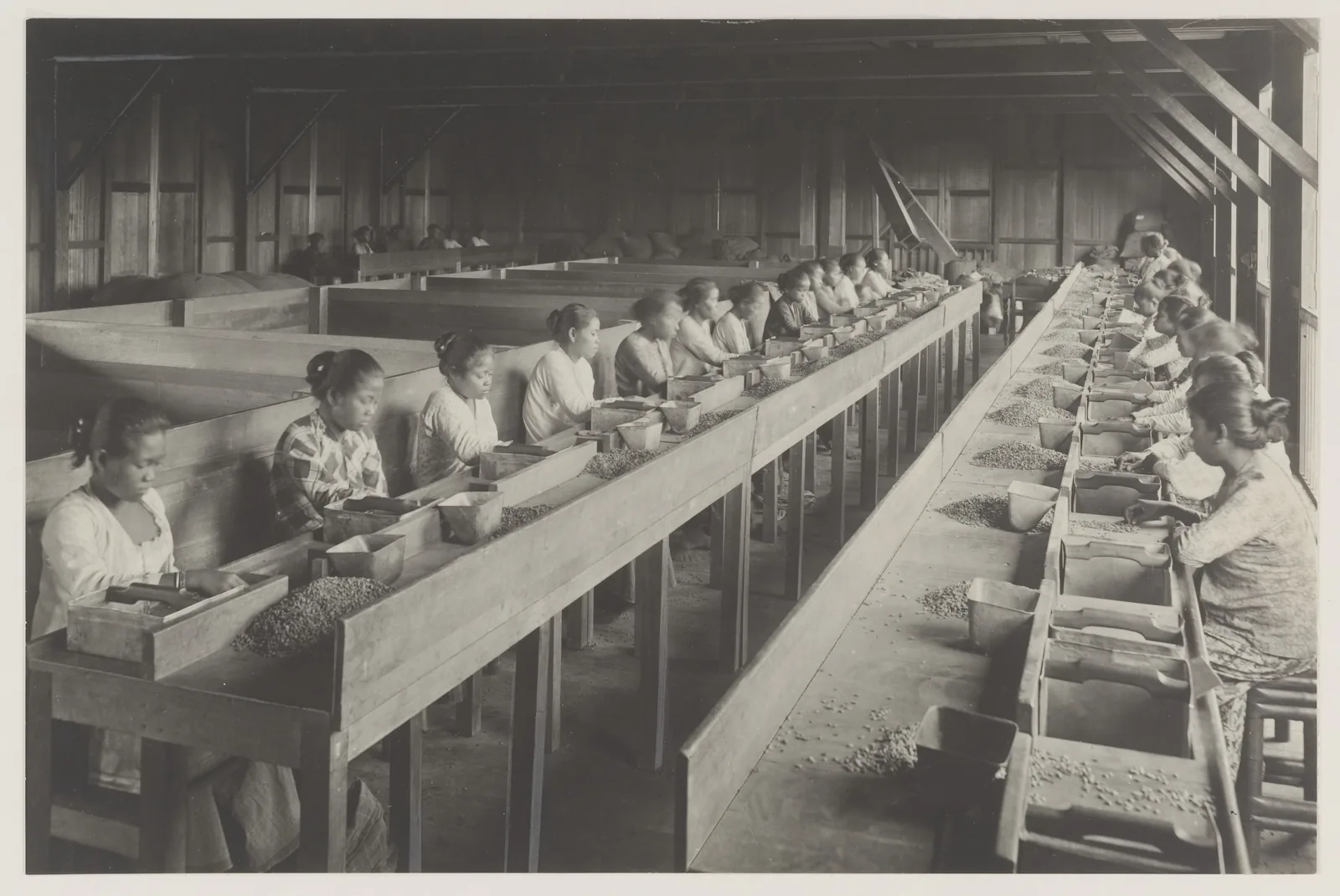
The principle
What the scale counts, and what it does not count
The Specialty Coffee Association system does not score the quality of a coffee. It counts physical mishaps in a mass of green beans, converts this count into a common unit, and sets a ceiling beyond which a lot ceases to be sellable under the specialty label. It is an instrument of eligibility, not of merit: merit is measured in the cup, by the codified tasting that the trade calls cupping, and the manual itself refers to it (SCA, washed arabica guide, edition no. 3, p. 5). Confusing the scale with the score amounts to confusing a vehicle inspection with a test drive.
The sample, and why its size decides everything
Even before the list of defects, the system fixes the mass on which one counts: 350 grams of green coffee, and 100 grams of roasted for quakers (SCA, p. 4 and p. 3). This number is half of the scale, because a defect is not an absolute quantity but a concentration, and a concentration only makes sense relative to a mass: five broken beans in 350 grams or in 300 grams do not express the same severity, and the sources do not agree on this point, as the gray area sets out. The sample must also be representative and homogenized (p. 4), otherwise the result measures the spot in the bag where the sample was drawn.
The two categories, and the absolute zero
The specialty coffee threshold comes down to two numbers. On the 350 grams of green, zero Category 1 defects and at most five Category 2 defects. On the 100 grams of roasted, zero quakers (p. 3 and 5).
The absolute zero of Category 1 is the key to the system: a single entirely black bean, a single entirely sour bean, a single stone, and the lot is out, with no averaging or compensation. This is not gratuitous severity, because Category 1 brings together mishaps that do not stay in their corner: one whole sour bean is enough to spoil an entire coffee (p. 10), and a bean attacked by a fungus contaminates its neighbors in the bag (p. 11). Tolerating one unit would amount to tolerating the whole lot. Category 2, on the contrary, admits five whole defects, which is to say that these mishaps are diluted.
The full defect equivalent, a conversion unit
What remains is the notion that gives the scale its meaning and that is the most misunderstood: the full defect equivalent. It is not a score, it is a conversion unit, like an exchange rate. Some mishaps are so serious that a single bean is worth a full defect, others mild enough that three, five or ten are needed. The complete table is on page 4.
In Category 1, the following count as a full defect on their own: the entirely black bean, the entirely sour bean, the dried cherry or pod, the bean attacked by a fungus and any foreign matter; still in Category 1 but at a different rate, the severely insect-damaged bean is worth a full defect per five beans. In Category 2, three partially black or three partially sour beans are needed; five are needed for each of the seven families that are the bean left in parchment, the floater, the immature, the withered, the shell, the broken, chipped or cut bean, and the husk fragment; ten are needed for the slightly insect-damaged bean, the mildest rate in the table and the only one at ten.
Two distinct scales, and the insect-damaged bean that proves it
Here is the most instructive point of the system, and the one that almost all popularizations summarize wrongly. Category and equivalent are two different scales: the category says how many whole defects the lot is entitled to carry, zero or five, it is a ceiling; the equivalent says how many beans must be gathered to make one whole defect, it is an exchange rate.
The bean severely damaged by the coffee berry borer demonstrates it. It is in Category 1, therefore zero tolerance, while requiring five beans to form one defect. Four severely insect-damaged beans in 350 grams leave the lot in specialty; the fifth takes it out.
This looks like an inconsistency and is not one, once one sees that the two scales do not measure the same thing. The category measures the nature of the danger, that is, what happens if the defect is there: here a risk of ochratoxin, the toxin produced by certain molds, which the manual flags for the insect-damaged bean (p. 18), and an effect in the cup that becomes clear as soon as there is quantity. The equivalent measures the intensity of damage per bean. Now an insect-damaged bean is a bean perforated by a small beetle, whose flesh remains largely sound; it is not comparable to an entirely black bean, which is a bean dead from fermentation. The perforation opens a door, it does not destroy the bean.
The scale therefore says this, and it is coherent: an insect-damaged bean weighs almost nothing alone, but what it announces is serious enough that the lot is entitled to no complete defect of this family. The same reading ruins the idea, carried by the vocabulary of primary and secondary defects, that the first would always be the worst: the severely insect-damaged bean, in Category 1, is worth five beans per defect, whereas the partially black bean, in Category 2, is worth three. On the scale of equivalents, it is here the Category 2 defect that weighs the heaviest.
The non-addition rule, which is the heart of the system
The manual gives two counting rules that weigh as much as the table, and the first is the one no one explains: different families are not added together to make an equivalent, each type being counted separately (p. 5).
The consequence is counterintuitive. Four broken beans and four withered beans in the same sample make no whole defect, each family staying under its threshold of five. Eight broken beans make one. The same number of damaged beans, eight, produces a result in one case and nothing at all in the other.
This is not a flaw, it is the thesis of the system. The scale does not measure a mass of damaged beans, it measures a concentration per type of mishap, and it does so for a precise reason: a type of mishap is a cause, and a cause is a badly adjusted machine, a tank left too long, a poorly swept dryer. Eight broken beans point to a pulper; four broken and four withered point to nothing, because four broken beans in 350 grams are the background noise of any decent plant, and four withered beans that of any slightly dry season.
An arithmetic can be drawn from this that the manual does not publish. By pushing each family just under its threshold, a lot can carry four severely insect-damaged beans, two partially black, two partially sour, nine slightly insect-damaged and four beans in each of the seven five-for-one families, that is twenty-eight: forty-five damaged beans for an official count of zero defects, and the lot still has its five Category 2 defects available. This calculation is ours, it follows mechanically from the published table, and it says what a zero means here, namely the absence of concentration and not the absence of mishap.
Arbitration, misshapen beans, and three neighboring figures
The second rule settles the case of the doubly affected bean: when two defects appear on the same bean, the one that weighs heaviest on the cup is retained (p. 5). A bean that is both broken and moldy is therefore counted as moldy, Category 1, and not as broken. The rule avoids double counting, but above all it does something else: it installs impact in the cup as the superior criterion of the system, and two entries of the table escape it, which is the subject of the last part of this sheet. The manual finally sets aside merely misshapen beans, which are not defects, only those the guide describes entering the classification (p. 5); two entries, the shell and the withered bean, are nonetheless described there as misshapen and well and truly counted (p. 27 and 29).
The sequence
How the counting is done, in practice
350 grams of green taken from a homogenized lot are weighed and spread out, and the affected beans are separated by hand into as many piles as there are families. Each pile is counted and divided by the equivalent of its family, and the whole defects obtained are added up, Category 1 on one side, Category 2 on the other. A bean carrying two mishaps goes into the pile of the one that is worse in the cup; a bean that is merely twisted goes nowhere. What follows is the entire table, sixteen entries, plus the quaker and the potato defect: eighteen.
Category 1, six entries at zero tolerance
The entirely black bean, full black, grano negro, is black over at least half of its surface. One bean for one defect. The manual places its origin in the field and describes it as a blackening due to an over-fermentation pigment associated with microorganisms: it is a bean dead before it was processed. In the cup: fermented, acetic acid, damp mold, earthy, sour, phenolic, this last word designating the medicinal, bandage-like smell that spoils a coffee at trace level. Ochratoxin risk flagged (p. 6 and 7).
The entirely sour bean, full sour, grano agrio, is black at its embryo and turns yellowish or reddish brown outside; scratched, it releases a frank smell of vinegar. One bean for one defect. Its entry points are overripe cherries, cherries picked up from the ground, contaminated water and over-fermentation of fruit left on the tree in wet weather. In the cup: sour, fermented, acetic acid. It is of this bean that the manual says a single whole example is enough to spoil an entire coffee (p. 8 and 10).
The bean attacked by a fungus, fungus damaged, daño por hongos, bears powdery yellow to reddish-brown spots, which are the spores themselves, and which spread until they cover it. One bean for one defect. The manual names the three genera involved, Aspergillus, Penicillium and Fusarium, and places the contamination anywhere between harvest and storage, as soon as two conditions are met together, favorable temperature and humidity on one side, spores on the other. In the cup: fermented, dusty, damp mold, phenolic. Ochratoxin risk flagged. These beans contaminate their neighbors in the bag: it is not an isolated mishap, it is a hotspot (p. 11 to 13).
The dried cherry or pod, guayaba or cereza seca, is a bean still enclosed in part or in whole in the dried pulp of the fruit, sometimes marked with powdery white dots that signal a mold. One cherry for one defect. Its cause is twofold: in processing, a failed pulping and the failure to remove floaters at the receiving tank; in the field, drought and disease that make the fruit dry on the tree. In the cup: fermented, damp mold, phenolic (p. 16 and 17).
The bean severely damaged by the insect, severe insect damage, la broca, bears three or more perforations. Category 1, but five beans for one whole defect. The perforations measure 0.3 to 1.5 millimeters in diameter, or 0.01 to 0.06 inch, often on two opposite faces. The agent is the coffee berry borer, Hypothenemus hampei, a small beetle that bores into the cherry on the tree and tunnels to the tender seed to reproduce there, the young emerging on the other side. The manual gives a precious agronomic benchmark, the incidence of this insect decreases as altitude increases. In the cup: earthy, sour, damp mold, clear especially in quantity. Ochratoxin risk flagged (p. 18 to 20).
Foreign matter, materia extraña, designates everything that is not coffee: wood, stones, metal objects, insects, plastic, glass, other seeds. One object for one whole defect. Its cause is undifferentiated, these objects being able to enter at any stage, which explains why no agricultural remedy is offered. The manual insists less on the cup than on the health risk and the damage to mills, and recommends destoners and magnets (p. 14 and 15).
Category 2, ten entries and five defects tolerated
The partially black bean, partial black, is the same mishap stopped earlier, less than half of the bean being blackened. Three beans for one whole defect (p. 6).
The partially sour bean, partial sour, follows the same logic, occupies less than half of the bean and is worth one whole defect per three beans (p. 8). Same family, same origin, one degree less.
The slightly insect-damaged bean, slight insect damage, bears two perforations or fewer. Ten beans for one whole defect, the mildest rate in the table and the only one at ten (p. 18 and 20).
The broken, chipped or cut bean, grano partido, mordido, cortado, is worth one whole defect per five beans. Its cause is entirely mechanical, a pulping or hulling whose setting applies excessive friction or pressure to the bean. In the cup: earthy, dusty, sour, fermented. The manual adds that only ripe cherries should be processed, half-ripe cherries pulping badly and green ones not at all (p. 21 and 22).
The immature bean, also called unripe, inmaduro, is worth one whole defect per five beans. It is recognized by the pallid, greenish yellow color of its spermoderm, that fine silvery film that wraps the seed, and above all by the fact that it adheres firmly instead of coming off. Its cause is agronomic: unripe cherries picked, or the uneven ripening of late varieties at altitude. In the cup, the manual makes it the main source of astringency, that rough sensation in the mouth which is not a taste but a touch, with hay and unripe fruit (p. 23 and 24).
The withered bean, averanado or arrugado, is worth one whole defect per five beans. It is a smaller, malformed bean, wrinkled like a raisin. Its cause is climatic and not human, a lack of water during the formation of the bean inside the cherry, aggravated by weak trees or too dense shade. In the cup: grassy, hay, depending on quantity. Low in density, it floats and is skimmed off early in washing (p. 25 to 27).
The shell, concha, is worth one whole defect per five beans. It is a malformed bean made of an external part shaped like a seashell and an internal conical part, found separate or nested. The manual says here something that is not trivial: its cause is genetic, and the only remedy proposed is the choice of variety. In the cup, the effect is indirect and only arrives at roasting, these thin fragments charring before the rest and giving smoky or ashy notes (p. 28 and 29).
The floater, flotador, is worth one whole defect per five beans. It is whitish and washed out, gives the sample a marbled look, and floats in water. Its cause lies entirely in processing: parchment beans forgotten in the corners of dryers or patios give this pale, low-density bean, and parchment coffee stored too damp produces the same result. In the cup, the effect varies a lot, from fermented to grassy, hay, earthy, damp mold, and the manual flags a case worth knowing, the floater being able to dilute the cup without off-taste (p. 30 and 31).
The bean left in parchment (pergamino in Spanish) is worth one whole defect per five beans. It is a bean still wrapped, in part or in whole, in its white or beige papery hull, and it is the only defect in the table whose effect in the cup the manual declares nil. Its cause is single and purely industrial, a badly calibrated hulling at the dry mill. What it signals is therefore not a problem of taste but a problem of seriousness: the manual writes that its presence is the sign of a poor grading of the lot (p. 32 and 33).
The husk fragment, hull or husk, is worth one whole defect per five beans. It is a piece of dried pulp, dark red, coming from a poorly cleaned natural coffee or from a badly calibrated pulper whose shreds of fruit skin dry into fragments. In sufficient quantity, it gives dirty, earthy, damp mold, fermented or phenolic notes. The remedy is winnowing, that separation by air current that carries off the light elements (p. 34 and 35).
The two defects that are not counted on green
The quaker is not an entry of the table. It is the same physical object as the immature bean, but it only reveals itself after cooking: it is the bean that refuses to brown in roasting because it was picked before ripeness and lacks the sugars that make the color. The count is done on 100 grams of roasted, and the rule is an absolute zero (p. 3 and 5). It is the only place in the system where the same mishap is counted twice and at two opposite severities, five beans for one Category 2 defect on green, zero tolerance on roasted: the harshest threshold is applied where the measure is most reliable.
The potato defect, potato taste defect, appears neither in the manual nor on the poster, and this absence is logical in a system built for a visual count: a defect invisible on the bean has no place in it. The trade article examined here presents it as a form of insect damage caused by the Antestia bug, in East Africa, and insists on what matters to a buyer: it is impossible to see on green, and it is the roasted coffee that smells of raw potato. The site treats it by the chemical route in section 14 of the plate “The cup”.
The diagnostic key, or how the bean says where the machine went wrong
The manual slips into the broken bean entry a reading key worth far more than the entry it belongs to, because it turns a count into a diagnosis. A bean nicked at pulping, therefore at the wet mill, takes a dark reddish-brown color on the wound: the freshly opened surface oxidizes, then ferments and molds, since everything around it is wet, sugary and warm. A bean broken at the dry mill, on the contrary, shows a clean break, with no trace of oxidation, because there was nothing left around it to do any work (p. 22).
Two broken beans, two colors, two workshops. Whoever does the counting thus learns, by looking at the wound, whether the faulty setting is that of the pulper, at the farm, or that of the huller, at the dry mill, that is, with two different actors and often several months apart. It is the only piece of information in the whole table that designates a responsible party.
The sanitary consequence follows, and it is more serious than the defect itself. The wound from the wet mill opens the door to fermentation and mold, which the dry break does not, and the manual explicitly lists the nicked bean among the causes of fungal infection (p. 12). A mechanical Category 2 defect thus manufactures a sanitary Category 1 defect at zero tolerance.
The color scale of green coffee, eight hues and a single gloss
The poster carries as a banner a color scale for green beans, which the manual reproduces on page 3, and its status is counterintuitive: the color of the green is information for the buyer’s use and is not part of the specification. No hue disqualifies a lot. Color informs, it does not judge.
The scale has eight named hues, in the order in which the poster lays them out, from the coolest and most saturated to the warmest and dullest:
- blue-green;
- bluish-green;
- green;
- greenish;
- yellow-green;
- pale yellow;
- yellowish;
- brownish.
What the documents say about its interpretation fits in one sentence, and the temptation to complete it must be resisted: the color of unroasted coffee ranges from blue-green to brownish depending on origin or age. There is no other gloss. Neither the manual nor the poster gives a hue-by-hue reading, says from which shade a coffee is too old, or ties a hue to a drying practice. Trade grids of the type “pale yellow equals two years of storage” circulate with no support in these documents.
The two named variables do not have the same meaning, however, and that is where the only solid reading comes from. Origin means that two fresh, well-run coffees are born at two different places on the scale; age, for its part, moves the lot in a single direction, toward brownish. A uniform hue therefore describes the age and origin of the lot, whereas heterogeneity of hue within a single sample describes beans that have not lived through the same drying, the same storage or the same mishap as their neighbors. It is the spread that is read, not the average hue.
What it gives in the cup
What the scale itself states must be set first: this classification does not produce a cup score, and none of its numbers translates into points. What follows groups by taste family the effects attributed defect by defect.
The heaviest register is the fermentative register, and it brings together the heaviest entries of the table. Fermented, acetic acid, sour and phenolic recur for the black bean, the sour bean, the fungus-attacked bean, the dried cherry and the husk fragment. This is no accident of nomenclature: these five entries all describe fruit sugar worked by microorganisms out of control, at the farm, in the tank, on the tree or in the bag. Phenolic is the worst of the lot because it survives roasting and is recognizable at trace level.
The earthy and dusty register brings together mishaps in which the bean was opened or emptied, the insect-damaged bean, the broken bean, the husk fragment and the floater: what they have in common is not a fermentation but an exposed surface, dry matter that has taken up dust, air and time. The vegetal register is that of the fruit that has not finished its work, with the astringency and hay of the immature bean and the grassy of the withered bean, the only defects whose effect rises with quantity without ever producing a frank off-taste: they impoverish rather than spoil. Three entries finally escape these registers, the shell that is only paid for at roasting, the floater that may simply dilute the cup, and the bean left in parchment that the manual declares to have no effect whatsoever.
It remains to say what the scale lets through, because that is where its relation to the cup is decided. The threshold of five beans per family in Category 2 means that four beans of each family reach the coffee without having been counted, and these four beans are well and truly roasted and drunk. The classification therefore does not claim that an eligible lot is a lot without mishap: it asserts that below these concentrations the coffee stands up. This assertion is backed by no published measurement in the documents examined, which contain no blind trial comparing a lot with four broken beans with the same lot with none. It is a market convention, held by use, and it should be read as such.
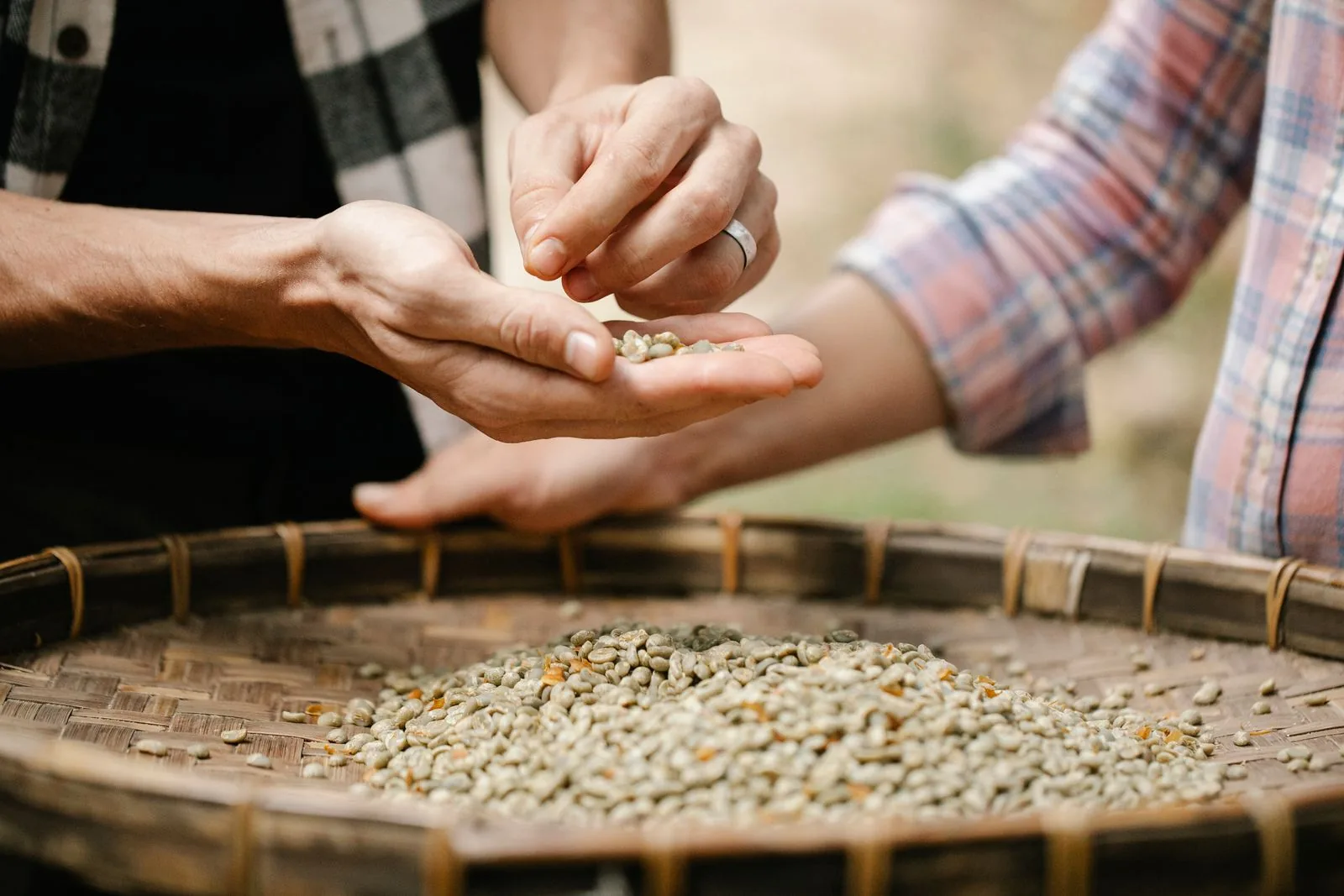
What goes wrong
The manual structures each entry in the same way, with a section on causes and a section on remedies split in two, agricultural and processing. This architecture makes it possible to trace the chain link by link, and that is what makes this sheet useful to the thirty others: each link points back here to the one that deals with it.
The field and the picking
Four families are born before anyone has touched anything: the withered bean (climatic), the immature bean, the shell (genetic), and the insect-damaged bean. The black bean is also filed among the agricultural causes, its first remedy being to pick only ripe fruit. It is the only link where the classification corrects nothing: one does not fix a drought or a genome, one puts a figure on a season.
Picking, for its part, can be corrected, and three recommendations recur in three different entries of the manual, which is the best proof of their weight: do not collect cherries fallen on the ground, do not pick overripe cherries, do not pick cherries dried on the tree. The ground is a triple source, it gives sour beans, it feeds dried cherries, and it sustains the borer’s cycle since the insect reproduces in the fallen seed. The manual adds that fermented cherries left on the tree in wet weather produce the same sour as the tank.
Fermentation and washing
Fermentation and washing produce sour in all its forms, and the manual lists the levers in the order in which they arise: pulp without delay rather than store the cherries, control the time in the tank, never use contaminated or recycled water, move on without interruption to drying. The sheets “The classic washed process”, “Extended fermentation” and “Processing water and pulp” deal with each of these levers. The same dirty water and the same badly emptied tank feed the fungus, the manual citing among the causes of infection beans forgotten in tanks and uncontrolled fermentations: it is not only sour that lies in wait for a badly kept tank, it is a Category 1 defect at zero tolerance, and it is contagious.
Pulping and hulling, and the loop that manufactures a Category 1 defect
The two friction machines of the chain, the pulper and the huller, produce on their own four entries of the table: the broken bean, the dried cherry passed through, the husk fragment and the bean left in parchment. The manual treats them all as defects of setting and maintenance, never as fatalities, and the sheet “Hulling and resting in parchment” describes what the dry mill does to the bean.
The loop must be underlined, the only chain of causes the manual describes explicitly. A badly set pulper nicks the bean; the nicked bean, wet and sugary, becomes an entry point for the fungus. A mechanical Category 2 defect thus manufactures a sanitary Category 1 defect at zero tolerance. It is the strongest technical argument in favor of adjusting the machines, and it does not go through taste.
Drying, storage and transport
Drying produces the floater and sustains the fungus. The floater is born of uneven drying, of those parchment beans left in the corners of patios and dryers, or of storage in parchment that is too damp. The remedy comes down to two words that amount to a program, regular and progressive, and it is the subject of the sheets “Drying, from floor to ceiling”, “The patio”, “The raised bed and drying areas”, “Mechanical drying” and “Shade and greenhouse drying”. For the fungus, the manual designates two faults, the delay in starting drying and interruptions along the way.
Storage and transport have no sheet of their own in the manual but are named three times there: the fungus can infect coffee anywhere between harvest and storage as soon as temperature and humidity allow, the manual pointing to coffee kept in parchment in warmth and damp; the floater is born of the same storage; and the whole chain is framed by the two eligibility thresholds, 10 to 12% moisture and less than 0.70 Aw, which govern microbial life in a bag. The sheets “Monsooned coffee” and “Deliberate aging” describe what becomes of a coffee that is kept on purpose. Foreign matter, finally, accumulates at any stage.
What the classification makes people do wrong
The risk specific to the tool comes down to four errors. First, confusing the two scales: believing that Category 1 means one bean per defect leads to rejecting eligible lots, four severely insect-damaged beans having cost nothing, and believing the opposite leads to accepting ones that are not. Next, adding up the families, which the manual forbids and habit reconstructs: one looks at a sample full of small varied mishaps, judges it dirty, and the scale says zero.
Then, relying on sorting to make up for it. The manual describes a division of tasks far more nuanced than the commercial talk: density for the shell, the low-density floater, the severely insect-damaged bean and the parchment, color for the black and the sour, the hand for the light fungus, large broken beans and dense floaters. And it writes that most optical sorters are unable to remove the immature bean, even though the color sorter is sold everywhere as the universal solution.
Taking a count for a judgment, finally. A graded lot has not been tasted.
Where the line runs
Two entries of the table pose a question to the system that it does not resolve, and they fail for two opposite reasons.
The bean left in parchment is the only defect whose effect in the cup the manual declares nil (p. 32). It spoils nothing, dilutes nothing, burns nothing. What it signals is something else, and the manual writes it: its presence is the sign of a poor grading of the lot, that is, of a badly calibrated hulling and a sorting that did not do its job. A negligence is thus penalized through its trace.
The shell fails at the other end. The manual describes it as a natural phenomenon of genetic origin, whose only remedy is the choice of variety (p. 28). It does have an effect, but it only arrives at roasting and it belongs to the roaster as much as to the producer. Above all, it is not a mishap: it is a property of the plant material, which the producer did not cause and can only correct by uprooting the trees.
Yet the arbitration rule of page 5, the one that settles the doubly affected bean by retaining the defect that weighs heaviest on the cup, installs taste impact as the superior criterion of the system. Two entries therefore escape it, one because it has no declared impact, the other because its impact is deferred and its cause inherited. The text asserts one criterion and counts according to another.
Two readings are possible, and this sheet does not decide between them. The first saves the coherence by changing the description of the system: the scale would not measure taste but the conformity of a lot to what a buyer expects of careful work. Parchment is then a perfectly legitimate finishing defect, in the same way as a crooked label on a bottle, and the rule on page 5 is only a local rule of arbitration, made to settle between two accidents and not to define what a defect is.
The second takes the rule seriously and concludes that these two entries are misclassified. It has in its favor the wording of the manual, which nowhere says that the cleanliness of the work would be a criterion in itself, and a concrete economic consequence: five shells in 350 grams cost exactly as much as five beans broken by a badly adjusted machine, whereas one is a fact of nature that the producer did not choose and the other a fault.
What remains established, whichever reading is retained, comes down to one sentence useful to the buyer: this system counts two different things under a single word, damage to the coffee and a failure of workmanship, and it does not say so. Knowing which of the two one is looking at changes what one negotiates.
Benchmarks
- SCA sample350 g of green, 100 g of roasted for quakers
- Specialty coffee threshold0 Category 1 defects, at most 5 Category 2 defects, 0 quakers
- Entries in the equivalence table16, plus the quaker counted on roasted coffee
- Full black, full sour, dried cherry, fungus damage, foreign matter1 bean for 1 defect, Category 1
- Severely insect-damaged bean5 beans for 1 defect, but Category 1
- Partial black and partial sour3 beans for 1 defect, Category 2
- Parchment, floater, immature, withered, shell, broken, husk fragment5 beans for 1 defect, Category 2
- Slightly insect-damaged bean10 beans for 1 defect, the most lenient rate
- Damaged beans tolerated for a count of zero defects45, deduced from the published table
- Families flagged as at risk for ochratoxin3, full black, fungus damage and insect-damaged beans
- Insect damage, threshold between severe and slight3 or more perforations versus 2 or fewer
- Diameter of borer perforations0.3 to 1.5 mm, or 0.01 to 0.06 inch
- Moisture content of specialty green coffee at importat least 10% and at most 12%
- Water activity, SCAstrictly below 0.70 Aw
- Size variation tolerated in the contract5%, advisory status
- Shades named in the green color scale8, from bluish green to brownish
- Published shade-by-shade readingnone
- Published numerical justification of the equivalentsnone