The escapes
In 1685, a French scholar writes that coffee grows only in Arabia. In 1712, the king's envoys at Mocha are told the same thing on the spot. They are both wrong: the plant has been growing in Amsterdam for six years. The story of four thefts, of a single tree, and of what remains of it in your cup.
Chapter I
01The port that held the world
For nearly two centuries, all the world's coffee left through a single port.
It is called Mocha, it lies on the Red Sea, and from 1536 it belongs to the Ottomans, who have just occupied Yemen. Coffee then ceases to be a curiosity of religious brotherhoods and becomes what it will never cease to be: a source of state revenue. It is taxed, and it is conveyed through Jeddah and Suez to Cairo and Constantinople. La Roque, who will describe all this at close range, notes that each camel carries two bales of two hundred and seventy pounds, and that the governor of Mocha pays thirty thousand piastres a year to the king.
Thirty thousand piastres a year. Remember that figure, because it explains everything else: the monopoly is not a whim, it is a budget line.
And it holds. It holds so well that in 1685, Dufour publishes in France a treatise in which he writes that coffee grows only in Arabia, without cultivation, and nowhere else. This is not the folly of an ignoramus: it is what everybody knows. In 1712, a French expedition lands at Mocha and at Bait al-Faqih to check for itself; La Roque brings back the description of the terraces, of hand sorting, and of the monopoly. The king's envoys are told, on the spot, by people who ought to know, that the plant grows only there.
At that very moment, a coffee plant has been growing in Amsterdam for six years.
That is the story we are about to tell: that of a monopoly nobody dreamed of doubting, and which had already leaked through four breaches at once.
La Roque, Voyage de l'Arabie heureuse (1716), 1732 translation, p. 88-89 and 106; Dufour, Traitez nouveaux & curieux du café (1685); Ukers 1922, chapter on Arabia; see the chronicle landmarks “1536,” “1685” and “1712”Chapter II
02Seven seeds in a belt
The first breach is Indian, and the story goes like this.
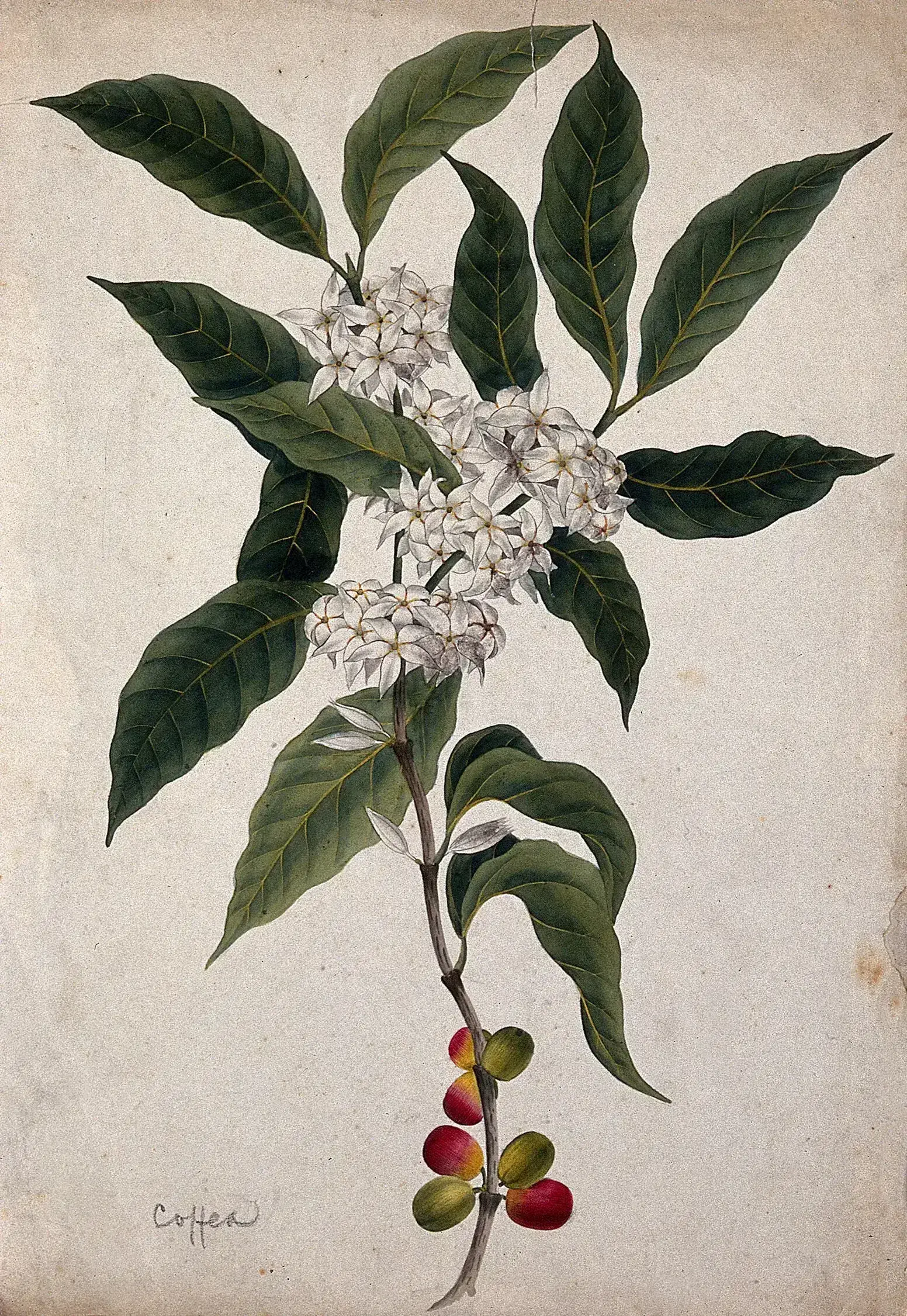
A pilgrim named Baba Budan returns from Mecca with seven coffee seeds hidden in his belt. He plants them on the hills of Chikmagalur, in southern India.
When? This is where honesty begins. Ukers gives 1600. Another source gives 1695. Almost a century apart, and no way to decide. Rather than choosing the date that would make the prettiest story, let us say how things stand: we do not know.
What we do know, on the other hand, is perfectly established, and it is what matters most. From this handful of seeds, seven if one is willing to believe the number, comes a very real Indian lineage: Kent is selected in Mysore in 1911, the first arabica said to be resistant to coffee leaf rust; S.795, a cross of S.288 and Kent, is released in 1945-1946 and becomes the first resistant variety widely grown in the world.
A pilgrim's belt, three and a half centuries, and millions of trees. That is the kind of proportion to keep in mind in order to understand what follows.
Ukers, All About Coffee (1922); see the chronicle landmarks “around 1600,” “1911” and “1945-1946,” the first explicitly carrying the two competing datesChapter III
03The Amsterdam plant
The second breach is Dutch, and it is methodical.
1616: Pieter Van den Broecke brings back from Mocha the first coffee to Holland; a merchant brings a plant to Amsterdam. 1640: Wurffbain puts the first commercial cargo on sale in Amsterdam. 1658: the Dutch plant coffee in Ceylon, which they have just taken from the Portuguese. 1696-1699: plants from Malabar are carried to Java, to Batavia.
Forty years, four stages, no haste. While the French politely question the authorities in Mocha, the Dutch move the plant from one end of the Indian Ocean to the other.
And then, in 1706, something tiny happens from which everything else follows.
A single plant leaves Java for the botanical garden in Amsterdam.
One. Almost all the Typica in the world descends from that one. All the plantations of the Americas, all the taste of the 18th century, everything that will be drunk for two hundred years passes through this earthen pot landed on a Dutch quay.
WCR 2025, history of Typica, p. 9-10; Ukers 1922, chronology p. 726; see the chronicle landmarks “1616,” “1658,” “1696-1699” and “1706”Chapter IV
04July 29, 1714
In this story of thefts and crossings, there is a scene that looks nothing like a novel and yet is the hinge of everything.
On July 29, 1714, at the Jardin du Roi in Paris, Antoine de Jussieu examines a coffee plant. It is a gift from Amsterdam.
Nothing more. A botanist in front of a potted plant, on a summer day. But this plant descends from the plant of 1706, and it is from it that the cuttings for the Antilles will leave, nine years later. France did not steal its coffee from Yemen: it received it from the Dutch, who had taken it from Java, where they had brought it from Malabar, where it had come from Yemen.
Two years earlier, his compatriots were being told in Mocha that the plant grew only in Arabia.
La Roque 1716, 1732 translation, p. 398-399; see the chronicle landmark “July 29, 1714”Chapter V
05The man who shared his water
Here now is the showpiece, the one that has been turned into paintings.
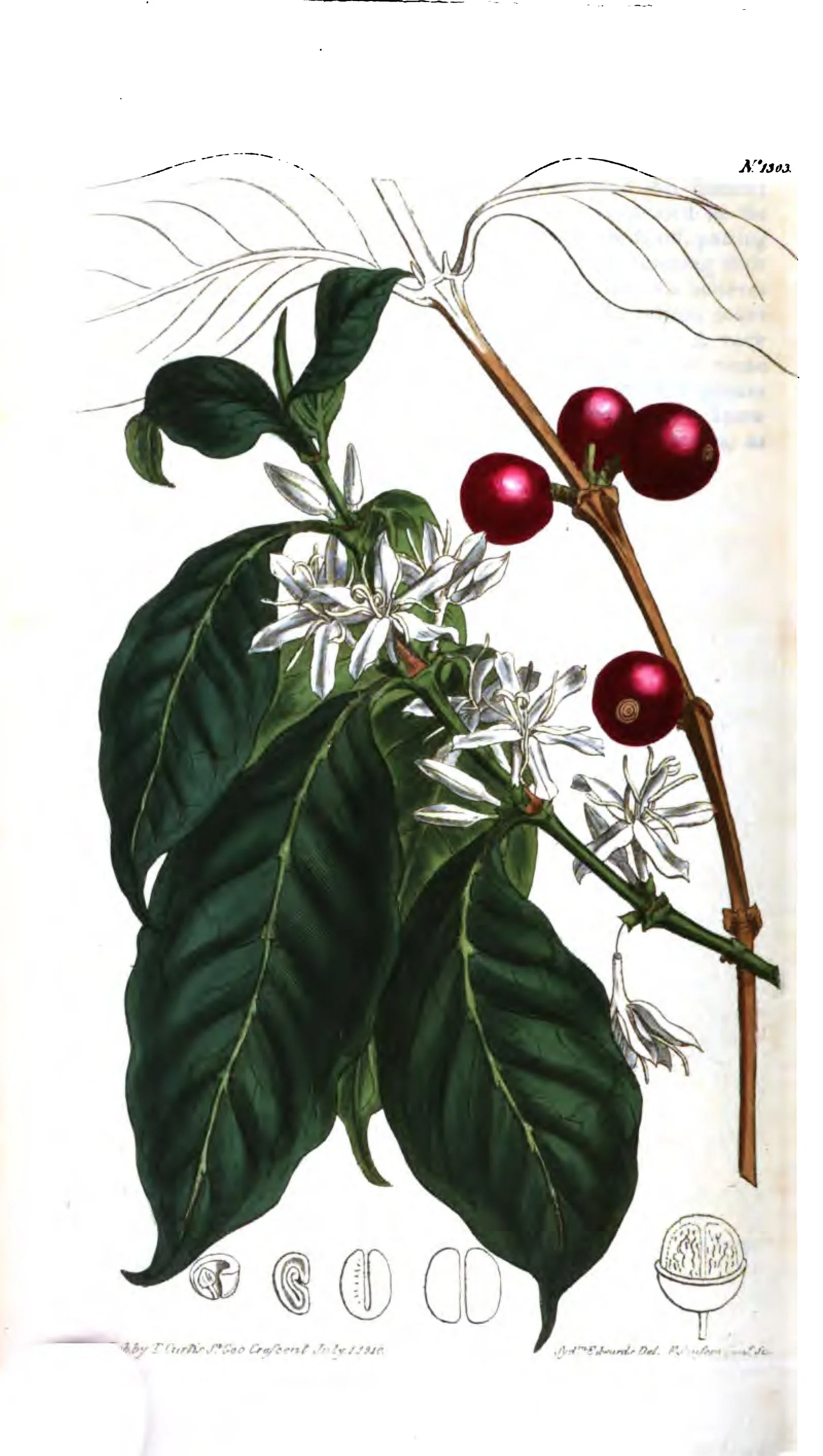
1723. Gabriel de Clieu sails for Martinique with a young coffee plant from the Jardin du Roi, sheltered under a glass bell. The crossing is long. Water runs short. Legend has it that he shared his ration with the plant. First harvest in 1726.
It is beautiful, it is taught in schools, and it is roughly true. The problem is not in the facts, it is in the calendar.
Because in 1718, five years before Clieu embarked, coffee had already arrived in Dutch Suriname. And in 1722, a year before his departure, it reached Pará, in Brazil, coming from Cayenne.
In other words: at the moment our hero shares his water with his pot, coffee is already growing on the South American continent, by another route, without him. The heroic tale and the chronology do not quite overlap.
Which does not mean that either of the two is false. Both are true, just not in the order in which they are told. Clieu did not bring coffee to America; he brought his stock to his island, and it is that stock that will spread. The difference looks like a detail. It is exactly what separates a history from a legend.
Ukers 1922; Thurber, Coffee: From Plantation to Cup (1881), p. 124; see the chronicle landmarks “1718,” “1722” and “1723”Chapter VI
06The Cayenne bouquet
Brazil, for its part, dates its coffee from another episode, and that one is frankly a tradition, and the chronicle classifies it as such.
1727. The Portuguese Francisco de Melo Palheta is sent to Cayenne to arbitrate a border dispute between French Guiana and Portuguese territory. A diplomatic mission, then, and strictly diplomatic: France refuses to export its plants.
Palheta leaves with a bouquet of flowers, given by the governor's wife. Plants are hidden in it.
Brazil starts its coffee history there. And it has a serious reason to prefer this version: the first coffee plant in Pará, planted in 1723 with plants from Cayenne, had failed. The official attempt fails, the gallant attempt succeeds; it is understandable that the country kept the second.
Two trees will be carried to Rio between 1770 and 1774. A century later, Brazil will produce more than three quarters of the world's coffee.
Brazilian tradition reported by Pendergrast, Uncommon Grounds (1999), chapter 1; Ukers 1922, chronology p. 727 (1723, failure at Pará); Thurber 1881, p. 124; see the chronicle landmark “1727,” marked as a legendChapter VII
07Twenty-two years
Now put the dates end to end. This is where the story stops being a collection of anecdotes and becomes a phenomenon.
1718, Suriname. 1722, Pará. 1723, Martinique. 1725, Saint-Domingue. 1727, Brazil by the bouquet. 1730, Jamaica, where the Typica that will become Blue Mountain arrives from Martinique.
Twenty-two years. A plant that an entire empire had guarded for two centuries crosses an ocean and settles on a continent within the span of a single human generation.
And on the other ocean, the same thing at the same time: between 1715 and 1718, the French introduce Yemeni coffee to the island of Bourbon; the World Coffee Research catalog even dates the presence of the plant to 1708. Of all this, around 1720, a single plant survives. It founds the Bourbon group, that is, half of what is grown today.
Twice in this story, everything rests on a single tree. This is not a figure of speech, it is a genetic fact, and we are still paying the price.
Ukers 1922, chronology; Thurber 1881, p. 124; WCR 2025, p. 10 and p. 20, Typica entry p. 84; see the chronicle landmarks “1715-1718,” “around 1720,” “1725” and “1728”Chapter VIII
08Father Romero's penances
That left Colombia, and its story deserves a detour because it is the opposite of all the others: here, nobody steals anything.
The oldest written trace is sober. Around 1730, the Jesuit José Gumilla notes, in El Orinoco ilustrado, the presence of coffee at the mission of Santa Teresa de Tabajé, near the mouth of the Meta. That is all, and it is the oldest written testimony of coffee in Colombia.
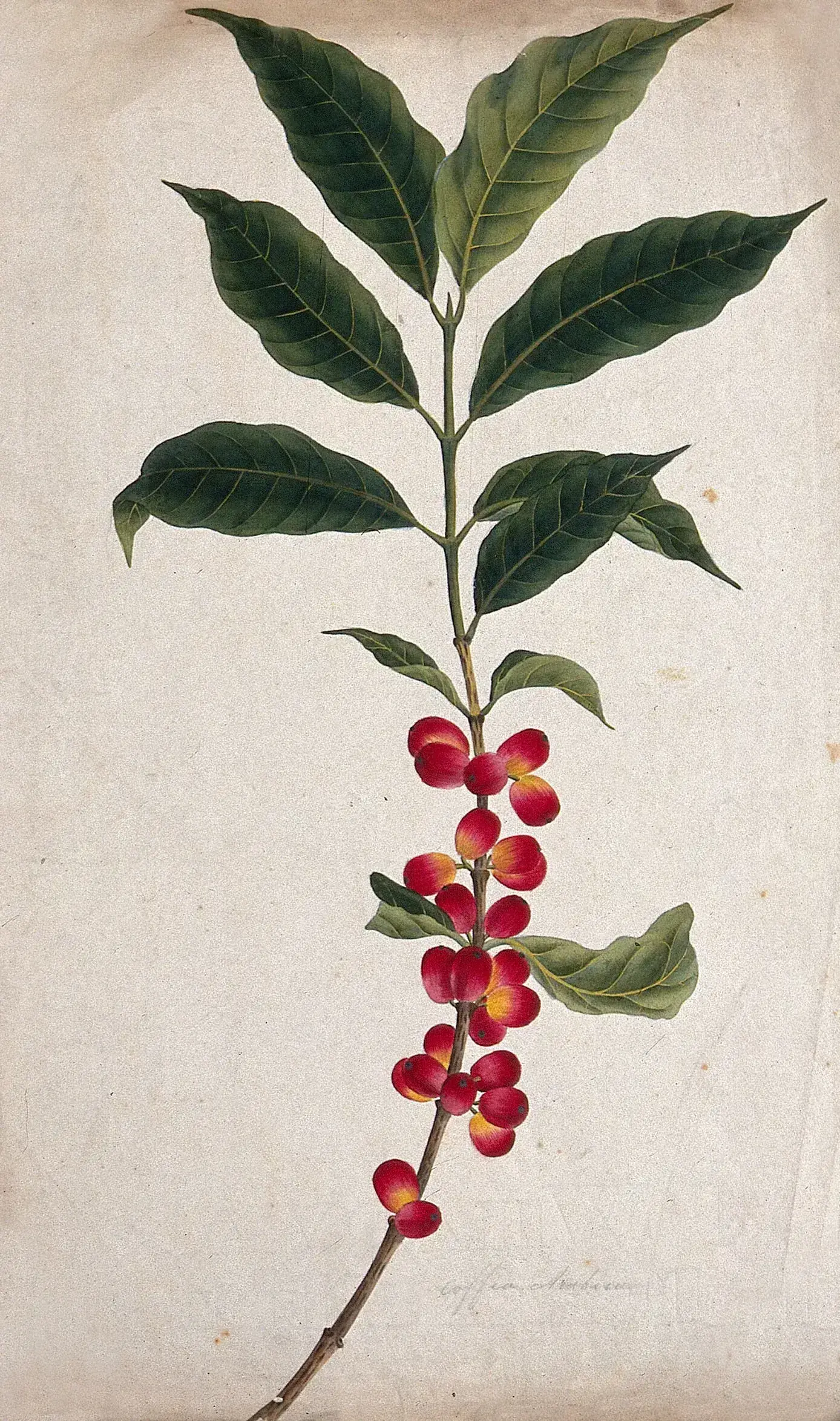
What the country tells, for its part, is of another nature. In Salazar de las Palmas, in Norte de Santander, at the end of the 18th century, Father Francisco Romero, who came from Rubio in Venezuela, is said to have imposed on his parishioners a penance of a new kind: planting coffee trees. Three or four plants per confessed sin. And the planting is done on Sunday.
The National Federation of Coffee Growers endorses the tradition and makes this village the cradle of Colombian coffee. What is missing must be said: no contemporary written source, an approximate date. It is an oral tradition, later taken up by an institution, which makes it official, not verified.
What is dated, on the other hand, is what follows: the first export leaves from there in 1835. Two thousand five hundred and ninety-two bags, by way of Lake Maracaibo.
Gumilla, El Orinoco ilustrado (1741, written around 1730); oral tradition of Salazar de las Palmas taken up by the Federación Nacional de Cafeteros; see the chronicle landmarks “1730” and “around 1780-1800,” the second marked as a legendChapter IX
09What the escape cost
It is time to stop smiling, because the sequel to this fine story of potted plants under bells and gallant bouquets has a name, and that name is Saint-Domingue.
Coffee is introduced there in 1725, between Clieu's Martinique and Palheta's bouquet. By the end of the century, the island supplies half the world's coffee.
It does so on the labor of enslaved people. This is not a regrettable circumstance of coffee's history: it is its economic engine. A plant that requires repeated picking, pass after pass, on slopes, for months, becomes a mass commodity only if labor costs nothing. The twenty-two years of the previous chapter would have produced nothing but botanical gardens without it.
In 1791, the enslaved people of Saint-Domingue revolt. Production collapses. The center of gravity of coffee shifts to Cuba, to Jamaica, then to Brazil, where in 1876 a census will count one million four hundred and seventy-six thousand five hundred and sixty-seven enslaved people, and where abolition will not come until 1888.
The map of coffee as we know it today was drawn by this revolt. It is something to know before looking at a list of origins.
Trouillot, Motion in the System (Review, 1982); Pendergrast, Uncommon Grounds (1999), chapter 1; Ukers 1922; see the chronicle landmarks “1725,” “1791,” “1830” and “1888”; the 1791 landmark is absent from Ukers's chronology, which is noticeableLet us count again. Seven seeds in a belt. A plant from Mocha in 1616. A single plant leaving Java in 1706. A single survivor at Bourbon around 1720. A potted plant under a bell in 1723. A bouquet in 1727.
That is what all the arabica grown outside Ethiopia went through. This is not a figure of speech: when Montagnon and his colleagues analyze the diversity of Yemen in 2022, they find only three groups there: SL34, Typica/Bourbon and New-Yemen. And when World Coffee Research revises its catalog in 2025, the Brazilian finding is clear: 97.55% of the country's cultivars descend from Typica and Bourbon.
So the next time you look at the map of varieties and find the oddly thin tree on the arabica side, with a few branches, many cousins, almost no ancestors, do not put it down to nature. Nature had everything that was needed, and still has it, in Ethiopia.
It is belts, pots and bouquets.