Carbonic maceration
Directed fermentations.
What distinguishes carbonic maceration?
Start the scene or choose a stage. The animation simplifies the mechanism; what follows gives the details and the available references.
Ripe, whole, undamaged cherries are loaded, sorted by flotation. The Brix degree, which measures the sugar in the fruit, tells what the fermentation will have to consume. The volume of the tank matters, because it sets the ratio between the mass of fruit and the gas headspace above it.
Read the stages without animation
- Whole cherries in a closed tankRipe, whole, undamaged cherries are loaded, sorted by flotation. The Brix degree, which measures the sugar in the fruit, tells what the fermentation will have to consume. The volume of the tank matters, because it sets the ratio between the mass of fruit and the gas headspace above it.
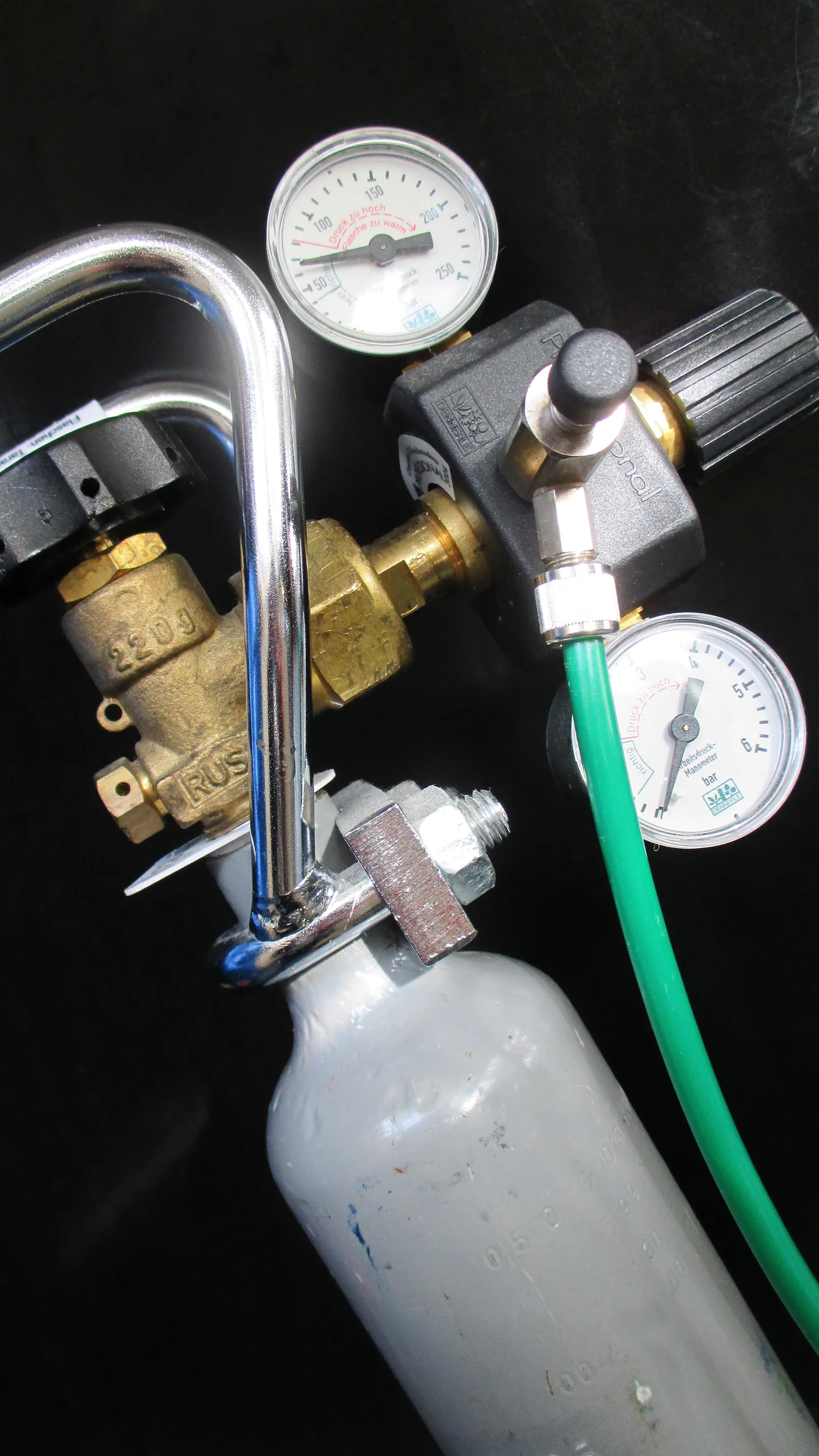
- The CO₂ from the cylinder drives out the airIn injection-driven operation, carbon dioxide comes from a cylinder and the tank is held at constant pressure: the pressure drives out the air and keeps it from coming back. The only coffee trial read with this setup held 1.50 bar, a figure the sheet could not recheck at the source. Without a cylinder, the merely closed tank must first deplete its oxygen.
- Macerating: temperature sets the durationPublished durations range from 24 hours to 15 days: five to fifteen days at about 18 to 20 °C, four to five days at 38 °C. The mass heats up by itself, it is the parameter that gets away fastest, and it can be controlled only if it is measured.
- The fruit gives off juice, the skin delays the microbesThe whole cherry gives off a leachate, the liquid that runs to the bottom: 1,400 mL for 20 kg at 144 hours in a closed tank. Its skin delays microbial work, without creating a new mechanism: fermentation inside the cells of the fruit, known in grapes, is not demonstrated by any study on the coffee cherry. By the fifteenth day, the green coffee deteriorates while the score rises.
- Getting out and drying below 0.70In Mexico, the coffee dries 21 days on raised beds, down to 10 to 11% moisture and a water activity below 0.70, the share of free water available to molds. Some of the lots sold under this name are pulped and then washed after the maceration.
To remember: The word covers two ways of running it: injected carbon dioxide, which drives out the air from the start, or a merely closed tank where the air runs out by itself.
In history: The word enters coffee in 2015, with the Colombian Sudan Rume of Sasa Sestic at the world barista championship; the detail of the lot rests only on the press.
Read the full article and its sources ↓Where it is practiced
The word enters coffee in 2015. Sasa Sestic wins the world barista championship with a Colombian Sudan Rume. The specialist press of the time attributes it to Finca Las Nubes, at Camilo Merizalde’s, and describes the technique as borrowed from wine. The detail of the lot rests only on this press, and nothing more solid supports it.
The published research, for its part, comes from four identified centers.
- Brazil, Espírito Santo. Lucas Louzada Pereira’s group publishes on arabica in 2021, then on conilon. It is the largest body of work.
- Mexico, Veracruz. A full-scale trial at the La Joya farm, on yellow Caturra cherries, 2021/22 harvest.
- Colombia, Huila. Cenicafé compares open and closed tanks, on whole fruit and on pulped coffee, and publishes in 2025.
- Southeast Asia. Trials appear between 2023 and 2025 in Indonesia and Thailand, including a study that files inoculated tanks under this name.
Commercially, the name circulates more widely than these four centers. A Slovak team bought specialty coffees on the market to measure heavy metals in them, including lots labeled carbonic maceration. The origins in this sampling numbered seven.
- Ethiopia, Kenya.
- Rwanda, Burundi.
- Guatemala, Nicaragua, Peru.
The label thus travels faster than the documented method.
The principle
Carbonic maceration comes from wine, and the principle there is precise. Whole bunches, uncrushed, are shut in a tank saturated with carbon dioxide. Deprived of oxygen, the grape berry stops respiring and switches to intracellular fermentation. Its own enzymes do the work, in its own cells, with no added yeast. The rest of the winemaking begins only afterwards, in the liquid phase.
The transfer to the coffee cherry is not automatic. The exocarp, the skin of the fruit, acts as a barrier. As long as it is intact, the surface microorganisms do not directly attack the mucilage, the layer of sweet flesh stuck to the parchment, the rigid shell that surrounds the bean. Cenicafé measured this barrier. On whole fruit, fermentation starts later than on pulped coffee. Acidity is lower at 24 hours, and more glucose remains in the mass throughout the process. The skin delays microbial work. It does not thereby create a new mechanism.
A second gap with wine, and it concerns the word anaerobic. In the coffee trials read here, nobody drives the air out of the tank. It is closed, the microorganisms consume the oxygen present and give off carbon dioxide. The medium becomes anoxic by depletion, not by purging. Cenicafé calls this regime SIAF, self-induced anaerobic fermentation, and distinguishes it explicitly from injecting gas from a cylinder. The two ways of running it nonetheless carry the same commercial name.
The seed, for its part, stays alive. Bytof and Selmar showed that it starts real germination processes during post-harvest, then a stress metabolism. It is the only intracellular metabolism documented in coffee. No study read here shows that the cherry pulp produces, as the grape does, the aromatic markers specific to carbonic maceration.
A tank is not a homogeneous environment, and semi-carbonic needs no cylinder
Two mechanisms are missing from this sheet, and they go together: the first explains what happens inside a carbonic maceration tank, the second explains how the carbon dioxide atmosphere is obtained without buying any.
The tank is stratified, and stirring becomes a variable
Hackler and Särchen describe what happens during microbial fermentation, the kind that converts sugar into alcohol and carbon dioxide: the cherries burst under the pressure produced, and different conditions set in at different heights of the tank, from intact cherries at the top to burst cherries fermenting submerged in their own juice at the bottom.
This is not a descriptive detail, it is the physical cause of a gradient that the site measures elsewhere without being able to explain it. The sheet on lactic fermentation reports five point zero six grams per liter of lactic acid at the bottom of a tank of one hundred seventy-five kilograms, against two point eighteen at the top, more than double. A stack of cherries under pressure is not a stirred reactor: it is a column where the load crushes the bottom, where juice accumulates by gravity, and where the residual oxygen, lighter than carbon dioxide, stays at the top. Three superimposed gradients, then, of pressure, humidity and oxygen, and three different floras.
The consequence for how it is run is clear: stirring stops being a convenience and becomes a process variable on a par with duration. Stirring brings the layers together and homogenizes the result; not stirring produces, in a single container, several fermentations whose average the cup will make. Yet none of the sources consulted publishes a stirring protocol with its frequency, nor a trial comparing a stirred tank with one left in place. It is a striking gap, since it is the least costly gesture of the whole process.
Semi-carbonic, explained
This sheet lists the name semi-carbonic without giving it a mechanism. Hackler and Särchen supply one, borrowed from Jitjaroen, Kongngoen and Panjai: it is a hybrid form in which part of the cherries is left intact and ferments in the same tank as crushed cherries. No carbon dioxide needs to be added, since it is produced by the fermentation of the pulped cherries, and this gas creates the necessary protective atmosphere by displacing the oxygen upward.
The detail of the upward displacement is mechanically right and worth spelling out: carbon dioxide is denser than air, so it builds up from the bottom and pushes the oxygen toward the surface, exactly as in a winemaking tank. That is why the upper layer of such a tank remains the most exposed to oxidation, and why intact cherries are better placed there than crushed cherries.
The value of this definition is that it makes the process accessible without equipment: a gas cylinder is expensive, a fraction of crushed cherries costs nothing. It also explains why so many lots sold as carbonic have never seen a cylinder: semi-carbonic produces a real carbon dioxide atmosphere, it simply produces it afterward and not beforehand, which leaves the first hours an aerobic regime that true carbonic maceration does not have.
Sources for this passage: Hackler and Särchen, chapter 3, p. 33 for the stratification; chapter 3, p. 34 for semi-carbonic, after Jitjaroen, Kongngoen and Panjai, Coffee Science, 2023. Gradient measured: sheet 14.
The sequence
1. Harvest and sorting. Ripe, whole, undamaged cherries. Flotation to remove floating fruit and foreign matter. The Brix degree measures the sugar available in the fruit. It is the fuel of fermentation, and a mass poor in sugar ferments badly. The Mexican trial started from yellow Caturra at 14.5 degrees Brix.
2. Loading into a closed tank. In Colombia, 20 kg of cherries per 30-liter high-density polyethylene bioreactor. In Mexico, 16 kg per 19-liter stainless steel tank. The volume matters, because it sets the ratio between the mass of fruit and the gas headspace above it.
3. Atmosphere. This is where the word is decided, and two very different ways of running it carry it.
- True injection. Carbon dioxide comes from a cylinder and the tank is held at constant pressure. The only coffee trial read here with this setup held 1.50 bar. The pressure drives out the air and keeps it from coming back.
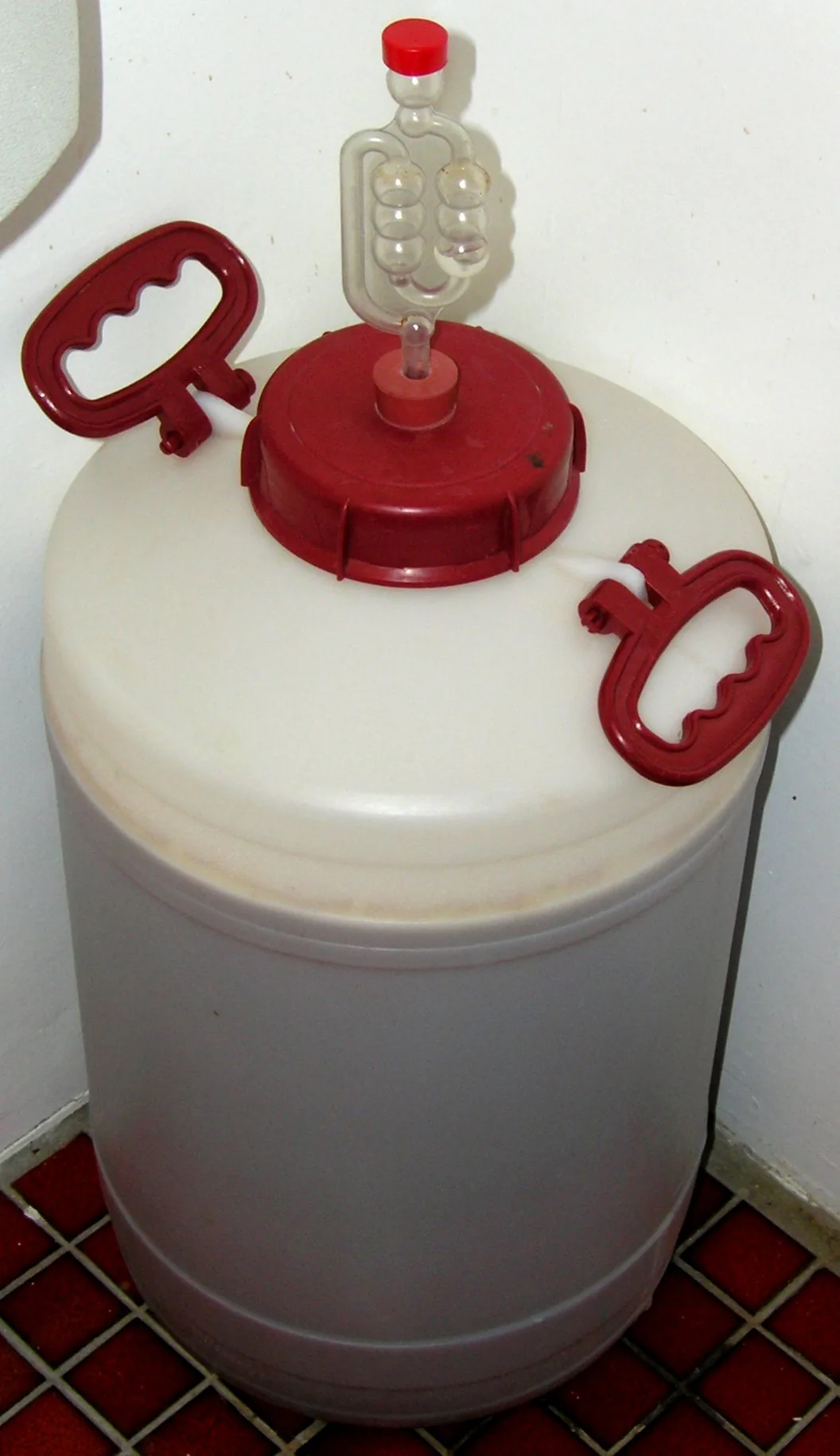
- Self-generation. The tank is merely closed, with an airlock that lets gas out without letting air in. The oxygen present is consumed by the microorganisms, the carbon dioxide builds up. Anoxia therefore takes time to set in, the time it takes for that oxygen to run out.
4. Maceration. Published durations range from 24 hours to 15 days. Temperature governs the speed of fermentation, and therefore the useful duration.
- 18 to 20 °C. Five to fifteen days. This is the Mexican regime and the Colombian regime.
- 28 °C. Intermediate step tested in Brazil, on arabica and on conilon.
- 38 °C. Four to five days. This is the step at which the Brazilian trials obtain their best scores.
5. Monitoring. pH and temperature at a minimum. The mass heats up on its own, and it is the parameter that gets away fastest. Cenicafé recorded 37 °C at 48 hours on whole fruit in an open tank, while the room was held at 20 ± 1 °C. Past this point, these tanks stayed above 30 °C until the end of the trial.
The whole fruit also gives off juice. Cenicafé collected 1,400 mL of leachate, the liquid that runs to the bottom of the tank, for 20 kg of cherries at 144 hours in a closed tank. In an open tank, the peak is earlier, 1,250 mL at 72 hours.
6. Emptying and drying. In Mexico, drying on raised beds for 21 days. Target: 10 to 11% moisture and a water activity below 0.70. Water activity is the share of free water, the water available to molds. Above 0.70, the lot does not keep in storage.
7. Variants. Some of the lots sold under this name are pulped and then washed after the maceration. The 2015 lot was presented this way, under the name washed carbonic maceration. An Indonesian study also files under carbonic maceration tanks to which an inoculant is added, pineapple or banana with yeast and sugar.
What it gives in the cup
What is measured, first, with its disagreements.
In Mexico, on yellow Caturra, the authors conclude that maceration improves the score from the fifth day. The natural control at day 0 scores 83.4 SCA points. On the fifteenth day, the pressurized tank scores 85.7 and the airlock tank 86.2. Injecting carbon dioxide at 1.50 bar therefore did not give a better score than the simple airlock. But the same authors conclude that the physical quality of the green coffee deteriorates on the tenth and fifteenth days. The score rises while the bean deteriorates, and that is the real result of this trial.
The descriptors grow more complex with duration. At day 0:
- sugarcane, molasses, blackberry;
- cinnamon, cardamom;
- light body.
On the fifteenth day:
- chocolate, cocoa, vanilla, nuts;
- cherry, pomegranate;
- medium to high citric acidity, medium to high body;
- a mention of winey.
In Brazil, on conilon, the design crossed five durations, from 24 to 120 hours, and three temperatures, 18, 28 and 38 °C. The relationship between overall score and temperature is significant there at 24, 72 and 96 hours. Warmer, higher scored, in this range. The scores reported range from 78.64 to 83.25. The 2025 study on the same material identifies 92 volatile compounds and associates the best scores with pyrazines and phenols. Most of the pyrazines are not born in the tank. They form in roasting, through the Maillard reaction, which condenses reducing sugars with amino acids.
Cenicafé finds none of this. At 20 °C over 192 hours, in Huila, no factor had a significant effect on the score. The p is the probability of observing such a gap if the factor did nothing. Above 0.05, no effect is concluded.
- Type of raw material, whole fruit or pulped coffee: p = 0.6669.
- Tank closure, open or sealed: p = 0.5740.
- Fermentation duration: p = 0.3338.
The samples stayed between 80.75 and 85.00 points. Only one showed a phenolic defect.
What is claimed, next. No trial read here links a specific aroma compound to the carbonic maceration of coffee. Wine, for its part, links its own to benzaldehyde and ethyl cinnamate. The winey, red-fruit profile described in the trade is nowhere isolated from the effect of fermentation duration. This duration is enough to explain the gaps observed in Mexico.
Finally, the label itself has an effect. A study of 180 consumers served the same coffee under three labels. The one that said carbonic maceration increased perceived novelty, without harming acceptance in the mouth. The one that said fermentation created a stronger expectation of acidity and a lower rating. This drop held through the tasting. Part of what we think we taste is written on the bag.
What goes wrong
The green coffee deteriorates before the cup does. It is the best-documented risk, and it is the very conclusion of the Mexican trial.
In Mexico, on the fifteenth day, total defects rise to 12.97% in the pressurized tank and 17.77% in the airlock tank, against 11.37% at day 0. Primary defects, the most penalizing in grading, go from 0.58% to 1.96% under pressure and 3.07% without pressure. The share of sound beans falls from 88.63% to 82.23%. Density drops from 732 to 681 g/L, a sign that the bean has hollowed out. The color turns from bluish green to brownish yellow, especially in the unpressurized tank. Cenicafé cites this same trial to recall that defects rise on the fifteenth day in both ways of running it, with or without injection.
The phenolic defect, that taste of medicine or bandage, is the only named defect that appeared in the literature read. Cenicafé found it on whole fruit in an open tank at 72 hours. The open tank lets air in, and acetic acid bacteria need oxygen to work. They made up 20 to 57% of the bacterial flora in this condition, mostly Acetobacter. Elsewhere, lactic flora dominates, Weissella first, then Leuconostoc and Lactiplantibacillus.
Thermal runaway is the central mechanism. A mass of whole fruit heats itself up to 37 °C in 48 hours, in a room held at 20 °C. What this heat does to the cup is not settled. The Brazilians score their lots higher at 38 °C, the Colombians see no effect at 20 °C. What is established is that the temperature of the tank is not that of the room. It is therefore not controlled as long as it is not measured.
The seed dies, and fast in an open tank. Cenicafé measured embryo viability with tetrazolium, a salt that turns red on contact with living tissue. The control is at 83.3%, with a standard deviation of 12.2 points, which is wide. In a closed tank, viability stays above 80% up to 120 hours. In an open tank, degradation kicks in from 48 hours and falls to 25% at 192 hours. The decline over time is significant (p < 0.0001). In this same study, the cup score did not follow this drop. The link between embryo death and cup defect is therefore not established here. It is a signal, not a proof.
The last risk is the name. Selling a merely closed tank, or an already pulped coffee, as carbonic maceration is penalized by nothing. The green coffee buying guide of the American importer Royal Coffee defines the carbonic maceration of coffee as cherry left intact in a sealed tank. It describes the carbon dioxide as coming from microbial activity, not from a cylinder. Elsewhere, studies publish under the same name tanks inoculated with pineapple or banana.
Benchmarks
- Cenicafé, thermal peak on whole fruit in an open tank37 °C at 48 hours, room held at 20 °C
- Cenicafé, leachate collected for 20 kg of cherries1,400 mL at 144 hours in a closed tank
- Cenicafé, effect on the score at 20 °C over 192 hoursnone (p = 0.6669; 0.5740; 0.3338)
- Cenicafé, embryo viability by tetrazolium83.3% in the control, more than 80% at 120 hours in a closed tank, 25% at 192 hours in an open tank
- Cenicafé, acetic acid bacteria in an open tank20 to 57% of the bacterial flora
- Mexico, SCA score83.4 at day 0, then 85.7 under pressure and 86.2 with the airlock on the fifteenth day
- Mexico, primary defects on the fifteenth day1.96% under pressure, 3.07% without, against 0.58% at day 0
- Brazil, conilondesign from 24 to 120 hours crossed with 18, 28 and 38 °C
- Indonesia, inoculated maceration at 29 °C85.50 points for the best treatment, 79.00 for the control
- Labeling180 consumers, three labels, one and the same coffee