Customs
How the world drinks its coffee: the gestures, the words for ordering, the furniture, the prices, the hours. William Ukers drew up in 1922 the inventory of customs country by country by copying the European travelers who had preceded him; his chapters XXXII and XXXIII give the coffee of writers, painters and goldsmiths, his chapters IV to XIV the history of the coffeehouses of Venice, Vienna, Paris, London, Amsterdam and Berlin. This plate follows them from the Arab hearth to the Brazilian counter, says how a custom of drinking is made, and ends on what has changed since.
The 21 sections of this plate
Each section has its own page. The first sentence says what you will find there.
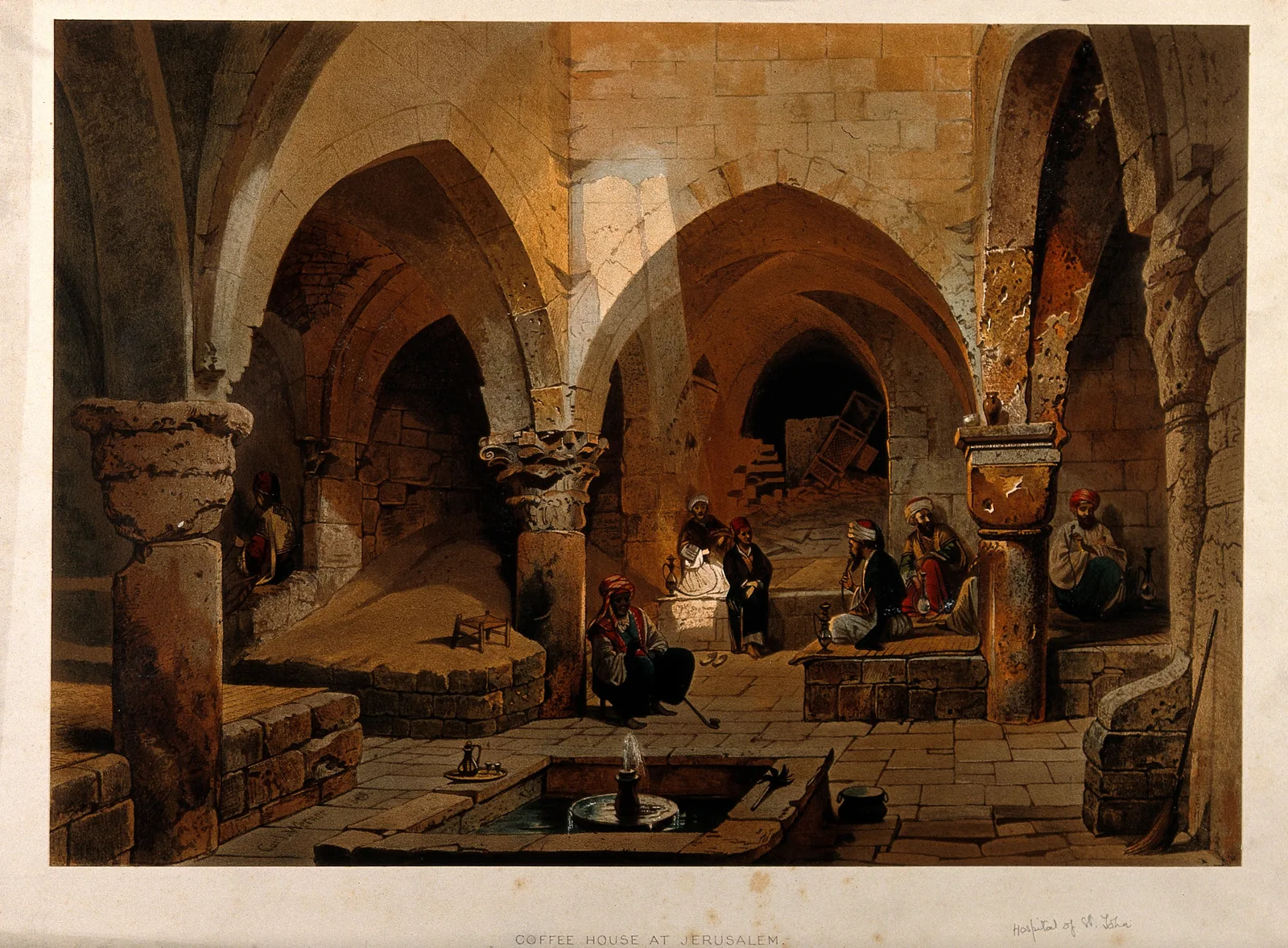
- 01The Arab ceremony: the coffee room and its gesturesThe Arab house of the 19th-century travelers is built around the kahwah, that is, the coffee room.
- 02The Bedouin circle, the four sips, the rule of waterAmong Doughty's nomads, coffee orients the tent itself.
- 03Turkish coffee: the room, the price, the etiquetteThe sumptuous caffinet of the romantic travelers no longer existed in 1922, and Ukers even doubts it ever did.
- 04Ramadan, Karagöz and the coffee calendarCoffee is a matter of hours. Stamboul, outside Ramadan, is deserted at night, and it is just after twilight that the coffeehouses are at their best.
- 05Damascus, Cairo, Algiers: water, smoke and the storytellerThe most precise text Ukers reproduces was written in 1836, to accompany a plate by Bartlett and Purser.
- 06Venice: the first caffè of Europe and the square as a salonIn Europe, coffee was first sold by lemonade sellers.
- 07Vienna: the blend, the newspaper and the word for orderingLegend · during the siege of 1683, Franz Georg Kolschitzky, a Pole who had lived among the Turks, crosses the enemy lines on August 13 in Turkish uniform.
- 08Paris: from Procope to the boulevard, and the waiter's vocabularyBefore Procope there were Turkish-style coffeehouses, of low standing, where people of condition did not want to be seen.
- 09London: the penny university, and what replaced itThe London coffeehouse of the 17th century had a tariff and a set of rules.
- 10Berlin, Saxony and the KaffeeklatschGermany invented the social function of the afternoon called Kaffeeklatsch, and Ukers describes its popular Sunday version: the family walks to a suburban garden where coffee is sold by the pot.
- 11Amsterdam and Athens: the glass of water and the kaimakiThe United Provinces adopted the coffeehouse without ever persecuting it, and the first opens at the Korten Voorhout, in The Hague.
- 12The North and the East: copper kettles, lemon and flambéed cognacIn Norway, the boiling method prevails, that is, the grounds are boiled in the water instead of the water being passed through them.
- 13Italy, Spain, Portugal, BelgiumThe Italy of 1922 is not yet the country of espresso.
- 14The United States: Prohibition, the coffee room and the free cupIn the colonies, beer and cider first gave way to tea, then tea to coffee.
- 15New Orleans, Brazil, Cuba, Mexico, AustraliaThe Creole coffee of New Orleans, also called French market coffee, is not a drink but a concentrated extract.
- 16Coffee in painting, engraving and caricatureTo describe how coffee was drunk in the 17th and 18th centuries, Ukers has almost nothing but images.
- 17Coffee in music and literatureThe centerpiece is Bach's Coffee Cantata, number 211 of the secular cantatas, published in Leipzig in 1732 under the title Schweigt stille, plaudert nicht, “be silent, do not chatter,” on a text by Picander.
- 18Silverwork, porcelain and the furniture of serviceThe European coffeepot has an origin and a date of rupture.
- 19How a custom is made: taste is a habitUkers himself poses the problem without resolving it.
- 20What has changed since 1922The geography of consumption has shifted north.
- 21Archive platesEngravings and photographs from William Ukers's All About Coffee (1922), which has entered the public domain.
Elsewhere on the site, the passages that deal with the same things as this page. Computed from the text, not picked by hand.