Sorting, from flotation to the optical sorter
After drying.
Three properties, four machines
Start the scene or choose a stage. The animation simplifies the mechanism; what follows gives the details and the available references.
At reception, the cherries drop into water. A ripe, full cherry is denser than water and sinks; one that the broca, a small beetle, has emptied, one that has dried on the tree or whose bean did not form, contains air and floats. This is Archimedes' buoyancy, not a ripeness test: a green fruit is dense, it sinks with the good ones.
Read the stages without animation
- Density: what floats, what sinksAt reception, the cherries drop into water. A ripe, full cherry is denser than water and sinks; one that the broca, a small beetle, has emptied, one that has dried on the tree or whose bean did not form, contains air and floats. This is Archimedes' buoyancy, not a ripeness test: a green fruit is dense, it sinks with the good ones.
- Size: plates with round holesAfter drying and hulling, the green bean passes over perforated plates. Each retains what is wider than its holes; one number equals one sixty-fourth of an inch. Screen grading does not judge quality: it makes the lot uniform, so that a small bean does not burn before the large ones in roasting.
- Density again: the tableA gravity table takes up density again, on the dry bean this time: a perforated deck, inclined and vibrating, with air passing through from below. The bed of beans fluidizes; the dense beans touch the sheet and climb the slope, the light ones float on the air cushion and slide back down. No published trial measures its efficiency on coffee.
- Color: a camera, a jet of airThe beans stream past a camera in free fall, in the visible or near infrared. The one whose reflected light falls outside the accepted range is ejected by a jet of air. What the surface does not betray, no color sorter sees.
- What no stage seesEach stage measures only one property and stays blind to the others. The potato defect, a molecule with an earthy smell, can be read neither on the scale nor in the color: the affected bean passes everything and ends up accepted. The quaker, an immature bean that stays pale, only reveals itself after roasting. Sorting does not make up for non-selective picking.
To remember: flotation and the table sort by density, the screen by size, the camera by color; none judges cup quality on its own.
Read the full article and its sources ↓
Where it is practiced
Sorting belongs to no country. It frames all the processes, everywhere, and it exists in one form or another in every beneficiadero and every hulling plant. The sources that quantify it, however, are concentrated.
Flotation at reception is documented in Colombia by Cenicafé, in Chinchiná. Four devices were evaluated and quantified there:
- the tanque sifón, a tank where the water leaves through a siphon;
- the semi-submerged channel;
- a pneumatic classifier, which separates by air current and not by water;
- a hydraulic separator with a hopper and an auger.
This work spans 1987 to 2009.
Screen grading is documented in Colombia, where screens 12 to 17 serve as the commercial basis, and in Ethiopia, where the national standard is based on screen 14. Optical sorting and spectral reading are the subject of laboratory trials published in Colombia and China between 2011 and 2026.
A word about the family. The sheet is classified among the post-drying ones, because screen grading, the gravity table and optical sorting come in once the coffee is dry. But the first stage, flotation, takes place at reception of the cherries, before pulping. Sorting is therefore a chain that begins before the process and closes after it.
The principle
Sorting does not judge quality. It measures three physical properties, and only three: density, size, surface appearance. Each stage of the chain acts on only one of these properties and stays blind to the other two.
Density first. A ripe, well-filled cherry is denser than water. The small beetle that bores into the fruit is called the broca. A cherry it has emptied contains air, so it floats. The cherry dried on the tree and the one whose bean did not form also float. Water, at about 1,000 kg per cubic meter, serves as the threshold. It is a simple Archimedean buoyancy, not a ripeness test. Cenicafé says so bluntly: density classification does not eliminate immature fruit. A green fruit is dense and full, it sinks.
Size next. A sieve with round holes retains what is wider than its opening. A sieve number equals one sixty-fourth of an inch: screen 17 therefore corresponds to 17/64 of an inch. Screen grading says nothing about the quality of the bean. It produces uniformity, which matters in roasting, where a small bean mixed with large ones burns before them.
Appearance last. A camera lights the bean, measures the reflected light, and a jet of air ejects what falls outside an accepted color range. The sensor can work in the visible or in the near infrared, which reaches chemical bonds rather than pigments. What the surface does not betray, no color sorter sees.
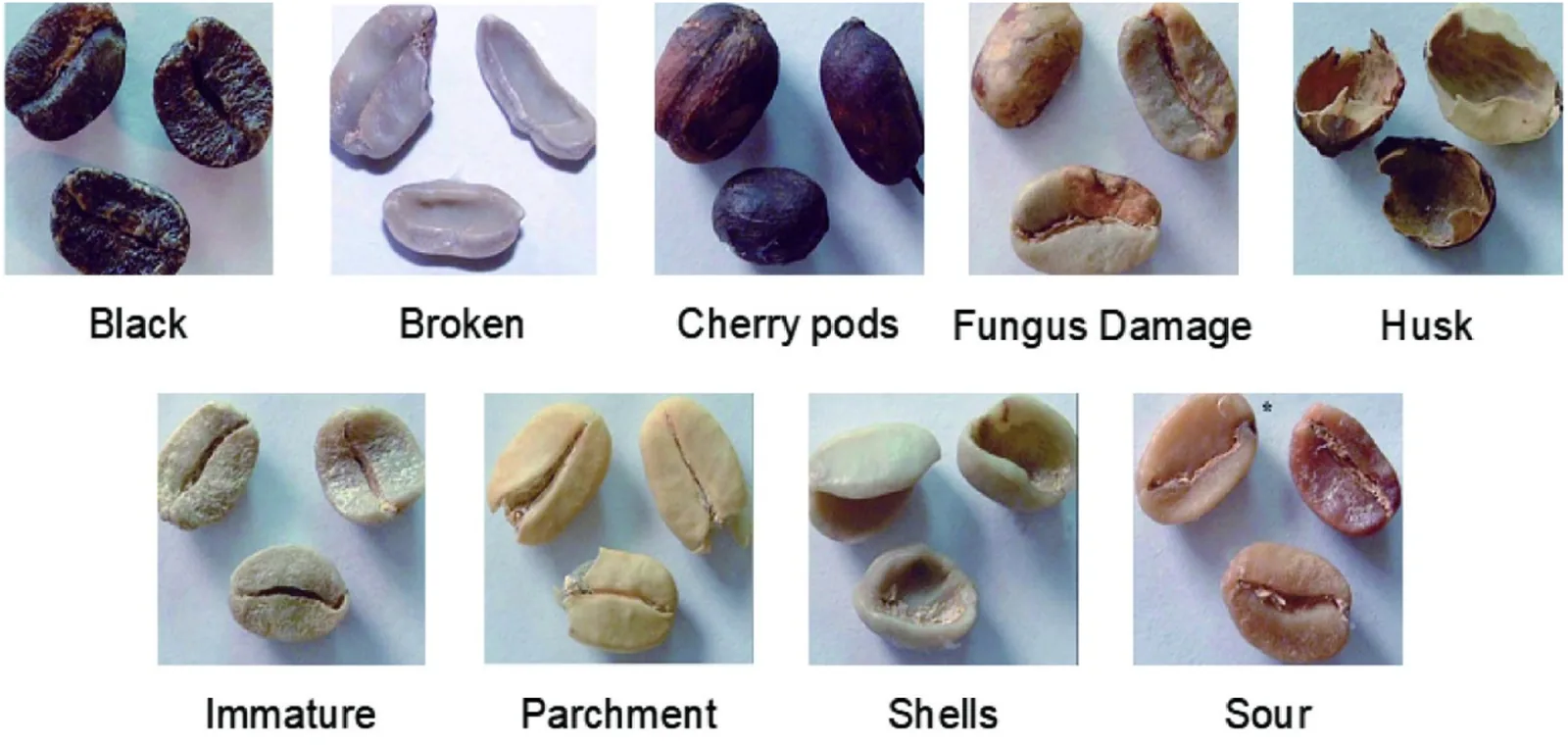
These three properties are correlated with defects, without being the same thing. The correspondence is statistical, never exact. A principal component analysis links earthy and fermented sensory defects to visible physical defects: beans bitten by the bark beetle, black and sour beans (brocado and vinagre, in Spanish). But a defect lodged in the chemistry of the bean, with no surface mark or density difference, passes through all three stages.
The sequence
- Reception and flotation. The cherries fall into a volume of water, the floaters are skimmed off. The tanque sifón was evaluated in Colombia, with a level difference of 0.70 m and a 114 mm tube. It separates 88.9% of floaters and 49.3% of hard objects. It uses 4.7 L of water per kilogram of dry parchment coffee. Its optimal water-to-fruit ratio is 0.94 L/kg, for a maximum capacity of 6.1 tonnes of fruit per hour.
- Measured variants of this same step. The semi-submerged channel separates 100% of floaters and hard objects, but uses 6.5 L/kg of dry coffee. A pneumatic classifier was tested with a 0.8 m column and an average air speed of 14.9 m/s. It separates 61.0% of floaters and 100% of hard objects, at 326.1 kg of cherries per hour. Cenicafé's hydraulic separator with hopper and auger separates 96.7% of floaters on average. The minimum observed is 91%, the maximum 98.8%. It also removes 88.2% of hard objects on average, with a minimum observed of 52.5%. Set at 60 degrees of elevation and 200 to 300 revolutions per minute, it uses less than 0.01 L of water per kilogram of cherry. It processes up to 1,000 kg of fruit per hour with less than 80 L of water.
- What flotation actually removes. In the Colombian trials, the floaters combine four categories. Fruit attacked by the broca. Fruit poorly filled during its development. Dried fruit. Fruit hit by mancha de hierro or mal rosado, two diseases of the coffee tree. The hard objects targeted are defined physically: compressive strength above 50 MPa, Mohs hardness above 3, density above 2.5 g/cm3. These are what break the pulpers.
- Screen grading of pulped coffee, in the traditional process. A circular bar sieve (zaranda, in Spanish), average spacing 8.38 mm, separates the beans before fermentation. Cenicafé describes what it removes and what it misses. It removes many immature beans, dried fruit and pieces of pulp. But it sends large defective beans along with the good coffee, and small immature beans too. A sieve measures only size.
- Density classification during washing. Canal de correteo, semi-submerged channel or tanque sifón: the heavy bean settles, the light bean leaves with the water. This step has a measured cost: it also removes sound coffee, which ends up in the second-quality product and lowers the first-quality yield.
- Drying to 10 to 12% moisture, water activity below 0.62. This is not a sorting step, but it is the condition that makes the following sorts useful. Water activity measures free water, the water a fungus can use. Cenicafé gives two distinct thresholds. The initial growth of the fungus starts at a water activity of 0.76, or 14.2% moisture on green bean. Ochratoxin A production requires more, a minimum water activity between 0.83 and 0.87. It is to the growth of the fungus, and not to the toxin, that Cenicafé ties the threshold of 13% moisture on a wet basis.
- Screen grading of dry parchment before hulling. In the ecological process evaluated by Cenicafé, a flat sieve with a 4.4 mm opening precedes hulling (trilla, in Spanish).
- Hulling, then particle size analysis of the green bean, on a perforated plate with round holes. On a Colombian lot sorted by hand, screen 17 retains 73.32% of the weight and screen 16 retains 16.96%. Screens 15, 14 and 12 share 6.83%, 2.33% and 0.50%. On the same unsorted coffee, screen 17 falls to 67.32%. Coffee retained on screen 17 corresponds to the Colombian Supremo. In Ethiopia, more than 85% of the lot must exceed screen 14 to meet the national standard.
- Gravity table. A perforated deck, inclined and vibrating, with an air flow passing through it from bottom to top. The bed of beans fluidizes and stratifies. The dense beans touch the sheet and climb the slope, pushed by the oscillation. The light beans float on the air cushion and slide back down. This is the principle of a fluidized bed. No published trial measuring its efficiency on coffee was found in this research: see GRAY AREA.
- Optical sorting. The beans stream past in free fall or on a belt, lit, observed by a camera, then ejected by a jet of air. The published performances are laboratory performances, obtained on image sets. A detection model reaches 99.2% mAP@50 on seven categories of defects from the SCA reference, with a latency of 2.0 ms per image. Another classifies three grades and nine sub-levels of defect, at 96.34% on its own image set.
- Spectral reading, which is something else. The Colombian trial published in 2026 works from 400 to 2,498 nm. It measures 110 g of coffee poured into a reflection cell. It therefore classifies a lot, not a bean. The four classes take up the four Colombian groups of sensory defects. The overfermented. The harsh. The earthy. The contaminated. Success is 93.5% on dry parchment coffee, with a kappa of 0.90. The kappa measures agreement beyond what chance would give. On green coffee, success falls back to 82.4% and the kappa to 0.55. The green matrix is harder to read.
- Fluorescence sorting. The principle is to illuminate the bean in the ultraviolet and read the light it re-emits. On corn, a published trial shows that kernel-by-kernel sorting on yellow-green fluorescence separates the kernels well according to their aflatoxin content. This trial gives no quantified reduction rate. On coffee, nothing was found: see GRAY AREA.
- Final hand sorting, and sometimes sorting after roasting. It is the only stage that sees the quaker, the immature bean that does not caramelize and stays pale once roasted.
What it gives in the cup
What is measured concerns the physical quality of the lot, not the score in the cup. This must be said clearly, because the trade often makes the leap.
On a Colombian lot, sorting the mass by hand before wet processing (beneficio, in Spanish) brings the proportion of defective beans, the pasillas, from 9.19% to 5.41%. On the same basis, the weight of green bean obtained after hulling rises from 185.39 g to 194.08 g. The share retained on screen 17 goes from 67.32% to 73.32%. The Colombian average for sound beans stands at 74%. The national yield factor is 94 kg of dry parchment for 70 kg of excelso, the Colombian export grade of screen 15 and above. The rest divides into 18.7 kg of cisco, the skin of the parchment, and 5.3 kg of defective beans.
The ecological process adds mechanical demucilaging and density classification. Compared with the traditional process, it halves the proportion of pasillas. It reduces first-group defects by 82% in first-quality coffee, and by 84% in second-quality coffee.
On the cup itself, three measurements exist, and they are indirect.
- Immature fruit degrades the cup from 2.5% of the harvested mass, a threshold established by Cenicafé. It is this threshold that forces selective picking, and that makes harvesting so costly in labor.
- Quakers have a counted threshold. Seven quaker beans in a cup of 65 beans are enough to degrade the sensory profile of a specialty natural coffee. The beans concerned are those whose color after roasting reaches or exceeds 82.8 on the Agtron scale, where a high number designates a light roast. The trial was set up to test the rule of the Specialty Coffee Association, which requires the total absence of quakers in a specialty lot.
- Defective beans, black ones in particular, are associated with the acrid and harsh descriptors. These two terms are defined by the Colombian standard NTC 2758. Acrid there is a bitter, astringent and heavy sensation. Harsh there is a rasping tactile sensation.
What is claimed with no proof read. The trade pays more for large screen sizes, and sometimes presents the screen as an index of cup quality. An Ethiopian study does find that bean size contributes to the variation in quality, with a weight of 0.46 on the second axis of a principal component analysis. That does not isolate a cause-and-effect relationship. No blind trial comparing the same lot graded at screen 17 and at screen 15 has been read here. Screen grading is justified by roasting uniformity, which the same study states in so many words. It is a technical argument, not a demonstrated taste superiority.
What goes wrong
The first risk of sorting is sorting itself. The density classification devices used in washing remove sound coffee along with the light coffee. This sound coffee tips into the pasillas, the second-quality product, and the first-quality yield drops by as much. No one measures this false positive day to day.
The second risk is the blind spot of flotation. A green fruit is dense: it sinks. Flotation therefore does not sort for ripeness. Yet green fruit weighs heavily in the harvested mass. A Colombian characterization measures green fruit by harvest period: 11.37% at the start, 7.35% in the middle, 9.61% at the end. The standard of the National Federation of Coffee Growers sets the maximum at 2%. Another evaluation, on the main harvest, measures 27% of green fruit and pintons (in Spanish, the fruit that is turning, between green and ripe). Dried fruit is measured from 3.47% to 6.40%, for a standard of 2%. Fruit attacked by the broca ranges from 4.84% to 6.93%, for a standard of 5%. Sorting does not make up for non-selective picking.
The third risk is what no stage sees.
- The potato defect, which affects East Africa, can be read neither on the scale nor in the color. It comes down to methoxypyrazines, molecules with an earthy, raw-vegetable smell. The main one is IPMP. Its concentration ranges from 1.6 to 529.9 ng/g in defective samples, against 2.0 ng/g on average in healthy coffee. It is a chemical marker, measured in the laboratory, and not a sign that a sorting machine can spot: see GRAY AREA.
- Sensory defects are graded in the cup, not on the bean. The NTC 2758 standard defines the stinker by a strong smell of putrefied organic matter, never by an appearance. No optical threshold therefore corresponds to this defect.
- Internal damage with no surface mark passes the color sorter by construction, since a camera in the visible reads only the surface.
- Ochratoxin A that has already formed is not destroyed by sorting, since it is inside the bean. Sorting can only lower the lot's content by setting aside the affected beans. This path is quantified on other grains, not on coffee: see GRAY AREA.
The fourth risk is the defect manufactured downstream of the field. The official Colombian list comes from Resolution No. 2 of the National Committee of Coffee Growers, of April 25, 2016, which sorts green coffee defects into two groups. The names tell where each defect comes from.
- Mordido, cortado: bean damaged at pulping, which develops brown or black spots.
- Aplastado: bean flattened and partly fractured by undue pressure during drying or during hulling of a still-moist coffee.
- Cristalizado, sobresecado: light gray, brittle bean, produced by drying temperatures that are too high.
- Flojo: dark gray, soft bean, incomplete drying.
- Cardenillo: yellow-orange fungus spots, interrupted drying or storage of moist coffee.
- Decolorado veteado: white veins, due to rewetting.
- Decolorado reposado: bean turned yellow by long or poorly managed storage.
- Negro and vinagre: overfermentation, collection of dried cherries, incorrect washing.
- Ámbar or mantequillo: translucent yellow bean, deficient nutrition in the field.
- Averanado, arrugado: wrinkled, light bean, drought or deficient nutrition.
- Picado por insectos: small holes left by the broca or by the weevil.
- Inmaduro: small bean entirely covered with its silverskin, harvested before complete formation.
The fifth risk is excess confidence in instrumental sorting. On parchment coffee, spectral classification of sensory defects reaches 93.5%, with a kappa of 0.90. On green coffee, it falls to 82.4% and the kappa to 0.55. The green bean is a more complex matrix, and water dominates the signal around 1,900 nm. Above all, this measurement concerns 110 g poured into a reflection cell. It does not concern a bean ejected on the fly. It therefore says nothing about what an in-line sorting machine is worth.
Finally, the hard objects that are not removed break the pulpers. It is a mechanical risk, but it ends up as a defect: a damaged pulper bites the beans.
Benchmarks
- Flotation, tanque sifón88.9% of floaters, 49.3% of hard objects, 4.7 L of water per kg of dry parchment
- Flotation, Cenicafé screw separator96.7% of floaters on average, less than 0.01 L of water per kg of cherry
- Green fruit in the harvested mass7.35 to 11.37% measured, standard of 2%
- Screen gradinga sieve number equals 1/64 inch, and screen 17 defines the Colombian Supremo
- Ethiopian screen-size standardmore than 85% of the lot above screen 14
- Quaker nuisance threshold7 beans out of 65 in the cup, from Agtron 82.8
- Potato defectIPMP from 1.6 to 529.9 ng/g against 2.0 ng/g in healthy coffee, and nothing visible
- Drying10 to 12% moisture and water activity below 0.62, against 0.76 for the onset of molds