Lactic fermentation
Directed fermentations.
What does a lactic fermentation change?
Start the scene or choose a stage. The animation simplifies the mechanism; what follows gives the details and the available references.
Every coffee fermentation is already lactic in part; the process changes the relative share of the lactic acid bacteria. They draw their energy from fermentation alone. Acetic bacteria, those of vinegar, need oxygen to oxidize alcohol. Closing the tank therefore does not feed the lactic ones: it starves the acetic ones. Nobody purges the tank, the oxygen is consumed.
Read the stages without animation
- Closing starves the acetic onesEvery coffee fermentation is already lactic in part; the process changes the relative share of the lactic acid bacteria. They draw their energy from fermentation alone. Acetic bacteria, those of vinegar, need oxygen to oxidize alcohol. Closing the tank therefore does not feed the lactic ones: it starves the acetic ones. Nobody purges the tank, the oxygen is consumed.
- Submerge, or notIn the trial on the Arara cultivar, bioreactors of 200 liters each receive about 124 kg of cherries; the submerged variant adds 60 liters of water, 30% of the volume. Submerged, Lactobacillus reaches 80.9% of the bacteria; with no added water, 67.4%, with Weissella occupying 21.9%.
- Hold 27 °C, sometimes inoculateA chamber held at 27 °C raised the relative abundance of Lactobacillus by 10.8%. The closed tank warms little by itself, by 0.5 to 3.7 °C, whereas the open tank gains 5.1 to 17.6 °C. When one inoculates, it is to impose a dominant population from the start.
- The pH drops and keeps orderThe pH goes from 5.8 to 4.4 in a closed Brazilian tank: the enterobacteria at the start cannot bear this acidity and recede. The heterofermentative lactics yield lactic acid, carbon dioxide and ethanol or acetic acid. Cenicafé places the tipping point at 72 hours: beyond it, the viability of the embryo and the physical quality of the bean decline.
- Wash, dry, restThe lot is washed then dried to 11 or 12% moisture; in the Arara trial, hulling takes place only after 30 days of rest at room temperature.
To remember: Lactic is an orientation, not a category: closing the tank removes an advantage from the acetic bacteria, without guaranteeing a lactic flora.
Read the full article and its sources ↓Where it is practiced
Two things that bear the same name must be told apart. Lactic fermentation as a phenomenon is universal. Lactic acid bacteria appear in almost every published microbiological survey of coffee. The process called lactic, for its part, is a deliberate, recent practice, confined to specialty microlots.
The published work is concentrated on a few sites.
- Colombia, with Cenicafé, the national coffee research center, on arabica var. Castillo harvested at the Naranjal experimental station, in Caldas, at 1,381 meters.
- Brazil, in two distinct places: the Federal University of Lavras, on canephora Conilon, and the Federal University of Uberlândia, on arabica cv. Arara, at the Chuá farm in Minas Gerais, at 1,050 meters.
- Ecuador, where De Bruyn and colleagues sampled a plantation near Nanegal, at 1,329 meters, from May to July 2014.
- Yunnan in China, where Zhang and colleagues followed concrete tanks near Jinghong, at 1,300 meters, from December 2015 to January 2016.
The dating is checked on the laboratory side, not the trade side. The first scientific article on coffee to use the term self-induced anaerobic fermentation appeared online in December 2021, in Food Microbiology. Published trials of lactic acid bacteria inoculation on coffee then follow without interruption: Cassimiro in 2023, Rabelo in 2024, Shen in 2025. The word lactic circulated on bags before that, without it being possible to fix its first occurrence.
The principle
Every coffee fermentation is already lactic in part. What the process changes is not the presence of lactic acid bacteria, it is their relative share. There is therefore no threshold that would tip a lot into the category: there is a slider.
These bacteria eat the sugars of the mucilage, the layer of sugary flesh stuck to the parchment. Two metabolic pathways exist, and they do not yield the same thing.
The homofermentative ones follow ordinary glycolysis, called the Embden-Meyerhof-Parnas pathway. They yield almost only lactic acid, about two molecules per molecule of glucose. The heterofermentative ones take the phosphoketolase pathway, named after the enzyme that cleaves the sugar into two fragments. This pathway yields, per molecule of glucose, one molecule of lactic acid, one of carbon dioxide, and one of ethanol or acetic acid. It therefore explains why a so-called lactic tank gives off gas and smells of alcohol. The heterofermentative genera most often recorded in coffee are Leuconostoc, Weissella and Lactiplantibacillus. At Cenicafé, it is Weissella that dominates, followed by Leuconostoc and Lactiplantibacillus. When fructose is available, these bacteria reduce it to mannitol, a sugar alcohol. They use it as an electron acceptor, to balance their redox budget.
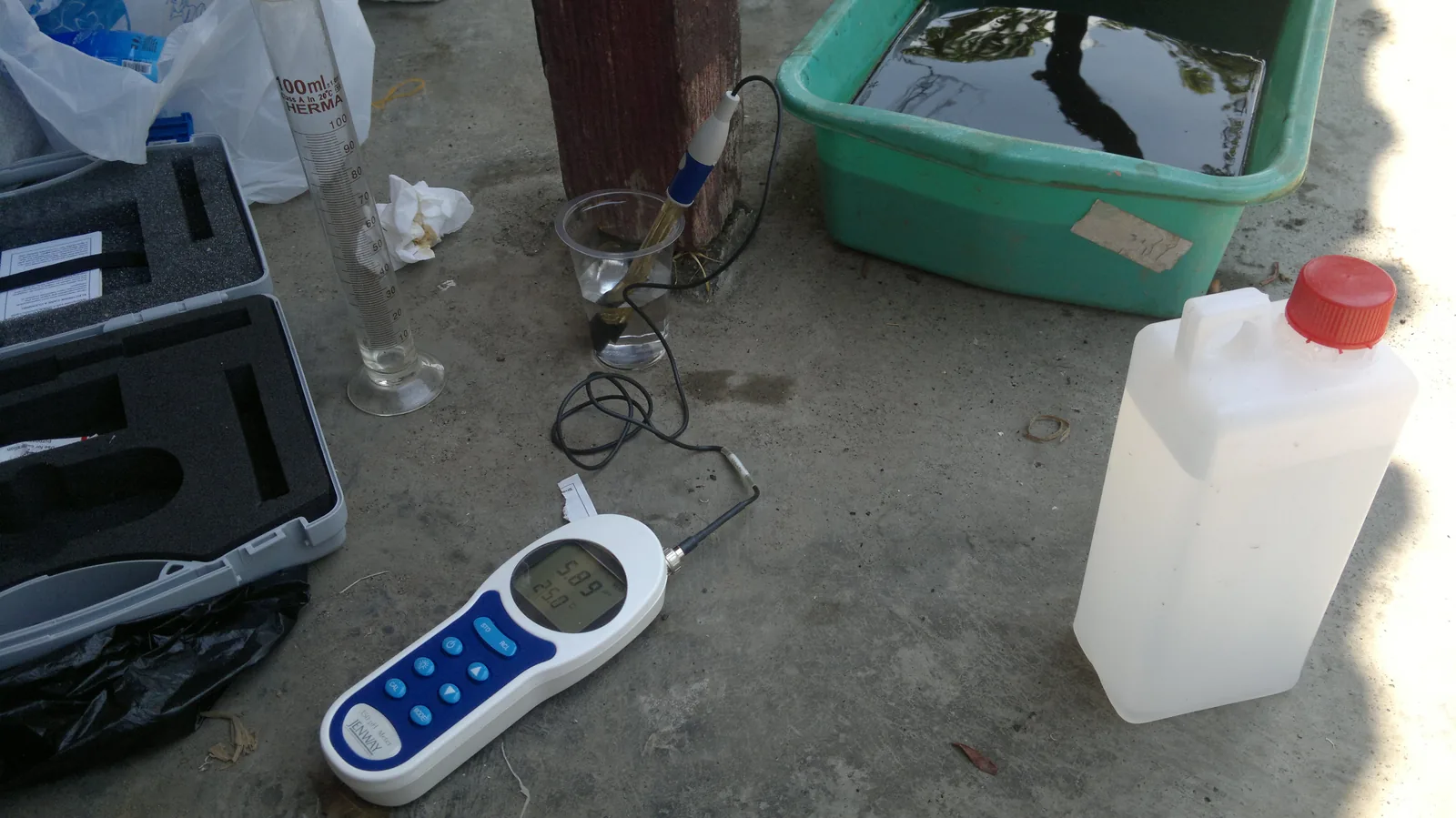
Acidification is the second effect, and it is what protects the lot. In a closed Brazilian tank followed layer by layer, the pH went from 5.8 to 4.4. The enterobacteria that dominate the starting flora cannot bear this acidity and recede. Acidification is thus both the product of fermentation and its enforcer.
What remains is the lever of management, and it does not act on the lactic bacteria. It acts on their competitors. Lactic acid bacteria draw their energy from fermentation alone and do without oxygen. Acetic bacteria need it: they oxidize alcohol into acetic acid, that of vinegar, and this oxidation consumes oxygen. Closing the tank therefore does not feed the lactic bacteria, it starves the acetic ones.
This lever is not reliable for all that, and it must be said. In the closed Brazilian tank cited above, it was the enterobacteria that dominated, and the lactic bacteria remained a minority. Closing a tank does not guarantee a lactic flora, it merely removes an advantage from the acetic bacteria.
The sequence
- Harvest of ripe cherries and sorting. Ripeness sets the available sugar and the starting pH, and therefore the speed at which acidification will set in.
- Choice of material: whole cherry or pulped coffee. Cenicafé compared the two over 192 hours. Whole cherry gives more glucose and less lactic acid than pulped coffee. The authors attribute the surplus of glucose to the complex carbohydrates of the pulp, which add a source of carbon. They attribute the deficit of lactic acid to a better balance between acetic and lactic bacteria in an open tank.
- Loading into a closed tank fitted with an airlock. The Uberlândia trial on cv. Arara used high-density polyethylene bioreactors of 200 liters, loaded with about 124 kilos of cherries. The lids carried a one-way valve, which lets carbon dioxide out without letting air in.
- Submerged variant: addition of 60 liters of water, or 30 percent by volume. The water evens out the temperature and slows gas exchange. In this trial, the submerged route brought the genus Lactobacillus to 80.9 percent of the bacterial community. In a solid medium, that is, with no added water, it did not exceed 67.4 percent, with Weissella then occupying 21.9 percent.
- Setting anoxia. Nobody purges the tank: the oxygen present is consumed by the microorganisms themselves, and the headspace of the tank saturates with carbon dioxide. The medium becomes anoxic by exhaustion, not by driving the air out. The term anaerobic is therefore improper in the strict sense, and the literature speaks of self-induced anaerobic fermentation.
- Thermal management. In the Arara trial, a chamber regulated at 27 degrees raised the relative abundance of Lactobacillus by 10.8 percent, compared with tanks left in the shade without regulation. The closed tank warms little by itself. At Cenicafé, with an ambient temperature held at 20.1 degrees, it gained only 0.5 to 3.7 degrees. The open tank, for its part, gained from 5.1 to 17.6 degrees.
- Inoculation, when it takes place. In Cassimiro's work, Leuconostoc mesenteroides was already present in the cherries at 8.54 log10 cells per milliliter, and stayed there to the end. The aim of inoculation is to short-circuit competition by imposing a dominant population from the start.
- Duration. Published trials on closed tanks run around 24 to 72 hours. Cenicafé went as far as 192 hours and places the tipping point at 72 hours. Beyond it, the physical quality of the bean and the viability of the embryo decline, whatever the management.
- Monitoring. The pH is measured continuously. Cenicafé measures the glucose and lactic acid of the mucilage with Reflectoquant reflectometric strips, other teams by liquid chromatography. The point of monitoring is to see early whether acidification is setting in, because a tank that does not acidify has drifted toward another flora.
- Washing, then drying to 11 or 12 percent moisture. In the Arara trial, hulling took place only after 30 days of rest at room temperature.
What it gives in the cup
What is measured, first, and the picture is not unambiguous.
Cassimiro and colleagues inoculated Leuconostoc mesenteroides on canephora Conilon in a closed tank. This lot is classed fine, that is, between 80.0 and 89.0 points, while the other treatments stay in premium, between 70.0 and 79.0. The descriptors recorded are caramel, fruit and spices. It is the clearest positive result available on lactic inoculation. It concerns canephora, however, not arabica.
Cenicafé provides the counterweight, and it is severe. On arabica, comparing open and closed tanks over 192 hours, sensory quality did not move. It varies neither with the raw material, nor with the fermentation condition, nor with the duration. The p values are 0.6669, 0.5740 and 0.3338 respectively. The mean stands at 83.14 SCA points, with a standard deviation of 0.39, and all the samples fall between 80.75 and 85.00. In other words, the study that measured lactic acid production most finely found no corresponding difference in the cup.
The trial on cv. Arara built a decision tree linking microbial composition and sensory score, with 96.43 percent accuracy. The discriminating genus is not the one you would expect: it is Leuconostoc, above 2.6 percent relative abundance. Only when Leuconostoc is rare does the dominance of Lactobacillus become decisive, from 88.73 percent. The rule remains soft on that side: above the threshold, the association with a good cup is only 67 percent. This is moreover a correlation from a statistical model, not a causal demonstration.
A Colombian trial on var. Castillo shows a clear sensory improvement after inoculation, but it does not allow it to be attributed to the microorganisms. The starter poured into the tank also contained wheat flour, brown sugar and 30 kilos of crushed pineapple. The authors moreover note that the inoculum did not colonize the tank, and attribute the difference to the nutrients supplied.
What is claimed, next. The commercial vocabulary of lactic is stable from one seller to another: yogurt, cream, butter, enveloping texture, sweetness. No published blind trial attributes these descriptors to lactic acid itself. The same gesture shifts dozens of other compounds, and nothing makes it possible to apportion them.
We must be clear about the missing link. De Bruyn and colleagues measured the metabolites by liquid chromatography coupled with mass spectrometry. The lactic acid, acetic acid and mannitol produced in the mucilage are found in the endosperm, that is, in the bean itself. In the dry process, the outer layers contain 1.0 to 2.1 percent lactic acid in dry matter. The migration is therefore established. On the other hand, no published study links a measured lactic acid content in the green bean to a cupping score. The chain stops before the cup.
What goes wrong
The central risk is duration, not the closing of the tank. At Cenicafé, embryo viability and the proportion of sound beans fall significantly with time, in all conditions. The starting lot showed 84.3 percent sound beans and 83.3 percent embryo viability. The authors' conclusion places the tipping point beyond 72 hours.
A widespread idea must be corrected here. One often reads that the lactic acid being sought would itself be what damages the seed. Cenicafé does report this link, but by citing earlier work, not as a result of its own. Its own data go the other way. The closed tank produced more lactic acid and better embryo viability than the open tank. It is in the open tank that the loss is greatest, and whole cherry in a closed tank is what is damaged least, up to 120 hours.
A green coffee bean remains a living seed, and this is what the tetrazolium test measures. In an open tank, the degradation of the embryo starts after 48 hours and falls to 25 percent at 192 hours. The resulting defect bears the usual names of the trade: fermented, over-fermented, stinker for an isolated bean that has turned putrid.
Whole cherry in an open tank is the most explicitly discouraged case. It is sometimes sold under the names double fermentation, pre-coffee cherry or fruit reserve. Cenicafé judges it inadvisable beyond 24 hours. The reason is twofold: physical quality degrades and embryo viability collapses.
The phenolic defect, that taste of medicine or plastic, did not appear just anywhere. At Cenicafé, a single sample in the whole trial shows it: whole cherry, open tank, 72 hours. In the Colombian trial on var. Castillo, it was perceived by the three certified tasters on the spontaneous fermentation. The authors associate it with high contents of phenol and aminophenol, specifying that this is the first published report linking these compounds to this defect.
Acetic drift lurks as soon as air gets in, since acetic bacteria work only in the presence of oxygen. A badly set airlock, a tank opened to take a sample or an incomplete filling are enough to hand them back control.
Tank heterogeneity is the least visible risk, because it produces not a defect but a blend. A Brazilian tank was loaded with 175 kilos of pulped coffee and 30 liters of water. Lactic acid was measured there at 5.06 grams per liter at the bottom, 4.70 in the middle and 2.18 at the top. The microbial composition did not vary from one layer to another: it is the metabolism that differs, not the flora. A lot managed this way is not one fermentation, it is the average of three.
Temperature adds its own drift in an open tank. At Cenicafé, whole cherry in an open tank exceeds 30 degrees from 48 hours and never comes back down. It reached 37 degrees at 48 hours. Everything then speeds up, with no way of regaining control.
Benchmarks
- Tank pH, measured in Brazil layer by layerfrom 5.8 at the start to 4.4 at the end
- Tipping point in duration72 hours, beyond it embryo viability and physical quality decline
- Whole cherry in an open tankdiscouraged beyond 24 hours, above 30 °C from 48 hours
- Sensory score at Cenicafé83.14 SCA points, standard deviation 0.39, no difference between treatments
- Regulation at 27 °C+10.8 percent relative abundance of Lactobacillus against unregulated ambient
- Gradient in a tank of 175 kg of pulped coffee5.06 g/L of lactic acid at the bottom, 2.18 g/L at the top
- Lactic acid in the outer layers in the dry process1.0 to 2.1% of dry matter