Shade and greenhouse drying
Drying.
Shade and greenhouse: same goal, different environments
Start the scene or choose a stage. The animation simplifies the mechanism; what follows gives the details and the available references.
“Shade drying” and “greenhouse drying” are used for one another. They have one point in common, which explains the confusion: no more rain or dew on the coffee. On temperature, they do the opposite of one another.
Read the stages without animation
- Two covers, one word“Shade drying” and “greenhouse drying” are used for one another. They have one point in common, which explains the confusion: no more rain or dew on the coffee. On temperature, they do the opposite of one another.
- Under the net: slower, coolerA net intercepts direct radiation: the surface of the bean cools, evaporation slows. The black honeys of Los Pirineos, in El Salvador, dry in this way for about twenty-five days. The only demonstrated effect of this slowness is to avoid case hardening, the crust that locks in the water of the core.
- Under the greenhouse: hotterThe polyethylene sheeting lets solar radiation in and holds back the infrared returned by the coffee: the air rises 5 to 15 °C above ambient. In Colombian drying greenhouses in service, 35 °C inside was recorded for 21 outside. Drying there takes 7 to 15 days, against 24 to 48 hours in a gas dryer.
- Open the sidesClosed, the greenhouse saturates with the vapor it draws from the coffee: it heats without drying, and a bare enclosure can exceed 64 °C. It is ventilated through side openings, a low opening of 70% giving a good effect, and one stays under 50 °C.
- At night, the sheeting dripsThe day’s vapor condenses on the cooled plastic and falls back in drops on the lot. In the cup, slowness has demonstrated nothing: 81.37 points in the slow zone, 80.93 in the fast zone. The cover brings sanitary quality first: 4.0% of infected beans in a tunnel on a 2 cm layer, 93.3% in full sun on 6.
To remember: What the cover brings that is measured is sanitary quality and regularity; what it brings in the cup is not demonstrated.
Read the full article and its sources ↓Where it is practiced
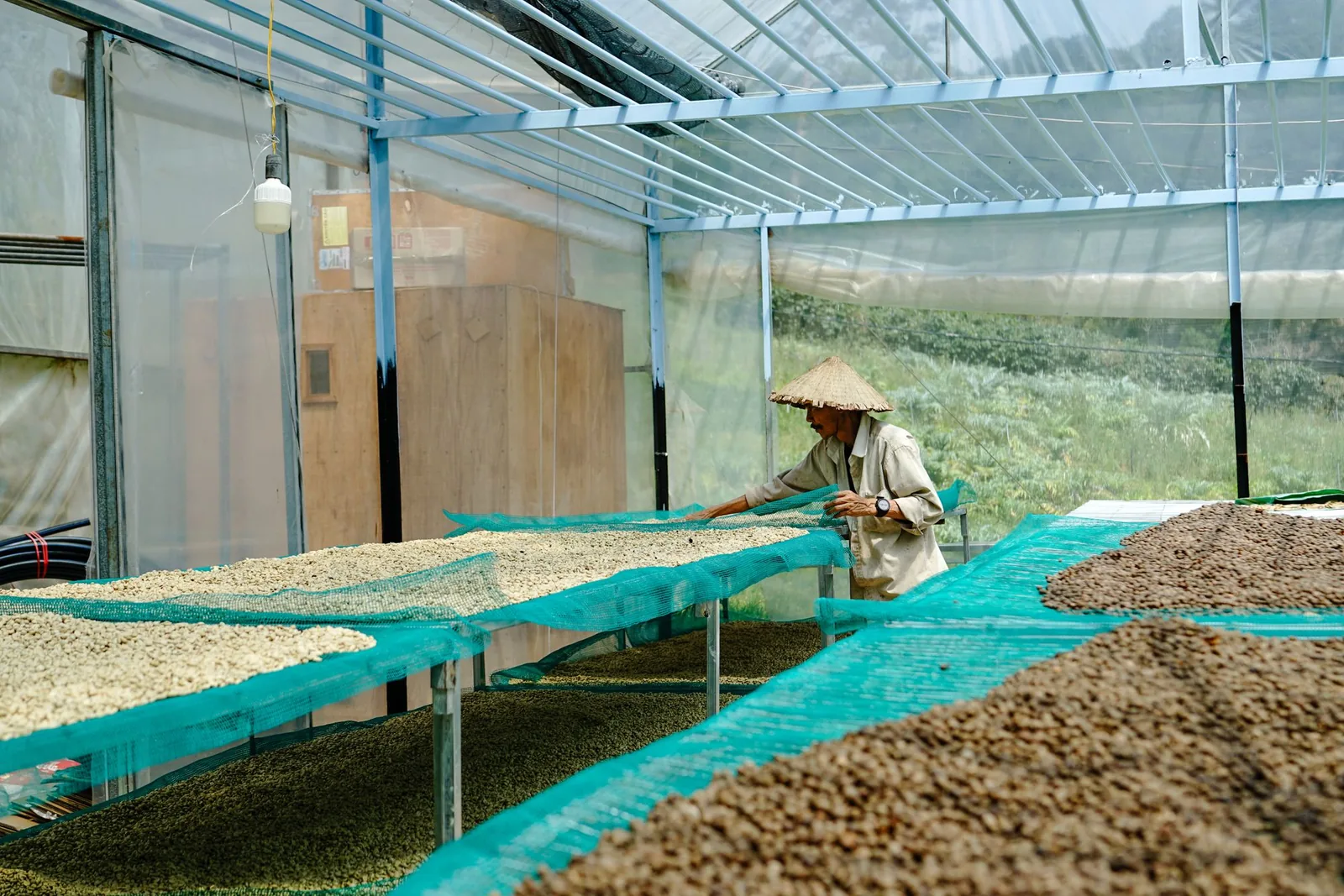
Colombia is the country where the device bears the most widely used name and where it has been studied the most. The marquesina there designates a structure covered with a plastic, under which the coffee dries on a raised platform. Cenicafé has been working for some forty years on plastic-covered dryers of this type, marquesinas, parabolic and tunnel types. Field measurements were carried out on marquesinas in service in the Catatumbo region, in Norte de Santander, and prefabricated modules are distributed around Manizales.
The word has traveled. It is found in Central America and in the Dominican Republic, with construction variants. Brazil speaks of a drying greenhouse and a covered drying area (estufa de secagem and terreiro coberto, in Portuguese).
Ethiopia supplied the most complete trial on a solar tunnel, at Jimma, on washed parchment coffee, comparing three zones of the tunnel with a full-sun control and three layer thicknesses.
Shade drying in the strict sense, that is, under a net or a shelter without greenhouse effect, is practiced mainly on mucilage lots at Central American micro-mills. The black honeys of Los Pirineos, in El Salvador, are described as dried for about twenty-five days in a thin layer on shaded raised beds. The honeys of Las Lajas, in Costa Rica, are driven by the drying management alone, shading included, with no demucilager setting.
Finally, one must say where it is not: this drying is a minority everywhere, there is no census of its share in the world harvest, and it is concentrated on specialty lots or on small farms in regions too rainy for a patio.
The principle
Two very different devices circulate under the same banner, and telling them apart is the whole point of this sheet.
The first is shade proper. A net, a cloth or a shelter intercepts direct solar radiation. The consequence is immediate and goes in one direction only: the surface temperature of the bean drops, the rate of evaporation drops with it, and the drying lengthens. One dries more slowly and cooler.
The second is the greenhouse, of which the marquesina, the parabolic dryer and the solar tunnel are the forms. A polyethylene sheet lets short-wavelength solar radiation through and holds back the long-wavelength infrared returned by the ground and by the coffee. The result is a greenhouse effect: the inside air heats up. The orders of magnitude reported by the literature on greenhouse solar drying give a rise of 5 to 15 degrees above ambient, and Colombian field measurements record on marquesinas in service an interior at 35 degrees for an exterior at 21. The same literature reports that a bare greenhouse enclosure, with no load and no ventilation, can exceed 64 degrees, and recommends keeping the maximum under 50 degrees so as not to harm the drying of the coffee. One therefore dries faster and hotter.
The two devices have a single point in common, and it is the one that makes them confused: they remove rain and dew. The coffee no longer takes up water at night, it is no longer rewetted in a shower, and one stops covering and uncovering. This is considerable progress over an open-air area, and it is enough to explain why the same word serves for two opposite things. But on the quantity that decides everything, the temperature of the air in contact with the bean, a marquesina is not a shade dryer: it is a low-temperature solar dryer, and it is almost always hotter than a well-ventilated patio.
There remains the underlying question, the one Marco poses between the lines: what does slowness bring.
The argument that circulates is simple and seductive. Slow drying would leave more time for the transformations that take place in the bean and, on mucilage lots, more time for the microorganisms that work the sugary layer. It would therefore produce a more complex and sweeter cup. This argument is everywhere in the green coffee trade.
Two mechanisms support it, and they do not have the same reach. The first is physical and solid: to dry slowly is to let the internal diffusion of water keep up with surface evaporation, hence to avoid case hardening, that hard crust that forms when the outside of the bean dries faster than its core and that traps the residual water. On this point, slowness does have an effect, and it is mechanical. The second is microbiological and holds only for the routes that keep mucilage: as long as water activity stays high, yeasts and bacteria work, producing acids, alcohol and esters. Lengthening the drying lengthens this window. But that mechanism is not an effect of shade, it is an effect of fermentation, and it does not concern a washed coffee, whose mucilage has already been removed.
The only published result that directly supports slowness moreover does not come from a shading trial. Borém and his collaborators, by crossing in 2018 three dry-bulb temperatures with three dew-point temperatures, showed that at 35 degrees beverage quality fell as the dew point fell, that is, as the air became drier and the drying faster. It is an argument for slowing down, and it concerns the dryness of the air more than its temperature.
What is missing, on the other hand, is a measurable mechanism by which slowness would build complexity in a bean of washed coffee. None of the sources consulted proposes one that goes beyond the avoidance of case hardening.
The sequence
The marquesina is the best described device, and field measurements published in 2026 give its real dimensions. Three structures in service at Bucarasica, in the Catatumbo, all measured 6 meters long and 2.8 meters wide, with a drying platform 0.45 meter above the ground. They differed only in the height of the cover above this platform: 0.93, 1.00 and 1.16 meter. The cover was polyethylene, a material to which the study attributes an overall heat transfer coefficient of 5 watts per square meter per degree. Prefabricated modules distributed around Manizales are given as 1.5 meters by 6, allowing a drying area of 9 square meters to be installed.
The result these measurements bring out is counterintuitive and deserves to be understood. The lower the cover, the more the structure retains heat, and the faster and more homogeneous the drying. The reason is geometric: at constant ground surface, a high cover has a larger exchange surface with the outside, hence more losses. The authors calculate the losses for the three heights and conclude that a height of 0.6 meter between the platform and the highest point would minimize thermal losses, immediately adding the practical constraint that prevents it from going lower: below that, the operator can no longer reach the coffee to stir it. The parabolic geometry is retained for the cover because it offers the smallest cover surface for the usable ground surface and distributes loads better.
Ventilation is the constraint that the sheeting imposes and that many installations neglect. A closed greenhouse accumulates the water vapor that comes out of the coffee, the interior relative humidity rises, and the humidity gap between the surface of the bean and the air, which is the engine of evaporation, collapses. A non-ventilated greenhouse dryer ends up ceasing to dry while remaining hot, which is the worst possible combination. The literature on solar dryers therefore places side openings along the structure, and advanced designs add fans; a low opening value of 70 percent is reported as giving a good ventilation effect inside.
Turning is carried out as elsewhere, except that the low cover makes it painful. The Colombian study proposes for this reason a mechanical rake 2 meters wide, with teeth of 0.15 meter spaced 0.05 apart, rolling on side rails: shorter and more regularly spaced teeth than an ordinary agricultural rake, precisely to reduce the risk of breaking the parchment.
The solar tunnel is run differently, because it is long and the air heats up and takes on moisture as it advances. The Ethiopian trial at Jimma showed it and drew from it a rule of practice that runs against intuition: the thinnest layer is put in the coolest zone, 4 centimeters, an intermediate layer of 5 centimeters in the middle zone, and the thickest layer, 6 centimeters, in the hottest zone. The logic is not to dry as well as possible everywhere but to equalize times between zones: the hot zone dries fast enough to absorb a thicker layer without lengthening the lot, and a tunnel in which all zones finish together empties in one go.
The durations recorded in this same trial must be read with care, because the article’s abstract and its body do not say the same thing. Drying was run from 9 hours to 17 hours, so that the published hours are cumulative and not calendar hours. At 2 centimeters of layer, it takes 14 hours in the hot zone, then 20.7 and 25.3 hours in the other two zones, and 32.7 hours in full sun. In full sun at 6 centimeters, it takes 47 hours.
The marquesina durations are given by the Colombian comparison of the three methods: 7 to 15 days under a marquesina, against 24 to 48 hours for a gas dryer, the solar patio being given as very dependent on climate and exposed to heterogeneous drying. Shade drying in the strict sense lengthens even more: the Salvadoran black honeys are described at about twenty-five days.
A last point of practice concerns the night and is described nowhere with precision. A cold sheet above a wet mass is a condensation surface. The vapor that leaves the coffee during the day condenses on the plastic when night falls, and it falls back in drops onto the coffee if the slope of the cover does not lead it to the sides. This is one of the reasons the parabolic or arched shape is preferred to a flat cover, and it is a reason that none of the sources consulted formulates explicitly.
Shade drying under a net, finally, calls for little description and much discipline. One dries on raised beds or on an area, under a shade net or a roof, in a thin layer, with turnings whose frequency varies enormously from one farm to another. The black honeys of Las Lajas are described as stirred very little, which deliberately prolongs the fermentation under the layer; other farms turn every hour on the first day. No technical sheet settles it, and no trial compares these two practices.
What it gives in the cup
What is measured is short and runs, for the most part, against the commercial argument. It must be reported as it stands.
The most directly relevant result comes from a Colombian study carried out in two zones of different annual solar brightness, on the Castillo variety, with an automatic system recording the variables inside the dryers and the mass loss, and an evaluation according to the Specialty Coffee Association protocol. The drying rates separate on either side of 0.52 percent per hour, and the drying time is significantly longer in the low-brightness zones. The mean scores obtained are 81.37 points for the less bright zone, hence the slowest, and 80.93 for the brighter, hence the fastest. The gap is 0.44 point, in the direction the trade expects, and it is far below the ordinary dispersion of a panel. In other words: slow drying did not do appreciably better. The same study notes an inverse linear relationship between the rewetting percentage and the moisture of the bean, which describes precisely the phenomenon of nighttime re-uptake.
The second result comes from the Ethiopian solar tunnel trial, which compared twelve treatments, three layer thicknesses crossed with three zones of the tunnel and a full-sun control. Total scores range from 84.3 to 87.3 on the Ethiopian scale, which combines 40 points of raw bean and 60 points of cup and is not a Specialty Coffee Association score. The important result is negative: the statistical analysis does not separate the treatments, either on the total score or on the cup score. A gap of three points therefore exists between the best and the worst, and it sits within the noise.
Sanitary quality, for its part, separates clearly in this same trial, and it is the real contribution of the cover. The final fungal load ranges from 4.0 to 93.3 percent of infected beans. The minimum, 4.0 percent, is reached in the tunnel, in the hot zone, on 2 centimeters of layer. The maximum, 93.3 percent, is reached in full sun on 6 centimeters. The open-air control is therefore far behind the tunnel on this criterion, and thickness governs sanitary quality far more than the score.
The third result is Borém’s, already cited, and it is the only one that frankly supports slowing down: at 35 degrees dry bulb, quality falls when the dew point falls, that is, when the air dries and the speed rises.
What is claimed, in opposition, comes down to one sentence repeated everywhere: slow drying would give more complexity, more sweetness and more length. No blind trial going in this direction was found for this sheet, nor for the neighboring sheets of this site. The only published head-to-head on whole devices, the 2025 Brazilian trial, even leans the other way: the dedicated dryer, hence fast, there beats the traditional solar route in two regions and one vintage. This is not enough to settle it, and it is enough to refuse the opposite claim.
The honest conclusion is therefore twofold, and it is not comfortable for the seller. What the cover brings that is measured is sanitary quality and regularity: it removes rain and dew, it divides the fungal load, it makes the lot more homogeneous. What it brings in the cup is not demonstrated, and the two trials that posed the question under controlled conditions find no significant difference. Slowness is a safety measure against case hardening, not an ingredient of complexity.
What goes wrong
The first risk is the paradox of the device: a greenhouse is the hottest of solar dryers. A non-ventilated enclosure under plastic can exceed 64 degrees, and the usage recommendation is to stay under 50. A producer who buys a marquesina believing they are buying gentleness can therefore, by closing the sides to protect against a cold wind, subject their coffee to temperatures that a patio would never have inflicted on it. This is the most frequent risk and the least often written.
The second is captive relative humidity. Coffee dries because the air is drier than its surface. A closed greenhouse saturates with the vapor it has itself drawn from the coffee, and the gap vanishes. The dryer then ceases to dry while remaining hot, that is, it goes from a dryer to an oven, and an oven at 40 degrees on a coffee at 30 percent moisture is the best incubator one can offer a mold. Ventilation is therefore not a design comfort, it is the condition for the device to do what it is bought for.
The third is nighttime condensation. The vapor that rises during the day condenses on the cooled plastic and falls back in drops. An almost dry lot that receives drops is not rewetted uniformly: it is rewetted in patches, and each patch is a restart point for fungi.
The fourth is the lengthening of the stay in the dangerous window, and it is the underlying risk of slow drying. Ochratoxin A is produced by a few Aspergillus whose growth and production play out in a water activity band of 0.80 to 0.95. The Codex holds that five days at most spent on the area in this band suffice to avoid accumulation. A drying under a marquesina that takes 7 to 15 days, a shade drying that takes 25, eat into this reserve. The cover compensates in part, since it removes rewettings; it does not compensate in full, and the Ethiopian trial shows well that the fungal load depends first on the thickness of the layer, hence on the local speed.
The fifth is heterogeneity along a tunnel. Temperature and relative humidity vary from one end to the other, which is why thickness is set zone by zone there. A tunnel run with a single thickness gives three different coffees in the same structure, which cannot be made up by blending.
The sixth is cost and bulk. A marquesina of 6 meters by 2.8 offers a drying area smaller than a farm patio, for an investment in structure, sheeting and upkeep. The sheeting is replaced, tears in the wind and ages under ultraviolet light, which adds a burden the patio does not have. None of the sources consulted publishes a cost per square meter comparable to those recorded for patios.
The seventh, finally, is a drift of vocabulary that has real commercial consequences. “Slow dried” is sold as a choice. Yet slowness is also obtained by accident: a rainy fortnight, a zone of low brightness, a poorly ventilated greenhouse. The Colombian study shows it in its way, since its slowness comes not from a shading decision but from the annual brightness of the zone. A lot that is slow because the climate willed it and a lot that is slow because the producer willed it look alike on arrival, and nothing on the label tells them apart. The rule of reading is the same as for the other practice-related names on this site: what distinguishes a know-how from an incident is what was measured and written, the duration, the speed in percent per hour, the temperature under the sheeting, and not the adjective.
Benchmarks
- Temperature rise under a drying greenhouse5 to 15 degrees above ambient
- Temperatures recorded on marquesinas in service, Catatumbo35 degrees inside for 21 degrees outside
- Maximum temperature that can be reached in a bare greenhouse enclosurebeyond 64 degrees
- Recommended maximum inside a solar dryer for coffeeunder 50 degrees
- Dimensions of the marquesinas measured in the Catatumbo6 meters long, 2.8 meters wide, platform 0.45 meter above the ground
- Cover heights measured, from platform to high point0.93, 1.00 and 1.16 meter
- Cover height proposed to minimize thermal losses0.6 meter, limited by operator access
- Overall heat transfer coefficient retained for a polyethylene cover5 watts per square meter per degree
- Prefabricated marquesina module distributed around Manizales1.5 meters by 6, or 9 square meters of drying
- Mechanical rake proposed2 meters wide, teeth of 0.15 meter spaced 0.05 meter apart
- Low opening giving a good ventilation effect in a drying corridor70 percent
- Drying time under a marquesina7 to 15 days
- Drying time in a gas dryer, given for comparison by the same source24 to 48 hours
- Recommended thicknesses by solar tunnel zone, Ethiopian trial4 centimeters in the cool zone, 5 in the middle zone, 6 in the hot zone
- Cumulative drying hours at 2 centimeters of layer, same trial14 hours in the hot zone, 20.7 and 25.3 in the other zones, 32.7 in full sun
- Cumulative hours in full sun at 6 centimeters, same trial47 hours
- Final fungal load, same trial4.0 percent of infected beans in the tunnel hot zone at 2 centimeters, 93.3 percent in full sun at 6 centimeters
- Threshold separating the drying speeds of the two Colombian brightness zones0.52 percent per hour
- Mean scores obtained, Colombian study81.37 points in the low-brightness zone, 80.93 in the high-brightness zone
- Total scores of the Ethiopian trial on twelve treatments, Ethiopian 100-point scale84.3 to 87.3, no significant difference between treatments
- Maximum stay in the 0.80 to 0.95 water activity band according to the Codexfive days
- Duration of a black honey dried in shade on raised beds, El Salvadorabout 25 days
- Trials comparing, on the same lot, shaded and unshaded drying with a blind panelnone found