The raised bed and drying areas
Drying.
What does a raised bed change?
Start the scene or choose a stage. The animation simplifies the mechanism; what follows gives the details and the available references.
Drying means taking the parchment from about 52% moisture to 10 or 12%. Skin drying, two to three hours in a 2.5-centimeter layer stirred without stopping, removes the surface water first. The Codex then asks for layers of 3 to 5 centimeters, or 25 to 35 kilos per square meter; on a raised bed, a 2026 review gives 2 to 4 centimeters. The bed is a frame held 0.8 or 1.2 meters off the ground, stretched with wire mesh or cloth.
Read the stages without animation
- Skin dry, then load in a thin layerDrying means taking the parchment from about 52% moisture to 10 or 12%. Skin drying, two to three hours in a 2.5-centimeter layer stirred without stopping, removes the surface water first. The Codex then asks for layers of 3 to 5 centimeters, or 25 to 35 kilos per square meter; on a raised bed, a 2026 review gives 2 to 4 centimeters. The bed is a frame held 0.8 or 1.2 meters off the ground, stretched with wire mesh or cloth.
- Air passes above and belowEvaporation depends on the renewal of the air in contact with the layer, and it is the support that decides this. On a mesh bed, air passes under the coffee as much as over it. A concrete slab blocks the underside and gives the day's heat back to the coffee; a tarp becomes damp under the layer, which the Codex links to molds.
- Cross the window fastAt the second stage, water loss is at its maximum and water activity, the share of water that microorganisms can use, crosses the band of 0.95 to 0.80 where the Aspergillus grow and make ochratoxin A. The Codex allows five days at most in this band; the layer is turned constantly.
- Ventilate at nightAt night, the moist coffee is ventilated so that vapor does not condense on the beans. It is piled under a tarp only after one day of drying for parchment, three for cherry: earlier, the cover traps vapor.
- Finish under 12.5%The Codex sets the end at under 12.5% moisture and a water activity of 0.67 to 0.70 at most; Cenicafé aims at 10 to 12% before bagging, and regards drying below 10.5% as excessive. Samples are taken two or three days before the expected end, then every day.
To remember: The drying support is independent of the process: a washed, a natural or a honey is dried on the same bed, and what changes is the renewal of the air under the layer.
In history: The 2009 Codex already lists mesh tables among ordinary surfaces; the origin of the African bed is not dated.
Read the full article and its sources ↓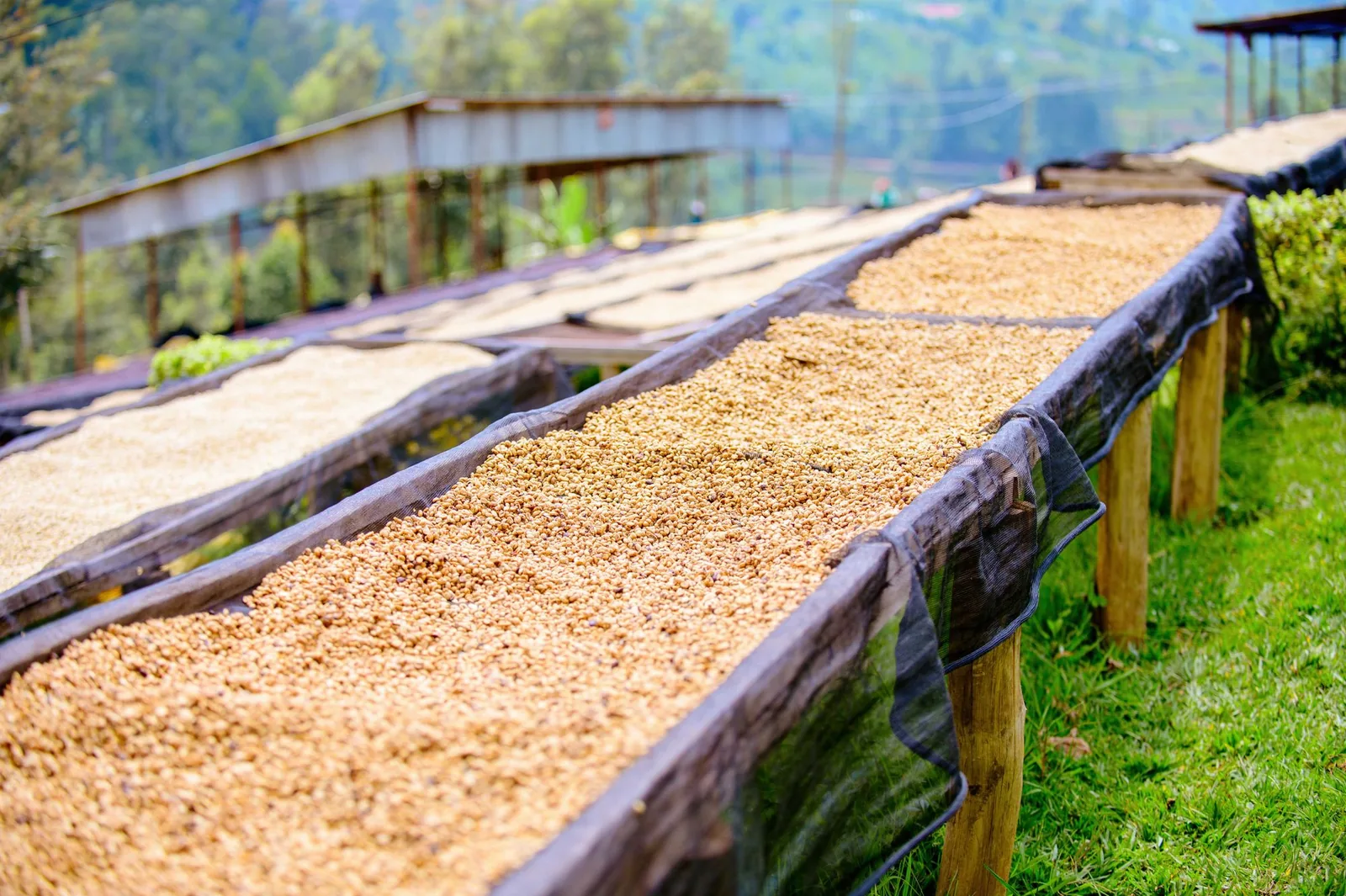
Where it is practiced
The raised bed is commonly used in the washing stations of East Africa. Kenya, Ethiopia, Rwanda and Burundi use it. It then spread to Central America, Colombia and Brazil, on lots sold as specialty. Brazil then calls it a suspended drying area (terreiro suspenso, in Portuguese).
Ground-level areas remain the majority in volume. The concrete, brick or asphalt patio dominates in Latin America. The coffee is spread there in layers of 2 to 5 centimeters. Drying there takes from 7 to 20 days depending on the climate, which lengthens by as much the window in which molds can settle.
The Colombian order of magnitude is useful. In 2008, Cenicafé reports that 41 percent of the country's farms dried in the sun and 2 percent in a mechanical dryer. Mechanical drying therefore remains a minority, even where it is old.
This classification needs a word on what it is worth. The bed does not properly belong to any family of processes. Washed, natural and honey coffees are all dried on it. It is filed here because drying is the dry phase common to all of them.
The 2009 Codex code of practice lists raised tables covered with wire mesh or netting among the ordinary solar drying surfaces. It cites them at the same level as cement terraces, tarps and bamboo mats. The practice was therefore commonplace by 2009 at the latest.
The principle
Drying means bringing coffee from about half its weight in water down to 10 or 12 percent. Cenicafé measures 52 percent moisture on freshly washed parchment, the parchment being the fibrous envelope that stays stuck to the bean after pulping. Water leaves the bean by diffusion toward its surface, then evaporates into the air. Evaporation depends on two things: the moisture gap between the bean surface and the air, and the renewal of that air in contact with the layer. The support decides the second term, and that is its whole purpose.
A raised bed is a frame carried 0.8 or 1.2 meters above the ground, stretched with wire mesh or a mesh cloth. Air passes under the layer as much as over it. A cement slab blocks the underside, but it stores the heat of the day and gives it back to the coffee. A plastic tarp, for its part, turns damp under the layer: the Codex notes that this trapped moisture favors the growth of molds. Packed earth slows drying through direct contact with the soil, and Cenicafé asks that mesh dryers be set on cement or on stone.
That leaves the clock, which governs everything else. Ochratoxin A is a toxin that the International Agency for Research on Cancer classifies as possibly carcinogenic to humans, group 2B. In coffee, it comes from only a few Aspergillus species: A. ochraceus and its relatives, A. niger and its relatives, A. carbonarius. Their window is read in water activity, that is, the share of water actually available to microorganisms, rated from 0 to 1. The whole management of drying consists in crossing this window quickly.
The sequence
- Surface drying of the parchment. It removes surface water and the water lodged between the parchment and the bean. The Kenyan manual wants it done in 2 to 3 hours, in a layer of 2.5 centimeters, with constant turning. The parchment does not spend the night on these tables: a pile still full of water heats up and gives an onion flavor.
- Loading. The Codex calls for thin layers of 3 to 5 centimeters, which comes to 25 to 35 kilos per square meter of parchment or fresh cherry. It does not distinguish between the two products. A thicker layer is allowed only with dry air, good circulation and strong sunshine. Cenicafé holds that beyond 3 centimeters drying slows down, which prolongs the bean's stay at critical moisture.
- On a raised bed, the review published in Foods in 2026 gives layers of 2 to 4 centimeters. The reason is exposure: the thinner the layer, the more each bean sees the sun and the air.
- First stage. Moisture drops little. The Codex counts 1 day or less for parchment, 1 to 3 days for cherry. Water activity is still above 0.95. Toxigenic Aspergillus grow poorly here, because faster yeasts and hydrophilic molds take the place before them.
- Second stage. This is the point of maximum water loss, and it is the dangerous phase. Water activity crosses the band from 0.80 to 0.95, where Aspergillus grow and make the toxin. The Codex holds that no more than five days spent on the drying area are enough to avoid the accumulation of ochratoxin A.
- Turning. The Codex asks that the layer be turned constantly during the day. The 2026 review gives at least two to three turns a day on the beds. The reason is twofold: clumps are broken up and localized fermentations under the surface are avoided.
- Night and rain. The Codex asks that damp coffee be ventilated at night, so that vapor does not condense on the beans. It is piled up and put under a tarp only after one day of drying for parchment, three days for cherry. Earlier than that, the cover traps vapor and rewets the lot.
- Third stage. The coffee is clearly drier and moisture now falls only slowly. Conditions no longer favor toxigenic Aspergillus.
- Finish and conditioning. The Codex sets less than 12.5 percent moisture on a wet basis, and a water activity of 0.67 to 0.70 at most. Cenicafé aims for 10 to 12 percent before bagging. Sampling starts two or three days before the expected end date, then continues every day.
- Moisture measurement. The Codex refers to the ISO 6673 method. Moisture meters are cross-checked and calibrated once a year against this method, before harvest. Measurement is done at room temperature, otherwise the reading drifts.
- Mechanical drying in a static layer. Hot air passes through a fixed layer. A moisture gradient builds up along the path of the air: the inlet face dries first, the outlet face stays damp. The coffee must therefore be turned or partly unloaded. Cenicafé showed as early as 1985 that reversing the direction of the flow improves the uniformity of final moisture.
- Mechanical drying in a drum. The coffee turns in a cylinder through which hot air passes. Continuous turning limits crusting and keeps the beans from sticking together. This matters for naturals and honeys, still loaded with mucilage, the layer of sweet flesh stuck to the parchment.
- Air temperature. The 2026 review takes 50 degrees as the usual ceiling, and 40 to 50 degrees as the range that best preserves attributes. Beyond that, chemical degradation and sensory loss increase. For the drum, it gives 40 to 60 degrees of air on parchment, and a little less on cherry.
What it gives in the cup
What is measured, first. An Ethiopian trial published in 2023 dried washed parchment in layers of 2, 4 and 6 centimeters. It compared four conditions: open sun as a control, then three zones of a solar tunnel. That makes twelve treatments. Total scores range from 84.3 to 87.3 out of 100.
The important result is negative. The authors find no significant difference between the twelve treatments, either in the total score or in the cup score. The gap of three points is therefore not a demonstrated effect. It falls within the noise of tasting.
Soundness, by contrast, separates clearly. The final fungal load ranges from 4.0 to 93.3 percent of infected beans. In open sun, it goes from 45.3 percent at a 2 centimeter layer, to 77.3 percent at 4 centimeters, then to 93.3 percent at 6 centimeters. Under the tunnel, in zone three, it falls to 4.0 percent at 2 centimeters. The authors isolated 252 fungi, including 186 Aspergillus, 41 Penicillium and 25 Fusarium. Thickness governs soundness, not the score.
One nuance, which the trial itself carries. Its final recommendation is not the thinnest layer everywhere. It is 4, 5 and 6 centimeters depending on the tunnel zone, to equalize drying times between zones. A thin layer is therefore not valid as a universal rule.
What is claimed, next. The 2026 review writes that the raised bed better preserves sensory quality and earns better scores on the specialty market. It puts this forward by pointing to a reference, not to a trial it conducted itself. The Codex, for its part, refuses to rank the supports: it writes that every type of surface has its advantages and disadvantages.
What goes wrong
Mold comes from a layer that is too thick or left still. The Ethiopian measurement gives the order of magnitude: 93.3 percent of infected beans at 6 centimeters in open sun, against 45.3 percent at 2 centimeters.
Ochratoxin A comes from the time spent between 0.80 and 0.95 of water activity. The Codex sets five days at most on the drying area there. Below 0.80, Aspergillus are still present but no longer make the toxin. Below 0.78 to 0.76, they no longer grow at all. The risk is therefore decided in the middle of drying, neither at the start nor at the end.
The Codex treats rewetting separately and asks that it be avoided. The reason is biological: the returning water restarts the molds already settled in all at once, and with them toxin production. A shower on an almost dry lot, a tarp laid too early, an unprotected dew are enough.
Case hardening, or crusting, comes from initial drying that is too fast. The outer layers of the bean dry faster than the core. They form a hard shell that traps the remaining water. The 2026 review describes what follows: internal cracks during storage or roasting, uneven roasting, degraded cup uniformity.
Over-drying ruins weight without showing. The Codex makes it the most common defect of mechanical drying and gives its direct consequence: loss of weight, hence loss of income. Cenicafé places the threshold at 10.5 percent, below which drying is excessive.
Black beans from immature fruit come from inlet air that is too hot. The Codex states it this way and makes it the second defect of mechanical drying, after over-drying.
The smoky flavor and the chemical flavor come from contact of the combustion gases with the coffee. Cenicafé therefore asks for external-combustion dryers and heat exchangers. It links the discolored, crystallized and moldy defects to the use of direct combustion and a temperature that is too high.
The earthy flavor comes from contact with the ground. The Codex rules out bare earth for rainy regions. It asks for a washable surface, failing which the parchment picks up off-flavors that no later step removes.
Storage reopens the file. Below 60 percent relative humidity, the coffee keeps drying. Above 80 percent, it takes water back up. A correctly dried lot can therefore become dangerous again in a warehouse.
Benchmarks
- Solar drying loadlayers of 3 to 5 cm, that is 25 to 35 kg/m² of parchment or fresh cherry (Codex)
- Layer on a raised bed2 to 4 cm (Foods review 2026)
- Height of a raised bed0.8 to 1.2 m above the ground (Foods review 2026)
- Growth window of toxigenic Aspergilluswater activity of 0.80 to 0.95 (Codex)
- Time on the drying areafive days at most in this window (Codex)
- End of dryingless than 12.5% moisture on a wet basis, water activity of 0.67 to 0.70 at most (Codex)
- Moisture before bagging in Colombia10 to 12% (Cenicafé)
- Over-drying threshold10.5% (Cenicafé)
- Air temperature ceiling50 °C, recommended range 40 to 50 °C (Foods review 2026)
- Effect of thickness in open sun45.3% of infected beans at 2 cm, 77.3% at 4 cm, 93.3% at 6 cm (Ethiopian trial 2023)
- Drying time on a patio7 to 20 days depending on climate (Foods review 2026)