Drying, from floor to ceiling
Drying.
What makes a coffee stable?
Start the scene or choose a stage. The animation simplifies the mechanism; what follows gives the details and the available references.
Whole cherry or fresh parchment contains 50 to 60% water on a wet basis, that is, relative to the total weight of the wet bean; a washed parchment followed in Huila started from 52%. Drying must bring it down to the level at which microorganisms no longer grow.
Read the stages without animation
- Start from 50 to 60% waterWhole cherry or fresh parchment contains 50 to 60% water on a wet basis, that is, relative to the total weight of the wet bean; a washed parchment followed in Huila started from 52%. Drying must bring it down to the level at which microorganisms no longer grow.
- Migrate, then evaporateTwo resistances govern the operation. Water must first migrate from the core of the bean to its surface, then evaporate into the air. After the first hours, it is internal migration that limits everything; it speeds up with the temperature of the air.
- Turn the layerOn a patio, the layer is 2 to 5 centimeters; on a raised bed, 2 to 4. It is turned at least two to three times a day: without stirring, a wet layer stays trapped under an already dry layer. At night it is covered, otherwise the coffee takes water back from the air.
- Get under the toxin thresholdWhat matters for molds is not moisture but water activity, the share of free water. At least 0.80, about 14% moisture, is needed for Aspergillus to produce ochratoxin A. Too fast, and the surface hardens and locks in the water: this is case hardening.
- Stop at 10 or 12%The target is 10 to 12% moisture, a water activity of 0.60 or less. Brazil and Indonesia cap commercial green at 12.5%. The reference measurement remains weighing before and after sixteen hours in an oven at 105 °C.
To remember: Moisture percentage and water activity are two different measures: the second says what share of the water microorganisms can use.
Read the full article and its sources ↓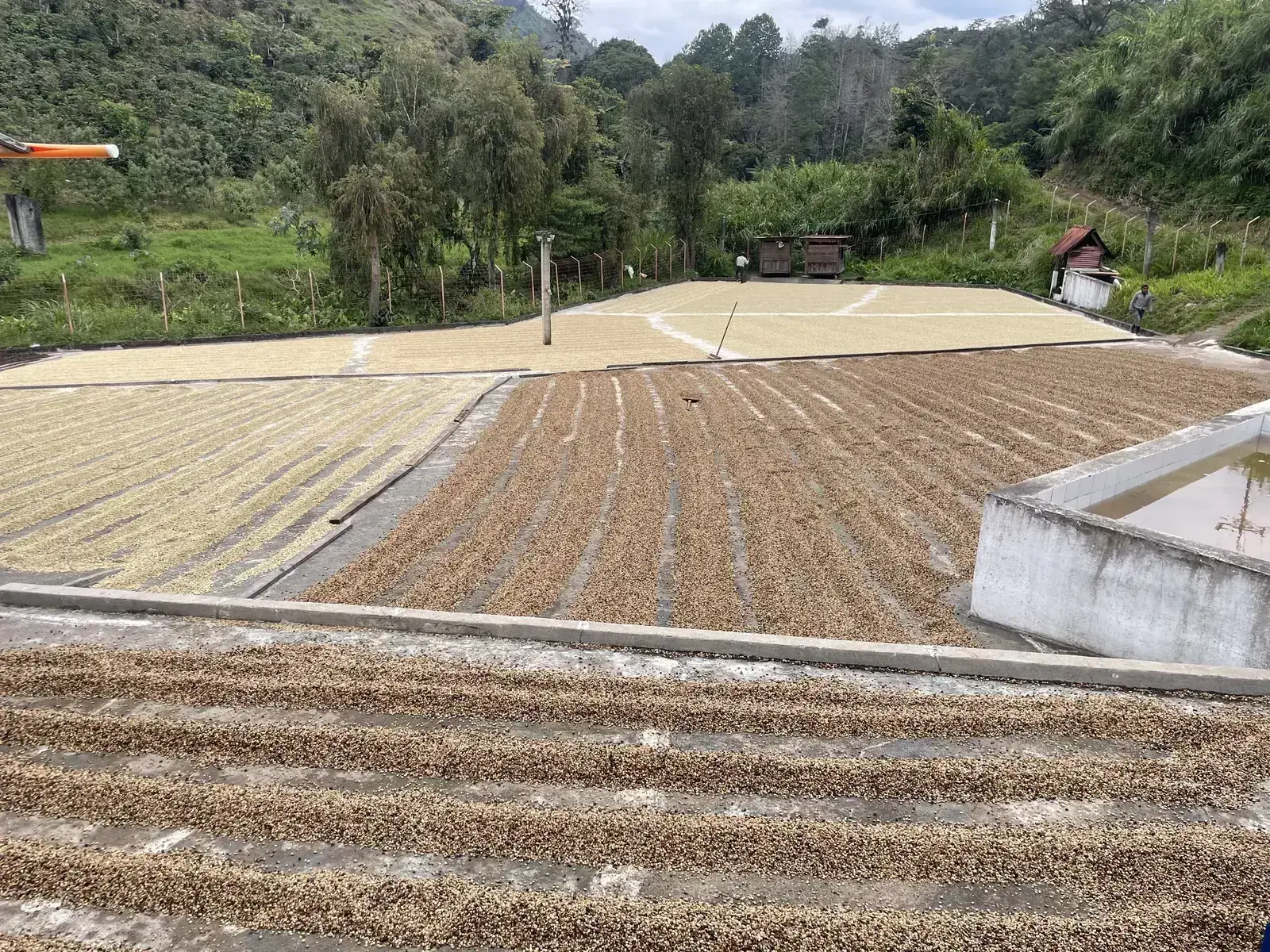
Where it is practiced
Wherever coffee is produced. Drying actually belongs to no process family. It ends all the routes:
- the washed route;
- the dry route;
- honeys;
- fermentations run in a tank.
It is classed here in the dry family because that is where it takes the most time and space.
The forms that recent literature documents with figures:
- Brazil, regions of Campo das Vertentes and Alta Mogiana: terrace in the sun, or terrace then a pass through a rotary dryer, or a dedicated dryer alone (Abreu 2025).
- Ethiopia, Jimma region: raised beds and solar tunnels, on washed parchment coffee (Abdissa 2023).
- Colombia: mechanical drying. Cenicafé works on the thermal insulation of dryers (Cruz-Ospina 2026). CESURCAFÉ, in Neiva in Huila, followed a parchment from 52% to 8% moisture (Ordoñez-Lozano 2025).
- Indonesia and Thailand: rotary dryers and thin-layer trials (Syamsiana 2025, Phitakwinai 2019).
The date mechanical drying appeared in producing countries could not be established from primary sources (see gray area).
The principle
Drying removes water from the bean down to a level at which microorganisms no longer grow and chemical reactions slow sharply. Whole cherry, or fresh parchment, contains 50 to 60% water on a wet basis (Duque-Dussán 2026). Parchment is the fibrous shell that surrounds the bean after pulping. The wet basis relates this water to the total weight of the wet bean, and not to its dry matter. The storage target is 10 to 12% on a wet basis (Duque-Dussán 2026).
Two resistances govern the operation. Water must first migrate from the core of the bean to its surface. It must then evaporate into the air. After the first hours, internal migration limits everything. The effective diffusion coefficient of water in parchment increases with the temperature of the air (Coradi 2021). This dependence is described by an Arrhenius-type equation, the classic exponential relationship between a rate and temperature (Phitakwinai 2019).
What counts biologically is not moisture content. It is water activity, written aw: the fraction of free water, hence available to a microorganism, on a scale from 0 to 1. The link between moisture and water activity is called the sorption isotherm. It was measured between aw 0.1 and 0.9, at 25, 35 and 45 °C (Collazos-Escobar 2025). Three materials went through it: the parchment shell, parchment coffee and green coffee. At least aw 0.80, or about 14% moisture, is needed for Aspergillus to make ochratoxin A in vitro on green coffee (Bucheli and Taniwaki 2002). Ochratoxin A is a kidney mycotoxin, regulated on import.
Heat speeds all this up, but it has a cost. Beyond 50 °C, chlorogenic acids and the precursors of volatile aromas degrade. The reported consequence is a reduced acidity, a shifted bitter balance and a loss of aromatic complexity (Duque-Dussán 2026).
The sequence
1. Start of drying. Washed parchment enters at around 52% wet-basis moisture (Ordoñez-Lozano 2025). Whole cherry stands between 50 and 60% (Duque-Dussán 2026). Surface water leaves quickly, internal water much more slowly.
2. Layer thickness. Cement patio: 2 to 5 cm. Raised bed: 2 to 4 cm, the table set between 0.8 and 1.2 m above the ground (Duque-Dussán 2026). Thickness governs the passage of air through the bed, hence the homogeneity of the lot. In the Jimma solar tunnel, the recommendation runs against intuition (Abdissa 2023):
- coolest zone: 4 cm
- middle zone: 5 cm
- hottest zone: 6 cm
The hot zone dries fast enough to absorb a thicker layer without lengthening the lot.
3. Stirring. Two to three turnings a day at minimum on a raised bed (Duque-Dussán 2026). Stirring brings the beans from the bottom back to the surface. Without it, a wet layer stays trapped under an already dry layer.
4. The first five days. In whole-cherry drying, the water contained in the pulp is enough to feed molds, and it is the outer part of the cherry that becomes contaminated (Bucheli and Taniwaki 2002). A trial on ripe cherries dried in the sun places the critical period in the first five days (Kouadio 2007). The coffee is covered at night. Otherwise it takes moisture back from the air, which the literature calls nighttime rehumidification (Duque-Dussán 2026). A 2024 review divides drying differently and places the risk window later (see gray area).
5. Durations in the sun (Duque-Dussán 2026):
- patio: 7 to 20 days
- passive solar dryer, without fan: 7 to 12 days
- active solar dryer, ventilated: 4 to 7 days
A parabolic greenhouse raises the air 5 to 15 °C above ambient. It saves about 20 to 40% of time over the bare patio, for a more homogeneous final moisture. The raised bed dries faster than the patio, but no quantified duration was found for it (see gray area).
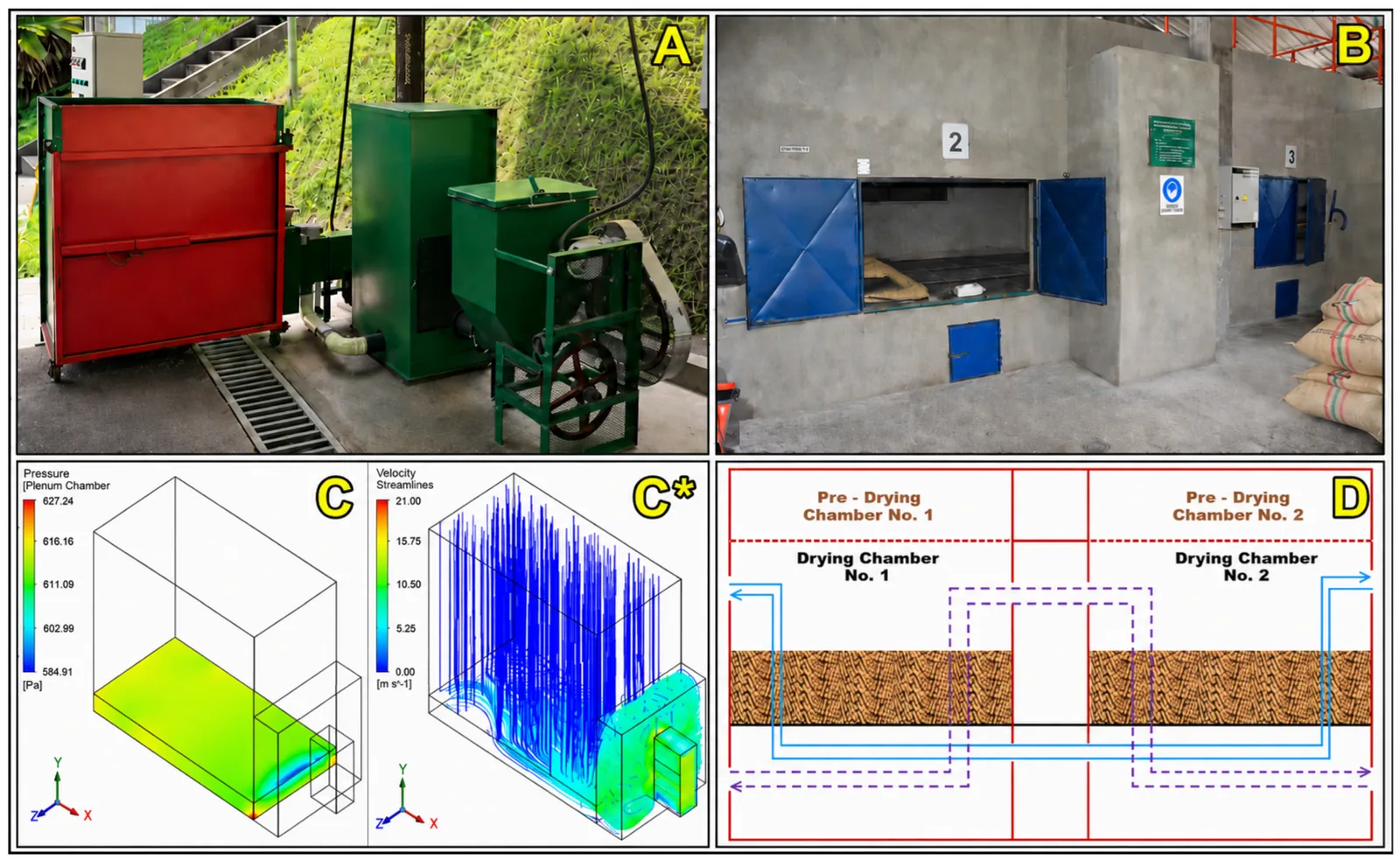
6. Mechanical drying. The generally accepted maximum is 50 °C, and the advised practice lies between 40 and 50 °C (Duque-Dussán 2026). This range has a second advantage: above 42 °C, the growth of Aspergillus and the production of ochratoxin A are hindered (Kouadio 2007). Three families of machines, with their own conditions (Duque-Dussán 2026):
- static silo: bed of 20 to 40 cm, air blown from bottom to top or from top to bottom, 40 to 60 °C
- cross-flow dryer: air sent sideways, 45 to 65 °C, 24 to 48 hours
- rotary dryer: drum stirred continuously, 40 to 60 °C on parchment, residence from a few minutes to a few hours
All machines taken together, mechanical drying takes 24 to 72 hours depending on the load, the starting moisture and the design (Duque-Dussán 2026). A laboratory trial in a rotary dryer held at 60 °C, with fan regulation by fuzzy logic, gives three points (Syamsiana 2025):
- 1 kg, 270 minutes, 11.28% final moisture
- 2 kg, 330 minutes, 9.92%
- 3 kg, 450 minutes, 10.92%
The Colombian protocol monitored by spectroscopy runs more gently: 40 °C, 35 seconds of agitation every hour, down to 10 to 12% (Ordoñez-Lozano 2025).
7. End of drying. Target: 10 to 12% wet-basis moisture (Duque-Dussán 2026). Water activity at 0.60 or less, the threshold from which the lot is judged fit for long storage (Abreu 2025, López-Rodríguez 2024). Two national standards cap commercial green at 12.5%: Brazilian normative instruction no. 08/2003 (Abreu 2025) and the Indonesian standard SNI 01-2907-2008 (Syamsiana 2025).
8. Measurement. The reference method is mass loss in an oven at 105 °C, held sixteen hours, as applied by the ISO 6673 standard (Abdissa 2023). Published protocols sometimes depart from it: a 2024 Ethiopian trial heats for 24 hours (Eshete 2024). Monitoring during drying by near-infrared spectroscopy was calibrated over the full range, from 52% to 8% (Ordoñez-Lozano 2025).
9. Rest in parchment. The dry coffee stays in its parchment before being hulled. A duration of thirty to sixty days is commonly cited in the trade. No rank 1 or 2 source could be found to establish it or to show its effect (see gray area).
Three drying devices, and what each preserves
This sheet describes drying by its bounds, a moisture floor below which the bean is damaged and a ceiling above which mold settles in. It lacks a comparison of the devices, which Hackler and Särchen supply with one figure and two mechanisms.
- The solar dryer: It is a greenhouse, and it exploits the higher air temperature obtained in it. The announced gain is considerable: up to fifty percent acceleration compared with drying in full sun. One must understand where it comes from, because it is not only heat: hotter air holds more water vapor before being saturated, so each volume of air that crosses the layer carries away more water. The greenhouse also protects from bad weather, insects, additional microorganisms and mycotoxins, which makes it as much a shelter as an accelerator.
- The mechanical dryer: It works under fifty degrees, and this bound is the point to remember. Beyond it, it is the aroma precursors that suffer, that is, the sugars, amino acids and chlorogenic acids from which roasting will later draw the odorous compounds. Drying too hot does not show on the bean, it shows in the cup several months later.
- The heat pump: It is the most interesting device of the set, because it allows fine control not only of the temperature but also of the relative humidity of the drying gas, which a simple burner cannot do. The chemical composition obtained is very close to that of solar drying, and a study on canephora showed a superior preservation of aroma precursors.
The heat pump’s result deserves to be explained, because it is counterintuitive for anyone who associates quality with slowness. It is not slowness that preserves, it is the regularity of the temperature and relative humidity pair. Sun drying alternates hot, dry days and cool, humid nights, which makes water enter and leave the bean repeatedly, and each of these cycles is an occasion for internal migration and mechanical stress. A device that holds a stable setpoint removes these cycles. This is also why it approaches the result of solar drying without copying it: it aims at the same gentle regime, and holds it better.
A fourth device exists and must be presented differently, because the authors themselves speak of it in the conditional: dryers working under a nitrogen atmosphere or one depleted in carbon dioxide, which are supposed to retain volatile compounds better by limiting oxidation. The only source is a page of professional extension, and no measurement accompanies the claim. To be treated as a lead on equipment, not as a result.
Sources of this passage: Hackler and Särchen, chapter 5, p. 64 for the solar dryer; chapter 5, p. 70 for mechanical dryers and heat pumps. Drying under an inert atmosphere: same chapter, single source Barista Hustle, consulted on November 14, 2024.
What it gives in the cup
What is measured. A Brazilian trial compared two drying practices in each of two regions, on the 2024 harvest (Abreu 2025). In the Campo das Vertentes, sun on a cement terrace for ten days faces a dedicated dryer run for 24 hours. In the Alta Mogiana, eight days of sun on asphalt then 48 hours in a rotary dryer face the same dedicated dryer. The lots are therefore not the same from one region to the other, and the harvest months differ.
The dedicated dryer wins, without being infallible. In the Campo das Vertentes it clears the 80-point bar of the SCA scale, the 100-point rating of the Specialty Coffee Association. It gets 81 at the start of the harvest and 80 in the middle. At the end of the harvest it falls under 80, at the same level as the traditional route. In the Alta Mogiana it holds 80 points whatever the harvest date, where the traditional route stays under 80.
The same trial records a water activity below 0.6 in all treatments. No sample exceeded the detection threshold of the ochratoxin A kit, set at 2.5 µg/kg. The toxin was therefore not detected, which is not the same thing as a measured value. The dedicated dryer also reduces the population of filamentous fungi, by 38% in the Alta Mogiana and by 44% in the Campo das Vertentes.
A second measurement exists, on another scale. In an Ethiopian solar tunnel, total quality ranges from 84.3 to 87.3 (Abdissa 2023). This figure is not an SCA score. It is the Ethiopian scale, which combines 40 points for the green bean and 60 points for the cup. Above all, the statistical analysis does not separate the treatments: tunnel zones and layer thicknesses give equivalent results in the cup.
What is documented as a mechanism, with no associated tasting note. Above 50 °C, chlorogenic acids and volatile precursors degrade. The reported consequence is a reduced acidity and a shifted bitter balance (Duque-Dussán 2026).
What is only asserted. The idea that slow drying produces more complexity in the cup circulates everywhere in the green coffee trade. No blind trial pointing in that direction was found for this sheet. The only head-to-head read here leans the other way, across two regions and a single crop year (Abreu 2025). That is not enough to settle the question, but it is enough to refuse the opposite claim.
What goes wrong
Molds and ochratoxin A. The list of responsible species has changed. In 2002, a review named Aspergillus ochraceus and A. carbonarius as the most potent producers on coffee (Bucheli and Taniwaki 2002). A 2024 review corrects this: in section Circumdati, the biggest producers are A. westerdijkiae and A. steynii, described after 2002; in section Nigri, it is A. carbonarius, ahead of A. niger (López-Rodríguez 2024). On a coffee-based medium, the growth of these Aspergillus is optimal around 30 °C and aw 0.99 (Kouadio 2007). Toxin production is blocked at 42 °C or at aw 0.75 (Kouadio 2007). At least aw 0.80 is needed for it to start, or about 14% moisture (Bucheli and Taniwaki 2002). The risk is built during drying and transport, not only during storage (Magan and Aldred 2005). The husk concentrates the problem. After hulling, the dry husks removed from the bean can be heavily loaded with toxin (Bucheli and Taniwaki 2002).
Fungal load by handling. At Jimma, the proportion of infected beans at the end of drying ranges from 4.0% to 82.7% in the tunnel (Abdissa 2023). The minimum is reached in the hot zone on a 2 cm layer, the maximum in the cold zone on 6 cm. The control lot dried in full sun on 6 cm climbs to 93.3%. The corresponding defect in the cup is moldy.
Surface crust, or case hardening. If the outside of the bean dries faster than the inside, a hard shell forms that traps the residual water (Duque-Dussán 2026). The lot seems dry to the touch without being so. The moisture then comes back out in the bag and restarts the molds. The continuous turning of the rotary dryer reduces this risk compared with static silos and cross-flow dryers (Duque-Dussán 2026).
Excessive heat. Above 50 °C of air, one leaves the accepted range, with chemical degradation and sensory loss (Duque-Dussán 2026).
Heterogeneity of the lot. In a long solar tunnel, temperature and relative humidity vary from one end to the other (Abdissa 2023). This is why the layer thickness is set zone by zone there.
Nighttime rewetting. A lot left uncovered at night takes water back from the air and lengthens the risk window by as much (Duque-Dussán 2026).
Over-drying. At Alta Mogiana, the dedicated dryer brought lots down to 7.73 to 9.01%, thus below the range of 10 to 12% (Abreu 2025). The first cost is commercial: weight lost at sale, and a lot outside the usual contractual ranges. Yet these same lots scored 80 points. The authors still invoke a loss of aromas below 9%, but they borrow it from another article and do not measure it themselves (see gray area).
Storage drift. In jute sacks, the fungal community shifts over the course of the year. Saccharomycetales, the order that groups the yeasts, dominate the first six months. The filamentous genus Wallemia then takes over, and the bean discolors (Broissin-Vargas 2018). Hermetic packaging keeps moisture and water activity more stable over twelve months than jute (Eshete 2024). Three Ethiopian parchment coffee lots went into storage at 10.92 to 11.63% moisture and aw 0.62 to 0.64. In jute, their moisture fell to 8.0 to 8.3% by the eighth month, then rose again.
Benchmarks
- Starting moisture50 to 60% wet basis
- Storage target10 to 12% wet basis
- Target water activity0.60 or less
- Ochratoxin A production thresholdaw 0.80, or about 14% moisture
- Ochratoxin A production blocked42 °C, or aw 0.75
- Air in mechanical drying40 to 50 °C advised, 50 °C maximum
- Critical mold windowthe first 5 days of drying as cherry