Provenance
Each image, its nature and its source
| Natural | Image | Author, institution | Date | License | Used in |
|---|
Every image, one by one
The 653 items displayed on the site, with their author, their date, their license and the address where it is published. Under the images appears only what the license requires, that is, almost nothing for the public domain and free collections; the register, for its part, is complete.
Caffeol poster, the best coffee substituteGino Boccasile (1901-1952) · c. 1930CC0 source

Café Collas poster, Pearls of the IndiesAnonymous poster artist, La Semeuse printing house, France · 1927Public domain source

Cafés Biard poster, the ten-centime cupMaurice Neumont (1868-1930), Établissements Minot printer, Paris; Bibliothèque nationale de France · 1908Public domain source

Feima poster, a coffee substitute with coffee beans addedLudwig Hohlwein (1874-1949) · 1926Public domain source

Poster for Imperial fig coffeeKoszler studio, Vienna · early 20th centuryCC BY-SA 4.0 source

Tram cards, spring 1921William H. Ukers, All About Coffee (New York, The Tea and Coffee Trade Journal Company, 1922) · p. 464Public domain source
Drying yard of a plantation in Costa RicaWilliam H. Ukers, All About Coffee (New York, 1922) · photograph from the 1922 edition, p. 266Public domain source
Coffee drying yard, Chuva district, GuatemalaWilliam H. Ukers, All About Coffee (New York, 1922) · photograph from the 1922 edition, p. 265Public domain source
Drying yards of the Schmidt fazenda, the largest in BrazilWilliam H. Ukers, All About Coffee (New York, The Tea and Coffee Trade Journal Company, 1922) · p. 261Public domain source
Open-air drying yards on a plantation in West JavaWilliam H. Ukers, All About Coffee (New York, 1922) · photograph from the 1922 edition, p. 270Public domain source
Drying yards, pulping building and fermentation tanks in Brazil and Costa Rica, plate from All About CoffeeWilliam H. Ukers, All About Coffee, The Tea and Coffee Trade Journal Company, New York, 1922 · 1922, plate from the chapter “Preparing green coffee for market”Public domain (work published in the United States in 1922, copyright expired) source
Old kafa coffee cup, EthiopiaRod Waddington (Wikimedia Commons) · 2014 photographCC BY-SA 2.0 source

Old and new loading methods, SantosWilliam H. Ukers, All About Coffee (New York, The Tea and Coffee Trade Journal Company, 1922) · p. 315Public domain source
Old coffee-making apparatus, foreign and AmericanWilliam H. Ukers, All About Coffee (New York, 1922) · illustration from the 1922 edition, p. 632Public domain source
Heinrich Trillich's apparatus for extracting caffeine from coffee, US patent No. 964,944Heinrich Trillich, Munich; United States Patent Office, Washington · filed April 15, 1909, issued July 19, 1910, US patent 964,944, single drawing sheetPublic domain (plate from a US patent, official document of the United States Patent Office not subject to copyright) source
Heinrich Trillich's apparatus for extracting caffeine from whole beans, US patent No. 953,074Heinrich Trillich, Munich; United States Patent Office, Washington · filed April 15, 1909, issued March 29, 1910, US patent 953,074, single drawing sheetPublic domain (plate from a US patent, official document of the United States Patent Office not subject to copyright) source
Giuseppe Tagliabue's apparatus for measuring the alcohol content of a fermenting must, US patent No. 111,885, drawing plateGiuseppe Tagliabue, instrument maker in New York; United States Patent Office, Washington · issued February 14, 1871, US patent 111,885, single drawing sheetPublic domain (plate from a US patent, official document of the United States Patent Office not subject to copyright) source
Roberto Okrassa's coffee washing apparatus, Antigua (Guatemala), US patent No. 1,013,807Roberto Okrassa, Antigua (Guatemala); United States Patent Office, Washington · filed September 30, 1911, issued January 2, 1912, US patent 1,013,807, single drawing sheetPublic domain (plate from a US patent, official document of the United States Patent Office not subject to copyright) source
W. A. Hastings and N. J. Harrington's coffee cherry cleaning apparatus, US patent No. 700,327William A. Hastings (Oakland) and N. J. Harrington (San Francisco); United States Patent Office, Washington · filed January 14, 1901, issued May 20, 1902, US patent 700,327, single drawing sheetPublic domain (plate from a US patent, official document of the United States Patent Office not subject to copyright) source
W. D. Balcom's coffee cleaning apparatus, US patent No. 957,138, sheet 1William D. Balcom, Oberlin; United States Patent Office, Washington · filed June 21, 1909, issued May 3, 1910, US patent 957,138 (2 sheets), sheet 1Public domain (plate from a US patent, official document of the United States Patent Office not subject to copyright) source
Hiram Stevens Maxim's coffee treating apparatus, US patent No. 701,750, sheet 1Hiram Stevens Maxim, London; United States Patent Office, Washington · filed January 14, 1901, issued June 3, 1902, US patent 701,750 (2 sheets), sheet 1Public domain (plate from a US patent, official document of the United States Patent Office not subject to copyright) source
J. H. Grubb's coffee treating apparatus, US patent No. 155,300, drawing plateJ. H. Grubb; United States Patent Office, Washington · issued September 22, 1874, US patent 155,300, single drawing sheetPublic domain (plate from a US patent, official document of the United States Patent Office not subject to copyright) source
Theodore C. Miller's coffee-making apparatus, Brooklyn, US patent No. 1,767,544Theodore C. Miller, Brooklyn (New York); United States Patent Office, Washington · filed August 8, 1928, issued June 24, 1930, US patent 1,767,544, single drawing sheetPublic domain (plate from a US patent, official document of the United States Patent Office not subject to copyright) source
Early apparatus, European and AmericanWilliam H. Ukers, All About Coffee (New York, The Tea and Coffee Trade Journal Company, 1922) · p. 632Public domain source
Plated dishes set on the pass of a restaurant kitchenLeo Sacchi · February 23, 2023Pexels License (free, commercial use allowed) source
Eight-cylinder gas roasting shopWilliam H. Ukers, All About Coffee (New York, 1922) · photograph from the 1922 edition, p. 389Public domain source
At the club of White's Coffee House, 1733, after HogarthWilliam H. Ukers, All About Coffee (New York, The Tea and Coffee Trade Journal Company, 1922) · p. 588Public domain source
Fermentation and washing tanks on a São Paulo fazenda, page from All About CoffeeWilliam H. Ukers, All About Coffee, The Tea and Coffee Trade Journal Company, New York, 1922 · 1922, page 260Public domain (work published in the United States in 1922, copyright expired) source
Laboratory balance to the hundredth of a gramEl CarlosCC BY 3.0 source

Aquarium water test stripsR. Henrik Nilsson · 2026CC BY 4.0 source

Glass airlock on the bung of a wine barrelMarco Daniele · 2010-05-29CC BY-SA 3.0 source

Lagoon basin of the Ruai sewage treatment plant, in NairobiSuSanA Secretariat · 2011CC BY 2.0 source

Cherry receiving basin in a washing stationHannoversche KaffeemanufakturPexels License source
Receiving basin filled with cherriesHannoversche KaffeemanufakturPexels License source
Washing basins of a processing station in KenyaDaniel Case · 2025-08-10CC BY-SA 4.0 source

Battery of Carter drawer-type roasters in an old American plantWilliam H. Ukers, All About Coffee (New York, 1922) · photograph from the 1922 edition, p. 628Public domain source
Benjamin Green Arnold, first president of the New York Coffee ExchangeWilliam H. Ukers, All About Coffee (New York, The Tea and Coffee Trade Journal Company, 1922) · p. 517Public domain source
Sodium bicarbonate, one of the salts in the published recipesThavox · 2008Public domain source

Plastic fermentation jug closed with an airlockKVDP · 2008-07-16Public domain source

Layered milk drink in a double-wall glassJames DollinPexels License source
Blanke roasted coffee tin, 1904 ExpositionMissouri History Museum, St. Louis · 1904Public domain source

Henri Christiaens tin, raw and roasted coffees, BrusselsPrivate collection of antique tins; photograph Alf van Beem · early 20th centuryCC0 source

Hand-labeled green coffee sample boxesFoxPexels License source
Bowls lined up in front of the coffee packets, before a tasting session in Ystad, Sweden, in 2024Jonn Leffmann · 2024CC BY 4.0 source

Branch of Coffea arabica in fruitWilliam H. Ukers, All About Coffee (New York, 1922), photographs The Tea and Coffee Trade Journal · 1909 photograph, p. 141Public domain source
Achille Gaggia patent No. 2,898,844, coffee brewing machine, 1959Giovanni Achille Gaggia, Milan; US patent No. 2,898,844, “Machines for Infusing Coffee and Like Liquid Extracts”, United States Patent Office, Washington, 1959 · filed March 9, 1956, issued August 11, 1959, sheet 1 of 7Public domain (plate from a US patent, official document not subject to copyright) source
US patent of Luigi Bezzera No. 726,793, coffee-making machine, 1903Luigi Bezzera, Milan; US patent No. 726,793, “Coffee Making Machine”, United States Patent Office, Washington, 1903; plate lithographed by The Norris Peters Co., Washington · filed June 10, 1902, issued April 28, 1903, sheet 1 of 2Public domain (plate from a US patent, official document not subject to copyright) source
US patent No. 897,763 of Meyer, Roselius and Wimmer, treatment of coffee, 1908Johann Friedrich Meyer Jr., Ludwig Roselius and Karl Wimmer, of Bremen; US patent No. 897,763, “Treatment of Coffee”, United States Patent Office, Washington · filed May 4, 1906, issued September 1, 1908Public domain (official document of the US patent office) source
US patent No. 897,840 of Meyer, Roselius and Wimmer, extraction of caffeine, 1908Johann Friedrich Meyer Jr., Ludwig Roselius and Karl Wimmer, of Bremen; US patent No. 897,840, United States Patent Office, Washington · issued September 1, 1908Public domain (official document of the US patent office) source
Charles Morgan patent No. 461,784, coffee mill, 1891Charles Morgan; US patent No. 461,784, “Coffee Mill”, United States Patent Office, Washington, 1891; plate lithographed by N. Peters, Washington · issued October 20, 1891Public domain (plate from a US patent, official document not subject to copyright) source
Edwin L. Henington patent No. 232,714, coffee pulper and separator, 1880Edwin L. Henington; US patent No. 232,714, “Coffee Pulper and Separator”, United States Patent Office, Washington, 1880; plate lithographed by N. Peters, Washington · issued September 28, 1880Public domain (plate from a US patent, official document not subject to copyright) source
Jabez Burns patent No. 241,295, gas-heated roaster, 1881Jabez Burns, Brooklyn, New York, assignor to William Durbrow; US patent No. 241,295, “Coffee-Roaster”, United States Patent Office, Washington, 1881; plate lithographed by N. Peters, Washington · filed October 21, 1880, issued May 10, 1881Public domain (plate from a US patent, official document not subject to copyright) source
Jabez Burns patent No. 44,704, roaster, sheet 1: the machine in sectionJabez Burns, New York; US patent No. 44,704, “Coffee Roaster”, United States Patent Office, Washington, 1864; plate lithographed by N. Peters, Washington · issued December 18, 1864, sheet 1 of 2Public domain (plate from a US patent, official document not subject to copyright) source
Jabez Burns patent No. 44,704, roaster, sheet 2: the inner double helixJabez Burns, New York; US patent No. 44,704, “Coffee Roaster”, United States Patent Office, Washington, 1864; plate lithographed by N. Peters, Washington · issued December 18, 1864, sheet 2 of 2Public domain (plate from a US patent, official document not subject to copyright) source
Fritsch Pulverisette 14 centrifugal millFight&Bite · 2009 · photograph, Wikimedia CommonsCC BY-SA 4.0 source

Compressed spent coffee grounds logs from Bio-bean, on displayVernon Chan · 2017CC BY 2.0 source

Button's Coffee House, Great Russell StreetWilliam H. Ukers, All About Coffee (New York, The Tea and Coffee Trade Journal Company, 1922) · p. 84Public domain source
Women drinking coffee, tea and chocolate, 1707 frontispieceAnonymous frontispiece by Daniel Duncan, Von dem Missbrauch heisser und hitziger Speisen und Geträncke, sonderlich aber des Caffes, Schockolate und Thees, German translation, 1707; Wellcome Collection, London, EPB/A/21186, image L0016397 · 1707Public domain (Public Domain Mark declared on the Wellcome record; the reproduction relayed by Wikimedia Commons still carries Wellcome Images' former CC BY 4.0 notice, which is credited out of caution) source
Bedouins preparing coffee in the sandWillem van de Poll (1895-1970); Nationaal Archief, The Hague · 1960CC0 source

Roasted coffee from the island of Fogo, in 2012Ji-Elle · 2012CC BY-SA 3.0 source

Bulk parchment coffee in a wooden hopperField photograph, Baja Verapaz, Guatemala · February 3, 2026Own collection
Parchment coffee drying on a tarp in a street in Maubisse, in 2011David Stanley · 2011CC BY 2.0 source

Coffee spread out in the sun to dry at the market of Pyin Oo Lwin, in 2018Myrmux · 2018CC BY-SA 4.0 source

Ground coffee on a market stall, in a basin and an enameled bowl, in 2025Lucia236, Wiki Loves Africa 2025 · 2025CC BY-SA 4.0 source

Coffee raked in lines on a drying patioField photograph, Baja Verapaz, Guatemala · February 3, 2026Own collection
Coffee raked on the drying yard of a plantation in El Salvador, bags loaded on a cart, early 20th century (uncertain date)State Government Photographer, History Trust of South Australia · early 20th century, uncertain dateCC0 source

Green coffee in Kpalimé, in 2025Alfrednadjere · 2025CC BY-SA 4.0 source

Cafeeiro Sul de Minas Gerais 02.jpgErnani Zimmermann Viana · 2016-10-14 09:36:50CC BY-SA 4.0 source

Coffee plant at Curimagua, in the Sierra de San Luis (Falcón State), in 2014Juan Carlo Castillo Ortega · 2014CC BY-SA 3.0 source

Coffee plant in the village of Dulalthok, Kavrepalanchok district, in 2014Krish Dulal · 2014CC BY-SA 3.0 source

Coffee plants laden with cherries by the roadside at Maubisse, in 2002J. Patrick Fischer · 2002CC BY-SA 3.0 source

Coffee plants laden with green cherries on the Bolovens Plateau, in 2018Christophe95 · 2018CC BY-SA 4.0 source

Three-year-old coffee plants in flower in Panama, photograph published by William H. Ukers in 1922William H. Ukers, All About Coffee, 1922 · 1922Public domain source
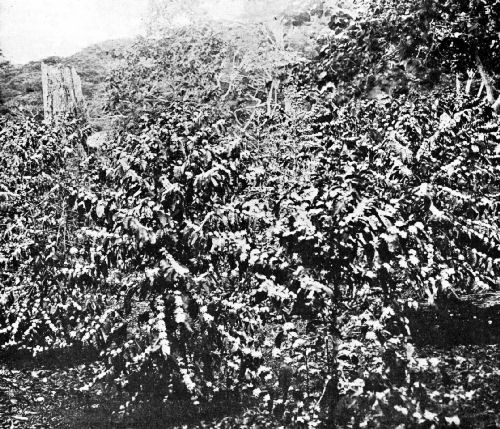
Six-year-old excelsa coffee plants shaded by Cassia spectabilis, Boukoko station, 1950sBoukoko station, Institut national d'agronomie coloniale, BnF (Gallica) · 1950sPublic domain source

Niaouli coffee plants shaded by Leucaena, at Tové, in 1929André Fontaine, BnF (Gallica) · 1929Public domain source

Coffee plantation as far as the eye can see under a cloudless skyField photograph, Brazil · 2026Own collection
Coffee plantation in front of the line of volcanoesField photographOwn collection
Terraced coffee plantation on the hillsideField photographOwn collection
Coffee plantation planted in straight rows to the horizon, on red earthField photograph, Brazil · 2026Own collection
Electric drip coffee maker on a countertop in a retro kitchenJackie A · April 15, 2026Pexels License (free, commercial use allowed) source
Viennese coffee pot, 1830, Metropolitan MuseumWilliam H. Ukers, All About Coffee (New York, The Tea and Coffee Trade Journal Company, 1922) · p. 609Public domain source
Albert Rutenick's filter coffee pot, US patent No. 272,481Albert Rutenick, New York; United States Patent Office, Washington · issued February 20, 1883, US patent 272,481, single drawing sheetPublic domain (plate from a US patent, official document of the United States Patent Office not subject to copyright) source
18th-century silver coffee potsWilliam H. Ukers, All About Coffee (New York, The Tea and Coffee Trade Journal Company, 1922) · p. 605Public domain source
Belgian, Russian and French pewter coffee potsWilliam H. Ukers, All About Coffee (New York, The Tea and Coffee Trade Journal Company, 1922) · p. 622Public domain source
Coffee pots by American silversmiths, including Paul RevereWilliam H. Ukers, All About Coffee (New York, The Tea and Coffee Trade Journal Company, 1922) · p. 613Public domain source
Earthenware and porcelain coffee pots, from the eighteenth to the twentieth centuryWilliam H. Ukers, All About Coffee (New York, 1922) · illustration from the 1922 edition, p. 606Public domain source
Coffee pots and apparatus, plate from the chapter on the evolution of utensilsWilliam H. Ukers, All About Coffee (New York, The Tea and Coffee Trade Journal Company, 1922) · p. 650Public domain source
Cafeto arábico (Coffea arabica), Parque Nacional de Lokobe, Nosy Be, Madagascar, 2025-09-21, DD 24.jpgDiego Delso · 2025-09-21 10:49:18CC BY-SA 4.0 source

Caffé Caffé, the itinerant coffee seller of the Cries of ParisAnne Claude Philippe de Tubières, comte de Caylus, etching finished with the burin by Pierre Étienne Moitte after Edme Bouchardon, Études prises dans le bas peuple ou les Cris de Paris, fifth series, 1746; The Metropolitan Museum of Art, New York, 53.600.588(49), Harris Brisbane Dick Fund · 1746Public domain (CC0, Met Open Access) source
Bogota coffee, green and roasted, seen under the microscope, plate from All About CoffeeWilliam H. Ukers, All About Coffee, The Tea and Coffee Trade Journal Company, New York, 1922 · 1922, page 154Public domain (work published in the United States in 1922, copyright expired) source
Roadside café in Toyohashi, Naito Coffee signIMHHPexels License source
Parchment coffee flowing through handsDaniel Case · 2025-08-10CC BY-SA 4.0 source

Parchment coffee on a drying rackDaniel Case · 2025-08-10CC BY-SA 4.0 source

South Indian filter coffee served in its davara, froth overflowingBaljinder SinghPexels License source
Ground coffee seen under the microscope, page from the chemistry chapter of All About CoffeeWilliam H. Ukers, All About Coffee, The Tea and Coffee Trade Journal Company, New York, 1922; chemistry chapter written by Charles W. Trigg · 1922, page 167Public domain (work published in the United States in 1922, copyright expired) source
Coffee poured into several mismatched cups on a wooden tableLucas Andrade · March 15, 2024Pexels License (free, commercial use allowed) source
Green coffee stored on the docks of Le Havre, FranceWilliam H. Ukers, All About Coffee (New York, 1922) · photograph from the 1922 edition, p. 328Public domain source
Café-concert des Ambassadeurs, the sword swallowerJules Chéret (1836-1932); Bibliothèque nationale de France · 1876Public domain source

Coffee plant laden with fruit despite rust, 1909 photographUnidentified photographer, agronomic collection digitized by the Bibliothèque nationale de France · 1909Public domain source

Coffea excelsa coffee plant from Bangelan, 1935Roland Portères, photographer; Bibliothèque nationale de France · 1935Public domain source

Coffea robusta coffee plant in Africa, 1930 photographP. Pascalet, photographer; Bibliothèque nationale de France · 1930Public domain source

Coffea robusta coffee plant in Java, 1930 photographP. Pascalet, photographer; Bibliothèque nationale de France · 1930Public domain source

Coffee plant in flower and fruit, watercolorAnonymous artist, watercolor on paper, c. 1823; Wellcome Collection, London, iconographic reference V0043506EL · c. 1823Public domain (Public Domain Mark, declared on the Wellcome record) source
Coffee plant in fruit, watercolor companion to the previous oneAnonymous artist, watercolor on paper, c. 1823; Wellcome Collection, London, iconographic reference V0043506ER · c. 1823Public domain (Public Domain Mark, declared on the Wellcome record) source
Coffee plants of the Bourbon variety, French IndochinaWilliam H. Ukers, All About Coffee (New York, The Tea and Coffee Trade Journal Company, 1922) · p. 238Public domain source
Six-year-old Liberian coffee plants, 1920 press photographMeurisse press agency; Bibliothèque nationale de France · July 7, 1920Public domain source

Thirty-year-old coffee plants, Esperanza, HuatuscoWilliam H. Ukers, All About Coffee (New York, The Tea and Coffee Trade Journal Company, 1922) · p. 221Public domain source
Coffee plants in flower in front of a planter's bungalow, MysoreWilliam H. Ukers, All About Coffee (New York, 1922), photographs The Tea and Coffee Trade Journal · color photograph c. 1909Public domain source
Terraced coffee plants at Attara, near Manakha, Yemen, 1893Plate from Walter Burton Harris, A Journey through the Yemen, and some general remarks upon that country, Edinburgh and London, 1893, p. 29; digitized copy from the British Library, shelfmark HMNTS 10076.eee.25 · 1893Public domain (1893 work; British Library, Mechanical Curator collection) source

Robusta coffee plants and pepper vinesTimothy A. Gonsalves · 2024-02-07CC BY-SA 4.0 source

Wild coffee plants of Kaffa, near Addis AbabaWilliam H. Ukers, All About Coffee (New York, The Tea and Coffee Trade Journal Company, 1922) · p. 231Public domain source
Washing channel loaded with cherries in a wet-process facility at Doi Chaang, in 2014LannaPhoto · 2014CC BY-SA 4.0 source

Map of the range of Coffea stenophyllaFiver, der Hellseher · January 23, 2022CC BY-SA 4.0 source

Map of the area affected by the coffee plant disease, August 1887Emilio Augusto Goeldi, “Relatorio sobre a molestia do cafeeiro na provincia do Rio de Janeiro”, Rio de Janeiro, Imprensa Nacional, 1887, offprint from vol. VIII of the Archivos do Museu Nacional; plates engraved by A. Lallemant, Museu Nacional · August 1887, folding mapPublic domain source
Map of the London coffeehouses before the fire of 1748William H. Ukers, All About Coffee (New York, The Tea and Coffee Trade Journal Company, 1922) · p. 76Public domain source
Advertising card for Schotten's Oura Java coffeeMissouri History Museum, St. Louis · c. 1905Public domain source

Cherries in the water of a sorting basin at Doi Chaang, Chiang Rai province, in 2014LannaPhoto · 2014CC BY-SA 4.0 source

Whole dried coffee cherries, before hulling, in 2025Giovanni Damandji, Wiki Loves Africa 2025 · 2025CC BY-SA 4.0 source

Canephora cherries ripeningTimothy A. Gonsalves · 2024-02-04CC BY-SA 4.0 source

Coffea racemosa cherriesTon Rulkens · December 6, 2013CC BY-SA 2.0 source

Cherries entering the hopper of a pulperChristian BolañosPexels License source
Whole cherries drying on a patioField photograph, Antigua region, Sacatepéquez, Guatemala · February 4, 2026Own collection
Harvested cherries in bulk on the screening grid of a machineField photograph, Brazil · 2026Own collection
Cherries drying on raised beds, UgandaSpeak Media UgandaPexels License source
Copper cezve and porcelain cup on a trayAsumaaniPexels License source
Brass cezve and empty cup on a wooden trayDenisse VillarPexels License source
Cezve sunk into hot sand, the coffee risingMutecevvilPexels License source
Loading bags of coffee aboard a shipWilliam H. Ukers, All About Coffee (New York, 1922) · photograph from the 1922 edition, p. 313Public domain source
José Marcelino Urgellés's coffee cherry processing chain, US patent No. 1,038,032, drawing plateJosé Marcelino Urgellés; United States Patent Office, Washington · filed December 11, 1911, issued September 10, 1912, US patent 1,038,032, single drawing sheetPublic domain (plate from a US patent, official document of the United States Patent Office not subject to copyright) source
Private railway on a São Paulo fazendaWilliam H. Ukers, All About Coffee (New York, The Tea and Coffee Trade Journal Company, 1922) · p. 208Public domain source
Large-rooted Magdeburg chicoryVilmorin-Andrieux & Cie, Les plantes potagères (Paris, 1904) · 1904Public domain source

Drop in pH over 72 hours of fermentation, dry process and wet processRocha R.A.R., Cruz M.A.D.D. et al. · 2024CC BY 4.0 source
Green scale Lecanium viride on a coffee leaf, Bingerville, 1932A. Mallamaire, botanist and photographer; Bibliothèque nationale de France · 1932Public domain source

Coffea arabica 'bourbon pointu' from Sliti farm in Reunion island.jpgAdrienChatenay · 2017-04-02CC BY-SA 4.0 source

Coffea arabica: leaves, flowers and fruits, painted from life by M. E. EatonWilliam H. Ukers, All About Coffee (New York, The Tea and Coffee Trade Journal Company, 1922) · p. 8Public domain source
Coffea arabica flowers.JPGB.navez · 2007-12-27CC BY-SA 4.0 source

Coffea arabica L., plate 106 of Köhler's Medizinal-Pflanzen (Gera, 1887): twig, flowers, section of the flower, fruit, section of the fruit, seedsFranz Eugen Köhler (ed.), lithograph · 1887Public domain source

Coffea arabica, plate 1303 of Curtis's Botanical MagazineDrawn by Sydenham Teast Edwards, engraved by Francis Sansom, published by Thomas Curtis, St George's Crescent, July 1, 1810; Curtis's Botanical Magazine, volume 32, plate 1303, text by John Sims; Harvard University copy · 1810Public domain source
Coffea arabica, plate from Blanco's Flora de FilipinasFrancisco Manuel Blanco, “Flora de Filipinas”, large edition, atlas I, Manila · 1880-1883Public domain source

Coffea canephora berries.JPGKsd5 · 2009-07-12CC0 source

Eighteen-month-old Coffea Kouilou in flowerWilliam H. Ukers, All About Coffee (New York, 1922), photographs The Tea and Coffee Trade Journal · p. 147Public domain source
Coffea liberica (5597836927).jpgDinesh Valke from Thane, India · 2011-03-31 14:51CC BY-SA 2.0 source

Coffea liberica in plantation at Bangelan, Java, 1931P. Pascalet, photographer; Bibliothèque nationale de France · 1931Public domain source

Coffea stenophylla kz01.jpgKrzysztof Ziarnek, Kenraiz · 2019-12-13 11:36:09CC BY-SA 4.0 source

Coffea travancorensis, wild coffee plant of the islandGeorge de Alwis (drawing), Henry Trimen, Biodiversity Heritage Library · 1895Public domain source

Coffea zanguebariae, the species of Ibo coffeeRalph Holt Cheney, Internet Archive digitization · 1925Public domain (no known copyright restriction; book published in New York in 1925) source

Coffee berries in Hacienda Guayabal, Colombia.jpgBernard Gagnon · 2020-01-23CC BY-SA 4.0 source

Coffee berry sorting process, near Hawassa.jpgNiels Van Iperen · 2017-01-26 02:37:48CC BY-SA 4.0 source

Coffee seedlings puerto rico.jpgUSDA · 2013-12-11Public domain source

John Ashcroft's coffee processing chest, US patent No. 113,832, sheet 1John Ashcroft; United States Patent Office, Washington · issued April 18, 1871, US patent 113,832 (2 sheets), sheet 1Public domain (plate from a US patent, official document of the United States Patent Office not subject to copyright) source
Collection of Ottoman zarfsTitit (Wikimedia Commons), Adnan Ege Kutay collection · pieces of the 18th and 19th centuriesCC BY-SA 4.0 source

Comparison of Coffea racemosa, liberica and arabica beansLeClair Organics · September 18, 2019CC BY-SA 4.0 source

Counter laden with a neighborhood café's sugar and coffee tinsLokman Sevim · January 17, 2023Pexels License (free, commercial use allowed) source
Counter of a minimalist café seen from the entrance of the roomAmar Preciado · July 25, 2024Pexels License (free, commercial use allowed) source
Packing and transport of coffee at AdenWilliam H. Ukers, All About Coffee (New York, 1922) · photograph from the 1922 edition, p. 311Public domain source
Checking a handful of beans at the drum outletRaphael LoquellanoPexels License source
Screenshot of the Barista Pocket toolApplication supplied by the site's author · 2026Screenshot of the site itself
Screenshot of the coffee quiz toolApplication supplied by the site's author · 2026Screenshot of the site itself
Screenshot of the Auto machine toolApplication supplied by the site's author · 2026Screenshot of the site itself
Screenshot of the Mission and Constraint toolApplication supplied by the site's author · 2026Screenshot of the site itself
Screenshot of the sitePXL Roasters · 2026Screenshot of the site itself
Screenshot of the sitePXL Roasters · 2026Screenshot of the site itself
Screenshot of the sitePXL Roasters · 2026Screenshot of the site itself
Grind color minute by minute for seven roast profilesAnokye-Bempah L., Styczynski T. et al. · 2025CC BY 4.0 source
Section of a coffee cherry: exocarp, mesocarp, pectin layer, endocarp, integument and endospermY tambe, vectorized by Chabacano; French version supplied by the site's author · original 2004, vectorization 2007CC BY-SA 3.0 (derivative work under the same license) source

Cross section of a coffee cherry and the names of its coveringsBastian F., Hutabarat O.S. et al. · 2021CC BY 4.0 source
Tasting cups and spoons on the cupping tableAlinaskazkaPexels License source
Paved courtyard of a coffee farm at the foot of the mountains, in Venezuela, in 2007 (exact location not specified by the author)Matthias Kirsch · 2007CC BY-SA 2.0 source

Citric acid crystals under the microscope in polarized light, magnified 200 timesJan Homann · 2006Public domain source

Picking and bagging in BrazilWilliam H. Ukers, All About Coffee (New York, The Tea and Coffee Trade Journal Company, 1922) · p. 177Public domain source
Picking and transport in the fields, São PauloWilliam H. Ukers, All About Coffee (New York, The Tea and Coffee Trade Journal Company, 1922) · p. 209Public domain source
Picking on a plantation in BogotaWilliam H. Ukers, All About Coffee (New York, The Tea and Coffee Trade Journal Company, 1922) · p. 211Public domain source
Picking on a plantation in North QueenslandWilliam H. Ukers, All About Coffee (New York, The Tea and Coffee Trade Journal Company, 1922) · p. 239Public domain source
Picker in a row of coffee plants1500m CoffeePexels License source
Coffee pickers in the interior of São Paulo, BrazilUnidentified photographer; Frank and Frances Carpenter Collection, Library of Congress, Prints and Photographs Division, digital ID cph.3c04097; the record reproduces the old deposit notice “Copyright by E. M. Newman” and states that no publication restrictions are known · between 1900 and 1923Public domain (work published in the United States before 1929; Library of Congress: no known restrictions on publication) source
Spoons and bowls during a tasting sessionAlina SkazkaPexels License source
Shade-grown cultivation, Urban estate, IndiaWilliam H. Ukers, All About Coffee (New York, The Tea and Coffee Trade Journal Company, 1922) · p. 228Public domain source
Shade-grown cultivation, Puerto RicoWilliam H. Ukers, All About Coffee (New York, The Tea and Coffee Trade Journal Company, 1922) · p. 201Public domain source
Closed fermentation tank topped with a bubbler airlockShermozle · 2006-01-08CC BY-SA 3.0 source

Lawrence K. Watrous's vertical green coffee treatment tank, US patent No. 1,498,410, drawing plateLawrence K. Watrous, Minneapolis; United States Patent Office, Washington · filed September 19, 1922, issued June 17, 1924, US patent 1,498,410, single drawing sheetPublic domain (plate from a US patent, official document of the United States Patent Office not subject to copyright) source
Stainless-steel fermentation tanks in a row with valves and pressure gaugesDrew Cuddy · 2010-06-03CC BY-SA 2.0 source

Fermentation and washing tanks on a São Paulo fazendaWilliam H. Ukers, All About Coffee (New York, The Tea and Coffee Trade Journal Company, 1922) · p. 260Public domain source
Das Coffe-Haus, the German café of 1711Caspar Luyken, etching for Abraham a Sancta Clara, Etwas für Alle, second part (1711); Rijksmuseum, Amsterdam, RP-P-1896-A-19368-1616 · 1711CC0 (Rijksmuseum) source
Clearing land to plant coffee in Sumatra, in 1918-1919 (KITLV collection)Unknown photographer, KITLV collection (Leiden University library) · 1918-1919CC BY 4.0 source
Spoon tasting over bowls of coffeeMasu RodriguezPexels License source
Pulper and washing tank on a farm in TanzaniaHarald Ulver · 2024CC BY-SA 4.0 source

Packaged coffees made famous by advertisingWilliam H. Ukers, All About Coffee (New York, The Tea and Coffee Trade Journal Company, 1922) · p. 430Public domain source
Smokers in a Turkish café listen to the news brought by a courierJoseph Nash, 1843 lithograph after the drawing by David Wilkie made in Constantinople in 1840; Wellcome Collection, London, V0019283 · 1843, after a drawing of 1840Public domain (lithograph published in 1843; Joseph Nash died in 1878, David Wilkie died in 1841) source
Glasses set on a map of the originsЕвгений ШухманPexels License source
Workshop drawing of a Tiffany coffee pot, model 8473Tiffany & Co.; Metropolitan Museum of Art · c. 1889CC0 source

Patent drawings of old French coffee potsWilliam H. Ukers, All About Coffee (New York, 1922) · illustration from the 1922 edition, p. 624Public domain source
Two of the blackboards of the Coffee ExchangeWilliam H. Ukers, All About Coffee (New York, The Tea and Coffee Trade Journal Company, 1922) · p. 331Public domain source
Two women drying cherriesPHILIP ASEDRI DRADRIO · 2017-09-16CC BY-SA 4.0 source

Two “The San Franciscan” roasters installed side by sideVisitor7 · 2013-03-06CC BY-SA 3.0 source

Two double-wall glasses filled with black coffeeHafize BalciPexels License source
In front of an Ottoman caféUnidentified photographer; British Museum, London · c. 1910Public domain source

Kissaten storefront in Japan, signs “喫茶” and “COFFEE”Keisuke IwasawaPexels License source
Different types of coffee containers in 1922William H. Ukers, All About Coffee (New York, 1922) · illustration from the 1922 edition, p. 411Public domain source
Disappearance of sugars and appearance of acids and alcohols during 96 hours of fermentationSilva L.C.F., Pereira P.V.R. et al. · 2024CC BY 4.0 source
Fermentation setup in closed jugs, whole coffee and pulped coffeeRocha R.A.R., Cruz M.A.D.D. et al. · 2024CC BY 4.0 source
Outdoor coffee and tea vending machineVladislav Likhomanov · February 16, 2021Pexels License (free, commercial use allowed) source
Coffee estate in Antioquia, with its windbreaksWilliam H. Ukers, All About Coffee (New York, The Tea and Coffee Trade Journal Company, 1922) · p. 203Public domain source
Coffee estate in the mountains of Costa RicaWilliam H. Ukers, All About Coffee (New York, The Tea and Coffee Trade Journal Company, 1922) · p. 226Public domain source
One-year-old robusta estate, west coast of SumatraWilliam H. Ukers, All About Coffee (New York, The Tea and Coffee Trade Journal Company, 1922) · p. 145Public domain source
Doses of beans on the scale of a roasting stationFoxPexels License source
Unloading by hoist at New OrleansWilliam H. Ukers, All About Coffee (New York, The Tea and Coffee Trade Journal Company, 1922) · p. 324Public domain source
Unloading coffee from a steamer arriving from Central AmericaWilliam H. Ukers, All About Coffee (New York, 1922) · photograph from the 1922 edition, p. 326Public domain source
Unloading Java coffee from a sailing ship at BrooklynWilliam H. Ukers, All About Coffee (New York, The Tea and Coffee Trade Journal Company, 1922) · p. 311Public domain source
Unloading under the covered sheds of the New York Dock CompanyWilliam H. Ukers, All About Coffee (New York, The Tea and Coffee Trade Journal Company, 1922) · p. 319Public domain source
Kensett Champney's coffee huller, Senahú (Guatemala), US patent No. 773,544, drawing plateKensett Champney, Senahú (Guatemala); United States Patent Office, Washington · issued November 1, 1904, US patent 773,544, single drawing sheetPublic domain (plate from a US patent, official document of the United States Patent Office not subject to copyright) source
Tasting in a Costa Rican roasteryEric T Gunther · 2012-03-12CC BY-SA 3.0 source

Old parchment remover driven by an ox-powered whim, VenezuelaWilliam H. Ukers, All About Coffee (New York, 1922) · illustration from the 1922 edition, p. 263Public domain source
Comparative advertising expenditure of coffee and substitutesWilliam H. Ukers, All About Coffee (New York, The Tea and Coffee Trade Journal Company, 1922) · p. 440Public domain source
Pulping of cherries at a Ugandan stationErinamukuta · 2014-10-12CC BY-SA 4.0 source

Pulper and washing tank in TanzaniaHarald Ulver · 2024-08-05CC BY-SA 4.0 source

Tandem pulper of English makeWilliam H. Ukers, All About Coffee (New York, 1922) · illustration from the 1922 edition, p. 250Public domain source
J. C. H. Grant's coffee pulper, US patent No. 1,496,265, drawing plateJosceline Charles Herbert Grant; United States Patent Office, Washington · filed June 9, 1922, issued June 3, 1924, US patent 1,496,265, single drawing sheetPublic domain (plate from a US patent, official document of the United States Patent Office not subject to copyright) source
R. T. Richards's coffee pulper, Honolulu, US patent No. 620,053, sheet 1R. T. Richards, Honolulu (Hawaii); United States Patent Office, Washington · issued February 21, 1899, US patent 620,053 (2 sheets), sheet 1Public domain (plate from a US patent, official document of the United States Patent Office not subject to copyright) source
Richard Bahmann's coffee pulper, US patent No. 991,413, sheet 1Richard Bahmann; United States Patent Office, Washington · filed October 10, 1906, issued May 2, 1911, US patent 991,413 (3 sheets), sheet 1Public domain (plate from a US patent, official document of the United States Patent Office not subject to copyright) source
Richard Bahmann's coffee pulper, US patent No. 991,413, sheet 3: the drum and its jacketsRichard Bahmann; United States Patent Office, Washington · filed October 10, 1906, issued May 2, 1911, US patent 991,413 (3 sheets), sheet 3Public domain (plate from a US patent, official document of the United States Patent Office not subject to copyright) source
Details of coffee germination, drawing by Ch. KmochWilliam H. Ukers, All About Coffee (New York, The Tea and Coffee Trade Journal Company, 1922) · p. 133Public domain source
Samples of green and roasted coffee prepared for a tastingUC Davis College of Engineering · 2016CC BY 2.0 source

Flakes of limescale detached from a kettleAlexander Davronov · 2020CC BY-SA 4.0 source

Sliding pizza dough into a professional ovenSergei Starostin · November 3, 2024Pexels License (free, commercial use allowed) source
Bagging ground coffee with a scoop, on a counter scaleBetül ÜstünPexels License source
Lambert Économique charcoal-fired roasting setWilliam H. Ukers, All About Coffee (New York, 1922) · illustration from the 1922 edition, p. 397Public domain source
Green coffee warehouse, stacked jute bagsField photograph, Baja Verapaz, Guatemala · February 2, 2026Own collection
Lot warehouse, white and red bags stackedField photograph, Antigua region, Sacatepéquez, Guatemala · February 4, 2026Own collection
Entrance of a finca in the Guatemalan highlandsWilliam H. Ukers, All About Coffee (New York, The Tea and Coffee Trade Journal Company, 1922) · p. 218Public domain source
Espresso served in a glass on a porcelain saucerAmelia HallsworthPexels License source
Underside of a coffee leaf covered in orange rust pustulesMariño Y.A., Buitrago D.P. et al. · 2026CC BY 4.0 source
Women drinking coffeeJean-Baptiste Vanmour (1671-1737); Google Art Project · first half of the 18th centuryPublic domain source

Women cleaning Mocha coffee in a warehouse in AdenWilliam H. Ukers, All About Coffee (New York, The Tea and Coffee Trade Journal Company, 1922) · p. 267Public domain source
Leaf affected by orange rust and urediniospores of Hemileia vastatrix under the microscopeRamírez-Camejo L.A., Keith L.M. et al. · 2022CC BY 4.0 source
Shipping tracking sheet placed on boxes marked fragileTima Miroshnichenko · December 12, 2020Pexels License (free, commercial use allowed) source
Coffee leaves affected by orange rust, Kiambu, KenyaDaniel Case · August 10, 2025CC BY-SA 4.0 source

Turkish girl taking coffee on the sofaAfter Jean-Baptiste Vanmour; Metropolitan Museum of Art · 1714-1715CC0 source

Arab coffee finjanPhotograph published on Flickr under CC BY 2.0 license · 2012CC BY 2.0 source

Coffee flower and fruit, photograph by W. L. H. Skeen & Co., CeylonW. L. H. Skeen & Co., Colombo; Wellcome Collection, London · late nineteenth centuryCC BY 4.0 source

Pinkish flowers of a local arabica cultivar, Bukidnon province, Mindanao, in 2024Obsidian Soul · 2024CC0 source

Flowering of Coffea canephora in Sri Lanka, in 2020Deshan Herath · 2020CC BY-SA 4.0 source

Flowering of Coffea robusta at Bingerville, Côte d'Ivoire, 1934Roland Portères, photographer; Bibliothèque nationale de France · 1934Public domain source

Flowering of Coffea stenophylla at Bingerville, Côte d'Ivoire, 1934Roland Portères, photographer; Bibliothèque nationale de France · 1934Public domain source

Operation of an Italian fast coffee machineWilliam H. Ukers, All About Coffee (New York, 1922) · illustration from the 1922 edition, p. 652Public domain source
Mountain forest near Sérédou, seat of the coffee research station, at the northern edge of the Ziama, in 2016Yakoo1986 · 2016CC BY-SA 4.0 source

Formula of caffeine and its place in the purine group, with the alkaloid's solubility table, page from All About CoffeeWilliam H. Ukers, All About Coffee, The Tea and Coffee Trade Journal Company, New York, 1922; chemistry chapter written by Charles W. Trigg · 1922, page 160Public domain (work published in the United States in 1922, copyright expired) source
Heavy fruiting of a Coffea robusta in JavaWilliam H. Ukers, All About Coffee (New York, The Tea and Coffee Trade Journal Company, 1922) · p. 214Public domain source
Fruiting of an eight-year-old robusta coffee plant, Malang, JavaUnidentified photographer, agronomic collection digitized by the Bibliothèque nationale de France · c. 1900Public domain source

Ribbed green fruits of a native coffee plant from northern Mozambique, at Chiure (Cabo Delgado), in 2013Ton Rulkens · 2013CC BY-SA 4.0 source

Green coffee fruits and glossy foliageVarun VenugopalPexels License source
Puck of spent grounds knocked out of the portafilter over the binKampus ProductionPexels License source
Germination of Hemileia vastatrix urediniospores under the microscopeCarlos Roberto Carvalho, Ronaldo C. Fernandes, Guilherme Mendes Almeida Carvalho, Robert W. Barreto, Harry C. Evans · November 2011CC BY 2.5 source

Takeaway cup set on a curbSuzy HazelwoodPexels License source
Paper cups and lids on the countertop of a caféEl DisculpePexels License source
Metal tumblers and saucers of Indian filter coffeeAkshata BabladPexels License source
Pinxton porcelain coffee cansDerby Museum and Art Gallery; photograph Roger (Derby) · c. 1805CC BY-SA 2.0 source

Beans stopped at different moments of roasting, from green to very dark brownNachotacl · 2023CC BY-SA 4.0 source

Robusta coffee beans, photographic plateUnidentified photographer, agronomic collection digitized by the Bibliothèque nationale de France · c. 1900Public domain source

Rice grains covered with koji myceliumForrest O. · 2008-07-05CC BY-SA 2.0 source

Old coffee substitute packaging, village grocery of Tuuri, FinlandTiia Monto (Wikimedia Commons) · 2018 photographCC BY-SA 3.0 source

Beans spread in the sun on a drying yard at Doi Chaang, in 2014LannaPhoto · 2014CC BY-SA 4.0 source

Green Gayo beans from three processes: honey, wine and naturalYulia M., Analianasari A. et al. · 2023CC BY 4.0 source
Large Broekema shop tin, coffee and teaPrivate collection of antique tins; photograph Alf van Beem · early 20th centuryCC0 source

Large coffee urns, Duparquet and Still machineWilliam H. Ukers, All About Coffee (New York, The Tea and Coffee Trade Journal Company, 1922) · p. 707Public domain source
Group of cylinder pulpers of English makeWilliam H. Ukers, All About Coffee (New York, 1922) · illustration from the 1922 edition, p. 247Public domain source
Group head and drip tray of a machine covered with groundsThirdmanPexels License source
Hemileia vastatrix - coffee leaf rust.jpgSmartse · 2011-07-15CC BY-SA 3.0 source

Hemileia vastatrix: underside of an affected leafWilliam H. Ukers, All About Coffee (New York, The Tea and Coffee Trade Journal Company, 1922) · p. 153Public domain source
Hoisting coffee in the warehouses next to the Brooklyn docksWilliam H. Ukers, All About Coffee (New York, The Tea and Coffee Trade Journal Company, 1922) · p. 320Public domain source
Men dancing in a coffeehouseThomas Rowlandson and Charles Grignion, for The Expedition of Humphry Clinker (London, 1793); Metropolitan Museum of Art · 1793CC0 source

Men and children smoking in a Turkish caféJoseph Nash after David Wilkie; Wellcome Collection, London · 1840CC BY 4.0 source

Manthey-Zorn rapid infuser-dispenserWilliam H. Ukers, All About Coffee (New York, 1922) · photograph from the 1922 edition, p. 653Public domain source
Inserting a coffee capsule into a pod machinethiago japyassu · January 4, 2023Pexels License (free, commercial use allowed) source
German gas installation, Ideal-Rapid machinesWilliam H. Ukers, All About Coffee (New York, The Tea and Coffee Trade Journal Company, 1922) · p. 386Public domain source
English gas installation, Morewood machinesWilliam H. Ukers, All About Coffee (New York, The Tea and Coffee Trade Journal Company, 1922) · p. 641Public domain source
English gas roasting installation, four machinesWilliam H. Ukers, All About Coffee (New York, The Tea and Coffee Trade Journal Company, 1922) · p. 385Public domain source
LEOGAP 2000 plate roasting installation, TchornomorskNnizhnik · 2019 · photograph, Wikimedia CommonsCC BY-SA 4.0 source

French gas installation, Moderne machinesWilliam H. Ukers, All About Coffee (New York, The Tea and Coffee Trade Journal Company, 1922) · p. 387Public domain source
Hydraulic coffee cleaning installation near Manizales and preparation of Colombian coffee, plate from All About CoffeeWilliam H. Ukers, All About Coffee, The Tea and Coffee Trade Journal Company, New York, 1922 · 1922, page 262, plate “Preparing Colombian coffee for the market”Public domain (work published in the United States in 1922, copyright expired) source
Interior of a Turkish caffinet, early 19th centuryWilliam H. Ukers, All About Coffee (New York, The Tea and Coffee Trade Journal Company, 1922) · p. 665Public domain source
Interior of a cleaning and grading warehouse in SantosWilliam H. Ukers, All About Coffee (New York, 1922) · photograph from the 1922 edition, p. 305Public domain source
Interior of a coffee processing factory in East JavaWilliam H. Ukers, All About Coffee (New York, 1922) · photograph from the 1922 edition, p. 270Public domain source
Interior of a coffee processing factory in Java, pulping machines and fermentation tanks, plate from All About CoffeeWilliam H. Ukers, All About Coffee, The Tea and Coffee Trade Journal Company, New York, 1922 · 1922, plate “Preparing Java coffee for the market”Public domain (work published in the United States in 1922, copyright expired) source
Jebena and finjan of the Ethiopian ceremonyMiraethiopia (Wikimedia Commons) · 2024CC BY-SA 4.0 source

Young coffee plant in its planting basinGeossegawa · 2025-03-18CC BY 4.0 source

Young coffee seedlings in a nursery at Naudada, in 2019Hopingyousuf · 2019CC BY-SA 4.0 source

Young coffee seedlings in bags in a nursery at Boquete, in 2018Aqutiv · 2018CC BY-SA 4.0 source

John ArbuckleWilliam H. Ukers, All About Coffee (New York, The Tea and Coffee Trade Journal Company, 1922) · p. 523Public domain source
Card players in a Viennese caféTheodor Zasche (1862-1922); watercolor, Dorotheum sale · before 1922Public domain source

Kolschitzky, the “brother of the heart”, and the first café in ViennaWilliam H. Ukers, All About Coffee (New York, The Tea and Coffee Trade Journal Company, 1922) · p. 48Public domain source
Napier's apparatus, 1841William H. Ukers, All About Coffee (New York, The Tea and Coffee Trade Journal Company, 1922) · p. 700Public domain source
The roast test, with the paddleWilliam H. Ukers, All About Coffee (New York, The Tea and Coffee Trade Journal Company, 1922) · p. 394Public domain source
The Hacienda Altamira, Venezuela, and its water conduitWilliam H. Ukers, All About Coffee (New York, The Tea and Coffee Trade Journal Company, 1922) · p. 212Public domain source
The building of the New York Coffee and Sugar ExchangeWilliam H. Ukers, All About Coffee (New York, 1922) · photograph from the 1922 edition, p. 329Public domain source
The Mavis Bank coffee factory, in the Blue Mountains, in 2008Elizabeth B. Thomsen · 2008CC BY-SA 4.0 source

The historic Kaffee HAG factory in Bremen-WalleJürgen Howaldt · November 2017CC BY-SA 4.0 source

The night coffee stall in LondonWalter George Mason, wood engraving after Henry Anelay, himself after a daguerreotype by Richard Beard, for Henry Mayhew, London Labour and the London Poor (London, 1851) · 1851Public domain source

The coffee stall of the London streetsHenry Anelay and Walter George Mason, in Henry Mayhew, London Labour and the London Poor (1851) · 1851Public domain source

The evolution of a cup of coffee: the operations that separate the seed from the cupWilliam H. Ukers, All About Coffee (New York, The Tea and Coffee Trade Journal Company, 1922) · frontispiece platePublic domain source
The coffee ring at the New York Coffee and Sugar ExchangeWilliam H. Ukers, All About Coffee (New York, 1922) · photograph from the 1922 edition, p. 330Public domain source
Picking at Las Nubes, Guatemala, 1875Eadweard Muybridge, photographic campaign in Guatemala, 1875, albumen print from a glass negative, Metropolitan Museum of Art, New York, accession number 2005.100.781 · 1875Public domain (CC0, Open Access of the Metropolitan Museum) source
The tasting spoon above the bowlsMasud AllahverdizadePexels License source
The cultivation and preparation of mild coffeesWilliam H. Ukers, All About Coffee (New York, The Tea and Coffee Trade Journal Company, 1922) · p. 193Public domain source
The coffee urn of the Green Dragon tavernWilliam H. Ukers, All About Coffee (New York, 1922) · illustration from the 1922 edition, p. 612Public domain source
The great fair on the frozen Thames, 1683William H. Ukers, All About Coffee (New York, The Tea and Coffee Trade Journal Company, 1922) · p. 79Public domain source
The Dakin roasting machine of 1848William H. Ukers, All About Coffee (New York, 1922) · illustration from the 1922 edition, p. 633Public domain source
The enslaved labor force of a Brazilian coffee fazenda, c. 1885Marc Ferrez (1843-1923), c. 1885; reproduced in Bia Corrêa do Lago, Os fotógrafos do Império: a fotografia brasileira no Século XIX, Rio de Janeiro, Capivara, 2005 · c. 1885Public domain (author died in 1923) source

The coffeehouse of JerusalemCarl Friedrich Heinrich Werner (1808-1894); Wellcome Collection, London · 1868CC BY 4.0 source

The manor house of the La Isabelica coffee estate, near Santiago de Cuba, in 2008Sigi Knoll (Lagaly_de) · 2008CC BY-SA 3.0 source

The circular stone mill where the dry bean was hulled, at La IsabelicaSigi Knoll (Lagaly_de) · 2008CC BY-SA 3.0 source

The first advertisement for coffee, London, 1652, after the original in the British MuseumWilliam H. Ukers, All About Coffee (New York, The Tea and Coffee Trade Journal Company, 1922) · p. 55Public domain source
The preparation of coffee in Central and South AmericaWilliam H. Ukers, All About Coffee (New York, The Tea and Coffee Trade Journal Company, 1922) · p. 249Public domain source
The row of bowls on a cupping tableVisitor7 · 2013-03-24CC BY-SA 3.0 source

The flavor wheel laid on the tableMaria OrlovaPexels License source
The tasting session of a roasting laboratoryIndigo.udm · 2025-05-20CC BY 4.0 source

The main spring of Barton Springs, in Texas, emerges from a fracture in the limestoneUSGS (United States Geological Survey)Public domain source

The rotating table of a tasting laboratoryRpdecamps · 2008CC BY 3.0 source

The rotating tasting table, three and a half feet in diameterWilliam H. Ukers, All About Coffee (New York, The Tea and Coffee Trade Journal Company, 1922) · p. 357Public domain source
Pruning of the coffee plant in the State of São Paulo, colored postcardPostcard from the series As Grandes Culturas no Estado de S. Paulo, Santos, color series No. 532; Cartões Postais collection, Museu Paulista of the University of São Paulo, No. 1-03869; reproduction José Rosael and Hélio Nobre, Museu Paulista da USP · early 20th centuryPublic domain (old work, Museu Paulista license template PD-old) source

The world coffee cup and the largest ship in the worldWilliam H. Ukers, All About Coffee (New York, The Tea and Coffee Trade Journal Company, 1922) · p. 275Public domain source
The world coffee tower compared with the Eiffel Tower and the WoolworthWilliam H. Ukers, All About Coffee (New York, The Tea and Coffee Trade Journal Company, 1922) · p. 272Public domain source
The brass drop door of a ProbatClinton WeaverPexels License source
The lion's head of Button's, drawn by HogarthWilliam H. Ukers, All About Coffee (New York, The Tea and Coffee Trade Journal Company, 1922) · p. 80Public domain source
Sign lantern “珈琲 COFFEE” under a paper parasol, KyotoJY LeePexels License source
Washing the beans under running waterMichael BurrowsPexels License source
Costa Rican vertical washer and McKinnon continuous-running horizontal washer, page from All About CoffeeWilliam H. Ukers, All About Coffee, The Tea and Coffee Trade Journal Company, New York, 1922 · 1922, page 251Public domain (work published in the United States in 1922, copyright expired) source
A. A. Warner's patent for Landers, Frary and Clark, 1905William H. Ukers, All About Coffee (New York, The Tea and Coffee Trade Journal Company, 1922) · p. 648Public domain source
The Greene and Burns patent, 1917William H. Ukers, All About Coffee (New York, The Tea and Coffee Trade Journal Company, 1922) · p. 652Public domain source
The Caffè Gambrinus, NaplesNemo bis (Wikimedia Commons) · 2016CC BY-SA 3.0 source

The Caffè Pedrocchi in Padua, the most beautiful café in the worldWilliam H. Ukers, All About Coffee (New York, The Tea and Coffee Trade Journal Company, 1922) · p. 599Public domain source
The Richter café in Leipzig, 17th centuryWilliam H. Ukers, All About Coffee (New York, The Tea and Coffee Trade Journal Company, 1922) · p. 46Public domain source
The host's coffee in a Muslim house, the DjowfWilliam H. Ukers, All About Coffee (New York, The Tea and Coffee Trade Journal Company, 1922) · p. 639Public domain source
The Café de la Régence in ParisWilliam H. Ukers, All About Coffee (New York, The Tea and Coffee Trade Journal Company, 1922) · p. 81Public domain source
The Café Procope in 1743, engraving by BosredonWilliam H. Ukers, All About Coffee (New York, The Tea and Coffee Trade Journal Company, 1922) · p. 2Public domain source
Fazenda coffee is delivered to the commission agents' warehouses in RioWilliam H. Ukers, All About Coffee (New York, 1922) · photograph from the 1922 edition, p. 305Public domain source
The Café des Mille Colonnes in 1811, engraving by BosredonWilliam H. Ukers, All About Coffee (New York, The Tea and Coffee Trade Journal Company, 1922) · p. 99Public domain source
The French café in London, second half of the 18th centuryWilliam H. Ukers, All About Coffee (New York, The Tea and Coffee Trade Journal Company, 1922) · p. 89Public domain source
The Café Heinrichhof, ViennaMoriz Jung (1885-1915), Wiener Werkstätte; Metropolitan Museum of Art · 1912CC0 source

The Quincampoix café in Amsterdam during the stock market fever of 1720Anonymous from the United Provinces, etching and engraving from the series Het Groote Tafereel der Dwaasheid, 1720; Rijksmuseum, Amsterdam, RP-P-OB-83.514 · 1720CC0 (Rijksmuseum) source
The Café Schrangl, on the Graben, in ViennaWilliam H. Ukers, All About Coffee (New York, The Tea and Coffee Trade Journal Company, 1922) · p. 672Public domain source
Coffee under the steel sheds of New OrleansWilliam H. Ukers, All About Coffee (New York, The Tea and Coffee Trade Journal Company, 1922) · p. 325Public domain source
The coffee plant and the six uses of coffee, lithographed plateAuthor not identified on the record; hand-colored lithograph, c. 1840; Wellcome Collection, London, iconographic reference V0044750 · c. 1840Public domain (Public Domain Mark, declared on the Wellcome record) source
The coffee plant, line engraving by H. Burgh, c. 1726H. Burgh, burin engraving; Wellcome Collection, London · c. 1726CC BY 4.0 source

The joint advertising committee of the coffee trade in the United StatesWilliam H. Ukers, All About Coffee (New York, The Tea and Coffee Trade Journal Company, 1922) · p. 447Public domain source
The Spring Valley coffee estate near Badulla, c. 1890Unknown photographer, KITLV collection (Leiden University library) · c. 1890CC BY 4.0 source
The Boekit Gompong estate, near Padang, west coast of SumatraWilliam H. Ukers, All About Coffee (New York, The Tea and Coffee Trade Journal Company, 1922) · p. 202Public domain source
The Smout huller-polisherWilliam H. Ukers, All About Coffee (New York, The Tea and Coffee Trade Journal Company, 1922) · p. 254Public domain source
Walker's original disc pulper, 1860William H. Ukers, All About Coffee (New York, The Tea and Coffee Trade Journal Company, 1922) · p. 246Public domain source
The thin stream of water poured over the ChemexKübra Sorgit TavukçuPexels License source
The thin stream of espresso into the graduated glassJames CollingtonPexels License source
The Fort of Santo António on the island of Ibo, which gave its name to Ibo coffee, in 2009Rosino · 2009CC BY-SA 2.0 source

Jonathan's Coffee House in Change AlleyAfter Jefferyes Hamett O'Neale; British Museum, London · 1763Public domain source

The King's Arms, the first café in New York, opened in 1696William H. Ukers, All About Coffee (New York, The Tea and Coffee Trade Journal Company, 1922) · p. 116Public domain source
The lever and thermometer of an Aug Olsen roasterVisitor7 · 2014-02-11CC BY-SA 3.0 source

Lloyd's Coffee House at the Royal Exchange and its subscribers' roomWilliam H. Ukers, All About Coffee (New York, The Tea and Coffee Trade Journal Company, 1922) · p. 86Public domain source
The Ziama massif, which gives its name to the coffee's geographical indication, in 2016Yakoo1986 · 2016CC BY-SA 4.0 source

The Merchants Coffee House, as it appeared from 1772 to 1804William H. Ukers, All About Coffee (New York, The Tea and Coffee Trade Journal Company, 1922) · p. 119Public domain source
Mount Gorongosa seen from the floodplain of the national park, at dusk, in 2018Judy Gallagher · 2018CC BY 2.0 source

The Fogo coffee museum, at Mosteiros, in 2025GualdimG · 2025CC BY-SA 4.0 source

Count Rumford's percolatorWilliam H. Ukers, All About Coffee (New York, The Tea and Coffee Trade Journal Company, 1922) · p. 623Public domain source
The plunger pushed down into the coffee makerVinícius Vieira ftPexels License source
The Mambilla plateau, in Taraba State, in 2025Thelongbaker · 2025CC BY-SA 4.0 source

The control station of a small roasting workshop, seen from abovecottonbro studioPexels License source
The digital control desk of a drum roastercottonbro studioPexels License source
The green coffee district of New OrleansWilliam H. Ukers, All About Coffee (New York, The Tea and Coffee Trade Journal Company, 1922) · p. 487Public domain source
The second London Coffee House, opened in 1754 by William BradfordWilliam H. Ukers, All About Coffee (New York, The Tea and Coffee Trade Journal Company, 1922) · p. 127Public domain source
Serving a Chemex into three glassesRyan LansdownPexels License source
Coffee service at a barber's in CairoWilliam H. Ukers, All About Coffee (New York, The Tea and Coffee Trade Journal Company, 1922) · p. 637Public domain source
The single-cup service, open and closedWilliam H. Ukers, All About Coffee (New York, The Tea and Coffee Trade Journal Company, 1922) · p. 654Public domain source
The evening at the caféWilhelm Schneider-Didam; oil on cardboard, Dorotheum sale · before 1923Public domain source

The Tontine Coffee House, opened in 1793William H. Ukers, All About Coffee (New York, The Tea and Coffee Trade Journal Company, 1922) · p. 121Public domain source
Jabez Burns's original roaster, 1864William H. Ukers, All About Coffee (New York, The Tea and Coffee Trade Journal Company, 1922) · p. 635Public domain source
Hand sorting of green coffee in Addis AbabaDFID - UK Department for International Development · 2011-06-15CC BY 2.0 source

The sorting of coffee on a plantation in Java, c. 1925Anonymous photographer, KITLV collection (Southeast Asian and Caribbean Images), Universitaire Bibliotheken Leiden, shelfmark KITLV 5444 · c. 1925CC BY 4.0; credit: KITLV collection, Universitaire Bibliotheken Leiden, KITLV 5444 source
The tray pulled out of the roaster, loaded with beansHannoversche KaffeemanufakturPexels License source
The “Bon”, the first printed representation of the coffee plant in EuropeProspero Alpini, De plantis Aegypti liber, Venice, Francesco de Franceschi, 1592, leaf 26 verso, woodcut; Getty Research Institute copy · 1592Public domain source
The paved drying yards of La Isabelica, where coffee dried in the sunSigi Knoll (Lagaly_de) · 2008CC BY-SA 3.0 source

The coffee apparatus used in the United StatesWilliam H. Ukers, All About Coffee (New York, The Tea and Coffee Trade Journal Company, 1922) · p. 703Public domain source
The bowls filled with grounds before pouringAlina SkazkaPexels License source
The coffeehouses of old LondonWilliam H. Ukers, All About Coffee (New York, The Tea and Coffee Trade Journal Company, 1922) · p. 87Public domain source
The hills seen from the Lérida farm, near Boquete, in 2018gailhampshire · 2018CC BY 2.0 source

The morning gossip in the room of the Old Cock TavernWilliam H. Ukers, All About Coffee (New York, The Tea and Coffee Trade Journal Company, 1922) · p. 569Public domain source
The beans stirred in the cooling traycottonbro studioPexels License source
The beans fall from the drum into the cooling trayJkafader · 2011-07-03CC BY-SA 3.0 source

The regulars of Button's Coffee-house in London around 1720Samuel Ireland, aquatint after a drawing by William Hogarth; Wellcome Collection, London, V0006693 · aquatint from the late 18th century, scene dated 1720Public domain (Samuel Ireland died in 1800, after William Hogarth who died in 1764) source
The Western mail coaches at the Gloucester Coffee House, PiccadillyCharles Rosenberg after James Pollard; Cooper Hewitt, Smithsonian Design Museum · 1828Public domain source

The pioneers of roasted coffee in New York, with the approximate dates of their beginningsWilliam H. Ukers, All About Coffee (New York, The Tea and Coffee Trade Journal Company, 1922) · p. 493Public domain source
The coffee politiciansUnidentified engraver; British Museum, London · c. 1733Public domain source

The first Parisian cafésWilliam H. Ukers, All About Coffee (New York, The Tea and Coffee Trade Journal Company, 1922) · p. 97Public domain source
The four positions of the berry borer in the coffee cherryKawabata A., Myers R. et al. · 2023CC BY 4.0 source
The four stages of coffee in Guatemala, 1877 woodcutGeorge Henry Andrews, engraver, after photographs by Eadweard Muybridge, plate published in The Graphic, London, October 20, 1877, p. 376; Wellcome Collection, London, No. V0019188 · October 20, 1877Public domain (engraving published in 1877; George Henry Andrews died in 1898) source
The bags of green coffee waiting to be roastedVisitor7 · 2014-02-11CC BY-SA 3.0 source

The roasters of French retailersWilliam H. Ukers, All About Coffee (New York, The Tea and Coffee Trade Journal Company, 1922) · p. 423Public domain source
The New York roasters of the old school, 1892William H. Ukers, All About Coffee (New York, The Tea and Coffee Trade Journal Company, 1922) · p. 495Public domain source
Yeasts isolated from the mucilage during coffee fermentationGóngora C.E., Holguín-Sterling L. et al. · 2024CC BY 4.0 source
Conveyor line in a production plantMark Stebnicki · April 1, 2022Pexels License (free, commercial use allowed) source
African drying beds in a villageImanishimwe regisPexels License source
PXL Roasters logo, Coffee Quest title screenPXL Roasters · 2026Brand of the site's author
Fruit rot lesions on green, yellow and red cherries pierced by the berry borerBayman P. and Serrato-Diaz L.M. · 2025CC BY 4.0 source
Hulling machine on a small farmVincent Mugaba · 2016-04-12CC BY-SA 4.0 source

Raoul Felice Bossini's coffee machine, US patent No. 1,473,898Raoul Felice Bossini (Italy); United States Patent Office, Washington · issued November 13, 1923, US patent 1,473,898, single drawing sheetPublic domain (plate from a US patent, official document of the United States Patent Office not subject to copyright) source
Angelo Torriani's high-output espresso coffee machine, Pavia, US patent No. 1,709,290Angelo Torriani, Pavia (Italy); United States Patent Office, Washington · filed June 29, 1927, issued April 16, 1929, US patent 1,709,290, single drawing sheetPublic domain (plate from a US patent, official document of the United States Patent Office not subject to copyright) source
La Victoria Arduino Mignonne fast coffee machineWilliam H. Ukers, All About Coffee (New York, 1922) · illustration from the 1922 edition, p. 652Public domain source
P. McAuliffe's machine for hulling, scouring and cleaning coffee, US patent No. 208,324, sheet 2P. McAuliffe, New York; United States Patent Office, Washington · issued September 24, 1878, US patent 208,324 (3 sheets), sheet 2Public domain (plate from a US patent, official document of the United States Patent Office not subject to copyright) source
José Marcelino Urgellés's machine for removing the pulp from coffee cherries, US patent No. 1,038,031, sheet 1José Marcelino Urgellés; United States Patent Office, Washington · filed December 11, 1911, issued September 10, 1912, US patent 1,038,031 (3 sheets), sheet 1Public domain (plate from a US patent, official document of the United States Patent Office not subject to copyright) source
Professional espresso machine and tamper on a café counterlumverte · May 19, 2025Pexels License (free, commercial use allowed) source
Vittorio Casoletti's machine for making and brewing coffee, Turin, US patent No. 1,462,322Vittorio Casoletti, Turin (Italy); United States Patent Office, Washington · filed November 3, 1920, issued July 17, 1923, US patent 1,462,322, single drawing sheetPublic domain (plate from a US patent, official document of the United States Patent Office not subject to copyright) source
J. List and W. B. Smith's coffee-making machine, US patent No. 517,283, sheet 1J. List and W. B. Smith; United States Patent Office, Washington · issued March 27, 1894, US patent 517,283 (4 sheets), sheet 1Public domain (plate from a US patent, official document of the United States Patent Office not subject to copyright) source
Manuel Iglesias's coffee-making machine, US patent No. 1,493,984Manuel Iglesias; United States Patent Office, Washington · issued May 13, 1924, US patent 1,493,984, single drawing sheetPublic domain (plate from a US patent, official document of the United States Patent Office not subject to copyright) source
Samuel Thompson's coffee washing and cleaning machine, Baltimore, US patent No. 108,407Samuel Thompson, Baltimore (Maryland); United States Patent Office, Washington · issued October 18, 1870, US patent 108,407, single drawing sheetPublic domain (plate from a US patent, official document of the United States Patent Office not subject to copyright) source
E. C. Smith's coffee cleaning and sizing machine, US patent No. 940,989, sheet 1Elvah C. Smith; United States Patent Office, Washington · filed February 14, 1908, issued November 23, 1909, US patent 940,989 (3 sheets), sheet 1Public domain (plate from a US patent, official document of the United States Patent Office not subject to copyright) source
J. M. Moore's coffee cleaning machine, New York, US patent No. 129,359James M. Moore, New York; United States Patent Office, Washington · issued July 16, 1872, US patent 129,359, single drawing sheetPublic domain (plate from a US patent, official document of the United States Patent Office not subject to copyright) source
J. W. Brady's coffee cleaning machine, Baltimore, US patent No. 100,493James W. Brady, Baltimore (Maryland); United States Patent Office, Washington · issued March 8, 1870, US patent 100,493, single drawing sheetPublic domain (plate from a US patent, official document of the United States Patent Office not subject to copyright) source
José Guardiola's coffee polishing machine, Chocolá (Guatemala), US patent No. 129,947, drawing plateJosé Guardiola, Chocolá (Central America); United States Patent Office, Washington · issued July 30, 1872, US patent 129,947, single drawing sheetPublic domain (plate from a US patent, official document of the United States Patent Office not subject to copyright) source
C. R. Groff's coffee separating machine, US patent No. 778,576, sheet 2Charles R. Groff; United States Patent Office, Washington · filed January 9, 1903, issued December 27, 1904, US patent 778,576 (5 sheets), sheet 2Public domain (plate from a US patent, official document of the United States Patent Office not subject to copyright) source
Italian fast coffee machines, 1903-1904William H. Ukers, All About Coffee (New York, The Tea and Coffee Trade Journal Company, 1922) · p. 651Public domain source
German gas and charcoal roasting machinesWilliam H. Ukers, All About Coffee (New York, 1922) · illustration from the 1922 edition, p. 638Public domain source
Elderly hand picking cherries in BrazilNicole QueirozPexels License source
Turkish coffeehouse in SarajevoFranz Leo Ruben (1842-1920); Österreichische Galerie Belvedere, Vienna · 1897Public domain source

Handling of a large coffee cargo on the quay at landingWilliam H. Ukers, All About Coffee (New York, 1922) · photograph from the 1922 edition, p. 326Public domain source
Electron micrograph of a roasted bean and identification of its poresLindsey Z.R., Williams J.R. et al. · 2024CC BY 4.0 source
Microtomography of a coffee cherry infested by the berry borer and its offspringAlba-Alejandre I., Alba-Tercedor J. et al. · 2018CC BY 4.0 source
Moll King, mistress of King's Coffee-HouseAnonymous engraver; Yale Center for British Art · 18th centuryCC0 source

17th-century bronze and brass mortarsWilliam H. Ukers, All About Coffee (New York, The Tea and Coffee Trade Journal Company, 1922) · p. 619Public domain source
PXL Roasters wordmark, Coffee Quest title screenPXL Roasters · 2026Brand of the site's author
Onward E. Winger's coffee mill, Freeport (Illinois), US patent No. 243,338Onward E. Winger, Freeport (Illinois); United States Patent Office, Washington · issued June 21, 1881, US patent 243,338, single drawing sheetPublic domain (plate from a US patent, official document of the United States Patent Office not subject to copyright) source
Walter F. Stimpson's coffee mill, US patent No. 1,086,868, sheet 1Walter F. Stimpson; United States Patent Office, Washington · filed November 19, 1908, issued February 10, 1914, US patent 1,086,868 (2 sheets), sheet 1Public domain (plate from a US patent, official document of the United States Patent Office not subject to copyright) source
Turkish coffee mill, Peter collection, National MuseumWilliam H. Ukers, All About Coffee (New York, The Tea and Coffee Trade Journal Company, 1922) · p. 618Public domain source
Double electric coffee grinder with a portafilter being dosedAgencia Bonito · September 18, 2024Pexels License (free, commercial use allowed) source
Old French coffee mills, wall-mounted and tabletopWilliam H. Ukers, All About Coffee (New York, 1922) · illustration from the 1922 edition, p. 618Public domain source
Grinders, scale and tamper on a counterArti KhPexels License source
Mechanical cleaning and grading of coffee at AdenWilliam H. Ukers, All About Coffee (New York, 1922) · photograph from the 1922 edition, p. 268Public domain source
H. B. Stevens's coffee cleaner, Buffalo, US patent No. 172,671, sheet 1Henry B. Stevens, Buffalo (New York); United States Patent Office, Washington · issued January 25, 1876, US patent 172,671 (2 sheets), sheet 1Public domain (plate from a US patent, official document of the United States Patent Office not subject to copyright) source
Nine types of green bean defects: black, broken, dried cherry, moldy, pod, immature, parchment, shell, sourJiao Y., Zhao Y. et al. · 2025CC BY 4.0 source
DIEDRICH name embossed on an orange roasterVisitor7 · 2013-02-15CC BY-SA 3.0 source

News brought by a courier in a Turkish caféJoseph Nash after David Wilkie; Wellcome Collection, London · 1840CC BY 4.0 source

Night at Tom King's Coffee House, Covent GardenUnidentified engraver; British Museum, London · c. 1735-1740Public domain source

Home reverse osmosis unit with cartridges and membrane, sold for aquariumsKingfish101 · 2008CC BY-SA 3.0 source

Opening of a coffee plantation near Antigua, Guatemala, 1875Eadweard Muybridge, Setting out a Coffee Plantation at Antigua de Guatemala, 1875, albumen print published in 1877, National Gallery of Art, Washington, accession number 2006.133.109, gift of Mary and Dan Solomon and the Patrons' Permanent Fund · 1875, print published in 1877Public domain (CC0, Open Access program of the National Gallery of Art) source
Pair of Geneva coffee cups for export to TurkeyHonolulu Museum of Art, on loan from the Doris Duke Foundation for Islamic Art; photograph Hiart · c. 1830CC0 source

Packet of Van Nelle coffee substituteNationaal Bevrijdingsmuseum 1944-1945, Netherlands; photograph RenseNBM · Second World WarCC BY-SA 4.0 source

Old packets of coffee substitutesThomas Quine (Wikimedia Commons) · 2014 photographCC BY 2.0 source

Canephora plot under shade trees, CoorgTimothy A. Gonsalves · 2024-04-11CC BY-SA 4.0 source

Share of lactic acid bacteria, acetic acid bacteria and enterobacteria over the course of fermentationPeñuela-Martínez A.E., Osorio-Giraldo C.V. et al. · 2025CC BY 4.0 source
Drying patio under an overcast skyField photograph, Baja Verapaz, Guatemala · February 3, 2026Own collection
Drying patios, Longa-España hacienda, VenezuelaWilliam H. Ukers, All About Coffee (New York, The Tea and Coffee Trade Journal Company, 1922) · p. 265Public domain source
Silverskin from a natural roast and from a sugar roastQuagliata E., Gazzara S. et al. · 2025CC BY 4.0 source
Dried cherry skins, known as cascaraEva BronziniPexels License source
Walter R. Montgomery's percolator adaptable to coffee pots and teapots, US patent No. 745,883Walter R. Montgomery, Muncie (Indiana); United States Patent Office, Washington · filed March 18, 1902, issued December 1, 1903, US patent 745,883, single drawing sheetPublic domain (plate from a US patent, official document of the United States Patent Office not subject to copyright) source
James H. Nason's coffee percolator, US patent No. 51,741James H. Nason, Franklin (Massachusetts); United States Patent Office, Washington · issued December 26, 1865, US patent 51,741, single drawing sheetPublic domain (plate from a US patent, official document of the United States Patent Office not subject to copyright) source
Lloyd S. Roberts's slow-filtration percolator, US patent No. 1,581,871Lloyd S. Roberts; United States Patent Office, Washington · filed February 18, 1924, issued April 20, 1926, US patent 1,581,871, single drawing sheetPublic domain (plate from a US patent, official document of the United States Patent Office not subject to copyright) source
Perkebunan Kopi Jangkat Merangin.jpgRoby diery · 2016-09-11CC BY-SA 4.0 source

Small carbon dioxide cylinder with a regulator with two gaugesLupus in Saxonia · 2018-05-22CC BY-SA 4.0 source

pH and temperature over 96 hours of self-induced fermentationSilva L.C.F., Pereira P.V.R. et al. · 2024CC BY 4.0 source
Portable pH meter showing a field readingTommy Gustaviano Yeza · 2013-10-17CC BY-SA 3.0 source

Used Vietnamese phin set on a glass of coffeeVindhyaPexels License source
Stacks of containers at the Burchardkai terminalWolfgang WeiserPexels License source
Dirt track through the coffee plantationField photographOwn collection
Herbarium sheet of Coffea charrieriana, the caffeine-free coffee plantCoffea charrieriana Stoff. & F.Antony, species described from Cameroon by Piet Stoffelen and François Anthony; sheet from the living plant collections of the Meise Botanic Garden (Belgium), specimen BR5010157483583, collection number MR/S116; the record gives neither the collector, nor the date, nor the place of collection. Image made available by the Meise Botanic Garden under a CC BY 4.0 license · digitized sheet; collection date not given on the recordCC BY 4.0; credit: Meise Botanic Garden / Jardin botanique de Meise source
Herbarium sheet of Coffea humblotiana, caffeine-free coffee plant of MayotteCollected by F. Barthelat, M. M. Pignal, M. M'Changama and B. A. Sifari, No. 520; determination J.-N. Labat; herbarium of the Naturalis Biodiversity Center, Leiden · collected on September 24, 2001 at the summit of Hachirongou, Chembenyoumba (Mayotte)CC0 1.0 source
Herbarium sheet of Coffea pseudozanguebariae, a species lacking caffeineCollected by M. A. Mwangoka, M. Charles and T. Zuakuu; herbarium of the Naturalis Biodiversity Center, Leiden · collected in TanzaniaCC0 1.0 source
Herbarium sheet of the type specimen of Coffea eugenioides, collected in Uganda in 1906Collected by Arthur G. Bagshawe, number 1076, July 1906, Uganda; species described by Spencer Le Marchant Moore; specimen BM000903409, The Natural History Museum, London. Image made available by The Trustees of the Natural History Museum, London, under a CC BY 4.0 license · collected in July 1906CC BY 4.0; credit: The Trustees of the Natural History Museum, London source
Herbarium sheet of the type specimen of Coffea salvatrix, collected by Swynnerton in 1935Collected by Charles Francis Massey Swynnerton, October 1935, Southern Rhodesia (Zimbabwe); species described by Swynnerton and Philipson; specimen BM000903407, The Natural History Museum, London. Image made available by The Trustees of the Natural History Museum, London, under a CC BY 4.0 license · collected in October 1935CC BY 4.0; credit: The Trustees of the Natural History Museum, London source
Herbarium sheet of the type specimen of Coffea stenophylla, collected by George Don in Sierra LeoneCollected by George Don (Sierra Leone, 1820s), specimen BM000903346 from the botany herbarium of the Natural History Museum, London; species published in George Don, A General History of the Dichlamydeous Plants, vol. III, p. 581 (London, 1834). Image made available by The Trustees of the Natural History Museum, London, under a CC BY 4.0 license · collected in the 1820s, species published in 1834CC BY 4.0; credit: The Trustees of the Natural History Museum, London source
Plate of eighteenth-century silver and silver-plated coffee potsWilliam H. Ukers, All About Coffee (New York, 1922) · illustration from the 1922 edition, p. 610Public domain source
Coffea arabica sheet from George Clifford's herbarium, lectotype of the speciesHerbarium of George Clifford III, Hartekamp garden (Netherlands), sheet studied by Linnaeus for the Hortus Cliffortianus; specimen BM000558021, The Natural History Museum, London. Image made available by The Trustees of the Natural History Museum, London, under a CC BY 4.0 license · sheet from the 1730s, designated lectotype of Coffea arabica L.CC BY 4.0; credit: The Trustees of the Natural History Museum, London source
Plate from James W. Carter's patent for a drum roaster, 1846James W. Carter, Boston; US patent No. 4,849, “Coffee Roaster”, United States Patent Office, Washington, 1846; plate lithographed by N. Peters, Washington · issued November 12, 1846, single drawing sheetPublic domain (plate from a US patent, official document not subject to copyright) source
Plate I: the green scale of the coffee plant and its natural enemies, Java 1897J. C. Koningsberger and A. Zimmermann, “De dierlijke vijanden der koffiecultuur op Java”, Mededeelingen uit 's Lands Plantentuin No. XX, Batavia, G. Kolff & Co., 1897; plates lithographed after drawings by Atmobroto and Kassanwardjo · 1897, plate 1Public domain source
Plate I: coffee twig affected by thread blight, Puerto Rico 1915G. L. Fawcett, pathologist, “Fungus Diseases of Coffee in Porto Rico”, Bulletin No. 17, Porto Rico Agricultural Experiment Station, United States Department of Agriculture, Washington, Government Printing Office, 1915 · 1915, plate IPublic domain source
Plate II: nematode galls on the fine roots of the coffee plant, Rio de Janeiro 1887Emilio Augusto Goeldi, “Relatorio sobre a molestia do cafeeiro na provincia do Rio de Janeiro”, Rio de Janeiro, Imprensa Nacional, 1887, offprint from vol. VIII of the Archivos do Museu Nacional; plates engraved by A. Lallemant, Museu Nacional · 1887, print IIPublic domain source
Plate II: bugs and aphids of the coffee plant in JavaJ. C. Koningsberger and A. Zimmermann, “De dierlijke vijanden der koffiecultuur op Java”, Mededeelingen uit 's Lands Plantentuin No. XX, Batavia, G. Kolff & Co., 1897; plates lithographed after drawings by Atmobroto and Kassanwardjo · 1897, plate 2Public domain source
Plate III: anatomy of the coffee nematode described by Goeldi in 1887Emilio Augusto Goeldi, “Relatorio sobre a molestia do cafeeiro na provincia do Rio de Janeiro”, Rio de Janeiro, Imprensa Nacional, 1887, offprint from vol. VIII of the Archivos do Museu Nacional; plates engraved by A. Lallemant, Museu Nacional · 1887, print IIIPublic domain source
Plate IV: leaves, roots and egg masses, detail plate from the Goeldi reportEmilio Augusto Goeldi, “Relatorio sobre a molestia do cafeeiro na provincia do Rio de Janeiro”, Rio de Janeiro, Imprensa Nacional, 1887, offprint from vol. VIII of the Archivos do Museu Nacional; plates engraved by A. Lallemant, Museu Nacional · 1887, print IVPublic domain source
Plate V: coffee trunk inoculated with Fusarium, Puerto Rico 1915G. L. Fawcett, pathologist, “Fungus Diseases of Coffee in Porto Rico”, Bulletin No. 17, Porto Rico Agricultural Experiment Station, United States Department of Agriculture, Washington, Government Printing Office, 1915 · 1915, plate VPublic domain source
Plate VI: coffee root attacked by nematodes and white root rotG. L. Fawcett, pathologist, “Fungus Diseases of Coffee in Porto Rico”, Bulletin No. 17, Porto Rico Agricultural Experiment Station, United States Department of Agriculture, Washington, Government Printing Office, 1915 · 1915, plate VIPublic domain source
Brazilian plantation in flowerWilliam H. Ukers, All About Coffee (New York, 1922), photographs The Tea and Coffee Trade Journal · p. 134Public domain source
Coffee plantation at Clifton Mount, the Blue Mountains in the backgroundMarianne North · 1872Public domain source

Terraced coffee plantation at Mount Gumitir, in JavaOkkisafire · 2015-02-08 10:49:25CC BY-SA 4.0 source

Coffee plantation in full sun near Houayxay, Xékong province, in 2011Adriaan Castermans · 2011CC BY-SA 3.0 source

Coffea robusta plantation at Bangelan, Java, 1931P. Pascalet, photographer; Bibliothèque nationale de France · 1931Public domain source

Plantation near Cuemba, in today's Bié province, c. 1931-1932Unknown photographer, Hans Schomburgk expedition, SLUB Dresden, Deutsche Fotothek · c. 1931-1932Public domain source

Planter inspecting his coffee plants at XicotepecDaniel MoralesPexels License source
DIEDRICH plate on a roaster's control panelVisitor7 · 2013-10-10CC BY-SA 3.0 source

“The San Franciscan” brass plate on a roasterVisitor7 · 2013-03-06CC BY-SA 3.0 source

JOPER Portugal 1962 plate on a roasterDaderot · 2026-06-15CC0 source

PROBAT plate on a roaster installed in a caféVisitor7 · 2012-01-24CC BY-SA 3.0 source

Toper plate on the drum and control box of a roasterRobert-brook · 2025-03-23CC0 source

Enameled sign for Franck chicoryDorfmuseum Mönchhof, Austria; photograph SK Sturm Fan · 2015 photographCC BY-SA 4.0 source

Enameled sign for Kathreiner malt coffeeMuseum Rotterdam · 1910CC BY-SA 3.0 source

Pump and detector of a high-performance liquid chromatograph (HPLC), the type of instrument used to measure the organic acids in a coffeeKitmondo LAB · 2013CC BY 2.0 source

Coffee porter on the port of Santos, 302 kilos on the headPostcard published by M. Pontes & Co., Santos; Cartões Postais collection, Museu Paulista of the University of São Paulo, No. 1-03646; reproduction José Rosael and Hélio Nobre, Museu Paulista da USP · early 20th centuryPublic domain (old work, Museu Paulista license template PD-old) source

Coffee fruit rot observed in the field, from twig to fruit sectionWang R., Shi Y. et al. · 2026CC BY 4.0 source
First American patents for coffee pots, 1789-1921William H. Ukers, All About Coffee (New York, The Tea and Coffee Trade Journal Company, 1922) · p. 625Public domain source
First French filters: Casseneuve's paper machine, 1824William H. Ukers, All About Coffee (New York, The Tea and Coffee Trade Journal Company, 1922) · p. 624Public domain source
Preparing coffee for the host in a Muslim houseWilliam H. Ukers, All About Coffee (New York, 1922) · photograph from the 1922 edition, p. 659Public domain source
Heinrich Trillich's caffeine extraction process, US patent No. 950,357Heinrich Trillich, Munich; United States Patent Office, Washington · filed April 15, 1909, issued February 22, 1910, US patent 950,357, single drawing sheetPublic domain (plate from a US patent, official document of the United States Patent Office not subject to copyright) source
Steven Birnie's process and apparatus, Gombong (Java), for freeing the kernel from coffee cherries, US patent No. 1,737,071Steven Birnie, Gombong, Java (Dutch East Indies); United States Patent Office, Washington · issued November 26, 1929, US patent 1,737,071, single drawing sheetPublic domain (plate from a US patent, official document of the United States Patent Office not subject to copyright) source
Advertisement for Kaffee HAG, Ludwig Roselius's decaffeinated coffee, 1932Advertisement of the Kaffee HAG company, Bremen, published in the press on November 2, 1932; digitization Bartleby08 · November 2, 1932CC BY 4.0 source

Bread dough being kneaded in the bowl of a mixerAngela Khebou · August 6, 2022Pexels License (free, commercial use allowed) source
Coffee nursery, Pajajabal, PochutaWilliam H. Ukers, All About Coffee (New York, The Tea and Coffee Trade Journal Company, 1922) · p. 200Public domain source
Coffee pulp discarded in a pit after pulpingLudger001 · 2014CC BY-SA 4.0 source

Four coffee cups from a Worcester serviceWorcester Manufactory; Metropolitan Museum of Art · c. 1770CC0 source

Some well-known green coffee brandsWilliam H. Ukers, All About Coffee (New York, The Tea and Coffee Trade Journal Company, 1922) · p. 339Public domain source
Branch laden with ripe and green cherries in Sri Lanka, in 2018Charles R. Benedict · 2018CC BY-SA 4.0 source

Arabica branch with green and ripe cherries, at Pyin Oo Lwin, in 2018Myrmux · 2018CC BY-SA 4.0 source

Twig of Coffea stenophylla in the Berlin botanical gardenJi-Elle · February 16, 2018CC BY-SA 4.0 source

Fruiting twig of Coffea excelsa, 1935Roland Portères, photographer; Bibliothèque nationale de France · 1935Public domain source

Canephora branches laden with cherries, BrazilNicole QueirozPexels License source
Rows of coffee plants and dirt laneField photographOwn collection
Rows of coffee plants under tree cover at Pyin Oo Lwin, in 2018Myrmux · 2018CC BY-SA 4.0 source

Rows of coffee plants under shade trees, Bolovens Plateau, in 2018Christophe95 · 2018CC BY-SA 4.0 source

Rows of steel racks loaded with coffee1500m CoffeePexels License source
Row of industrial metal storage silosMuharrem Alper · August 19, 2025Pexels License (free, commercial use allowed) source
Rows of bags of the National Federation of Coffee Growers of ColombiaDiego Abello RicoPexels License source
Raking coffee on the drying yardDiego Castro CalderonPexels License source
Mechanical harvester unloading its crop into a trailerField photograph, Brazil · 2026Own collection source
Handheld refractometerFernando G. (FGM) · 2006CC BY-SA 3.0 source

Relics of the Peter collection, United States National MuseumWilliam H. Ukers, All About Coffee (New York, The Tea and Coffee Trade Journal Company, 1922) · p. 617Public domain source
Filling a bag with coffee beans from a metal hopperMasud Allahverdizade · April 10, 2025Pexels License (free, commercial use allowed) source
Household appliance heating element covered in limescaleDmitry G · 2020CC BY-SA 3.0 source

Faucet encrusted with limescale from hard water, in southern ArizonaBbypnda · 2014CC BY-SA 3.0 source

Robusta in flower, Preanger, JavaWilliam H. Ukers, All About Coffee (New York, The Tea and Coffee Trade Journal Company, 1922) · p. 144Public domain source
Robusta on the Suzannah estate, CochinchinaWilliam H. Ukers, All About Coffee (New York, The Tea and Coffee Trade Journal Company, 1922) · p. 237Public domain source
Wheel of the post-harvest processing stages and their volatile markersPajuelo-Muñoz A.J., Cayo-Colca I.S. et al. · 2026CC BY 4.0 source
Reception and measurement of cherries brought in by pickers, MexicoWilliam H. Ukers, All About Coffee (New York, The Tea and Coffee Trade Journal Company, 1922) · p. 223Public domain source
Advertisement for Oberlindober fig coffeeOberlindober firm · c. 1900CC BY-SA 4.0 source

Advertisement for Schmidt malt and fig coffeeJoh. F. Schmidt, Eppan and Bolzano · 1929CC BY-SA 4.0 source

Advertisement for Neptune's Coffee-HouseJohn Johnson Collection of Printed Ephemera, Bodleian Libraries, Oxford · c. 1800Public domain source

Advertisements aimed at medical journalsWilliam H. Ukers, All About Coffee (New York, The Tea and Coffee Trade Journal Company, 1922) · p. 454Public domain source
Digital refractometer showing a Brix readingGmhofmann · 2015-07-20CC BY-SA 4.0 source

Handheld optical refractometer in its caseCEphoto, Uwe Aranas · 2013-10-29CC BY-SA 3.0 source

Distribution of calcium, potassium and chlorine in the section of a roasted beanDebastiani R., da Silva L.P. et al. · 2025CC BY 4.0 source
Open bag of green coffee at Ermera, in 2012Janina M. Pawelz · 2012CC BY-SA 2.0 source

Sixty-kilo bag of Brazilian coffee in a shopKellyPexels License source
Packet of koji spores for seeding riceVojtěch Zavadil · 2020-11-05CC BY-SA 4.0 source

Single-origin coffee bags lined up on a shelf with a price labelBetül Üstün · May 11, 2026Pexels License (free, commercial use allowed) source
Jute bags of Ethiopian Yirgacheffe in a warehouseChristian DalaPexels License source
Hand-marked bags of Marsellesa in a warehouseField photographOwn collection
Bags from Rwanda and Ethiopia on a wooden palletCottonbro StudioPexels License source
Restaurant dining room seen from the open-kitchen counterVidal Balielo Jr. · July 3, 2022Pexels License (free, commercial use allowed) source
Characteristic scene of a 17th-century Turkish caféWilliam H. Ukers, All About Coffee (New York, The Tea and Coffee Trade Journal Company, 1922) · p. 21Public domain source
Cross-section diagram of the coffee cherry and detached silverskinWronka A., Del Valle Raydan N. et al. · 2025CC BY 4.0 source
Seven roast profiles and their phases, from color change to second crackAnokye-Bempah L., Styczynski T. et al. · 2025CC BY 4.0 source
Turkish coffee service, Peter collection, United States National MuseumWilliam H. Ukers, All About Coffee (New York, 1922) · illustration from the 1922 edition, p. 614Public domain source
Coffee service with floral decoration, ViennaViennese manufactory; Los Angeles County Museum of Art · 1831Public domain source

Coffee service with antique scenes, NymphenburgNymphenburg manufactory, decoration by Anton Auer; Los Angeles County Museum of Art · 1804Public domain source

Tea and coffee service from the Denuelle manufactory, ParisDenuelle porcelain manufactory, Paris; Art Institute of Chicago, photograph Daderot · c. 1820CC0 source

Six degrees of roast, whole beans and corresponding groundsWilliams S.D., Barkla B.J. et al. · 2022CC BY 4.0 source
Six types of copper jackets for pulper cylinders, page from All About CoffeeWilliam H. Ukers, All About Coffee, The Tea and Coffee Trade Journal Company, New York, 1922 · 1922, page 248Public domain (work published in the United States in 1922, copyright expired) source
pH meter probe immersed in a dark liquid sampleAgne27 · 2012-01-25CC BY-SA 3.0 source

Storage of coffee by brand and lot in a warehouseWilliam H. Ukers, All About Coffee (New York, 1922) · photograph from the 1922 edition, p. 320Public domain source
Anthracnose symptoms on coffee leaves, twigs and fruitsAlhudaib K., Ismail A.M. et al. · 2023CC BY 4.0 source
Orange rust symptoms and infectious structures of Hemileia vastatrixPelayo-Sánchez G., Yáñez-Morales M.J. et al. · 2025CC BY 4.0 source
Sun drying of coffee at the Harar customs house, AbyssiniaWilliam H. Ukers, All About Coffee (New York, 1922) · photograph from the 1922 edition, p. 269Public domain source
Sun drying of parchment coffee on a concrete patioDuque-Dussán E., Figueroa-Varela P.A. et al. · 2026CC BY 4.0 source
Greenhouse drying on mesh tables1500m CoffeePexels License source
O'Krassa coffee dryer coupled to a direct-fire furnaceWilliam H. Ukers, All About Coffee (New York, 1922) · illustration from the 1922 edition, p. 255Public domain source
Mechanical coffee dryers: experimental prototype, industrial unit and flow simulationDuque-Dussán E., Figueroa-Varela P.A. et al. · 2026CC BY 4.0 source
Ramón F. Cordero's coffee separator, Chivacoa (Venezuela), US patent No. 844,253, sheet 1Ramón F. Cordero, Chivacoa (Venezuela); United States Patent Office, Washington · filed July 13, 1906, issued February 12, 1907, US patent 844,253 (2 sheets), sheet 1Public domain (plate from a US patent, official document of the United States Patent Office not subject to copyright) source
Picture of the troupe of the café-concert des AmbassadeursUnidentified poster artist, L. Michel & Cie printing house, Paris; Bibliothèque nationale de France · 1878Public domain source

Chlorotic rust spots and defoliation of the coffee plantSantiago-Santiago M., Sánchez-Viveros G. et al. · 2023CC BY 4.0 source
Retsch test sievesCnnresearcher · 2020 · photograph, Wikimedia CommonsCC BY-SA 4.0, cropped source

W. S. Tyler Ro-Tap laboratory sieve shakerHannes Grobe · 2012 · photograph, Wikimedia CommonsCC BY 3.0 source

English four-lobed cup and saucerCooper Hewitt, Smithsonian Design Museum, New York · c. 1910Public domain source

Austrian cup and saucerCooper Hewitt, Smithsonian Design Museum, New York · c. 1805Public domain source

Mocha cup and saucer from the Kornilov manufactoryKornilov manufactory, Saint Petersburg; Cooper Hewitt, Smithsonian Design Museum · 1900-1910Public domain source

Cups and saucers waiting on the cup warmer of a machineCharlotte MayPexels License source
Colorful espresso cups lined up on a counterJulia LeePexels License source
TDS meter immersed in a glass of waterSpotless property · 2015CC BY-SA 3.0 source

Bean temperature and rate of temperature rise for increasingly dark roastsLindsey Z.R., Williams J.R. et al. · 2024CC BY 4.0 source
Temperature recorded in the fermentation tanks of twenty farmsGóngora C.E., Holguín-Sterling L. et al. · 2024CC BY 4.0 source
Point-of-sale terminal with cash drawer and receipt printerVuong · March 24, 2026Pexels License (free, commercial use allowed) source
Bistro terrace, lunch menu on a slateKarographyPexels License source
Printed receipt listing a coffee among other itemsGOWTHAM AGM · November 22, 2023Pexels License (free, commercial use allowed) source
Jute cloths spread on a drying patioField photographOwn collection
Tom's Coffee House, 17 Great Russell StreetWilliam H. Ukers, All About Coffee (New York, The Tea and Coffee Trade Journal Company, 1922) · p. 85Public domain source
Wooden barrels of Jamaica Blue Mountain coffee, in 2011Wade van laius · 2011CC0 source

Ferd. Gothot sample roaster of 1925, German Customs MuseumAndreas Praefcke · 2010 · photograph, Wikimedia CommonsPublic domain source

Fletcher Russell & Co home roaster, collector's itemAuckland War Memorial Museum Tāmaki Paenga Hira, collection photograph (AM 610180-2) · undated object, museum photographCC BY 4.0 source

18th-century roaster, Essex Institute, SalemWilliam H. Ukers, All About Coffee (New York, The Tea and Coffee Trade Journal Company, 1922) · p. 621Public domain source
Roaster identified as a Loring Smart RoastVisitor7 · 2011-12-05CC BY-SA 3.0 source

High-capacity industrial roaster with cooling trayDiego Castro Calderon · October 31, 2024Pexels License (free, commercial use allowed) source
Kaffelogic Nano 7 roasterKobidin · 2025 · photograph, Wikimedia CommonsCC BY-SA 4.0, cropped source

Lido roaster from Officine VittoriaVisitor7 · 2013 · photograph, Wikimedia CommonsCC BY-SA 3.0 source

Primo roaster at Ryan Brothers Coffee, San DiegoVisitor7 · 2014 · photograph, Wikimedia CommonsCC BY-SA 3.0 source

A. J. Deer Co. Royal No. 5 roaster, Ciales coffee museumThe Eloquent Peasant · 2019 · photograph, Wikimedia CommonsCC BY-SA 4.0 source

Samiac roaster, MUSCO of LimonestBenoît Prieur · 2022 · photograph, Wikimedia CommonsCC0 source

G. W. Barth spherical roaster of 1890, Dersut museum of ConeglianoMarcocekada · 2010 · photograph, Wikimedia CommonsCC BY-SA 4.0, cropped source

Old English and American roastersWilliam H. Ukers, All About Coffee (New York, 1922) · illustration from the 1922 edition, p. 630Public domain source
Faulder and Simplex roasters in an English factoryWilliam H. Ukers, All About Coffee (New York, The Tea and Coffee Trade Journal Company, 1922) · p. 422Public domain source
Old French roastersWilliam H. Ukers, All About Coffee (New York, The Tea and Coffee Trade Journal Company, 1922) · p. 627Public domain source
Roasting in a cast-iron pan, James Dennis' Coffee, Section, Portland Parish, JamaicaMatthew Kowal (Wikimedia Commons) · November 10, 2018CC BY-SA 4.0 source

Cold drip tower, known as Kyoto-style, in a café in BangaloreSubhashish Panigrahi · 2018CC BY-SA 4.0 source

Tractor moving coffee on the docks of Bush Terminal, BrooklynWilliam H. Ukers, All About Coffee (New York, The Tea and Coffee Trade Journal Company, 1922) · p. 322Public domain source
Processing of canephora in a workshop in Lâm Đồng1500m CoffeePexels License source
Sorting of beans and husks above a bamboo sieveMichael BurrowsPexels License source
Three commercial grades of green coffee compared with defective beansJiao Y., Zhao Y. et al. · 2025CC BY 4.0 source
Three Vietnamese phin brewing over their glassesSóc Nâng DângPexels License source
Entry hole of the berry borer in a coffee cherry, Mudigere, IndiaL. Shyamal · May 11, 2013CC BY-SA 3.0 source

Hopper of a pulper loaded with fresh cherriesChristian BolanosPexels License source
Green coffee sample tube annotated with a markerViêt Anh NguyênPexels License source
Steel filter coffee tumblers in BangaloreMuhammed Shasal A VPexels License source
Turk in a coffeehouseCarl Spitzweg (1808-1885) · c. 1855Public domain source

Coffeehouse types, or hints to newspaper readersGeorge Moutard Woodward (1760-1809); Yale Center for British Art · 1808CC0 source

A coffeehouse in the time of Charles II, 1674 woodcutWilliam H. Ukers, All About Coffee (New York, The Tea and Coffee Trade Journal Company, 1922) · p. 60Public domain source
A café in Damascus at nightCarel Christiaan Antony Last, lithograph from life, plate 4 of an Oriental series, printed by Desguerrois et Cie, 1837; Rijksmuseum, Amsterdam, RP-P-1905-3172 · 1837CC0 (Rijksmuseum) source
A café in Holland around 1650, after Beauvarlet's etchingWilliam H. Ukers, All About Coffee (New York, The Tea and Coffee Trade Journal Company, 1922) · p. 586Public domain source
A café in Syria, after JardinWilliam H. Ukers, All About Coffee (New York, The Tea and Coffee Trade Journal Company, 1922) · p. 667Public domain source
A Parisian café following Pascal's, with Armenian decorations, 17th-century printWilliam H. Ukers, All About Coffee (New York, The Tea and Coffee Trade Journal Company, 1922) · p. 93Public domain source
A Parisian café, engraving by BosredonWilliam H. Ukers, All About Coffee (New York, The Tea and Coffee Trade Journal Company, 1922) · p. 101Public domain source
A coffee tree on a dry slope near Mosteiros, on Fogo, between a low wall of volcanic stones and agaves, in 2010Torbenbrinker · 2010CC BY-SA 3.0 source

An eighteen-month-old Coffea kouilou in flowerWilliam H. Ukers, All About Coffee (New York, The Tea and Coffee Trade Journal Company, 1922) · p. 147Public domain source
An espresso pulled on the scaleAlp YıldızlarPexels License source
An espresso pulled on a Sanremo machinecottonbro studioPexels License source
A man rakes coffee on a vast patioField photographOwn collection
A roaster at the desk while the beans coolcottonbro studioPexels License source
An advertisement published in the New York Packet, January 1, 1791William H. Ukers, All About Coffee (New York, The Tea and Coffee Trade Journal Company, 1922) · p. 434Public domain source
A coffee shop in CairoLouis Haghe after David Roberts; Wellcome Collection, London · 1849CC BY 4.0 source

A branch bearing green, yellow and red cherries at the same timeField photograph, Brazil · 2026Own collection
A roast run on a Loring S70Indigo.udm · 2024-12-10CC BY 4.0 source

A coffeehouse in Tophane, IstanbulMegerdich Jivanian (1848-1906), after Thomas Allom; Google Art Project · late 19th centuryPublic domain source

A handful of beans taken from above the binAntoni ShkrabaPexels License source
A meeting of the Amsterdam coffee brokers, 1820William H. Ukers, All About Coffee (New York, The Tea and Coffee Trade Journal Company, 1922) · p. 291Public domain source
A cup of coffee in São Filipe, the main town of Fogo, in 2012Ji-Elle · 2012CC BY-SA 3.0 source

Gas roasting plant with a capacity of a thousand bags a dayWilliam H. Ukers, All About Coffee (New York, 1922) · photograph from the 1922 edition, p. 380Public domain source
Winnowing coffee with a bamboo winnowing basketMichael BurrowsPexels License source
Valve and regulator of a carbon dioxide cylinderRotkaeppchen68 · 2023-05-25CC BY-SA 4.0 source

Itinerant coffee seller in the LevantWilliam H. Ukers, All About Coffee (New York, The Tea and Coffee Trade Journal Company, 1922) · p. 666Public domain source
Turkish coffee seller and his tray of cupsUnidentified engraver; Wellcome Collection, London · c. 1860CC BY 4.0 source

Empty tasting glasses, seen from abovePolina TankilevitchPexels License source
Pouring milk between two pitchersMasud Allahverdizade · October 3, 2022Pexels License (free, commercial use allowed) source
Dropping the charge in a charcoal roasting shopWilliam H. Ukers, All About Coffee (New York, 1922) · photograph from the 1922 edition, p. 395Public domain source
Twenty-five grams of calcium chloride in a Petri dishRoi.Frvr · 2026CC0 source

Volcano erupting above the valleyField photograph, toward the volcanoes of Acatenango and Fuego, Guatemala · February 9, 2026Own collection
Constructed view of facing, generated by CodexGenerated visual · Codex (OpenAI) · October 22, 2026Image generated by Codex from the prompt “Generate ONE photographic image with your image generation tool (no drawing in code, no SVG, no PIL, no canvas). Studio macro photograph on a plain very light gray #f5f7f8 background, diffuse light coming from the left, tight framing. Three WHOLE roasted coffee beans, unbroken, uncracked, placed side by side, all turned onto their flat face, the one that touched the drum, with the center cut clearly visible on each bean. On the flat face of each bean, an area burned by contact with the hot metal: flat, matte, dark brown to black, with soft, diffuse edges, covering part of the face; the rest of each bean keeps its normal roast color, an even medium brown. Matte surface, no shine, no oil. Exclusions: no broken, cracked or open bean, no bean interior visible, no shine, no text, no hand, no face, no wood background, no brown decor, no steam, no other object. Landscape format, at least 1024 pixels wide.”
Constructed view of scorching, generated by CodexGenerated visual · Codex (OpenAI) · October 22, 2026Image generated by Codex from the prompt “Generate ONE photographic image with your image generation tool (no drawing in code, no SVG, no PIL, no canvas). Studio macro photograph of a single medium brown roasted coffee bean, whole, placed on a plain very light gray #f5f7f8 background, diffuse light coming from the left, tight framing, the bean filling two thirds of the image. The bean shows its flat face, with its center cut clearly visible, marked by a sharp black spot with clean edges, one third the size of the face, in the middle of the face, far from the two tips, which stay brown; the rest of the bean is an even brown. Exclusions: no text, no hand, no face, no wood background, no brown decor, no steam, no other bean. Landscape format, at least 1024 pixels wide.”
Constructed view of tipping, generated by CodexGenerated visual · Codex (OpenAI) · October 22, 2026Image generated by Codex from the prompt “Generate ONE photographic image with your image generation tool (no drawing in code, no SVG, no PIL, no canvas). Studio macro photograph of a single medium brown roasted coffee bean, whole, lying flat on a plain very light gray #f5f7f8 background, diffuse light coming from the left, tight framing, the bean filling two thirds of the image; only one of the two tips of the bean is blackened and charred over a few millimeters, the rest of the bean is an even brown. Exclusions: no text, no hand, no face, no wood background, no brown decor, no steam, no other bean. Landscape format, at least 1024 pixels wide.”
View of the coffee district of San FranciscoWilliam H. Ukers, All About Coffee (New York, The Tea and Coffee Trade Journal Company, 1922) · p. 489Public domain source
Exploded view of the coffee cherry, from skin to green bean: exocarp, mesocarp, mucilage, parchment, silverskin, beanMarco De Sousa Rosa, digital composition · 2026© PXL Roasters, all rights reserved
Financial quotes screen showing colored numbersPixabay · October 23, 2016Pexels License (free, commercial use allowed) source
Smout peeler-polisher and Okrassa direct-heat dryer, page from All About CoffeeWilliam H. Ukers, All About Coffee, The Tea and Coffee Trade Journal Company, New York, 1922 · 1922, page 255Public domain (work published in the United States in 1922, copyright expired) source
Upper floor of a Jubilee installation: roaster, cooler and stonerWilliam H. Ukers, All About Coffee (New York, 1922) · photograph from the 1922 edition, p. 390Public domain source
Change in bean porosity, from green coffee to the darkest roastsLindsey Z.R., Williams J.R. et al. · 2024CC BY 4.0 source
“Coffee-growing region of Angola”Élisée Reclus, Nouvelle géographie universelle, English edition by A. H. Keane · late 19th centuryPublic domain source

The home page intro
The pixel intro on the home page is made of pieces from packs, placed without rescaling, and of a few generated objects that no pack provided, including the character who speaks, generated from a photo. These pieces are added to the register above.
Land of pixels, Laboratory tilesetMarceles · home page intro: walls, windows, pipe, baseboard, floor, lamps, screens, cabinet, shelf, lockers, lab benches, glassware, terminals, bubble liquidCC BY 4.0 source
Free Top-Down Bushes Pixel ArtCraftPix.net · home page intro: the bushes of the preludeFree CraftPix license: commercial use, attribution not required, files not redistributable source
Grassland and Desert Top-Down TilesetsCraftPix.net · home page intro: the grass, the sand, the palm trees and the arch of the preludeCraftPix License source
2D Pixel Fishing Village PackCraftPix.net · home page intro: the ship and its bags, the water, the light tray under the bean and the cupCraftPix License source
Pixel Blacksmith House Interior and ExteriorCraftPix.net · home page intro: the furnace, its smoke, the paving stonesCraftPix License source
Cafe ItemsToffeeCraft · home page intro: the bean (green: its tones replaced one for one), the cup and the coffee pot of the preludeFree, commercial or personal use, resale alone prohibited source
Legacy CollectionLuis Zuno (Ansimuz) · home page intro: the roaster's steam, lightened to the laboratory tonesCC0 source
UI Pack Pixel AdventureKenney · home page intro: the frame and the tip of the bubbleCC0 source
Images generated by Codex (OpenAI), matched to the style of the laboratory tilesetgenerated for this site · home page intro: the character who speaks (character generated from a photo), the coffee tree, the fermentation tank, the roaster (from the photo of a Loring S15 Falcon, without logo), the book on its lecternAI-generated images, reduced, quantized to the Land of pixels palette and outlined with a one-pixel ink border source