The price of coffee
A telegraph cable cut on a Saturday. A plague epidemic. A speculator who left on vacation at the wrong moment. A real frost that nobody wanted to believe. And seventy-eight million bags burned, thrown into the sea or poured into embankments. This is what sets the price of your cup, and you will notice that coffee almost never figures in it.
Chapter I
01The bookkeeper from Rhode Island
In 1836, a young man from Rhode Island arrives in New York to keep the books of a grocer. His name is Benjamin Green Arnold.
Partner in 1851. Head of the firm in 1868, with half a million dollars in credit. And in 1869 he launches the first great speculation in green coffee, and he holds it for ten years.
Ten years. He is called the king of the coffee trade. A single one of those years earns him 1.2 million dollars. He presides over the New York Coffee Exchange and counts the president of the United States among his friends. Thurber, writing in the heat of the moment, calls the decade a speculative bubble, and he is right: in July 1880, the market turns. Between that date and January 1881, New York and Boston lose five to seven million dollars, and the three largest firms in the market are swept away. Arnold falls with them.
He dies in December 1894, and Ukers notes something one does not often read in such stories: his creditors kept their esteem for him.
Hold on to that sentence. It is the last time, in this story, that anyone will come out of a bankruptcy with the esteem of others.
Ukers 1922, p. 517-540; Thurber, Coffee: From Plantation to Cup (1881); see the chronicle landmarks “1836,” “1869 → 1879” and “1880-1881”Chapter II
02The man who came back with a bundle of orders
The other son in this story is German, and his career reads like a novel.
Hermann Sielcken is the son of a small baker in Hamburg. He spends a year in Costa Rica, lands penniless in San Francisco, becomes a wool buyer between the Rockies and the Pacific, and survives, in Oregon, a stagecoach accident that will leave him with a hunched back for life.
Hired by Crossman, he then does something no employee does: he disappears. For months, in South America. Nobody knows where he is or what he is up to.
He comes back with a bundle of orders, and he demands to be made a partner.
He gets it in 1881. Coffee king in 1904. And it is at his place, in a villa in Baden-Baden, that a state will one day come to ask permission to exist. But let us not go too fast.
Ukers 1922, p. 517-540; see the chronicle landmark “1869 · Sielcken”Chapter III
03The Saturday the cable was cut
1884. There is not yet a direct telegraph cable between Europe and Brazil. Orders go through relays, and one of those relays is Portuguese.
One Saturday, the line is cut by Portugal.
What happens next follows an implacable logic. The agents of the Brazilian syndicate must, like all futures operators, cover their margins, pay in fresh money to keep their positions open. No cable, no instructions, no funds. Their accounts are liquidated automatically. Rio falls from 11.5 to 8.25 cents.
On Monday, the funds arrive. Everything is settled, with interest.
Nothing had happened. No harvest had failed, no ship had sunk, no coffee tree had suffered. A line cut for two days had made the world's coffee lose a quarter of its value, then given it back.
From that day on, the price of coffee is a function of the speed of information. It has never stopped being so.
Ukers 1922, p. 517-540; see the chronicle landmark “1884 · the cable”Chapter IV
04Corners
A word of explanation, because the rest cannot be understood without it. To run a corner is to buy up, quietly, everything of a commodity that is for sale, on every market at once, until those who have sold it without owning it are forced to buy it back from you at the price you set. It is legal, it is brutal, and it takes a great deal of money.
Two men try it, four years apart.
George Kaltenbach, a Parisian speculator, begins with the opposite: in 1891 he breaks a New York corner, together with three operators from Le Havre, Hamburg and Antwerp. Then he buys on every market in the world. At 17.7 cents, his profits exceed a million. The crash of May 1893 sweeps away thirty firms in Hamburg, Le Havre and Rotterdam, and his New York agent.
In 1895 it is the turn of Guzmán Blanco, a former president of Venezuela, who lives in Paris with twenty million. He buys two hundred thousand bags in Le Havre and contracts everywhere. Luck helps him: cholera strikes Rio. He pushes Rio 7 to 15.5 cents in October.
Then come three years of decline, down to 4.5 cents in 1898.
You read that correctly. The price was multiplied by three by a financial maneuver and an epidemic, then divided by three. In between, the Brazilian planter did exactly the same work.
Ukers 1922, p. 528; see the chronicle landmarks “1893 · Kaltenbach” and “1895”Chapter V
05The sugar war
1896. John Arbuckle, who launched Ariosa in 1873, the first national brand of packaged coffee in the United States, glazes his coffee with sugar and eggs. So he buys a lot of sugar, and he ends up thinking he might as well refine it himself. He opens his refinery against the Havemeyer trust.
The trust strikes back where it hurts: it buys, for two million, Woolson Spice of Toledo and its Lion coffee brand. Sielcken joins its board.
Ten years of price war follow, on coffee and on sugar, and millions of dollars in legal fees. In the end, Arbuckle still sells both.
When he dies, on March 27, 1912, after four days of illness, the Coffee Exchange closes at two o'clock. His Brooklyn plant roasts eight to nine thousand bags a day and ships eight hundred thousand packages of Ariosa. It receives a hundred and eight million coupons a year, against four million premiums sent out, including, Ukers specifies, enough wedding rings to “attend 80,000 weddings.” Estate: thirty-three million dollars.
A hundred and eight million coupons. It is the first moment in this story when we catch a glimpse of the consumer, and he appears in the form of a scrap of cardboard cut from a package.
Ukers 1922, p. 519, 522-525 and 523-524; see the chronicle landmarks “1873,” “1896 · the sugar war” and “March 27, 1912”Chapter VI
06Baden-Baden, August 1906
Here is the scene. If this story is to keep only one, it is this one.
Brazil has just harvested, in 1906-1907, twenty million one hundred and ninety thousand bags. An absolute record. It is a catastrophe: a crop that size makes prices collapse. The State of São Paulo therefore decides to “valorize” its coffee, buying the surpluses and storing them to hold prices up. For this it needs financing that nobody has ever granted a state for a commodity.
Its commissioner tours Europe. The Rothschilds refuse. Every bank refuses.
So he goes up to Baden-Baden, to the villa of Hermann Sielcken, the Hamburg baker's son, the one who had disappeared for months in South America twenty-five years earlier. And he asks him to finance five to eight million bags.
Sielcken refuses. Then accepts, at eighty percent of a value of seven cents a pound.
What follows goes beyond the arrangement. The record crop forces the state to buy nine million bags and leaves it nearly bankrupt. Sielcken then brings the Rothschilds back into the deal, and has a law passed forbidding any new coffee planting in Brazil.
Read that last sentence again. A private green coffee trader, from a German spa town, has just set the agricultural policy of the world's leading producer.
Ukers 1922, p. 517-519 and 529-534, after Sloss, World's Work; see the chronicle landmarks “1906,” “1906-1907” and “August 1906 · Baden-Baden”Chapter VII
07Five thousand dollars to anyone who can explain it
In the United States, someone finally finds that this is a lot.
In 1911, Senator Norris of Nebraska accuses the valorization syndicate of costing Americans thirty-five million dollars a year. The inquiry drags on. The 1912 trial is dropped after Sielcken and Brazil promise to sell the seven hundred and forty-six thousand five hundred and thirty-nine bags stored on American soil.
The Norris law, in February 1913, prohibits any American participation in a valorization.
And Sielcken, who is blamed for a mechanism that nobody around the table fully understands, offers five thousand dollars to anyone who can explain it.
It is perhaps the most honest sentence in this whole story, and it comes from the culprit.
Ukers 1922, p. 532-533; see the chronicle landmarks “1911 · Norris” and “1912”Chapter VIII
08The frost nobody believed
June 1918. It really does freeze in Paraná and São Paulo.
Now, every year, at the same season, the market hums with frost rumors: it is a classic, an operator's weapon, a noise spread to push prices up. American buyers have learned to stop believing it.
This time it is true. They do not follow. The ships leave empty.
Santos 4 is worth 8.25 cents in May. On December 10, after the armistice, it is worth 20.5.
One detail must be added that says everything about this period: to obtain shipping tonnage in wartime, Hoover, at the Food Administration, had had to have coffee officially recognized as a food. Otherwise the ships were used for something else.
A market that has cried wolf for twenty years no longer recognizes the wolf. That is the very definition of a market that has stopped talking about the commodity.
Ukers 1922, p. 535-538; Food Administration, rules of February 1918; see the chronicle landmark “June 1918”Chapter IX
09Seventy-eight million bags
And then comes what has to be called by its name.
The crash of 1929 makes prices collapse, on top of the enormous stocks built up by twenty years of valorization. Brazil is in crisis even before Vargas's revolution.
So, from 1931 to 1944, the country methodically destroys its exportable coffee.
Seventy-eight million two hundred thousand bags. Burned in Santos. Thrown into the sea. Used as locomotive fuel. Poured as fill under roads.
The equivalent of three world harvests.
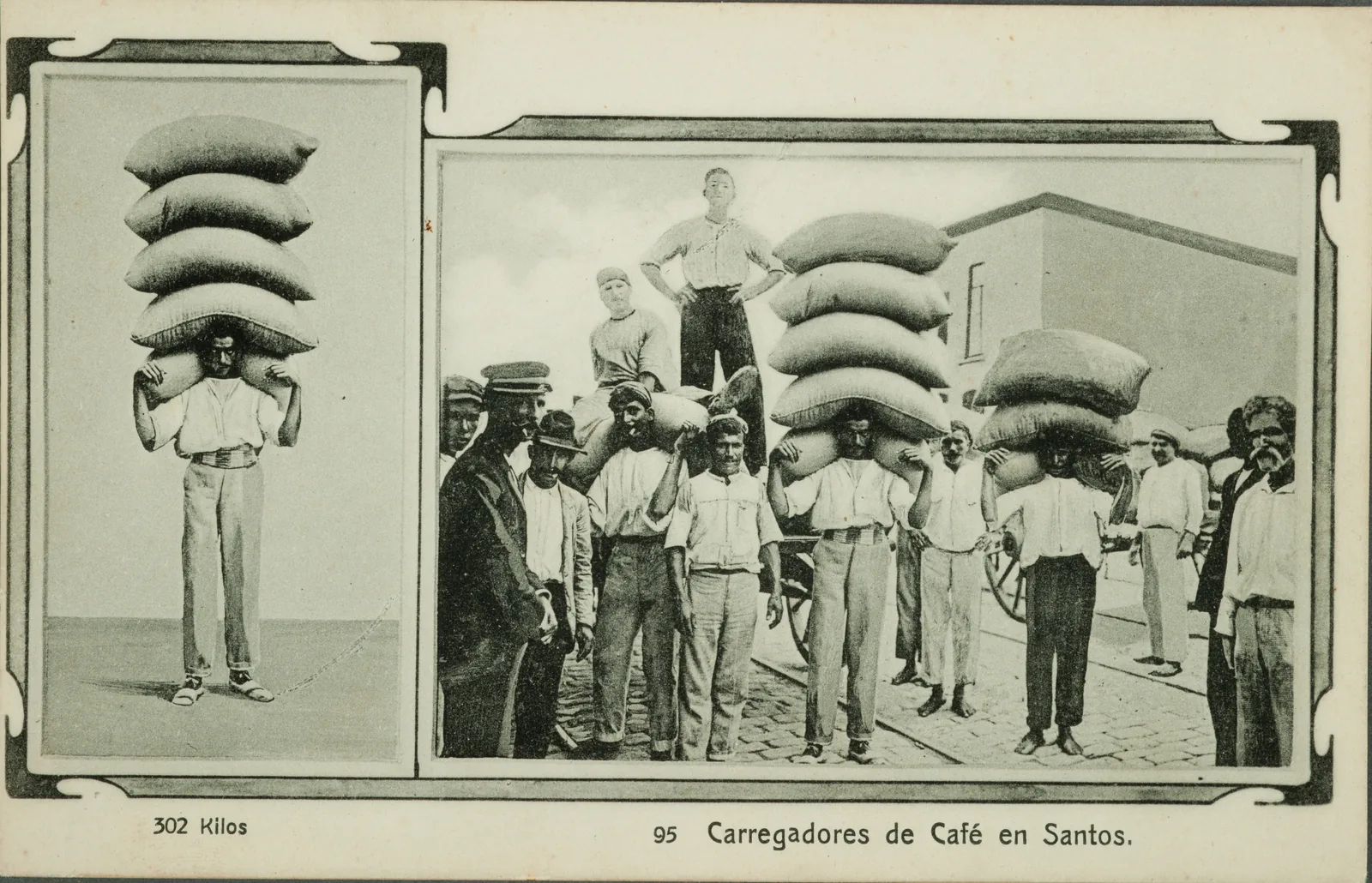
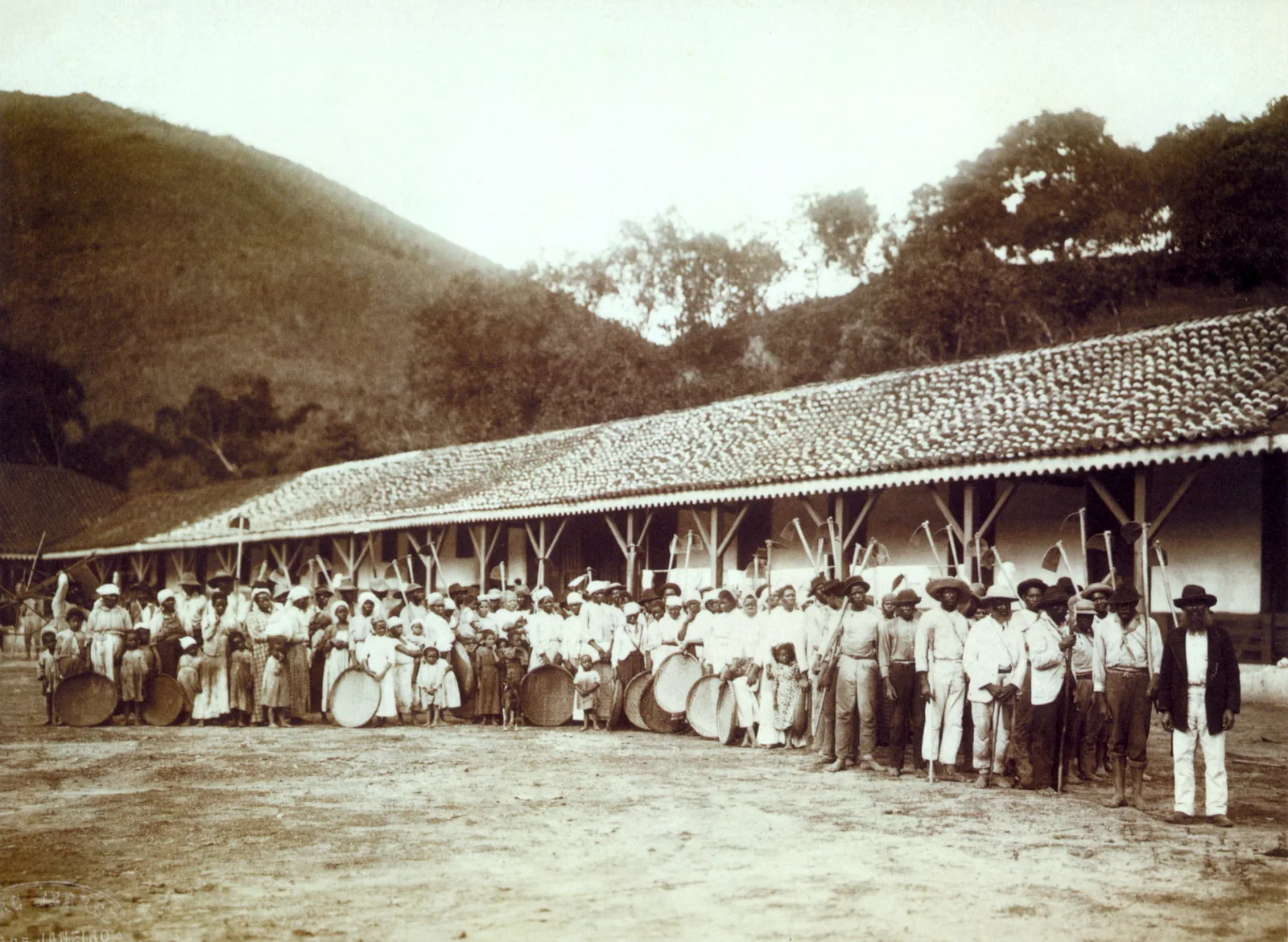
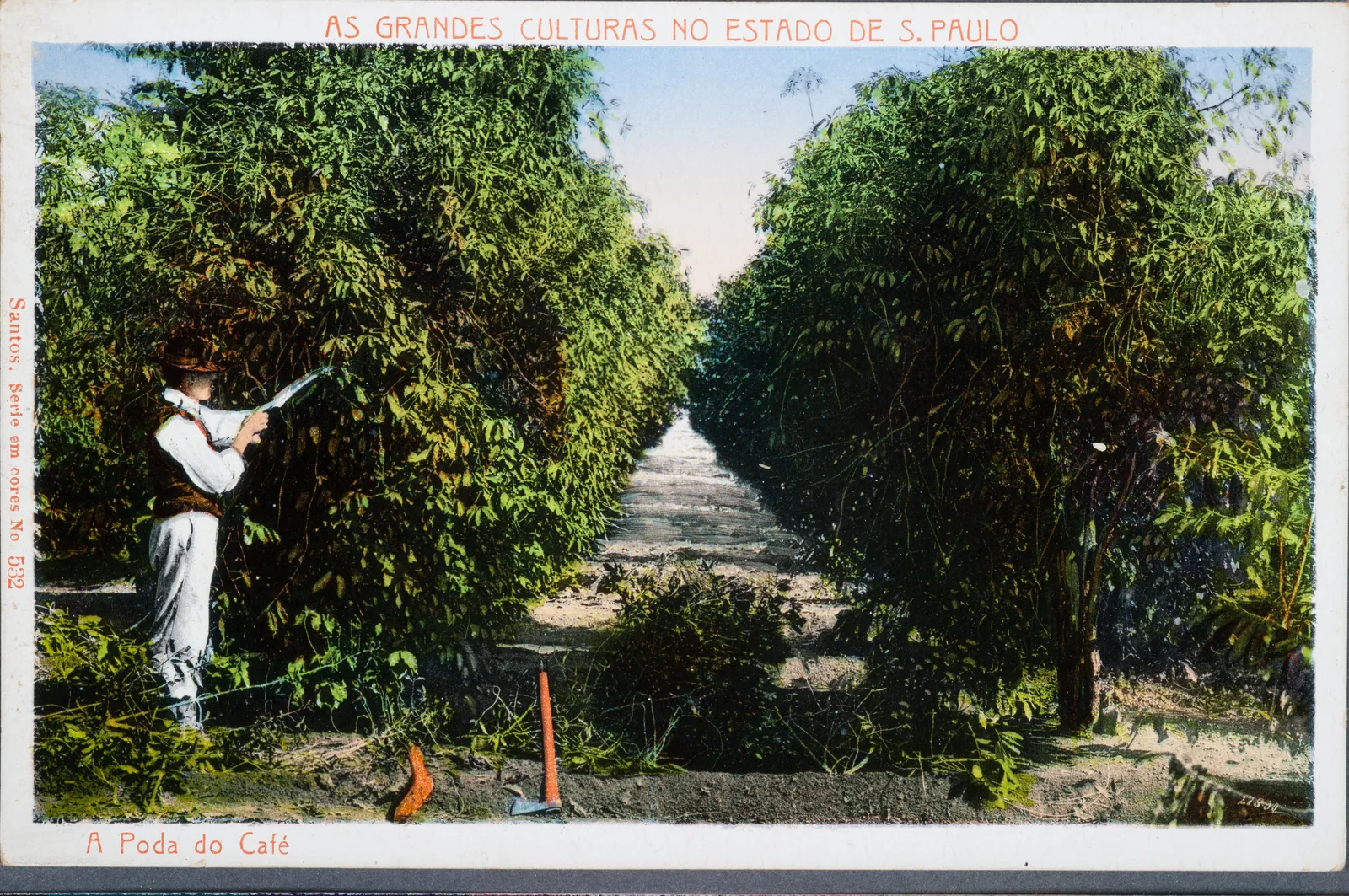
Take a minute with that figure. Each of these bags was planted, weeded, shaded, picked cherry by cherry, pulped, dried, sorted, bagged, loaded. The work of hundreds of thousands of people over thirteen years was loaded into locomotive boilers so that the price would not fall.
This is not a market accident. It is the market working as intended.
Daily Coffee News, 90 Years Ago… (2021); Time, Brazil: Smoke & Mirth (1936); Conselho Nacional do Café; Ukers 1935; see the chronicle landmarks “1929-1930” and “1931-1944”Chapter X
10And it has never stopped
One might think the era is over. It is not; only the scenery has changed.
On July 17 and 18, 1975, the black frost kills about a billion and a half trees in Brazil and devastates Paraná. The world price will more than triple: in March 1977, arabica passes three dollars a pound in New York, a real level never reached again since.
In 1989, the quota system of the International Coffee Agreement collapses. Prices fall. The liberal phase begins.
In 2001 comes the crisis: real prices fall to their lowest since 1900, below the levels of 1930. The International Coffee Organization holds its first world conference in London in May.
And on February 11, 2025, arabica reaches 440.85 cents per pound in New York: the highest in the whole history of the C contract. Frost and drought in Brazil, stocks at their lowest. The same month, a Panamanian Geisha sells for ten thousand dollars a kilo at auction.
The same month. The all-time high of a mass market, and an exceptional lot at ten thousand dollars a kilo. These are two worlds that no longer have anything to say to each other.
ICE Futures US, C contract, all-time high of February 11, 2025; ICO; Pendergrast, Uncommon Grounds; see the chronicle landmarks “July 17-18, 1975,” “1977,” “1989,” “2001” and “February 2025”Go over the list again of what has moved the price of coffee since 1869. A cable cut by Portugal. A cholera epidemic in Rio. A quarantine because of plague. A speculator who left on vacation while his partner was selling. A green coffee trader vacationing in Baden-Baden. A real frost the market took for a rumor. A stock market crash in New York.
In this list, coffee appears twice: in 1975 and in 2025, when there was frost.
It is the only honest conclusion of this story, and it is an unpleasant one. The price of coffee has never been a price of coffee. It is the price of the information we have about it, of the credit that can be mobilized against it, and of the composure of seven or eight people.
The planter, for his part, did the same work all those years.