The room where it all began
An academy of sciences, the oldest insurance company in the world, the London Stock Exchange, the New York one and England's first ballot box were all born in coffeehouse rooms, in less than a century and a half, a few streets apart. This is no coincidence, and we can say why.
Chapter I
01A room where no one gets drunk
To understand what follows, one must first see what the coffeehouse is not: a tavern.
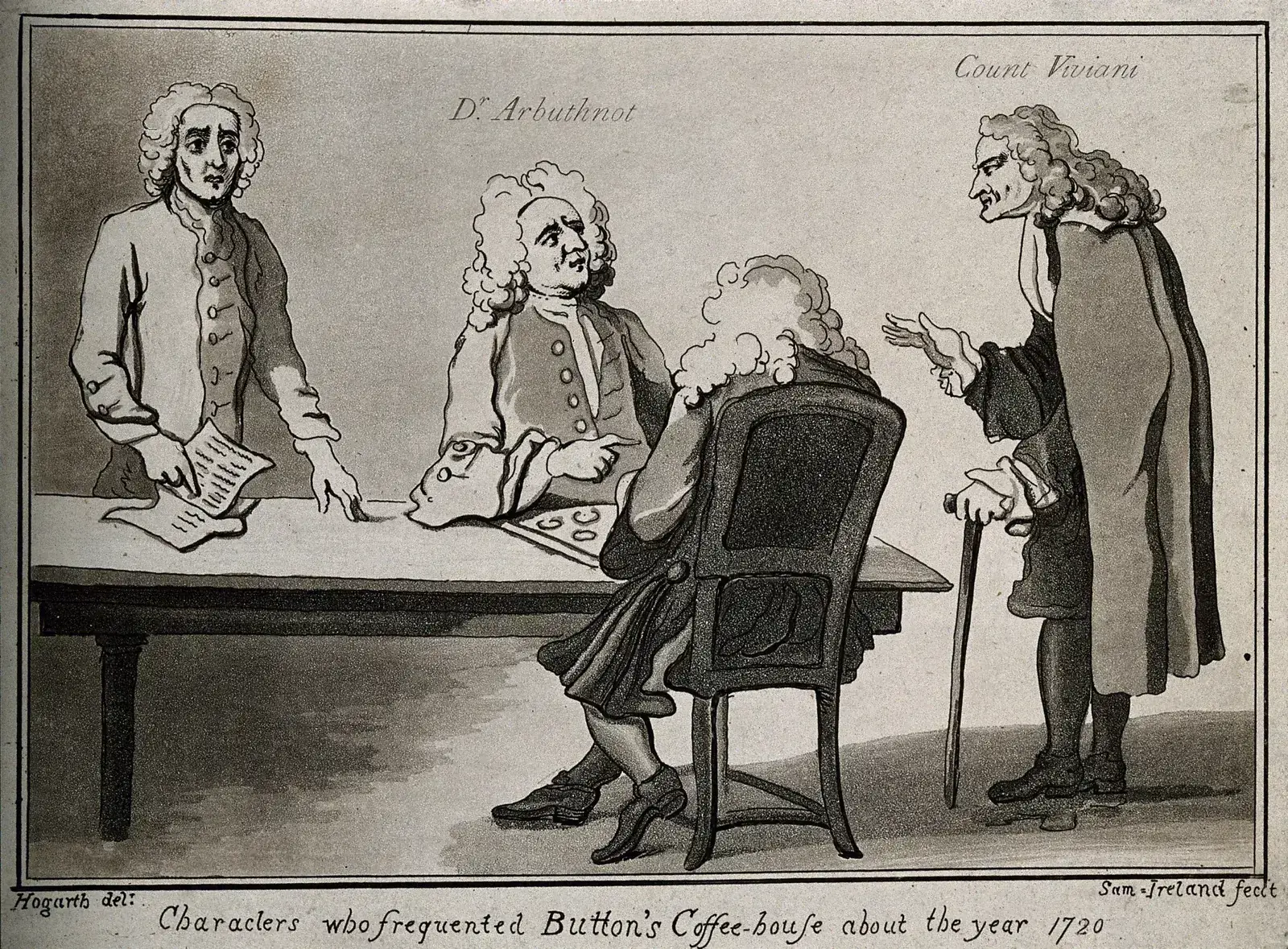
In the 1650s, the coffeehouses of Oxford and London are nicknamed penny universities. For a penny, you get the cup and the conversation: that of scholars, merchants and men of letters, in the same room, at the same time. Admission costs the price of a drink, and this drink does not make you lose your head.
The houses post their “Rules and Orders,” in verse. Everyone sits in the first free seat. Twelve pence fine for an oath. A round for whoever starts a quarrel. No cards or dice.
Read the first of these rules again. Everyone sits in the first free seat. In an England where everything is rank, precedence and birth, here is a room where one sits wherever there is room. We do not appreciate enough what this represents.
Add the rest: people are sober there, so they can count; they are mixed there, so they meet people they do not know; they come back every day, so reputation matters. A room that meets these three conditions is not a drinking place. It is a machine for manufacturing trust between strangers.
Everything that follows comes out of this machine.
Ukers 1922, p. 73 (penny universities and coffeehouse keepers' tokens), p. 58 and 60 (the Rules and Orders and the prices of the Turk's Head in Exchange Alley); see the chronicle landmarks “1650s” and “1662”Chapter II
02Against All Souls
Oxford, around 1655. Royalist students push an apothecary, Arthur Tillyard, to serve coffee publicly; the reported expression is “against All Souls,” that is, opposite the college.
A club forms there. People discuss, experiment and argue there; this lasts until the Restoration.
This club is the origin of the Royal Society.
Take the measure of that sentence. The oldest scientific academy still active in the world begins in the back room of an apothecary's shop, because students wanted a room to meet in outside their college. Köprülü, who had drinkers sewn into leather sacks at the same time, had identified the danger perfectly.
Ukers 1922, p. 41-42, after Aubrey, Brief Lives, and Anthony Wood; see the chronicle landmark “around 1655”Chapter III
03The first ballot box
1659, at Miles's Turk's Head, in Westminster. James Harrington founds a republican club, the Rota.
The furniture alone is worth the detour: an oval table, with a passage cut through the middle so that coffee can be served without disturbing anyone. The members sit in a circle, at an equal distance. Nobody is at the head of the table, because there is no head.
And they vote there. With the first ballot box ever seen in England.
Pepys, who stops by, simply calls it the Coffee Club. Milton is a member. Marvell is a member. Petty is a member.
We must pause a second on what this is. A small group of men, around a table without precedence, in a room one enters for a penny, invents the very object of the secret vote, in a country that has no republic and will not have one. The room precedes the institution by more than a century.
Ukers 1922, p. 58-59, after Aubrey and Pepys's Diary; see the chronicle landmark “1659”Chapter IV
04Mr. Lloyd's lists
Let us move from politics to commerce, and watch a coffeehouse keeper at work.
Around 1688, Edward Lloyd runs a coffeehouse on Tower Street, then on Lombard Street. His clientele is made up of shipowners and insurers. So he does something simple and considerable: he posts lists of ships for them.
That is all. A proprietor who pins to the wall the information his customers need, so that they come back to him rather than to the place across the street.
From these lists descend Lloyd's List and Lloyd's of London.
That is the mechanism, and it is exemplary. Nobody in this room founds an institution. People there want to know which ship has come home, to decide whether to insure the next one. The institution is the residue of a habit.
Ukers 1922, chapter on the coffeehouses of London, Lloyd's coffee house, p. 86; Lloyd's of London, history; see the chronicle landmark “around 1688”Chapter V
05Across from Garraway's
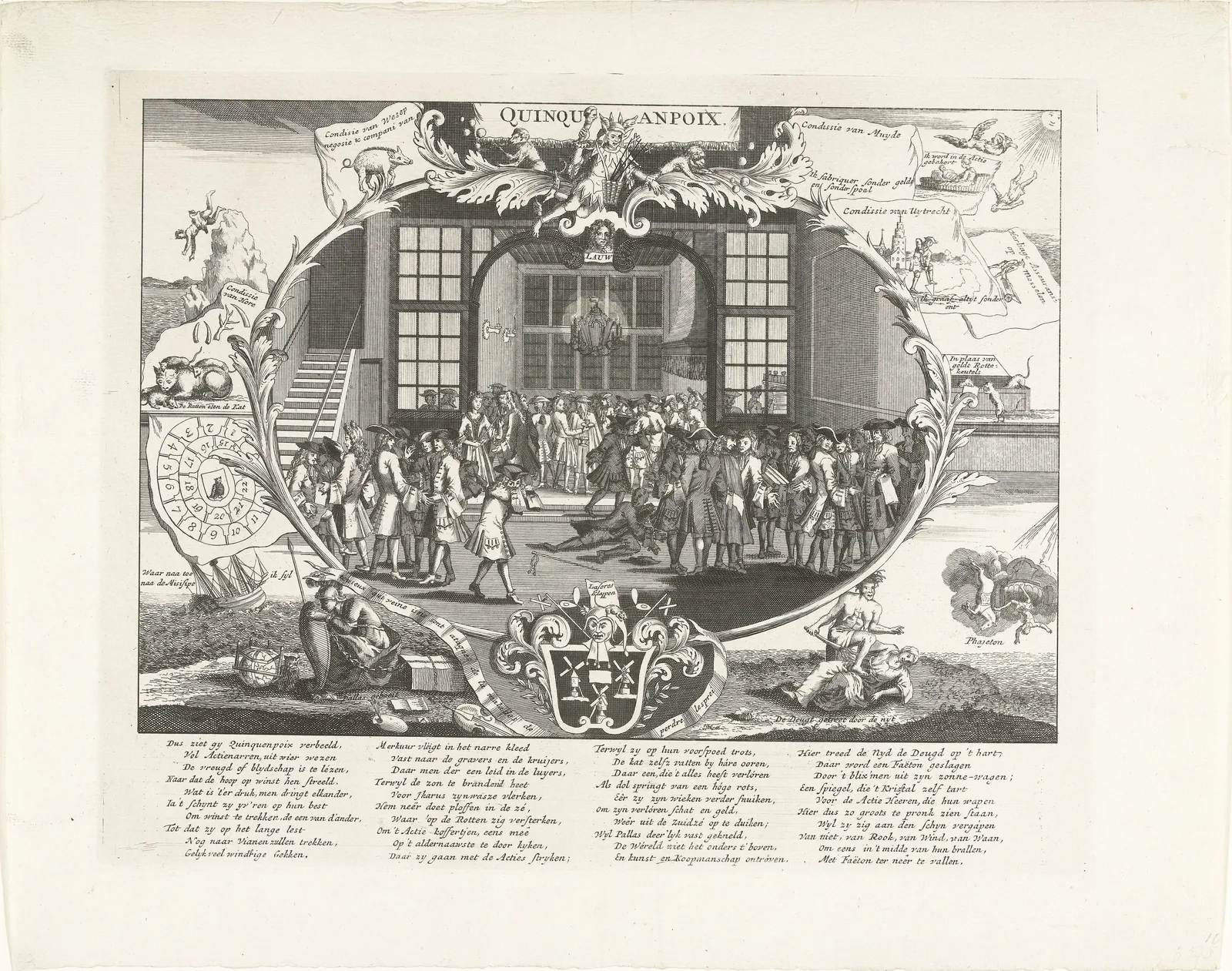
The same year, a few steps away, in Change Alley, Jonathan's Coffee House becomes what the Tatler will call the “general market of speculators.”
Shares are traded there. People speculate there. Prices are shouted out there. The London Stock Exchange descends from it, exactly as Lloyd's descends from the coffeehouse on Tower Street.
Across the way, at Garraway's, they pride themselves on having been the first to sell tea in England, which is another story, and a fine irony for this neighborhood.
One street, two coffeehouses, two global financial institutions. It is not that coffee made people better at business. It is that a room where strangers see each other every day, judge each other, and know that their reputation stays there is exactly the place where one can promise money to one another without a contract.
Ukers 1922, p. 84-86 and 89, quoting the Tatler; see the chronicle landmark “1688 · Jonathan's”Chapter VI
06The day the coffeehouse keepers wanted a monopoly on the news
1729. The coffeehouse keepers of London have understood what they were producing. They are going to understand it a little too well.
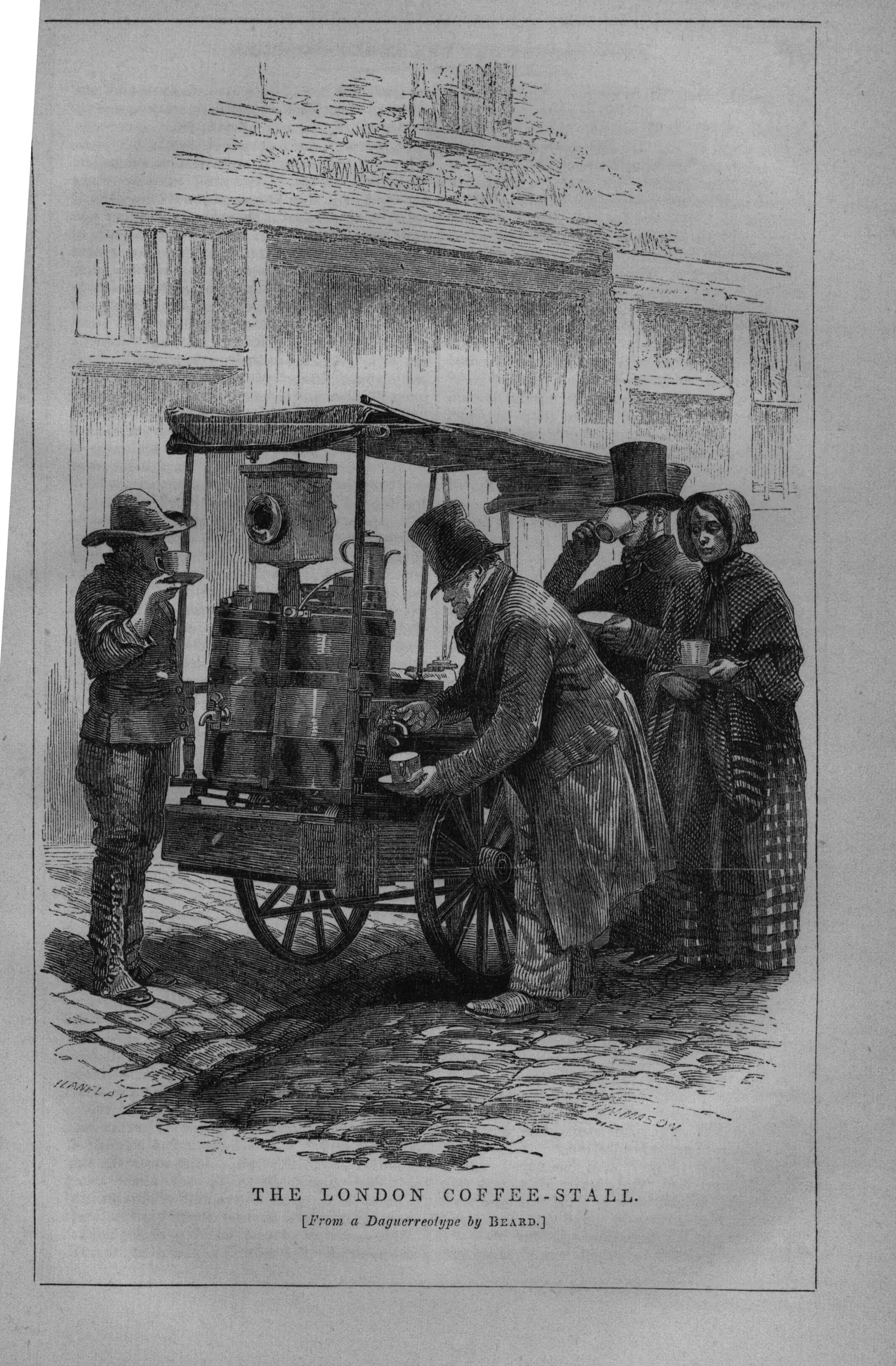
Sure of their power, they ask the government for a monopoly on the news. The plan is detailed: a Coffee House Gazette, written by the customers themselves on brass slates placed in the rooms, collected twice a day.
Let us stop here, because the object is astonishing. A network of public rooms, a collection twice a day, a text written by the readers. They will later be reproached for having been presumptuous; one may also notice that they had described, two and a half centuries ahead of time, something that has become familiar to us.
Ukers sums up the fate of the proposal in one phrase: it was met with the contempt it deserved.
He is probably right on the substance: a private monopoly on information is never a good idea. But the request says something true about these houses: they no longer saw themselves as businesses. They saw themselves as a press.
Ukers 1922, p. 74; see the chronicle landmark “1729”Chapter VII
07The best English prose
1763, at the Turk's Head in the Strand. Samuel Johnson founds a literary club that will meet until 1783.
The list of members is enough: Goldsmith, Boswell, Burke, Garrick, Reynolds, then Gibbon and Adam Smith.
Ukers draws a conclusion that may seem excessive and that he stands by: the best English prose owes something to coffee.
Excessive, really? These men saw each other because there was a room where one could sit without an invitation, stay for hours for a penny, and talk to someone one had not planned to meet. Remove the room and you do not remove their talent, you remove their meetings. It is not the same thing, and it is not nothing.
Ukers 1922, p. 81, after Boswell, Life of Johnson; see the chronicle landmark “1763”Chapter VIII
08The stone of June 5, 1792
Let us cross the Atlantic, where the same thing will be done, but deliberately this time, and before a notary.
On June 5, 1792, a hundred and fifty New York merchants lay the cornerstone of the Tontine Coffee House. The financing is a tontine: two hundred and three shares of two hundred pounds. The great room will be the New York Exchange, with two registers of ships “as at Lloyd's.” The reference is explicit; they know very well what they are copying.
The Stock Exchange will sit there in 1817.
And that room will also have its moment of intimate history: it is on its walls that the bulletins on Alexander Hamilton's death throes will be posted, after his duel.
Note the reversal. In London, the institution had come out of a habit, without anyone intending it. In New York, the coffeehouse is built first so that it becomes an exchange. In a century, the mechanism went from chance to method.
Ukers 1922, p. 121-123; see the chronicle landmark “June 5, 1792”Chapter IX
09Seven floors, and a fire
The peak and the end fit in the same building.
In 1808, Boston opens Bulfinch's Exchange Coffee House. Seven floors of stone, marble and brick. Half a million dollars. Two hundred rooms. A maritime news room modeled on Lloyd's. President Monroe is received there at a banquet in 1817.
The building burns down in 1818.
And the same year, something more discreet happens in Le Havre: the coffee market is founded there. Not a coffeehouse: a market. In 1882, the New York Coffee Exchange opens its windows, Le Havre inaugurates the first French futures exchange for coffee, Amsterdam and Hamburg will follow in 1887.
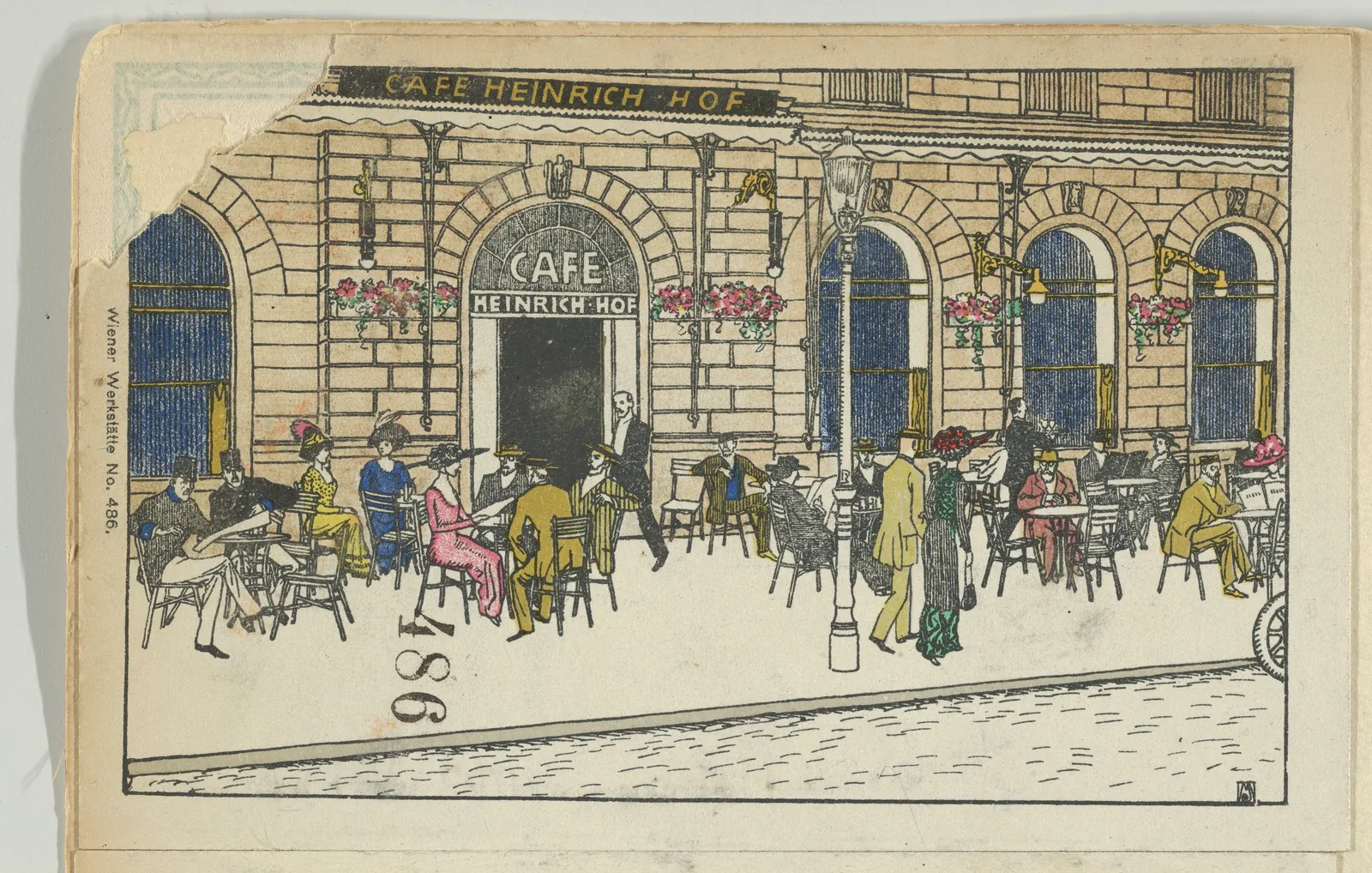
You see the movement. As long as a room was needed for strangers to trust each other, the room served for everything: people insured there, voted there, published there, did science there. The day the instruments of that trust exist on their own: an insurance policy, a share, a quotation, an exchange rule. The room becomes again what it was: a place where one drinks coffee.
Ukers 1922, p. 113-114 (Boston's Exchange Coffee House) and chronology; see the chronicle landmarks “1808,” “1818” and “1882”Let us go through the list again, and look at the dates:
- 1655Oxford
- 1659Westminster
- 1688Tower Street
- 1688Change Alley
- 1763the Strand
- Wall Street 1792. A hundred and thirty-seven years. An academy of sciences, a ballot box, an insurance company, two exchanges and a literary club.
All of this came out of a room where one sat in the first free seat.
One irony remains, which the rest of the story did not miss. These rooms had invented the instruments that allow people to promise each other money on a commodity they do not yet have. In 1882, these instruments turn back to the commodity that had seen them born: coffee goes onto the exchange.
What follows is far less commendable.