Banning coffee
For three centuries, governors, sultans, muftis, a king of Prussia and a bishop of Münster tried to ban coffee. All of them failed. And all of them failed in the same way, for a reason that none of them wanted to face.
Chapter I
01The word that made it all possible
In Arabic, qahwah did not mean coffee. The word meant wine.
Everything starts there, and we must dwell on it for a minute, because without this oddity of vocabulary nothing that follows would have been possible. The Sufi brotherhoods of Yemen, in the 15th century, adopt the decoction of beans to stay awake during nights of devotion. They were looking for something to keep them awake, and incidentally something to replace what was forbidden to them. They give their discovery the name of the forbidden thing.
The name gives it away. The censors will make use of it.
Because in this story there is a problem of law before there is a problem of morals. Wine is forbidden, it is written. Coffee is written nowhere, since the plant did not exist when the texts were fixed. To reach it, one must therefore bring it into them, and the shortest path goes through its name. For three centuries, everyone who wants to ban coffee will begin by trying to show that it is something other than coffee: wine, intoxication, or, we will get to it, charcoal.
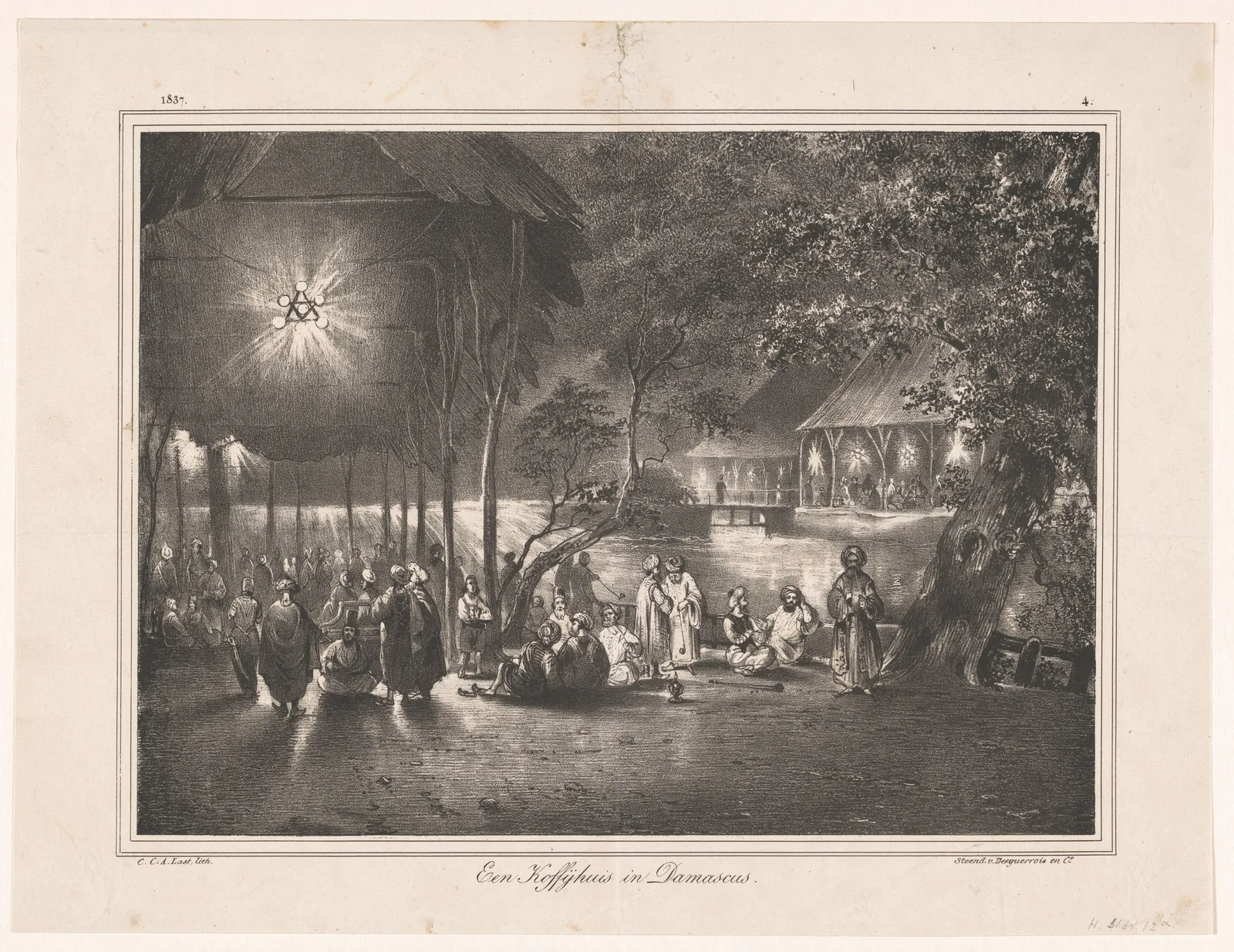
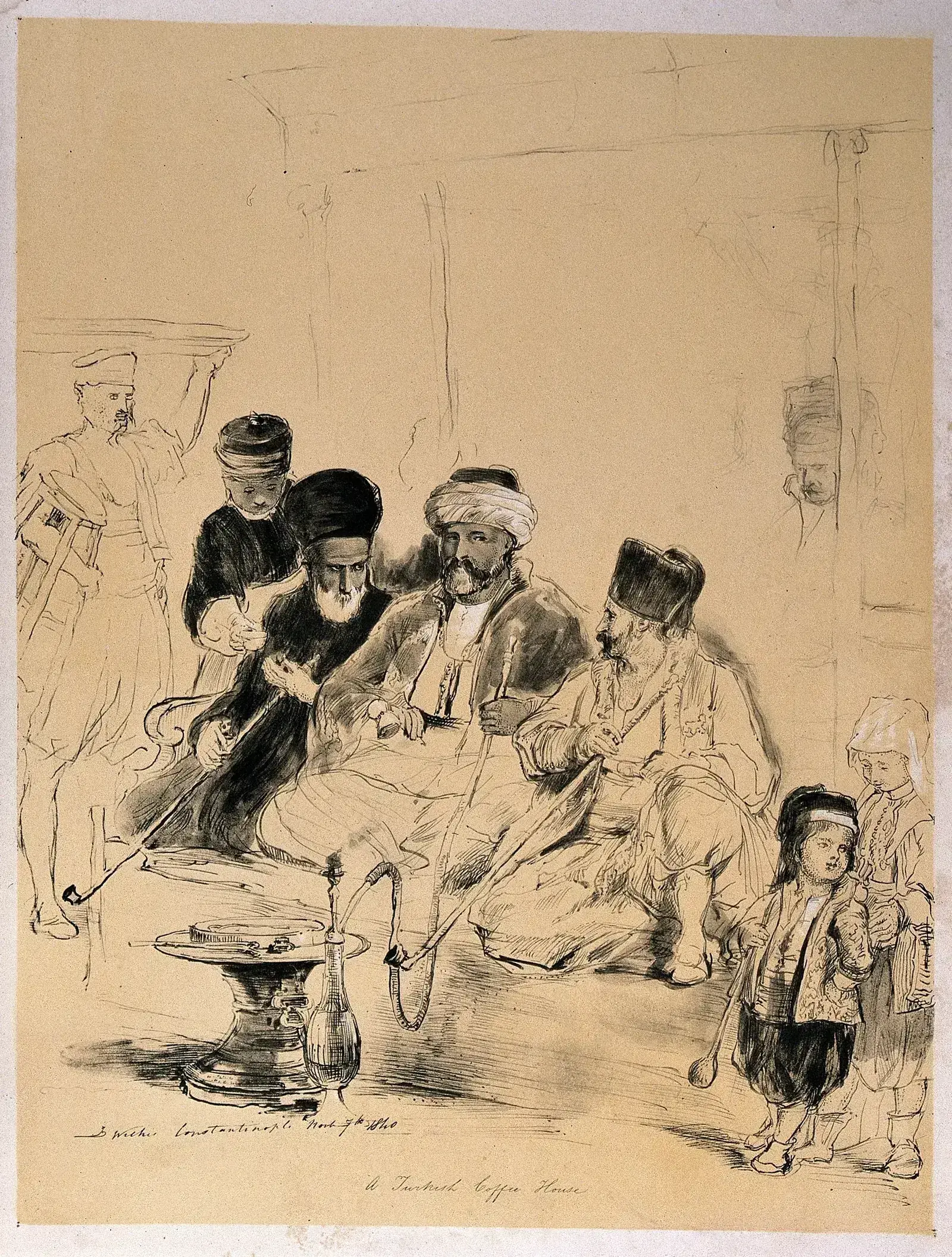
In 1510, in Cairo, the Yemeni dervishes, that is, the members of the Sufi brotherhoods, drink coffee on nights of devotion from a large red clay vessel; the superior draws from it for each, chanting, then the bowl passes to the laity. That is the gesture. It is religious, it is collective, and it takes place in a mosque. The same year, in Mecca, the drink leaves the mosque and enters the kaveh kanes, where people play chess and sing. These are the first coffeehouses in the world.
The whole affair lies between these two sentences. Coffee posed no problem as long as it was drunk at the mosque. It poses one the very year it settles into a room where people come for something other than prayer.
Ukers 1922, p. 18-20 (the word qahwah, the dervishes of Cairo, the first kaveh kanes); La Roque 1715, quoted by Ukers; La Roque 1716, 1732 translation; see the chronicle landmarks “around 1500” and “1510”Chapter II
02What frightened them
Before looking at how they go about it, we must ask what worries them. Because none of these men gets up one morning and decides that a hot drink is the enemy. They have reasons, they rarely state them, and they are not the same in Mecca in 1511 and in Berlin in 1781.
First, a room that nobody supervises. Think about where people used to gather before. The mosque, the market, the prince's court, the home. Each of these places has a master: an imam, a guild, a lord, a father. The coffeehouse has none. You pay, you sit down, you stay as long as you like, and nobody in the room owes anything to anybody. For a governor in 1511, this is not a business, it is a hole in the map of his city.
Next, it takes up the hours of prayer. Remember the detail from the previous chapter: in 1510, the drink leaves the mosque to enter the kaveh kanes. The same men, the same evening hours, but no longer the same place. The Sufis drank coffee to stay awake during the service. The laity end up drinking it instead. A drink invented to serve devotion begins to compete with it, and in its own time slot.
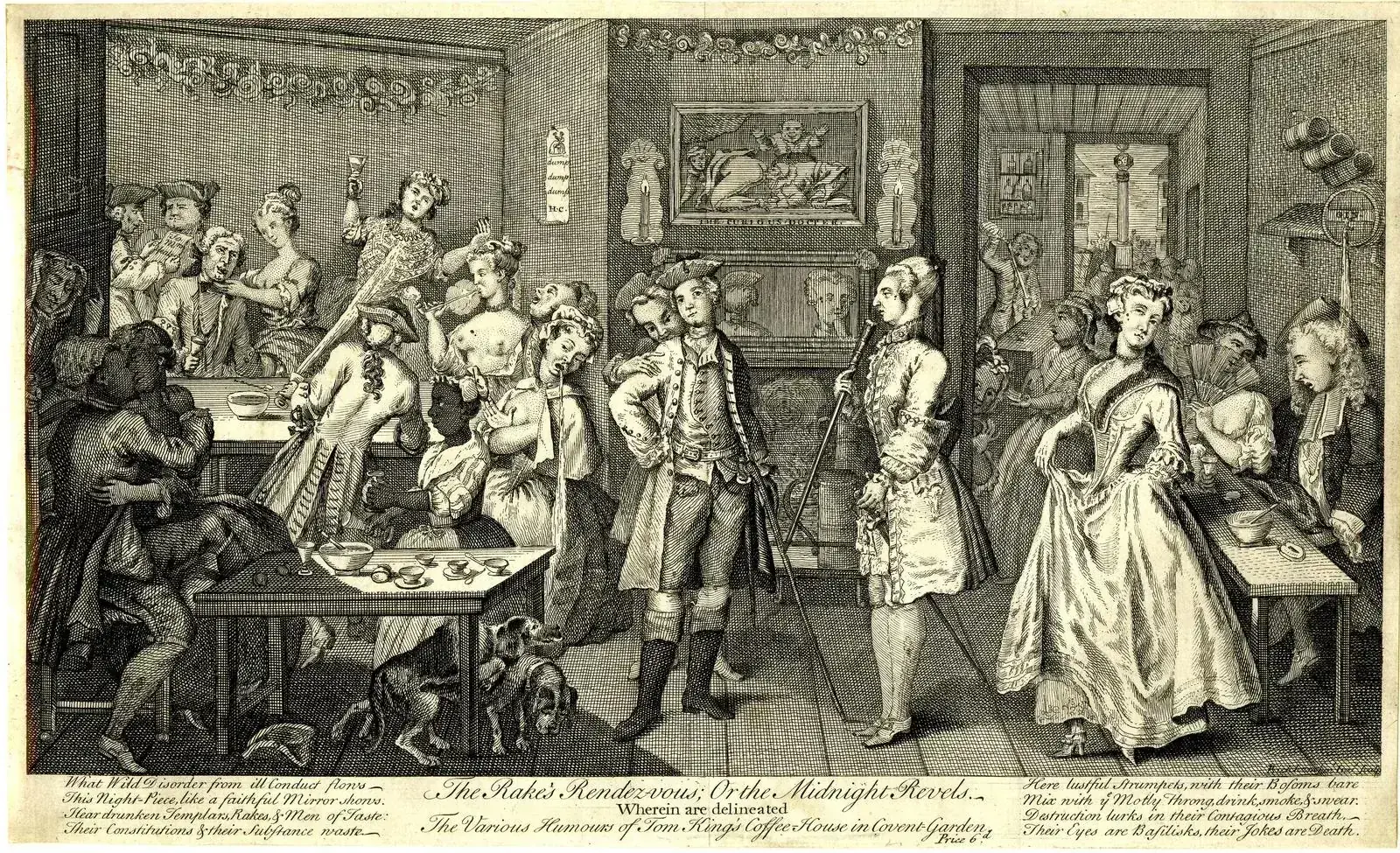
Then, people talk there. The sources describe what is done there: people play chess, sing, recite, chat. Put like that, it is harmless. Except that in an age when news travels by word of mouth, a room that fifty men pass through every day is quite simply the fastest medium in the city. Charles II will say so bluntly in his proclamation of 1675: they are “hotbeds of sedition,” that is, places where people plot against the king.
And the grand vizier Köprülü closes the coffeehouses in 1656, precisely during a war he is in the process of losing. A fragile power does not fear that people drink. It fears the room where people comment.
And then there is the money, which nobody admits before Frederick II. Coffee is bought abroad, beer is brewed at home, and every cup is a coin leaving the kingdom. In Mecca, it is smaller and more human: one of the two physicians who will testify against coffee had already written against it and feared for his clientele. One rarely defends an idea without defending one's livelihood at the same time.
Now look at this list. A room without a master, hours stolen from prayer, conversations that cannot be controlled, and money leaving. Not one of these four reasons concerns taste, health or even the drink.
That is why none of these bans worked. They went after what people drank because they could not go after what people said.
Ukers 1922, p. 19-22 (the kaveh kanes, the games and songs, the trial of 1511), p. 47-48 (Frederick II's manifesto) and chronology p. 726 (the proclamation of 1675 and Köprülü's ban); La Roque 1716, 1732 translationChapter III
03The trial in Mecca
1511. The governor of Mecca is called Khair Beg. He does what governors do: he notes that gatherings are being held that he does not control, and decides that this must stop. He needs a motive. He finds it in the name: he sees in coffee the shadow of wine, and convenes an assembly to have scholars say so.
What happens that day deserves to be told in detail, because the first trial of coffee already contains all the others.
Two Persian physicians come forward, the Hakimani brothers. One of them had already written against coffee and feared for his clientele: he therefore has a personal interest in the verdict, and nobody thinks to be troubled by it. The two men declare the plant cold and dry. In the humoral medicine of the time, this is a full medical condemnation.
Then comes a witness, and the hearing tips into something that looks very much like a farce. This man claims that coffee intoxicates like wine. He knows it, he says, because he has experienced it. It is immediately pointed out to him that he has just publicly admitted to drinking wine. He is bastinadoed on the spot, that is, beaten on the soles of his feet before the assembly.
In the whole assembly, only one man defends coffee: the mufti of Aden. A mufti is a jurist whose job is to say what religious law permits, and his opinion carries great weight. Only one, then, but he comes from the city through which coffee entered the world, and he knows what he is talking about.
The edict is pronounced. It will not hold. The sultan of Cairo overturns it, and the reason he gives deserves to be remembered, because it is unanswerable: even the sacred water of Zamzam, the well of Mecca where all pilgrims come to drink, can be abused. In other words, the abuse of a thing says nothing about the thing. In one sentence, the argument that will be used to ban coffee for three centuries is disarmed for three centuries, which will not stop anyone from taking it up again.
The epilogue is brutal in a way that reminds us where we are. Governor Khair Beg will end up tortured for embezzlement, the period word for an official having helped himself from the till. The two physicians will be executed in Cairo, not for their complacent expertise, but for having cursed Sultan Selim I. Nobody in this affair died for coffee.
Ukers 1922, p. 20-21, after the Abd al-Qadir manuscript translated by Galland in 1699; La Roque 1716, 1732 translation; see the chronicle landmarks “1511” and “1511 · the trial”Chapter IV
04It is not the coffee, it is the room
If you wanted proof that these bans never targeted the drink, here it is, and it is written in black and white.
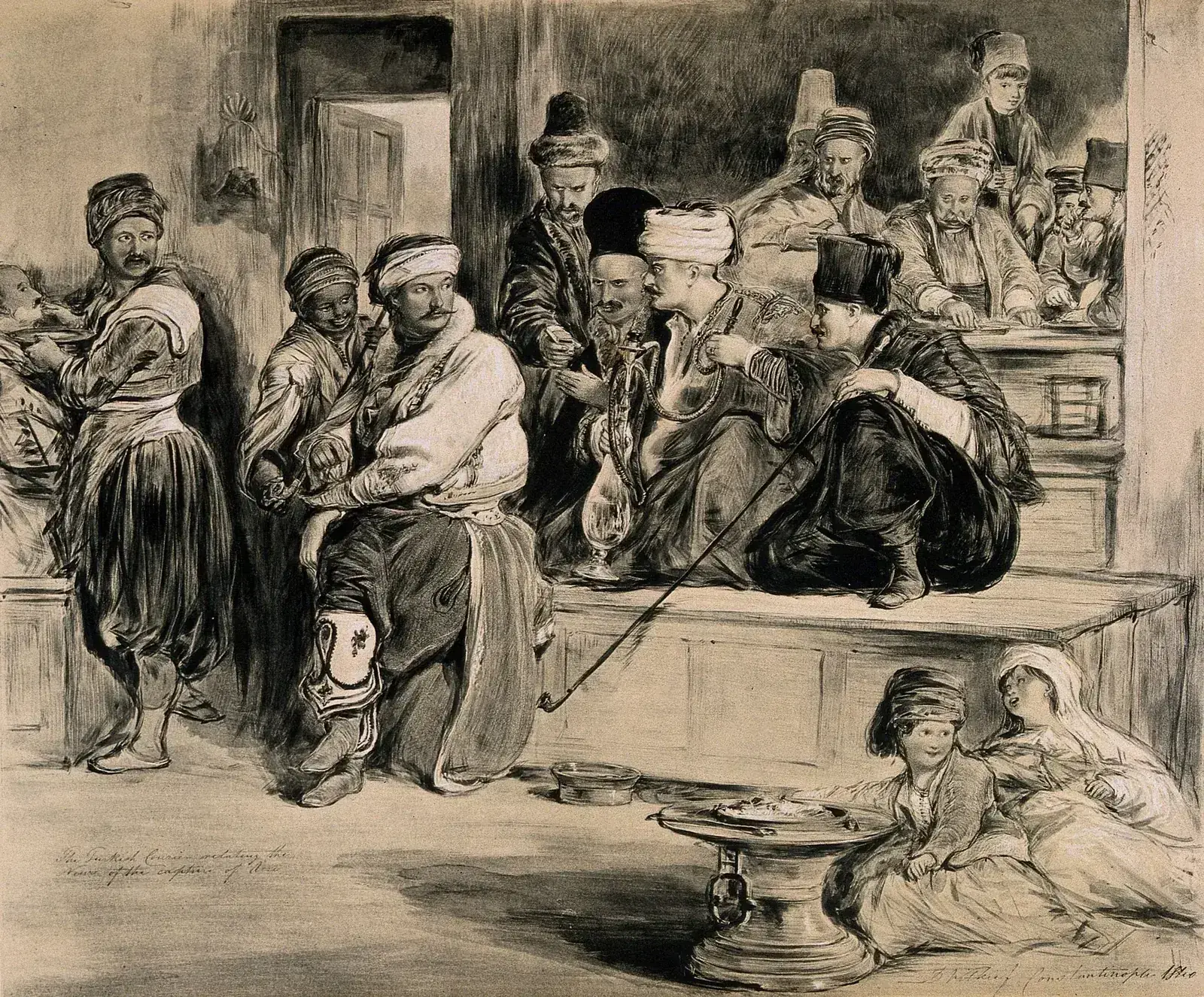
1524, Mecca. The qadi, the city's judge, closes the coffeehouses on grounds of disorder. But he explicitly tolerates the drink at home. His successor will reopen the establishments, under license. Drink as much as you like, but not together, and not without authorization.
1534, Cairo. A preacher stirs up the crowd against the coffeehouses, which are ransacked. The city divides. The chief judge summons the physicians, listens to them, then has coffee served to the whole assembly and drinks it himself before it. The quarrel stops short. It is not an argument, it is a piece of staging, and it works better than any argument, because everyone understands that authority has just ruled for public order and not for theology.
1543, Constantinople. Suleiman gives orders in his turn. The goods are thrown into the sea. And trade continues, through the very city that has just condemned it. They seize, they drown, they cash in.
Around 1580, the peak of the genre is reached. The clerics of Constantinople obtain from the mufti a ruling of devious elegance: roasted coffee is charcoal, therefore a burnt matter, therefore forbidden. Murad III orders the coffeehouses closed. And then? Then people drink behind closed doors, and the officers charged with enforcing the ban turn a blind eye for payment.
Look at the mechanism, it is always the same. You cannot ban a drink that is written in no text: so you must reclassify it. As wine, as intoxication, as charcoal. And once the reclassification is obtained, it is of no use, because what was to be closed was not the cup but the room, and the room moves.
Ukers 1922, chronology p. 725-726 and p. 20-22; La Roque 1716, 1732 translation; see the chronicle landmarks “1524,” “1534,” “1543” and “around 1580”Chapter V
05The leather sack
1656. The Republic of Venice and the Ottoman Empire have been fighting over Crete for years; the War of Candia drags on, is costly, and is going badly. The grand vizier Köprülü abolishes the coffeehouses.
His penalty is graduated. For the first offense, the bastinado. For the second, the offender is sewn into a leather sack and thrown into the Bosphorus.
We must gauge what this means. We are very far from fines and licenses. A man can be drowned for having drunk a second coffee in the wrong place. It is, in this whole story, the most extreme sanction ever pronounced. And it fails too.
Why does a vizier in the middle of a war go after coffeehouses rather than anything else? The answer is in the date. A power that is losing a war does not fear that people drink: it fears the room where the war is commented on. Köprülü is not fighting a substance, he is fighting a nascent public opinion, and he is perfectly right about the danger, since fifty years later, in London, that very room will have founded an insurance company, an exchange and an academy of sciences.
But that is another story.
Ukers 1922, chronology p. 726; see the chronicle landmark “1656”Chapter VI
06Charles II asks his judges
Let us move to England, where the affair takes a turn the East had not known: that of a question of law put by a king to his own judges.
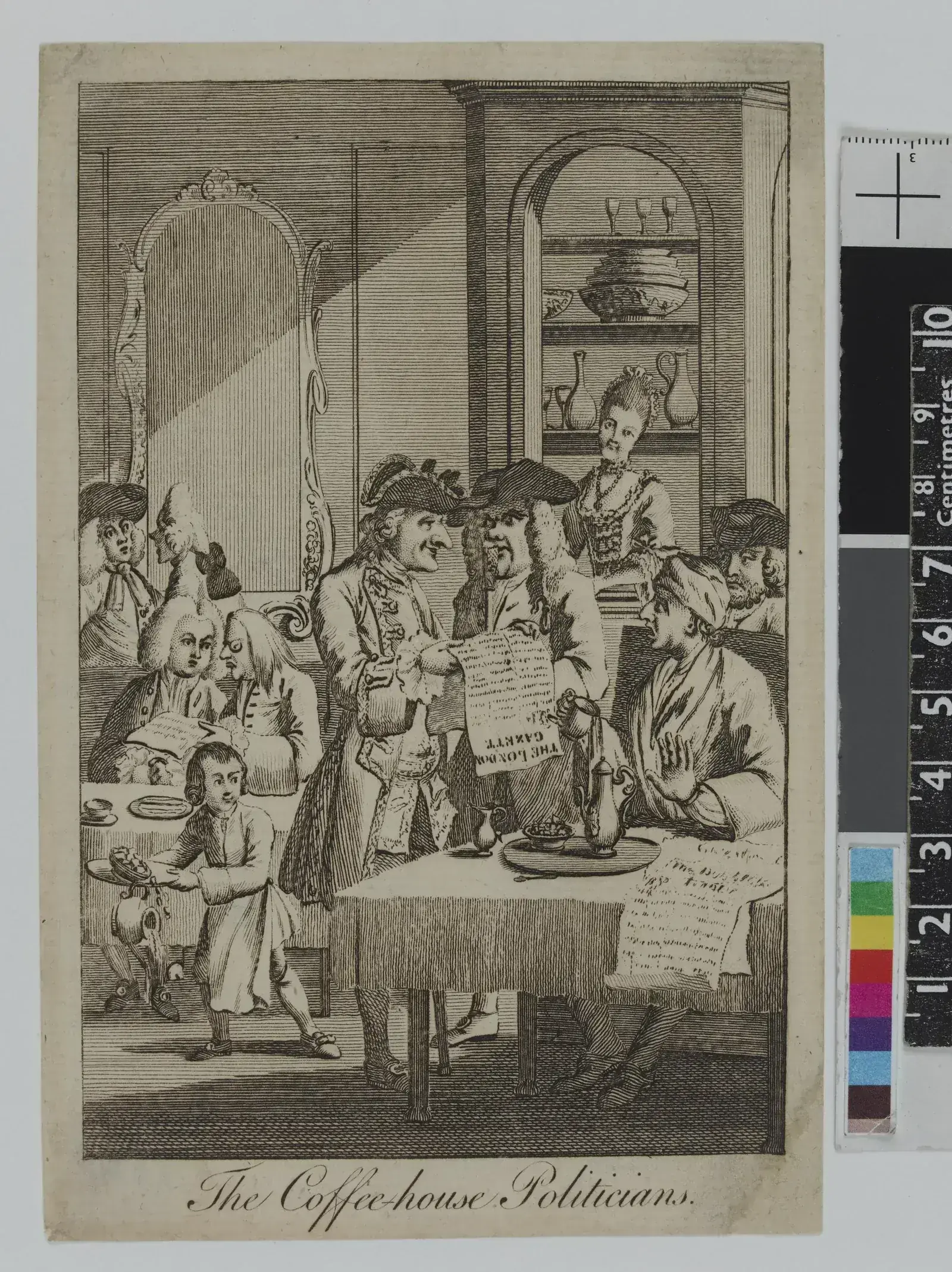
The coffeehouses of London have become institutions. They are nicknamed penny universities: for a penny, the cup and the conversation of scholars, merchants and men of letters. They post their “Rules and Orders” in verse: everyone sits in the first free seat, twelve pence fine for an oath, a round for a quarrel, no cards or dice. A place that writes its own rules is a place that governs itself, and that is exactly what begins to cause worry.
The attacks come first from below, and they are mostly comic. We must set the scene, because without it the joke falls flat.
The first coffeehouse keeper in London is called Pasqua Rosée. He opened in 1652 in St Michael's Alley, a lane in the City, and had printed for the occasion a leaflet praising the merits of his drink, The Vertue of the Coffee Drink, which is quite simply the first printed advertisement for coffee. His partner, for his part, was a coachman by trade.
Keep this detail about the coachman, everything is in it.
In 1672 appears a broad-side, that is, a sheet printed on one side only and sold in the street for a few coins, the equivalent of the leaflet of the day. It is titled A Broad-side Against Coffee, or the Marriage of the Turk, and it mocks Rosée and his partner in one sentence: “a coachman was the first here to make coffee, and since then the others have run the trade.”
Let us translate, because this is where it gets interesting. What the pamphleteer finds scandalous is not the drink. It is that a man who drove horses has taken up trade, and that this trade is doing well. The reproach is not about health, it is social. We find exactly what bothered people in Mecca: a room where one sits in the first free seat is a room where ranks no longer hold.
Two years later, in 1674, The Women's Petition Against Coffee appears, a petition by the women of London accusing the drink of making their husbands sterile and talkative. The men respond with a counter-petition. All of this is pamphleteering, not law, and it is better to laugh at it.
Except that in the same year 1672, something much more serious is happening behind the scenes: Charles II puts a question of law to his judges. How far can he legally crack down on coffeehouses?
Let us stop here, because this question had never been asked anywhere. In Mecca, in Constantinople, in Cairo, power bans and discusses afterward. Here, a king first asks whether he has the right. It is already a defeat half completed.
The judges reply that this “might be an innocent trade.” In plain terms: we do not see what you can base this on.
He takes no notice. On December 29, 1675, a proclamation orders the closing of all the coffeehouses of London, hotbeds of sedition.
It is revoked in January 1676, in the face of the merchants' petition.
A few weeks. That is all the most famous ban on coffee in Europe lasted. And it is revoked not in the name of liberty, nor of health, nor of theology, but because trade asked for it. It had already been written, ten years earlier, in an anonymous pamphlet, that coffee and the Commonwealth “begin with the same letter and came in together for a Reformation.” The joke was apt.
Ukers 1922, p. 53-56 (Pasqua Rosée and his leaflet of 1652), p. 73 (penny universities), p. 58 and 60 (the Rules and Orders), p. 65-72 (The Character of a Coffee-House), p. 75-77 (the Broad-side and the consultation of the judges, after Roger North, Examen), chronology p. 726; The Women's Petition Against Coffee, London, 1674Chapter VII
07“We do not know”
On February 27, 1679, at the city hall of Marseille, a public disputation is held on the dangers of coffee.
The subject has changed. It is no longer about what is lawful and unlawful, it is about health. Does coffee make you ill? Does it dry out the humors? Does it shorten life? The physicians confront each other before the assembled city, and it is, in its way, progress: we have gone from the tribunal to learned controversy.
The honest answer, that day, comes down to one thing: we do not know.
Keep this date. It is the pivot of the story. Before, coffee is banned because it resembles wine or because people gather there. After, it will be banned because it costs the kingdom dearly, and morals and health will be fetched as a disguise. Marseille 1679 is the last moment when the question asked is truly the one being asked.
La Roque 1716; see the chronicle landmark “February 27, 1679”Chapter VIII
08Frederick's sniffers
On September 13, 1777, Frederick II of Prussia publishes a manifesto on coffee and beer. He does not beat around the bush.
“It is disgusting to see the quantity of coffee my subjects use… my people must drink beer.”Frederick II of Prussia, manifesto of September 13, 1777
We smile, and we are wrong to stop there. This text is the first in the whole series to tell the truth about its motive: money. Coffee is bought abroad, beer is brewed at home; every cup is a coin leaving the kingdom. The disgust on display is a matter of trade balance.
In 1781, the king moves from words to deeds, and the apparatus he invents is remarkable. The Declaration of the King concerning the sale of roasted coffee, published on January 21, reserves roasting to the royal establishments and to a few licensees: the nobility, the clergy, civil servants. In other words, coffee remains perfectly permitted to those who have the means and the titles. The operation of the monopoly, what was then called the régie, is entrusted to Count de Lannay, who draws a personal income from it.
And all this must of course be enforced. The king then recruits discharged soldiers, who are given a quarter of the fines they bring in, and they are let loose in the streets. Their job consists of walking about sniffing the air, in search of the smell of a bean being roasted in secret. They will be called the coffee sniffers.
Three years later, on February 17, 1784, the elector of Cologne, bishop of Münster, does the same in the duchy of Westphalia: sale of roasted or green coffee forbidden under penalty of a hundred thalers, a sum that represents several months' wages for a craftsman, or two years in prison, only purchases of fifty pounds at a time remaining permitted. That is, again, that only the rich carry on. Denunciations and sniffing poison the duchy. They have no effect on consumption.
What remains is what this particular ban produced, and it is its true legacy. Deprived of beans, the poor of Prussia fall back on barley, wheat, chicory and dried fig. The ersatz was not born of fraud: it was born of a law. A century later, these same substitutes will fill the packages sold as coffee, and it will take a whole other chapter, and a whole other apparatus of detection, to get them out.
Ukers 1922, p. 47-48 (the Declaration of the King of January 21, 1781, Lannay's régie, the quarter of the fines, the substitutes) and p. 48 (decree of the elector of Cologne of February 17, 1784, quoted), chapter on Germany (manifesto of 1777) and chronology p. 727; see the chronicle landmarks “September 13, 1777,” “1781 · Berlin” and “February 17, 1784”Chapter IX
09The twins of Gustav III
We must now tell the Swedish story, and tell it for what it is: a legend. It has no primary source. But it is too telling to be passed over in silence, and the reader has the right to know exactly what he is reading.
It is said, then, that Gustav III of Sweden, hostile to coffee, commuted the sentence of two twins condemned to death. One would drink three pots of coffee a day, the other three pots of tea, until the end of their days, under the supervision of two physicians, in order to establish which of the two beverages kills first.
What follows is what makes the story irresistible. The two physicians died before the twins. The king was assassinated in 1792. And the tea drinker died first, at the age of eighty-three.
No archive records this experiment. What is, on the other hand, perfectly documented, and far less told, is that Sweden banned coffee five times between 1756 and 1823. Five real bans, five real failures. And it is the imaginary experiment that everyone remembers.
There is a lesson here about memory that applies to this whole story. What survives is not what happened, it is what makes a good tale.
Legend with no primary source, reported notably by Weinberg and Bealer, The World of Caffeine (2001); the five Swedish bans between 1756 and 1823 are, for their part, documented; see the chronicle landmark “around 1780,” marked as a legendChapter X
10The last ban no longer resembles the others
Let us skip two centuries. The series is not closed, but it has changed in nature, and it is this change that is interesting.
In 1988, Costa Rica bans by law the cultivation of canephora on its territory. Not the drink: the species. It is the only producing country in the world ever to have done this. The motive has nothing theological or moral about it anymore, and nothing to do with a room where people gather: the aim is to push growers toward arabica, therefore toward quality, therefore toward a price. A ban of industrial policy.
And here is the honesty owed to the reader: what became of this law in 2018 is not clear. An attempt at repeal failed for lack of two thirds of Congress, and yet several sources claim that an opening was granted for hot zones, on the grounds of climate adaptation. The Costa Rican plantings, for their part, remain almost entirely in arabica. We have not got our hands on the text of the law; as long as that is so, this sentence will stay in the conditional mood.
Daily Coffee News, February 2018, on the repeal attempt; BeanScene; the Costa Rican legislative text itself remains to be found; see the chronicle landmark “1988 · Costa Rica”- Let us go through the series again. Mecca 1511, Mecca 1524, Cairo 1534, Constantinople 1543, Constantinople around 1580
- 1656Constantinople
- 1675London
- 1777 and 1781Prussia
- 1784Westphalia
- Sweden five times between 1756 and 1823. Two continents, three centuries, regimes with nothing in common, and not a single success.
Not a single one, and always for the same reason. They thought they were banning a drink; they were banning a room. And a room moves: behind a closed door in Constantinople, at home in Mecca, at the licensee's in Berlin. The only power that obtained anything is the one that banned nothing at all: the chief judge of Cairo, in 1534, who had a cup served to him before the city and drank it.
What remains is what these bans left behind, and it is perhaps the most ironic part. They did not make a single cup disappear. They invented chicory.