Wet hulled
The intermediate processes.
Why hull while still wet?
Start the scene or choose a stage. The animation simplifies the mechanism; what follows gives the details and the available references.
The cherries first go into a water tank: the hollow ones, pierced by the borer, float and are set aside. The cherry enters the pulper at 60 or 65% moisture. The water injected into the pulper does not wash: it lubricates, so as not to split the parchment. The coffee then ferments, generally under water, for 12 to 46 hours according to a regional survey, until the parchment is no longer sticky to the finger.
Read the stages without animation
- Pulp, ferment overnightThe cherries first go into a water tank: the hollow ones, pierced by the borer, float and are set aside. The cherry enters the pulper at 60 or 65% moisture. The water injected into the pulper does not wash: it lubricates, so as not to split the parchment. The coffee then ferments, generally under water, for 12 to 46 hours according to a regional survey, until the parchment is no longer sticky to the finger.
- Wash, drain, deliver wetIn the FAO trial, the schedule fits in three days: washing, half a day of sun drying, collection in the afternoon. The parchment leaves for the collector at 41.7 to 49.0% moisture.
- Wait in bags, unmanagedThis is the step that decides the lot, and no one runs it. The core of the bags goes from 21.5 °C to 34 or 35 °C in two days: microorganisms respire by consuming the remaining sugars. Water activity oscillates between 0.89 and 0.95; black Aspergillus goes from 0 to 4% of beans on the first day to 21 to 97% on the seventh.
- Hull at 40% moistureEverywhere else, the parchment leaves only once the bean is dry. Here, in the hulling workshop, it is torn off at about 40%: the bean is soft and deformable. The screw huller is modified, its steel bar replaced by a rubber belt that peels the parchment without shearing the bean. The signature defect remains the goat's hoof: the tip of the bean splits.
- Dry the bare beanWithout parchment to cross, the steam escapes faster: the bare bean dries down to 12% and takes on its dark bluish green color, its swollen, irregular look. It nonetheless leaves the huller at 14.3% on average, above the 12.5% ceiling of the Indonesian standard.
To remember: The distinguishing feature of the process is the timing of hulling: it is a shift in the drying calendar, imposed by climate and collection, not a managed fermentation.
In history: The huller is of Dutch colonial design, made in Malang; the date of the process is established by no first-rank source.
Read the full article and its sources ↓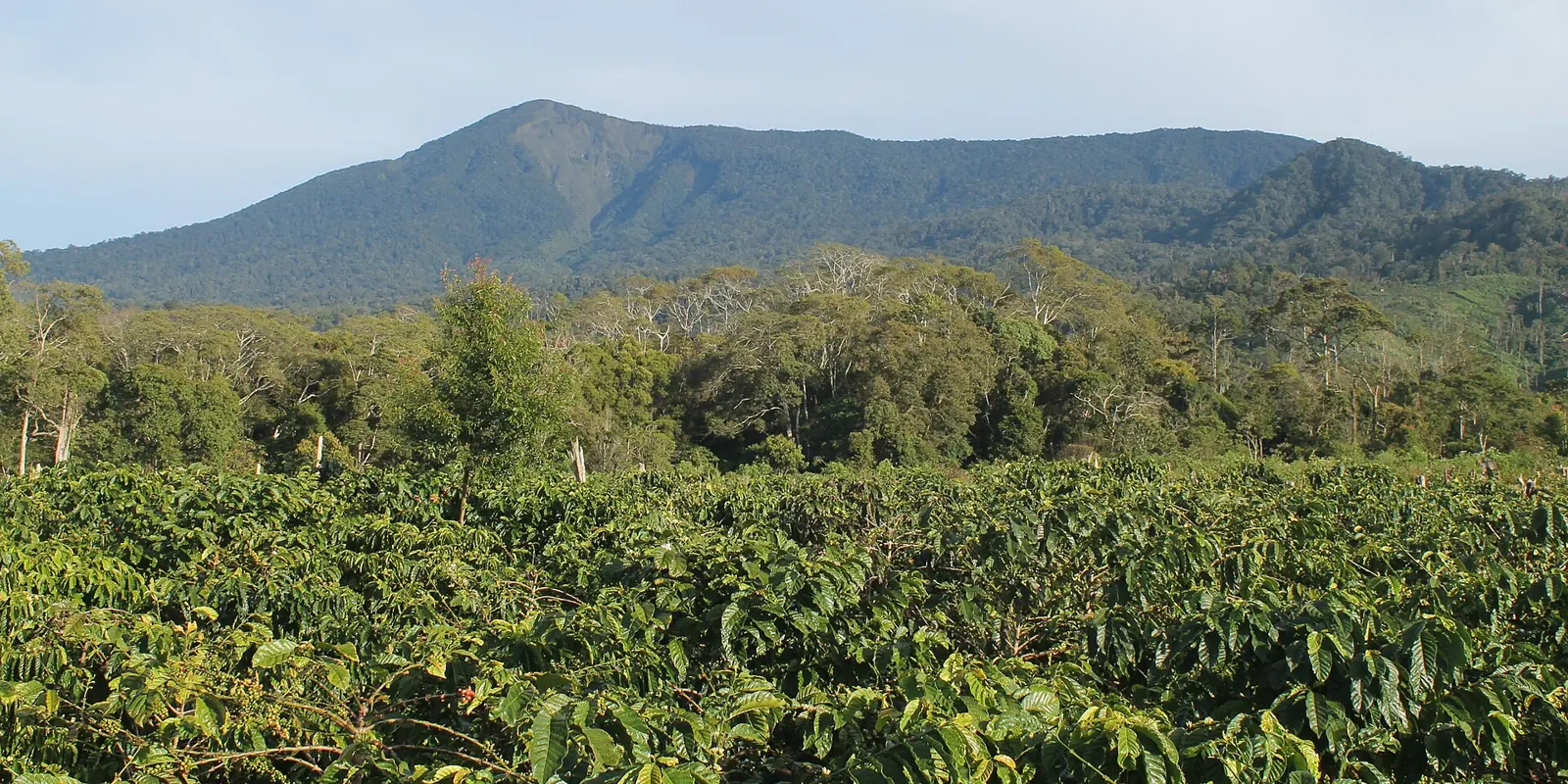
Where it is practiced
Indonesia, almost alone. The home is northern Sumatra, in two zones. In Aceh, the Gayo highlands, with three districts: Aceh Tengah, Bener Meriah and Gayo Lues. Together they carry 94,800 hectares of coffee, most of the production being held between 1,000 and 1,500 meters. In North Sumatra, the districts of Tapanuli Utara and Toba Samosir, around Lake Toba. From there come the names Lintong and Mandheling, exported through the port of Medan.
Mandheling is not a place. The word comes from the name of the Mandailing, a people of southern Tapanuli, and the spelling got distorted in passing into the trade. It is therefore a trade name, not a delimited appellation. This matters for what follows: when four cuppers look for the “Mandheling character”, they are not looking for the same thing.
These volumes grew fast: 12,000 tonnes through Medan in 1992, about 30,000 tonnes estimated for the 2004-2005 season by the Indonesian exporters' association.
The practice is also reported in Sulawesi (Toraja, Kalosi), Flores and Papua, on arabica as on canephora. This extension rests on a secondhand source (see gray area).
Since when, nobody knows. The huller used is of Dutch colonial design, made today by Kemajuan Industries in Malang, on Java. No first-rank source consulted dates the appearance of wet hulled itself (giling basah, in Indonesian), nor fixes the date of arrival of arabica in Sumatra (see gray area).
The principle
All processes resemble one another up to hulling. What defines wet hulled is the moment the parchment falls, the rigid shell that envelops the bean. Everywhere else, one waits for the bean to be dry. The parchment leaves only once the moisture has dropped to the level at which green coffee keeps and is traded, at most 12.5% for the Indonesian standard. Here it is torn off at about 40%.
At this level, the bean is not a dry solid. It is a soft, deformable matter. The huller therefore does not burst a shell around a hard core: it shears a bean that yields. Hence the defect that Indonesian mechanics call the goat's hoof (kuku kambing, in Indonesian), when the tip of the bean splits into two lobes.
Removing the parchment at this stage has two physical consequences, and they run in opposite directions.
The first is sought. Drying speeds up, because water vapor no longer has to cross the parchment to leave the bean. Northern Sumatra has a humid equatorial climate, where rain can return at any moment and interrupt drying. Gaining days on the slab shortens by as much the window during which the lot can degrade.
The second is suffered. The bean stays several days bare, in the open air, with a water activity close to 0.9. Water activity is not a water content. It is the ratio between the water vapor pressure above the product and that above pure water, at the same temperature. It therefore says what share of the water remains available to microorganisms. Most storage molds stop growing around 0.80, and only a few dry-loving species go lower. At 0.9, one is far above this threshold, and for a long time.
It must be said plainly: wet hulled is not a managed fermentation. No one chooses a strain, no one aims for a pH. It is a shift in the drying calendar, imposed by the collection chain and by the climate. This shift opens a long microbial window, which the producer undergoes more than directs.
The sequence
1. Harvest of red cherries. The target stated in the Gayo highlands is at least 85% red cherries and at most 15% yellow, with no green or black. Flotation sorting in a water tank. Hollow cherries, or those pierced by the borer, the small weevil that bores into the cherry to lay eggs, are lighter than water and float. They are handled separately.
2. Pulping the same day. The cherry enters at 60 or 65% moisture. The water injected into the pulper cylinder is not for washing. It lubricates, and reduces the friction of the rotor on the cherry. This is what avoids splitting the parchment right at the start. The clearance between rotor and stator directly governs the breakage rate. Canephora, with tougher skin and scarcer mucilage, requires several passes and more water.
3. Fermentation, generally under water, for 12 to 46 hours on Gayo arabica according to a regional survey. It serves to detach the remaining mucilage, the layer of sweet flesh stuck to the parchment. This mucilage holds by pectins, chains of sugars that form a gel. Enzymes, those of the fruit and those of microorganisms, cut these chains, and the gel comes apart. The stopping point is judged by finger: when the parchment is no longer sticky, it is done.
4. Washing, then half a day of draining in the sun. In the FAO trial, the schedule fits in three days: pulping on day -1, fermentation overnight, washing and half a day of drying on day 0, collection in the afternoon.
5. The wait in wet parchment. This is the step that decides the lot, and the one that no one manages. The parchment leaves at 41.7 to 49.0% moisture, water activity of 0.912 to 0.929, and circulates in bags among the collectors. Measurements from the FAO trial over fourteen days. The core of the bags goes from 21.5 °C on day 0 to 34 or 35 °C on day 2. This heat comes from the respiration of microorganisms, which release energy by consuming the remaining sugars. Water activity never comes back down, it oscillates between 0.89 and 0.95. Visible molds appear on day 3 on broken and stripped beans. Black Aspergillus goes from 0 to 4% of beans on day 1 to 21 or 97% on day 7 depending on the lot. Spreading the coffee on a tarp in the warehouse during the day was enough to slow this rise.
6. The wet hulling proper, between 35 and 45% moisture. Three surveys in a hulling workshop (kilang, in Indonesian) give in Aceh Tengah 39.2 to 40.9%, average 40.0%. The machine is a Kemajuan screw huller, modified for this use on three points:
- the steel hulling bar is replaced by a rubber belt;
- the motor goes from 15 to 25 horsepower;
- the speed goes from 600 to 750 revolutions per minute.
Throughput falls to 800 kg per hour of wet green bean, against one tonne per hour in dry parchment. The rubber belt is the whole point: it peels the parchment without shearing the soft bean.
7. Second drying, bare bean, down to 12%. This is where the bean takes on its dark bluish green color and its swollen, irregular look.
8. The asalan stage, that is, the unsorted green, as it is sold in bulk. The FAO report describes traders holding this half-dry green at around 17% moisture for three weeks. This is far above the standard's 12.5% ceiling, hence at a water activity that still allows molds. This stage adds a second risk window after that of the parchment.
9. Hand sorting, screen grading, then scoring of defects according to the SNI 01-2907-2008 standard, on a test portion of 300 grams.
What it gives in the cup
What the trade announces, as a list because it is long:
- heavy body;
- almost nil acidity;
- earthy character;
- herbaceous notes, cedar, spices;
- tobacco, dark chocolate.
These descriptors have returned from one catalog to another for a long time. They describe a market expectation, not a trial result.
What was measured is more embarrassing, and it must be reported as it is. A single published controlled trial tried to reproduce the Sumatra character through the process. Marsh, for the FAO/CFC/ICO project, took six lots of wet parchment from North Sumatra. He applied seven different routes to them, which gives 42 samples. They went blind to four trading houses versed in the coffees of this region. Results:
- The trial reproduced the Mandheling character consistently in no process group and no origin group.
- The cuppers found all the samples atypical: too clean in the cup, body less complex, color too green.
- The character nevertheless exists as a recognizable object: three cuppers out of four designated the same sample, number 2, as the best Mandheling.
- But the fourth ranked this same sample among the worst Mandhelings. The profession therefore has no shared definition.
- The best character came from the fastest treatment: parchment hulled after a single day of waiting, then dried directly to 12%. Not long waits.
- The control dried in whole parchment, without wet hulling, was judged by several cuppers as more acidic and cleaner.
One detail sums up the problem. The cupper who gave sample 2 the maximum for Mandheling character wrote in comment, on this same sample: moldy. He wrote moldy on nine samples, including the two he judged the best. The sought character and the defect do not separate cleanly in practice.
The SCAA scores recorded in this trial range from 71 to 80 for one cupper, from 63 to 74 for another. The report itself notes that this scale lends itself poorly to the exercise, since it scores intensity: a good Mandheling must obtain a low acidity score there.
Honest conclusion. The low-acid, full-bodied profile is real enough for experienced buyers to recognize it. But no published trial has tied it to wet hulling. The report itself writes that the mechanism remains obscure. Everything that follows the trade list is therefore measured; the list itself is not.
What goes wrong
Moldy, apek in Indonesian, rated berbau kapang by the standard. Cause: the wait in wet parchment, then the asalan stage at 17%. The measurements follow the length of the wait closely. The SNI standard does not count this defect in points: a moldy or rotten smell disqualifies the lot outright, it is a general requirement.
Sour. The cuppers of the FAO trial noted sour mainly on samples from seven and fourteen days of waiting. The acid accumulates in a wet, warm mass that goes on fermenting without control.
Fermented and fruity. Reported by all four cuppers on the same sample, the one that had been hulled early then held at 17% for three weeks.
Goat's hoof and broken bean. The huller splits the tip of the soft bean. Measurements on three workshops in Aceh Tengah: 2.7 to 4.6% broken beans, average 3.5%, and 4.1 to 7.1% damaged beans, average 5.2%. A broken bean is worth a fifth of a defect point. A bean left in parchment, incomplete hulling, is worth a half.
Overall defect score. These same three workshops give 29.5 to 54.6, average 39.2. The SNI standard places grade 1 (mutu 1, in Indonesian), that is, the highest, at 11 points at most, and grade 3 between 26 and 44. Beyond 44 points come grade 4 and the lower grades. The coffee leaving the workshop is therefore not a grade 1. It is the hand sorting downstream that brings the score down.
Under-drying. In the same study, the green leaves the workshop at 14.1 to 14.4% moisture, average 14.3%, whereas the standard caps at 12.5%. A lot that leaves too wet enters storage with a water activity still favorable to molds, and the risk runs as long as drying is not complete.
Ochratoxin A. Black Aspergillus dominates, that is, the species of the section Nigri, named for their heads bearing dark spores. A common shortcut holds that only the ochre group is toxigenic: this is false. Aspergillus carbonarius produces ochratoxin A, and some strains of Aspergillus niger too. The ochre group, which contains Aspergillus ochraceus, is one more producer. It is absent from the parchment on day 1 and day 7, but present in five lots out of six on day 14. Of the 42 greens in the trial, seven contained ochratoxin A, from 0.07 to 2.24 ppb, that is, micrograms per kilo. Four of these seven came from parchment held fourteen days. European regulation sets no maximum level for green coffee: these values are therefore compared to no legal threshold at this stage of the chain.
Bag and handling defects. Baggy, papery, metallic recur often in the trial's comments. The bare, porous bean, with no parchment to protect it, picks up the odors of its container.
Benchmarks
- Moisture at hulling35 to 45%, measured average 40.0% in Aceh Tengah
- Water activity of the parchment during the wait0.89 to 0.95 over fourteen days
- Temperature at the core of the bags21.5 °C on day 0, 34 to 35 °C on day 2
- Beans carrying black Aspergillus0 to 4% on day 1, 21 to 97% on day 7
- Defect score at workshop exit39.2 on average, when grade 1 requires 11 at most
- Moisture at workshop exit14.3% on average, when the standard caps at 12.5%