Roasting
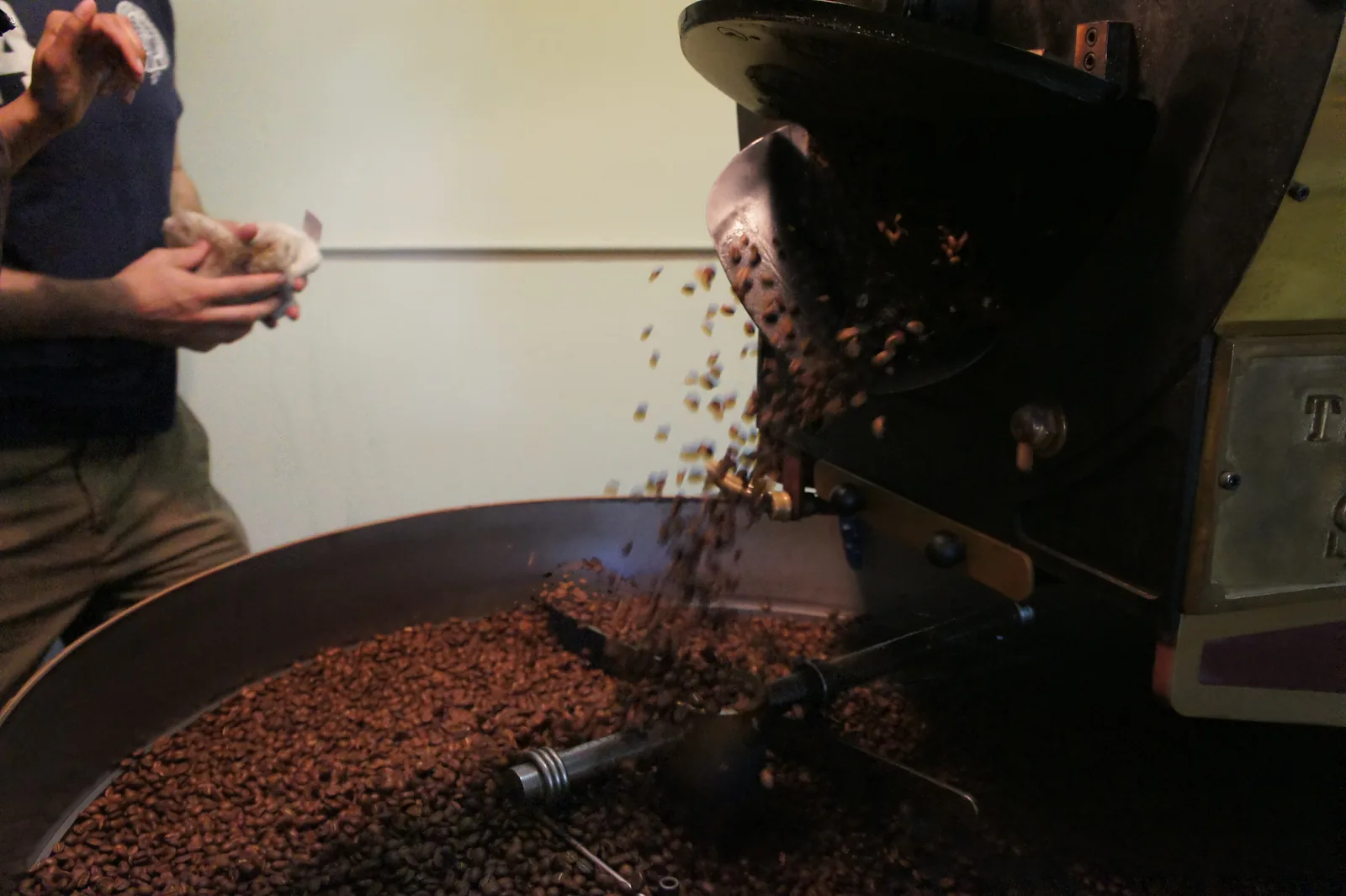
Green coffee hardly smells of anything; everything the cup gives us to recognize is born in ten to twenty minutes of heat. This plate follows the machines from the perforated plates of Persia and Turkey to the electric drums of 2025 (Ukers 1922, chronology and chapter XXXIV; trade press 2016-2026), sets out the physics of the process after the engineering thesis of Johandri Vosloo (North-West University, 2017) and the energy balance of Henry Schwartzberg (University of Massachusetts), the chemistry after the review by Yang et al. (2026) and the chapters of the author's unpublished book, then details the technologies, the manufacturers, the tools, the profile, the colors, the defects, the resting, the uses, the energy and the state of the trade in 2024-2026. What the sources do not settle is gathered in the gray areas.
The 19 sections of this plate
Each section has its own page. The first sentence says what you will find there.
- 01What roasting does, and what it does not doA green bean contains precursors, not aromas.
- 02From brazier to cylinder, 1200-1800According to Ukers's reconstruction, the first dried seeds and hulls are roasted between 1200 and 1300 in terracotta or stone dishes, over an open fire.
- 03Industrialization, 1824-1864Richard Evans obtained in 1824 the first English patent for a commercial roaster, and his apparatus already holds three ideas that will not change.
- 04Gas, the sphere and “fast roasting,” 1868-1922Gas changes the trade, and for a reason worth keeping in mind: with coal, heat is adjusted by waiting; with gas, it is adjusted by turning a tap.
- 05The physics: how heat enters the beanThree modes of transfer coexist. Conduction, by contact of the bean with the hot metal of the drum and from bean to bean; convection, by the hot air passing through the mass; radiation, from the wall and the flame.
- 06Five stages, two cracksThe stages are a pedagogical simplification.
- 07The chemistry, stage by stageThe two families of reactions are those of the kitchen.
- 08The technologies, one by oneTwo points of this section need to be revisited, and they are linked: the split between the two modes of transfer in a drum, and the part invoked to correct it.
- 09The manufacturers, one by oneAn article in the Book of Roast completes this section on three dates and adds a machine that it lacks.
- 10The toolsThe moisture of green coffee, 10 to 12%, is measured by capacitance or by oven.
- 11The profile: charge, time, rate of rise, development time ratio, dropA profile is described by a few numbers. The charge, mass of green coffee and drum temperature at charging, which decide the vigor of drying; Ukers already noted that one does not exceed 90% of nominal capacity and that too small a charge heats too fast.
- 12Colors and scalesThe degree is read by color, and there is no standard shared from one roaster to another.
- 13Roast defectsOne fact deserves to open this section, because it is more surprising than it looks: the defects Ukers described in 1922 are exactly those described today.
- 14Degassing, resting, freshnessThe CO2 formed stays largely trapped under pressure in the bean; quantity and pressure depend on the profile, and fast, dark roasts produce more and release it faster.
- 15Espresso, filter, decafAn “espresso profile” is not necessarily darker: the roasters interviewed by Perfect Daily Grind in 2019 often keep the same temperature and the same time after the…
- 16Industrial versus artisanal: time, energy, emissionsSchwartzberg first quantifies the sector: 6.7 billion kg of coffee roasted a year, mostly in batches.
- 17Roasting at originProducing countries have always roasted for themselves, very dark according to Ukers, in a pan or a small cylinder.
- 18TodayThe dominant fact of these last three years fits in one word: electrification.
- 19Archive platesEngravings and photographs from William Ukers's All About Coffee (1922), which has fallen into the public domain.
Two sheets to go further
Elsewhere on the site, the passages that deal with the same things as this page. Computed from the text, not picked by hand.