The patio
Drying.
How does coffee dry on a patio?
Start the scene or choose a stage. The animation simplifies the mechanism; what follows gives the details and the available references.
Brazilian agricultural extension spreads cherry 5 centimeters deep on the first day, parchment 2. The Codex asks for 3 to 5 centimeters. With 50 liters of cherry per square meter, a 500 liter bag needs ten square meters of slab.
Read the stages without animation
- Spreading in a thin layerBrazilian agricultural extension spreads cherry 5 centimeters deep on the first day, parchment 2. The Codex asks for 3 to 5 centimeters. With 50 liters of cherry per square meter, a 500 liter bag needs ten square meters of slab.
- RakingA slab is a thermal mass: it stores the heat of the day and gives it back to the coffee from below. The bottom of the layer is therefore the hot spot, with no air to renew it. The coffee is turned with a wooden rake every two hours on a paved area, in the direction of the sun; the mass is held around 35 to 40 °C.
- Thickening the furrows at mid-dryingUntil mid-drying, the furrows are about 3 centimeters; they are then thickened to about fifteen. Once the surface water is gone, evaporation no longer cools the layer: thick, it shades itself and avoids the black-green bean, burned by heat. A hulled sample still shows a dark kernel.
- Piled under a tarp, at nightAfter one day of drying for parchment, three for cherry, the coffee spends the night in a pile under a tarp. In the early morning, the slab drops below the air temperature: that is the condition for dew, and a lot left spread takes the water back up.
- Looking at the kernelA sample is hulled: a dark blue-green kernel is still damp. When the sample shows none, the lot is finished, at around 10 to 12% moisture, after 7 to 20 days depending on climate.
To remember: The patio is a support, not a route: its quality is not decided the day the slab is poured, it is decided every afternoon of the harvest.
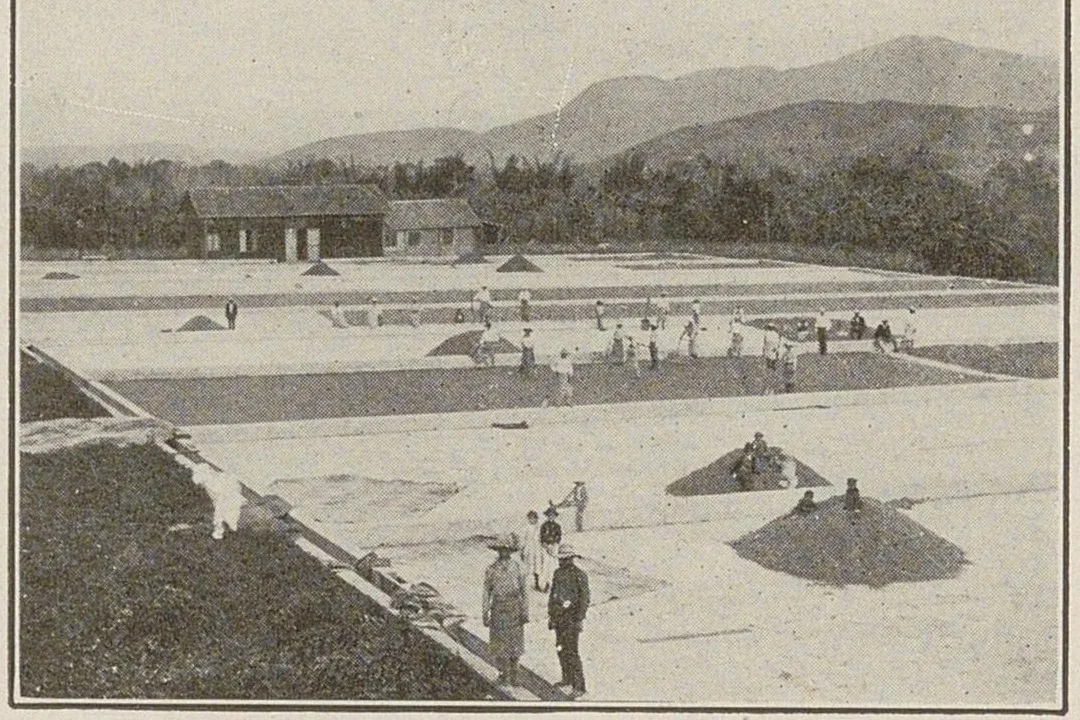
In history: Ukers describes in 1922 drying areas with cement or brick surfaces, turned several times a day.
Read the full article and its sources ↓Where it is practiced
Everywhere, and always. It is the most widespread drying method in the world, and it is also the one this site talked about least.
Brazil is its most organized form. The patio (terreiro, in Portuguese) is a farm facility there on a par with a shed, sized for the peak of harvest, and it goes by different names depending on its surface: terra or chão batido for packed earth, lama de cimento for the smoothed mortar screed, lama asfáltica for the bitumen emulsion coating, concreto for the concrete slab. Spanish-speaking Latin America speaks of patio, in cement, brick or asphalt. Ethiopia, India, Indonesia and Yemen dry on floors, terrace roofs and mats, with the same logic and other materials.
The Colombian order of magnitude, already given in the sheet on raised beds, is worth recalling because it puts the matter in perspective. In 2008, Cenicafé reports that 41 percent of the country's farms dried in the sun and 2 percent in a mechanical dryer. Solar drying, of which the patio is the most common form, therefore remains very much the majority even where mechanical drying is old and well documented.
Age can be observed rather than dated. Ukers describes in 1922 the dry process in terms a Brazilian producer would recognize today: the fruits are spread in a thin layer on open floors, or barbecues, often with a cement or brick surface; they are turned several times a day so that sun and wind reach all parts; drying lasts about three weeks; and after the first three days, the fruits must be protected from dew and rain, by covering them with tarps or piling them under shelter. He adds an observation that is a diagnosis: if the fruits are not spread out, they heat, the silverskin sticks to the bean and often discolors it. The date the patio appeared, for its part, has not been established from primary sources, and this sheet does not put one forward.
One last point of geography matters. The patio belongs to no processing route. Natural coffee is dried on it as whole cherry, washed coffee as parchment, pulped natural (cereja descascado, in Portuguese) and honey. It is the surface that defines the method, not what is laid on it.
The principle
A slab is not a neutral support. It is a thermal mass, that is, a body that stores heat and gives it back with a delay, and this is what makes all the difference with the other dryers.
A raised bed is ventilated from below and heated from above. A patio is heated from above and from below, and ventilated from above only. The slab absorbs solar radiation all day, heats up, and gives that heat back to the layer of coffee by contact and by infrared radiation. Coffee laid on a patio therefore receives not only the sun: it receives yesterday's sun, stored in the concrete.
Three consequences follow, and they govern all the handling.
The first is that evaporation is fast at the surface of the layer and that the bottom of the layer is the hot spot, not the cold spot. This is the reverse of intuition. On a mesh bed, air passes under the layer and the bottom is ventilated; on a slab, the bottom is in contact with the hottest body of the setup, with no air renewal at all. Turning therefore serves not only to even out moisture: it serves to bring out of the hot contact the beans that stayed there, and to break up clumps before they form.
The second is that the nature of the surface changes the temperature reached, and not only cleanliness. A dark coating absorbs more radiation than a light screed and climbs higher at peak. The authors of the Brazilian trial cited below explicitly attribute to these temperature peaks the higher electrical conductivity values they measure on beans dried on the bitumen emulsion coating. The electrical conductivity of the exudate is an indicator of the integrity of the bean's cell membranes: a bean whose membranes have given way releases more electrolytes into water, and conductivity rises. The surface is therefore not a maintenance detail, it is a thermal parameter.
The third is the phase shift between the slab and the air. Concrete keeps giving back its heat after sunset, then, in the early morning, it drops below the air temperature by radiation to the clear sky. This is exactly the condition for dew: a surface colder than the ambient air, on which water vapor condenses. A lot left spread overnight therefore takes water back up, and this uptake does not merely cancel the previous day's work. It restarts the molds already settled in all at once, which is far worse than a simple delay.
Hygiene remains, which is the historical reason for paving. The Codex Alimentarius rules out bare earth for rainy regions and asks for a washable surface, failing which the coffee picks up off-flavors that no later step removes. A slab is swept and washed; packed earth holds water, dust and spores, and in addition slows drying by direct contact with damp ground.
What the patio does well, to finish, comes down to one word: mass. No other setup dries as much coffee for so small an investment. It is a floor, and a floor is built in a week. Everything that follows describes what this choice costs.
The sequence
Construction comes first, because it decides everything else. A Brazilian trial conducted at the Federal Institute of southern Minas Gerais built five experimental patios of 50 square meters each, on the same ground levelled in the same way, and published their cost. The values, in 2014 reais, are as follows: packed earth 2.70 per square meter, mortar screed 11.65, bitumen emulsion coating 14.02, concrete slab 22.30, suspended bed 38.54. The concrete slab in this trial is 10 centimeters thick and has a rougher surface; the mortar screed is 5 centimeters and smoother; the emulsion coating is 0.5 to 1 centimeter and falls between the two in roughness. These figures are local and dated, and their interest is not their absolute value but their ratios: the mortar screed costs half as much as the concrete slab and a quarter less than the coating, for a cup quality that the same trial finds equivalent to that of concrete.
Slope and drainage come next, and no source consulted publishes the value. A patio must be washable and must not hold rainwater; that is all that can be said of it with a source.
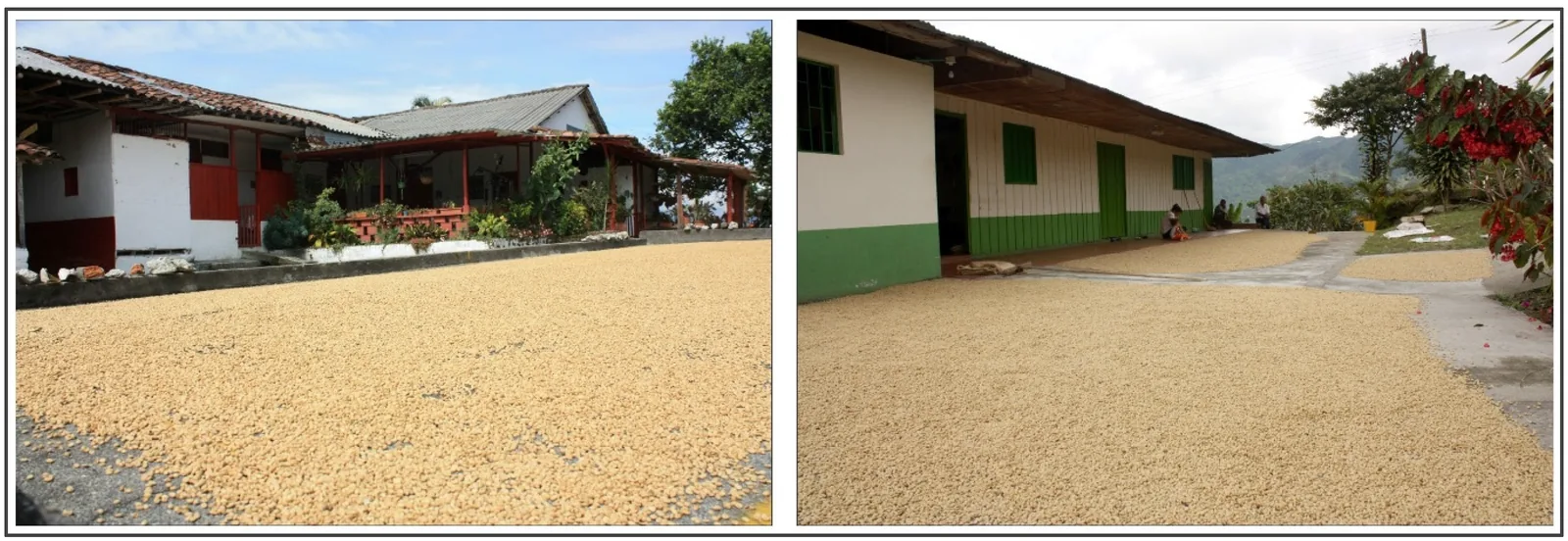
Spreading is the first action of the day, and its thickness depends on the product. For whole cherry, the Brazilian extension recommendation is a layer of 5 centimeters on the first day. For coffee in parchment, it drops to 2 centimeters, with light, suitable rakes so as not to damage the parchment. Cenicafé holds that beyond 3 centimeters drying slows down, which prolongs the bean's stay at critical moisture. The Codex calls for layers of 3 to 5 centimeters, which comes to 25 to 35 kilos per square meter of parchment or fresh cherry, without distinguishing between the two products, and allows thicker only with dry air, good circulation and strong sunshine. The review published in Foods in 2026 gives 2 to 5 centimeters for the patio.
A rule of scale makes it possible to translate all this into area. A distribution of 50 liters of cherry per square meter, with a Brazilian bag corresponding to 500 liters, requires 10 square meters of patio per bag. A lot of one hundred bags therefore occupies a thousand square meters, which is the real constraint of the process: the patio is a fixed asset sized for the peak day of harvest, and that day governs the investment of the whole farm.
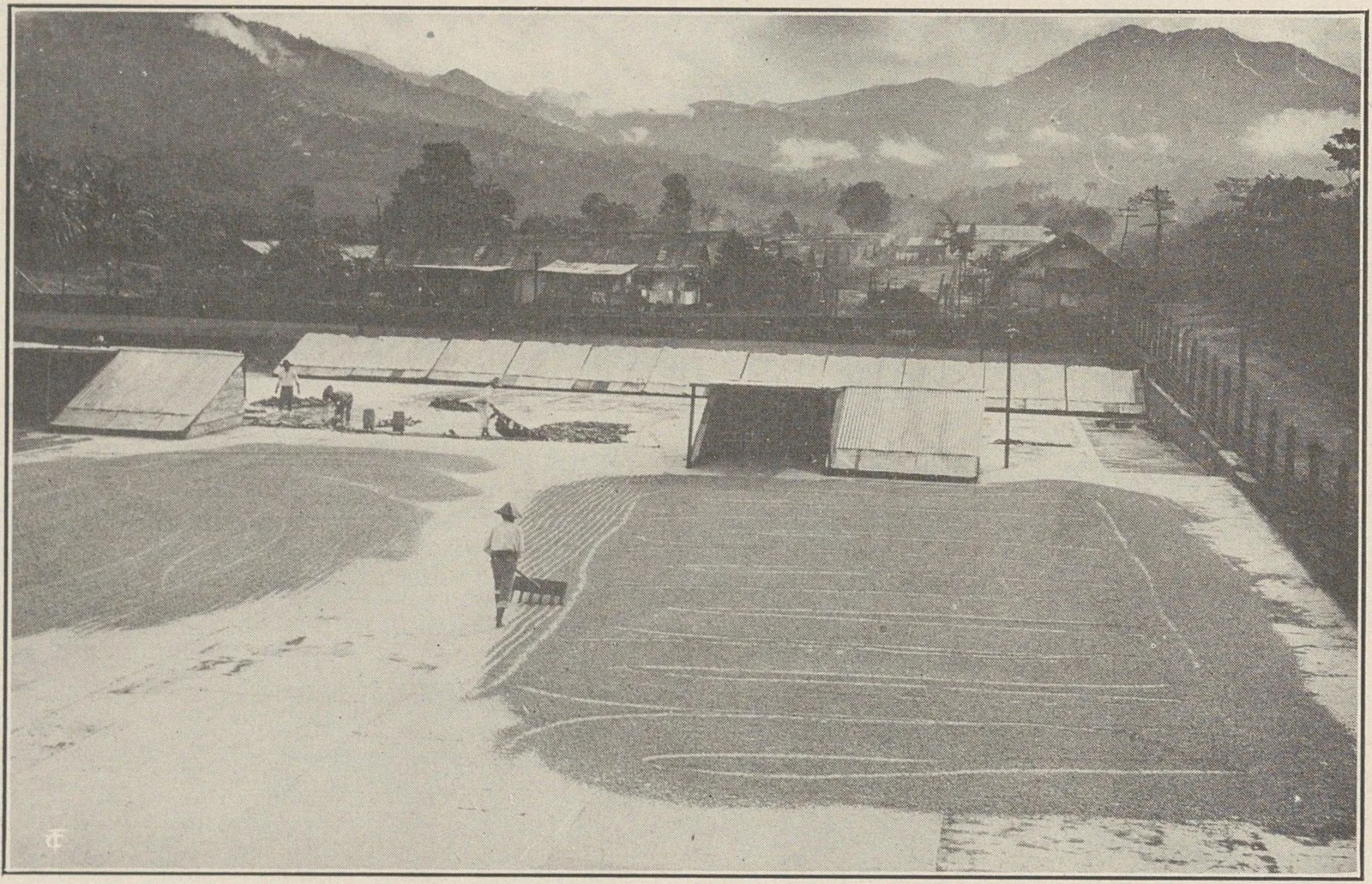
Turning fills the day. The Brazilian recommendation is one turn with a wooden rake (rodo, in Portuguese) every two hours on a paved patio, and every hour on packed earth. The Codex asks that the layer be turned constantly during the day, without a figure. The 2026 review gives at least two to three turns a day. These values cannot be reconciled and do not aim at the same thing: two to three passes a day describe a safety minimum, sixteen passes on the first day describe quality handling. One detail is worth more than a figure: the Brazilian recommendation asks to turn in the direction of the sun, so that the small leiras, the furrows formed by the passing of the rake, do not shade one another.
Next comes an action that surprises, and whose reason lights up the whole process. Until mid-drying (meia seca, in Portuguese), the furrows are kept thin, around 3 centimeters, with constant turning. Past this stage, they are thickened, to about fifteen centimeters. The thickening is not a relaxation: it aims to avoid the preto-verde defect (the black-green, in Portuguese), which comes from the rise in temperature. Once the surface water is gone, evaporation no longer cools the layer, and a bean spread thin on a hot slab has nothing left to protect it. By thickening it, one makes it shade itself. Running a patio is therefore in two opposite stages: thin and stirred as long as there is water to get out quickly, thick and calmer afterward.
Night and rain are dealt with by piling, the amontoa, and by the tarp. The Codex sets a schedule: coffee is piled and put under a tarp only after one day of drying for parchment and three days for cherry. Earlier than that, the cover traps vapor and rewets the lot, which produces exactly the opposite of the intended effect. It also asks that damp coffee be ventilated at night, so that vapor does not condense on the beans.
The temperature of the mass is monitored throughout. Common Brazilian practice aims for 35 to 40 degrees. A precise warning is added: if the lot contains many green fruits, the mass must not exceed 30 degrees, excessive heating on immature beans producing the verde-escuro defects, the dark green, and preto-verde.
Durations are then read as a result, not as an instruction. The patio takes 7 to 20 days depending on climate for coffee in parchment or cherry, according to the 2026 review. Ukers gave about three weeks for whole cherry in 1922, and wrote that machines dried parchment in twenty-four hours where the sun took ten days. That comparison has not aged a day.
The end of drying is judged by sampling. It starts two or three days before the expected date, then continues every day. In Colombia, the field method is visual and it is a good one: a sample is hulled and the color of the kernel is looked at. A bean that is still damp is a dark bluish green; this is what Cenicafé calls a grano flojo. When the sample shows none, the lot is judged finished. The target is 10 to 12 percent moisture on a wet basis before bagging, the Codex setting for its part less than 12.5 percent and a water activity of at most 0.67 to 0.70. The reference measurement is the mass loss in the oven, and moisture meters are cross-checked and calibrated once a year against it, before harvest.
What it gives in the cup
What is measured on the surface itself comes from a single trial, and it deserves to be described with its limits. Santos and his collaborators compared in 2014 five patio surfaces and three coffee preparations, in a fully randomized design with three replicates, that is forty-five plots, on Catuaí Amarelo IAC 62 harvested in 2013. The three preparations were the plantation coffee (café de roça, in Portuguese), that is, picked up from the ground and from the branch without separation, the floaters (boia, in Portuguese) and the pulped natural. Drying was stopped at 11 percent moisture for all plots.
Two results come out of it. On the electrical conductivity of the exudate, the lowest values, hence the best-preserved membranes, are found on concrete and on the mortar screed; the highest are found on the bitumen emulsion coating. On pulped natural, the gap runs from 122.10 microsiemens per centimeter per gram on concrete to 231.87 on the coating, almost from single to double. On tasting, conducted by three tasters qualified under Brazilian normative instruction number 8 of 2003, the earth and coating patios give on average drinks classed riado and rio (in Portuguese, the iodine-tasting classes of the Brazilian scale), whereas concrete, mortar screed and the suspended bed give mostly hard.
It must be said at once what this trial does not prove. It covers one variety, one harvest, one place and three tasters. Its stated purpose is a cost-benefit calculation, not a fine sensory comparison. The Brazilian scale of bebidas, which runs from strictly soft to rio zona, is a classification of defects and not a quality score: saying that a lot is hard or riado does not place it on the hundred points of the Specialty Coffee Association scale. And the plantation coffee, which enters the design, is the worst possible material for judging a surface, since it already carries all the defects of ground picking.
What is measured on the patio against other setups is found in two other studies, already used elsewhere on this site. The 2025 Brazilian trial on two regions sets sun on a cement terrace or on asphalt against a dedicated dryer, and the dryer wins, without being infallible: it clears the 80 point bar of the SCA scale in Campo das Vertentes early and mid-harvest, and falls below it there at the end of harvest, at the same level as the traditional route. The 2023 Ethiopian solar tunnel trial finds no significant sensory difference between its twelve treatments, but an enormous difference in soundness: from 4.0 to 93.3 percent of infected beans, the maximum being reached in full sun on a 6 centimeter layer.
The honest summary comes down to two sentences. The surface and handling of a patio clearly govern the soundness of the lot and the load of defects, and this is measured. Their effect on the cup is measured only once, on a coarse scale, and it goes in the direction expected without the magnitude being established.
What is only asserted deserves to be named, because it is the argument that the patio endures rather than the one it claims. The trade commonly holds that the patio produces more rustic and less clean coffees than the raised bed. No controlled trial isolating the support alone has been located, the Codex itself refuses to rank the surfaces, and the Ethiopian trial, the only numerical one, does not separate its treatments in the cup.
What goes wrong
The temperature spike is the risk specific to the patio, and the one least often named. A slab exposed all day climbs well above the air, and a coffee spread thin on it at the wrong time takes this heat with nothing to carry it off once the surface water is gone. The defects that follow are named. The preto-verde, or black-green, is distinguished from the true black by its shiny look, the silverskin remaining stuck to it, and it must be counted as a burn defect. The cristalizado (the crystallized, in Portuguese) is a gray-blue bean, fragile and brittle, attributed to drying temperatures above 50 degrees. Cenicafé links this same crystallized defect, with the discolored and the moldy, to a temperature that is too high.
Rewetting is the second, and it is dealt with separately by the Codex, which asks that it be avoided. The reason is biological and worth repeating: returning water does not wet a fresh lot, it wakes molds already settled in and restarts toxin production. A shower on an almost dry lot, a tarp laid too early, an unprotected dew are enough.
The mold window is the third, and it is a matter of clock. Ochratoxin A is produced by only a few Aspergillus, whose growth and production play out in a water activity band of 0.80 to 0.95. The Codex holds that no more than five days spent on the drying area in this band are enough to avoid accumulation. A patio that takes twenty days therefore has no margin: everything that lengthens drying eats into this reserve. The Ethiopian trial gives the order of magnitude of what thickness costs in open sun: 45.3 percent of infected beans at 2 centimeters, 77.3 at 4, and 93.3 at 6.
Earthy flavor is the fourth, and it is settled by paving. The Codex is categorical: on a surface that is not washable, parchment picks up off-flavors that no later step removes. The Brazilian trial confirms it in its own way, ranking the earth patio among the worst on the two criteria it measures.
The fifth risk is not technical, it is one of use. A patio is a large, flat, convenient surface in the middle of a farm, and so it also serves other purposes: vehicles are parked on it, a tractor is turned on it, animals pass over it, dust from the track settles on it. Every secondary use is a source of contamination for the next harvest, and this is why sweeping and washing before the season are not a rite but a sanitary operation.
The sixth is labor, and it is the real cost of the process. Each turn is a pass of the rake over the whole surface. At sixteen passes on the first day over a thousand square meters, one no longer counts in actions but in man-days. A patio that is not turned is not a slow patio, it is a fermentation tank in the open air: the beans at the bottom stay damp, heat up, and the lot goes fermented. The quality of patio drying is not decided the day the slab is built, it is decided every afternoon of the harvest.
The seventh is over-drying, which does not show and is costly. Cenicafé places at 10.5 percent the threshold below which drying is excessive. The loss is first of weight, hence of income, and it is final: a coffee brought down too low cannot be honestly rewetted.
The eighth, finally, is the season. The patio presupposes a reliable dry window. Where the harvest coincides with the rains, as in many Colombian regions, drying drags on, and Cenicafé says so plainly: solar drying is slow there, and slowness is itself a risk of quality loss.
Benchmarks
- Layer thickness, whole cherry, first day, Brazilian extension5 centimeters
- Layer thickness, parchment coffee, same sourceup to 2 centimeters
- Thickness beyond which drying slows down according to Cenicafé3 centimeters
- Thickness asked by the Codex3 to 5 centimeters, or 25 to 35 kilos per square meter
- Patio thickness according to the Foods 2026 review2 to 5 centimeters
- Furrow thickness before and after the mid-drying stageabout 3 centimeters, then about 15 centimeters
- Area needed50 liters of cherry per square meter, or about 10 square meters per 500 liter bag
- Rake turning frequency, paved patioevery two hours
- Rake turning frequency, packed earthevery hour
- Target mass temperature35 to 40 degrees
- Temperature not to exceed if the lot contains many green fruits30 degrees
- Drying temperature above which the crystallized defect is placed50 degrees
- Patio drying time7 to 20 days depending on climate
- Duration of sun drying of whole cherry according to Ukers, 1922about three weeks
- Drying parchment, machine against sun according to Ukers, 192224 hours against 10 days
- Piling under a tarp, minimum delay according to the Codexone day for parchment, three days for cherry
- Maximum stay in the 0.80 to 0.95 water activity band according to the Codexfive days
- Infected beans in open sun by thickness, Ethiopian trial 202345.3 percent at 2 cm, 77.3 at 4 cm, 93.3 at 6 cm
- Construction cost per square meter, Brazilian trial, 2014 reaisearth 2.70; mortar screed 11.65; emulsion coating 14.02; concrete 22.30; suspended bed 38.54
- Electrical conductivity of the exudate on pulped natural by surface, same trial122.10 microsiemens per centimeter per gram on concrete, 231.87 on emulsion coating
- Cup classification by surface, same trialhard on concrete, screed and suspended bed; riado and rio on earth and emulsion coating
- Target moisture before bagging10 to 12 percent on a wet basis
- Over-drying threshold according to Cenicafé10.5 percent
- Share of Colombian farms drying in the sun in 200841 percent, against 2 percent in a mechanical dryer