Double fermentation
Directed fermentations.
Two meanings for a double fermentation
Start the scene or choose a stage. The animation simplifies the mechanism; what follows gives the details and the available references.
In the Kenyan sequence described by the FAO in 2000, the coffee is pulped on the day of harvest and ferments in a tank, on its mucilage. The first fermentation lasts from 1 to 4 days depending on the weather, 12 to 24 hours according to trade descriptions: the ambient temperature sets it more than the operator does.
Read the stages without animation
- Ferment a first timeIn the Kenyan sequence described by the FAO in 2000, the coffee is pulped on the day of harvest and ferments in a tank, on its mucilage. The first fermentation lasts from 1 to 4 days depending on the weather, 12 to 24 hours according to trade descriptions: the ambient temperature sets it more than the operator does.
- Stop by touch, wash thoroughlyA handful of parchment is washed and felt: if rough, the mucilage is degraded. The parchment is then washed thoroughly to remove the degraded mucilage and the acids. It is this wash that defines the process; without it, there would only be a long fermentation.
- A second fermentationA second fermentation works on what remains of the mucilage, 12 to 24 hours according to the trade, a duration that the FAO manual does not give. It starts from a lot that is already acidic and depleted: giving it the duration of the first is going too far.
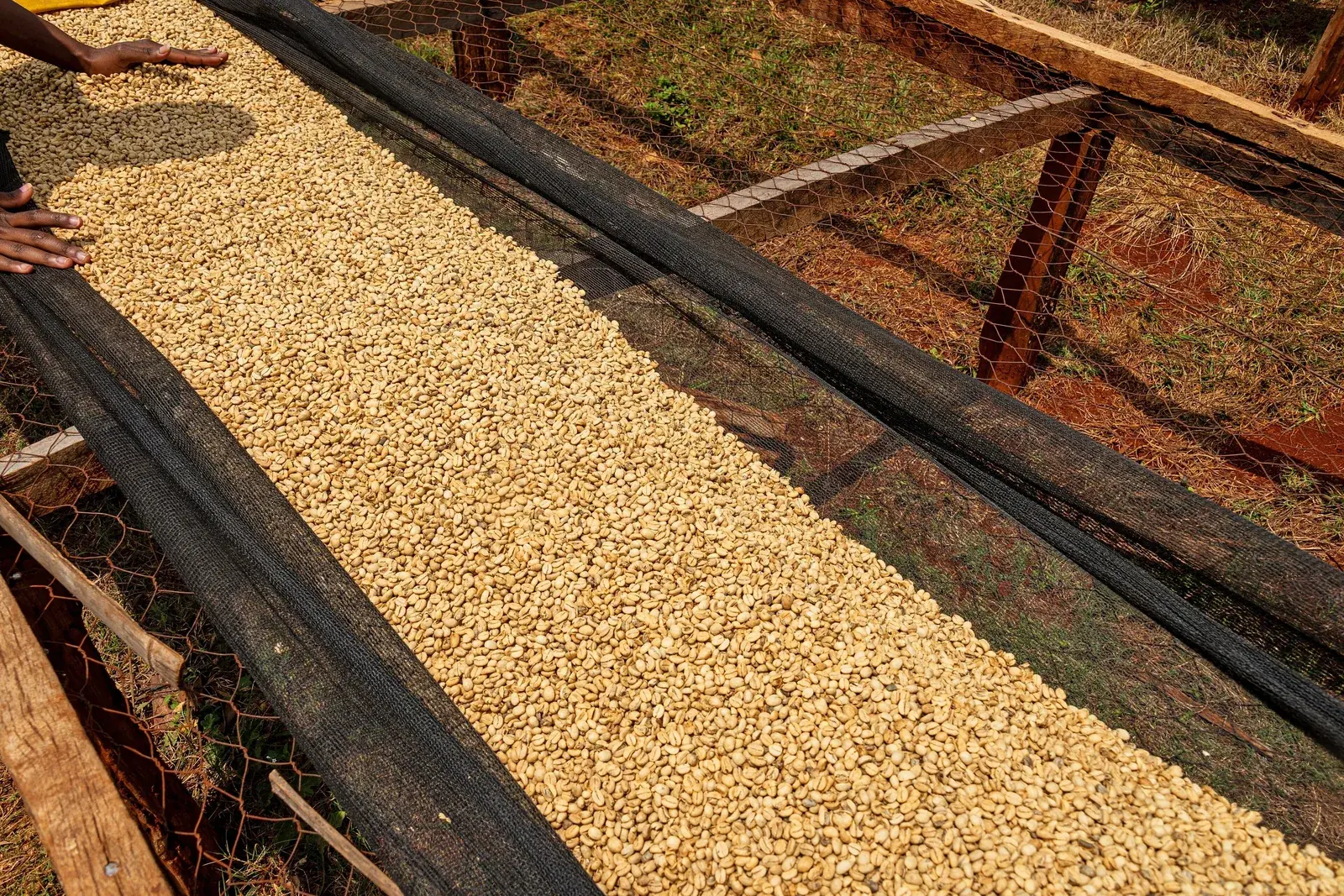
- Soak, then dryThe coffee soaks for about 12 hours in clean water, up to 48 hours when the drying areas are full. The mucilage is gone: it is no longer a fermentation. It then dries on raised beds, from 55% moisture to 11%.
- The directed version, without washingA 2024 Peruvian trial cuts it differently: a solid phase of about 18 hours, without water, then a liquid phase of about 22 hours, coffee and water in equal parts, at 13.2 or 22.8 °C. The break is the change of medium, not a wash. The final pH drops to between 3.2 and 3.9.
To remember: Under one name, a Kenyan sequence that washes between two fermentations to detach the mucilage, and a recent process that changes medium to build aromas.
In history: The Kenyan sequence is described as the ordinary practice of washing stations as early as 2000, in an FAO manual on coffee post-harvest in Africa.
Read the full article and its sources ↓Where it is practiced
Two things bear this name, and they are neither the same age nor the same purpose.
The first is Kenyan. It is the ordinary practice of Kenya's washing stations, described as such as early as 2000 in an FAO manual on coffee post-harvest in Africa. It chains a fermentation, an intermediate wash, a second fermentation, then a soak in clear water. None of the documents consulted says when this sequence appeared, or who formalized it. The trade attributes a colonial origin to it, with no verifiable reference. The same sequence is reported by the trade in Rwanda and Burundi, but no institutional source consulted confirms it.
The second is contemporary and directed. It chains two fermentation phases separated by a change of medium, and it aims at aroma, not at the cleanliness of the bean. It is documented by published trials: a 2024 Peruvian trial on the Catucaí variety, and Brazilian sequential inoculation trials conducted around the Federal University of Lavras. The trade also announces it in Colombia and Panama. No census says how many lots are produced this way, or in which countries.
The point to remember: under one name, a traditional practice of mucilage degradation and a recent process of aromatic construction.
The principle
A coffee fermentation runs out. The mucilage, the layer of sweet flesh stuck to the parchment, contains only a finite quantity of fermentable sugars. Microorganisms consume them, produce acids, and the pH falls. Past a certain point, the medium is acidic, poor in sugar, and the population that lives in it has changed. Prolonging the same tank restarts nothing: it pushes toward defects.
Double fermentation answers this by cutting the process in two, with a break in the middle. This break is either a wash, or a change of medium, or both. It does three things that simple prolongation cannot do.
It evacuates the accumulated products. The intermediate wash carries away the already degraded mucilage and the dissolved acids. The medium of the second phase therefore starts again at a higher pH and less loaded.
It changes the substrate. The mucilage remaining after the first phase is no longer the same: the pectins, which are the polysaccharides that give mucilage its gel hold, have been partly cut by microbial pectinases and by the fruit's enzymes. The second phase works on shorter chains and on what diffuses out of the bean.
It changes the population. A phase in solid medium, with no added water, keeps air between the beans and favors aerobic microbes. A phase in an immersed tank becomes anoxic through exhaustion of oxygen and favors yeasts and lactic acid bacteria. Chaining the two means making two successive communities work on a single lot.
This is where the two uses of the word diverge. In Kenya, the objective is mechanical: to detach the mucilage completely and wash the bean, in a highland climate where cold slows degradation. In the directed version, the objective is chemical: to produce esters and organic acids that the first phase alone does not produce.
A third named center, Burundi, and what magnetic resonance measures there
This sheet places double fermentation on the Kenyan side and in the 2024 Peruvian trial. A third center exists, named and described in the literature, and it comes with a set of chemical measurements that the other two lack.
Hackler and Särchen devote a section to what they call the “Burundian”, described as a double soak or a double fermentation. The protocol is simple: the wet pulped beans ferment in water for twenty-four hours, a wash removes the floaters, that is, the hollow or damaged beans that rise to the surface, and the remaining beans ferment a second time in water before drying.
They cite Kwon and colleagues for the chemical consequences, measured by nuclear magnetic resonance metabolomics. This technique deserves a word, because it changes what can be concluded: instead of assaying a molecule one has decided to look for, it records the fingerprint of all the metabolites present in an extract, which makes it possible to discover differences that had not been anticipated. The beans from the Burundian process carry, according to this measurement, more sugars and more organic acids, and less caffeine, less asparagine, less gamma-aminobutyric acid and less chlorogenic acid.
Two of these decreases deserve comment. Asparagine is an amino acid, and it is the main precursor of the acrylamide that forms during roasting: a drop in asparagine is therefore not an analytical detail. Gamma-aminobutyric acid, often abbreviated GABA, is produced by the bean itself in response to stress, and its decrease suggests that the double passage in water leaches some of it rather than making it. The overall movement, more sugars and organic acids, fewer nitrogen compounds, is that of a bean washed twice: what is soluble and mobile leaves, what is produced by fermentation stays.
It must nevertheless be pointed out what distinguishes this protocol from the other two, because this sheet already documents it for good reasons. The Burundian protocol places its two fermentations in water. The Peruvian trial chains a solid phase and a liquid phase. The Kenyan chains a fermentation and a soak, which is also debated as to whether it deserves the name of fermentation. Three practices, three distributions of water and time, a single name. This is exactly the warning that this sheet carries, and the Burundian case confirms it rather than contradicts it.
A final reservation on the status of the figures: they come secondhand, reported by Hackler and Särchen after Kwon, and neither the number of lots, nor the presence of a control run with simple fermentation on the same coffee, nor the origin of the samples is given in the text available. Without a control from the same lot of cherries, a different composition does not prove that double fermentation is the cause. Kwon will have to be read before these movements are carried as measurements.
Sources of this passage: Hackler and Särchen, chapter 5, p. 77, after Kwon and colleagues. 2024 Peruvian trial and Kenyan protocol: sheet 12, fields DEROULE and SOURCES.
The sequence
Two distinct protocols. They are not to be mixed.
A. The Kenyan sequence, as described by the 2000 FAO manual
1. Pulping on the day of harvest. The mucilage stays on the parchment. It is what serves as the substrate for the two following phases.
2. First fermentation in a tank. The FAO gives a duration of 1 to 4 days depending on the weather, faster in warm weather, slower in cold. Trade descriptions narrow this range to 12 to 24 hours. The duration is not a setting but a consequence: it governs the degree of mucilage degradation, and the ambient temperature sets it more than the operator does.
3. End-of-phase check by touch. A handful of parchment is washed with clear water and felt. A rough sensation indicates that the mucilage is degraded. It is the only stopping criterion given by the document.
4. Intermediate wash. The parchment is washed thoroughly to remove completely the degraded mucilage and the acids. It is this wash that defines the process: without it, there is only a long fermentation.
5. Second fermentation in a tank, on what remains of the mucilage. The trade announces 12 to 24 hours. This duration is not given by the FAO document consulted, which moves directly on to the soak.
6. Soak in clean water. The FAO gives about 12 hours, and up to 48 hours when the drying areas are full. The manual credits this soak, on the strength of trials conducted in Kenya, with an improvement in color and taste. These trials are not referenced. It is not a fermentation: the mucilage is gone, almost no sugar is left. What happens there is a prolonged rinsing of the bean, still alive and saturated with water.
7. Drying on raised beds, from 55% initial moisture down to 11% for storage.
B. Directed double fermentation, protocol published in 2024
1. Harvest of ripe cherries, pulping, 4 kilograms per trial lot.
2. Phase 1 in solid medium, about 18 hours, no added water. Two atmospheres compared, closed with removal of carbon dioxide through a tube, or open. Two temperatures compared, 13.2 degrees and 22.8 degrees. Temperature governs the speed: at 13 degrees, the stopping window is wide, at 23 degrees it closes quickly.
3. Phase 2 in liquid medium, about 22 hours, coffee and water at a 1 to 1 ratio. Same atmosphere and same temperature as phase 1. It is the passage from solid to liquid that constitutes the break here, not a wash.
4. Total duration of about 40 hours, at the end of which the trial records complete separation of the mucilage.
5. Physicochemical monitoring. The final pH falls to between 3.2 and 3.9. The final Brix, which measures dissolved sugar, drops to between 4 and 5.5. Titratable acidity settles between 0.5 and 1.7%.
6. Washing, then drying to a mean moisture of 11.74% in the trial.
C. Variant by sequential inoculation
Another route separates the two phases not by the medium but by the microorganism. A lactic acid bacterium, Lactiplantibacillus plantarum, is introduced first. The yeast Saccharomyces cerevisiae is introduced afterward, on the already acidified medium. The published trials cover 48 hours and 96 hours of fermentation after inoculation. The order is the point of the protocol: inoculating together would make the two strains compete for the same sugars, inoculating them one after the other gives each its own window.
What it gives in the cup
What is measured.
The 2024 Peruvian trial is the only trial with a control found on double fermentation proper. Five lots, four treatments and a control run with the traditional method. The scores obtained on the SCAA scale, the hundred-point tasting scale of the specialty coffee association:
- closed fermentation at 22.8 degrees: 84.25 points, notes of chocolate, orange, panela, which is unrefined cane sugar, and almond;
- closed fermentation at 13.2 degrees: 83.75 points, red fruits, chocolate, cedar;
- open fermentation at 22.8 degrees: 83.50 points, red fruits, cherry, hazelnut;
- open fermentation at 13.2 degrees: 82.50 points, cinnamon, citrus, carob;
- traditional control: 82.25 points, cinnamon, chocolate, brown sugar.
The gap between the best treatment and the control is 2 points. All four treatments exceed the control. The trial reports marked gains in fragrance, aftertaste and body. A single trial, on one variety, in one place, does not make a rule.
Brazilian sequential inoculation reports forty-seven volatile compounds identified, and a profile dominated by fruity and fermentative notes. This protocol is not the Kenyan double fermentation and says nothing about it.
What is claimed, with no published measurement found.
On Kenyan coffees, the trade and the specialty press attribute four effects to double washing:
- a cleaner cup, with no fermentative note;
- a livelier acidity;
- greater aromatic clarity;
- better consistency from one lot to another.
These effects are plausible and widely shared. No controlled comparison between the full Kenyan sequence and a simple wash was found in the literature consulted.
It is also read that the final soak would stabilize the amino acids and proteins of the bean, and would explain the storage stability of Kenyan coffees. This claim circulates with no experimental reference. It is to be treated as a trade hypothesis.
Finally, the Kenyan profile, gooseberry and blackcurrant acidity, is commonly attributed to double washing. It also depends on the SL28 and SL34 varieties, on soils and on altitude. The process has never been isolated from these factors in a published trial.
What goes wrong
Over-fermentation, on the second phase. This is the risk specific to the process. The second phase starts from a lot that is already acidic, already depleted. The operator who applies the same duration as for the first goes too far. Over-fermentation favors propionic acid and butyric acid, which give an onion and rancid butter taste. The literature retains a threshold: these acids should not exceed 1 milligram per milliliter. Beans from these lots are called stinkers.
Under-fermentation, on the first phase. If the first phase is cut short to “catch up” afterward, residual mucilage and sugar remain. They hinder drying and open the door to spoilage bacteria and molds.
Water, in quantity and quality. The process immerses twice and washes twice. It therefore consumes more water than a simple wash, and it produces more wastewater, loaded with sugars and acids. Poor-quality second-phase water inoculates the lot with its own flora. It is a contamination risk, not only an environmental risk.
Prolonged soaking. Kenyan practice allows the parchment to be held under water for up to 48 hours when the drying areas are full. It is a logistical convenience, not a quality choice. Water that stagnates and warms becomes a culture medium again.
Confusion of naming, which is a commercial risk. A lot sold as “double fermentation” may mean the Kenyan sequence, two anaerobic tanks in sequence, or a two-step inoculation. These three things do not give the same cup. The green buyer must ask for the protocol, not the name.
Benchmarks
- Kenya, first fermentation1 to 4 days according to the FAO, depending on the weather
- Kenya, final soak in clean waterabout 12 hours, up to 48 hours if the drying areas are full
- Kenya, fermentation stopping criterionrough feel of the parchment washed by hand
- 2024 Peruvian trial, solid phase then liquid phaseabout 18 hours then about 22 hours, or about 40 hours
- 2024 Peruvian trial, highest score versus control84.25 points versus 82.25 points
- 2024 Peruvian trial, final pH3.2 to 3.9; final Brix: 4 to 5.5
- Propionic and butyric acids, cited threshold1 milligram per milliliter not to be exceeded