Wet polishing
After drying.
What is actually being polished?
Start the scene or choose a stage. The animation simplifies the mechanism; what follows gives the details and the available references.
Wet polishing is a finishing step of the dry mill. It takes a green coffee already hulled, graded and sorted, which still holds remnants of silverskin, the seed’s integument, mostly in its center cut.
Read the stages without animation
- An already dry beanWet polishing is a finishing step of the dry mill. It takes a green coffee already hulled, graded and sorted, which still holds remnants of silverskin, the seed’s integument, mostly in its center cut.
- Wet the silverskin, not the beanA pump mists a little water, or steam, just enough to wet the silverskin. Dry, it is brittle and clings; wet, it swells and loosens. The word wet describes the water added, not the state of the bean.
- The beans rub against each otherThe machine agitates the lot with no abrasive lining: the beans rub against one another, and the silverskin leaves with the dust in a bin. The loss and breakage figures come from a manufacturer; nobody has verified them.
- Cool before baggingFriction heats: thirty kilowatts for 800 kilos per hour have to go out somewhere. The bean is cooled right away, because a bean bagged hot discolors. The lot comes out clean and shiny; no trial says what this changes in the cup.
To remember: wet polishing removes the silverskin from a dry bean; it changes the look and the price of a lot, not its demonstrated quality.
In history: In history: in Guadeloupe, in the early 20th century, polished coffee was called café bonifieur, after the name of the machine.
Read the full article and its sources ↓Where it is practiced
Vietnam first, and by a wide margin. The mention “wet polished” has become a grade descriptor there, written plainly in canephora export offers: Grade 1, screen 18, wet polished. The specifications sold with these lots announce at most 0.3 percent of black and broken beans, at most 12.5 percent moisture, at most 0.1 percent of foreign matter and at least 90 percent of beans retained on screen 18. Screens are counted in sixty-fourths of an inch, so screen 18 is worth about 7.1 millimeters. The national reference standard is TCVN 4193, revised in 2014, which fixes the sizes, defects, moisture and test methods of green coffee for export. This text was not read for this sheet.
Indonesia next, on its canephora. The commercial grading carries a separate mention there, AP, for after polished, that is, after polishing. It is added to the defect grade, which is counted on a test sample of 300 grams according to the standard SNI 01-2907-2008. Lampung, in southern Sumatra, is its center: dry preparation is done in Bandar Lampung, in the port’s mills, and not on the farms.
India, in its curing works, those green coffee preparation mills set up far from the plantations, has long practiced polishing on its washed arabicas. This is where the mention “plantation” in Indian grades comes from.
And Guadeloupe, historically. Ukers reports in 1922 that polished coffee there was called café bonifieur, from the name given locally to the polishing machine, the bonifieur, that is, the improver. It was also called café de luxe. Unpolished coffee was called habitant, and coffee still in parchment, café en parche. Ukers adds that extra polished coffee was then in great demand in London, Hamburg and the other European markets.
A point of geography matters more than the list of countries. Polishing does not belong to the farm. It belongs to the dry mill, often at the port, sometimes to the exporter, and almost never to the producer. It is therefore decided at the point of the chain where coffee is sold, not where it is grown. No census says what share of the world’s coffee is polished, or on which species.
The principle
One has to begin by establishing what the term designates, because it circulates under three meanings that do not describe the same operation, and two of them are commonly confused.
The first meaning is the trade’s, and it is the only one that is documented. Wet polishing is a finishing operation of the dry mill. It is performed on green coffee that is already dry, already hulled, already graded and often already color sorted. The beans are introduced into a chamber where a small quantity of sprayed water, or steam, is injected, just enough to moisten the silverskin without wetting the bean itself. The beans are then agitated and rub against one another. The silverskin comes loose, leaves with the dust, and the bean comes out cleaner and slightly shiny. The word wet therefore describes the water that is added, not the state of the bean being treated.
The second meaning is the one suggested by the name “wet hulled wet polish”, and it must be dealt with frankly: no source consulted for this sheet describes a polishing carried out on a bean still wet on leaving the Indonesian hulling. The chain of wet hulled (giling basah, in Indonesian), as described by the studies that measured it, runs from hulling at 35 to 45 percent moisture to a second drying of the naked bean down to 12 percent, with no intermediate polishing step. There is a mechanical reason for this absence, and it is the same one that produces the defect of the goat’s hoof (kuku kambing, in Indonesian), when the tip of the bean splits at hulling: at 40 percent moisture, the bean is not a solid, it is a soft, deformable material. A polishing machine works by friction under pressure. Applied to this material, it would not peel off a skin, it would crush the bean. Wet polishing, in its documented sense, is in fact the exact opposite: it is because the bean is dry and hard that it withstands the friction, and that is why the silverskin is wetted rather than the bean.
The third meaning is a real technical variant, and it is probably what feeds the confusion. There is a process in which green coffee is soaked in a water bath before being polished, and not simply misted. This route removes almost all the silverskin, but it truly wets the lot, it requires a complete re-drying, and it discharges a quantity of wastewater that poses an environmental problem. Vietnamese professional documentation explicitly distinguishes it from polishing by misting. A lot put through the bath has indeed been wetted; a lot put through the mister has not.
It remains to say what the operation removes. The silverskin, which botany calls the integument of the seed, is a thin membrane that wraps the bean under the parchment. It never leaves entirely at hulling, and some always remains in the center cut, the furrow that runs along the flat face of the bean. Ukers already noted it in 1922, in a sentence that has not aged: this last envelope is so tenacious that no rough treatment dislodges it completely, and pieces of it remain until roasting and grinding. Dry, this membrane is brittle and clings; moistened, it swells, loosens and yields at the first friction. The whole logic of the process rests on this difference in state, and that is why water is added rather than force.
What the operation does not do must be said with the same clarity. It does not touch the inside of the bean, it does not change its composition, it removes no defect. It changes the look of a lot, its weight and its surface cleanliness. Any claim that goes beyond this requires a measurement, and that measurement does not exist.
The sequence
The place of polishing in the dry-mill chain is fixed, and it is the last or the second to last. The parchment coffee is first cleaned and stripped of metal, then hulled, then winnowed to carry away the husk debris, then graded on screens, then run over a density table, then color sorted. Polishing comes after, and bagging after it. This order is not arbitrary. Polishing before sorting would amount to spending energy and breaking beans on a lot from which a part is going to be removed; polishing after optical sorting also prevents the silverskin dust from blinding the sorter’s cameras. The hulling and the resting in parchment that precede all this are the subject of a separate sheet, to which this one refers rather than going back over them.
Two families of machines coexist, and they actually define the two polishings.
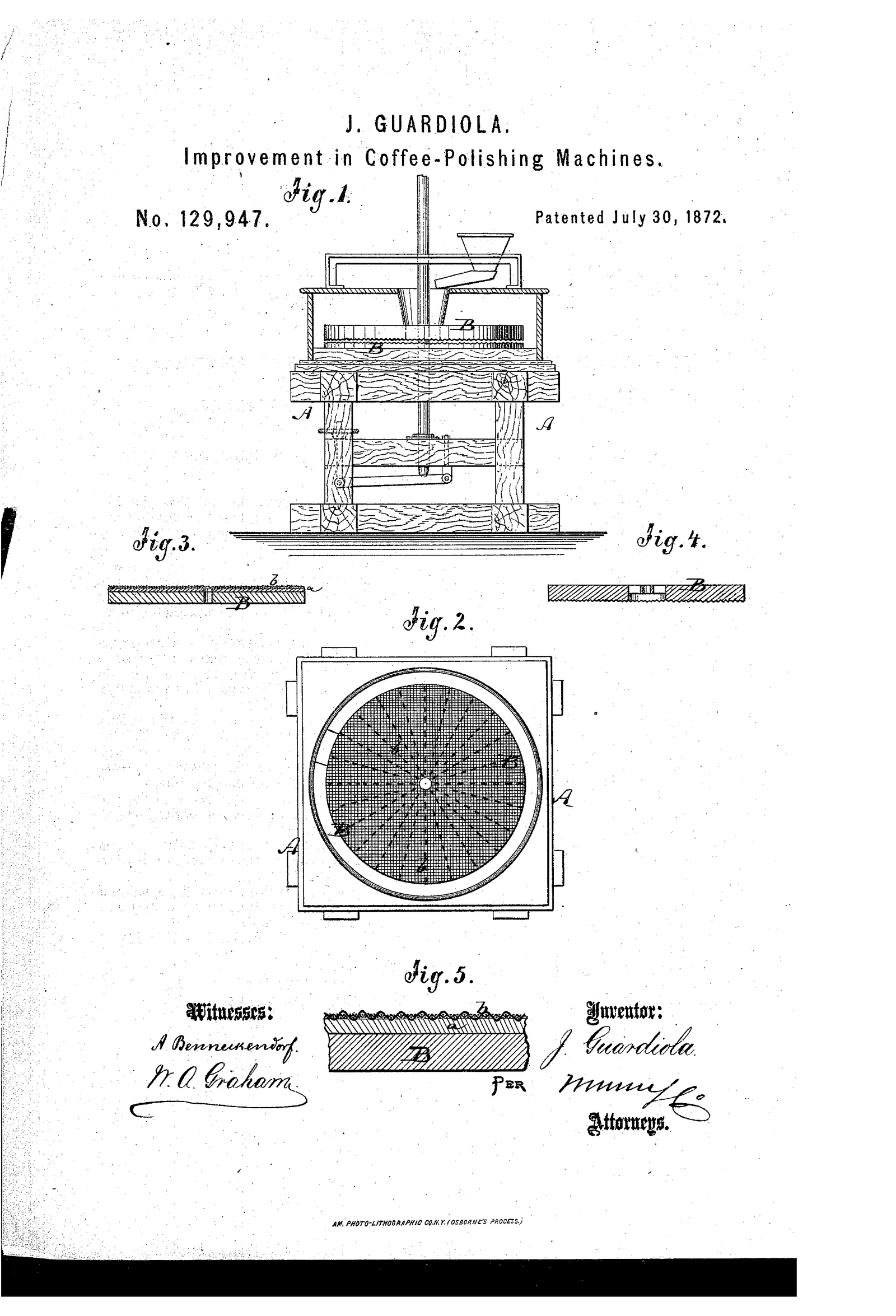
The dry polisher is the older. It is a rotating cone in a jacket, both lined with phosphor bronze, a hard alloy used for its resistance to wear. The bean passes through the gap and rubs against the metal. Ukers describes exactly this machine in 1922 and names its two reference manufacturers, the Swiss Jules Smout and Roberto O’Krassa, of Guatemala, both selling a combined apparatus that hulls and polishes in the same pass. The machine is efficient and brutal. Vietnamese professional documentation credits it with 4 to 5 percent breakage, 2 to 3 percent loss in dust and debris, and the frequent need for two passes to reach 90 percent of silverskin removed.
The wet polisher is the answer to this balance sheet. The principle announced by Vietnamese manufacturers is to remove the abrasive lining and to have the beans work against one another: a high-pressure pump mists while the machine agitates, and the shine comes from mutual friction, not from rasping against metal. The figures published by one manufacturer for a machine of this family are as follows: 750 to 800 kilos per hour, 30 kilowatts, a polishing rate recorded up to 95 percent, a loss of 1.1 to 1.2 percent collected in the dust and silverskin bin, and an increase in breakage of only 0.2 to 0.4 percent. The same document sets against these values a European misting technology given at 500 kilos per hour, 2 percent loss and 2.5 percent added breakage. These numbers must be read for what they are: a seller’s brochure comparing its product with others. Their order of magnitude is plausible and consistent from one line to the next, but none has been verified by a third party.
The added water raises a question that brochures treat quickly and that the buyer must ask slowly: where does it go. The announced answer is that the heat released by friction evaporates it at once, so that the moisture of the lot does not move. A British importer describes the heat involved as not exceeding what a bean would undergo in a mechanical dryer. This is plausible, and it remains an assertion: no record of moisture and water activity before and after polishing has been found published. On a lot contractually capped at 12.5 percent, the margin is thin, and this is precisely the kind of point that a half-day trial would settle.
Immediate cooling at the outlet is among the announced features, and its reason is visible to the eye: a hot bean stored hot discolors. It is the same mechanism that forbids bagging a coffee taken out of a mechanical dryer without letting it return to ambient temperature.
The bath variant is run differently and must be described separately, since it sometimes carries the same name. The coffee is soaked there to detach the silverskin, polished afterwards, then re-dried. The cleanliness yield is close to one hundred percent. The cost is too: a water consumption, an effluent to treat, and a re-drying energy that does not exist in the misting route.
Finally, polishing is a commercial decision before it is a technical one, and the Indonesian literature says so without detour: polishing is rarely done by producers, because of the cost it adds, and it is most often carried out by traders or exporters, to raise the price of the coffee. This is the most important fact of this sheet, and the one least often written.
What it gives in the cup
What has been measured must be separated here from what is asserted, and the split is brutal: nothing has been measured.
No trial comparing, on the same lot, on the same day, a polished fraction and an unpolished fraction, tasted blind by a panel, was found for this sheet. Not in one direction or the other. The trial is not difficult: it is enough to divide a lot at the sorter outlet and polish only one half. It has simply not been published.
What is claimed on the favorable side comes down to little, and the vocabulary there is significant: a cleaner, shinier bean, more regular in appearance, and buyers who pay a premium for it. The argument therefore concerns appearance and price, not the cup. A British importer states it in exactly those terms.
What is claimed on the unfavorable side is more technical, and rests on two ideas. The first is that friction releases heat and that this heat damages the cup. Anglo-Saxon professional literature writes this and concludes that the practice is now discouraged. The second is that the silverskin protects the bean in storage, and that a naked bean ages faster. Neither rests on a published measurement, and the second is all the more fragile because it contradicts a fact established elsewhere on this site: a bean hulled early and kept naked, as wet hulled requires, is described everywhere as fragile to aging, and that fragility is no more measured either.
One real effect remains, which plays out not in the cup but in the roaster’s drum, and which deserves to be named because it is the only one whose mechanism is clear. The silverskin comes off during roasting and becomes the chaff, that dry flake the cyclone draws away. The more of it remains on the green, the more there is in the machine, and the greater the risk that a fragment stuck in the center cut burns before the bean. A polished lot produces less of it. Nobody has quantified what this is worth in the cup, and it is possible that it is worth nothing at all.
The honest conclusion is therefore this one. Wet polishing is a cosmetic and commercial operation whose effect on the beverage is established in neither direction. This is not an accusation, it is a description. A buyer who pays a premium for a polished lot pays for an appearance, and is entitled to want it; what the buyer cannot do is claim to be paying for a taste.
What goes wrong
Breakage is the first risk, and it is also the reason for being of the wet process. A broken bean is not only a loss of weight and a defect penalty. It roasts faster than whole beans, because its exchange surface is larger for a smaller mass, and it burns while the rest of the lot is still cooking. The values announced by Vietnamese documentation, 0.2 to 0.4 percent of added breakage in wet polishing against 4 to 5 percent in dry polishing, describe a gap of an order of magnitude. They come from a seller.
Weight loss is the second, and it can be quantified immediately. At 1.1 to 1.2 percent, a container of nineteen tonnes leaves 210 to 230 kilos in the dust bin. At 2 or 3 percent, it leaves 380 to 570. This material is not lost for everyone, since the silverskin is sold as a by-product, but it is lost for the seller of the coffee.
Overheating is the third. Every friction machine converts mechanical power into heat, and thirty kilowatts applied to 800 kilos per hour is energy that has to go out somewhere. If it does not go out, it goes into the bean, and discoloration follows. Manufacturers answer with cooling at the outlet; this means the problem exists.
Water uptake is the fourth, and it is the one nobody documents. A lot sold at 12.5 percent moisture at most is already close to its contractual ceiling. Added water that does not fully evaporate raises the moisture and, with it, the water activity, that is, the share of water actually available to a microorganism. The thresholds are established elsewhere on this site and need not be repeated here; it is enough to recall that they are close. A lot polished and then bagged hot and poorly dried sweats in its bag exactly like a coffee taken too hot out of a dryer.
The effluent is the fifth, and it concerns only the bath variant. Vietnamese professional literature states it clearly: this route obliges one to give the coffee a bath before polishing it, and the volume of wastewater discharged puts industrial operators before the environmental authorities. This point joins the file on processing water treated elsewhere on this site.
The sixth risk is not technical, and it is the most serious. Polishing embellishes a lot without improving it. A coffee with defects, polished, looks more like a coffee without defects than it did before. The operation is done, most often, by the one who sells and not by the one who produces, and it is done with the stated aim of raising the price. That does not make it dishonest: a waxed fruit is not a rigged fruit. It only imposes a rule of reading on the buyer, and it is simple. The shine of a green coffee is not information about its quality. It is information about what was done to it after sorting, and nothing else. Judging a lot by its appearance has always been a bad method; on a polished lot, it is a blind method.
Benchmarks
- Moisture of the coffee at the time of polishingthat of commercial green coffee, at most 12.5 percent
- Material loss in wet polishing by misting, manufacturer source1.1 to 1.2 percent
- Added breakage in wet polishing by misting, manufacturer source0.2 to 0.4 percent
- Added breakage in dry polishing, manufacturer source4 to 5 percent
- Material loss in dry polishing, manufacturer source2 to 3 percent
- Passes needed in dry polishing to exceed 90 percent of silverskin removedoften two
- Polishing rate recorded on a wet machine, manufacturer sourceup to 95 percent
- Throughput of a wet polisher, manufacturer source750 to 800 kilos per hour for 30 kilowatts
- Throughput of a European misting machine, manufacturer source500 kilos per hour, 2 percent loss, 2.5 percent added breakage
- Specification of a common Vietnamese gradeGrade 1, screen 18, wet polished, at most 0.3 percent of black and broken beans, at most 0.1 percent of foreign matter, at least 90 percent above screen 18
- Opening of screen 18about 7.1 millimeters, screens being counted in sixty-fourths of an inch
- Test sample for counting defects, Indonesian standard SNI 01-2907-2008300 grams
- Controlled trials comparing a polished lot and the same lot unpolished in blind tastingnone found
- Published measurements of moisture and water activity before and after polishingnone found