Honey: the colors are standardized nowhere
Why are honey colors not recipes?
Start the scene or choose a stage. The animation simplifies the mechanism; what follows gives the details and the available references.
The cherry is pulped as for a washed coffee, but there will be neither a fermentation tank nor washing.
Read the stages without animation
- Pulp as for a washed coffeeThe cherry is pulped as for a washed coffee, but there will be neither a fermentation tank nor washing.
- Dry with the mucilageIt is dried directly with all or part of the mucilage, whose sugar slowly browns: hence the name honey. On a canephora honey, the starting conditions are quantified: pH 6.7 to 6.8, 26 °C, 10 ± 1.5 °Brix, the degree of dissolved sugar, then a drop to pH 4.3 ± 0.3.
- Four colors, a single mucilageThe importer Cafe Imports reports that some mills leave 100% of the mucilage on all their lots and obtain the four colors by changing only the drying: shading, thickness, duration. The color tells how the coffee was cooked, not the recipe.
- Percentages without a definitionThe percentages that circulate, 10% of mucilage for white, 25 for yellow, 50 for red, 75 to 100 for black, vary from one source to another, and no body defines them. The same category is also obtained by machine, with a mechanical demucilager, and in a tank: Cenicafé makes honey through the controlled degradation of the mucilage to 25, 50 or 75%.
To remember: A single commercial category covers at least three ways of obtaining the result: the machine, the drying and the fermentation.
In history: The documented origin is Brazilian; Costa Rica popularized the colors.
Read the full article and its sources ↓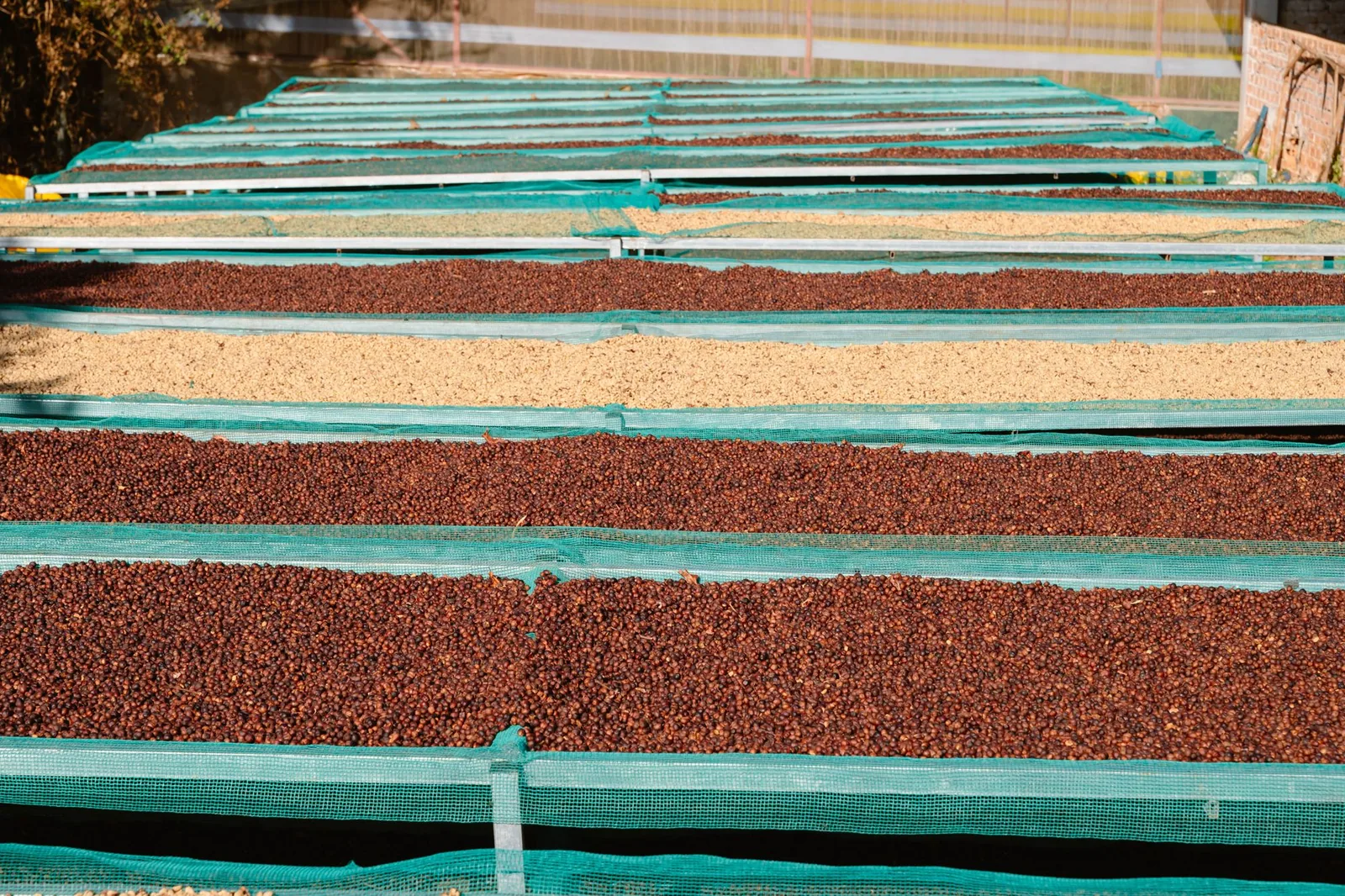
The cherry is pulped as for a washed coffee, but it is not fermented in a tank and not washed: it is dried directly with all or part of the mucilage, whose sugar slowly browns, hence the name honey. The documented origin is Brazilian: pulped natural (cereja descascado, in Portuguese) appears after the dissolution of the Instituto Brasileiro do Café in 1990, with Pinhalense credited with the first machine in 1991; Costa Rica then popularized the vocabulary of colors through its micro-mills.
The explanation by the water restrictions after the 2008 earthquake has only commercial sources. A crucial and counterintuitive point: white, yellow, red, black are defined by no body, neither the SCA, nor an institute, nor a product specification. The percentages that circulate, 10% of mucilage for white, 25 for yellow, 50 for red, 75 to 100 for black, vary from one source to another.
The importer Cafe Imports puts it most clearly: some mills leave 100% of the mucilage on all their lots and obtain the four colors by changing only the drying, shading, thickness, duration. The color tells how the coffee was cooked, not the recipe: two coffees labeled red honey may come from two distinct processes.
Pinhalense; Cafe Imports, Honey process glossary; LC ch. 17bResearch is beginning to give some benchmarks. A Chinese study from 2025 identifies an optimum of 75 to 80% mucilage retention for richness in volatile compounds, with bacteria more active when little mucilage remains and fungi when a lot remains. On canephora honey, quantified starting conditions: pH 6.7-6.8, 26 °C, 10 ± 1.5 °Brix, falling to pH 4.3 ± 0.3. Cenicafé makes honey by another route, the controlled degradation of the mucilage to 25, 50 or 75%, a definition by fermentation and not by mechanics.
A single commercial category therefore covers at least three ways of obtaining the result, even though honey makes molecules of its own, the phenolamides, that neither the washed nor the natural produces (see the cup).
Food Chemistry: X (2025), abstract; Food Chemistry (2023) on canephora honey; Cenicafé, Avances Técnicos no. 554 (2023); Yang et al. 2026 for the phenolamides