The United States: Prohibition, the coffee room and the free cup
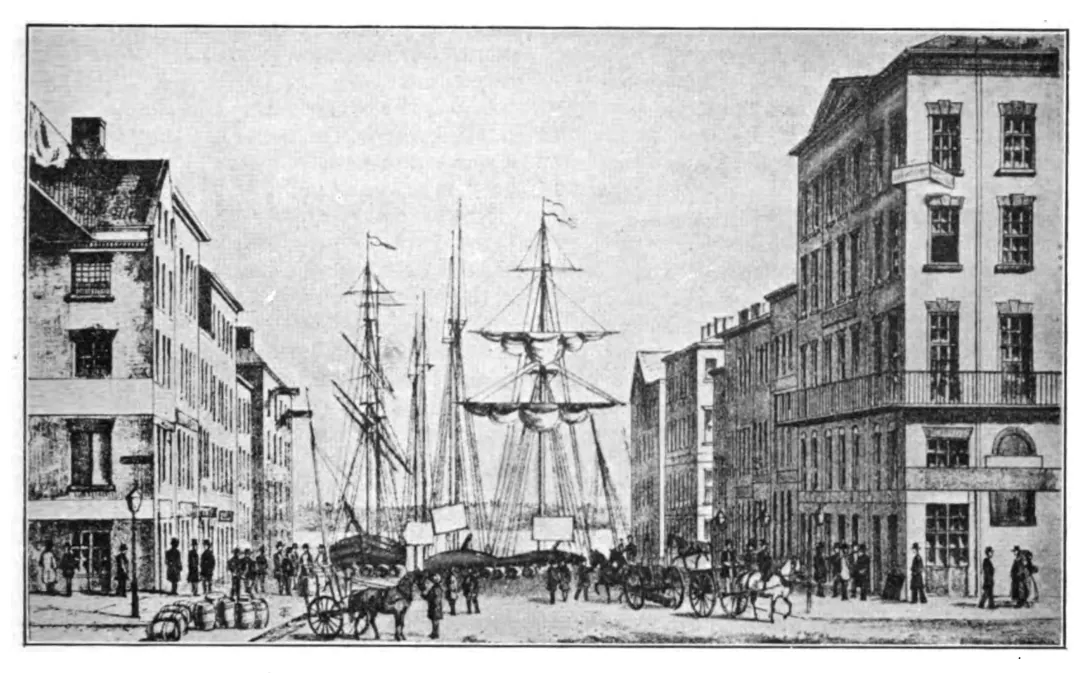
In the colonies, beer and cider first gave way to tea, then tea to coffee. The Boston Tea Party settled it. Coffee nevertheless remained confined to the same moments as in Europe: between meals, or after dinner.
The shift comes later. It was in the early 19th century that coffee settled in as the American breakfast drink. By 1922, the American cup had become a food as much as a drink. The same large cup comes back at the midday meal and at the evening one, whereas European custom reserves for coffee a small after-meal cup.
Then there is the most repeated figure. Fred Mason, of the American Sugar Refining Company, puts forward forty billion cups a year, or about eight hundred million pounds of sugar.
One must know where it comes from. It is the argument of a sugar industrialist, published by a coffee-trade publisher. In other words, both parties had an interest in the number being enormous. This is an interested order of magnitude, not a statistic.
Ukers 1922, ch. XXXV, citing Fred Mason, American Sugar Refining Co.Prohibition, in force since 1920, is presented as the great consumption fact of the moment: the average citizen would drink a hundred more cups a year, most of it coming from coffee taken between meals, at soda fountains, at the hotel and at home, in place of alcoholic drinks. Three institutions come out of it: the hotel coffee room that replaces the bar, the custom of afternoon coffee, and free service in factories and offices.
Since 1921, many large hotels serve a free half cup as soon as the traveler sits down, which the waiters call petits noirs. Childs serves forty million cups a year in ninety-two restaurants, or fifty-three cups to the pound, and Thompson one hundred sixty thousand cups a day.
Ukers 1922, ch. XXXV, p. 655-694The protocol of the large hotels is given by their stewards. At the Waldorf-Astoria, a French porcelain filter pot is used, that is, a pot where the water passes through the grounds instead of staying in them.
This pot is kept warm and scalded at the moment of the order. It thus does not cool the water on the way through.
The dose is one level tablespoon of ground coffee “at the consistency of granulated sugar.” The water is freshly boiled and poured through. For after-dinner cups, which are wanted stronger, ten percent more grounds are added.
The house works a blend of Old Government Java and Bogota.
Ukers 1922, ch. XXXV, p. 655-694In this plateThe 21 sections
- 01The Arab ceremony: the coffee room and its gestures
- 02The Bedouin circle, the four sips, the rule of water
- 03Turkish coffee: the room, the price, the etiquette
- 04Ramadan, Karagöz and the coffee calendar
- 05Damascus, Cairo, Algiers: water, smoke and the storyteller
- 06Venice: the first caffè of Europe and the square as a salon
- 07Vienna: the blend, the newspaper and the word for ordering
- 08Paris: from Procope to the boulevard, and the waiter's vocabulary
- 09London: the penny university, and what replaced it
- 10Berlin, Saxony and the Kaffeeklatsch
- 11Amsterdam and Athens: the glass of water and the kaimaki
- 12The North and the East: copper kettles, lemon and flambéed cognac
- 13Italy, Spain, Portugal, Belgium
- 14The United States: Prohibition, the coffee room and the free cup
- 15New Orleans, Brazil, Cuba, Mexico, Australia
- 16Coffee in painting, engraving and caricature
- 17Coffee in music and literature
- 18Silverwork, porcelain and the furniture of service
- 19How a custom is made: taste is a habit
- 20What has changed since 1922
- 21Archive plates
The table of contents, with the first sentence of each section