Ramadan, Karagöz and the coffee calendar
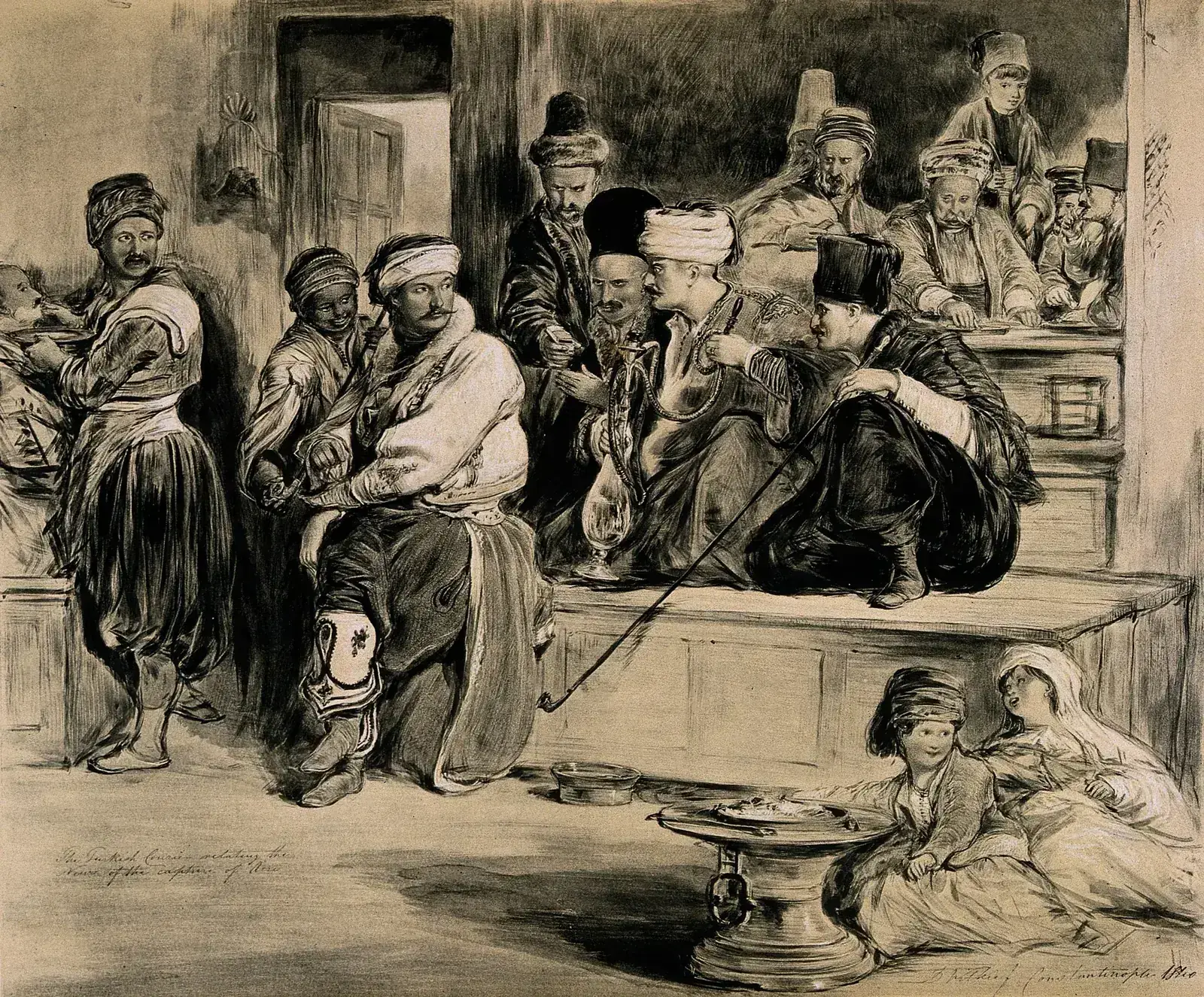
Coffee is a matter of hours. Stamboul, outside Ramadan, is deserted at night, and it is just after twilight that the coffeehouses are at their best. Throughout the month of Ramadan, the purely Turkish coffeehouses close by day and stay open all night; it is in that month only that one can see, in some of the largest, the Karagöz, the Turkish shadow theater.
Ukers 1922, ch. XXXV, citing Dwight (1915)Christian coffeehouses follow the calendar of the Church, as Turkish ones follow that of Ramadan. Coffee has no schedule of its own: it takes that of the religion of its customers.
Each quarter celebrates its patron saint with a panayiri, that is, a three-day patronal festival. The street is decked with flags, tables move out onto the pavement, and the room thus overflows outside.
One detail scandalizes the observer: men and women dance there together, to the sound of the lanterna, the barrel organ peculiar to Constantinople. The rest of the year, the coffeehouse of Constantinople gathers only men.
Ukers 1922, ch. XXXV, citing Dwight (1915)In this plateThe 21 sections
- 01The Arab ceremony: the coffee room and its gestures
- 02The Bedouin circle, the four sips, the rule of water
- 03Turkish coffee: the room, the price, the etiquette
- 04Ramadan, Karagöz and the coffee calendar
- 05Damascus, Cairo, Algiers: water, smoke and the storyteller
- 06Venice: the first caffè of Europe and the square as a salon
- 07Vienna: the blend, the newspaper and the word for ordering
- 08Paris: from Procope to the boulevard, and the waiter's vocabulary
- 09London: the penny university, and what replaced it
- 10Berlin, Saxony and the Kaffeeklatsch
- 11Amsterdam and Athens: the glass of water and the kaimaki
- 12The North and the East: copper kettles, lemon and flambéed cognac
- 13Italy, Spain, Portugal, Belgium
- 14The United States: Prohibition, the coffee room and the free cup
- 15New Orleans, Brazil, Cuba, Mexico, Australia
- 16Coffee in painting, engraving and caricature
- 17Coffee in music and literature
- 18Silverwork, porcelain and the furniture of service
- 19How a custom is made: taste is a habit
- 20What has changed since 1922
- 21Archive plates
The table of contents, with the first sentence of each section