Damascus, Cairo, Algiers: water, smoke and the storyteller
Ordering in 1922
| City | What is said | What arrives |
|---|---|---|
| Constantinople | with or without sugar | boiled three times, glass of water first |
| Vienna | mélange | 2/3 coffee, 1/3 hot milk, whipped cream |
| Vienna | brauner / schwarzer | darker / without milk |
| Paris | café crème | table brushed twice |
| Paris | café complet | table brushed three times, bread and butter |
| Paris | café gloria | black coffee and cognac in equal parts |
| Paris | mazagran | lengthened cold coffee, in a large glass |
| Athens | with kaimaki | froth shared in equal parts |
| London | a dish of coffee | 1 to 2 pence, newspapers included |
| Rioy | cafezinho | you pull a cup, the waiter fills it |
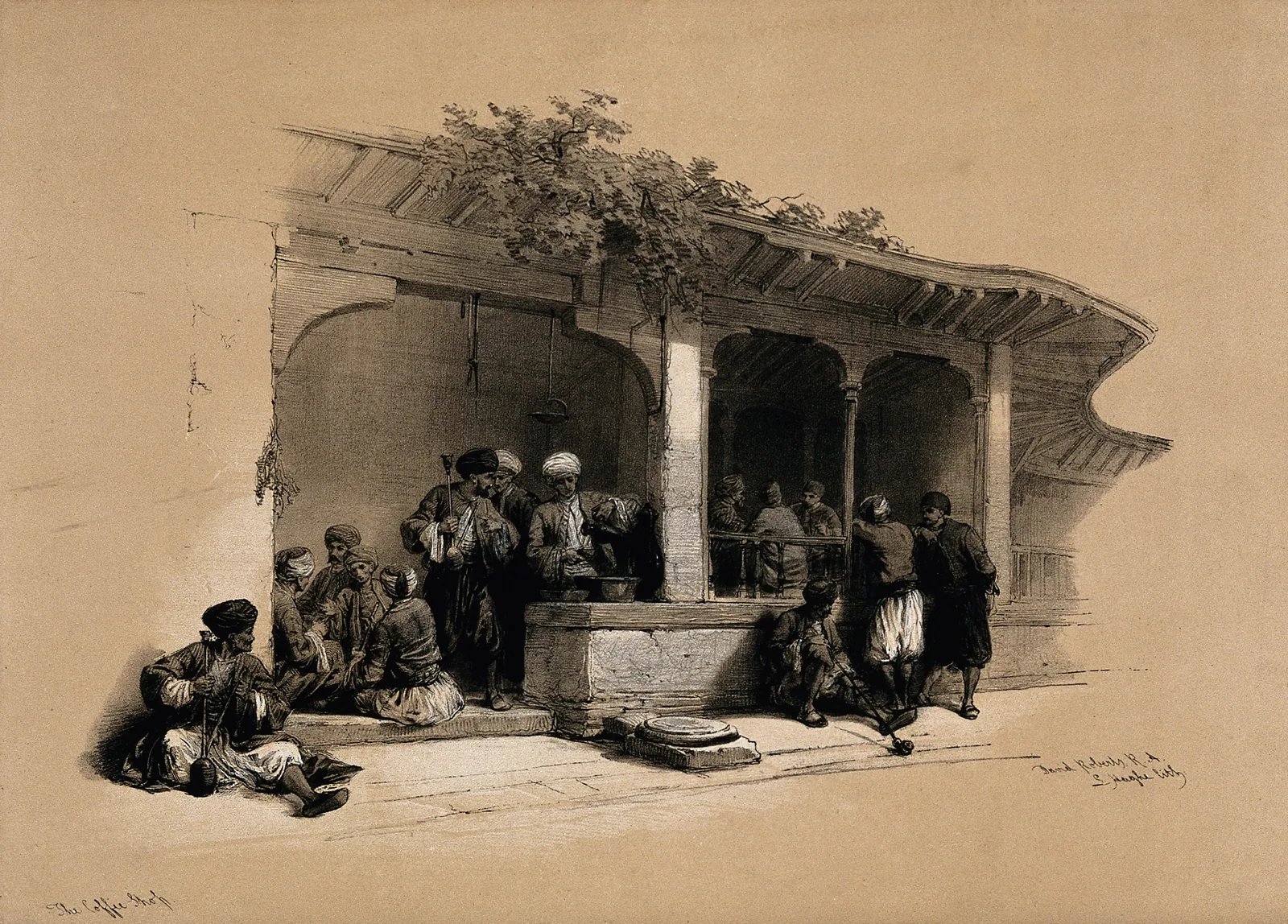
The most precise text Ukers reproduces was written in 1836, to accompany a plate by Bartlett and Purser. Ukers notes that it could have been written in 1922, so little had the setting changed. The reference is the coffeehouse that Shemsi had brought from Damascus to Constantinople in 1554.
The Damascus coffeehouses are built on the river itself, the Barada. A light roof rests on slender pillars. The wooden floor is watered and raised a few inches above the current: the water thus flows under the drinkers' feet.
The seats are small, and everyone places his own where he wants. Nothing is set against the wall, unlike the benches of the coffeehouses of Constantinople. The customer composes his place himself. The cup of Mocha, for its part, arrives as soon as the stranger is seated, without his having to ask for anything.
Two phrases from this text became famous. The first: “The Turk has his opera, his theater, his conversazione there.” The second: “Mohammed made a grave mistake in omitting coffeehouses from the next world.”
Ukers 1922, ch. XXXV, commentary on the plate by Bartlett and Purser (1836)In Cairo, Ukers takes as his document Gérôme's painting kept at the Metropolitan Museum: two men prepare the drink near a hearth, a dervish dances. The preparation is modified Turkish-Arab, powdered coffee boiled in an ibrik with sugar. Coffee accompanies every commercial transaction, and Arab barber shops have served coffee, tobacco and sweets for centuries.
Ukers 1922, ch. XXXVIn Algiers, Rousseau and Roland de Bussy describe the typical interior, and it comes down to a short inventory. A narrow, deep cellar. Two benches covered with mats. Chipped cups, tongs, a box of brown sugar, a small stove. Nothing else.
It is the clearest illustration of what has just been said: the coffeehouse has no architecture, it has a hearth and somewhere to sit.
Algeria nevertheless gave a word to the vocabulary of coffee. The mazagran is sweetened cold coffee, lengthened with water or ice. Its name is said to come from the fort of Mazagran, kept by France under the Treaty of the Tafna in 1837.
The fashion has its opponents. Jardin condemns it flatly: “This way of serving coffee in glasses has no reason to exist.”
Ukers 1922, ch. XXXV, citing Antoine Rousseau, Th. Roland de Bussy and JardinIn this plateThe 21 sections
- 01The Arab ceremony: the coffee room and its gestures
- 02The Bedouin circle, the four sips, the rule of water
- 03Turkish coffee: the room, the price, the etiquette
- 04Ramadan, Karagöz and the coffee calendar
- 05Damascus, Cairo, Algiers: water, smoke and the storyteller
- 06Venice: the first caffè of Europe and the square as a salon
- 07Vienna: the blend, the newspaper and the word for ordering
- 08Paris: from Procope to the boulevard, and the waiter's vocabulary
- 09London: the penny university, and what replaced it
- 10Berlin, Saxony and the Kaffeeklatsch
- 11Amsterdam and Athens: the glass of water and the kaimaki
- 12The North and the East: copper kettles, lemon and flambéed cognac
- 13Italy, Spain, Portugal, Belgium
- 14The United States: Prohibition, the coffee room and the free cup
- 15New Orleans, Brazil, Cuba, Mexico, Australia
- 16Coffee in painting, engraving and caricature
- 17Coffee in music and literature
- 18Silverwork, porcelain and the furniture of service
- 19How a custom is made: taste is a habit
- 20What has changed since 1922
- 21Archive plates
The table of contents, with the first sentence of each section