Turkish coffee: the room, the price, the etiquette
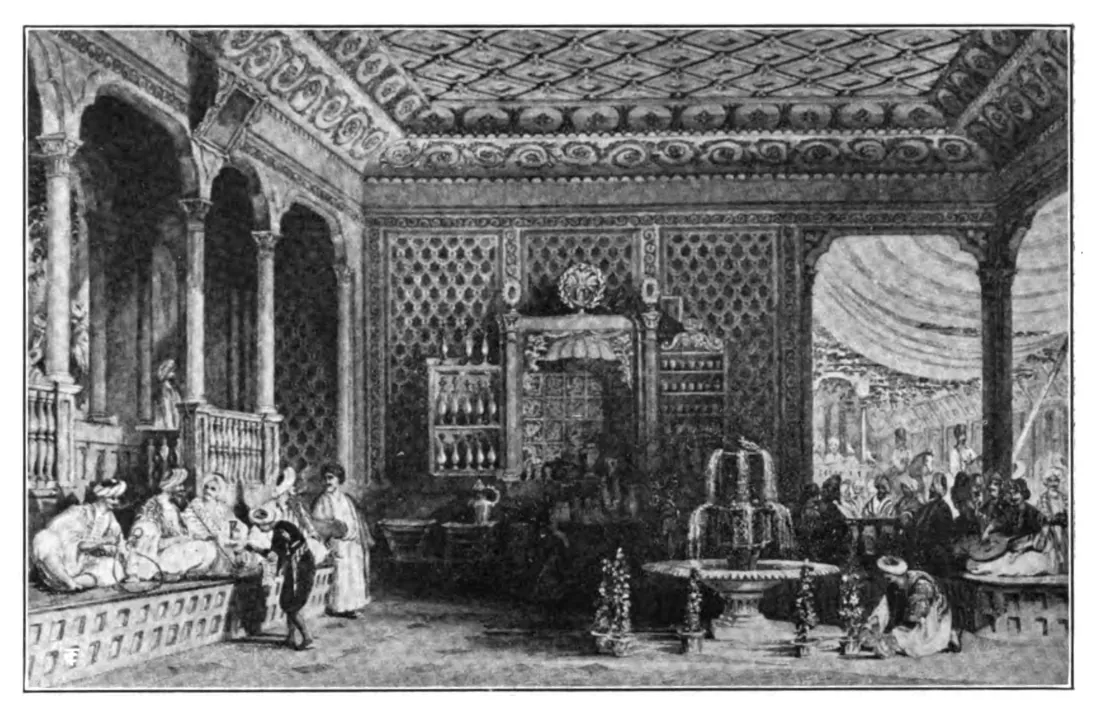
The sumptuous caffinet of the romantic travelers no longer existed in 1922, and Ukers even doubts it ever did. His argument comes down to one sentence: “there has certainly never been such a thing as coffeehouse architecture.” No style ever settled on these rooms, and it is on that that he bases his doubt.
What remains is a canonical portrait, that of Allom and the Reverend Walsh. The building is carried on pillars and open at the front. A platform covered with mats receives the customers, sitting cross-legged.
The room is divided in two: the Greek musicians on one side, on the other the men dozing under the double influence of coffee and tobacco.
The drink itself is described thus: “in cups no bigger than eggcups, with the grounds, without cream or sugar, so black, thick and bitter that it has been compared to boiled soot.” The grounds stay in the cup because that coffee is not filtered.
Ukers 1922, ch. XXXV, citing Walsh and Allom, Constantinople IllustratedThe ordinary coffeehouse of 1922, described by H. G. Dwight, is the club of the poor classes. Whole streets have no other trade, and the men of a street, a trade, a province or a nation meet there among their own, for a Turkish coffeehouse can be Albanian, Armenian, Greek, Jewish or Kurdish; the clientele is so fixed that one understands why they were called “schools of knowledge.” A room longer than wide, windows on the street side, a counter at the back with its flashes of brass and its kahvehji; one does not stand at the counter, one sits on the benches along the walls and takes off one's shoes to fold one's feet under oneself.
Ukers 1922, ch. XXXV, citing H. G. Dwight, Constantinople Old and New (1915)The etiquette strikes the observer: Dwight saw a newcomer greet one by one all the occupants of a crowded room, at the door and then after sitting down, the right hand to the heart with the word Merhabah or by the temennah, that triple sweep of the hand. The making is precise: a bean roasted to order in an iron cylinder over a fire of branches, ground to a powder in the brass mill, brought up to froth three times on a brazier in a small long-handled pot; milk would be “an unheard-of sacrilege.” The cup arrives with a glass of water that the Turk drinks first, and he lifts it by the saucer. Ten paras, a little over a cent; and one does not tip.
Ukers 1922, ch. XXXV, citing Dwight (1915)Two recipes frame the practice. The old one, noted by Fellows, is Arab: each cup is made in a ladle an inch wide and two deep, filled more than half with pounded coffee and then with water, and its contents are shaken more than poured, “much thicker than chocolate.” The improved Turkish recipe adds the sugar during cooking: three lumps for two cups, two teaspoons of powder, four successive risings tapping the bottom between each, then pouring alternately into both cups to share the froth in equal parts.
Ukers 1922, ch. XXXV, citing Fellows, Excursions through Asia MinorIn this plateThe 21 sections
- 01The Arab ceremony: the coffee room and its gestures
- 02The Bedouin circle, the four sips, the rule of water
- 03Turkish coffee: the room, the price, the etiquette
- 04Ramadan, Karagöz and the coffee calendar
- 05Damascus, Cairo, Algiers: water, smoke and the storyteller
- 06Venice: the first caffè of Europe and the square as a salon
- 07Vienna: the blend, the newspaper and the word for ordering
- 08Paris: from Procope to the boulevard, and the waiter's vocabulary
- 09London: the penny university, and what replaced it
- 10Berlin, Saxony and the Kaffeeklatsch
- 11Amsterdam and Athens: the glass of water and the kaimaki
- 12The North and the East: copper kettles, lemon and flambéed cognac
- 13Italy, Spain, Portugal, Belgium
- 14The United States: Prohibition, the coffee room and the free cup
- 15New Orleans, Brazil, Cuba, Mexico, Australia
- 16Coffee in painting, engraving and caricature
- 17Coffee in music and literature
- 18Silverwork, porcelain and the furniture of service
- 19How a custom is made: taste is a habit
- 20What has changed since 1922
- 21Archive plates
The table of contents, with the first sentence of each section