London: the penny university, and what replaced it
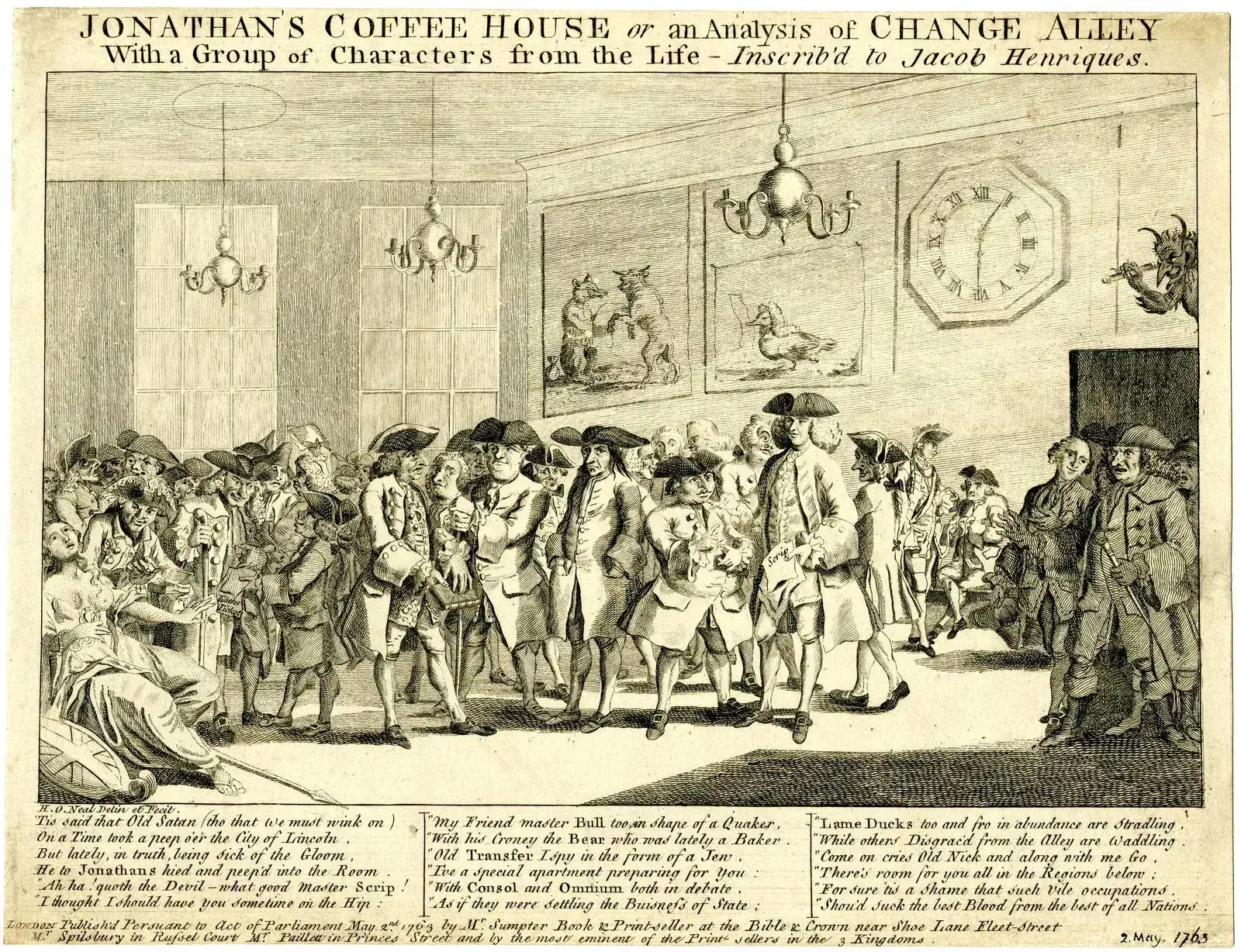
The London coffeehouse of the 17th century had a tariff and a set of rules. A cup cost one to two pence, and the demand was such that the keepers made coffee in pots of eight to ten gallons. Contemporaries spoke of penny universities: two pence a cup, newspapers and candles included, and custom was to put one's penny on the counter on entering or leaving.
Ukers links to these rooms the origin of the tip, brass-bound boxes being hung there with the inscription To Insure Promptness, whose initials supposedly gave tip. The National Review puts forward two thousand houses before 1715; Dufour, writing in 1683 from travelers' accounts, announces three thousand, but this is a marginal note and not a census.
Ukers 1922, ch. X, p. 53-90, citing the National Review and Dufour (1683); on the value of this note, LC ch. 7A set of rules was posted on the walls, under the title The Rules and Orders of the Coffee House. Its first article establishes the equality of the room. Gentlemen and merchants are all welcome there, and they may sit together without affront to anyone.
What follows is very concrete. Everyone takes the nearest free seat. Nobody has to rise for a greater man. The rank that governs the street thus buys no seat here, and that is exactly what one pays for with one's penny.
Next comes a morals police, and it has a tariff. An oath costs twelve pence in fines. Whoever starts a quarrel owes the room a round.
Prices and quantities, around 1922
| Reference point | Value |
|---|---|
| Ordinary Turkish coffee | 10 paras |
| Turkish coffee, pretentious house | 20 paras |
| London coffeehouse | 1 to 2 pence a cup |
| Fine for an oath, London | 12 pence |
| Betting cap, London | 5 shillings |
| Cup in Rio | about 3 cents |
| Arabia | 25 to 30 finjans a day |
| Brazil | 12 to 24 cups a day |
| Greece | about 2 pounds per inhabitant per year |
Two subjects are not to be treated with an irreverent tongue: sacred things and affairs of State. Cards, dice and all gaming are banned, and bets capped at five shillings.
The last article closes the system: the fines must be spent on drinks of the house. The offender's money thus does not go into the keeper's pocket, it returns to the table he disturbed.
Ukers 1922, ch. X, p. 53-90, The Rules and Orders of the Coffee House, 17th centuryThe pamphlet Coffee Houses Vindicated, published in 1675, says what the place allowed. For a penny or two, one spends two or three hours there. One finds the shelter of a house, the warmth of a fire, company and a pipe.
Its strongest argument comes down to a single phrase: business is done there sober, that is, without having drunk. Hence the phrases of the text, which make a well-kept coffeehouse “the sanctuary of health, the nursery of temperance, an academy of civility.”
The same year, Charles II tried the opposite. His proclamation for the suppression of coffeehouses was issued on December 23, 1675, effective January 10, 1676. It was recalled on January 8, before even taking effect. Eleven days were enough.
There remains the case of Edward Lloyd, where the common formula reverses causality. Lloyd was not an insurer. He kept a house where information on ship movements circulated, and insurance came to settle in that information, not the reverse. The Society of Lloyd's was not constituted until 1774.
Coffee Houses Vindicated (1675) and Charles II's proclamation of December 23, 1675, in Ukers 1922, ch. X; on Lloyd's, LC ch. 7 and professional training document, L'Histoire du caféThe end of the story is a substitution of clientele. Charles Cooper describes for Ukers the houses of forty or fifty years ago, around the Strand and the Inns of Court. The rooms there were divided into boxes and the prices moderate.
They were the last houses where real buttered toast was made, “an art now lost.” They had another trait in common, decisive for what followed: they served men exclusively.
It was the tea rooms that killed them, and the reason is social. An unaccompanied woman could then obtain in London little more than a cup of weak tea at a confectioner's.
As long as the female office worker did not exist, this exclusion cost nobody anything. It began to weigh when women worked in the city. It was the tea room that gathered this new clientele, and the coffeehouse that lost it.
Ukers 1922, ch. XXXV, notes by Charles Cooper written for UkersIn this plateThe 21 sections
- 01The Arab ceremony: the coffee room and its gestures
- 02The Bedouin circle, the four sips, the rule of water
- 03Turkish coffee: the room, the price, the etiquette
- 04Ramadan, Karagöz and the coffee calendar
- 05Damascus, Cairo, Algiers: water, smoke and the storyteller
- 06Venice: the first caffè of Europe and the square as a salon
- 07Vienna: the blend, the newspaper and the word for ordering
- 08Paris: from Procope to the boulevard, and the waiter's vocabulary
- 09London: the penny university, and what replaced it
- 10Berlin, Saxony and the Kaffeeklatsch
- 11Amsterdam and Athens: the glass of water and the kaimaki
- 12The North and the East: copper kettles, lemon and flambéed cognac
- 13Italy, Spain, Portugal, Belgium
- 14The United States: Prohibition, the coffee room and the free cup
- 15New Orleans, Brazil, Cuba, Mexico, Australia
- 16Coffee in painting, engraving and caricature
- 17Coffee in music and literature
- 18Silverwork, porcelain and the furniture of service
- 19How a custom is made: taste is a habit
- 20What has changed since 1922
- 21Archive plates
The table of contents, with the first sentence of each section