New Orleans, Brazil, Cuba, Mexico, Australia
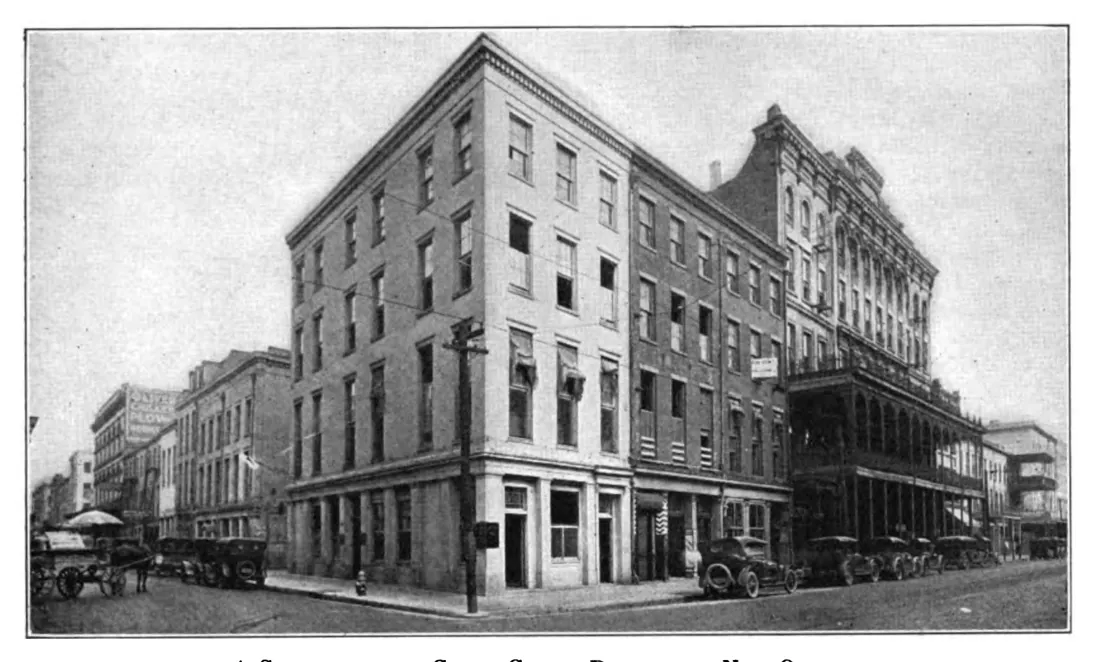
The Creole coffee of New Orleans, also called French market coffee, is not a drink but a concentrated extract.
First enough boiling water is poured to wet the grounds. Then boiling water is added by the tablespoon, at five-minute intervals. The operation is thus long, and it produces no cup.
What it produces is an extract kept in a stoppered bottle. It will then be used to make a café au lait or a black coffee, depending on what is added. The cooking is done once and for all, the cup is assembled on demand.
Coffee is often served there in bed on waking, as a first breakfast.
Ukers 1922, ch. XXXV, p. 655-694In Brazil, everybody drinks coffee at all hours. The bean is roasted almost to carbonization and ground fine.
Three preparations then coexist. It is boiled the Turkish way, or passed through the French filter, or filtered in conical linen socks hung from wire rings.
The counter ritual does not vary: doors wide open, round marble-topped tables, small cups arranged around a sugar bowl. The customer pulls a cup toward him, and a waiter at once comes to fill it. The gesture takes the place of the order.
Twelve to twenty-four cups a day are common, and the social rule pushes toward it. Every visit, to the President of the Republic as to the humblest tradesman, is the signal for a coffee.
Ukers 1922, ch. XXXV, p. 655-694In Mexico, three situations give three methods. Popular custom pounds the roasted bean in a canvas bag, which is then dipped in a pot of boiling water and milk.
The vaquero, the herdsman, does it the shortest way: he pours boiling water onto the powder at the bottom of his cup and sweetens with a stick of brown sugar.
The recipe of the well-off classes, for its part, works the bean before grinding. A teaspoon of butter, one of sugar and a little brandy are mixed into the hot bean. It is covered with a cloth, left to cool for an hour, then ground and filtered through a flannel bag.
In Australia, the drink commonly contains thirty to forty percent chicory, used there too as a modifier and not as a fraud. In the bush, the water boils in a billy, the camp kettle, and the coffee is made as soon as the liquid returns to a boil.
Ukers 1922, ch. XXXV, p. 655-694In this plateThe 21 sections
- 01The Arab ceremony: the coffee room and its gestures
- 02The Bedouin circle, the four sips, the rule of water
- 03Turkish coffee: the room, the price, the etiquette
- 04Ramadan, Karagöz and the coffee calendar
- 05Damascus, Cairo, Algiers: water, smoke and the storyteller
- 06Venice: the first caffè of Europe and the square as a salon
- 07Vienna: the blend, the newspaper and the word for ordering
- 08Paris: from Procope to the boulevard, and the waiter's vocabulary
- 09London: the penny university, and what replaced it
- 10Berlin, Saxony and the Kaffeeklatsch
- 11Amsterdam and Athens: the glass of water and the kaimaki
- 12The North and the East: copper kettles, lemon and flambéed cognac
- 13Italy, Spain, Portugal, Belgium
- 14The United States: Prohibition, the coffee room and the free cup
- 15New Orleans, Brazil, Cuba, Mexico, Australia
- 16Coffee in painting, engraving and caricature
- 17Coffee in music and literature
- 18Silverwork, porcelain and the furniture of service
- 19How a custom is made: taste is a habit
- 20What has changed since 1922
- 21Archive plates
The table of contents, with the first sentence of each section