Coffee in painting, engraving and caricature
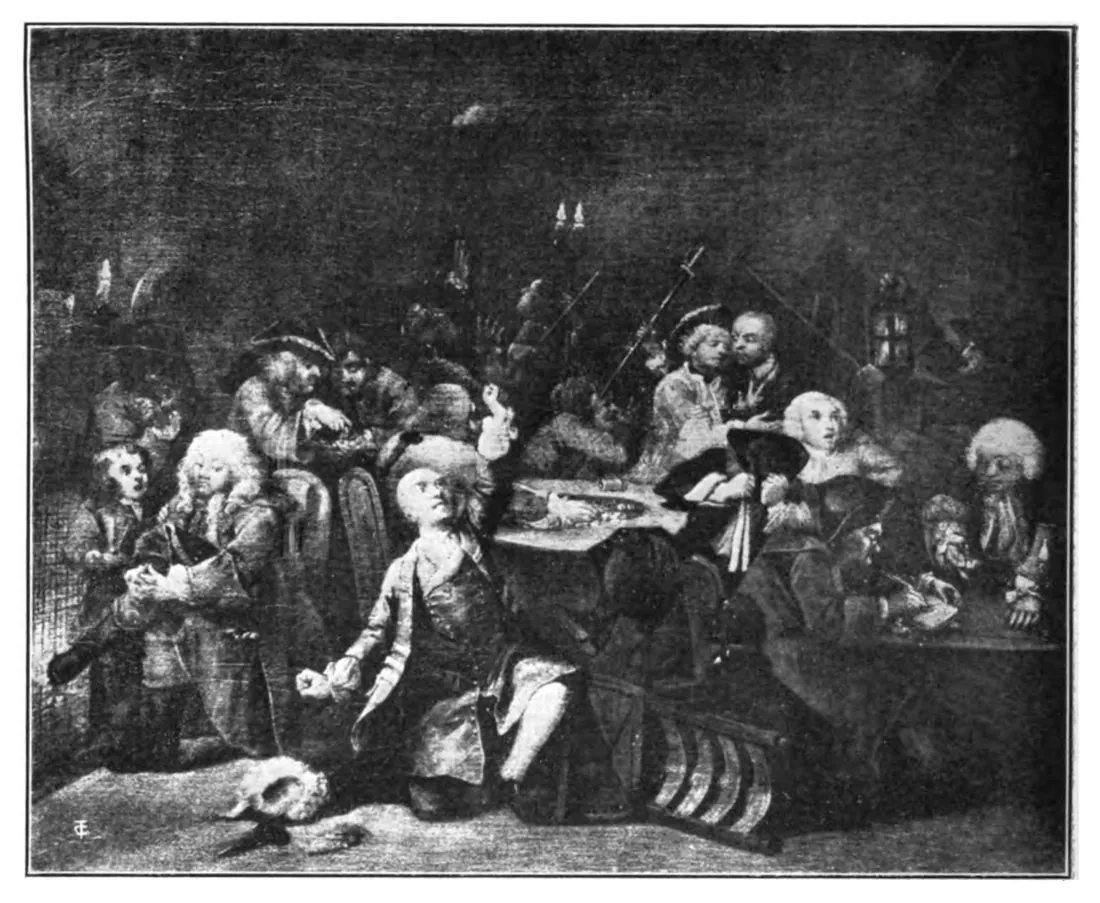
To describe how coffee was drunk in the 17th and 18th centuries, Ukers has almost nothing but images. He states it at the outset: the painters and engravers of these two centuries are his main documentary source on the first ways of drinking.
And he immediately qualifies it with a warning, because the source is fragile. A painting is not a record, it is a composition, often satirical. The painter arranges the room to make people laugh or to make it pretty, and nothing obliges the scene to have taken place.
The oldest known image of a coffeehouse is said to be the Dutch Coffeehouse by Adriaen Van Ostade, dated 1650. It is, moreover, not known directly: it comes to us through the etching by J. Beauvarlet kept in Munich, that is, through an engraving made after the original.
Hogarth, for his part, supplies two documents that can be dated. The first is the Covent Garden plate, in the Four Times of the Day: the clock of St Paul's there reads seven fifty-five, and the plate is dated 1738. A text of the period rarely gives the hour; the painter gives it.
The second is scene VI of A Rake's Progress, at White's club. Flames come out of the paneling there, an allusion to the fire of 1733. Here again, the date is slipped into the setting rather than into a caption.
Ukers 1922, ch. XXXIII, p. 587-614What the French 18th century left us of coffee is not a text, it is a table service, painted.
The Breakfast by Boucher, in the Louvre, shows a dining room of 1744 with the coffee service of the time. Van Loo's portrait of Mme de Pompadour shows a servant presenting a half cup, poured from a covered Oriental pot. That pot is itself a stage: it had succeeded the Arab-Turkish boiling pot, and the form marks the moment when Europe stops copying and begins adapting.
The following century does the opposite: it returns to the East, but through imagination. Orientalism produces a whole series of Turkish cafés, painted by artists some of whom had never been there.
Gérôme's Coffeehouse in Cairo is in the Metropolitan Museum. Marilhat's Café on a Road in Syria was shown at the Salon of 1844. Descamps's Turkish Café dates from 1855, and de Tournemine's Café in Asia Minor from the Salon of 1859.
These paintings are documents, but not about what they show. They document what Europe wanted to see in an Oriental café, at the precise moment when it was industrializing its own.
Ukers 1922, ch. XXXIII, p. 587-614, citing Malcolm C. Salaman, French Color Prints of the XVIIIth CenturyEnglish caricature gave the liveliest images of the rooms, and for a simple reason: the caricaturist looks for the ridiculous detail, hence the gesture, the furniture and the disorder, which the official portrait erases.
Rowlandson left a Mad Dog in a Coffeehouse and a watercolor of the French Coffeehouse in London. T. H. Shepherd, for his part, preserved Button's, Tom's and Slaughter's in watercolors of 1841 and 1857, which are today, for these three rooms, what stands in for photography.
Charlet lithographed the anecdote of 1814. Napoleon finds in a presbytery the priest turning his hand roaster, that vessel turned over the fire to roast one's coffee at home. “Sire,” answers the priest, “I do as you do, I burn the colonial fodder.”
The whole point lies in the verb. To burn, at that date, means to roast; it also means to destroy by fire. The priest thus answers that he does as the Emperor does, on his own scale, with a handful of beans.
Ukers 1922, ch. XXXIII, p. 587-614In this plateThe 21 sections
- 01The Arab ceremony: the coffee room and its gestures
- 02The Bedouin circle, the four sips, the rule of water
- 03Turkish coffee: the room, the price, the etiquette
- 04Ramadan, Karagöz and the coffee calendar
- 05Damascus, Cairo, Algiers: water, smoke and the storyteller
- 06Venice: the first caffè of Europe and the square as a salon
- 07Vienna: the blend, the newspaper and the word for ordering
- 08Paris: from Procope to the boulevard, and the waiter's vocabulary
- 09London: the penny university, and what replaced it
- 10Berlin, Saxony and the Kaffeeklatsch
- 11Amsterdam and Athens: the glass of water and the kaimaki
- 12The North and the East: copper kettles, lemon and flambéed cognac
- 13Italy, Spain, Portugal, Belgium
- 14The United States: Prohibition, the coffee room and the free cup
- 15New Orleans, Brazil, Cuba, Mexico, Australia
- 16Coffee in painting, engraving and caricature
- 17Coffee in music and literature
- 18Silverwork, porcelain and the furniture of service
- 19How a custom is made: taste is a habit
- 20What has changed since 1922
- 21Archive plates
The table of contents, with the first sentence of each section