Paris: from Procope to the boulevard, and the waiter's vocabulary
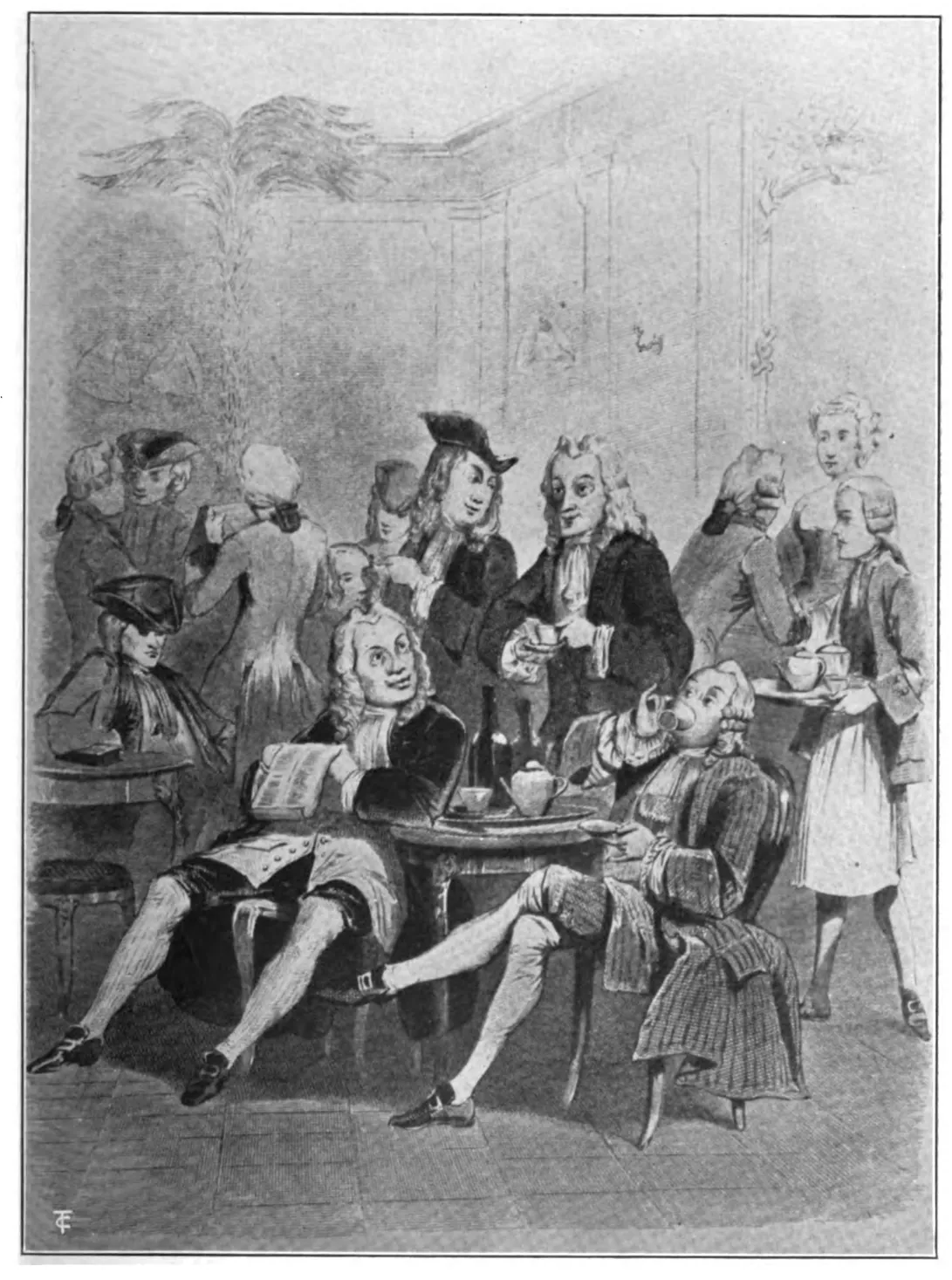
Before Procope there were Turkish-style coffeehouses, of low standing, where people of condition did not want to be seen. The shift occurred when French merchants set up, at the Saint-Germain fair, vast rooms adorned with tapestries, large mirrors, marble tables and chandeliers: drinking coffee in public became respectable. The Café de Procope is dated 1689 by Ukers, 1686 by other accounts, 1689 being the year the Comédie-Française settled across the street.
A contemporary calls it the Antre de Procope, “because it was very dark there even in broad daylight, and one often saw there a band of lean, pale poets.”
Ukers 1922, ch. XI, p. 91-104; on the opening date, LC ch. 7The Café de la Régence, named around 1718 in honor of the Regent, is the other pole. Every great Parisian café ends up with its specialty, and this one's is chess.
Diderot worked on the Encyclopédie there, and he tells that his wife gave him nine sous each day for his coffee. The sum is daily, so the expense entered the household budget.
In Le Neveu de Rameau, he goes there around five o'clock to watch the chess playing. He pronounces: “nowhere in the world is chess played as skillfully as in Paris, and nowhere in Paris as in this café.”
The Parisian café also serves as a rostrum. On July 12, 1789, it was on leaving the Café de Foy that Camille Desmoulins climbed onto a table.
The numbers follow. Three hundred cafés around 1710, six hundred under Louis XV, more than three thousand in 1843. Between these two dates, coffee ceases to be a curiosity and becomes an ordinary place.
Ukers 1922, ch. XI, p. 91-104, citing Diderot; professional training document, L'Histoire du café, for the series 300 in 1710, 380 in 1730, 745 in 1789The Paris of 1922 has rules written nowhere. Coffee is never boiled there, always passed or filtered, but roasted “burned almost to the state of charcoal” and cut with chicory, held not as an adulteration but as a modifier. In the morning, café au lait for everyone, and the workman stands a length of bread upright in his bowl, lets it soak up the coffee, then sucks the whole thing in.
Coffee is drunk at no other meal but is served in a half cup after lunch and dinner, with liqueur. Café gloria is black coffee and cognac in equal parts; mazagran, coffee lengthened in a large glass. The waiter brings the newspapers and brushes the table twice for a café crème, three times for a café complet.
Ukers 1922, ch. XXXV, citing Emmet G. Beeson, The Tea and Coffee Trade JournalHome roasting still holds the sidewalk: the little tin cylinders turned over a charcoal box are sold even in department stores. The object is thus not a rural curiosity, it is a shelf article.
Beeson describes in the Midi an old man who went around the village roasting the coffee of the houses, for a few sous a kilo. The model is that of the knife grinder: the craftsman goes from door to door instead of keeping a shop.
Grinding also remains domestic, almost everywhere. This is what makes the grocer so uncooperative: grinding is not part of his trade. Hence the saying, “to make a French grocer grumble, buy a kilo of coffee from him and ask him to grind it.”
Ukers 1922, ch. XXXV, citing BeesonIn this plateThe 21 sections
- 01The Arab ceremony: the coffee room and its gestures
- 02The Bedouin circle, the four sips, the rule of water
- 03Turkish coffee: the room, the price, the etiquette
- 04Ramadan, Karagöz and the coffee calendar
- 05Damascus, Cairo, Algiers: water, smoke and the storyteller
- 06Venice: the first caffè of Europe and the square as a salon
- 07Vienna: the blend, the newspaper and the word for ordering
- 08Paris: from Procope to the boulevard, and the waiter's vocabulary
- 09London: the penny university, and what replaced it
- 10Berlin, Saxony and the Kaffeeklatsch
- 11Amsterdam and Athens: the glass of water and the kaimaki
- 12The North and the East: copper kettles, lemon and flambéed cognac
- 13Italy, Spain, Portugal, Belgium
- 14The United States: Prohibition, the coffee room and the free cup
- 15New Orleans, Brazil, Cuba, Mexico, Australia
- 16Coffee in painting, engraving and caricature
- 17Coffee in music and literature
- 18Silverwork, porcelain and the furniture of service
- 19How a custom is made: taste is a habit
- 20What has changed since 1922
- 21Archive plates
The table of contents, with the first sentence of each section