Amsterdam and Athens: the glass of water and the kaimaki
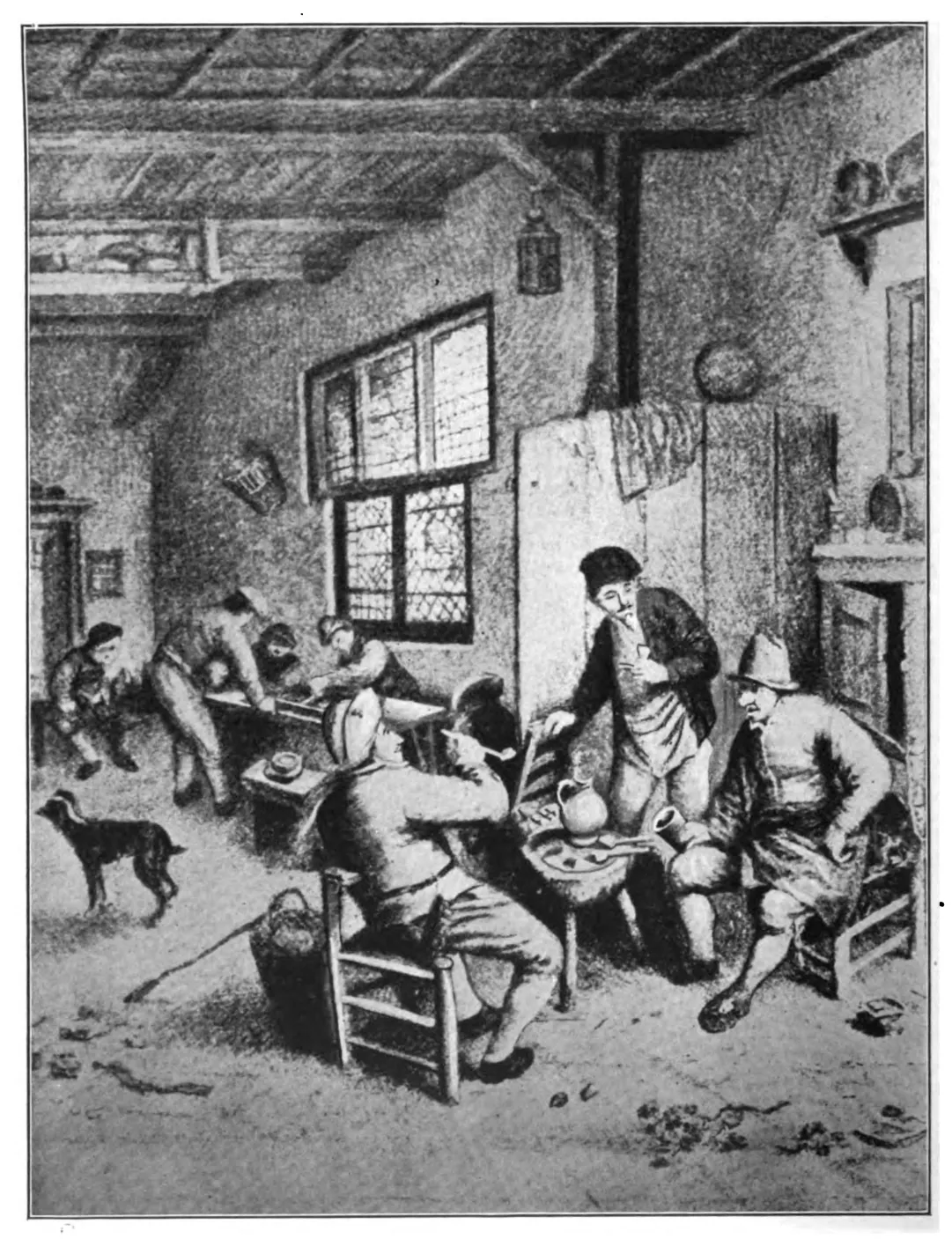
The United Provinces adopted the coffeehouse without ever persecuting it, and the first opens at the Korten Voorhout, in The Hague. The Dutch service of 1922 is the most regulated in Europe: individual pot, or half cups on a tray of silver, nickel or brass, with a miniature jug holding just the right amount of cream, generally whipped, a small dish bearing three lumps of sugar, and a slender glass of water.
The glass of water always goes with the coffee, and Ukers points it out as “the only sure way, for an American, of getting a drink.” Custom has it that one goes to take the after-dinner coffee somewhere other than where one dined.
Ukers 1922, ch. VII, p. 43-44, and ch. XXXVThe Greece of 1922 consumes about two pounds per inhabitant per year. Coffee is used there almost solely as powder, even at breakfast, by the Turkish method described above.
Edmond About gives the recipe of his servant Petros, “the first man in Athens for coffee.” Roast without burning. Reduce to an impalpable powder, that is, fine enough not to be felt under the tooth, since it will stay in the cup.
Then bring the water to the first boil. Take it off the fire to throw in one spoonful of coffee and one spoonful of pounded sugar per cup. Put it back on the fire until the contents seem ready to overflow. Remove, return, then pour quickly.
Petros never lets it rise more than three times. It is these successive risings that make the froth, and it is the froth that the recipe aims at.
This froth has a name, the kaimaki, and Petros shares it equitably among the cups. The sharing is no incidental politeness: “a cup without kaimaki is dishonored.”
Ukers 1922, ch. XXXV, citing Edmond About, La Grèce contemporaine (1854)About draws two observations from it. “One is surprised to find food in a cup where one expected a drink,” but prepared this way coffee can be taken ten times a day without inconvenience when five cups of French coffee could not be drunk with impunity, “because the coffee of the Turks and the Greeks is a diluted tonic, and ours a concentrated tonic.” He finally corrects an error of Parisian fashion: those who drink their coffee without sugar to imitate the Orientals should know that in Athens, Smyrna and Constantinople it is brought to them sweetened everywhere.
Ukers 1922, ch. XXXV, citing About (1854)In this plateThe 21 sections
- 01The Arab ceremony: the coffee room and its gestures
- 02The Bedouin circle, the four sips, the rule of water
- 03Turkish coffee: the room, the price, the etiquette
- 04Ramadan, Karagöz and the coffee calendar
- 05Damascus, Cairo, Algiers: water, smoke and the storyteller
- 06Venice: the first caffè of Europe and the square as a salon
- 07Vienna: the blend, the newspaper and the word for ordering
- 08Paris: from Procope to the boulevard, and the waiter's vocabulary
- 09London: the penny university, and what replaced it
- 10Berlin, Saxony and the Kaffeeklatsch
- 11Amsterdam and Athens: the glass of water and the kaimaki
- 12The North and the East: copper kettles, lemon and flambéed cognac
- 13Italy, Spain, Portugal, Belgium
- 14The United States: Prohibition, the coffee room and the free cup
- 15New Orleans, Brazil, Cuba, Mexico, Australia
- 16Coffee in painting, engraving and caricature
- 17Coffee in music and literature
- 18Silverwork, porcelain and the furniture of service
- 19How a custom is made: taste is a habit
- 20What has changed since 1922
- 21Archive plates
The table of contents, with the first sentence of each section