The Bedouin circle, the four sips, the rule of water
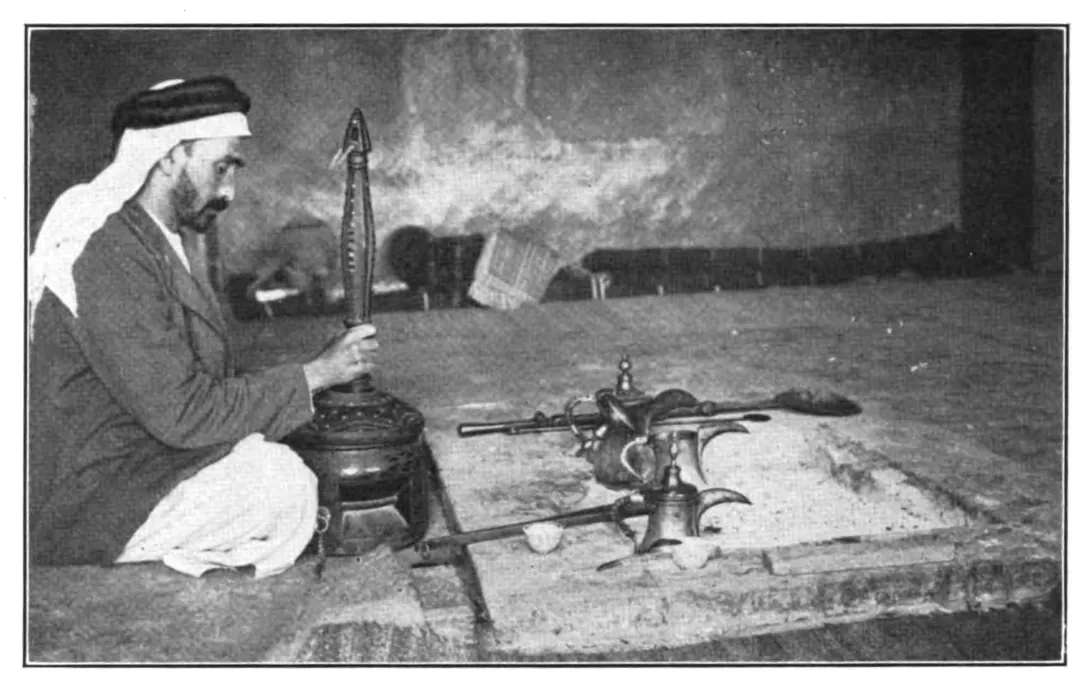
Among Doughty's nomads, coffee orients the tent itself. Sheikh Zeyd turns its front to the south, thus into full sun, to discourage freeloading drinkers.
The device has a limit, and that limit is a rule: a man of rank who enters a sheikh's tent must be served, even in the absence of the master. One therefore does not refuse, one dissuades.
The equipment travels with the camp. The coffeepots fit in the fatya, the coffee basket. The mortar is of brass, bought in town, or of studded wood.
The bean is pounded there “with a magnanimous clatter,” rhythmic like all nomad work.
Ukers 1922, ch. XXXV, citing Doughty, Travels in Arabia Deserta (1888)The dose is fixed: the fenjeyn kahwah, the cup of coffee, “is only four sips.” Nobody serves more, nobody asks for more.
To fill to the brim, as is done in the northern towns, would be an insult of perfectly clear meaning: “drink that and go.” The full cup dismisses, the half-full cup keeps.
Place also counts as rank. The farther toward the back of the tent, the higher the place. A poor man who arrives from behind stays standing, and waits for the circle to be widened for him.
Ukers 1922, ch. XXXV, citing Doughty (1888)One rule runs through the whole Levant: water is drunk before coffee, never after. Ukers cites the recipe of the cadi Hodhat, who justifies it by the fact that cold water lessens the dryness of coffee and makes it less likely to keep one awake, and a traveler gives the proof: “Once, in Syria, I was recognized as a foreigner because I had asked for water just after my coffee.” The kisher, a decoction of the roasted husks of the cherry, was still drunk, and the Galla mixed the powdered bean with fats to make a marching ration.
Ukers 1922, ch. XXXV, recipe attributed to the cadi HodhatIn this plateThe 21 sections
- 01The Arab ceremony: the coffee room and its gestures
- 02The Bedouin circle, the four sips, the rule of water
- 03Turkish coffee: the room, the price, the etiquette
- 04Ramadan, Karagöz and the coffee calendar
- 05Damascus, Cairo, Algiers: water, smoke and the storyteller
- 06Venice: the first caffè of Europe and the square as a salon
- 07Vienna: the blend, the newspaper and the word for ordering
- 08Paris: from Procope to the boulevard, and the waiter's vocabulary
- 09London: the penny university, and what replaced it
- 10Berlin, Saxony and the Kaffeeklatsch
- 11Amsterdam and Athens: the glass of water and the kaimaki
- 12The North and the East: copper kettles, lemon and flambéed cognac
- 13Italy, Spain, Portugal, Belgium
- 14The United States: Prohibition, the coffee room and the free cup
- 15New Orleans, Brazil, Cuba, Mexico, Australia
- 16Coffee in painting, engraving and caricature
- 17Coffee in music and literature
- 18Silverwork, porcelain and the furniture of service
- 19How a custom is made: taste is a habit
- 20What has changed since 1922
- 21Archive plates
The table of contents, with the first sentence of each section