Berlin, Saxony and the Kaffeeklatsch
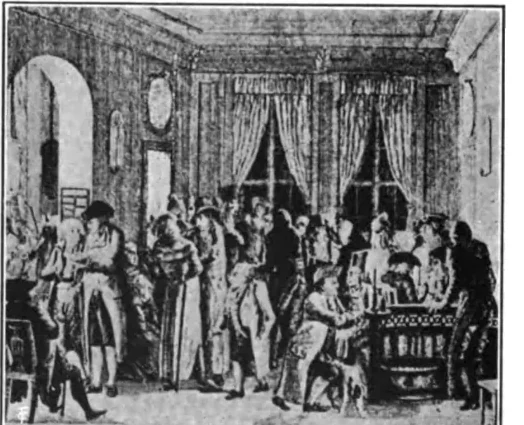
Germany invented the social function of the afternoon called Kaffeeklatsch, and Ukers describes its popular Sunday version: the family walks to a suburban garden where coffee is sold by the pot. The keeper supplies coffee, cups, spoons and two lumps of sugar per cup, the customers bring their own cake; one lump goes in the cup and the other is taken home “for the canary,” that is, for the pantry sugar bowl. Other gardens post “families may cook their own coffee here,” and the customer then buys only the hot water.
Ukers 1922, ch. XXXV, p. 655-694The German city café is a public reading room. Some keep hundreds of dailies available, and a customer who has bought only a cup holds his place there for hours. The cup thus pays less for the drink than for the seat and the newspaper.
At the crossing of Unter den Linden and the Friedrichstrasse, three of the four corners are occupied by cafés, and each has its own rule of the game.
- The old Kranzlerits downstairs room is reserved for nonsmokers.
- The Café Bauerknown the world over.
- The Victoriawhere most of the ladies light at least their escort's cigar.
This attachment has a history of conflict. Frederick II published on September 13, 1777 a manifesto in which he expressed indignation at the quantity of coffee his subjects drank: “my people must drink beer.” In 1781, noting the failure, he created a royal monopoly and banned roasting outside royal establishments by an ordinance of January 21; the licenses went to the nobility, the clergy and civil servants, and became a social badge.
The administration employed wounded soldiers charged with tracking the smell of roasting coffee, with a quarter of the fine as salary: the people call them coffee sniffers.
Ukers 1922, ch. VIII, p. 45-48; manifesto of September 13, 1777; Déclaration du Roi concernant la vente du café brûlé, January 21, 1781; decree of the Elector of Cologne, February 17, 1784In this plateThe 21 sections
- 01The Arab ceremony: the coffee room and its gestures
- 02The Bedouin circle, the four sips, the rule of water
- 03Turkish coffee: the room, the price, the etiquette
- 04Ramadan, Karagöz and the coffee calendar
- 05Damascus, Cairo, Algiers: water, smoke and the storyteller
- 06Venice: the first caffè of Europe and the square as a salon
- 07Vienna: the blend, the newspaper and the word for ordering
- 08Paris: from Procope to the boulevard, and the waiter's vocabulary
- 09London: the penny university, and what replaced it
- 10Berlin, Saxony and the Kaffeeklatsch
- 11Amsterdam and Athens: the glass of water and the kaimaki
- 12The North and the East: copper kettles, lemon and flambéed cognac
- 13Italy, Spain, Portugal, Belgium
- 14The United States: Prohibition, the coffee room and the free cup
- 15New Orleans, Brazil, Cuba, Mexico, Australia
- 16Coffee in painting, engraving and caricature
- 17Coffee in music and literature
- 18Silverwork, porcelain and the furniture of service
- 19How a custom is made: taste is a habit
- 20What has changed since 1922
- 21Archive plates
The table of contents, with the first sentence of each section