The Arab ceremony: the coffee room and its gestures
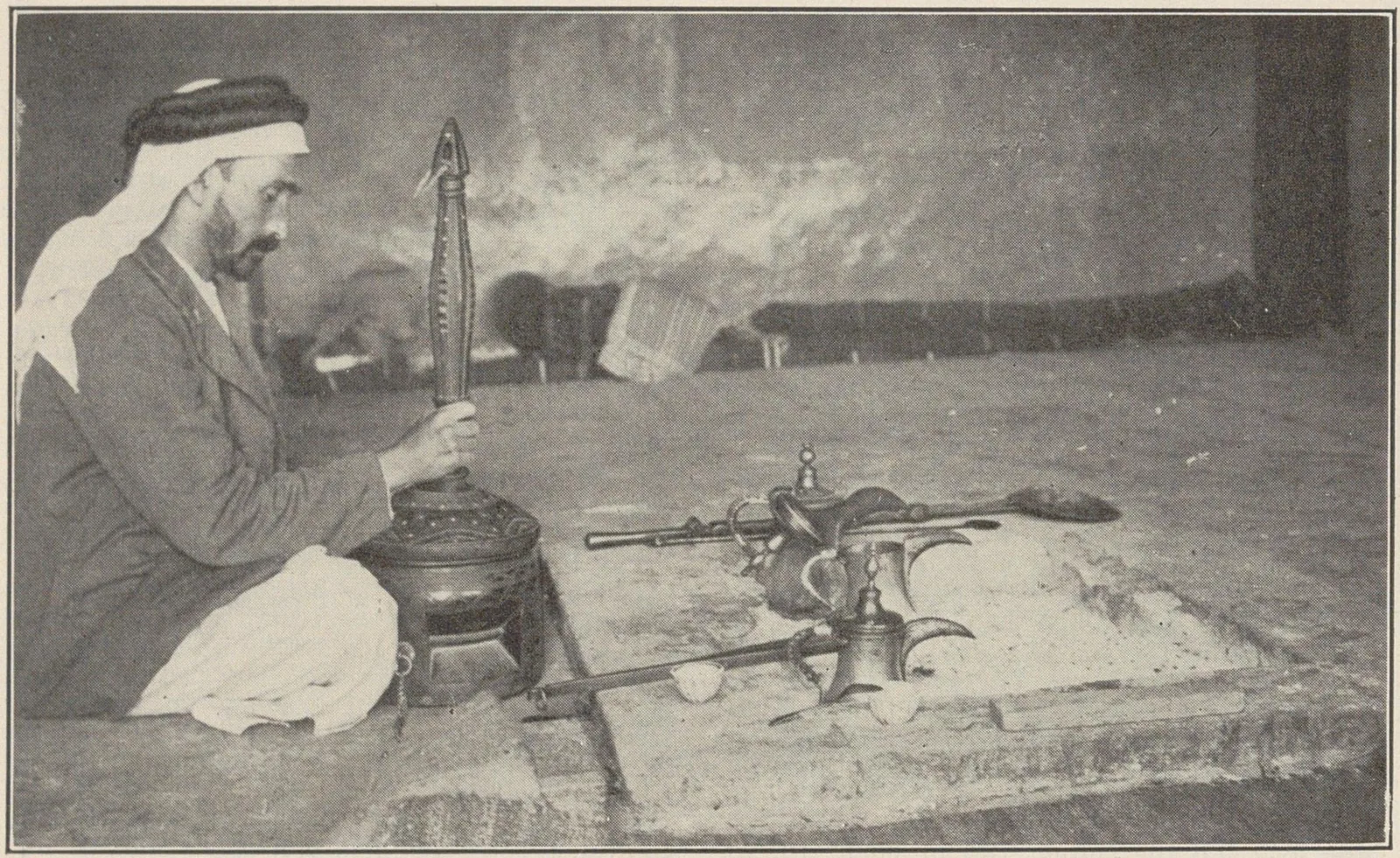
The Arab house of the 19th-century travelers is built around the kahwah, that is, the coffee room. The drink gives its name to the main room, which says enough about the place it holds there.
The proportions are those of a hall: some twenty feet high, some fifty long. The floor is fine sand. Rugs and cushions run along the walls, because guests are received seated, and not at a table.
A wall is built across the direction of the Kaaba, the sanctuary toward which one turns to pray. It gives the orientation, and so one prays without leaving the room. Women enter only in the absence of strangers, since it is the room where guests are received.
The hearth occupies the corner farthest from the door. A block of stone hollowed into a funnel receives the charcoal on a grate, which a bellows revives. On its rim lines up a row of copper coffeepots.
Palgrave counted a dozen of them at a single fire, when making the coffee needs three at most. The number thus does not serve to make the coffee, it tells the frequency of guests.
Ukers 1922, ch. XXXV, p. 655-694, citing William Wallace and Palgrave, Narrative of a Year's Journey through Central and Eastern Arabia (1865)Entering is a protocol: every gesture has its place, and any departure from it is noticed at once. Four moments make it up.
- The thresholdOne says Bismillah, “in the name of God,” before crossing the door.
- The walkOne advances in silence to the middle of the room.
- The greetingEs-salamu aleykum, “peace be upon you,” said while looking at the master of the house. He alone rises to reply, and his movement makes the whole company rise.
- The handThe guest places his open hand in the palm of the master. He does not squeeze, he does not shake: either would pass for uncivil.
The preparation lasts half an hour in front of the guests: five minutes of bellows, beans sorted on a tray of plaited grass, roasted in an iron ladle until they crackle and redden but taken off well before they blacken, “in the mistaken manner of Turkey and Europe”; pounded in a stone mortar to a coarse reddish grit and not a powder; brought to as light a boil as possible; lifted with a pinch of heyl, cardamom, or of saffron; filtered through palm-bark fibers. Sugar would be “an absolutely unheard-of profanation.”
Ukers 1922, ch. XXXV, citing Palgrave (1865)The service carries the meaning. The one who pours drinks first, a practical assurance “that there is no death in the pot”; the guests follow starting from the hearth of honor, the master is served last, refusing would be unforgivable. The finjans, as big as an eggshell, are never filled more than halfway, a point of good manners exactly the reverse of European practice and summed up by the adage “fill the cup for your enemy.” A second round in reverse order, a third on great occasions: the whole is not a quarter of what a European swallows at breakfast, and Ukers gives an average of twenty-five to thirty finjans a day.
Ukers 1922, ch. XXXV, citing Palgrave (1865)In this plateThe 21 sections
- 01The Arab ceremony: the coffee room and its gestures
- 02The Bedouin circle, the four sips, the rule of water
- 03Turkish coffee: the room, the price, the etiquette
- 04Ramadan, Karagöz and the coffee calendar
- 05Damascus, Cairo, Algiers: water, smoke and the storyteller
- 06Venice: the first caffè of Europe and the square as a salon
- 07Vienna: the blend, the newspaper and the word for ordering
- 08Paris: from Procope to the boulevard, and the waiter's vocabulary
- 09London: the penny university, and what replaced it
- 10Berlin, Saxony and the Kaffeeklatsch
- 11Amsterdam and Athens: the glass of water and the kaimaki
- 12The North and the East: copper kettles, lemon and flambéed cognac
- 13Italy, Spain, Portugal, Belgium
- 14The United States: Prohibition, the coffee room and the free cup
- 15New Orleans, Brazil, Cuba, Mexico, Australia
- 16Coffee in painting, engraving and caricature
- 17Coffee in music and literature
- 18Silverwork, porcelain and the furniture of service
- 19How a custom is made: taste is a habit
- 20What has changed since 1922
- 21Archive plates
The table of contents, with the first sentence of each section