Venice: the first caffè of Europe and the square as a salon
In Europe, coffee was first sold by lemonade sellers. Trade thus precedes the drink: coffee was added to a stall that already served cold drinks.
The vocabulary kept it longer than usage did. In Florence, they were called not caffettieri but limonáji, lemonade sellers. And the café of Procope began as a lemonade shop.
The Venetian chronology, for its part, remains uncertain, and Ukers says so himself. He reports 1645 for the first coffeehouse in Italy, but notes that convincing confirmation is lacking.
What is established begins later. A shop opens under the Procuratie Nuove in 1683. The Caffè Florian follows, opened by Floriano Francesconi in 1720. The Quadri, opened in 1775 by Giorgio Quadri of Corfu, is the first to serve real Turkish coffee in Venice.
The detail matters: after nearly a century of Venetian coffeehouses, the drink served in them was still not real Turkish coffee.
Ukers 1922, ch. IV, p. 25-31, and ch. XXXVThe rooms are low, unornamented, windowless, poorly lit, and the day there is regulated: in the morning the merchants, lawyers, doctors and peddlers, in the afternoon and late into the night the idle classes, women included. Florian had become a living directory: those leaving the city left him cards and itineraries, and when gout immobilized him his friend Canova made a model of his leg to spare him boot fittings.
For a Venetian of any rank, the coffeehouse was the last place visited when leaving the city and the first on returning. In 1775 and then 1776, the Council of Ten instructed the State Inquisitors to root out these “social cancers”; the coffeehouses survived.
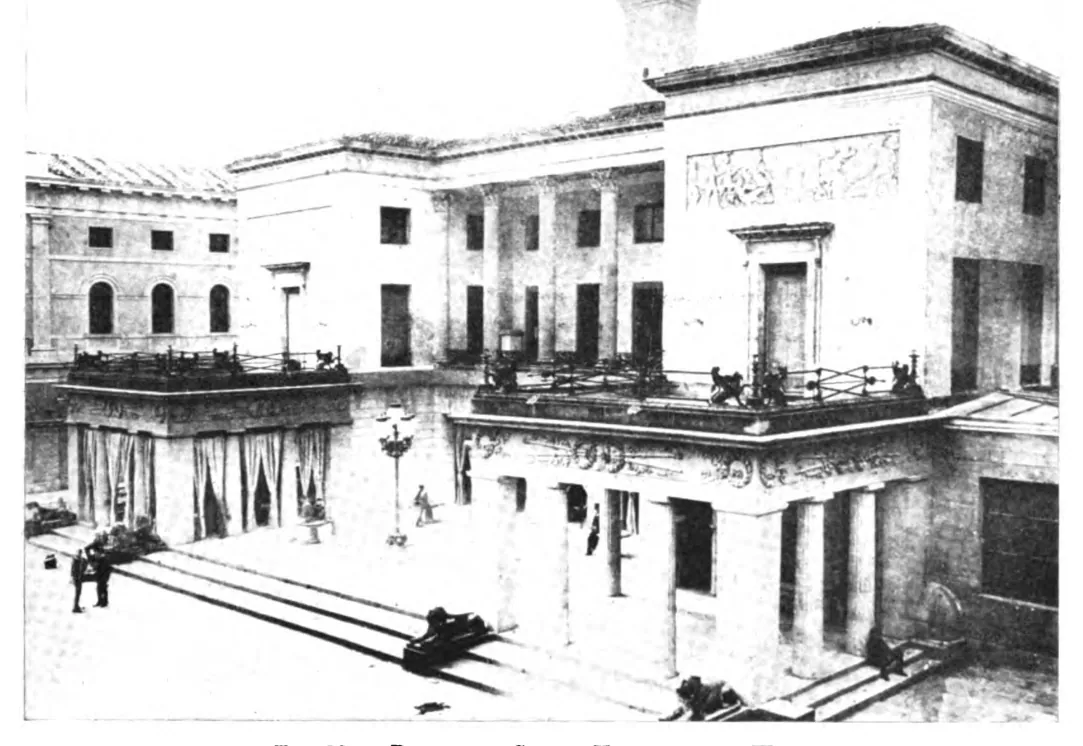
Ukers 1922, ch. IV, p. 25-31, citing Hazlitt and MolmentiPadua produced the coffeehouse conceived as a monument. Antonio Pedrocchi, a lemonade seller, bought an old house, discovered that there were no cellars, had them dug, and found that the house was built on the vault of an old church that contained a treasure. Work began in 1816, the Caffè Pedrocchi opened on June 9, 1831 and was not completed until 1842; Ukers considers it the most beautiful coffeehouse in the world.
Ukers 1922, ch. IV, p. 25-31, and ch. XXXIII, p. 587-614In this plateThe 21 sections
- 01The Arab ceremony: the coffee room and its gestures
- 02The Bedouin circle, the four sips, the rule of water
- 03Turkish coffee: the room, the price, the etiquette
- 04Ramadan, Karagöz and the coffee calendar
- 05Damascus, Cairo, Algiers: water, smoke and the storyteller
- 06Venice: the first caffè of Europe and the square as a salon
- 07Vienna: the blend, the newspaper and the word for ordering
- 08Paris: from Procope to the boulevard, and the waiter's vocabulary
- 09London: the penny university, and what replaced it
- 10Berlin, Saxony and the Kaffeeklatsch
- 11Amsterdam and Athens: the glass of water and the kaimaki
- 12The North and the East: copper kettles, lemon and flambéed cognac
- 13Italy, Spain, Portugal, Belgium
- 14The United States: Prohibition, the coffee room and the free cup
- 15New Orleans, Brazil, Cuba, Mexico, Australia
- 16Coffee in painting, engraving and caricature
- 17Coffee in music and literature
- 18Silverwork, porcelain and the furniture of service
- 19How a custom is made: taste is a habit
- 20What has changed since 1922
- 21Archive plates
The table of contents, with the first sentence of each section