Vienna: the blend, the newspaper and the word for ordering
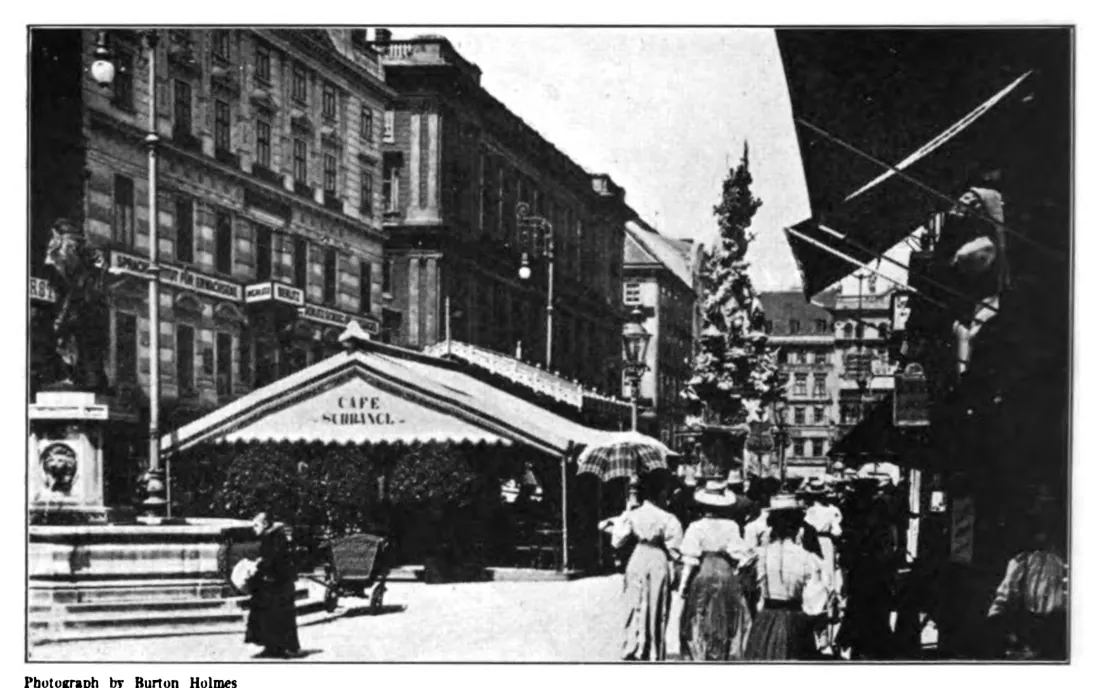
Legend · during the siege of 1683, Franz Georg Kolschitzky, a Pole who had lived among the Turks, crosses the enemy lines on August 13 in Turkish uniform. He carries messages between the garrison and the relief army. After the rout of September 12, he claims from the booty the sacks of green beans that nobody wants.
Ukers then publishes the municipal archives, and the character is less clear-cut there. Kolschitzky claims. He compares himself to the heroes of Rome and Sparta. He demands a house worth at least a thousand florins, obtains in 1685 the 30 Haidgasse, sells it within the year, and dies of tuberculosis in 1694.
What the archives show is a man claiming his reward, not a man founding a trade. What is established, then, is not he, it is the institution.
The guild of the kaffee-sieder, the coffee boilers, had his statue erected: the trade kept that name as its origin. And in 1839, the city counted eighty coffeehouses inside the walls and fifty in the suburbs.
Ukers 1922, ch. IX, p. 49-52, citing M. Bermann, Alt und Neu Wien; on the form of this type of story, LC ch. 7The vocabulary comes down to three words: mélange, that is with milk; brauner, that is darker; schwarzer, that is without milk. Viennese coffee is served with two parts coffee to one of hot milk, crowned with whipped cream; during the war of 1914-1918 and after, condensed milk replaced cream and saccharin sugar. In restaurants, an urn combines a metal strainer and a cloth bag: after six minutes of infusion, a screw raises the strainer and pressure forces the liquid through the bag. It is accompanied by a kipfel or a Kugelhupf, “beside which our sponge cake is lead.”
Ukers 1922, ch. XXXV, p. 655-694Viennese coffee is above all a subscription to the world press. A traveler of the early 18th century already describes rooms full of zeitungs-doctors, “doctors of the newspapers,” who judge the weightiest events and meddle even in the life of the emperor. Charles J. Rosebault, in the New York Times, gives the most quoted line: “The coffeehouse of Vienna has been imitated all over the world, but the result has never failed to be an imitation.”
Ukers 1922, ch. IX and ch. XXXV, citing Charles J. Rosebault, New York TimesIn this plateThe 21 sections
- 01The Arab ceremony: the coffee room and its gestures
- 02The Bedouin circle, the four sips, the rule of water
- 03Turkish coffee: the room, the price, the etiquette
- 04Ramadan, Karagöz and the coffee calendar
- 05Damascus, Cairo, Algiers: water, smoke and the storyteller
- 06Venice: the first caffè of Europe and the square as a salon
- 07Vienna: the blend, the newspaper and the word for ordering
- 08Paris: from Procope to the boulevard, and the waiter's vocabulary
- 09London: the penny university, and what replaced it
- 10Berlin, Saxony and the Kaffeeklatsch
- 11Amsterdam and Athens: the glass of water and the kaimaki
- 12The North and the East: copper kettles, lemon and flambéed cognac
- 13Italy, Spain, Portugal, Belgium
- 14The United States: Prohibition, the coffee room and the free cup
- 15New Orleans, Brazil, Cuba, Mexico, Australia
- 16Coffee in painting, engraving and caricature
- 17Coffee in music and literature
- 18Silverwork, porcelain and the furniture of service
- 19How a custom is made: taste is a habit
- 20What has changed since 1922
- 21Archive plates
The table of contents, with the first sentence of each section