Silverwork, porcelain and the furniture of service
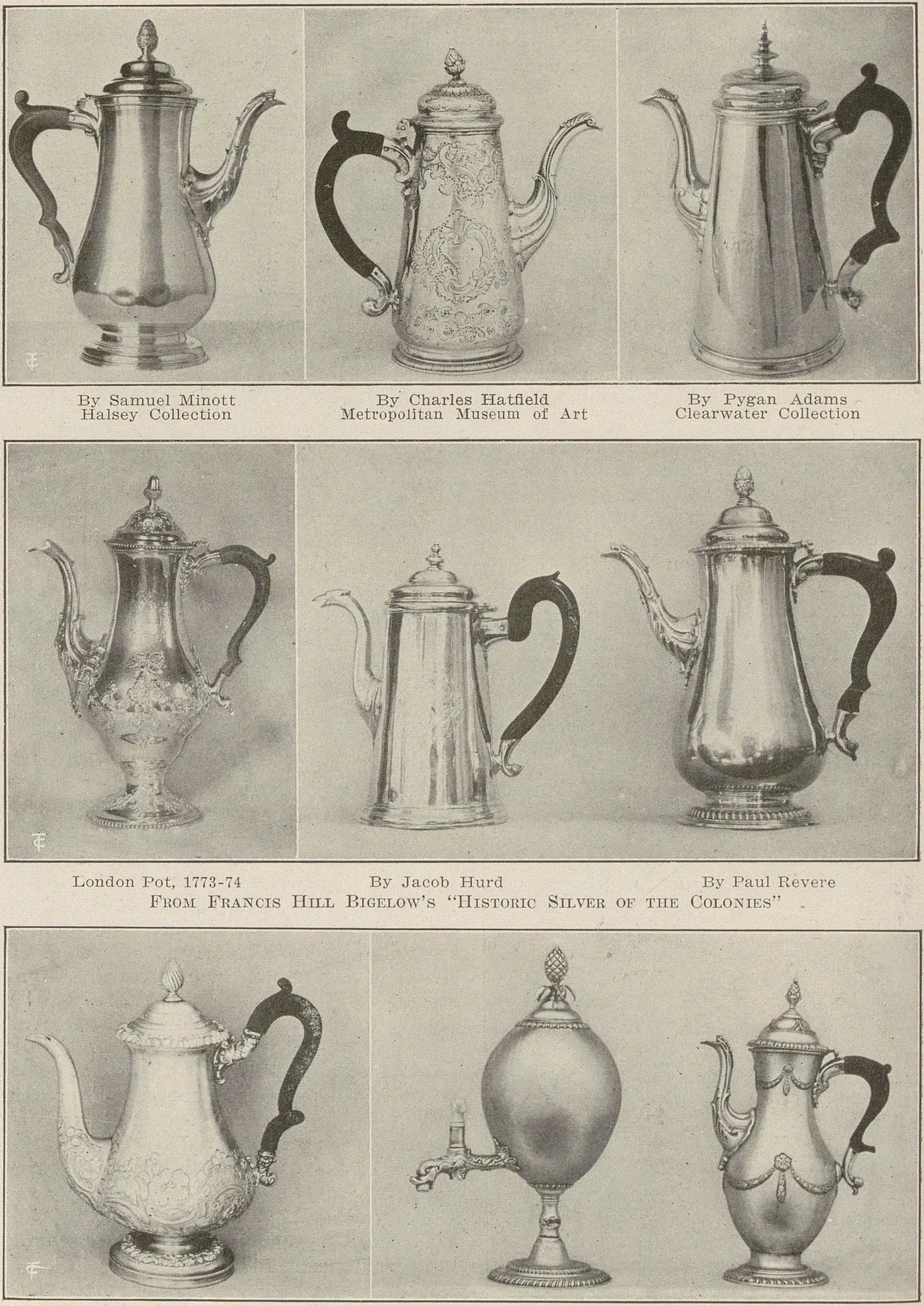
The European coffeepot has an origin and a date of rupture. H. D. Ellis, before the Society of Antiquaries, maintains that the first vessels were imported with the bean, that is, the Turkish ewer: the tokens of coffeehouse keepers from 1660 to 1675, in the Beaufoy collection at the Guildhall Museum, almost invariably take as their sign a hand pouring coffee from a pot of this model.
Then domestic demand gave rise to English manufacture, and the taste of the time imposed the straight line. The lantern pot of 1692 fixes the type: fifteen centimeters high, a base eleven centimeters wide narrowing to six at the rim, an almost straight spout fitted with a flap, a true conical lid, a handle at a right angle to the spout.
Ukers 1922, ch. XXXIII, p. 587-614, citing H. D. Ellis and Charles James Jackson, Illustrated History of English PlateEllis then describes the drift: as early as a Chinese porcelain coffeepot made after an English model shortly after 1692, the spout has lost its straightness and the lid begins to round; at the start of the 18th century the lid is a perfect dome; at the end of Anne's reign the handle is no longer at a right angle; the second quarter of the century is that of the pear-shaped coffeepot; and under George III a revolution brings back the flowing lines of the Turkish ewer abandoned a hundred years earlier. A panel of Delft tiles from an old coffeehouse in Brick Lane, dated 1692 at the latest, shows a boy pouring coffee under the inscription dish of coffee boy.
Ukers 1922, ch. XXXIII, p. 587-614, citing EllisThe court of France pushed the utensil to pure goldsmithing. The coffeepot is no longer an object to be improved there, it is an object to be shown.
Between March 20, 1754 and April 16, 1755, Louis XV bought from Lazare Duvaux three gold coffeepots with sculpted branches, for 1,950, 1,536 and 2,400 livres. Each comes with its burnished-steel warmer and its spirit lamp, that is, an alcohol lamp. The coffee thus stays hot on the table, in front of the guests, and not in the kitchen.
Mme de Pompadour's inventory includes a coffee mill of gold chased to represent the branches of a coffee tree. The tool imitates the plant whose seed it grinds.
Outside the court, the same utensil answers a very concrete problem. The Bostonian Society keeps the Sheffield silver coffee urn of the Green Dragon tavern: a heated iron bar was slipped into it, which warmed the contents from within. This bar was sheathed in zinc, so that the ashes would not fall into the coffee.
Ukers 1922, ch. XXXIII, p. 587-614, citing Francis Hill Bigelow, Historic Silver of the ColoniesIn this plateThe 21 sections
- 01The Arab ceremony: the coffee room and its gestures
- 02The Bedouin circle, the four sips, the rule of water
- 03Turkish coffee: the room, the price, the etiquette
- 04Ramadan, Karagöz and the coffee calendar
- 05Damascus, Cairo, Algiers: water, smoke and the storyteller
- 06Venice: the first caffè of Europe and the square as a salon
- 07Vienna: the blend, the newspaper and the word for ordering
- 08Paris: from Procope to the boulevard, and the waiter's vocabulary
- 09London: the penny university, and what replaced it
- 10Berlin, Saxony and the Kaffeeklatsch
- 11Amsterdam and Athens: the glass of water and the kaimaki
- 12The North and the East: copper kettles, lemon and flambéed cognac
- 13Italy, Spain, Portugal, Belgium
- 14The United States: Prohibition, the coffee room and the free cup
- 15New Orleans, Brazil, Cuba, Mexico, Australia
- 16Coffee in painting, engraving and caricature
- 17Coffee in music and literature
- 18Silverwork, porcelain and the furniture of service
- 19How a custom is made: taste is a habit
- 20What has changed since 1922
- 21Archive plates
The table of contents, with the first sentence of each section