What has changed since 1922
The geography of consumption has shifted north. Recent rankings put at the top Finland, Norway, Iceland, Denmark, the Netherlands and Sweden, on the order of eight to twelve kilograms per inhabitant per year.
Consumption per capita today
| Country | kg per inhabitant per year |
|---|---|
| Finland | ≈ 12 |
| Norway | ≈ 9 |
| Iceland | ≈ 9 |
| Denmark | ≈ 8 |
| Netherlands | ≈ 8 |
| Sweden | ≈ 8 |
| Switzerland | ≈ 7 |
| Austria | ≈ 6 |
| Brazil | ≈ 6 |
| Italy | ≈ 5 |
| France | ≈ 5 |
| United States | ≈ 4 |
The gap with the countries these pages talk about most is wide: France stands around five kilograms, the United States around four.
These ranks must be read with caution, because the sources do not count the same thing. Some measure the green coffee available in the country, others the roasted coffee sold, still others the cups declared by drinkers. Three definitions, three results, and a ranking that mixes them.
The International Coffee Organization, for its part, publishes no per-capita ranking. It publishes a world aggregate, estimated at about 177 million 60-kg bags for the 2023-2024 coffee year, up about 2.25 percent.
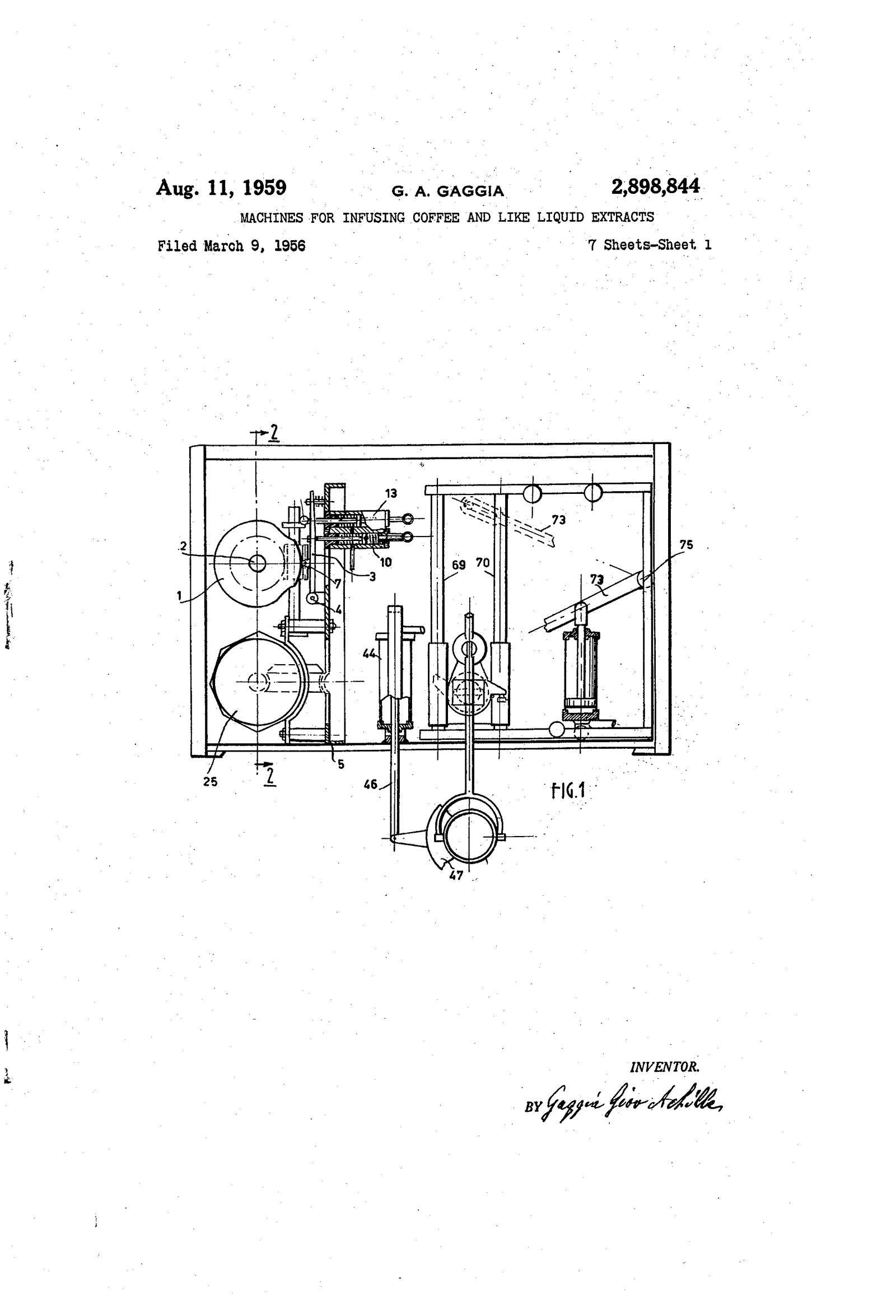
International Coffee Organization, Coffee Market Report, November 2024 and subsequent monthly reports, ico.org, accessed September 7, 2026After 1922 Italy invented the way that was going to prevail everywhere. Giovanni Achille Gaggia filed on September 5, 1938 patent no. 365726 for a machine without steam, called Lampo, which pushes hot water under pressure through the grounds instead of passing steam through them, and thus produces the layer of crema that the world associates with espresso; in 1947 he filed the patent for the lever and spring-piston group.
In 1961, the Faema E61 of Carlo Ernesto Valente replaced the lever with a pump delivering about 9 bars continuously and added the heat exchanger: this is the group from which most current professional machines derive. The Italian bar and its vocabulary are thus customs of the second half of the 20th century, not immemorial traditions. See the preparations.
Gaggia, patent no. 365726 filed September 5, 1938, official history of the brand, gaggia.com; Faema E61 (1961), technical notices of the E-61 group, accessed September 7, 2026Chronology of places
- 1554the coffeehouse passes from Damascus to Constantinople
- 1645first coffeehouse in Italy according to Ukers, unconfirmed
- 1652Pasqua Rosée opens the first coffeehouse in London
- 1671first coffeehouse in France, in Marseille
- 1675Charles II's proclamation against coffeehouses, recalled in eleven days
- 1683café under the Procuratie Nuove in Venice; siege of Vienna
- 1686-1689Procope in Paris; the Comédie-Française opposite in 1689
- 1707first periodical devoted to coffee, Leipzig
- 1720Caffè Florian, Venice
- 1732Bach's Coffee Cantata, BWV 211, Leipzig
- 1777-1781Frederick II's royal monopoly; the coffee sniffers
- 1831Caffè Pedrocchi in Padua, completed in 1842
- 1839Vienna: 80 cafés inside the walls, 50 in the suburbs
- 1920-1933Prohibition; hotel bars become coffee rooms
- 1938-1948Gaggia patents: espresso with crema
- 1961Faema E61, continuous 9-bar pump
- 1976-1986patent, then launch of the capsule
- 2013-2024Turkish coffee, Arabic coffee and Khawlani coffee on UNESCO's heritage lists
The second rupture is the individual dose. Éric Favre, a Swiss engineer who joined Nestlé in 1975, filed the capsule system patent as early as 1976. It nevertheless took ten years for management to authorize the launch.
The first Nespresso capsules thus arrived in 1986. They aimed first at bars, hotels and offices, with a test in Japan, then a rollout in Switzerland, France and Italy the same year.
The result is a way of drinking that existed in none of the countries described by Ukers. A sealed capsule. An extraction without gesture. A grind the drinker never sees and adjusts nothing of, since the dose and the fineness were fixed at the factory.
The format caught on: it weighs about 52 percent of the value of the French coffee market in 2023.
The third rupture goes the other way. The third wave brought back after 2000 the manual filter, the scale and measured temperature, that is, the instrumented version of what Dufour described in 1685. The gesture returns, but with numbers. See the plate the cup.
Éric Favre, Nestlé patent of 1976 and launch of 1986, houseofswitzerland.org; French market shares, supermarket records 2023 and July 2024-July 2025, accessed September 7, 2026; on the protocol of 1685, LC ch. 7 after Dufour, Traité du café (1685)Ways of drinking have, in their turn, become heritage objects. And the detail of the files is worth more than the general formula, because it shows what was judged worthy of protection.
Three elements linked to coffee appear on the Representative List of the Intangible Cultural Heritage of Humanity.
“Turkish coffee culture and tradition”, presented by Türkiye in 2013.
“Arabic coffee, a symbol of generosity”, inscribed in 2015 by the United Arab Emirates, Saudi Arabia, Oman and Qatar, then extended in 2024 to Jordan, under file number 02111. This description deserves a pause: it retains exactly the gestures described by the travelers of the 19th century. Serving the elders and the guests first. Pouring with the right hand. Shaking the cup to signify that one has finished. What foreigners noted as a curiosity is today protected by those who practice it.
“Knowledge and practices related to Khawlani coffee cultivation”, in 2022, which concerns no longer the way of drinking but the plant itself.
UNESCO, intangible cultural heritage lists, ich.unesco.org, files Turkish coffee culture and tradition (2013), Arabic coffee, a symbol of generosity (2015, extended in 2024, file 02111) and Khawlani coffee beans (2022), accessed September 7, 2026Two often-cited traditions fall under another status. Viennese coffeehouse culture is not inscribed on an international list: it has appeared since 2011 on the Austrian national inventory, where it is defined as a place “in which time and space are consumed, but where only the coffee appears on the bill,” with small marble tables, Thonet chairs, alcoves and newspaper holders, that is, exactly the inventory Ukers drew up in 1922.
The Ethiopian buna ceremony does not appear on any UNESCO list at the date of consultation: it is a domestic custom, in which the host washes and roasts the beans in front of his guests, burns incense, pounds in a mortar, brews in a clay jebena and serves three rounds that each bear a name. What has not changed, finally: the glass of water served with coffee is today the norm of specialty cafés, for the exact reason given by the cadi Hodhat.
Austrian Commission for UNESCO, national inventory, file Viennese coffee house culture (2011), unesco.at; absence of the buna checked on ich.unesco.org on September 7, 2026; Ukers 1922, ch. XXXVIn this plateThe 21 sections
- 01The Arab ceremony: the coffee room and its gestures
- 02The Bedouin circle, the four sips, the rule of water
- 03Turkish coffee: the room, the price, the etiquette
- 04Ramadan, Karagöz and the coffee calendar
- 05Damascus, Cairo, Algiers: water, smoke and the storyteller
- 06Venice: the first caffè of Europe and the square as a salon
- 07Vienna: the blend, the newspaper and the word for ordering
- 08Paris: from Procope to the boulevard, and the waiter's vocabulary
- 09London: the penny university, and what replaced it
- 10Berlin, Saxony and the Kaffeeklatsch
- 11Amsterdam and Athens: the glass of water and the kaimaki
- 12The North and the East: copper kettles, lemon and flambéed cognac
- 13Italy, Spain, Portugal, Belgium
- 14The United States: Prohibition, the coffee room and the free cup
- 15New Orleans, Brazil, Cuba, Mexico, Australia
- 16Coffee in painting, engraving and caricature
- 17Coffee in music and literature
- 18Silverwork, porcelain and the furniture of service
- 19How a custom is made: taste is a habit
- 20What has changed since 1922
- 21Archive plates
The table of contents, with the first sentence of each section